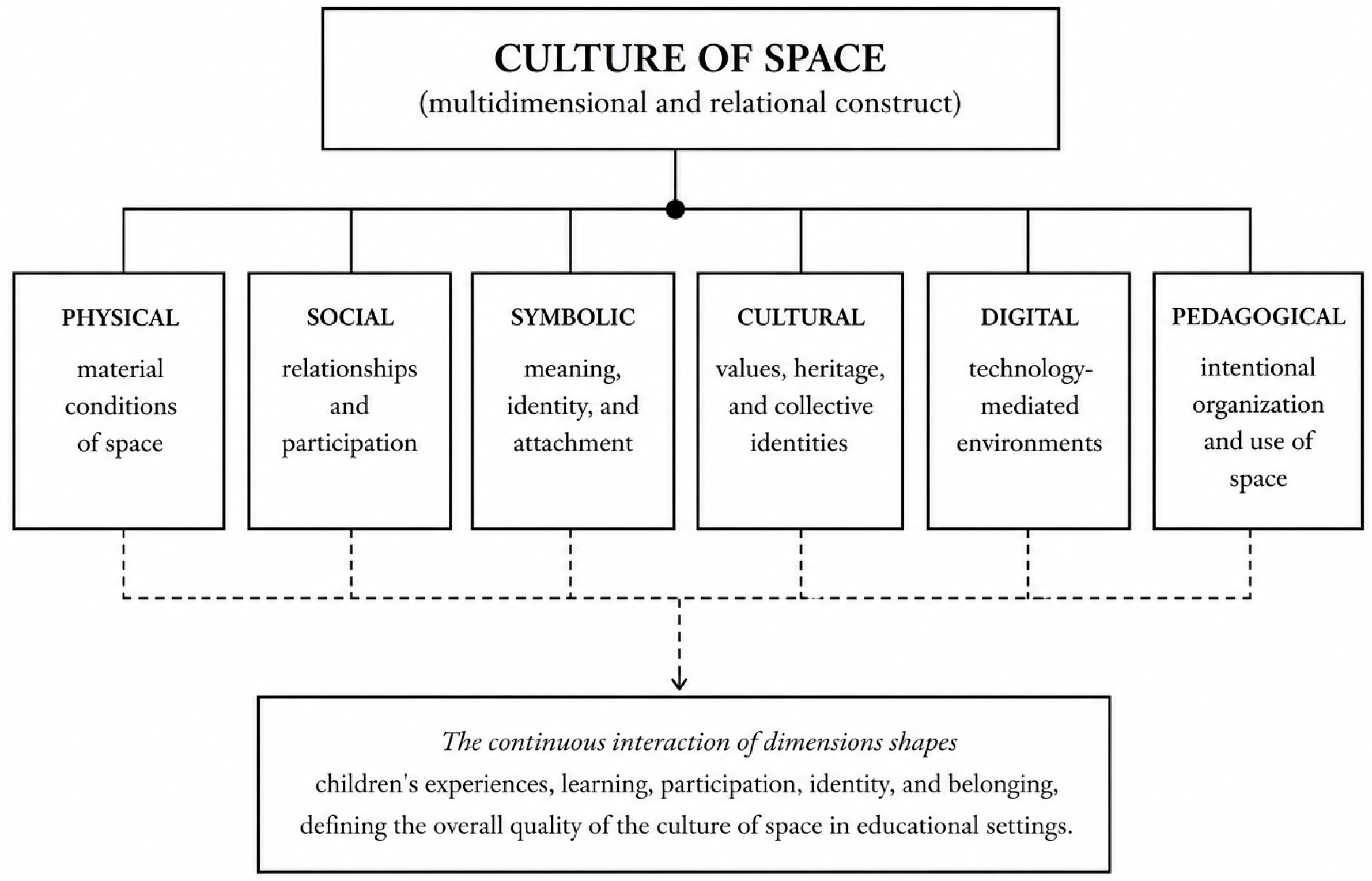


Dimensions of the Culture of Space in Early Childhood Education and Care
Abstract
1. Introduction
2. Culture of Space (Spatial Culture)
2.1. The Child and Space
2.2. The Child and Space in International Educational Programs and Policy Documents
2.3. Aim of the Study
- What dimensions of the culture of space can be identified in contemporary pedagogical literature?
- How is the culture of space reflected in national and international policy and curriculum documents related to early childhood education?
- How can these findings be synthesized into a unified conceptual framework defining the culture of space in education?
3. Materials and Methods
3.1. Research Design
3.2. Literature Search and Data Sources
3.3. Policy and Curriculum Documents
3.4. Data Analysis
4. Results
4.1. Analysis Related to Research Question 1
4.1.1. The Physical Dimension
4.1.2. Social Dimension
4.1.3. Symbolic Dimension
4.1.4. Cultural Dimension
4.1.5. Digital Dimension
4.1.6. Pedagogical Dimension
4.2. Analysis Related to Research Question 2
4.3. Analysis Related to Research Question 3
5. Discussion
6. Conclusions
6.1. Main Findings
6.2. Limitations of the Study and Implications for Future Research
Funding
Institutional Review Board Statement
Informed Consent Statement
Data Availability Statement
Acknowledgments
Conflicts of Interest
References
- Adam, Robert. 2012. Identity and Identification: The Role of Architectural Identity in a Globalized World. In The Role of Place Identity in the Perception, Understanding, and Design of Built Environments. Edited by Hernan Casakin and Fátima Bernardo. Oak Park: Bentham Science Publishers, pp. 176–92. [Google Scholar] [CrossRef]
- Adams, Roderick. 2023. Designing Spatial Culture, 1st ed. London: Routledge. [Google Scholar] [CrossRef]
- Australian Children’s Education and Care Quality Authority. 2026. Guide to the National Quality Framework; Sydney: Australian Children’s Education and Care Quality Authority. Available online: https://www.acecqa.gov.au/national-quality-framework/guide-nqf (accessed on 21 July 2026).
- Australian Government Department of Education. 2022. Belonging, Being and Becoming: The Early Years Learning Framework for Australia (Version 2.0); Canberra: Australian Government Department of Education for the Ministerial Council. Available online: https://www.acecqa.gov.au/sites/default/files/2023-01/EYLF-2022-V2.0.pdf (accessed on 14 March 2025).
- Azzopardi, Elaine, Jasper O. Kenter, Juliette Young, Chris Leakey, Seb O’Connor, Simone Martino, Wesley Flannery, Lisa P. Sousa, Dimitra Mylona, Katia Frangoudes, and et al. 2022. What Are Heritage Values? Integrating Natural and Cultural Heritage into Environmental Valuation. People and Nature 5: 368–83. [Google Scholar] [CrossRef]
- Baker, Lindsay. 2012. A History of School Design and Its Indoor Environmental Standards, 1900 to Today; Washington, DC: National Clearinghouse for Educational Facilities. Available online: https://files.eric.ed.gov/fulltext/ED539480.pdf (accessed on 14 March 2025).
- Beach, Jane, Morna Ballantyne, and Elizabeth Adamson. 2025. Why Physical Environment Matters in Child Care. Child Care Now, Growth by Design: Expanding Early Learning and Child Care in Canada. Available online: https://childcarenow.ca/wp-content/uploads/sites/9/2025/05/Spotlight_3_Why-the-physical-environment-matters_EN-4_5.5.2025.pdf (accessed on 14 March 2025).
- Bender, Barbara, ed. 2024. Landscape: Politics and Perspectives. Abingdon: Routledge. [Google Scholar] [CrossRef]
- Berti, Sara, Ada Cigala, and Nima Sharmahd. 2019. Early Childhood Education and Care Physical Environment and Child Development: State of the Art and Reflections on Future Orientations and Methodologies. Educational Psychology Review 31: 991–1021. [Google Scholar] [CrossRef]
- Bobbio, Andrea. 2020. La pedagogia di Loris Malaguzzi: Per una ‘nuova’ idea di bambino. RELAdEI: Revista Latinoamericana de Educación Infantil 9: 85–93. Available online: https://revistas.usc.gal/index.php/reladei/article/view/7080 (accessed on 20 April 2025). [CrossRef]
- Bobovec, Borka, Davor Mateković, and Goran Rako. 2020. Odrastanje uz arhitekturu: Dječji vrtići i škole u 21. stoljeću. Zagreb: Oris Kuća arhitekture. [Google Scholar]
- Bourke, Jackie. 2016. Children’s Experiences of Their Everyday Walks through a Complex Urban Landscape of Belonging. Children’s Geographies 15: 93–106. [Google Scholar] [CrossRef]
- Bronfenbrenner, Urie. 1979. The Ecology of Human Development: Experiments by Nature and Design. Cambridge: Harvard University Press. [Google Scholar] [CrossRef]
- Brussoni, Mariana, Takuro Ishikawa, Sara Brunelle, and Susan Herrington. 2017. Landscapes for Play: Effects of an Intervention to Promote Nature-Based Risky Play in Early Childhood Centers. Journal of Environmental Psychology 54: 139–50. [Google Scholar] [CrossRef]
- Ceppi, Giulio, and Michele Zini, eds. 1998. Children, Spaces, Relations: Metaproject for an Environment for Young Children. Reggio Emilia: Reggio Children. [Google Scholar]
- Cifrić, Ivan. 2010. On the Occasion of the Yearbook Titius: Protection of Natural and Cultural Heritage. Titius Yearbook: An Annual for Interdisciplinary Research on the Krka River Basin 3: 243–59. Available online: https://hrcak.srce.hr/117715 (accessed on 14 March 2025).
- Crawford, Marcus. 2020. Ecological Systems Theory: Exploring the Development of the Theoretical Framework as Conceived by Bronfenbrenner. Journal of Public Health Issues and Practices 4: 170. [Google Scholar] [CrossRef]
- Curtis, Deb. 2010. What’s the Risk? Supporting Children’s Risk-Taking in Early Childhood Environments. Redmond: Exchange Press. [Google Scholar]
- Delgado-Algarra, Emilio José, and José María Cuenca-López, eds. 2020. Handbook of Research on Citizenship and Heritage Education. In Advances in Educational Technologies and Instructional Design. Hershey: IGI Global. [Google Scholar] [CrossRef]
- Dudek, Mark. 2005. Digital Landscapes—The New Media Playground. In Children’s Spaces. Edited by Mark Dudek. Amsterdam: Architectural Press, Amsterdam: Elsevier, pp. 154–77. [Google Scholar]
- Edwards, Carolyn P., and Carlina Rinaldi, eds. 2009. The Diary of Laura: Perspectives on a Reggio Emilia Diary. St. Paul: Redleaf Press. [Google Scholar]
- Eisenman, Peter. 1992. Visions Unfolding: Architecture in the Age of Electronic Media. Domus 734: 20–24. [Google Scholar]
- Fisher, Kenn, and Kim Dovey. 2016. Plans and Pedagogies. In The Translational Design of Schools. Edited by Kenn Fisher. Rotterdam: Sense Publishers. [Google Scholar] [CrossRef]
- Gandini, Lella. 1993. Fundamentals of the Reggio Emilia Approach to Early Childhood Education. Young Children 49: 4–8. Available online: https://eric.ed.gov/?id=EJ474815 (accessed on 14 March 2025).
- Gandini, Lella. 2011. The Relationship between Architecture and Pedagogy in the Experience of the Reggio Municipal Infant-Toddler Centers and Preschools. In The Hundred Languages of Children: The Reggio Emilia Experience in Transformation, 3rd ed. Edited by Carolyn Edwards, Lella Gandini and George Forman. Santa Barbara: Praeger, pp. 317–35. [Google Scholar]
- Gómez-Galán, José. 2018. Educational Architecture and Emerging Technologies: Innovative Classroom Models. Hekademos: Revista Educativa Digital 22: 7–18. [Google Scholar] [CrossRef]
- Halpern, David. 2014. Mental Health and The Built Environment: More Than Bricks And Mortar? Abingdon: Routledge. [Google Scholar]
- Hart, Roger A. 1987. Children’s Participation in Planning and Design. In Spaces for Children: The Built Environment and Child Development. Edited by Carol Simon Weinstein and Thomas G. David. New York: Plenum Press, pp. 217–39. [Google Scholar]
- Herrington, Susan. 2005. The Sustainable Landscape. In Children’s Spaces. Edited by Mark Dudek. Amsterdam: Architectural Press, pp. 216–43. [Google Scholar]
- Holloway, Sarah L., and Gill Valentine. 2000. Spatiality and the New Social Studies of Childhood. Sociology 34: 763–83. [Google Scholar] [CrossRef]
- Jacobs, Jane. 1961. The Death and Life of Great American Cities. New York: Vintage Books. [Google Scholar]
- Jermstad, Linnéa K. 2025. Building History: Project-Based Pedagogy for Cultural Heritage in Early Childhood Education. Journal of Early Childhood Education Research 14: 1–23. [Google Scholar] [CrossRef]
- Jurić, Josipa, Linda Podrug Krstulović, and Ines Blažević. 2026. The Role of Digital Media in Early Childhood Education and Care: A Qualitative Analysis of Educators’ Perceptions. Behavioral Sciences 16: 970. [Google Scholar] [CrossRef] [PubMed]
- Khan, Matluba, Simon Bell, and Jenny Wood, eds. 2020. Place, Pedagogy and Play: Participation, Design and Research with Children. Abingdon: Routledge. [Google Scholar] [CrossRef]
- Kjørholt, Anne Trine. 2004. Childhood as a Social and Symbolic Space: Discourses on Children as Social Participants in Society. Doctoral dissertation, Norwegian University of Science and Technology, Trondheim, Norway. Available online: https://www.researchgate.net/publication/277867772_Childhood_as_a_social_and_symbolic_space_discourses_on_children_as_social_participants_in_society (accessed on 14 March 2025).
- Knaps, Falco, Sarah Gottwald, Christian Albert, and Sylvia Herrmann. 2022. Using Meaningful Places as an Indicator for Sense of Place in the Management of Social-Ecological Systems. Ecology and Society 27: 9. [Google Scholar] [CrossRef]
- Kritchevsky, Sybil, Elizabeth Prescott, and Lee Walling. 2023. Planning Environments for Young Children: Physical Space. In Alternative Learning Environments. London: Routledge, pp. 311–20. [Google Scholar]
- Kuščević, Dubravka. 2015. Cultural Heritage: Stimulation Key to Child Development (Art Aspect). Školski vjesnik 64: 479–91. Available online: https://hrcak.srce.hr/151378 (accessed on 14 April 2025).
- Kuščević, Dubravka, and Marija Brajčić. 2023. Hrvatska Kulturna Baština u Interakciji i Kontekstu Održivog Razvoja: Implementacija u Odgoj i Obrazovanje. Metodički Ogledi 30: 199–221. [Google Scholar] [CrossRef]
- Labus, Mladen. 2014. Kulturni identitet/i/ i proces/i/ globalizacije: Onto-antropološka i sociološka perspektiva. In Identitet i kultura. Edited by Mladen Labus, Lino Veljak, Ana Maskalan and Mirjana Adamović. Zagreb: Institut za društvena istraživanja u Zagrebu, pp. 11–54. [Google Scholar]
- Loudoun, Fiona M., Bryan Boyle, and Maria Larsson-Lund. 2024. Play Value of Digital Play Spaces: Children’s Voices. International Journal of Child-Computer Interaction 40: 100649. [Google Scholar] [CrossRef]
- Lynch, Kevin. 2013. “The Image of the Environment” and “The City Image and Its Elements”. In The Urban Design Reader, 2nd ed. Edited by Michael Larice and Elizabeth Macdonald. London: Routledge, pp. 125–38. [Google Scholar]
- Manzo, Lynne, and Patrick Devine-Wright, eds. 2013. Place Attachment. Abingdon: Routledge. [Google Scholar] [CrossRef]
- Manzo, Lynne C. 2003. Beyond House and Haven: Toward a Revisioning of Emotional Relationships with Places. Journal of Environmental Psychology 23: 47–61. [Google Scholar] [CrossRef]
- Manzo, Lynne C. 2005. For Better or Worse: Exploring Multiple Dimensions of Place Meaning. Journal of Environmental Psychology 25: 67–86. [Google Scholar] [CrossRef]
- Maroević, Ivo. 2001. The Concept of Sustainable Development in Cultural Heritage Protection. Social Ecology 10: 235–46. Available online: https://hrcak.srce.hr/141328 (accessed on 15 May 2025).
- Masterson, Vanessa A., Richard C. Stedman, Johan Enqvist, Carl Tengö, Marcus Giusti, Ingrid Wahl, and Uno Svedin. 2017. The Contribution of Sense of Place to Social-Ecological Systems Research: A Review and Research Agenda. Ecology and Society 22: 49. [Google Scholar] [CrossRef]
- Mijatović, Antun. 2005. Zavičajna mudrost i kulturna baština. In Zavičajno blago u funkciji razvoja Zabiokovlja: Očuvanje zavičajnog. Edited by Ante Mrkonjić. Split: Književni krug. Available online: https://hrcak.srce.hr/file/442539 (accessed on 15 May 2025).
- Ministry of Science, Education and Sports. 2015. National Curriculum for Early Childhood and Preschool Education; Zagreb: Ministry of Science, Education and Sports. Available online: https://mzom.gov.hr/UserDocsImages/dokumenti/Obrazovanje/Predskolski/Nacionalni%20kurikulum%20za%20rani%20i%20predskolski%20odgoj%20i%20obrazovanje%20NN%2005-2015.pdf (accessed on 15 May 2025).
- Nelson, Jake, Jeong Joo Ahn, and Elizabeth A. Corley. 2020. Sense of Place: Trends from the Literature. Journal of Urbanism: International Research on Placemaking and Urban Sustainability 13: 236–61. [Google Scholar] [CrossRef]
- Nikolopoulou, Kleopatra. 2024. Children in the Digital Space: Issues Researched and Suggestions for Future Research. Creative Education 15: 815–27. [Google Scholar] [CrossRef]
- OECD. 2012. Starting Strong III: A Quality Toolbox for Early Childhood Education and Care. Paris: OECD Publishing. [Google Scholar] [CrossRef]
- OECD. 2023. Starting Strong VII: Empowering Young Children in the Digital Age. Paris: OECD Publishing. [Google Scholar] [CrossRef]
- OECD. 2025. Results from TALIS Starting Strong 2024: Strengthening Early Childhood Education and Care. Paris: OECD Publishing. [Google Scholar] [CrossRef]
- Olds, Anita Rui. 2001. Child Care Design Guide. New York: McGraw-Hill. [Google Scholar]
- Parr, Hester. 2011. Mental Health and Social Space: Towards Inclusionary Geographies? Chichester: Wiley-Blackwell. [Google Scholar]
- Penn, Helen. 2005. Spaces without Children. In Children’s Spaces. Edited by Mark Dudek. Amsterdam: Architectural Press, pp. 61–78. [Google Scholar]
- Philo, Chris. 2000. ‘The Corner-Stones of My World’: Editorial Introduction to Special Issue on Spaces of Childhood. Childhood 7: 243–56. [Google Scholar] [CrossRef]
- Pia, Nazmun Akter, and Karabi Bezboruah. 2025. Urban Design Strategies for Creating Child-Friendly Neighborhoods: A Systematic Literature Review. Cities 162: 105919. [Google Scholar] [CrossRef]
- Piaget, Jean. 1955. The Language and Thought of the Child. New York: Meridian Books. [Google Scholar]
- Piaget, Jean, and Bärbel Inhelder. 2016. The Child’s Conception of Space. Abingdon: Routledge. First published 1948. [Google Scholar]
- Podrug Krstulović, Linda, and Antonija Radeljak Gudelj. 2024. Povezivanje djece s prirodom i održivim razvojem kroz sudjelovanje u međunarodnim projektima [Connecting Children with Nature and Sustainable Development through Participation in International Projects]. In Mirisi djetinjstva: Zaštita mentalnog zdravlja djece rane i predškolske dobi: Zbornik radova 27. znanstveno-stručne konferencije [The Scents of Childhood: Protecting the Mental Health of Early and Preschool Children: Proceedings of the 27th Scientific and Professional Conference]. Edited by Ivana Visković and Jelena Topić. Split: Faculty of Humanities and Social Sciences, University of Split. [Google Scholar]
- Proshansky, Harold M., Abbe K. Fabian, and Robert Kaminoff. 1983. Place-Identity: Physical World Socialization of the Self. Journal of Environmental Psychology 3: 57–83. [Google Scholar] [CrossRef]
- Raymond, Christopher M., Marketta Kyttä, and Richard Stedman. 2017. Sense of Place, Fast and Slow: The Potential Contributions of Affordance Theory to Sense of Place. Frontiers in Psychology 8: 1674. [Google Scholar] [CrossRef] [PubMed]
- Redvaldsen, David. 2023. Not by the Book: The Teaching of History in Norwegian Kindergartens. History Education Research Journal 20: 3. [Google Scholar] [CrossRef]
- Relph, Edward. 1976. Place and Placelessness. London: Pion. [Google Scholar]
- Ryan, Robert L. 1998. Attachment to Urban Natural Areas: Effects of Environmental Experience. Ph.D. dissertation, University of Michigan, Ann Arbor, MI, USA. [Google Scholar]
- Santisteban, Antoni, Neus González-Monfort, and Joan Pagès. 2020. Critical Citizenship Education and Heritage Education. In Handbook of Research on Citizenship and Heritage Education. Edited by Emilio José Delgado Algarra and José María Cuenca López. Hershey: IGI Global, pp. 26–42. [Google Scholar] [CrossRef]
- Scannell, Leila, and Robert Gifford. 2010. Defining Place Attachment: A Tripartite Organizing Framework. Journal of Environmental Psychology 30: 1–10. [Google Scholar] [CrossRef]
- Schein, Edgar H., ed. 2010. Organizational Culture and Leadership, 4th ed. The Jossey-Bass Business & Management Series; San Francisco: Jossey-Bass. [Google Scholar]
- Seamon, David. 2012. Place, Place Identity, and Phenomenology: A Triadic Interpretation Based on J. G. Bennett’s Systematics. In The Role of Place Identity in the Perception, Understanding, and Design of Built Environments. Edited by Hernan Casakin and Fátima Bernardo. Sharjah: Bentham Science Publishers, pp. 3–21. [Google Scholar] [CrossRef]
- Shu, Huangna, and Guoquan Zheng. 2025. Bibliometric Analysis of Research on Child-Friendly Cities from the Web of Science, 2004–2024. Sustainability 17: 525. [Google Scholar] [CrossRef]
- Stanković, Danica. 2008. Space in the Function of Psychological Stability of a Child. Facta Universitatis, Series: Architecture and Civil Engineering 6: 229–33. [Google Scholar] [CrossRef]
- Stedman, Richard C. 2003. Is It Really Just a Social Construction?: The Contribution of the Physical Environment to Sense of Place. Society & Natural Resources 16: 671–85. [Google Scholar] [CrossRef]
- Stedman, Richard C. 2008. What Do We ‘Mean’ by Place Meanings? Implications of Place Meanings for Managers and Practitioners. In Understanding Concepts of Place in Recreation Research and Management; Edited by Linda E. Kruger, Thomas E. Hall and Michael C. Stiefel. Portland: U.S. Forest Service, pp. 61–81. [Google Scholar]
- Stedman, Richard C. 2016. Subjectivity and Social-Ecological Systems: A Rigidity Trap (and Sense of Place as a Way Out). Sustainability Science 11: 891–901. [Google Scholar] [CrossRef]
- Strong-Wilson, Teresa, and Julia Ellis. 2007. Children and Place: Reggio Emilia’s Environment as Third Teacher. Theory Into Practice 46: 40–47. [Google Scholar] [CrossRef]
- Theologou, Kostas. 2020. Space and Ethos: Fostering Supranational Citizenship in Urban Bioethics. Jahr–European Journal of Bioethics 11: 129–42. [Google Scholar] [CrossRef]
- Tindall, Rachel Marie. 2022. Architecture and Students’ Physical Activity in Learning Environments. Doctoral dissertation, The University of Notre Dame Australia, Fremantle, WA, Australia. Available online: https://researchonline.nd.edu.au/theses/343/ (accessed on 15 April 2025).
- Tuan, Yi-Fu. 1977. Space and Place: The Perspective of Experience. Minneapolis: University of Minnesota Press. [Google Scholar]
- UNESCO, and UNICEF. 2024. Global Report on Early Childhood Care and Education: The Right to a Strong Foundation. Paris: UNESCO. [Google Scholar] [CrossRef]
- UNICEF. 2022. Responsible Innovation in Technology for Children (RITEC). Florence: UNICEF Innocenti—Global Office of Research and Foresight. Available online: https://www.unicef-irc.org/ritec (accessed on 15 May 2025).
- United Nations. 1989. Convention on the Rights of the Child. Adopted by United Nations General Assembly Resolution 44/25 of 20 November 1989. New York: United Nations. Available online: https://www.ohchr.org/en/instruments-mechanisms/instruments/convention-rights-child (accessed on 10 May 2025).
- Valentine, Gill. 2014. Social Geographies: Space and Society. Abingdon: Routledge. [Google Scholar]
- Valentine, Gill. 2017. Public Space and the Culture of Childhood. Abingdon: Routledge. [Google Scholar]
- Valera, Sergi, Joan Guàrdia, and Enric Pol. 1998. A Study of the Symbolic Aspects of Space Using Nonquantitative Techniques of Analysis. Quality & Quantity 32: 367–81. [Google Scholar] [CrossRef]
- Visković, Ivana. 2018. Kultura odgojno-obrazovne ustanove [Culture of Educational Institutions]. In Izazovi suradnje: Razvoj profesionalnih kompetencija odgojitelja za suradnju i partnerstvo s roditeljima [Challenges of Collaboration: Developing Early Childhood Teachers’ Professional Competencies for Collaboration and Partnership with Parents]. Edited by Adrijana Višnjić Jevtić, Ivana Visković, Edita Rogulj, Kristina Bogatić and Emilija Glavina. Zagreb: Alfa, pp. 41–65. [Google Scholar]
- Visković, Ivana. 2021. The Right of the Child to Family, Identity and Culture. In Young Children in the World and Their Rights. Edited by Adrijana Višnjić-Jevtić, Alicja R. Sadownik and Ingrid Engdahl. Cham: Springer International Publishing, vol. 35. [Google Scholar] [CrossRef]
- Visković, Ivana, Adrijana Višnjić Jevtić, and Andriana Marušić. 2023. Teachers’ Opinions on Recognizable Aspects of the Institutional Early Childhood Education Culture. In Nova promišljanja o djetinjstvu II. Dijete i prostor/Rethinking Childhood II. Child and Space. Edited by Maja Cindrić, Ksenija Ivon and Sanja Šimić Šašić. Zadar: Sveučilište u Zadru, pp. 397–412. [Google Scholar] [CrossRef]
- Visković, Ivana, and Adrijana Višnjić-Jevtić. 2024. Croatian Early Childhood Education Teachers’ Perspectives on the Quality of Environments for Children at Risk of Social Exclusion. Asia-Pacific Journal of Research in Early Childhood Education 18: 57–80. [Google Scholar] [CrossRef]
- Višnjić Jevtić, Adrijana, Alicja R. Sadownik, and Antonija Halavuk. 2021. Early Childhood Education Teachers’ Attitudes towards Risky Play as Developed through Teacher Education and Impeded by Safety Procedures. A Report from Croatia. Journal of Adventure Education and Outdoor Learning 22: 135–47. [Google Scholar] [CrossRef]
- Weinstein, Carol S., and Anita E. Woolfolk. 1981. Classroom Design and Impression Formation: A New Area for Research. Contemporary Educational Psychology 6: 383–86. [Google Scholar] [CrossRef]
- Weinstein, Carol Simon, and Thomas G. David, eds. 1987. Spaces for Children: The Built Environment and Child Development. New York: Plenum Press. [Google Scholar] [CrossRef]
- Yahya, Raudhah, and Elizabeth Ann Wood. 2017. Play as Third Space between Home and School: Bridging Cultural Discourses. Journal of Early Childhood Research 15: 305–22. [Google Scholar] [CrossRef] [PubMed]
- Yılmaz Yıldırım, Demet, Şeyma Bayram, and Nilgün Çakır Güngör. 2023. An Investigation into the Perception of Space in Children through Visual Representations: The Children’s Library in Giresun (The Capuchin Catholic Church). Megaron 18: 43–58. [Google Scholar] [CrossRef]
- Zimring, Craig, Anjali Joseph, Gayle L. Nicoll, and Sharon Tsepas. 2005. Influences of Building Design and Site Design on Physical Activity. American Journal of Preventive Medicine 28: 186–93. [Google Scholar] [CrossRef] [PubMed]


| Source | Search Terms + Child/ECEC | Initial Records (Raw Hits) | Screened | Included |
|---|---|---|---|---|
| Scopus | “culture of space”; “spatial culture”; “sense of place”; “place identity”; “place attachment”; “learning environment” + early childhood education/ECEC; “Reggio Emilia”; “children and space”; “cultural heritage”; “digital spaces” + children | 10,130 | 312 | 49 |
| Google Scholar | Simplified combinations of the same terms; peer-reviewed sources prioritized | 990,190 | 280 | 23 |
| ResearchGate (full text only) | Simplified combinations of the same terms; full-text availability required | 23,217 | 145 | 12 |
| Google (official institutional websites) | Google Search (using combinations of the same search terms) and searches of official institutional websites (OECD, UNESCO, UNICEF, Ministry of Science, Education and Youth of Croatia, and the Australian Government Department of Education) identified through the reviewed literature. | 35 | 12 | 11 |
| Total | After title/abstract screening, full-text checking, and assigning each included source to one primary retrieval source | 1,023,545 | 745 | 95 |
| Literature Category | Representative Authors/Publications | Contribution to the Analysis |
|---|---|---|
| Foundations of space, place and environmental theory | Jacobs (1961); Relph (1976); Tuan (1977); Proshansky et al. (1983); Halpern (2014); Lynch (2013); Bobovec et al. (2020) | Conceptual foundations of space, place, identity, and environmental psychology |
| Place identity and sense of place. | Scannell and Gifford (2010). Stedman (2003; 2008; 2016); Seamon (2012); Knaps et al. (2022); Bender (2024) | Symbolic and social meanings of place, attachment, belonging |
| Children and space | Hart (1987); Olds (2001); Herrington (2005); Berti et al. (2019); Pia and Bezboruah (2025); Yılmaz Yıldırım et al. (2023); Shu and Zheng (2025) | Children’s spatial experience, learning environments, outdoor environments |
| Educational environments and pedagogy | Ceppi and Zini (1998). Gandini (2011); Bobbio (2020); Tindall (2022); Weinstein and Woolfolk (1981) | Pedagogical dimension of space and learning environments |
| Culture, heritage and identity | Theologou (2020); Kuščević and Brajčić (2023); Maroević (2001); Cifrić (2010); Azzopardi et al. (2022) | Cultural dimension, heritage, identity, citizenship |
| Digital learning environments | Dudek (2005); Gómez-Galán (2018); UNICEF (2022); Loudoun et al. (2024); Nikolopoulou (2024); Jurić et al. (2026); Podrug Krstulović and Radeljak Gudelj (2024) | Digital dimension of the culture of space |
| Document | Institution | Analytical Focus |
|---|---|---|
| Starting Strong III | OECD (2012) | Quality dimensions of ECEC; curriculum, workforce, family engagement and quality monitoring |
| Starting Strong VII | OECD (2023) | Digital technologies, digital competences, children’s well-being and safe digital environments |
| Results from TALIS Starting Strong | OECD (2025) | ECEC workforce, professional development, pedagogical practices, staff well-being and quality of learning environments |
| Global Report on Early Childhood Care and Education | UNESCO and UNICEF (2024) | Equity, inclusion, sustainability, community engagement and quality learning environments |
| National Curriculum for Early and Preschool Education | Ministry of Science, Education and Sports (2015) | Child identity, culture, values, holistic development and educational environment |
| Early Years Learning Framework | Australian Government Department of Education (2022) | Belonging, Being and Becoming; play-based learning, identity and learning environments |
| Guide to the National Quality Framework (First published, 2018—Last updated, 2026) | Australian Children’s Education and Care Quality Authority (2026) | Quality standards, learning environments, inclusion, leadership, continuous improvement and partnerships with families and communities |
| Deductive Categories (Literature) | Examples of Inductively Developed Categories | Final Dimension |
|---|---|---|
| Educational environment; built environment | Flexible learning spaces; indoor–outdoor integration | Physical |
| Place identity; sense of place | Children’s belonging; emotional attachment | Symbolic |
| Culture; cultural heritage | Local community; intercultural awareness | Cultural |
| Human relationships; participation | Children’s agency; collaborative learning | Social |
| Digital environments | Digital learning spaces; ICT integration | Digital |
| Space as the third teacher; spatial pedagogy | Child-centered organization of space | Pedagogical |
| Dimension | Analytical Focus | Core Question | Main Indicators |
|---|---|---|---|
| Physical | Material and sensory conditions of space | What does the environment enable or constrain? | Layout, accessibility, furniture, materials, lighting, acoustics, nature, indoor–outdoor connections |
| Social | Relationships, participation, and agency within space | Who interacts, participates, and makes decisions? | Communication, collaboration, inclusion, children’s agency, family involvement, power relations |
| Symbolic | Meanings, emotions, and attachments associated with place | What does the place mean to its users? | Place identity, sense of place, memories, symbols, emotional attachment, perceived safety |
| Cultural | Collective knowledge, heritage, values, and ways of life represented through space | Whose cultures and histories are represented and negotiated? | Languages, traditions, heritage, local narratives, cultural diversity, intercultural dialogue |
| Digital | Participation in technology-mediated environments | How is children’s digital participation organized? | Digital creation, communication, collaboration, media literacy, safety, access, educator mediation |
| Pedagogical | Intentional educational organization and use of space | Why and how is the environment used for learning? | Pedagogical philosophy, flexibility, accessible materials, educator mediation, documentation, child-led transformation |
| Concept | Dimension | Analytical Focus |
|---|---|---|
| Belonging | Social | Participation, recognition, inclusion, and membership within relationships and communities. |
| Symbolic | Emotional attachment and personal connection to a particular place. | |
| Cultural | Recognition within shared histories, traditions, languages, and cultural repertoires. | |
| Pedagogical | An educational objective intentionally supported through teaching practices and the organization of space. | |
| Identity | Symbolic | The lived relationship between self and place; place identity and personal meaning. |
| Cultural | Identity grounded in shared heritage, languages, traditions, and collective ways of life. | |
| Social | Identity negotiated through interaction, participation, and group membership. | |
| Values | Cultural | Collectively shared systems of meaning, beliefs, norms, and traditions represented through space. |
| Symbolic | Values attributed to a particular place through personal or collective meanings. | |
| Pedagogical | Values guiding intentional educational decisions and pedagogical practice. | |
| Community | Social | Relationships, participation, collaboration, and shared practices among members. |
| Cultural | Community as a bearer of shared history, heritage, and cultural knowledge. | |
| Pedagogical | Community intentionally fostered through educational practices and partnerships. |
| Document | Physical | Social | Symbolic | Cultural | Digital | Pedagogical |
|---|---|---|---|---|---|---|
| EYLF V2.0 (Australian Government Department of Education 2022) | Strong | Strong | Implicit | Strong | Largely absent | Strong |
| Guide to the National Quality Framework (Australian Children’s Education and Care Quality Authority 2026) | Strong | Strong | Implicit | Strong | Weak | Strong |
| Croatian National Curriculum (Ministry of Science, Education and Sports 2015) | Strong | Strong | Implicit | Strong | Weak | Strong |
| TALIS Starting Strong (OECD 2025) | Weak–Moderate | Strong | Absent | Implicit | Weak | Strong |
| Starting Strong VII (OECD 2023) | Limited | Strong | Implicit | Limited | Strong | Strong |
| Starting Strong III (OECD 2012) | Strong | Strong | Absent | Implicit | Absent | Strong |
Disclaimer/Publisher’s Note: The statements, opinions and data contained in all publications are solely those of the individual author(s) and contributor(s) and not of MDPI and/or the editor(s). MDPI and/or the editor(s) disclaim responsibility for any injury to people or property resulting from any ideas, methods, instructions or products referred to in the content. |
© 2026 by the author. Licensee MDPI, Basel, Switzerland. This article is an open access article distributed under the terms and conditions of the Creative Commons Attribution (CC BY) license.
Share and Cite
Podrug Krstulović, L. Dimensions of the Culture of Space in Early Childhood Education and Care. Soc. Sci. 2026, 15, 524. https://doi.org/10.3390/socsci15080524
Podrug Krstulović L. Dimensions of the Culture of Space in Early Childhood Education and Care. Social Sciences. 2026; 15(8):524. https://doi.org/10.3390/socsci15080524
Chicago/Turabian StylePodrug Krstulović, Linda. 2026. "Dimensions of the Culture of Space in Early Childhood Education and Care" Social Sciences 15, no. 8: 524. https://doi.org/10.3390/socsci15080524
APA StylePodrug Krstulović, L. (2026). Dimensions of the Culture of Space in Early Childhood Education and Care. Social Sciences, 15(8), 524. https://doi.org/10.3390/socsci15080524