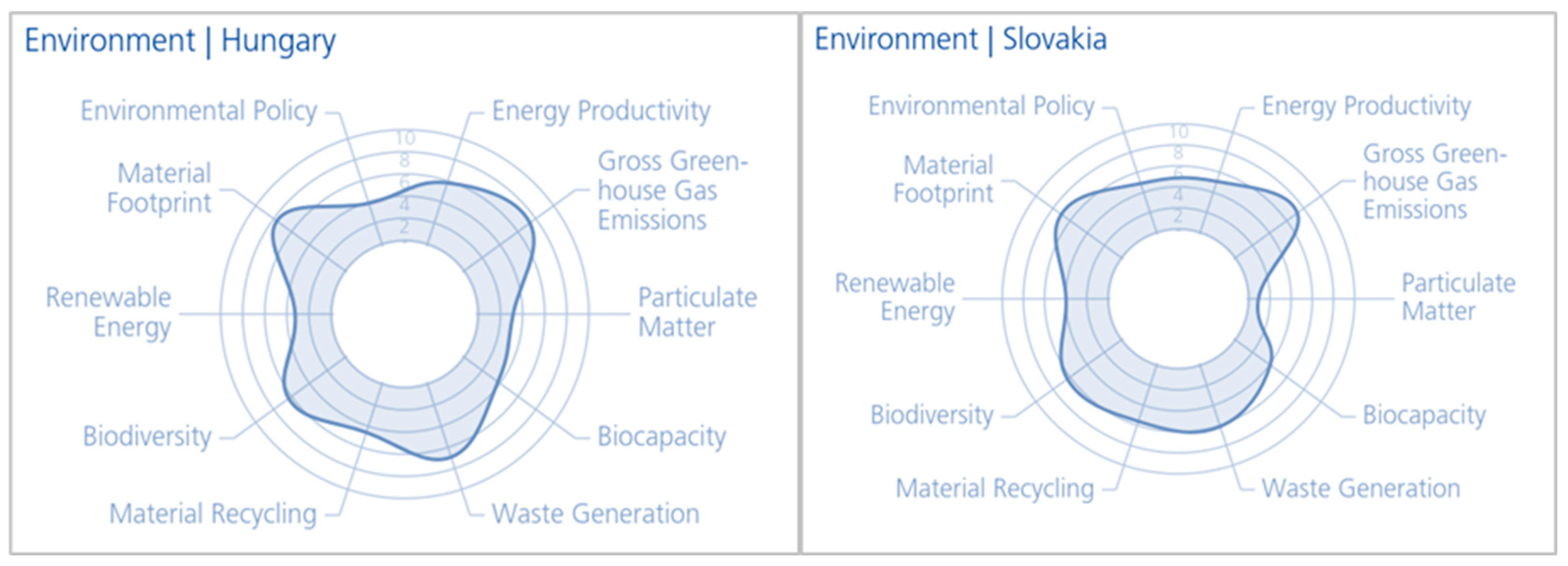
1. Introduction
Sustainable consumption is an approach to meeting the needs of the present without compromising the needs of future generations. In this sense, sustainable consumption significantly impacts our consumption habits, lifestyles, values, and attitudes (
Gyurián Nagy and Gyurián 2023). While these studies primarily address supply-side efficiency, our research contributes to the sustainability discourse by focusing on the demand side—namely, the environmental orientation and environmental knowledge of the Baby Boomer generation. Environmental orientation and environmental knowledge are not formed in isolation; they may be shaped by broader cultural, psychological, and social contexts. In the present study, these factors are not measured as separate explanatory variables. Rather, they provide a conceptual background for interpreting why environmental orientation and environmental knowledge may differ between generational and national contexts. The empirical analysis, therefore, focuses specifically on two measured dimensions—environmental orientation and environmental knowledge—while cultural, psychological, and social factors are treated as contextual considerations rather than direct causal variables. According to
Evans et al. (
2017), collective patterns lurking in the unconscious play a significant role in our attitudes towards nature, so our attitudes towards the environment are often not the result of conscious decisions but of internalized cultural indoctrination. Likewise,
Smoyer (
2020) notes that generational attitudes are shaped not only by age but also by the historical experiences of a given cohort. This is particularly pronounced for the Baby Boomer generation, as they were socialized during the rise of affluent societies. Drawing on these theoretical considerations, the present research explores generational characteristics of environmental attitudes and knowledge, with a particular focus on the Central European context.
The present study is positioned within generational sustainability research and focuses on the distinction between environmental orientation and environmental knowledge. Environmental orientation refers to respondents’ general attitudinal disposition toward environmental issues, while environmental knowledge refers to their self-reported familiarity with sustainability-related concepts and the perceived environmental role of sustainable products. This distinction is important because positive environmental orientation does not necessarily imply that consumers possess the knowledge required to make informed sustainable consumption decisions.
The study, therefore, does not aim to test a comprehensive behavioral model of sustainable consumption. Instead, it provides an exploratory comparative analysis of whether environmental orientation and environmental knowledge appear in similar or different ways among Baby Boomer respondents in Hungary and Slovakia. This conceptual positioning is consistent with the empirical scope of the study, which measures attitudes and knowledge, but does not directly measure behavioral intention, actual sustainable behavior, subjective norms, perceived behavioral control, personal norms, or other psychological mechanisms underlying sustainable behavior.
At the individual level, sustainable consumption can manifest itself in many areas. These can include preferring environmentally friendly products, practicing moderate consumption, reducing waste, and recycling. It can also include environmental and social aspects in consumer decisions. Sustainable consumption is therefore a holistic approach that connects individual action to achieving global sustainability goals. Its realization is a pillar of environmental, social, and economic sustainability (
Stafford-Smith et al. 2016). Making consumption sustainable is important because current consumption trends are unsustainable in the long-term. For example, increasing resource use, waste production, or environmental pressures pose an increasing risk to the planet’s habitability (
Toyese 2019).
The present research is built around three interrelated concepts: sustainable consumption, environmental orientation, and generational context. In this study, sustainable consumption is understood as a set of consumer decisions and practices that consider the preservation of environmental resources, waste reduction, and long-term socio-economic consequences (
Stafford-Smith et al. 2016). Environmental orientation refers to individuals’ general attitudes and evaluations regarding environmental issues, while environmental knowledge reflects respondents’ familiarity with and understanding of basic sustainability-related concepts. Generational context is relevant because different age cohorts were socialized under different historical, social, and consumer conditions, which may shape their relationship with the environment and sustainable consumption (
Leach et al. 2013;
Francis and Sarangi 2022;
Gyurián Nagy 2023). Accordingly, the study does not aim to measure general personality traits or environmental responsibility broadly; rather, it focuses on two specific dimensions—environmental orientation and environmental knowledge—among Baby Boomer respondents in Hungary and Slovakia.
Moreover, unlike previous generations, they are enjoying retirement in particularly good health. Their life expectancy is also 10–20 years longer than that of their parents. Their material and financial resources allow them to plan a much more active retirement. Many want to travel, have fun, and go shopping. Accordingly, they are a priority consumer group for companies (
Leach et al. 2013).
3. Materials and Methods
The study used a quantitative questionnaire to compare environmental orientation and environmental knowledge among Baby Boomer respondents in Hungary and Slovakia. The unit of analysis was the individual respondent. The empirical analysis focused on two measured constructs: environmental orientation (EO) and environmental knowledge (EK).
In the present study, the Baby Boomer generation is operationally defined as respondents born between 1943 and 1960, following
Bejtkovský’s (
2016) generational categorization. Since generational boundaries are not entirely uniform in the literature, this definition is treated as an operational criterion applied during data collection and sample selection. Accordingly, only respondents whose year of birth fell within this predefined range were included in the analysis. Throughout the manuscript, the term Baby Boomer refers to this operational definition.
Data were collected using a structured questionnaire in spring 2024. The Hungarian subsample was derived from a broader all-generation survey conducted in Hungary. The questionnaire was administered online, and Baby Boomer respondents were selected from the full dataset based on the predefined birth-year criterion. The Slovak subsample was collected through face-to-face questionnaire administration using the same age-screening criterion and the same EO and EK measurement items. Participation was voluntary in both countries. After age screening and data cleaning, the final analytical sample comprised 374 Baby Boomer respondents, including 188 from Hungary and 186 from Slovakia.
The two subsamples were therefore obtained through different data collection modes: online in Hungary and face-to-face administration of questionnaires in Slovakia. This difference should be considered when interpreting the findings. Online data collection may involve self-selection and differences in access, motivation, and response behavior, while face-to-face administration may be affected by interviewer presence, social desirability, and differences in respondent engagement. The country-level results are interpreted as exploratory sample-based comparisons rather than definitive national differences.
Because the study relied on non-probability sampling and, in the Hungarian case, on an already existing broader survey dataset, a formal response rate could not be calculated. This limitation reduces the replicability of the sampling procedure and should be considered when interpreting the results.
The sample is not nationally representative. Therefore, the findings should be interpreted as referring to the studied respondents rather than to the entire Baby Boomer population in Hungary and Slovakia. The aim of the study was not to produce population-level estimates, but to conduct an exploratory comparative analysis of environmental orientation and environmental knowledge in two Central European samples. The sample size was considered adequate for the exploratory and comparative purposes of the study. Both national subsamples exceeded the commonly used minimum thresholds for group comparisons and cluster analysis (
Newbold et al. 2013;
Hair et al. 2016).
The questionnaire contained 74 questions. Although the full questionnaire included a broader set of sustainability-related items, the present study analyzes only the items presented in
Table 1, seven environmental orientation items, and five environmental knowledge items.
Table 1, therefore, does not present the full questionnaire, but only the measurement items used in the present analysis. Environmental orientation was measured using items adapted from the New Ecological Paradigm tradition, whereas environmental knowledge was measured through items assessing respondents’ self-reported familiarity with selected sustainability-related concepts and the perceived environmental role of sustainable products. Higher values indicate stronger agreement with the respective item.
The questionnaire was based on selected items adapted from previously applied measurement scales that are widely used in environmental and sustainability-related consumer research. The Environmental Orientation (EO) scale was adapted from the NEP-related scale used by
Polonsky et al. (
2014), while the Environmental Knowledge (EK) items were adapted from
Kumar et al. (
2017) and
Taufique et al. (
2016). Because the questionnaire was administered in Hungarian and Slovak, the items were translated and culturally adapted before data collection. The translation process focused on semantic equivalence, terminological accuracy, and contextual comprehensibility. The research team reviewed the Hungarian and Slovak versions to ensure that the adapted items preserved the meaning of the original scales while remaining understandable for respondents in both national contexts. Items were retained in the analysis only if their substantive meaning was comparable across the two language versions. The validated scales examined in this study are presented in
Table 1.
In the present study, environmental knowledge is treated as an exploratory composite knowledge index rather than as a newly validated latent construct. The five EK items were selected because they capture two complementary aspects of sustainability-related knowledge relevant to consumer decision-making. EK1 and EK2 refer to product-related environmental knowledge; namely, respondents’ perception of the role of environmentally sustainable products in reducing pollution and the wasteful use of natural resources. EK3, EK4, and EK5 refer to self-reported familiarity with key sustainability-related concepts; namely, “organic product”, “climate change”, and “greenhouse gas”.
This combination of items has not been presented as a previously validated five-item scale in the manuscript. Rather, the items were selected from previously published measurement scales because of their conceptual relevance to the study’s aim, their suitability for Baby Boomer respondents, and their semantic comparability across the Hungarian and Slovak questionnaire versions. Items were retained if they were directly related to sustainable consumption, understandable for older respondents, and suitable for cross-country comparison. Accordingly, the EK measure should be interpreted as a composite index of selected environmental knowledge indicators, not as a fully validated psychometric scale or a coherent latent construct. The analysis, therefore, emphasizes descriptive patterns, internal reliability, and cautious interpretation rather than claims of full construct validation.
The measurement items were assessed for content validity and internal reliability before conducting the main analyses. Content validity was supported by previously used measurement items and a conceptual review of the fit between each item and the two dimensions examined in the study. Environmental orientation items capture general pro-environmental evaluations and beliefs, whereas environmental knowledge items focus on respondents’ self-reported familiarity with sustainability-related concepts and the perceived environmental role of sustainable products. The two dimensions were therefore analyzed separately. It should be noted that the present study does not claim to provide a full psychometric validation of the measurement model. No factor analysis, factor loadings, convergent validity, or discriminant validity assessment is reported. Accordingly, the validity evidence presented in this study should be interpreted as content validity supported by prior scale use and conceptual item review, rather than as empirical construct validity in the strict methodological sense.
In particular, the five EK items should not be interpreted as evidence of a single empirically validated latent construct. They are used as selected indicators of environmental knowledge for exploratory comparative purposes.
Internal reliability was assessed separately for the EO and EK scales and for each national subsample. In the Hungarian sample, the EO scale showed good internal consistency (α = 0.897), as did the EK scale (α = 0.805). In the Slovak sample, both scales also demonstrated good reliability, with Cronbach’s alpha values of 0.844 for EO and 0.840 for EK. These results indicate that the EO and EK scales were sufficiently reliable in both national subsamples.
Statistical Analysis
In the empirical analysis, the national context was operationalized through the country variable. Respondents were assigned to either the Hungarian or the Slovak contextual group based on the location of data collection. Because the data collection mode and country are not independent in the current design, the country variable should not be interpreted as a pure national context effect. Rather, it serves as a contextual grouping variable that combines national setting, sample characteristics, and data collection conditions. This variable was used to compare environmental orientation and environmental knowledge across the two national samples. Descriptive statistics were calculated for all EO and EK items, including means, modes, and medians. Country-level differences in the overall EO and EK dimensions were assessed using group comparison procedures, and effect sizes were calculated using eta squared (η2). A significance level of α = 0.05 was applied in all statistical tests. Before interpreting the ANOVA results, the assumptions of the test were considered, including the distribution of the variables and the homogeneity of variances. Given the Likert-type nature of the items and the exploratory nature of the analysis, ANOVA results were interpreted cautiously, along with descriptive statistics and effect sizes, rather than as standalone evidence. Before interpreting the group comparison results, the assumption of homogeneity of variances was examined using Levene’s test. Where the assumption was not fully met, the results were interpreted cautiously, along with effect size measures. Given the Likert-type nature of the items and the exploratory nature of the analysis, the statistical results were not interpreted as standalone evidence but were combined with descriptive statistics, medians, modes, and eta squared effect sizes.
K-means clustering was used to identify respondent groups with distinct patterns of environmental orientation and environmental knowledge. The EO and EK items were included in the clustering procedure. Since all variables were measured on the same five-point Likert scale, the original scale values were retained. The analysis was conducted separately for the Hungarian and Slovak samples in order to identify country-specific within-generation patterns. Several cluster solutions were tested (k = 2, k = 3, k = 4, and k = 5). The three-cluster solution was retained because it provided the most interpretable structure in terms of cluster size, separation of cluster centers, and substantive meaning. The clusters were interpreted based on their mean EO and EK scores and described as groups with low, moderate, and high levels of environmental orientation and environmental knowledge.
4. Results and Discussion
The empirical analysis follows the conceptual contribution outlined above. It first examines whether environmental orientation and environmental knowledge show similar or different country-level patterns, and then explores whether internally differentiated orientation–knowledge segments can be identified within the Baby Boomer samples. In this way, the analysis connects the descriptive findings to the study’s broader contribution to generational sustainability research. Because the EK measure is used as an exploratory composite knowledge index, the results for environmental knowledge are interpreted alongside item-level patterns. The overall EK score is used as a summary indicator of selected knowledge items, while the item-level results show how product-related environmental knowledge and familiarity with sustainability-related terminology contribute to the observed patterns.
First, descriptive statistics were calculated for the environmental orientation (EO) and environmental knowledge (EK) items to provide an overview of response patterns in the Hungarian and Slovak Baby Boomer samples.
Table 2 presents the descriptive statistics for the environmental orientation and environmental knowledge items in the Hungarian and Slovak samples. The results indicate that respondents in both countries generally reported a relatively high level of environmental orientation. For the EO items, mean values ranged from 3.85 to 4.19 in Hungary and from 3.90 to 4.16 in Slovakia. These values suggest that Baby Boomer respondents in both samples tended to agree with statements concerning environmental limits, human impact on nature, the rights of plants and animals, and the fragility of ecological balance.
The pattern of responses for environmental orientation was broadly similar in the two countries. The highest mean value in Hungary was observed for EO3, which indicates that humans are severely abusing the environment (M = 4.19), followed by EO5, which indicates that humans are subject to the laws of nature (M = 4.15). In Slovakia, the highest mean values were recorded for EO5 and EO6 (both M = 4.16), indicating strong agreement with the idea that humans remain subject to natural laws and that the balance of nature is delicate and easily upset. Although the differences between the two countries are small at the descriptive level, the Slovak sample showed a slightly higher mode for EO6, with the most frequent response being 5.00, compared with 4.00 in Hungary. This may indicate a somewhat stronger perceived sensitivity to ecological balance among Slovak respondents.
In the case of environmental knowledge, the results show more visible descriptive differences between the two samples. For EK1, which refers to the role of environmentally sustainable products in reducing pollution, the median value was higher in Slovakia (5.00) than in Hungary (3.00). This suggests that Slovak respondents were more likely to strongly agree that using environmentally sustainable products can contribute to reducing pollution. By contrast, for EK2, which concerns the role of sustainable products in reducing the wasteful use of natural resources, the median was higher in Hungary (5.00) than in Slovakia (4.00). This indicates that Hungarian respondents may associate sustainable products more strongly with resource conservation than with pollution reduction.
The largest descriptive differences among the environmental knowledge items are related to self-reported knowledge of environmental concepts. For EK4, which measures familiarity with the term “climate change,” the mean value was higher in Slovakia (M = 4.13) than in Hungary (M = 3.92). A similar pattern can be observed for EK5, referring to knowledge of the term “greenhouse gas,” where the Slovak mean was 3.91 compared with 3.51 in Hungary. These results suggest somewhat higher self-reported environmental knowledge among Slovak respondents, particularly regarding climate-related terminology. For EK3, which measures familiarity with the term “organic product,” both samples showed lower mean scores than for the other knowledge items, especially in Hungary (M = 3.23) and Slovakia (M = 3.36). This may suggest that respondents in both countries understand or recognize the meaning of “organic product” less clearly or with less confidence than they do more widely discussed concepts, such as climate change.
This first descriptive step supports the study’s central argument by showing that environmental orientation and the selected environmental knowledge indicators do not follow the same pattern. While environmental orientation appears relatively strong and similar across the two national samples, the EK items show more variation. This variation is evident not only in overall environmental knowledge but also in the distinction between product-related environmental knowledge and familiarity with sustainability-related terminology. Accordingly, positive environmental attitudes should not be equated with equally developed sustainability-related knowledge.
Overall, the descriptive results indicate that environmental orientation is relatively high and broadly similar among Baby Boomer respondents in Hungary and Slovakia. However, environmental knowledge shows more variation between the two samples. Slovak respondents reported somewhat higher knowledge of climate-related concepts and stronger agreement with the pollution-reducing role of sustainable products. In contrast, Hungarian respondents showed stronger agreement with the resource-conservation role of sustainable products. These findings support the need to distinguish between environmental orientation and environmental knowledge, as positive environmental orientation does not necessarily imply the same level or type of environmental knowledge across national contexts.
These descriptive findings can be interpreted in relation to previous generational sustainability research in two ways. First, the relatively high level of environmental orientation in both samples is consistent with studies suggesting that older consumers should not automatically be treated as environmentally passive. Although some previous research has emphasized the stronger sustainability orientation of younger generations (
Dwidienawati et al. 2021;
Gomes et al. 2023), other findings suggest that Baby Boomers may also show meaningful environmental awareness and engagement (
Severo et al. 2017). The present results support this more differentiated view by showing that Baby Boomer respondents in both Hungary and Slovakia reported broadly positive environmental orientation. Second, the more uneven pattern of the selected EK indicators extends previous generational comparisons by showing that environmental orientation and sustainability-related knowledge should not be treated as interchangeable. While previous research has often compared generations in terms of general environmental attitudes, awareness, or behavior, the present findings suggest that older consumers may express positive environmental attitudes while still differing in their familiarity with sustainability-related terminology and product-related environmental claims. This distinction strengthens the analytical relevance of examining environmental orientation and environmental knowledge separately.
To further assess the practical relevance of the country-level differences, effect sizes were calculated for the overall EO and EK dimensions. No statistically significant country-level difference was found for environmental orientation (p = 0.811; η2 = 0.000), while environmental knowledge showed a statistically significant but small difference in favor of the Slovak sample (p = 0.030; η2 = 0.013). This supports the descriptive pattern that the two countries are broadly similar in environmental orientation, while environmental knowledge differs modestly. However, this difference should be interpreted with caution because country and data collection mode are confounded in the present research design. The observed difference in the EK composite index may reflect differences between the Hungarian and Slovak samples, but it cannot be attributed solely to national context. It may also be influenced by data collection conditions, respondent recruitment, or sample composition. Accordingly, the result is interpreted as a modest sample-level difference rather than as evidence of a definitive country-level effect. Given the exploratory status of the EK measure, this country-level difference should be interpreted cautiously. The overall EK score provides a useful summary of the selected knowledge indicators, but it should not be interpreted as evidence of a fully validated latent construct. Therefore, the significant but small difference in EK is best understood as a modest sample-level difference in selected sustainability-related knowledge indicators rather than as a strong substantive separation between the two national groups.
In relation to previous research, this result does not support a simple interpretation of strong national divergence in environmental attitudes. Instead, it suggests that the Hungarian and Slovak Baby Boomer samples are broadly similar in attitudinal orientation, while differing modestly in selected sustainability-related knowledge indicators. This finding refines earlier work arguing that environmental attitudes and knowledge may be shaped by political, educational, and cultural systems (
Severo et al. 2017;
Gyurián Nagy 2023). In the present study, however, the country-level difference should be interpreted as an exploratory sample-based association rather than as evidence of a direct contextual or policy effect. The result, therefore, extends previous research by showing that national context may be more visible in knowledge-related indicators than in general environmental orientation, but this relationship requires further empirical testing with direct measures of education, communication, media exposure, and policy awareness.
These findings suggest that the difference between the two national samples should not be interpreted as a general difference in environmental concern, but rather as a difference in selected knowledge-related indicators of sustainability orientation. The absence of a significant country-level difference in environmental orientation indicates that Baby Boomer respondents in both countries show a broadly similar attitudinal openness toward environmental issues. However, the significant but small difference in the EK composite index suggests that the two samples may differ modestly in how sustainability-related concepts and product-related environmental information are understood or internalized.
This distinction is analytically important because it shows that environmental orientation and selected environmental knowledge indicators do not necessarily develop in parallel. A respondent may express concern about environmental limits, ecological balance, or human impact on nature without having the same level of familiarity with specific sustainability-related terminology or product-related environmental claims. The results, therefore, support the study’s central argument: among older consumers, a positive environmental orientation should not be treated as equivalent to informed sustainable consumption readiness. This interpretation provides a more nuanced contribution to generational sustainability research by showing that Baby Boomers may be environmentally receptive while still differing in selected knowledge indicators that could support sustainable consumption decisions.
After examining the descriptive patterns, K-means clustering was used to determine whether distinct respondent groups could be identified within the Baby Boomer samples based on the EO and EK items. This step further develops the central thesis by examining whether Baby Boomers form internally differentiated segments rather than a homogeneous generational group. The analysis was conducted separately for Hungary and Slovakia in order to identify country-specific within-generation patterns. Several cluster solutions were tested (k = 2–5), and the three-cluster solution was retained because it provided the most interpretable balance between cluster size, separation of cluster centers, and substantive meaning. The clusters were interpreted based on their mean EO and EK scores as lower, moderate, and higher environmental orientation and knowledge segments.
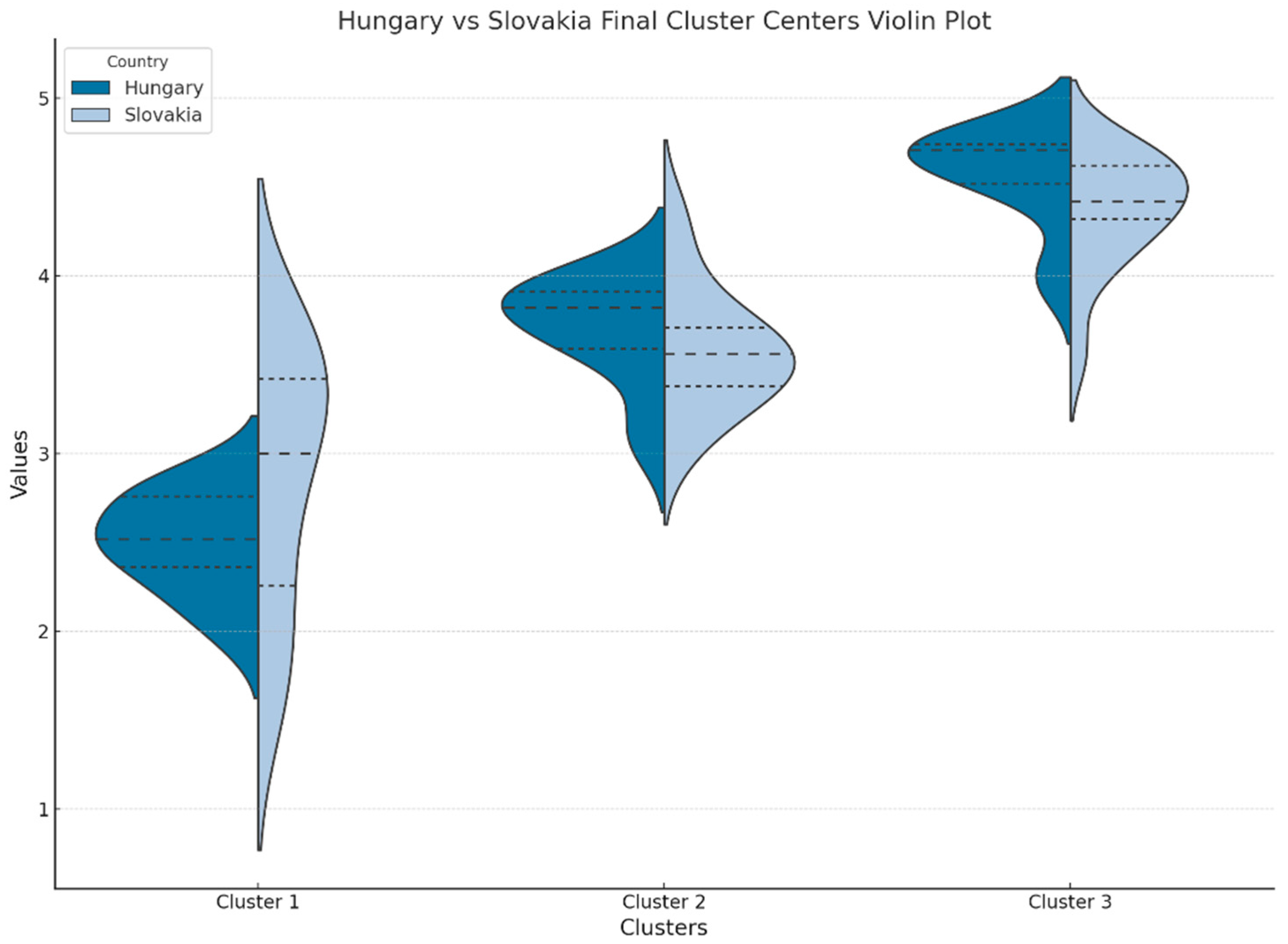
Figure 2 visualizes the distribution of the cluster centers for the Hungarian and Slovak Baby Boomer samples. The violin plots illustrate how respondents are distributed across the three clusters in relation to the EO and EK dimensions. The figure shows that, in both countries, three interpretable clusters can be identified, but the distribution of responses differs between the Hungarian and Slovak samples. In general, the Slovak clusters are positioned slightly closer to higher values, while the Hungarian clusters show broader dispersion in some parts of the distribution. This suggests that although similar cluster structures emerge in both countries, the intensity of environmental orientation and knowledge differs across the two national samples.
Table 3 presents the number and percentage of respondents assigned to each cluster in the Hungarian and Slovak samples. The table shows that all respondents were assigned to one of the three clusters, with no missing cases in either national sample. Based on the cluster profiles, Cluster 1 represents respondents with lower levels of both environmental orientation and environmental knowledge. This group can therefore be interpreted as the least environmentally engaged segment within the Baby Boomer sample.
Cluster 2 includes respondents with moderate EO and EK scores. This group may be described as a moderately oriented and moderately informed segment, whose responses indicate some familiarity with environmental issues but not consistently high levels of environmental orientation or knowledge.
Cluster 3 represents respondents with the highest EO scores and the highest scores on the selected EK indicators. This segment can therefore be interpreted as the group with the strongest environmental orientation and the highest level of self-reported sustainability-related knowledge within the Baby Boomer sample.
The country-specific distributions show that the Slovak sample generally contains a larger proportion of respondents in the higher-scoring range, particularly in Cluster 3. In Hungary, the first cluster is smaller, but the distribution of responses appears more dispersed, suggesting greater heterogeneity within the Hungarian Baby Boomer sample. In Slovakia, the largest group is Cluster 3, indicating that a substantial share of respondents reported relatively high levels of both environmental orientation and environmental knowledge. These findings suggest that the three-cluster structure is meaningful in both countries, whereas the distributions and intensities of EO and EK differ across the national samples.
As with the country-level comparison, the cluster results should be interpreted as exploratory EO–EK response profiles rather than as externally validated consumer segments.
ANOVA was used to examine whether the three clusters differed across the EO and EK items. Since the same variables were used to form the clusters, the ANOVA results are interpreted as indicators of internal cluster separation rather than as independent confirmatory tests. A significance level of α = 0.05 was applied, and effect sizes were calculated to assess the practical relevance of the observed differences.
Table 4 shows that in the case of Hungary, the F-values are high for all variables, indicating that the variation between clusters is significant. The significance values for all variables are 0.000, meaning the differences are statistically significant at the 95% confidence level.
Table 5 shows that in Slovakia, the variance between clusters exceeds the error variance, indicating that the variation between clusters is significant. For all variables, the F-values are high, confirming the previous finding.
The ANOVA results indicate that the three clusters differed significantly across all EO and EK items in both national samples. In the Hungarian sample, all F-values were statistically significant at p < 0.001. The calculated effect sizes suggest substantial differences between clusters, with η2 values ranging from 0.240 for EK3 to 0.562 for EK1. The strongest cluster separation in the Hungarian sample was observed for EK1, EO3, and EO7, indicating that the clusters were particularly well differentiated by respondents’ views on the pollution-reducing role of sustainable products, perceived human abuse of the environment, and expectations of ecological catastrophe.
In the Slovak sample, all EO and EK items also showed statistically significant cluster differences at p < 0.001. The η2 values ranged from 0.230 for EO4 to 0.537 for EK4. The greatest differentiation was observed among EK4, EK5, and EO6, suggesting that the Slovak clusters were particularly distinct in self-reported knowledge of climate change and greenhouse gases, as well as perceptions of the fragility of the balance of nature.
These effect sizes confirm that the three-cluster solution meaningfully differentiated respondents in both countries. Thus, the ANOVA results reinforce the main argument by demonstrating that the identified clusters are not merely descriptive labels, but represent meaningful internal differences in environmental orientation and environmental knowledge within the Baby Boomer samples. However, because the same EO and EK items were used to form the clusters, the ANOVA results should be interpreted as evidence of internal cluster separation rather than as independent confirmatory tests.
The cluster patterns can be discussed in relation to the country-level comparison, but they should not be interpreted as direct evidence of national differences or as effects of national environmental policy. In the present study, the country variable functions as a contextual grouping variable rather than as a direct measure of policy exposure, environmental education, media communication, or cultural mechanisms. Moreover, because the data collection modes differ between the two national subsamples, the cluster distributions may partly reflect sample composition and data collection conditions. The higher proportion of Slovak respondents in the highest-scoring cluster, therefore, indicates a sample-level difference in the distribution of EO and selected EK indicators, while the more dispersed Hungarian pattern suggests greater heterogeneity within the studied Hungarian Baby Boomer sample. These findings remain exploratory and should be examined in future research using harmonized data collection procedures and direct measures of environmental communication, policy awareness, education, media exposure, and cultural context. Taken together, the findings contribute to previous research in three main ways. First, they partly confirm and partly nuance earlier generational sustainability studies. Previous research has often emphasized younger generations as more visible carriers of sustainability-oriented lifestyles and environmental engagement (
Dwidienawati et al. 2021;
Francis and Sarangi 2022;
Gomes et al. 2023). The present findings do not directly contradict this literature, because the study does not compare Baby Boomers with younger generations. However, they refine this perspective by showing that Baby Boomer respondents in both countries reported relatively high environmental orientation. This supports the argument that older consumers should not be reduced to assumptions of lower environmental engagement or environmental passivity.
Second, the findings extend previous research by demonstrating that environmental orientation and selected environmental knowledge indicators do not necessarily develop at the same level. The absence of a significant country-level difference in EO suggests that respondents in both samples share a broadly similar attitudinal openness toward environmental issues. By contrast, the modest difference in the EK composite index suggests that sustainability-related knowledge may be more unevenly distributed. This pattern supports the attitude–knowledge gap proposed in the study’s conceptual framework. It shows that positive environmental attitudes among older consumers do not automatically imply the same level of familiarity with sustainability-related terminology or the perceived environmental role of sustainable products.
Third, the cluster analysis extends previous work on generational sustainability by showing internal heterogeneity within the Baby Boomer cohort. Earlier studies have emphasized that environmental engagement may vary not only between generations, but also according to factors such as education, income, occupation, place of residence, personal values, and lifestyle (
Humphreys 2017;
Situmorang et al. 2023). The present cluster results are consistent with this broader view of heterogeneity. In both countries, lower, moderate, and higher EO–EK response profiles were identified, suggesting that Baby Boomers should not be treated as a single undifferentiated consumer group. This finding is also consistent with previous segment-based research indicating that Baby Boomer respondents may appear across different sustainability-related consumer segments rather than forming a uniform group (
Gyurián Nagy 2023).
The main analytical contribution of the study, therefore, lies in the attitude–knowledge inconsistency identified among Baby Boomer respondents. The results show that relatively high environmental orientation does not necessarily imply equally high or uniform sustainability-related knowledge. This finding narrows the study’s interpretation to the relationship between attitudinal openness and selected knowledge indicators, rather than making broader claims about actual sustainable behavior, purchasing decisions, or the effectiveness of sustainability communication. The cluster analysis further supports this focused interpretation by showing within-generation heterogeneity. Lower, moderate, and higher EO–EK response profiles were identified in both national samples, indicating that Baby Boomers should not be treated as a single undifferentiated group in relation to environmental orientation and selected sustainability-related knowledge indicators. This finding is consistent with previous segment-based research suggesting that older consumers may appear across different sustainability-related consumer segments rather than forming a uniform cohort. The cross-country comparison should also be interpreted within this narrower scope. The findings do not provide evidence of strong national separation, and they should not be interpreted as direct effects of national environmental policy, educational systems, media exposure, or communication environments. Instead, the results suggest that selected knowledge-related indicators may vary more than general environmental orientation between the two studied samples. Future research should examine these patterns using representative samples, harmonized data collection procedures, and direct measures of educational background, media exposure, policy awareness, and sustainability communication. In this sense, the study’s contribution is exploratory and focused: it shows that among Baby Boomer respondents, positive environmental orientation and selected sustainability-related knowledge indicators may be partly decoupled, and that this relationship varies within the cohort. The findings may inform future research and cautious practical reflection, but they should not be interpreted as direct evidence of sustainable purchasing behavior or communication effectiveness.
5. Conclusions
This study contributes to generational sustainability research by showing that Baby Boomers should not be treated as a homogeneous or environmentally passive consumer group, and that their relationship to sustainable consumption is better understood by distinguishing between environmental orientation and environmental knowledge. The findings support this argument in three ways. First, respondents in both countries reported relatively high environmental orientation, suggesting broadly positive attitudes toward environmental issues. Second, the country-level comparison showed no statistically significant difference in environmental orientation, whereas environmental knowledge differed significantly, although with a small effect size, in favor of the Slovak sample. Third, the cluster analysis identified internally differentiated respondent segments in both countries, indicating that Baby Boomers differ in the extent to which they combine environmental orientation and environmental knowledge.
The cluster analysis further demonstrated that Baby Boomers should not be treated as a homogeneous consumer group. In both countries, three interpretable segments were identified, representing lower, moderate, and higher levels of environmental orientation and environmental knowledge. The Slovak sample contained a larger proportion of respondents in the highest-scoring cluster, while the Hungarian sample showed somewhat greater heterogeneity. However, these findings should be interpreted cautiously, as the study was based on a non-representative sample and did not directly measure policy exposure, environmental education, media use, or cultural mechanisms.
Theoretically, the findings contribute to generational sustainability research by refining the interpretation of Baby Boomers as older consumers. Rather than confirming a simple generational deficit or treating Baby Boomers as environmentally passive, the study shows that this cohort may report relatively high environmental orientation while differing in selected sustainability-related knowledge indicators. This supports the need to distinguish between attitudinal openness and knowledge-based readiness when examining sustainable consumption among older consumers.
From a practical perspective, the findings should be interpreted cautiously. The study did not measure actual sustainable purchasing behavior or the effectiveness of sustainability communication. Nevertheless, the results suggest that future sustainability-related communication aimed at older consumers should not assume that positive environmental attitudes are automatically accompanied by detailed sustainability-related knowledge. This implication should be treated as a cautious suggestion derived from the observed EO–EK inconsistency, rather than as direct evidence of communication effectiveness.
The study has several limitations. The sample is not nationally representative; therefore, the results should be interpreted as referring to the studied respondents rather than to the entire Baby Boomer population in Hungary and Slovakia. In addition, the research measured self-reported environmental orientation and knowledge, but did not directly examine actual sustainable behavior, policy awareness, media exposure, or educational background. In addition, although the measurement items were based on previously applied scales and showed acceptable internal reliability, the study did not conduct a full psychometric validation of the measurement model. The EK measure was used as an exploratory composite index based on selected indicators adapted from previously published scales. Future research should test the dimensionality of this item combination through factor analysis and examine whether product-related environmental knowledge and familiarity with sustainability terminology should be modeled as a single or multiple dimensions. Future research should therefore apply factor analysis and examine factor loadings, convergent validity, and discriminant validity in order to provide stronger empirical evidence for construct validity. A further methodological limitation concerns the comparability of the Hungarian and Slovak subsamples. Although the same age screening criterion and the same EO and EK items were used in both countries, the data collection modes differed. The Hungarian subsample was derived from a broader survey, while the Slovak subsample was collected through face-to-face questionnaire administration. As a result, country and data collection mode are confounded, and the observed differences cannot be attributed solely to national context. The country-level findings should therefore be interpreted as exploratory sample-based comparisons. Future research should apply harmonized data collection procedures across countries and use representative samples in order to provide stronger evidence on national differences in environmental orientation and environmental knowledge.