Territorial Governance and Technological Convergence: Toward a Methodological Framework for Social Innovation Based on Artificial Intelligence and the Multi-Helix Model from the Global South
Abstract
1. Introduction: The Paradigm Shift in Social Innovation (2020–2025)
2. Theoretical Framework
2.1. Social Innovation in the Global South: The Modeling Problem and Innovation by Necessity
2.2. Territorial Governance, the Multi-Helix Model, and the Challenge of “Methodological Myopia”
2.3. Artificial Intelligence as an Embedded Methodological Instrument for Ethical Governance
3. Materials and Methods
3.1. Research Approach and Design
3.2. Systematic Literature Review (SLR) and Identification of Epistemological Biases
3.3. Situated Qualitative Case Study: Antofagasta Region
- Participatory diagnosis: Collection of relational and narrative data on territorial resilience.
- Multi-helix governance: Analysis of public value co-creation among heterogeneous actors.
- Multidimensional evaluation: Design of longitudinal metrics that transcend quantitative bias.
- Technological convergence (AI): Assessment of AI as a mechanism for traceability and social auditing, subordinated to ethical algorithmic frameworks.
3.4. Analytical Procedure and Systematization
- Corpus organization: Categorization of indexed material according to digital transition and sustainability axes.
- Construction of analytical axes: Identification of “methodological myopia” as the guiding category for empirical contrast.
- Case systematization: Analysis of operational dimensions in Antofagasta under the ERI 2022–2028 framework.
- Conceptual triangulation: Comparative analysis of SLR trends, case evidence, and AI-mediated governance proposals.
- Integrative synthesis: Formulation of conclusions based on the interdependence between scientific validity and situated relevance.
3.5. Rigor, Ethics, and Limitations
4. Results
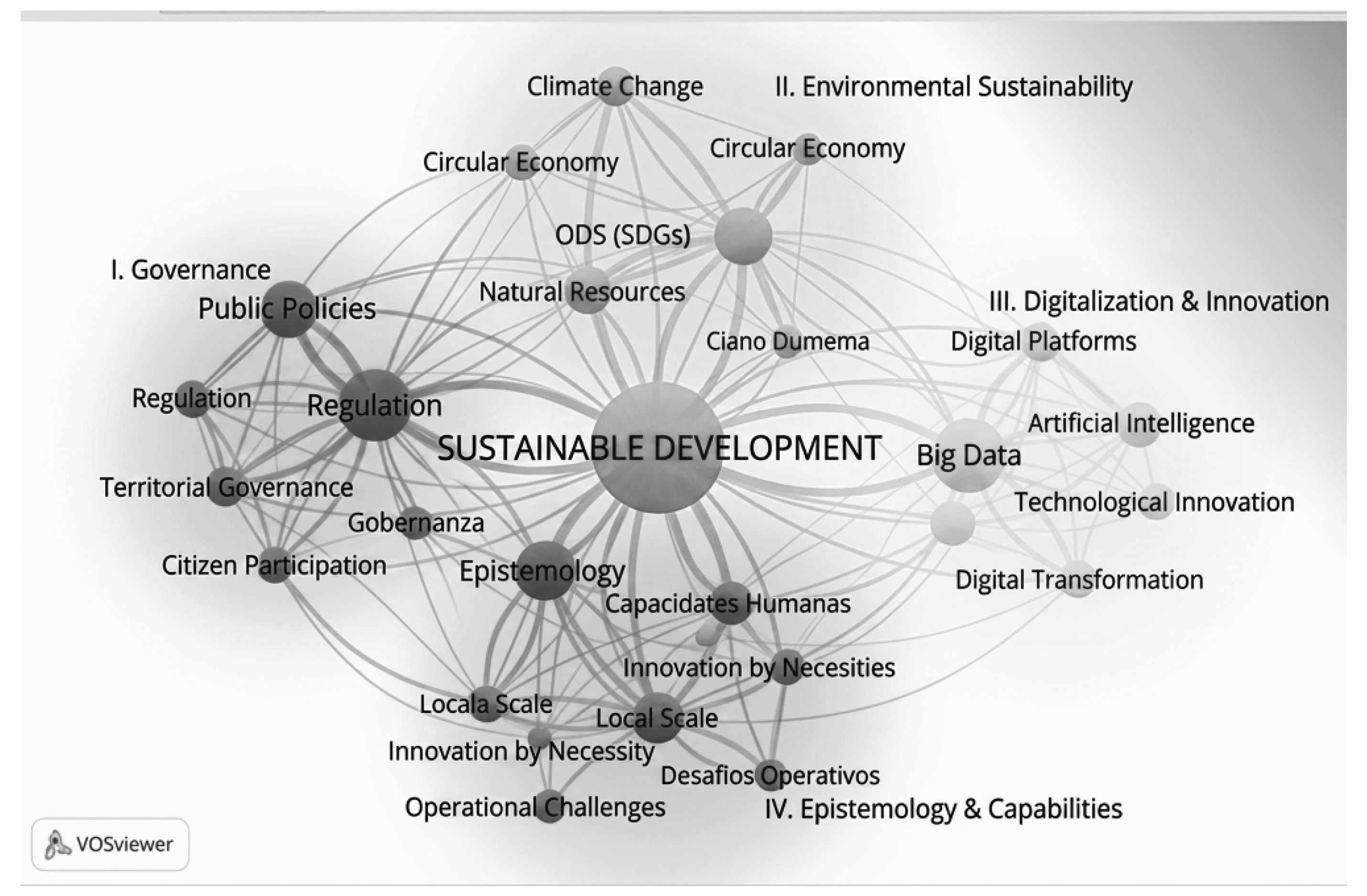
4.1. Categorical and Thematic Mapping: From Conceptual Delimitation to Operational Gaps
4.2. Empirical Institutionalization and Multi-Helix Governance in Antofagasta
4.3. Artificial Intelligence as a Methodological Catalyst: Traceability and Social Auditing
- Restricted Causal Attribution: Isolating the specific impacts of SI remains challenging due to the confounding influence of macro-territorial variables, such as volatile extractive economic cycles.
- Data Literacy Gaps: The transition to an AI-supported system introduces a risk of digital exclusion, potentially marginalizing civil society actors with limited technological capacities.
- The Standardization Paradox: A persistent tension exists between the deployment of comparable global metrics and the preservation of local territorial singularity.
5. Discussion
5.1. Epistemological Implications and the Mitigation of “Methodological Myopia”
5.2. Multi-Helix Governance and Institutional Continuity as Stabilizing Factors
5.3. Algorithmic Mediation and “Situated Standardization”: Scope, Constraints, and Transferability
6. Conclusions
6.1. Systemic Insights and Empirical Synthesis
- Epistemologically, it treats impact evaluation as an inherently political and ontological issue, explicitly linking conceptual fragmentation to the modeling problem under conditions of structural scarcity characteristic of the Global South.
- Methodologically, it outlines a longitudinal evaluative architecture that integrates computational natural language processing as a support mechanism for social auditing, offering a concrete, mixed-method response to the persistent absence of comparable international standards.
- Empirically, the analysis indicates that SI can effectively move beyond a fragmented, project-based logic when it is embedded in territorial public policy and conceived as a model of cooperative multi-helix governance.
6.2. Implications for Policy and Territorial Management
6.3. Algorithmic Infrastructure and the Logic of Conditional Transfer
7. Patents
Funding
Institutional Review Board Statement
Informed Consent Statement
Data Availability Statement
Conflicts of Interest
Abbreviations
| AI | Artificial Intelligence |
| FIC-R | Innovation Fund for Regional Competitiveness |
| MHM | Multi-Helix Model |
| ERI | Regional Innovation Strategy (Estrategia Regional de Innovación) |
| SDGs | Sustainable Development Goals |
| SI | Social Innovation |
| TRL | Technology Readiness Level |
Appendix A. Methodological Appendix
Appendix A.1. Systematic Literature Review: Design and Purpose
Appendix A.2. Information Sources and Databases
- Scopus;
- Web of Science (WoS—Core Collection);
- SciELO;
- Redalyc.
Appendix A.3. Search Strategy and Key Terms
Appendix A.3.1. Conceptual Axes
- Social innovation;
- Impact evaluation/impact measurement;
- Territorial governance and helix models;
- Digital transformation and artificial intelligence.
Appendix A.3.2. Examples of Search Strings
- (“social innovation” AND (“impact assessment” OR “impact measurement” OR evaluation)
- AND (“governance” OR “territorial governance” OR “multi-helix” OR “quadruple helix”)
- AND (“digital transformation” OR “artificial intelligence” OR “data analytics”))
- (“innovación social” AND (“evaluación de impacto” OR “medición del impacto”)
- AND (“gobernanza territorial” OR “modelo multihélice”)
- AND (“inteligencia artificial” OR “transformación digital”))
Appendix A.4. Inclusion and Exclusion Criteria
Appendix A.4.1. Inclusion Criteria
- Publication between 2020 and 2025.
- Peer-reviewed journal articles.
- Explicit engagement with at least two of the following components:social innovation; impact evaluation; governance or public policy; digitalization or AI applied to social domains.
- Conceptual or methodological relevance for high territorial complexity contexts or the Global South.
Appendix A.4.2. Exclusion Criteria
- Non-peer-reviewed documents (editorials, technical reports, institutional documents);
- Studies focused exclusively on technological innovation without a social dimension;
- Purely instrumental approaches lacking methodological or epistemological reflection;
- Duplicate records across databases.
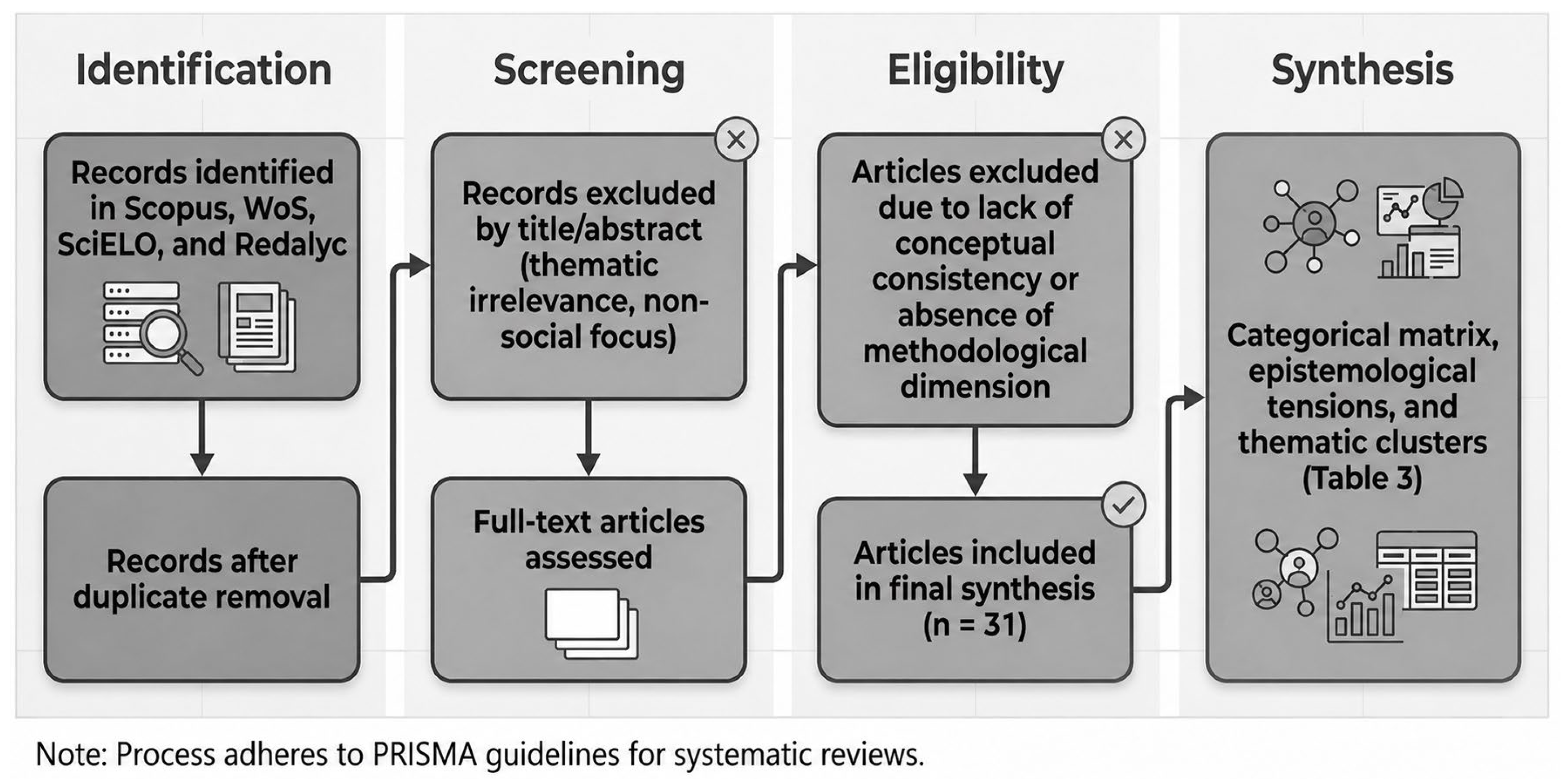
Appendix A.5. Corpus Selection Process
- Initial identification of records using the defined search strings;
- Removal of duplicates across databases;
- Title and abstract screening applying inclusion/exclusion criteria;
- Full text assessment to determine conceptual relevance and analytical quality.
Appendix A.6. Review Process Flow Diagram

Appendix A.7. Considerations on Rigor and Limitations
References
- Adro, Francisco, and Cristina I. Fernandes. 2020. Social innovation: A systematic literature review and future agenda research. International Review on Public and Nonprofit Marketing 17: 23–40. [Google Scholar]
- Amershi, Saleema, Maya Cakmak, William Bradley Knox, and Todd Kulesza. 2014. Power to the people: The role of humans in interactive machine learning. AI Magazine 35: 105–20. [Google Scholar] [CrossRef]
- Andion, Carolina, Graziela Dias Alperstedt, and Júlia Furlanetto Graeff. 2020. Ecossistema de inovação social, sustentabilidade e experimentação democrática: Um estudo em Florianópolis. Revista de Administração Pública 54: 181–200. [Google Scholar] [CrossRef]
- Ansell, Chris, and Alison Gash. 2018. Collaborative platform governance. The American Review of Public Administration 48: 16–32. [Google Scholar]
- Arrieta, Alejandro Barredo, Natalia Díaz-Rodríguez, Javier Del Ser, Adrien Bennetot, Siham Tabik, Alberto Barbado, Salvador García, Sergio Gil-Lopez, Daniel Molina, Richard Benjamins, and et al. 2020. Explainable Artificial Intelligence (XAI): Concepts, taxonomies, opportunities and challenges toward responsible AI. Information Fusion 58: 82–115. [Google Scholar] [CrossRef]
- Bacon, Nicola, Sarah Woodcraft, and Julie Caulier-Grice. 2008. The Social Innovator’s Guide. London: The Young Foundation. Available online: https://youngfoundation.org (accessed on 18 March 2026).
- Bryson, John M., Barbara C. Crosby, and Laura Bloomberg. 2014. Public Value Governance: Moving Beyond Traditional Public Administration and the New Public Management. Public Administration Review 74: 445–56. [Google Scholar] [CrossRef]
- Bucio-Mendoza, Saray, and José Alberto Solis-Navarrete. 2024. Institutionalising social innovation in the Global South. Heliyon 10: e39556. [Google Scholar] [CrossRef] [PubMed]
- Bucio-Mendoza, Saray, and José Alberto Solis-Navarrete. 2025. Social Innovation Ecosystems in Times of Crisis: Rethinking Innovation Policy Through the COVID-19 Pandemic. Sustainability 17: 9502. [Google Scholar] [CrossRef]
- Caeiro, Andreia Filipa Pereira. 2020. Inovação social e desenvolvimento local sustentável: Estudo de caso de uma cooperativa multisectorial. Gestão e Desenvolvimento 28: 145–68. [Google Scholar]
- Calzada, Igor. 2024. Artificial Intelligence for Social Innovation: Beyond the Noise of Algorithms and Datafication. Sustainability 16: 8638. [Google Scholar] [CrossRef]
- Carayannis, Elias G., and David F. Campbell. 2009. Mode 3’ and ‘Quadruple Helix’: Innovation ecosystems and social ecology. International Journal of Social Ecology and Sustainable Development 1: 201–34. [Google Scholar] [CrossRef]
- Carayannis, Elias G., and David F. Campbell. 2012. Mode 3 Knowledge Production in Quadruple Helix Innovation Systems: 21st-Century Democracy, Innovation, and Entrepreneurship for Development. Berlin/Heidelberg: Springer. [Google Scholar]
- Carayannis, Elias G., Thorsten D. Barth, and David F. Campbell. 2012. The Quintuple Helix innovation model: Global warming as a challenge and driver for innovation. Journal of Innovation and Entrepreneurship 1: 2. [Google Scholar] [CrossRef]
- Castro, Ana Paula Ferreira Lopes, Maria Márcia Ferreira Lopes, and Glória Maria Marinho Silva. 2024. Empreendedorismo social: O papel da inovação social como ferramenta de política pública no desenvolvimento socioeconômico em comunidades subdesenvolvidas. Cadernos de Prospecção 17: 1271–85. [Google Scholar] [CrossRef]
- Cavazos-Arroyo, Judith, and Rogelio Puente-Diaz. 2023. Antecedents and Consequences of Three Selling Strategies in Social Enterprises. Revista Brasileira de Gestão de Negócios 25: 2–17. [Google Scholar] [CrossRef]
- Ciasullo, Maria Vincenza, Orlando Troisi, Mara Grimaldi, and Daniele Leone. 2020. Multi-level governance for sustainable innovation in smart communities: An ecosystems approach. International Entrepreneurship and Management Journal 16: 1167–95. [Google Scholar] [CrossRef]
- Comisión Económica para América Latina y el Caribe (CEPAL). 2025. Tecnologías Digitales para un Desarrollo Sostenible y una Gobernanza Basada en datos en América Latina. In Naciones Unidas. Available online: www.cepal.org (accessed on 12 March 2026).
- Concha, Roberto M., and Emilio Ricci. 2018. Desde el modelo de la Triple Hélice a la Multihélice en los procesos de intervención y desarrollo de núcleos de innovación social a nivel local o regional [From the Triple Helix to the Multi-Helix model in intervention processes and development of social innovation nuclei at local or regional levels]. In Innovación Social: Consolidación Modelo Multihélice en la Región de Antofagasta. Edited by Emilio Ricci and Roberto M. Concha. Santiago: Ediciones Universidad Católica del Norte, pp. 115–38. [Google Scholar]
- de França Filho, Genauto Carvalho. 2024. Editorial—Tecnologia social: Uma introdução à pesquisa, à prática e à mudança social. Organizações & Sociedade 31: 1–11. [Google Scholar] [CrossRef]
- De Matos, Francisco Regilson Pinho, Breno Henrique Azevedo Bezerra De Sousa, Elton Jhon Almeida De Souza, Eliane Aires De Oliveira, Fábio André De Farias Vilhena, Fernando Diniz Abreu Silva, Gyzah Amui Barros Pereira, Hugo Silva Ferreira, Isidro José Bezerra Maciel Fortaleza Do Nascimento, Livia Reges De Oliveira, and et al. 2025. Inovação Social No Terceiro Setor: Uma Revisão Sistemática Sobre Impacto E Sustentabilidade. IOSR Journal of Humanities and Social Science 30: 35–40. [Google Scholar]
- dos Santos, Ailton Luiz, Jatniel Rodrigues Januário, Flávio Carvalho Cavalcante, Marcos Klinger dos Santos Paiva, and Dã Cesar Tavares de Azevedo. 2025. Economia circular e sustentabilidade: Desafios e soluções para um futuro sustentável. Revista Políticas Públicas & Cidades 14: e1535. [Google Scholar] [CrossRef]
- Edwards-Schachter, Mónica. 2021. Contextualizing social innovation: A critical review of its conceptualization, dimensions, and typologies. Journal of Technology Management & Innovation 16: 95–107. [Google Scholar]
- Etzkowitz, Henry. 2008. The Triple Helix: University-Industry-Government Innovation in Action. Oxfordshire: Routledge. [Google Scholar]
- Etzkowitz, Henry, and Loet Leydesdorff. 1995. The Triple Helix—University-industry-government relations: A laboratory for knowledge based economic development. EASST Review 14: 14–19. [Google Scholar]
- Etzkowitz, Henry, and Loet Leydesdorff. 2000. The dynamics of innovation: From National Systems and “Mode 2” to a Triple Helix of university-industry-government relations. Research Policy 29: 109–23. [Google Scholar] [CrossRef]
- Freire, Paulo. 2017. Pedagogía del Oprimido. Mexico City: Siglo XXI Editores. [Google Scholar]
- Gobierno Regional de Antofagasta. 2022. Estrategia Regional de Innovación (ERI) Antofagasta 2022–2028: Hacia un Ecosistema de Bienestar. Available online: www.goreantofagasta.cl (accessed on 10 March 2026).
- Gómez-Cano, Carlos Alberto. 2023. Innovación social y desarrollo sostenible: Un análisis de las áreas de impacto y su relación con los ODS. Revista de Investigación en Políticas Públicas (EPSIR) 8: 241. [Google Scholar]
- Hernández-Ascanio, José, Jaime Aja Valle, Miguel Jesús Medina Viruel, and Ramón Rueda López. 2016. El concepto de innovación social: Ámbitos, definiciones y alcances teóricos. CIRIEC-España, Revista de Economía Pública, Social y Cooperativa 88: 165–99. [Google Scholar]
- Hernández-Ascanio, José, Jaime Aja Valle, Miguel Jesús Medina Viruel, and Ramón Rueda López. 2023. Fundamentación teórica de la innovación social: El problema de la modelización en un campo de estudio sin consolidar. CIRIEC-España, Revista de Economía Pública, Social y Cooperativa 108: 131–62. [Google Scholar] [CrossRef]
- Holzinger, Andreas, Markus Plass, Michael Kickmeier-Rust, Katharina Holzinger, Gloria Cerasela Crișan, Camelia-Mihaela Pintea, and Vasile Palade. 2019. Interactive Machine Learning: Experimental Evidence for the Human in the Algorithmic Loop. A Case Study on Ant Colony Optimization. Applied Intelligence 49: 2401–14. [Google Scholar] [CrossRef]
- Howaldt, Jürgen, Dmitri Domanski, and Christoph Kaletka. 2014. Theoretical Approaches to Social Innovation: A Critical Literature Review. Deliverable 1.1 of the Project “Social Innovation: Driving Force of Social Change” (SI-DRIVE). In Sozialforschungsstelle Dortmund. Available online: https://cordis.europa.eu/docs/results/612/612870/final1-si-drive-final-report-2018.pdf (accessed on 3 March 2026).
- Janssen, Marijn, Paul Brous, Elsa Estevez, Luis S. Barbosa, and Tomasz Janowski. 2020. Data governance: Organizing data for trustworthy Artificial Intelligence. Government Information Quarterly 37: 101493. [Google Scholar] [CrossRef]
- Jareh, Alotaibi. 2025. Sustainable Social Innovation as a Solution for Systemic Change and Resilience. Sustainability 17: 1583. [Google Scholar] [CrossRef]
- Larrán-Jorge, Manuel, Jesús Herrera Madueño, María Yolanda Calzado Cejas, and Francisco Javier Andrades Peña. 2020. An approach to the implementation of sustainability practices in Spanish universities. Journal of Cleaner Production 106: 34–44. [Google Scholar]
- Leduc, Benoît. 2016. Innovation Sociale: Guide de Conception et de Gestion de Projets. Quebec City: Presses de l’Université du Québec. [Google Scholar]
- Lippolis, Stella, Angelo Ruggieri, and Rossella Leopizzi. 2023. Open Innovation for sustainable transition: The case of Enel “Open Power”. Business Strategy and the Environment 32: 4202–16. [Google Scholar] [CrossRef]
- López Ruiz, Manuel José. 2024. Proyectos de Aprendizaje Servicio en la Universidad bajo el enfoque de Enseñanza en cadena y su proyección social. European Public & Social Innovation Review 9: 1–19. [Google Scholar] [CrossRef]
- Manzini, Ezio. 2022. Design as a discipline of the everyday. Design Issues 38: 4–17. [Google Scholar]
- Marques, Pedro, Kevin Morgan, and Ranald Richardson. 2018. Social innovation in question: The theoretical and practical implications of a contested concept. Environment and Planning C: Politics and Space 36: 496–512. [Google Scholar]
- Mazzucato, Mariana. 2023. Inclusive and sustainable growth: A mission-driven multi-stakeholder approach. CIRIEC-España, Revista de Economía Pública, Social y Cooperativa 2023: 27–36. [Google Scholar] [CrossRef]
- Melo, Sandro, and José Roberto Soares. 2021. Inovação social: Um estudo da produção científica internacional por meio da análise de redes. Brazilian Business Review 18: 450–67. [Google Scholar]
- Menczer, Filippo, Santo Fortunato, and Clayton A. Davis. 2020. A First Course in Network Science. Cambridge: Cambridge University Press. [Google Scholar]
- Mildenberger, Georg, Gudrun Schimpf, and Jürgen Streicher. 2020. Social innovation assessment? Reflections on the impacts of social innovation on society—Outcomes of a systematic literature review. European Public & Social Innovation Review 5: 1–13. [Google Scholar] [CrossRef]
- Montgomery, Thomas, and Micaela Mazzei. 2021. Two paths of social innovation in the post-pandemic world. Social Enterprise Journal 17: 450–67. [Google Scholar] [CrossRef]
- Montgomery, Tom. 2016. Are social innovation paradigms incommensurable? Voluntas 27: 1979–2000. [Google Scholar] [CrossRef]
- Moulaert, Frank, Diana MacCallum, Jean Hillier, and Stijn Vicari Haddock. 2013. The International Handbook on Social Innovation: Collective Action, Social Learning and Transdisciplinary Research. Cheltenham: Edward Elgar Publishing. [Google Scholar]
- Mulgan, Geoff. 2019. Social Innovation: How Societies Find the Power to Change. Bristol: Policy Press. [Google Scholar]
- Mulgan, Geoff, Simon Tucker, Ali Rushanara, and Ben Sanders. 2011. Social innovation: What it is, why it matters and how it can be accelerated. In Skoll Centre for Social Entrepreneurship. Oxford: Saïd Business School, University of Oxford. [Google Scholar]
- Murray, Robin, Julie Caulier-Grice, and Geoff Mulgan. 2010. The Open Book of Social Innovation. London: The Young Foundation. [Google Scholar]
- Mursalzade, Hikmat. 2024. Digital social entities, valuable communities: How digitalization enables value co-creation for social entrepreneurship. Society and Economy 46: 423–40. [Google Scholar] [CrossRef]
- Osoegawa, Diego Ken, and Maria do Perpétuo Socorro Rodrigues Chaves. 2024. Inovações e tecnologias sociais: Bases conceituais e princípios epistemológicos para a sustentabilidade e bem-viver. Revista Videre 16: 53–79. [Google Scholar] [CrossRef]
- Pamplona, Leonardo, Marcos Estellita Lins, Amanda Xavier, and Mariza Almeida. 2024. Transformative Social Innovation as a Guideline to Enhance the Sustainable Development Goals’ Framework. Sustainability 16: 7114. [Google Scholar] [CrossRef]
- Pel, Bonno, Alex Haxeltine, Flor Avelino, Adina Dumitru, René Kemp, Tom Bauler, Iris Kunze, Jens Dorland, Julia Wittmayer, and Michael Søgaard Jørgensen. 2020. Towards a theory of transformative social innovation: A relational framework and 12 propositions. Research Policy 49: 104080. [Google Scholar] [CrossRef]
- Pérez-Hernández, Atilano. 2021. Políticas públicas para la innovación social: Una comparativa entre España y México. Gestión y Política Pública 30: 55–82. [Google Scholar]
- Ricci, Emilio, and Roberto. M. Concha. 2018a. Desde la Multihélice a la Innovación Social: El caso de la Universidad Católica del Norte UCN [From the Multi-Helix to Social Innovation: The case of the Universidad Católica del Norte UCN]. In Perspectives About Social Innovation Between Europe and Latin America. Medellín: Latin American Social Innovation Network (LASIN), pp. 35–47. [Google Scholar]
- Ricci, Emilio, and Roberto M. Concha, eds. 2018b. Innovación Social: Consolidación Modelo Multihélice en la Región de Antofagasta [Social Innovation: Consolidation of the Multi-Helix Model in the Antofagasta Region]. Antofagasta: Ediciones Universidad Católica del Norte. [Google Scholar]
- Rojas, Paulina Rojas, and Diego Pérez Marchant. 2025. Innovación Social: Análisis de Brechas y Oportunidades Estratégicas. In Sumo para el análisis en el marco de la actualización de la Estrategia Nacional de CTCI para el Desarrollo—2026. Santiago: Consejo Nacional de Ciencia, Tecnología, Conocimiento e Innovación para el Desarrollo (Consejo CTCI). [Google Scholar]
- Russell, Stuart, and Peter Norvig. 2020. Artificial Intelligence: A Modern Approach, 4th ed. London: Pearson. [Google Scholar]
- Rüede, Dominik, and Kathrin Lurtz. 2012. Mapping the Various Meanings of Social Innovation: Towards a Differentiated Understanding. EBS Business School Research Paper No. 12-03. Oestrich-Winkel: EBS Business School. [Google Scholar]
- Sampaio, Carlos, and João Renato Sebastião. 2024. Social Innovation and Social Entrepreneurship: Uncovering Themes, Trends, and Discourse. Administrative Sciences 14: 53. [Google Scholar] [CrossRef]
- Satalkina, Liliya, and Gerald Steiner. 2022. Social Innovation: A Retrospective Perspective. Minerva 60: 567–91. [Google Scholar] [CrossRef] [PubMed]
- Serrano Cárdenas, Lizeth Fernanda, and Isabela Casadiego Casanova. 2025. Descubriendo el ADN de los innovadores sociales: Una revisión de literatura enfocada en la identificación de sus capacidades y habilidades. European Public & Social Innovation Review 10: 1–20. [Google Scholar] [CrossRef]
- Severo, Eliana Andréa, Julio Cesar Ferro de Guimarães, and Eric Charles Henri Dorion. 2020. Assessment of the degree of innovation of micro and small enterprises: Evidence from Brazil. International Journal of Innovation and Learning 27: 392–415. [Google Scholar] [CrossRef]
- Solís Navarrete, José Alberto, Saray Bucio Mendoza, and Jaime Paneque Gálvez. 2023. Innovación social en el contexto del COVID-19: Hacia la conformación de sistemas territoriales de innovación. In Migración, mercados de trabajo y educación. Inclusión social en la gestión territorial. Ciudad de México: UNAM-AMECIDER, pp. 531–38. Coordinate with Crucita Aurora Ken Rodríguez, and María del Pilar Alejandra Mora Cantellano. [Google Scholar]
- Sun, Shuo, Bing Gu, and Fangcheng Tang. 2025. Cross-Category Innovation Strategy and Evolution of Digital Platform Ecosystems: A Technology-Driven Perspective. Sustainability 17: 5113. [Google Scholar] [CrossRef]
- UNESCO, and CLACSO. 2024. Estudio de las Buenas Prácticas de la Innovación Social: Miradas Desde el Emprendimiento. Buenos Aires: Biblioteca Virtual CLACSO. [Google Scholar]
- United Nations Educational, and Scientific and Cultural Organization (UNESCO). 2025. Global Report on the Ethics of Artificial Intelligence and Social Inclusion. Paris: UNESCO Publishing. [Google Scholar]
- Van Der Have, Robert P., and Luis Rubalcaba. 2016. Social innovation research: An emerging area of innovation studies? Research Policy 45: 1923–35. [Google Scholar] [CrossRef]
- Vaquero García, Alberto, María Bastida, Miguel Ángel Vázquez Taín, and Marisa Del Río. 2025. The Broad Spectrum of Sustainability and the Social Economy: Perspectives from Bibliometric Data. Journal of the Knowledge Economy 16: 10811–40. [Google Scholar]
- Vázquez-Maguirre, Mario. 2022. Innovación social en empresas comunales indígenas: Un modelo de bienestar colectivo. Revista de Administração Pública 56: 415–34. [Google Scholar]
- Yin, Robert K. 2018. Case Study Research and Applications: Design and Methods, 6th ed. Thousand Oaks: SAGE Publications. [Google Scholar]
- Ziegler, Rafael, Thomas Bauwens, Michael J. Roy, Simon Teasdale, Ambre Fourrier, and Emmanuel Raufflet. 2023. Embedding Circularity: Theorizing the Social Economy, Its Potential, and Its Challenges. Ecological Economics 214: 107970. [Google Scholar] [CrossRef]


| Evaluation Dimension | Traditional Approach (Global North) | Situated Approach (Global South/Antofagasta) |
|---|---|---|
| Nature of Impact | Operational efficiency and incremental well-being optimization | Sustaining livelihoods and addressing basic needs (structural transformation) |
| Predominant Metric | Quantitative outputs and linear scalability (growth) | Collective agency and network density under conditions of scarcity |
| Relationship with the Environment | Adaptation to digital markets and service economies | Resilience to extractive economies and socio-environmental tensions |
| Role of Technology | Inclusive digitalization and lifestyle improvement | Hybrid intelligence for traceability and territorial technological autonomy |
| Methodological Risk | Technical fragmentation of indicators | Cognitive extractivism and imposition of exogenous standards |
| Governance | Procedural multi-actor coordination | Mechanism of legitimacy and territorial sovereignty in the face of power asymmetries 1 |
| Component/Phase | Unit of Analysis (Source) | Analytical Strategy (What Is Done) | Output/Rigor Criterion (What Is Obtained/How It Is Supported) |
|---|---|---|---|
| Systematic Literature Review (2020–2025) | Corpus of 31 peer-reviewed articles (Scopus, WoS, SciELO, Redalyc). | Selection, screening, and organization into a Systematic Qualitative Content Matrix; identification of contemporary trends and operational gaps. | Four distinct thematic clusters (see Table 3); conceptual traceability through strict inclusion/exclusion criteria and PRISMA consistency. |
| Identification of Epistemological Tensions | Global social innovation field tensions (impact, measurement, standardization, governance). | Analytical deconstruction of “methodological myopia” and the “modeling problem” via a Global North/Global South critical contrast. | Guiding analytical axes for empirical contrast; theoretical coherence and internal consistency between theory and method. |
| Situated Single-Case Study (Antofagasta) | Antofagasta Region analyzed as a pioneering, revelatory living laboratory under the ERI 2022–2028 public policy framework. | Situated systematization of the regional ecosystem; deep qualitative territorial reading of a high-complexity, extractive setting (Yin 2018). | Analytical description of the case-pioneer and its paradoxes; high ecological validity and territorial relevance for the Global South. |
| Dimension 1: Participatory Diagnosis | Relational and narrative territorial data from regional initiatives. | Interpretive analysis to characterize localized needs, urgent community requirements, and endogenous assets. | Interpretive inputs; contextual relevance and coherence with the applied critical-qualitative paradigm. |
| Dimension 2: Multi-Actor (Multi-Helix) Governance | Academia–State–industry–civil society interactions within the FIC-R 2023 framework. | Analysis of multi-sector articulation as an institutional infrastructure for public value co-creation. | Legitimacy and cross-sector articulation mechanisms; consistency with ethical, decentralized, and participatory governance. |
| Dimension 3: Multidimensional/Longitudinal Evaluation | Long-term territorial evaluative parameters from the certification design. | Multidimensional approach to overcome output-based reductionism and track nonlinear structural transformation over time. | Ad hoc guidelines and evaluation criteria; coherence with complex social systems and capture of deep behavioral changes. |
| Dimension 4: Artificial Intelligence (Instrumental Use) | Narrative diagnosis records, certification-stage documents, implementation milestones, and multi-actor evaluative inputs. | Instrumental deployment of a sequential NLP pipeline using a 5W/1H syntactic framework and a Human-in-the-loop (HITL) calibration protocol (Russell and Norvig 2020). | Auditable traceability of SI processes; automated analytical reports subordinated to the Multi-Helix Governance Committee; mitigation of information asymmetries through explainable algorithms (XAI). |
| Analytical Cluster | Core Epistemological/ Operational Tension Identified | Key Sources (n = 31) | Critical Node/Focus |
|---|---|---|---|
| Cluster I: Governance and Public Policy | Tension between top-down bureaucratic compliance and local multi-helix co-creation of public value. | Andion et al. (2020); Pérez-Hernández (2021); Castro et al. (2024); De Matos et al. (2025); Ciasullo et al. (2020). | Public governance, collaborative networks, policy tools, and smart cities alignment. |
| Cluster II: Sustainability and Metrics (SDGs) | Methodological myopia: reliance on short-term, output-based indicators that obscure systemic, long-term transformation. | Bucio-Mendoza and Solis-Navarrete (2025); Jareh (2025); Pel et al. (2020); Vaquero García et al. (2025); Ziegler et al. (2023); Gómez-Cano (2023); Manzini (2022); Caeiro (2020). | Sustainable development goals, microfinance, circular economy, and design for sustainability. |
| Cluster III: Digitalization and Technology | Risk of technocentric automation vs. the need for embedded technological instruments for social inclusion. | Sun et al. (2025); Mursalzade (2024); de França Filho (2024); Osoegawa and Chaves (2024); Cavazos-Arroyo and Puente-Diaz (2023); Edwards-Schachter (2021). | Digital platforms, social technology, data analytics, and digital literacy gaps. |
| Cluster IV: Epistemology and Territorial Capabilities | The “modeling problem” and cognitive extractivism: imposition of universal standards on territories characterized by scarcity. | Serrano Cárdenas and Casanova (2025); López Ruiz (2024); dos Santos et al. (2025); Solís Navarrete et al. (2023); Hernández-Ascanio et al. (2023); Mazzucato (2023); Vázquez-Maguirre (2022); Larrán-Jorge et al. (2020); Severo et al. (2020); Melo and Soares (2021); Montgomery and Mazzei (2021). | Conceptual fragmentation, innovation by necessity, local scale, and human capabilities. |
Disclaimer/Publisher’s Note: The statements, opinions and data contained in all publications are solely those of the individual author(s) and contributor(s) and not of MDPI and/or the editor(s). MDPI and/or the editor(s) disclaim responsibility for any injury to people or property resulting from any ideas, methods, instructions or products referred to in the content. |
© 2026 by the author. Licensee MDPI, Basel, Switzerland. This article is an open access article distributed under the terms and conditions of the Creative Commons Attribution (CC BY) license.
Share and Cite
Ricci, E. Territorial Governance and Technological Convergence: Toward a Methodological Framework for Social Innovation Based on Artificial Intelligence and the Multi-Helix Model from the Global South. Soc. Sci. 2026, 15, 437. https://doi.org/10.3390/socsci15070437
Ricci E. Territorial Governance and Technological Convergence: Toward a Methodological Framework for Social Innovation Based on Artificial Intelligence and the Multi-Helix Model from the Global South. Social Sciences. 2026; 15(7):437. https://doi.org/10.3390/socsci15070437
Chicago/Turabian StyleRicci, Emilio. 2026. "Territorial Governance and Technological Convergence: Toward a Methodological Framework for Social Innovation Based on Artificial Intelligence and the Multi-Helix Model from the Global South" Social Sciences 15, no. 7: 437. https://doi.org/10.3390/socsci15070437
APA StyleRicci, E. (2026). Territorial Governance and Technological Convergence: Toward a Methodological Framework for Social Innovation Based on Artificial Intelligence and the Multi-Helix Model from the Global South. Social Sciences, 15(7), 437. https://doi.org/10.3390/socsci15070437