


Abstract
This article examines how justice institutions produce and reproduce gender-based violence against women through the invisibilization of moral violence, with particular attention to their spatial dimensions. Drawing on the concept of juridical–patriarchal habitus, the study conceptualizes justice institutions not only as sites of legal action but as spatial formations that shape the visibility, recognition, and adjudication of harm. Using a feminist ethnographic approach, the article analyzes two cases of gender-based violence documented in 2020 in the municipality of Querétaro, Mexico. The findings demonstrate how movement into legal and institutional spaces transforms lived experiences of violence, as procedural requirements, evidentiary expectations, and institutional interactions operate as spatial filters that render certain forms of harm visible while obscuring others. In this process, justice actors construct and reproduce gendered stereotypes about what counts as violence, simultaneously positioning women as victims and subjecting them to processes of revictimization. By conceptualizing the invisibility of moral violence as a spatially mediated process, the article contributes to debates in legal and feminist geography, highlighting how institutional spaces not only respond to gender-based violence but actively participate in its production and concealment.
1. Introduction
Gender-based violence against women and girls is a structural problem, “the product of a social organization structured on the basis of gender inequality, which systematically affects millions of women worldwide” (Sagot 2008). Its multiple manifestations constitute one of the most cruel and explicit expressions of the patriarchal order. It can be understood as “a continuum of violence against women that ranges from subtle forms to the most extreme” (Sagot 2019, p. 2). This violence operates in complex ways, as it is sustained by diverse ideological, moral, political, economic, and legal frameworks that support the exercise of male authority over women.
In contexts such as Latin America, this violence takes shape as a multidimensional phenomenon, articulated with other systems of power such as capitalism, racism, ethnocentrism, and extractivism (Ruiz 2022), which produce different forms of devastation and death. In this sense, its causes are not fixed or predetermined, and its social consequences are neither linear nor always predictable (Segato 2003).
Consequently, gender-based violence is not understood as one or several discrete acts involving an individual victim and perpetrator but rather as the effect of a gender power system known as patriarchy, which produces and reproduces asymmetric and exclusionary relations between women and men. Thus, violence must be problematized in terms of the ways in which it is embedded within this system, in order to reveal the multiplicity of its expressions.
In the Latin American context, despite the existence since the late twentieth century of a broad legal, political, and institutional framework—implemented through the intervention of non-governmental organizations, primarily feminist organizations, and international bodies, which have emphasized the need to ensure respect for women’s rights and the State’s obligation to protect and guarantee them—women victims of violence continue to face multiple obstacles in accessing justice within both the criminal and family justice systems.
Specifically, following the implementation of the new criminal justice system, a process that began in Latin America in the late twentieth century1, Casas Becerra (2010), based on a comparative analysis of the judicialization of violence against women in different Latin American countries under the adversarial criminal justice system, demonstrates how some complaints were dismissed at a preliminary stage by prosecutors’ offices and investigations did not proceed. As Casas notes, “in many cases the victim’s account is not valued as evidence. In other cases, it is necessary to validate her credibility through multiple credibility assessments. At other times, interrogations are aimed at proving the victim’s honesty, as if that were a determining circumstance for imposing a conviction” (Casas Becerra 2010, p. 131).
According to Casas, these tensions between women victims of violence and the criminal justice system manifest themselves beginning with “the definition of certain criminal offenses in which gender prejudices are inherent to the norms themselves, as well as in the application of legal protections for women when they are victims of crimes” (Casas Becerra 2010, p. 119). In this sense, the creation, interpretation, and application of legal norms are mediated by gender roles and stereotypes (Facio Montejo 1992; Núñez Rebolledo 2018; Spaventa 2002).
Daich (2004, 2011), through the analysis of different cases of violence against women in both family and criminal justice settings in Argentina, argues that the historical position occupied by women within judicial discourse and legal treatment has produced a particular notion of victimhood: “the victimized person appears weak, unaware of her rights, and in need of protection; added to this is the image of the ‘battered woman,’ which refers to a widely shared stereotype” (Daich 2004, p. 334). Women victims of violence are perceived as submissive, weak, and uninformed in relation both to their aggressor and to the justice system. This stereotype of the “battered woman” creates obstacles to women’s access to justice because cases are classified by justice actors according to women’s physical appearance. In other words, in order to appear as a “true victim,” women must appear “fragile” and “disheveled.”
Likewise, Piqué and Pzellinsky (2015) identify some of these obstacles, which generally stem from structural or normative problems but are also linked to gender roles and stereotypes about women. In particular, in the context of criminal justice in Argentina, the authors point to “the multiplicity of jurisdictions involved in cases where women report their partners or former partners as the first obstacle, significantly increasing revictimization and the decontextualization of events” (Piqué and Pzellinsky 2015, p. 223). Thus, when a case of gender-based violence involves acts related to different criminal offenses (serious bodily harm, property damage, unlawful deprivation of liberty), the case may fall under different jurisdictions—and therefore different justice institutions—such as national criminal courts, national correctional courts, or family courts. This produces a decontextualization of violence, since it is treated as an isolated event, while also generating processes of revictimization because victims must recount the events repeatedly before different institutions and justice actors.
Ristoff (2022) argues that, in contexts such as Latin America, it is essential not to lose sight of “the persistence of sexist and discriminatory stereotypes within criminal justice systems” (p. 193), which contributes to the revictimization of women. Obstacles to women’s access to justice are also linked to the presence of sociocultural patterns, norms, and practices that permeate the criminal justice system, giving rise to forms of institutional violence that are exacerbated by intersecting factors such as ethnicity, educational level, age, and social class. According to the author, these structural obstacles emerge from the very moment a complaint is filed, “through the concentration of courts in urban areas; the existence of multiple, uncoordinated jurisdictions through which victims are forced to navigate; the lack of clear and accessible information; and the absence of complaint reception centers with adequate spaces” (Ristoff 2022, p. 194). This results in violations of women’s human rights, including their rights to access justice and privacy as complainants.
In the specific case of Mexico, Lachenal (2016), through a legal analysis of 70 judicial rulings issued by the Judiciary of the State of Oaxaca, highlights both the possibilities and limitations of women victims’ access to justice and the protection of their human rights under the adversarial criminal justice model. The author identifies general and structural patterns in judicial decision-making and emphasizes the need for judges to deepen their analysis of the context of inequality and subordination between men and women, which would allow for different interpretations of the facts. Lachenal demonstrates how the predominance of procedural formalities and the literal and formal application of criminal law are prioritized over the substantive dimensions of violence, in the absence of a gender perspective.
de Pina Ravest (2024), through an analysis of the possibilities and limitations of the criminal justice system in addressing gender-based violence against women, emphasizes the need for institutional support mechanisms to reduce the “gap in reporting, judicialization, and case resolution at the national level” (p. 120). The author argues that the state of criminal justice in Mexico regarding this issue has been widely debated and that the most significant obstacles frequently involve evidentiary matters and structural problems such as discrimination in access to justice. Among these obstacles are “low reporting rates and high rates of revictimization, undue delays in case processing and protection requests, and the lack of training and gender-sensitive awareness among personnel who work with victims” (de Pina Ravest 2024, p. 124). The persistence of gender stereotypes and prejudices among public officials responsible for investigations is also highlighted.
Herrera Peñafiel (2025), for his part, identifies several factors affecting women’s access to justice and, consequently, the full guarantee of their rights. These include institutional practices that fail to incorporate a gender perspective, delays in judicial proceedings, and sociocultural stigmas associated with women victims of violence. The author argues that although Mexico possesses a solid legal framework regarding the protection of women’s human rights to live free from violence, it is still necessary to implement institutional protocols grounded in a gender perspective in order to reduce the gap between legal norms and legal practice.
As can be observed, the tensions experienced by women victims of violence in relation to the family and, especially, criminal justice systems in Latin America, and particularly in Mexico, demonstrate that this is not an isolated problem but rather a complex one shaped by multiple factors and structural problems within the system itself. These include the legal classification of certain offenses that exclude forms of violence, the predominance of procedural formalities over the substantive realities of violence, the reproduction of stereotypes that stigmatize women, lack of trust in justice institutions2, the decontextualization of violence from the patriarchal order and its treatment as an individual conflict, as well as the lack of coordination among institutions, which translates into a bureaucratic labyrinth and contributes to the revictimization of women.
Consequently, criminal and family justice institutions in the city of Querétaro, Mexico, were selected as the object of study in order to identify how these tensions experienced by women victims of violence within both justice systems manifest themselves in relation to a form of violence that has received little visibility: moral violence. Furthermore, in Mexico—and particularly in Querétaro—gender-based violence against women constitutes an alarming reality. To provide official figures that at least partially quantify the magnitude of this phenomenon, according to the latest report of the Executive Secretariat of the National Public Security System (2026)3, between January 2025 and January 2026, a total of 732 femicides were recorded in Mexico. Regarding intentional homicides of women, that is, cases not prosecuted as femicides, 2068 incidents were recorded. In relation to the crime of intentional bodily harm, 80,525 cases were reported.
In the specific case of the state of Querétaro, according to the ENDIREH survey (Instituto Nacional de Estadística y Geografía (INEGI) 2016)4, published in August 2022, 75.2% of women aged 15 and over reported having experienced some form of violence, whether psychological, physical, sexual, economic, or patrimonial, at some point in their lives, and 49.8% in the past 12 months. It is important to highlight that among these forms of violence, psychological (moral) violence accounts for the highest percentage, with 57.7% of women reporting having experienced it at some point in their lives and 36.2% in the past 12 months.
In the first half of 2025, eight femicides, seven intentional homicides, and 932 cases of intentional bodily harm were recorded; for the latter offense, the state ranked sixth at the national level. With regard to domestic violence, 2491 cases were reported, along with 669 cases of gender-based violence; for the latter offense, the state ranked first nationally per 100,000 inhabitants. According to Executive Secretariat of the National Public Security System (2026), covering the period from January to February 2026, two femicides were reported, no intentional homicides were recorded, and there were 243 cases of intentional bodily harm, 699 cases of domestic violence, and 229 cases of gender-based violence. For this last offense, the state once again ranked first nationally per 100,000 inhabitants5.
However, these figures do not capture the full scope of the phenomenon. For example, in cases of domestic violence and gender-based violence, the data are not disaggregated exclusively for women, and many cases go unreported due to multiple factors, including their normalization in social and cultural terms and the obstacles women face when seeking access to justice. Likewise, as is evident, these figures primarily reflect the physical dimension of violence, which poses a problem, as other forms of violence, such as moral violence, remain obscured.
Likewise, the figures are derived from information recorded in the investigative case files initiated before prosecutors’ offices and are reported on a monthly basis by the general prosecutor’s offices of the 32 federal entities. In other words, they refer to alleged criminal acts recorded in initiated case files, which implies that complaints that did not proceed and were dismissed at a preliminary stage are not included in the data.
In contrast to the figures presented above, in the sphere of justice, the state of Querétaro ranked first nationally for the third consecutive year in terms of the effectiveness and quality of its criminal justice system. This is according to the report Rule of Law Index in Mexico 2023–2024, prepared by the international civil society organization World Justice Project (WJP)6. The index implies that the criminal justice system is socially perceived as one that respects the rights of both victims and defendants. According to the report, all actors within the system were evaluated, including police officers, public defenders, prosecutors, judges, and penitentiary authorities.
In this context, it is necessary to account for the different ways in which expressions of gender-based violence against women, particularly moral violence, are not recognized by the criminal justice system, specifically in the context of Querétaro, either because they are not classified as criminal offenses or because structural barriers, articulated with gender, hinder women’s access to justice.
In this sense, interest emerged in empirically documenting the difficulties that women face when seeking to file a complaint or find a way out of situations of violence. This is because gender ideologies are not only created, expressed, and reproduced through criminal law or in the definition of specific offenses (Núñez Rebolledo 2018), but also through the differentiation between women and men in terms of unequal power relations.
Moral violence, in particular, is understood as “the most efficient mechanism of social control and the reproduction of inequalities” (Segato 2003, p. 114), as it can operate without physical aggression or overtly harsh actions. It may occur in the absence of verbal or physical aggression, manifesting instead through gestures, attitudes, or gazes. Historically, the legal notion of moral violence in the Latin American context had a more restricted definition. It began to be introduced “when it was no longer possible to sustain the criminalization of violence based exclusively on the criterion of physical violence exerted upon the victim” (Segato 2003, p. 108).
Initially, moral violence was understood to exist when the offense was committed against a victim occupying a subordinated position normalized by tradition7. Subsequently, this form of violence came to include a type of brutality that did not produce direct physical consequences; that is, it was conceptualized as moral coercion, since it did not solely involve physical harm.
Moral coercion was understood as the “lack of consent resulting from physical or moral violence” (Segato 2003, p. 109), implying an abuse against the will of the victim. In the twentieth century, under new conceptions of violence shaped by human rights sensibilities and feminist movements, moral violence came to be understood, in a broader sense, as the loss of victims’ autonomy, that is
[…] vulnerability to moral violence and psychological abuse among those subordinated within a status system—women and children—came to be associated with the impairment of the independent exercise of the will and with freedom of choice.(Segato 2003, p. 109)
In this way, the notion of moral, psychological, or emotional violence emerges, to which women are predominantly vulnerable within the patriarchal system. Since 1993, this type of violence has been recognized in various international legal instruments, such as the Declaration on the Elimination of Violence against Women (Asamblea General de la OEA 1993) the Inter-American Convention on the Prevention, Punishment and Eradication of Violence against Women—known as the Convention of Belém do Pará (Asamblea General de la OEA 1994)—and the Beijing Declaration and Platform for Action (Asamblea General de la OEA 1995).
In Mexico, it has been legally recognized since 1993 with the signing of the United Nations Declaration on the Elimination of Violence against Women, followed by the ratification of the Beijing Declaration and Platform for Action in 1995 and the enactment of the Convention of Belém do Pará in 1999. It is not only acknowledged but also defined in the Ley General de Acceso a las Mujeres a una Vida Libre de Violencia (2007) as a modality of violence against women. In the Criminal Code of the State of Querétaro, it is included within the offenses of gender-based violence (Chapter VI, Art. 142 BIS) and domestic violence (Chapter VIII, Art. 217 BIS). In the Civil Code of the State of Querétaro, it is established as part of violence within the family sphere (Chapter III, Art. 310).
Likewise, there are jurisprudential rulings issued by the Supreme Court of Justice of the Nation (SCJN), which establish that, in cases of domestic violence in its psychological dimension, it is not necessary for the offense to be
[…] visible to society or continuous, but rather constituted by specific or repeated moments and concrete acts, such as verbal abuse, threats, economic control, manipulation, among others; therefore, it should be considered as occurring in a concealed manner, as it takes place within the family unit and not always in view of those outside it.(Direct Amparo No. 303/2017, Collegiate Circuit Courts 157, 2018)
In this sense, the victim’s testimony and expert psychological assessments carry primary evidentiary value in establishing domestic violence in its psychological form; therefore, it is not necessary to prove the specific circumstances of time, place, and manner in which the events occurred, as is typically required for the prosecution of criminal offenses under the adversarial criminal justice system.
Despite being formally recognized and, at least to some extent, made visible in these international and national legal instruments and in SCJN jurisprudence, moral violence remains one of the least problematized forms of violence in relation to the protection of women’s human right to live free from violence. Although it is formally regulated and acknowledged, it is rendered invisible in social, cultural, and legal terms. That is, it is a form of violence that, due to its characteristics, is often ignored or overlooked.
In this regard, the proposal advanced by (Segato 2003) is adopted, which conceptualizes this form of gender-based violence against women as moral violence. This notion is framed from a gender perspective, encompasses the demoralization experienced by women, and points to its grounding in a traditional patriarchal morality sustained by routine forms of violence. “I thus argue that the normality of the system is a violent normality, which depends on the everyday demoralization of subordinated groups [girls, boys, and women]” (Segato 2003, p. 121).
Accordingly, the most important characteristic of moral violence is not that it extends or intensifies physical violence but rather its diffuse, subtle, and omnipresent nature. Its effectiveness lies in the social acceptance of behaviors considered natural or customary, in their rootedness in moral—patriarchal—family and religious values, and in the difficulty of naming or perceiving their consequences (Segato 2003).
Consequently, this article seeks to address, through the analysis of two cases documented using feminist ethnography, how justice institutions contribute to the creation and reproduction of stereotypes about violence against women and about women as victims, while rendering invisible forms of violence that leave no physical traces. In particular, the study focuses on the Justice Center for Women of Querétaro and the family courts of the Querétaro judicial district.
In this regard, the concepts of the legal field and habitus developed by Bourdieu (2001) are employed, from a feminist perspective on law, to highlight how gender-based violence against women is rendered invisible within these institutional spaces. Particular attention is given to moral violence, understood as one of the most effective mechanisms for reproducing inequalities between the feminine and the masculine, as it manifests through actions such as
emotional aggression, even when it is neither conscious nor deliberate. This includes ridicule, moral coercion, suspicion, intimidation, condemnation of sexuality, and the everyday devaluation of women as persons—their personality and psychological traits, their bodies, their intellectual capacities, their work, and their moral worth.(Segato 2003, p. 115)
Finally, the article is organized as follows: the first section provides a theoretical discussion of the legal field and patriarchal habitus; this is followed by a presentation of feminist ethnography as a method for analyzing gender-based violence within justice institutions, highlighting the ethical considerations adopted for conducting the interviews and the empirical material collected to carry out the research within the context of the COVID-19 pandemic. The following section presents and analyzes two ethnographically documented cases to show how these institutions create and reproduce different stereotypes about women and about violence against them, sustained by the reproduction of a patriarchal habitus shaped by the gender order. This dynamic affects women’s access to justice and contributes to the invisibilization of moral violence. Finally, a third section presents concluding remarks, showing how, within these state justice spaces, the legibility of harm is determined and how this determination leads to the revictimization of women who seek a response to the violence they have experienced.
2. Legal Field and Patriarchal Habitus
In theoretical terms, since their inception, studies within the Anthropology of Law have been influenced by the work of French scholars such as Michel Foucault and Pierre Bourdieu8, among others (Juárez Ortiz and Caixeta Maciel 2021; Sinhoretto 2011). These approaches seek to understand the mechanisms of power operating within state bureaucracies and justice institutions, while law is understood as a social product.
At the same time, scholars have developed reflections that address the particular contexts of Latin America. For example, based on Bourdieu’s analysis of the legal field, Sinhoretto (2011) proposes the concept of the state field of conflict management to incorporate informal mechanisms and non-judicial techniques for dispute resolution that operate within this social space. The goal is to identify “the roles and positions assumed in rituals by state agents and by the parties in conflict” (Sinhoretto 2011, p. 28), and, in turn, to understand their relationships and hierarchies, how truths are created and reproduced, and how the meanings of laws and rights are negotiated.
In this way, justice institutions are not understood as homogeneous organizations; rather, each operates according to its own logics and rituals and is configured as a space in which different forms of power are exercised. This produces unequal access to justice on the basis of gender, ethnicity, age, and other social markers. In other words, the decisions made within these institutions regarding legal matters are mediated by social, cultural, and political factors, whereby “a differentiated treatment is reserved for conflicts and for individuals according to the position they occupy within a hierarchy of values, persons, things, and places” (Sinhoretto 2011).
Sarrabayrouse Oliveira (2004), drawing on ideas previously discussed by Da Matta, points to the coexistence of two worlds within the state field of conflict management: one governed by universal rules and laws, and the other by personal relationships “characterized by clientelism, status, and hierarchy” (Sarrabayrouse Oliveira 2004, p. 40). These two logics operate differently, yet they are intricately intertwined, as justice operators navigate both spheres according to the interests at stake.
Currently, in the specific context of Queretaro, research by Juárez Ortiz (2016), Córdova (2003), Córdova Esparza and Terven Salinas (2022), and Martínez Palomera Báez (2019) draws on the fields of legal anthropology and ethnography within justice institutions.
Juárez Ortiz (2016) analyzes the criminal justice system to understand the relationship the State establishes with adolescent defendants following the implementation of a rights-based system in 2005, which replaced a tutelary model. Martínez Palomera Báez (2019), for her part, examines how women—both victims and defendants—are treated within the criminal justice system in the city of Queretaro, identifying gender-based constructions that affect their access to justice.
The works of Córdova (2003) and Córdova Esparza and Terven Salinas (2022), respectively, examine the tensions between how justice is perceived and how legal facts are constructed by justice operators in Queretaro’s legal field, following the 2008 constitutional reform that introduced an accusatory and oral criminal justice system. Additionally, they explore how justice institutions produce and reproduce stereotypes about women victims of violence, and how this contributes to the invisibilization of subtle forms of violence, such as moral violence (Córdova Esparza and Terven Salinas 2022).
As noted, justice institutions, particularly criminal ones, are placed at the center of analysis and examined in depth to understand the multiple ways in which they contribute to the creation and reproduction of social inequalities. Regarding gender, as one of the key areas of study in Legal Anthropology and the Anthropology of Law, it has been argued that legal frameworks alone are insufficient to guarantee women’s right to access justice in diverse sociocultural contexts (Sierra 2019), highlighting, among other issues, the gender-based obstacles they face when engaging with state justice systems.
In relation to this, feminist legal theories or feminist critiques of law9 have proposed multiple and varied ways to understand the relationship between law and gender. Some focus on the foundations of law and its structural notions, situating themselves within legal theory (Jaramillo 2000), with the aim of “unmasking the ideology and patriarchal structure hidden behind the text of legal norms” (Jalil Montiel 2023, p. 60). These critiques also extend to contemporary legal institutions.
Because this article seeks to understand how justice institutions create and reproduce stereotypes about gender-based violence against women, this section addresses the concepts of the legal field and habitus. From the perspective of the Anthropology of Law, articulated through a feminist lens, these spaces are conceived as gender-producing environments, insofar as justice actors attribute a set of characteristics to behavior stereotypically associated with femininity.
Understanding the logics of the legal field, and as part of it the practices of justice, is fundamental for analyzing the obstacles faced by women, victims of gender-based violence, when they turn to justice institutions. According to the theory of social fields developed by Pierre Bourdieu (Bourdieu 2001), the legal field is an organized social space that is “relatively independent in relation to external demands, within which legal authority is produced and exercised, the quintessential form of legitimate symbolic violence whose monopoly belongs to the State” (Bourdieu 2001, p. 168).
Based on this definition, Bourdieu points to the existence of a social universe within the legal field that maintains a degree of independence from external demands due to the symbolic effect socially produced around the neutrality and objectivity of law and its jurists. Legal practices and discourses are understood as the result of the internal logic of the field, determined by the power relations among its members in their struggle for the monopoly of legal capital, translated as “the right to say what the law says” (Bourdieu 2001, p. 39), and by the body of doctrines, codes, and laws that determine what is possible within the law and, consequently, how cases should be resolved—what Bourdieu calls “properly legal solutions” (Bourdieu 2001, p. 168).
This structure of the legal field prevents judicial decisions from being identified as abuses of authority—forms of legitimate symbolic violence—because they appear as “the necessary result of a regulated interpretation of unanimously recognized texts” (Bourdieu 2001, p. 171). In other words, justice operators have the “socially recognized capacity to interpret (with varying degrees of freedom or authorization) a corpus of texts that enshrine the legitimate, proper vision of the social world” (Bourdieu 2001, p. 169).
Accordingly, the practices of members of the legal field should be understood as trades that involve the incorporation of techniques, beliefs, and references, stemming from “the automatic effect of belonging to the field” (Bourdieu 2002, p. 125). In this sense, Bourdieu (2002) introduces the concept of habitus, understood as a “system of dispositions acquired through implicit or explicit learning, functioning as a system of generative schemes” (Bourdieu 2002, p. 125). Thus, habitus is both the product of practice and the generative principle of new practices, perceptions, and ideologies among field members.
As Posada Kubissa (2017) notes, when applying Bourdieu’s theoretical concepts in feminist and/or gender studies, it is necessary to understand their meaning and scope. Although Bourdieu examines male domination through an analysis of the symbolic gender order and the social structures sustaining it, he does not engage in dialogue with feminist theory, overlooking its contributions to understanding patriarchal power and its material and symbolic mechanisms.
From this perspective, through the concept of habitus, authors such as Córdova (2003), Capdevielle (2012), and Posada Kubissa (2017) note that Bourdieu seeks to bridge the most abstract level of culture—as a guide to behavior—and individual conduct Córdova (2003), or, in Capdevielle (2012) terms, the correspondence between social and mental structures and their interaction with social praxis (Posada Kubissa 2017): “This set of durable and transferable dispositions is shaped by exposure to certain social conditions that lead individuals to internalize the needs of the existing social environment, inscribing within the body the inertia and external tensions” (Posada Kubissa 2017, p. 34). In this way, habitus, as the internalization of the social, also implies the embodiment of power relations within society.
That is, the differences and inequalities between the feminine and the masculine are socially constructed; they are the result of the social organization known as patriarchy (Álvarez et al. 2001; Segato 2003). Patriarchy is “a structure of relationships between hierarchically ordered positions” (Segato 2003, p. 14). It is, therefore, by definition, a hierarchical structure that underpins power relations within a society.
Consequently, it is not a matter of individual actions by men and women, “but always relationally, in such a way that the social praxis of gender construction and deconstruction does not produce individualities, but a relational structure” (Posada Kubissa 2017, p. 252). This forms a structure of male domination over the feminine, which appears across different social spaces and subspaces: in the family, in the media, in schools, in bureaucracies, and in justice institutions, among others (Larrandart 2010).
In this sense, the concept of habitus enables understanding of the relational nature of social structures, and, specifically, of the interconnection between social structures and individual action. Regarding gender, habitus as a structuring structure (Bourdieu 2001) is “gendered” and, at the same time, “genders social groups, bodies, institutions, and forms of communication” (Posada Kubissa 2017, p. 253). Thus, the practices of justice operators, as a set of historically constituted dispositions, are shaped not only by their belonging to the legal field but also by the socially, culturally, and historically established gender power relations that are produced and reproduced within it.
As examples of the reproduction of a patriarchal habitus within justice institutions, Spaventa (2002) and Bovino (2005) analyze, respectively, the practical effects of the legal classification of sexual offenses such as rape. According to Bovino (2005), when women are victims of sexual crimes, legal practice within justice institutions tends to deny or restrict their status as victims through different mechanisms linked both to the legal text and to the decisions made by justice actors. For example, women are often required to demonstrate resistance to the attack or lack of consent to the act “with a forcefulness or heroic resistance” (Bovino 2005, p. 12). These dynamics take shape in judicial practices grounded in stereotypes and sociocultural judgments about women as victims, leading to revictimization through questioning of their behavior (Spaventa 2002).
Specifically, Article 160 of the Criminal Code of the State of Querétaro establishes the following definition of the offense of rape: “Whoever, by means of physical or moral violence, engages in sexual intercourse with a person of any sex without that person’s consent shall be punished with a prison sentence of five to twelve years” Código Penal del Estado de Querétaro (2009).
In other words, the provision also establishes the absence of consent without specifying the criteria that justice actors must consider to determine it. This is therefore left to the discretionary interpretation of justice actors, which, as previously noted, is not gender-neutral.
As can be observed, this feminist way of understanding habitus as part of legal practices, as well as legal theory itself, emphasizes that these are neither neutral, objective, nor indifferent “to social phenomena; on the contrary, they seek to demonstrate the beliefs and ideologies that consolidate the status quo and restrict the freedom of certain social groups” (Jalil Montiel 2023, p. 60). In addition, it highlights the multiple ways in which legal theory and legal practice are articulated in the resolution of disputes.
In this regard, and considering the transversal feminist perspectives that guide this analysis, the following subsection presents the methodology of feminist ethnography and subsequently the two cases documented through this method. These cases illustrate how the habitus of justice actors is shaped by historically, culturally, and socially established gender power relations.
3. Feminist Ethnography and the Analysis of Gender-Based Violence in Justice Institutions
In the feminist ethnographic method, listening, observation, recording, description, and interpretation of data “explicitly or implicitly take into account the social division by gender and its hierarchy” (Bartra 2012, p. 70). In other words, social reality is observed, analyzed, and documented with the ethical–political aim of “revolutionizing the power structure between genders and, in doing so, transforming daily life, relationships, roles, and the statuses of women and men” (Lagarde y de los Ríos 1996, p. 6).
From an ethical and methodological standpoint, feminist ethnographies question gender power systems in multiple cultural contexts and their articulation with other systems of oppression such as racism, extractivism, and capitalism. Consequently, this method seeks to contribute to the transformation of relations of inequality and oppression that produce and reproduce different forms of violence.
Within these ethnographies, women have often been privileged as research subjects to support their processes of emancipation and liberation. At the same time, feminist ethnography has questioned “the orientations, contents, and gender biases that place women, men, and other gendered social categories in differentiated positions” (Castañeda 2010, p. 221).
In this way, feminist ethnography can be understood as an ethical–political method grounded in feminist knowledge which, through its political practice, contributes to destabilizing the political and social spaces that, as sets of practices and discourses, create and reproduce subordination and oppression, with the aim of improving the lives of women in diverse cultural contexts.
From this critical political stance toward the patriarchal system—social, cultural, political, and legal—which produces and reproduces women’s subordination and oppression, and with the purpose of understanding the different ways in which moral violence is rendered invisible and contributes to the exercise of male hegemony, it became possible to approach and participate in ethnographic fieldwork. This fieldwork began within a private therapeutic group for women, which was accessed through an invitation from its founder, Ana10, a clinical psychologist and therapist, activist, and feminist who decided to create the group in order to provide psychological and therapeutic support, from a feminist perspective, to women experiencing processes of gender-based violence.
Work with this group took place from January to June 2020. However, beginning in May 2020, the sessions were held virtually via Zoom due to the COVID-19 pandemic. This made it impossible to continue the ethnographic work with the group because, although the group was reconstituted in a virtual format—and, as a result, the number of participants increased and more young women between 15 and 25 years of age from different parts of Mexico, not only Querétaro, began to join—some participants attended only one session, and many issues related to gender-based violence could no longer be addressed in depth. The space for listening and accompaniment that we had described as safe, outside the family sphere, was no longer possible, since many of us remained in our homes, which, in most cases, were precisely the places where violence was exercised.
Thus, between January and March 2020—before the onset of the COVID-19 pandemic—the group consisted of five women whose life experiences were marked by differences in age, occupation, educational background, and marital status. Nevertheless, we all shared the experience of having been subjected to some form of gender-based violence, primarily within family and workplace settings11.
The dynamics of the sessions consisted of stating our motivation for attending the group and proposing the topic or topics we wished to discuss. This made it possible to engage in processes of reflection on our own experiences as women, mothers, wives, daughters, and friends. On some occasions, after one of us introduced a topic, Ana would ask prompting questions, and the group listening process enabled us to identify shared issues and explore some of them in greater depth. For example, experiences of violence, generally exercised by men, were shared, although some of the women in the group did not recognize or name them as such.
From an ethical standpoint, the women participating in the in-person group were informed about the topic and purpose of the research. In this regard, some members of the group, Ana and Karina, became interested in the study and decided to collaborate by providing contacts with other women victims of violence and with women working in justice institutions, specifically at CEJUM-Querétaro and in the family courts of the Querétaro judicial district. Likewise, at Karina’s invitation, surveys were conducted with women users of CEJUM-Querétaro12. These surveys took place during the week of 11–14 February 2020, and were limited to asking women to evaluate the service they had received in that setting. Nevertheless, women who agreed to answer the survey often ended up sharing part of their experience within the institution.
For example, when asked how they rated the service received, some women stated that it had been very poor because, in addition to having to recount their story in different areas of CEJUM—reception, psychology, and the Prosecutor’s Office—upon reaching the prosecutorial area, the prosecutor on duty refused to register their complaint, raising issues that did not correspond to the formal procedure and that reveal aspects of her patriarchal habitus.
One of the surveyed women stated that she had gone to file a complaint because a man had been sending messages to her mobile phone showing his sexual organs and threatening her by saying that he already knew where she lived and would go looking for her. When she explained the reason for her complaint to the prosecutor, he replied by asking whether she was sure about what she was doing, “because if she had anything to do with it, everything would come out there.”
This reveals stereotypes about women that portray them as provocateurs. In cases of sexual harassment, women are not required to prove that they are innocent victims or that they did not provoke the acts; that is, they are not required to demonstrate that they are “true victims.” In this way, we can observe how the gender-based obstacles faced by women victims of violence, discussed at the beginning of this article, are reproduced in practice.
To continue the fieldwork process during the COVID-19 pandemic (beginning in March 2020), the women in the therapeutic group were contacted individually if they had filed, or at least attempted to file, a complaint or legal claim with a justice institution and were willing to share their experiences. In this regard, only Karina met this criterion, as she had attempted to file a complaint. Another member of the therapeutic group, Mariana, also agreed to share her experience of gender-based violence, although she was not considering filing a complaint or legal claim. It is important to note that, prior to the interviews, they were provided with an informed consent form explaining the research objective, the content of the questions that would guide the interviews, and the ethical considerations regarding data protection and voluntary participation.
In this sense, as part of the methodological reflection, the networks woven with other women through the group were fundamental for conducting ethnographic fieldwork in the context of the pandemic. Empirical work does not necessarily imply only a prolonged stay in a single setting,
Accordingly, virtual semi-structured interviews were also conducted with one woman justice actor who had worked within Unit IV of the Prosecutor’s Office as a forensic psychologist. These interviews were carried out between March and April 2020. Subsequently, between September and October 2020, in-depth interviews were conducted in person with Karina and Mariana.[…] but rather a meticulous process of gathering information through highly heterogeneous and multisited sources. In this context, the existence of women’s networks established in virtual spaces has become one of the most important points of reference for the empirical work of contemporary feminist ethnographies.(Castañeda 2010, p. 237)
In addition, virtual interviews were conducted with two other women justice actors from the family courts of the Querétaro judicial district. In February 2022, a virtual interview was conducted with a woman activist and founder of a therapeutic group for women within the Autonomous University of Querétaro, with the purpose of identifying the paths women construct to leave situations of violence. This formed part of the feminist ethnographic approach, which currently emphasizes the need to show the ways in which women resist structural violence and to avoid placing them in positions of inaction (Hernández Castillo 2021). All of the above was recorded in a field diary, together with the transcription of the interviews. Taken together, the empirical material collected for this study comprised interviews with women victims of violence, justice actors, and women activists, surveys conducted at CEJUM-Querétaro, and the review of judicial case files. Table 1 summarizes this corpus.
Table 1.
Empirical material collected during the research.
The Figure 1 shows the networks woven among women that made it possible to conduct feminist ethnography in the context of the pandemic.
Figure 1.
Networks among women for the conduct of feminist ethnography.
In parallel with the feminist ethnography, a judicial case file concerning a contested divorce proceeding based on domestic violence, processed in the aforementioned family courts, was also reviewed. From the perspective of the Anthropology of Law, the analysis of judicial case files has been proposed as a methodological tool that makes it possible to apprehend legal knowledge and, therefore, the functioning of justice bureaucracies, since the search for legal truth is constructed, disputed, and ultimately established exclusively through what is recorded in the case file. Barrera (2009) argues that these files are devices of judicial bureaucracies that “account for events, record procedures, and give rise to numerous knowledge relations that operate within the legal apparatus. Moreover, they establish the limits of their own reality; that is, the reality of judicial knowledge” (Barrera 2009, p. 224).
In this way, the methodology, implemented within the feminist ethnographic approach, enabled the identification, analysis, and interpretation of orientations, contents, and gender biases that place women and men, as generic social categories, in differentiated positions of power (Castañeda 2010).
In particular, the cases presented reveal specific forms of the invisibilization of moral violence within criminal justice institutions and, as a point of contrast, within the family justice sphere. In both settings, stereotypes are articulated around violence that leaves physical or visible marks, as well as around how a woman should appear and/or behave in order to be recognized as a victim and for the legibility of harm to be established. Because attention in both cases is centered on the physical dimension of violence, the analysis reveals some of the obstacles faced by women victims of violence in exercising their human right to access justice in a specific context such as Querétaro. Although the data were collected between 2020 and 2022, as stated at the beginning of this article, these obstacles are not isolated events. Rather, they form part of a broader reality that women face when attempting to file a complaint and that must continue to be studied in order to show how these spaces contribute to the reproduction of male hegemony and, consequently, to the perpetuation of relations of oppression and subordination of women under the patriarchal order.
3.1. Ethical Recommendations Followed in Conducting Interviews with Women Victims of Violence
The interviews with women victims of violence were conducted in accordance with the ethical considerations established by the World Health Organization (1999), which state that the safety of the women interviewed is fundamental and must be reflected throughout all stages of the research project. This is because “for women exposed to abuse, the mere act of participating in a study could generate additional violence” (World Health Organization 1999, p. 3).
Accordingly, interviewees must provide their full and informed consent. In the case of the interviews, prior to their conduct, participants were informed of the research’s objective and scope through an informed consent form and asked whether they wished to participate. They were also informed about the confidentiality of the data and the academic purposes for which their experiences of violence would be used. In addition, they were made aware of the content of the questions, emphasizing that their participation was voluntary and that they could choose not to answer at any time without any consequences.
Regarding this point, the WHO recommends that interviews be conducted in a private space or environment where women can express themselves freely and safely. In this sense, despite the COVID-19 pandemic, the interviews with women victims of violence were conducted in person, on the dates, at the times, and in the places selected by the participants or deemed most convenient for them to feel safe.
The WHO also notes that protecting confidentiality is essential to ensure both the safety of women and the quality of the data. This is because most of the information provided by women during the interviews is “highly personal. The dynamics of a violent relationship are such that the act of revealing details about abuse to someone outside the family could also provoke another violent episode” (World Health Organization 1999, p. 6).
In this regard, for the presentation of the data analysis and/or research findings, the names of the women surveyed and interviewed were changed. In addition, prior to the interviews, permission was requested to record the conversations. They were informed of the purpose for which the recordings would be used and that only the researcher would have access to them. This was done to ensure that the identity of the person or persons who provided the information could not be identified and to safeguard both the women’s safety and the quality of the collected data.
Continuing with the WHO’s ethical considerations, it is stated that all members of the research team must be carefully selected and must receive specialized training and ongoing support, including “a basic introduction to issues of domestic violence and general guidance on the concepts of gender and gender discrimination/inequality” (World Health Organization 1999, p. 7). This is intended to help them confront and overcome their biases and stereotypes regarding women victims.
In this way, the methodology employed through feminist ethnography made it possible to deepen the study of unequal gender relations between women and men within the patriarchal system, as well as their multiple forms of expression through different forms of violence, gender roles and stereotypes, and stereotypes concerning women victims or battered women. This helped avoid suggesting critical judgments or blame toward the women interviewed.
Another WHO ethical recommendation followed in this study is that the research design should include measures to mitigate any potential distress caused to participants by the research. This implies minimizing any distress that may arise for women as a result of the interviews, since “domestic violence is a sensitive and stigmatized issue and, frequently, women are blamed for the violence to which they are subjected” (World Health Organization 1999, p. 9).
Accordingly, semi-structured interviews were conducted, with questions designed to avoid conveying critical judgments or generating blame and stigmatization. This allowed women to express themselves and tell their stories more freely while respecting the aspects they did not wish to discuss or explore in greater depth, recognizing that recalling experiences of violence may be painful and may have emotional consequences for them.
Likewise, efforts were made to conclude the interviews on a positive note (World Health Organization 1999) by emphasizing the strategies the women had used to leave situations of violence and by informing them that the information they shared was important and would be used to denaturalize non-visible forms of violence exercised against us because we are women.
3.2. The Invisibility of Moral Violence in Justice Institutions: Two Ethnographic Cases
To illustrate how justice institutions produce and reproduce stereotypes about women as victims and about gender-based violence, excerpts from the judicial file of a contested divorce proceeding are presented from the case of María13, a woman who experienced multiple forms of gender-based violence and decided to separate from her husband.
Before presenting the case, it is important to outline, in general terms, some of the characteristics and scope of family justice. Family law is one of the branches of civil law and regulates the personal and property relations among members of a family, both among themselves and in relation to third parties. In this sense, family civil proceedings seek to resolve disputes related to family matters, including marriage, divorce, guardianship and parental authority over minors, adoption, property, among others (Suprema Corte de Justicia de la Nación 2003). In this regard, one of the justice actors interviewed, who works as a judicial clerk14 in the family courts of the Querétaro judicial district, stated
[…] In a family court, we indeed handle divorces, custody cases, child support payments, succession proceedings when people pass away and leave property, particularly intestate cases—when no will was made—where it must be determined who has the strongest legal claim to those assets; adoptions; and declarations of incapacity. A declaration of incapacity occurs, for example, when a person lacks full mental capacity and requires a guardian. In such cases, a legal proceeding must be initiated to demonstrate that the person is indeed unable to make decisions for themselves, and therefore must be represented—especially when they have assets or require legal representation. There are many different matters that can be addressed in a family court.(Judicial clerk, personal communication, 30 September 2020)
As can be observed, within the sphere of family justice, penalties or custodial sanctions are not imposed; rather, through a judicial ruling, the respondent is ordered to comply with certain civil or administrative obligations. This is significant because, although domestic violence may appear as a ground for divorce or as an obstacle to the exercise of parental authority over minors15, the purpose of family justice is not to address the problem of domestic violence and, as part of it, moral violence. From the perspective developed in this article, which understands law and justice institutions as gender-reproducing structures (Núñez 2019), this issue is not fully addressed within the criminal justice system either.
Moreover, the proceedings carried out within this type of justice are considered to be of a private nature, that is, as matters between individual parties. One consequence of this is that domestic violence, within the sphere of civil–family justice, is detached from the patriarchal structure that sustains it. It is instead understood “as the result of deviant or pathological behaviors” (García 2014, p. 229), as “a couple or family problem and, in the worst-case scenario, as a ‘women’s issue’” (Martínez 2008, p. 6). This implies that gender-based violence against women occurring within the domestic sphere is not recognized as a social problem shaped by a patriarchal structure, organized on the basis of inequality and the oppression of women by men.
According to the judicial file, in October 2016, with the assistance of attorneys from the Office for the Defense of Minors and the Family in the municipality of Queretaro, María filed a petition before the Family Courts of the Queretaro judicial district for a necessary divorce on the grounds that her husband had committed acts of violence against her and their minor daughter.
It is important to note that a month earlier, in September 2016, María had verbally requested urgent or precautionary civil measures from the same courts in response to the violence she was experiencing. These measures were granted by the court, as documented in the judicial case file: “with the sole purpose of safeguarding her integrity […] and given the possibility that there is domestic violence between the parties”.
The measures granted included the removal of her husband–aggressor from the marital home and the issuance of a restraining order prohibiting him from approaching the residence or harassing María and her daughter. However, these measures automatically expired if the woman did not initiate formal family court proceedings within 15 days—a rule confirmed by a justice operator interviewed, who worked as a drafting clerk in the aforementioned courts:
In urgent measures, you can go even if you don’t have a case file. You go to court and request that they assign you a number, and that number is forwarded—currently there are 12 Family Courts—you can be sent to any of them and you’re attended immediately. They ask you what happened, what measures you’ll need, and based on what you tell them—many can say, you know what, I want this guy out of my house because yesterday he hit me, he just hit me, I can’t take it anymore, grant me custody of my children, and I’m going to start my petition. OK, so those measures are decreed, and they give you a period of about 10 to 15 days to prove that you have already filed your formal petition so your case can proceed. If in that time you don’t prove you started your case, the measures lapse. Urgent measures are only valid for about 15 days.
This meant that María was effectively forced to initiate a divorce proceeding according to the procedures established in civil–family law; otherwise, the protective measures would expire, allowing her husband to return to the marital home.
In her petition, María’s lawyers requested, as part of the claims required in any formal petition, the dissolution of the marriage bond, invoking the causes listed in sections XI, XV, and XIX of article 246 of the Civil Code of the State of Queretaro, which at that time included16: cruelty, threats, or serious insults between spouses; gambling habits, drunkenness, or unlawful and persistent use of narcotic drugs; and acts of domestic violence committed between spouses or against their children.
They also requested permanent parental authority and custody of their daughter because her husband was violent toward their minor daughter. They cited Article 440 of the Civil Code of the State of Queretaro, which establishes that parental authority can be lost if there is abuse and depraved behavior that endangers the health or integrity of a minor.
The above is because, according to the facts set forth by the lawyers in the complaint, María stated that, since November 1994, after learning that she was pregnant for the second time, her husband began to physically and verbally abuse her. He claimed that she was unfaithful to him with several men. He left her without food for several days because María was prohibited from working. The case file states
He pinched my arms, legs, ribs and cursed, saying, “You’re a loser, a slut, you sleep with every man who sees you, you’re an idiot, a fucking bitch […] He tore and burned my clothes, stating that I liked to provoke men. He humiliated me in front of people, pulled me and forced me to have sex. When I didn’t want to comply with his demands, he would take me out of the house with my minor children in the early hours of the morning, hit me with a closed fist, grabbed me by the hair and dragged me. He began to watch a lot of pornography, not caring that our youngest daughter was still with us.” present, he had many pornographic magazines in view, he was with many women, and the shouting and cursing continued toward the undersigned and my children, especially toward my youngest daughter […] going so far as to chase her out of the house, arguing that she didn’t pay attention to him.
To justify María’s husband’s bad habits and the danger he posed to her daughter, it is alleged that he allowed addicts—drunks and drug addicts—into the house and watched pornography in the presence of his minor daughter. The case file states
He watched pornographic films in the living room of the marital home, at all hours of the day, at full volume, often sitting on the couch with his nephew [a minor], not caring that our daughter [daughter’s name] was present. I complained to him about this on several occasions, but he would get angry and say, “Don’t get involved, idiot, you know what’s going to happen to you. Stop messing around, it’s a lesson for them.”
Finally, it is alleged that the attacker constantly threatened to kill María. The case file states: “I’ll send people to kill you and throw you somewhere.” Among the documents included in the complaint was a copy of the marriage certificate. This fact is important to highlight because its absence or presence had direct consequences for the way in which this case was resolved and/or dismissed.
As can be seen, as part of their legal practice, the lawyers described the events in a way that allowed them to fit the invoked grounds for divorce—abuse, threats, and domestic violence—that is, they captured some of the gender-based violence experienced by María and her daughter in order to obtain a judicial settlement. This is because, according to Sarrabayrouse Oliveira (2004), legal practitioners use the law to address the interests at stake.
In Bourdieu’s terms (Bourdieu 2001), when conflicts enter the legal field, they are redefined “in a way that completely departs from ordinary experience and from the very situation at issue, since this entry implies the tacit acceptance of the fundamental law of the legal field” (p. 191). In other words, conflicts are transmuted from a matter between the interested parties into a debate between professionals “acting by proxy and sharing a common knowledge and recognition of the rules of the legal game” (p. 190).
In this case, however, although María’s lawyers reframed the matter according to the rules of the field, their work was not enough to configure it as a matter of interest within the legal field, because one of the formal requirements of civil–family procedure was not met. The judge who handled the petition rejected it on the grounds that the marriage certificate lacked the complete registration date, as documented in the case file:
Having reviewed the content of your initial filing and prior to granting it the corresponding legal processing, and considering that from the certified copy of the marriage certificate […] submitted, it appears that it does not have the complete registration date, as the year in which said certificate was issued is missing, and given that your main claim is THE DISSOLUTION OF THE MARRIAGE BOND, for which said document is the basis of your claim, you are hereby instructed to provide the original and certified copy of said marriage certificate, which must contain the complete registration date.
In addition, she issued an initial preventive order, which, according to the formalities of a civil–family lawsuit, is issued when the legal requirements are not met (Suprema Corte de Justicia de la Nación 2003). In this regard, the justice official interviewed points out that there are basic documents because
It’s the basis for initiating a petition; it’s like the most important document. If you’re requesting a divorce, obviously you have to prove you’re married. What happens is that you can give them a three-day deadline, and if in that time they don’t provide the document, then they have to file the petition again, but with all their documents ready.
According to the file, while María’s lawyers were responding to the judge’s warning, in November 2016, the legal representatives of her husband–aggressor filed a motion before the same court requesting that María be declared in default, arguing that she had failed to present the marriage certificate with the required date and that the deadline to do so had expired. They therefore asked the judge to lift the precautionary measures previously imposed on the aggressor.
In response, the judge stated that the measures granted to María and her daughter would remain in effect. Regarding the initial warning order, the judge acknowledged that no specific deadline had originally been set for compliance, but the file then notes “She shall comply with said warning within a period of 03 working days, under penalty that, should she fail to do so, her initial petition shall be dismissed”.
María’s lawyers ultimately failed to present the marriage certificate with the complete registration date as required by the judge because, according to the judicial file, the municipal Civil Registry informed María that no record of a marriage between her and her husband existed in the state of Queretaro.
As a result, in late November 2016, the legal representatives of María’s husband–aggressor once again filed a motion requesting the following:
Considering that the plaintiff did not comply with the warning issued by order of November 17 of the current year within the granted deadline, I therefore request that she be declared in default and that her initial petition be considered not filed, thus lifting the precautionary measures decreed in this proceeding.
Finally, in December 2016, the judge handling the case declared María in default and, regarding the precautionary measures, ruled
[…] given that on December 2, 2016, the petition filed by Ms. [María] was considered not submitted due to her failure to comply with the warning issued by order of October 25, 2016, the provisional measures decreed in the process are hereby lifted. Therefore, an official notice is to be sent to the Head of the Legal Department of the Municipal Public Security Secretariat of Queretaro to inform them that the measures reported in official letter [reference number] are no longer in effect. Furthermore, since among those measures it was decreed that the provisional residence in favor of Ms. [María] and her minor daughter was the marital home of the parties, pursuant to Articles 203 and 261 of the Civil Procedure Code, the court bailiff is ordered to attend the residence at […] accompanied by Mr. [name of aggressor] and restore him to said home, requesting that Ms. [María] voluntarily allow such restitution, with the bailiff required to draft a detailed record of the events.
From a gender perspective, María and her daughter were experiencing multiple forms of gender-based violence, including physical and moral violence—separable only for analytical purposes. Specifically, regarding moral violence, there was economic control, as her husband did not allow her to work; moral denigration, meaning “the use of accusations and suspicions, veiled or explicit, that imply immoral attribution through insults or jokes, as well as demands that restrict freedom in choosing clothing or makeup” (Segato 2003, p. 116). In particular, María’s aggressor accused her of infidelity—claiming she had sexual relations with all men who looked at her—burned or tore her clothes, and called her a whore and slut.
He devalued and/or disqualified her intellectually, meaning “the depreciation of a woman’s intellectual capacity by imposing restrictions on her speech” (Segato 2003, p. 116). He ridiculed and humiliated her in front of her children and friends, silenced her, and ordered her not to intervene. He also intimidated her with death threats.
Nevertheless, this violence was ignored because a formal requirement—a marriage certificate with the complete registration date—was not met within the time limits established by the judicial process. This requirement, considered by legal field operators as part of their juridical habitus, was seen as indispensable to initiating proceedings. This reflects the formalist legal tradition in which judicial decisions are made and justified according to normative standards without considering the specific circumstances of the case (Pintore 2017), where justice is equated with what is legal or provided for in the norm.
Thus, it becomes clear how law, both in theory and practice, contributes to the creation of gender (Smart 1995)—that is, to the subordination and oppression of women and the feminine—and “to reinforcing gender privileges in favor of the masculine” (Lachenal 2016, p. 39). In this case, it allowed an aggressor to return to the home and continue exercising patriarchal violence because a procedural–formal requirement was not met.
3.3. Criminal Justice Institutions and Karina’s Case
More specifically, institutional spaces such as the Justice Center for Women–Querétaro (CEJUM–Querétaro), where Unit IV of the Querétaro State Prosecutor’s Office is located, were created in response to the international obligations assumed by the Mexican State regarding the protection of women’s human right to live free from violence17.
In Mexico, the Justice Centers for Women were created in 2010 by the Ministry of the Interior, through the National Center for Crime Prevention and Citizen Participation of the Executive Secretariat of the National Public Security System18 The purpose of these Centers is to “concentrate—under one roof—interinstitutional and specialized services in order to facilitate access to justice and provide comprehensive care, with a gender perspective, to women who have been victims of crimes related to gender-based violence” Protocol for the Care of Users and Victims in Justice Centers for Women in Mexico (Centro Nacional de Prevención del Delito y Participación Ciudadana and Instituto Nacional de Ciencias Penales 2012).
In Querétaro, the CEJUM was established in 2012 by governmental decree and forms part of the Querétaro State Secretariat of Citizen Security (Ley de la Secretaría de Seguridad Ciudadana del Estado de Querétaro 2020). According to the Protocol for the Care of Users and Victims in Justice Centers for Women in Mexico (Centro Nacional de Prevención del Delito y Participación Ciudadana and Instituto Nacional de Ciencias Penales 2012) the CEJUM–Querétaro brings together, within the same physical space, several governmental bodies, specifically the State Judiciary19, the State Attorney General’s Office–Prosecutor’s Office, the Querétaro Institute for Women, and the State System for the Comprehensive Development of the Family, through the Office for the Defense of Minors and the Family. These institutions are required to provide coordinated and specialized services to women experiencing violence, as well as to their daughters and sons, facilitating access to justice, legal protection, and the recovery of their integrity—not only physical, but also psychological (Superior Court of Justice of the State of Querétaro 2020).
The Figure 2 shows the procedure that CEJUM staff must follow when a woman seeks assistance at this institution.
Figure 2.
The figure outlines, in general terms, the care process that women are formally expected to receive when they approach CEJUM-Querétaro to file a complaint. The diagram was developed based on information provided by the Superior Court of Justice of the State of Querétaro (2020).
For the proper integration of the preliminary investigation—that is, once the case of violence has been referred to the Prosecutor’s Office and a criminal legal proceeding is to be initiated—this Unit has the auxiliary areas shown in the Figure 3.
Figure 3.
The figure presents the services that are formally provided within CEJUM-Querétaro for women victims of gender-based violence. The diagram was developed based on information provided by the Superior Court of Justice of the State of Querétaro (2020).
These specialized areas must work in a coordinated manner in order to provide comprehensive care to victims of crime. Specifically, prosecutors, as part of their powers to investigate criminal offenses20, have several obligations. Among these, and due to its relevance to the topic addressed in this article, it is important to highlight their duty to receive criminal reports or formal complaints21, whether submitted in writing, orally, or through digital means, in relation to situations that may constitute a criminal offense (National Code of Criminal Procedure, 2014, Article 131) (Código de Procedimientos Penales del Estado de Querétaro 2018). In other words, in cases of gender-based violence against women and domestic violence—within which moral violence may be understood to be included—these justice actors are legally required to register a criminal report or formal complaint “without further requirements, and to investigate the facts of which they become aware” National Code of Criminal Procedure, 2014, Article 217 (Código de Procedimientos Penales del Estado de Querétaro 2018).
In the specific case of domestic violence offenses, the Criminal Code of the State of Querétaro establishes the obligation of prosecutors to issue the necessary measures “to provide safety and assistance to victims in order to safeguard their physical and psychological integrity, and thus prevent the continued commission of the offense” (Criminal Code of the State of Querétaro, 2009, Article 217 QUÁTER) (Código Penal del Estado de Querétaro 2009)22.
Likewise, in order to guarantee compliance with the constitutional principles of legality, efficiency, professionalism, honesty, loyalty, impartiality, and respect for human rights, prosecutors are required, in the performance of their duties, to
[…] Always conduct themselves with dedication and discipline, in accordance with the legal order and with respect for the individual guarantees and human rights recognized in the Constitution; […] Provide assistance to persons threatened by danger or who have been victims or injured parties of a criminal offense, as well as protect their property and rights.(Reglamento del servicio profesional de carrera de la fiscalía general del estado de Querétaro 2019)
More specifically, prosecutors working in Unit IV of the Prosecutor’s Office within CEJUM are appointed and/or removed by the Directorate of the Professional Career Service of the Office of the Attorney General of the State of Querétaro. In this sense, in order to obtain their appointments and exercise their functions, prosecutors must enter and belong to the Professional Career Service of the Office of the Attorney General of the State of Querétaro23, whose objective “is to manage the integration and development of suitable and competent personnel for the Office of the Attorney General, in order to adequately fulfill the function of administering justice for the benefit of society” (Regulation of the Professional Career Service of the Office of the Attorney General of the State of Querétaro, 2016, pp. 17, 940 (Fiscalía General del Estado de Querétaro 2016))24.
This means that there is a procedure for the selection25, recruitment, training, and continuous professional development of those who serve as prosecutors in the different specialized units of the Prosecutor’s Office26. As part of their training, continuing education, and specialization in different areas of knowledge, they are required to attend training courses, diploma programs, seminars, workshops, symposia, conferences, among other activities, that allow them to improve their professional practice and development as members of the Prosecutor’s Office27. In this way, prosecutors working in Unit IV, which specializes in sexual offenses and domestic violence, are expected to possess knowledge related to gender-based violence against women and a gender perspective.
Nevertheless, as became evident during fieldwork and interviews with women who attempted to file a complaint in this setting, the institutionalization of a gender perspective is not sufficient to guarantee their access to justice. This is a complex problem in which multiple factors converge, and the gender perspective must be incorporated critically, at both individual and sociocultural levels. This requires making visible the patriarchal power relations that underlie it. In other words, if those who receive training do not seek or strive to eliminate gender oppression “on the basis of their experiences and consciousness, but rather encounter it merely as part of their work, or as an unelected form of social or political action” (Lagarde y de los Ríos 1996, p. 9), the gender perspective becomes aseptic, devoid of meaning, and loses the emancipatory force with which it emerged from feminisms.
In this way, issues such as gender-based violence against women—which is also produced and reproduced within institutional justice spaces—are addressed in a superficial, fragmented, and isolated manner, without recognizing that this is a complex problem that requires equally complex, comprehensive, and sustained actions.
As previously noted, the case described below was documented through in-depth interviews, involves a woman who attempted to file a complaint at Unit IV of the Prosecutor’s Office in CEJUM–Queretaro. This is the case of Karina, who endured multiple forms of gender-based violence for more than three years at the hands of her ex-partner. At the beginning of the relationship, he treated her well, but after a few months, he began isolating her from her family and friends, forbade her from continuing her studies, forced her to have sexual relations, and physically assaulted her on a regular basis. He also devalued her through insults, calling her a whore and stupid.
As part of the moral violence she endured, Karina lived in fear and felt trapped, unable to find a way out of the relationship. She explains as follows:
My self-esteem was already in bad shape, and then to meet someone so aggressive—imagine how much that destroys you. It demoralizes you. It’s like they trap you, and that’s it—you don’t feel capable of getting out. It’s like saying, “That’s it, I have no other option.” That’s how I felt. Imagine constantly being in a place you know you need to leave but can’t.(Córdova Esparza and Terven Salinas 2022)
According to Segato, moral violence is one of the most common and effective ways to “undermine self-esteem, erode self-confidence, and destabilize women’s autonomy. Due to its invisibility and capillarity, moral violence is the ordinary and effective form of female subordination and oppression, socially accepted and validated” (Segato 2003, p. 115).
Karina recounted that her family only learned about the abuse when her father happened to witness her ex-partner assaulting her in a public park near her home. Her father intervened, leading to a physical and verbal fight with the aggressor. Yet instead of receiving support or understanding, Karina was blamed by her family for having allowed a violent relationship.
This incident was decisive in her decision to go to Unit IV of the Prosecutor’s Office at CEJUM–Queretaro to file a complaint. However, she was revictimized when the prosecutor refused to take her statement. She recalls as follows:
The excuse was that he couldn’t have been harassing me because the messages he sent me didn’t have sexual content, and I didn’t have any visible injuries. Imagine the helplessness I felt—it’s like my life didn’t matter, like no one cared about what he had done to me. And on top of that, the way she treated me—I’ll never forget the prosecutor’s face. I was telling her what was happening, and she rolled her eyes [Karina imitates the prosecutor’s gestures], like saying, “Hurry up”.(Córdova Esparza and Terven Salinas 2022)
Regarding the dismissal of Karina’s complaint due to the absence of visible injuries, another justice operator interviewed—a forensic psychologist working at CEJUM–Queretaro—explained that these judicial spaces often expect women to conform to a specific “victim profile”:
They expect to see a certain type of person, someone who looks a certain way. While violence does have a cycle or a pattern of repetitive behaviors, the experience of violence is different for each person—it’s suffered and assumed in different ways.(Córdova Esparza and Terven Salinas 2022)
Casado Neira and Martínez (2016) argue that what defines a victim is not the origin or degree of her suffering, “but the process of reconstructing her identity within that institutional and expert framework that configures and defines her” (p. 881). Thus, in institutional contexts, victims are shaped through a process that legitimizes their identity as such.
Specifically, the image of women victims of gender-based violence is “marked by a lack of agency and a need for external help—someone who needs to be saved from herself” (Casado Neira and Martínez 2016, p. 882). In the legal field, stereotypes about how a woman–victim should behave depict her as “passive, suffering, and consistent in her statements, denying her agency—even reactive agency” (p. 890), meaning she must prove she is a “real” victim.
Through Karina’s case, it becomes evident that, at the time of filing a complaint, women are expected to present signs or evidence of physical violence (Bodelón 2014) as an essential requirement for triggering judicial intervention. Yet, as Bovino notes, these stereotypes in legal practice “end up being elevated to the status of typical elements of the offense or presunciones juris et de iure [assumptions by law], with effects as real as they are discriminatory” (Bovino 2005, p. 189). Notably, under the criminal codes of Queretaro, neither the offenses of domestic violence nor gender violence require the presence of physical injuries at the time of the complaint for a case to proceed.
Nevertheless, stereotypes of the woman–victim with visible physical injuries (Bodelón 2014) are enforced by justice operators—in this case, the prosecutor who dismissed the complaint—as if they were legal requirements. This results in the invisibilization of gender-based violence that leaves no physical marks, such as moral violence, which often manifests subtly. Moreover, gender-based violence against women is complex and interlinked; as Segato (2003, p. 122) asserts, “when cruelty is physical, it cannot do without its moral counterpart: without demoralization, no subordination is possible.”
In this way, it becomes evident how gender operates within justice institutions, which do not intervene in an egalitarian manner with respect to gender. In this case, the prosecutor’s decisions reflect patriarchal structures and stereotypes about the behaviors attributed to each sex (Larrauri et al. 1994). Consequently, this is not only a matter of a legal habitus that allows for the transmutation of conflicts and the automatic and/or mechanical application of norms and procedures regardless of the facts or experiences of violence. It is also a habitus understood as an apprehension of the social world that is patriarchal in nature, shaped by gender power relations configured socially, culturally, and historically. As has been argued within certain strands of feminist legal thought, law and its application by institutions and individuals are permeated by the patriarchal social order and contribute to the creation and perpetuation of gender differences.
4. Final Considerations
As has been noted throughout this article, the problem of gender-based violence against women is complex; at its core lies a patriarchal structure that establishes unequal relations between the feminine and the masculine. Recognizing its manifestations and consequences requires that social institutions be critically examined and made visible. In this article, through feminist ethnography of a judicial case file and interviews with women victims of violence, we have shown the ways in which the patriarchal order manifests within the legal sphere and contributes to the production and reproduction of gender.
In the specific context of Querétaro, although it is socially regarded as having one of the most effective justice systems at the national level—particularly in the criminal sphere, where it is perceived as protecting the rights of both victims and defendants—statistical data reveal the presence of multiple forms of violence in the state, predominantly associated with the physical dimension (intentional bodily harm). In this sense, through feminist ethnographic analysis of specific cases, we identified fissures within justice institutions regarding the protection of women’s human right to live free from violence and to access justice. This demonstrates that the use of feminist ethnographic methodology was both necessary and pertinent for making moral violence visible as a subtle yet effective form of violence that sustains the reproduction of women’s subordination and oppression.
From a theoretical and methodological standpoint, anthropological work on the dynamics of institutions responsible for the administration of justice and on legal phenomena has made it possible to understand the legal field, its representations, and its practices “with the aim of identifying, recording, reflecting on—and diagnosing—the problems and obstacles involved in the fact that ‘the law that is practiced is far removed from the law that is idealized’” (Juárez Ortiz and Caixeta Maciel 2021, p. 17).
Feminist ethnographic methodology enables us to denaturalize practices considered normal by justice actors, to relativize categories and concepts of the legal field, and to identify the gap between the idealization of law and its actual implementation within institutions that, formally, are obliged to address and resolve issues associated with gender-based violence against women.
This perspective, which conceives law and its institutions as gender-producing through the reproduction of stereotypes about violence and about women as victims, makes it possible to analyze legal phenomena in more complex terms. In particular, it highlights how these institutions are permeated by the patriarchal order, since it is within them that the legibility of harm is established. In this regard, as illustrated by the cases presented, we observe not only the dismissal of such harm but also institutional practices that allow gender-based violence to continue, thereby reiterating the patriarchal subordination of women and the feminine.
The aim of this article is not limited to offering a critique of the gender-related obstacles women face in accessing justice and in realizing their human right to live free from violence. Rather, it also seeks to identify theoretical and practical ways of analyzing the dynamics of institutions responsible for administering justice. To this end, an anthropological and gender-based analysis was developed, drawing on concepts such as habitus, to propose that the habitus operating within these institutions is patriarchal and shapes the judicialization of cases involving gender-based violence against women.
Figure 4 summarizes key elements of the discussion developed in this article.
Figure 4.
The figure illustrates how the patriarchal habitus of justice institutions in Querétaro is articulated through stereotypes regarding the image of the woman victim and forms of violence that leave visible marks, carried out in order to produce the legibility of harm. At the same time, it shows how women victims are silenced when they do not conform to or deviate from these stereotypes, thereby contributing to the invisibilization of moral violence.
It is important to emphasize that, as part of the ethical–political stance of feminist ethnography, there is a consistent effort to make visible certain expressions of gender-based violence. In this case, particular attention is paid to moral violence, whose traces or marks are not evident and whose effectiveness lies in the social acceptance of behaviors considered normal or customary, such as disparagement through insults or jokes, intellectual disqualification through restrictions on speech, economic control, and the everyday devaluation of women (Segato 2003).
Although the invisibilization of moral violence is linked to multiple social, cultural, and historical mechanisms, it is essential to recognize its reproduction within justice institutions and within the legal field. This reveals that these institutions are also part of the patriarchal system that defines and produces both the legitimacy of harm and women’s status as victims. Thus, rather than functioning as guarantors of rights, these institutions are configured as spaces that, through their practices, further harm women who are victims of gender-based violence, placing them in situations of vulnerability and defenselessness before the State.
Author Contributions
Conceptualization, K.-E.C.-E.; Methodology, K.-E.C.-E.; Formal analysis, K.-E.C.-E.; Investigation, K.-E.C.-E., E.-I.L.-R., D.-M.C.-E., R.-E.L.-M. and T.G.-R.; Resources, K.-E.C.-E., E.-I.L.-R., D.-M.C.-E., R.-E.L.-M. and T.G.-R.; Writing—original draft, K.-E.C.-E.; Writing—review & editing, K.-E.C.-E., E.-I.L.-R., D.-M.C.-E., R.-E.L.-M. and T.G.-R.; Supervision, K.-E.C.-E.; Project administration, K.-E.C.-E. All authors have read and agreed to the published version of the manuscript.
Funding
This research received no external funding.
Institutional Review Board Statement
This study was conducted in accordance with the ethical guidelines of the Autonomous University of Queretaro. Ethical approval was obtained from the Faculty Board (Facultad de Filosofía) on 13 January 2020.
Informed Consent Statement
Approval was granted for the interview script related to one of the participants included in this study. The second case concerns a publicly available judicial case file, which is exempt from informed consent under research ethics guidelines because the information is in the public domain.
Data Availability Statement
The original contributions presented in this study are included in the article. Further inquiries can be directed to the corresponding author.
Acknowledgments
We thank the Autonomous University of Queretaro for its institutional support, as well as the Secretariat of Science, Humanities, Technology and Innovation (SECIHTI) for its support through the National System of Researchers (SNII).
Conflicts of Interest
The authors declare no conflicts of interest.
Notes
| 1 | Under the broader context of the construction of new democratization processes in Latin America since the late twentieth century, aimed at abolishing—at least at the formal legal level—forms of exclusion and guaranteeing respect for human rights (Otano 2000), several countries began a transition from inquisitorial-mixed criminal justice systems to adversarial criminal justice systems. Argentina was the first country to do so in 1991, followed by Guatemala in 1994; Costa Rica and El Salvador in 1998; Venezuela in 1999; Paraguay in 2000; Bolivia, Nicaragua, and Ecuador in 2001; Honduras in 2002; the Dominican Republic, Colombia, and Chile in 2005; Peru in 2006; and Mexico in 2008 (Duce 2009). |
| 2 | According to the 2021 National Survey on the Dynamics of Household Relationships (ENDIREH), in Mexico “7 out of 10 women have experienced situations of violence at some point in their lives; however, in most cases, they have not sought help due to distrust in institutions, lack of knowledge about how or where to request support, and fear of the revictimization associated with reporting processes” (Gamboa Estrella 2024, p. 5). |
| 3 | As part of the international obligations of the Mexican State in the prevention and eradication of gender-based violence against women and girls, since February 2018 the Executive Secretariat of the National Public Security System (SESNSP) has issued a monthly report on crime incidence at the national level. This report is published on the 25th of each month and includes data disaggregated at both national and state levels. |
| 4 | National Survey on the Dynamics of Household Relationships (Instituto Nacional de Estadística y Geografía (INEGI) 2016). Main Results for Querétaro. The sample size of this survey at the national level was 140,784 households, and 4386 households in Querétaro, with a target population of women aged 15 and over. This survey had previously been conducted every four years by the National Institute of Statistics and Geography (INEGI); however, the most recent edition, carried out in the context of the COVID-19 pandemic, corresponds to 2021. |
| 5 | For its calculation, the updated population projections for the period 2016–2050 published by the National Population Council (CONAPO) in August 2019 were used. |
| 6 | This report is produced by the World Justice Project (WJP) to measure, from a citizen-based perspective, the degree of adherence to the rule of law across the 32 federal entities of Mexico. It generates data on people’s experiences and perceptions in both rural and urban settings on issues such as corruption, interactions with authorities, security, victimization, fundamental rights, and access to justice. It also gathers information from experts in criminal, civil, and labor law, as well as public health. In this sense, it includes public officials, civil society organizations, and professionals from the fields of communication and academia. |
| 7 | Segato (2003) provides the example of a woman who was raped one night in her home by a man who impersonated her husband. She initially submits, but upon discovering the deception, she resists him. However, because she was an adult woman and had not suffered physical violence, the court ruled that the act did not constitute rape. The case was appealed, and ultimately the court acknowledged and redefined the crime by considering that the lack of her consent constituted a form of moral violence exercised against the victim. |
| 8 | It is important to note that, for the purposes of this research, the analysis focused exclusively on the theoretical framework developed by Pierre Bourdieu, in accordance with the objectives established for the study. |
| 9 | They emerge from Anglo-Saxon feminism in the work of authors such as Margaret Greenberg, Naffine, and Carol Smart, and in Latin America in the work of scholars such as Alda Facio, Rita Segato, and Breny Mendoza (Galicia 2016). |
| 10 | The names of the women who participated in this research have been changed for ethical reasons related to the privacy, safety, and confidentiality of the information provided. |
| 11 | It is important to note that, because this was a newly created group, not all of the women attended every session; on some occasions, only Karina and I were present. |
| 12 | These surveys were coordinated by a public agency for which Karina worked, with the purpose of evaluating the quality of the services provided to women victims within CEJUM-Querétaro. This allowed me to document the experiences of women who approached this Unit to file their complaints. |
| 13 | As previously noted, all names of the women interviewed were modified in accordance with the ethical recommendations of the World Health Organization (1999). |
| 14 | According to the Council of the Judiciary of the Judicial Branch of the State of Querétaro (2007), individuals serving as clerks of court (Secretaries of Agreements) have among their duties and responsibilities the authorization of documents issued by the court, such as official communications, records, and procedural acts. They are also responsible for overseeing the court in the temporary absence of the judge and, together with the judge, for signing rulings, procedural actions, and official documents. In other words, within the institutional hierarchy, this position is subordinate to the judge. |
| 15 | Article 440, section VIII, of the Civil Code of the State of Querétaro establishes that parental authority over minors may be lost “in cases of domestic violence exercised against the minor, provided that such violence constitutes sufficient grounds for its termination” (p. 100). |
| 16 | The documented case file was initiated prior to the 2016 reform in family law, which introduced no-fault divorce. That is, Article 246 of the Civil Code of the anonymized State currently establishes that divorce may be requested when either spouse files a petition and expresses before the judicial authority their intention not to continue the marriage. |
| 17 | In Mexico, according to the Protocol for the Care of Users and Victims in Justice Centers for Women in Mexico, Centro Nacional de Prevención del Delito y Participación Ciudadana and Instituto Nacional de Ciencias Penales (2012) the Justice Centers for Women were created in 2010 by the Ministry of the Interior, through the National Center for Crime Prevention and Citizen Participation of the Executive Secretariat of the National Public Security System. |
| 18 | The National Center for Crime Prevention and Citizen Participation is responsible, among other duties, for carrying out actions to promote a culture of reporting crimes within society; designing and promoting policies, programs, strategies, and actions that foster cultural and civic values, strengthen the social fabric, encourage respect for the rule of law, and promote peace, victim protection, respect for human rights, citizen participation, and a life free from violence; encouraging public institutions to establish policies that ensure crime prevention and the care and protection of vulnerable groups; proposing, in coordination with the competent authorities, policies for the prevention, care, punishment, and eradication of violence, especially violence against girls and boys, youth, women, Indigenous peoples, and older adults; promoting policies for gender equality and equity; and conducting campaigns to prevent violence against children and youth in coordination with the competent authorities. Likewise, the National Public Security Council of the Executive Secretariat of the National Public Security System established that access to justice for women is a national priority program for achieving the strategic objectives of that system. This area includes the creation or strengthening of Justice Centers for Women (Centro Nacional de Prevención del Delito y Participación Ciudadana and Instituto Nacional de Ciencias Penales 2012). |
| 19 | The office of the Judiciary within the Justice Center for Women aims to provide warm and compassionate legal assistance to women experiencing physical, psychological, patrimonial, economic, sexual, or any other analogous form of violence that harms, or may harm, their dignity, integrity, or freedom. In doing so, it contributes to building a more equitable society through actions aimed at preventing, addressing, and referring cases of violence (Superior Court of Justice of the State of Querétaro 2020). |
| 20 | Prosecutors, as part of the powers established by law, have the authority to investigate the possible commission of criminal offenses. In this regard, they may coordinate police forces and forensic services during an investigation, initiate criminal proceedings against one or more individuals for their alleged participation in or commission of a crime, and thereby determine whether a crime has occurred and whether responsibility can be attributed to those who committed it or participated in its commission (Código de Procedimientos Penales del Estado de Querétaro 2018). |
| 21 | A distinction is made between a formal complaint (querella) and a criminal report (denuncia), since the substantive Criminal Code establishes offenses that must be prosecuted ex officio and others that require a complaint to be filed directly by the victim or injured party, or by their legal representatives in the case of minors, as a procedural requirement for prosecution by the Prosecutor’s Office. This is the case of domestic violence, which is prosecuted upon formal complaint (querella). In other words, women victims of domestic violence must go to Unit IV of the Prosecutor’s Office to file a complaint so that the Prosecutor’s Office may intervene in the investigation and prosecution of the offense. |
| 22 | These measures include ordering the respondent aggressor to leave the residence occupied by the family group; prohibiting the aggressor from going to certain places, such as the home, workplace, or place of study of the affected parties; and restricting the aggressor from approaching or engaging, by any means, in any act of harassment or disturbance against the affected parties, at the distance deemed appropriate by the judge (Código Penal del Estado de Querétaro 2009). |
| 23 | The Professional Career Service comprises three stages: entry, development, and termination. The entry stage refers to the requirements and procedures for recruitment, selection, training, and initial certification that every applicant seeking to serve as a prosecutor, forensic expert, or police officer within the Prosecutor’s Office must fulfill. The second stage includes the requirements and procedures for continuous and specialized training, professional updating, retention and performance evaluations, development and promotion, the granting of incentives and recognitions, certification, and the sanctions established for members of the Professional Career Service (Fiscalía General del Estado de Querétaro 2019). The termination stage may occur due to ordinary causes, such as resignation, death, permanent disability, or retirement, as well as extraordinary causes, such as removal from office for failure to meet entry and retention requirements. |
| 24 | It is important to note that not only prosecutors are part of the Professional Career Service; forensic experts and police officers within the organizational structure of the Prosecutor’s Office are also included Regulation of the Professional Career Service of the Office of the Attorney General of the State of Querétaro (Fiscalía General del Estado de Querétaro 2016). |
| 25 | One of the minimum requirements for those seeking to serve as prosecutors is to hold a law degree, possess a professional license, and have at least two years of experience in the field of justice. |
| 26 | As part of the retention process within the Professional Career Service, or as members of the Prosecutor’s Office, prosecutors are subject to periodic evaluations “to verify that they retain the knowledge and skills that enabled them to occupy the position they hold” (Fiscalía General del Estado de Querétaro 2016, p. 17964). |
| 27 | According to the Regulation, these courses are delivered by the Institute of the Professional Career Service of the Office of the Attorney General of the State of Querétaro, or in coordination with related institutions and agencies or with professionals of recognized standing (Fiscalía General del Estado de Querétaro 2016). |
References
- Asamblea General de la OEA. 1993. Declaración sobre la eliminación de la violencia contra la mujer. (48/104). Available online: https://www.ohchr.org/es/instruments-mechanisms/instruments/declaration-elimination-violence-against-women (accessed on 26 January 2026).
- Asamblea General de la OEA. 1994. Convención interamericana para prevenir, sancionar y erradicar la violencia contra la mujer “Convención de Belém do Pará”. Available online: https://www.oas.org/juridico/spanish/tratados/a-61.html (accessed on 26 January 2026).
- Asamblea General de la OEA. 1995. Declaración y Plataforma de Acción de Beijing. Available online: https://www.acnur.org/fileadmin/Documentos/Publicaciones/2015/9853.pdf (accessed on 26 January 2026).
- Álvarez, Silvina, Elena Beltrán, and Cristina Sánchez. 2001. Feminismo liberal, radical y socialista. Feminismos: Debates teóricos contemporáneos. Ciencias sociales. Madrid: Alianza Editorial. [Google Scholar]
- Barrera, Leticia. 2009. La circulación de expedientes y las formas de los expertos legales: Agencia y sujeto en la corte suprema argentina. Revista Jurídica de la Universidad de Palermo 10: 221–40. [Google Scholar]
- Bartra, Eli. 2012. Acerca de la investigación y la metodología feminista. Mexico City: Centro de Investigaciones Interdisciplinarias en Ciencias y Humanidades, UNAM. [Google Scholar]
- Bodelón, Encarna. 2014. Violencia institucional y violencia de género. Anales de la cátedra Francisco Suárez 48: 132–54. [Google Scholar] [CrossRef] [Scilit]
- Bourdieu, Pierre. 2001. Poder, derecho y clases sociales. Bilbao: Desclée de Brouwer. [Google Scholar]
- Bourdieu, Pierre. 2002. Campo de poder, campo intelectual. itinerario de un concepto. Jungla simbólica. París: Ed. Montresor. [Google Scholar]
- Bovino, Alberto. 2005. Justicia penal y derechos humanos. Buenos Aires: del Puerto. [Google Scholar]
- Capdevielle, Julieta. 2012. El concepto de habitus: “con Bourdieu y contra Bourdieu”. Revista Andaluza de Ciencias Sociales 10: 31–45. [Google Scholar] [CrossRef]
- Casado Neira, David, and María Martínez. 2016. La víctima simulada: Identidades forzadas en la violencia de género. Política y Sociedad 53: 879–96. [Google Scholar] [CrossRef] [Scilit]
- Casas Becerra, Lidia, ed. 2010. Introducción a los problemas de género en la justicia penal en América Latina. Santiago: Centro de Estudios de Justicia de las Américas (CEJA). [Google Scholar]
- Castañeda, Martha. 2010. Etnografía feminista. In Investigación feminista. Epistemología, metodología y representaciones sociales. Edited by Norma Blazquez Graf, Fátima Flores Palacios and Marisa Ríos Everardo. Mexico City: Universidad Nacional Autónoma de México, pp. 217–38. [Google Scholar]
- Centro Nacional de Prevención del Delito y Participación Ciudadana, and Instituto Nacional de Ciencias Penales. 2012. Protocolo para la atención de usuarias y víctimas en los Centros de justicia para las mujeres en México. Available online: https://www.gob.mx/cms/uploads/attachment/file/164222/02ProtocoloAtencionCJM.pdf (accessed on 26 January 2026).
- Council of the Judiciary of the Judicial Branch of the State of Querétaro. 2007. Internal Regulations of the Courts of the Judicial Branch of the State of Querétaro Arteaga. Santiago de Querétaro: Judicial Branch of the State of Querétaro. Available online: https://poderjudicialqro.gob.mx/biblio/leeDoc.php?cual=30393®lamentos=1 (accessed on 26 January 2026).
- Código de Procedimientos Penales del Estado de Querétaro. 2018. Mexico. Available online: https://www.poderjudicialqro.gob.mx/biblio/leeDoc.php?cual=9983 (accessed on 26 January 2026).
- Código Penal del Estado de Querétaro. 2009. Mexico. Available online: https://site.legislaturaqueretaro.gob.mx/CloudPLQ/InvEst/Codigos/COD-ID-07.pdf (accessed on 26 January 2026).
- Córdova, Rosío. 2003. El concepto de habitus de pierre bourdieu y su aplicación a los estudios de género. Colección Pedagógica Universitaria 40: 1–10. [Google Scholar]
- Córdova Esparza, Karen Edith, and Adriana Terven Salinas. 2022. La violencia sin huella. un estudio sobre los estereotipos femeninos y de la violencia como obstáculos en la judicialización de denuncias en Querétaro, México. Revista Humanidades: Revista de la Escuela de Estudios Generales 12: 1–17. [Google Scholar] [CrossRef] [Scilit]
- Daich, Deborah. 2004. Los procedimientos judiciales en los casos de violencia familiar. In Burocracias y violencia: Estudios de antropología jurídica. Edited by Sofía Tiscornia. Buenos Aires: Editorial Antropofagia; Facultad de Filosofía y Letras, Universidad de Buenos Aires, pp. 327–80. [Google Scholar]
- Daich, Deborah. 2011. La administración burocrática del cuidado. justicia penal y “conflictos de familia”. Debate Feminista 44: 33–59. [Google Scholar] [CrossRef] [Scilit]
- de Pina Ravest, Volga. 2024. Acompañamiento a las víctimas de violencia de género durante la investigación y el proceso penal. In Perspectiva de género y derecho penal: Violencia de género y delito. Edited by Isabel Montoya Ramos. Ciudad de México: Tirant lo Blanch México, pp. 117–50. [Google Scholar]
- Duce, Mauricio. 2009. Reforma de la justicia penal en américa latina: Una perspectiva panorámica y comparada, examinando su desarrollo, contenidos y desafíos. Documentos de Trabajo 3. Santiago de Chile: Instituto de Políticas Públicas Expansiva UDP. [Google Scholar]
- Executive Secretariat of the National Public Security System. 2026. Información sobre violencia contra las mujeres. Incidencia delictiva y llamadas de emergencia 9-1-1. Centro Nacional de Información. Available online: https://www.gob.mx/sesnsp/documentos/informe-de-violencia-contra-las-mujeres (accessed on 26 January 2026).
- Facio Montejo, Alda. 1992. Cuando el género suena cambios trae: Una metodología para el análisis de género del fenómeno legal. San José: Instituto Latinoamericano de las Naciones Unidas para la Prevención del Delito y Tratamiento del Delincuente (ILANUD). [Google Scholar]
- Fiscalía General del Estado de Querétaro. 2016. Reglamento del servicio profesional de carrera de la fiscalía general del estado de querétaro. Periódico Oficial del Gobierno del Estado de Querétaro, “La Sombra de Arteaga”. Available online: https://fiscaliageneralqro.gob.mx/portal/wp-content/uploads/2022/06/Reglamento-del-Servicio-Profesional-de-Carrera-de-la-Fiscali%CC%81a-General-del-Estado-de-Quere%CC%81taro.pdf (accessed on 26 January 2026).
- Fiscalía General del Estado de Querétaro. 2019. Reglamento académico del instituto del servicio profesional de carrera de la fiscalía general del estado de querétaro. Periódico Oficial del Gobierno del Estado de Querétaro “La Sombra de Arteaga”. Available online: https://fiscaliageneralqro.gob.mx/portal/wp-content/uploads/2022/06/Reglamento-Acade%CC%81mico-del-Instituto-del-Servicio-Profesional-de-Carrera.pdf (accessed on 26 January 2026).
- Galicia, Cynthia. 2016. Aportaciones del feminismo al derecho. In Lecturas críticas en investigación feminista. Ciudad de México: Universidad Nacional Autónoma de México, pp. 125–44. [Google Scholar]
- Gamboa Estrella, Fátima. 2024. Reforma Judicial Feminista: Desmantelar las Fábricas de Injusticias. Technical Report. Mexico City: EQUIS Justicia para las Mujeres. [Google Scholar]
- García, Fabiola. 2014. Violencia intrafamiliar y divorcio: Las contradicciones entre los dichos legales y los hechos conservadores en hermosillo, sonora. Religión y Sociedad 4: 217–60. [Google Scholar]
- Hernández Castillo, Rosalva Aída. 2021. Etnografía feminista en contextos de múltiples violencias. Alteridades 31: 41–55. [Google Scholar] [CrossRef] [Scilit]
- Herrera Peñafiel, David Armando. 2025. Justicia en deuda: Desafíos del acceso legal para mujeres víctimas de violencia familiar en méxico. Ciencia Latina Revista Científica Multidisciplinar 9: 8097–108. [Google Scholar] [CrossRef] [Scilit]
- Instituto Nacional de Estadística y Geografía (INEGI). 2016. Encuesta Nacional sobre la Dinámica de las Relaciones en los Hogares (ENDIREH). Available online: https://www.inegi.org.mx/programas/endireh/2021/ (accessed on 26 January 2026).
- Jalil Montiel, Yamil Carlos. 2023. Crítica feminista al derecho. el acceso a la justicia para las mujeres víctimas de violencia. Ab-REVISTA DE ABOGACÍA, 59–70. [Google Scholar]
- Jaramillo, Isabel Cristina. 2000. La crítica feminista al derecho. In Généro y teoría del derecho. Bogotá: Ediciones Uniandes, pp. 27–66. [Google Scholar]
- Juárez Ortiz, Guadalupe Irene. 2016. Reformas, procesos y trayectorias, análisis antropológico del proceso judicial para adolescentes, dentro del modelo acusatorio, en el estado de Querétaro. Tesis inédita de doctorado, Centro de Investigaciones y Estudios Superiores en Antropología Social, Ciudad de México, México. [Google Scholar]
- Juárez Ortiz, Guadalupe Irene, and Welliton Caixeta Maciel. 2021. El foro latinoamericano de antropología del derecho (flad): Diálogos, conexiones y retos entre méxico, brasil y argentina. Vibrant: Virtual Brazilian Anthropology 18: e18812. [Google Scholar] [CrossRef] [Scilit]
- Lachenal, Cécile. 2016. Justicia sin perspectiva. violencia contra las mujeres en el nuevo sistema de justicia penal en oaxaca. Mexico City: Fundar, Centro de Análisis e Investigación. [Google Scholar]
- Lagarde y de los Ríos, Marcela. 1996. Género y feminismo: Desarrollo humano y democracia. Madrid: Horas y Horas. [Google Scholar]
- Larrandart, Lucila. 2010. Control social, derecho penal y perspectiva de género. In Reflexiones jurídicas desde la perspectiva de género. Buenos Aires: Editorial Biblos, vol. 7. [Google Scholar]
- Larrauri, Elena. 1994. Mujeres, derecho penal y criminología. Madrid: Siglo XXI de España Editores. [Google Scholar]
- Ley de la Secretaría de Seguridad Ciudadana del Estado de Querétaro. 2020. Available online: https://cesq.gob.mx/normatividad/visualizar?id=84&t=NOR#gsc.tab=0 (accessed on 26 January 2026).
- Ley General de Acceso a las Mujeres a una Vida Libre de Violencia. 2007. Available online: https://www.oas.org/dil/esp/Ley%20General%20de%20Acceso%20a%20las%20Mujeres%20a%20una%20Vida%20Libre%20de%20Violencia%20Mexico.pdf (accessed on 26 January 2026).
- Martínez, Angela. 2008. El vuelo de la alondra: Violencia sistémica y familiar. Sociedad y Utopía, 125–140. [Google Scholar]
- Martínez Palomera Báez, Valeria. 2019. Transgredir el orden de género. mujeres frente al proceso judicial en la ciudad de querétaro, qro. Bachelor’s thesis, Universidad Autónoma de Querétaro, Santiago de Querétaro, Mexico. [Google Scholar]
- Núñez, Lucía. 2019. Reflexiones sobre los límites y utilidades del sistema penal para enfrentar la violencia de género. Cuestiones Criminales 2: 193–211. [Google Scholar]
- Núñez Rebolledo, Lucía. 2018. El género en la ley penal: Crítica feminista de la ilusión punitiva. Mexico City: CIEG-UNAM. [Google Scholar]
- Otano, Graciela Edit. 2000. La mujer y el derecho penal: Una mirada de género. In Las trampas del poder punitivo: El género del derecho penal. Edited by Haydée Birgin. Buenos Aires: Biblos; Centro de Apoyo al Desarrollo Local (CEADEL), pp. 111–35. [Google Scholar]
- Pintore, Anna. 2017. El formalismo jurídico: Un cotejo entre jori y schauer. Derecho PUCP, 47–75. [Google Scholar] [CrossRef] [Scilit]
- Piqué, María Luisa, and Romina Pzellinsky. 2015. Obstáculos en el acceso a la justicia de las mujeres víctimas de violencia de género. Revista Jurídica de la Universidad de Palermo 14: 223–30. [Google Scholar]
- Posada Kubissa, Luisa. 2017. Sobre bourdieu, el habitus y la dominación masculina: Tres apuntes. Revista de filosofía 73: 251–57. [Google Scholar] [CrossRef] [Scilit]
- Reglamento del servicio profesional de carrera de la fiscalía general del estado de Querétaro. 2019. Available online: https://fiscaliageneralqro.gob.mx/portal/wp-content/uploads/2022/06/Reglamento-Academico-del-Instituto-del-Servicio-Profesional-de-Carrera.pdf (accessed on 26 January 2026).
- Ristoff, Camila. 2022. ¿A mayor punitivismo, mayor justicia de género? una mirada crítica al sistema penal y sus consecuencias sobre las mujeres. Revista Latinoamericana de Derechos Humanos 33: 185–200. [Google Scholar] [CrossRef] [Scilit]
- Ruiz, Marisa. 2022. Etnografías feministas en méxico: Críticas de las nuevas generaciones de antropólogas. Alteridades, 81–94. [Google Scholar] [CrossRef] [Scilit]
- Sagot, Montserrat. 2008. Estrategias para enfrentar la violencia contra las mujeres: Reflexiones feministas desde América Latina. Athenea Digital. Revista de Pensamiento e Investigación Social, 215–228. [Google Scholar] [CrossRef] [Scilit]
- Sagot, Montserrat. 2019. Construcción del conocimiento feminista en centroamérica: Diálogos, rupturas y continuidades entre la militancia y la academia. Boletín GEC, 11–31. [Google Scholar]
- Sarrabayrouse Oliveira, María José. 2004. La justicia penal y los universos coexistentes. reglas universales y relaciones personales. In Estudios de antropología jurídica. Burocracias y violencia. Buenos Aires: Editorial Antropofagia/Facultad de Filosofía y Letras (UBA), p. 199. [Google Scholar]
- Segato, Rita Laura. 2003. Las estructuras elementales de la violencia: Ensayos sobre género entre la antropología, el psicoanálisis y los derechos humanos. Bernal: Universidad Nacional de Quilmes. [Google Scholar]
- Sierra, María Teresa. 2019. Antropología jurídica latinoamericana y pluralismo jurídico: Balances y perspectivas desde méxico. In Hacer ciencias sociales desde América Latina: Desafíos y experiencias de investigación. Buenos Aires: CLACSO, p. 130. [Google Scholar]
- Sinhoretto, Jacqueline. 2011. Campo estatal de administração de conflitos: Reflexões sobre a prática de pesquisa para a construção de um objeto. In Burocracias, Direitos e Conflitos: Pesquisas comparadas em Antropologia do Direito. Rio de Janeiro: Editoral Garamond Lida. [Google Scholar]
- Smart, Carol. 1995. Law, Crime and Sexuality: Essays in Feminism. Atlanta: Sage. [Google Scholar]
- Spaventa, Verónica. 2002. Género y control social. Lecciones y Ensayos, 213–34. [Google Scholar]
- Superior Court of Justice of the State of Querétaro. 2020. Centro de justicia para mujeres en querétaro. Mexico City: Poder Judicial del Estado de Querétaro. [Google Scholar]
- Suprema Corte de Justicia de la Nación. 2003. Manual del Justiciable. Mexico City: Poder Judicial de la Federación. [Google Scholar]
- World Health Organization. 1999. Dando prioridad a las mujeres: Recomendaciones éticas y de seguridad para la investigación sobre la violencia doméstica contra las mujeres. Technical Report OMS/EIP/GPE/99.2. Ginebra: Organización Mundial de la Salud. [Google Scholar]
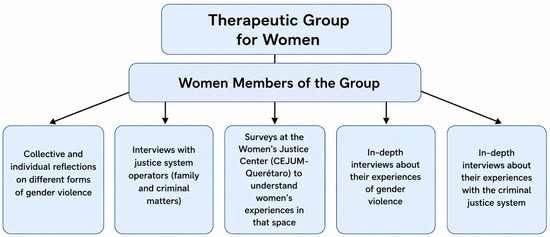
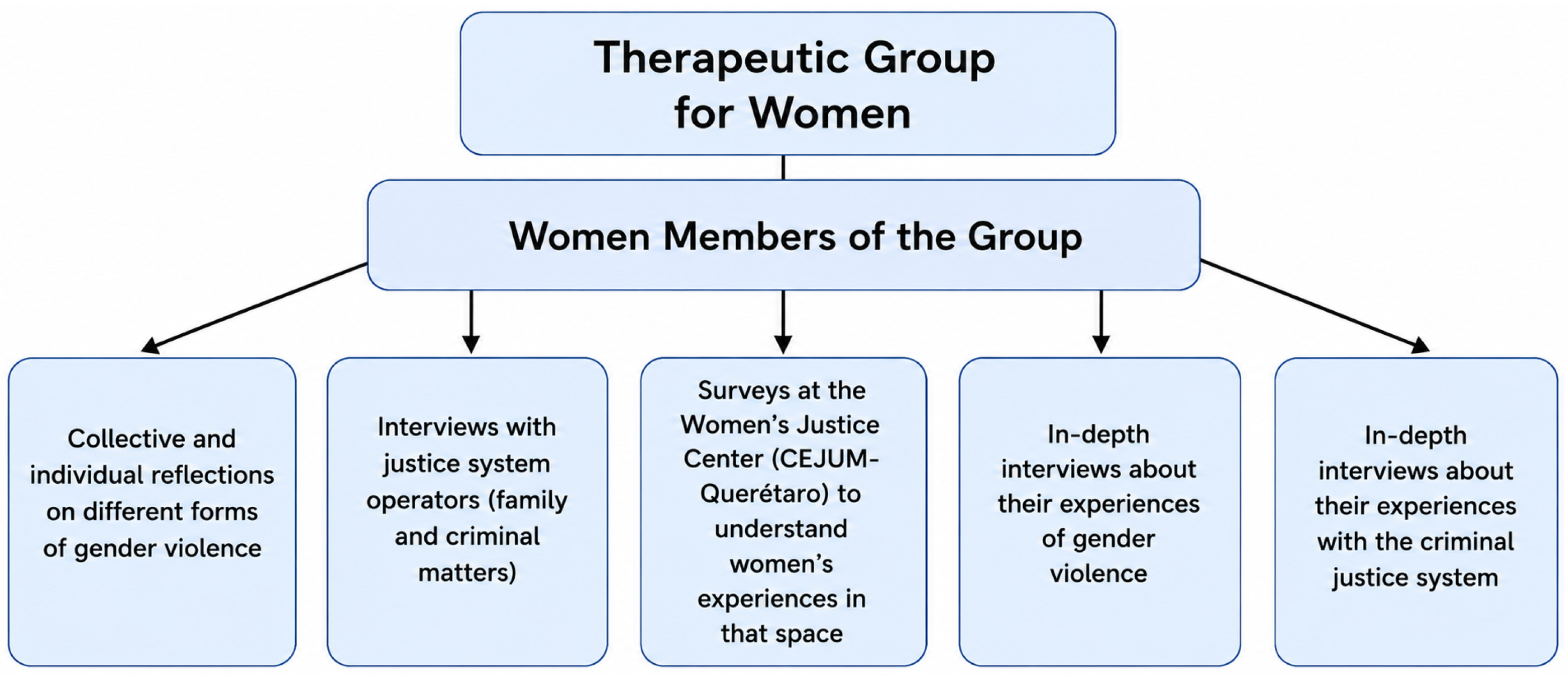
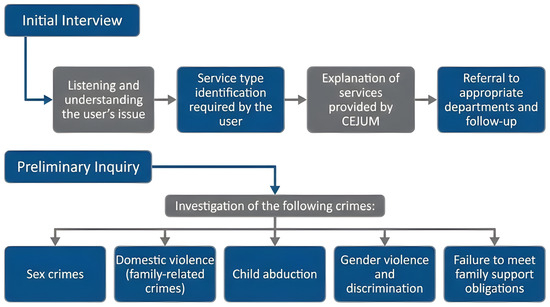
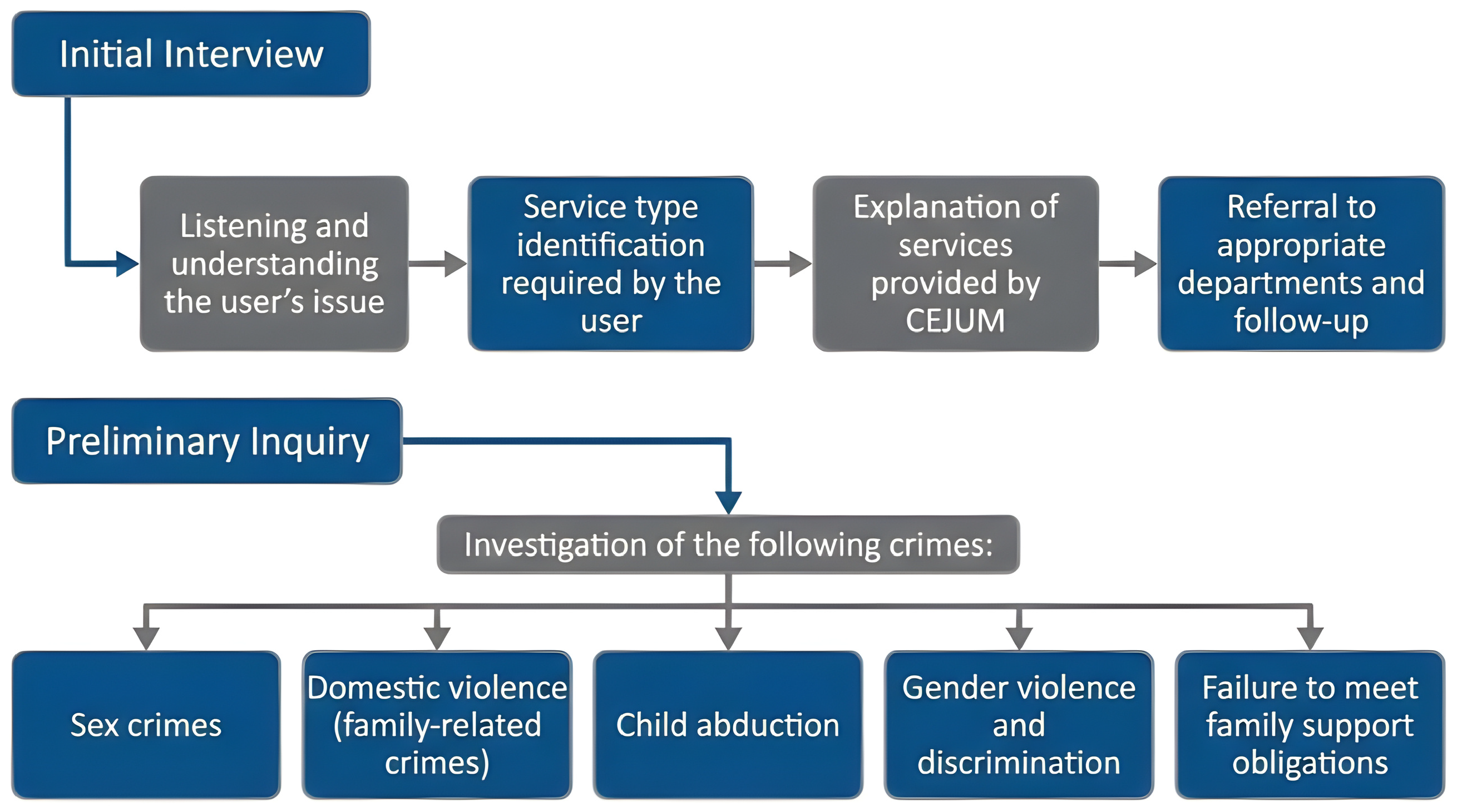
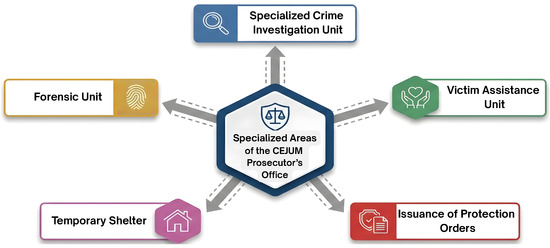
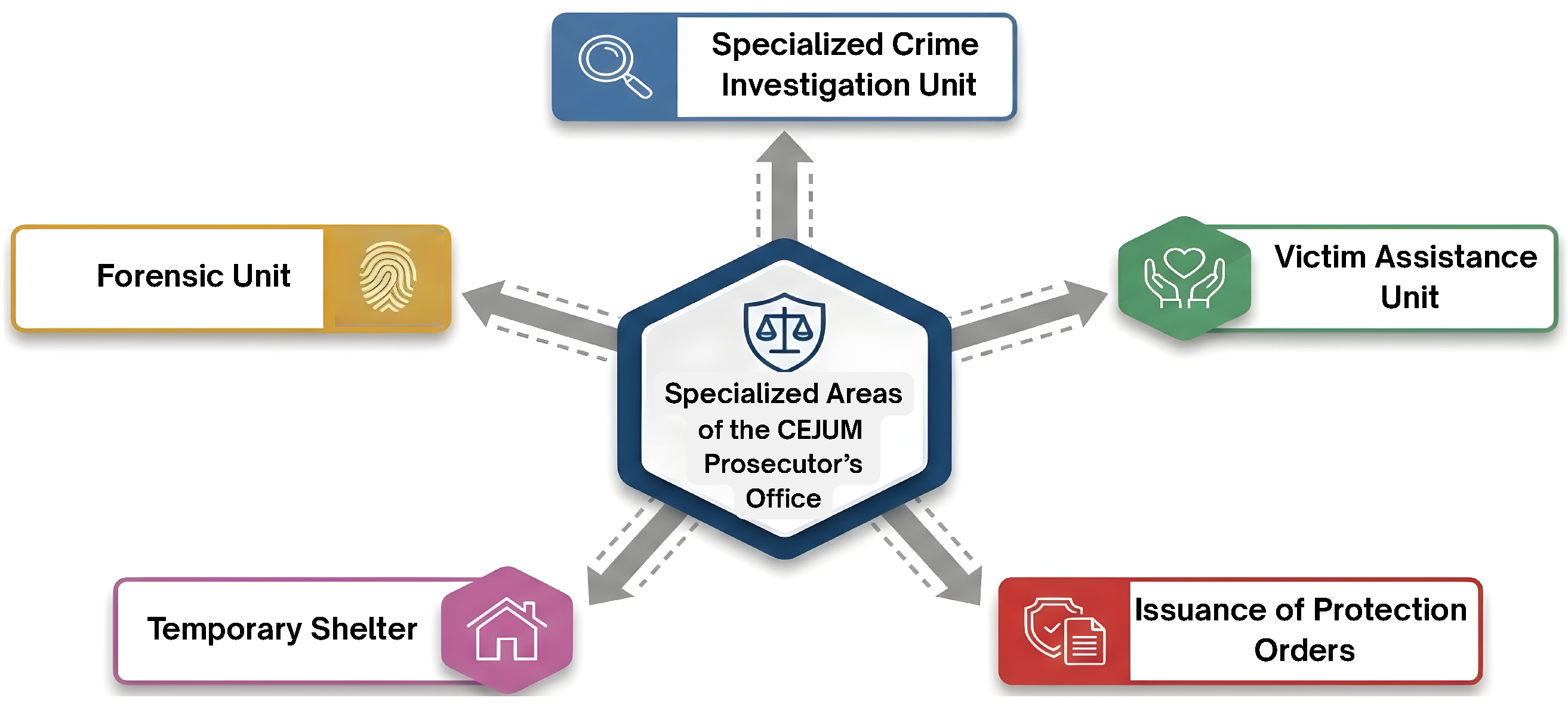
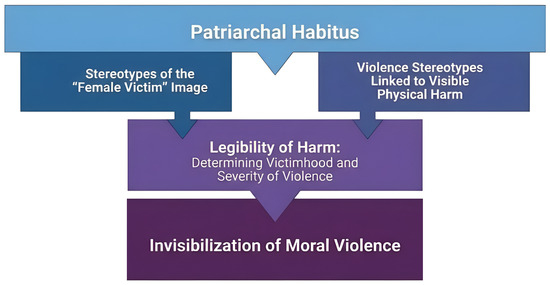
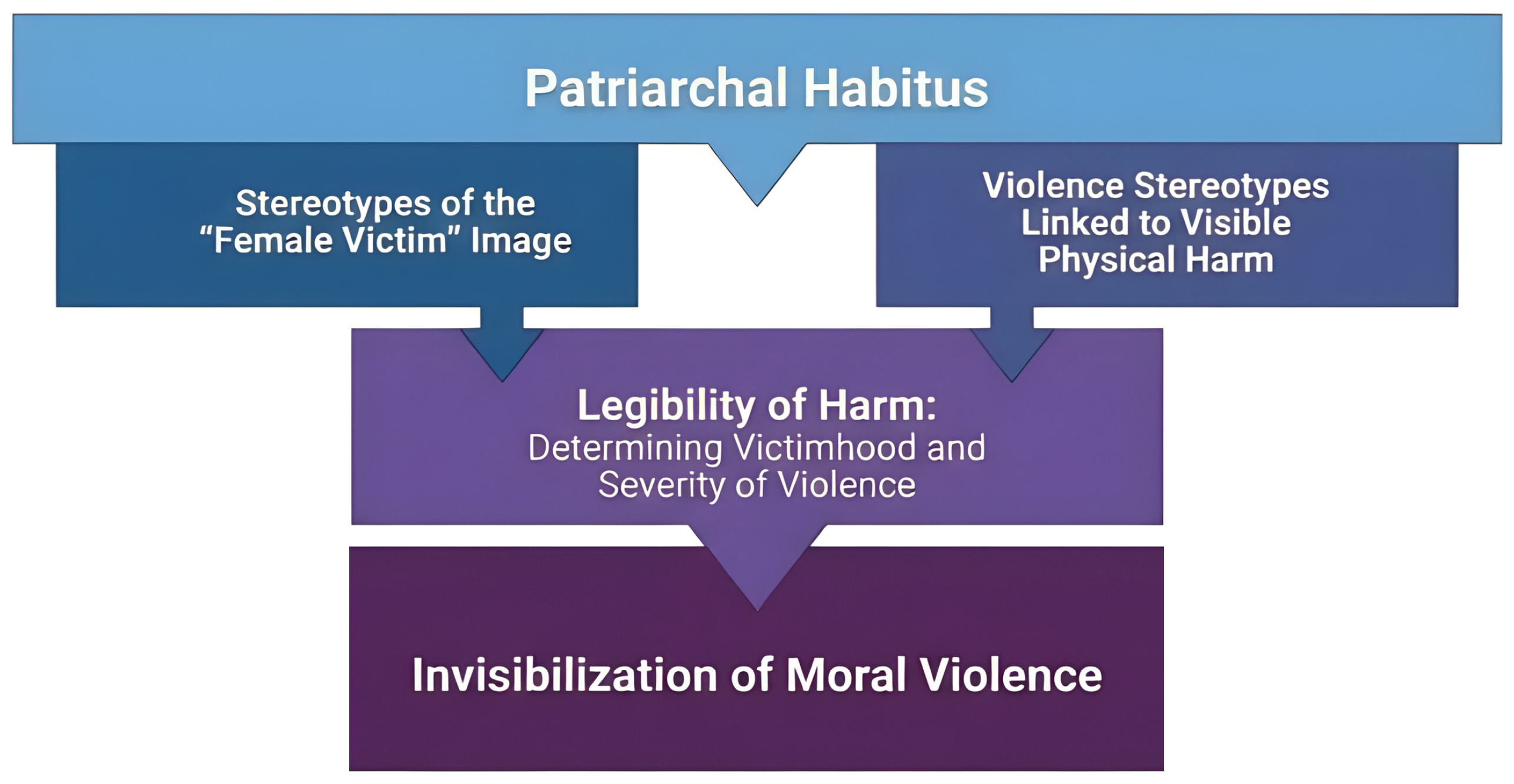

Disclaimer/Publisher’s Note: The statements, opinions and data contained in all publications are solely those of the individual author(s) and contributor(s) and not of MDPI and/or the editor(s). MDPI and/or the editor(s) disclaim responsibility for any injury to people or property resulting from any ideas, methods, instructions or products referred to in the content. |
© 2026 by the authors. Licensee MDPI, Basel, Switzerland. This article is an open access article distributed under the terms and conditions of the Creative Commons Attribution (CC BY) license.