1. Introduction
Public protest has re-emerged as a central feature of political life, particularly in periods of rapid social and economic transformation. The COVID-19 pandemic constituted one of the most significant recent social and political shocks, reshaping patterns of civic participation and temporarily transforming the dynamics of collective action across Europe and beyond. Mobility restrictions, public health policies and heightened political polarisation altered the conditions under which protest could occur, initially reducing street mobilisation while simultaneously fostering new digital networks of coordination and engagement (
Kowalewski 2020;
Kriesi and Oana 2023). In the post-pandemic period, as restrictions were lifted and new socio-economic tensions emerged—including inflation, energy crises and declining political trust—protest activity re-emerged in reconfigured forms combining material grievances with cultural and identity-based claims (
Plümper et al. 2021;
van der Zwet et al. 2022).
Between 2021 and 2023, Europe and Israel witnessed large-scale protest waves surrounding pension reforms, judicial restructuring, rising living costs, gender equality, climate policies and contested questions of democratic governance. These mobilisations highlight the continued relevance of contentious politics as a channel through which citizens articulate grievances, contest political authority and seek to influence public decision-making. While this study analyses individual participation in demonstrations using survey data, protest is understood here not merely as an isolated behavioural act but as the observable outcome of broader collective processes of mobilisation, organisation and identity construction.
Within the broader literature on political participation and social movements, contemporary protest is commonly interpreted through three complementary theoretical traditions. Resource mobilisation theory emphasises the role of organisational infrastructures, social capital and civic skills in facilitating participation (
Jenkins 1983;
McCarthy and Zald 1977). From this perspective, individual resources such as education, political engagement and network embeddedness increase the capacity to participate in demanding forms of political action. In the post-COVID context, these resources increasingly include digital infrastructures and online mobilisation networks developed during periods of social distancing (
Kanilmaz et al. 2024).
Political process and political opportunity approaches explain protest participation through the interaction between individual motivations and changing political contexts (
McAdam 1982;
Meyer 2004;
Tarrow 1998;
Tilly 2004). The pandemic can be interpreted as a temporary disruption of established repertoires of contention, followed by a phase of renewed mobilisation in which accumulated grievances and institutional tensions lowered participation thresholds (
Kriesi and Oana 2023). From this perspective, protest participation reported across the 2018–2023 period reflects not only individual predispositions but also specific stages within a broader European protest cycle shaped by pre-pandemic, pandemic and post-pandemic dynamics.
In addition, the New Social Movements (NSM) paradigm highlights the cultural and identity-based dimensions of contemporary mobilisation (
Melucci 1996;
Offe 1985;
Touraine 1981). Unlike traditional class-based protests centred primarily on economic redistribution, many recent demonstrations are articulated around values, lifestyles and symbolic struggles over autonomy, democratic legitimacy and civil liberties. The pandemic experience intensified these identity-related dimensions, transforming protest into a space of meaning-making and collective identity construction in conditions of prolonged uncertainty (
Benford and Snow 2000;
van Stekelenburg and Klandermans 2013).
Together, these theoretical traditions suggest that protest participation emerges from the interaction between individual resources, political opportunities and collective identity processes. Within this framework, individual-level predictors commonly used in survey research—such as political interest, ideological orientation, education, age, or evaluations of democratic performance—can be interpreted not as isolated behavioural determinants but as micro-level manifestations of broader mobilisation dynamics.
A large body of empirical research has documented that protest participation is not randomly distributed across individuals or countries. At the individual level, studies consistently show that political engagement, ideological orientation, age and education shape the likelihood of engaging in non-electoral forms of participation (
Dalton 2008;
Dalton et al. 2010;
Verba et al. 1995). Protest participation tends to be higher among younger, more educated and politically interested citizens and is often widespread among individuals located on the left side of the ideological spectrum. Evaluative orientations toward the political system—such as satisfaction with democracy, political trust and perceptions of inequality—have also been shown to motivate protest, particularly during periods of declining institutional legitimacy (
Kriesi 2014;
Norris 2011). These perspectives bridge resource-based explanations with grievance-oriented approaches, linking participation to perceptions of democratic performance and distributive justice.
Beyond individual characteristics, a second strand of the literature emphasises the decisive importance of political context. Classic theories of political opportunity structures argue that protest participation is shaped not only by individual motivations and resources but also by the openness of political institutions, elite alignments and broader mobilisation environments (
McAdam 1996;
Meyer 2004;
Tarrow 1998). Comparative research has documented pronounced cross-national differences in protest participation, reflecting variation in protest cultures, institutional arrangements and cycles of mobilisation (
Kriesi et al. 2012;
van der Meer et al. 2009). Yet relatively few studies integrate individual-level predictors with cross-national variation in mobilisation environments within a unified empirical framework.
Beyond its relevance for theories of political participation, contemporary protest mobilisation has increasingly been discussed in connection with the broader agenda of sustainable development. Protest waves frequently emerge in response to distributive conflicts, governance failures, and contested socio-economic and environmental transitions, all of which relate to the social and political pillars of sustainable development (
Fukuda-Parr 2016;
Sachs et al. 2019). While survey data do not directly measure sustainability outcomes, protest participation may nevertheless be interpreted as a behavioural signal of tensions surrounding inequality, democratic accountability and inclusive growth.
Despite these advances, two limitations remain salient in the existing literature. First, relatively few studies simultaneously examine individual predispositions and contextual mobilisation environments. Second, evidence on protest participation across the pre-pandemic and post-pandemic period remains scarce, and few studies have systematically examined whether individual-level determinants of protest are stable across pre-pandemic, pandemic and post-pandemic contexts. The years 2018–2023 constitute a period of exceptional transformation in contentious politics, characterised by the temporary suppression of street mobilisation during the pandemic, followed by renewed and reconfigured protest waves amid overlapping economic shocks, institutional conflicts and renewed debates over democratic legitimacy.
This study addresses these gaps by analysing protest participation using data from Rounds 9, 10 and 11 of the European Social Survey (ESS 2018–2023) ((
European Social Survey European Research Infrastructure (ESS ERIC) 2023a,
2023b,
2025). By combining individual-level predictors with country fixed effects and a multilevel modelling strategy, the analysis provides a comprehensive account of how political engagement, socio-demographic characteristics, economic grievances, democratic evaluations and national contexts jointly shape citizens’ propensity to participate in public demonstrations.
Building on resource mobilisation theory, political process approaches and perspectives from the New Social Movements tradition, the study starts from the expectation that protest participation reflects the interaction between individual political resources, evaluative orientations toward democratic institutions and broader mobilisation environments. Socio-demographic resources such as education and age are expected to shape citizens’ capacity and propensity to engage in demanding forms of collective action, while political interest and ideological self-placement capture motivational and interpretative dimensions linked to contentious engagement, although ideological effects may vary depending on national political alignments and protest contexts. Evaluative attitudes—including satisfaction with democracy, institutional trust and perceptions of inequality—are treated as indicators of perceived legitimacy and grievance formation that may facilitate mobilisation under specific political opportunity structures. Rather than assuming purely individualistic explanations, the analysis therefore examines protest participation as an outcome emerging from the interplay between individual predispositions and cross-national variation in mobilisation contexts across the pre-pandemic, pandemic and post-pandemic protest cycles captured by ESS Rounds 9–11.
The central aim of the study is to examine how individual political predispositions and national mobilisation environments interact in structuring protest participation in Europe across the pre-pandemic, pandemic and post-pandemic periods. Specifically, the article addresses three research questions: (1) which individual-level characteristics and political attitudes are associated with protest participation; (2) to what extent these associations reflect within-country relationships rather than cross-national differences; and (3) whether the identified individual-level associations are stable across distinct mobilisation periods or reflect dynamics specific to particular protest cycles. By doing so, the study contributes to the comparative literature on contentious politics by providing new evidence on the joint micro–macro foundations of protest participation across a period of intensified political conflict and socio-economic strain.
2. Methodology
2.1. Data Source and Sample
This study uses data from Rounds 9, 10 and 11 of the European Social Survey (ESS 2018–2023), a high-quality, cross-national survey that collects nationally representative samples from European countries using strict probability-based sampling procedures (
European Social Survey European Research Infrastructure (ESS ERIC) 2023a,
2025). The three rounds cover the pre-pandemic (Round 9, 2018–2019), pandemic (Round 10, 2020–2022) and post-pandemic (Round 11, 2022–2023) periods, providing a temporally structured comparative framework. The ESS ensures a high level of cross-national comparability through standardised questionnaires, centralized translation protocols and rigorous fieldwork quality controls. The three rounds are analysed both as a pooled cross-sectional dataset and separately, allowing assessment of whether individual-level relationships identified in Round 11 are stable across different mobilisation contexts. The unit of analysis is the individual respondent. The analytical sample includes all respondents with valid information on protest participation and on the main independent variables of interest. Respondents with missing information on any variables included in the models were excluded from the analysis. All remaining missing values were handled through listwise deletion in the regression models. Consequently, all descriptive statistics and regression models are based on the complete-case analytical sample. The selection of individual-level covariates was guided by key theoretical perspectives from the study of social movements and political participation. In line with resource mobilisation approaches, socio-demographic characteristics such as education and age are interpreted as indicators of civic resources that may facilitate participation. Political process theories motivate the inclusion of political interest and ideological self-placement as markers of engagement and interpretative positioning within contentious politics, while evaluative attitudes toward democracy, institutional trust and inequality perceptions capture grievance formation and legitimacy evaluations associated with mobilisation dynamics. Accordingly, the operationalisation of variables reflects the expectation that protest participation emerges from the interaction between individual political resources, perceived democratic performance and broader mobilisation environments.
While the New Social Movements tradition highlights collective identity, framing and cultural dimensions of mobilisation as central drivers of contentious participation, these processes cannot be directly operationalised using standard ESS survey items. The variables included in the analysis capture individual-level manifestations of broader mobilisation dynamics—political interest, ideological orientation and democratic evaluations—which may be interpreted as partial proxies for the motivational and interpretative dimensions emphasised by NSM approaches, without directly measuring the relational and cultural processes through which collective identities are constructed.
All data management and statistical analyses were conducted using the R statistical software environment.
2.2. Dependent Variable: Protest Participation
Protest participation was measured using the ESS item Taken part in a public demonstration during the last 12 months, available as pbldmn in Round 9 and as pbldmna in Rounds 10 and 11. Response categories are identical across rounds: 1 = Yes, 2 = No, 7 = Refusal, 8 = Don’t know, 9 = No answer. The two variables were harmonised into a single binary indicator: 1 = participated and 0 = did not participate. Refusals, don’t know and missing answers (codes 7–9) were treated as missing values and excluded from the analysis. This operationalization follows standard practice in studies of non-electoral political participation using ESS data.
2.3. Independent Variables
Economic Conditions and Inequality
Objective household income was measured using the ESS post-tax household income deciles variable (hinctnta), which places respondents into ten income categories ranging from 1 (lowest decile) to 10 (highest decile). Refusals, “don’t know” and missing answers (codes 77, 88 and 99) were recoded as missing values.
To facilitate interpretation and to allow for potential non-linearities in the relationship between income and protest participation, this variable was recoded into three income groups: Low income (deciles 1–3), Middle income (deciles 4–7), High income (deciles 8–10). The low-income category was used as the reference group in the regression models.
Subjective financial hardship was measured using the item “How difficult is it to live on present income” (hincfel), coded on a four-point ordinal scale ranging from 1 (“living comfortably”) to 4 (“very difficult”). Higher values indicate greater subjective economic strain. Non-substantive responses were treated as missing values.
Perceptions of income inequality were measured using the item “Government should reduce income differences” (gincdif). Responses were coded on a five-point scale ranging from 1 (“agree strongly”) to 5 (“disagree strongly”). Higher values indicate weaker support for redistribution and, implicitly, lower perceived urgency of income inequality. Non-substantive responses were treated as missing values.
These variables capture economic resources and distributive grievances, which resource mobilisation and grievance-based approaches identify as potential drivers of participation in contentious politics.
2.4. Political Trust and Democratic Legitimacy
Political institutional trust was measured using an index combining three ESS items: trust in parliament (trstprl), trust in politicians (trstplt) and satisfaction with the national government (stfgov). The variable stfgov (satisfaction with the national government) was used in place of the standard trust in government item (trstgov), which was not available in the integrated multi-round dataset used for this analysis. Each item was measured on an eleven-point scale ranging from 0 to 10. Refusals, “don’t know” and missing answers (codes 77, 88 and 99) were treated as missing values. An index (trust_index) was constructed as the arithmetic mean of the three items, yielding a continuous scale ranging from 0 to 10. Higher values indicate higher levels of political institutional trust.
Democratic legitimacy was further captured using the item “Satisfaction with the way democracy works in [country]” (stfdem), coded on an eleven-point scale ranging from 0 (“extremely dissatisfied”) to 10 (“extremely satisfied”). Higher values indicate greater satisfaction with democratic performance. Non-substantive responses were recoded as missing values.
These indicators reflect evaluative orientations toward political institutions, which political process theories link to perceptions of legitimacy and opportunity structures shaping protest participation.
2.5. Control Variables
Several socio-demographic and political control variables were included in all models.
Gender differences in political participation have been widely documented, although findings regarding protest remain mixed. Gender was coded as a binary variable (male), with 1 = male and 0 = female.
Age was included to capture life-cycle effects and generational differences in protest repertoires documented in participation research. It was measured in years (agea). The value 999 was treated as missing.
Education is commonly interpreted as a proxy for civic skills and political resources, facilitating participation in demanding forms of collective action. Education was measured as the number of years of full-time education completed (eduyrs). Refusals, “don’t know” and missing answers (codes 77, 88 and 99) were treated as missing values.
Political interest captures motivational resources associated with political engagement and mobilisation capacity. Political interest was measured using the item “How interested are you in politics” (polintr), coded on a four-point scale ranging from 1 (“very interested”) to 4 (“not at all interested”). Higher values indicate lower political interest. Non-substantive responses were treated as missing values.
Ideological self-placement is included as an indicator of political alignment and value orientation, which may shape engagement in contentious politics through conflict framing and issue positioning. It was measured using the left–right scale (lrscale), ranging from 0 (“left”) to 10 (“right”). Refusals, “don’t know” and missing answers were recoded as missing values.
2.6. Analytical Strategy
Given the binary nature of the dependent variable, logistic regression models were estimated to examine the individual and contextual determinants of protest participation.
The baseline model included four main blocks of predictors:
Socio-demographic characteristics: gender, age, education and income group
Political orientation and engagement: political interest and left–right self-placement
Economic grievances and inequality: objective income, subjective financial hardship and perceptions of income inequality
Political legitimacy: institutional trust and satisfaction with democracy
The general model specification can be expressed as:
Protest participation = f (gender, age, education, income, political interest, ideology, financial hardship, inequality perceptions, political trust, satisfaction with democracy)
To account for unobserved heterogeneity across countries, additional models included country fixed effects. A multilevel logistic regression with random intercepts for countries was also estimated to explicitly model cross-national heterogeneity in baseline protest propensity.
To assess the temporal stability of the identified relationships, the baseline and fixed-effects models were estimated separately for each ESS round (Round 9: 2018–2019; Round 10: 2020–2022; Round 11: 2022–2023), covering the pre-pandemic, pandemic and post-pandemic periods respectively. This cross-round comparison allows evaluation of whether the individual-level associations identified in Round 11 reflect stable structural patterns or period-specific dynamics tied to the exceptional mobilisation context of 2022–2023.
All models were estimated using listwise deletion for missing data. Missing data rates vary considerably across variables: income shows the highest rate of non-response (20.8%), followed by ideological self-placement (13.4%), while other variables show missing rates below 5%. A comparison of protest participation rates between the full sample with valid protest responses (7.8%) and the complete-case analytical sample (8.5%) indicates a modest upward bias introduced by listwise deletion, likely reflecting the systematic exclusion of less politically engaged and lower-income respondents who are more likely to have missing values on income and ideology items. This pattern is consistent across all three rounds. Results should therefore be interpreted with the caveat that the analytical sample may slightly overrepresent politically engaged citizens, which could lead to a modest overestimation of the effects of political interest and ideology. Results are reported as odds ratios with 95% confidence intervals. Model fit was assessed using the Akaike Information Criterion and likelihood-ratio tests.
3. Results
3.1. Descriptive Statistics of the Main Variables
Table 1 reports descriptive statistics for the main variables included in the analysis. The dependent variable indicates whether respondents reported having participated in a public demonstration during the previous twelve months. In the pooled sample across all three ESS rounds, 8.5% of respondents reported protest participation, while 91.5% reported no participation. Participation rates were remarkably stable across rounds: 8.5% in Round 9 (2018–2019), 8.6% in Round 10 (2020–2022) and 8.5% in Round 11 (2022–2023).
The sample is balanced in terms of gender, with 48.6% men and 51.4% women. The mean age of respondents is approximately 51.6 years (median = 52), with a range from 15 to 90 years. Educational attainment shows substantial variation, with a median of 13 years of completed education.
Household income is distributed across three categories, with 26.9% of respondents in the low-income group, 43.9% in the middle-income group and 29.1% in the high-income group. Subjective financial difficulty is concentrated in the lower categories, with approximately half of respondents reporting either living comfortably or coping on present income and the remainder reporting varying degrees of difficulty.
Political attitudes exhibit wide dispersion. Political interest is highest in the middle categories of the scale, while ideological self-placement clusters around the centre, with a median value of 5 on the left–right scale (with nearly one-third of respondents selecting the midpoint of the scale). Satisfaction with democracy displays a mean of 5.36, indicating moderate levels of democratic satisfaction across the sample. The constructed political trust index has a mean value of 4.29 on a 0–10 scale. These descriptive patterns provide a first indication of substantial heterogeneity in both political engagement and protest participation across individuals and countries.
3.2. Cross-National Patterns of Protest Participation
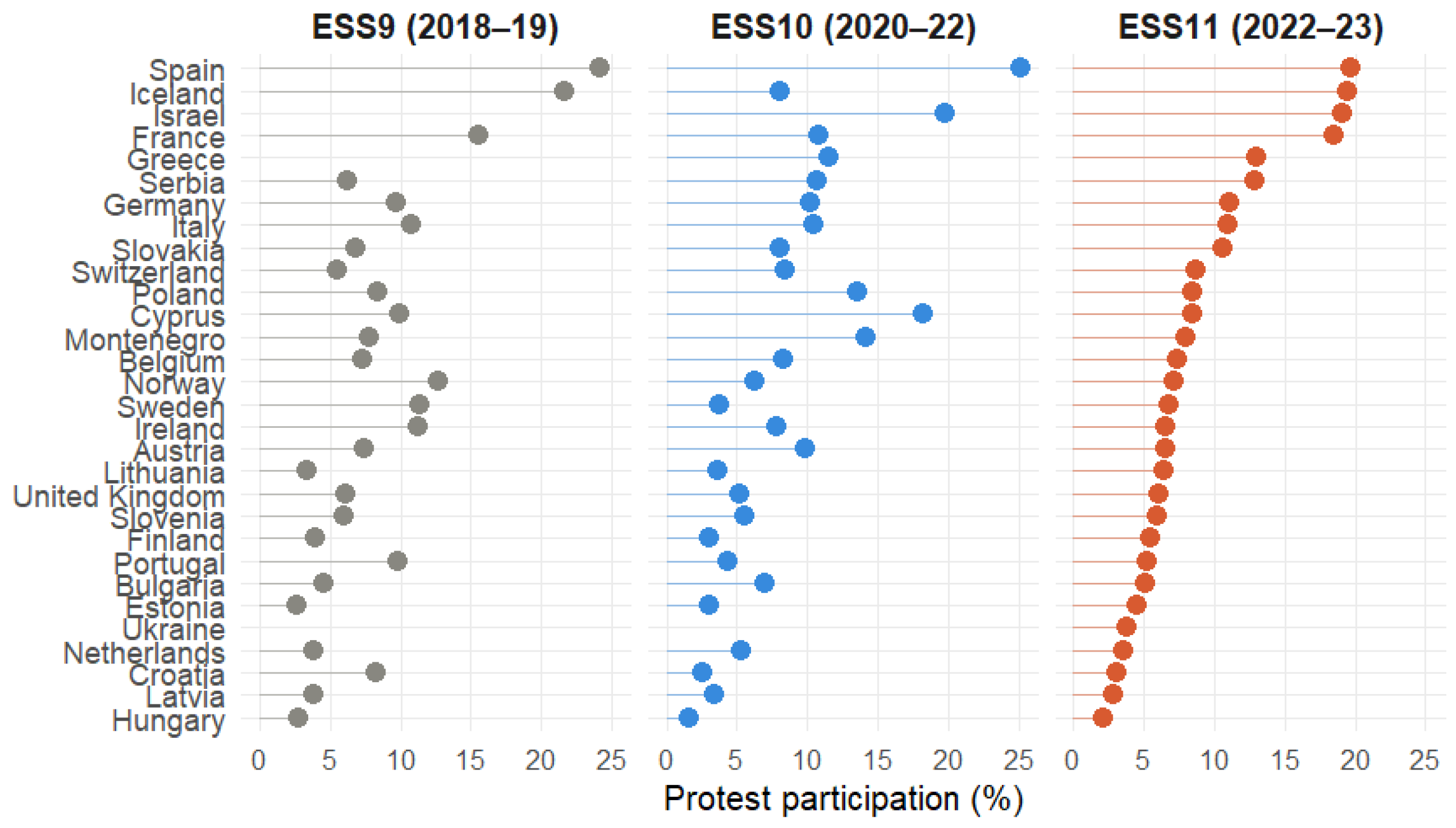
Figure 1 and
Table 2 display substantial cross-national variation in reported protest participation across the countries reported in the three ESS rounds included in the analysis. Participation rates range from below 3% in several Central and Eastern European countries to nearly 25% in the most mobilised contexts. Countries not present in all three rounds (Czechia, Denmark, North Macedonia) are excluded. Israel and Greece entered the ESS from Round 10 onwards and therefore have no data for Round 9. Participation rates are calculated on the complete-case analytical sample.
Table 2 reports the top 10 countries by protest participation for each round separately, revealing both persistent patterns and notable shifts across the pre-pandemic, pandemic and post-pandemic periods.
Participation rates in
Figure 1 and
Table 2 are calculated on the full ESS sample with valid responses on the protest participation item. Regression analyses in (
Table 3,
Table 4,
Table 5 and
Table 6) are based on the complete-case analytical sample after listwise deletion (N = 106,106), which accounts for minor differences in participation rates between descriptive and regression sections.
Several patterns emerged from this cross-round comparison. Spain consistently ranks first across all three rounds, with participation rates between 19.7% and 25.2%, reflecting a sustained protest culture driven by overlapping economic, political and regional conflicts. France and Germany also appear in the top 10 across all rounds, indicating stable high-mobilisation environments. Italy also maintains consistently elevated participation throughout the period.
At the same time, notable shifts are evident. Iceland displays a dramatic drop during the pandemic period (21.7% in ESS9 to 8.0% in ESS10), likely reflecting mobility restrictions, followed by a full recovery in ESS11 (19.5%). A similar pandemic-period decline is observed in Norway (from 12.7% to 6.3%) and Sweden (from 11.4% to 3.7%), neither of which returns to pre-pandemic levels in ESS11.
Poland shows a spike in ESS10 (13.6%), coinciding with mass protests against the near-total abortion ban in 2020–2021, followed by a return to pre-pandemic levels in ESS11 (8.4%). Cyprus exhibits the opposite pattern, with an unusually high ESS10 rate (18.2%) that does not persist into ESS11 (8.4%).
By contrast, several countries show consistently low levels of protest activity across all rounds, including Hungary, Latvia and Croatia, where participation remains below 4% throughout the observation period.
These cross-round patterns suggest that while some national protest environments are structurally stable, others are more sensitive to specific political events and mobilisation cycles—a distinction that the regression analyses in the following sections address directly. The results indicate pronounced cross-national heterogeneity in protest participation and suggest that national contexts play a central role in shaping citizens’ propensity to engage in contentious political action (
Kriesi et al. 2012;
van der Meer et al. 2009).
3.3. Individual-Level Correlates of Protest Participation
Table 3 reports the results of the baseline logistic regression model estimating individual-level determinants of protest participation on the pooled three-round sample. Several socio-demographic and political variables emerge as significant predictors.
Age was strongly and negatively associated with protest participation. Each additional year of age was associated with a decrease of approximately 2% in the odds of participation (OR = 0.98, p < 0.001), indicating that younger respondents are substantially more likely to engage in protest activities. Education exhibits a positive and highly significant effect: each additional year of schooling increases the odds of participation by roughly 6% (OR = 1.06, p < 0.001).
Among political attitudes, political interest emerges as the strongest individual-level predictor. Higher levels of political interest are associated with markedly lower odds ratios (OR = 0.55,
p < 0.001), reflecting a powerful association between political engagement and protest behaviour (
Dalton 2008;
Verba et al. 1995) (Higher values indicate lower interest; therefore, OR < 1 implies that politically interested respondents are more likely to protest.). Ideological orientation also plays a significant role: respondents positioned further to the right on the left–right scale are significantly less likely to protest (OR = 0.86,
p < 0.001). Evaluative attitudes toward the political system further shape protest behaviour. Both lower satisfaction with democracy (OR = 0.94,
p < 0.001) and weaker political trust (OR = 0.95,
p < 0.001) are associated with higher protest propensity, while perceptions of income inequality are also associated with higher protest propensity (OR = 0.87,
p < 0.001), suggesting that protest is more prevalent among those who perceive distributive arrangements as unfair.
By contrast, several socio-economic variables display weak or inconsistent effects. Gender and subjective financial difficulty are not significantly associated with protest participation. Subjective financial difficulty approaches but does not reach conventional significance thresholds (OR = 0.97, p = 0.060).
The results indicate that protest participation is primarily driven by political engagement, ideological positioning and critical orientations toward democratic institutions, while material circumstances play a secondary and inconsistent role.
3.4. Country Fixed Effects and Robustness of Individual Predictors
To assess whether the observed individual-level effects reflect genuine intra-country relationships or are driven by cross-national differences, a second model including country fixed effects was estimated (
Table 4).
Model comparison strongly supports the inclusion of country effects. The Akaike Information Criterion decreases from 56,005 in the baseline model to 54,078 in the fixed-effects specification and a likelihood ratio test confirms a highly significant improvement in model fit (χ2(32) =1990.9, p < 0.001).
Importantly, the inclusion of country fixed effects leaves the core individual-level predictors largely unchanged. Age, education, political interest, ideological orientation, satisfaction with democracy and political trust remain highly significant and retain comparable. effect sizes to the baseline model. This stability indicates that these associations reflect robust intra-country relationships rather than spurious cross-national correlations.
The inclusion of country fixed effects does, however, produce two notable shifts. First, household income becomes fully non-significant once country effects are introduced, confirming that the modest income gradient observed in the baseline model reflects between-country variation rather than within-country socio-economic stratification. Second, subjective financial difficulty becomes marginally significant (OR = 0.96, p = 0.015)—a pattern that the round-by-round analysis in the following section shows to be driven primarily by the pre-pandemic period.
The fixed-effects model demonstrates that protest participation is shaped by a stable set of political and attitudinal predictors across national contexts, while individual economic resources play a limited and temporally variable role.
3.5. National Contexts and Protest Participation (Multilevel Model)
To account for the hierarchical structure of the data and explicitly model cross-national heterogeneity, a multilevel logistic regression with a random intercept for countries and a fixed effect for ESS round was estimated (
Table 5).
The model indicates substantial between-country variation in protest participation (SD = 0.554; variance = 0.307), confirming that national contexts play a role in shaping citizens’ propensity to engage in demonstrations, with the ICC of 0.085 indicating that approximately 8.5% of the unexplained variation in protest participation is located at the country level. Model fit improves markedly compared to the baseline logistic specification (AIC = 54,162 vs. 56,005), supporting the inclusion of a country-level random component.
Importantly, the multilevel specification leaves the pattern of individual-level effects largely unchanged. Political interest, ideological orientation, age, education, satisfaction with democracy and perceptions of inequality remain strong and highly significant predictors of protest participation, with effect sizes closely mirroring those observed in the baseline and fixed-effects models. This stability indicates that the associations identified earlier are not driven by model specification but reflect robust individual-level relationships. Income remains non-significant. Subjective financial difficulty reaches marginal significance (OR = 0.96, p = 0.014), consistent with the fixed-effects results.
The round effects are substantively informative. Controlling for individual predictors and country-level heterogeneity, protest participation was significantly lower in Round 10 (OR = 0.87, p < 0.001) compared to the pre-pandemic baseline of Round 9, reflecting the suppressive effect of pandemic mobility restrictions on street mobilisation. Round 11 also shows somewhat lower participation than Round 9 (OR = 0.94, p = 0.045), though the gap is considerably smaller, indicating a partial but incomplete recovery of protest activity in the post-pandemic period.
The multilevel results confirm that protest participation is primarily structured by stable individual-level political predispositions, while national contexts and temporal period shape baseline levels of mobilisation without altering the underlying individual-level mechanisms.
3.6. Temporal Stability of Individual-Level Predictors Across ESS Rounds
To directly address whether the individual-level associations identified in the pooled models reflect stable structural relationships or period-specific dynamics, the baseline fixed-effects model was estimated separately for each ESS round (
Table 6). This cross-round comparison covers the pre-pandemic (Round 9, 2018–2019), pandemic (Round 10, 2020–2022) and post-pandemic (Round 11, 2022–2023) periods.
The results reveal a consistent pattern across all three rounds. Political interest, ideological self-placement, age, education, perceived inequality, political trust and satisfaction with democracy remain statistically significant predictors with virtually identical effect sizes across rounds, indicating that these associations reflect stable structural relationships rather than period-specific dynamics tied to any particular mobilisation cycle.
Only two predictors show temporal variation. Subjective financial difficulty is significant in Round 9 (OR = 0.908, p < 0.01) but loses significance in Rounds 10 and 11, suggesting that individual hardship was a more relevant driver of protest in the pre-pandemic period. Gender shows a similar pattern—marginally significant in Round 9 but absent thereafter. Household income remains non-significant across all three rounds once country effects are controlled.
4. Discussion
This study examined individual and contextual determinants of protest participation using data from Rounds 9, 10 and 11 of the European Social Survey, covering the pre-pandemic (2018–2019), pandemic (2020–2022) and post-pandemic (2022–2023) periods By combining individual-level predictors with country fixed effects, a multilevel specification and a systematic cross-round comparison, the analysis provides a detailed account of how political engagement and national protest contexts jointly shape citizens’ propensity to participate in public demonstrations—and whether these relationships remain stable across distinct mobilisation periods.
4.1. Individual-Level Determinants of Protest Participation
With respect to individual predispositions, the findings highlight the central role of political engagement and political orientations in structuring protest behaviour. Political interest emerges as the strongest individual-level predictor across all model specifications. Even after controlling for socio-demographic characteristics, ideological positioning, evaluations of democracy and country-specific factors, politically interested respondents remain substantially more likely to engage in protest activities. This result underscores the importance of cognitive and motivational resources for participation in contentious politics and confirms that protest participation is primarily a form of politically engaged behaviour rather than a reaction driven by socio-economic hardship alone. This interpretation is consistent with resource mobilisation theory, which emphasises that participation in demanding forms of collective action requires cognitive engagement, organisational resources and civic skills rather than solely material grievances (
Jenkins 1983;
McCarthy and Zald 1977). At the same time, framing approaches highlight how politically engaged individuals are more likely to interpret grievances through collective action frames that legitimise protest participation (
Benford and Snow 2000).
Ideological orientation constitutes a second major individual-level determinant. Respondents positioned further to the right on the left–right scale are consistently less likely to report protest participation. This pattern suggests a systematic ideological asymmetry in contentious political action in contemporary Europe, with protest remaining prevalent among respondents located on the left side of the political spectrum (
Dalton et al. 2010;
Kriesi et al. 2012). Importantly, this association proves highly robust to the inclusion of country fixed effects and contextual indicators, indicating that ideological differences operate primarily within countries rather than reflecting cross-national compositional effects. From the perspective of political process theory, ideological positioning can also be understood as reflecting alignment with broader conflict structures and opposition dynamics within national political arenas, which shape the perceived legitimacy and strategic relevance of protest (
McAdam 1996;
Tarrow 1998). Moreover, research within the New Social Movements tradition suggests that ideological orientations may capture underlying value conflicts and identity-based repertoires that structure contemporary mobilisation beyond traditional class cleavages (
Melucci 1996;
Offe 1985;
Touraine 1981).
Age and education also display strong and stable associations with protest participation. Younger respondents are substantially more likely to protest, while higher levels of education are associated with increased participation. These findings are consistent with the interpretation of protest as a politically demanding form of participation that requires both political motivation and civic skills (
Gallego 2007;
Verba et al. 1995). In contrast, gender and subjective financial difficulty do not exert independent effects once political attitudes and contextual factors are taken into account.
Evaluative orientations toward the political system further shape protest behaviour. Lower satisfaction with democracy is systematically associated with higher protest participation, suggesting that protest is closely linked to critical attitudes toward democratic performance (
Kriesi 2014;
Norris 2011). Similarly, perceptions of income inequality are negatively associated with participation, indicating that protest is more likely among respondents who perceive distributive arrangements as unfair. Political institutional trust also exerts a consistent negative effect across all model specifications, with higher trust associated with lower protest propensity. This finding suggests that generalised political trust operates as a distinct dimension of legitimacy evaluation, complementing rather than duplicating the effect of satisfaction with democracy (
Norris 2011;
Vasilopoulou and Halikiopoulou 2023).
The cross-round comparison reported in
Table 6 further confirms the temporal stability of these individual-level associations. Political interest, ideological orientation, age, education, perceived inequality and democratic satisfaction retain virtually identical effect sizes across the pre-pandemic, pandemic and post-pandemic periods, indicating that these relationships reflect stable structural patterns rather than dynamics specific to any particular mobilisation cycle. Two predictors show limited temporal variation: subjective financial difficulty is significant in the pre-pandemic period but loses explanatory power in subsequent rounds, while gender differences in protest participation, present in Round 9, disappear in the pandemic and post-pandemic periods—a pattern potentially reflecting the broader feminisation of protest repertoires in recent years (
Hunger and Lorenzini 2020).
The individual-level results point to a coherent pattern: protest participation is primarily driven by political engagement, ideological positioning and critical evaluations of democratic performance, while socio-economic resources play a limited and largely indirect role. These findings reinforce interpretations of protest as a form of politically sophisticated participation rather than as an expression of marginalisation or economic distress.
4.2. The Role of National Context and Country Fixed Effects
Beyond individual characteristics, the analysis reveals the decisive importance of national contexts. The inclusion of country fixed effects substantially improves model fit and accounts for a large share of the unexplained variance in protest participation. At the same time, the stability of the core individual-level coefficients across specifications demonstrates that the observed associations are not artefacts of cross-national differences but reflect genuine within-country relationships.
An important implication of the fixed-effects results concerns the role of income. While household income exhibits a modest positive association with protest participation in the baseline model, this effect disappears once country fixed effects are introduced. This pattern indicates that income differences in protest participation are largely attributable to between-country variation rather than to socio-economic stratification within countries (
Hutter 2014;
Kriesi et al. 2012). In contrast, political attitudes and evaluative orientations remain highly robust, suggesting that political engagement constitutes a universal driver of protest across diverse national contexts.
The fixed-effects analysis thus highlights a dual structure of protest participation. On the one hand, individual-level political predispositions exert stable effects within countries. On the other hand, substantial cross-national heterogeneity persists, pointing to the importance of macro-level opportunity structures and mobilisation environments that shape the overall prevalence of protest.
Consistent with this interpretation, the multilevel specification further confirms the substantive role of national contexts. The estimated random intercept for countries (SD = 0.554) indicates meaningful cross-national differences in baseline levels of protest participation that persist even after controlling for individual-level predictors. This pattern aligns with political opportunity approaches and comparative research emphasising how institutional environments and mobilisation cultures shape participation beyond individual predispositions (
Kriesi et al. 2012;
McAdam 1996;
Meyer 2004;
Tarrow 1998;
van der Meer et al. 2009).
Such contextual variation resonates with classic arguments that protest participation is embedded in broader cycles of contention and political opportunity structures, where shifts in institutional openness, elite alignments and mobilisation infrastructures alter participation thresholds across countries (
McAdam 1996;
Tarrow 1998;
Tilly 2004).
The consistently low levels of protest participation observed across post-communist countries—including Hungary, Latvia, Croatia and Bulgaria—are consistent with a well-documented pattern in the comparative literature, which attributes lower contentious mobilisation in these contexts to legacies of state socialism, weaker civic infrastructures and historically lower levels of generalised social trust (
Howard 2012;
Ekiert and Kubik 1999). While the present analysis does not directly model these structural differences, their persistence across all three ESS rounds suggests that post-communist protest cultures constitute a relatively stable contextual constraint on mobilisation that operates independently of individual-level political predispositions.
4.3. Interpreting Cross-National Variation in Protest Participation
The cross-national distribution of protest participation closely reflects the major episodes of political and social mobilisation that characterised Europe and Israel in 2022–2023 (
della Porta 2020;
Kriesi et al. 2020). In several countries where participation levels were comparatively high in the ESS data, elevated participation rates coincide with periods of intense political conflict, contested institutional reforms, or acute socio-economic pressures.
France represents the clearest illustration of this dynamic. The exceptionally high participation rate observed in the French case coincides with the mass protests against the 2023 pension reform, which raised the statutory retirement age from 62 to 64. These mobilisations involved repeated nationwide strikes and demonstrations with millions of participants and constituted one of the largest waves of contentious action in recent French history.
Israel constitutes a particularly salient case of institutionally driven mobilisation. Throughout 2023, unprecedented and sustained protests emerged in response to the government’s proposed judicial reforms, widely perceived as undermining democratic checks and balances. Weekly demonstrations involving hundreds of thousands of participants created an unusually dense mobilisation environment, which is closely mirrored in the elevated protest participation reported in the survey data.
Greece continues to display high levels of contentious politics in the post-crisis period. Protest activity intensified following the fatal railway accident in Tempi in February 2023, which was widely interpreted as the result of state negligence and corruption and was further fuelled by persistent grievances related to inflation, wages and the cost of living. These episodes reflect the enduring salience of institutional distrust and socio-economic vulnerability in shaping mobilisation in the Greek case.
In Serbia, high protest participation coincides with the emergence of the “Serbia Against Violence” movement in spring and summer 2023, following two mass shootings. The subsequent weekly marches in Belgrade and other cities rapidly evolved into a broad anti-government mobilisation From the perspective of political opportunity theory, Serbia represents an instructive outlier: despite comparatively weak democratic institutions and limited civic infrastructure, the sustained mobilisation observed here illustrates how critical focusing events can function as collective shocks that lower individual participation thresholds simultaneously for large segments of the population, generating rapid and sustained contentious action even where structural opportunity structures are constrained (
Granovetter 1978;
McAdam 1996;
Tarrow 1998).
Germany and Italy represent cases in which multiple overlapping issue domains contributed to elevated mobilisation. In Germany, climate protests linked to the Lützerath eviction and Fridays for Future campaigns intersected with demonstrations related to energy prices and inflation during 2022–2023. In Italy, trade-union mobilisations and social protests over the cost of living, wages and energy prices combined with demonstrations opposing key policy orientations of the Meloni government, particularly in the fields of civil rights and migration.
Spain and Iceland further illustrate the breadth of mobilisation drivers in high-participation contexts. In Spain, protest activity reflected a combination of economic grievances, housing affordability, feminist mobilisations and persistent political tensions surrounding regional autonomy and institutional reform. In Iceland, despite its small population, repeated waves of protest related to public sector negotiations, housing shortages, environmental conflicts and cost-of-living pressures contributed to the highest observed participation rate in the sample. Iceland presents a theoretically interesting case in a different sense: its consistently high participation rates sit alongside favourable socio-economic conditions and comparatively strong democratic institutions. This pattern suggests that in contexts with well-established protest cultures and dense civic networks, participation may become normalised and relatively decoupled from acute grievances—a form of routinised contention in which the threshold for engagement is structurally low regardless of immediate political pressures (
della Porta and Diani 2006;
Kriesi et al. 2012).
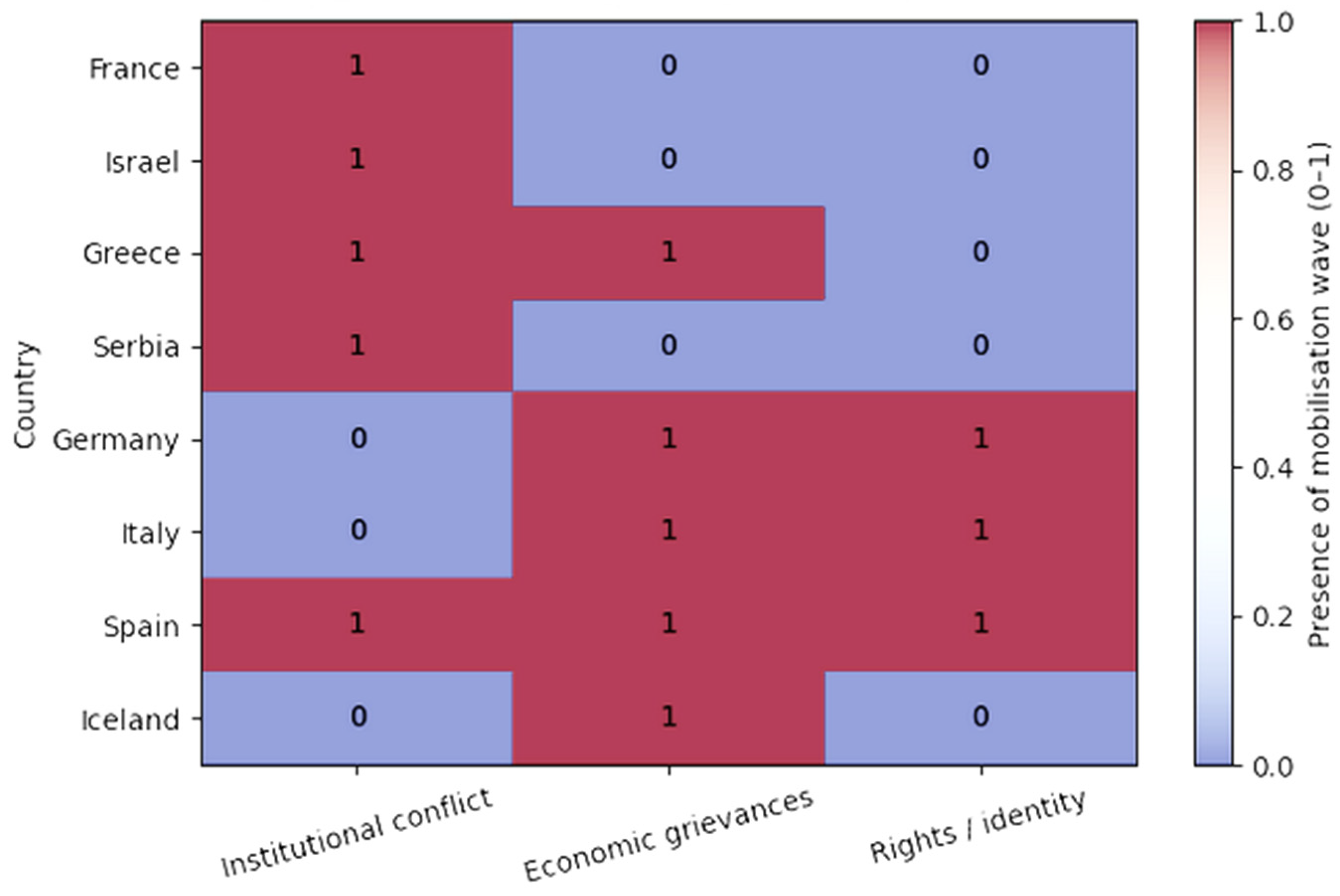
Taken together, these country cases indicate that high protest participation is frequently linked to periods of institutional conflict, contested reforms and declining democratic legitimacy, as well as with acute socio-economic pressures and highly visible mobilisation campaigns. Across contexts, protest waves appear to be triggered primarily by three broad clusters of grievances: (i) institutional and democratic conflicts (judicial reforms, pension reforms, governance crises), (ii) economic and distributive grievances (inflation, wages, energy prices, housing) and (iii) rights-based and identity-related mobilisations (gender equality, migration, environmental protection) (
della Porta 2020;
Hunger and Lorenzini 2020;
Vasilopoulou and Halikiopoulou 2023). This qualitative pattern, conceptually illustrated in
Figure 2, points to a recurring configuration of mobilisation drivers across countries in which institutional conflicts and democratic legitimacy crises appear prominently, often accompanied by economic grievances and, more selectively, by rights- and identity-based claims.
Interpreted through a social movement perspective, these patterns suggest that protest participation during the pandemic/post-pandemic period reflects not only immediate grievances but also processes of collective identity construction and symbolic contestation, as highlighted by the New Social Movements paradigm (
Klandermans and van Stekelenburg 2013;
Melucci 1996;
van Stekelenburg and Klandermans 2013). In this sense, national protest waves can be seen as moments in broader cycles of contention in which institutional conflicts, distributive tensions and cultural claims converge to reshape participation repertoires (
della Porta and Diani 2006;
Tilly 2004).
4.4. Implications for the Study of Protest Participation
The findings point to a multi-level structure of protest participation in contemporary Europe, in line with findings from previous studies. At the individual level, political engagement, ideological orientation and critical evaluations of democratic performance constitute the central drivers of participation. At the contextual level, national mobilisation environments exert an important complementary influence, shaping the overall probability of protest and conditioning the translation of individual motivations into action.
A further contribution of this study concerns the temporal dimension of protest determinants. The cross-round comparison reveals that the individual-level structure of protest participation is remarkably stable across the pre-pandemic, pandemic and post-pandemic periods. This stability is itself a substantive finding: it demonstrates that the relationships identified in the pooled analysis are not artefacts of an exceptional mobilisation cycle but reflect durable micro-level mechanisms linking political engagement, ideological positioning and democratic evaluations to contentious participation.
Beyond this overall stability, the analysis also identifies theoretically informative exceptions. Subjective financial difficulty exerts a significant negative effect in the pre-pandemic period but loses explanatory power in subsequent rounds, suggesting that individual hardship may have been displaced as a mobilisation driver by collective and politically mediated grievances during and after the pandemic. The attenuation of gender differences across rounds may similarly reflect broader shifts in protest repertoires associated with the growing prominence of feminist and identity-based mobilisations in recent years (
Hunger and Lorenzini 2020). These temporal patterns point to the value of repeated cross-sectional designs for distinguishing structural from period-specific effects in contentious politics research.
This joint pattern has several important implications. First, it challenges explanations that attribute protest primarily to socio-economic grievances or individual marginalisation. Instead, protest emerges as a politically structured form of participation, embedded in broader political opportunity structures (
McAdam 1996;
Meyer 2004;
Tarrow 1998). This interpretation also aligns with resource mobilisation perspectives emphasising the organisational and relational foundations of protest, as well as with cultural approaches that stress the role of framing and identity processes in transforming individual grievances into collective action (
Benford and Snow 2000;
McCarthy and Zald 1977;
Melucci 1996).
Rather than portraying protest as an individual reaction to hardship, these findings support relational and culturally mediated interpretations of contentious participation, consistent with social movement research emphasising framing processes, collective identities and cycles of contention in shaping mobilisation dynamics (
Benford and Snow 2000;
Melucci 1996;
Tilly 2004).
Second, the magnitude of contextual effects underscores the importance of incorporating macro-level indicators into models of contentious politics. Analyses limited to individual-level predictors risk underestimating the role of national mobilisation environments in shaping participation. In the present study, contextual variation is captured through country fixed effects, multilevel random intercepts and the qualitative interpretation of cross-national protest patterns observed during the ESS Rounds 9–11 period. Together, these approaches indicate that differences between countries reflect broader mobilisation cycles, institutional conflicts and protest cultures rather than isolated individual characteristics. Future research could further strengthen this perspective by integrating external event-based indicators of protest activity and theoretically grounded measures of political opportunity structures, allowing a more direct examination of how macro-level dynamics condition individual engagement in contentious politics.
Finally, the results suggest that periods of intensified protest activity may generate self-reinforcing participation dynamics. Once mobilisation reaches a critical mass at the national level, protest becomes substantially more likely among otherwise similar individuals, potentially leading to rapid diffusion and escalation of contentious activity.
An additional implication of these findings concerns the relationship between protest participation and the broader agenda of sustainable development. Several national contexts characterised by comparatively high participation levels, as shown by ESS data, were characterised during 2021–2023 by conflicts directly linked to distributive justice, cost-of-living pressures, energy transitions and environmental governance.
While the empirical models do not directly measure sustainability outcomes, the patterns observed across national contexts allow for a broader interpretative reflection on how contemporary protest participation may intersect with debates on socially and economically sustainable development. The cross-national variation observed in the models suggests that protest participation may constitute an important channel through which citizens react to perceived failures in achieving socially and economically sustainable development. In this perspective, protest does not merely reflect episodic political dissatisfaction but may also signal deficits in inclusive growth, social cohesion, and democratic accountability that are central to the sustainability agenda. By highlighting the role of national mobilisation environments, the results indicate that sustainable development challenges may become more visible in the form of contentious participation when they become embedded in highly visible political conflicts and institutional crises.
4.5. Limitations and Directions for Future Research
Several limitations of the present analysis should be acknowledged. First, the cross-sectional design of the ESS data does not allow for causal inference regarding the direction of the observed relationships. In particular, political interest and democratic dissatisfaction may both influence and be influenced by protest participation (
della Porta 2020;
Kriesi and Oana 2023;
Vasilopoulou and Halikiopoulou 2023). Second, although the multilevel specification captures cross-national heterogeneity through random intercepts, it does not explicitly model specific macro-level drivers of mobilisation or short-term political developments that may shape protest dynamics. Third, while the theoretical framework draws on the New Social Movements tradition, key elements of this perspective—including collective identity formation, framing processes and cultural dimensions of mobilisation—remain unmeasured in the present analysis. Future research combining survey data with qualitative or event-based measures could more directly examine these relational and symbolic dimensions of protest participation.
The absence of macro-level indicators—such as measures of democratic quality, protest culture, or economic conditions—means that the analysis can establish that countries differ in baseline protest propensity, but cannot directly explain why. Future research incorporating country-level covariates would allow a more theoretically grounded examination of the structural conditions underlying cross-national variation in mobilisation. Future research could address these limitations by incorporating longitudinal or event-based indicators of protest activity, allowing a more precise examination of how mobilisation unfolds over time. In addition, integrating a wider range of individual-level indicators available in the ESS—such as political efficacy, social trust, health status, or organisational membership—could further refine the understanding of the mechanisms linking political attitudes and protest participation. Despite these limitations, the present study provides robust evidence that protest participation reflects the joint influence of individual political engagement and broader national contexts.
By integrating individual-level predictors with country fixed effects, a multilevel modelling approach, and a systematic cross-round comparison across three ESS rounds, the analysis demonstrates that the propensity to engage in contentious politics is shaped by both stable micro-level motivations and cross-national variation in mobilisation environments—a pattern that holds consistently across the pre-pandemic, pandemic and post-pandemic periods.
5. Conclusions
Using data from ESS Rounds 9, 10 and 11 (2018–2023), this study examined how individual political predispositions and national contexts jointly structure citizens’ likelihood of participating in public demonstrations. Covering the pre-pandemic, pandemic and post-pandemic periods, the analysis examines a period marked by overlapping institutional conflicts, socio-economic pressures and renewed debates over democratic legitimacy across Europe and Israel. While protest participation remains a minority behaviour in the pooled sample, the descriptive evidence reveals substantial cross-national heterogeneity, with participation rates ranging from below 3% in several Central and Eastern European countries to nearly 20% in the most mobilised contexts. From a theoretical perspective, these patterns support the view that protest participation represents the behavioural outcome of broader processes of mobilisation, opportunity structures and collective meaning-making, as emphasised by resource mobilisation, political process and New Social Movements traditions (
McAdam 1996;
McCarthy and Zald 1977;
Melucci 1996;
Tarrow 1998;
Tilly 2004).
The empirical results point to three central conclusions. First, protest participation is consistently structured by political engagement and political orientations. Political interest emerges as the strongest individual-level correlate across specifications, indicating that contentious participation depends primarily on motivational and cognitive resources that facilitate engagement with mobilisation networks and collective action frames (
Benford and Snow 2000;
McCarthy and Zald 1977). Ideological self-placement is also robustly associated with participation, with respondents located further to the right reporting lower involvement. Rather than constituting a direct test of government–opposition dynamics, this pattern should be interpreted as a general orientation effect shaped by broader conflict structures within national political arenas. Political process approaches suggest that the relevance of ideology varies depending on contextual alignments and protest targets (
McAdam 1982;
Tarrow 2011), highlighting the need for future research to incorporate measures of political congruence between citizens and governing actors.
Second, socio-demographic resources display stable and theoretically consistent associations with protest participation. Younger respondents are significantly more likely to engage in demonstrations, while education increases participation, in line with resource mobilisation and civic voluntarism perspectives emphasising the role of civic skills and participatory capacities (
Jenkins 1983;
Verba et al. 1995). At the same time, the analysis provides limited support for hardship-centred explanations: subjective financial difficulty does not exert a robust independent effect once political orientations and contextual differences are considered. Instead, perceptions of inequality remain stable predictors across models, suggesting that protest participation is linked less to individual deprivation than to evaluative perceptions of distributive injustice and democratic performance (
Kriesi 2014;
Hunger and Lorenzini 2020;
Norris 2011).
Third, the findings highlight the decisive role of national context. Introducing country fixed effects substantially improves model fit while leaving the main individual-level associations largely unchanged, indicating that the observed relationships reflect robust within-country mechanisms rather than cross-national compositional artefacts. Results from the multilevel specification reveal persistent country-level differences in baseline protest propensity. The estimated random-intercept variance (
0.307; SD = 0.554) implies an intraclass correlation coefficient of approximately 0.085 on the latent logistic scale, demonstrating that a meaningful share of unexplained variation remains located at the country level even after controlling for individual predictors. This pattern aligns with political opportunity approaches emphasising how institutional environments, protest cultures and mobilisation infrastructures shape participation beyond individual predispositions (
Kriesi et al. 2012;
McAdam 1996;
Meyer 2004). In this sense, protest participation during the ESS 9 = 11 period reflects not only individual motivations but also the broader mobilisation cycle characterising the post-pandemic political landscape.
Fourth, the cross-round comparison provides direct evidence for the temporal stability of individual-level associations. Political interest, ideological orientation, age, education, perceived inequality and democratic satisfaction retain virtually identical effect sizes across the pre-pandemic, pandemic and post-pandemic periods. This consistency demonstrates that the relationships identified in the pooled analysis reflect durable structural patterns rather than dynamics specific to an exceptional mobilisation cycle—a finding that speaks directly to the generalisability of survey-based research on protest participation conducted during periods of heightened political conflict.
Beyond its implications for contentious politics research, the analysis also engages with broader discussions on sustainable development and societal tensions emerging during periods of crisis. Although the empirical models do not directly measure sustainability outcomes, the concentration of higher protest participation in contexts characterised during 2021–2023 by distributive conflicts, governance disputes and contested socio-economic or environmental transitions suggests that protest may operate as a behavioural signal of societal strain relevant to the social and political dimensions of sustainable development (
Fukuda-Parr 2016;
Sachs et al. 2019). Interpreted through a social movement perspective, these mobilisation patterns reflect relational and culturally mediated processes of collective identity construction and legitimacy contestation, reinforcing recent research that views protest not simply as a reaction to hardship but as a socially embedded form of political participation (
della Porta 2020;
Melucci 1996;
Tilly 2004).
Taken together, the findings point to a multi-level structure of protest participation in contemporary Europe. Individual political engagement and evaluative orientations differentiate who participates within countries, while national mobilisation environments condition the broader probability that political motivations and grievances translate into contentious action. By systematically comparing individual-level associations across three ESS rounds, the study contributes new comparative evidence on how micro-level political predispositions interact with cross-national contexts during a period of intensified political conflict and socio-economic strain, highlighting the growing normalisation of protest as a recurrent mode of democratic participation.