
Roles and Collaborative Practices of Drug Rehabilitation Social Workers and Community Drug Control Officers in Community-Based Drug Rehabilitation in China: A Qualitative Study

Abstract
1. Introduction
2. Methods
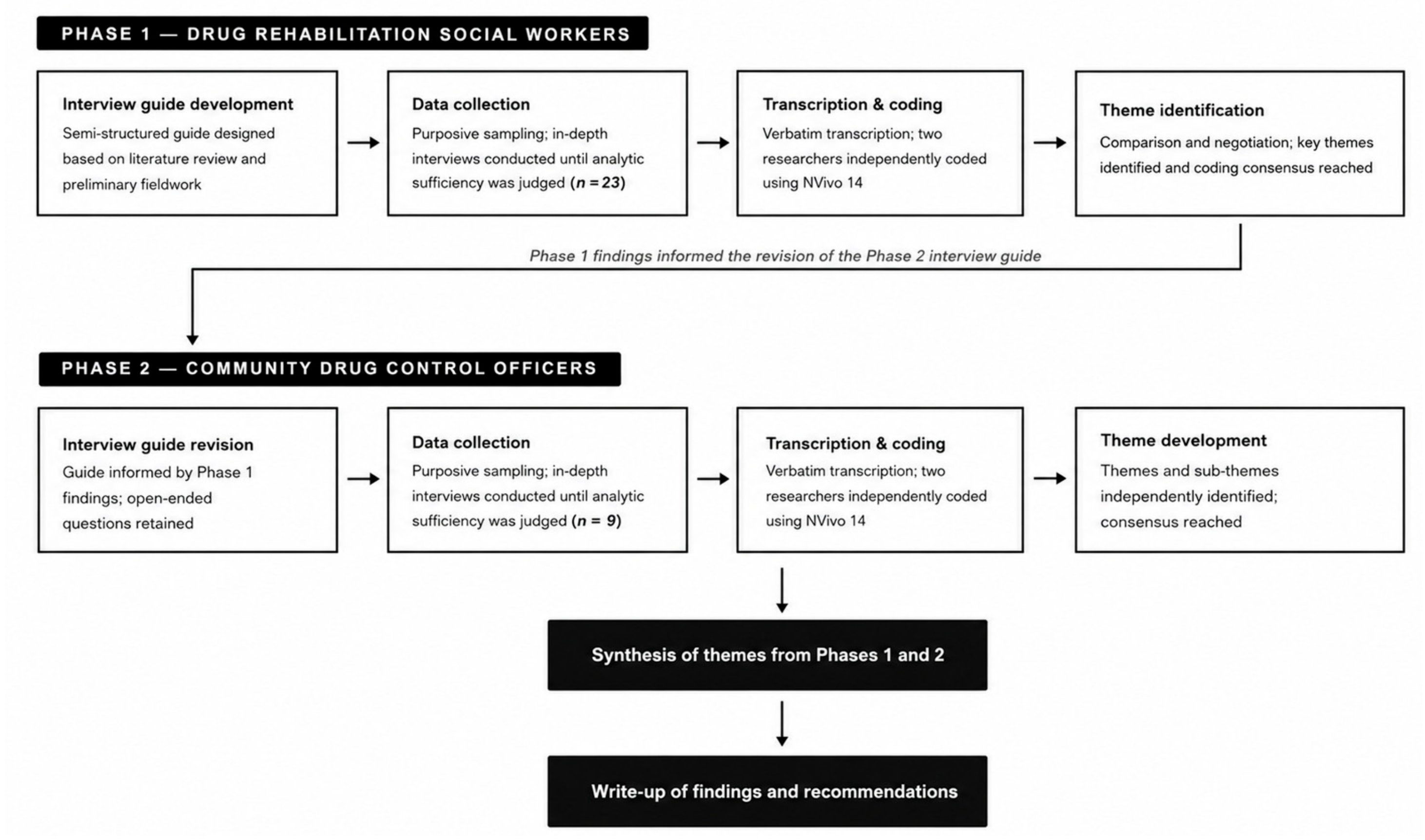
2.1. Study Design
2.2. Location and Sampling
2.3. Data Collection
2.4. Data Analysis
2.5. Researcher Reflexivity
2.6. Ethical Considerations
3. Findings
3.1. Participant Characteristics
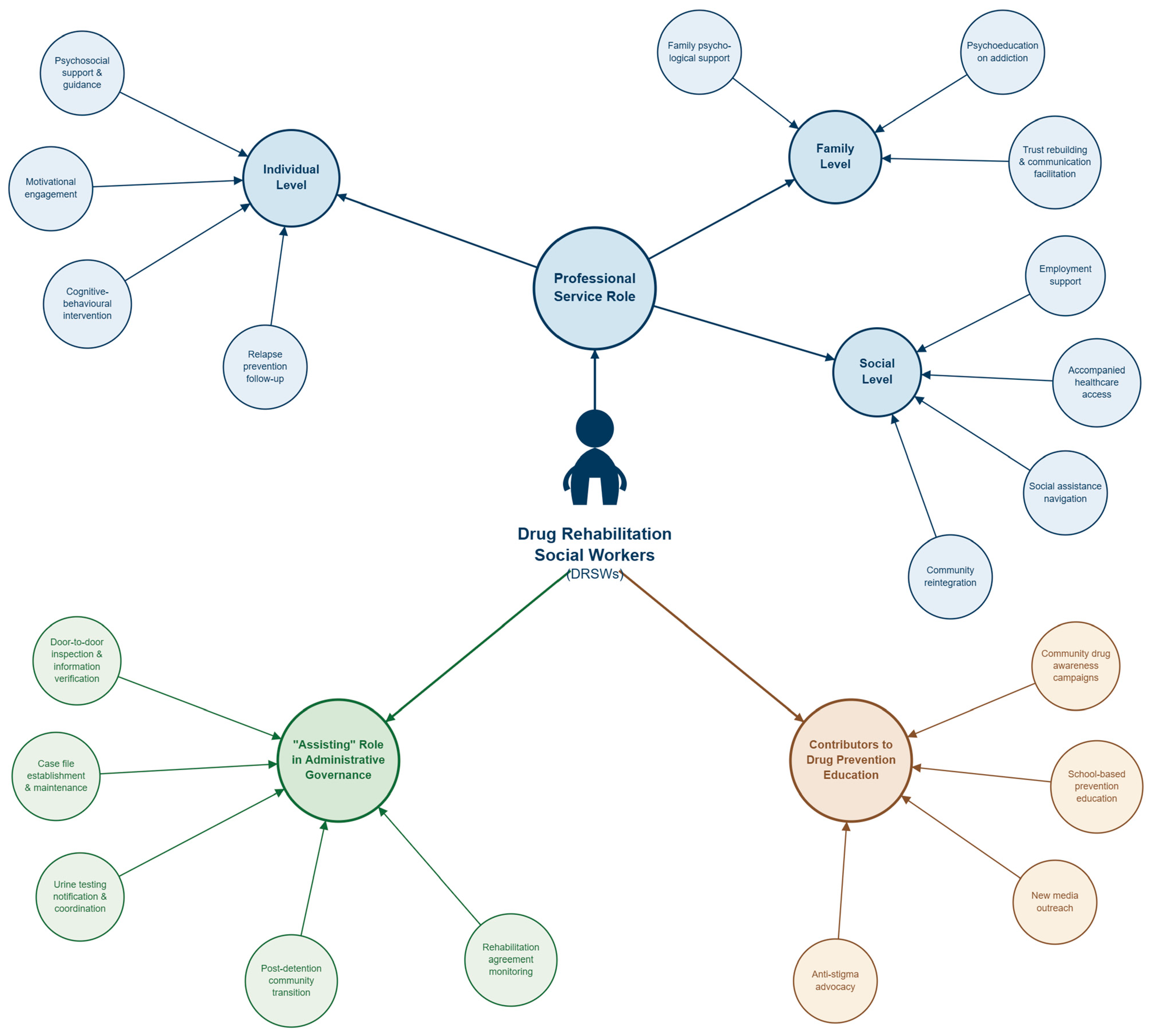
3.2. Key Roles of DRSWs
3.2.1. Theme 1: The Professional Service Role
Individual Level
“When they first meet us, most of them are reluctant, even angry. For a long time, they assume we are there to supervise them, like the relationship between a prison guard and an inmate. Lecturing them only deepens their mistrust. So what do we do? Our profession tells us to accept and empathize.”(DRSW-07)
“Ask them why they want to quit drugs, and most will say it is because they are afraid of being arrested or sent to compulsory detention. Under those circumstances, the moment external supervision ends, relapse is almost inevitable. My job is to help them find something inside themselves that makes them want to change.”(DRSW-02)
“I often ask them one question: if one day you were completely free from drugs, what is the one thing you would most want to do? I want to use that kind of question to help them find a reason that feels worth enduring the pain of change.”(DRSW-08)
“These misconceptions allow them to justify their drug use, so correcting these cognitive distortions is something we have to do on a daily basis.”(DRSW-12)
“One client insisted that methamphetamine was not a real drug and said he only used it to stay alert. I did not argue with him directly. Instead, I asked him: ‘If it is just something to keep you awake, why did it make you go three days without sleep and lose 20 jin [about 10 kg]?’ After that, we listed what he had lost because of it.”(DRSW-17)
“During regular follow-ups, I go through the high-risk triggers with them: holiday gatherings with old friends, payday when they suddenly have cash, a major argument with family. I keep asking them: ‘If one day you really cannot hold on anymore, can you at least send me a message before you act on it?’ Our follow-up is not about watching whether they slip up. It is about being a safety net when they are close to breaking point.”(DRSW-15)
Family Level
“We are not just social workers for the clients. We are social workers for their families too. Family members carry deep resentment after years of repeated drug use. We have to truly feel what they are going through. Only through genuine empathy can we actually enter their family world.”(DRSW-07)
“The thing family members say to us most often is ‘I have given up hope.’ At that point, you cannot rush into discussing a rehabilitation plan. You first need to make them feel that their pain has been seen. I tell them: ‘You have been carrying this alone for years. That must have been incredibly hard.’ Some of them start crying when they hear that, because no one has ever said it to them before.”(DRSW-03)
“We regularly provide families with education on the mechanisms of addiction. The goal is to help them see the person who uses drugs not as a ‘destroyer’ but as someone who is also a victim.”(DRSW-12)
“Reasoning with family members in abstract terms does not work. You have to use language they can understand. I tell them: ‘Blaming him for having no conscience is useless, because the drug has already hijacked his brain. Just like a patient with pneumonia cannot stop coughing through willpower alone, he cannot quit just because you scold him.’ Once their understanding shifts, their attitude may begin to shift too.”(DRSW-18)
“We need to get both sides on the same page. The client wants the family to trust them, but the family watches them like they are guarding against a thief. The moment the client steps out the door, the family assumes they are going to use drugs. Unless this dynamic is addressed, family functioning cannot be restored.”(DRSW-20)
“A father and son were living under the same roof and had not spoken a single word to each other for nearly a year. So when I was with the son, I casually mentioned that his father had secretly asked me whether his stomach problem was getting better. Then I went to the father and told him that his son had received his first paycheck and wanted to buy him a carton of cigarettes but felt too awkward to give it to him directly.”(DRSW-23)
Social Level
“I often have to go door-to-door to visit nearby businesses, looking for employers willing to offer job opportunities to our clients. Initially, they are almost always unwilling to hire people with criminal records, so we have to repeatedly persuade them. Sometimes, we even have to humble ourselves just to seek their cooperation.”(DRSW-09)
“They worry about the looks people give them if a doctor sees the needle marks on their arms, or if their record shows up in the system. So, whenever we have the time, we try our best to accompany them, just to make sure they don’t get discriminated against.”(DRSW-22)
“Some of them are only in their thirties. According to the policy, they fall under ‘people with working capacity,’ so it’s basically impossible to get Dibao (minimum living allowance) approved. But the reality is, after years of drug use, their brains are damaged, they just can’t work a normal job. So that’s when we must help out. We help them get their medical records, get the hardship certificates, and then we have to run to the sub-district office over and over again to apply for temporary relief.”(DRSW-20)
“In the community, they are practically invisible. Their families would rather hide them away. We never organize anything called a ‘drug rehabilitation forum’ because that would be putting them on public display. Instead, we invite them to volunteer: joining a neighborhood cleanup, delivering dumplings to elderly people living alone, or helping direct traffic at an intersection. Real social reintegration is not about forcing society to accept them. It is about creating opportunities for them to feel that they still matter.”(DRSW-05)
3.2.2. Theme 2: The “Assisting” Role in Administrative Governance
“Every month we have to go out on inspection rounds, visiting households one by one to check whether the registered PWUD in our area still live at the same address, what their current status is, and whether they have moved elsewhere. All of this has to be entered into the system. Nothing can be left out.”(DRSW-04)
“Every client has a file box with their basic info, drug use history, and rehab progress. From setting up the files to keeping them updated, it all falls on us. Honestly, just dealing with this stuff takes up a massive amount of our time. Especially when supervisors or government leaders come down for an inspection, we have to work overtime to check and re-check all these documents just to make sure there are no mistakes.”(DRSW-13)
“We don’t actually have the authority to do urine tests on the clients ourselves. But for some reason, it’s our job to notify them to come in for testing. Sometimes we can’t even reach them on the phone, so we have to go out and look for them in person.”(DRSW-06)
“After someone is released from a compulsory rehabilitation facility, they are required to report to the sub-district office and sign a community rehabilitation agreement within a set period. We find out about their situation in advance, go to meet them on the day of release, help them complete the paperwork, and explain what they need to do going forward.”(DRSW-10)
3.2.3. Theme 3: Contributors to Community-Based Drug Prevention Education
“The sub-district drug control office will ask us to help them with public awareness tasks. For example, we have to set up a booth and put out some mock drugs and drug identification materials on it. These tasks get a lot heavier on special dates like the World Drug Day.”(DRSW-04)
“Young people are all on their phones these days, so traditional leaflets do not reach them very well. We produce short videos and post them on community WeChat groups and public accounts, mainly about how to identify new types of drugs and the dangers of addiction. Once we made a one-minute clip called ‘Recognizing Disguised Drugs,’ and it spread quickly in parent chat groups. A lot of parents shared it and said it was very practical.”(DRSW-16)
“Every semester we go to primary and secondary schools in our area to give anti-drug education talks. You cannot just read from a textbook when speaking to students. You have to use language they can relate to. I usually bring replica drug models and use real cases to explain the harm drugs cause.”(DRSW-11)
“When we do awareness work, we do not just talk about how dangerous drugs are. We also talk about how hard it is for people in rehabilitation. We want community residents to understand that these people are not bad people. They are trying to change, and they need society to give them a chance.”(DRSW-14)
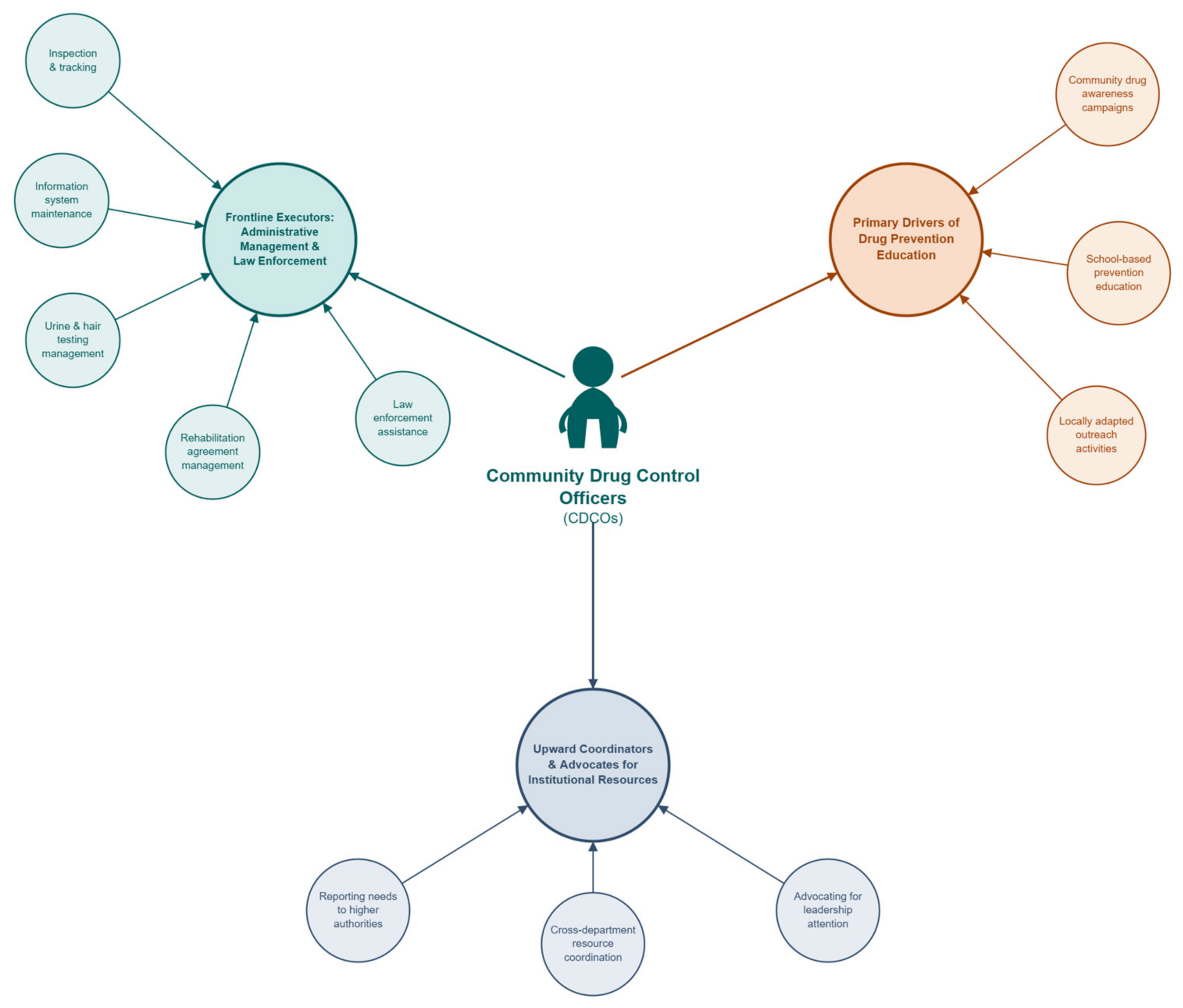
3.3. Key Roles of CDCOs
3.3.1. Theme 1: Frontline Executors of Administrative Management and Law Enforcement Support
“We have dozens of people to manage in our jurisdiction. We visit each one at least once a month. Who has moved, who has left for work, who seems off lately. We need to know all of this. Some of them refuse to cooperate. They do not answer the phone, they do not open the door. So we have to go back again and again. Sometimes it takes several trips before we can even see them.”(CDCO-09)
“The daily monitoring of drug users is all based on this management system. Since it is open to the national police network, we have to constantly update the data in real time and make sure everything is completely accurate. For example, we have to upload details like when a user comes in to report, when they take a hair test, and exactly what the results are.”(CDCO-04)
“Everyone has a different date they need to come in for testing. Some need to be tested today, and others are scheduled for tomorrow. We handle everything from verifying their IDs, to supervising them on-site while they provide the sample, to labeling and sealing the samples, and finally inputting every single test result into the management system. We go through this entire routine almost every day.”(CDCO-02)
“The community rehabilitation agreement is not just a piece of paper to sign and forget about. For these three years, if they step out of line, if they relapse and get caught, or if they miss urine tests three times, I do not care how much they cry. I submit the request to the public security bureau to send them to two years of compulsory rehabilitation. We are the ones holding the ruler. If you do not show them the sword hanging over their heads, they have no sense of accountability.”(CDCO-06)
“We do not have law enforcement power, but our coordination with the police station is very tight. For example, when a suspected drug user is newly identified in the area, the police station will ask us to go together to verify the situation. Sometimes when they carry out targeted raids, we participate from start to finish. And when someone goes off the grid or out of control, we assist the police in tracking them down and bringing them back.”(CDCO-03)
“You cannot just manage them without helping them. When I visit someone and see that their fridge is empty or they are still wearing thin clothes in winter, I am not going to just turn around and leave. I will ask around at the sub-district office about whether there is any temporary assistance they can apply for, or help them find out who is hiring. Strictly speaking, not all of this falls within my job description. But you are dealing with a real person. You cannot just look the other way.”(CDCO-08)
3.3.2. Theme 2: Primary Drivers of Community-Based Drug Prevention Education
“Drug prevention publicity is our biggest event every year. 26 June for the International Day Against Drug Abuse, 1 December for World AIDS Day, the start of the school year, around Chinese New Year. We have to organize activities at all of these. From writing the plan, booking the venue, and preparing materials to running the event on the day, we take the lead on all of it. Social workers and volunteers come to help, but the overall coordination is on us.”(CDCO-01)
“Every semester we have to arrange anti-drug education classes in the schools. I am the one who contacts the school, sets the date and grade level, and prepares the teaching materials. Sometimes I deliver the talk myself, sometimes I ask a social worker to do it, and when possible, we invite a police officer from the local station, which tends to have a stronger impact.”(CDCO-05)
“Just handing out flyers and hanging banners has very limited effect. People do not even look at them. So now we try things that feel more relevant to local life, like screening anti-drug films in the village square, weaving drug prevention messages into local folk opera, or running prize quizzes at the entrance to the farmers’ market. The key is getting people to stop, watch, and actually take it in.”(CDCO-07)
3.3.3. Theme 3: Upward Coordinators and Advocates for Institutional Resources
“The people above do not necessarily understand the difficulties we face at the grassroots level. How many people we have to manage, whether we have enough staff, whether the budget is sufficient. If we do not raise these issues ourselves, nobody up there is going to know. Every time I go to a meeting, I lay out the real situation. I put the roster on the table and do the math right in front of the leaders: how much the urine test kits cost, how much travel money I advanced out of my own pocket to go after someone. You have to push for it, or this job simply cannot be done.”(CDCO-02)
“Drug rehabilitation is not something a single department can handle on its own. If a client needs to apply for Dibao, you have to go to the Civil Affairs Bureau. If they need vocational training, you go to the Human Resources Bureau. If there are mental health issues, you go to the Health Commission. A lot of the time, I just have to run around between these different departments trying to coordinate resources.”(CDCO-04)
“If the leaders take drug control work seriously, the funding comes through, we get enough staff, and things just run smoothly. If they don’t care, it is really hard to get anything done. So, we must also learn how to ‘manage up’ and show them actual results to make the leadership realize why this work is so important.”(CDCO-09)
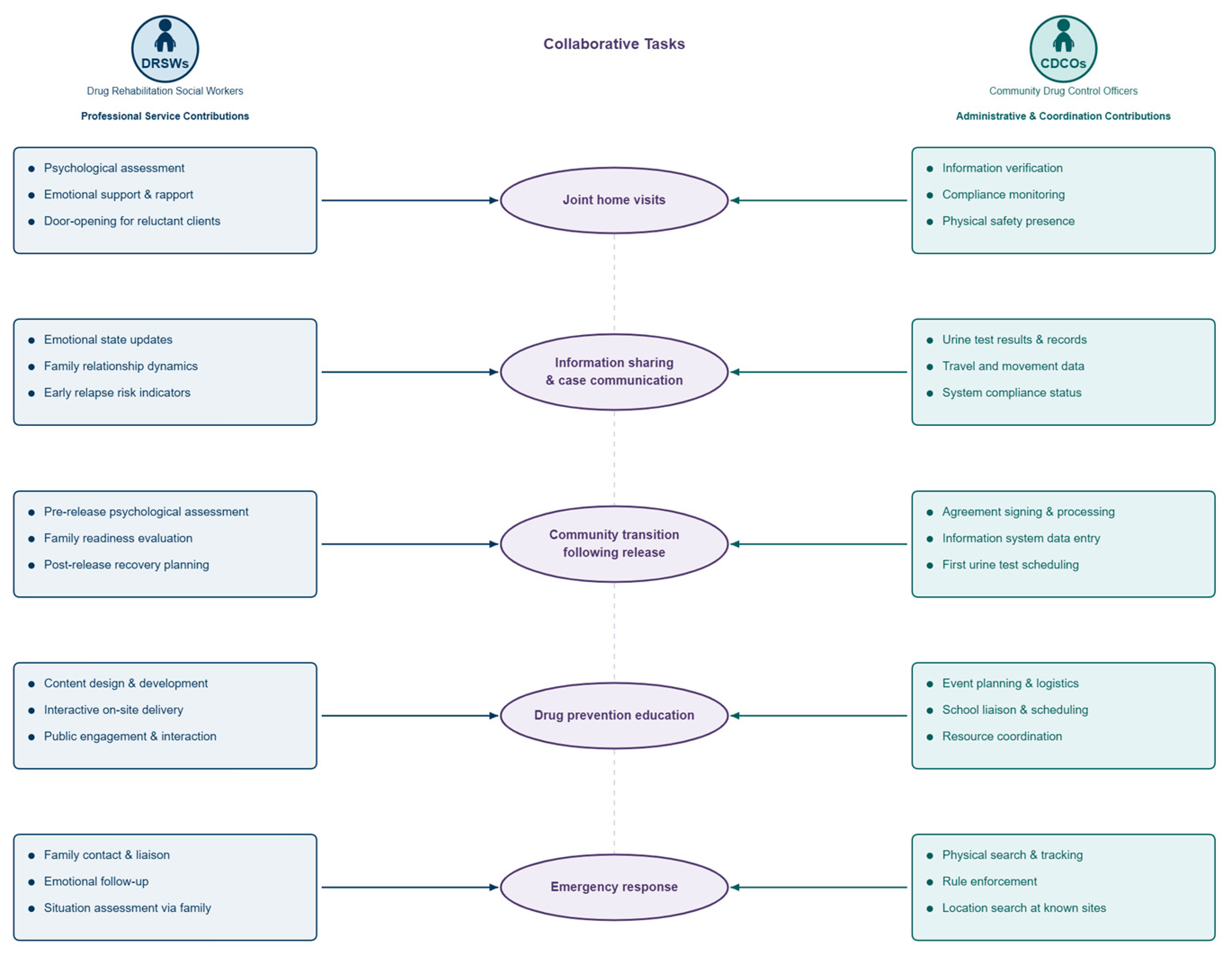
3.4. Collaborative Tasks and Role Boundaries Between DRSWs and CDCOs
3.4.1. Collaborative Tasks
“When we go on home visits, I usually go with the social worker. I am responsible for verifying basic information and checking for any violations, and the social worker is responsible for chatting with the client about how things have been going and how they are feeling. The division of labor happens naturally. I handle the ‘hard’ part, and the social worker handles the ‘soft’ part.”(CDCO-03)
“The advantage of going with the CDCO is that some clients are afraid of the CDCO and will not open the door, but they are willing to talk to me. I knock on the door first and get them to open up, and then the CDCO comes in to do his part. On the other hand, there are situations where it is not safe for me to go alone, for example when a client is emotionally unstable. Having the CDCO there makes me feel much more at ease.”(DRSW-08)
“The CDCOs have the ‘hard data’: urine test results, check-in records, whether someone has left the area. We have the ‘soft information’: how someone has been feeling lately, whether their family relationships are stable, whether there are early signs of relapse. Put these two pieces together, and you get the full picture of a person. That is why we regularly sit down with the CDCOs to update each other.”(DRSW-12)
“A client was perfectly cooperative in front of me, and his urine test came back completely clean. But the social worker told me he is actually going through a divorce right now and feeling really low. So looking at the whole picture, there is definitely a huge risk of relapse here. We would never pick up on that just by looking at the data without the social worker telling us.”(CDCO-04)
“When a client is released from a compulsory drug treatment facility, I handle all the procedural work. We take the lead on everything from signing agreements and entering data into the system to scheduling their very first urine and hair tests. But when it comes to their mental state, whether their family is willing to take them back, and how to plan their actual recovery steps, the social workers take over.”(CDCO-06)
“During the handover, we actually go into the compulsory rehab center beforehand to look at how they behaved inside and check their psychological evaluations. Then we talk to the family to see if they are willing to take them back. We are also right there on the day they are released, but my role is very different from CDCO. The CDCO is there to lay down the rules. My job is to talk with the clients about their future plans and figure out what kind of support they are going to need moving forward.”(DRSW-10)
“When we run large-scale awareness events, I am the one who writes the plan, arranges the venue, organizes the materials, and coordinates the staff. But when it comes to designing exhibition boards, putting together quiz activities, and interacting with the public on the day, the social workers are better at that than we are.”(CDCO-01)
“When there is an emergency, the CDCO and I are usually both on the scene. For example, last time one of our clients suddenly went unreachable for two days. The CDCO immediately went to the places the client was known to frequent, and I contacted his family at the same time to find out what had happened. It turned out he had had a fight with his family and taken off. We found him together. The CDCO talked to him about the rules he had broken, and I did the emotional follow-up.”(DRSW-17)
3.4.2. Role Boundaries
“At the beginning, I was just helping the CDCO with a few things here and there, like making phone calls to remind clients about urine tests. But gradually, more and more of these tasks ended up on my plate. Now I handle case files, enter data into the system, and even go on inspection rounds on my own. It is hard to say no, because the CDCO is short-staffed and there is nobody else to do it. But every hour I spend on paperwork is an hour I am not spending on actual casework.”(DRSW-12)
“I know the emotional side is supposed to be the social worker’s job. But when I am sitting in someone’s living room and they start telling me about their problems, what am I supposed to do, tell them to wait for the social worker? I just listen. Sometimes I give them advice based on my own life experience. It is not professional counseling, but it is what I can do in that moment.”(CDCO-03)
“Most of our clients have no idea what the difference is between a social worker and a CDCO. To them, we are all ‘the people from the street office.’ When I try to explain that I am here to help rather than to supervise, they do not really believe it, because they have seen me show up alongside the CDCO so many times.”(DRSW-18)
4. Discussion
Limitations
5. Conclusions
Author Contributions
Funding
Institutional Review Board Statement
Informed Consent Statement
Data Availability Statement
Acknowledgments
Conflicts of Interest
Abbreviations
| CBDR | Community-based drug rehabilitation |
| PWUDs | Persons with drug use histories |
| DRSW | Drug rehabilitation social worker |
| CDCO | Community drug control officer |
References
- Bark, Harry, Jeremy Dixon, and Judy Laing. 2023. The professional identity of social workers in mental health services: A scoping review. International Journal of Environmental Research and Public Health 20: 5947. [Google Scholar] [CrossRef] [PubMed]
- Braun, Virginia, and Victoria Clarke. 2021. Thematic Analysis: A Practical Guide. Thousand Oaks: SAGE Publications. [Google Scholar]
- Braun, Virginia, and Victoria Clarke. 2022. Thematic analysis. In Encyclopedia of Quality of Life and Well-Being Research. Edited by Filomena Maggino. Berlin: Springer. [Google Scholar] [CrossRef]
- Central Committee of the Communist Party of China, and State Council of the People’s Republic of China. 2014. 关于加强禁毒工作的意见 [Opinions on Strengthening Anti-Drug Work]. Available online: https://www.mps.gov.cn/n2253534/n2253535/c4767741/content.html (accessed on 10 March 2026).
- China National Narcotics Control Committee. 2020. Drug Situation in China (2019). Available online: http://www.nncc626.com/2020-06/25/c_1210675877.htm (accessed on 10 March 2026).
- China National Narcotics Control Committee. 2022. Drug Situation in China (2021). Available online: https://www.mps.gov.cn/n2255079/n6865805/n7355741/n7355780/c8660792/content.html (accessed on 10 March 2026).
- Cootes, Hannah, Milena Heinsch, and Caragh Brosnan. 2022. ‘Jack of all trades and master of none’? Exploring social work’s epistemic contribution to team-based health care. The British Journal of Social Work 52: 256–73. [Google Scholar] [CrossRef]
- Enjuto Martinez, Regina, Yuanyuan Qu, and Jude Howell. 2023. Government contracting services to social organisations in China: A review of research for future enquiry. Social Policy and Society 22: 615–35. [Google Scholar] [CrossRef]
- General Office of the CPC Central Committee, and General Office of the State Council. 2024. 关于加强社区工作者队伍建设的意见 [Opinions on Strengthening the Development of the Community Work Force]. Available online: https://www.12371.cn/2024/04/10/ARTI1712746885127746.shtml (accessed on 10 March 2026).
- Guangzhou People’s Procuratorate. 2023. White Paper on Lawfully Punishing Drug Crimes and Participating in Comprehensive Drug Control by Guangzhou Procuratorial Organs (January 2020 to May 2023). Available online: https://guangzhou.jcy.gov.cn/xw/25493.jhtml (accessed on 10 March 2026).
- Huang, Chienchung, Xiaoxia Xie, Shannon P. Cheung, Yuqing Zhou, and Ganghui Ying. 2021. Job demands, resources, and burnout in social workers in China: Mediation effect of mindfulness. International Journal of Environmental Research and Public Health 18: 10526. [Google Scholar] [CrossRef]
- Islam, Mohammed F., Mayra Guerrero, Rebecca L. Nguyen, Alexandra Porcaro, Camilla Cummings, Ed Stevens, Ann Kang, and Leonard A. Jason. 2023. The importance of social support in recovery populations: Toward a multilevel understanding. Alcoholism Treatment Quarterly 41: 222–36. [Google Scholar] [CrossRef] [PubMed]
- Jiang, Jize, and Apei Song. 2025. Strong control and weak service: Enforcing drug treatment in China. Journal of Drug Issues 55: 379–400. [Google Scholar] [CrossRef]
- Joshi, Rohina, Mohammed Alim, Andre Pascal Kengne, Stephen Jan, Pallab K. Maulik, David Peiris, and Anushka A. Patel. 2014. Task shifting for non-communicable disease management in low and middle income countries: A systematic review. PLoS ONE 9: e103754. [Google Scholar] [CrossRef]
- Leana, Carrie, Eileen Appelbaum, and Iryna Shevchuk. 2009. Work process and quality of care in early childhood education: The role of job crafting. Academy of Management Journal 52: 1169–92. [Google Scholar] [CrossRef]
- Li, Chen, and Guandong Song. 2022. A qualitative study of drug treatment conformity behavior among young drug users who are in recovery in China. International Journal of Environmental Research and Public Health 19: 14832. [Google Scholar] [CrossRef]
- Liu, Nian, Zekai Lu, and Ying Xie. 2022. Tracking study on the relapse and aftercare effect of drug patients released from a compulsory isolated detoxification center. Frontiers in Psychiatry 12: 699074. [Google Scholar] [CrossRef]
- Liu, Tzu-Hsuan, Spencer De Li, and Ruoshan Xiong. 2023. The drug addiction treatment system in China: Promises and controversies. Asian Journal on Addictions 1: 12. [Google Scholar] [CrossRef]
- Malterud, Kirsti, Volkert Dirk Siersma, and Ann Dorrit Guassora. 2016. Sample size in qualitative interview studies: Guided by information power. Qualitative Health Research 26: 1753–60. [Google Scholar] [CrossRef]
- Ministry of Finance of the People’s Republic of China. 2020. Administrative Measures for Government Purchase of Services. Order No. 102. Available online: https://guangdong.chinatax.gov.cn/gdsw/mmsw_zfcgzd/2020-07/08/content_218fb7513bec48d698f9af37ae0f9496.shtml (accessed on 10 March 2026).
- Mo, Han, Minjv Du, Lanlan Jiang, and Guanyao Mo. 2024. The origin and development of anti-drug social work in Chinese mainland. Asian Journal on Addictions 1: 17. [Google Scholar] [CrossRef]
- Office of National Narcotics Control Commission. 2023. China Drug Situation Report 2022. Available online: https://losangeles.china-consulate.gov.cn/eng/topnews/202306/t20230628_11104750.htm (accessed on 15 May 2026).
- Office of National Narcotics Control Commission. 2024. China Drug Situation Report 2023. Available online: https://www.mps.gov.cn/n2255079/n6865805/n7355748/n7355818/c9623360/part/9623372.pdf (accessed on 15 May 2026).
- Office of National Narcotics Control Commission. 2025. China Drug Situation in 2024. Available online: https://www.mps.gov.cn/n2255079/n6865805/n7355748/n7355818/c10114681/content.html (accessed on 15 May 2026).
- Office of National Narcotics Control Commission, General Office of the Central Committee for Comprehensive Social Management, and Ministry of Public Security. 2017. 关于加强禁毒社会工作者队伍建设的意见 [Opinions on Strengthening the Development of the Anti-Drug Social Work Force]. Available online: https://www.mps.gov.cn:8080/n6557558/c5648093/content.html (accessed on 10 March 2026).
- Ou, Xiaodan. 2024. Study of the impact of sports participation on social capital among drug addicts. International Journal of Social Sciences and Public Administration 3: 382–92. [Google Scholar] [CrossRef]
- Pilgrim, David. 2014. Some implications of critical realism for mental health research. Social Theory & Health 12: 1–21. [Google Scholar] [CrossRef]
- Reeves, Scott, Simon Lewin, Sherry Espin, and Merrick Zwarenstein. 2010. Interprofessional Teamwork for Health and Social Care. Hoboken: Wiley-Blackwell. [Google Scholar]
- Singwane, Thembinkosi, and Dillo Justin Ramoshaba. 2023. Social workers’ roles and contemporary responsibilities in addiction management: The case of selected treatment centres. International Journal of Research in Business and Social Science 12: 170–76. [Google Scholar] [CrossRef]
- Song, Apei, and Jize Jiang. 2025. Coercive rehabilitation and therapeutic control: How the police navigate the penal-welfare nexus in Chinese drug governance. Policing and Society 35: 1203–18. [Google Scholar] [CrossRef]
- Standing Committee of the National People’s Congress. 2015. Anti-Drug Law of the People’s Republic of China. Available online: https://english.court.gov.cn/2015-07/17/c_761568.htm (accessed on 10 March 2026).
- State Council of the People’s Republic of China. 2011. 戒毒条例 [Drug Rehabilitation Regulations]. Available online: http://big5.www.gov.cn/gate/big5/www.gov.cn/zwgk/2011-06/26/content_1892716.htm (accessed on 10 March 2026).
- Tesema, Azeb Gebresilassie, Sikhumbuzo A. Mabunda, Kanika Chaudhri, Anthony Sunjaya, Samuel Thio, Kenneth Yakubu, Ragavi Jeyakumar, Myron Godinho, Renu John, Mai Eltigany, and et al. 2025. Task-sharing for non-communicable disease prevention and control in low- and middle-income countries in the context of health worker shortages: A systematic review. PLoS Global Public Health 5: e0004289. [Google Scholar] [CrossRef]
- Tummers, Lars L. G., Victor Bekkers, Evelien Vink, and Michael Musheno. 2015. Coping during public service delivery: A conceptualization and systematic review of the literature. Journal of Public Administration Research and Theory 25: 1099–126. [Google Scholar] [CrossRef]
- Wang, Yixuan, Jianhong Liu, and Hao Zhou. 2025. Describing the evolution of three features of China’s drug policy: Regulation, crime and punishment, and rehabilitation. International Journal of Drug Policy 140: 104827. [Google Scholar] [CrossRef]
- Xie, Yingying, and Maria-Carmen Pantea. 2019. The de-professionalization of social work? A qualitative analysis of subcontracted social workers in Shenzhen. International Journal of China Studies 10: 251–69. [Google Scholar]
- Yang, Jie, and Melita J. Giummarra. 2021. Compulsory and voluntary drug treatment models in China: A need for improved evidence-based policy and practice to reduce the loaded burden of substance use disorders. International Journal of Drug Policy 92: 103063. [Google Scholar] [CrossRef]
- Zhang, Hanlin, and Jize Jiang. 2025. Strategic benevolence: The rehabilitation ideal and emotional labor of social workers within Chinese community corrections. Asian Journal of Criminology 20: 12. [Google Scholar] [CrossRef]
- Zhang, Nannan, Xin Li, and Xuesong He. 2022. Role conflict, role ambiguity, and depressive symptoms: The moderating effects of job autonomy among social workers in China. International Journal of Social Welfare 31: 323–32. [Google Scholar] [CrossRef]
- Zhao, Fangdu, Yaqin Cao, and Huimin Zhang. 2024. Offering security or incentives: The relationship among sector type, organizational support, and turnover intentions of social workers in China. The British Journal of Social Work 55: 1275–95. [Google Scholar] [CrossRef]
- Zhou, Bo, Jintao Tan, Wenli Li, and Cheng Yu. 2024. A study on the mediating-moderate effect of the types of illicit drugs on mental health in China. Frontiers in Public Health 12: 1431854. [Google Scholar] [CrossRef]



| Demographics | Drug Rehabilitation Social Workers (n = 23) | Community Drug Control Officers (n = 9) |
|---|---|---|
| Mean age (years) | 39.1 | 53.6 |
| Mean years of experience | 5.6 | 11.4 |
| Gender | ||
| Male | 30.4% | 77.8% |
| Female | 69.6% | 22.2% |
| Education level | ||
| Senior high school or below | - | 11.1% |
| College diploma | 69.6% | 77.8% |
| Bachelor’s degree | 26.1% | 11.1% |
| Postgraduate or above | 4.3% | - |
| Professional qualification | ||
| Assistant social worker | 82.6% | - |
| Intermediate social worker | 17.4% | - |
| Participant ID | Gender | Age | Education Level | Professional Qualification | Years of Experience | District |
|---|---|---|---|---|---|---|
| Drug rehabilitation social workers (n = 23) | ||||||
| DRSW-01 | Male | 46 | College diploma | Assistant social worker | 7 | A |
| DRSW-02 | Male | 35 | Bachelor’s degree | Assistant social worker | 4 | B |
| DRSW-03 | Female | 37 | College diploma | Assistant social worker | 5 | A |
| DRSW-04 | Female | 51 | College diploma | Intermediate social worker | 10 | C |
| DRSW-05 | Female | 33 | College diploma | Assistant social worker | 4 | B |
| DRSW-06 | Male | 45 | Bachelor’s degree | Assistant social worker | 3 | D |
| DRSW-07 | Female | 39 | College diploma | Assistant social worker | 6 | A |
| DRSW-08 | Female | 36 | College diploma | Assistant social worker | 4 | E |
| DRSW-09 | Male | 42 | College diploma | Assistant social worker | 7 | C |
| DRSW-10 | Female | 29 | Bachelor’s degree | Assistant social worker | 3 | B |
| DRSW-11 | Female | 43 | College diploma | Assistant social worker | 8 | D |
| DRSW-12 | Female | 39 | College diploma | Assistant social worker | 9 | A |
| DRSW-13 | Male | 44 | Bachelor’s degree | Intermediate social worker | 7 | E |
| DRSW-14 | Female | 37 | College diploma | Assistant social worker | 5 | C |
| DRSW-15 | Female | 38 | College diploma | Assistant social worker | 4 | B |
| DRSW-16 | Female | 24 | College diploma | Assistant social worker | 3 | D |
| DRSW-17 | Female | 44 | Bachelor’s degree | Assistant social worker | 5 | A |
| DRSW-18 | Female | 41 | College diploma | Assistant social worker | 8 | E |
| DRSW-19 | Female | 35 | College diploma | Assistant social worker | 4 | C |
| DRSW-20 | Male | 48 | Bachelor’s degree | Intermediate social worker | 7 | B |
| DRSW-21 | Female | 36 | Postgraduate or above | Intermediate social worker | 5 | D |
| DRSW-22 | Female | 38 | College diploma | Assistant social worker | 6 | E |
| DRSW-23 | Male | 39 | College diploma | Assistant social worker | 4 | C |
| Community drug control officers (n = 9) | ||||||
| CDCO-01 | Male | 55 | College diploma | - | 9 | A |
| CDCO-02 | Male | 48 | College diploma | - | 12 | C |
| CDCO-03 | Female | 58 | College diploma | - | 10 | C |
| CDCO-04 | Male | 47 | Bachelor’s degree | - | 8 | D |
| CDCO-05 | Male | 56 | College diploma | - | 13 | E |
| CDCO-06 | Male | 50 | College diploma | - | 11 | A |
| CDCO-07 | Female | 53 | College diploma | - | 12 | B |
| CDCO-08 | Male | 59 | Senior high school or below | - | 16 | E |
| CDCO-09 | Male | 56 | College diploma | - | 12 | D |
Disclaimer/Publisher’s Note: The statements, opinions and data contained in all publications are solely those of the individual author(s) and contributor(s) and not of MDPI and/or the editor(s). MDPI and/or the editor(s) disclaim responsibility for any injury to people or property resulting from any ideas, methods, instructions or products referred to in the content. |
© 2026 by the authors. Licensee MDPI, Basel, Switzerland. This article is an open access article distributed under the terms and conditions of the Creative Commons Attribution (CC BY) license.
Share and Cite
Wei, Z.; Hassan, N.; Mohamad Aun, N.S.; Zakaria, E.; Chen, S. Roles and Collaborative Practices of Drug Rehabilitation Social Workers and Community Drug Control Officers in Community-Based Drug Rehabilitation in China: A Qualitative Study. Soc. Sci. 2026, 15, 334. https://doi.org/10.3390/socsci15050334
Wei Z, Hassan N, Mohamad Aun NS, Zakaria E, Chen S. Roles and Collaborative Practices of Drug Rehabilitation Social Workers and Community Drug Control Officers in Community-Based Drug Rehabilitation in China: A Qualitative Study. Social Sciences. 2026; 15(5):334. https://doi.org/10.3390/socsci15050334
Chicago/Turabian StyleWei, Zhihao, Nazirah Hassan, Nur Saadah Mohamad Aun, Ezarina Zakaria, and Sheng Chen. 2026. "Roles and Collaborative Practices of Drug Rehabilitation Social Workers and Community Drug Control Officers in Community-Based Drug Rehabilitation in China: A Qualitative Study" Social Sciences 15, no. 5: 334. https://doi.org/10.3390/socsci15050334
APA StyleWei, Z., Hassan, N., Mohamad Aun, N. S., Zakaria, E., & Chen, S. (2026). Roles and Collaborative Practices of Drug Rehabilitation Social Workers and Community Drug Control Officers in Community-Based Drug Rehabilitation in China: A Qualitative Study. Social Sciences, 15(5), 334. https://doi.org/10.3390/socsci15050334