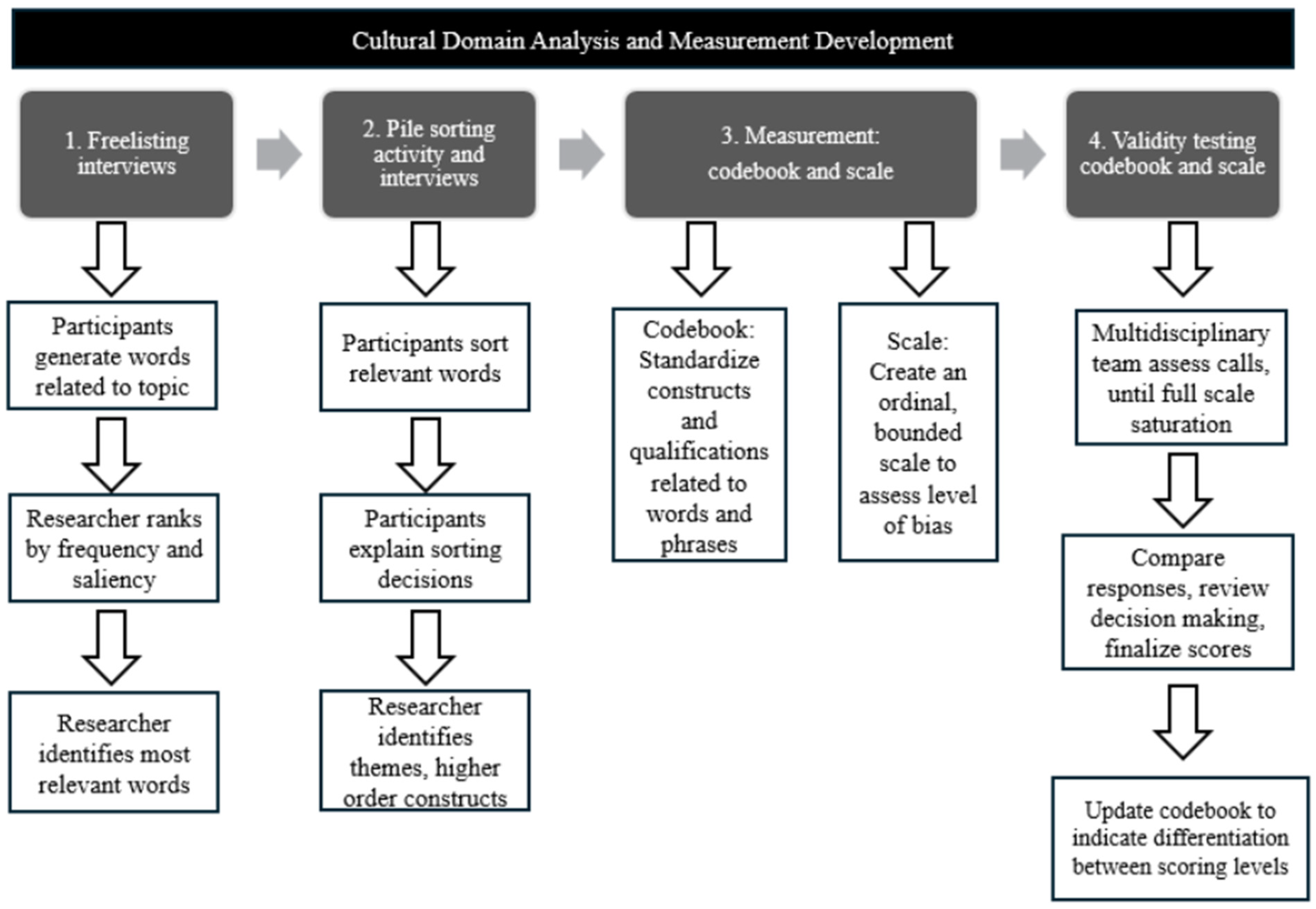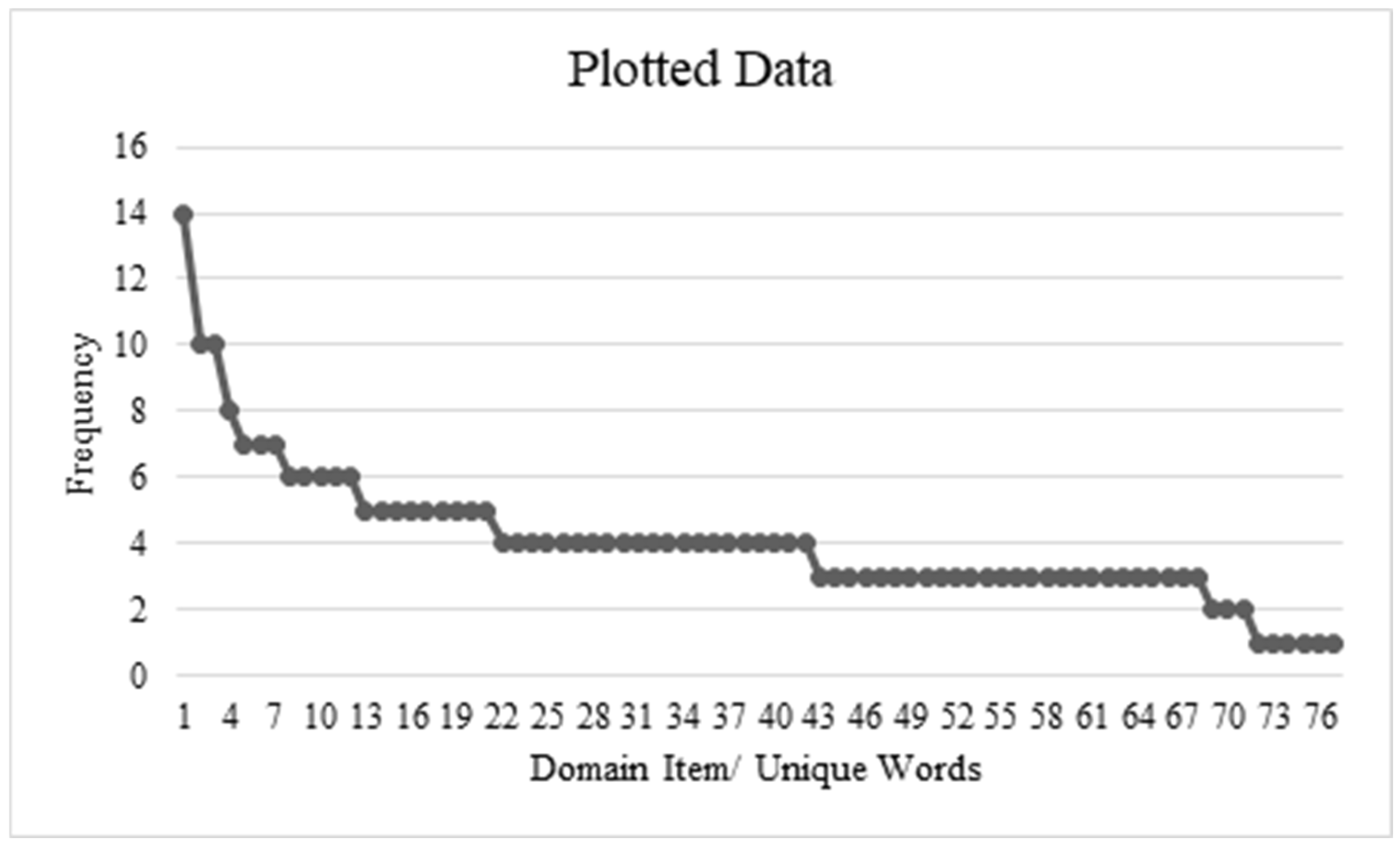

Decoding Narrative Statements in Child Protective Services Hotline Calls: A Methodological Approach

Abstract
1. Introduction
2. Background
2.1. Theoretical Framework
2.2. Research on Bias in Child Welfare
2.2.1. Qualitative Research
2.2.2. Quantitative Research
2.3. The Approach
2.4. Cultural Domain Analysis: Background and Application
2.4.1. Cultural Domain Analysis
2.4.2. Freelisting
2.4.3. Pile Sorting
2.5. Use of CDA in Understanding Bias
3. Materials and Methods
3.1. Application of Cultural Domain Analysis for an Observational Measurement Framework
3.2. A Phased Approach
3.2.1. Phase I: Planning and Preparation
3.2.2. Part II: Cultural Domain Analysis
Freelisting: Interview Protocol and Activity
Pile Sorting: Interview Protocol and Activity
- What was your strategy for sorting these terms?
- What makes this pile different from others?
- How would you infer that this group of terms or phrases is indicative of implicit bias: what other information in the call would you consider?
- When you hear a reporter use a word like ‘uncooperative,’ how does their tone or volume help you decide if they are reporting a factual safety concern or expressing a personal bias against the parent?
3.2.3. Part III: Measurement Framework
Codebook
Scale Development
3.2.4. Part IV: Validity Testing
4. Discussion
4.1. Implications for Practice
4.1.1. Call Volume, Call Fatigue and Related Practice Changes
4.1.2. Informing Reporter Training and Narrative Framing
4.2. Policy
4.3. Future Research
5. Conclusions
Author Contributions
Funding
Institutional Review Board Statement
Informed Consent Statement
Data Availability Statement
Conflicts of Interest
Abbreviations
| CDA | Cultural Domain Analysis |
| CPS | Child Protective Services |
| AC | Advisory Committee |
References
- Agha, Asif. 2005. Voice, footing, enregisterment. Journal of Linguistic Anthropology 15: 38–59. [Google Scholar] [CrossRef]
- Albanowski, Kimberly, Kendall Burdick, Christopher Bonafide, Ruth Kleinpell, and Joseph Schlesinger. 2023. Ten Years Later, Alarm Fatigue Is Still a Safety Concern. AACN Advanced Critical Care 34: 189–97. [Google Scholar] [CrossRef]
- Arafat, Tharwat, and Bilal Hamamra. 2021. ‘Noooooooooooooooooooooo’: Word elongation, gender and emotions in Realistic Fiction. Psychodynamic Practice 27: 259–75. [Google Scholar] [CrossRef]
- Baron, Jason, Joseph Doyle, Natalia Emanuel, Peter Hull, and Joseph Ryan. 2023. Racial Discrimination in Child Protection. Working Paper 31490. Cambridge, MA: National Bureau of Economic Research. [Google Scholar]
- Barth, Richard, Jill Berrick, Melissa Jonson-Reid, Antonio Garcia, Johanna Greeson, John Gyourko, and Brett Drake. 2026. Understanding Child Welfare. Glos: Edward Elgar Publishing. [Google Scholar]
- Borgatti, Stephen. 1994. Cultural domain analysis. Journal of Quantitative Anthropology 4: 261–78. [Google Scholar]
- Borgatti, Stephen. 1998. Elicitation techniques for cultural domain analysis. In The Ethnographer’s Toolkit. Edited by Jean Schensul and Margaret LeCompte. Walnut Creek: AltaMira Press, vol. 3. [Google Scholar]
- Brewer, William. 2000. Bartlett’s concept of the schema and its impact on theories of knowledge representation in contemporary cognitive psychology. In Bartlett, Culture and Cognition. Edited by Akiko Saito. East Sussex: Psychology Press, pp. 69–89. [Google Scholar]
- Caparoso, Jenna, and Christopher Collins. 2015. College student racial and ethnic stereotype-based humor as a cultural domain. Power and Education 7: 196–223. [Google Scholar] [CrossRef]
- Cheng, Joey T., Jessica L. Tracy, Simon Ho, and Joseph Henrich. 2016. Listen, follow me: Dynamic vocal signals of dominance predict emergent social rank in humans. Journal of Experimental Psychology: General 145: 536–47. [Google Scholar] [CrossRef] [PubMed]
- Children’s Bureau, Administration on Children, Youth and Families, Administration for Children and Families, and U.S. Department of Health and Human Services. 2024. National Child Abuse and Neglect Data System (NCANDS) Child File, FFY 2024; Ithaca: National Data Archive on Child Abuse and Neglect.
- Collins, Cyleste, and William Dressler. 2008. Cultural consensus and cultural diversity: A mixed methods investigation of human service providers’ models of domestic violence. Journal of Mixed Methods Research 2: 362–87. [Google Scholar] [CrossRef]
- Day, Elizabeth, Laura Tach, and Brittany Mihalec-Adkins. 2022. State child welfare policies and the measurement of child maltreatment in the United States. Child Maltreatment 27: 411–22. [Google Scholar] [CrossRef]
- Dettlaff, Alan, and Joan Rycraft. 2008. Deconstructing disproportionality: Views from multiple community stakeholders. Child Welfare 87: 37–58. [Google Scholar]
- Douglas, Heather, and Emma Fell. 2020. Malicious reports of child maltreatment as coercive control: Mothers and domestic and family violence. Journal of Family Violence 35: 827–37. [Google Scholar] [CrossRef]
- Drake, Brett, Dylan Jones, Hyunil Kim, John Gyourko, Antonio Garcia, Richard P. Barth, Sarah A. Font, Emily Putnam-Hornstein, Jill Duerr Berrick, Johanna K. P. Greeson, and et al. 2023. Racial/ethnic differences in child protective services reporting, substantiation and placement, with comparison to non-CPS risks and outcomes: 2005–2019. Child Maltreatment 28: 683–99. [Google Scholar] [CrossRef]
- Drake, Brett, Melissa Jonson-Reid, and Hyunil Kim. 2017. Surveillance bias in child maltreatment: A tempest in a teapot. International Journal of Environmental Research and Public Health 14: 971. [Google Scholar] [CrossRef]
- Drake, Brett, Sang Moo Lee, and Melissa Jonson-Reid. 2009. Race and child maltreatment reporting: Are Blacks overrepresented? Children and Youth Services Review 31: 309–16. [Google Scholar] [CrossRef] [PubMed]
- Dwyer, Clair, and Caroline Bressey, eds. 2008. New Geographies of Race and Racism. Surrey: Ashgate Publishing, Ltd. [Google Scholar]
- Edwards, Frank. 2019. Family surveillance: Police and the reporting of child abuse and neglect. RSF: The Russell Sage Foundation Journal of the Social Sciences 5: 50–70. [Google Scholar] [CrossRef]
- Faulkner, Monica, Catherine LaBrenz, Anna Wasim, and Laura Marra. 2024. Assessing Racial and Class Bias in Child Welfare: Development and Piloting of the Race and Class Bias in Child Welfare Scale. Societies 14: 172. [Google Scholar] [CrossRef]
- Fluke, John, Brenda Harden, Molly Jenkins, and Ashleigh Ruehrdanz. 2011. Research synthesis on child welfare: Disproportionality and disparities. Disparities and Disproportionality in Child Welfare: Analysis of the Research 1: 151–62. Available online: https://casala.org/wp-content/uploads/2015/12/Disparities-and-Disproportionality-in-Child-Welfare_An-Analysis-of-the-Research-December-2011-1.pdf (accessed on 12 February 2026).
- Fong, Kelley. 2017. Child welfare involvement and contexts of poverty: The role of parental adversities, social networks, and social services. Children and Youth Services Review 72: 5–13. [Google Scholar] [CrossRef]
- Font, Sarah A., Lawrence M. Berger, and Kristen S. Slack. 2012. Examining racial disproportionality in child protective services case decisions. Children and Youth Services Review 34: 2188–200. [Google Scholar] [CrossRef] [PubMed]
- Freire, Paulo. 1970. Pedagogy of the Oppressed. Translated by Myra Ramos. New York: Herder and Herder. [Google Scholar]
- Gandarilla Ocampo, Maria, Brett Drake, James Simon, and Melissa Jonson-Reid. 2024. Does a child maltreatment report source predict differences in immediate and subsequent report outcomes? Child Abuse & Neglect 147: 106587. [Google Scholar] [CrossRef]
- Genter, Dedre. 2001. Mental Models, Psychology of. In International Encyclopedia of the Social & Behavioral Sciences. Edited by Neil Smelser and Paul Baltes. Oxford: Pergamon, pp. 9683–87. [Google Scholar] [CrossRef]
- Guyer, Joshua, Pablo Briñol, Thomas Vaughan-Johnston, Leandre Fabrigar, Lorena Moreno, and Richard Petty. 2021. Paralinguistic features communicated through voice can affect appraisals of confidence and evaluative judgments. Journal of Nonverbal Behavior 45: 479–504. [Google Scholar] [CrossRef]
- Haile, Zelalem, and Dawit Woldu. 2024. Breastfeeding measurement: Cultural domain analysis. Journal of Human Lactation 40: 506–10. [Google Scholar] [CrossRef]
- Harris, Lasana. 2021. Leveraging cultural narratives to promote trait inferences rather than stereotype activation during person perception. Social and Personality Psychology Compass 15: e12598. [Google Scholar] [CrossRef]
- Harris, Marian. 2021. Racial bias as an explanatory factor for racial disproportionality and disparities in child welfare. In Racial Disproportionality and Disparities in the Child Welfare System. Cham: Springer International Publishing, pp. 141–58. [Google Scholar]
- Harris, Marian, and Wanda Hackett. 2008. Decision points in child welfare: An action research model to address disproportionality. Children and Youth Services Review 30: 199–215. [Google Scholar] [CrossRef]
- Hill, Robert. 2006. Synthesis of Research on Disproportionality in Child Welfare: An Update. Seattle: Casey-CSSP Alliance for Racial Equity in Child Welfare. Available online: https://assets.aecf.org/m/resourcedoc/aecf-CFS-SynthesisOfResearchOnDisproportionalityInChildWelfareAnUpdate-2006.pdf (accessed on 2 February 2026).
- Hines, CharMaine. 2023. Gatekeepers to the community college presidency for leaders of color. New Directions for Community Colleges 2023: 47–62. [Google Scholar] [CrossRef]
- Holmes, Janet, and Nick Wilson. 2022. An Introduction to Sociolinguistics. Oxfordshire: Routledge. [Google Scholar] [CrossRef]
- Ibanez, Elizabeth, Joaquin Borrego, Jr., Joy Pemberton, and Sherri Terao. 2006. Cultural factors in decision-making about child physical abuse: Identifying reporter characteristics influencing reporting tendencies. Child Abuse & Neglect 30: 1365–79. [Google Scholar] [CrossRef] [PubMed]
- Issitt, Micah. 2024. Alarm Fatigue. EBSCO Knowledge Advantage. Available online: https://www.ebsco.com/research-starters/environmental-sciences/alarm-fatigue#brief-history (accessed on 21 January 2026).
- Jackson, Peter. 2008. Afterword: New geographies of race and racism. In New Geographies of Race and Racism. Edited by Claire Dwyer and Caroline Bressey. Surrey: Ashgate Publishing, pp. 297–304. [Google Scholar]
- Johnstone, Barbara. 2011. Dialect enregisterment in performance. Journal of Sociolinguistics 15: 657–79. [Google Scholar] [CrossRef]
- Jonson-Reid, Melissa, Brett Drake, and Patricia Kohl. 2009. Is the overrepresentation of the poor in child welfare caseloads due to bias or need? Children and Youth Services Review 31: 422–27. [Google Scholar] [CrossRef]
- Keddem, Shimrit, Frances Barg, and Rosemary Frasso. 2021. Practical guidance for studies using freelisting interviews. Preventing Chronic Disease 18: e06. [Google Scholar] [CrossRef]
- Kokaliari, Effrosyni, Ann Roy, and Joyce Taylor. 2019. African American perspectives on racial disparities in child removals. Child Abuse & Neglect 90: 139–48. [Google Scholar] [CrossRef]
- Lätsch, David, Peter Voll, Rebecca Jung, and Andreas Jud. 2021. Evaluating assessment tools in child protection: A conceptual framework of internal and ecological requirements. Child Abuse Review 30: 508–19. [Google Scholar] [CrossRef]
- Maass, Anne, Daniela Salvi, Luciano Arcuri, and Gün R. Semin. 1989. Language use in intergroup contexts: The linguistic intergroup bias. Journal of Personality and Social Psychology 57: 981. [Google Scholar] [CrossRef]
- Maloney, Tim, Nan Jiang, Emily Putnam-Hornstein, Erin Dalton, and Rhema Vaithianathan. 2017. Black–White differences in child maltreatment reports and foster care placements: A statistical decomposition using linked administrative data. Maternal and Child Health Journal 21: 414–20. [Google Scholar] [CrossRef]
- Massey, Doreen. 1995. The conceptualization of place. In A Place in the World? Places, Cultures and Globalization. Edited by Doreen Massey and Pat Jess. Oxford: Oxford University Press, pp. 45–85. [Google Scholar]
- Merritt, Darcey, Rachel Ludeke, Julie Halverson, Jai Chewe, and Usha Kaul. 2025. Mandated Reporting and Child Welfare Surveillance: Protection or Subordination. Families in Society 106: 480–99. [Google Scholar] [CrossRef]
- Miller, Keva, Katherine Cahn, Ben Anderson-Nathe, Angela Cause, and Ryan Bender. 2013. Individual and systemic/structural bias in child welfare decision making: Implications for children and families of color. Children and Youth Services Review 35: 1634–42. [Google Scholar] [CrossRef]
- Monocello, Lawrence, and William Dressler. 2020. Flower boys and muscled men: Comparing South Korean and American male body ideals using cultural domain analysis. Anthropology & Medicine 27: 176–91. [Google Scholar] [CrossRef] [PubMed]
- Nadon, Melanie, Keunhye Park, Joyce Lee, and Morgan Wright. 2023. Who makes the call? Examining the relationship between child maltreatment referral sources and case outcomes in the United States, 2008–2018. Child Abuse & Neglect 145: 106404. [Google Scholar] [CrossRef]
- Piersiak, Hannah, Benjamin Levi, and Kathryn Humphreys. 2023. Statutory threshold wording is associated with child maltreatment reporting. Child Maltreatment 28: 517–26. [Google Scholar] [CrossRef]
- Roberts, Dorothy. 1997. Killing the Black Body: Race, Reproduction, and the Meaning of Liberty. New York: Pantheon Books. [Google Scholar]
- Roberts, Dorothy. 2002. Shattered Bonds: The Color of Child Welfare. New York: Basic Books. [Google Scholar]
- Robinson, Oliver. 2014. Sampling in interview-based qualitative research: A theoretical and practical guide. Qualitative Research in Psychology 11: 25–41. [Google Scholar] [CrossRef]
- Romney, Kimball, Susan Weller, and William Batchelder. 1986. Culture as consensus: A theory of culture and informant accuracy. American Anthropologist 88: 313–38. [Google Scholar] [CrossRef]
- Scherer, Klaus. 1986. Vocal affect expression: A review and a model for future research. Psychological Bulletin 99: 143–65. [Google Scholar] [CrossRef]
- Sedlak, Andrea, Leanne Heaton, and Marneena Evans. 2022. Trends in child abuse reporting. In Handbook of Child Maltreatment. Cham: Springer International Publishing, pp. 3–34. [Google Scholar]
- Smith, Erin, Lisa Holmes, and Frederick Burkle, Jr. 2019. Exploring the physical and mental health challenges associated with emergency service call-taking and dispatching: A review of the literature. Prehospital and Disaster Medicine 34: 619–24. [Google Scholar] [CrossRef]
- Smith, Jerome, and Stephen Borgatti. 1997. Salience counts-and so does accuracy: Correcting and updating a measure for free-list-item salience. Journal of Linguistic Anthropology 7: 208–9. [Google Scholar] [CrossRef]
- Soja, Edward. 1989. Postmodern Geographies: The Reassertion of Space in Critical Social Theory. London: Verso. [Google Scholar]
- Spielfogel, Jill, Sonya Leathers, and Errick Christian. 2016. Agency culture and climate in child welfare: Do perceptions vary by exposure to the child welfare system? Human Service Organizations: Management, Leadership & Governance 40: 382–96. [Google Scholar] [CrossRef] [PubMed]
- Sue, Derald, Christina Capodilupo, Gina Torino, Jennifer Bucceri, Aisha Holder, Kevin Nadal, and Marta Esquilin. 2007. Racial microaggressions in everyday life: Implications for clinical practice. American Psychologist 62: 271. [Google Scholar] [CrossRef] [PubMed]
- U.S. Department of Health & Human Services, Administration for Children and Families, Administration on Children, Youth and Families, and Children’s Bureau. 2026. Child Maltreatment 2024. Available online: https://acf.gov/cb/data-research/child-maltreatment (accessed on 2 February 2026).
- Vygotsky, Lev. 1978. Mind in Society: The Development of Higher Psychological Processes. Cambridge: Harvard University Press. [Google Scholar]
- Wolf, Montrose. 1978. Social validity: The case for subjective measurement or how applied behavior analysis is finding its heart. Journal of Applied Behavior Analysis 11: 203–14. [Google Scholar] [CrossRef] [PubMed]
- Ziegler, Sandra, and Kayvan Bozorgmehr. 2024. “I don’ t put people into boxes, but...” A free-listing exercise exploring social categorisation of asylum seekers by professionals in two German reception centres. PLoS Global Public Health 4: e0002910. [Google Scholar] [CrossRef] [PubMed]
- Zumbo, Bruno, and Jose-Luis Padilla. 2020. The interplay between survey research and psychometrics, with a focus on validity theory. In Advances in Questionnaire Design, Development, Evauation and Testing. Edited by Paul Beatty, Debbie Collins, Lyn Kaye, Jose-Luis Padilla, Gordon Willis and Amanda Wilmot. Hoboken: John Wiley & Sons, Inc., pp. 593–612. [Google Scholar]


Disclaimer/Publisher’s Note: The statements, opinions and data contained in all publications are solely those of the individual author(s) and contributor(s) and not of MDPI and/or the editor(s). MDPI and/or the editor(s) disclaim responsibility for any injury to people or property resulting from any ideas, methods, instructions or products referred to in the content. |
© 2026 by the authors. Licensee MDPI, Basel, Switzerland. This article is an open access article distributed under the terms and conditions of the Creative Commons Attribution (CC BY) license.
Share and Cite
Phillips, C.; Black, C. Decoding Narrative Statements in Child Protective Services Hotline Calls: A Methodological Approach. Soc. Sci. 2026, 15, 329. https://doi.org/10.3390/socsci15050329
Phillips C, Black C. Decoding Narrative Statements in Child Protective Services Hotline Calls: A Methodological Approach. Social Sciences. 2026; 15(5):329. https://doi.org/10.3390/socsci15050329
Chicago/Turabian StylePhillips, Chereese, and Caroline Black. 2026. "Decoding Narrative Statements in Child Protective Services Hotline Calls: A Methodological Approach" Social Sciences 15, no. 5: 329. https://doi.org/10.3390/socsci15050329
APA StylePhillips, C., & Black, C. (2026). Decoding Narrative Statements in Child Protective Services Hotline Calls: A Methodological Approach. Social Sciences, 15(5), 329. https://doi.org/10.3390/socsci15050329