
Family Resilience and Hardship During the Severe Economic Crisis in Lebanon: Perspectives from Four Discussion Groups of Professionals


Abstract
1. Introduction
2. Materials and Methods
2.1. Study Design
2.2. Participants
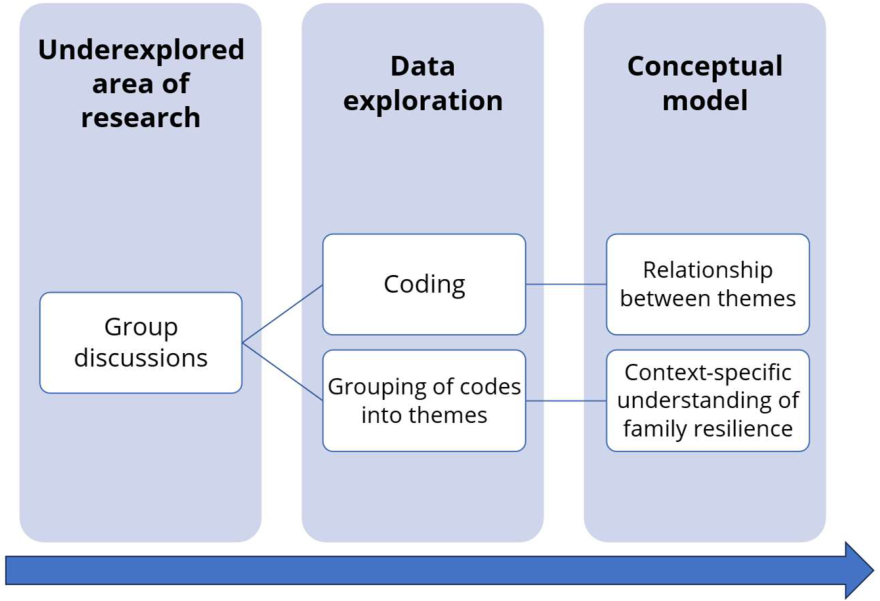
2.3. Data Analysis
2.4. Positionality Statement
3. Results
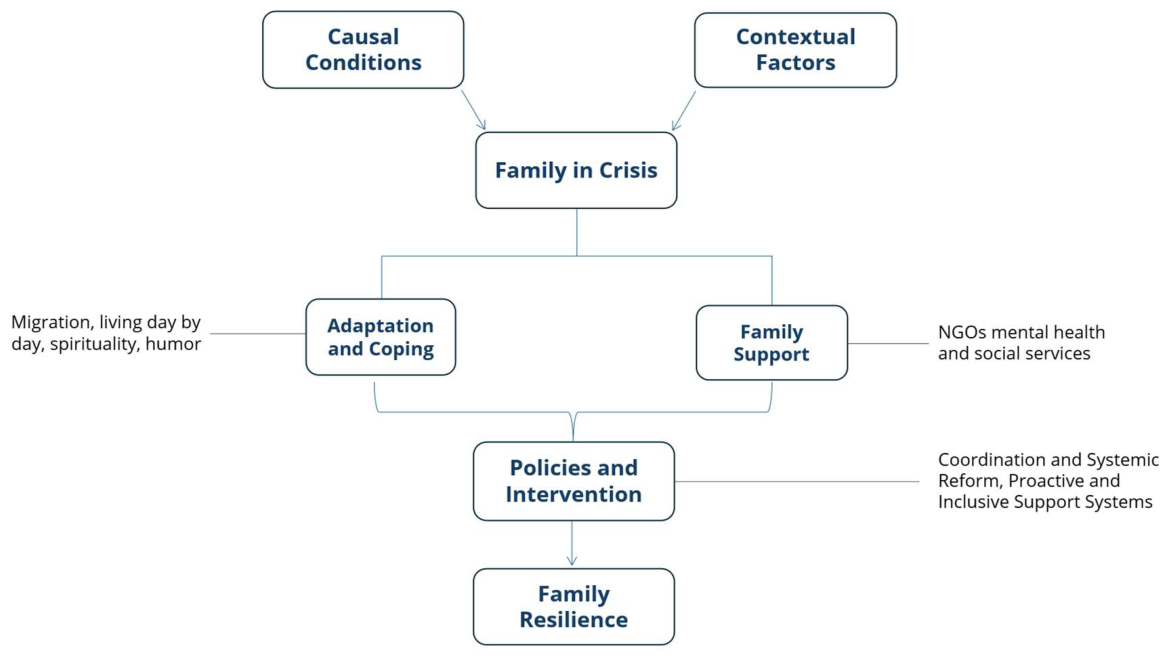
3.1. Causal Conditions
“From the day I was born till this day I haven’t witnessed a ‘normal’ day in this country.”—Clinical psychologist, Group 1
“It saddens me to see that we’re at a point where even the most basic needs have become a luxury that most people [and families] can’t afford.”—Social worker, Group 1
“The anxiety and suffering that the parents went through because of the war and are going through again are being passed down to their children.”—Clinical psychology graduate, Group 1
“There is no escape from the negative and it is impossible to distract yourself from anxiety and negativity.”—Clinical psychology graduate, Group 1
3.2. Contextual and Institutional Factors
“Even when everything else fails, family is what keeps people standing.”—Social scientist, Group 3
3.3. Family in Crisis as a Dynamic Site of Resilience
“Everyone has developed anxiety because nothing is certain and unpredictable.”—Clinical psychologist, Group 1
“Even when adapting may be the worst thing to do… that’s just what they do in their everyday lives in order to survive and keep going.”—Clinical psychology graduate, Group 1
3.4. Adaptation and Coping
3.5. Family Support
- (a)
- Non-Governmental Organizations (NGOs)
- (b)
- Mental Health and Social Services
- (c)
- Governance and Policy Gaps
“It would be helpful to create platforms for regular communication and information sharing among institutions, services, and NGOs involved in family support and crisis management”—Political scientist/policy expert, Group 4
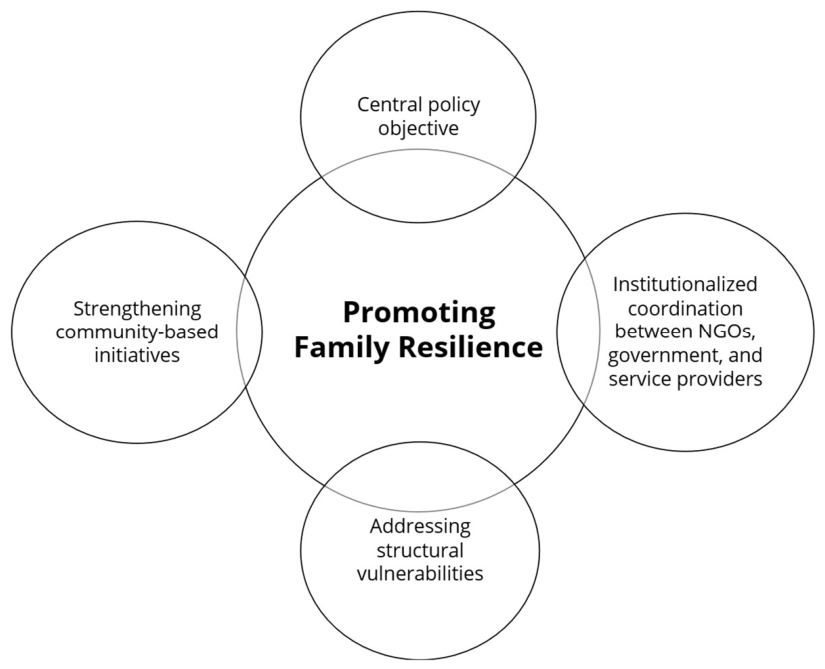
3.6. Social Policies, Interventions, and Pathways to Family Resilience
- (a)
- Coordination and Systemic Reform
- (b)
- Proactive and Inclusive Support Systems
- Establishing safe spaces where individuals and families can share experiences of loss, displacement, and recovery.
- Developing targeted psychosocial programs for mothers and mediation services for marital or intergenerational conflicts.
- Leveraging technology and social media platforms to centralize information, amplify outreach, and connect families with services.
- Designing policies that prioritize psychosocial well-being alongside material aid, ensuring interventions start at the individual and family level.
4. Discussion
4.1. Family Resilience in a Context of Chronic Crisis
4.2. Social and Practical Implications
4.3. Limitations
5. Conclusions
Author Contributions
Funding
Institutional Review Board Statement
Informed Consent Statement
Data Availability Statement
Acknowledgments
Conflicts of Interest
References
- Abboud Mzawak, Mirna, Rudy S. Younes, and Clara Moukarzel. 2025. Echoes of the Blast: A Qualitative Study of Loss and Adaptation among Bereaved Families of the 2020 Beirut Explosion. Death Studies 50: 647–60. [Google Scholar] [CrossRef]
- Acocella, Ivana, and Silvia Cataldi. 2021. Using Focus Groups: Theory, Methodology, Practice. Thousand Oaks: SAGE Publications Ltd. [Google Scholar] [CrossRef]
- Akesson, Bree, and Cindy Sousa. 2019. Parental Suffering and Resilience Among Recently Displaced Syrian Refugees in Lebanon. Journal of Child and Family Studies 29: 1264–73. [Google Scholar] [CrossRef]
- Al-Khalil, Zeina M., Walaa G. El Sheikh, Ghena H. Lababidi, Elissa O. Shehayeb, Pia Maria Ghanime, Farid R. Talih, Hani Tamim, and Bilal R. Kaafarani. 2025. Impact of Socioeconomic and Political Stressors on Mental Health: A Cross-Sectional Study on University Students in Lebanon. BMC Medical Education 25: 91. [Google Scholar] [CrossRef] [PubMed]
- Arab Barometer. 2022. Half of Lebanese Consider Migrating. Available online: https://www.arabbarometer.org/2022/04/what-lebanese-citizens-think-about-migration/ (accessed on 1 May 2026).
- Arias Valencia, María Mercedes. 2022. Principles, Scope, and Limitations of the Methodological Triangulation. Investigacion y Educacion en Enfermeria 40: e03. [Google Scholar]
- Aulia, Nida Rivdah, Farida Agus Setiawati, and Siti Rohmah Nurhayati. 2025. Dynamics of Family Resilience to Economic Crisis: English. Counsenesia Indonesian Journal of Guidance and Counseling 6: 406–16. [Google Scholar] [CrossRef]
- Azhari, Timour, and Laila Bassam. 2022. Bank Holdups Snowball in Lebanon as Depositors Demand Their Own Money. Reuters. Available online: https://www.reuters.com/world/middle-east/armed-man-detained-after-holding-up-south-lebanon-bank-access-own-savings-2022-09-16/ (accessed on 1 May 2026).
- Bardin, Laurence. 2013. L’Analyse de Contenu. Paris: Presses Universitaires de France. [Google Scholar] [CrossRef]
- Beasley, Lana O., Jens E. Jespersen, Amanda S. Morris, Aisha Farra, and Jennifer Hays-Grudo. 2022. Parenting Challenges and Opportunities among Families Living in Poverty. Social Sciences 11: 119. [Google Scholar] [CrossRef]
- Benček, David, and Claas Schneiderheinze. 2024. Higher Economic Growth in Poor Countries, Lower Migration Flows to the OECD—Revisiting the Migration Hump with Panel Data. World Development 182: 106655. [Google Scholar] [CrossRef]
- Bingham, Andrea J. 2023. From Data Management to Actionable Findings: A Five-Phase Process of Qualitative Data Analysis. International Journal of Qualitative Methods 22: 16094069231183620. [Google Scholar] [CrossRef]
- Bird, Christian. 2016. Interviews. In Perspectives on Data Science for Software Engineering. Edited by Christian Bird. Amsterdam: Elsevier. [Google Scholar] [CrossRef]
- Boss, Pauline, Chalandra M. Bryant, and Jay A. Mancini. 2017. Family Stress Management: A Contextual Approach. Thousand Oaks: Sage Publications. [Google Scholar] [CrossRef]
- Braun, Susanne, Dieter Frey, Felix Claus Brodbeck, and Tanja Hentschel. 2015. Group Processes in Organizations. In International Encyclopedia of the Social & Behavioral Sciences. Amsterdam: Elsevier. [Google Scholar] [CrossRef]
- Braun, Virginia, and Victoria Clarke. 2006. Using Thematic Analysis in Psychology. Qualitative Research in Psychology 3: 77–101. [Google Scholar] [CrossRef]
- Bronfenbrenner, Urie. 1981. The Ecology of Human Development: Experiments by Nature and Design. Cambridge: Harvard University Press. [Google Scholar] [CrossRef]
- Chab, Rida. 2025. Psycho-Social Resilience Amid Political and Economic Upheaval 2020–2024. In Global Societal Resilience Through Political, Environmental, and Cultural Upheaval. Hershey: IGI Global Scientific Publishing, pp. 177–208. [Google Scholar] [CrossRef]
- Choueiri, Fadlo Jad Abi Haidar, and Marc Moukarzel. 2023. Annual Inflation in Lebanon at 253.55% in June 2023. Credit Libanais. Available online: https://economics.creditlibanais.com/Article/211727#en (accessed on 1 May 2026).
- Chutiyami, Muhammad, Natalie Cutler, Sopin Sangon, Tusana Thaweekoon, Patcharin Nintachan, Wilai Napa, Phachongchit Kraithaworn, and Jo River. 2025. Community-Engaged Mental Health and Wellbeing Initiatives in Under-Resourced Settings: A Scoping Review of Primary Studies. Journal of Primary Care & Community Health 16: 21501319251332723. [Google Scholar] [CrossRef]
- Coulston, Free, Fiona Lynch, and Danya F. Vears. 2025. Collaborative Coding in Inductive Content Analysis: Why, When, and How to Do It. Journal of Genetic Counseling 34: e70030. [Google Scholar] [CrossRef]
- DeFrain, John, and Sylvia M. Asay. 2007. Strong Families Around the World: An Introduction to the Family Strengths Perspective. Marriage & Family Review 41: 1–10. [Google Scholar] [CrossRef]
- Demuth, Carolin, and Günter Mey. 2015. Qualitative Methodology in Developmental Psychology. In International Encyclopedia of the Social & Behavioral Sciences. Amsterdam: Elsevier. [Google Scholar] [CrossRef]
- Démurger, Sylvie. 2015. Migration and Families Left Behind. IZA World of Labor. ahead of print. [Google Scholar] [CrossRef]
- Digard, Jean-Pierre. 2003. Tribus, Maisons, États: Modernité de La Parenté Arabe. L’Homme 166: 185–92. [Google Scholar] [CrossRef]
- El-Khoury, Joseph. 2019. A Review of the Psychological Impact of the 2006 War on the Civilian Population in Lebanon. Traumatology 25: 203–7. [Google Scholar] [CrossRef]
- El Murr, Perla, Elias Rahme, Rudy S. Younes, Rabih Assaf, and Nadine Zalaket. 2025. Mental Health during the Lebanese Economic Crisis: Association between Financial Well-Being, Anxiety, and Depression. International Journal of Social Psychiatry 17: 00207640251359059. [Google Scholar] [CrossRef]
- Firestone, Robert W., and Lisa Firestone. 2012. Separation Theory and Voice Therapy Methodology. In Meaning, Mortality, and Choice: The Social Psychology of Existential Concerns. Edited by Phillip R. Shaver and Mario Mikulincer. Washington, DC: American Psychological Association. [Google Scholar] [CrossRef]
- Gale, Chrissie, Rosalind Willi, Purcell Michelle, and Nicola Oberzaucher. 2023. Strengthening Families: How Strengthening Families Can Help Prevent Unnecessary Separation of Children from Their Families (Central and Eastern Europe and Central Asia). Chicago: SOS Children’s Village. [Google Scholar]
- Given, Lisa. 2008. Exploratory Research. In The SAGE Encyclopedia of Qualitative Research Methods. Edited by Lisa Given. Thousand Oaks: SAGE Publications, Inc. [Google Scholar] [CrossRef]
- Goundar, Prashneel Ravisan. 2025. Researcher Positionality: Ways to Include It in a Qualitative Research Design. International Journal of Qualitative Methods 24: 16094069251321251. [Google Scholar] [CrossRef]
- Gumiandari, Septi, Abd Madjid, Eti Nurhayati, Wanda Listiani, and Ilman Nafi’a. 2024. Heading to Reciprocity in Islamic Psychology: Coping Adaptive Strategy for Family Resilience During the Pandemic. Jurnal Akidah & Pemikiran Islam 26: 348–84. [Google Scholar] [CrossRef]
- Herdiana, Ike, Suryanto, and Seger Handoyo. 2018. Family Resilience: A Conceptual Review. Paper presented at 3rd ASEAN Conference on Psychology, Counselling, and Humanities (ACPCH 2017), Malang, Indonesia, October 21–22. [Google Scholar] [CrossRef]
- Hirst, David. 1999. South Lebanon: The War That Never Ends? Journal of Palestine Studies 28: 5–18. [Google Scholar] [CrossRef]
- International Monetary Fund. 2023. IMF Executive Board Concludes 2023 Article IV Consultation with Lebanon. Available online: https://www.imf.org/en/News/Articles/2023/06/28/pr23245-lebanon-imf-executive-board-concludes-2023-article-iv-consultation-with-lebanon (accessed on 1 May 2026).
- Ivanova, Masha Y., and Allen C. Israel. 2005. Family Stability as a Protective Factor Against the Influences of Pessimistic Attributional Style on Depression. Cognitive Therapy and Research 29: 243–51. [Google Scholar] [CrossRef]
- Jamshed, Shazia. 2014. Qualitative Research Method-Interviewing and Observation. Journal of Basic and Clinical Pharmacy 5: 87. [Google Scholar] [CrossRef]
- Karam, Elie G., Mariam El-Jamal, Rayane Osman, Sana Toukan, Ghiwa Ishac Mouawad, and Josleen Al Barathie. 2025. The Aftermath of Multiple Trauma on a Nation: Unraveling Lebanon’s Unique Mental Health Struggle. Frontiers in Psychiatry 15: 1444245. [Google Scholar] [CrossRef]
- Kim, Jinhee, Taylor L. Spangler, and Michael S. Gutter. 2016. Extended Families: Support, Socialization, and Stress. Family and Consumer Sciences Research Journal 45: 104–18. [Google Scholar] [CrossRef]
- Kingston, Paul, and William L. Ochsenwald. 2026. Lebanese Civil War. In Encyclopedia Britannica. Available online: https://www.britannica.com/event/Lebanese-Civil-War (accessed on 1 May 2026).
- Lee, Soo Yeon, and Kuem Sun Han. 2024. Family Strength: A Concept Analysis. Journal of Korean Academy of Psychiatric and Mental Health Nursing 33: 124–37. [Google Scholar] [CrossRef]
- Lim, Weng Marc. 2025. What Is Qualitative Research? An Overview and Guidelines. Australasian Marketing Journal 33: 199–229. [Google Scholar] [CrossRef]
- Lin, Xiuyun. 2024. Family Socialization. In The ECPH Encyclopedia of Psychology. Edited by Kan Zhang. Singapore: Springer Nature. [Google Scholar] [CrossRef]
- Lincoln, Yvonna S., and Egon G. Guba. 1986. But is it rigorous? Trustworthiness and authenticity in naturalistic evaluation. New Directions for Program Evaluation 1986: 73–84. [Google Scholar] [CrossRef]
- Makri, Chara, and Andy Neely. 2021. Grounded Theory: A Guide for Exploratory Studies in Management Research. International Journal of Qualitative Methods 20: 16094069211013654. [Google Scholar] [CrossRef]
- Manti, Sara, and Amelia Licari. 2018. How to Obtain Informed Consent for Research. Breathe 14: 145–52. [Google Scholar] [CrossRef]
- Mildenberger, Carl D. 2013. Economics and Social Conflict. London: Palgrave Macmillan UK. [Google Scholar] [CrossRef]
- Naeem, Muhammad, Wilson Ozuem, Kerry Howell, and Silvia Ranfagni. 2023. A Step-by-Step Process of Thematic Analysis to Develop a Conceptual Model in Qualitative Research. International Journal of Qualitative Methods 22: 16094069231205789. [Google Scholar] [CrossRef]
- Nasr, Ramona, Nada Nasr, Chadia Haddad, Samantha Abi Saab, Sara Abou Ibrahim, Joanne Karam, and Abir Abdel Rahman. 2024. Financial Insecurity and Mental Well-being: Experiences of Parents Amid the Lebanese Economic Crisis. BMC Public Health 24: 3017. [Google Scholar] [CrossRef]
- Powell, Richard A., and Helen M. Single. 1996. Focus Groups. International Journal for Quality in Health Care 8: 499–504. [Google Scholar] [CrossRef]
- Sanogo, Souleymane, Clémentine Rossier, Matthias Studer, and Marlène Sapin. 2025. Cultural Context and Family Support across 29 Nations: Evidence from the ISSP 2017 Social Networks and Social Resources Module. International Journal of Sociology 55: 409–30. [Google Scholar] [CrossRef]
- Saunders, Benjamin, Jenny Kitzinger, and Celia Kitzinger. 2015. Anonymising Interview Data: Challenges and Compromise in Practice. Qualitative Research 15: 616–32. [Google Scholar] [CrossRef]
- SOS Children’s Village. 2025. Five Devastating Effects of Family Separation on Children—And How We Can Stop It. Available online: https://www.sos-usa.org/news/topics/strengthening-families/5-effects (accessed on 1 May 2026).
- Stilz, Anna. 2022. Economic Migration: On What Terms? Perspectives on Politics 20: 983–98. [Google Scholar] [CrossRef]
- Sutton, Jane, and Zubin Austin. 2015. Qualitative Research: Data Collection, Analysis, and Management. The Canadian Journal of Hospital Pharmacy 68: 226. [Google Scholar] [CrossRef]
- Tabar, Paul. 2010. Lebanon: A Country of Emigration and Immigration. Lebanese American University, Institute for Migration Studies. Available online: https://fount.aucegypt.edu/faculty_journal_articles/5056/ (accessed on 1 May 2026).
- Tarabay, Jennifer, and Dennis Golm. 2024. The Transmission of Intergenerational Trauma and Protective Factors in Survivors of the Lebanese Civil War and Their Adult Offspring. International Journal of Intercultural Relations 99: 101952. [Google Scholar] [CrossRef]
- Tohme, Pia, Ian Grey, Maria Theresa El-Tawil, Mohamad El Maouch, and Rudy Abi-Habib. 2024. Prevalence and Correlates of Mental Health Difficulties Following the Beirut Port Explosion: The Roles of Mentalizing and Resilience. Psychological Trauma: Theory, Research, Practice, and Policy 16: 30–38. [Google Scholar] [CrossRef]
- Tuzi, Irene. 2023. ‘Doing Family’ as a Separated Household: The Experience of Syrian Refugees in Germany and Lebanon. In Forced Migration and Separated Families. Edited by Marja Tiilikainen, Johanna Hiitola, Abdirashid A. Ismail and Jaana Palander. IMISCOE Research Series; Cham: Springer International Publishing. [Google Scholar]
- Ungar, Michael. 2011. The Social Ecology of Resilience: Addressing Contextual and Cultural Ambiguity of a Nascent Construct. American Journal of Orthopsychiatry 81: 1–17. [Google Scholar] [CrossRef] [PubMed]
- UNICEF. 2021. Humanitarian Action for Children. Available online: https://www.unicef.org/media/109531/file/2021-HAC-Lebanon-August-Revision.pdf (accessed on 1 May 2026).
- Vladislav, Elena Otilia, Gabriela Marc, Corina-Ioana Paica, and Ovidiu Pop. 2024. Family Resilience in a Social-Ecological Context—Emotional Difficulties and Coping Strategies. Frontiers in Psychology 15: 1421745. [Google Scholar] [CrossRef] [PubMed]
- Von Soest, Christian. 2023. Why Do We Speak to Experts? Reviving the Strength of the Expert Interview Method. Perspectives on Politics 21: 277–87. [Google Scholar] [CrossRef]
- Walsh, Froma. 2016a. Family Resilience: A Developmental Systems Framework. European Journal of Developmental Psychology 13: 313–24. [Google Scholar] [CrossRef]
- Walsh, Froma. 2016b. Strengthening Family Resilience, 3rd ed. New York: The Guilford Press. [Google Scholar]
- Walsh, Froma. 2020. Loss and Resilience in the Time of COVID-19: Meaning Making, Hope, and Transcendence. Family Process 59: 898–911. [Google Scholar] [CrossRef]
- World Bank Group. 2021. Lebanon Sinking into One of the Most Severe Global Crises Episodes, Amidst Deliberate Inaction. Available online: https://www.worldbank.org/en/news/press-release/2021/05/01/lebanon-sinking-into-one-of-the-most-severe-global-crises-episodes (accessed on 1 May 2026).
- Younes, Rudy S., Clara Moukarzel, Chantale D. Ibrahim, and Mirna Abboud Mzawak. 2025. Finding Strength in Times of War: A Systematic Review of Resilience and Adaptation Among Arabs Exposed to War. Social Sciences 14: 626. [Google Scholar] [CrossRef]



| Group | Principal Questions |
|---|---|
| Group 1 | From your experiences and observations, how do the ongoing socio-economic crisis and the Beirut port explosion result in psychological distress among individuals and families in Lebanon? |
| How do these crises disrupt familial dynamics and relationships within Lebanese households? What are some common challenges faced by families in navigating these crises? | |
| What are the potential long-term impacts of familial struggles in the context of Lebanon’s crises, on the familial and societal levels? | |
| Group 2 | In the face of ongoing crises, what are some notable adaptive strategies employed by Lebanese families to navigate the challenges? |
| How do social support and solidarity play a role in facilitating adaptation and resilience among Lebanese families during times of crisis? | |
| Reflecting on the collective experiences of Lebanese communities, how does the concept of solidarity, mutual aid, and community-driven efforts contribute to the adaptation process during crises? | |
| Group 3 | What are some services or institutions that have supported individuals and families facing separation and trauma in Lebanon? |
| Considering the cultural context of Lebanon, how can adaptation strategies and support services be tailored to be more culturally sensitive and responsive to the unique socio-cultural dynamics of Lebanese society? | |
| Group 4 | What roles do various services and institutions play in supporting individuals and families affected by the crises in Lebanon? |
| Reflecting on the current policy landscape, what are some key policy gaps or shortcomings that need to be addressed to better support families in Lebanon? |
| Group | Number of Participants | Participants’ Profile |
|---|---|---|
| Group 1—Social and psychological repercussions of the crisis | 9 | Clinical psychologists, clinical psychology graduate students, social workers, and social scientists who provide direct clinical or support services to individuals and families affected by the crisis. |
| Group 2—Insights into the adaptation methods of Lebanese families and communities | 12 | Social workers working in NGOs and associations, and people involved in community initiatives in Lebanese communities during the crisis, who primarily observed and documented community responses rather than providing direct support. |
| Group 3—Promotion of effective adaptation strategies | 12 | Clinical psychologists, social workers, and social scientists who developed or implemented community-based interventions with families and communities to promote better adaptation and coping during times of crisis. |
| Group 4—Policy recommendations | 11 | Social policy experts with research and/or intervention experience in Lebanon during the crisis. |
Disclaimer/Publisher’s Note: The statements, opinions and data contained in all publications are solely those of the individual author(s) and contributor(s) and not of MDPI and/or the editor(s). MDPI and/or the editor(s) disclaim responsibility for any injury to people or property resulting from any ideas, methods, instructions or products referred to in the content. |
© 2026 by the authors. Licensee MDPI, Basel, Switzerland. This article is an open access article distributed under the terms and conditions of the Creative Commons Attribution (CC BY) license.
Share and Cite
Younes, R.S.; Ibrahim, C.D.; Moukarzel, C.; Abboud Mzawak, M. Family Resilience and Hardship During the Severe Economic Crisis in Lebanon: Perspectives from Four Discussion Groups of Professionals. Soc. Sci. 2026, 15, 300. https://doi.org/10.3390/socsci15050300
Younes RS, Ibrahim CD, Moukarzel C, Abboud Mzawak M. Family Resilience and Hardship During the Severe Economic Crisis in Lebanon: Perspectives from Four Discussion Groups of Professionals. Social Sciences. 2026; 15(5):300. https://doi.org/10.3390/socsci15050300
Chicago/Turabian StyleYounes, Rudy S., Chantale D. Ibrahim, Clara Moukarzel, and Mirna Abboud Mzawak. 2026. "Family Resilience and Hardship During the Severe Economic Crisis in Lebanon: Perspectives from Four Discussion Groups of Professionals" Social Sciences 15, no. 5: 300. https://doi.org/10.3390/socsci15050300
APA StyleYounes, R. S., Ibrahim, C. D., Moukarzel, C., & Abboud Mzawak, M. (2026). Family Resilience and Hardship During the Severe Economic Crisis in Lebanon: Perspectives from Four Discussion Groups of Professionals. Social Sciences, 15(5), 300. https://doi.org/10.3390/socsci15050300