
Attachment Styles, Emotional Dependence, and Intimate Partner Violence: A Systematic Review


 , , and
Abstract
1. Introduction
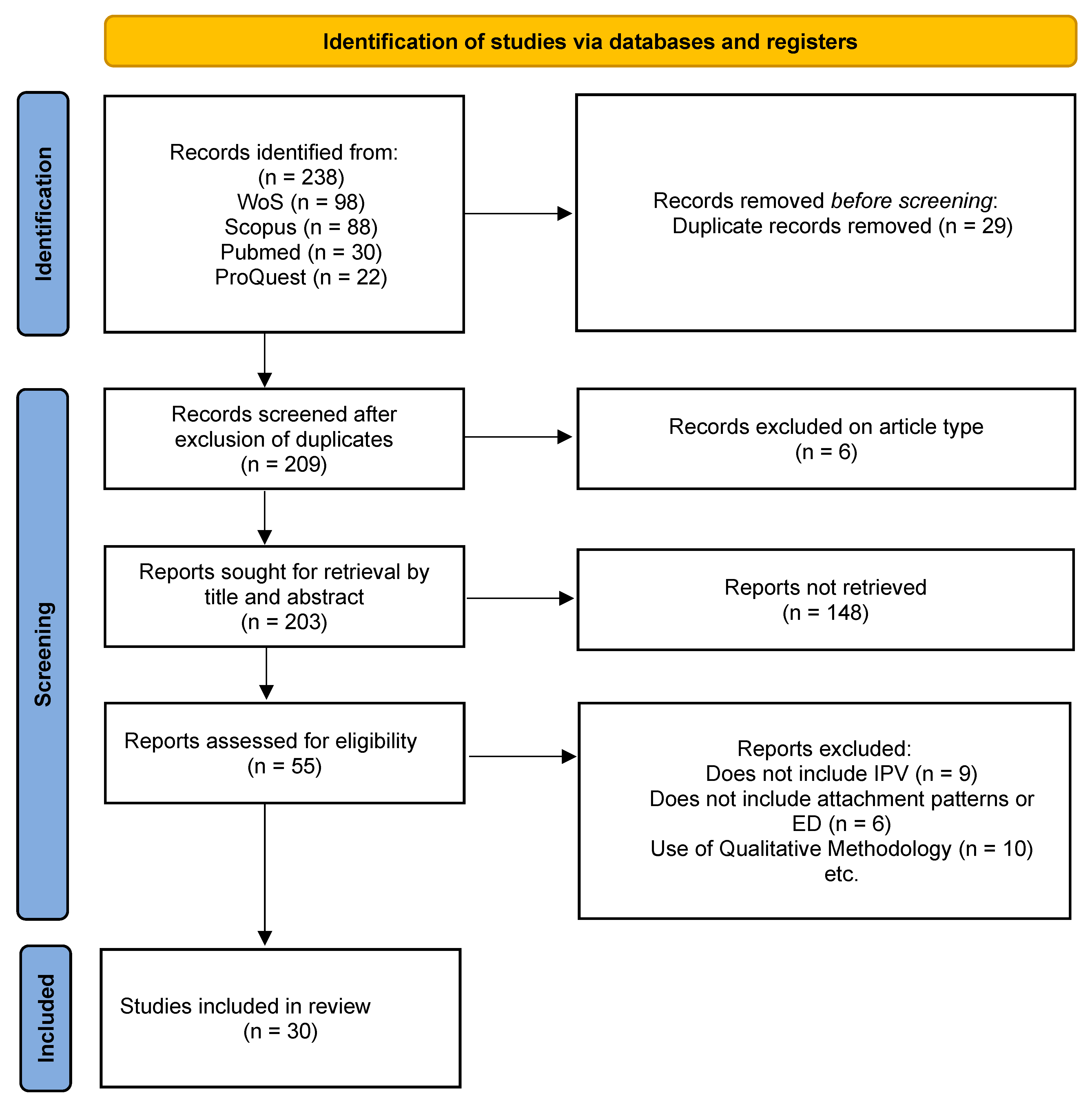
2. Materials and Methods
3. Results
3.1. Qualitative Analysis
3.2. Relationship Between Attachment Patterns and/or Emotional Dependence and Intimate Partner Violence

| Code | Author(s) (Year of Publication) | Sample | Research Objectives | Instruments Used | Main Findings |
|---|---|---|---|---|---|
| 1. | Almeida et al. (2023) Portugal (Europe) | n = 158 women, victims of intimate relationship violence (IPV) Age range: 18–73 years (M = 43.95). | To examine the relationship between adult attachment, psychopathology and beliefs about intimate relationship violence. |
| The majority of victims exhibited a secure attachment style. Nevertheless, a significant association was found between insecure-anxious attachment and higher levels of psychopathology, as well as beliefs that justify or minimize violence in intimate relationships. These findings reinforce the connection between insecure attachment styles and a higher vulnerability for psychological distress and the normalization of intimate partner violence. |
| 2. | Amor et al. (2022) Spain (Europe) | n = 257, women −56% abused women undergoing treatment (n = 144). −44% non-abused women (n = 113). Age range: 18+ (M = 40.58). Inclusion criteria:
| To analyze differences between abused and non-abused women in emotional dependence, considering total and subscale scores of the scale. To examine correlations between the dimensions of the SED and clinical and personality variables in the group of abused women. To establish cut-off points to detect the risk of intimate partner violence in women based on emotional dependence. | Abused women scored significantly higher than non-abused women on all dimensions and items of the Emotional Dependence Scale (SED), with large effect sizes, especially in the dependence/submission factor. ED in this group was positively associated with depression, anxiety, and impulsivity, and negatively associated with self-esteem, confirming a strong relationship between intimate partner violence and emotional dependence. | |
| 3. | Bahadir-Yilmaz and Şahin (2021) Turkey (Asia) | n = 261, women, nursing and midwifery students at a university located in northeastern Turkey. Age range: 18–41 years (M = 20.94). Inclusion criteria:
| To investigate the effects of irrational beliefs about romantic relationships and experiences in close relationships on dating violence among nursing and midwifery students. |
| Anxious attachment (β = −3.241), secure attachment (β = −3.119), social time use (β = −0.252), and differentiated thinking (β = −2.788) were predictors of dating violence (p < 0.01). The most important predictors of dating violence were anxious attachment, secure attachment, social time use, and differentiated thinking. |
| 4. | Barría-Muñoz (2015) Chile (Ibero-America) | n = 832, men. n = 732 perpetrators. n = 100 non-abusive men (control group). Age range: 18+ (M = 38.7). | To examine two constructs that have recently been studied in Ibero-American contexts (Spain and Chile) in samples of perpetrators: attachment styles and beliefs related to masculinity and femininity. |
| A predominance of anxious/preoccupied (27.8% to 39.7%) and fearful/disorganized (25.6% to 42.3%) attachment styles was observed among perpetrators, in contrast to men without a history of violence, among whom the secure attachment style predominated (66.7%). High and extreme risk perpetrator groups were concentrated in disorganized (16.2%) and anxious (15.1%) attachment styles. In contrast, low-risk individuals were primarily concentrated in the secure attachment style (11.2%). |
| 5. | Bonache et al. (2019) Spain (Europe) | n = 216, heterosexual university students from Spain: 76.4% women. 23.6% men. Age range: 17–44 years (M = 21.40 years). | (1) To better understand the links between adult attachment style, conflict management strategies in romantic relationships, and two forms of intimate partner violence (IPV), namely psychological abuse and sexual coercion. 1.1. To analyze the direct associations between attachment styles, conflict resolution patterns, and IPV victimization. 1.2. To examine the role of self-reported conflict resolution styles and perceived partner conflict resolution styles in explaining the link between insecure attachment and vulnerability to IPV victimization in the form of psychological abuse and sexual coercion. |
| Anxious and avoidant attachment styles were directly associated with IPV victimization (psychological and sexual). Anxious attachment also showed indirect pathways to both forms of victimization, mediated by the use of destructive conflict resolution strategies, particularly self-reported confrontation and perceived partner confrontation. These strategies were linked to a higher risk of sexual coercion and psychological abuse. In contrast, although avoidant attachment was associated with withdrawal during conflict, no significant indirect pathways to victimization were found. No differences were observed according to gender or relationship status. The findings highlight the role of anxious attachment in conflict escalation processes that increase vulnerability to intimate partner violence. |
| 6. | Castillo-Gonzáles and Andrade (2024) Ecuador (Ibero-America) | n = 3202, university students from three different public universities in Ecuador: −35.7% men. −64.3% women. Age range: 16–48 years (M = 21.50). Inclusion criteria:
| To analyze the perpetration and victimization of online dating violence and emotional dependence among men and women. |
| Significant gender differences (p < 0.01) were found in both victimization and perpetration of online dating violence. ED predicted online dating violence victimization more strongly in women (17% of explained variance) than in men (7%). It also predicted perpetration, slightly more in men (13%) than in women (9%). Emotional dependence was a stronger predictor of victimization in women than in men, both overall and across specific dimensions. |
| 7. | Castillo-Gonzáles et al. (2024) Ecuador (Ibero-America) | n = 3203, university students: −64.3% women. −35.7% men. Age range: 16–48 years. | Analyze the relationship between dating violence and emotional dependence in young university students in Ecuador, identifying differences by sex. | Dating violence affects both sexes equally in general terms (90.4% men, 88.1% women; p = 0.051), although differences were observed by type and intensity: men reported more mild violence, while women suffered more psychological and instrumental violence at severe levels (p ≤ 0.05). Women also showed higher emotional dependence (p < 0.001). This dependence is directly related to a higher presence of violence, especially psychological (large effect), sexual (medium), and, to a lesser extent, physical and instrumental. Emotional dependence is a clear risk factor for experiencing dating violence, particularly among women. | |
| 8. | Creamer and Hand (2022) United Kingdom (Europe) | n = 58, university students (Glasgow Caledonian University): −48.3% women (n = 28). −51.7% men (n = 30). Age range: 18–35 years (M = 21.99). | Examine the role of participants’ attachment style in prior perpetration of intimate partner stalking (IPS), stalking behaviors, and cognitive and physiological measures. |
| Men were more likely to perpetrate IPS than women. Participants with an anxious attachment style were more likely to have perpetrated IPS, as well as show greater cognitive disruption and heart rate variability (HRV) than those with an avoidant attachment style. They also exhibited a higher frequency of stalking behaviors, reinforcing the association between anxious attachment and intrusive behavior patterns in intimate relationships. |
| 9. | de la Osa Subtil et al. (2022) Spain (Europe) | n = 176 men convicted of partner violence, on probation or serving alternative sentences. Age range: 20–80 years (M = 39). | Determine whether different attachment styles (secure and insecure: preoccupied, dismissive, fearful) and having experienced parental abuse predict adult aggression. |
| Childhood abuse is a risk factor for adult violent behavior but does not determine it. Secure attachment functions as a protective factor, insecure styles as risk factors. Fearful-hostile attachment showed the greatest increase in aggression (mean +20.43 points), followed by distant attachment (+7.68), compared with secure attachment. |
| 10. | de la Villa et al. (2017) Spain (Europe) | n = 224 adolescents and young adults (pre-university and university students): −74.3% women (n = 168). −25.7% men (n = 58). Age range: 15–26 (M = 18.2). | Examine the relationship between dating violence, emotional dependence, and self-esteem, including inter-gender and educational level differences. |
| Emotional dependence is significantly related to dating violence. Victimized adolescents show higher emotional dependence and lower self-esteem, especially in women. Males show accommodation and emotional manipulation. Violence and dependence are more frequent in secondary students than university students, indicating greater vulnerability at younger ages. |
| 11. | Echeburúa et al. (2023) Spain (Europe) | n = 100 men (50 offenders in community outpatient treatment and 50 non-offenders control group). Age range: 18+ (M = 41.87). Inclusion criteria:
| (1) Analyze sociodemographic and emotional dependence differences between men who perpetrate and do not perpetrate partner violence. (2) Examine correlations of partner emotional dependence with relationship length, age, and clinical (anxiety, depression) and personality (anger, self-esteem) variables among offenders. | A strong association between emotional dependence (ED) and perpetrated violence was found. Offenders scored significantly higher on ED than non-offenders in 18/22 items. In offenders, ED correlated positively with depressive symptoms but not with anxiety, self-esteem, or anger, highlighting its specific role in sustaining violent behavior | |
| 12. | Erdem et al. (2022) Turkey (Asia) | n = 300 university students (two universities: Mar negro and Anatolia Central). Age range: 18–28 year (M = 20.78). | (1) Adapt the Cyber Dating Violence Scale (CDVS) to Turkish. (2) Investigate relationships between attachment styles and cyber-dating violence among university students. |
| Women scored higher on relational abuse and avoidant attachment. Anxious attachment was the main predictor of psychological abuse and victimization in cyber context (14% and 22% variance, respectively) and also predicted relational victimization (7% variance). Avoidant attachment predicted only psychological abuse (5% variance). |
| 13. | Guermazi et al. (2024) Tunisia (Africa) | n = 120, women, victims of intimate partner violence (IPV) who sought care at the Psychiatric Emergency Department in Sfax. Age range: 19–58 years (M = 37.27). Inclusion criteria:
| Describe sociodemographic, clinical, and relational profiles of women victims of IPV, assessing emotional abuse, emotional dependence, alexithymia, and self-esteem | 75.8% of the women were victims of severe emotional abuse, and 38.3% showed emotional dependence on their partners. A significant correlation was found between emotional abuse and emotional dependence. In addition, alexithymia (present in 59.2% of participants) was significantly associated with emotional dependence (p = 0.004). Higher levels of emotional dependence were related to an earlier onset of violence (p < 0.001) and a history of psychiatric disorders (p = 0.02). 83.3% of the women had low self-esteem, which was also associated with indicators of violence. The data indicate a direct relationship between intimate partner violence and higher emotional dependence. | |
| 14. | Gündoğmuş et al. (2023) Turkey (Asia) | n = 75 women attending outpatient psychiatric services and suffered IPV in the last year. Age range: 18–65 (M = 37.61). | To investigate the relationship between Intimate Partner Violence (victimization in the intimate partner (IPV-V) and perpetration in the intimate partner (IPV-P)) with attachment styles, schema domains, and personality beliefs in a group of women seeking treatment. |
| Anxious attachment style showed a significant and direct association with most forms of intimate partner violence, both in perpetration and victimization. In perpetration, it was associated with psychological aggression (β = 0.47; 22% of the variance), physical aggression (β = 0.42; included in a model explaining 32% of the variance), sexual coercion (β = 0.29; 27%), and injury (β = 0.38; 30%). In victimization, it was also associated with psychological violence (β = 0.42; 20%), physical violence (β = 0.30; 17%), and injury (β = 0.28; 19%). Avoidant attachment was not related to any CTS-2 subscale in the correlational analyses, although it did appear in regression models for physical aggression (perpetration: β = 0.22; victimization: β = 0.19). No effects were found for the negotiation subscales. Finally, schema domains and personality beliefs did not show a mediating effect on the relationship between attachment styles and intimate partner violence. |
| 15. | Guzmán González et al. (2016) Chile (Ibero-America) | n = 744, university students, who have or had at least one romantic relationship lasting one month or more in the past twelve months, divided into two equally sized subgroups (n = 372) based on whether they had experienced physical violence at least once in the past year or had not experienced physical violence in the past year. −45.1% men (n = 334). −54.9% women (n = 407). −3 students did not specify their gender. Age range: 18–28 years (M = 21.37) | To evaluate the association between attachment styles and the experience of physical violence in romantic or dating relationships among university students. | It was found a significant relationship between attachment styles and the presence/absence of physical violence (χ2 (2) = 14.02, p < 0.05, ϕ = 0.14) There is a significant association between the two variables (attachment style and experience of physical violence), with the anxious-preoccupied attachment style being predominant among those who experienced violence, and the secure attachment style being predominant among those who did not. | |
| 16. | Guzmán-Toledo et al. (2021) Mexico (Ibero-America) | n = 47, young mexican adults, non-students:
Inclusion criteria:
| To determine the relationship between attachment styles and control exercised and/or experienced within cyber dating violence (CDV) in the romantic relationships of young Mexican non-students. |
| A positive and significant association was found between secure attachment and control exerted, both in the total sample and among men, indicating a direct link between attachment style and cyber dating violence. Additionally, bidirectionality was observed in control behaviors (control exerted ↔ control experienced). Men exhibited higher levels of anxious attachment, whereas women showed higher levels of secure attachment. |
| 17. | Laforte et al. (2023) Canada (North America) | n = 253 adolescents.
Inclusion criteria:
| (1) To examine, using a dual approach, the associations between romantic attachment and the perpetration and victimization of digital dating violence (DDV) during adolescence. (1.1) Specifically, to assess whether the attachment dimensions (anxiety and avoidance) of both partners are related to their own patterns of direct aggression and monitoring/control in DDV, as well as those of their partner. | 96% of couples reported at least one incident of digital control in the last year, and 34% reported digital aggression. Both victimization and perpetration in digital aggression were associated with higher levels of anxiety in attachment, about oneself and in the relationship both for men and women. In digital monitoring, victimization was more strongly linked to the partner’s attachment anxiety, whereas perpetration was associated with both the individual’s and the partner’s attachment anxiety in girls, and primarily with the individual’s attachment anxiety in boys. No significant associations were found with avoidant attachment. | |
| 18. | Macía et al. (2022) Ecuador (Ibero-America) | n = 1533 adolescents: −53.9% male (n = 826). −46.1% female (n = 707). Age range: 14–18 years (M = 15.76). Inclusion criteria:
| To analyze the relationship between emotional dependence, addictive behaviors, and remaining in violent relationships during adolescence. |
| Emotional dependence was significantly correlated with violence received (r = 0.37, p < 0.001). Compulsive spending was strongly associated with emotional dependence (r = 0.21, p < 0.001), while sex addiction was more strongly associated with violence received (r = 0.18, p < 0.001). Violence received mediated the relationship between emotional dependence and addictive behaviors. |
| 19. | Mamani-Benito et al. (2023) Peru (Ibero-America) | n = 180 women, Peruvian entrepreneurs. Age range: 19–69 years (M = 43.21). Inclusion criteria:
| To determine how emotional dependence and self-esteem predict psychological violence in Peruvian women entrepreneurs. |
| A direct correlation was found between high emotional dependence scores and high levels of psychological violence. Psychological violence was significantly associated with self-esteem and emotional dependence. Additionally, education level, marital status, self-esteem, and emotional dependence were identified as predictors of psychological violence. Specifically, low self-esteem and high emotional dependence predicted higher levels of psychological violence in Peruvian women entrepreneurs. |
| 20. | Martín and Moral (2019) Spain (Europe) | n = 396 Spanish adolescents and young adults: 66.16% women (n = 262) 33.84% men (n = 134) Age range: 15–30 years (M = 19.36) | To analyze the relationship between emotional dependence and psychological abuse (both as victim and perpetrator) in a youth population. |
| Young people who were psychologically victimized and those who perpetrated this type of violence had higher average levels of emotional dependence. Emotional dependence was not related to gender, age, or education level, whereas psychological abuse was related to age and education level. |
| 21. | Momeñe et al. (2022) Spain (Europe) | n = 258 adults: −77.1% women −22.9% men Age range: 18–67 years (M = 32.63) | 1. Analyze the possible relationship between emotional dependence (ED), intolerance of uncertainty, worry tendency, and pessimism. 2. Evaluate the mediating role of intolerance of uncertainty in the relationship between ED and received physical and psychological partner violence. 3. Examine whether worry tendency mediates the relationship between ED and received physical and psychological partner violence. 4. Assess the mediating role of pessimism in the relationship between ED and received physical and psychological partner violence. |
| A positive and statistically significant relationship was found between ED and partner violence, particularly psychological and physical violence. ED was directly associated with psychological violence received, intolerance of uncertainty, worry tendency, and pessimism. A significant relationship was observed between ED and physical violence, partially explained (6.67%) by intolerance of uncertainty. ED was significantly linked to both physical and psychological violence, with worry tendency explaining 6.67% of the relationship with physical violence and 4.54% of the relationship with psychological violence. |
| 22. | Moral Jiménez and Prieto (2022) Spain (Europe) | n = 627, university students from the Principality of Asturias (Spain): −58.3% women −41.7% men Age range: 18–26 years (M = 21.27) | Determine whether there is a relationship between emotional dependence (ED) and partner control through social networks in romantic relationships among young people. |
| Statistically significant positive relationships were found between ED, cyber-control, and online aggression victimization. Male participants exerted more online control over their partners, while young women with ED showed a higher risk of technology addiction. A clear link was established between ED and cyber-abuse in young couples. |
| 23. | Ørke et al. (2021) Norway (Europe) | n = 154 women Age range: 20–69 years (M = 39.85) Inclusion criteria:
| 1. Investigate differences in attachment between women victimized and non-victimized by IPV, as well as between women victimized by a single partner versus multiple partners. 2. Explore whether victimization by multiple partners increased the likelihood of certain attachment characteristics, adjusting for childhood adversity and sociodemographic variables. |
| Compared to non-victimized women, women victimized by IPV were more likely to exhibit high levels of attachment avoidance. Among victimized women, those who experienced IPV from multiple partners were more likely to show higher attachment anxiety than those victimized by a single partner. After adjusting for childhood adversities, childhood sexual abuse emerged as an independent risk factor for IPV. Childhood emotional abuse mediated the association between attachment anxiety and IPV victimization, particularly in the context of multiple-partner victimization. |
| 24. | Paiva et al. (2022) Brasil (Ibero-America) | n = 222, women −53.3% in dating relationships −44.1% married Age range: 18–66 years (M = 27.9) | 1. Understand the relationships between psychological abuse, self-esteem, and emotional dependence in women during the pandemic, from the perspective of traumatic bonding theory. 2. Analyze the sociodemographic profile and characteristics of the participants. |
| Psychological abuse was associated with higher emotional dependence (particularly exclusive dependence and anxious attachment) and lower self-esteem. The relationship is bidirectional: abuse predicts emotional dependence (partially mediated by low self-esteem), and emotional dependence predicts abuse (also partially mediated by self-esteem). The mediating effect of self-esteem was significant only in women under 34 years; in women older than 34, the relationship between abuse and emotional dependence was direct. |
| 25. | Pimentel and Santelices (2017) Chile (Ibero-America) | n = 40, men n = 20: men convicted of intimate partner violence n = 20: men without a history of partner violence Age range: 30–50 years (M = 39) | To determine whether there are differences in adult attachment and mentalization between men convicted of partner violence and men with no history of partner violence. |
| Men with a history of partner violence showed a higher prevalence of insecure attachment (60% vs. 30%, p = 0.004), with fearful attachment being particularly prominent, while the non-violent group predominantly exhibited preoccupied attachment (p = 0.031; Fisher p = 0.049). The violent group also showed significantly higher attachment anxiety (p = 0.004), with no differences in avoidance. These results indicate a clear association between insecure attachment and intimate partner violence, especially linked to anxiety in the affective bond. No differences were found in mentalization abilities (p = 0.547). |
| 26. | Pollard and Cantos (2021) United States (North America) | n = 416 individuals, 206 heterosexual couples of Hispanic origin −85.1% (n = 177) composed of two partners identifying as Hispanic −12% (n = 25) with only one partner identifying as Hispanic −2.9% (n = 6) with neither partner identifying as Hispanic Age range: 18+ years (M = 21.21) | To examine associations between insecure attachment and the perpetration of physical intimate partner violence (IPV) in men and women, and to analyze whether these associations are exacerbated when involved with a partner exhibiting contrasting attachment needs and high levels of emotional dysregulation and impulsivity. The study also investigated whether the emotional dysregulation of both partners interacted to predict partner violence. |
| Attachment anxiety was significantly associated with IPV, particularly in women, predicting both self-reported and partner-reported violence (7–10% of variance). In men, both attachment anxiety and avoidance predicted self-reported violence (8–10%). Female attachment anxiety moderated the relationship between male attachment avoidance and violence (16%). Overall, attachment styles and their interaction are clearly linked to IPV as an expression or consequence of emotional dependence, especially in contexts marked by attachment anxiety. |
| 27. | Ponce-Díaz et al. (2019) Peru (Ibero-America) | n = 1211 women, psychology university students
Inclusion criteria:
| To examine the relationship between emotional dependence (ED) and life satisfaction in a group of psychology students from public and private universities in Lima, both victims and non-victims of IPV. | Among women experiencing IPV, ED was negatively associated with life satisfaction, with significant correlations for the total scale (r = −0.24; p < 0.005) and across all dimensions (r = −0.128 to −0.26; p < 0.001). Women with IPV showed significantly higher levels of ED compared to women without IPV. In the non-violent group, correlations between ED and life satisfaction were lower (r = −0.11; p < 0.005) and significant in only three of seven dimensions. | |
| 28. | Rosas-Muñoz et al. (2022) Mexico (Ibero-America) | n = 76 women Age range: 20–50 years Inclusion criteria:
| To determine the correlation between emotional dependence (ED) and intimate partner violence (IPV) in women registered at primary care services. |
| A positive correlation was found between emotional dependence (ED) and intimate partner violence (IPV), with Spearman’s rho of 0.67 (p ≤ 0.01), indicating a strong association between the two variables. There is a high correlation between ED and IPV in women, confirming that emotional dependence acts as a risk factor for experiencing partner violence. |
| 29. | del Sarquiz-García et al. (2022) Mexico (Ibero-America) | n = 230, Mexican youth −73.5% women (n = 169) −26.5% men (n = 61) Age range: 15–25 years (M = 20) Inclusion criteria:
| Examine the relationship between adult attachment, relationship satisfaction, and cyber dating violence among youth during the COVID-19 pandemic. |
| Sex differences emerged in the association between attachment and violence. In women, anxious attachment was associated with perpetrated aggression, while avoidant attachment was linked to both experienced and perpetrated aggression, showing that insecure attachment styles relate to higher levels of partner violence. Secure attachment had a protective effect, negatively associated with experienced aggression and avoidance, and positively related to relationship satisfaction. In men, secure attachment was related to relationship satisfaction and avoidance, and anxious attachment was associated with younger age. No direct links between attachment and violence were found, although control behaviors were related to aggression. |
| 30. | Segundo et al. (2022) United States (North America) | n = 360 young Hispanic women, undergraduate students at a Hispanic-Serving Institution in the southern United States Age range: 18–51 years (M = 21.9) Inclusion criteria: 1. Currently in, or previously involved in, a romantic relationship lasting at least one month. | 1. Examine whether risk factors commonly associated with intimate partner violence (IPV) are related to women’s perpetration of physical IPV and their victimization among young Hispanic women. 2. Analyze how emotional dysregulation, impulsivity, and attachment style exacerbate these relationships. 3. Investigate how these associations vary according to the type of self-reported physical violence against a romantic partner. |
| Women in the bidirectional violence group reported the highest levels of both perpetration and victimization. Anxious and avoidant attachment were significantly associated with higher levels of physical IPV perpetration and victimization, particularly in cases of bidirectional violence. Avoidant attachment predicted both perpetration and victimization, while anxious attachment predicted victimization. Both insecure styles also mediated the effects of parental victimization and exposure to interparental violence on partner violence. Additionally, emotional dysregulation and impulsivity amplified the relationship between insecure attachment and IPV, especially for those with anxious attachment. |
4. Discussion
4.1. Attachment and Intimate Partner Violence
4.2. Emotional Dependence and Intimate Partner Violence
5. Conclusions
Author Contributions
Funding
Institutional Review Board Statement
Informed Consent Statement
Data Availability Statement
Acknowledgments
Conflicts of Interest
References
- Aiquipa Tello, Jesús J. 2012. Diseño y validación del Inventario de Dependencia Emocional–-IDE. Revista de Investigación en Psicología 15: 133–45. [Google Scholar]
- Aiquipa Tello, Jesús J. 2015. Dependencia emocional en mujeres víctimas de violencia de pareja. Revista de Psicología 33: 411–437. [Google Scholar] [CrossRef]
- Allison, Colleen J., Kim Bartholomew, Ofra Mayseless, and Donald G. Dutton. 2008. Love as a battlefield: Attachment and relationship dynamics in couples identified for male partner violence. Journal of Family Issues 29: 125–50. [Google Scholar] [CrossRef]
- Almeida, Iris, Carolina Nobre, Joana Marques, and Patrícia Oliveira. 2023. Violence against women: Attachment, psychopathology, and beliefs in intimate partner violence. Social Sciences 12: 346. [Google Scholar] [CrossRef]
- Amor, Pedro, and Enrique Echeburúa. 2010. Claves psicosociales para la permanencia de la víctima en una relación de maltrato. Clínica Contemporánea 1: 93–100. [Google Scholar] [CrossRef]
- Amor, Pedro, Enrique Echeburúa, Leticia Camarillo, Francisco Ferre, Belén Sarasua, and Irene Zubizarreta. 2022. Dependencia emocional y maltrato en mujeres víctimas de violencia contra la pareja. Behavioral Psychology/Psicología Conductual 30: 291–307. [Google Scholar] [CrossRef]
- Babcock, Julia C, Charles E Green, and Chet Robie. 2004. Does batterers’ treatment work? A meta-analytic review of domestic violence treatment. Clinical Psychology Review 23: 1023–53. [Google Scholar] [CrossRef]
- Bagby, R. Michael, James D. A. Parker, and Graeme J. Taylor. 1994. The Twenty-Item Toronto Alexithymia Scale–I: Item selection and cross-validation of the factor structure. Journal of Psychosomatic Research 38: 23–32. [Google Scholar] [CrossRef]
- Bahadir-Yilmaz, Emel, and Eda Şahin. 2021. The effects of irrational romantic relationship beliefs and experiences in close relationships on dating violence of nursing and midwifery students. Perspectives in Psychiatric Care 57: 1761–68. [Google Scholar] [CrossRef] [PubMed]
- Baron-Cohen, Simon, Sally Wheelwright, Jacqueline Hill, Yogini Raste, and Ian Plumb. 2001. The “Reading the Mind in the Eyes” Test revised version: A study with normal adults, and adults with Asperger syndrome or high-functioning autism. Journal of Child Psychology and Psychiatry 42: 241–51. [Google Scholar] [CrossRef] [PubMed]
- Baron-Cohen, Simon, Therese Jolliffe, Catherine Mortimore, and M. Robertson. 1997. Another Advanced Test of Theory of Mind: Evidence from Very High Functioning Adults with Autism or Asperger Syndrome. Journal of Child Psychology and Psychiatry 38: 813–822. [Google Scholar] [CrossRef] [PubMed]
- Barratt, Ernest S. 1995. Impulsiveness and aggression. In Violence and Mental Disorder. Edited by John Monahan and Henry J. Steadman. Chicago: University of Chicago Press, pp. 61–79. [Google Scholar]
- Barría-Muñoz, Javier. 2015. Estilo de apego adulto y creencias en relación a masculinidad y femineidad en hombres agresores de su pareja íntima. Revista Austral de Ciencias Sociales 29: 107–23. [Google Scholar] [CrossRef]
- Bartholomew, Kim, and Leonard M. Horowitz. 1991. Attachment styles among young adults: A test of a four-category model. Journal of Personality and Social Psychology 61: 226–44. [Google Scholar] [CrossRef]
- Bates, Elizabeth A. 2019. “No one would ever believe me”: An exploration of the impact of intimate partner violence victimization on men. Psychology of Men & Masculinities 21: 497–507. [Google Scholar] [CrossRef]
- Beck, Aaron T., Calvin H. Ward, Mock Mendelson, Jerold Mock, and JoAnn Erbaugh. 1961. An Inventory for Measuring Depression. Archives of General Psychiatry 4: 561–571. [Google Scholar] [CrossRef] [PubMed]
- Beck, Aaron T., Norman Epstein, Gary Brown, and Robert A. Steer. 1988. An inventory for measuring clinical anxiety. Journal of Consulting and Clinical Psychology 56: 893–97. [Google Scholar] [CrossRef]
- Beck, Aaron T., Robert A. Steer, and Gregory Brown. 1996. Manual for the Beck Depression Inventory-II. In Psychological corporation. APA PsycTests: Available online: https://psycnet.apa.org/doiLanding?doi=10.1037%2Ft00742%E2%80%90000 (accessed on 10 September 2025).
- Belli, Simone. 2023. Critical Approaches to the Psychology of Emotion. Abingdon: Routledge. [Google Scholar]
- Bernstein, David P., Judith A. Stein, Michael D. Newcomb, Edward Walker, David Pogge, Taruna Ahluvalia, John Stokes, Leonard Handelsman, Martha Medrano, David Desmond, and et al. 2003. Development and Validation of a Brief Screening Version of the Childhood Trauma Questionnaire. Child Abuse & Neglect 27: 169–190. [Google Scholar] [CrossRef]
- Bonache, Helena, Rosaura Gonzalez-Mendez, and Barbara Krahé. 2019. Adult attachment styles, destructive conflict resolution, and the experience of intimate partner violence. Journal of Interpersonal Violence 34: 287–309. [Google Scholar] [CrossRef] [PubMed]
- Borrajo, Erika, Manuel Gámez-Guadix, Noemí Pereda, and Esther Calvete. 2015. The development and validation of the Cyber Dating Abuse Questionnaire among young couples. Computers in Human Behavior 48: 358–65. [Google Scholar] [CrossRef]
- Bowlby, John. 1979. The Bowlby-Ainsworth attachment theory. Behavioral and Brain Sciences 2: 637–38. [Google Scholar] [CrossRef]
- Bowlby, John. 1988. A Secure Base: Parent-Child Attachment and Healthy Human Development. New York: Basic Books. [Google Scholar]
- Breiding, Matthew J., Kathleen C. Basile, Sharon G. Smith, Michele C. Black, and Reshma R. Mahendra. 2015. Intimate Partner Violence Surveillance: Uniform Definitions and Recommended Data Elements, Version 2.0. Atlanta: Centers for Disease Control and Prevention. [Google Scholar]
- Brennan, Kelly A., Catherine L. Clark, and Phillip R. Shaver. 1998. Self-Report Measurement of Adult Attachment: An Integrative Overview. In Attachment Theory and Close Relationships. Edited by Jeffry A. Simpson and W. Steven Rholes. New York: Guilford Press, pp. 46–76. [Google Scholar]
- Buss, Arnold H., and Mark Perry. 1992. The Aggression Questionnaire. Journal of Personality and Social Psychology 63: 452–59. [Google Scholar] [CrossRef]
- Butler, Andrew C., Aaron T. Beck, and Linda H. Cohen. 2007. The Personality Belief Questionnaire–Short Form: Development and Preliminary Findings. Cognitive Therapy and Research 31: 357–370. [Google Scholar] [CrossRef]
- Camarillo, Leticia, Pedro J. Amor, Belén Sarasua, Irene Zubizarreta, Francisco Ferré, and Enrique Echeburúa. 2020. Escala de dependencia emocional de la pareja (SED): Propiedades psicométricas. Behavioral Psychology/Psicología Conductual 28: 391–408. [Google Scholar]
- Capaldi, Deborah M., and Jennifer Langhinrichsen-Rohling. 2012. Informing intimate partner violence prevention efforts: Dyadic, developmental, and contextual considerations. Prevention Science 13: 323–28. [Google Scholar] [CrossRef]
- Castelló, Jorge. 2005. Dependencia Emocional: Características y Tratamiento. Madrid: Alianza Editorial. [Google Scholar]
- Castillo-Gonzáles, Mayra, and Emilio Terán Andrade. 2024. Victimization and perpetration of online dating violence and emotional dependence by gender among university students in Ecuador. Social Sciences 13: 406. [Google Scholar] [CrossRef]
- Castillo-Gonzáles, Mayra, Santiago Mendo-Lázaro, Benito León-Del-Barco, Emilio Terán-Andrade, and Víctor-María López-Ramos. 2024. Dating violence and emotional dependence in university students. Behavioral Sciences 14: 176. [Google Scholar] [CrossRef]
- Cava, María-Jesús, and Sofía Buelga. 2018. Propiedades psicométricas de la Escala de Ciber-Violencia en Parejas Adolescentes (Cib-VPA). Suma Psicológica 25: 51–61. [Google Scholar] [CrossRef]
- Connell, Robert W., and James W. Messerschmidt. 2005. Hegemonic masculinity: Rethinking the concept. Gender & Society 19: 829–59. [Google Scholar] [CrossRef]
- Coopersmith, Stanley. 1959. A method for determining types of self-esteem. Journal of Abnormal and Social Psychology 59: 87–94. [Google Scholar] [CrossRef]
- Creamer, Catherine J., and Christopher J. Hand. 2022. Intimate partner stalking/pursuit: A pathophysiology of attachment style. International Journal of Offender Therapy and Comparative Criminology 66: 604–24. [Google Scholar] [CrossRef] [PubMed]
- Cupach, William R., and Brian H. Spitzberg. 2004. The Dark Side of Relationship Pursuit: From Attraction to Obsession and Stalking. Mahwah: Lawrence Erlbaum Associates. [Google Scholar]
- de la Osa Subtil, Iria, Pedro Vicente Mateo Fernández, Andrés Arias Astray, and Susana Ivonne Aguirre. 2022. Insecure attachment style and child maltreatment: Relations to aggression in men convicted of intimate partner violence. Ansiedad y Estrés 28: 207–13. [Google Scholar] [CrossRef]
- de la Villa, María, Andrea García, Glenda Cuetos, Carlos Sirvent, and Fundación Instituto Spiral. 2017. Violencia en el noviazgo, dependencia emocional y autoestima en adolescentes y jóvenes españoles. Revista Iberoamericana de Psicología y Salud 8: 96–107. [Google Scholar] [CrossRef]
- del Sarquiz-García, Guadalupe Carmen, Rosa María Guzmán Toledo, José Luis Rojas Solís, and Rocío Fragoso Luzuriaga. 2022. Ciberviolencia en el noviazgo, apego y satisfacción en la relación en jóvenes mexicanos durante el confinamiento. Apuntes Universitarios 12: 120–41. [Google Scholar] [CrossRef]
- Derogatis, Leonard R., and Nick Melisaratos. 1983. The Brief Symptom Inventory: An introductory report. Psychological Medicine 13: 595–605. [Google Scholar] [CrossRef] [PubMed]
- Desmarais, Sarah L., Kim A. Reeves, Tonia L. Nicholls, Robin P. Telford, and Martin S. Fiebert. 2012. Prevalence of physical violence in intimate relationships, part 1: Rates of male and female victimization. Partner Abuse 3: 140–69. [Google Scholar] [CrossRef]
- Diener, Ed, Robert A. Emmons, Randy J. Larsen, and Sharon Griffin. 1985. The Satisfaction with Life Scale. Journal of Personality Assessment 49: 71–75. [Google Scholar] [CrossRef]
- Doumas, Diana M., Christine L. Pearson, Jenna E. Elgin, and Lisa L. McKinley. 2008. Adult attachment as a risk factor for intimate partner violence: The “mispairing” of partners’ attachment styles. Journal of Interpersonal Violence 23: 616–34. [Google Scholar] [CrossRef]
- Dovran, Anders, Dagfinn Winje, Simon N. Overland, Kyrre Breivik, Kjersti Arefjord, Anita S. Dalsbø, Mette B. Jentoft, Anita L. Hansen, and Leif Waage. 2013. Psychometric Properties of the Norwegian Version of the Childhood Trauma Questionnaire in High-Risk Groups. Scandinavian Journal of Psychology 54: 286–291. [Google Scholar] [CrossRef]
- Echeburúa, Enrique, and Pedro Javier Amor. 2016. Hombres violentos contra la pareja: ¿Tienen un trastorno mental y requieren tratamiento psicológico? Terapia Psicológica 34: 31–40. [Google Scholar] [CrossRef]
- Echeburúa, Enrique, Pedro J. Amor, Belén Sarasua, Irene Zubizarreta, Leticia Camarillo, and Francisco Ferre. 2023. La dependencia emocional en hombres maltratadores de su pareja en tratamiento comunitario: Un estudio piloto. Anuario de Psicología Jurídica 33: 1–7. [Google Scholar] [CrossRef]
- Erdem, Ahmet, Emine Tunç, and Şefika Erdem. 2022. Investigation of the relationship between cyber dating violence and attachment styles in university students. Turkish Psychological Counseling and Guidance Journal 12: 171–88. [Google Scholar] [CrossRef]
- Ferrer-Pérez, Victoria A., Virginia Ferreiro-Basurto, Capilla Navarro-Guzmán, and Esperanza Bosch-Fiol. 2016. Programas de intervención con maltratadores en España: La perspectiva de los/as profesionales. Psychosocial Intervention 25: 159–68. [Google Scholar] [CrossRef]
- Fraley, R. Chris, Marie E. Heffernan, Amanda M. Vicary, and Claudia C. Brumbaugh. 2011. The Experiences in Close Relationships–Relationship Structures Questionnaire: A Method for Assessing Attachment Orientations across Relationships. Psychological Assessment 23: 615–625. [Google Scholar] [CrossRef]
- Fraley, R. Chris, Niels G. Waller, and Kelly A. Brennan. 2000. An item response theory analysis of self-report measures of adult attachment. Journal of Personality and Social Psychology 79: 350–65. [Google Scholar] [CrossRef] [PubMed]
- Fridel, Emma E., and James Alan Fox. 2019. Gender differences in patterns and trends in U.S. homicide, 1976–2017. Violence and Gender 6: 27–36. [Google Scholar] [CrossRef]
- Gratz, Kim L., and Lizabeth Roemer. 2004. Multidimensional assessment of emotion regulation and dysregulation. Journal of Psychopathology and Behavioral Assessment 26: 41–54. [Google Scholar] [CrossRef]
- Grossman, Paul, and Edwin W. Taylor. 2007. Toward Understanding Respiratory Sinus Arrhythmia: Relations to Cardiac Vagal Tone, Evolution and Biobehavioral Functions. Biological Psychology 74: 263–285. [Google Scholar] [CrossRef]
- Guermazi, Fatma, Faten Tabib, Farah Cherif, Rim Masmoudi, Dorra Mnif, Ines Feki, Imen Baâti, and Jawaher Masmoudi. 2024. Intimate partner violence in Tunisia: Emotional abuse and dependency, alexithymia, and self-esteem in female victims. Social Sciences 13: 503. [Google Scholar] [CrossRef]
- Guzmán González, Mónica, Verónica Contreras Carracedo, Alejandra Martínez Oribe, and Camila Rojo Arismendi. 2016. Asociación entre los estilos de apego y violencia física recibida en relaciones de noviazgo en estudiantes universitarios. Revista Argentina de Clínica Psicológica 25: 177–85. [Google Scholar]
- Guzmán-Toledo, Rosa María, Ángel Daniel Horta-Hernández, Saúl Hernández-Cruz, Louise M. Greathouse Amador, and José Luis Rojas-Solís. 2021. Ciberviolencia y apego en parejas de jóvenes mexicanos no estudiantes durante el confinamiento. Dilemas Contemporáneos: Educación, Política y Valores, VIII (Edición Especial), Artículo No. 25. Available online: https://dilemascontemporaneoseducacionpoliticayvalores.com/index.php/dilemas/article/view/2777 (accessed on 10 September 2025).
- Gündoğmuş, Ayşe Gökçen, Süheyla Doğan Bulut, Yasemin Koçyiğit, Yasir Şafak, and Leyla Welkin Haksar. 2023. The relationships between intimate partner violence and attachment, personality features, and early maladaptive schemas. Klinik Psikiyatri Dergisi: The Journal of Clinical Psychiatry 26: 91–103. [Google Scholar] [CrossRef]
- Hazan, Cindy, and Phillip Shaver. 1987. Romantic love conceptualized as an attachment process. Journal of Personality and Social Psychology 52: 511–24. [Google Scholar] [CrossRef]
- Heise, Lori L. 1989. International dimensions of violence against women. Response to the Victimization of Women and Children 12: 3–11. [Google Scholar]
- Henderson, Susan N., and John D. Cunningham. 1993. Women’s Emotional Dependence on Men: Scale Construction and Test of Russianoff’s Hypothesis. Sex Roles 28: 729–747. [Google Scholar] [CrossRef]
- Hendrick, Susan S. 1988. A generic measure of relationship satisfaction. Journal of Marriage and the Family 50: 93–98. [Google Scholar] [CrossRef]
- Hernández, Esther, and Rosaura González-Méndez. 2009. Coerción sexual, compromiso y violencia en las relaciones de pareja de los universitarios. Escritos de Psicología 2: 40–47. [Google Scholar] [CrossRef]
- Jacobson, Neil S., John M. Gottman, Jennifer Waltz, Regina Rushe, Julia Babcock, and Amy Holtzworth-Munroe. 1996. Affect, verbal content, and psychophysiology in the arguments of couples with a violent husband. Journal of Consulting and Clinical Psychology 64: 982–88. [Google Scholar]
- Jennings, Wesley G., Chidike Okeem, Alex R. Piquero, Christine S. Sellers, Delphine Theobald, and David P. Farrington. 2017. Dating and intimate partner violence among young person’s ages 15–30: Evidence from a systematic review. Aggression and Violent Behavior 33: 107–25. [Google Scholar] [CrossRef]
- Kurdek, Lawrence A. 1994. Conflict Resolution Styles in Gay, Lesbian, Heterosexual Nonparent, and Heterosexual Parent Couples. Journal of Marriage and Family 56: 705–722. [Google Scholar] [CrossRef]
- Laforte, Stéphanie, Alison Paradis, Emily-Helen Todorov, and Chantal Cyr. 2023. Romantic attachment and cyber dating violence in adolescence: A dyadic approach. Journal of Adolescence 95: 647–60. [Google Scholar] [CrossRef]
- Lara-Cantú, Ma. Asunción, Ma. Angélica Verduzco, Maricarmen Acevedo, and José Cortés. 1993. Validez y confiabilidad del inventario de autoestima de Cooper Smith para adultos, en población mexicana. Revista Latinoamericana de Psicología 25: 247–255. [Google Scholar]
- Lemos Hoyos, Mariantonia, and Nora H. Londoño Arredondo. 2006. Construcción y validación del cuestionario de dependencia emocional en población colombiana. Acta Colombiana de Psicología 9: 127–140. [Google Scholar]
- Liu, Min, Xianghao Cai, Guang Hao, Wenhao Li, Qingshan Chen, Yuhan Chen, and Peng Xiong. 2021. Prevalence of intimate partner violence among men who have sex with men: An updated systematic review and meta-analysis. Sexual Medicine 9: 100433. [Google Scholar] [CrossRef]
- Loinaz, Ismael, and Enrique Echeburúa. 2012. Apego adulto en agresores de pareja. Acción Psicológica 9: 33–46. [Google Scholar] [CrossRef]
- Machado, Carla, Marlene Matos, and Maria M. Gonçalves. 2007. Violência nas relações amorosas: Comportamentos e atitudes na população universitária. Psychologica 44: 171–200. [Google Scholar]
- Macía, Patricia, Ana Estevez, Iciar Iruarrizaga, Leticia Olave, Mᵃ Dolores Chávez, and Janire Momeñe. 2022. Mediating role of intimate partner violence between emotional dependence and addictive behaviours in adolescents. Frontiers in Psychology 13: 873247. [Google Scholar] [CrossRef]
- Malik, Jagbir Singh, and Anuradha Nadda. 2019. A cross-sectional study of gender-based violence against men in the rural area of Haryana, India. Indian Journal of Community Medicine 44: 35–38. [Google Scholar] [CrossRef]
- Mamani-Benito, Oscar, Mariaines Idme Uyuquipa, Renzo Carranza Esteban, Wilter Morales-García, and Percy Ruiz Mamani. 2023. Dependencia emocional y autoestima como predictores de la violencia psicológica en emprendedoras. Revista de Psicología 41: 763–86. [Google Scholar] [CrossRef]
- Marshall, Linda L. 2001. The Subtle and Overt Psychological Abuse Scale (SOPAS). Unpublished manuscript. Department of Psychology, University of North Texas, Denton, TX, USA.
- Martín, Beatriz, and María de la Villa Moral. 2019. Relación entre dependencia emocional y maltrato psicológico en forma de victimización y agresión en jóvenes. Revista Iberoamericana de Psicología y Salud 10: 75–89. [Google Scholar] [CrossRef]
- Mayseless, Ofra. 1991. Adult attachment patterns and courtship violence. Family Relations: An Interdisciplinary Journal of Applied Family Studies 40: 21–28. [Google Scholar] [CrossRef]
- Márquez-Domínguez, Juan F., Sara R. Aragón, and Irma R. Lagunes. 2009. Desarrollo de una escala de estilos de apego adulto para la población mexicana. Revista Iberoamericana de Diagnóstico y Evaluación-e Avaliação Psicológica 2: 9–30. [Google Scholar]
- Melero, Remedios, and Mª Cantero. 2008. Los estilos afectivos en la población española: Un cuestionario de evaluación del apego adulto. Clínica y Salud 19: 83–100. Available online: https://scielo.isciii.es/pdf/clinsa/v19n1/v19n1a04.pdf.
- Millon, Theodore, and Roger D. Davis. 1998. Millon Clinical Multiaxial Inventory-III (MCMI-III): Manual, 2nd ed. Minneapolis: National Computer Systems. [Google Scholar]
- Momeñe, Janire, Ana Estevez, Ana María Pérez-García, and Andere Maguregi. 2022. La intolerancia a la incertidumbre, la tendencia a experimentar preocupaciones y el pesimismo como factores intervinientes en la relación entre la dependencia emocional y la violencia. Anales de Psicología/Annals of Psychology 38: 327–35. [Google Scholar] [CrossRef]
- Momeñe, Janire, and Ana Estévez. 2018. Los estilos de crianza parentales como predictores del apego adulto, de la dependencia emocional y del abuso psicológico en las relaciones de pareja adultas. Behavioral Psychology/Psicología Conductual 26: 359–77. [Google Scholar]
- Montesino, María Luisa Cuenta, and José Luis Graña Gómez. 2014. Evaluación de la agresión en las relaciones de pareja según la CTS-2: Una revisión teórica. Psicopatología Clínica Legal y Forense 14: 111–24. [Google Scholar]
- Moral Jiménez, María de la Villa, and Patricia Prieto. 2022. Emotional dependence and partner cyber abuse through social networks in Spanish university students. Revista Iberoamericana de Psicología y Salud 13: 15–27. [Google Scholar] [CrossRef]
- Morelli, Mara, Dora Bianchi, Antonio Chirumbolo, and Roberto Baiocco. 2017. The Cyber Dating Violence Inventory: Validation of a New Scale for Online Perpetration and Victimization among Dating Partners. European Journal of Developmental Psychology 15: 464–471. [Google Scholar] [CrossRef]
- Mossige, Svein, and Kari Stefansen. 2016. Vold og overgrep mot barn og unge: Omfang og utviklingstrekk 2007–2015 [Violence and Abuse towards Children and Young People: Time Trends 2007–2015]. NOVA Rapport 5/16. Oslo: Velferdsforskningsinstituttet NOVA. [Google Scholar]
- Nowinski, Sabrina N., and Erica Bowen. 2012. Partner violence against heterosexual and gay men: Prevalence and correlates. Aggression and Violent Behavior 17: 36–52. [Google Scholar] [CrossRef]
- Olssøn, Ingrid, Øystein Sørebø, and Alv A. Dahl. 2010. The Norwegian Version of the Experiences in Close Relationships Measure of Adult Attachment: Psychometric Properties and Normative Data. Nordic Journal of Psychiatry 64: 340–349. [Google Scholar] [CrossRef]
- Ørke, Elisabeth Christie, Stål Bjørkly, Mariana Dufort, and Solveig Karin Bø Vatnar. 2021. Attachment characteristics among women victimized in no, one, and multiple IPV relationships: A case–Control study. Violence Against Women 27: 2179–202. [Google Scholar] [CrossRef]
- Page, Matthew J., Joanne E. McKenzie, Patrick M. Bossuyt, Isabelle Boutron, Tammy C. Hoffmann, Cynthia D. Mulrow, Larissa Shamseer, Jennifer M. Tetzlaff, Elie A. Akl, Sue E. Brennan, and et al. 2021. The PRISMA 2020 statement: An updated guideline for reporting systematic reviews. BMJ 372: N71. [Google Scholar] [CrossRef]
- Paiva, Tamyres Tomaz, Kaline da Silva Lima, and Jaqueline Gomes Cavalcanti. 2022. Abuso psicológico, autoestima e dependência emocional de mulheres durante a pandemia de COVID-19. Ciencias Psicológicas 16: E-2257. [Google Scholar] [CrossRef]
- Patton, Jim H., Matthew S. Stanford, and Ernest S. Barratt. 1995. Factor structure of the Barratt Impulsiveness Scale. Journal of Clinical Psychology 51: 768–74. [Google Scholar] [CrossRef]
- Pedrero, Eduardo J., María T. Rodríguez-Monje, Francisco Gallardo-Alonso, Manuel Fernández-Girón, Mercedes Pérez-López, and Jorge Chicharro-Romero. 2007. Validación de un instrumento para la detección de trastornos de control de impulsos y adicciones: MULTICAGE CAD-4. Trastornos Adictivos 9: 209–215. [Google Scholar] [CrossRef]
- Peris, Montserrat, Carmen Maganto, and Maite Garaigordobil. 2018. Escala de riesgo de adicción-adolescente a las redes sociales e internet: Fiabilidad y validez (ERA-RSI). Revista de Psicología Clínica con Niños y Adolescentes 5: 30–36. [Google Scholar] [CrossRef]
- Pimentel, Valezka, and María Pía Santelices. 2017. Apego adulto y mentalización en hombres que han ejercido violencia hacia su pareja. Psykhe 26: 1–16. [Google Scholar] [CrossRef]
- Plews, Daniel J., Benedict J. Scott, Marco Altini, Matt Wood, Andrew E. Kilding, and Paul B. Laursen. 2017. Comparison of Heart-Rate-Variability Recording with Smartphone Photoplethysmography, Polar H7 Chest Strap, and Electrocardiography. International Journal of Sports Physiology and Performance 12: 1324–1328. [Google Scholar] [CrossRef]
- Pollard, Deanna L., and Arthur L. Cantos. 2021. Attachment, emotion dysregulation, and physical IPV in predominantly Hispanic, young adult couples. International Journal of Environmental Research and Public Health 18: 7241. [Google Scholar] [CrossRef]
- Ponce-Díaz, Carlos, Jesús Aiquipa Tello, and Manuel Arboccó de Los Heros. 2019. Dependencia emocional, satisfacción con la vida y violencia de pareja en estudiantes universitarias. Propósitos y Representaciones 7: E351. [Google Scholar] [CrossRef]
- Porges, Stephen W. 2007. The Polyvagal Perspective. Biological Psychology 74: 116–143. [Google Scholar] [CrossRef]
- Porrúa-García, Clara, Álvaro Rodríguez-Carballeira, Jordi Escartín, Juana Gómez-Benito, Carmen Almendros, and Javier Martín-Peña. 2016. Development and Validation of the Scale of Psychological Abuse in Intimate Partner Violence (EAPA-P). Psicothema 28: 214–221. [Google Scholar] [CrossRef]
- Pugliese, Erica, Angelo Maria Saliani, Oriana Mosca, Fridanna Maricchiolo, and Francesco Mancini. 2023. When the war is in your room: A cognitive model of pathological affective dependence (PAD) and intimate partner violence (IPV). Sustainability 15: 1624. [Google Scholar] [CrossRef]
- Rathus, Jill H., and K. Daniel O’Leary. 1997. Spouse-specific dependency scale: Scale development. Journal of Family Violence 12: 159–68. [Google Scholar] [CrossRef]
- Robins, Richard W., Holly M. Hendin, and Kali H. Trzesniewski. 2001. Measuring global self-esteem: Construct validation of a single-item measure and the Rosenberg Self-Esteem Scale. Personality and Social Psychology Bulletin 27: 151–61. [Google Scholar] [CrossRef]
- Rodríguez-Díaz, Francisco J., Jesús Herrero, Luis Rodríguez-Franco, Carolina Bringas-Molleda, Santiago Paíno-Quesada, and Beatriz Pérez-Sánchez. 2017. Validation of Dating Violence Questionnaire-R (DVQ-R). International Journal of Clinical and Health Psychology 17: 77–84. [Google Scholar] [CrossRef]
- Rodríguez-Franco, Luis, Javier López-Cepero, Francisco Javier Rodríguez-Díaz, and María de los Ángeles Antuña-Bellerín. 2009. La violencia de género entre parejas de novios universitarios. In En Investigación y género, avance en las distintas áreas de conocimiento: I Congreso Universitario Andaluz Investigación y Género. Sevilla: Universidad de Sevilla, pp. 1123–43. [Google Scholar]
- Rodríguez-Franco, Luis, Javier López-Cepero Borrego, Francisco Javier Rodríguez-Díaz, Carolina Bringas Molleda, M. A. Antuña, and Cristina Estrada Pineda. 2010. Validación del Cuestionario de Violencia entre Novios (CUVINO) en jóvenes hispanohablantes: Análisis de resultados en España, México y Argentina. Anuario de Psicología Clínica y de la Salud 6: 45–52. [Google Scholar]
- Rosas-Muñoz, Olga A., Cíbeles Arrambí-Díaz, Izkra J. Luna-Bernal, and Rafael Lugo-Valenzuela. 2022. Dependencia emocional y violencia de pareja en usuarias del primer nivel de atención. Revista Mexicana de Medicina Familiar 9: 5–11. [Google Scholar] [CrossRef]
- Rosenberg, Morris. 1965. Society and the Adolescent Self-Image. Princeton: Princeton University Press. [Google Scholar]
- Rosette, Ashleigh Shelby, Jennifer S. Mueller, and R. David Lebel. 2015. Are male leaders penalized for seeking help? The influence of gender and asking behaviors on competence perceptions. The Leadership Quarterly 26: 749–62. [Google Scholar] [CrossRef]
- Sandín, Bonifacio, Paloma Chorot, Rosa M. Valiente, and Lourdes Lostao. 2009. Validación española del cuestionario de preocupación PSWQ: Estructura factorial y propiedades psicométricas. Revista de Psicopatología y Psicología Clínica 14: 107–122. [Google Scholar] [CrossRef]
- Sarı, Tuğba, and Fidan Korkut Owen. 2015. The Development of Irrational Romantic Relationship Beliefs Inventory. International Journal of Human Sciences 12: 255–273. [Google Scholar] [CrossRef]
- Segundo, Joahana, Arthur L. Cantos, Gabriela Ontiveros, and K. Daniel O’leary. 2022. Risk factors of female-perpetrated intimate partner violence among Hispanic young adults: Attachment style, emotional dysregulation, and negative childhood experiences. International Journal of Environmental Research and Public Health 19: 13850. [Google Scholar] [CrossRef]
- Sirvent Ruiz, Carlos, Moral Jiménez, and María de la Villa. 2018. Inventario de Relaciones Interpersonales y Dependencias Sentimentales (IRIDS-100). Asturias: Publicaciones del Norte. [Google Scholar]
- Spielberger, Charles D. 1988. Manual for the State-Trait Anger Expression Inventory (STAXI). Odessa: Psychological Assessment Resources. [Google Scholar]
- Spielberger, Charles D., Richard L. Gorsuch, and Ruth E. Lushene. 1970. Manual for the State-Trait Anxiety Inventory. Palo Alto: Consulting Psychologists Press. [Google Scholar]
- Stoet, Gijsbert. 2017. PsyToolkit: A Novel Web-Based Method for Running Online Questionnaires and Reaction-Time Experiments. Teaching of Psychology 44: 24–31. [Google Scholar] [CrossRef]
- Stöckl, Heidi, Karen Devries, Alexandra Rotstein, Naeemah Abrahams, Jacquelyn Campbell, Charlotte Watts, and Claudia Garcia Moreno. 2013. The global prevalence of intimate partner homicide: A systematic review. The Lancet 382: 859–65. [Google Scholar] [CrossRef]
- Straus, Murray A., Sherry L. Hamby, Sue Boney-McCoy, and David B. Sugarman. 1996. The revised Conflict Tactics Scales (CTS2): Development and preliminary psychometric data. Journal of Family Issues 17: 283–316. [Google Scholar] [CrossRef]
- Stroop, John R. 1935. Studies of Interference in Serial Verbal Reactions. Journal of Experimental Psychology 18: 643–662. [Google Scholar] [CrossRef]
- Taylor, Graeme J., R. Michael Bagby, and James D. A. Parker. 2000. The 20-Item Toronto Alexithymia Scale: IV. Reliability and Factorial Validity in Different Languages and Cultures. Journal of Psychosomatic Research 55: 277–283. [Google Scholar] [CrossRef] [PubMed]
- Terzioğlu, Füsun, İmran M. Gönenç, Funda Özdemir, Gülten Güvenç, Gülşah Kök, Neslihan Y. Sezer, and Betül Demirtaş Hiçyılmaz. 2016. Flört Şiddeti Tutum Ölçeği Geçerlilik ve Güvenirlilik Çalışması [The Validity and Reliability of the Dating Violence Scale]. Anadolu Hemşirelik ve Sağlık Bilimleri Dergisi 19: 225–232. [Google Scholar]
- Tolman, Richard M. 1999. The validation of the Psychological Maltreatment of Women Inventory. Violence and Victims 14: 25–37. [Google Scholar] [CrossRef]
- Tussey, Brian Ermon, Kimberly A. Tyler, and Leslie Gordon Simons. 2021. Poor parenting, attachment style, and dating violence perpetration among college students. Journal of Interpersonal Violence 36: 2097–116. [Google Scholar] [CrossRef]
- United Nations Office on Drugs and Crime. 2019. Global Study on Homicide 2019: Gender-Related Killing of Women and Girls (Booklet 5). Vienna: United Nations. [Google Scholar]
- Urbiola, Irache, Ana Estévez, and Ioseba Iraurgi. 2014. Dependencia emocional en el noviazgo de jóvenes y adolescentes (DEN): Desarrollo y validación de un instrumento. Ansiedad y Estrés 20: 101–114. [Google Scholar]
- Urbiola, Irache, Ana Estévez, Itziar Iruarrizaga, and Paula Jauregui. 2017. Emotional dependence in young people: Relationship with anxious and depressive symptomatology, self-esteem, and gender differences. Ansiedad y Estrés 23: 6–11. [Google Scholar] [CrossRef]
- Urbiola-Pérez, Irache, Ana I. Estévez-Gutiérrez, and Janire Momeñe-López. 2020. Desarrollo y validación del cuestionario VREP (Violencia Recibida, Ejercida y Percibida) en las relaciones de pareja en adolescentes. Apuntes de Psicología 38: 103–114. [Google Scholar] [CrossRef]
- Velotti, Patrizia, Guyonne Rogier, Sara Beomonte Zobel, Antonio Chirumbolo, and Giulio Cesare Zavattini. 2020. The relation of anxiety and avoidance dimensions of attachment to intimate partner violence: A meta-analysis about perpetrators. Trauma, Violence, & Abuse 23: 196–212. [Google Scholar] [CrossRef] [PubMed]
- Victor, Sarah E., and E. David Klonsky. 2016. Validation of a Brief Version of the Difficulties in Emotion Regulation Scale (DERS-18) in Five Samples. Journal of Psychopathology and Behavioral Assessment 38: 582–589. [Google Scholar] [CrossRef]
- Walker, Lenore E. 1979. Battered women: A psychosociological study of domestic violence. Psychology of Women Quarterly 4: 136–38. [Google Scholar] [CrossRef]
- Waters, Everett, Susan Merrick, Dominique Treboux, Judith Crowell, and Leah Albersheim. 2000. Attachment security in infancy and early adulthood: A twenty-year longitudinal study. Child Development 71: 684–89. [Google Scholar] [CrossRef]
- Wei, Meifen, Daniel W. Russell, Brent Mallinckrodt, and David L. Vogel. 2007. The Experiences in Close Relationship Scale (ECR)-short form: Reliability, validity, and factor structure. Journal of Personality Assessment 88: 187–204. [Google Scholar] [CrossRef]
- World Health Organization. 2012. Understanding and Addressing Violence Against Women: Intimate Partner Violence (No. WHO/RHR/12.36). Geneva: World Health Organization. [Google Scholar]
- Young, Jeffrey E. 2005. Young Schema Questionnaire—Short Form 3 (YSQ-S3). Huntington Beach: Cognitive Therapy Center. [Google Scholar]
- Yount, Kathryn M., Yuk Fai Cheong, Zara Khan, Irina Bergenfeld, Nadine Kaslow, and Cari Jo Clark. 2022. Global measurement of intimate partner violence to monitor Sustainable Development Goal 5. BMC Public Health 22: 456. [Google Scholar] [CrossRef]

| Study Code | Item (Newcastle-Ottawa Quality Assessment Scale Case–Control Studies) | ||||||||
|---|---|---|---|---|---|---|---|---|---|
| ACD | RC | SSC | DC | Comp. | AE | SMACC | NRR | Total | |
| 1 | ✰ | - | - | - | ✰ | ✰ | - | - | 3 |
| 2 | ✰ | - | - | ✰ | ✰ | ✰ | ✰ | - | 5 |
| 3 | ✰ | - | ✰ | ✰ | ✰✰ | ✰ | ✰ | - | 7 |
| 4 | ✰ | ✰ | ✰ | ✰ | ✰✰ | ✰ | ✰ | - | 8 |
| 5 | ✰ | - | - | ✰ | ✰✰ | ✰ | ✰ | - | 6 |
| 6 | ✰ | - | - | - | ✰ | ✰ | ✰ | - | 4 |
| 7 | ✰ | - | - | - | ✰ | ✰ | ✰ | - | 4 |
| 8 | ✰ | - | ✰ | ✰ | ✰ | ✰ | ✰ | - | 6 |
| 9 | ✰ | - | - | - | ✰ | ✰ | ✰ | - | 4 |
| 10 | ✰ | - | - | - | ✰ | ✰ | ✰ | - | 4 |
| 11 | ✰ | - | ✰ | ✰ | ✰ | ✰ | ✰ | - | 4 |
| 12 | ✰ | - | ✰ | ✰ | ✰✰ | ✰ | ✰ | - | 6 |
| 13 | ✰ | - | - | - | ✰ | ✰ | ✰ | ✰ | 7 |
| 14 | ✰ | - | - | - | ✰ | ✰ | ✰ | ✰ | 5 |
| 15 | ✰ | ✰ | - | ✰ | ✰ | ✰ | ✰ | - | 5 |
| 16 | ✰ | - | - | - | ✰ | ✰ | ✰ | - | 8 |
| 17 | ✰ | ✰ | - | - | ✰✰ | ✰ | ✰ | ✰ | 4 |
| 18 | - | ✰ | - | - | ✰✰ | ✰ | ✰ | ✰ | 7 |
| 19 | - | - | - | - | ✰ | ✰ | ✰ | ✰ | 7 |
| 20 | - | - | ✰ | ✰ | ✰ | ✰ | ✰ | ✰ | 5 |
| 21 | - | - | ✰ | ✰ | ✰ | ✰ | ✰ | ✰ | 7 |
| 22 | - | - | ✰ | ✰ | ✰ | ✰ | ✰ | ✰ | 7 |
| 23 | - | - | ✰ | ✰ | ✰ | ✰ | ✰ | - | 7 |
| 24 | - | - | - | - | - | ✰ | ✰ | - | 2 |
| 25 | - | - | ✰ | ✰ | ✰ | ✰ | ✰ | - | 6 |
| 26 | - | - | ✰ | ✰ | ✰ | ✰ | ✰ | - | 6 |
| 27 | - | - | ✰ | ✰ | - | ✰ | ✰ | - | 5 |
| 28 | - | - | ✰ | ✰ | - | ✰ | ✰ | - | 5 |
| 29 | - | - | - | - | - | ✰ | ✰ | - | 2 |
| 30 | - | - | ✰ | ✰ | ✰ | ✰ | ✰ | - | 6 |
Disclaimer/Publisher’s Note: The statements, opinions and data contained in all publications are solely those of the individual author(s) and contributor(s) and not of MDPI and/or the editor(s). MDPI and/or the editor(s) disclaim responsibility for any injury to people or property resulting from any ideas, methods, instructions or products referred to in the content. |
© 2026 by the authors. Licensee MDPI, Basel, Switzerland. This article is an open access article distributed under the terms and conditions of the Creative Commons Attribution (CC BY) license.
Share and Cite
Sosa Barrios, M.F.; Navarro-Soria, I.; Saorín Marín, B.; Rosales-Gómez, M.; Pimentel, A.P. Attachment Styles, Emotional Dependence, and Intimate Partner Violence: A Systematic Review. Soc. Sci. 2026, 15, 297. https://doi.org/10.3390/socsci15050297
Sosa Barrios MF, Navarro-Soria I, Saorín Marín B, Rosales-Gómez M, Pimentel AP. Attachment Styles, Emotional Dependence, and Intimate Partner Violence: A Systematic Review. Social Sciences. 2026; 15(5):297. https://doi.org/10.3390/socsci15050297
Chicago/Turabian StyleSosa Barrios, María Fátima, Ignasi Navarro-Soria, Beatriz Saorín Marín, Megan Rosales-Gómez, and Andrea Plasencia Pimentel. 2026. "Attachment Styles, Emotional Dependence, and Intimate Partner Violence: A Systematic Review" Social Sciences 15, no. 5: 297. https://doi.org/10.3390/socsci15050297
APA StyleSosa Barrios, M. F., Navarro-Soria, I., Saorín Marín, B., Rosales-Gómez, M., & Pimentel, A. P. (2026). Attachment Styles, Emotional Dependence, and Intimate Partner Violence: A Systematic Review. Social Sciences, 15(5), 297. https://doi.org/10.3390/socsci15050297