

Affective Transfer in Digital Media Systems: Rethinking Political Legitimacy in Platform-Mediated Public


Abstract
1. Introduction
2. Theoretical Framework
2.1. Political Legitimacy as a Symbolic and Strategic Construction
2.2. Affect and Performance in the Construction of Political Leadership
2.3. Non-Institutional Mediators and Digital Platforms
3. Methodology
3.1. Methodological Approach and Research Design
3.2. Sources and Analytical Criteria
4. Results: Empirical Case and Process Reconstruction
4.1. Initial Conditions: Institutional Crisis, Succession, and Baseline Rejection
4.2. Emergence of Non-Institutional Affective Mediation
4.3. Algorithmic Circulation and Stabilisation of the Affective Code
4.4. Institutional Appropriation and Affective Transfer to Leadership
5. Discussion
5.1. Affective Transfer as a Mechanism of Political Legitimation in Platform-Mediated Environments
5.2. Digital Media, Affective Transfer, and the Reconfiguration of Political Legitimacy
5.3. Affective Transfer Across Digital Media Systems: A Comparative Analysis of North America, Latin America, and Europe
5.4. Scope and Limitations of Affective Transfer in Platform-Mediated Political Communication
6. Conclusions
Author Contributions
Funding
Institutional Review Board Statement
Informed Consent Statement
Data Availability Statement
Conflicts of Interest
References
- AlAfnan, Mohammad Awad. 2025. The role of memes in shaping political discourse on social media. Studies in Media and Communication 13: 7482. [Google Scholar] [CrossRef]
- Arrobo-Agila, Juan Pablo, Mayra Paola Gonzales Córdova, and Patricio Barrazueta Molina. 2025. The language and meaning of media memes from a semiotic perspective. European Public and Social Innovation Review 10: 1040. [Google Scholar] [CrossRef]
- Artero Abellán, Pablo Agustin. 2025. Intonation and emotional framing in political rallies: A multimodal approach to populist political speech. Language & Communication 102: 1016. [Google Scholar] [CrossRef]
- Associated Press. 2025. Leader of Peru’s Congress, José Jerí, assumes interim presidency after Boluarte’s removal. AP News. October 10. Available online: https://apnews.com/article/peru-crisis-politica-pedidos-destitucion-070e8552789be09d12ba0a8839702928 (accessed on 17 March 2026).
- Barros, Denise Franca, Alessandra Costa, and Sergio Eduardo Wanderley. 2025. Beyond humor: Memes as historical sources in management & organizational history. Management & Organizational History 20: 111–119. [Google Scholar] [CrossRef]
- BBC News Mundo. 2025. El presidente interino de Perú, José Jerí, se lanza a la caza del “like” para salvar su imagen. Available online: https://www.bbc.com/mundo/articles/cr70g1g0r1jo (accessed on 17 March 2026).
- Bozdağ, Uğur, and Admilson Veloso da Silva. 2025. Like, share, influence: The role of populist content in shaping social media user engagement—A systematic review. Communication & Society 38: 25–41. [Google Scholar] [CrossRef]
- Bruns, Axel, Tarcízio dos Santos Choucair, Katharina Esau, Samantha F. K. Svegaard, and Shari Vilkins. 2024. Polarization in online spaces: Distinguishing forms of polarized politics. In The Routledge Handbook of Political Campaigning. Edited by Darren G. Lilleker, Daniel Jackson, Bente Kalsnes, Claudia Mellado, Francesco Trevisan and Anastasia Veneti. London: Routledge, pp. 45–57. [Google Scholar] [CrossRef]
- Cheng, Zicheng, and Yanlin Li. 2026. Political content engagement model: A large-scale analysis of TikTok political video content features and audience engagement. Computers in Human Behavior 170: 108808. [Google Scholar] [CrossRef]
- Coronel, Roberto, and Federico Trigos. 2025. Digital personas in AI-assisted qualitative research. In Advances in Transdisciplinary Engineering. Amsterdam: IOS Press. [Google Scholar] [CrossRef]
- Daniel, William T., and Lukas Obholzer. 2026. Social media campaigning across multiple platforms: Evidence from the 2024 European elections. West European Politics 49: 293–319. [Google Scholar] [CrossRef]
- Domínguez-García, Ricardo, João Pedro Baptista, Concha Pérez-Curiel, and Daniela Esperança Monteiro da Fonseca. 2025. From emotion to virality: The use of social media in the populism of Chega and VOX. Social Sciences 14: 255. [Google Scholar] [CrossRef]
- El País. 2025. Peru’s interim president, José Jerí, is on a campaign to save his image. El País (English Edition), November 11. Available online: https://english.elpais.com/international/2025-11-11/perus-interim-president-jose-jeri-is-on-a-campaign-to-save-his-image.html (accessed on 17 March 2026).
- Fernández, Carmen Beatriz. 2025. The new kids on the block: Cyberpolitics and the emergence of new Latin American parties (2000–2024). Journalism and Media 6: 143. [Google Scholar] [CrossRef]
- France 24. 2025. Quién es José Jerí, el nuevo presidente interino de Perú y de qué ha sido acusado. Available online: https://www.france24.com/es/am%C3%A9rica-latina/20251010-qui%C3%A9n-es-jos%C3%A9-jer%C3%AD-el-nuevo-presidente-interino-de-per%C3%BA-y-de-qu%C3%A9-ha-sido-acusado (accessed on 17 March 2026).
- Gianolla, Cristiano, Antoni Aguiló, and Jesús Sabariego. 2024. E-motions and participation in technopopulist movement-parties: Enthusiasm and technopolitical disillusion. Innovation: The European Journal of Social Science Research 37: 1098–119. [Google Scholar] [CrossRef]
- Godber, Amelia, and Gloria Origgi. 2023. Telling propaganda from legitimate political persuasion. Episteme 20: 778–97. [Google Scholar] [CrossRef]
- Koliba, Christopher. 2025. Truth and democratic accountability: Considerations for the public sphere, public leadership and performance management. Public Performance & Management Review 48: 1–30. [Google Scholar] [CrossRef]
- Kurylo, Bohdana. 2025. Populism and the aesthetics of security: The case of Ukraine’s Volodymyr Zelenskyy. In Routledge Handbook of Populism and Foreign Policy. Edited by David Cadier, Angelos Chryssogelos and Sandra Destradi. London: Routledge, pp. 572–88. [Google Scholar] [CrossRef]
- Leonard, David. 2025. Distributional foundations of democratic backsliding: Five lessons from the Americas. IDS Bulletin 56: 126. [Google Scholar] [CrossRef]
- Lind, Fabienne, Hyunjin Song, Hajo G. Boomgaarden, Ahrabhi Kathirgamalingam, Kim Pamina Syed Ali, and Rens Vliegenthart. 2025. Research practices in comparative communication research: Visibility, topical and geographical disparities, and their longitudinal patterns. International Journal of Communication 19: 26. Available online: https://www.zora.uzh.ch/entities/publication/73591afa-b1a5-4ba1-bc34-86399aa7f358 (accessed on 17 March 2026).
- McMahon, Timothy P. 2024. Comparing Charismatic Leaders’ Communication Styles: A Study of Presidents Barack Obama and Donald Trump. London: Routledge. [Google Scholar] [CrossRef]
- Metz, Rudolf. 2025. In the age of populist leaders: Insights from ideational, strategic and discursive–performative perspectives. International Journal of Public Leadership 21: 34–49. [Google Scholar] [CrossRef]
- Montaño Sánchez, Luis Ernesto. 2025. Discontent found its voice: Javier Milei’s discourse and performativity on TikTok. Revista de Estudios Sociales 94: 07. [Google Scholar] [CrossRef]
- Navarrete, Rosa M., and Christina Eder. 2024. Social media, misinformation, and attitudes towards democracy in Germany during the COVID-19 pandemic. German Politics 33: 99–120. [Google Scholar] [CrossRef]
- Nikolaienko, Nataliia, Valentyna Nadolska, Liubov Melnychuk, Tetyana Yelova, Ivan Osadtsa, and Maksym Blahovirnyi. 2025. Navigating geopolitics through culture: An analysis of Ukraine’s strategic communication and cultural diplomacy in its EU accession bid. European Journal of Social Science Education and Research 12: 31–40. [Google Scholar] [CrossRef]
- Novelli, Claudio, and Giulia Sandri. 2025. Digital democracy. In A Companion to Digital Ethics. Edited by Luciano Floridi and Mariarosaria Taddeo. Hoboken: Wiley, pp. 240–55. [Google Scholar] [CrossRef]
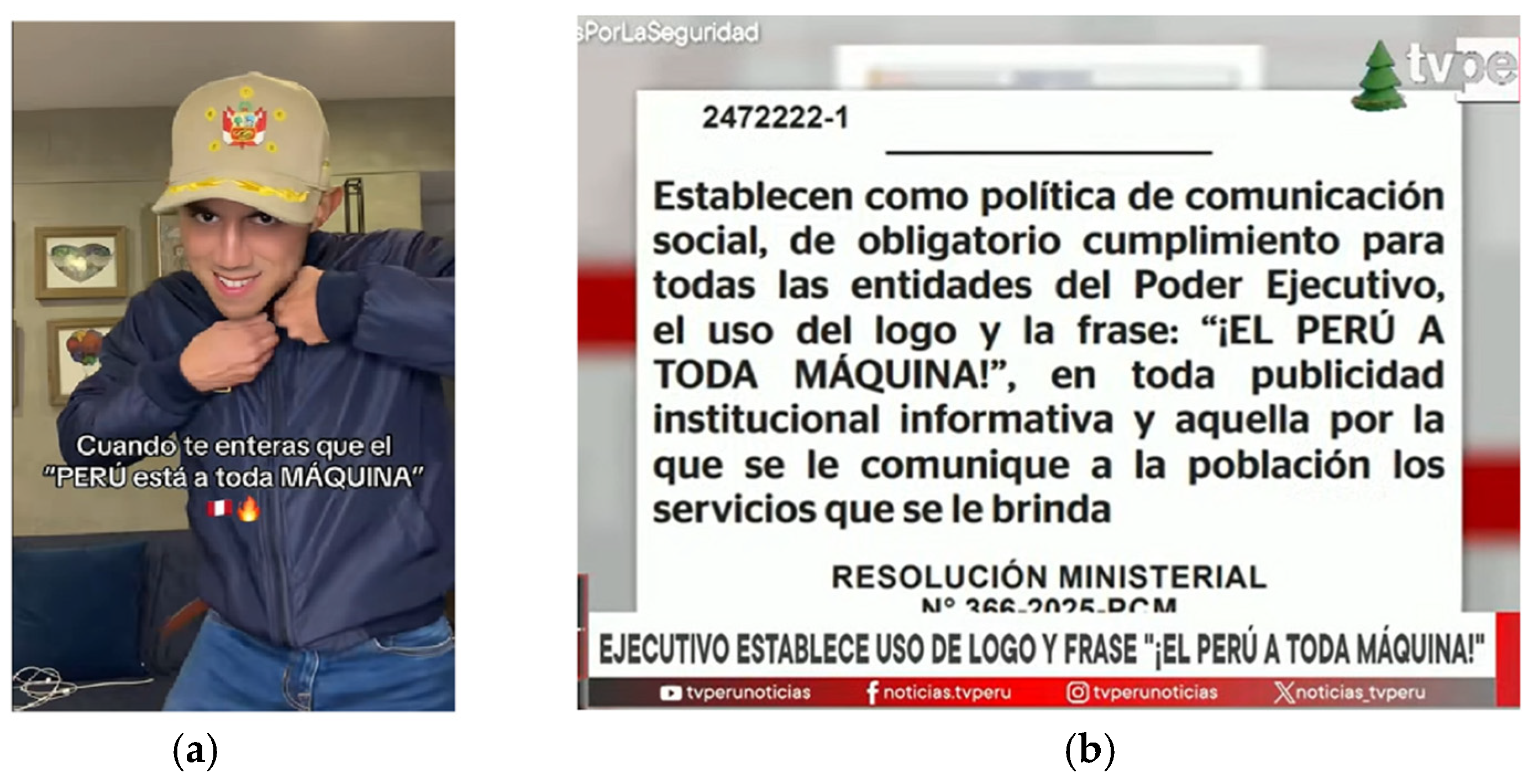
- Pal, Martin [@martin_pal]. 2025. Cuando te enteras que el Perú está a toda máquina. TikTok, 30 de diciembre. Available online: https://www.tiktok.com/@martin_pal/video/7589852252349713684 (accessed on 17 March 2026).
- Papacharissi, Zizi, Margreth Lünenborg, and Birgitt Röttger-Rössler. 2023. Affective publics and their meaning in times of global crises. In Affective Formation of Publics: Places, Networks, and Media. Edited by Margreth Lünenborg and Birgitt Röttger-Rössler. London: Routledge, pp. 1–15. [Google Scholar] [CrossRef]
- Pérez-Díaz, Pedro Luis, and Enrique Arroyas Langa. 2025. Javier Milei’s disruptive populism: Analysis of his discursive strategy on social media. European Public and Social Innovation Review 10: 2064. [Google Scholar] [CrossRef]
- Reuters. 2025. Who Is Jose Jeri, the Young President Who Inherits a Troubled Peru? Available online: https://www.reuters.com/world/americas/who-is-jose-jeri-young-president-who-inherits-troubled-peru-2025-10-10/ (accessed on 17 March 2026).
- Sarasqueta, Gonzalo, Martina Ferrero, Samantha Olmedo, Erick Roberto Rojas Montiel, and Cristian Castillo Peñaherrera. 2025. The construction of political narratives in South American electoral campaigns: A social media analysis. Revista Latina de Comunicación Social 83: 2442. [Google Scholar] [CrossRef]
- Staab, Philipp, and Christoph Sorg. 2025. The rise of digital eco-technocracy: Ecological crisis, digital innovation and legitimacy in the adaptive society. European Journal of Social Theory 28: 605–624. [Google Scholar] [CrossRef]
- TV Perú Noticias. 2025. Establecen uso de frase “¡El Perú a toda máquina!” para todas las entidades del Ejecutivo. Available online: https://www.youtube.com/watch?v=g13qZ1TbkAE (accessed on 17 March 2026).
- Warner, John. 2025. The outsider: Outsider rhetoric and truth-seeking in The Profession of Faith. European Journal of Political Theory 24: 425–444. [Google Scholar] [CrossRef]
- Webster, Steven W., and Beth Albertson. 2022. Emotion and politics: Noncognitive psychological biases in public opinion. Annual Review of Political Science 25: 401–18. [Google Scholar] [CrossRef]
- Weinberg, James. 2024. Building trust in political office: Testing the efficacy of political contact and authentic communication. Political Studies 72: 1288–1312. [Google Scholar] [CrossRef]
- Wiggins, Bradley Earl. 2025. The backrooms and liminal spaces: Explorations of a digital urban legend. New Media & Society 27. [Google Scholar] [CrossRef]
- Zulli, Diana, and David James Zulli. 2022. Extending the Internet meme: Conceptualizing technological mimesis and imitation publics on the TikTok platform. New Media & Society 24, 8. [Google Scholar] [CrossRef]


| Element | Description |
|---|---|
| Platform | TikTok |
| Type of content | Short-form videos (presidential imitation, humorous performance, related political content) |
| Number of videos analysed | 102 videos |
| Number of comments analysed | 1050 user comments |
| Time frame | June 2025–January 2026 |
| Selection criteria (videos) | High visibility, recurrence of symbolic elements, presence across multiple posts |
| Selection criteria (comments) | High-engagement posts (likes, replies, visibility) |
| Data collection method | Manual observation and iterative platform-based navigation |
| Analytical approach | Qualitative interpretive analysis |
| Key analytical categories | Identity ambiguity, affective acceptance, symbolic attribution |
| Category | Description | Example |
|---|---|---|
| Affective code | Recurrent symbolic element generating emotional recognition, often embedded in humour, parody, and performative cues | “Máquina”, expression, gestures |
| Identity ambiguity | Blurring between imitator and president | “I don’t know if he’s the president” |
| Symbolic attribution | Transfer of qualities to leadership | “You are the real president” |
| Affective acceptance | Expressions of tolerance or positive affect | “Because of you we can tolerate the president” |
Disclaimer/Publisher’s Note: The statements, opinions and data contained in all publications are solely those of the individual author(s) and contributor(s) and not of MDPI and/or the editor(s). MDPI and/or the editor(s) disclaim responsibility for any injury to people or property resulting from any ideas, methods, instructions or products referred to in the content. |
© 2026 by the authors. Licensee MDPI, Basel, Switzerland. This article is an open access article distributed under the terms and conditions of the Creative Commons Attribution (CC BY) license.
Share and Cite
Chachi Espinoza, M.M.; García Chachi, A. Affective Transfer in Digital Media Systems: Rethinking Political Legitimacy in Platform-Mediated Public. Soc. Sci. 2026, 15, 293. https://doi.org/10.3390/socsci15050293
Chachi Espinoza MM, García Chachi A. Affective Transfer in Digital Media Systems: Rethinking Political Legitimacy in Platform-Mediated Public. Social Sciences. 2026; 15(5):293. https://doi.org/10.3390/socsci15050293
Chicago/Turabian StyleChachi Espinoza, Maria Monica, and Adrián García Chachi. 2026. "Affective Transfer in Digital Media Systems: Rethinking Political Legitimacy in Platform-Mediated Public" Social Sciences 15, no. 5: 293. https://doi.org/10.3390/socsci15050293
APA StyleChachi Espinoza, M. M., & García Chachi, A. (2026). Affective Transfer in Digital Media Systems: Rethinking Political Legitimacy in Platform-Mediated Public. Social Sciences, 15(5), 293. https://doi.org/10.3390/socsci15050293