1. Introduction
South Korea has emerged as a major destination for international students, driven by rapid economic development and the global diffusion of Korean popular culture (Hallyu). Against a backdrop of demographic challenges such as a declining school-age population and shrinking labor force, foreign-student recruitment has evolved from an internationalization initiative in higher education into a core component of national human-capital and migration strategies. Policy efforts such as the Study Korea Project, launched in 2004, the Measures to Expand the Recruitment of International Students, introduced in 2015, and the Study Korea 300K Project announced in 2023, reflect this shift. These developments suggest that international students are increasingly viewed not merely as temporary students, but also as potential long-term residents connected to broader demographic and labor-market strategies (
Shin et al. 2018).
Despite this policy evolution, international student mobility cannot be adequately understood solely through the admission rules, visa regimes, and post-entry controls of receiving countries. International student mobility is a transnational process shaped by the interaction of legal frameworks in both sending and receiving states. However, existing scholarship in South Korea has focused predominantly on host-country issues, including visa status, residence management, irregular stay, and post-entry adaptation, while paying relatively limited attention to the legal and administrative frameworks through which sending states regulate overseas study before departure. This gap is significant because sending-state regulation can shape mobility pathways, structure pre-departure expectations, and influence post-study outcomes in ways that host-country-centered approaches often overlook.
This study addresses that gap by examining overseas study governance as a form of sending-state pre-mobility regulation (
Betts 2011;
Scholten 2020). It takes Vietnam as its primary analytical case and uses South Korea as a receiving-country context through which the policy implications of sending-state regulation can be observed more clearly. In this way, the article contributes by clarifying how pre-mobility regulation operates through the legal and institutional organization of overseas study in Vietnam.
Vietnam provides a particularly important case for such an analysis. In 2024, approximately 250,000 Vietnamese students were studying abroad, with about 43,000 enrolled in South Korea, making it one of the largest source countries (
VnExpress 2025). Under its socialist governance structure, Vietnam treats overseas study not simply as a private educational decision, but as a state-managed instrument of national human-resource development. Its regulatory architecture, which encompasses government scholarship programs, return-related obligations, and the oversight of private study-abroad intermediaries, shapes student mobility in ways that bear directly on receiving-country concerns.
The analysis is informed primarily by two perspectives: an institutional perspective and a transnational perspective. An institutional perspective highlights how overseas study is structured through formal legal rules, ministerial mandates, and inter-agency coordination. A transnational perspective, in turn, draws attention to how these domestic arrangements interact with cross-border education markets, intermediary networks, and receiving-country migration regimes. Together, these perspectives make it possible to examine overseas study not simply as an educational issue, but as a legally and administratively organized form of cross-border mobility.
This analytical approach is especially useful in the Vietnamese context, where overseas study is closely linked to state-led human-resource development and broader national policy objectives. Previous studies on the internationalization of Vietnamese higher education help contextualize this feature by showing that cross-border educational mobility has been shaped not only by market demand but also by developmental priorities and public regulation (
Nhan and Le 2018;
Tran and Marginson 2018). This broader regional context is also reflected in studies that situate Vietnam’s higher education internationalization within wider Asia-Pacific mobility dynamics (
Ziguras and Pham 2018). In this respect, Vietnam serves as a compelling hybrid case where formal state regulation intersects with expanding private intermediaries and transnational education networks, providing an ideal analytical foundation for observing the dynamics of sending-state governance.
Against this background, this study addresses three related questions: (1) Through what legal and institutional mechanisms does Vietnam govern overseas study? (2) What are the main characteristics and limitations of this sending-state governance framework? (3) What policy implications does this framework suggest for receiving-country contexts, particularly South Korea?
The article’s analytical claim is that sending-state governance shapes pre-departure mobility conditions through four linked mechanisms: the classification of student pathways, the regulation of intermediary access, the allocation of institutional monitoring responsibilities, and the imposition of reporting and return-related obligations.
Methodologically, this study adopts a qualitative legal and policy analysis drawing on document analysis and relevant secondary empirical research (
Bowen 2009;
Schreier 2012;
Dalglish et al. 2020). The analysis focuses on major Vietnamese legal instruments, including the Law on Education, the Law on Higher Education, and Decree No. 86/2021/ND-CP, together with official statistics and government documents. These materials were examined through three analytical dimensions: regulatory scope, institutional roles, and governance mechanisms. More specifically, the analysis compared how core legal and policy instruments defined student categories, regulated intermediary access, allocated monitoring responsibilities, and imposed reporting and return obligations. This process of close reading, analytical categorization, and cross-document comparison made it possible to identify recurring patterns and relationships across legal and policy instruments, including the prominence of pre-departure control, multi-ministerial coordination, and tensions between formal regulation and market-mediated implementation. In this way, the study traces how sending-state governance structures mobility conditions before departure.
The remainder of the article is organized as follows.
Section 2 provides the receiving-country context necessary for addressing the third research question by showing why Vietnamese student mobility to South Korea has become a significant migration-governance issue.
Section 3 addresses the first and second questions by examining the legal structure, institutional configuration, implementation limits, and regional significance of Vietnam’s overseas study governance framework. The Conclusion then returns explicitly to the third question by considering how the Vietnamese case may inform international student policy and migration governance in South Korea.
2. Inflow of Vietnamese Students into South Korea
This section situates Vietnamese students within South Korea’s broader educational migration system, highlighting how legal status, attrition, and unauthorized stay constitute key migration outcomes rather than isolated administrative issues.
As of the end of August 2025, the total number of foreign residents in South Korea was 2,729,609. By nationality, the largest groups were Chinese nationals (980,646; 35.9%), followed by Vietnamese (343,900; 12.6%), Americans (176,090; 6.5%), Thais (169,978; 6.2%), and Uzbeks (99,457; 3.6%). Among all foreign residents, international students numbered 305,329, accounting for about 11.2% of the total foreign population. Compared with the previous year, this represented an increase of 16.8%, or 43,860 individuals.
According to Korea’s Ministry of Justice, the number of international students declined temporarily by 14.9% in 2020 owing to the COVID-19 pandemic but has since rebounded, reaching 305,329 by August 2025. The number of students enrolled in degree programs under the D-2 visa category increased from 101,810 in 2020 to 225,769 in 2025, representing a more than twofold increase. Similarly, enrollment in Korean language programs under the D-4-1 visa category rose from 51,545 to 79,500 during the same period (
Ministry of Justice 2025b). These trends indicate that both higher education institutions and affiliated language institutes have served as the primary institutional channels for the inflow of international students into Korea.
Table 1 summarizes the annual changes in the number of international students in South Korea by visa category from 2020 to August 2025.
By nationality, Vietnamese students comprised the largest group of international students as of August 2025, totaling 107,807, followed by Chinese students (86,179). Other major groups included students from Uzbekistan, Mongolia, and Nepal. Among Vietnamese students, those enrolled in degree programs (D-2) numbered 54,161, while those in Korean language programs (D-4-1) totaled 53,644, reflecting a relatively balanced distribution between degree-oriented and preparatory pathways. This structural characteristic distinguishes Vietnamese students from other national groups, which tend to be more heavily concentrated in degree programs (
Ministry of Justice 2025b).
Table 2 presents a breakdown of international students in South Korea by nationality and visa category as of 31 August 2025.
Recent developments also underscore the timeliness of this issue. According to official Korean statistics, the number of international students in South Korea reached 308,838 at the end of 2025, confirming a continued post-pandemic expansion of student mobility (
Ministry of Justice 2026). At the same time, policy attention has shifted from recruitment alone to the quality of student management, including stricter monitoring of universities, stronger language requirements, and closer scrutiny of visa issuance and student retention (
Ministry of Education 2026). These developments suggest that contemporary student mobility to Korea is increasingly shaped not only by educational demand, but also by evolving regulatory frameworks that connect admission, study, and residence management.
Recent labor-market data further reinforce this shift. Among foreign graduates from Korean higher education institutions in 2024, 4993 were employed, corresponding to an employment rate of 33.4% (
Ministry of Education 2025). In addition, recent reforms to the D-10 job-seeking visa expanded post-graduation job-search opportunities for international students by extending the maximum period of stay from two years to three years (
Ministry of Justice 2025c). Taken together, these trends indicate that the governance of student mobility is becoming more closely linked to labor-market integration and longer-term migration management.
Despite the quantitative expansion of international student inflow, various structural challenges persist during the course of study. International students in South Korea commonly face difficulties related to limited Korean language proficiency, financial constraints, and challenges adapting to both academic life and everyday life. These factors contribute to systemic issues such as premature withdrawal from academic programs and residency status instability. In recent years, the attrition rate among international students has consistently remained between 6% and 7%, suggesting a structural rather than temporary phenomenon (
Ministry of Justice 2025a).
Language proficiency in particular is closely linked to academic performance. Failure to acquire sufficient Korean language skills is often identified as a primary cause of program discontinuation. A critical issue arises when students who withdraw from school do not return to their home countries but remain in South Korea without a valid legal status. As of 2024, about 15% of all foreign residents in South Korea were classified as undocumented. While the rate of unauthorized stay among degree program students (D-2) remained relatively low at 5.4%, the corresponding rate among language program students (D-4) exceeded 28%, underscoring the heightened vulnerability associated with this pathway (
Ministry of Justice 2025a).
In practice, the D-4-1 Korean language program, which serves as a major entry channel for international students, is characterized by recurring cases of declining attendance, program discontinuation, and expulsion. Following expulsion, many students do not transition to an alternative legal status, resulting either in undocumented stay or participation in informal labor markets through short-term or unauthorized employment (
Dong-A Ilbo 2024). These outcomes should not be interpreted solely as individual deviations but as structural problems arising from the interaction of high educational and living costs, institutional vulnerabilities in sending mechanisms, and insufficient access to accurate information regarding residency and employment regulations.
Such structural vulnerability is particularly pronounced among Vietnamese students. Government-sponsored scholarship recipients are generally subject to relatively strict state oversight, which reduces the likelihood of transitioning into unauthorized status. By contrast, students entering Korea through private study-abroad channels face a range of institutional blind spots, including high intermediary fees, loan burdens, and broker involvement. These conditions increase the risk of overstaying, unauthorized employment, and broader residency instability. In some cases, students seeking to repay the substantial costs incurred during predeparture preparation engage in work that is unauthorized or beyond the legally permitted hours. Extreme cases include reports of prolonged factory or logistics work and, in rare instances, involvement in criminal activity.
The mobility of Vietnamese students to South Korea should be understood not merely as a matter of individual educational choice, but as a migration governance issue shaped by institutional conditions and structural constraints. Previous studies indicate that Vietnamese students have figured prominently in concerns regarding dropout and irregular stay, and these patterns have often been discussed in connection with the recruitment strategies of regional universities seeking to secure enrollment and financial stability (
Gu and Park 2022, pp. 3–4, 22;
Battsengel and Kim 2020, p. 26).
This concern is also reflected in available statistics. According to Lee Young-jun and Lee Yu-gyeong, 4531 persons, or 65.2% of foreign nationals who entered Korea on student status and later became undocumented, were Vietnamese nationals, followed by Uzbeks (1001; 14.4%), Mongolians (488; 7.0%), and Chinese nationals (292; 4.2%) (
Lee and Lee 2022, pp. 318–19). This figure does not by itself establish a nationality-based causal effect. However, it does indicate that the Vietnamese case is disproportionately represented in Korean discussions of student-status transition into undocumented stay and therefore merits closer institutional analysis. At the same time, Vietnamese students frequently experience a combination of financial pressures, the need to balance employment with study, and challenges related to language and social adaptation. These factors have been identified as influencing academic persistence, university adjustment, and the risk of early withdrawal (
Kim et al. 2018, p. 485;
Lee and Lee 2022, pp. 318–19).
Furthermore, several studies suggest that private intermediaries, such as recruitment agencies, play a significant role in shaping school choice and mobility pathways. This dynamic is often associated with information asymmetry, mismatched expectations, and gaps in institutional oversight (
Gu and Park 2022, p. 22). Accordingly, Vietnamese student mobility to South Korea is better understood not solely through individual aspirations, but within a broader structural context in which state policies, university recruitment strategies, economic pressures, and private intermediary networks interact to shape mobility pathways and outcomes.
These patterns, however, do not mean that international students are merely passive subjects of state regulation or institutional screening. Even within highly structured mobility pathways, students exercise agency in deciding whether to pursue overseas study, how to finance their mobility, how to respond to academic and linguistic challenges, and how to navigate the constraints of visa and employment rules after arrival. In the Korean context, difficulties such as financial pressure, language barriers, and limited access to accurate information may shape not only students’ vulnerabilities but also their coping strategies, including reliance on peer networks, informal work opportunities, and intermediary advice. Recognizing this dimension of student agency helps reveal policy blind spots in existing governance frameworks, particularly in relation to pre-departure counseling, academic adaptation support, and the provision of clear information on legal status, employment restrictions, and institutional expectations.
The present analysis does not directly reconstruct students’ lived experiences through primary interviews. However, existing empirical studies, official statistics, and policy reports consistently suggest that students’ trajectories are shaped by a combination of language barriers, financial pressure, intermediary involvement, and institutional constraints in both sending and receiving contexts. These findings do not substitute for stakeholder-based fieldwork, but they do indicate that overseas study governance has consequences that extend beyond formal legal design and materially affect students’ mobility experiences.
At the same time, a nascent trend has emerged in which the graduates of vocational and technical programs at Korean junior colleges transition to professional employment visas (E-7) after completing their studies (
Study in Korea Visa News 2021). Although such cases remain limited, they suggest that overseas study is increasingly functioning not only as a pathway to academic credential acquisition but also as a legally structured route to labor market entry and longer-term residence.
Taken together, the inflow and residence of Vietnamese students in South Korea should be understood as a complex phenomenon situated at the intersection of education, migration, and labor. International students pursue not only academic objectives, such as degree attainment and social adaptation, but also economic goals, including income generation and remittances to their home countries. This multilayered dynamic is shaped not only by Korea’s post-entry student-management system but also by the legal frameworks, policies, and institutional arrangements governing overseas study in Vietnam. Accordingly, effective international student policy in South Korea requires an analytical perspective that extends beyond domestic regulatory measures to incorporate the legal and institutional characteristics of the major sending countries.
From this perspective, the expansion of Vietnamese student mobility can be understood not simply as a matter of individual educational choice, but as a process shaped by structurally produced opportunities and constraints influenced by state policies and institutional arrangements. Rather than being treated as the sole drivers of adverse outcomes, private intermediaries are better understood as important mediating actors that influence pre-departure expectations, financial burdens, and placement decisions. Their significance lies in the way they structure the conditions under which students enter overseas study, including information access, fee burdens, and the degree of mismatch between expectations and actual study conditions.
3. Legal Framework Governing Overseas Study in Vietnam
3.1. Overview of the Legal and Administrative System
Vietnam treats overseas study as a core policy instrument for national human-resource development and regulates it through a centralized legal-administrative framework. Instead of viewing overseas study as a purely private educational choice, Vietnam’s government positions it as an institutional mechanism linked to state-led development strategies. Accordingly, overseas study is subject to comprehensive legal regulations that integrate education policy, labor force development, immigration control, and post-study return management.
The legal framework governing overseas study in Vietnam mainly comprises the Law on Education, Law on Higher Education and its subordinate decrees, Law on Vietnamese Workers Working Abroad under Contract, and Decree No. 86/2021/ND-CP
1 on Government-Managed Overseas Study. Among them, Decree 86/2021/ND-CP plays a central role by providing an integrated regulatory framework that governs key aspects of overseas study, including eligibility and selection criteria, funding arrangements, administrative management during study, and mandatory return obligations upon completion of studies.
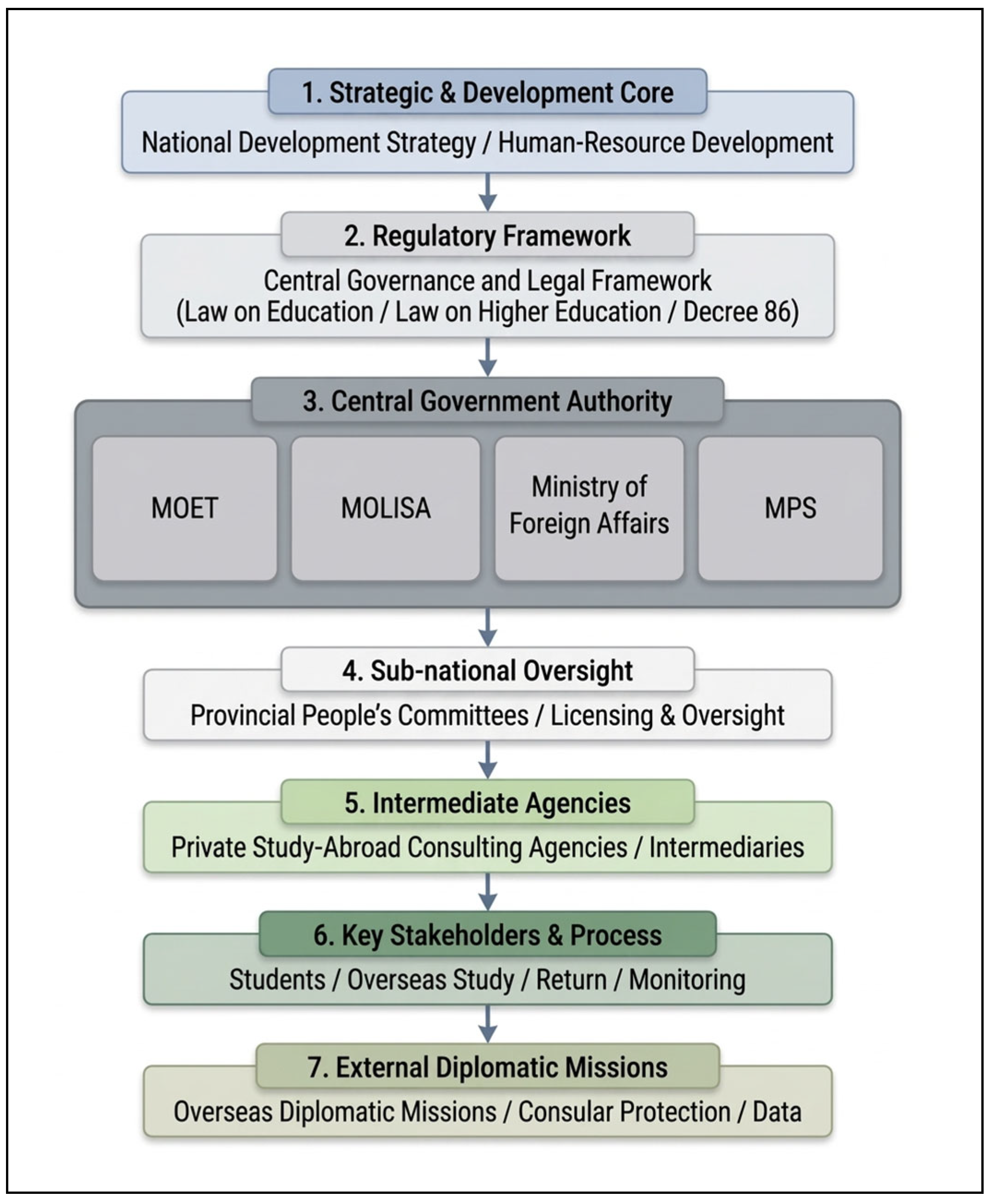
Administratively, Vietnam’s overseas study governance operates through a multilayered, multi-ministerial structure involving several state agencies with overlapping yet distinct competencies. The Ministry of Education and Training (MOET) is the principal authority responsible for general, higher, and postgraduate education. It oversees the educational dimensions of overseas study policies, including government scholarship programs, the recognition of foreign degrees, and the management of faculty members dispatched abroad for training or academic cooperation. The Ministry of Labour, Invalids and Social Affairs (MOLISA), by contrast, exercises jurisdiction over vocational education and programs that combine overseas study with employment, thereby incorporating overseas study into broader labor force development and skills training policies.
In addition, the Ministry of Foreign Affairs provides consular protection for Vietnamese students abroad and coordinates with host-country institutions and governments. The Ministry of Public Security, meanwhile, enforces immigration-related regulations, including measures aimed at preventing unauthorized stay and ensuring compliance with mandatory return requirements. At the subnational level, Provincial People’s Committees are responsible for the licensing, registration, and supervision of private study-abroad consulting agencies, thereby regulating the private sector’s involvement in overseas study. Vietnamese diplomatic missions overseas further contribute by monitoring local conditions, supporting student protection, gathering policy-relevant information, and facilitating educational and academic cooperation.
This institutional configuration demonstrates that overseas study in Vietnam is governed not as a narrowly defined educational matter but as a comprehensive policy domain intersecting education, labor, diplomacy, immigration, and public administration. As illustrated in
Figure 1, this multilevel governance structure reflects the state’s coordinated approach to regulating student mobility across education, labor, and migration domains.
Through this centralized, coordinated governance structure, Vietnam seeks to align overseas study with national development objectives by ensuring that the acquisition of foreign education and skills ultimately contributes to domestic human-capital formation.
Analytically, this institutional configuration matters because it allocates monitoring and gatekeeping responsibilities across multiple agencies before departure and during overseas study. In particular, the distribution of authority across MOET, MOLISA, the Ministry of Public Security, provincial authorities, and overseas missions shapes how students are classified, monitored, and returned. This suggests that governance affects mobility conditions not only through legal rules themselves, but also through the administrative architecture through which those rules are implemented.
3.2. Structure and Key Provisions of the Government-Managed Overseas Study Decree
Decree No. 86/2021/ND-CP on Government-Managed Overseas Study, promulgated on 25 September 2021, and effective from 1 December 2021, is a comprehensive regulatory instrument governing overseas study, research activities, academic exchanges, and the overseas assignment of faculty and researchers within a unified legal framework. The Decree is structured into five chapters: General Provisions; Overseas Study; Overseas Assignment of Faculty, Researchers, and Academic Exchange Participants; Implementation and Administrative Mechanisms; and Supplementary Provisions. The chapter structure and key regulatory components of the Decree are summarized in
Table 3.
The application scope of the Decree is broad. It applies not only to government-sponsored students but also to recipients of other scholarships, self-funded students, faculty members and researchers undertaking overseas assignments, participants in academic exchange programs, and study-abroad consulting agencies (Articles 1–3). By contrast, overseas placement for employment purposes is explicitly excluded from the Decree’s scope and remains regulated separately under the Law on Vietnamese Workers Working Abroad under Contract. This delineation reflects the Vietnamese government’s effort to distinguish overseas study governance from labor migration regimes while maintaining close institutional coordination between the two.
A key feature of the Decree is its categorization of overseas students into three groups: government-sponsored students, students receiving other forms of scholarships, and self-funded students. Although these categories differ with regard to financial support, the Decree imposes a largely uniform set of eligibility requirements on all overseas students. In particular, self-funded students must satisfy baseline criteria comparable to those applicable to government-sponsored students, including political and ethical suitability, educational background and academic performance, foreign language proficiency, and health conditions (Article 12). This approach underscores the state’s intention to subject overseas study, regardless of funding source, to consistent standards of administrative oversight.
The Decree further defines the rights and obligations of self-funded students in detail. Their rights include the ability to reenter Vietnam for educational purposes, access to consular protection, and support related to study and residence abroad. Correspondingly, their obligations encompass compliance with both Vietnamese law and the laws of the host country, registration of academic and residential information in the national database, timely reporting of changes in academic status, and return upon completion of studies in accordance with prescribed procedures. While self-funded students are not subject to scholarship repayment obligations, they remain fully subject to administrative controls prohibiting the submission of false documentation, unauthorized changes in study programs or leave of absence, and illegal stay abroad. Therefore, with the exception of financial obligations, the regulatory regime applicable to self-funded students largely mirrors that imposed on government-sponsored students (Articles 21–27).
This is analytically important because student categorization does more than classify funding sources; it structures differentiated mobility pathways while still keeping all categories within a common framework of state oversight. In this sense, categorization functions as a gatekeeping mechanism that standardizes eligibility and preserves administrative visibility across outward mobility channels.
To address the risks associated with private overseas study arrangements, the Decree introduces the stringent regulation of study-abroad consulting agencies. Agencies are required to obtain official certification, counselors must possess professional qualifications, and study contracts must clearly specify essential elements such as field of study, tuition fees, living expenses, and risk-management measures. Notably, contractual arrangements that combine study with employment—such as study–work package programs—are expressly prohibited (Articles 31–33). Through these provisions, the Decree seeks to enhance transparency and accountability in the private consulting market while preventing the misuse of overseas study pathways for de facto labor migration.
These provisions are significant not only as regulatory details, but as a mechanism for controlling intermediary access to overseas study. By regulating who may recruit, advise, and contract with students, the Vietnamese state seeks to shape the informational and financial conditions under which mobility begins.
The Decree also establishes regulatory standards governing the overseas assignment of faculty members, researchers, and academic exchange participants. Such individuals must meet prescribed political, ethical, and professional criteria. While they are guaranteed certain rights, including income remittance and consular protection, they are simultaneously bound by obligations relating to return, reporting, and confidentiality (Articles 34–36). These provisions reflect the state’s emphasis on safeguarding national interests while facilitating international academic engagement.
Finally, the supervisory and enforcement framework under the Decree is designed as a multilayered governance structure involving MOET, MOLISA, the Ministry of Foreign Affairs, the Ministry of Finance, the Ministry of Public Security, Provincial People’s Committees, and Vietnamese diplomatic missions abroad (Articles 40–44). This arrangement enables coordinated management across central, local, and overseas levels, ensuring the continuous oversight of overseas study activities throughout the entire study cycle.
Reporting and return-related obligations extend governance beyond admission and placement, creating an institutional expectation that overseas study remains legible and recoverable to the state. This helps explain why overseas study in Vietnam operates not as a purely private decision, but as a monitored mobility pathway embedded in national development strategy.
In summary, Decree No. 86/2021/ND-CP establishes a comprehensive legal framework governing overseas study in Vietnam. By integrating the regulation of government-sponsored and self-funded students, oversight of private consulting agencies, and management of faculty and researcher mobility within a single regulatory instrument, the Decree aims to promote efficient public resource use, institutionalized student governance, market transparency, and the eventual return and effective utilization of human capital acquired abroad.
3.3. Private Overseas Study Market and Limitations of Legal Effectiveness
Despite Vietnam’s strong regulatory framework governing overseas study, substantial gaps persist between formal legal provisions and their implementation in the private study-abroad market. Although the Law on Vietnamese Workers Working Abroad under Contract establishes a comprehensive regulatory regime applicable to a wide range of overseas placement activities—including overseas training and education—it also extends licensing, registration, and supervisory requirements to private agencies involved in student placement. The law provides for administrative and criminal sanctions against illegal placement practices, including false or exaggerated advertising and the imposition of excessive brokerage fees. Nevertheless, in practice, enforcement remains limited, and irregularities in the private overseas study market continue to arise.
The relevance of governance for mobility outcomes lies not simply in the existence of formal rules, but in how these rules shape access to information, financing, intermediary involvement, and placement pathways before departure. In this sense, governance influences later outcomes indirectly by structuring the conditions under which students enter overseas study rather than by determining their trajectories in a mechanical way.
Existing studies suggest that Vietnamese students are disproportionately represented in concerns over dropout and transitions into unauthorized stay in South Korea, although these outcomes are shaped by multiple structural factors rather than nationality alone. Some studies report that Vietnamese nationals account for more than 65% of undocumented international students in South Korea (
Lee and Lee 2022, p. 319). This phenomenon has been attributed to multiple structural factors, including information asymmetries in the placement process, high intermediary fees charged by brokers, and the formation of expectations poorly aligned with the realities of studying and living abroad (
Lee and Kim 2021, p. 126). Other studies note that prospective students often incur substantial financial burdens prior to departure to secure admission through private intermediaries. As a result, once abroad, some students prioritize short-term income-generating activities over academic engagement, increasing the likelihood of academic failure and unauthorized stay (
Son 2023, p. 359).
Such findings underscore the limitations of Vietnam’s overseas study governance framework in terms of addressing the risks associated with private-sector involvement. While the legal system is characterized by strict formal regulation and extensive state oversight, illegal and irregular practices continue to coexist in the private-placement market. This dual structure emphasizes that the mere existence of a comprehensive regulatory framework does not automatically ensure effective policy outcomes. Rather, weaknesses in implementation, monitoring, and enforcement undermine the intended objectives of the legal regime.
In this regard, the Vietnamese case illustrates a broader limitation of state-centered regulatory approaches to overseas study. Strengthening legal effectiveness requires not only tighter formal controls but also enhanced oversight throughout the entire placement process, improved transparency in private agency operations, and more effective mechanisms to align predeparture expectations with actual study conditions. Without such measures, the gap between legal design and practical outcomes is likely to persist, limiting the capacity of overseas study policies to achieve their stated goals of human-capital development and orderly international mobility.
3.4. Trends in Decree Amendments and Evaluation of Vietnam’s Overseas Study Legal Framework
Section 3.3 shows that the analytical significance of private intermediaries lies not simply in their existence, but in the way they mediate access, information, and cost before departure.
Section 3.4 then examines how recent amendment efforts implicitly acknowledge these implementation problems, thereby revealing where the governance model itself encounters practical limits.
About three years after coming into force, Decree No. 86/2021/ND-CP governing overseas study revealed a number of institutional limitations and operational challenges. In response, MOET prepared a draft amendment and submitted it to the government in 2025 (
Education Journal 2024). The rationale for revising the Decree can be summarized into three principal factors. First, the existing regulatory framework has not kept pace with Vietnam’s national digital transformation agenda, particularly with regard to document submission and administrative processing. Second, rigid procedural requirements have created practical difficulties, as applicants for overseas study are often unable to correct or supplement submitted documents, resulting in a gap between formal compliance and administrative reality. Third, repayment obligations imposed on government-sponsored students were widely regarded as excessively stringent, rendering effective enforcement difficult in practice.
To address these concerns, the amendment draft proposed a series of pragmatic adjustments. These included simplifying application documentation, introducing mechanisms allowing for document supplementation, consolidating vocational education-related overseas study management under MOET, and allowing the digital submission of graduation and completion reports. In addition, the draft provided for exemptions from repayment obligations in cases of force majeure and introduced the possibility of installment-based repayment arrangements. Institutional management provisions were also revised, including clearer rules on the renewal and reporting obligations of study-abroad consulting agencies and adjustments to the reporting frequency required of faculty members and researchers assigned overseas to better reflect actual operational conditions (
Ministry of Education and Training 2025, p. 4).
Overall, the amendment draft can be seen as an effort to mitigate the rigidity and impractical elements of the existing regulatory regime, thereby improving administrative efficiency and reducing the procedural burden on students and dispatched personnel. At the same time, the proposed revisions do not represent a fundamental departure from Vietnam’s core overseas study governance model. The legal framework continues to be characterized by strong state regulation, centralized administrative control, mandatory return and service obligations for government scholarship recipients, and reinforced oversight of private placement agencies (
Gu and Park 2022, pp. 19–21).
Nevertheless, structural limitations persist. These include fragmentation within the private overseas study market, high-cost structures associated with private placement, administrative complexity, and limited effectiveness in enforcement. Empirical studies further suggest that student attrition and unauthorized stay among Vietnamese nationals are driven less by the formal content of legal regulations than by external and structural factors, such as information asymmetry during the placement process, financial burdens incurred prior to departure, and variations in educational quality abroad (
Ministry of Justice 2025a).
However, the persistence of these problems suggests that the gap between legal design and practical enforcement is rooted in broader structural conditions. First, administrative oversight capacity remains uneven across central and provincial authorities, making it difficult to monitor a large and fragmented market of private intermediaries. Second, the private placement process often involves multilayered brokerage and subcontracting arrangements, which reduce transparency and complicate formal supervision. Third, incentives are not always aligned: while the state seeks to regulate overseas study as part of a human-capital strategy, private intermediaries and some local actors may prioritize the short-term economic gains associated with student outflows. As a result, formal regulatory ambition is not always matched by implementation capacity, and a gap persists between legal provisions and ground-level practices.
These observations indicate that a law-centered governance model, while capable of establishing normative standards and administrative order, does not automatically ensure effective policy outcomes (
Scott and Guan 2022, p. 3). The Vietnamese experience underscores the importance of complementing regulatory control with practical enforceability, implementation capacity, and market transparency. Future reforms of Vietnam’s overseas study legal framework should therefore seek to balance normative rigor with institutional flexibility, aligning legal design more closely with the social and economic conditions that shape overseas study in practice.
In analytical terms, the amendment debate is revealing because it shows that the limits of the governance model lie less in the absence of formal regulation than in the uneven performance of the mechanisms through which regulation is supposed to operate. The problem is therefore not simply legal insufficiency, but partial breakdown in monitoring, intermediary control, and administrative coordination.
3.5. Comparative Perspectives on Sending-State Governance in Asia
Vietnam’s overseas study governance can be more clearly understood when situated within a broader Asian context. Selected sending-country cases reveal different balances between state oversight and market mediation in the governance of outbound student mobility. China, for example, represents a more state-led model characterized by centralized administrative control over student selection, approval, and monitoring (
Mok and Han 2016). By contrast, the Philippines reflects a more market-oriented configuration in which private intermediaries, migration networks, and training institutions play a greater role in facilitating overseas education and mobility pathways (
Ortiga 2018).
Against this comparative backdrop, Vietnam can be characterized as a hybrid governance model. Its overseas study regime is anchored in formal legal regulation and administrative oversight, yet private agencies and commercial intermediaries have assumed an increasingly important role in facilitating student mobility. Vietnam is therefore neither fully state-controlled nor predominantly market-driven; rather, it reflects a transitional governance configuration in which public regulation and private mediation coexist and, at times, generate tension.
This comparison highlights a broader regional issue: sending states differ not only in the degree of state control they exercise, but also in how they regulate private intermediaries, address implementation gaps, and align educational objectives with migration outcomes. From an institutional perspective, variation across sending states reflects differences in administrative centralization, regulatory authority, and the governance of private intermediaries. From a transnational perspective, these same differences shape how students navigate cross-border mobility pathways that connect domestic policy, intermediary markets, and host-country opportunity structures. In this regard, Vietnam’s distinctiveness lies in the coexistence of strong formal regulation and expanding market participation. Situating Vietnam within this wider regional spectrum strengthens the article’s contribution to the literature on international student mobility while keeping its primary analytical focus on Vietnam. It also reinforces the central argument of this study that sending-state governance plays a critical role in structuring both the opportunities and constraints experienced by international students.
Taken together, this comparison shows that sending states in Asia vary not only in the degree of state control they exercise, but also in how they regulate private intermediaries and connect educational mobility to broader developmental objectives. In this regional spectrum, Vietnam is best understood as a hybrid case: it combines strong formal state regulation with an expanding role for private intermediaries and market-mediated mobility channels. This comparative positioning helps clarify what is distinctive about the Vietnamese case and why it offers a useful analytical lens for understanding intra-Asian student mobility.
This variation helps clarify that the Vietnamese case is analytically useful not because it is unique in every respect, but because it occupies an intermediate position between highly centralized and more market-mediated sending-state governance models.
4. Conclusions
This study addressed three related questions concerning Vietnam’s governance of overseas study and its implications for South Korea. First, it showed that Vietnam governs overseas study through a centralized legal and institutional system involving formal legislation, inter-ministerial coordination, and administrative oversight. In this system, overseas study is regulated not as a purely private educational decision, but as a policy domain linked to national human-resource development.
Second, the analysis found that this system combines strong formal regulation with important implementation limits. While the legal framework provides clear rules on student categories, eligibility, intermediary oversight, and return obligations, its effectiveness is constrained by uneven monitoring capacity, fragmented private placement practices, and the gap between formal regulation and students’ actual mobility experiences.
Third, the Vietnamese case suggests that South Korea should pay closer attention to the pre-departure institutional conditions that help structure student mobility before arrival. A more effective policy approach would require greater sensitivity to the different pathways through which Vietnamese students enter overseas study, the risks associated with private intermediaries, and the need to connect pre-departure conditions more closely to post-entry support and monitoring.
The Korean policy implications presented here are derived from three central findings of the analysis: the dual structure of mobility pathways, the implementation limits of intermediary governance, and the gap between formal regulation and students’ actual mobility experiences. First, South Korea should adopt a more differentiated approach to Vietnamese student mobility by recognizing the diversity of pathways through which students enter and remain in the higher education system. Government-sponsored students, degree-seeking students, language trainees, and students entering through privately arranged channels face different institutional conditions and risks. A more pathway-sensitive approach would therefore allow for more tailored screening, monitoring, and institutional support.
Second, the analysis indicates that greater policy attention should be paid to the role of private intermediaries and to implementation gaps that emerge across the sending–receiving interface. The findings on information asymmetry, financial burdens, and irregularities in private placement pathways suggest the need for stronger intermediary oversight, more systematic document verification, and earlier institutional monitoring of attendance, academic progression, and attrition risk. In this respect, Korea’s student-management system would benefit less from generalized control and more from preventive, risk-sensitive oversight mechanisms.
Third, the analysis also highlights the need for a more student-centered policy approach. Because student mobility outcomes are shaped not only by legal regulation but also by language barriers, adaptation difficulties, and financial pressure, policy responses should include stronger pre-departure information, academic and language support, and clearer guidance on residence and employment rules. At the same time, for students who successfully complete their studies and seek professional employment, more coherent post-study transition pathways would help connect international student policy to longer-term labor-market integration.
Viewed through institutional and transnational perspectives, the findings show that overseas study in Vietnam is governed through a centralized legal-administrative structure whose effects extend beyond the sending state itself. In this sense, the Vietnamese case shows how pre-departure regulation helps shape later mobility outcomes in receiving-country contexts such as South Korea. The study contributes by specifying, through the Vietnamese case, how sending-state legal and policy structures organize pre-departure mobility conditions that remain relevant after arrival.
Despite its contributions, this study has certain limitations that suggest directions for future research. Because the analysis primarily relies on legal texts, policy documents, official statistics, and secondary empirical studies, it carries a risk of interpretive bias, as official documents may not fully capture the complexity of ground-level enforcement and informal practices. In addition, the study does not directly incorporate the lived experiences of key stakeholders, including Vietnamese students, private recruitment agencies, university administrators, and government officials. While this institutional approach was necessary to map the macro-level governance architecture of overseas study, it may overlook the micro-level negotiations, ambiguities, and gray areas that emerge in the implementation of Decree 86.
Future research should therefore combine qualitative fieldwork—such as in-depth interviews and focus group discussions—with longitudinal analysis in order to examine how regulatory changes shape student trajectories, attrition patterns, and labor-market integration over time. Such approaches would enrich the study of transnational governance by linking formal legal structures to lived mobility experiences.
In conclusion, the Vietnamese case suggests that student mobility outcomes are conditioned not only by post-entry experiences in receiving countries, but also by the legal and institutional arrangements that organize mobility before departure. A more effective policy response in receiving countries will therefore require attention not only to domestic student-management systems, but also to the pre-departure regulatory contexts of major sending countries such as Vietnam.