1. Introduction
Over the past decade, Kenya has advanced toward HIV epidemic control through rapid scale-up of testing and treatment, differentiated service delivery, and community-led programs (
Musyoki et al. 2021). Nationally, approximately 1.3–1.4 million people are living with HIV, with an adult (15–49) prevalence of about 3.2–3.3 percent. Women account for roughly two-thirds of cases and experience higher prevalence (about 4.3–4.5 percent) compared to men (about 2.1–2.2 percent), reflecting persistent gender disparities in exposure and care engagement (
Banadakoppa Manjappa et al. 2024;
Musyoki et al. 2021;
UNAIDS n.d.-b).
Although annual new HIV infections in Kenya have declined by approximately 75 percent since 2010, an estimated 17,000–20,000 new infections still occur each year, indicating continued transmission, particularly among women and adolescent girls (
Young et al. 2023;
Tamir et al. 2024). At the national level, progress toward the 95–95–95 targets is strong, with about 96 percent of people living with HIV aware of their status, 94–96 percent receiving antiretroviral therapy (ART), and 90–91 percent achieving viral suppression (
UNAIDS 2024,
n.d.-a). However, these national averages conceal substantial inequities, as ART coverage remains below 50 percent among key populations, including sex workers, men who have sex with men, people who inject drugs, and transgender people. Prevention of mother-to-child transmission (PMTCT) coverage is high at approximately 89–90 percent, yet mother-to-child transmission persists at 8–9 percent, exceeding the 5 percent elimination threshold and reflecting late entry into antenatal care, adherence challenges, and fragmented perinatal services (
UNAIDS n.d.-a).
The epidemic is also marked by pronounced geographic disparities along the Lake Victoria basin. Counties such as Homa Bay, Migori, Kisumu, and Siaya consistently record adult HIV prevalence levels exceeding 9–11 percent, more than three times the national average, and together account for a substantial proportion of people living with HIV nationally (
Banadakoppa Manjappa et al. 2024). This concentration reflects a historically entrenched epidemic shaped by structural, behavioral, and health-system factors, including high population mobility linked to fishing and trade economies, dense sexual networks, gendered livelihood vulnerabilities, and long-standing socioeconomic disadvantage. In these high-burden counties, prevalence is particularly elevated among women, with female prevalence often exceeding 12–14 percent, underscoring the intersection of gender inequality and localized transmission dynamics (
Banadakoppa Manjappa et al. 2024).
These epidemiologic magnitudes and social distributions carry profound social, economic, and wellbeing consequences that directly shape women’s engagement in ART. Socially, HIV-related stigma and discrimination, particularly toward key and marginalized populations, undermine trust in health systems and deter consistent care-seeking, contributing to gaps in ART coverage and viral suppression (
Turan et al. 2016). Economically, people living with HIV experience substantial income shocks and food insecurity; evidence from Kenya indicates that severe food insecurity affects a majority of affected households and is strongly associated with disrupted HIV care and poorer adherence outcomes (
Lyons et al. 2024). At the macro level, HIV reduces labor supply, productivity, and long-term human capital accumulation, with gendered effects that constrain women’s economic participation and caregiving capacity (
Thirumurthy et al. 2008). Intergenerational impacts remain significant: Kenya has an estimated ~700,000 children orphaned due to AIDS, expanding household dependency ratios and caregiving burdens that can undermine sustained treatment engagement (
Apedaile et al. 2023).
Within this context, women’s ART engagement is patterned by intersecting forces—educational and economic disadvantage, gendered power dynamics within intimate relationships, HIV-related stigma, intimate partner violence (IPV), and unmet mental health needs—that co-occur and reinforce one another across multiple levels of women’s lives, undermining adherence and retention during pregnancy and breastfeeding in particular. Guided by Bronfenbrenner’s Ecological Systems Theory and socio-ecological HIV models (
Bronfenbrenner 1979;
Sweat and Denison 1995), we conceptualize women’s ART engagement as a multilevel phenomenon shaped by interacting structural, health system, community, interpersonal, and individual determinants, and we examine how these determinants cluster into vulnerability profiles that shape care engagement over time.
By explicitly modeling co-occurrence and clustering of determinants, this study addresses a critical evidence gap in Kenya’s otherwise high-performing but inequitable HIV response: it moves beyond single-factor explanations to identify actionable profiles that can inform county-level targeting, differentiated service delivery, and integrated PMTCT–maternal mental health–GBV services where need is greatest (
National Syndemic Disease Control Council 2021). In doing so, it aligns with Kenya’s devolved strategy and current planning tools that prioritize high-burden geographies and populations and provide empirical guidance for resource allocation and program integration under national strategies. Finally, by linking vulnerability profiles to measurable outcomes (e.g., viral suppression, retention, MTCT), the study offers a scalable approach to monitor gaps using national estimates platforms and to translate ecological insights into program design that advances equity in sustained ART outcomes.
1.1. Theoretical Framework
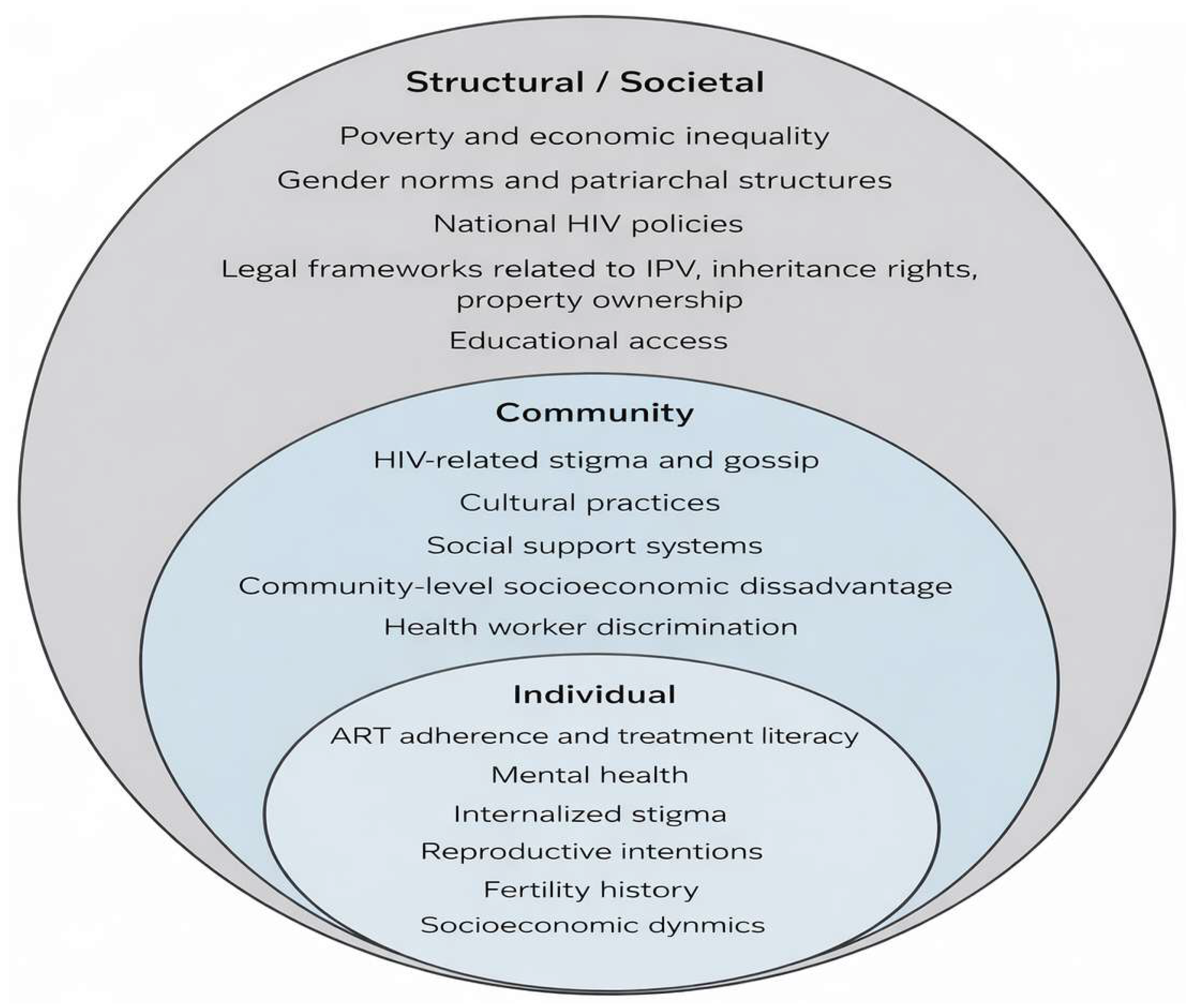
Bronfenbrenner’s Ecological Systems Theory proposes that individual outcomes are shaped by nested and interacting systems, ranging from immediate interpersonal contexts to broader structural and policy environments (
Bronfenbrenner 1979). Socio-ecological HIV models build on this framework to highlight how social inequities, stigma, gender norms, and health systems jointly influence HIV risk, care access, and treatment outcomes. Applied to ART engagement, this perspective frames engagement not simply as medication adherence but as the result of interacting influences across five levels: structural, health system, community, interpersonal, and individual (
Baral et al. 2013;
Eshun-Wilson et al. 2019;
Stangl et al. 2019). This ecological lens guides the literature review below and informs the analytic approach used in this study.
1.1.1. Structural Level: Poverty, Gender Inequality, Education, and Policy Contexts
At the structural level, women’s engagement in HIV care in Kenya is strongly shaped by socioeconomic disadvantage, gender inequality, and legal–policy contexts. Nationally representative data from the 2022 Kenya Demographic and Health Survey (KDHS) show that women living with HIV are disproportionately concentrated in the lowest wealth quintiles and rural areas, where poverty-related barriers to care are most pronounced (
Kenya National Bureau of Statistics 2023a). Poverty limits women’s ability to afford transportation to health facilities, increases vulnerability to food insecurity—which can undermine medication tolerance—and reduces autonomy in health-seeking decisions. Studies from western Kenya report that over 70 percent of people living with HIV, most of them women, experience severe food insecurity, which is strongly linked to missed clinic visits and poorer adherence (
Lyons et al. 2024).
Gender inequality amplifies these challenges. Across Kenya and sub-Saharan Africa, women’s lower educational attainment, limited access to independent income, and unequal household bargaining power restrict their ability to prioritize sustained HIV care. Women also shoulder disproportionate unpaid labor and caregiving responsibilities, limiting time and flexibility for clinic attendance, while unequal power within relationships can reduce their ability to disclose HIV status or negotiate adherence (
Gathungu et al. 2025;
Sia et al. 2014;
Jewkes et al. 2010).
Legal and policy environments governing property ownership, inheritance, and social protection form another layer of vulnerability. Although Kenyan law formally recognizes women’s rights to property and inheritance, widows and divorced women—particularly those living with HIV—often face disinheritance and housing loss due to entrenched customary practices. Studies from high-prevalence regions in western Kenya show that widowed women experience severe economic shocks, forced displacement, and heightened HIV vulnerability, with modeled HIV prevalence among inherited widows exceeding 60 percent (
Gathungu et al. 2025). These disruptions destabilize residence, income, and social support networks, further undermining continuity of care. Together, these structural conditions form the context within which all other levels—health system, community, interpersonal, and individual—affect ART engagement.
1.1.2. Community Level: Normative Stigma, Disclosure Expectations, and Social Support
At the community level, normative HIV stigma remains a significant barrier. KDHS data indicate that over 40 percent of women living with HIV fear involuntary disclosure, and roughly one in three report community-level stigmatizing attitudes, with stigma more pronounced in rural settings where anonymity is limited (
Kenya National Bureau of Statistics 2023a,
2023b). Research from western Kenya highlights how gossip, social surveillance, and secrecy norms discourage women from attending clinics or taking ART openly, contributing to missed visits and interruptions in treatment (
Lyons et al. 2024). Fear of disclosure is consistently associated with lower adherence and viral suppression among women in sub-Saharan Africa (
Jewkes et al. 2010).
Community-based support, however, can buffer these risks. Evidence from Kenya and other African countries shows that community ART groups, peer networks, and decentralized medication refill models reduce stigma exposure, improve retention, and support sustained adherence, especially for women facing structural and relational barriers (
Belay et al. 2022). Communities thus play a crucial intermediary role, either amplifying stigma-related risks or providing collective support that enables women to maintain engagement in care.
1.1.3. Interpersonal Level: Intimate Partner Violence and Widowhood
Intimate partner violence (IPV) has been consistently linked to reduced autonomy, psychological distress, and interruptions in HIV care (
Hatcher et al. 2015;
Jewkes et al. 2010;
Li et al. 2014). Widowhood presents a distinct interpersonal vulnerability, often accompanied by economic shocks, social marginalization, and increased stigma (
Zheng and Yan 2024). These interpersonal dynamics directly shape women’s ability to sustain ART engagement and connect broader structural inequalities to daily lived experiences.
1.1.4. Individual Level: Mental Health, Internalized Stigma, Reproductive Intentions, and Treatment Literacy
At the individual level, ART engagement among women reflects the cumulative impact of structural, community, and interpersonal influences rather than isolated personal traits (
Bronfenbrenner 1979). Depression and anxiety are common among Kenyan women living with HIV and are strongly associated with poor adherence and treatment interruptions, particularly in contexts of poverty, food insecurity, and gender-based violence (
Altamirano et al. 2023;
Costa-Cordella et al. 2022;
Truong et al. 2021). Internalized stigma, shaped by community norms and prior experiences of discrimination, undermines self-efficacy, discourages disclosure, and reinforces disengagement from care (
Akatukwasa et al. 2021). Reproductive intentions also affect ART engagement, as social expectations around childbearing can create ambivalence about treatment use, particularly during pregnancy and postpartum, when fears of stigma, vertical transmission, and economic insecurity intersect (
Ayieko et al. 2017;
Wekesa and Coast 2014). Treatment literacy—including understanding HIV as a lifelong condition requiring ART—remains uneven in Kenya and is associated with inconsistent adherence, especially among women with lower education or recent diagnoses (
Kanguya et al. 2022).
Conceptually, women’s engagement in lifelong ART in Kenya emerges from the interplay of multiple, overlapping influences rather than a single factor. Structural barriers, health system gaps, community stigma, unequal power dynamics in relationships, and individual psychosocial challenges all shape whether women can consistently access and adhere to treatment. Much of the existing research has examined these influences separately, leaving limited insight into how they interact in women’s daily lives. By applying an ecological systems perspective, this study explores how these factors cluster into distinct vulnerability profiles and how these profiles relate to ART engagement outcomes. Using nationally representative data and multivariate methods, the study captures the complex, interconnected realities that shape women’s experiences with HIV care (
Figure 1).
2. Materials and Methods
2.1. Study Design and Data Source
We conducted a cross-sectional secondary analysis of the 2022 Kenya Demographic and Health Survey (KDHS), a nationally representative household survey employing a stratified two-stage cluster sampling design to generate population-level estimates for women aged 15–49 years. Detailed sampling procedures, fieldwork protocols, and quality assurance processes are documented in the KDHS Final Report published by the Kenya National Bureau of Statistics and the DHS Program (
Kenya National Bureau of Statistics 2023a). For this study, we used the Individual Women’s Recode File, which contains individual-level information on women’s sociodemographic characteristics, reproductive history, and health indicators.
2.2. Study Population
The study population was derived from the 2022 Kenya Demographic and Health Survey (KDHS), a nationally representative household survey of women aged 15–49 years. The survey interviewed 32,156 women. This analysis used the Individual Recode (IR) dataset, which contains individual-level information for female respondents. HIV biomarker testing yielded recorded HIV test outcomes for 13,757 participants.
The present analysis focused on women who tested HIV-positive in the biomarker module (n = 332). Women who tested HIV-negative (n = 13,357) and those with indeterminate or missing results due to refusal or failure to receive test results (n = 68) were not eligible for inclusion. The analytic sample therefore comprised HIV-positive respondents with available information on antiretroviral therapy (ART) use, stigma indicators, mental health variables, and covariates included in the multivariable logistic regression model.
2.3. Measures
2.3.1. Outcome Variable
The primary outcome was a binary indicator of enhanced ART engagement, operationalized to reflect both treatment uptake and key psychosocial conditions supporting sustained engagement in care. Women were classified as meeting the enhanced engagement criterion if they reported current use of antiretroviral therapy (ART), no internalized stigma (defined as not endorsing feelings of shame related to their HIV status), and no experience of HIV-related verbal harassment. Participants meeting all three criteria were coded as 1, and all others were coded as 0. This composite approach reflects evidence that psychosocial environments characterized by low stigma and absence of harassment are integral to women’s ability to initiate and sustain engagement in HIV treatment. Accordingly, the outcome is interpreted as a multidimensional engagement phenotype rather than a measure of medication adherence alone. Because the outcome reflects whether respondents simultaneously met all components of the enhanced engagement phenotype, it was specified as a binary variable. Participants either satisfied the full set of criteria or did not; therefore, the measure does not represent ordered levels of engagement, and logistic regression was used to estimate associations with the outcome.
2.3.2. Independent Variables
Independent variables were selected a priori based on established ecological and structural determinants of HIV-related outcomes. Sociodemographic measures included age, place of residence (urban or rural), educational attainment (none, primary, secondary, higher), and household wealth quintile derived from the DHS wealth index. Marital status was categorized as never in union, married, cohabiting, widowed, separated, or divorced. Fertility history was assessed using parity and categorized as 0, 1–2, 3, 4, or ≥5 children. HIV-related stigma indicators included internalized stigma (shame), anticipated stigma (perception that others speak negatively about the respondent because of HIV), involuntary disclosure of HIV status, verbal harassment, and healthcare-related stigma. Each indicator was coded dichotomously according to DHS standards. Mental health measures included self-reported prior diagnosis of depression or anxiety, and current receipt of treatment for either condition. Variables used to construct the composite outcome were not simultaneously modeled as independent predictors in regression analyses.
2.4. Statistical Analysis
All analyses were performed using IBM SPSS Statistics for Windows, version 29.0, IBM Corp. (Armonk, NY, USA). Descriptive statistics were calculated to summarize the sociodemographic, reproductive, stigma-related, and mental health characteristics of women living with HIV, with weighted frequencies and percentages generated in accordance with DHS analytic guidelines. A multivariable logistic regression model was then fitted to identify factors independently associated with the enhanced engagement outcome. Variables were selected a priori based on theoretical relevance and prior evidence. Prior to model estimation, multicollinearity among independent variables was assessed using correlation diagnostics. No evidence of problematic multicollinearity was observed, and therefore all variables were retained in the multivariable logistic regression model. Adjusted odds ratios (AORs) and 95% confidence intervals (CIs) were reported. Model performance was evaluated using the likelihood ratio chi-square test, pseudo R2 statistics, and overall classification accuracy. Statistical significance was defined as p < 0.05.
In addition to regression analyses, a TwoStep cluster analysis was conducted to identify multidimensional vulnerability profiles among women living with HIV using a person-centered approach that captures co-occurring socioeconomic, psychosocial, and reproductive characteristics. TwoStep clustering was selected because it accommodates mixed categorical variables and determines the optimal number of clusters using the Bayesian Information Criterion (BIC). The cluster model incorporated measures representing key domains of vulnerability, including internalized stigma, enacted stigma, depression, anxiety, household wealth quintile, educational attainment, parity, rural–urban residence, and current ART use. The log-likelihood distance measure was applied. Cluster quality was evaluated using silhouette coefficients and predictor importance values generated by SPSS. Cluster membership was saved to the dataset to enable descriptive comparison of psychosocial, socioeconomic, and health-related patterns across the resulting clusters.
2.5. Ethical Considerations
The 2022 Kenya Demographic and Health Survey (KDHS) protocol received ethical approval from the Kenya Medical Research Institute Scientific and Ethics Review Unit (KEMRI–SERU) and the ICF Institutional Review Board, and complied with national and international guidelines for human subject research (
Kenya National Bureau of Statistics 2023a) Written informed consent was obtained from all participants prior to interview and biomarker collection.
The DHS Program releases only fully anonymized, de-identified datasets, with removal of direct identifiers and geo-spatial displacement of cluster coordinates to protect confidentiality. Because this study used publicly available, de-identified secondary data, it was classified as non-human subjects research and did not require additional institutional review board approval.
3. Results
Table 1 summarizes the sociodemographic characteristics of the 332 women living with HIV included in the analysis. The age distribution was concentrated among women aged 35–49 years, who comprised the majority of the sample. Most participants resided in rural areas, representing 65.4% of the sample, while 34.6% lived in urban settings. Educational attainment was generally low. Six percent of women had no formal education, nearly two-thirds (65.4%) had completed primary schooling, just under one quarter (24.4%) had secondary education, and only a small proportion (4.2%) had attained higher education.
Socioeconomic status reflected a similar pattern of disadvantage. Women in the poorest, poorer, and middle wealth quintiles accounted for 21.4%, 25.0%, and 26.5% of the sample, respectively, whereas 20.5% were in the richer quintile and 6.6% in the richest category. Fertility was high. Only 6.9% of women reported having no children, while 22.9% had one or two children. Among the remainder, 20.2% had three children, 20.8% had four children, and 29.2% had five or more. Marital status varied considerably. Nearly half of the women were married at the time of the survey (49.4%). An additional 11.7% had never been in a union, and 5.1% were cohabiting. Widowhood was common, affecting 18.7% of the sample. A further 12.0% were separated, and 3.0% were divorced.
Stigma was prevalent across multiple domains. Nearly two-fifths of participants (39.8%) reported feeling ashamed of their HIV status, and 32.8% indicated that people in their community spoke negatively about them because of their status. Involuntary disclosure was also common, with 27.4% reporting that someone else had shared their HIV status without consent. Additionally, 20.8% of women had experienced verbal insults or harassment related to HIV. Stigmatizing behaviors within healthcare settings were less frequently reported but still present; 8.1% stated that healthcare workers had spoken negatively about them, and 4.5% had experienced verbal abuse from a healthcare provider.
Mental health needs were also evident in this population. A diagnosis of depression had been reported by 9.6% of women, while 4.8% had been diagnosed with anxiety. Despite these burdens, treatment coverage was extremely low. Only 22.2% of participants reported receiving any form of treatment for depression or anxiety at the time of the survey (
Table 2).
3.1. Multivariable Logistic Regression Analysis
Multivariable logistic regression was conducted to identify factors associated with the enhanced ART engagement, which required current ART use, absence of HIV-related shame, and no experience of verbal insults. Assessment of multicollinearity indicated no problematic correlations among the independent variables. The overall model demonstrated a statistically significant improvement over the null model (χ
2(10) = 19.14,
p = 0.039) and achieved a classification accuracy of 56.9%. Although model fit was modest (Nagelkerke R
2 = 0.075), several predictors showed meaningful associations with the adherence outcome.
Table 3 presents both unadjusted (crude) and adjusted odds ratios with corresponding 95% confidence intervals for all variables included in the analysis.
A diagnosis of anxiety was strongly associated with reduced odds of ART engagement. Women who had been diagnosed with anxiety had substantially lower odds of meeting the enhanced adherence criteria compared with those without such a diagnosis (AOR = 0.11; 95% CI: 0.023–0.488; p = 0.005). Socioeconomic status also demonstrated a graded association with ART engagement. Women in the poorest (AOR = 0.25; 95% CI: 0.072–0.830; p = 0.024), poorer (AOR = 0.22; 95% CI: 0.067–0.723; p = 0.013), and middle (AOR = 0.24; 95% CI: 0.076–0.743; p = 0.013) wealth categories had significantly lower odds of ART engagement when compared with those in the richest category. The richer group showed a similar trend, although the association did not reach statistical significance (AOR = 0.40; 95% CI: 0.137–1.183; p = 0.098). Other sociodemographic variables were not significantly associated with ART engagement in adjusted analyses. Rural residence showed a suggestive but non-significant reduction in ART engagement (AOR = 0.59; 95% CI: 0.315–1.099; p = 0.093), and educational attainment displayed no clear pattern of association across primary, secondary, or higher education categories.
3.2. Cluster Analysis
The TwoStep cluster analysis identified seven distinct profiles among women living with HIV (n = 332), with cluster sizes ranging from 16 (4.8%) to 88 (26.5%), indicating substantial heterogeneity in stigma, mental health, socioeconomic position, reproductive burden, and ART engagement. Three salient vulnerability pathways emerged: Stigma-driven vulnerability (Cluster 4; 11.4%)—The highest enacted stigma profile (55.1% verbal harassment; elevated shame) co-existed with strong ART uptake (97%), suggesting that high exposure to stigma does not preclude treatment use but may compromise the psychosocial environment underpinning sustained engagement.
Mental health-dominant vulnerability (Cluster 5; 4.8%), the most severe mental health burden (75% anxiety; 50% depression) occurred in a small subgroup with universal ART use, highlighting that pharmacologic engagement can coexist with profound psychosocial risk that may threaten continuity if unaddressed. Structurally driven poverty (Cluster 7; 18.4%), an entirely rural, low-wealth cluster, demonstrated the highest internalized shame alongside full ART uptake, indicating that structural deprivation and internalized stigma co-occur even where current treatment is reported as ongoing.
In contrast, two clusters illustrated resilience profiles: Urban, lower stigma, high ART (Cluster 1; 26.5%), predominantly urban women with low mental health burden and high ART uptake (96.6%). High parity, low stigma, 100% ART (Cluster 3; 9.9%), women with very high parity (100% ≥ 5 children) but minimal psychosocial burden and universal ART engagement. The remaining clusters suggested intermediate or mixed risk constellations: rural low stigma stability (Cluster 2; 14.2%) with 83% ART use, and rural, high parity with mixed ART (Cluster 6; 14.8%) (
Table 4).
Overall, the person-centered findings reinforce that distinct constellations of structural, community, interpersonal, and individual factors map onto recognizable profiles of vulnerability and resilience—patterns that are only partially captured by regression coefficients (
Table 4).
4. Discussion
This study advances understanding of ART engagement among women living with HIV in Kenya by demonstrating that engagement in care is shaped not only by biomedical access but also by interacting structural, psychosocial, and relational vulnerabilities. Using nationally representative data, we integrated variable-centered regression analysis with person-centered cluster modeling to examine how these factors jointly influence meaningful ART engagement. Together, these approaches reveal that women’s experiences of HIV care are heterogeneous and shaped by distinct vulnerability profiles rather than a single pathway.
The multivariable regression analysis identified poverty and anxiety as the most significant predictors of reduced enhanced ART engagement. These factors affect more than whether a woman takes her medication; they influence whether she can engage in care in a stable, safe, and consistent manner. In our analysis, women in the poorest, poorer, and middle wealth quintiles had approximately 75–80 percent lower odds of meeting the study’s enhanced ART engagement criteria compared with those in the richest category. This relationship followed a clear socioeconomic gradient, with engagement improving as wealth increased. Notably, these disparities persist despite ART being free and widely available, highlighting that access to medication alone is insufficient to ensure meaningful engagement in care. Women experiencing poverty may still face barriers such as transportation costs, food insecurity, and competing caregiving or work responsibilities that interfere with clinic attendance and treatment routines (
Kenya Kenya National Bureau of Statistics 2023a;
Lyons et al. 2024). Together, these findings suggest that women navigate HIV care through multiple, distinct pathways rather than a single uniform experience.
Beyond structural disadvantage, mental health also emerged as a critical determinant of enhanced ART engagement. Women in our study who reported a prior diagnosis of anxiety had nearly 90 percent lower odds of achieving enhanced ART engagement (AOR = 0.11) compared with women without anxiety. This was the strongest predictor in the model, exceeding education, marital status, or residence. Anxiety may make it harder to attend appointments, disclose HIV status, cope with stigma, or manage the routines required for lifelong treatment. In this way, mental health challenges are not merely a side effect of HIV; they represent an important barrier to sustained engagement in care (
Tao et al. 2018;
Haas et al. 2023;
Nakimuli-Mpungu et al. 2022).
The cluster analysis adds another layer by showing how these challenges cluster together in women’s daily lives. Importantly, the clusters demonstrate that high rates of ART use do not always signal stable engagement. Women can technically be “on ART” while remaining deeply vulnerable. Poverty and anxiety are foundational constraints—they shape the conditions under which ART is taken, not merely whether it is taken. Several groups reported near-universal ART use yet also faced intense stigma, poverty, or mental health concerns, factors that can destabilize care even when medication use appears strong. For instance, the structural vulnerability cluster (Cluster 7) included rural women living in low-wealth households who also reported elevated internalized stigma. Although ART use was high in this group, the combination of poverty, rural residence, and stigma suggests that engagement may rely heavily on structural supports such as transportation assistance, food programs, or decentralized service delivery. Without these supports, even minor economic shocks could disrupt treatment.
The mental health-dominant cluster (Cluster 5) consisted of women experiencing severe anxiety and depression, all of whom were using ART. This reinforces the regression finding that anxiety strongly reduces the likelihood of enhanced engagement. For women in this group, providing medication alone is not sufficient. HIV care settings must integrate mental health screening, counseling, and psychosocial support if they are to help women maintain stable, long-term engagement.
Another group, the high enacted stigma cluster (Cluster 4), included women who reported frequent verbal harassment. Although their ART use was high, ongoing community-level stigma may undermine emotional wellbeing and erode engagement over time. For these women, community-based stigma reduction efforts, peer support groups, and confidential service delivery models are especially important.
Other clusters reflected greater resilience. For example, women in the urban, lower-stigma cluster (Cluster 1) and those in the high-parity stable cluster (Cluster 3) showed high ART uptake and fewer psychosocial challenges. These profiles suggest that supportive environments, more stable household contexts, or greater familiarity with the healthcare system may help women remain engaged even in the presence of structural constraints. These groups illustrate that not all women require the same level or type of support.
Overall, the findings show that ART engagement is shaped by a constellation of structural, community, interpersonal, and individual influences, consistent with socio-ecological perspectives on HIV care (
Bronfenbrenner 1979). The combination of regression and cluster analyses highlights poverty and mental health as central drivers of vulnerability while also demonstrating that their effects vary across women’s broader social and lived contexts.
5. Implications
The identification of distinct vulnerability profiles has clear implications for HIV program design and delivery. First, the findings support the need for differentiated service delivery models that tailor care to the circumstances of different groups rather than assuming all women face similar challenges. For women in rural or low-wealth clusters, programs may need to focus on structural supports such as transportation vouchers, food assistance, community-based ART distribution, or mobile clinics.
Second, the strong link between anxiety and engagement underscores the importance of integrating mental health care into HIV services. Regular screening for depression and anxiety, coupled with access to counseling or group-based support, may significantly improve retention among women experiencing psychological distress (
Lyons et al. 2024;
Tao et al. 2018;
Haas et al. 2023;
Nakimuli-Mpungu et al. 2022).
The co-occurrence of intimate partner violence (IPV) and HIV, a syndemic driven by gender inequality and structural vulnerability, is well documented (
Tsai and Burns 2015;
Li et al. 2014;
Dunkle and Decker 2013). Some women disengage from HIV care due to violence from partners, while widowhood can leave women economically and socially vulnerable. For these women, clinics should routinely screen for IPV, provide safe and confidential referrals, and link women, especially widows, to legal and social support for issues such as property or inheritance disputes (
Gathungu et al. 2025). Responding to these realities can prevent disruptions in care caused by fear, instability, or loss of support.
It is also important to measure engagement in ways that go beyond simply tracking pill pickups. Being “on ART” does not necessarily mean a woman is safely or meaningfully engaged in care. Our study outcome combines ART use with freedom from stigma and harassment, capturing whether women are engaged under supportive conditions. Programs could adopt similar composite indicators, tailored to local contexts, to better monitor meaningful engagement (
Lyons et al. 2024). Thus, the clusters characterized by high stigma point to the necessity of community-level interventions, stigma-reduction campaigns, peer-support initiatives, and clinic practices that prioritize privacy and confidentiality
Finally, the results emphasize the importance of using multidimensional measures of engagement instead of relying solely on ART uptake. Tailoring HIV services to the distinct vulnerability profiles identified in this study has the potential to enhance the stability and quality of ART engagement among women living with HIV. Such an approach is consistent with differentiated service delivery frameworks, which advocate for care models that are responsive to patients’ contextual realities rather than assuming uniform needs. By aligning service delivery with the structural, psychosocial, and relational factors influencing engagement, programs can more effectively support sustained ART adherence and improve long-term treatment outcomes (
Grimsrud et al. 2016).
Several limitations should be considered when interpreting these findings. First, the cross-sectional design limits causal inference and makes it difficult to establish temporal relationships between anxiety, poverty, and ART engagement, which may be bidirectional. While our analysis showed that women experiencing anxiety or living in poorer households had lower odds of enhanced ART engagement, it is plausible that anxiety or socioeconomic hardship contributes to disengagement, while difficulties in maintaining care due to stigma, financial constraints, or unstable access may in turn exacerbate anxiety.
Second, the study relied on self-reported data, which may be influenced by social desirability or recall bias. Participants could overreport ART use or underreport experiences of stigma or mental health challenges to avoid judgment. This potential misclassification may lead to underestimation of psychosocial barriers to engagement. Third, the primary outcome combined ART use with psychosocial factors, including exposure to stigma and harassment, to capture meaningful engagement in care. Although this multidimensional measure reflects the broader conditions under which care occurs, it does not directly measure clinical adherence or viral suppression. Consequently, results should be interpreted as representing engagement under supportive conditions rather than strictly biomedical outcomes. Fourth, the sample size of 332 women, while sufficient for many analyses, limited statistical power to detect differences between smaller vulnerability clusters identified in the person-centered analysis. Some clusters, such as the mental health–dominant profile, may have less precise estimates, and the separation between clusters was moderate. These profiles should therefore be interpreted as patterns of vulnerability and resilience rather than discrete categories, with recognition that individual experiences may overlap across groups. Finally, the study was limited to women aged 15–49 years with complete data on all study variables. Findings may not be generalizable to older women or those excluded due to missing information, whose engagement patterns and vulnerabilities could differ.
Despite these limitations, the study has several key strengths. Applying an ecological framework to nationally representative data allowed for a comprehensive examination of structural, psychosocial, and relational determinants of ART engagement. The use of a multidimensional outcome highlights that being on ART does not necessarily equate to stable or safe engagement in care. Moreover, the person-centered cluster analysis elucidates distinct patterns of vulnerability and resilience that are obscured in variable-centered approaches. Collectively, these methodological approaches advance understanding of ART engagement as a complex, context-dependent process and provide evidence to inform differentiated, profile-aligned HIV service delivery for women living with HIV.
6. Conclusions
Using nationally representative data, this study shows that ART engagement among women living with HIV in Kenya is constrained less by treatment availability than by poverty and anxiety, even in a setting of high ART coverage. Person-centered analyses reveal that many women remain on ART while experiencing stigma, mental health burden, or structural deprivation, indicating that ART use alone does not reflect stable engagement in care. Closing persistent engagement gaps will require differentiated, profile-aligned services that integrate mental health care, stigma reduction, and structural support alongside biomedical treatment.
Author Contributions
Conceptualization, E.S. and S.P.N.; methodology, E.S. and S.P.N.; formal analysis, S.P.N.; investigation, E.S.; data curation, E.S. and Y.M.; writing—original draft preparation, E.S.; writing—review and editing, S.P.N., V.P., Y.M., and A.M.; supervision, S.P.N. and A.M.; project administration, S.P.N. All authors have read and agreed to the published version of the manuscript.
Funding
This study was financed by the European Union-NextGenerationEU, through the National Recovery and Resilience Plan of the Republic of Bulgaria, project No. BG-RRP-2.004-0009-C02.
Institutional Review Board Statement
Ethical review and approval were waived for this study due to the use of secondary data from the 2022 Kenya Demographic and Health Survey (KDHS), a publicly accessible, anonymized dataset available through the DHS Program. The original survey protocol was approved by the Kenya Medical Research Institute Scientific and Ethics Review Unit and the ICF Institutional Review Board. Because this study involved secondary analysis of de-identified data with no direct contact with human participants, individual informed consent was not required and no additional ethical approval was necessary.
Informed Consent Statement
Not applicable, as this study used de-identified, publicly available, secondary data, and no participants can be identified.
Data Availability Statement
The data analyzed in this study are publicly available from the DHS Program and can be accessed at
https://www.dhsprogram.com upon registration and request. No new data were generated in this study.
Acknowledgments
During the preparation of this manuscript, the authors used ChatGPT (OpenAI, GPT-5) for the purposes of text refinement, grammar correction, and style editing. The authors have reviewed and edited the output and take full responsibility for the content of this publication.
Conflicts of Interest
The authors declare no conflicts of interest. The funders had no role in the design of the study; in the collection, analyses, or interpretation of data; in the writing of the manuscript; or in the decision to publish the results.
References
- Akatukwasa, Cecilia, Monica Getahun, Alison M. El Ayadi, Judith Namanya, Irene Maeri, Harriet Itiakorit, Lawrence Owino, Naomi Sanyu, Jane Kabami, Emmanuel Ssemmondo, and et al. 2021. Dimensions of HIV-related stigma in rural communities in Kenya and Uganda at the start of a large HIV ‘test and treat’ trial. PLoS ONE 16: e0249462. [Google Scholar] [CrossRef] [PubMed]
- Altamirano, Jonathan, Isdorah A. Odero, Mevis Omollo, Eucabeth Awuonda, Ken Ondeng’e, Jennifer L. Kang, Rasika Behl, Richard Ndivo, Michael Baiocchi, Hellen C. Barsosio, and et al. 2023. Understanding ART adherence among adolescent girls and young women in Western Kenya: A cross-sectional study of barriers and facilitators. International Journal of Environmental Research and Public Health 20: 6922. [Google Scholar] [CrossRef] [PubMed]
- Apedaile, Dorothy, Allison DeLong, Edwin Sang, David Ayuku, Lukoye Atwoli, Omar Galárraga, Joseph Hogan, and Paula Braitstein. 2023. HIV incidence and death among orphaned and non-orphaned children and adolescents living in family-based settings in Western Kenya. Journal of Pediatrics 258: 113410. [Google Scholar] [CrossRef] [PubMed]
- Ayieko, James, Angeline Ti, Jill Hagey, Eliud Akama, Elizabeth A Bukusi, Craig R Cohen, and Rena C Patel. 2017. HIV status and treatment influence on fertility desires among women newly becoming eligible for antiretroviral therapy in western Kenya: Insights from a qualitative study. Reproductive Health 14: 93. [Google Scholar] [CrossRef]
- Banadakoppa Manjappa, Ramesh, Parinita Bhattacharjee, Souradet Yuh-Nan Shaw, Joshua Gitonga, Japheth Kioko, Franklin Songok, Faran Emmanuel, Peter Arimi, Helgar Musyoki, Ruth Laibon Masha, and et al. 2024. A sub-national HIV epidemic appraisal in Kenya: A new approach for identifying priority geographies, populations and programmes for optimizing coverage for HIV prevention. Journal of the International AIDS Society 27: e26245. [Google Scholar] [CrossRef]
- Baral, Stefan, Carmen H. Logie, Ashley Grosso, Andrea L. Wirtz, and Chris Beyrer. 2013. Modified social ecological model: A tool to guide the assessment of the risks and risk contexts of HIV epidemics. BMC Public Health 13: 482. [Google Scholar] [CrossRef]
- Belay, Getaneh Mulualem, Fikadu Ambaw Yehualashet, Amare Wondim Ewunetie, and Kendalem Asmare Atalell. 2022. Pediatrics HIV-positive status disclosure and its predictors in Ethiopia: A systematic review and meta-analysis. PeerJ 10: e13896. [Google Scholar] [CrossRef]
- Bronfenbrenner, Urie. 1979. The Ecology of Human Development. Cambridge: Harvard University Press. [Google Scholar]
- Costa-Cordella, Stefanella, Alejandra Rossi, Aitana Grasso-Cladera, Javiera Duarte, and Claudia P. Cortes. 2022. Characteristics of psychosocial interventions to improve ART adherence in people living with HIV: A systematic review. PLoS Global Public Health 2: e0000956. [Google Scholar] [CrossRef]
- Dunkle, Kristin L., and Michele R. Decker. 2013. Gender-based violence and HIV: Reviewing the evidence for links and causal pathways in the general population and high-risk groups. American Journal of Reproductive Immunology 69: 20–26. [Google Scholar] [CrossRef]
- Eshun-Wilson, Ingrid, Anke Rohwer, Lynn Hendricks, Sandy Oliver, and Paul Garner. 2019. Being HIV positive and staying on antiretroviral therapy in Africa: A qualitative systematic review and theoretical model. PLoS ONE 14: e0210408. [Google Scholar] [CrossRef]
- Gathungu, Duncan K., Viona N. Ojiambo, Mark E. Kimathi, David Kaftan, Hae-Young Kim, Daniel T. Citron, Ingrida Platais, Daniel Briedenbecker, Clark Kirkman, Samuel M. Mwalili, and et al. 2025. Mitigating HIV risk associated with widow cleansing and wife inheritance using combined biomedical and structural interventions in western Kenya: A mathematical modeling study. BMC Medicine 23: 3906. [Google Scholar] [CrossRef] [PubMed]
- Grimsrud, Anna, Helen Bygrave, Meg Doherty, Peter Ehrenkranz, Tom Ellman, Robert Ferris, Nathan Ford, Bactrin Killingo, Lynette Mabote, Tara Mansell, and et al. 2016. Reimagining HIV service delivery: The role of differentiated care from prevention to suppression. Journal of the International AIDS Society 19: 21484. [Google Scholar] [CrossRef] [PubMed]
- Haas, Andreas D., Raphael Lienhard, Christiane Didden, Morna Cornell, Naomi Folb, Tebatso M. G. Boshomane, Luisa Salazar-Vizcaya, Yann Ruffieux, Patience Nyakato, Anja E. Wettstein, and et al. 2023. Mental health, ART adherence, and viral suppression among adolescents and adults living with HIV in South Africa: A cohort study. AIDS and Behavior 27: 1849–60. [Google Scholar] [CrossRef] [PubMed]
- Hatcher, Abigail M., Elizabeth M. Smout, Janet M. Turan, Nicola Christofides, and Heidi Stöckl. 2015. Intimate partner violence and engagement in HIV care and treatment among women: A systematic review and meta-analysis. AIDS 29: 2183–94. [Google Scholar] [CrossRef]
- Jewkes, Rachel K, Kristin Dunkle, Mzikazi Nduna, and Nwabisa Shai. 2010. Intimate partner violence, relationship power inequity, and incidence of HIV infection in young women in South Africa: A cohort study. The Lancet 376: 41–48. [Google Scholar] [CrossRef]
- Kanguya, Tukiya, Aybüke Koyuncu, Anjali Sharma, Thankian Kusanathan, Martha Mubanga, Benjamin H. Chi, Michael J. Vinikoor, and Mwangelwa Mubiana-Mbewe. 2022. Identifying barriers to ART initiation and adherence: An exploratory qualitative study on PMTCT in Zambia. PLoS ONE 17: e0262392. [Google Scholar] [CrossRef]
- Kenya National Bureau of Statistics. 2023a. Kenya Demographic and Health Survey 2022. Nairobi: KNBS. Available online: https://www.knbs.or.ke/reports/kdhs-2022/ (accessed on 4 February 2026).
- Kenya National Bureau of Statistics. 2023b. Kenya Demographic and Health Survey 2022: Key Indicators Report. Nairobi: DHS Program. [Google Scholar]
- Li, Ying, Caitlin M. Marshall, Hilary C. Rees, Annabelle Nunez, Echezona E. Ezeanolue, and John E. Ehiri. 2014. Intimate partner violence and HIV infection among women: A systematic review and meta-analysis. Journal of the International AIDS Society 17: 18845. [Google Scholar] [CrossRef]
- Lyons, Carrie, Jennifer Ching, Dan N. Tran, Catherine Kafu, Juddy Wachira, Hillary Koros, Maya Venkataramani, Jamil Said, Sonak D. Pastakia, Omar Galárraga, and et al. 2024. Social, economic and food insecurity among people living with HIV in Kenya during coinciding public health and environmental emergencies: A mixed-methods study. BMJ Public Health 2: e000836. [Google Scholar] [CrossRef]
- Musyoki, Harrison, Prakash Bhattacharjee, Keith Sabin, Elizabeth Ngoksin, Tim Wheeler, and George Dallabetta. 2021. A decade and beyond: Learnings from HIV programming with underserved and marginalized key populations in Kenya. Journal of the International AIDS Society 24: e25729. [Google Scholar] [CrossRef]
- Nakimuli-Mpungu, Etheldreda, Colin M. Smith, Kizito Msc Wamala, James Okello, Josephine Birungi, Micheal Etukoit, Ramin Mojtabai, Jean B. Nachega, Ofir Harari, Seggane Musisi, and et al. 2022. Long-term effect of group support psychotherapy on depression and HIV treatment outcomes: Secondary analysis of a cluster randomized trial in Uganda. Psychosomatic Medicine 84: 914–24. [Google Scholar] [CrossRef]
- National Syndemic Disease Control Council. 2021. Kenya AIDS Strategic Framework II 2020/21–2024/25. Nairobi: NSDCC. Available online: https://nsdcc.go.ke/kenya-aids-strategic-framework-kasf-ii/ (accessed on 8 February 2026).
- Sia, Drissa, Yentéma Onadja, Arijit Nandi, Anne Foro, and Timothy Brewer. 2014. What lies behind gender inequalities in HIV/AIDS in sub-Saharan African countries: Evidence from Kenya, Lesotho and Tanzania. Health Policy and Planning 29: 938–49. [Google Scholar] [CrossRef] [PubMed]
- Stangl, Anne L., Valerie A. Earnshaw, Carmen H. Logie, Wim van Brakel, Leickness C. Simbayi, Iman Barré, and John F. Dovidio. 2019. The Health Stigma and Discrimination Framework: A global, crosscutting framework to inform research, intervention development, and policy on health-related stigmas. BMC Medicine 17: 31. [Google Scholar] [CrossRef] [PubMed]
- Sweat, Michael D., and Julie A. Denison. 1995. Reducing HIV incidence in developing countries with structural and environmental interventions. AIDS 9: S251–S257. [Google Scholar] [PubMed]
- Tamir, Tadesse Tarik, Alebachew Ferede Zegeye, Enyew Getaneh Mekonen, Bikis Liyew, and Belayneh Shetie Workneh. 2024. Determinants of non-testing for HIV among women during antenatal care follow up in sub-Saharan Africa: A hierarchical analysis of recent Demographic and Health Survey datasets. BMC Health Services Research 24: 1542. [Google Scholar] [CrossRef]
- Tao, Jun, Sten H. Vermund, and Han-Zhu Qian. 2018. Association between depression and antiretroviral therapy use among people living with HIV: A meta-analysis. AIDS and Behavior 22: 1542–54. [Google Scholar] [CrossRef]
- Thirumurthy, Harsha, Joshua Graff Zivin, and Markus Goldstein. 2008. The economic impact of AIDS treatment: Labor supply in Western Kenya. Journal of Human Resources 43: 511–52. [Google Scholar] [CrossRef]
- Truong, Michael, Madhura S. Rane, Sabina Govere, Sean R. Galagan, Mahomed-Yunus Moosa, Ann Vander Stoep, Connie Celum, and Paul K. Drain. 2021. Depression and anxiety as barriers to ART initiation, retention in care, and treatment outcomes in KwaZulu-Natal, South Africa. EClinicalMedicine 31: 100621. [Google Scholar] [CrossRef]
- Tsai, Alexander C., and Bridget F. O. Burns. 2015. Syndemics of psychosocial problems and HIV risk: A systematic review of empirical tests of the disease interaction concept. Social Science & Medicine 139: 26–35. [Google Scholar] [CrossRef]
- Turan, Bulent, Henna Budhwani, Pariya L. Fazeli, Wesley R. Browning, James L. Raper, Michael J. Mugavero, and Janet M. Turan. 2016. How does stigma affect people living with HIV? The mediating roles of internalized and anticipated HIV stigma in the effects of perceived community stigma on health and psychosocial outcomes. AIDS and Behavior 21: 283–91. [Google Scholar] [CrossRef]
- UNAIDS. 2024. A Year of Resilience. Geneva: UNAIDS. [Google Scholar]
- UNAIDS. n.d.-a. Kenya Country Profile. Available online: https://www.unaids.org/en/regionscountries/countries/kenya (accessed on 8 February 2026).
- UNAIDS. n.d.-b. UNAIDS Data. Available online: https://www.unaids.org/en (accessed on 8 February 2026).
- Wekesa, Eliud, and Ernestina Coast. 2014. Fertility desires among men and women living with HIV/AIDS in Nairobi slums: A mixed methods study. PLoS ONE 9: e106292. [Google Scholar] [CrossRef]
- Young, Peter Wesley, Paul Musingila, Leonard Kingwara, Andrew C. Voetsch, Emily Zielinski-Gutierrez, Marc Bulterys, Andrea A. Kim, Megan A. Bronson, Bharat S. Parekh, Trudy Dobbs, and et al. 2023. HIV incidence, recent HIV infection, and associated factors, Kenya, 2007–2018. AIDS Research and Human Retroviruses 39: 57–66. [Google Scholar] [CrossRef]
- Zheng, Jichao, and Lei Yan. 2024. The impact of widowhood on the mental health of older adults and the buffering effect of social capital. Frontiers in Public Health 12: 1385592. [Google Scholar] [CrossRef]
| Disclaimer/Publisher’s Note: The statements, opinions and data contained in all publications are solely those of the individual author(s) and contributor(s) and not of MDPI and/or the editor(s). MDPI and/or the editor(s) disclaim responsibility for any injury to people or property resulting from any ideas, methods, instructions or products referred to in the content. |



 ,
,