1. Introduction
The Russian Federation’s full-scale invasion of Ukraine in February 2022 generated one of the most significant and prolonged security crises in contemporary Europe. Unlike short-lived crises that trigger brief institutional reactions, the war created a persistent environment of geopolitical uncertainty in which military escalation, diplomatic signalling and information competition unfolded simultaneously. In this context, communication became an essential dimension of crisis governance. International organisations were required not only to provide information but also to reassure publics, maintain political cohesion and signal resolve to adversaries within an increasingly complex digital information ecosystem.
For the North Atlantic Treaty Organization (NATO), this communicative task was particularly demanding. As a collective security alliance composed of multiple member states with diverse political contexts and threat perceptions, NATO must communicate in ways that sustain alliance unity while maintaining credibility and restraint. Digital platforms have become key arenas where such institutional messaging is articulated and publicly visible. Among these platforms, Facebook functions as a relatively stable channel for institutional communication, allowing organisations to disseminate longer narrative messages that combine informational updates, strategic signalling and normative framing. Consequently, NATO’s social media communication during the Ukraine war represents an important site for observing how international organisations manage public narratives and emotional signalling in a prolonged crisis environment.
Existing scholarship has extensively examined the Ukraine war through media framing, political rhetoric and public opinion dynamics. Studies have documented how the conflict has generated strong emotional responses in public discourse, particularly fear, anger and moral condemnation across different national contexts (
Nortio et al. 2022;
Zemanová and Madarászová 2025;
Meza and Mogoș 2025). Research on social media has also highlighted the role of digital platforms in amplifying emotionally charged narratives and polarised interpretations of the war (
Güroçak 2023;
Gómez-Muñoz and Muñoz-Pico 2023). However, far less attention has been paid to the communicative behaviour of international institutions themselves. In particular, the emotional signalling and temporal dynamics of institutional digital communication during armed conflict remain insufficiently explored.
Two additional limitations can be identified in the current literature. First, most studies focus on media narratives, political elites or user-generated content rather than on the communication strategies of international organisations operating within digital platforms. Second, while sentiment and emotion analysis are increasingly applied to political communication, few studies examine how multiple discursive indicators—such as agenda concentration, tonal volatility, negativity and threat-related emotions—interact over time to produce moments of heightened communicative tension. As a result, the temporal dynamics of institutional crisis communication remain only partially understood.
To address these gaps, this study investigates NATO’s official Facebook communication during the Ukraine–Russia war between January 2022 and November 2025. Using a computational approach that combines transformer-based sentiment analysis, emotion detection, dictionary-based conflict scoring and temporal aggregation, the analysis introduces a composite indicator—the Discursive Risk Index (DRI)—designed to capture periods in which institutional communication deviates significantly from routine patterns through increased agenda pressure, tonal divergence and threat-related emotional signalling.
By examining the temporal evolution of NATO’s messaging across nearly four years of conflict, the study contributes to research on crisis communication, securitization and digital political communication. Empirically, it provides the first longitudinal analysis of NATO’s social media communication during the Ukraine war. Methodologically, it proposes a replicable framework for measuring discursive escalation in institutional communication. The findings offer insights into how international organisations manage emotional signalling and narrative stability within digitally mediated conflict environments.
2. Theoretical Framework
2.1. Crisis Communication, SCCT and Institutional Signalling
Crisis communication theory provides a central framework for understanding how organisations respond to situations characterised by uncertainty, reputational vulnerability and heightened public scrutiny. Crises are commonly conceptualised as socially constructed events in which stakeholders seek both information and emotional cues that help them interpret risk and evaluate institutional credibility. Within this field, Situational Crisis Communication Theory (SCCT) remains one of the most influential approaches, emphasising the strategic management of responsibility attribution, emotional responses and reputational repair (
Coombs 2013).
SCCT argues that institutions facing crises must combine two forms of communication: instructional information, which helps audiences understand the situation and appropriate behavioural responses, and adjusting information, which addresses emotional needs such as reassurance, empathy or expressions of concern. Although originally developed for corporate crises, SCCT has increasingly been applied to political and international contexts, where institutions must address not only reputational threats but also broader societal anxieties and security concerns.
In the context of armed conflict, crisis communication acquires additional strategic dimensions. Institutional messages function simultaneously as informational updates, legitimacy-maintaining narratives and signals directed toward multiple audiences. International organisations must therefore calibrate tone carefully: communication must convey seriousness and resolve without triggering unnecessary escalation or public panic. Emotional cues play an important role in this process, shaping how audiences interpret the credibility and urgency of institutional messaging.
The Ukraine war illustrates these dynamics particularly clearly. NATO operates in what SCCT would describe as a prolonged externally induced crisis: the organisation is not the source of the conflict but is nevertheless responsible for communicating about it in ways that sustain legitimacy, alliance cohesion and public trust. Such crises evolve over time, requiring institutions to adapt their communicative strategies as the situation unfolds. Consequently, NATO’s messaging must continuously balance informational clarity, strategic signalling and emotional calibration across different phases of the conflict.
2.2. Securitization, Threat Construction and Ontological Stability
While crisis communication theory explains tactical aspects of institutional responses, securitization theory provides a broader framework for understanding how political actors construct and communicate threats. Originating in the Copenhagen School of security studies, securitization theory posits that security threats are not merely objective conditions but are produced through discursive processes in which actors frame an issue as existential and requiring extraordinary measures.
According to this perspective, security communication involves performative speech acts that seek audience acceptance by transforming political issues into matters of survival. Empirical studies demonstrate how such processes operate in contemporary European security debates. For example,
Sjöstedt and Noreen (
2025) show how Nordic political discourse increasingly frames Russia as a direct security threat, facilitating shifts in defence policy and alliance cooperation. Similar dynamics have been observed in broader NATO-related debates.
In the context of the Ukraine war, NATO’s communication often situates the conflict within a normative framework centred on the defence of international law and the rules-based order.
Beaumont et al. (
2024) argue that since the annexation of Crimea the Alliance has increasingly framed its role in moral and legal terms, presenting itself as a defender of international stability and truth.
Hardt (
2024) likewise demonstrates that the 2022 invasion reinforced discursive cohesion within the Alliance, strengthening narratives of collective defence and strategic unity.
Securitization processes are closely connected to questions of identity and continuity. Research on NATO’s enlargement and regional security debates suggests that security narratives also serve to maintain ontological security—the sense of stability and continuity that political communities require in order to maintain collective identity. Studies examining Finland’s transition toward NATO membership highlight how security discourse contributed to redefining national identity and threat perception during the war (
Kyllönen 2025). Similar dynamics are visible in political debates across Europe and North America, where interpretations of the conflict intersect with domestic political narratives (
Rieger 2025).
Taken together, these perspectives suggest that institutional communication during the Ukraine war operates not only as crisis management but also as a form of identity stabilisation. NATO’s public discourse therefore performs multiple functions: it informs audiences, legitimises policy choices and reinforces collective understandings of security and responsibility.
2.3. Strategic Narratives and Geopolitical Information Competition
Strategic narrative research further expands these perspectives by examining how international actors compete to shape interpretations of geopolitical events. Strategic narratives are coherent storylines that explain the causes, responsibilities and broader meaning of political developments, thereby influencing how audiences understand international order.
Homolar and Turner (
2024) describe international cooperation as structured through “narrative alliances,” shared interpretive frameworks that sustain political coordination among actors. These narratives do not merely describe political realities but actively shape them by defining legitimate actions, assigning responsibility and reinforcing collective identities.
During the Ukraine war, narrative competition has intensified across global media systems. Chinese state media frequently portray NATO as a destabilising actor whose expansion contributes to regional insecurity (
Zhang et al. 2024). Russian domestic discourse similarly frames the Alliance as an existential adversary and integrates anti-Western ideological narratives into its portrayal of the conflict (
Ma et al. 2025). In parallel, certain far-right media ecosystems in Europe employ conspiratorial interpretations that depict the war as evidence of systemic collapse or elite manipulation (
Welker 2025).
Western media and political discourse also display distinctive framing patterns.
Zollmann (
2024) argues that mainstream Western coverage has often omitted historical factors such as NATO enlargement when explaining the origins of the conflict. Other research highlights how the invasion has reshaped public attitudes toward European defence cooperation and security integration (
Fernández et al. 2023). These competing interpretations create a complex narrative environment in which institutional communication must continuously reaffirm legitimacy and counter alternative frames.
Consequently, NATO’s communication cannot be analysed in isolation from this broader information ecosystem. Institutional messaging operates within a dense network of competing narratives that influence how audiences interpret both the causes of the conflict and the legitimacy of international responses.
2.4. Emotions and Affective Dynamics in Digital War Communication
Emotions represent a central component of contemporary political communication, particularly in contexts of armed conflict. Research across multiple countries demonstrates that the Ukraine war has generated strong emotional responses in public discourse, including fear, anger and moral condemnation.
Nortio et al. (
2022), for instance, show how fear of Russian aggression has become embedded in national identity narratives in Finland, while
Meza and Mogoș (
2025) identify similar emotional patterns in Eastern European media coverage.
Political elites also actively shape emotional expectations.
Zemanová and Madarászová (
2025) demonstrate that political discourse often establishes implicit “feeling rules” that define appropriate emotional responses to geopolitical events. Through these mechanisms, political communication not only conveys information but also guides how audiences interpret and emotionally process security threats.
Digital platforms further amplify the role of emotions in political communication. Studies examining social media debates show that emotionally charged messages tend to generate higher levels of engagement and visibility than purely informational content (
Gómez-Muñoz and Muñoz-Pico 2023). Online discussion spaces frequently intensify polarisation by encouraging emotionally expressive narratives that spread rapidly across networks (
Güroçak 2023).
Despite the extensive literature on emotional dynamics in public discourse, relatively little research has examined institutional emotional signalling—that is, how organisations themselves deploy emotional cues within their communication strategies. Questions remain regarding how institutions calibrate emotions such as fear, reassurance or anger, how these signals evolve over time and how they interact with broader communicative patterns such as agenda concentration or narrative framing.
Addressing these questions requires analytical approaches capable of measuring emotional patterns systematically across large corpora of institutional communication. Computational methods based on sentiment analysis and emotion detection models provide one such possibility, allowing researchers to identify recurring affective patterns within digital texts.
2.5. Digital War Communication and Platform Dynamics
The Ukraine war has unfolded within an intensely digitised information environment in which social media platforms function as key arenas for geopolitical communication. Research has documented the rapid spread of disinformation, propaganda and competing narratives across these platforms.
Studies examining Twitter (now X), for example, show how pro-Russian actors attempted to shift blame for the invasion toward NATO through coordinated narrative strategies (
Kobilke et al. 2023). Similar discursive campaigns have been identified in Chinese and Russian information ecosystems, where media outlets portray NATO as responsible for escalating tensions (
Ma et al. 2025;
Zhang et al. 2024). Other research demonstrates how alternative media networks and extremist groups use emotionally charged narratives to delegitimise Western institutions (
Welker 2025).
These dynamics highlight the importance of analysing institutional communication within its digital context. Platforms differ in their communicative affordances: some prioritise rapid, short-form updates, while others support longer narrative messages that combine informational and interpretive elements. Facebook, in particular, enables institutions to publish relatively detailed posts that integrate strategic narratives, policy explanations and emotional signalling.
At the same time, digital platforms accelerate the visibility of discursive shifts. Algorithmic amplification mechanisms often prioritise emotionally intense content, meaning that fluctuations in tone or narrative framing can quickly become highly visible within online communication ecosystems. Understanding institutional messaging during war therefore requires attention to how platform dynamics interact with communicative strategies.
2.6. Research Gaps and Analytical Contribution
Despite the rapid growth of scholarship on the Ukraine war, several important gaps remain. First, much of the existing literature focuses on media framing, elite rhetoric or user-generated content, while institutional digital communication receives comparatively limited attention. NATO’s social media activity is often treated as contextual background rather than as an analytical object in its own right.
Second, although emotions have been widely studied in public discourse surrounding the war, the emotional signalling strategies of international organisations remain poorly understood. Existing studies rarely examine how institutions modulate emotional cues over extended periods or how these cues interact with broader communicative patterns.
Third, research on political communication typically examines discursive elements such as framing, sentiment or agenda-setting separately. Few studies attempt to integrate these dimensions into a single analytical framework capable of capturing the temporal dynamics of crisis communication.
The present study addresses these limitations by examining NATO’s Facebook communication as a longitudinal system of crisis signalling in which agenda pressure, emotional tone and discursive volatility evolve over time. By combining sentiment analysis, emotion detection and lexical conflict indicators into a composite Discursive Risk Index (DRI), the analysis aims to identify periods in which institutional communication shifts from routine messaging toward structurally distinct episodes of heightened discursive intensity.
The following section describes the data sources and methodological procedures used to operationalise this analytical framework.
2.7. Research Questions
Building on the theoretical and empirical gaps identified in the previous sections—particularly the limited attention to institutional emotional signalling, the lack of longitudinal analyses of crisis communication, and the absence of integrated indicators capturing discursive escalation—this study addresses the following research questions:
RQ1. How did the volume and agenda share of NATO’s Ukraine-related Facebook communication evolve between 2022 and 2025?
RQ2. How did sentiment, negativity and threat-related emotions structure NATO’s communication about the war over time?
RQ3. Under what conditions did NATO’s communication shift into high-intensity discursive episodes, as measured by the Discursive Risk Index?
RQ4. What rhetorical and emotional patterns characterize NATO’s communication during peak-risk periods?
The following section describes the data sources and methodological procedures used to address these questions.
3. Materials and Methods
3.1. Data Source and Corpus Construction
The analysis draws on NATO’s official Facebook communication published between 1 January 2022 and 19 November 2025. The beginning of the observation period precedes the Russian Federation’s full-scale invasion of Ukraine on 24 February 2022 and therefore captures both the immediate pre-invasion communicative baseline and the subsequent wartime communication dynamics. The end date corresponds to the most recent complete data export available at the time of data collection.
Facebook was selected as the primary data source because it represents one of the most stable and archival institutional communication channels used by international organisations. Unlike platforms oriented primarily toward short-form or real-time messaging, Facebook allows longer narrative posts that integrate informational updates, strategic framing and normative signalling. These characteristics make it particularly suitable for analysing discursive structures, sentiment and emotional cues within institutional communication.
All posts were retrieved using the social media analytics platform Fanpage Karma, which provides structured exports of institutional Facebook pages containing publication dates, message text and basic engagement indicators. Data access was obtained through an academic trial licence granted for research and teaching purposes. The dataset therefore includes only publicly available institutional posts retrieved under the platform’s research-use conditions. No automated scraping was performed, and all data were obtained through the platform’s standard export functionality.
Only public posts published by NATO’s official Facebook account were included in the dataset. User-generated comments, reaction-level metadata and any form of personal data were excluded from the analysis in order to focus exclusively on institutional communication. The raw export was imported into Python v. 3.10.11, where an automated preprocessing routine detected the rows containing the variables “Date” and “Message,” removed incomplete or orphaned records and harmonised the remaining columns.
3.2. Identification of Ukraine-Related Communication
To isolate communication explicitly referring to the Ukraine–Russia war, a transparent dictionary-based lexical classifier was applied to each message. This approach allows systematic identification of conflict-related language while preserving methodological transparency and replicability.
Four lexical counters were computed for each post. The first counter (ukraine_hits) captured references to Ukraine and major Ukrainian cities such as Kyiv. The second counter (russia_hits) recorded references to Russia or its leadership, including expressions such as Russia, Kremlin or Putin. The third counter (war_hits) included war-related terminology such as war, attack, invasion, missile or frontline. The fourth counter (security_hits) captured NATO deterrence and defence vocabulary, including terms such as deterrence, Article 5, collective defence, battlegroup or high alert.
The sum of these counters formed a composite Ukraine-war score. Posts scoring at least one point were classified as Ukraine-related communication (is_ukraine_war = 1). Retaining both the individual counters and the composite score made it possible to track variations in conflict-related lexical intensity throughout the observation period while maintaining a transparent classification procedure.
3.3. Sentiment and Emotion Detection
Sentiment and emotional tone were estimated using transformer-based natural language processing models available through the HuggingFace library. Sentiment labels were obtained using the model cardiffnlp/twitter-roberta-base-sentiment-latest (
Barbieri et al. 2020), which assigns each text one of three categories: negative, neutral or positive. These labels were subsequently mapped to a numeric scale (−1, 0, +1) in order to enable quantitative analysis of tonal dynamics.
Emotional categories were extracted using the model j-hartmann/emotion-english-distilroberta-base (
Hartmann et al. 2023), which predicts the most probable emotional state expressed in a text. The model identifies several possible categories, including anger, fear, sadness and joy. For each post, the dominant predicted emotion and its associated probability score were retained.
Both models were applied to the English-language text of each Facebook message with truncation at 512 tokens, corresponding to the maximum sequence length supported by the transformer architecture. Emoji characters were preserved within the original text but were not analysed as a separate analytical layer. Although emojis may influence emotional interpretation, the present analysis focuses on textual discursive structures in order to maintain methodological consistency across the dataset.
3.4. Construction of the Daily Analytical Panel
A daily analytical panel was constructed by aggregating all posts published on the same date. For each calendar day, the analysis computed the total number of posts (n_all) and the number referring to Ukraine (n_ua). From these values, an agenda-share indicator was calculated as the proportion of daily communication devoted to the Ukraine war (ua_share = n_ua/n_all).
Several indicators were derived to capture tonal and emotional dynamics. The mean sentiment of all posts and the mean sentiment of Ukraine-related posts were calculated in order to identify potential differences between the general institutional tone and the tone of conflict-related communication. Sentiment volatility within Ukraine posts (sent_ua_std) was measured as the standard deviation of sentiment scores among Ukraine-related messages published on the same day. This measure captures the degree of tonal dispersion in the daily communication output.
Negativity indicators were also computed by calculating the proportion of Ukraine-related posts classified as negative (neg_ua_ratio) as well as the proportion of negative posts across the entire daily output (neg_all_ratio). Emotional signalling was operationalised through the proportion of Ukraine-related posts classified as fear or anger. A threat-emotion indicator (threat_emo_ua) was calculated as the mean of daily fear and anger proportions. In addition, a tone-gap measure (sent_gap_ua_all) captured the difference between the mean sentiment of Ukraine-related posts and the overall daily institutional tone.
Short-term structural patterns were assessed using fourteen-day rolling averages for ua_share, neg_ua_ratio and sent_gap_ua_all in order to smooth short-term fluctuations and reveal underlying trends in communication dynamics.
3.5. Discursive Risk Index (DRI)
Discursive escalation was modelled through a composite indicator called the Daily Risk Index (DRI), specifically developed for this study. The index integrates several dimensions of institutional communication that theoretical frameworks associate with crisis escalation, including agenda concentration, tonal divergence and emotional signalling.
Six components were incorporated into the index: the daily volume of Ukraine-related posts, the agenda share of Ukraine-related communication, the negativity ratio of Ukraine posts, sentiment volatility among Ukraine posts, the threat-emotion indicator and inverted sentiment (−sent_ua_mean), so that stronger negativity increases the level of risk captured by the index.
For each component
observed on day
, the analysis computed a standardised z-score:
where
and
represent the mean and standard deviation of component
across the entire observation period.
To ensure that only above-average deviations contributed to escalation, negative z-scores were truncated as follows:
The Discursive Risk Index for day
was then calculated as the average of the six truncated z-scores:
Days with DRI values at or above the 90th percentile of the empirical distribution were classified as high-risk communication days.
3.6. Temporal and Event-Based Analysis
Monthly summaries were derived from the daily analytical panel in order to examine longer-term communication dynamics. For each calendar month, the analysis calculated descriptive statistics including mean, standard deviation, minimum and maximum values for Ukraine agenda share, the Discursive Risk Index and negativity indicators. In addition, a monthly risk-share indicator was computed as the proportion of high-risk days relative to the total number of days within each month.
To analyse escalation dynamics around peak-risk events, the ten highest peaks of the DRI time series were identified. For each peak, a symmetric time window of ten days before and ten days after the peak day was extracted. Aligning these windows relative to the peak day made it possible to reconstruct typical pre-peak and post-peak trajectories of discursive intensity and sentiment dynamics.
Finally, all Ukraine-related posts falling within these ±10-day windows were exported into a dedicated qualitative corpus. For each message, the dataset retained the peak identifier, relative day position within the window, the daily DRI value, lexical conflict indicators, sentiment score, dominant emotional classification and the exact publication timestamp. This corpus enabled micro-level qualitative analysis of recurring linguistic patterns, framing strategies and emotional cues associated with episodes of elevated discursive risk.
4. Results
4.1. Descriptive Overview of NATO’s Communication Dynamics (General)
Table 1 shows that on the 359 Ukraine-active days, NATO published on average 1.12 Ukraine-related posts (SD = 0.39), with most days containing exactly one such message. However, when Ukraine appears on the agenda, it dominates it: the mean agenda share is 0.87 (SD = 0.22), and the median equals 1.00, indicating that in at least half of these days all NATO posts focused exclusively on the war.
The tone of Ukraine-related posts is mildly positive on average but highly heterogeneous across days. The mean daily sentiment (0.11, SD = 0.47) spans the full –1 to +1 range, while the median and both quartiles equal 0. This combination—a neutral central tendency with high dispersion—suggests a bimodal pattern: most days contain neutral messaging, while a smaller subset exhibits distinctly positive or negative framings. Within-day tonal dispersion is minimal (mean sent_ua_std = 0.02; all quartiles = 0), reaching 0.5 only rarely. Given the small number of posts per day, this indicates that NATO typically maintains homogeneous tone on any given day, with heterogeneity driven by isolated messages rather than broad tonal divergence.
Negativity is structurally rare but episodically dominant. The mean daily negativity ratio is 0.06 (SD = 0.24), with the median and upper quartile equal to 0 and the maximum equal to 1. Thus, most Ukraine-active days contain no negative posts, but a few days consist exclusively of negative messaging—likely triggered by acute conflict events. This reflects a communicative preference for neutral or cautiously positive framing, punctuated by short bursts of explicitly negative tone.
Emotion classification reveals an asymmetric affective profile. The daily proportion of posts labelled as fear has a high mean (0.73, SD = 0.44) but a polarised distribution: the 25th percentile is 0, while the median and 75th percentile are both 1. This indicates that on many days either all or none of the posts are coded as fear, consistent with binary classifier outputs rather than gradual shifts. Anger is extremely rare (mean = 0.02; quartiles = 0), showing that confrontational rhetoric is uncommon. The composite threat_emo_ua index (mean = 0.37, median = 0.50) reinforces the pattern of threat communicated primarily through fear-coded alerts rather than anger-driven denunciations.
The Discursive Risk Index (mean = 0.83, SD = 0.58; range: 0.19–3.20) integrates these dimensions. Its right-skewed distribution—with a dense core around 0.75 and a small set of extreme values above 3.0—indicates that while most Ukraine-active days represent moderate departures from routine communication, a limited number combine high volume, strong threat framing and episodic negativity, generating marked discursive stress.
4.2. Monthly Structural Dynamics: Agenda Share, Tone Divergence, and Negativity
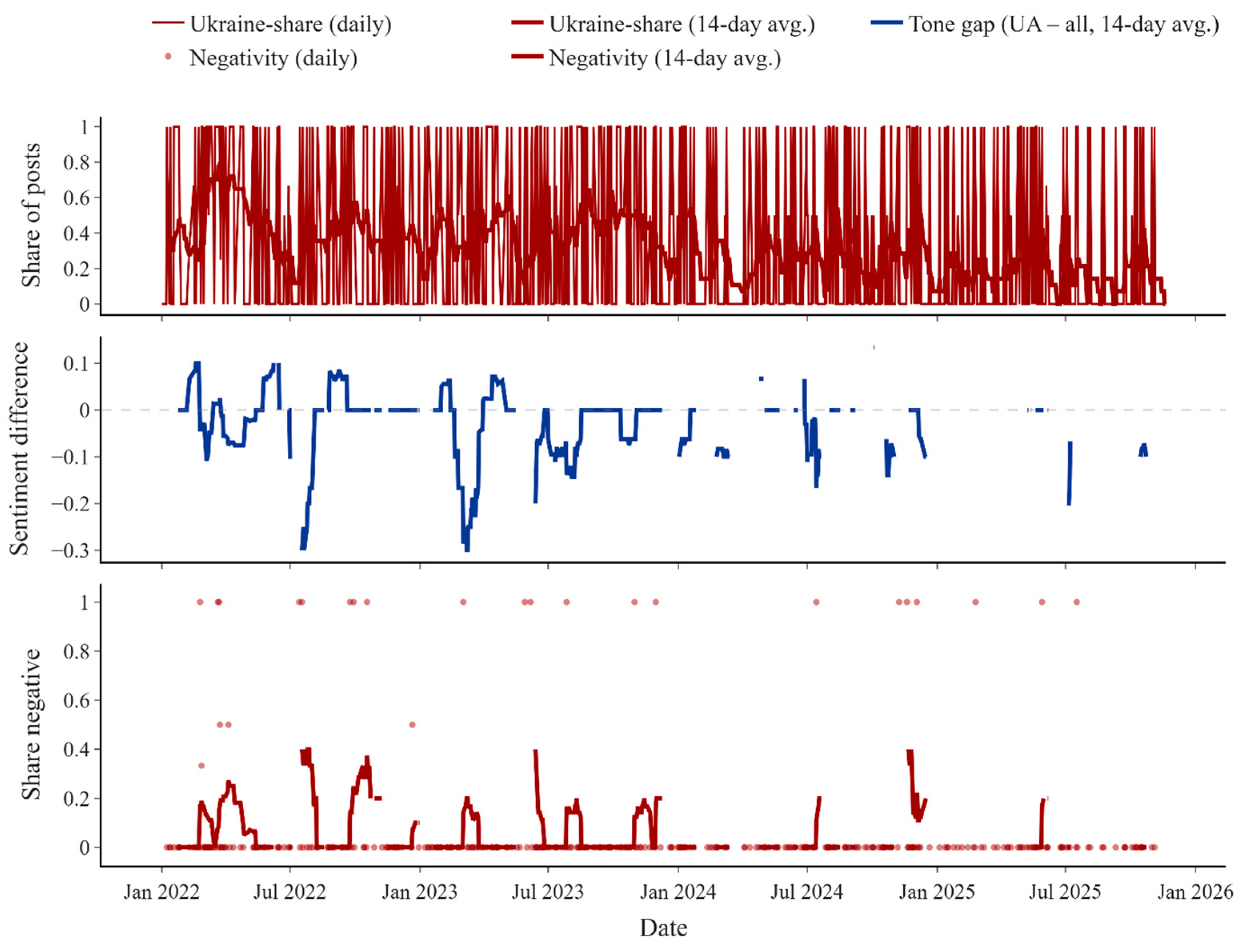
Figure 1 provides an integrated view of three structural dimensions of NATO’s Ukraine-related Facebook communication between January 2022 and November 2025: (a) the daily and smoothed share of posts devoted to Ukraine, (b) the tone gap between Ukraine-focused and general institutional messaging, and (c) the daily and smoothed negativity ratio. The monthly descriptive statistics derived from these series reveal a communication system that oscillates between phases of concentrated agenda pressure and extended periods of reduced attention, accompanied by systematic shifts in tone and emotional signalling.
The agenda-share dynamics reveal a strong concentration of Ukraine-related content in the first five months of the war, when the monthly mean share ranges between 0.39 and 0.69 and monthly maxima routinely reach 1. Smoothed 14-day trajectories confirm sustained agenda saturation throughout early 2022, consistently exceeding 0.60 and mirroring the intensity of unfolding events. From mid-2022 onward, the series enters a prolonged decline. Between late 2022 and mid-2024, monthly Ukraine-share stabilises at 0.20–0.45, with temporary increases during major geopolitical developments such as missile strikes, NATO summits or territorial escalations. After mid-2024, the decline becomes structural: by 2025, monthly averages fall to 0.05–0.20 and the smoothed series remains below 0.15, indicating a durable shift toward a diversified agenda in which Ukraine is no longer the dominant communicative focus.
Tone-gap dynamics reinforce this two-phase pattern. In early 2022, monthly sentiment gaps hover around zero, suggesting initial tonal alignment between Ukraine-related posts and NATO’s broader messaging. However, the smoothed 14-day series shows early divergence beginning in March–April 2022, when Ukraine-focused posts start adopting a slightly less positive tone. This divergence becomes systematic throughout late 2022 and 2023, with monthly gaps between −0.05 and −0.12 and smoothed minima below −0.15, reflecting a more cautious, conflict-proximate framing. In 2024–2025, the gap narrows again: monthly means return toward zero and volatility decreases, marking a shift toward a more routinised and emotionally uniform communication style.
Negativity patterns further confirm the phased transition. Although average monthly negativity is low (0.00–0.20), several clusters of elevated values appear in February–March 2022, July 2022, early 2023 and mid-2024, corresponding to acute battlefield escalations. Yet the smoothed negativity series remains much lower—typically 0.00–0.10—demonstrating that negativity is episodic rather than structural, triggered by discrete geopolitical shocks.
Together, these patterns indicate a two-regime communicative trajectory: an early, high-pressure phase (early 2022–mid-2023) marked by strong agenda saturation, tonal divergence and negativity spikes, followed by a low-intensity phase (mid-2023–2025) characterised by reduced agenda share, tonal stabilisation and a return to routine institutional discourse.
4.3. Discursive Risk Index: Temporal Structure and Intensity Patterns
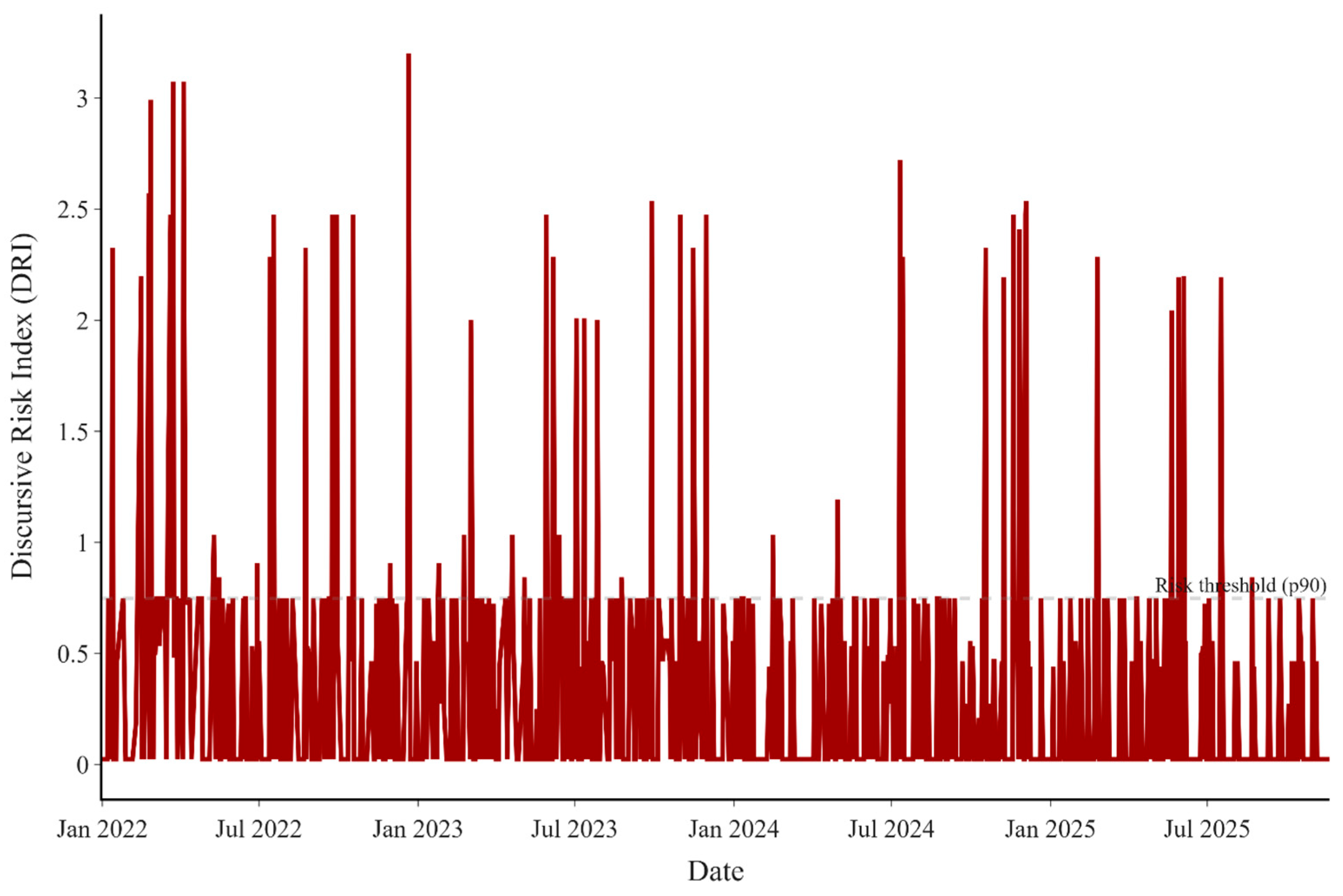
Figure 2 shows that the Discursive Risk Index (DRI) is highly asymmetric: most days display extremely low values, with the median and lower quartiles at 0.02, indicating highly stable, low-volatility communication. Only the upper quartile shows noticeable increases, while a long right tail—peaking at 3.20—reveals a small set of days marked by sharp, atypical discursive departures from NATO’s routine messaging.
The month-to-month dynamics add clarity to when discursive departures occur. Throughout 2022, DRI values remain consistently high: monthly averages typically range between 0.40 and 0.85, and more than one third of days each month exceed the high-risk threshold, reaching nearly 60% in March. These elevated levels align with the outbreak of the war and successive waves of operational escalation, creating a communication environment marked by concentrated attention, heightened volatility and intensified threat framing. The repeated presence of high-amplitude peaks—several surpassing 2.5—confirms that NATO’s messaging during this phase shifted sharply in response to unfolding security events.
In 2023, the pattern becomes more heterogeneous. Certain months, especially those coinciding with renewed military tension or high-visibility signalling, reach risk levels comparable to 2022, while others return closer to baseline, with averages around 0.25–0.30 and far fewer high-risk days. This alternation indicates that NATO preserved the capacity for rapid discursive escalation but activated it selectively, following the episodic nature of geopolitical triggers. By the end of 2023, risk values show signs of stabilisation: volatility decreases and extreme peaks become less frequent.
A more pronounced transition occurs in 2024 and 2025. Monthly averages often fall below 0.25, with several months dropping under 0.10—the lowest values in the series. High-risk days become rare, sometimes limited to a single occurrence or absent entirely, and maximum daily DRI values rarely exceed 1.2–1.5. This narrowing of the risk profile signals a shift toward a routinised, lower-intensity communicative mode in which Ukraine-related messaging remains present but no longer produces sustained deviations from NATO’s routine discursive pattern. The Alliance appears to adopt a more predictable, less volatile register even when addressing sensitive security issues.
Across the entire period, the trajectory of the DRI reflects a movement from crisis-intensified discourse toward communicative normalisation. Early 2022 is dominated by dense, extreme peaks indicative of acute discursive stress. The following year alternates between tension and stabilisation, while the final phase consolidates into a low-risk regime with infrequent, moderate deviations. Elevated discursive risk thus emerges as episodic, externally triggered and concentrated around identifiable geopolitical escalations.
4.4. System-Wide Discursive Risk Patterns
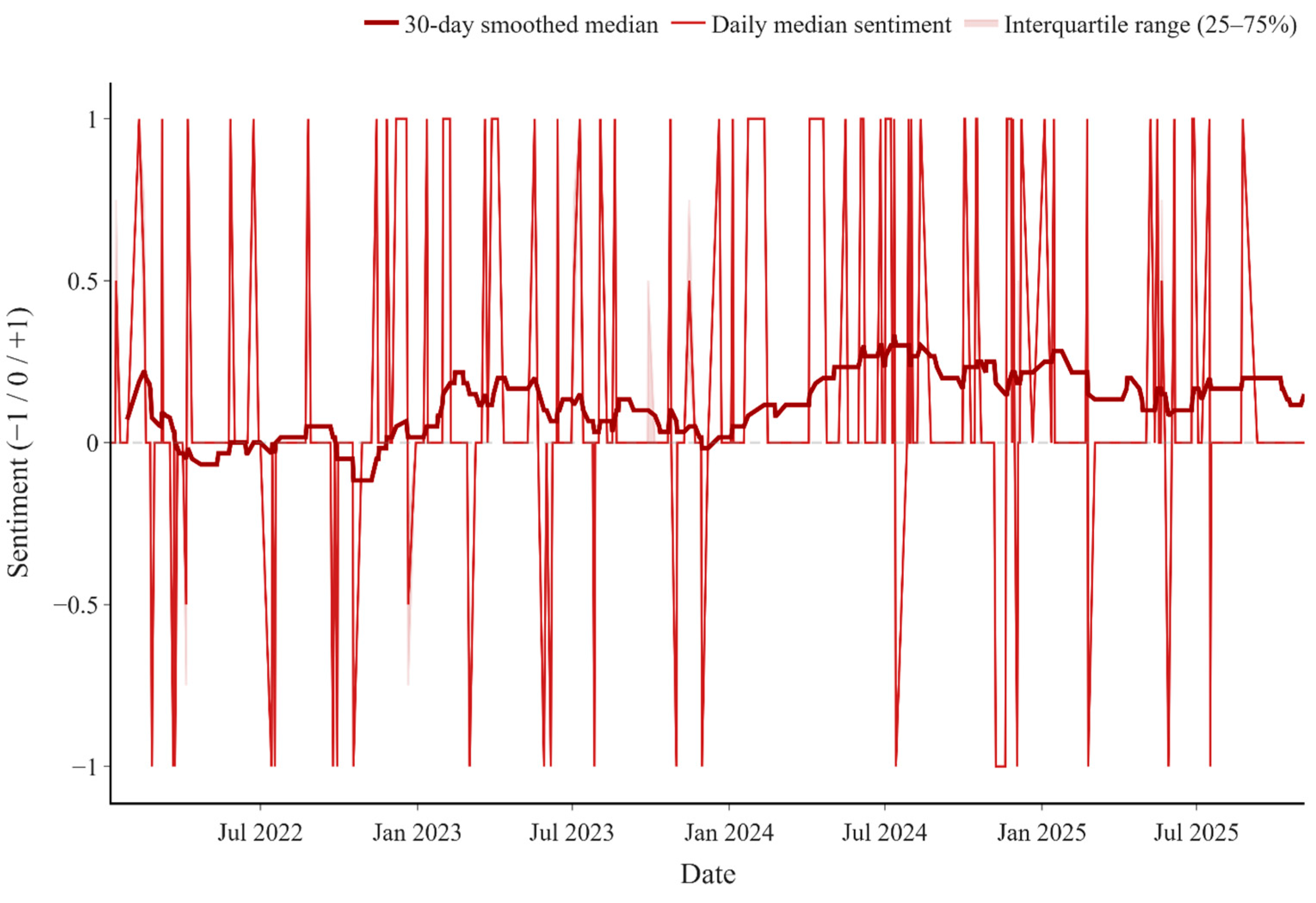
Figure 3 presents the temporal evolution of median sentiment, its daily interquartile range (IQR), and a 30-day smoothed median for all Ukraine-related posts, allowing a direct assessment of both central tendency and emotional dispersion across the full 2022–2025 period.
The longitudinal trajectory shows a communication environment defined by a narrow emotional bandwidth and a strong pull toward central neutrality. The daily median sentiment is usually zero, indicating that most Ukraine-related posts are affectively restrained, avoiding explicit positivity or negativity. This dominance of neutral medians aligns with the descriptive statistics: across 359 Ukraine-active days, the median averages 0.11 with low variability (SD ≈ 0.47), while the interquartile range is extremely compressed (mean ≈ 0.02). Together, these patterns reflect an editorial strategy oriented toward institutional stability, favouring controlled informational tone over emotionally charged expression.
Despite this stability, the series includes brief deviations. Negative median values appear mainly during acute geopolitical stress—mid-2022, early 2023 and late 2023—but these shifts are short-lived. Sentiment quickly returns to the central band, illustrating an oscillatory pattern in which NATO reacts to contextual triggers (battlefield escalations, diplomatic shocks, heightened rhetoric) without adopting a sustained negative posture. The system shows a rapid reversion mechanism that restores tonal equilibrium once the triggering events subside.
The 30-day smoothed median reveals a slower-moving baseline trend. Between late 2022 and mid-2024, it drifts upward toward mildly positive values, suggesting that the Alliance gradually incorporated more supportive or affirming framing as narratives of long-term assistance and deterrence consolidated. This trend recedes in 2025, when the smoothed median returns toward zero, consistent with a shift toward pragmatic, less evaluative communication as the conflict entered a more indeterminate phase.
Emotional dispersion reinforces this interpretation. Most days show IQR = 0, with only rare increases (e.g., March 2022, July 2023, November 2024), and even then seldom above 0.1. This indicates that sentiment deviations stem from a small number of outlier posts rather than broad shifts across the corpus; volatility is generated by sporadic high-intensity statements rather than widespread tonal change.
Overall, the pattern depicts a highly controlled affective regime. Central tendency remains neutral or mildly positive, dispersion is tightly contained, and deviations correspond to identifiable geopolitical shocks. This configuration supports communication that maintains credibility, minimises escalatory risk and preserves tonal continuity across a multi-year crisis.
4.5. Longitudinal Shifts in Agenda Pressure and Discursive Risk
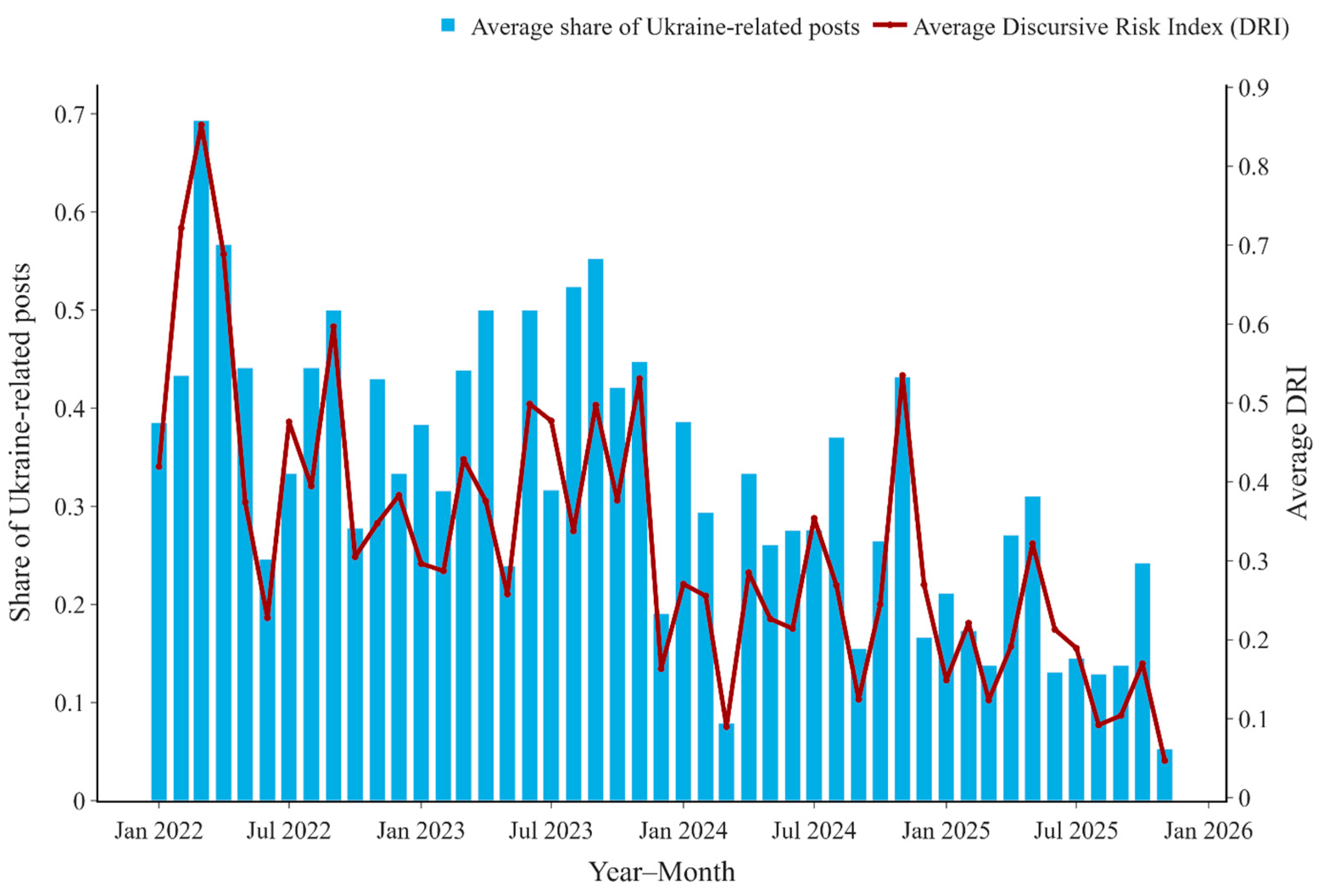
Figure 4 visualises the joint evolution of NATO’s monthly attention to the Ukraine war—expressed as the proportion of posts related to Ukraine—and the corresponding monthly average of the Discursive Risk Index (DRI). By combining both indicators in a single representation, the figure captures the structural relationship between agenda pressure and discursive escalation across the full 2022–2025 period.
The trajectories reveal a consistent temporal pattern linking agenda saturation and discursive risk. At the beginning of the conflict, NATO’s communication is heavily dominated by Ukraine-related content: in early 2022, more than two thirds of all Facebook posts concern the war, and monthly averages frequently reach or exceed 0.7. These periods of concentrated attention align with the highest DRI values in the dataset, including peaks above 2.9–3.0 and monthly means around 0.7–0.85. The simultaneous elevation of agenda share and DRI indicates a phase in which NATO’s messaging becomes unusually dense, volatile and responsive to fast-moving geopolitical developments.
As the war enters a protracted stage, the structure changes. From late 2022 through 2023, the share of Ukraine-related posts gradually declines and stabilises between 25% and 45%. The DRI follows a similar path, moderating into a 0.25–0.45 range with occasional spikes but no persistent high-risk intervals. This parallel descent shows that discursive risk is closely tied to issue dominance: when Ukraine occupies less of the monthly communicative agenda, tonal fluctuations decrease, emotional intensity weakens and overall discursive turbulence diminishes.
A second recalibration phase emerges from mid-2024 to late-2025. Ukraine remains a visible topic but no longer anchors the communication agenda, with monthly shares often falling below 30%. During the same period, average DRI values reach their lowest sustained levels—sometimes nearing 0.10—and extreme peaks become rare. Even when isolated spikes occur, such as those in July 2024 or January 2025, they are contained within a low-risk baseline and do not trigger broader escalation cycles.
Overall, the dynamics illustrate a structurally coherent mechanism: high agenda saturation amplifies the probability of elevated discursive risk, whereas a diversified communication agenda promotes stability. When NATO’s messaging is dominated by a single high-stakes conflict, tonal and emotional discontinuities become more likely; as the agenda broadens, the system re-stabilises and discursive risk declines toward minimal levels.
4.6. Dynamic Trajectories Around Discursive-Risk Peaks
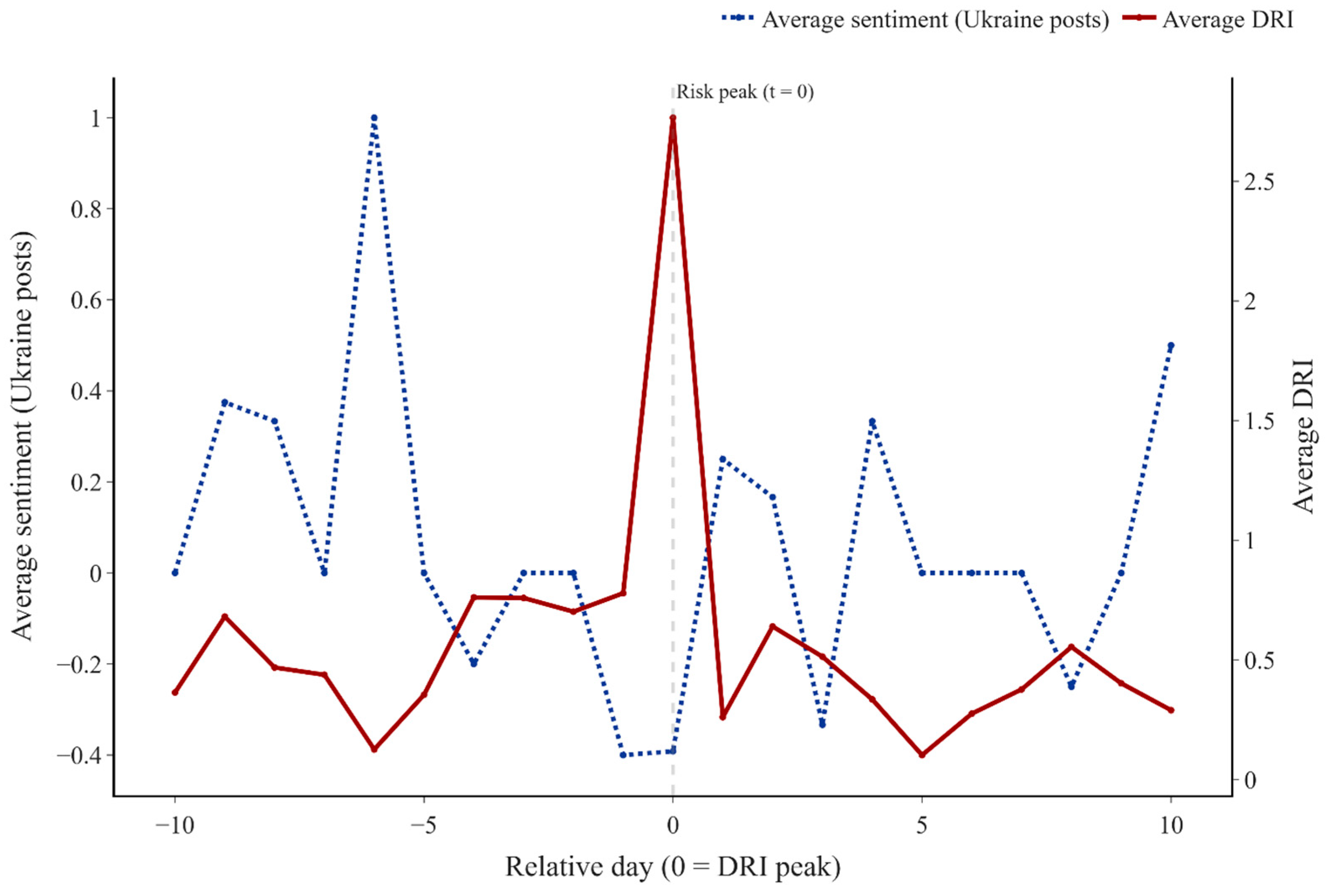
Figure 5 presents the event-aligned evolution of NATO’s Ukraine-related sentiment and the Discursive Risk Index (DRI) in a symmetric 21-day window centred on all peak-risk days (t = 0). By averaging across all events, the figure reveals the canonical temporal pattern that characterises NATO’s transitions into, during, and out of discursive-risk episodes.
The aligned trajectories reveal a consistent pattern of asymmetric buildup followed by rapid release. In the ten days preceding a peak-risk event, the DRI rises gradually from roughly 0.36 to values between 0.7 and 0.8 in the final three days, indicating that escalation is typically preceded by accumulating discursive tension rather than emerging abruptly. Volatility also increases, as reflected in widening standard deviations near t = 0, signalling increasingly unstable communicative conditions in which tone, emotional intensity and topical pressure diverge from routine patterns. Sentiment behaves differently during this phase: average values fluctuate irregularly between neutral, mildly positive and mildly negative, showing no monotonic trend. This confirms that escalating risk does not result from progressively more negative messaging, but from a structural reconfiguration of tone, emotional load and agenda concentration; isolated pre-peak sentiment dips—such as the negative shift at t = −1—coincide with sudden DRI expansion but do not define the broader trajectory.
At the peak itself (t = 0), NATO’s communication enters a distinct state. The mean DRI jumps to 2.77—more than three standard deviations above baseline—indicating a genuine discontinuity characterised by simultaneous surges in message volume, negativity and threat-coded emotions, accompanied by marked tonal volatility. Sentiment also shows a sharp drop into negative territory, reaching its lowest point in the entire 21-day window. Although sentiment does not drive escalation on its own, its convergence with intensified message concentration produces the conditions under which DRI spikes occur.
After the peak, the system resets quickly: DRI falls to around 0.26 the next day, returning to near-baseline levels. Sentiment exhibits a more erratic recovery—with temporary positive shifts at t = +1 and t = +4—indicating that tonal normalisation is slower and less linear than structural stabilisation. Overall, peak-risk episodes display a clear temporal signature: gradual tension buildup, a sharp break, and immediate structural normalisation. The persistent sentiment variability across the window confirms that DRI captures forms of communicative instability not reducible to tone alone. The episodic, reversible nature of these peaks indicates that NATO’s discursive posture responds acutely to geopolitical shocks while avoiding sustained escalation.
4.7. Micro-Level Discursive Patterns Around Peak-Risk Episodes
The micro-level analysis of posts published within ±10 days of the highest-risk dates reveals how specific linguistic constructions generate sharp DRI surges. Close reading—rather than aggregated indicators—shows the discursive mechanisms that structure NATO’s most intense crisis-communication episodes, illustrating how lexical cues, sentiment signals and emotional framings converge to amplify perceived geopolitical volatility. This granular view clarifies not only what NATO communicates during escalation, but how the institution constructs threat, uncertainty and resolve in moments that deviate most from routine discourse.
A consistent pattern across peaks is the dramatic intensification of Ukraine-related content, reaching 86–100% of daily posts immediately before and during DRI spikes. Lexical scoring confirms that these posts cluster multiple conflict-related cues—references to Russia, invasion, missile attacks, territorial defence, or regional deterioration—producing composite values between 3 and 10.5. This dense accumulation of geopolitical markers indicates that risk peaks emerge not from a single trigger but from simultaneous layers of high-salience security signalling. The vocabulary of invasion, deterrence, escalation and collective defence becomes unusually concentrated, aligning communication with moments of heightened geostrategic tension.
Emotionally, fear dominates nearly all peak-risk windows. Even when sentiment classifiers return neutral or moderately positive values, emotional framing remains fear-oriented, signalling urgency without relying on overt negativity. Anger appears rarely, and primarily in exceptional posts condemning war crimes—particularly around Bucha—which generate some of the highest DRI values. When present, anger acts as an intensifier embedded within a fear-anchored emotional architecture.
Peak periods are also marked by expansions in narrative length and informational density. Posts become noticeably longer and structurally richer, incorporating detailed accounts of troop movements, battlegroup configurations, readiness states, humanitarian support, ministerial agreements, strategic decisions and political consultations. Legal–normative vocabulary referencing international law, sovereignty violations or war crimes frequently accompanies operational detail. When multiple long posts appear on the same peak day—as on 24 March or 21 December 2022—their cumulative narrative mass contributes directly to tonal volatility and lexical escalation, feeding the DRI’s structural dimensions.
Different peaks reflect distinct escalation logics. The February 2022 spikes correspond to acute deteriorations in the security situation, with discourse centred on condemnations, explicit descriptions of Russian aggression and civilian risk. Sentiment turns negative, fear dominates, and anger appears proportionally to the severity of violations. Peaks such as 24 March or 5 April 2022 instead reflect multilateral coordination moments—summits, reinforcement announcements, strategic concept developments—where complexity rather than negativity drives high DRI values. Here, tone is more explanatory, highlighting alliance cohesion.
Late 2022 introduces peaks combining operational and symbolic communication. The December 2022 spike, for example, intertwines humanitarian gestures with accounts of energy infrastructure strikes, blackouts and winter conditions, producing high lexical density within a supportive narrative frame. In later peaks, such as those linked to the July 2024 Washington Summit or December 2024 ministerial meetings, escalation derives from agenda breadth: references expand to China, Iran, North Korea, defence-industrial capacity, cyber initiatives and multi-vector deterrence. Despite thematic diversification, fear remains the dominant emotional signal.
Across all cases, peak-risk communication is not merely more negative or more frequent—it is structurally distinct. It features dense clusters of conflict cues, explicit causal attributions (“Russia’s invasion,” “unprovoked attack”), normative assessments anchored in international law, high informational density and frequent high-level quotations. This configuration forms a recognisable rhetorical mode of institutional crisis communication, showing how international organisations deploy emotion and narrative structure to shape public interpretation, reinforce deterrence and maintain allied cohesion during rapidly evolving geopolitical shocks.
5. Discussion
5.1. Emotional Signalling and Crisis Communication
The findings reveal a communication system that adapts dynamically to the tempo of geopolitical developments, combining routine stability with episodic surges of discursive intensity. Rather than maintaining a permanent crisis posture, NATO’s Facebook communication follows cyclical patterns characterised by temporary concentrations of attention, brief increases in volatility and rapid return to equilibrium. This pattern challenges simplified interpretations frequently found in conflict communication studies, which assume either continuous rhetorical escalation or stable, linear institutional messaging. Instead, the results indicate that NATO manages a shifting equilibrium between informational restraint and moments of intensified rhetorical mobilisation, adjusting its communicative posture in response to evolving geopolitical conditions.
A central insight concerns the emotional architecture of institutional communication. Across the observation period, fear consistently emerges as the dominant emotional signal, whereas anger appears only rarely and primarily in relation to extreme events such as war crimes or attacks on civilians. Importantly, the presence of fear does not correspond to alarmist or panic-inducing rhetoric. Rather, it functions as a calibrated indicator of gravity and vigilance. This finding complements existing research demonstrating that the Ukraine war generated strong emotional responses in public discourse and media narratives (
Nortio et al. 2022;
Meza and Mogoș 2025;
Zemanová and Madarászová 2025). However, while previous studies focus primarily on emotional reactions among publics, journalists or political elites, the present analysis demonstrates how an international organisation deploys emotional cues in a more disciplined and controlled manner.
From the perspective of crisis communication theory, this pattern suggests that institutions operating in prolonged geopolitical crises may rely on carefully calibrated emotional signalling that balances urgency with credibility. Situational Crisis Communication Theory (SCCT) emphasises the importance of managing emotional responses in order to maintain legitimacy during crises (
Coombs 2013). The present findings extend this perspective by illustrating how emotional calibration operates not only in short-term crises but also in long-duration security conflicts. NATO’s communication appears to maintain a relatively stable emotional baseline punctuated by brief moments of intensified signalling, allowing the organisation to communicate seriousness without amplifying hostility or panic.
5.2. Discursive Escalation and the Discursive Risk Index
The introduction of the Discursive Risk Index (DRI) provides a systematic way to identify moments in which institutional communication departs significantly from routine patterns. By integrating agenda concentration, tonal volatility, negativity and threat-related emotions into a single indicator, the index captures structural shifts in the intensity of NATO’s messaging.
The results demonstrate that discursive escalation is episodic rather than continuous. Peaks of communicative intensity cluster around identifiable geopolitical developments and are characterised by increased informational density, stronger conflict-related vocabulary and higher levels of fear-related emotional signalling. Importantly, these peaks remain relatively short-lived. Discursive intensity tends to return quickly to baseline levels, indicating the presence of a stabilisation mechanism within NATO’s communication strategy.
This pattern contrasts with forms of domestic political crisis communication, where escalatory rhetoric may persist over extended periods. In NATO’s case, communication appears to rely on controlled bursts of intensified signalling that respond to geopolitical shocks while avoiding prolonged rhetorical escalation. The DRI therefore offers a useful analytical tool for identifying structural transitions between routine institutional communication and high-intensity crisis messaging.
Beyond its empirical findings, the DRI also contributes methodologically by demonstrating how multiple discursive indicators can be integrated to capture the temporal dynamics of crisis communication. Combining sentiment analysis, emotional classification and agenda indicators enables a more comprehensive understanding of how institutional messaging evolves over time in digitally mediated conflict environments.
5.3. Episodic Securitization and Narrative Discipline
The observed patterns also have implications for securitization theory and research on strategic narratives. Classical securitization scholarship conceptualises security communication as a performative act through which political actors frame issues as existential threats requiring extraordinary measures. The findings of the present study suggest that securitizing discourse within NATO’s digital communication is not constant but episodic.
Periods of high discursive risk correspond to moments when NATO intensifies threat-related language, invokes legal and normative arguments and emphasises alliance unity. During these peaks, communication becomes more informationally dense and normatively explicit, often referencing international law, territorial sovereignty and collective defence commitments. At the same time, the rapid return to routine communication indicates that securitizing rhetoric is strategically bounded rather than continuously sustained.
This bounded character of securitization may serve several functions. It reduces the risk of message fatigue among audiences, limits the potential for misinterpretation in highly sensitive geopolitical contexts and preserves the credibility of institutional communication. The findings therefore support the argument that strategic narratives operate not only through content but also through temporal discipline in communication practices (
Homolar and Turner 2024). NATO’s messaging appears to follow a pattern in which high-intensity signalling is activated during moments of acute geopolitical tension and subsequently replaced by more routine institutional communication.
Micro-level linguistic analysis of peak-risk episodes further reinforces this interpretation. During these periods, institutional posts tend to become longer, more detailed and more normatively framed. References to international norms, explicit causal attributions and operational descriptions frequently appear together with elevated emotional cues. The recurrence of these features across multiple peak events suggests the existence of a relatively stable rhetorical template for high-risk communication. Understanding this template contributes to research on crisis communication and digital diplomacy by illustrating how international organisations structure meaning and emotional signalling during rapidly evolving geopolitical crises.
5.4. Limitations and Future Research
This study has several limitations that should be acknowledged. First, the analysis focuses exclusively on NATO’s Facebook communication, which means that the findings cannot automatically be generalised to other social media platforms whose communicative affordances differ substantially. Platforms such as X (formerly Twitter), Instagram or Telegram may produce different discursive dynamics due to variations in message length, audience interaction and algorithmic amplification. Second, the analysis relies on automated sentiment and emotion classification using pretrained transformer models. Although these models enable consistent large-scale measurement, they may not fully capture subtle contextual nuances present in political communication. Third, the dictionary-based identification of Ukraine-related posts may not capture all implicit references to the conflict.
Future research could extend the present approach by incorporating cross-platform comparisons, multimodal analysis that includes visual and audiovisual content, and comparative studies examining the communication strategies of other international organisations engaged in crisis communication. Such extensions would further improve understanding of how institutional actors navigate complex digital information environments during periods of geopolitical instability.
6. Conclusions
This study provides the most extensive longitudinal analysis to date of NATO’s Facebook communication during the 2022–2025 Ukraine war, integrating sentiment analysis, emotion detection, lexical conflict scoring and a novel Discursive Risk Index. By mapping nearly four years of data, the research demonstrates that NATO’s digital discourse does not follow a linear escalation pattern but operates as a dynamic system characterised by episodic peaks of discursive stress embedded within long intervals of stability.
First, institutional emotional signalling in wartime is structured around fear rather than anger. Fear operates as a stable affective frame that communicates gravity and vigilance without undermining diplomatic restraint. Anger appears only in exceptional contexts—primarily war crimes or mass-casualty events—highlighting its role as a selective intensifier rather than a baseline emotion.
Second, discursive risk manifests through short, sharp spikes that coincide with operational shocks, rhetorical escalations or agenda saturation. These peaks represent structurally distinct communicative states marked by dense conflict lexicon, increased tonal volatility and heightened threat-emotion signalling. The rapid post-peak normalisation reveals an institutional mechanism that restores discursive balance swiftly, preventing prolonged crisis escalation in public communication.
Third, the long-term trajectory of NATO’s messaging shows a transition from a high-pressure, event-driven pattern in 2022 to a more routinised, low-volatility regime by 2024–2025. This evolution reflects both shifts in the strategic environment and deliberate editorial recalibration, suggesting that institutional communication adapts to the temporal morphology of conflict.
Fourth, the study demonstrates that crisis communication, securitization and strategic narratives intersect more closely in international war contexts than existing theories typically assume. NATO’s messaging performs multiple simultaneous functions: informing publics, constructing threat, reinforcing allied identity, signalling unity, deterring adversaries and countering hostile narratives. Integrating these dimensions into a single analytical framework allows for a more holistic understanding of how institutions manage communicative risk under conditions of protracted crisis.
Finally, the methodological contribution—through the development of the DRI—provides a replicable tool for measuring discursive volatility in other international crises. By combining agenda saturation, tonal divergence, emotional threat signals and negativity into a single composite indicator, the index offers a scalable approach for analysing institutional communication across conflicts, organisations and platforms.
Overall, the study shows that NATO’s communication during the Ukraine war embodies a distinctive form of strategic emotional governance. It neither suppresses emotion nor indulges in dramatisation; rather, it modulates affect in ways that support credibility, deterrence and alliance cohesion. This emotional equilibrium, punctuated by brief but intense rhetorical activations, exemplifies how international organisations navigate the delicate boundary between informing, signalling and securitizing in a digitally mediated conflict environment.