Review

Mapping Divisions of Elder Care Work in Family Contexts: A Gender-Focused Scoping Review of Caregiving Experiences


1
Department of Social Work, Hong Kong Baptist University, Hong Kong SAR 999077, China
2
First Branch, Chongqing Transportation Construction Management Co., Ltd., Chongqing 401120, China
*
Author to whom correspondence should be addressed.
Soc. Sci. 2026, 15(3), 187; https://doi.org/10.3390/socsci15030187

Submission received: 22 January 2026 / Revised: 5 March 2026 / Accepted: 11 March 2026 / Published: 15 March 2026
(This article belongs to the Special Issue The Role of Caregiving for Older Family Members in Communities)

Abstract

(1) Background: Rapid global aging has surged demand for elderly family care, a role long dominated by women. This study aims to reveal the specific manifestations of the gender division of labor in elderly family care through a systematic evidence synthesis, covering care tasks, care types, impacts, and driving factors. (2) Methods: We searched four databases (Web of Science (SSCI subsets), Scopus, PubMed, and ProQuest) for articles published between 2015 and 2025. After screening, 45 peer-reviewed articles from 16 countries or regions were included, and thematic analysis was employed for data extraction and evidence synthesis. (3) Findings: The results indicate a differentiated gender division of labor and inequality in elderly family care, where female caregivers bear a greater burden in terms of task assumption, care time allocation, and perception of care impacts. The formation of the gender division of labor results from a dynamic interplay among multiple factors, including objective needs, social norms, and institutional influences. Promisingly, men are increasingly participating in family care for the elderly. (4) Conclusions: The study suggests that gender-sensitive policies should address the gender gap for elderly family care and provide targeted support to alleviate the unequal distribution of care burdens.

1. Introduction

Population aging is an irreversible global phenomenon that has driven a significant increase in demand for care. Families have become the primary force in meeting the care needs of an aging population (Bangerter et al. 2024). Some research indicates that informal care significantly outnumbers formal care, both in total hours of assistance and in monetary value (Huber et al. 2005). However, the gender division of labor underlying informal care has long been overlooked. There is substantial empirical evidence indicating that women play a more significant role in the care arrangements for older adults than men. Caring for older relatives is primarily a female activity (Minayo 2021; Palacios et al. 2020). Women are more frequently the sole caregivers, offering more hours and more intensive support (Kelle and Ehrlich 2024; Vicente et al. 2022). In contrast, men tend to engage in caregiving less intensively, dedicating fewer hours and providing less personal care, while focusing on tasks traditionally associated with men, such as home repairs or substitution of household chores (Cha and Ailshire 2024; Kruijswijk et al. 2015). Consequently, women are reported to face a greater burden of caregiving and experience more significant emotional health consequences (Jacobson et al. 2025). The root of this phenomenon lies in the deeply gendered social constructs surrounding caregiving behaviors. As England noted, caregiving is a gendered activity that is “quintessentially identified with females” (England 2005). Both men and women come to believe that elder care is a natural responsibility for women in socialization (De Sousa et al. 2023).
Although academia is gradually recognizing the complexity of gender roles in family caregiving, existing research still has significant limitations. On one hand, there is a lack of in-depth analysis of the specific patterns and dynamic characteristics of caregiving practices among elderly families. Moreover, systematic studies on the heterogeneous impacts of economic costs, mental health, and career development among caregivers of different genders have yet to be established. On the other hand, current impact assessments often present a homogenized conclusion of “overall impairment for women,” failing to adequately reveal the complex causes and differentiated pathways behind gender differences. This is particularly true regarding the insufficient exploration of the interactions between macrostructural factors, such as caregiving support policies and social welfare models, and the micro-level dynamics of allocating family caregiving responsibilities. As a result, the impact of institutional constraints on shaping gender roles through internal family processes remains unexplored. These gaps underscore the need for a more comprehensive understanding of the gender division of elderly care within families. A scoping review is well-suited to addressing these limitations, as it provides a thorough exploration of the evidence and elucidates the complexity of the mechanisms underlying the gendered division of household caregiving (Pollock et al. 2023). This method is especially effective for outlining the scope of existing research, pinpointing patterns and gaps, and emphasizing underexplored fields in ways that more narrow approaches cannot (Munn et al. 2018, 2022). Note that this paper adopts a binary gender framework (male/female) in line with the focus of the existing literature on the division of elder care labor. Non-binary identities are beyond the scope of this study due to limited relevant research.
This scope review aims to systematically map the evidence on the gender division of labor in elder care within families and to deepen understanding of this division in the face of increasing long-term care needs amid changing demographic trends. The specific research question is “What are the types, characteristics, and implications of intra-household gender divisions in elder care?” It covered four sub-questions: (1) What caregiving tasks do male and female caregivers undertake among family caregivers for older adults? (2) What are the characteristics of the gendered division of patterns in family elderly care tasks? (3) What differential impacts does family elder care have on male versus female caregivers? (4) What are the significant differences in social support between male and female family caregivers for older adults?

2. Materials and Methods

2.1. Search Strategy

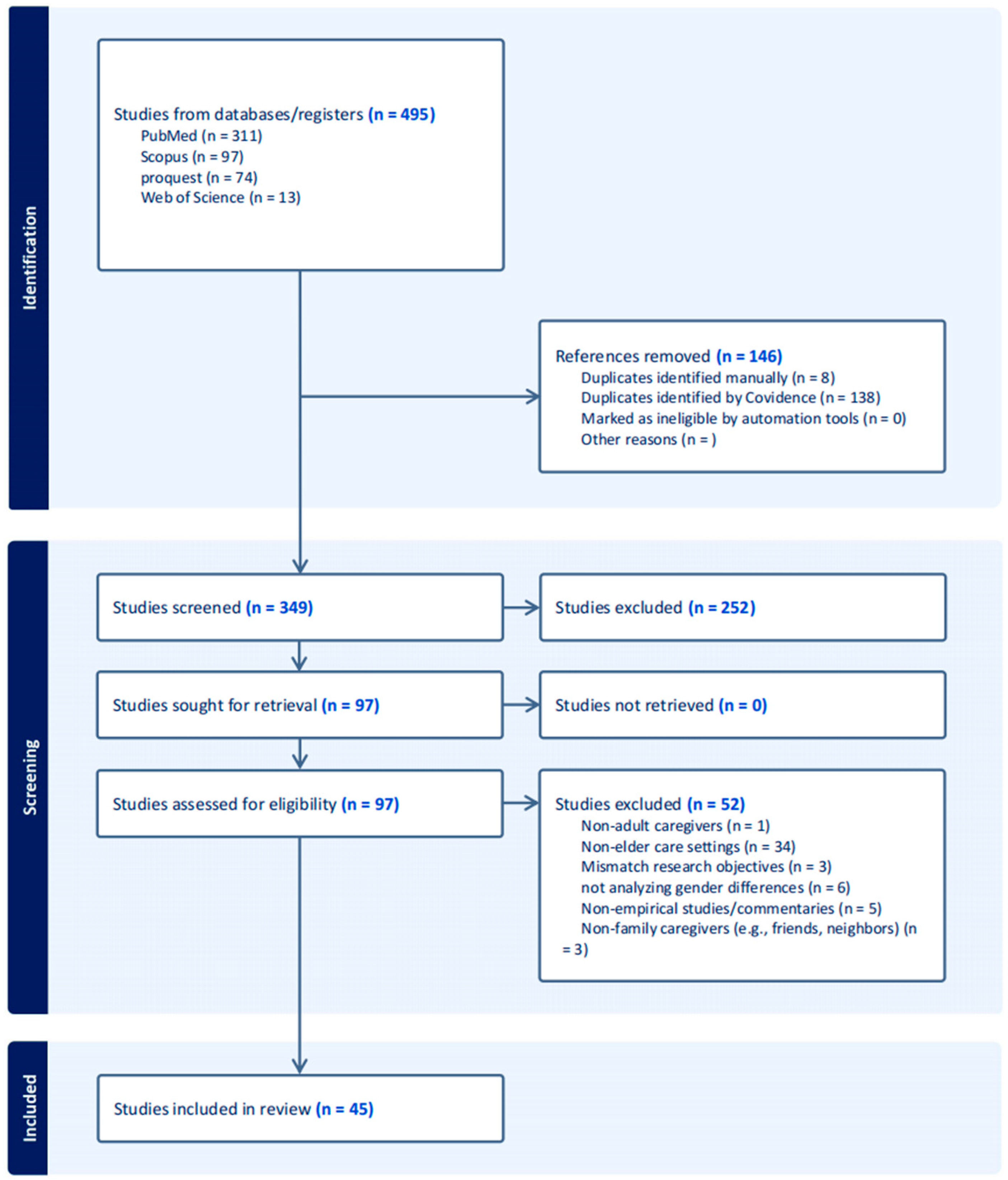
This scoping review was conducted using the Arksey and O’Malley methodological framework and reported in accordance with the PRISMA-ScR guideline (Preferred Reporting Items for Systematic Reviews and Meta-Analyses extension for Scoping Reviews). (Arksey and O’Malley 2005; Page et al. 2021; Tricco et al. 2018). A literature search strategy was co-developed by all authors. Terms such as “family caregiv*” OR “informal caregiv*” were combined with terms such as “gender* division*” OR “gender* disparity”, as well as elder* OR “old* patient*” to obtain the two main dimensions of this inquiry: family caregiving, gendered divisions, and the elderly. The first and second authors conducted searches of papers published from 2015 to 2025 in the Science (SSCI subsets), Scopus, PubMed, and ProQuest databases. A total of 495 articles were retrieved. To this end, we imported all results into EndNote to remove duplicates. And 146 duplicate articles were eliminated. Afterward, 349 articles were exported from EndNote, downloaded, and imported into the Covidence platform for title and abstract screening.

2.2. Study Selection

The first and second authors reviewed the titles and abstracts of all articles using predefined inclusion and exclusion criteria. The included studies were required to be peer-reviewed and empirical, discussing gender differences among older spousal caregivers, with caregivers being family members such as spouses, adult children, relatives, and so on. Furthermore, studies should be conducted in elder care settings (encompassing older adults aged 50 and above) and take into account gender differences in caregiving. The 50+ age threshold for care recipients follows the U.S. Health and Retirement Study (HRS) standard and Survey of Health, Ageing and Retirement in Europe (SHARE), supported by evidence of widespread functional decline in this group, particularly among 50+ cancer patients, who face a heightened risk of functional deterioration (Börsch-Supan and Scherpenzeel 2021; Cabrera et al. 2017; Nam et al. 2025; Sonnega et al. 2014; Walsh et al. 2023). Non-empirical studies, such as dissertations, literature reviews, preprints, and studies that did not analyze gender differences, did not focus on caregiving in non-elderly populations, or involved caregivers who were not family members, as well as studies not published in English, were excluded. The complete inclusion and exclusion criteria for the article are listed in Table 1 below. When disagreements arise, team members consistently engage in discussions to ensure consensus is reached.
With that complete, 252 studies were deemed irrelevant, and 97 were included in the full-text review. The first and second authors independently read and screened the full text of 97 articles, ultimately determining that 45 articles were extracted from the complete text data. All authors remained unblinded to the study and journal characteristics throughout the selection process. The specific selection procedure is illustrated in Figure 1, as outlined in the procedure (Tricco et al. 2018).

2.3. Data Extraction and Synthesis

The first and second authors independently extracted data in Covidence and continuously discussed it with other team members. Researchers were open to extracting any relevant data aligned with the research questions, even if it was not initially incorporated into the charting table. The specific extracted data includes the following: Author, years, country of study, research objectives, methodology, care recipients’ information, caregivers’ information, and types of care tasks (Physical, emotional, financial), division patterns (time division, decision-making division), the impact on caregivers (physical health, mental health, economic, career development), social support, driving factors (demographic factors, policy and service factors, cultural and attitudinal factors), key conclusions. The specific data items and extraction results are shown in the Supplementary Materials. To prevent repetition of the authors’ explanations, only data from the studies’ findings or results segments were used.
After completing data extraction from all articles, numerical and thematic analyses were conducted. To demonstrate the consistency between the survey results and the objectives of the reviews, reviewers present the findings in numerical analysis tables or charts, highlighting the most significant components of the results (Maggio et al. 2021; Mak and Thomas 2022). The researchers also employed descriptive qualitative techniques, such as coding data into specific categories, which are commonly used in scoping reviews aimed at discovering or illuminating concepts in specific areas, or recognizing essential features related to those concepts (Peters et al. 2020). Since the purpose of a scoping review is to identify all relevant studies rather than concentrating solely on high-quality research, the study did not assess the quality of all selected articles (Arksey and O’Malley 2005). The characteristics and key results of the reviews included are presented in Table S1 to help the reader assess the robustness of the synthesized findings.

3. Results

3.1. Study Characteristics

This review encompasses 45 peer-reviewed publications that feature research conducted across various countries, including cross-national European study (11 European countries and 17 European countries, respectively) (n = 2), and single-country studies including US (n = 11), the Netherlands (n = 6), China (n = 5), Canada (n = 3), Mexico (n = 2), Japan (n = 2), Norway (n = 2), Germany (n = 2), Spain (n = 2), Thailand (n = 2), New Zealand (n = 1), Korea (n = 1), Italy (n = 1), Ecuador (n = 1), Bulgaria (n = 1), and one article did not report the country. Regarding the methodologies, there were 37 quantitative studies, 7 qualitative studies, and 1 mixed-methods study. Moreover, the qualitative studies had sample sizes ranging from 12 to 121, while the mixed-methods studies had a sample size of 105. In contrast, the quantitative studies ranged from 80 to 457,864 participants. Twenty-one studies utilized original data, twenty-three relied on secondary data, and one study incorporated both original and secondary data. Caregivers can include spouses, adult children, grandchildren, and other relatives.

3.2. Care Tasks

Eight articles mentioned that women provide more elderly care tasks than men, regardless of their status as spouses, daughters, or daughters-in-law (Cohen et al. 2019, 2021; Duo 2024; Grigoryeva 2017; Kruijswijk et al. 2015; Langner and Furstenberg 2020; Meurs and Giddings 2021; Sutherland et al. 2016). Four articles mentioned men’s financial support for the elderly (Duo 2024, Kruijswijk et al. 2015, Meurs and Giddings 2021; Sutherland et al. 2016), but none mentioned emotional care for the elderly. Regarding caregiving tasks, most women take on essential responsibilities, whereas men typically offer supplementary support or step in only when necessary. Specifically, female caregivers are involved in care management roles that include coordinating various tasks, communicating with professional services, and handling intensive daily living activities (Cohen et al. 2021; Kruijswijk et al. 2015). In contrast, male caregivers primarily focus on instrumental assignments such as gardening, repairs, managing finances, providing indirect support like transportation, and substituting for household work, as well as arranging medical appointments and pilgrimages, and offering temporary assistance (Duo 2024; Kruijswijk et al. 2015; Meurs and Giddings 2021; Sutherland et al. 2016). Compared to sons, daughters’ caregiving behavior is more sensitive to their parents’ needs and exhibits higher ‘elasticity’ (Grigoryeva 2017).
From an intersectional perspective, the influence of gender on caregiving intensity is interconnected with race/ethnicity and employment conditions. Across nearly all racial groups, women tend to provide higher levels of care than men (Cohen et al. 2019). Between races, compared to unemployed White males, several groups provided notably higher levels of IADL caregiving, including both employed and unemployed Black females, unemployed White females, employed Hispanic females, and unemployed Black males (Cohen et al. 2021).

3.3. Division Patterns

3.3.1. Time Division

There are not many studies that directly and accurately report men’s and women’s caregiving time. Data from Japan indicates that men invest more time in high-intensity caregiving on days when the care recipient is heavily dependent (Torimoto-Sasai et al. 2015). However, women tend to provide care for a longer duration overall. In the United States, women account for the majority of total cumulative hours of long-term caregiving (Chari et al. 2015). Among caregivers of individuals under 65, female caregivers dedicate 1.8 times as many hours annually as their male counterparts. For those caring for individuals aged 65 and older, women contribute 1.65 times as many caregiving hours each year as men (Chari et al. 2015). An article from a study on caring for elderly people with dementia in the Netherlands presents a different conclusion: Male caregivers are more likely than female caregivers to become primary caregivers (de Graaff et al. 2025). This may be related to the lower life expectancy of Dutch men compared to women; however, further analysis of the reasons has not been provided (de Graaff et al. 2025).
Among studies of spousal caregiving, wives are the primary caregivers for their husbands, while husbands are significantly less likely to become the primary caregivers for their wives. (Chen et al. 2018; Dorin et al. 2016). Additionally, wives typically offer more hours of care each week for their husbands (Swinkels et al. 2019a). However, after the spouse becomes ill, men and women spend equivalent amounts of time on care (Langner and Furstenberg 2020). Regarding studies of children taking care of their parents, five articles reported that daughters-in-law are more likely to provide care for their parents compared to sons or sons-in-law (Grigoryeva 2017; Iwata and Horiguchi 2016; Jacobson et al. 2025; Knodel et al. 2018; Martín Moreno et al. 2024). And daughters generally provide twice as much care to their elderly parents as sons do (Grigoryeva 2017). Furthermore, sons offer less care in the presence of a sister, while daughters tend to increase their caregiving when they have a brother (Grigoryeva 2017).
Regarding the continuity of the caregiver’s role, female caregivers engage consistently over the long term and infrequently step back due to external influences, such as employment (Kruijswijk et al. 2015). Notably, a growing number of men are taking on caregiver roles, and men’s flexible support enhances network stability (Spatuzzi et al. 2021). At the same time, many women are beginning to reduce their caregiver roles, such as Mexican-American Generation X women in the United States (Duo 2024; Vazquez et al. 2025).

3.3.2. Decision-Making Division

Only one article has reported the gender distribution of decision-making power regarding care plans in the caregiving process. In general, male caregivers tend to dominate clinical decision-making, while female caregivers are more likely to be passively compliant in the care of elderly cancer patients (Sutherland et al. 2016).

3.4. The Impact on Caregivers

3.4.1. Physical Health

Caring for the elderly has varying degrees of adverse effects on the physical health of both male and female caregivers. Six articles directly report that female caregivers have poorer physical health status (de Zwart et al. 2017; Dorin et al. 2016; Hernández-Padilla et al. 2021; Lalani et al. 2025; Spatuzzi et al. 2021; Torimoto-Sasai et al. 2015), of which three articles indicate that caring for the elderly has a greater impact on the physical health of female caregivers than male caregivers in high blood pressure and a functional decline of the kidneys (de Zwart et al. 2017; Spatuzzi et al. 2021; Torimoto-Sasai et al. 2015). This may be because they have been in the caregiving role for a long time, leading to deterioration in health due to unhealthy lifestyles such as irregular eating and sleep deprivation (Lalani et al. 2025). Some women also neglect their own health by prioritizing the needs of the elderly (Jacobson et al. 2025). Studies in some southern and eastern European countries have found that women’s health status improves after leaving the caregiving role (Uccheddu et al. 2019). However, in the long term, after 4–7 years, there is no significant difference in the harmful effects of caregiving on the physical health of men and women (de Zwart et al. 2017).

3.4.2. Mental Health Impacts

There are many articles mentioning the mental health of caregivers, totaling 22 (Ahmad et al. 2020; Ailshire and Casanova 2025; Aung et al. 2021; Bjørge et al. 2024; Borsje et al. 2016; Bramboeck et al. 2020; Cook et al. 2018; de Graaff et al. 2025; de Zwart et al. 2017; Duggleby et al. 2016; Hernández-Padilla et al. 2021; Iwata and Horiguchi 2016; Jang et al. 2016; Kim et al. 2017; Lalani et al. 2025; Ruisoto et al. 2020; Sagbakken et al. 2018; Spatuzzi et al. 2021; Svec et al. 2024; Swinkels et al. 2019a, 2019b; Wong et al. 2019). Overall, being a caregiver is linked to poorer mental health outcomes for women, manifesting in depression and emotional disorders, a sense of burden, and isolation, while the evidence for men remains less conclusive.
Both in the care of ordinary elderly people and those with dementia, female caregivers exhibit higher symptoms of depression and emotional problems. In studies on elderly couples who care for each other, wives as caregivers experience stronger feelings of depression, anxiety, and stress (Borsje et al. 2016; Kim et al. 2017; Wong et al. 2019). After becoming a spousal caregiver, women experience a significant increase in depressive symptoms under both low and high-intensity caregiving, while men show a significant increase in depressive symptoms only under high-intensity caregiving (Ailshire and Casanova 2025). Among caregivers of individuals with dementia, female caregivers have more significant symptoms of depression, with their emotional distress and negative emotions noticeably higher than those of male caregivers (Bjørge et al. 2024). Additionally, women who live with elderly individuals suffering from dementia face an increased risk of depression. This heightened risk has not been detected among male caregivers (Jang et al. 2016).
Regarding a sense of burden, whether caring for elderly individuals in general or those with terminal illnesses or dementia, female caregivers not only report significantly higher levels of subjective burden (de Graaff et al. 2025; Sagbakken et al. 2018; Spatuzzi et al. 2021; Svec et al. 2024; Swinkels et al. 2019a, 2019b), but their positive caregiving experience (PAC) levels are also noticeably lower than those of male caregivers (Wong et al. 2019). Further research indicates that the burden experienced by female caregivers is approximately 2.5 times higher than that of their male counterparts (Aung et al. 2021). Contrary to most results, one article suggested that men experience a greater emotional burden when providing a high number of monthly hours of caregiving, as women are more likely to receive positive feedback through sustained emotional investment during long-term caregiving, such as parental gratitude and the deepening of parent–child relationships (Cook et al. 2018). In contrast, men may experience greater conflict between work and caregiving due to societal role expectations, which amplifies the sense of burden (Cook et al. 2018).
For isolation, women experience a more pronounced sense of isolation and social role stress, especially among female caregivers who care for individuals with dementia and those from rural areas (Ahmad et al. 2020; Lalani et al. 2025). However, an article points out that among caregivers of moderate to severe dementia patients in “hospital care,” male caregivers experience higher levels of loneliness (Bramboeck et al. 2020). However, the authors do not further analyze the reasons.
Factors influencing the mental health of male and female caregivers vary significantly by gender: relationship issues, sense of fulfillment, the elderly’s self-care ability, caregiver competence, identity, masculinity, caregiving intensity, and care type all play a role. For female caregivers, their psychological burden can be alleviated by positive caregiving experiences (PAC) and strong personal caregiving competence (Ruisoto et al. 2020; Wong et al. 2019). However, relationship conflicts with care recipients, social distress such as social isolation and role conflicts, the identity of being a high-income dementia caregiver, the role of daughters-in-law caring for fathers-in-law, daily care exceeding 4 h, and providing personal care such as feeding and bathing all increase stress (Ailshire and Casanova 2025; Bjørge et al. 2024; Iwata and Horiguchi 2016; Jang et al. 2016; Kim et al. 2017; Swinkels et al. 2019b). In contrast, male caregivers benefit from the fulfillment of caregiving and from masculine traits such as decisiveness and independence (Duggleby et al. 2016; Swinkels et al. 2019b). Conversely, low income, especially when living with the sick elderly, increased caregiving intensity, poor self-care ability of the care recipient, and care recipients’ emotionally over-involved attitudes, such as excessive dependence or emotional accusations, significantly increase male caregivers’ burden (Bjørge et al. 2024; Jang et al. 2016; Ruisoto et al. 2020; Swinkels et al. 2019a). Moreover, their quality of life declines more significantly over time, eventually approaching that of female caregivers.

3.4.3. Economic Impacts

Only two articles have reported on the economic impact of caring for the elderly (Chari et al. 2015; Lalani et al. 2025). For female caregivers, direct economic burdens include monetary losses, insufficient funds to cover medical expenses, out-of-pocket costs, hospital fees, debt accumulation, and depletion of personal and family savings, as well as potential loss of benefits, where applicable (Lalani et al. 2025). Moreover, although male caregivers have a higher opportunity cost, in terms of wages, per unit of time, women have a higher total opportunity cost due to longer caregiving hours and higher participation rates (Chari et al. 2015).

3.4.4. Career Development Impacts

Eleven articles have reported on the impact of elderly caregiving on career development (Aung et al. 2021; Chari et al. 2015; Cohen et al. 2019, 2021; de Graaff et al. 2025; Duo 2024; Kim et al. 2017; Kruijswijk et al. 2015; Lalani et al. 2025; Meurs and Giddings 2021; Sagbakken et al. 2018). Totally, caregiving responsibility disturbs the professional advancement of a quarter of caregivers, regardless of gender (Aung et al. 2021). However, male caregivers are more likely to remain employed, whereas female caregivers often experience job loss and decreased work productivity (Kim et al. 2017; Lalani et al. 2025). Furthermore, living with aging or disabled parents significantly reduces employment rates for women, particularly for those in rural areas, but has no impact on men (Meurs and Giddings 2021). And female caregivers are more likely to work part-time, with fewer working full-time (de Graaff et al. 2025). Regarding working hours and adjustment modes, women work fewer hours each week in their careers (de Graaff et al. 2025). Additionally, women tend to flexibly adjust their work hours to meet caregiving needs, whereas men rarely do so (Kruijswijk et al. 2015). Some female caregivers even have to resign from their jobs or hinder their career development due to their inability to attend career-related conferences or training (Sagbakken et al. 2018). From the perspective of role conflict and hidden burden, three articles have reported conflicts among female caregivers in balancing work and caregiving responsibilities, yet few articles have mentioned similar conflicts among male caregivers (Cohen et al. 2019, 2021; Duo 2024).

3.5. Social Support

Five articles have examined the external support access of male and female caregivers (Hernández-Padilla et al. 2021; Kim et al. 2017; Langner and Furstenberg 2020; Svec et al. 2024; Swinkels et al. 2019a). Among them, three studies indicate that men are more inclined than women to obtain external assistance (Kim et al. 2017; Langner and Furstenberg 2020; Swinkels et al. 2019a), while another study shows that women perceive higher levels of social support than men (Hernández-Padilla et al. 2021). Further analysis reveals that perceived social support among women can mitigate the negative impact of perceived health on burden, although this mediating effect was not observed in men (Hernández-Padilla et al. 2021). Regarding the supporting sources, female caregivers tend to seek informal support more to manage stress, whereas male caregivers do not show significant responses to different types of support (Svec et al. 2024). However, no study explores how caregivers proactively seek external help, nor does it analyze gender differences in help-seeking behaviors.

3.6. Driving Factors

3.6.1. Demographic Factors

Gender differences in life expectancy and health status are significant demographic driving factors, and most studies have focused on spousal caregiving, examining why wives caring for husbands is far more common than husbands caring for wives in old age. Specifically, the partner’s health needs, including age and chronic disease diagnoses, are central to care decision-making (Ailshire and Casanova 2025). From a physiological perspective, female partners tend to have a longer lifespan and are usually younger (Chen et al. 2018; de Graaff et al. 2025; Lapsley et al. 2020). Husbands tend to enter old age more quickly than wives and require more care (Knodel et al. 2018). And one research reported that wives are often healthy enough to take care of themselves (Dorin et al. 2016). As a result, care for women by their spouse or partner is often much less available.
Population aging is a non-eligible objective demographic factor. And numerous studies have indicated that severe aging trends are prevalent across multiple countries, including Thailand, the United States, Mexico, and China, leading to a surge in demand for elderly care (Aguila et al. 2019; Aung et al. 2021; Duo 2024; Grigoryeva 2017). Additionally, the population of special elderly groups with conditions such as cognitive impairments is substantial, and their care needs remain insufficiently addressed (Borsje et al. 2016). Severe population aging and the increasing number of exceptional elderly individuals raise the demand for family care, thereby placing a heavier burden on female caregivers.

3.6.2. Policy and Employment Structure Factors

Differences in policies and welfare systems also contribute to disparities in the burden of family caregiving. Under the “familialism” welfare systems of Southern and Eastern Europe, women bear high-intensity and high-pressure care responsibilities (Uccheddu et al. 2019). For comparison, the “service-oriented” welfare systems of Northern Europe alleviate this burden through formal services, thereby reducing caregiving burdens (Uccheddu et al. 2019). At the same time, the lack of policy support is an important policy and service factor, manifested in the lack of comprehensive support for family caregivers in long-term care policies in countries such as the United States, Mexico, and China (Aguila et al. 2019, Ailshire and Casanova 2025, Chen et al. 2018, Luo and Chui 2019). Meanwhile, influenced by neoliberal ideology, policy discussions that stress “individual responsibility” and “equal opportunity” shift the burden of caregiving onto personal capability rather than addressing social structures, thereby obscuring gender inequality (Sutherland et al. 2016). Furthermore, the shortage of nursing home infrastructure and the limited availability of public care services worsen the stress of family caregiving (Meurs and Giddings 2021; Nance et al. 2018). Respondents generally had unfavorable experiences with formal caregiving support, which further reinforces the elderly’s dependence on family care (Ahmad et al. 2020).
Regarding economic and employment structure constraints, due to gender differentiation in the job market, men often work full-time and frequently reduce their caregiving obligations under the pretext of “busy work” (Kruijswijk et al. 2015). In contrast, women are more likely to engage in low-paying, flexible employment or be unemployed, often becoming default caregivers, which further limits women’s options to prioritize caregiving responsibilities (Kruijswijk et al. 2015; Lalani et al. 2025). With the rapid transformation of society in certain areas, such as Tibetan communities in China, women’s education and economic involvement have increased the likelihood of their caregiving negotiations (Duo 2024).

3.6.3. Cultural & Attitudinal Factors

In traditional gender roles and family norms, females are often expected to accept the role of family caregiver in many countries, including Japan, China, Germany, and New Zealand (Cohen et al. 2019; Dorin et al. 2016; Lapsley et al. 2020; Torimoto-Sasai et al. 2015). On the other hand, Buddhist and Confucian doctrines prescribe children’s filial obligations to care for elderly parents, with Confucianism further codifying gender-based divisions of labor within family caregiving (Aung et al. 2021; Chen et al. 2018; Jang et al. 2016; Luo and Chui 2019). These religious and philosophical traditions have exerted a profound influence on the division of responsibilities in family care for the elderly across Asian nations such as Thailand, China, and South Korea. Similarly, religious and social movements have also contributed to transformations in the gendered divisions of labor. Influenced by Catholicism, Mexican male caregivers frame their role through the belief that “God bestows responsibility and strength,” thereby motivating their willingness to provide care to older adults (Nance et al. 2018). And the Chicano Movement of the last half of the 20th century in Mexico emphasized national equality and social justice, which may encourage women to seek more equitable divisions of labor within the family, no longer viewing ‘sacrificial caregiving’ as the only value, thereby influencing the way they participate in or continue (Vazquez et al. 2025).
Furthermore, socio-cultural norms have certain expectations about who provides care, viewing women as the primary caregivers in the family, with caregiving seen as an extension of their traditional gender responsibilities (Cohen et al. 2021; Duo 2024; Lalani et al. 2025). Gradually, women have to come to terms with their identities as family caregivers within an implicit gender framework (Ahmad et al. 2020). While caregivers took issue with the unequal allocation of caregiving tasks, they passively complied with the gender-based division of such responsibilities and rationalized their acceptance through moral framing rules (Ahmad et al. 2020). Moreover, three studies indicate that social groups such as nurses and older adults commonly hold the belief that “women are ‘naturally good at caregiving,’“ a belief that naturalizes women’s caregiving responsibilities (Jacobson et al. 2025; Kruijswijk et al. 2015; Sutherland et al. 2016). Furthermore, parental expectations regarding children’s caregiving responsibilities also exhibit gendered patterns, with a tendency to assign greater caregiving duties to daughters or daughters-in-law (Aguila et al. 2019).
Lastly, disparities in resource allocation across society may lead women to take on caregiving roles more frequently than men, further compressing their development space in areas such as work and health, and resulting in fewer opportunities and supports (Cohen et al. 2021; Yin et al. 2021). A study in the Orcasitas community of Madrid found that class differences in social resource allocation force families to take on care responsibilities. Combined with traditional gender roles, women, especially eldest daughters, labeled as “caregivers” and lacking resources, are compelled to assume primary caregiving duties and fall into “reverse dependence” on their parents (Martín Moreno et al. 2024). This vulnerability reinforces the intergenerational transmission of gendered care responsibilities, exacerbating the cycle of social and gender inequality (Martín Moreno et al. 2024).

4. Discussions

In this scoping review, we identified 45 primary studies that addressed gendered divisions across various settings of elder family care, published between 2015 and 2025. The current research emphasizes the differentiated gender division of labor and inequality in elderly family care. Whether it is the responsibility of specific tasks, the allocation of care time, or the impact of caring for the elderly on caregivers, female caregivers are more affected.

4.1. Summary of Results

There is a gender differentiation in the allocation of caregiving tasks, with women leading daily care and men providing supplementary support. The studies revealed significant gender differences in caregiving task allocation, with women occupying an absolute dominant position in daily care, such as dietary care, personal hygiene, and home care, while men are more responsible for supplementary support, such as transportation arrangements, medical expense management, and home maintenance. The key feature is that women not only invest more time in caregiving but also experience greater sustainability. However, their time investment is highly fragmented, making it more challenging to maintain a clear boundary between caregiving and their personal and professional lives. This division of labor pattern confirms the social construction of gendered care, where women are assumed to be “natural caregivers” and male participation is often seen as “supportive” or “external “responsibilities.
Gender division of caregiving further leads to adverse effects of differentiation for caregivers. In terms of physical and mental health, long-term high load care significantly increased the risk of depression, incidence rate of chronic diseases, and sleep disorders for female caregivers. Although male caregivers have a lighter overall caregiving burden, they exhibit higher emotional burden and loneliness than females when providing high-intensity monthly care or caring for hospitalized elderly with moderate to severe dementia. In terms of economic impacts, female caregivers bear heavier direct economic burdens, including monetary losses, out-of-pocket medical costs, depleted savings, and accumulated debt, as well as higher total opportunity costs than male caregivers, leading to long-term socioeconomic disadvantages. Regarding career development, women are more likely to be forced to interrupt their careers, forgo promotion opportunities, or opt for jobs with greater flexibility due to caregiving responsibilities, resulting in significant income loss and occupational marginalization.
The gender differences in the dimension of social support constitute a significant gap in the current research field of spousal care: only 5 studies included relevant analyses, and the existing conclusions show clear fragmentation. The advantages of men in obtaining formal support, women’s dependence on informal support, and the unique mediating effect of social support on women’s caregiving burden have not yet formed a unified explanatory framework. This distribution of evidence reflects insufficient attention to the mechanism of social support in previous studies.
The gender division of caregiving results from the dynamic interplay of multiple factors, including objective needs, institutionalization, and social norms. Regarding objective needs, the aging population exacerbates the overall demand for care, and women’s longer life expectancy increases their probability of becoming “potential long-term caregivers”. In terms of policy and systems, the government’s insufficient support for elderly care, the lack of public infrastructure, and the negative experiences with formal support push elderly care back to families. Meanwhile, economic pressure and structural constraints in the job market further concentrate this responsibility on women. In terms of social and cultural construction, the traditional gender division of labor in the family, the influence of Confucian culture and Buddhism, gender norms such as the stereotype that “women are good at caregiving”, and the unequal distribution of social resources leading to women’s dependence on family resources have jointly strengthened the inequality of transportation, elderly care division of labor. The intersection of these factors leads to gender division of labor, transcending individual choice and becoming a systemic inequality shaped by social structure and institutional design. Notably, socioeconomic status, a critical determinant of gendered caregiving arrangements, has rarely been explicitly examined as a core analytical variable in existing empirical studies on this topic, constituting a significant and underexplored research gap.
Although men have not yet become the dominant force in elderly care, their complementary role is crucial for maintaining the stability of the care network, and participation patterns are evolving. In the Dutch family care network, male participation often manifests as “flexible support”, which mainly involves temporarily filling gaps or indirectly supporting female caregivers. This’ auxiliary elasticity may alleviate women’s immediate stress, but it may also solidify traditional gender division of labor patterns. However, male participation in certain cultural contexts is challenging this framework. For example, among U.S.-based Mexican-origin families, the proportion of male caregivers has been increasing over time. Meanwhile, Mexican men are influenced by Catholic culture, extending to the role of primary caregivers. These changes mark a loosening of the traditional female-exclusive care model, but substantive gender equality has not yet been achieved. In the future, it is necessary to break further the cultural inertia and structural constraints of the feminization of caregiving responsibilities and promote the transformation of caregiving division of labor from supplementation to equal cooperation.

4.2. Recommendations for Practice

These findings underscore the urgent need for multi-level interventions to provide more support for family caregivers, promote the sharing of caregiving responsibilities, and reduce the gender gap. Systematic family-level intervention is necessary at the macro level. Local government should promote the coordination of formal and informal care, strengthen public care resources to reduce the burden on families, and pay special attention to the care needs of special families in rural areas or with elderly individuals who have specific illnesses (Lalani et al. 2023, 2025; Lapsley et al. 2020). The government should also incorporate gender equality into the core of health policies, presenting the dilemma of gender differentiation among caregivers in social policies, and providing differentiated support. Furthermore, medical institutions require medical staff to undergo training in gender-bias reflection (Sutherland et al. 2016).
At the micro level, social organizations such as social work agencies and families are supposed to encourage men to break traditional gender stereotypes and participate in caregiving to reduce the implicit burden on women, and design support measures for caregivers of different generations and genders (Jacobson et al. 2025; Sutherland et al. 2016; Swinkels et al. 2019a; Vazquez et al. 2025). Regarding caregivers’ mental health, the “Positive Care Experience (PAC)” intervention is used for female caregivers to enhance perceived value, and nursing competency training is also provided to improve self-efficacy (Ruisoto et al. 2020; Wong et al. 2019). For male caregivers, social workers need to design goal-oriented activities to enhance the sense of achievement, combining masculine traits such as decisiveness and independence with caregiving tasks to improve their mental health (Duggleby et al. 2016; Swinkels et al. 2019a).

4.3. Future Research

When selecting research methods, future studies should prioritize qualitative methods. The proportion of qualitative research accounts for only 15.6% (7 articles), and the methodological imbalance limits the in-depth exploration of caregivers’ subjective experiences. Given the unique advantages of qualitative research in revealing complex psychological processes, role cognition, and emotional dynamics, it is recommended that future research adopt qualitative methods to focus on the unique role adaptation process and deep subjective experience of caregivers, in order to compensate for the limitations of existing quantitative data in explaining implicit emotions and meaning construction in caregiving practice.
When selecting research regions, it is essential to prioritize expanding coverage to low- and middle-income countries and territories. At present, low-income countries and regions are severely underrepresented. Asia (except for China, Japan, and Thailand), Africa, and Middle Eastern countries are in a research gap. This regional bias limits our understanding of the diversity in the gender division of labor among caregivers worldwide. Therefore, it is recommended that future research prioritize addressing the above-mentioned areas of insufficient attention and, through comparative analysis, reveal the deep mechanisms by which cultural context and institutional arrangements shape the gender division of labor among caregivers.
Regarding research content, two main directions need to be expanded in the future: first, the mechanisms of gender differences in social support. The existing research on social support for caregivers is relatively limited and primarily focuses on the comparison of the quantity of support resources and subjective perception results, failing to deeply reveal the proactive mechanism of seeking help behavior, that is, the differentiation characteristics of seeking help motivation, willingness intensity, and specific seeking methods among caregivers of different genders. Given that social support is a core buffering factor for caregivers’ self-regulation (Gutiérrez-Sánchez et al. 2023; Xu et al. 2021), future research needs to analyze how gender role expectations and cultural norms shape caregivers’ decision-making processes for seeking help, such as whether men tend to seek implicit help rather than direct interpersonal help due to their “independent traits,” or whether women are more likely to activate formal support systems. The second is the gender dynamics of caregiving decision-making division. The current research lacks sufficient attention to decision-making allocation in elderly care, particularly in the systematic examination of the gender distribution of decision-making power in care plans, such as the selection of medical interventions and the allocation of economic resources. In the future, it is necessary to focus on analyzing differences in participation in decision-making, discourse power, and conflict coordination patterns among caregivers of different genders within families.
From a research perspective, future studies should incorporate intersectionality and a gender perspective, and socioeconomic capacity to enhance the analysis of identity dimensions. The current research on caregiver identity is largely limited to a single-gender dimension and lacks a systematic exploration of intersectionality theory. Future research should adopt an intersectionality analysis framework to fully reveal the cumulative effects of multiple social stratification factors, such as race, immigration status, social class, and sexual orientation, on gender, thereby compensating for the simplified treatment of identity complexity in existing research. Future research should also explore how social norms naturalize women’s elderly care roles, and how male caregivers engage in identity negotiation and gender role conflicts in the “feminized” care field. It should also trace the structural roots of the family’s gender division of labor, rooted in institutional, cultural, and other systems. Furthermore, socioeconomic capacity is a critical determinant of whether families can outsource care work, thereby mitigating the gendered burden of unpaid family care. So future research should prioritize investigating the moderating effect of socioeconomic status on gendered care division, as well as the interactive dynamics between formal care market accessibility, household economic resources, and gendered care responsibilities.

4.4. Limitations

Although this scoping review is based on rigorous research practices, it does have some limitations. Firstly, the databases searched were relatively limited, including only Web of Science (SSCI subsets), Scopus, PubMed, and ProQuest, which constrained the results of literature retrieval. And excluding gray literature may have omitted valuable insights from unreviewed sources, such as social work organizations’ service records or community survey reports. The literature search was restricted to English, thereby missing unique perspectives from caregiver studies in non-English-speaking countries and failing to adequately reflect the cultural diversity of gender issues among caregivers. Future research aims to address these limitations and provide a more comprehensive review.

5. Conclusions

The current scoping review emphasizes gender divisions and inequalities in family caregiving for seniors. Compared to male caregivers, female caregivers undertake more caregiving tasks and invest more time in caregiving, experiencing greater impacts on their physical, psychological, economic, and professional well-being. This gendered distribution of caregiving tasks stems from the objective growth of care needs for the elderly; traditional family gender division of labor; religious, cultural, and social norms; and the lack of social support. In specific contexts, males are also beginning to play increasingly significant caregiving roles. Therefore, it is essential to explore social support policies from a gender perspective and to implement different intervention measures for male and female caregivers.

Supplementary Materials

The following supporting information can be downloaded at: https://www.mdpi.com/article/10.3390/socsci15030187/s1, Table S1. Study Characteristics and Key Results.

Author Contributions

Conceptualization, J.T. and Y.Z.; methodology, J.T. and Y.Z.; software, J.T. and Y.Z.; validation, J.T., Y.Z., V.W.-P.L. and S.Y.; formal analysis, J.T. and Y.Z.; investigation, J.T., Y.Z., V.W.-P.L. and S.Y.; resources, J.T., Y.Z., V.W.-P.L. and S.Y.; data curation, J.T. and Y.Z.; writing—original draft preparation, J.T. and Y.Z.; writing—review and editing, J.T., Y.Z., V.W.-P.L. and S.Y.; visualization, J.T. and Y.Z.; supervision, V.W.-P.L.; project administration, J.T. and Y.Z. All authors have read and agreed to the published version of the manuscript.

Funding

This research received no external funding.

Institutional Review Board Statement

Not applicable.

Informed Consent Statement

Not applicable.

Data Availability Statement

No new data were created or analyzed in this study.

Conflicts of Interest

Author Shuang Yang was employed by Chongqing Transportation Con-struction Management Co., Ltd. However, all authors declare that the research was conducted in the absence of any commercial or financial relationships that could be construed as a potential conflict of interest.

References

  1. Aguila, Emma, Mariana López-Ortega, and Sean Angst. 2019. Do income supplemental programs for older adults’ help reduce primary caregiver burden? Evidence from Mexico. Journal of Cross-Cultural Gerontology 34: 385–402. [Google Scholar] [CrossRef]
  2. Ahmad, Menal, Jennifer van den Broeke, Sawitri Saharso, and Evelien Tonkens. 2020. Persons with a migration background caring for a family member with dementia: Challenges to shared care. The Gerontologist 60: 340–49. [Google Scholar] [CrossRef] [PubMed]
  3. Ailshire, Jennifer A., and Maria Casanova. 2025. Mental health impacts of spousal caregiving intensity in the US. Health Economics 34: 267. [Google Scholar] [CrossRef] [PubMed]
  4. Arksey, Hilary, and Lisa O’Malley. 2005. Scoping studies: Towards a methodological framework. International Journal of Social Research Methodology 8: 19–32. [Google Scholar] [CrossRef]
  5. Aung, Thin Nyein Nyein, Myo Nyein Aung, Saiyud Moolphate, Yuka Koyanagi, Siripen Supakankunti, and Motoyuki Yuasa. 2021. Caregiver burden and associated factors for the respite care needs among the family caregivers of community dwelling senior citizens in Chiang Mai, Northern Thailand. International Journal of Environmental Research and Public Health 18: 5873. [Google Scholar] [CrossRef]
  6. Bangerter, Lauren, Yijung Kim, Beth Fields, Michael Reese Wittke, and Kate Perepezko. 2024. The Intersection of Successful Aging and Family Caregiving. The Gerontologist 65: gnae054. [Google Scholar] [CrossRef]
  7. Bjørge, Heidi, Kari Kvaal, and Ingun Ulstein. 2024. Quality of Life and Relationships in Caregivers of People with Dementia. A Gender Perspective. American Journal of Alzheimer’s Disease and Other Dementias 39: 15333175241276404. [Google Scholar] [CrossRef]
  8. Borsje, Petra, Marleen A. P. Hems, Peter L. B. J. Lucassen, Hans Bor, Raymond T. C. M. Koopmans, and Anne Margriet Pot. 2016. Psychological distress in informal caregivers of patients with dementia in primary care: Course and determinants. Family Practice 33: 374–81. [Google Scholar] [CrossRef]
  9. Börsch-Supan, Axel, and Annette Scherpenzeel. 2021. The Survey of Health, Ageing and Retirement in Europe. In Encyclopedia of Gerontology and Population Aging. Cham: Springer International Publishing. [Google Scholar] [CrossRef]
  10. Bramboeck, Verena, Korbinian Moeller, Josef Marksteiner, and Liane Kaufmann. 2020. Loneliness and Burden Perceived by Family Caregivers of Patients with Alzheimer Disease. American Journal of Alzheimer’s Disease and Other Dementias 35: 1533317520917788. [Google Scholar] [CrossRef]
  11. Cabrera, M., M. Vieira, Ana Maria Rigo Silva, M. Bortolleto, and A. Lopes. 2017. Factors associated with functional decline among adults age 50 years or older: A 4-year follow-up. Innovation in Aging 1: 440–41. [Google Scholar] [CrossRef]
  12. Cha, Hyungmin, and Jennifer Ailshire. 2024. Male spousal caregivers are on the rise but they provide mostly secondary, instrumental, and low-intensity care. Innovation in Aging 8: 979–79. [Google Scholar] [CrossRef]
  13. Chari, Amalavoyal V., John Engberg, Kristin N. Ray, and Ateev Mehrotra. 2015. The opportunity costs of informal elder-care in the United States: New estimates from the American Time Use Survey. Health Services Research 50: 871–82. [Google Scholar] [CrossRef] [PubMed]
  14. Chen, Xinxin, John Giles, Yafeng Wang, and Yaohui Zhao. 2018. Gender Patterns of Eldercare in China. Feminist Economics 24: 54–76. [Google Scholar] [CrossRef] [PubMed]
  15. Cohen, Steven A., Carolyn A. Mendez-Luck, Mary L. Greaney, Ariana B. Azzoli, Sarah K. Cook, and Natalie J. Sabik. 2021. Differences in Caregiving Intensity Among Distinct Sociodemographic Subgroups of Informal Caregivers: Joint Effects of Race/Ethnicity, Gender, and Employment. Journal of Gerontological Nursing 47: 23–32. [Google Scholar] [CrossRef]
  16. Cohen, Steven A., Natalie J. Sabik, Sarah K. Cook, Ariana B. Azzoli, and Carolyn A. Mendez-Luck. 2019. Differences within differences: Gender inequalities in caregiving intensity vary by race and ethnicity in informal caregivers. Journal of Cross-Cultural Gerontology 34: 245–63. [Google Scholar] [CrossRef]
  17. Cook, Sarah K., Lauren Snellings, and Steven A. Cohen. 2018. Socioeconomic and demographic factors modify observed relationship between caregiving intensity and three dimensions of quality of life in informal adult children caregivers. Health and Quality of Life Outcomes 16: 12. [Google Scholar] [CrossRef]
  18. de Graaff, M. L. A., I. van der Heide, J. J. D. J. M. Rademakers, I. G. M. van Valkengoed, A. L. Francke, A. Woonink, and F. M. Bijnsdorp. 2025. Is caregiver burden associated with sex and gender-related characteristics? A large-scale survey study among family caregivers of people with dementia. Bmc Geriatrics 25: 171. [Google Scholar] [CrossRef]
  19. De Sousa, Girliani Silva, Raimunda Magalhães Da Silva, C. Brasil, Roger Flores Ceccon, A. Reinaldo, and Maria Cecília De Souza Minayo. 2023. Gender inequalities among caregivers of dependent older adults. Saude E Sociedade 32: e220325pt. [Google Scholar] [CrossRef]
  20. De Zwart, Paul L., Pieter Bakx, and Eddy K. A. van Doorslaer. 2017. Will you still need me, will you still feed me when I’m 64? The health impact of caregiving to one’s spouse. Health Economics 26: 127–38. [Google Scholar] [CrossRef]
  21. Dorin, Lena, Elzbieta Krupa, Sabine Metzing, and Andreas Büscher. 2016. Gender disparities in German home-care arrangements. Scandinavian Journal of Caring Sciences 30: 164–74. [Google Scholar] [CrossRef] [PubMed]
  22. Duggleby, Wendy, Allison Williams, Sunita Ghosh, Heather Moquin, Jenny Ploeg, Maureen Markle-Reid, and Shelley Peacock. 2016. Factors influencing changes in health related quality of life of caregivers of persons with multiple chronic conditions. Health and Quality of Life Outcomes 14: 9. Available online: https://www.proquest.com/scholarly-journals/factors-influencing-changes-health-related/docview/1800416644/se-2?accountid=11440 (accessed on 20 June 2025). [CrossRef]
  23. Duo, D. 2024. Elderly Care and Gender Dynamics in a Tibetan Village in Northwest China: Changes and Challenges. Asian Women 40: 126. [Google Scholar] [CrossRef]
  24. England, Paula. 2005. Emerging Theories of Care Work. Annual Review of Sociology 31: 381–99. [Google Scholar] [CrossRef]
  25. Grigoryeva, A. 2017. Own Gender, Sibling’s Gender, Parent’s Gender: The Division of Elderly Parent Care among Adult Children. American Sociological Review 82: 116–46. [Google Scholar] [CrossRef]
  26. Gutiérrez-Sánchez, Belén, Vasiliki Orgeta, Catalina López-Martínez, and Rafael del-Pino-Casado. 2023. Association between Social Support and Depressive Symptoms in Informal Caregivers of Adult and Older Dependents: A Systematic Review and Meta-Analysis. Journal of Clinical Medicine 12: 6468. [Google Scholar] [CrossRef]
  27. Hernández-Padilla, José Manuel, María Dolores Ruiz-Fernández, José Granero-Molina, Rocío Ortíz-Amo, María Mar López Rodríguez, and Cayetano Fernández-Sola. 2021. Perceived health, caregiver overload and perceived social support in family caregivers of patients with Alzheimer’s: Gender differences. Health Soc Care Community 29: 1001–9. [Google Scholar] [CrossRef]
  28. Huber, Manfred, Patrick Hennessy, and Co-operation Organisation for Economic, and Development. 2005. Long-Term Care for Older People. Paris: Organisation for Economic Co-operation and Development. [Google Scholar]
  29. Iwata, Noboru, and Kazuko Horiguchi. 2016. Differences in caregivers’ psychological distress and associated factors by care recipients’ gender and kinship. Aging & Mental Health 20: 1277–85. [Google Scholar] [CrossRef]
  30. Jacobson, Danielle, Tashani Parker, Lauren Cadel, Elizabeth Mansfield, and Kerry Kuluski. 2025. The Intersection of Gender, Culture and Society for Caregivers of Older Adults Ageing in Place in Ontario, Canada. Health Expectations 28: e70259. [Google Scholar] [CrossRef]
  31. Jang, Sung-In, Hong-Chul Bae, Jaeyong Shin, Suk-yong Jang, Seri Hong, Kyu-Tae Han, and Eun-Cheol Park. 2016. Depression in the family of patients with dementia in Korea. American Journal of Alzheimer’s Disease and Other Dementias 31: 481–91. [Google Scholar] [CrossRef] [PubMed]
  32. Kelle, Nadiya, and Ulrike Ehrlich. 2024. Family care in Germany and its gender-(un)specific patterns: An analysis using novel data from the German Socio-Economic Panel Innovation Sample. International Journal of Care and Caring 9: 197–213. [Google Scholar] [CrossRef]
  33. Kim, Min Hee, Ruth E. Dunkle, Amanda J. Lehning, Huei-Wern Shen, Sheila Feld, and Angela K. Perone. 2017. Caregiver stressors and depressive symptoms among older husbands and wives in the United States. Journal of Women & Aging 29: 494–504. [Google Scholar] [CrossRef]
  34. Knodel, John, Bussarawan Teerawichitchainan, and Wiraporn Pothisiri. 2018. Caring for Thai older persons with long-term care needs. Journal of Aging and Health 30: 1516–35. [Google Scholar] [CrossRef]
  35. Kruijswijk, Wilco, Barbara Da Roit, and Marcel Hoogenboom. 2015. Elasticity of care networks and the gendered division of care. Ageing & Society 35: 675–703. [Google Scholar] [CrossRef]
  36. Lalani, Nasreen, Kawther Hamash, and Yitong Wang. 2023. Palliative care needs and preferences of older adults with advanced or serious chronic illnesses and their families in rural communities of Indiana, USA. The Journal of Rural Health 40: 368–75. [Google Scholar] [CrossRef] [PubMed]
  37. Lalani, Nasreen, Osei Evans Appiah, Siqi Yang, Bhagyashree Katare, and Sampada Wagle. 2025. Financial health and well-being of rural female caregivers of older adults with chronic illnesses. Bmc Geriatrics 25: 1–11. [Google Scholar] [CrossRef] [PubMed]
  38. Langner, Laura A., and Frank F. Furstenberg. 2020. Gender Differences in Spousal Caregivers’ Care and Housework: Fact or Fiction? The Journals of Gerontology: Series B 75: 173–83. [Google Scholar] [CrossRef]
  39. Lapsley, Hilary, Karen J. Hayman, Marama Leigh Muru-Lanning, Simon A. Moyes, Sally Keeling, Richard Edlin, and Ngaire Kerse. 2020. Caregiving, ethnicity and gender in Māori and non-Māori New Zealanders of advanced age: Findings from LiLACS NZ Kaiāwhina (Love and Support) study. Australasian Journal on Ageing 39: e1–e8. [Google Scholar] [CrossRef] [PubMed]
  40. Luo, Meng Sha, and Ernest Wing Tak Chui. 2019. Trends in women’s informal eldercare in China, 1991–2011: An age-period-cohort analysis. Ageing and Society 39: 2756–75. [Google Scholar] [CrossRef]
  41. Maggio, Lauren A., Kelsey Larsen, Aliki Thomas, Joseph A. Costello, and Anthony R. Artino, Jr. 2021. Scoping reviews in medical education: A scoping review. Medical Education 55: 689–700. [Google Scholar] [CrossRef]
  42. Mak, Susanne, and Aliki Thomas. 2022. Steps for conducting a scoping review. Journal of Graduate Medical Education 14: 565–67. [Google Scholar] [CrossRef]
  43. Martín Moreno, Vicente, María Inmaculada Martínez Sanz, Amanda Martín Fernández, Elena Sánchez Rodríguez, Irene Sánchez González, Julia Herranz Hernando, Miriam Fernández Gallardo, Miguel Recuero Vázquez, María Palma Benítez Calderón, Eva Sevillano Fuentes, and et al. 2024. The care of non-institutionalized ADL-dependent people in the Orcasitas neighborhood of Madrid (Spain) during the COVID-19 pandemic and its relationship with social inequalities, intergenerational dependency and survival. Frontiers in Public Health 12: 1411390. [Google Scholar] [CrossRef]
  44. Meurs, Mieke, and Lisa Giddings. 2021. Elder care and paid work: Gender differences in the relationship between unpaid elder care work and employment in Bulgaria. Journal of European Social Policy 31: 223–38. [Google Scholar] [CrossRef]
  45. Minayo, M. 2021. Caring for those who care for dependent older adults: For a necessary and urgent policy. Ciencia & Saude Coletiva 26: 7–15. [Google Scholar] [CrossRef]
  46. Munn, Zachary, Danielle Pollock, Hanan Khalil, Lyndsay Alexander, Patricia Mclnerney, Christina M. Godfrey, Micah Peters, and Andrea C. Tricco. 2022. What are scoping reviews? Providing a formal definition of scoping reviews as a type of evidence synthesis. JBI Evidence Synthesis 20: 950–52. [Google Scholar] [CrossRef]
  47. Munn, Zachary, Micah D. J. Peters, Cindy Stern, Catalin Tufanaru, Alexa McArthur, and Edoardo Aromataris. 2018. Systematic review or scoping review? Guidance for authors when choosing between a systematic or scoping review approach. BMC Medical Research Methodology 18: 143–47. [Google Scholar] [CrossRef]
  48. Nam, Gina, Elizabeth Mayeda, Yancen Pan, Eleanor Hayes-Larson, L. Paloma Rojas-Saunero, Hua Zhou, JianJian Yu Rao, and Zuo-Feng Zhang. 2025. The impact of cancer diagnosis on functional decline in adults aged 50 and older: The US Health and Retirement Study. Journal of Cancer Survivorship: Research and Practice, 1–11. [Google Scholar] [CrossRef]
  49. Nance, Douglas C., Isabel Rivero May Maria, Luis Flores Padilla, Nava Mario Moreno, and Laura Deyta Pantoja Alma. 2018. Faith, Work, and Reciprocity: Listening to Mexican Men Caregivers of Elderly Family Members. American Journal of Men’s Health 12: 1985–93. [Google Scholar] [CrossRef] [PubMed]
  50. Page, Matthew J., Joanne E. McKenzie, Patrick M. Bossuyt, Isabelle Boutron, Tammy C. Hoffmann, Cynthia D. Mulrow, Larissa Shamseer, Jennifer M. Tetzlaff, Elie A. Akl, Sue E. Brennan, and et al. 2021. The PRISMA 2020 statement: An updated guideline for reporting systematic reviews. Systematic Reviews 10: 89. [Google Scholar] [CrossRef]
  51. Palacios, Josefa, Pedro Pérez-Cruz, and Andrew Webb. 2020. The experience of caring for an older relative in Chile: Going beyond the burden of care. Ageing and Society 42: 1340–59. [Google Scholar] [CrossRef]
  52. Peters, Micah D. J., Casey Marnie, Andrea C. Tricco, Danielle Pollock, Zachary Munn, Lyndsay Alexander, Patricia McInerney, Christina M Godfrey, and Hanan Khalil. 2020. Updated methodological guidance for the conduct of scoping reviews. JBI Evidence Synthesis 18: 2119–26. [Google Scholar] [CrossRef] [PubMed]
  53. Polenick, Courtney A., Amanda N. Leggett, Noah J. Webster, Benjamin H. Han, Steven H. Zarit, and John D. Piette. 2020. Multiple Chronic Conditions in Spousal Caregivers of Older Adults with Functional Disability: Associations with Caregiving Difficulties and Gains. Journals of Gerontology—Series B Psychological Sciences and Social Sciences 75: 160–72. [Google Scholar] [CrossRef] [PubMed]
  54. Pollock, Danielle, Micah D. J. Peters, Hanan Khalil, Patricia McInerney, Lyndsay Alexander, Andrea C Tricco, Catrin Evans, Érica Brandão de Moraes, Christina M. Godfrey, and Dawid Pieper. 2023. Recommendations for the extraction, analysis, and presentation of results in scoping reviews. JBI Evidence Synthesis 21: 520–32. [Google Scholar] [CrossRef] [PubMed]
  55. Ruisoto, Pablo, Marina Ramírez, Belén Paladines-Costa, Silvia Vaca, and Vicente Javier Clemente-Suárez. 2020. Predicting Caregiver Burden in Informal Caregivers for the Elderly in Ecuador. International Journal of Environmental Research and Public Health 17: 7338. [Google Scholar] [CrossRef]
  56. Sagbakken, Mette, Ragnhild Storstein Spilker, and Reidun Ingebretsen. 2018. Dementia and Migration: Family Care Patterns Merging with Public Care Services. Qualitative Health Research 28: 16–29. [Google Scholar] [CrossRef] [PubMed]
  57. Sonnega, Amanda, Jessica D. Faul, Mary Beth Ofstedal, Kenneth M. Langa, John W. R. Phillips, and David R. Weir. 2014. Cohort Profile: The Health and Retirement Study (HRS). International Journal of Epidemiology 43: 576–85. [Google Scholar] [CrossRef]
  58. Spatuzzi, Roberta, Maria Velia Giulietti, Francesca Romito, Giorgio Reggiardo, Carmela Genovese, Michele Passarella, Letizia Raucci, Marcello Ricciuti, Fabiana Merico, Gerardo Rosati, and et al. 2021. Becoming an older caregiver: A study of gender differences in family caregiving at the end of life. Palliative and Supportive Care 20: 38–44. [Google Scholar] [CrossRef]
  59. Sutherland, Nisha, Catherine Ward-Griffin, Carol McWilliam, and Kelli Stajduhar. 2016. Gendered Processes in Hospice Palliative Home Care for Seniors with Cancer and Their Family Caregivers. Qualitative Health Research 26: 907. [Google Scholar] [CrossRef]
  60. Svec, Joseph, Natasha Nemmers, and Jeong Eun Lee. 2024. Support for Family Caregivers: Implications of Work Strain and Its Intersections with Formal and Informal Help. The Journals of Gerontology, Series B: Psychological Sciences and Social Sciences 79: gbae087. [Google Scholar] [CrossRef]
  61. Swinkels, Joukje, Theo van Tilburg, Ellen Verbakel, and Marjolein Broese van Groenou. 2019a. Explaining the gender gap in the caregiving burden of partner caregivers. The Journals of Gerontology: Series B: Psychological Sciences and Social Sciences 74: 309–17. Available online: https://www.proquest.com/scholarly-journals/explaining-gender-gap-caregiving-burden-partner/docview/2417042404/se-2?accountid=11440 (accessed on 17 July 2025).
  62. Swinkels, Joukje C., Marjolein I. Broese van Groenou, Alice de Boer, and Theo G. van Tilburg. 2019b. Male and Female Partner-Caregivers’ Burden: Does It Get Worse over Time? Gerontologist 59: 1103–1111. [Google Scholar] [CrossRef]
  63. Torimoto-Sasai, Yasuko, Ayumi Igarashi, Takashi Wada, Yasuko Ogata, and Noriko Yamamoto-Mitani. 2015. Female family caregivers face a higher risk of hypertension and lowered estimated glomerular filtration rates: A cross-sectional, comparative study. BMC Public Health 15: 177. [Google Scholar] [CrossRef]
  64. Tricco, Andrea C., Erin Lillie, Wasifa Zarin, Kelly K. O’Brien, Heather Colquhoun, Danielle Levac, David Moher, Micah D. J. Peters, Tanya Horsley, and Laura Weeks. 2018. PRISMA extension for scoping reviews (PRISMA-ScR): Checklist and explanation. Annals of Internal Medicine 169: 467–73. [Google Scholar] [CrossRef]
  65. Uccheddu, Damiano, Anne H. Gauthier, Nardi Steverink, and Tom Emery. 2019. The pains and reliefs of the transitions into and out of spousal caregiving. A cross-national comparison of the health consequences of caregiving by gender. Social Science and Medicine 240: 112517. [Google Scholar] [CrossRef] [PubMed]
  66. Vazquez, Christian E., Sunshine Rote, Felipe Antequera, Alberto Cabrera, Phillip Cantu, and Jacqueline L. Angel. 2025. Cohort and Gender Differences in Stability over Five Years Among Mexican-Origin Caregivers to Older Adults Living with Cognitive Impairment. Research on Aging 47: 255–65. [Google Scholar] [CrossRef]
  67. Vicente, Joana, Kevin J. McKee, Lennart Magnusson, Pauline Johansson, Björn Ekman, and Elizabeth Hanson. 2022. Informal care provision among male and female working carers: Findings from a Swedish national survey. PLoS ONE 17: e0263396. [Google Scholar] [CrossRef]
  68. Walsh, Bronagh, Carole Fogg, Scott Harris, Paul Roderick, Simon de Lusignan, Tracey England, Andrew Clegg, Sally Brailsford, and Simon D. S. Fraser. 2023. Frailty transitions and prevalence in an ageing population: Longitudinal analysis of primary care data from an open cohort of adults aged 50 and over in England, 2006–2017. Age and Ageing 52: afad058. [Google Scholar] [CrossRef]
  69. Wong, Daniel Fu Keung, Ting Kin Ng, and Xiao Yu Zhuang. 2019. Caregiving burden and psychological distress in Chinese spousal caregivers: Gender difference in the moderating role of positive aspects of caregiving. Aging and Mental Health 23: 976–83. [Google Scholar] [CrossRef]
  70. Xu, Ling, Yiwei Liu, Hui He, Noelle Fields, D. Ivey, and Chen Kan. 2021. Caregiving intensity and caregiver burden among caregivers of people with dementia: The moderating roles of social support. Archives of Gerontology and Geriatrics 94: 104334. [Google Scholar] [CrossRef] [PubMed]
  71. Yin, Xuejun, Qixing Xie, Lieyu Huang, Liming Liu, Elizabeth Armstrong, Miaomiao Zhen, Jingnian Ni, Jing Shi, Jingzhou Tian, and Wei Cheng. 2021. Assessment of the Psychological Burden Among Family Caregivers of People Living with Alzheimer’s Disease Using the Zarit Burden Interview. Journal of Alzheimer’s Disease 82: 285–91. [Google Scholar] [CrossRef] [PubMed]
Figure 1. The scoping review process.
Socsci 15 00187 g001
Table 1. Summary of inclusion/exclusion criteria, by participants, concept, and context.
InclusionExclusion
ParticipantsFamily caregivers: spouses, adult children, or other relatives provide unpaid care to older adults (aged ≥ 50).1. Professional/paid caregivers
2. Care recipients aged < 50 years
3. Non-family caregivers (e.g., friends, neighbors)
4. Care receivers living in institutionalized settings
ConceptGender disparities in:
1. Care tasks (physical/emotional/financial)
2. Division patterns (time/decision-making)
3. Impacts (economic/mental health/career development)
4. Social support (sources/forms)
1. Studies not analyzing gender differences
ContextElder care settings
1. Care type (home-based)
2. English language publications
3. Publication period: 2015–2025.
4. peer-reviewed journal articles
1. Non-elder care settings (e.g., disability care, pediatric care)
2. Non-English language publications
3. Publication period before 2015
4. Non-empirical studies/commentaries
Disclaimer/Publisher’s Note: The statements, opinions and data contained in all publications are solely those of the individual author(s) and contributor(s) and not of MDPI and/or the editor(s). MDPI and/or the editor(s) disclaim responsibility for any injury to people or property resulting from any ideas, methods, instructions or products referred to in the content.