1. Introduction
Conventional placemaking has been widely criticized for privileging bureaucratic rationalities, expert-led design, and institutional narratives that delimit who can participate meaningfully in the production of space (
Clarke 2008;
de Souza e Silva and Gordon 2011;
Foth 2017;
Toolis 2017). In these models, people are often asked for their opinions, but they are not given real power to make decisions. The result is often a form of spatial improvement that prioritizes order, legibility, and marketability. This spatial improvement neutralizes conflict, suppresses informal practices, and marginalizes non-dominant voices. Such approaches tend to treat place as a stable object of intervention.
Radical Placemaking (RP) emerges in response to these limitations as a counter-hegemonic framework and reconceptualizes placemaking as an inherently political act. Drawing on traditions of insurgent urbanism, grassroots activism, and the “right to the city,” RP understands place not as a finished design outcome, but as an ongoing space produced through performative action, conflict, and collective negotiation. As articulated in RP scholarship, particularly in European contexts, RP challenges orthodox planning by operating within what have been described as “undecided” or indeterminate spaces—sites where institutional authority is absent, suspended, or contested, and where alternative forms of decision-making can emerge through practice. Placemaking is inseparable from questions of power: who decides, whose knowledge counts, and whose experiences are authorized to shape spatial meaning.
RP therefore provides alternative meanings for spatial reinterpretation and legitimizes forms of spatial practice that are typically excluded from planning discourse. These practices include rumor, memory, storytelling, and other narrative modes through which communities make sense of their environments. These practices embed lived experience, emotion, and social tension in place, resisting institutional tendencies to sanitize or depoliticize space. As Radical Placement scholarship emphasizes, such informal practices are not merely expressive but generative: they create conditions for belonging, articulate collective identities, and enable communities to assert claims over space in the absence—or defiance—of official recognition.
2. Literature Review and Theoretical Framework
Supernatural stories circulating on university campuses constitute peer-generated narrative practices through which students negotiate belonging, confront institutional authority, and participate in the social production of campus space. At Villanova University, ghost stories circulate as counter-narratives that attach memory, unease, and speculation to specific campus locations—particularly older buildings, basements, tunnels, and liminal or transitional spaces. These locations often function as institutional “blind spots”, physically present yet narratively peripheral within official campus histories and promotional narratives. As they transmit these stories, students engage in a form of RP that asserts experiential claims over University grounds through affective and narrative occupation.
Villanova University is a private Catholic (Augustinian) institution located in suburban Pennsylvania, founded in 1842. With approximately 7000 undergraduate and graduate students, it operates as a predominantly residential campus organized around a historic core of nineteenth- and early twentieth-century buildings, including St. Mary’s Hall, Corr Chapel, and Alumni Hall. The university maintains a strong institutional identity rooted in Catholic tradition, service, and community formation, reinforced through orientation rituals, campus tours, and curated historical narratives. Its architectural landscape includes older convent buildings, basements, sealed rooms, and infrastructural tunnels—features that invite speculation, secrecy, and narrative elaboration. These characteristics make Villanova an analytically productive site for examining the relationship between institutional authority and vernacular place-making. As a hierarchically governed religious university with visible historical layers and a stable residential population, it provides fertile conditions for the circulation of ghost legends, rituals, and hidden-space narratives through which students negotiate belonging and authority.
A recent YouTube video entitled
Miles Below the Church of Villanova (
2009) offers a vivid example of how Villanova students construct and circulate place-based supernatural narratives, transforming ordinary campus spaces into sites of mystery, depth, and hidden history. In the video, a group of students exploring a basement bathroom beneath the church refer to it as the “bathroom catacombs,” framing their discovery through language that blends archaeology, legend, and dark humor. As they speculate about “miles of tunnels” beneath the campus, invoke a nun said to have died at St. Mary’s, and describe features such as the “bloody evacuation pipe,” the “graves of the unclean,” the “burial mound,” and the “super sub-basement,” they effectively recast themselves as investigators—self-styled members of a “Discovery Channel”—participating in mapping hidden spaces and unofficial histories. These descriptors reveal how students tap into broader cultural tropes of secrecy, ruin, and forbidden access, projecting them onto familiar university structures in ways that reframe their environment as layered, charged, and narratively alive. By positioning themselves as explorers of forgotten spaces, the participants in the Youtube video reverse their usual vulnerability within ghost lore and instead become interpreters and narrators of the uncanny. The proliferation of referenced locations—more than two dozen in this single cluster of accounts—suggests an expansive imaginative geography that invites further inquiry.
In a study on extraordinary experiences,
von Lucadou and Wald (
2014) describes ghost stories as “self-organizing systems that describe self-organizing processes” (332). Ghost stories allow individuals to name and address their emotions and confront perceived notions of authority and danger. On university campuses, ghost stories are typically mono-episodic narratives grounded in a belief presented as a real event. In examining these accounts, Vladimir
Bahna (
2015) distinguishes between legends and memorates: Legends are stories shared by a larger group in relatively fixed forms (7). Memorates, on the other hand, writes
Honko (
1989), are framed as first-person experiences, anchored in an individual’s direct encounter (7). The belief system associated with these narratives means that tellers interpret what they have seen or heard through inherited patterns of tradition. As
Honko (
1989) observes, belief itself is often “the creation of the collector:” what the informant actually transmits is a memorate shaped by personal perception and culturally available motifs (9) (see
Figure 1). For
Honko (
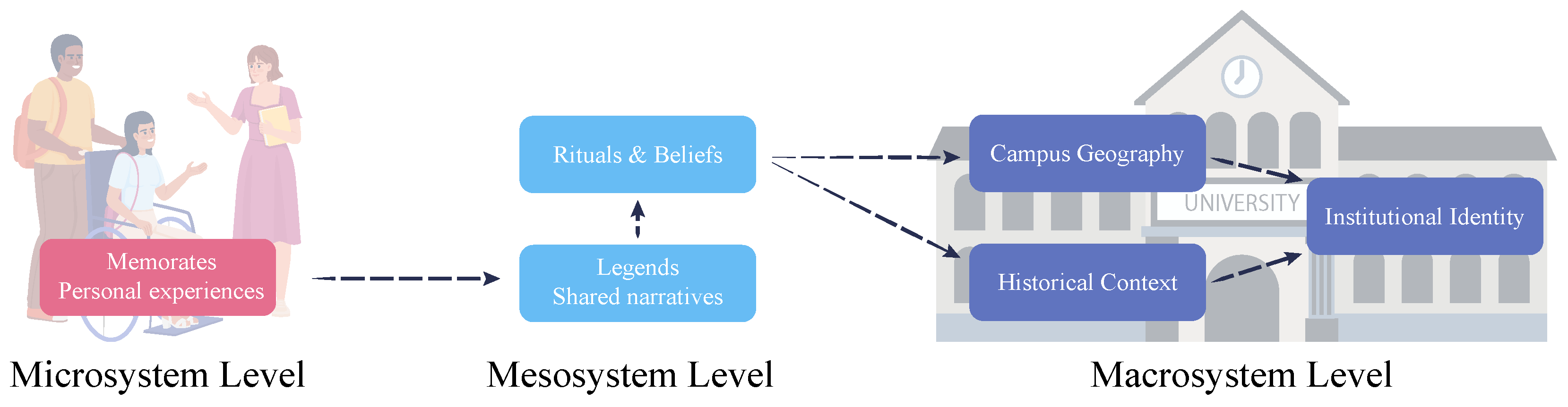
1989), this follows von Sydow’s classic definition of memorates as “Erzählungen der Leute über eigene, rein persönliche Erlebnisse” (10). Designed in conjunction with Scott’s culturally responsive ecological model, this distinction becomes especially useful to describe how campus ghost stories participate in the formation and adaptation processes of identity. Legends circulate at the mesosystem and macrosystem levels as shared narratives that articulate collective concerns, values, and histories tied to particular buildings, paths, or rituals. Memorates tend to unfold at the microsystem level as individualized efforts to make sense of unsettling experiences within a specific social and spatial context. Together, they reveal how students draw on traditional story patterns to interpret ambiguous events, negotiate feelings of vulnerability or displacement, and position themselves within the social and physical ecology of the university.
More recently, scholars offer a conceptual framework that strengthens a RP interpretation of campus folklore (
Hoe 2021;
Kan and Lim-Ratnam 2026;
King et al. 2025). In doing so, they emphasize the socially produced and pedagogically consequential nature of space in higher education.
Hoe (
2021)’s critical reflection on creative placemaking in Singapore demonstrates how institutional actors frequently appropriate placemaking discourse for managerial and branding purposes, producing curated and officially sanctioned cultural narratives. This dynamic parallels the selective incorporation of ritual traditions into formal university storytelling.
Kan and Lim-Ratnam (
2026)’s concept of “in-between spaces” shows how identity and professionalism develop within informal, self-directed, and socially embedded environments that develop between formal curriculum and professional practice. Such spaces resemble the peer-based transmission networks through which hidden-space and supernatural narratives circulate, enabling students to negotiate belonging and authority beyond institutional channels. Likewise,
King et al. (
2025)’s theorization of heterotopic affinity spaces extends this argument by describing sites that temporarily suspend dominant academic norms and redistribute agency through collaborative meaning-making. Campus ghost stories function analogously as narrative heterotopias: even when the physical spaces they reference are inaccessible, storytelling practices symbolically occupy and reinterpret institutional space.
This study is guided by two central research questions: First, to what extent did students show community binding rituals through ghost story communications during the academic year of 2019? Secondly, how did these accounts narrate student life using semantic terms that explicitly reflect the student’s social self-understanding? These two questions examine the resilience of the students at Villanova and analyze the students’ “communication” and their “value of communication”. The second question explores how students used rituals to respond to their encounters with Academic life. These forms of analysis can provide valuable insights into student conduct at Villanova University and the impact of their communicative practices on broader processes of social integration. In this context, ghost stories refer to the individual’s ability to use stories to adjust to their environment and affect their perception of shared meaning in their social subsystem. This approach provides valuable insights into the navigation of adaptation processes in society.
4. Results
4.1. Overview of the Dataset
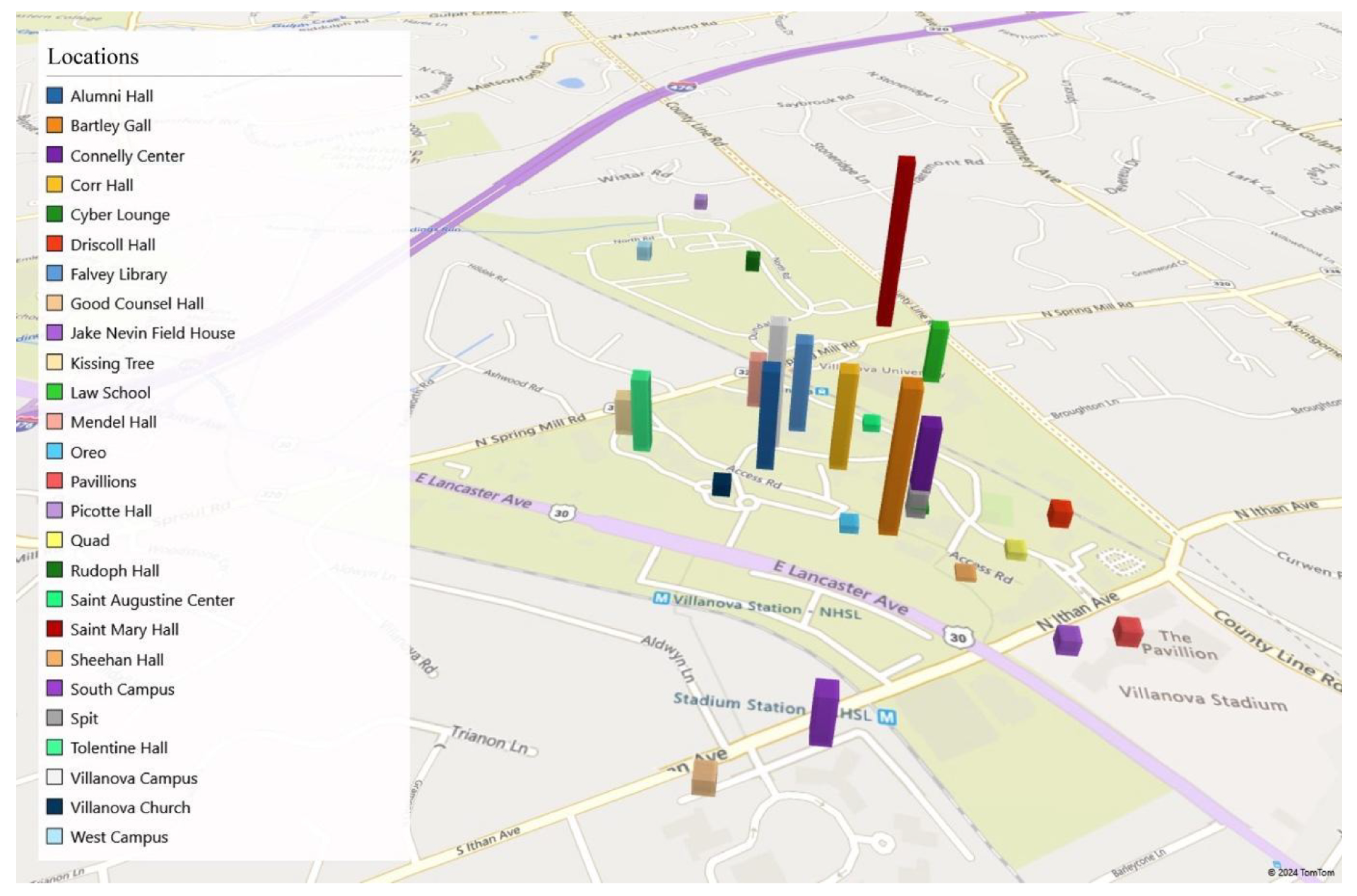
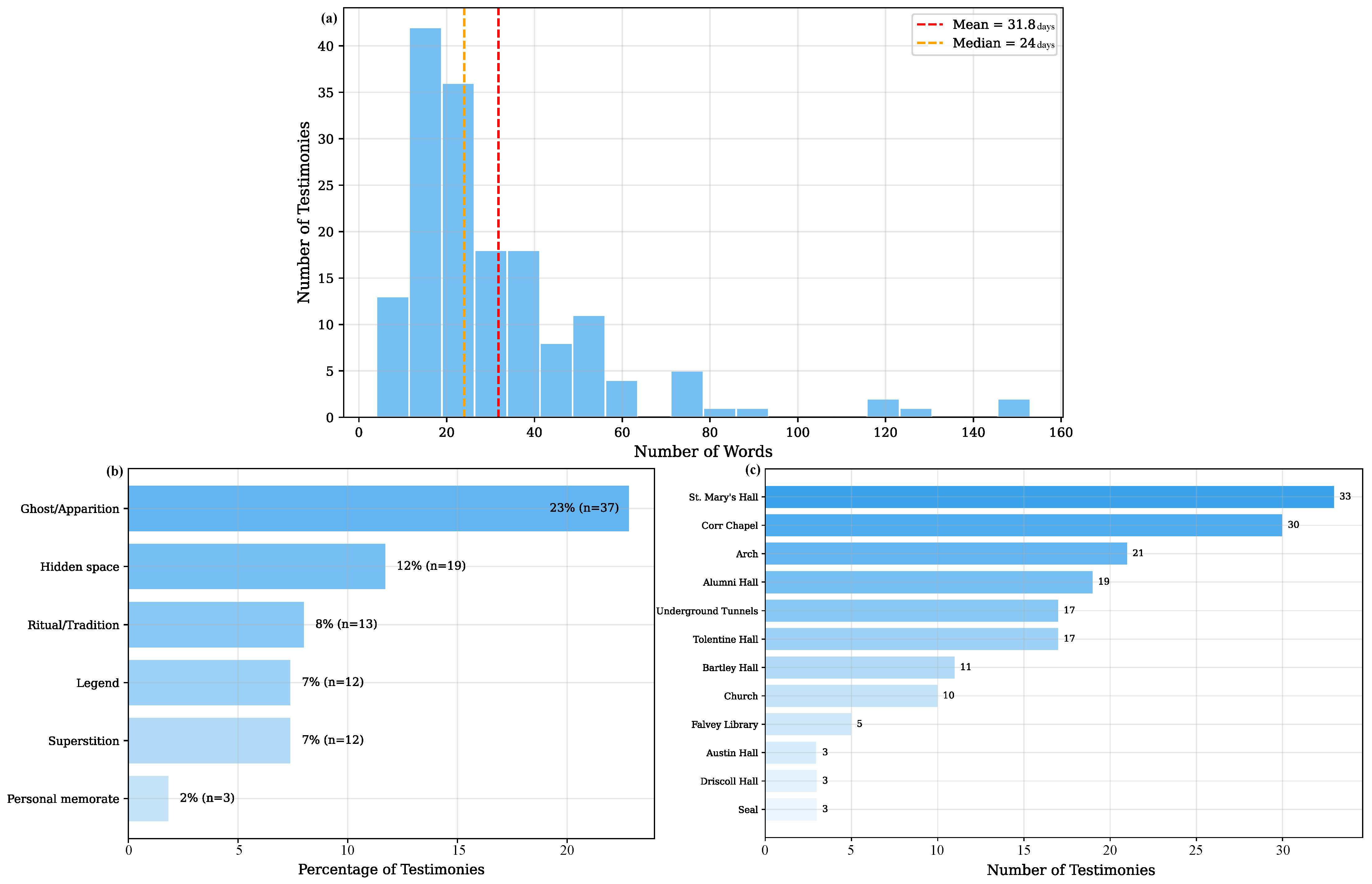
A 162 testimonies were collected spanning multiple locations on campus (see
Figure 3). They are notably brief, with most accounts capturing a single narrative episode in fewer than 30 words (see
Table 1). This compression reflects how campus folklore typically circulates: as fragmentary claims passed between peers rather than fully elaborated stories with narrative development. Further analysis appears in the panels of
Figure 4. Three spatial patterns emerge from the location analysis. First, narratives are heavily concentrated around Main Campus’s oldest structures, particularly St. Mary’s Hall, Corr Chapel, Alumni Hall, and Tolentine Hall, while the newer residential and athletic facilities generate few stories. Second, liminal spaces (e.g., tunnels, sealed rooms, basements) are disproportionately represented, given their inaccessibility to most students, suggesting that physical restriction itself generates narrative interest. Third, the arch near Corr Chapel functions as a distinct story-generating site despite being an architectural feature, highlighting the role of ritual practice in anchoring narrative to place. The narrative typology reveals that ghost encounters account for less than a quarter of the testimonies. Hidden space narratives and ritual accounts together rival ghost stories in frequency, indicating that Villanova’s campus folklore extends well beyond the supernatural into spatial curiosity and performative belief. In addition, the scarcity of explicit source attributions is itself telling: students relay these narratives without identifying their origins, a pattern consistent with legends that have become communal property.
4.2. Word-Level Analysis
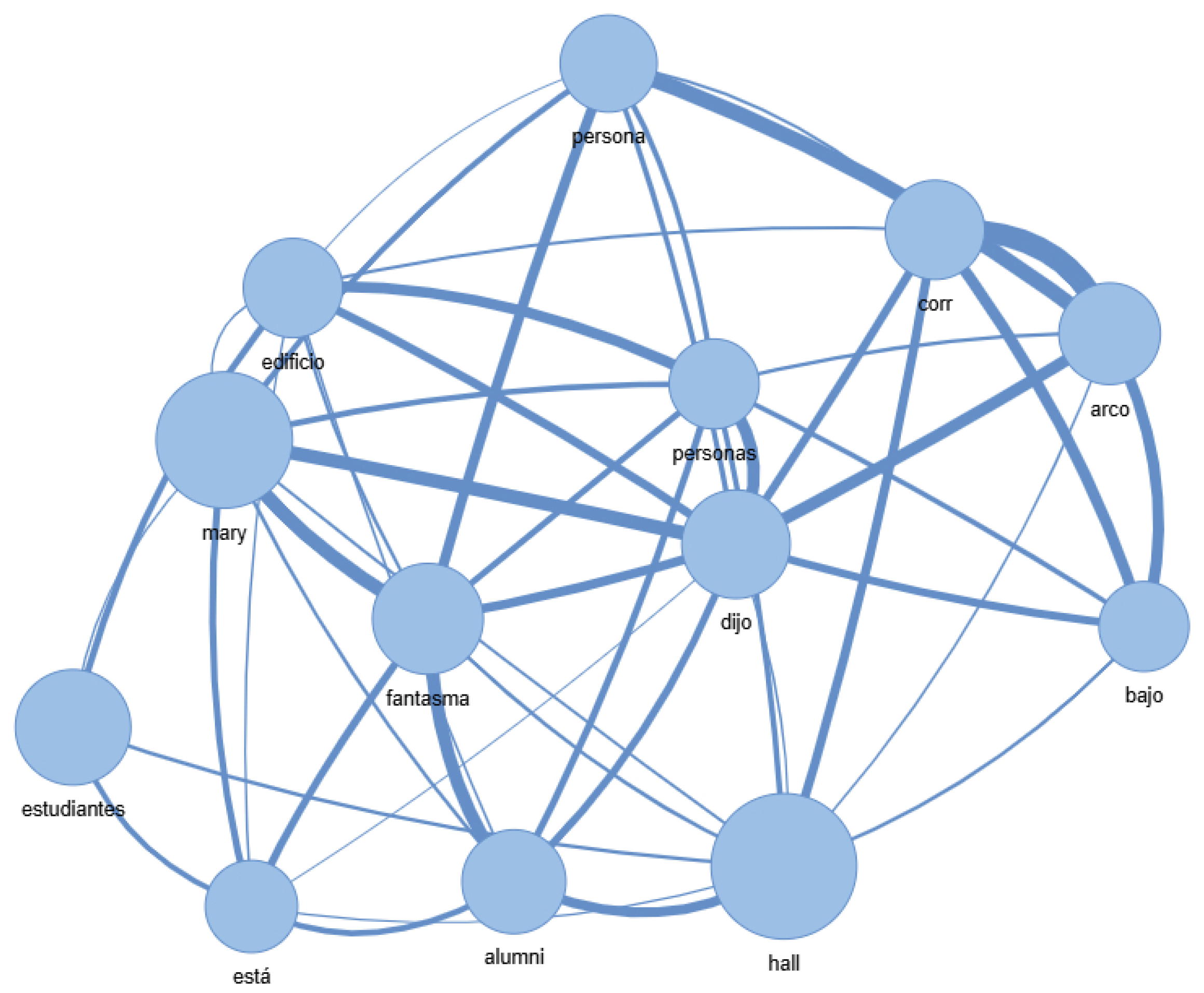
To examine how key terms cluster within the corpus, we constructed a co-occurrence network of the thirteen most frequent substantive terms using a 20-word sliding window and Dice coefficient normalization (see
Figure 5). The resulting network reveals three distinct semantic communities that mirror the thematic structure identified in the topic model.
The strongest association in the network links Corr and arco (Dice = 0.54), forming the nucleus of a tightly connected cluster that also includes bajo (“under”) and persona. This configuration reflects the Corr Chapel arch tradition, in which kissing under the arch is said to predict marriage. The high co-occurrence of persona within this cluster suggests that these narratives emphasize individual actors performing the ritual. A second cluster focuses on mary and fantasma (Dice = 0.36), with strong connections to dijo (“said”). This pattern captures the St. Mary’s Hall ghost narratives, where the nun legend circulates primarily through reported speech—stories told about encounters. The verb dijo also bridges this cluster to arco (Dice = 0.31), indicating that both ghost legends and ritual traditions share a common narrative framework: they are things people say.
The third cluster links alumni hall, and fantasma (Dice = 0.34 and 0.25 respectively), reflecting Alumni Hall’s prominence as a haunted site tied to its Civil War hospital history. Unlike the St. Mary’s cluster, alumni shows weaker connections to speech verbs, suggesting these narratives may circulate with greater emphasis on historical fact than on oral transmission.
The term edificio (“building”) occupies a bridging position, connecting to personas (Dice = 0.28), estudiantes (Dice = 0.18), and dijo (Dice = 0.23). This positioning reflects how buildings function as anchoring points for student narratives more broadly—not only as haunted sites but also as the physical infrastructure through which campus life is organized and narrated. Notably, estudiantes shows relatively weak connections across the network, appearing most strongly with edificio and está. Student identity appears to be the implicit subject of narratives that foreground places, ghosts, and ritual actions. The stories are about students without constantly naming them as such.
4.3. Topic Modelling Analysis
To identify latent thematic structures within the corpus, we employed BERTopic as defined in
Section 3. After systematic hyperparameter optimization across 588 configurations, the final model (min_topic_size = 2, n_neighbors = 12, min_samples = 3, metric = chebyshev) identified nine thematic clusters that encompass 92.6% of testimonies, with twelve documents (7.4%) remaining unclassified. Consequently,
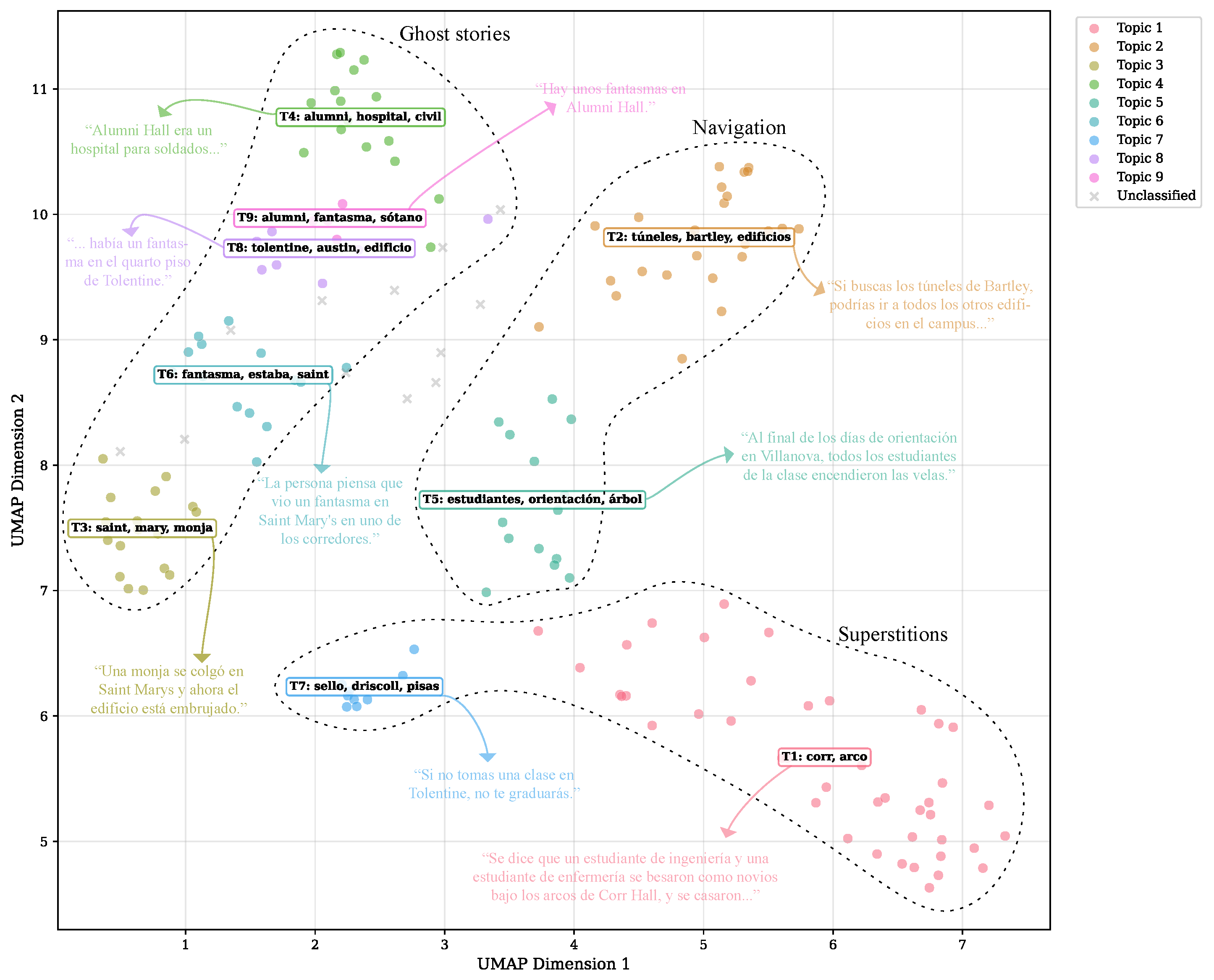
Figure 6 visualizes the testimonies projected in a two-dimensional semantic space, with colors indicating topic assignments, labeled by characteristic keywords. The spatial arrangement reveals meaningful structures: testimonies cluster into multiple distinct regions, indicating that the model captures genuine thematic coherence. The largest and most spatially dispersed cluster (e.g., Topic 1, n = 43) occupies the lower-right quadrant, capturing narratives about the Corr Chapel arch and the associated kissing tradition. In the upper portion of the figure, three clusters converge around building-specific ghost narratives: Alumni Hall’s Civil War hospital history (Topic 4), the underground tunnel network connecting Bartley Hall to other structures (Topic 2), and general ghost encounters at St. Mary’s Hall (Topic 6). The St. Mary’s nun legend, which is specifically tied to the swimming pool, forms a distinct cluster in the lower-left (Topic 3), spatially separated from the more diffuse St. Mary’s hauntings. Student ritual narratives are clustered in the center of the projection (Topic 5). The Driscoll Hall seal ritual (Topic 7) and Tolentine/Austin Hall ghost sightings (Topic 8) form smaller, tightly bounded clusters. The smallest cluster (Topic 9, n = 4) captures a specific narrative thread about the dark basement of Alumni Hall.
The spatial organization of
Figure 6 suggests three broader narrative domains. Supernatural encounters anchored to specific buildings and their histories cluster in the upper-left region, with Alumni Hall and St. Mary’s Hall generating the most elaborated traditions. Ritual narratives (e.g., the arch tradition, the seal, the kissing tree) occupy the lower and central portions of the projection, remaining semantically distinct from ghost encounters. The tunnel narratives position themselves between these domains, sharing semantic features with both hidden-space curiosity and building-specific legends.
4.4. Transmission Channels and Narrative Domains
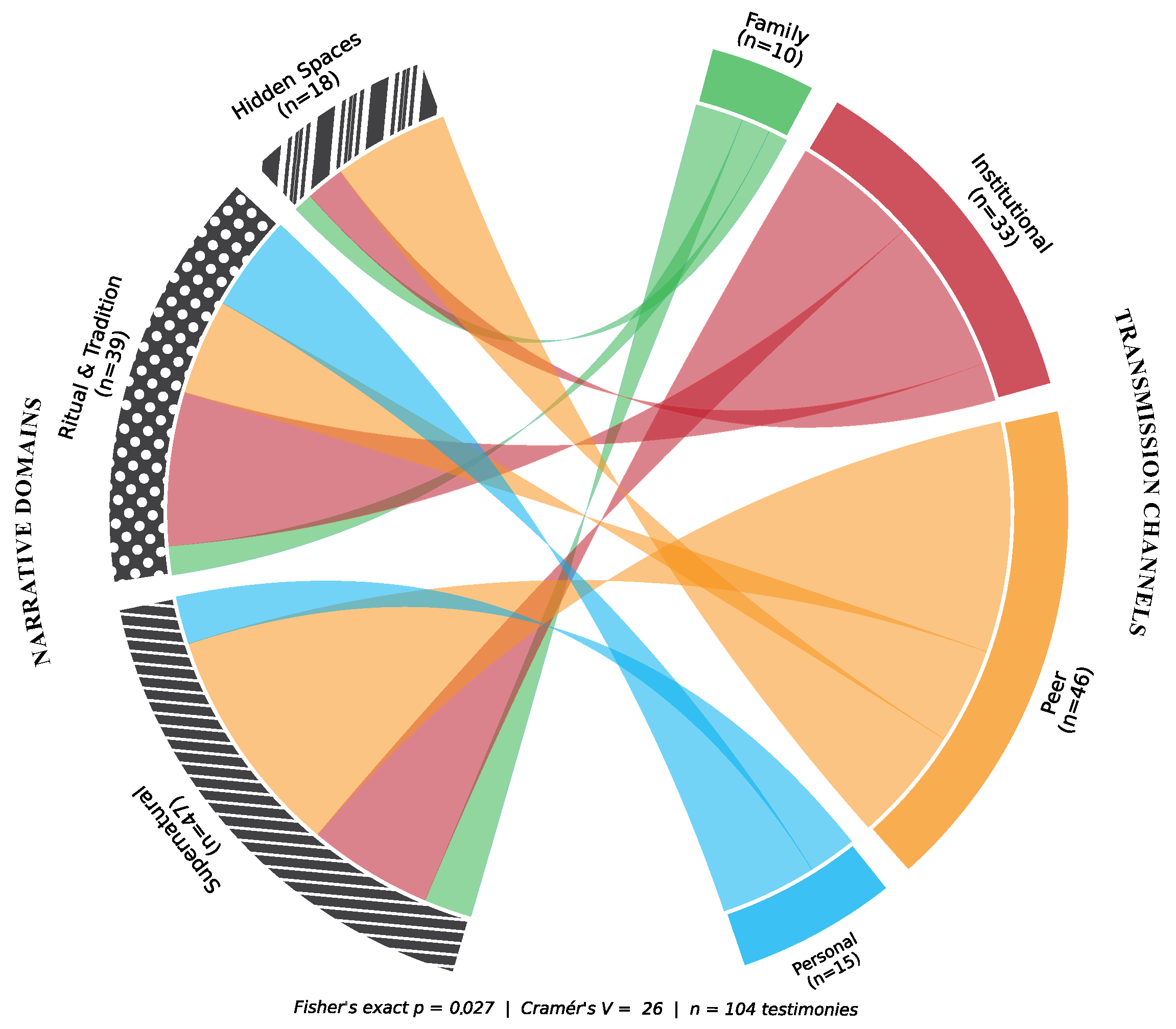
Of the 162 testimonies, 104 contained identifiable source attributions and were assigned to a narrative domain. Peer networks constituted the largest transmission channel (44%), followed by institutional sources (32%), personal experience (14%), and family (10%). Both chi-square and Fisher’s exact tests indicated a significant association between the transmission channel and the narrative domain: = 14.12, p = 0.028; Fisher’s exact p = 0.027. The effect size was small (Cramér’s V = 0.26).
Figure 7 visualizes the flow of narratives from transmission channels to narrative domains, with a ribbon width proportional to the number of testimonies. Several patterns emerge. Institutional sources (e.g., red ribbons) flow predominantly toward Ritual & Tradition, with 16 of 33 institutional testimonies (48%) concerning practices such as the Corr Chapel arch. This suggests that these traditions have been incorporated into official campus storytelling. Personal experience (e.g., blue ribbons) connects exclusively to Ritual & Tradition and Supernatural encounters, with no testimonies about hidden spaces, implying that tunnel narratives circulate as lore about exploration. Peer networks (e.g., orange ribbons) show the broadest distribution but concentrate notably toward Hidden Spaces: 12 of the 18 tunnel narratives (67%) derive from peer transmission. Family networks (e.g., green ribbons) connect weakly to all three domains.
Although no individual source-domain pairing exceeded the conventional significance threshold for standardized residuals (), the pattern of associations was coherent: personal experience tended toward ritual narratives (), peers toward hidden spaces (), and institutional sources toward ritual (). This distributed pattern, which is significant overall but without dominant cells, reflects the overlapping nature of campus folklore circulation, where institutional channels emphasize sanctioned traditions, peer networks share spatial exploration lore, and personal experience anchors performative beliefs.
5. Discussion
From a RP perspective, ghost stories circulating on university campuses function not as marginal folklore but as insurgent narrative practices through which students actively produce and contest institutional space. At Villanova University, these stories attach memory, unease, and speculation to specific locations—particularly older buildings, basements, tunnels, and other liminal or infrastructural sites that function as institutional blind spots within official campus histories. Through repeated telling, variation, and circulation, ghost stories transform these overlooked spaces into places of shared meaning, asserting experiential and affective claims that challenge sanitized, authoritative narratives of the university. As performative acts, these narratives reconfigure power by translating abstract systems of governance, surveillance, and tradition into lived, emotionally resonant spatial knowledge, enabling students to negotiate belonging, authority, and uncertainty. In doing so, ghost stories highlight RP’s emphasis on place as an ongoing contested process shaped through informal practice, collective memory, and narrative occupation.
5.1. Ghost Stories as Integration Mechanisms
The significant association between transmission channels and narrative domains (Fisher’s exact
p = 0.027) provides empirical support for the theoretical claim that campus legends serve integrative functions, albeit through differentiated pathways. Institutional sources—primarily tour guides and orientation counselors—disproportionately transmit ritual and tradition narratives, particularly the Corr Chapel arch legend. This pattern suggests that certain folklore elements have been selectively incorporated into official campus storytelling, functioning as what
Bronner (
2012) terms “sanctioned traditions” that welcome newcomers into university culture. The arch tradition, with its promise of marriage for couples who kiss beneath it, offers an optimistic narrative of romantic continuity that aligns with institutional messages about community and lifelong connection.
By contrast, supernatural encounter narratives remain largely outside institutional transmission, instead circulating through peer networks and personal testimony. This bifurcation implies that Villanova’s official voice has incorporated those folklore elements consonant with positive identity messaging, leaving darker supernatural content to informal channels. The absence of personal-experience testimonies concerning hidden spaces is particularly striking: tunnel narratives circulate exclusively as lore about exploration, suggesting that these stories function as shared imaginative resources, and not as records of actual practice.
Related to RP, these findings
Tucker (
2007) observation that campus ghost stories help “normalize behaviors, expectations, and social norms” by showing how this normalization occurs as a form of distributed spatial production. At Villanova, normalization unfolds across multiple scales and sites of authority: institutional channels normalize sanctioned rituals that reinforce official spatial narratives, peer networks normalize spatial curiosity and the circulation of transgressive knowledge about hidden or restricted campus spaces, and personal experience anchors performative rituals that students enact. From a RP perspective, these differentiated modes of normalization constitute competing placemaking practices, through which students do not simply internalize norms but actively produce space by negotiating, rehearsing, and reworking institutional power through narrative, movement, and embodied ritual.
5.2. The Meaning of Place
From a RP perspective, the concentration of ghost narratives around a small number of older buildings—St. Mary’s Hall, Corr Chapel, Alumni Hall, and Tolentine Hall—demonstrates that campus folklore functions as a selective and political process of place-making. These structures, marked by visible historical depth and architectural distinctiveness, become narrative anchors through which students attach memory, affect, and speculation to the campus landscape, transforming institutional heritage into a lived and contested place. This pattern supports
Broadwell and Tangherlini (
2016) argument that geographic visualization reveals “latent geo-semantic relationships” within folklore corpora. At Villanova, this geo-semantic structure is especially pronounced, with four buildings accounting for more than 60% of all location references. RP helps explain this imbalance by foregrounding how narrative practices gravitate toward sites where institutional history is most materially present but least narratively resolved, enabling students to assert alternative spatial meanings in contrast to the functional, and managerial logics that dominate newer residential and athletic facilities.
The prominence of hidden or inaccessible spaces (tunnels, sealed rooms, basements) despite their physical inaccessibility to most students suggests that narrative interest is partly generated by restriction itself. This pattern resonates with
de Certeau (
1984) concept of spatial practice, wherein walking and storytelling together constitute the “rhetoric of space.” Students who cannot physically access the tunnel network nevertheless participate in its cultural reality through narrative, using stories to claim knowledge of spaces that institutional authority places off-limits.
The results of the topic modeling reinforce this spatial logic. The nine BERTopic clusters consolidate into three narrative domains—supernatural encounters, ritual and tradition, and hidden spaces—each with distinct spatial anchoring. Supernatural narratives cluster around buildings with documented histories (Alumni Hall’s Civil War hospital, St. Mary’s convent past), ritual narratives anchor to specific architectural features (the arch, the seal, the kissing tree), and hidden-space narratives concern infrastructural elements beneath or between buildings. This tripartite structure suggests that Villanova’s folklore constitutes a layered cognitive map: a surface layer of visible rituals, a historical layer of building-specific hauntings, and a subterranean layer of imagined passages and sealed chambers.
5.3. Narrative Form and Transmission
The co-occurrence network analysis showing the verb
“dijo” (“said”) as a bridge between ghost legend and ritual tradition clusters highlights how campus folklore constitutes a collective, performative mode of placemaking. The prominence of reported speech indicates that these narratives are less concerned with evidentiary witnessing than with circulation, repetition, and social uptake—stories about what people say rather than what people claim to have directly experienced. This pattern complicates the memorate/legend distinction central to folkloristic analysis
Bahna (
2015). While memorates are theoretically grounded in first-person experience and legends in collective transmission, the Villanova corpus reveals a fluid boundary in which even personal-experience narratives are framed through communal speech conventions. From a RP perspective, this reliance on reported speech underscores how narrative authority is distributed, allowing ghost stories to function as shared spatial resources through which students collectively produce, negotiate and inhabit campus place.
The brevity of the testimonies (median 24 words) further supports this interpretation. These are not elaborated narratives with character development and plot structure, but compressed claims—“atoms” of folklore that can be rapidly transmitted and recombined. This fragmentary quality may be characteristic of contemporary campus legend circulation, where stories compete for attention in dense information environments and must be communicable in the span of a casual conversation or text message.
5.4. Theoretical Implications
Viewed through the
Scott (
2014) ecological model of identity development, these findings indicate that campus folklore develops within a multilayered system that links individual experience, peer interaction, and institutional context as interdependent processes of place production. Ghost stories do not function as marginal curiosities, but as cultural technologies of RP that support student navigation of university life by embedding identity formation within shared spatial narratives. They provide common reference points for peer bonding, circulate embodied and affective knowledge that orients newcomers to campus geography, and supply symbolic resources for negotiating the boundaries between official and unofficial forms of belonging. In doing so, ghost stories enable students to collectively produce campus place through narrative, ritual, and affect, asserting participatory claims over institutional space that extend beyond formal structures of orientation, governance, and representation.
The small but significant effect size (Cramér’s V = 0.26) for the transmission channel analysis deserves comment. A small effect indicates that the source type explains only a modest portion of the variation in the narrative domain—but this is precisely what ecological models would predict. Campus folklore circulates through redundant and overlapping channels; students encounter the same stories from multiple sources and in multiple contexts. The significance of this association lies not in its magnitude but in its structure: the fact that different channels show different affinities for different narrative types suggests functional differentiation within an otherwise interconnected system.
5.5. Limitations and Future Directions
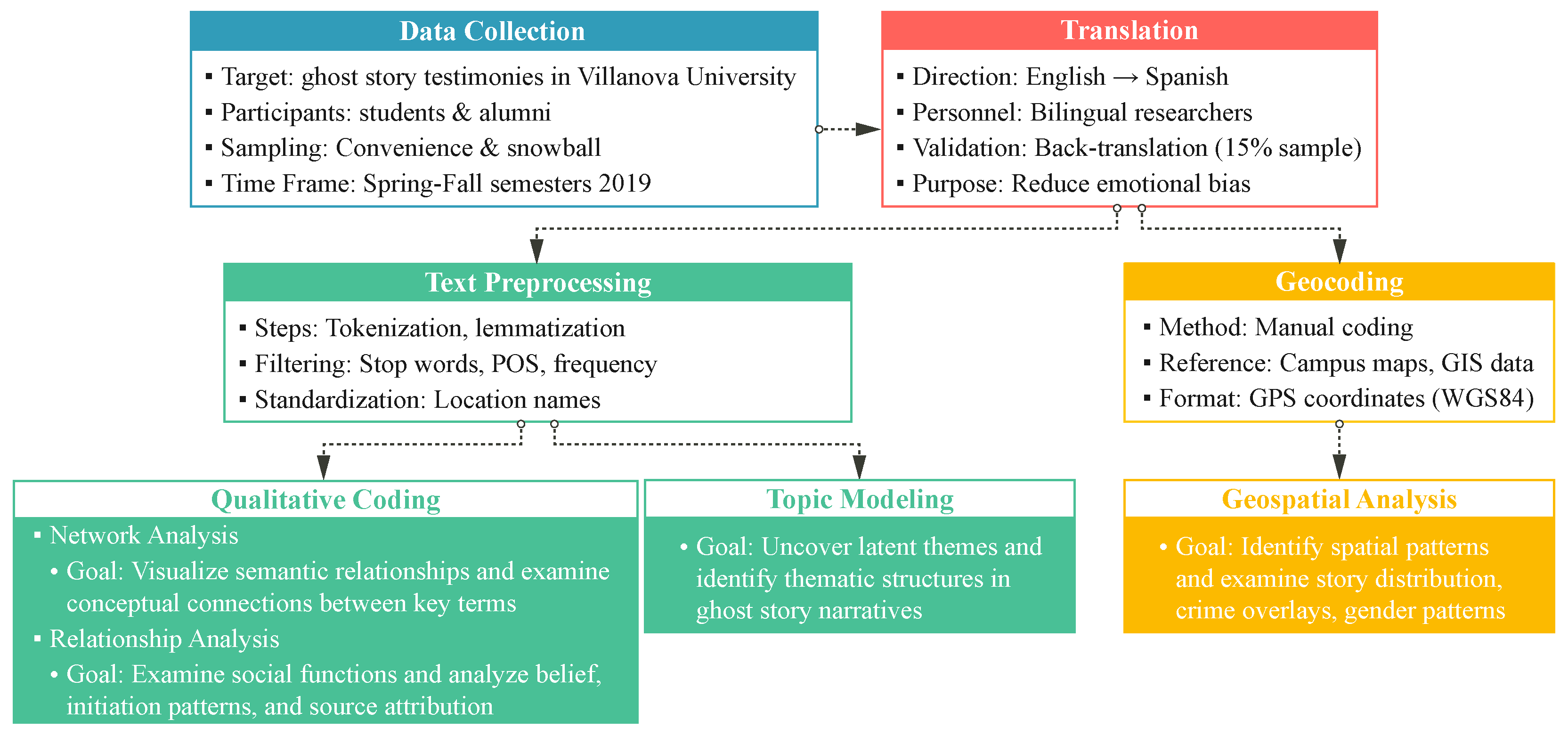
Several limitations qualify these findings. First, the corpus was collected in 2019 by student researchers, introducing potential selection biases in both informant recruitment and story elicitation. Second, the translation of testimonies from English to Spanish, while methodologically motivated, may have introduced semantic shifts that affected both topic modeling and co-occurrence analysis. Third, the cross-sectional design captures folklore at a single moment; longitudinal research would be necessary to track how stories emerge, spread, and fade over time.
The fact that 33% of cells had expected counts below 5 in the transmission channel analysis, even if they are addressed through permutation testing, reflects the fundamental challenge of analyzing folklore corpora: stories cluster unpredictably and some category combinations are rare or absent by nature. Future research with larger corpora might enable finer-grained analysis of source–topic relationships.
Several directions merit further investigation. First, comparative analysis with other university campuses would clarify whether the patterns observed at Villanova, particularly the institutional incorporation of ritual traditions and the peer-based circulation of hidden-space narratives, generalize across institutional contexts. Second, network analysis of storytelling relationships (who tells whom) could illuminate the social structure of folklore transmission. Third, the near absence of electronic or social media as cited sources in this 2019 corpus raises questions about how digital platforms have since reshaped campus legend circulation.