1. Introduction
Economic convergence represents one of the foundational objectives of European integration. From a theoretical perspective, neoclassical growth models predict that poorer economies should grow faster than richer ones, leading to a gradual reduction in income disparities over time (
Solow 1956;
Barro and Sala-i-Martin 1992). Within the European context, this expectation has been closely linked to the process of economic integration, market liberalization, and institutional harmonization, which are assumed to foster convergence among participating countries. As a result, convergence has become both an analytical concept and a policy benchmark for assessing the success of European integration.
Empirical evidence on income convergence in Europe, however, remains inconclusive. While early studies documented convergence among advanced economies (
Mankiw et al. 1992;
Barro and Sala-i-Martin 2004), subsequent research has highlighted persistent disparities, the emergence of convergence clubs, and multi-speed integration dynamics across European regions. These patterns have been further reinforced by successive shocks, including the global financial crisis, the euro area sovereign debt crisis, and the COVID-19 pandemic, which exposed structural asymmetries within the European economy and raised questions about the inclusiveness and resilience of the convergence process.
The Western Balkans occupy a particularly complex position within this landscape. Although these economies are deeply connected to the European Union through trade, foreign direct investment, and institutional alignment, their income levels remain substantially below the EU average. Previous research on transitional and post-transitional economies suggests that convergence in such contexts is neither automatic nor uniform, but depends on a combination of structural conditions, policy choices, and institutional quality (
Campos and Coricelli 2002). Consequently, the integration of Western Balkan countries into the broader European convergence framework requires careful empirical examination rather than normative assumptions.
This paper re-examines income convergence in Europe by jointly analyzing European Union member states and Western Balkan economies over the period 2004–2023. Rather than presuming convergence as an inevitable outcome of integration, the study investigates whether convergence has occurred, how strong it has been, and to what extent it differs across countries and regions. By adopting a unified empirical framework that encompasses both EU and Western Balkan economies, the analysis provides a comprehensive view of convergence dynamics within an enlarged European economic space.
Methodologically, the study builds on the classical convergence literature by employing panel data techniques to test for absolute and conditional β-convergence, complemented by an analysis of σ-convergence. Absolute β-convergence captures whether poorer economies grow faster than richer ones regardless of structural characteristics (
Barro and Sala-i-Martin 1992), while conditional β-convergence allows for heterogeneity by accounting for differences in macroeconomic and institutional conditions (
Mankiw et al. 1992). σ-convergence, in turn, examines changes in income dispersion over time and provides an aggregate perspective on convergence outcomes. Together, these approaches enable a multidimensional assessment of convergence patterns and their evolution.
In addition to standard economic determinants, the paper emphasizes the role of institutional and structural factors in shaping convergence outcomes. A growing body of literature underscores that institutions play a critical role in long-term economic performance and growth sustainability (
Acemoglu et al. 2001;
Rodrik et al. 2004). For Western Balkan economies in particular, institutional constraints, governance challenges, and structural vulnerabilities may limit the speed and durability of convergence, even in the presence of formal integration mechanisms. Incorporating institutional indicators into the empirical framework therefore allows for a more realistic evaluation of convergence prospects in Europe.
The contribution of this paper is threefold. First, it provides updated empirical evidence on European income convergence using a long- and recent-time horizon that captures multiple crisis episodes and structural shifts. Second, it explicitly integrates Western Balkan economies into the convergence analysis, enabling direct comparison with EU member states within a single empirical framework. Third, it links observed convergence patterns to broader institutional and structural conditions, offering insights that are relevant not only for academic debates but also for European cohesion and enlargement policies, as reflected in recent EU policy discussions on regional disparities and cohesion.
The remainder of the paper is structured as follows.
Section 2 reviews the relevant literature on economic convergence, European integration, and institutional determinants of growth.
Section 3 describes the data and variables used in the analysis.
Section 4 outlines the methodology.
Section 5 presents the results on absolute and conditional β-convergence and σ-convergence.
Section 6 discusses the broader economic and policy implications of the findings, and
Section 7 concludes.
2. Literature Review
2.1. Economic Convergence: Theoretical Foundations and Empirical Evidence
The theoretical foundations of economic convergence are rooted in neoclassical growth theory, which predicts that economies with lower initial income levels tend to grow faster than wealthier ones due to diminishing returns to capital (
Solow 1956). This framework provided the basis for the empirical literature on β- and σ-convergence, which formalized convergence testing and established it as a central concept in growth economics (
Barro and Sala-i-Martin 1992;
Barro and Sala-I-Martin 1997).
Subsequent empirical research extended this framework by incorporating human capital and structural characteristics, demonstrating that convergence is typically conditional rather than absolute (
Mankiw et al. 1992;
Islam 1995). Panel data approaches further improved empirical identification by accounting for unobserved heterogeneity across countries (
Islam 1995;
Baltagi 2021). Despite these methodological advances, empirical findings remain mixed, with evidence supporting convergence mainly within relatively homogeneous groups of economies (
Baumol 1986;
Quah 1996;
Sala-i-Martin 1996).
Later contributions emphasized that convergence dynamics are sensitive to initial conditions, technological diffusion, and structural characteristics, which may lead to persistent income gaps and the emergence of convergence clubs rather than global convergence (
Barro and Sala-i-Martin 2004;
Durlauf et al. 2005;
Barro 2015). These insights shifted the literature away from unconditional convergence toward a more nuanced understanding of heterogeneous growth paths.
2.2. European Integration and Convergence Patterns
Within the European context, convergence has been closely linked to the process of economic integration and EU enlargement. Early evidence suggested that integration could facilitate convergence through increased trade, capital mobility, and policy coordination (
Boldrin and Canova 2001;
Petrakos et al. 2005). However, later studies documented persistent regional disparities and uneven convergence outcomes across EU member states (
Crespo Cuaresma et al. 2008;
Monfort 2008).
Empirical analyses of EU convergence increasingly point to a multi-speed integration process, in which core economies converge more rapidly while peripheral and newer member states lag behind (
Borsi and Metiu 2015;
Bongardt and Torres 2016). These dynamics were further intensified by successive economic shocks, including the global financial crisis and the euro area debt crisis, which disproportionately affected less resilient economies (
Grauwe 2018;
Piketty 2018).
Recent EU policy-oriented studies reinforce these findings by highlighting the continued importance of cohesion policy and structural reforms in addressing regional disparities (
OECD 2020;
European Commission 2022). Overall, the European literature suggests that integration alone is insufficient to guarantee uniform convergence without supportive institutional and structural conditions.
2.3. Transition Economies and the Western Balkans
The experience of transition economies provides important insights into the limits of convergence within integrated economic areas. Research on post-socialist transitions emphasizes that growth and convergence outcomes depend critically on reform sequencing, institutional development, and macroeconomic stability (
Campos and Coricelli 2002;
Havrylyshyn 2002). As a result, convergence paths among transition economies have been highly heterogeneous.
The Western Balkans represent a distinct subgroup of transition economies characterized by delayed EU integration, post-conflict legacies, and persistent structural weaknesses. Empirical studies highlight that despite growing trade and investment linkages with the EU, income convergence in the region has remained slow and uneven (
Bartlett 2009;
Uvalic 2012;
Estrin and Uvalic 2016). Structural bottlenecks, limited competitiveness, and weak institutional capacity continue to constrain catch-up processes.
Recent regional research further supports these conclusions by emphasizing the role of firm-level competitiveness and investment constraints in shaping growth potential in the Western Balkans (
Anufrijev et al. 2026). These findings suggest that convergence in the region cannot be assumed as an automatic outcome of integration but must be empirically assessed within a broader structural context.
2.4. Institutions, Structural Conditions, and Conditional Convergence
A substantial body of literature underscores the central role of institutions in shaping long-term growth and convergence outcomes. Institutions affect incentives, investment decisions, and productivity, thereby influencing the speed and sustainability of economic convergence (
North 1990;
Knack and Keefer 1995). Seminal empirical studies demonstrate that institutional quality is a fundamental determinant of income levels and growth performance (
Acemoglu et al. 2001;
Rodrik et al. 2004).
Within the convergence literature, institutional variables are typically incorporated through the concept of conditional β-convergence, allowing economies with different institutional characteristics to converge toward distinct steady states (
Levine and Renelt 1992;
Rodrik 2008). Empirical evidence suggests that governance effectiveness, regulatory quality, and macroeconomic stability significantly condition convergence outcomes, particularly in emerging and transition economies (
Glaeser et al. 2004;
Pesaran 2007).
Recent regional studies provide additional support for this perspective. Evidence from European and Western Balkan contexts highlights the importance of monetary and fiscal policy credibility for maintaining macroeconomic stability and supporting convergence processes (
Obućinski et al. 2025). Similarly, transparency and regulatory disclosure practices in the financial sector have been identified as relevant structural factors influencing economic performance within Europe (
Bussoli and Fraccalvier 2025).
2.5. Synthesis and Research Gap
Taken together, the literature indicates that while convergence remains a central objective of European integration, its empirical realization has been partial, uneven, and highly conditional. Mixed empirical findings do not necessarily reflect theoretical inconsistency, but rather differences in sample composition, time horizons, crisis exposure, and model specification. Studies focusing on relatively homogeneous EU subgroups often report stronger convergence, whereas broader panels including peripheral or transition economies tend to find slower or club-type convergence patterns. Moreover, differences in econometric approaches—ranging from cross-sectional regressions to fixed-effects panel estimators—affect the estimated speed and robustness of convergence. The role of institutions and structural heterogeneity further complicates interpretation, as institutional variables are frequently correlated with income levels and structural growth determinants (
Durlauf et al. 2005;
Barro 2015;
Crespo Cuaresma et al. 2008;
Borsi and Metiu 2015).
Despite extensive research on EU convergence, two gaps remain particularly relevant. First, many studies focus exclusively on EU member states, treating the Western Balkans as peripheral or excluding them altogether. Second, relatively few contributions combine classical convergence testing with an explicit assessment of institutional and structural constraints within a unified empirical framework covering recent crisis-ridden periods.
This paper addresses these gaps by jointly analyzing EU and Western Balkan economies over a long- and recent-time horizon, employing absolute and conditional β-convergence as well as σ-convergence, while explicitly accounting for institutional and structural factors.
Building on the theoretical and empirical literature on economic convergence and European integration, this study formulates four testable hypotheses. First, consistent with the classical convergence framework, the analysis examines whether poorer European economies grow faster than richer ones, implying the presence of absolute income convergence (H1). Second, recognizing the role of structural and institutional heterogeneity, the study tests whether convergence is conditional on macroeconomic and institutional characteristics, allowing countries to converge toward different steady states (H2). Third, the analysis explicitly investigates whether institutional quality affects not only income levels but also the speed of convergence, by assessing whether stronger institutions amplify the negative relationship between initial income and subsequent growth (H3). Finally, given the diverse historical trajectories of European integration, the study evaluates whether convergence dynamics differ across regional groups—EU Core, EU New, and Western Balkan economies—both in terms of growth responses and changes in income dispersion over time (H4).
3. Data and Variables
The empirical analysis relies on an unbalanced panel dataset consisting of 32 European economies observed over the period 2004–2023. This time span captures several distinct phases of economic development in Europe, including the pre-crisis expansion, the global financial crisis, the euro area sovereign debt crisis, the COVID-19 pandemic, and the subsequent recovery period. Incorporating these episodes is essential for assessing the robustness and persistence of convergence dynamics within the European economic space.
The sample is structured into three regionally coherent groups reflecting differences in historical integration paths, levels of economic development, and institutional maturity. The EU Core group includes Austria, Belgium, Denmark, Finland, France, Germany, Ireland, Italy, Luxembourg, the Netherlands, and Sweden, representing early-integrated EU economies with advanced production structures and relatively stable institutional frameworks. The EU New group comprises Poland, the Czech Republic, the Slovak Republic, Slovenia, Hungary, Romania, Bulgaria, Croatia, Lithuania, Latvia, Estonia, Cyprus, Malta, Portugal, Spain, and Greece, encompassing post-2004 EU members from Central and Eastern Europe together with Southern European economies characterized by later institutional consolidation and more heterogeneous convergence experiences. The Western Balkans group consists of Serbia, Montenegro, North Macedonia, Albania, and Bosnia and Herzegovina, representing non-EU economies or accession candidates with more diverse institutional structures and incomplete convergence trajectories. This classification follows the grouping used in the accompanying dataset documentation and is consistent with comparative regional studies in the European convergence literature.
All macroeconomic variables are obtained from the World Bank’s World Development Indicators (WDIs), ensuring cross-country comparability across the entire sample, including Western Balkan economies for which Eurostat or AMECO coverage remains incomplete. The dataset includes real GDP per capita, GDP growth, foreign direct investment inflows expressed as a percentage of GDP, and tertiary education attainment. Institutional variables are sourced from the Worldwide Governance Indicators (WGIs), which provide annual assessments of governance quality along six dimensions. All data used in this study are publicly available from the World Bank databases, and the data construction procedures are described in detail in the paper.
The primary dependent variable in the β-convergence analysis is the annual growth rate of real GDP per capita, measured as the logarithmic difference in GDP per capita. For σ-convergence and descriptive analysis, the logarithm of real GDP per capita is employed. The central explanatory variable in the β-convergence framework is the lagged logarithm of real GDP per capita, capturing the standard convergence mechanism whereby economies with lower initial income levels tend to grow faster than wealthier ones.
Institutional quality is summarized using Principal Component Analysis (PCA) applied to the six WGI dimensions: Voice and Accountability, Political Stability, Government Effectiveness, Regulatory Quality, Rule of Law, and Control of Corruption. All variables are standardized prior to estimation. The first principal component explains approximately 89.5 percent of the total variance and exhibits uniformly positive and similarly sized loadings across all dimensions (see
Table 1), indicating that it captures a broad common governance factor rather than being driven by a single institutional component. This component is retained as the composite institutional index used in the empirical analysis.
Additional structural controls commonly employed in the growth literature—namely, foreign direct investment inflows and tertiary education attainment—are incorporated in robustness specifications to account for differences in long-run steady-state growth paths. Although trade openness was initially considered, it was excluded from the final specification to ensure full consistency between the empirical model and the variables retained in the estimation.
To capture regional heterogeneity in convergence dynamics, dummy variables identifying EU Core, EU New, and Western Balkan economies are included in selected specifications, facilitating subgroup analysis. For σ-convergence, the cross-sectional standard deviation of log GDP per capita is computed for the full sample as well as for each regional group in order to assess whether income dispersion narrows or widens over time.
Overall, this data structure enables a consistent and comparative assessment of growth dynamics, institutional patterns, and convergence trajectories across Europe’s main regional blocs over a twenty-year period. By integrating EU Core, EU New, and Western Balkan economies within a unified empirical framework, the dataset provides a solid foundation for evaluating both the extent and the limitations of income convergence in Europe.
4. Methodology
The empirical strategy builds on the standard growth-convergence framework and employs panel data techniques to examine income convergence across European Union and Western Balkan economies. The analysis combines tests of absolute and conditional β-convergence with an assessment of σ-convergence in order to capture both growth dynamics and changes in income dispersion over time. This integrated approach allows for a comprehensive evaluation of convergence patterns within an enlarged European economic space.
The baseline specification for testing β-convergence relates the growth rate of real GDP per capita to its initial level. Following the established literature, economic growth is measured as the log difference in real GDP per capita, while initial income is proxied by the lagged logarithm of GDP per capita. The baseline regression can be expressed as:
where
denotes real GDP per capita in country i at time t, α is a constant term, and
is the error term. A negative and statistically significant coefficient β provides evidence of absolute β-convergence, indicating that countries with lower initial income levels tend to grow faster than richer ones.
To account for unobserved heterogeneity across countries, the analysis exploits the panel structure of the data. In particular, fixed-effects and random-effects estimators are employed to control for country-specific characteristics that may influence growth but remain constant over time. The fixed-effects specification allows for correlation between unobserved country-specific effects and the explanatory variables, while the random-effects model assumes orthogonality between these effects and the regressors. Model selection between the two estimators is guided by the Hausman test, which evaluates the consistency of the random-effects specification. Consistent with the Hausman test results and standard practice in the growth literature, the fixed-effects estimator is used as the baseline specification in the conditional convergence analysis, as it allows for correlation between unobserved country-specific effects and the explanatory variables.
It is important to clarify that the empirical specification does not include a lagged dependent variable. Economic growth is measured as the first difference in the logarithm of GDP per capita, while the lagged income term captures the classical convergence mechanism derived from the neoclassical growth framework. Consequently, the model does not fall under the standard dynamic-panel structure associated with Nickell bias (
Nickell 1981), which arises in fixed-effects models that include lagged dependent variables. Therefore, the fixed-effects estimator employed in this study does not suffer from the conventional small-sample dynamic-panel bias typically addressed by GMM-type estimators.
While absolute convergence assumes a common steady state across countries, this assumption may be overly restrictive in the presence of structural and institutional heterogeneity. To address this issue, the analysis extends the baseline model to test for conditional β-convergence by incorporating a vector of control variables capturing macroeconomic, structural, and institutional characteristics. The conditional convergence specification is given by:
where
represents a vector of control variables capturing key structural and institutional characteristics, including foreign direct investment, human capital, and institutional quality. In this framework, a negative β coefficient indicates convergence toward country-specific steady states determined by structural and institutional conditions rather than toward a single common equilibrium.
In addition to β-convergence, the analysis examines σ-convergence, which focuses on the evolution of income dispersion over time. σ-convergence is assessed by computing the cross-sectional dispersion of log GDP per capita, measured by the standard deviation, for each year in the sample. A declining trend in dispersion over time indicates σ-convergence, while a stable or increasing dispersion suggests persistent divergence or polarization. Unlike β-convergence, which captures growth dynamics at the country level, σ-convergence provides an aggregate perspective on whether income inequalities across countries are narrowing.
The combined use of β- and σ-convergence allows for a more nuanced interpretation of convergence dynamics. In particular, the presence of β-convergence does not necessarily imply σ-convergence, as faster growth of poorer economies may coexist with stable or even increasing income dispersion. Examining both concepts jointly is therefore essential for understanding the depth and sustainability of convergence processes.
All estimations are conducted using panel-data techniques that account for heteroskedasticity and serial correlation in the error terms. Standard diagnostic tests are applied to assess model specification and robustness, and results are reported for alternative estimators to ensure consistency. This empirical framework provides a solid basis for evaluating convergence dynamics across EU and Western Balkan economies and for identifying the role of structural and institutional factors in shaping growth outcomes.
5. Results
5.1. Absolute Beta-Convergence (H1)
This subsection examines the presence of absolute β-convergence across European economies by analyzing the relationship between initial income levels and subsequent growth rates. According to Hypothesis H1, countries with lower initial GDP per capita are expected to grow faster than wealthier economies, implying a negative relationship between initial income and growth.
The empirical results strongly support this hypothesis. As reported in
Table 2, the coefficient on initial log GDP per capita is negative and statistically significant across pooled, random-effects, and fixed-effects specifications. The magnitude of the coefficient increases in absolute value once country fixed effects are introduced, indicating that unobserved country-specific heterogeneity masks part of the convergence process when not properly controlled for. Importantly, the statistical significance of the convergence coefficient remains robust when Driscoll–Kraay standard errors are applied, confirming that the observed relationship is not driven by heteroskedasticity, serial correlation, or cross-sectional dependence.
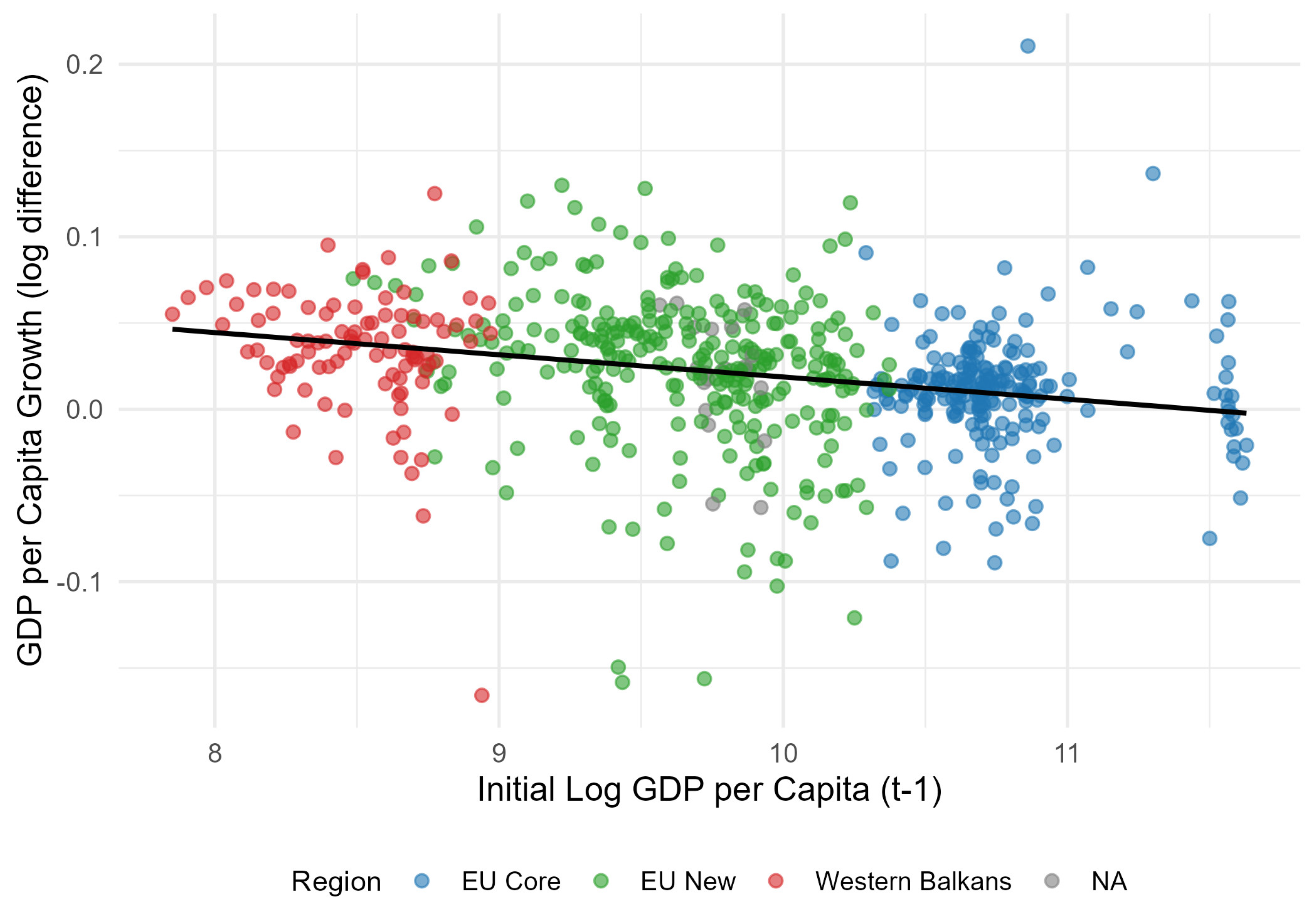
The graphical evidence further corroborates the regression results.
Figure 1 plots GDP per capita growth against initial income levels and reveals a clear downward-sloping relationship. Although dispersion around the fitted line is substantial—as is typical in growth regressions—the negative slope provides visual confirmation of absolute β-convergence across the sample.
Overall, the findings provide consistent statistical evidence in favor of Hypothesis H1, although the explanatory power of annual growth regressions remains modest, as is typical in panel growth frameworks.
5.2. Conditional Beta-Convergence and Structural Factors (H2)
Hypothesis H2 posits that income convergence is conditional upon structural and institutional characteristics, implying that growth dynamics depend not only on initial income levels but also on broader economic fundamentals.
The regression results presented in
Table 3 confirm the existence of conditional β-convergence. The coefficient on initial log GDP per capita remains negative and statistically significant across all model specifications, indicating that convergence persists even after controlling for institutional quality and other structural variables. This finding suggests that poorer economies continue to grow faster than richer ones, conditional on observable characteristics.
Institutional quality exhibits a statistically significant effect on the baseline conditional specification, highlighting its relevance for growth performance. However, once additional structural controls—namely, foreign direct investment and tertiary education attainment—are introduced, the direct effect of institutional quality weakens and loses statistical significance. At the same time, both foreign direct investment and human capital display positive and statistically significant coefficients, underscoring their role as key transmission channels through which institutional quality influences economic growth.
To further assess the relationship between institutional quality and structural controls,
Table 4 reports the correlation matrix and variance inflation factors (VIFs) for the main explanatory variables.
Taken together, these results suggest that institutional quality is strongly associated with structural growth determinants such as foreign direct investment and human capital. The weakening of the institutional coefficient once additional controls are introduced appears consistent with substantial correlation among these variables (see
Table 4), rather than providing evidence of a clearly identified causal transmission mechanism. Accordingly, the findings should be interpreted as reflecting conditional correlations within a panel growth framework rather than as establishing a definitive channel through which institutions affect convergence.
To ensure that the observed coefficient changes are not driven by differences in sample composition, all conditional specifications were re-estimated on a common sample restricted to observations with complete data on institutional quality, FDI, and tertiary education (N = 370). The convergence coefficient remains negative and statistically significant across these specifications, confirming that the results are not mechanically driven by observation loss but are instead associated with the inclusion of additional structural controls.
The evidence therefore supports Hypothesis H2 in a nuanced manner: convergence appears to be conditional on structural and institutional characteristics. However, rather than interpreting the weakening of the institutional coefficient as evidence of a mediation mechanism, the results suggest that institutional quality may operate as a prerequisite or enabling condition for structural growth factors such as foreign direct investment and human capital accumulation. Given the substantial correlation between institutional quality and these structural variables (
Table 4), the empirical framework does not allow for a clean identification of indirect channels. The findings should therefore be interpreted as reflecting conditional interdependence among institutions and structural determinants within a panel-growth setting, rather than a formally identified transmission mechanism.
5.3. Institutions and the Speed of Convergence (H3)
Hypothesis H3 extends the conditional convergence framework by examining whether institutional quality affects not only growth levels but also the speed of convergence. This hypothesis is tested by introducing an interaction term between initial income and institutional quality.
The estimation results reported in
Table 5 provide only limited support for this hypothesis. While the coefficient on initial income remains negative and statistically significant across all specifications-confirming the robustness of β-convergence-the interaction term between initial income and institutional quality does not reach conventional levels of statistical significance. Although the estimated coefficient carries the theoretically expected negative sign, its lack of statistical significance suggests that institutional quality does not systematically alter the speed at which poorer economies catch up with richer ones.
At the same time, institutional quality itself remains statistically significant in the parsimonious specification, indicating that institutional quality is associated with higher growth performance in simpler models, although this association becomes sensitive to specification once additional structural controls are introduced. These findings imply that better institutions are associated with higher growth performance but do not necessarily accelerate the convergence process conditional on initial income levels.
To provide a more informative interpretation, marginal effects of initial income were computed across the observed range of institutional quality. The estimated marginal effect remains negative throughout the distribution, and the corresponding 95% confidence intervals do not cross zero, indicating that the convergence mechanism remains stable rather than being substantially modified by institutional variation. However, given the substantial correlation between income levels and institutional quality (see
Table 4), the interaction term may be estimated with limited precision.
Accordingly, Hypothesis H3 does not receive statistically significant support in the present specification. However, given the substantial correlation between institutional quality and initial income levels, as well as the limited power inherent in annual growth regressions, the absence of statistical significance should not be interpreted as definitive evidence of no interaction effect.
5.4. Sigma-Convergence and Regional Heterogeneity (H4)
Hypothesis H4 addresses convergence from a distributional perspective by examining whether income dispersion across countries declines over time and whether this process differs across regional groups.
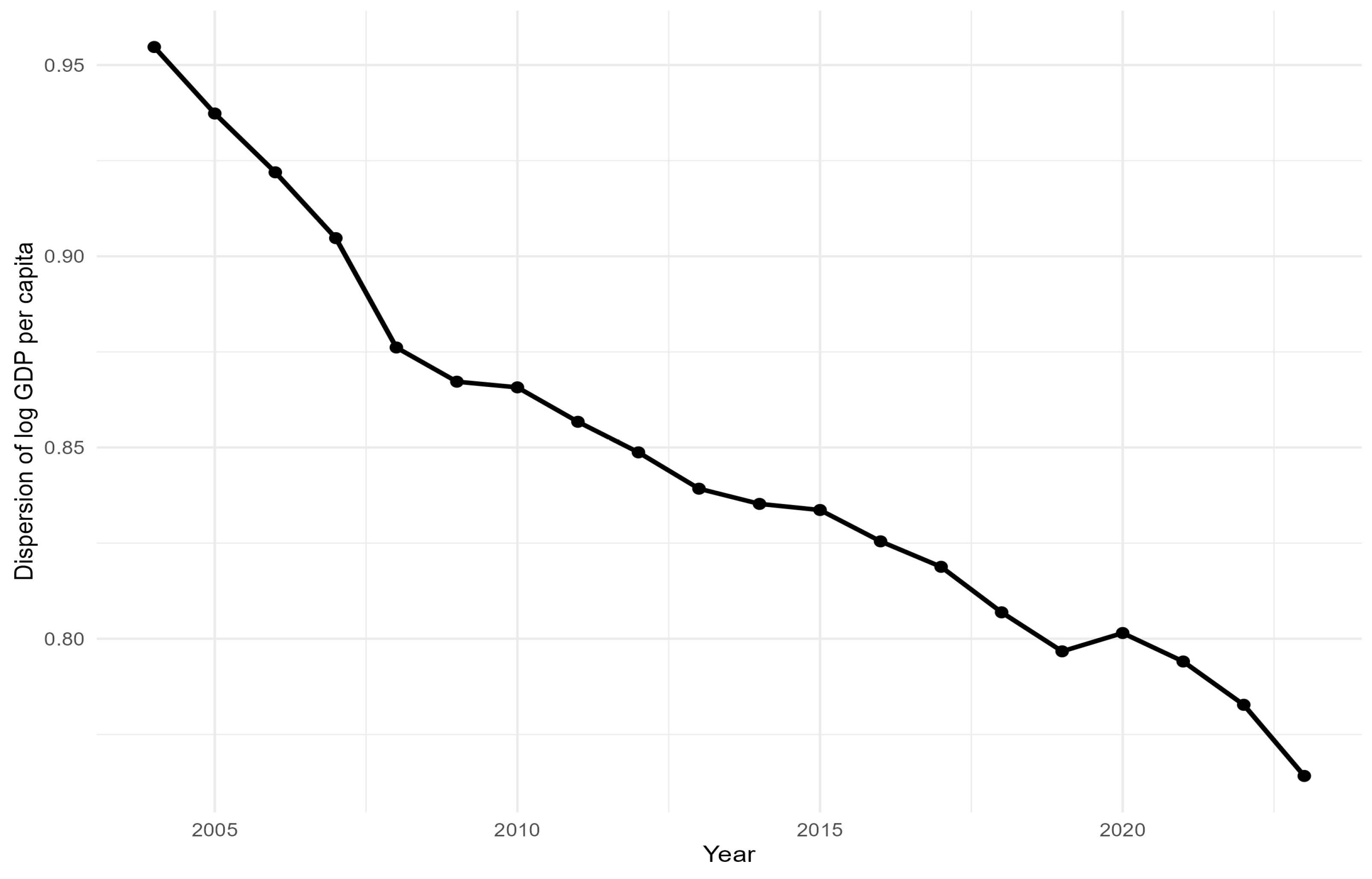
The evolution of income dispersion for the full sample is depicted in
Figure 2, which shows a clear and persistent decline in the cross-sectional standard deviation of log GDP per capita over the observed period. This pattern provides strong evidence of σ-convergence at the aggregate European level, indicating a gradual reduction in income inequality between countries.
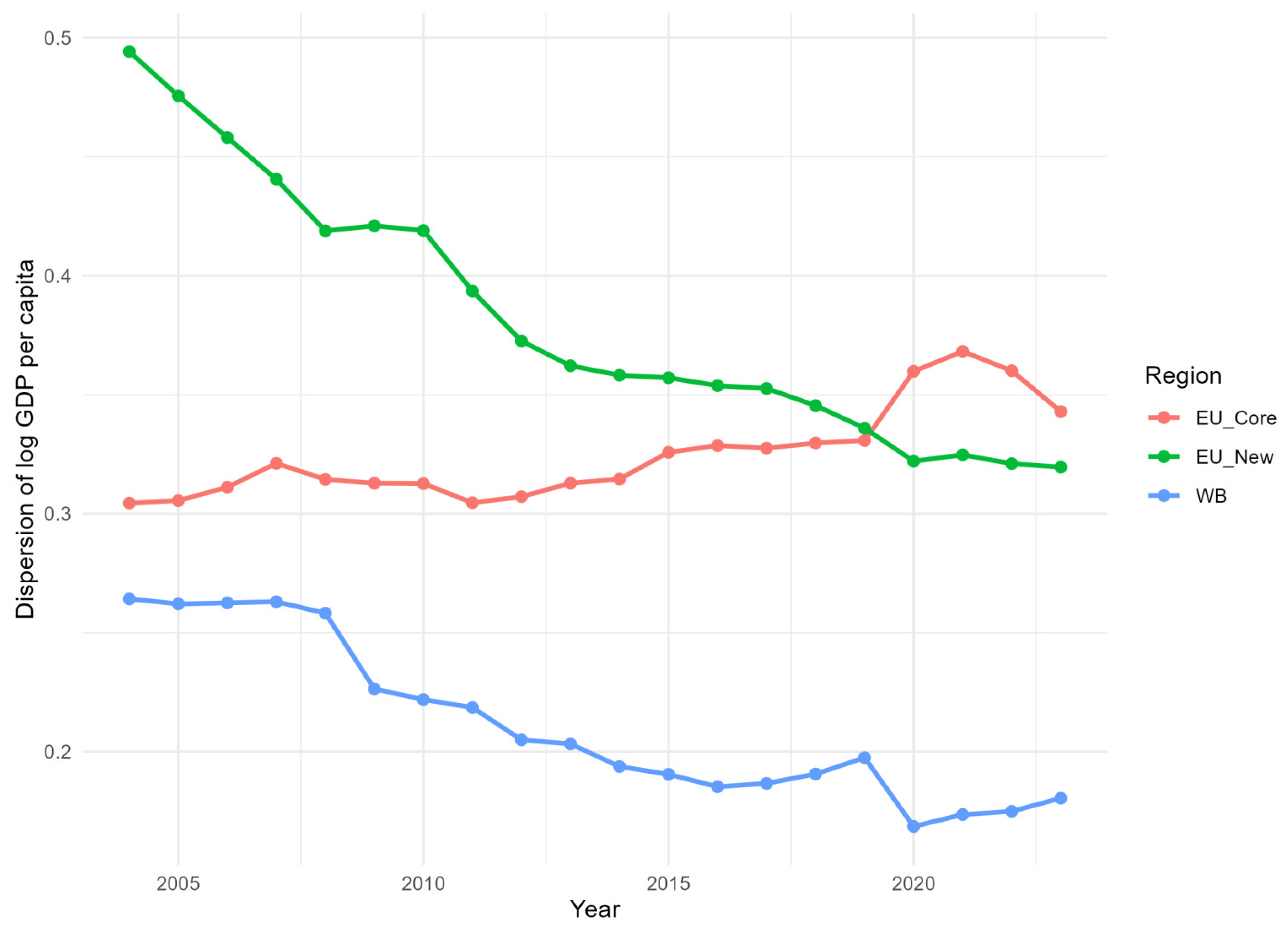
However, a more disaggregated analysis reveals substantial regional heterogeneity. As illustrated in
Figure 3 and summarized numerically in
Table 6, the new EU member states exhibit pronounced σ-convergence, reflecting a strong catching-up process following accession. In contrast, the Western Balkan economies display relatively low but stable dispersion, suggesting convergence within the group at persistently lower income levels. The EU core countries, meanwhile, show a comparatively stable dispersion pattern with temporary increases during major crisis periods, such as the global financial crisis and the COVID-19 shock.
These findings confirm that convergence in Europe follows a club-type pattern rather than a uniform process. While overall dispersion declines, regional trajectories differ markedly depending on institutional, structural, and historical factors. Consequently, Hypothesis H4 is strongly supported by both graphical and tabular evidence.
6. Discussion
The results of this study provide several important insights into the nature of income convergence in Europe and the role of institutional and structural factors in shaping growth dynamics. By jointly analyzing European Union member states and Western Balkan economies over a long and crisis-prone period, the findings contribute to a more nuanced understanding of convergence processes within an enlarged European economic space.
First, the results provide statistically consistent evidence of absolute β-convergence. However, the modest explanatory power of the growth regressions indicates that convergence should be interpreted as a tendency within a highly heterogeneous environment rather than as a fully explained growth mechanism. This result is consistent with the predictions of neoclassical growth theory and aligns with earlier empirical studies documenting convergence among relatively integrated economies. However, the modest explanatory power of the baseline growth regressions suggests that convergence is far from automatic and that substantial heterogeneity persists across countries. This observation reinforces the view that convergence should be understood as a tendency rather than a deterministic outcome of integration. The relatively low R2 values reflect the inherent volatility and multifactor nature of annual growth processes and are consistent with the broader empirical growth literature.
Second, the conditional convergence results highlight the importance of structural and institutional conditions in shaping growth trajectories. While institutional quality exhibits a statistically significant effect in parsimonious specifications, its direct impact weakens once foreign direct investment and human capital are included. This pattern is consistent with substantial correlation between institutional quality and structural growth determinants, rather than providing definitive evidence of an indirect causal channel. Such findings are consistent with the broader institutional economics literature, which emphasizes the role of institutions in determining long-run development paths rather than short-term growth fluctuations.
Third, the absence of a statistically significant interaction between institutional quality and initial income implies that institutions do not systematically alter the speed of convergence across countries. This result challenges simplified narratives according to which stronger institutions automatically accelerate catch-up processes in poorer economies. Instead, the findings point to a distinction between level effects and dynamic effects of institutions: while better institutions are associated with higher growth performance, they do not necessarily amplify the convergence mechanism itself. This distinction helps reconcile mixed empirical evidence in the literature and underscores the need for caution when interpreting institutional reforms as a direct accelerator of convergence.
Finally, the σ-convergence analysis reveals pronounced regional heterogeneity in convergence outcomes. While overall income dispersion across Europe has declined, this process has been driven primarily by strong convergence among new EU member states. In contrast, Western Balkan economies exhibit relatively low but stable dispersion, suggesting convergence within the group at persistently lower income levels. The EU core displays more stable dispersion patterns with temporary reversals during major crisis episodes. These findings support the notion of club-type convergence in Europe and highlight the enduring role of historical, institutional, and structural differences in shaping regional growth trajectories.
Taken together, the results suggest that European income convergence remains an uneven and highly conditional process. Integration and market access alone are insufficient to guarantee uniform convergence outcomes. Instead, convergence depends critically on the interaction between institutional quality, structural conditions, and regional contexts, particularly for economies at earlier stages of development such as the Western Balkans.
7. Conclusions
This paper examined income convergence in Europe by jointly analyzing European Union member states and Western Balkan economies over the period 2004–2023. Using panel data techniques, the study assessed absolute and conditional β-convergence and complemented this analysis with evidence on σ-convergence in order to capture both growth dynamics and changes in income dispersion.
The results provide statistically significant evidence of absolute income convergence, although the explanatory power of the annual growth specifications remains limited, as is common in panel growth analyses. Conditional convergence is also confirmed, although the direct effect of institutional quality weakens once structural factors such as foreign direct investment and human capital are taken into account. This finding suggests that the empirical evidence indicates that institutional quality is closely intertwined with structural conditions that support growth, although the analysis does not allow for a fully identified causal interpretation. Moreover, the analysis finds no systematic evidence that institutional quality alters the speed of convergence, highlighting a distinction between the level effects of institutions and their influence on convergence dynamics.
The σ-convergence results reveal substantial regional heterogeneity. While overall income dispersion in Europe has declined, convergence has been strongest among new EU member states, more limited within the Western Balkans, and relatively modest within the EU core. These patterns point to club-type convergence rather than a uniform European process.
From a policy perspective, the findings imply that sustained convergence in Europe requires more than formal integration and market access. Strengthening institutional quality remains an important policy objective, although its relationship with growth appears closely linked to broader structural conditions such as investment and human capital accumulation. For Western Balkan economies in particular, the results highlight the importance of comprehensive structural and institutional reforms as a prerequisite for durable convergence within the European economic framework.