


Abstract
The article is based on On the Move a holistic, playful movement intervention with children in Red Cross asylum centers in Denmark. Children in asylum centers in Denmark have diverse backgrounds, challenges, and resources. Common challenges due to their life situations can include potential trauma stemming from flight, migration, and/or war experienced by the children and their parents. Furthermore, they live with uncertainty regarding future relocation. These conditions may induce a state of alert, as the children’s foundations feel insecure. These circumstances can also affect the children’s emotional, cognitive, motor, and relational developmental processes. On the Move is a practice-based research project focused on examining how participation in a long-term holistic, playful movement intervention can support children in asylum centers regarding connectedness. The research project is inspired by a phenomenological understanding of body and movement, hermeneutic–phenomenological research, practitioner research, and Arts-Based Research. The data presented here is derived from scenic descriptions and interviews collected during the research project. The theoretical framework is based on the concepts of ontological security, movement philosophy and movement psychology. The article illuminates one of the main practice-based thematic findings from the research project: “Children sway—movement processes”. The article highlights challenges faced by the children due to their life situations and shows how teachers can support the children’s participation in the intervention. The article focuses both on the children’s life situations viewed by professionals and on the children’s movement processes during the intervention. In the movement processes, the children can enter a state in which they are described as being in harmony with the movements, with themselves, and with others. In this way, participating in a holistic, playful movement intervention can support the connectedness of children in asylum centers.
1. Introduction
Children in asylum centers can be characterized as being in a particularly vulnerable position (Moldenhawer 2017; Ekblad 1993; Bleile et al. 2021; Vitus and Nielsen [2011] 2017; Johansen and Vestergaard-Andersen 2016; Johansen and Winther 2024, 2025).
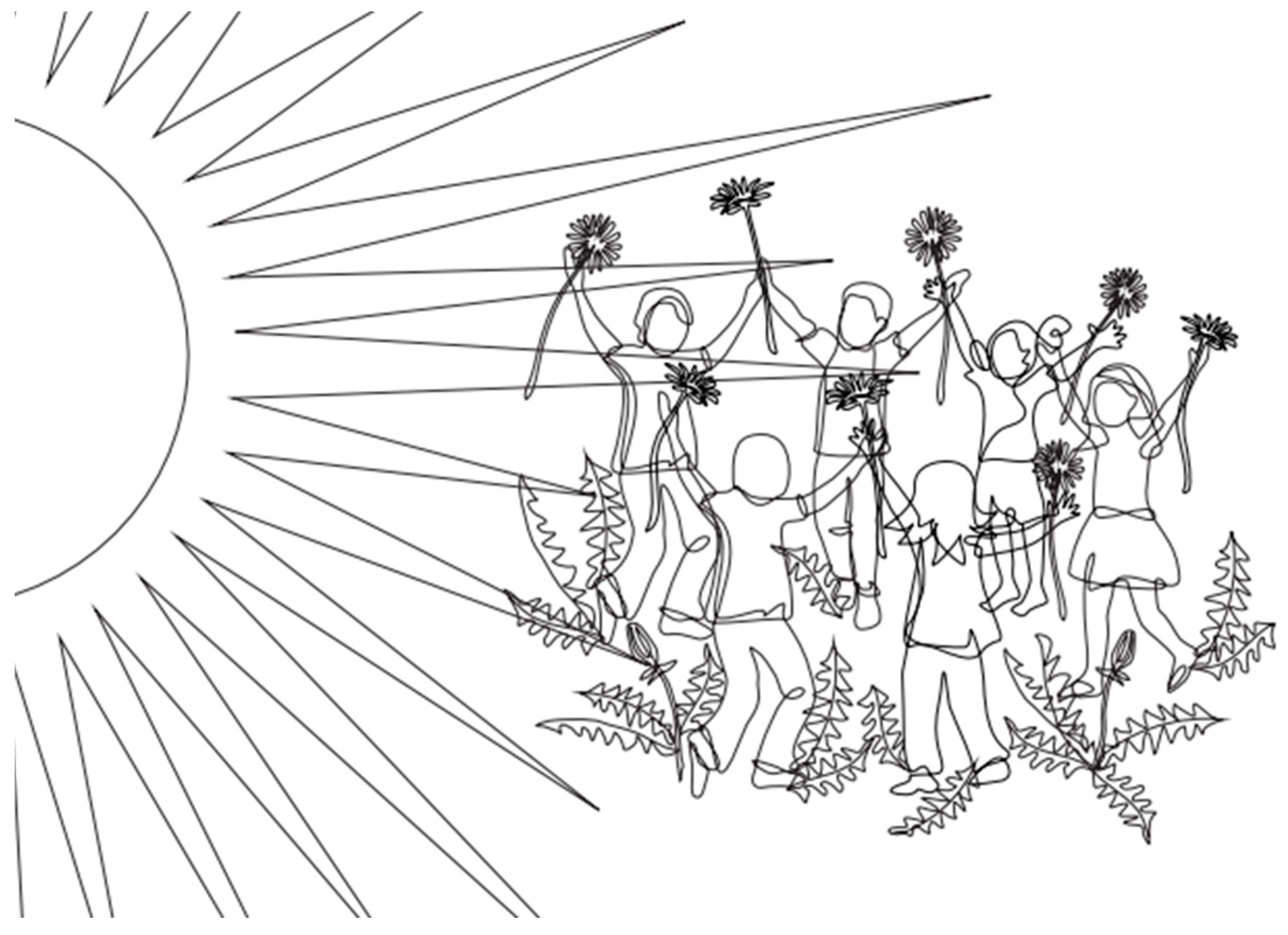
Illustration 1: In the rays of the sun, Children Sway by Maise Johansen & Anni Lamhauge:
International research studies indicate that sports can reduce stress, strengthen social communities, and foster positive experiences and inclusion for refugees and asylum seekers (Spaaij 2012, 2015; Lewis 2015; Stone 2018; Whitley et al. 2016; McDonald et al. 2019; Koopmans and Doidge 2022; Luguetti et al. 2022; Doidge et al. 2020; Nesse et al. 2023; Pink et al. 2020; Middleton et al. 2022). These studies also suggest that sports can provide a meeting place, offering joy and respite from the concerns associated with life as a refugee and fostering a sense of belonging and integration, leading to positive development for the target group (Spaaij 2012, 2015; Lewis 2015; Stone 2018; Whitley et al. 2016; McDonald et al. 2019; Koopmans and Doidge 2022; Luguetti et al. 2022; Doidge et al. 2020; Nesse et al. 2023; Pink et al. 2020; Middleton et al. 2022). The studies by Ley and Barrio (2010) and Bleile et al. (2021) specifically recommend inclusive and psychosocial movement interventions for refugees and asylum seekers (Ley and Barrio 2010; Bleile et al. 2021).
Pilot projects in Denmark show that playful, holistic movement interventions have the potential to support attachment processes and movement enjoyment for children and families in asylum centers (Baumgarten et al. 2023; Lamhauge et al. 2024). However, there is limited research-based knowledge regarding long-term holistic, playful movement interventions with children in asylum centers (Johansen and Winther 2024, 2025). There is also a need for more knowledge about this target group, as migrants, refugees, and asylum seekers are considered one of the world’s most hard-to-reach populations due to their temporary residences, diffusion across communities, and access to social networks (Shaghaghi et al. 2011; James 2023). Research results in articles focusing on children provide an opportunity to give visibility to one of the most invisible groups among displaced people and contribute knowledge about social work practices with refugees, including a movement intervention with children living in asylum centers.
On the Move
The movement intervention On the Move is a 3-year playful, holistic movement intervention in Red Cross Asylum Centers in Denmark (Johansen forthcoming; Johansen and Winther 2024, 2025; Johansen and Winther forthcoming). The intervention is generally based on Merleau-Ponty’s view of the body (Merleau-Ponty [1962] 2002) and a holistic, playful, creative approach to movement (Winther 2017, 2024). The programs were inspired by playful movement activities known in many cultures, dance activities from around the world, adapted martial arts exercises, inclusive ball games, and outdoor movement activities. New, playful movement activities were also developed through co-creative processes involving [Organization] personnel, children, and practitioner researchers (Johansen and Winther 2024, 2025). The movement intervention was conducted through themed programs lasting approximately 8 weeks each. A movement team has twice weekly during the 3 years held a holistic, playful movement intervention with children aged approximately 6–15 years in asylum centers, with different group sizes depending on the number at the school or center that day. If many children were present, they were divided into smaller groups. The groups were divided in the way the teachers normally divide them. The movement team consists of pedagogues and teachers from the pedagogical team and a university-educated teacher in sport. Approximately 350–400 children participated in the movement intervention during the 3 years.
The research project On the Move examines how participation in a long-term playful, holistic movement intervention can support children in asylum centers regarding connectedness. In the asylum system, there is a constant flow of children arriving at or moving on from the asylum centers. The children are therefore present at the asylum centers for different lengths of time, and not all children participated throughout the entire period. The children’s participation is therefore dynamically described with start, mid, and end periods depending on how long the children have stayed. They participated for periods ranging from 3 months to 3 years.
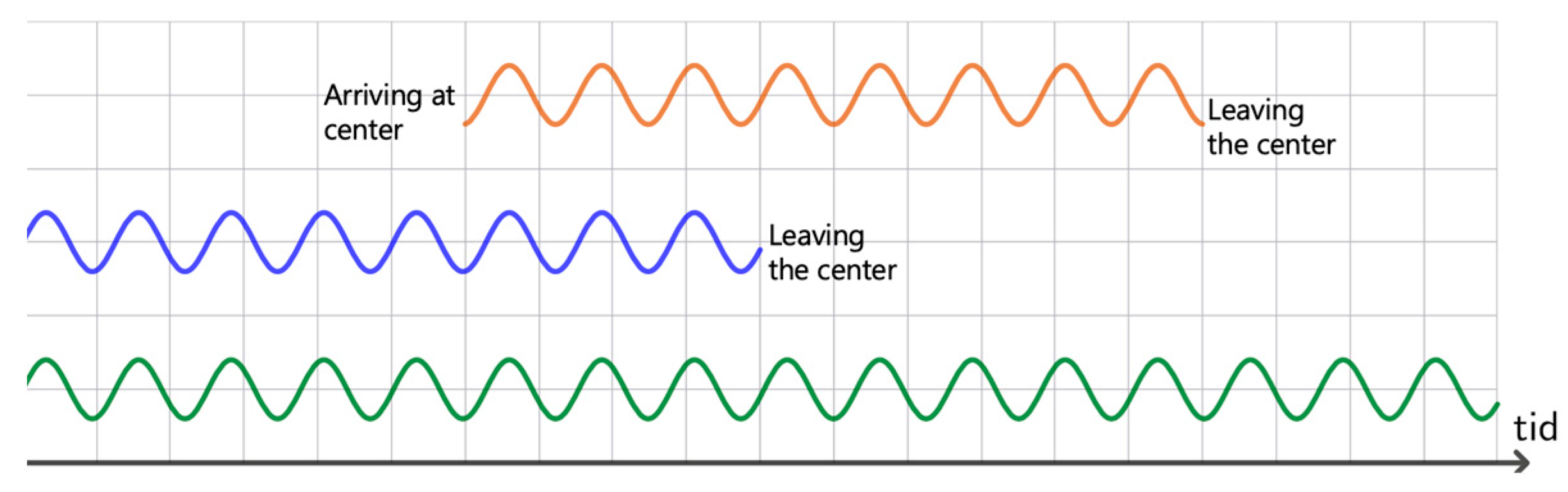
The research project creates portraits of the children in the intervention through coding and analysis of the children’s participation. Scenic descriptions of some children’s participation are used as examples to illustrate the prominent children’s movement processes. The timeline (Figure 1) is an illustration of how the children have participated during the time they have stayed at the center.
Figure 1.
The timeline of how the children have participated during the time they have stayed at the center.
The research project aims to contribute to national and international research on children in asylum centers and to generate research-based knowledge about how participation in a holistic, playful movement intervention can support children living in asylum centers. This article describes the children’s life situation, as well as showing how teachers in the movement intervention can both meet the children’s challenges and support their participation in the holistic movement activities. Furthermore, the article contributes insight into the children’s movement psychological processes and how these support the children’s connectedness.
2. Ethics
Ethically, the project is based on the phenomenological understanding that encounters with the children in asylum centers will necessitate care for the children (Løgstrup 1991; Brinkmann 2020). The research will therefore also encompass ethical dilemmas concerning encounters with the children and the public dissemination of aspects of their lives (Brinkmann 2020). At the same time, it holds ethical potential in that the children in asylum centers participated in a movement research project (Brinkmann 2020). The On the Move project followed formal ethical guidelines (Brinkmann 2020; Kelly and Ali 2004; Palmer 2016), including signing a legal collaboration agreement between University of Copenhagen and the Red Cross organization, which set the ethical principles and rules that were required to be followed (Johansen and Winther 2024, 2025). The researchers are not informed about the children’s demographic background or asylum cases. Under the cooperation agreement, the researchers’ knowledge is limited, as they do not have access to information regarding the children’s asylum cases. While this presents a challenge in engaging with the children and analyzing their participation processes, it also offers an opportunity to interact with them openly, knowing that the researchers cannot influence or hold knowledge of their cases. In this context, the children can theoretically engage “freely,” without having to consider the implications of their asylum status within the research project (Johansen and Winther 2024, 2025). The parents gave informed consent for the children to participate in the project through the Red Cross Asylum, and the children are pseudo-anonymized1 in reports and articles about the project. Furthermore, the researchers’ knowledge was limited in the collaboration agreement, so they were not familiar with any child’s asylum case.
The research project also includes reflections on the encounter with the children, also inspired by relational/situated ethics (Ellis 2007; Christians 2005). The children have thus had the opportunity to consent to participate continuously. Throughout the project, they had the opportunity to consent and participate, as well as to take breaks from research and movement activities (Johansen and Winther 2024, 2025). At the same time, the teachers and researchers adapted activities with sensitivity and knowledge about the children’s possible traumas. The project was based on trauma-informed care, understood as awareness of the impact of trauma on children; as such, it was focused on creating a safe and supportive environment for them. Teachers and researchers also had the opportunity to refer children to the Red Cross Asylum’s psychologists if needed (Johansen and Winther 2024, 2025).
3. Theoretical Framework of the Article
The theoretical basis for this article is broadly inspired by Sheets-Johnstone’s (2012, 2002) movement philosophy and concepts, Rosa’s (2021) concept of ontological security, and Winther’s movement psychological theory (Winther 2017, 2024). Rosa’s understanding of the individual’s place in the world and ontological security is used to understand the children’s life situation (Rosa 2021). Winther’s movement psychology (Winther 2017, 2024), as well as inspiration from Maxine Sheets-Johnstone’s understanding of movement, is used to both describe the basis of the movement intervention and to illuminate the children’s life situations and movement processes.
Movement Psychology
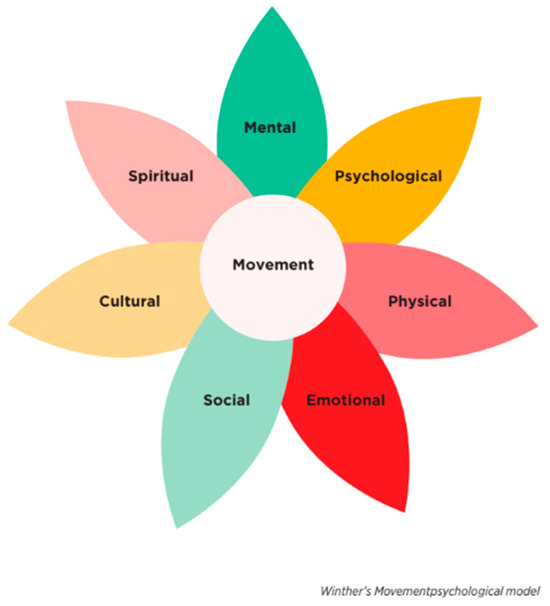
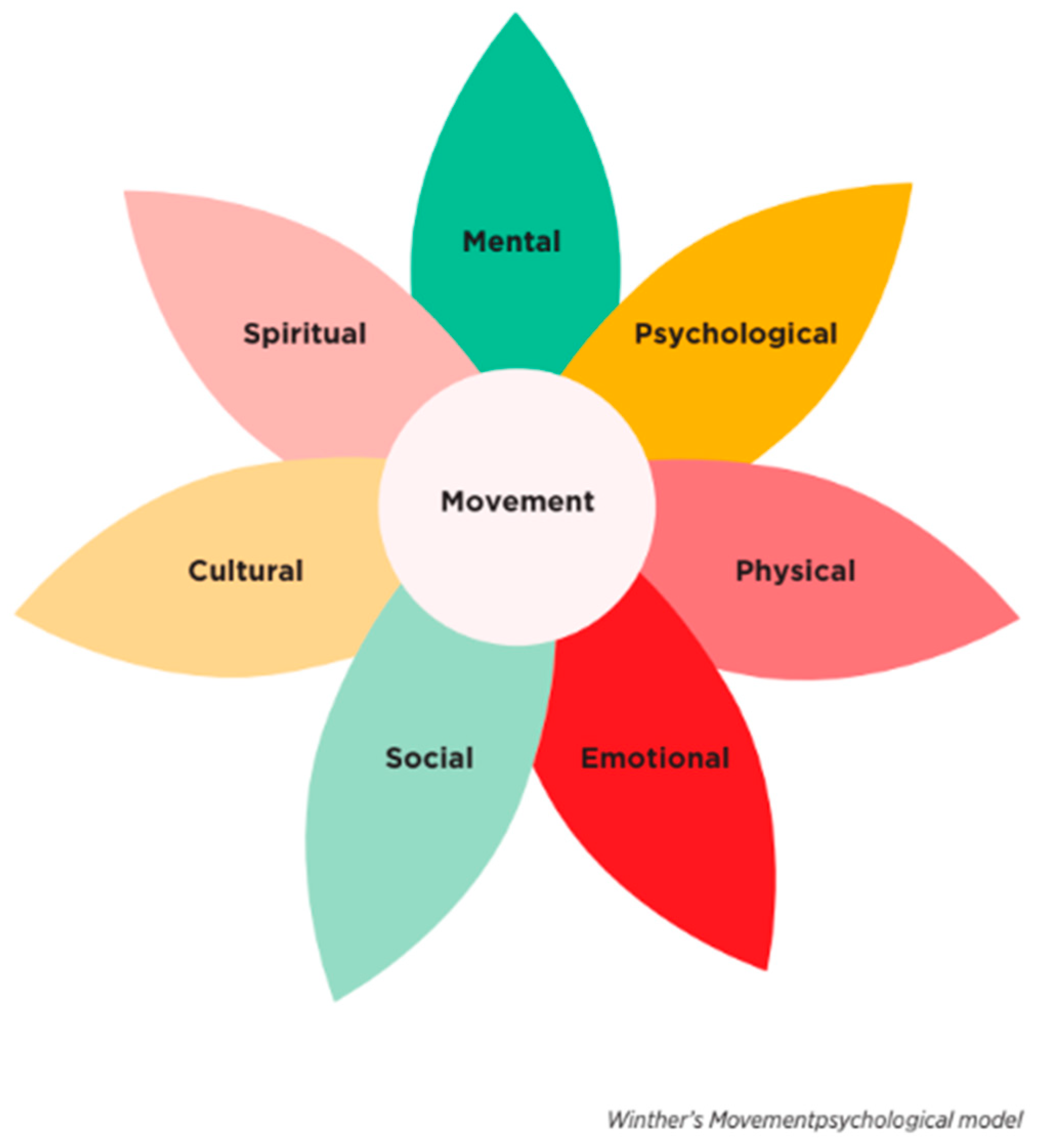
The following provides a concise description of movement psychology theory based on Winther’s movement psychological model2 (Winther 2024). The movement psychological core contains a wealth of meanings, which may be expressed as seven closely connected dimensions that are ubiquitous in movement:
“The mental dimension deals with thoughts, focusing, concentration, cognitive capacity, and understanding of awareness of frameworks and rules in movement activities.
The psychic dimension can, in a holistic understanding of movement, be seen as the situational or basic perception that a person has of themselves.
The physical dimension is associated with children and young people’s motor development, the body’s possibilities, physical capacity, and the individual’s motor abilities, including mobility, strength, endurance, tension balance and coordination.
The emotional dimension is associated with the basic emotions of anxiety, anger, sorrow, joy, and love.
The social dimension is associated with bodily communication, physical contact, trust, relationships, team spirit, attachment processes, and a sense of community.
The cultural dimension is associated with culturally toned movement codes, dance and music from different cultures, cross-cultural games, and the circle as a universal gathering ritual.
The spiritual dimension is associated with flow, happiness, self-forgetfulness, freedom, compassion and connectedness”.(Winther 2024, pp. 278–90)
The seven dimensions are present in many movement contexts as either opportunities or challenges. If the seven dimensions are in harmony, a positive, self-reinforcing spiral may arise, whereas challenges in one or more dimensions may lead to insecurity or the feeling of not being able to participate in the community (Winther 2024). This movement psychological theory (Figure 2) has been the focal point of the research project with a dual perspective: (1) as a source of pedagogical awareness in the movement intervention, and (2) as a tool for analysis and interpretation of the children’s movement processes.
Figure 2.
Winther’s Movement Psychological model.
(1) Source of pedagogical awareness in the movement intervention: Movement psychological theory has been used throughout the intervention as a source of pedagogical awareness for teachers (Winther 2017, 2024). They participated in continuing education/development days and supervision courses in order to create a common basis for the playful, holistic movement activities. In addition, the theory provided opportunities for the teachers to jointly put movement psychology into practice and develop pedagogical awareness of how they could guide and support the children’s participation in the movement intervention through it. Theory of the language of the body in professional practice (Winther 2024) was used as the teachers’ and researchers’ common basis for being able to support the children’s participation in the movement intervention. This included a common focus on how the teachers could be in contact with themselves and maintain calm in their own bodies (self-contact). There was also focus on how they could create trust-inspiring bodily communication in contact with the children (communication reading and contact ability) and how they could guide and lead movement activities in a playful and inspiring atmosphere (leadership over group and situation) (Winther 2024). The teachers’ movement–psychological insight can therefore be regarded as an underlying condition for how the children are supported in their participation in the movement intervention.
(2) Analysis and interpretation of movement processes: As this article is practice-based and focuses on how children participate in the intervention, movement psychology will be used as a theory that can illuminate these processes (Winther 2017, 2024). It is included together with Maxine Sheets-Johnstone’s theory of I can-experiences and the kinesthetic understanding of movement (Sheets-Johnstone 2002) as a fundamental theory for analyzing and interpreting the central research finding in the results.
The theoretical framework is closely connected to the hermeneutic–phenomenological approach (van Manen 2016). Therefore, a dialogical movement between research data and theory has been used throughout the process of this practice-based research project (van Manen 2016).
4. Epistemological and Methodological Framework
The research project is inspired by Merleau-Ponty’s understanding of the lived body (Merleau-Ponty [1962] 2002), van Manen’s (2016) hermeneutic–phenomenological approach (van Manen 2016), Arts-Based Research (Leavy 2018), and practitioner research (Jarvis 1999).
Arts-Based Research was a method used throughout On the Move. In this article, illustrations inspired by Arts-Based Research methods (Leavy 2018) are included to visually show thematic findings and scenic descriptions. These were initially hand-drawn by the researchers and then processed and developed in collaboration with the artist [artist 1]. The illustrations show the children’s resources, challenges, and vulnerabilities while ensuring that they are not recognizable.
Practitioner research (Jarvis 1999) in this research project consists of the researchers participating as co-teachers in the movement intervention while simultaneously writing scenic descriptions. The researchers are not employed as teachers in [organization] but have many years of experience with holistic, playful movement activities with children (Johansen and Winther 2024, 2025). Drawing inspiration from practitioner research involves adopting a dual perspective, where the researchers continuously shift between subjective bodily engagement and analytical reflection. This requires a high level of awareness, as navigating between these modes presents methodological, analytical, and writing-related challenges (Winther 2015; Johansen and Winther 2024, 2025). Practitioner research also includes a dual role: researchers alternate between acting as practitioners (co-teachers) and simultaneously observing the practice from a nuanced, focused, and analytical standpoint (Winther 2015). Beyond participating in the practice, researchers are responsible for subsequently documenting it through practice narratives, which demands attentiveness to both roles (Winther 2015). This approach provides researchers with deep insights into the children’s movement processes, including moments when the children face difficulties. (Johansen and Winther 2024, 2025).
- Research Methods
The entire On the Move research project is based on four main methods: (1) researchers’ scenic descriptions, (2) children’s experience descriptions3, (3) 43 child-friendly multimodal interviews with children, and 4) 21 semi-structured interviews with psychologists and teachers (Johansen and Winther 2024, 2025). One of the central thematic findings from the research project is: “Children sway—movement processes.” This finding is relevant for this publication because refugee children at asylum centers are in an especially vulnerable situation, but they lack visibility. At the same time, the article can provide knowledge about how a movement intervention can be carried out in social work with a target group about which there is limited knowledge.
This article describes thematic findings based on interviews with psychologists and teachers (main method 4) and on the researchers’ scenic descriptions (main method 1). The interviews are used to illuminate how the children are affected by their life situations, as these professional groups have specialized knowledge about the children through their daily work with them. Scenic descriptions, which are stories from practice, are used to illustrate prominent movement processes, as they can describe these in the children in a thorough manner while still protecting the children’s identities and vulnerabilities (Johansen and Winther 2024, 2025). Interviews with both the teachers and psychologists are used to analyze the children’s life situation. The psychologists’ interviews are used primarily, as they have in-depth psychological insight into the children’s traumas and resources. The analysis of the children is affected by their life situations are also supported by data from teacher interviews, as they have daily pedagogical contact with them. The psychologists did not participate in the movement intervention, so they are not included in the analysis of the children’s movement processes. These are analyzed based on the teachers’ interviews and the researchers’ scenic descriptions from the movement intervention, as these have followed the children’s participation in the intervention. The scenic descriptions are primarily used as examples in this part of the analysis, as they contain data on a deep level to describe movement processes in the children.
- Interviews
Two psychologists from the asylum centers were interviewed only at the start of the project period, in order to gain insight into the children’s life situations. Interviews with teachers were carried out in three rounds: at the start, in the middle, and at the end of the 3-year period. In this article, the term teachers is used for teachers such as pedagogues and university-educated instructors in sport (the movement team), since these professional groups instructed together in the movement interventions. The focus in these interviews and their coding was to determine the teachers’ descriptions of the children’s participation in the intervention. The text here will refer to (all teachers) when presenting results from all 19 teachers’ interview coding. Teachers in the asylum system are also subject to constant flux in the field, which means that they also change during the intervention period. Therefore, we have chosen interview quotes here from one teacher who participated during the whole project period and in interviews at all three stages (start, middle, and end) (teacher 1).
- Scenic descriptions
The researchers’ scenic descriptions were divided into categories depending on whether they were descriptions from the children’s start, middle or end process. The flow of children is a condition that means the researchers cannot follow the children linearly throughout the whole period, but they can describe the children’s movement processes dynamically. It was not possible to know in advance which children would be participating and for how long. The condition of the flow of the children makes the research process complex and also increases demands on the intervention in that its movement instruction must constantly take new children and their dynamics into account (Johansen and Winther 2024, 2025). In this article, momentary or “snapshot” descriptions of some children’s movement processes will be included as examples, with the aim of illustrating prominent processes seen in the children’s participations.
- Coding
Transcriptions of interviews and scenic descriptions were coded with inspiration from van Manen’s hermeneutic–phenomenological understanding of analysis and the coding process (van Manen 2016). The coding process focused on first determining the essence of the phenomenon and then analyzing and interpreting it through theories and concepts (Johansen and Winther 2024, 2025). Coding has focused on examining the participation of the children as a whole in the movement intervention. The reason for this is that the research project attempts to capture a complex reality by creating nuanced descriptions of the children’s overall participation. The processes are more nuanced, but this approach is chosen to illuminate prominent movement processes in a sensuous and thorough manner while still being aware that nuances may be lost. Furthermore, descriptions of the children’s life situations and movement processes will be representations, as they are based on the researchers’ scenic descriptions, interviews, and analysis of the research data (Johansen and Winther 2024, 2025).
This article illuminates the thematic finding from the coding and analysis process, “Children sway—movement processes”. This thematic finding has been found in the data with stories from practice that show how the children “sway” due to common challenges due to their life situations and how the children, despite those challenges, through support, can be described as being in important movement processes: moments when they can participate in the movements themselves and together with others. These are dynamic movement processes, which can also mean that the children may be challenged again and again in the movement intervention due to their life situations (Children sway). The children’s movement processes can thus be seen as resembling “swaying” while participating in holistic playful movement intervention. “Swaying” can also refer to the condition of the flow of children arriving and leaving the intervention suddenly.
In the following, “Children sway—movement processes” will be illuminated in three sections: (1) The children’s life situations, (2) support for the children to participate, and (3) the children’s movement processes.
4.1. The Children’s Life Situations
As described, On the Move is a long-term holistic, playful movement intervention with children in asylum centers. The research project has provided insight into the children’s life situation through the researcher’s scenic descriptions and analysis of interviews with psychologists and teachers. (This does not concern the children’s asylum cases or individual life situations.)
The children have diverse backgrounds, challenges and resources. The analysis shows that the children, due to their life situations, have some common challenges, which are elaborated in the following section based on the psychologists’ and teachers’ descriptions.
4.1.1. State of Alert, the Ground Being Torn Away, and the Family’s Situation Affecting the Children
“…in this state of alert, which shuts down everything else. And there will be many of them [children in asylum centers] who have long periods of their lives where they have just been in that state of alert…”(Psychologist 1)
Here, the psychologist expresses that the children seem to be in a basic state of alert due to their life situation. The children do not have or have not had basic ontological security. According to Rosa, ontological security can be understood as the individual being able to trust fundamental everyday life (Rosa 2021). As Rosa also writes: “The most obvious and most basic answer to the question of how we are situated in the world is: on our feet. We stand on the world, we feel it beneath us. It carries us” (Rosa 2021, p. 56)4. The opposite of standing firmly on one’s feet may be said to be the case for children in asylum centers. They are described as being in a state of alert, as they have often experienced what, in Rosa’s view, may be understood as not having the ground beneath their feet (Rosa 2021). And the ground may have been torn away from under their feet several times.
This can also be understood as the children having an insecure footing: “Well, many of them [children] have quite a long history in asylum systems at least, so these are children, many of whom have roots in not having had a base and have always been in chaos and have parents who have always been in uncertainty and affected by it, so in their home environment they have always had some kind of worry and always had an eye for their parents more than for themselves, many of them” (Psychologist 1). The psychologist here describes how the children who have been in asylum systems for a long time “have roots in not having had a base” and thus not having a firm base under their feet.
The psychologist also describes how the parents’ situation affects the children and elaborates that the children’s worries often concern the parents: “… how are my parents doing, what worries do my parents have, and always in that way from very early on have had a great responsibility, many of them. To keep an eye on how the condition is at home and how can I navigate in it? And forget themselves in it.” (Psychologist 1). The situation at home seems to be very important for the children. According to the psychologist, this can be expressed by the children as “having very few words for their life story and their own inner self, but they are focused on their parents. They know their parents’ reactions, their parents’ worries very well” (Psychologist 1). According to the psychologists, their state of alert due to lack of a firm base, as well as the parents’ situation, affects the children’s emotional, motor, social and cognitive development processes. According to psychologists and teachers, their development processes are often therefore not age-appropriate (Psychologist1;2; All teachers interviews). This also affects their behavior and opportunities to form relationships.
4.1.2. Emotional, Cognitive, and Relational Development Processes Are Challenged
“…the emotional thing recurs in all the children—that there will be something there that has been disturbed in some way… they are delayed in their emotional development and have been activated in their state of alert throughout their childhood, so therefore have not been through the development that they needed.”(Psychologist 1)
According to the psychologists, the emotional delay can mean that the children have difficulties with understanding their own feelings. It can be expressed by the children as “becoming very angry, very sad, isolating themselves violently from others, because it simply stresses them to be together with other people, so there can be different extroverted and introverted reactions in that way” (Psychologist 1). This is in line with the teachers’ description of the children: “…it is not because they [children] can express it [insecurity], but it is expressed through other things, that is, through their restlessness or that they can be a little aggressive sometimes or such outward-reacting—not aggressive, but outward-reacting or inward-seeking… many children have that restlessness and stress in the body where they have difficulty sitting still or focusing” (Teacher 1). According to the psychologists, the restlessness is related to an emotional delay in development, as the children are “restless because they simply do not know what is going on inside them, but it is just unpleasant at least—so it is a chaos of feelings in one way or another” (Psychologist 1). The psychologists and teachers describe that it is not only the children’s emotional process that is delayed and challenged but also “focused attention is challenged… It can also be expressed through introverted inattention…Because otherwise they zoom out all the time” (Psychologist 1). This may be shown by the children becoming either completely “drowsy or completely restless” (Psychologist 1).
According to the psychologists, the state of alert and restlessness also affects the children’s relationships and way of being in the community: “some isolate themselves completely from the community” (Psychologist 1). The children are described as challenged in relationships and in forming trust, as the psychologist expresses it: “Relationally children who are difficult to approach and gain trust in, and then it is… Yes, and then it is often due to their emotional development that they are challenged, which is expressed both by bodily restlessness, that I cannot feel where I am in the world, and that focused eye contact, where are we in our contact, where should my focus be directed right now? That it does not fall naturally. It needs to be guided a lot and supported a lot. I do not know if I can say so much else” (Psychologist 1). However, the psychologist also sees the opportunity to work with the children’s challenges with their state of alert through relationships: “The relational (aspect) which can calm down their state of alert” (Psychologist). In addition, psychologists also point out that the children’s emotional, cognitive, and relational processes are dynamic; it is therefore important to “relate to it dynamically, e.g., attention can change when the state of mind changes through life” (Psychologist 1).
The psychologists’ and teachers’ descriptions of the children’s challenges due to their life situation can also be interpreted using the seven movement dimensions. Seen in this context, the children’s challenges are at the mental level in relation to the many thoughts and worries they have, as well as their difficulty in being able to focus. Some children’s motor development is affected, and this is connected to the physical dimension. Psychologically, they are often more focused on their parents than on themselves, and emotionally, there can be a chaos of feelings, including anxiety, anger, and sorrow, which means that the children may have difficulty recognizing and feeling their emotional life. On the social dimension, there are children who isolate themselves from the community, while at the same time, as a psychologist describes, it is the relational aspect that can calm down their state of alert. On the cultural dimension, the children are in an asylum center where there are many different languages and cultures in the same place, so they do not have their own home or their own secure base.
4.1.3. The Body and Movement Pedagogical Framework
According to one psychologist, it is also crucial for the children that they work with their feelings in the body: “It is connected with knowing and feeling one’s emotional life—that is, how different feelings feel in my body. It can be completely unknown territory, and that is actually where you have to start when the children are delayed in their development” (Psychologist 1). According to the psychologist, it is also through the body that the children can “experience the fluctuations… to learn, my body can regulate itself in and out of these states” (Psychologist 1). At the same time, it is important for the children to experience structure, as it “can be more difficult for the children who also do not have focus if there are no frameworks and structure” (Psychologist 1). However, the psychologists and teachers unanimously point out that relationships, the body, a dynamic understanding, and guidance, support and structure can contribute to supporting the children in their challenges due to their life situations. It is these processes that both the movement pedagogical framework of On the Move and the teachers attempt to meet and ameliorate, so that it becomes possible to support the children’s participation in the holistic, playful movement intervention and support connectedness.
4.2. The Children’s Participation Is Supported
How did this project support the children so that they could participate in the movement activities? One scenic description from the movement intervention illustrates this:
The dandelions find their way
Around the edge of the asphalt court, the dandelions are trying to bloom. The children arrive. The children all come onto the small asphalt court. The teachers welcome the children with warm eyes and open arms. Everyone gathers in a circle. All the children stand on a mat in the circle with tense, curious glances. The music in the background makes some children sway a little from side to side, some children dance a little with fluttering legs and arms. Some children stand still with their arms down along their sides or in front of their stomachs. Eyan sits down, folds his hands and crouches his back and lays his head on the grass. A teacher sits down next to him and whispers a few words to him. Eyan rises while holding the teacher’s hand. Aida turns around and walks out of the circle with hesitant steps, but a teacher follows and gently brings Aida back into the circle. The music gets a little louder, and everyone holds each other’s hands. They move towards the center while holding each other’s hands and say “hello.” The voices become warmer and happier. The children move together from side to side while holding each other’s hands. The children look around in the circle. They welcome each other in a welcoming ritual where they say hello while making a sun movement and greeting in all the languages that are present. They follow the movements up, down, and around. Now they let go of each other’s hands and must make eye contact with another child in the circle and change places. They smile and wave to each other. Sera, Musa, Katrina, and Vali quickly make contact and dare to move out and change places. Eyan, Aida, Hassan, and Julio need a clear and loving invitation before they move out. The sound of laughter and squeals fills the air together with the music that plays in multicultural tones. The sun shines down on the children and the dandelions. The children find their way forward. A way out onto the asphalt. A way in space. A way into movement. A way out into the world.
Illustration 2: Maise Johansen and Anni Lamhauge (Johansen and Winther 2024, 2025):
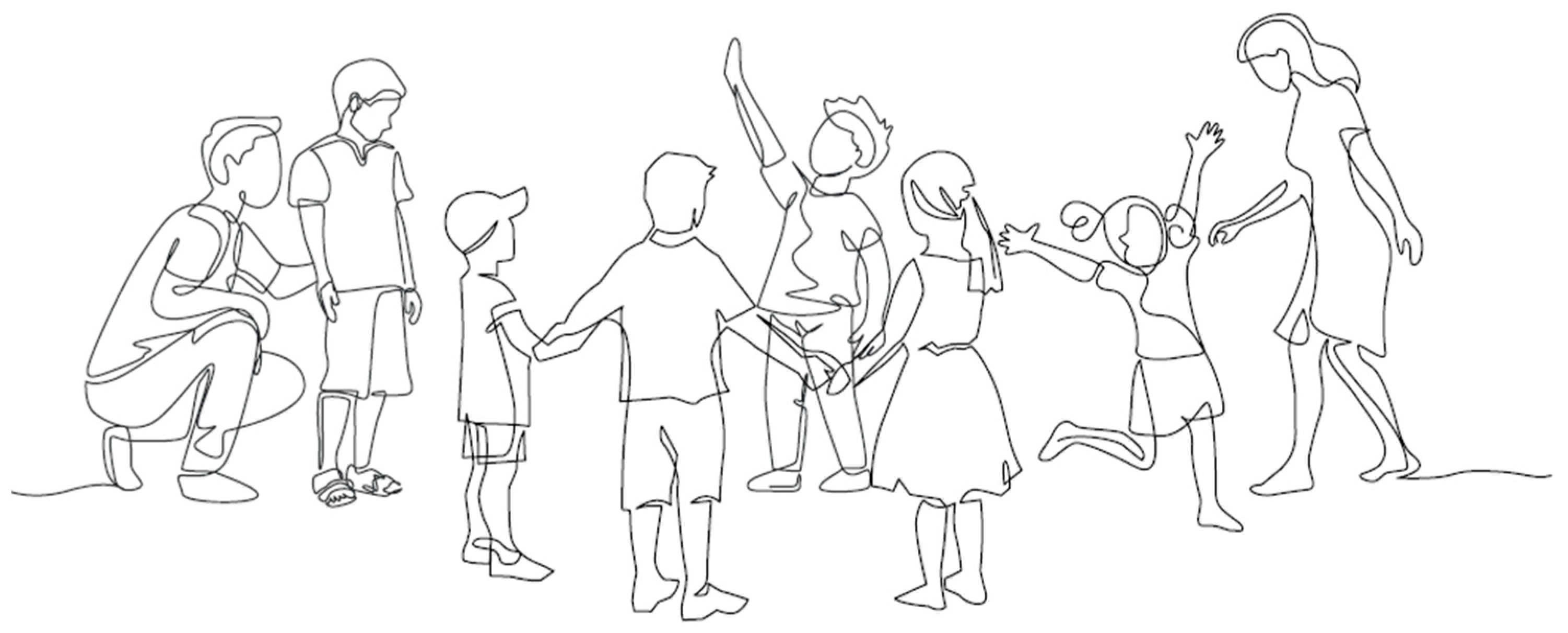
This scenic description gives an example of children’s participation in the movement intervention. The story shows how the teachers bodily welcome the children. At the same time, both children and adults gather in the circle and the music invites movement. That the children know that they are to enter the circle where the movement activities originate can be understood from the fact that the movement intervention is based on a structure: the circle forms the framework. This is chosen because recognizability and structure can support the children, who have experienced many shifts in their lives (Johansen and Winther 2024, 2025). All over the world, the circle is a symbol of community, and many playful dances and holistic movement activities take place in a circle (Winther 2024). The ritualized and repetitive circle is also a recognizable framework in On the Move. In the circle, the children can meet regardless of which languages they speak. Here, it is the universal language of play and movement. The music’s multicultural tones create an opportunity space where the children are invited to participate (Johansen and Winther 2024, 2025), and so does the welcoming ritual, in which the children greet each other in all the languages that are present. It can open up opportunities for all cultures and backgrounds to feel welcome in the intervention. Everyone can see everyone, and everyone has the opportunity to participate as the teachers guide the movements. At the same time, all the children have a mat, and thus their own place—their own base, so they know where they belong in the movement space. This can also be understood through Rosa’s concept of the need for ontological security (Rosa 2021). The mats function as a symbol and can literally create a safe place, “a home” to which the children can return and feel a sense of recognition. The scenic description also shows how the movement activities can be based on the old game Kis Pus, where the children can make eye contact with another child in the circle, mirror others’ movements, and then change places. It can also be challenging for the children to participate because the vulnerabilities they have due to their life situation are also present in the movement universe. The story shows how the teachers support the children in participating when they are challenged. When Aida begins to move out of the circle, a teacher gently guides her back into the community of the circle. When Eyan sits down, the teacher sits down next to him and whispers a few words. Through this, the teacher gently and respectfully adjusts their own bodily language with Eyan’s, so he can feel met. It is this small bodily meeting that Eyan needs in order for him to stand up, and, with the teacher in hand, he joins the group again. This also shows how the teachers guide the children to participate through the language of the body and their pedagogical awareness of movement psychological processes (Winther 2024), understood as the teacher showing the movement activities with their body and supporting the children’s participation in the movement.
The scenic description shows how the holistic, playful approach and the teachers’ supporting embodied communication can create an opportunity space for the children to participate in the movement intervention. The effort and the teachers’ support can be seen as the underlying “soil” under the “dandelions”, creating a foundation from which the children’s movement processes can be furthered. “Soil”, as individual support creating temporary ontological security (Rosa 2021), can be the foundation for the child to take part in the movement intervention, even though they are in a particularly vulnerable life situation. The children’s challenges due to their life situation and the teachers’ support also often appear in their movement processes, which are described in the next section.
4.3. The Children’s Movement Processes
Overall, the long-term movement intervention shows that the children’s movement processes have many nuances, dimensions, and variations. The children’s participation can thus be seen as dynamic, non-linear processes that are also characterized by other conditions and development processes in the children’s lives. Despite diverse vulnerabilities, the children’s resources grow through their participation in the movement interventions—like swaying dandelions that open in moments of sunlight—in moments and in different movement dimensions. The research project coding and analysis process found four prominent movement processes: (a) “I can hop, run, and skip,” (b) daring to participate in the movements, (c) sensing oneself and others, and (d) discovering calm in the movements. The following section describes the four prominent movement processes with scenic descriptions of children as examples, knowing that it cannot reveal the full complexity of their diverse nuances.
4.3.1. “I Can Hop, Run, and Skip”
“Jump as you land safely—Keep your eyes on your star telescope—Let the light you have shine just as brightly as now”(Excerpt from the song Warrior Heart by Dorthe Gerlach)
One prominent movement process was observed in children who are physically challenged in participating in the movement intervention. Several descriptions show how children were challenged in, for example, being able to “hop, run, and skip.” This primarily concerns the physical dimension: the children’s bodily and motor abilities (Winther 2017, 2024). Some of the children’s motor skills were challenged, as they had not had the opportunity to develop age-appropriately due to their life situations, but they developed along the way. The following shows movement processes in which the physical dimension is particularly prominent.
It is drizzling. There is a little warmth in the scent of spring. The asphalt is gray. The children are in a circle. The children hop around in the circle from mat to mat, while the music and its rhythms lifts the children to more flying hops. Daty and Epiza do not hop. They walk from mat to mat. Daty stops a little and walks out of the circle. The teachers support Daty and Epiza to participate and in getting their legs to take off to the music onto the new mat…”(Scenic description, asylum center, Daty and Epiza’s start process in On the Move)
The rain has been replaced by late summer’s warm dark rays. The asphalt has been replaced by grass, leaves in different glowing red, yellow, and orange shades. The mats are white with traces of use. The music starts playing. The children hop from mat to mat. Daty and Epiza also hop with small flying hops. With kicking happy bodies that continue together with the others around in the circle.”(Scenic description, asylum center, Daty’s and Epiza’s middle process in On the Move—the researchers do not have descriptions from the end of the Daty and Epiza process because they left suddenly.)
The description illustrates how Daty and Epiza are challenged in participating because they cannot hop. They are challenged in the physical dimension, but this also affects both the emotional and the social dimensions. Daty begins to withdraw from the circle’s community, but he is embraced by a teacher. Through the music’s energy, the teacher supports the children’s participation, so that they can “get their legs to take off.” The story also shows that Daty and Epiza learn to hop, and that joy and contact can appear when they can suddenly hop like the other children.
Through this, the children are given the opportunity to experience I can-experiences in the movement intervention. According to Sheets-Johnstone, “I can-experiences are central” (Sheets-Johnstone 2002). I can-experiences are connected with our sensuous–kinesthetic bodily movements (Sheets-Johnstone 2002), and these experiences are closely connected with being sensuously in the movements. It is a process of developing from being physically challenged in participating to being able to participate in the movements. According to Sheets-Johnstone, these experiences can also be a part of the children’s kinesthetic memory (Sheets-Johnstone 2002) and thus also potentially brought with them later in their lives. The story also shows the joy that grows when the children have such I can-experiences. This also supports their participation in the movement activities. Thus, the harmony between the physical, emotional, and social movement dimensions grows, while the cultural dimension is present in the multicultural music and the universal language of playfulness.
Most of the children who have participated in the movement intervention have been in a similar movement process involving the physical dimension. For some children, it can be important to have experiences of being able to catch and throw a ball, or bend down and reach their toes, try to do a somersault, or “skate” on mats across the floor. A central movement process in the On the Move research project is that children in asylum centers go from experiencing various physical challenges to having momentary experiences of being able to move, play and dance (I-can-experiences), and also longer sequences of self-reinforcing movement “spirals,” where more and more movement dimensions begin to “swing” together.
Another prominent movement process is daring to participate in the movements together with others.
4.3.2. Daring to Participate in the Movements Together with Others
Daring to participate in the movement intervention is a prominent movement process, as illustrated by the scenic description below:
Sati stands almost invisibly on the edge of the circle. She moves quietly and cautiously into the room, but mostly stands still if possible. All movements are very small, like an invisible, fragile thread that stops the body’s movements before they start. In her eyes a glimpse of uncertainty, despondency, and distance. But sometimes her mouth smiles a little, and that lights a glimmer in her eyes. A small opening to the desire to move…(Scenic description Satis start process in On the Move, asylum center)
Sati begins, in glimpses, to participate—movement and joy find their way into Sati’s expression. The smile becomes bigger, the movements become freer. But just as quickly, Sati is back to cautious, hesitant, small movements, and the distance in her eyes. Every little challenge brings Sati back to that place. But each time, a teacher stands and supports her with care and invitations to participate again. The support elicits small moments where Sati radiates courage and joy in the movements.(Scenic description, asylum center, Sati’s middle process in On the Move —The researchers do not have descriptions from the end of Sati’s process because she and her family left suddenly.)
The scenic description shows how Sati is in a process of being challenged in daring to enter the movements together with the others. This can also be connected to the psychologists’ and teachers’ descriptions of how the children’s worries and life situations may be expressed through stress and inwardly reacting behavior (All Teachers, Psychologist 1; 2). From the perspective of movement psychology, Sati’s movement processes can be seen as being challenged in the emotional and social dimensions. The social dimension may be that Sati is not feeling safe in the social framework and bodily movements together with others (Winther 2017, 2024). The emotional dimension may be that Sati is challenged by feelings such as anxiety, interpreted from: In her eyes, a glimpse of uncertainty, despondency, and distance can be traced.
In the description, Sati may also be seen as being in a process where she, in moments, through support from teachers, melts into a movement “spiral” when she dares a little more, experiences being able to, finds joy, and is in the movements together with others: Sati begins, in glimpses, to participate—movement and joy find their way into Sati’s expression. The smile becomes bigger, the movements become freer. This is an interpretation of Sati’s multidimensional movement challenges based on the researchers’ scenic description of Sati’s participation in the movement intervention, as we do not have Sati’s words on that process. From the perspective of movement psychology, Sati is first challenged by participating in the movement. At the same time, opportunities for positive movement spirals are created through support. According to movement psychology theory, the embracing community is important for positive movement spirals to arise (Winther 2024). Movement psychology also defines this in terms of resonance–response relationships, in which the teacher’s role can be regarded as decisive: But each time, a teacher stands and supports her with care and invitations to participate again. The support elicits small moments where Sati radiates courage and joy in the movements.
The scenic description also shows how movement processes are not linear but dynamic. This is seen in Sati going back into the challenging situation: But just as quickly, Sati is back to: the cautious, hesitant, small movements, and the distance in her eyes. Every little challenge brings Sati back to that place. According to their teachers and psychologists, the dynamic processes in which the children move in and out of a movement process may be due to the children being affected by their life situation (All Teachers; Psychologist 1;2 interviews coding). The movement process described here is an example of how children are challenged in various ways on psychological, social, cultural and emotional dimensions and how the children in the movement intervention are supported in processes in which they dare, are safe, and radiate joy in participating in the movements together with others.
Another prominent movement process is sensing oneself and others.
4.3.3. Sensing Oneself and Others
This prominent movement process is exemplified in the scenic description below:
You have to watch your head—You have to put your hands down when you jump, like flying, up on the mattress. Akri runs as fast as he can. He runs onto the bench at full speed. He throws himself at high speed over the bench with his head first, without his hands as support. He is about to thud his neck and head into the mattress. He is saved by a teacher who ensures that he does not hit his head. He looks up. He has a crooked and confused smile. He quickly runs towards the bench again, ready to repeat the run and the jump in exactly the same way. Akri is stopped by a teacher. With a gentle voice and body language, the teacher shows how he should make the jump—the teacher shows the run in a safe way. Akri wants to try again and he runs and jumps together with the teacher.(Scenic description Akri’s start process in On the Move, asylum center)
They are to move around in the room and hold a stick between them—Akri and the teacher. Akri presses the stick against the teacher’s stomach. It does not look deliberate. “You have to watch me and the others, Akri,” says the teacher gently and informatively. Akri tries again now with a close eye contact and focus with the teacher.(Scenic description, asylum center, Akri’s middle process in On the Move)
Inside the circle, Akri stands between other children, there is no teacher next to him. The children are to hold on to each other, support each other in keeping their balance without falling on one leg, while at the same time they should move forward. Akri is like a solid tree trunk, he has eye contact with the children next to him. He sees them, senses them.(Scenic description, asylum center, Akri’s end process in On the Move)
This process may be closely connected to being challenged, especially on the mental, social, and emotional dimensions. The mental dimension may be understood as Akri being challenged in “understanding of awareness of frameworks and rules in movement activities” (Winther 2024, p. 278). He may also be challenged in relation to the social dimension, not sensing the others and the teacher. The emotional dimension may also be affected. According to their teachers and psychologists, this can be an example of children in asylum centers who have difficulties expressing or understanding their emotions (Psychologist 1; 2, All teachers).
The scenic description also shows how the teacher’s guidance and the embracing community help Akri to adjust his actions in the movement. The guidance continues over a long time. At the same time, Akri’s example is also an illustration of a long-term process: a child with a description from the start, middle and end of the research period. It is an example of the “long stayers” in the asylum system and children with challenges to whom the teachers have been attentive over a longer period. Through long-term support, the scenic description recounts that Akri is like a solid tree, he has eye contact with the children next to him. He sees them, senses them. From a movement psychological perspective, this can be understood as an example of children having been in processes in which mental, social, and emotional challenges have especially caused the children to not be able to sense themselves or others in the movement intervention. Through support, the children, over time, come into positive movement spirals in which they can sense themselves individually, as well as others. This may also be understood from a sensuous–kinesthetic bodily movement perspective (Sheets-Johnstone 2002); in the movements, the children can experience sensing themselves and others. This is a process towards being able to feel oneself and others in the movements.
4.3.4. Discovering Calm in the Movements
This movement process is exemplified in the following scenic description:
Mahit’s arms move quickly. He walks a little one way, then the other way. His eyes are flickering, and he watches what is happening around in the room. His legs are also constantly moving with quick and heavy steps. Pushes and pats are given at a quick pace. A teacher is constantly by Mahit’s side showing him gently how to be focused on the movements. Otherwise, the unrest breaks out even more. When the teacher does not support Mahit, he cannot be in the activity. His legs take quick and heavy steps in different directions. At no time are his head and eyes still or in focus. His arms’ movements are so large that he himself or others cannot see what is going on. His voice and sounds are loud. The small pats and pushes quickly develop into a fight. The teachers shows him with his body language how to stay in the circle and join the movements.(Scenic description, asylum center, Mahit’s start process in On the Move)
Mahit comes running into the circle with quick steps. He smiles. Says hello to the teacher and to Emdida and Rari, who are standing next to him. The music starts. The children begin to move their arms in waving movements. Now they take each other’s hands and walk around in the circle together to the music. Mahit holds on, but gently, Emdida and Rari in his hands. He follows along around in the circle like a wave with the music and the other children. With a smile.(Scenic description, asylum center, Mahit’s middle process in On the Move the researchers do not have descriptions from the end of Mahit’s process because Mahit’s family left suddenly.)
The scenic description highlights Mahit’s unrest, which is also described as a common challenge for the children due to their life situations. Their vulnerable life situation, filled with worries and uncertainty, is expressed through this unrest (All teachers, psychologist 1; 2). From a movement psychological perspective, Mahit’s challenges may primarily stem from the mental, emotional, and social dimensions. “It is difficult for him to focus, concentrate, and understand frameworks and rules in the movement activities” (mental dimension). He also faces challenges in connecting to the community (social dimension). Like Akri’s movement process, Mahit’s process can also be interpreted as him being emotionally challenged, as expressed through much unrest and outwardly reacting behavior. It is an example of children being supported by the teachers to participate in the movement activities. With gentle guidance, the children can move towards positive movement spirals, as shown in the second part of the scenic description. Here, Mahit also exhibits resonance–response relationships with the other children in the movement activities: Mahit holds on, but gently, Emdida and Rari in his hands. He follows along around in the circle like a wave with the music and the other children. Mahit’s movement process is an example of how children discover calm in participating in the movements with support from teachers, as well as in meeting the other children.
This section has described four prominent movement processes in the intervention: (a) “I can hop, run, and skip,” (b) daring to participate in the movements, (c) sensing oneself and others, and (d) discovering calm in the movements. It has illustrated how children face challenges in the movement intervention and how the children, with support from their teachers, show evidence of dynamic processes with positive movement spirals.
5. Discussion
Limitations and Implications for the Research Field
This article has several limitations. It is based on the research project On the Move, which is inspired by body phenomenology, hermeneutic phenomenology, practitioner research, and ABR approaches, along with qualitative methods. This epistemological and methodological foundation means that the article’s conclusions are characterized by context dependence and subjectivity and that the research processes have been time-consuming and labor-intensive. Thus, they cannot provide definitive truth. However, that is not the purpose of the article, which is instead to describe and analyze how children in asylum centers in Denmark are challenged due to their life situations and how the movement intervention used in the project supports the children’s movement processes. The article’s dual application of movement psychology may be discussed and criticized in that it serves both as a source of pedagogical awareness in the movement intervention and as a tool in the analysis and interpretation of how the teachers support the children’s challenges in the movement processes. However, this approach may also provide significant depth in theoretical and practical research within the field of movement and children in asylum centers. Another point concerns considerations of conducting research and movement projects with children in vulnerable situations. Therefore, the Red Cross Asylum project has also addressed many ethical considerations and focused on how the children can best be both supported and protected. The research project also has limitations in that the age group of 6–15 years is very broad and the children participated in different periods of the project, suddenly arriving and leaving the center. Furthermore, the article cannot elaborate on the children’s demographic backgrounds.
This article contributes to the field of research showing that children at asylum centers have challenges due to their particularly vulnerable positions (Moldenhawer 2017; Ekblad 1993; Bleile et al. 2021; Vitus and Nielsen [2011] 2017; Johansen and Vestergaard-Andersen 2016; Johansen and Winther 2024, 2025). It also contributes in-depth knowledge about a target group that is one of the most hard-to-reach in studies in this field (Shaghaghi et al. 2011; James 2023). As in other studies, this article supports indications that sport and movement can have positive effects on the participants’ challenges. It brings a new approach to knowledge about how playful, holistic movement interventions can foster positive movement processes. Thus, it has implications pertinent to practice and may contribute to a field with sparse knowledge about holistic, playful movement interventions with children in asylum centers. It includes an especially close practical focus on the children’s movement processes, as well as on how teachers support children to participate in movement. Through their participation, positive movement spirals are created for the children, and this can support their connectedness to the movements as such, to themselves, and to the other children. The article also has practical implications, as it may inspire movement projects in different contexts, while still being aware of large contextual differences (Johansen and Winther 2025). It may inspire movement and research projects both within the asylum, refugee, and migration fields in national, international, and global contexts, as well as inspire movement projects with other groups of children in vulnerable or robust situations.
6. Conclusions
In the Rays of the Sun, the Children Sway
The article has shown how children in asylum centers are in a vulnerable life situation, while still having resources that can be supported by participation in a holistic movement intervention, like dandelions that can grow under challenging conditions.
It has shown how children in asylum centers “sway” due to common challenges. The children are in a life situation characterized by being in a state of alert, without having a basic ontological security from which they can trust fundamental everyday life. The children stand on insecure footing. This vulnerable life situation creates many worries for the children, especially about their parents’ condition. Their worries and life in a state of alert create emotional, cognitive, and relational challenges for them. These may be expressed through unrest and outward or inward reactions. The children can be passive or restless in the community, as well as being challenged in trust and relationships. These challenges must be understood dynamically in order to make change possible. From a movement psychological perspective, multidimensional challenges are also present in physical, psychological, mental, emotional, and social movement dimensions.
The article has also shown how the children “in the rays of the sun,” so to speak, can participate in a holistic, playful movement intervention with support from their teachers. In this regard especially, scenic descriptions illustrate how the teachers embrace the children’s challenges and support them in participating based on knowledge about the body’s language. The movement intervention’s playful, holistic approach opens up for the children to participate in the movements. At the same time, a movement structure grounded in a ritualized circle creates a recognizable framework that gives the children an opportunity to participate in the movement intervention.
In the article, four prominent movement processes are shown: (a) “I can hop, run, and skip,” (b) daring to participate in the movements, (c) sensing oneself and others, and (d) discovering calm in the movements. In the movement processes, the children progress from challenged to positive movement spirals, in which they—through the movement intervention and supported by teachers—enter the movements more fully. The movement processes show how the children, through support (“in the rays of the sun”), may be described as being in important movement processes: moments when they can participate in the movements themselves and still be together with others. The children’s connectedness is thus supported in this process. These are dynamic processes, which may also mean that the children may be challenged again. The children’s movement processes can thus be seen as resembling “swaying dandelions” while participating in holistic playful movement activities. The processes are founded in movement and thus have the potential for the children to bring them with them in the future, wherever they land, and must grow further.
The article points out that future studies could illuminate more areas within movement interventions with children in asylum centers, as well as research with holistic, playful movement activities with children in other vulnerable or robust situations. The article may also inspire practice-near research, movement projects and social work in other contexts, with awareness that these would have different perspectives that need to be considered. Hopefully, it will inspire movement projects with children in Nordic communities as well as in multiple contexts worldwide.
Author Contributions
M.J. was responsible for writing the scenic descriptions and preparing the original draft. M.J. and H.W. collaborated on writing and editing all sections of the article. All authors have read and agreed to the published version of the manuscript.
Funding
The research project is funded by Novo Nordisk Foundation.
Institutional Review Board Statement
The study was conducted according to the guidelines of the Declaration of Helsinki and approved by the University of Copenhagen, Faculty of Science 20B8E3FA-2A38-4ACE-9A94-3C7C348B22C6 27 May 2021.
Informed Consent Statement
Informed consent was obtained from all subjects involved in the study.
Data Availability Statement
This article is based on qualitative data generated through interviews and scenic descriptions. All data have been pseudonymized to protect the anonymity of participants. Due to the terms of the collaboration agreement and the inclusion of identifiable information in the original materials, the full dataset containing names or other potentially identifying details cannot be shared publicly. Consequently, the data are not available for deposition in a public repository.
Acknowledgments
The authors wish to express their sincere gratitude to the children and staff at the Red Cross asylum centres for their openness, cooperation, and willingness to share their experiences. Their participation has been invaluable to the completion of this work. The Authors also like to extend their heartfelt thanks to Anni Lamhauge for the assistance with making the illustrations. The authors would also like to extend their heartfelt thanks to Lynn Freligh for her generous assistance with English language editing and refinement. Her support greatly strengthened the clarity and quality of the final manuscript.
Conflicts of Interest
The authors declare no conflict of interest.
Correction Statement
This article has been republished with a minor correction regarding the organization & project Information. This change does not affect the scientific content of the article.
Notes
| 1 | Pseudo-anonymized means that the data has been processed so that it cannot be directly traced back to a specific person without additional information. That is, their identity is hidden, but not completely anonymous. For example, data may still contain a code that only researchers can use to re-identify the individual. In addition, the children’s names in the article are fictitious. |
| 2 | This understanding of movement is, among other things, inspired by Sheets-Johnstone (2012), who writes that movement is our mother tongue. We are born in movement, and it is through movement that the child can create a basic feeling of being welcome in and connected to the world (Sheets-Johnstone 2012; Winther 2024). |
| 3 | (Approximately 180 descriptions in total, inspired by practice narratives). |
| 4 | It is a translation from the Danish edition of Rosa’s (2021) book. |
References
- Baumgarten, Louise Gottlob, Maise Johansen, and Helle Winther. 2023. Holistic movement activities with refugee families: The importance of attachment processes. Body, Movement and Dance in Psychotherapy 18: 4–21. [Google Scholar] [CrossRef] [Scilit]
- Bleile, Alexandra C. E., Gabriela V. Koppenol-Gonzalez, Katia Verreault, Karin Abeling, Elin Hofman, Willem Vriend, Adnan Hasan, and Mark J. D. Jordans. 2021. Process evaluation of TeamUp: A movement-based psychosocial intervention for refugee children in the Netherlands. International Journal of Mental Health Systems 19: 25. [Google Scholar] [CrossRef] [Scilit] [PubMed]
- Brinkmann, Svend. 2020. Etik i en kvalitativ verden. In Kvalitative Metoder. Edited by Svend Brinkmann and Lene Tanggaard. København: Hans Reitzels forlag. [Google Scholar]
- Christians, Clifford G. 2005. Ethics and politics in qualitative research. In The Sage Handbook of Qualitative Research, 3rd ed. Edited by Norman K. Denzin and Yvonna S. Lincoln. Thousand Oaks: Sage Publications, pp. 139–64. [Google Scholar]
- Doidge, Mark, Marc Keech, and Elisa Sandri. 2020. ‘Active integration’: Sport clubs taking an active role in the integration of refugees. International Journal of Sport Policy and Politics 12: 305–19. [Google Scholar] [CrossRef] [Scilit]
- Ekblad, Solvig. 1993. Psychosocial adaptation of children while housed in a Swedish refugee camp: Aftermath of the collapse of Yugoslavia. Stress Medicine 9: 159–66. [Google Scholar] [CrossRef] [Scilit]
- Ellis, Carolyn. 2007. Telling secrets, revealing lives: Relational ethics in research with intimate others. Qualitative Inquiry 13: 3–29. [Google Scholar] [CrossRef] [Scilit]
- James, Michelle L. 2023. Ethical Dilemmas, Rewards, and Lessons for the Future: Conducting Participatory Photographic Research With Asylum Seekers. International Journal of Qualitative Methods 22: 1–12. [Google Scholar] [CrossRef] [Scilit]
- Jarvis, Peter. 1999. The Practitioner Researcher. Developing Theory from Practice. San Francisco: Jossey-Bass Publishers. [Google Scholar]
- Johansen, Maise. Forthcoming. On the Move—Children Moving at Asylum Centers. Ph.D. dissertation, University of Copenhagen, Copenhagen, Denmark.
- Johansen, Maise, and Helle Winther. 2024. “Vi flyver”—Følelser, fordybelse og forbundethed: Fortællinger fra en holistisk legende bevægelsespraksis med børn på asylcentre. Move 15: 6–22. [Google Scholar]
- Johansen, Maise, and Helle Winther. 2025. Ethical and Methodological Possibilities and Challenges in Conducting Qualitative Research With Children in Asylum Centers. International Journal of Qualitative Methods 24. [Google Scholar] [CrossRef] [Scilit]
- Johansen, Maise, and Helle Winther. Forthcoming. “But we are here now, let’s play, dance and move at the asylum center”—anchored embodied sense of belonging/in the rays of the sun. In Children Sway—Children in Asylum Centers’ Challenges and Movement Processes. London: Leisure Studies.
- Johansen, Maise, and Laura Vestergaard-Andersen. 2016. Orden i Kaos: Hvordan Røde Kors’ undervisningstilbud skaber en meningsfuld udvikling for asylbørn. Copenhagen: University of Copenhagen. [Google Scholar]
- Kelly, Moira, and Suki Ali. 2004. Ethics and Social Research. In Researching Society and Culture, 2nd ed. Edited by Clive Seale. London: Sage Publications Ltd., pp. 115–28. [Google Scholar]
- Koopmans, Berber., and Mark Doidge. 2022. ‘They play together, they laugh together’: Sport, play and fun in refugee sport projects. Sport in Society 25: 537–550. [Google Scholar] [CrossRef] [Scilit]
- Lamhauge, Katarina S., Maise Johansen, and Helle Winther. 2024. Bevægelses-sanglege med familier på asylcentre: Glæde, nærvær og understøttende samspil. BUKS—Tidsskrift for Børne- og Ungdomskultur 68: 15–34. [Google Scholar] [CrossRef] [Scilit]
- Leavy, Patricia. 2018. Handbook of Arts-Based Research. New York: The Guilford Press. [Google Scholar]
- Lewis, Hannah. 2015. Music, dancing and clothing as belonging and freedom among people seeking asylum in the UK. Leisure Studies 34: 42–58. [Google Scholar] [CrossRef] [Scilit]
- Ley, Clemens, and María Rato Barrio. 2010. Movement, games and sport in psychosocial intervention: A critical discussion of its potential and limitations within cooperation for development. Intervention 8: 106–20. [Google Scholar] [CrossRef] [Scilit]
- Løgstrup, Knud. Ejler. 1991. Den Etiske Fordring. Forlag: Gyldendal. [Google Scholar]
- Luguetti, Carla, Loy Singehebhuye, and Ramón Spaaij. 2022. ‘Stop mocking, start respecting’: An activist approach meets African Australian refugee-background young women in grassroots football. Qualitative Research in Sport, Exercise and Health 14: 119–36. [Google Scholar] [CrossRef] [Scilit]
- McDonald, Brent, Ramón Spaaij, and Darko Dukic. 2019. Moments of social inclusion: Asylum seekers, football and solidarity. Sport Society 22: 935–49. [Google Scholar] [CrossRef] [Scilit]
- Merleau-Ponty, Maurice. 2002. Phenomenology of Perception. London: Routledge Classics. First published 1962. [Google Scholar]
- Middleton, Thierry R. F., Robert J. Schinke, Bahaa Habra, Diana Coholic, Deborah Lefebvre, Kerry R. McGannon, and Cole E. Giffin. 2022. Centralizing Forced Immigrant Male Youths’ Stories in the Development of Socially Just and Inclusive Community Sport Programs. Sport, Exercise, and Performance Psychology 11: 156–73. [Google Scholar] [CrossRef] [Scilit]
- Moldenhawer, Bolette. 2017. «Vi prøver at gøre det så godt for dem som muligt, mens de er her»: En analyse af pædagogisk arbejde med asylsøgende børn i samspillet mellem skole, asylcenter og forvaltning i Danmark. Tidsskrift for Velferdsforskning 20: 302–16. Available online: https://www.scup.com/doi/full/10.18261/issn.2464-3076-2017-04-04 (accessed on 10 November 2025). [CrossRef] [Scilit]
- Nesse, Martin, Sine Agergaard, and Lucy V. Piggott. 2023. Young refugees’ experiences of accumulating horizontal and vertical social capital through organised and informal sports. International Review for the Sociology of Sport 59: 642–59. [Google Scholar] [CrossRef] [Scilit]
- Palmer, Catherine. 2016. Ethics in sport and exercise research—From research ethics committees to ethics in the field. In Routledge Handbook of Qualitative Research in Sport and Exercise. Edited by Brett Smith and Andrew C. Sparkes. London: Routledge, pp. 316–29. [Google Scholar]
- Pink, Matthew A., John W. Mahoney, and John E. Saunders. 2020. Promoting positive development among youth from refugee and migrant backgrounds: The case of Kicking Goals Together. Psychology of Sport and Exercise 51: 1–12. [Google Scholar] [CrossRef] [Scilit]
- Rosa, Hartmut. 2021. Resonans—En Sociologi om Forhold til Verden. København: Eksistensen. [Google Scholar]
- Shaghaghi, Abdolreza, Raj S. Bhopal, and Aziz Sheikh. 2011. Approaches to recruiting ‘hard-to-reach’ populations into research: A review of literature. Health Promotion Perspectives 1: 86–94. [Google Scholar] [CrossRef] [Scilit]
- Sheets-Johnstone, Maxine. 2002. Movement: Our common heritage and mother tongue [keynote]. In Dance knowledge—Dansekunnskap. International Conference on Cognitive Aspects of Dance. Proceedings, 6th NOFOD Conference. Edited by Anne Margrete Fiskvik and Egil Bakka. Trondheim: Rådet for folkemusikk og folkedans og Nordisk forum for danseforskning, pp. 37–50. [Google Scholar]
- Sheets-Johnstone, Maxine. 2012. Kinesthetic memory: Further critical reflections and constructive analyses. In Body Memory, Methaphor and Movement. Edited by Sabine C. Koch, Thomas Fuchs, Michela Summa and Cornelia Müller. Amsterdam: John Benjamins, pp. 43–72. [Google Scholar] [CrossRef] [Scilit]
- Spaaij, Ramón. 2012. Beyond the Playing Field: Experiences of Sport, Social Capital, and Integration among Somalis in Australia. Ethnic and Racial Studies 35: 1519–38. [Google Scholar] [CrossRef] [Scilit]
- Spaaij, Ramón. 2015. Refugee youth, belonging and community sport. Leisure Studies 34: 303–18. [Google Scholar] [CrossRef] [Scilit]
- Stone, Chris. 2018. Utopian community football? Sport, hope and belongingness in the lives of refugees and asylum seekers. Leisure Studies 37: 171–83. [Google Scholar] [CrossRef] [Scilit]
- van Manen, Max. 2016. Phenomenology of Practice: Meaning-Giving Methods in Phenomenological Research and Writing. New York: Taylor and Francis. [Google Scholar]
- Vitus, Kathrine, and Signe Smith Nielsen. 2017. Asylbørn i Danmark—En barndom i undtagelsestilstand. København: Hans Reitzels Forlag. First published 2011. [Google Scholar]
- Whitley, Meredith A., Cassandra Coble, and Gem S. Jewell. 2016. Evaluation of a sport-based youth development programme for refugees. Leisure/Loisir 40: 175–99. [Google Scholar] [CrossRef] [Scilit]
- Winther, Helle. 2015. Praktikerforskning [practitioner research]. In Metoder i idræts- og fysioterapiforskning [Methods in Sports and Physiotherapy Research], 2nd ed. Edited by Lone Friis Thing and Laila Susanne Ottesen. Copenhagen: Munksgaard, pp. 172–89. [Google Scholar]
- Winther, Helle. 2017. Bevægelse og flow i børn og unges lære-, være- og udviklingsprocesser: Introduktion til en praksisnær bevægelsespsykologisk teori [Movement and flow in children and young people’s learning, being, and development processes: Introduction to a practice-oriented movement psychology theory]. Unge Pædagoger 1: 36–44. [Google Scholar]
- Winther, Helle. 2024. Bevægelsespsykologi—En kilde til pædagogisk bevidsthed [Movement psychology—A source of pedagogical awareness]. In Fodfæste og Himmelkys: Undervisningsbog i bevægelse, rytmisk gymnastik og dans (3. udg., s. 273-298) [Grounded roots and kissing the sky: Teaching book on movement, rhythmic gymnastics and dance]. Edited by Helle Winther, Lis Engel, Maj-Britt Nørgaard and Mia Herskind. Copenhagen: Hans Reitzel. [Google Scholar]
Disclaimer/Publisher’s Note: The statements, opinions and data contained in all publications are solely those of the individual author(s) and contributor(s) and not of MDPI and/or the editor(s). MDPI and/or the editor(s) disclaim responsibility for any injury to people or property resulting from any ideas, methods, instructions or products referred to in the content. |
© 2026 by the authors. Licensee MDPI, Basel, Switzerland. This article is an open access article distributed under the terms and conditions of the Creative Commons Attribution (CC BY) license.