1. Introduction
As China’s demographic transition deepens, persistently low fertility has become one of the most pressing structural challenges confronting long-term social and economic development. Childbearing has thus shifted from a largely private family decision to a public issue embedded within policy design, labor markets, welfare regimes, and gender relations. In response, the Chinese government has successively adjusted population policies—from the selective two-child policy to the universal three-child policy—and introduced a range of fertility-support measures. However, the tension between institutional intentions and lived social realities has remained unresolved, keeping fertility at the center of public debate.
In this context, public discourse surrounding fertility has increasingly unfolded within social media environments (
Skouteris and Savaglio 2021). Social media platforms have become primary arenas in which individuals articulate fertility-related anxieties, negotiate reproductive norms, and contest policy narratives. Existing research has shown that fertility-related communication on social media is characterized by diversified themes, emotional intensity, and strong issue salience (
George et al. 2023). Yet, most studies continue to approach social media either as a neutral channel reflecting individual attitudes or as a supplementary data source for measuring fertility intention (
Li and Wei 2023).
Such approaches tend to overlook a critical transformation in contemporary communication environments: social media platforms do not merely host fertility discourse, but actively organize, prioritize, and amplify certain forms of expression. The visibility of fertility-related narratives is increasingly shaped by platform-specific recommendation systems, interaction mechanisms, and attention economies. As a result, fertility discourse is not simply “expressed” on social media; rather, it is selectively structured through platform architectures that privilege particular themes, emotional tones, and problem framings (
Han 2025).
From this perspective, low fertility should not only be understood as a demographic or attitudinal outcome, but also as a communicative phenomenon embedded in platformized public spheres. Different platforms operate according to distinct logics of content circulation—short-video platforms prioritize emotionally resonant life scenarios, while information aggregation platforms favor issue-oriented or policy-centered discussions. These structural differences raise a set of underexplored questions:
What kinds of fertility narratives gain prominence on different platforms? How are emotions related to fertility selectively amplified or marginalized across platform environments? And how do platform-specific communication logics shape the public visibility of fertility anxieties, responsibilities, and rights?
Addressing these questions requires moving beyond descriptive accounts of fertility-related content and toward a platform-sensitive analytical framework. However, existing studies on fertility intention and online public opinion have rarely conducted systematic cross-platform comparisons grounded in a coherent theoretical perspective. As a result, we still lack a clear understanding of how fertility discourse is differentially organized across platforms and how these differences may influence the public construction of fertility issues.
Based on this problematization, the present study examines fertility-related user-generated content (UGC) on three major Chinese platforms—Sina Weibo, Douyin, and Toutiao—between June and December 2024. Drawing on topic modeling and sentiment analysis, and guided by a platformization perspective, this study systematically compares the thematic configurations and emotional tendencies of fertility discourse across platforms. The current study offers an empirical perspective based on naturally occurring, large-scale social media data, which contrasts with the solicited data from questionnaires. Simultaneously, it intends to provide references for policymakers to accurately identify the key sources of fertility anxiety among different groups and optimize fertility-support measures, as well as for platforms to build a healthy content ecosystem centered on fertility topics.
2. Literature Review
2.1. The Media Perspective in Fertility Intention Research
Fertility intention, a core concept in fertility research, is generally defined as the subjective expectations and plans of individuals or families regarding the number of children, gender preference, and timing of childbearing within a specific socioeconomic and cultural context. This concept encompasses not only explicit fertility plans that can be directly observed (such as the “ideal number of children”) but also implicit fertility attitudes deeply rooted in an individual’s belief system (such as the “perception of the meaning of childbearing”) (
Lan 2025). Existing research has reached broad consensus that fertility intention is not merely an individual preference, but the outcome of interactions between personal decision-making tendencies and structural conditions (
Yang et al. 2024;
Liu et al. 2023). Demography focuses on the underlying constraints of macro population structure (
Kolk et al. 2014). Economics adopts the framework of rational choice theory, viewing childbearing as a “cost-benefit” decision and clarifying the rigid constraints of economic factors (
Leibenstein 1974;
Muth 1966;
Shen et al. 2023). Beyond the limitations of economic rationality, cultural anthropology and sociology emphasize the constructive role of institutions and culture (
Shepherd and Marshall 2018), while social psychology delves into how the dynamic interaction between individual psychology and the social environment shapes fertility decisions (
Zhang et al. 2024;
Zhao et al. 2024a).
Although existing studies cover multiple disciplines, they overlook the core role of media as a social influence mechanism in this era of deep mediatization. Against the backdrop of information and communication technologies reshaping social cognition and behavior, media is no longer a mere carrier of information transmission but a key force deeply involved in the construction of users’ cognition and the shaping of their behaviors (
Marolla-Gajardo and Lozano Mas 2025). This role is specifically reflected in three aspects: the constructor of fertility concepts, amplifier of fertility-related risks, and moderator of policy effects. First, through means such as agenda-setting and frame selection, media subtly shape public cognition (
Kim et al. 2025). The real-time interactivity and circle-based communication characteristics of social media tend to amplify the anxiety and pressure encountered by individuals during parenting into collective emotions (
Chee et al. 2024). In this sense, the media perspective can precisely play a key role in connecting the macro and micro levels: it serves not only as a “mirror” reflecting changes in social structure—transforming macro policy orientations and cultural concepts into perceivable micro-level cognition through communication—but also as a “bridge” facilitating interaction, enabling the collective feedback from individual fertility decisions to exert a reverse influence on macro policy adjustments and cultural construction (
Goldenberg and Gross 2020). Therefore, integrating the media perspective into fertility intention research is not only a necessary supplement to the existing interdisciplinary framework but also a key path to breaking through the current research bottlenecks and more comprehensively analyzing the causes of low fertility intention (
Ning et al. 2022).
2.2. Research on Fertility Public Opinion: From Traditional Media to Social Media
Fertility intention does not develop in isolation, but is deeply embedded in media-constructed public opinion environments. Individuals’ perceptions, attitudes, and decisions regarding childbearing are continuously shaped through mediated expression, interaction, and observation of others’ experiences. While much of the existing literature focuses on the direct effects of media exposure on fertility intention, fewer studies have systematically examined fertility public opinion as a mediating mechanism within media spaces. Shifting analytical attention from individual intention to fertility-related public opinion allows for a more dynamic understanding of how communicative processes influence reproductive decision-making.
In the era of traditional mass media, fertility discourse was largely shaped by centralized, one-way communication structures dominated by state institutions and authoritative media organizations. Research during this period exhibits a strong policy-oriented and state-centric tendency (
Dudová and Hašková 2023), treating media primarily as instruments for policy dissemination and ideological framing (
Tufte 2017). Although traditional media succeeded in bringing fertility issues from the private into the public sphere, their limited interactivity and top-down communication logic constrained public participation and individual meaning-making (
Luce et al. 2016).
Entering the social media era, with the transition of the communication structure from “centralization” to “decentralization” (
Herrero et al. 2025), research on fertility public opinion has achieved systematic breakthroughs. This shift is not merely about the platform, but more fundamentally about the empowerment of individuals to create and shape the discourse themselves through User-Generated Content (UGC). This is the key departure from the top-down, one-way communication of the traditional media era where the public remained passive receivers. By virtue of its real-time interactivity and advantages in circle-based communication, social media, as the primary field for UGC, has not only become a core information carrier but also occupies a key position in shaping public opinion and influencing decision-making (
Ogenga and Gamez 2025). Existing studies document three key developments: the fragmentation of fertility discourse into micro-level themes such as gender inequality and economic pressure (
Zhao et al. 2024b); the intensified circulation of fertility-related risks through high-frequency exposure and interaction (
Wright et al. 2019); and methodological innovations that employ computational approaches to capture large-scale patterns of fertility discourse and emotional expression (
Chen et al. 2023;
Peng et al. 2024).
2.3. Introducing a Platformization-Theoretical Perspective
Building on the foregoing review, it becomes evident that existing research on fertility intention and fertility-related public opinion, despite its interdisciplinary richness, remains insufficiently equipped to explain how fertility discourse is structured, circulated, and amplified in contemporary digital environments. While prior studies have emphasized media effects, user participation, and discursive themes, they largely conceptualize media—particularly social media—as neutral arenas for expression, thereby under-theorizing the institutional and infrastructural role of platforms in shaping public communication.
Platformization theory offers a crucial integrative perspective to address this limitation. Rather than treating platforms as passive intermediaries, this approach conceptualizes social media platforms as institutional actors that actively reorganize public communication through datafication, algorithmic governance, commercialization, and content regulation (
Nieborg and Poell 2018). Through mechanisms such as algorithmic recommendation, engagement-based visibility ranking, and platform-specific interaction design, platforms intervene in core communicative processes, including what issues gain prominence, which forms of expression are rewarded with visibility, and which emotional orientations are more likely to circulate at scale (
Gillespie 2014).
From a platformization perspective, agenda-setting in the digital era is no longer a linear process dominated by news organizations or policy elites. Instead, issue salience emerges from the dynamic coupling between platform traffic allocation mechanisms, user interaction feedback, and algorithmic preferences for engagement metrics such as likes, comments, shares, and viewing completion rates. In this process, attention is transformed into a calculable and distributable resource, and public discourse becomes increasingly shaped by competition for visibility within platform-specific economies of attention.
Importantly, platformization not only restructures information flows, but also contributes to the affective structuring of public discourse. By systematically privileging content that generates high levels of interaction, platforms tend to amplify emotionally charged, conflict-oriented, or problematizing forms of expression (
Napoli 2019). As a result, fertility-related public opinion is not simply a reflection of individual attitudes or lived experiences, but is co-produced through platform-specific visibility regimes and affective economies that selectively amplify certain narratives, emotions, and interpretive frames while marginalizing others.
Against this backdrop, this study adopts platformization theory as its core theoretical framework to conceptualize fertility-related discourse as a differentially platform-organized communicative phenomenon. Rather than treating platforms as a homogeneous media environment, this article explicitly foregrounds cross-platform comparison to examine how distinct platform architectures—characterized by divergent recommendation logics, interaction mechanisms, and visibility regimes—shape the thematic configuration, emotional tonality, and discursive trajectories of fertility discussions in different ways. By combining cross-platform topic modeling and sentiment analysis, this study moves beyond user-centered or content-centered explanations and demonstrates how fertility public opinion is selectively organized, emotionally structured, and reproduced under platform-specific structural conditions.
3. Methodology
This study employed a web crawler to collect fertility-related textual content from three major Chinese platforms—Weibo, Douyin, and Toutiao—covering the period from 30 June 2024 to 31 December 2024. Data collection was guided by a systematically constructed keyword set, including “生育 (childbearing),” “生娃 (having a baby),” “孩子 (child),” “三胎 (third child),” and “出生 (birth).” Specifically, the initial keywords were derived from key prior literature on fertility-related research and centered on fundamental concepts such as fertility, children, and birth. We then refined and expanded the list through exploratory searches on each platform, incorporating high-frequency colloquial expressions (e.g., “having a baby”) and policy- or trend-related terms (e.g., “third child”) to enhance both coverage and timeliness.
Following the research framework of “data cleaning—feature visualization—thematic mining—sentiment analysis,” the study first conducted multiple rounds of preprocessing to screen for high-quality texts, resulting in a total of 23,744 pieces of data. Subsequently, analysis was conducted in two dimensions: thematic mining and sentiment analysis. Combined with tracking the dynamic evolution of emotions and themes over time, the study ultimately reveals the content characteristics and changing trends of discussions on fertility-related topics (
Table 1).
The research methods and core parameter settings were as follows. First, we conducted data preprocessing. After standardizing the text format using Python 3.9, we applied strict filtering and cleaning procedures to remove invalid content and low-quality text. The specific criteria were as follows:
- (1)
Content filtering: advertisements, marketing promotions, recruitment posts, and other spam information unrelated to fertility topics were removed;
- (2)
Format filtering: to focus on users’ original opinions, reposts/shares without any original comments were excluded;
- (3)
Length filtering: texts with fewer than 5 characters in the main body were removed, as such posts typically do not contain substantive viewpoints;
- (4)
Deduplication: completely duplicated texts were deleted.
After completing the above cleaning steps, we used the Jieba toolkit for word segmentation, and removed meaningless words based on the Harbin Institute of Technology stopword list (HIT stopword list).
The BERTopic algorithm was used for topic analysis (
Grootendorst 2022). First, the Sentence-Transformers library was used to call the specified model to convert texts into 384-dimensional vectors. After dimensionality reduction using UMAP, the HDBSCAN algorithm was applied for clustering. Then, keywords were extracted using KeyBERT Inspired and adjusted with Maximum Marginal Relevance (MMR). Finally, the connotations of the topics were summarized based on the output files, and charts of topic distribution over time and proportion were plotted using relevant files (
Boussalis et al. 2021).
Key parameters were determined through multiple rounds of debugging and verification by the authors. In the UMAP data dimensionality reduction and distance calculation, the number of nearest neighbors (n_neighbors) was set to 10, the projected data dimensions (n_components) to 5, the minimum distance between points (min_dist) to 0, and cosine similarity was used as the metric for spatial distance calculation. In the HDBSCAN clustering, the number of clusters parameter (nr_topics) was set to “auto,” allowing the model to independently determine the optimal number of clusters based on data characteristics to ensure the objectivity and adaptability of the results. For topic representation, a strategy combining KeyBERT-inspired and MMR was adopted. To obtain a rich set of topic words while focusing on core issues, the MMR diversity parameter was set to 0.3, which balances the focus of topics and the diversity of topic words, avoids one-sided information or deviation from core issues, and ensures comprehensiveness and accuracy of the research perspective (
Carbonell and Goldstein 1998).
For sentiment analysis, the Baidu Sentiment Analysis Tool was used to obtain sentiment categories and sentiment scores for each text, which were subsequently aggregated and visualized. In parallel, sentiment-bearing words were extracted based on the Dalian University of Technology (DUT) sentiment dictionary, and word frequency statistics were conducted to support descriptive analysis.
It should be acknowledged that the sentiment analysis tools employed in this study—the Baidu Sentiment Analysis API and the lexicon-based approach using the DUT sentiment dictionary—are subject to several well-documented limitations when applied to Chinese social media discourse. These include reduced sensitivity to irony, sarcasm, and implicit negation, challenges in capturing rapidly evolving slang and colloquial expressions, and potential domain shifts between general-purpose sentiment lexicons and fertility-related discussions. In addition, comments on short-video platforms are often embedded in multimodal contexts, where emotional meaning may partly rely on visual, auditory, or interactional cues that are not accessible through text-only analysis.
To enhance methodological robustness, this study adopts a complementary strategy by combining a machine learning-based sentiment classifier with a dictionary-based approach, focusing on convergent patterns rather than absolute sentiment classification at the individual-post level. As a basic exploratory check, small random samples of texts from different platforms and sentiment categories were manually inspected to assess whether the aggregated sentiment tendencies were broadly consistent with the semantic content of the posts. Given these constraints, sentiment analysis results are interpreted at an aggregate and comparative level, with an emphasis on cross-platform differences and overall emotional orientations rather than fine-grained emotional nuances.
4. Results
4.1. From “Grand Narrative” to “Micro-Expression”: General Characteristic Analysis of Fertility-Related User-Generated Content (UGC) Texts
4.1.1. Temporal Dimension: Sustained Popularity with Prominent Dual Peaks
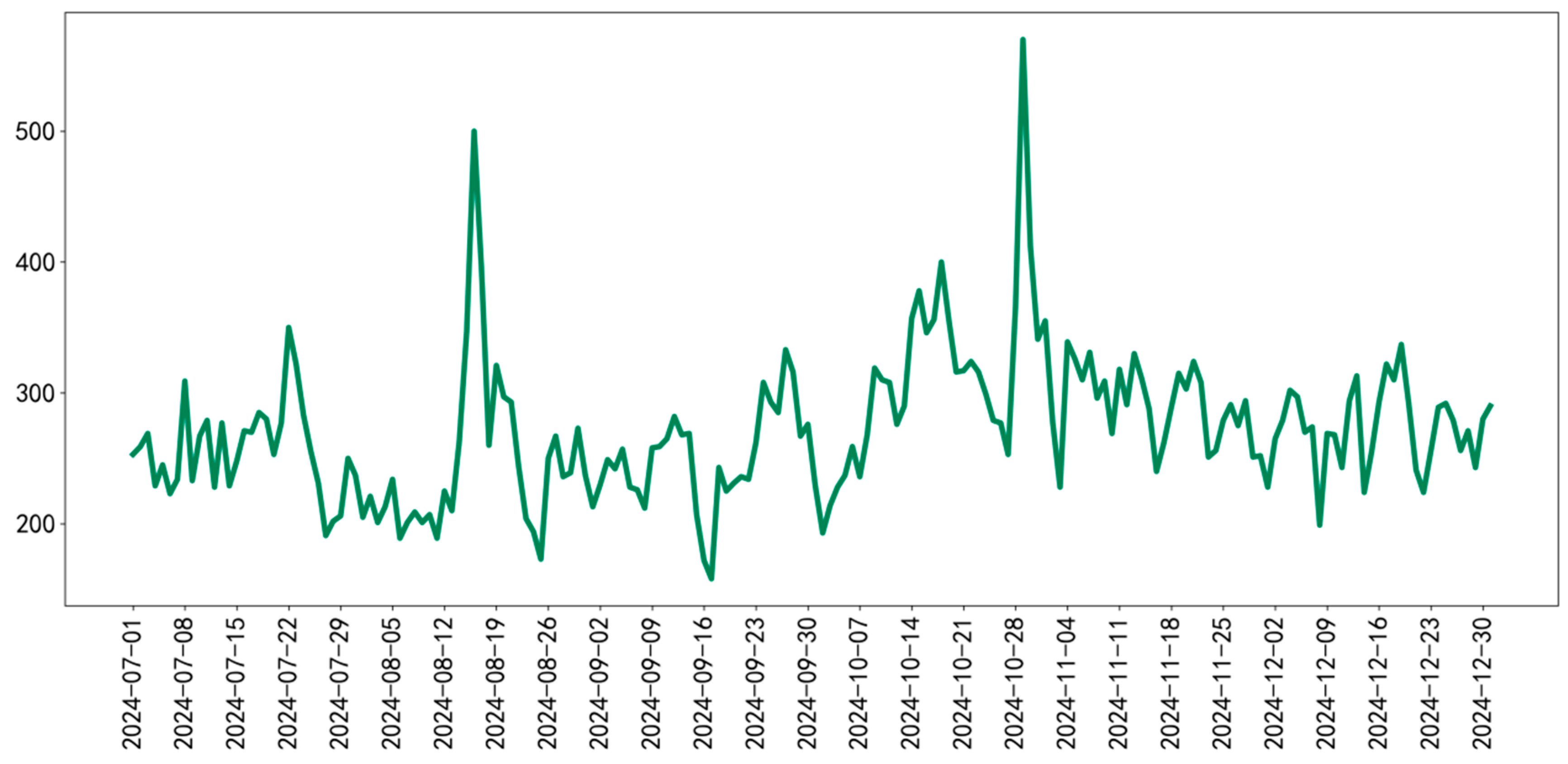
Figure 1 illustrates the daily volume of fertility-related user-generated content from 1 July to 30 December 2024. Overall, fertility discourse exhibits a pattern of sustained activity punctuated by several short-term peaks. Daily post volumes remain relatively stable throughout the observation period, indicating that fertility constitutes a continuously salient public issue rather than an episodic topic driven solely by isolated events.
Two prominent activity peaks can be identified. The first occurred in mid-August 2024 (approximately 15–18 August), during which fertility-related discussions intensified sharply within a short time span. To further substantiate the association between activity peaks and event-related attention shifts, we compared the thematic composition of posts during peak windows with that of non-peak periods. Results show that during the mid-August peak, posts classified under childbearing-related technological and institutional themes accounted for 2.07% of the total content, compared with 1.24% during baseline periods. Although these themes remain a relatively small proportion of overall fertility discourse, their increased presence during the peak suggests a temporary reorientation of public attention toward issues related to assisted reproductive technologies, medical institutions, and regulatory concerns.
The second and most pronounced peak occurred in late October 2024 (centered on October 28), representing the highest daily post volume observed during the entire study period. In contrast to the August peak, this surge was characterized by a stronger policy orientation. During this period, posts related to fertility policies and macro-social population issues accounted for 21.70% of all content, nearly doubling their proportion in non-peak periods (10.99%). Discussions during this window frequently addressed fertility subsidies, childcare support measures, demographic trends, and institutional responsibilities, while simultaneously incorporating references to individual and family-level constraints.
Taken together, these findings indicate that fertility-related discourse demonstrates a high degree of temporal sensitivity to socially salient developments. Rather than replacing ongoing discussions, event-centered moments appear to function as catalysts that temporarily reorganize the thematic structure of an already active communicative field. From this perspective, observed activity peaks reflect contextual associations between external events and shifts in public attention, rather than discrete causal effects, highlighting the dynamic and event-responsive nature of fertility-related public discourse.
4.1.2. Spatial Distribution: Agglomeration in Eastern Regions, Gradient Decreasing
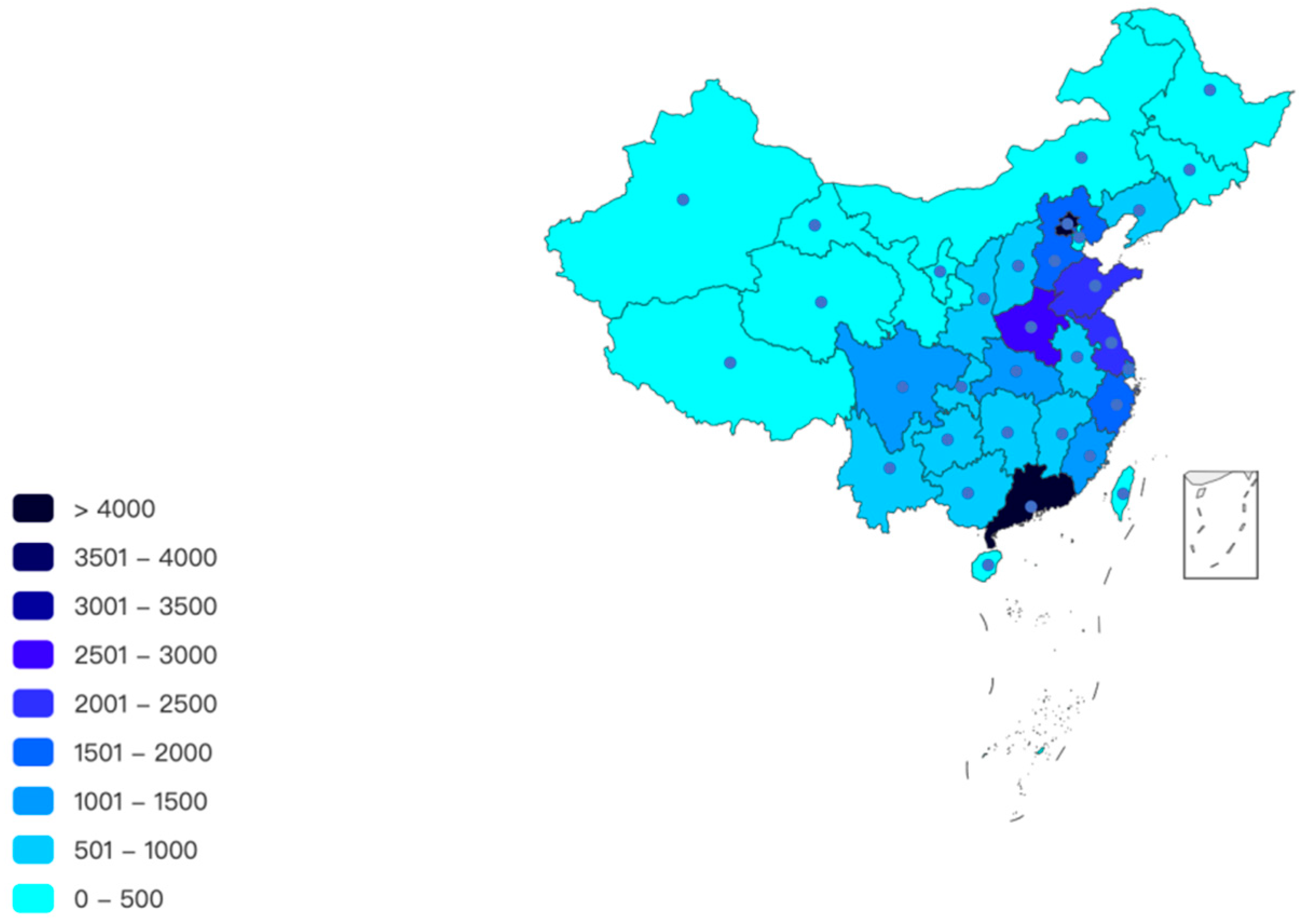
Based on IP geographic information, the spatial distribution of users participating in fertility-related discussions exhibits clear regional agglomeration patterns (
Figure 2). The data show that Guangdong Province ranks first in terms of user volume, while eastern coastal provinces and municipalities—including Beijing, Shandong, Jiangsu, and Zhejiang—constitute the core regions of fertility-related online discussions. User volumes in Guangdong and Beijing are substantially higher than those observed in other regions, forming distinct regional hubs of discussion.
In contrast, user participation in central and western regions remains comparatively low. For example, the number of users from regions such as the Tibet Autonomous Region, Qinghai Province, and Hainan Province accounts for less than 5% of the volume observed in the core eastern regions. From a spatial perspective, the overall distribution displays a gradual declining pattern from eastern coastal areas toward central and western inland regions.
Notably, several central and western provinces—such as Henan and Sichuan—exhibit higher levels of participation compared with other provinces within the same macro-region. Although their overall user volumes remain lower than those of the eastern coastal regions, these provinces stand out as secondary centers of fertility-related discussion within the central and western areas.
4.1.3. Textual Theme Analysis: Distribution of Core Discussion Themes
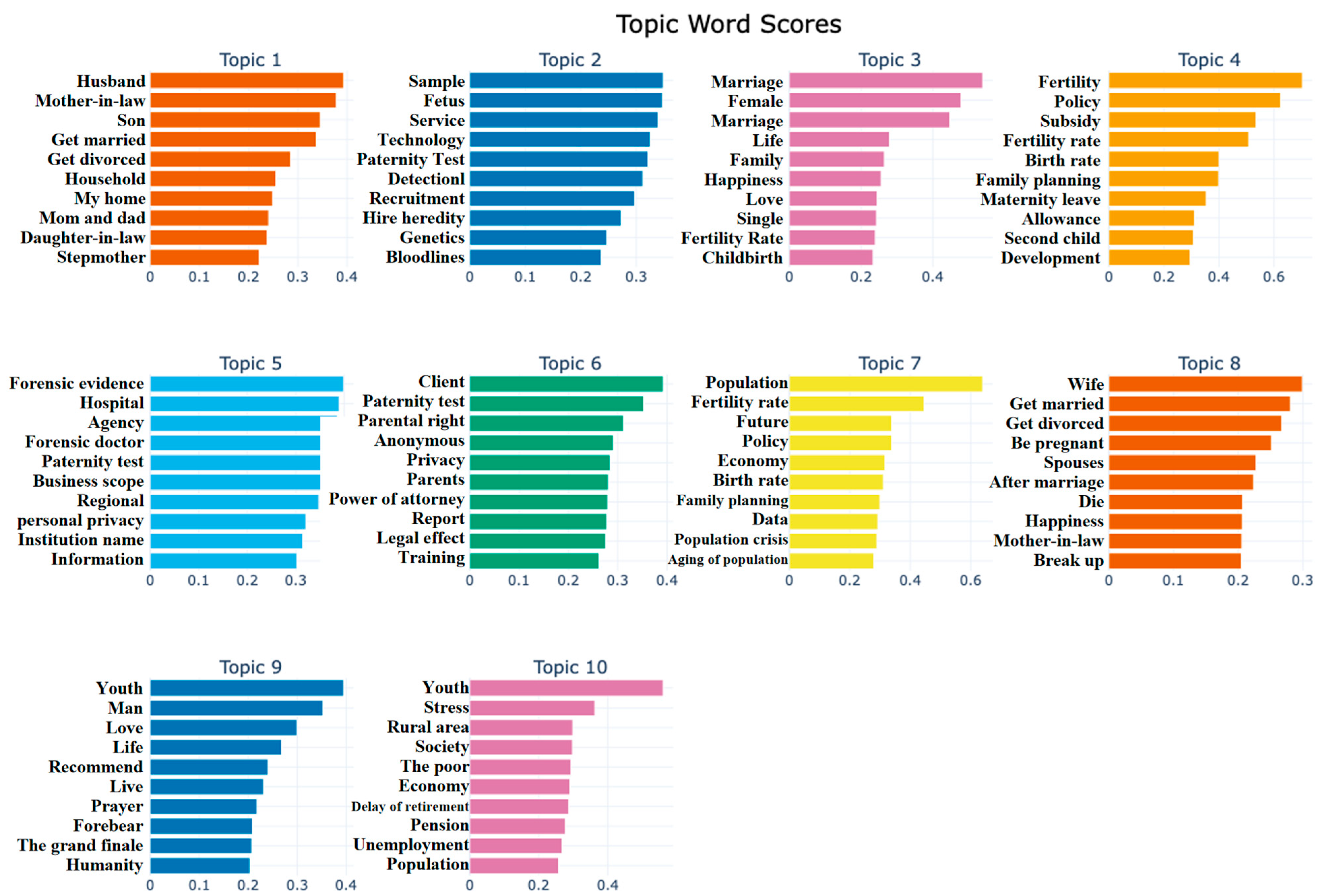
Ten core discussion themes were identified through topic modeling of fertility-related public opinion texts (
Table 2 and
Figure 3). These themes represent recurrent patterns in user-generated content and collectively outline the main topical structure of fertility-related discussions across platforms.
Based on the clustering results and keyword composition, the ten themes can be grouped into three broader thematic dimensions: (1) family conflicts and relationship dynamics, (2) policy- and technology-related issues, and (3) social pressures and life circumstances associated with childbearing. Each dimension encompasses multiple topics characterized by distinct keyword sets and relative frequencies.
(1) Dimension of Family Conflicts and Relationships
The dimension of family conflicts and relationships consists of three themes: Family Childbearing Ethics and Relationships, Spousal Relationships in Family Childbearing, and Marriage and Individual Childbearing Choices. Texts within this dimension primarily focus on interactions among family members and decision-making processes related to childbearing in everyday family contexts.
Keywords associated with these themes frequently reference family roles and marital relationships, including terms such as husband, wife, mother-in-law, marriage, divorce, and pregnancy. Discussions commonly describe situations involving spousal communication, intergenerational interactions, and individual considerations regarding marriage and childbearing. The content under this dimension is largely situated at the micro-level of family life, emphasizing concrete relationship dynamics and personal experiences related to fertility.
In addition, Topic 9 (“Youth Groups and Childbearing Gender”) complements this dimension by capturing youth-oriented discussions where fertility concerns are expressed through gendered expectations and moral–emotional discourse. The keywords (Man; Recommend; Prayer; Forebear; Humanity) indicate that this topic goes beyond men’s fertility rights and reflects peer advice-giving and value-laden narratives. Notably, “Prayer” often functions as an expression of hope or emotional support, while “Humanity” frames childbearing in broader moral terms such as responsibility and intergenerational continuity (“Forebear”).
(2) Dimension of Policy and Technological Issues
The policy and technological dimension includes three themes: Childbearing-related Laws and Institutions, Childbearing Technologies and Related Services, and Childbearing-related Legal Ethics. Texts within this dimension concentrate on institutional arrangements, regulatory frameworks, and technological practices associated with fertility.
Keywords in this dimension frequently involve institutional actors and technical terminology, such as hospital, agency, paternity test, privacy, authorization, and assisted reproductive technology. Discussions commonly address procedural aspects of fertility-related services, legal requirements, and ethical considerations linked to technological intervention in childbearing. Overall, content within this dimension is characterized by a focus on formal institutions, professional practices, and system-level processes related to fertility.
(3) Dimension of Social Pressures and Life Circumstances
The dimension of social pressures and life circumstances comprises three themes: Macro-social Issues of Population and Childbearing, Childbearing Policies and Related Supporting Measures, and Social Realistic Pressures Facing Childbearing. Texts grouped within this dimension situate individual fertility-related discussions within broader social and economic contexts.
Keywords frequently appearing in this dimension include population, fertility rate, policy, economy, youth, pressure, employment, and living conditions. Discussions under this dimension often describe population trends, policy measures related to fertility support, and everyday constraints associated with work, income, and living environments. Compared with the family-level dimension, this set of themes more frequently addresses macro-level conditions and structural contexts in which fertility-related decisions are discussed.
4.1.4. Overall Characteristics of Emotional Trends in Fertility-Related Discourse
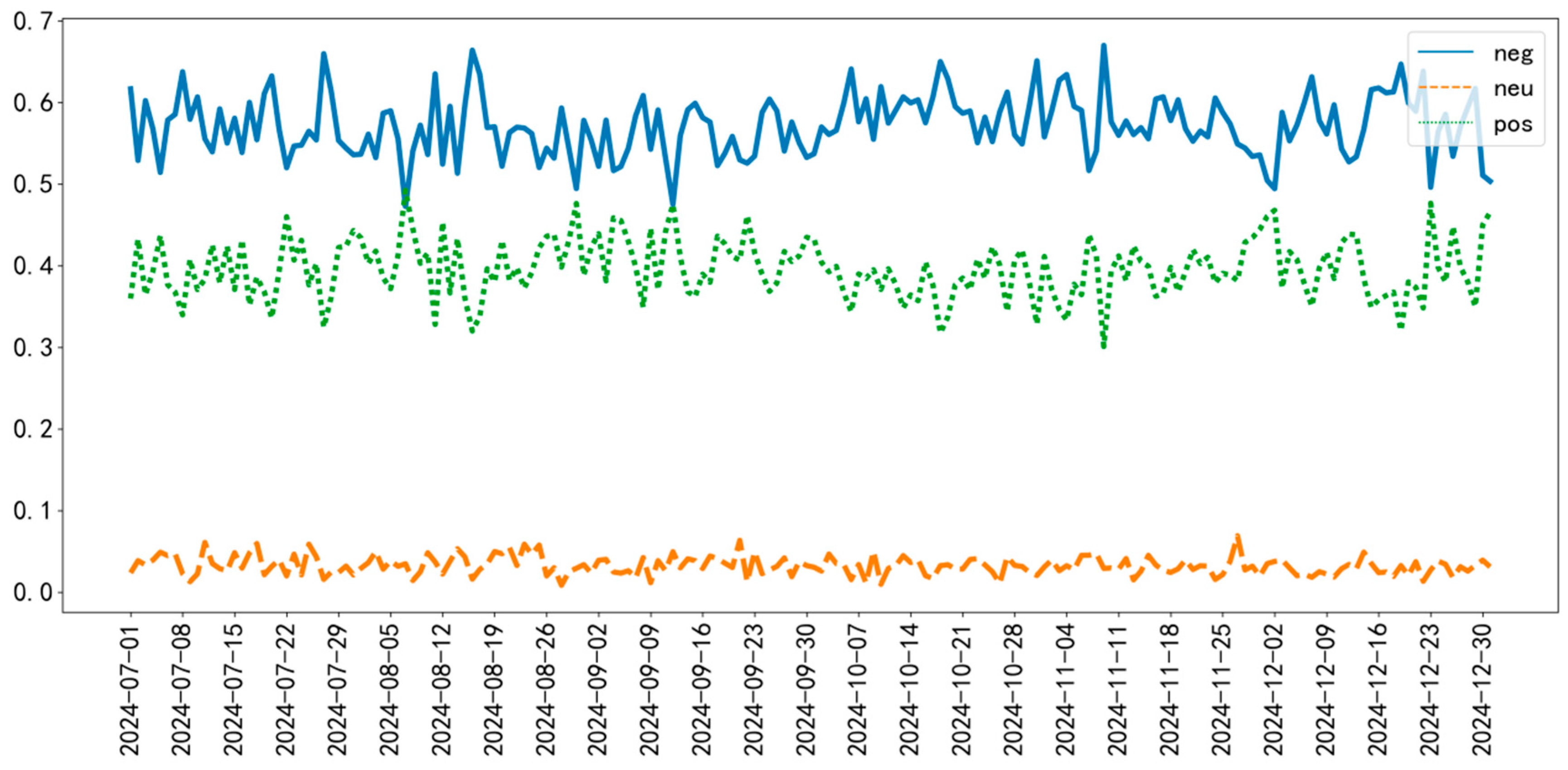
As shown in
Figure 4, fertility-related user-generated content exhibits a mixed emotional distribution over time, with negative, positive, and neutral emotions coexisting throughout the observation period. Based on sentiment scores ranging from −1 to 1, negative values indicate a tendency toward negative emotional orientation, while positive values indicate a tendency toward positive emotional orientation. Across the three platforms, negative emotions account for a relatively large proportion of the total emotional expressions, while positive and neutral emotions remain consistently present.
From a temporal perspective, the distribution of emotional categories shows no abrupt polarization toward a single emotional type. Instead, negative, positive, and neutral emotions appear in parallel across different time points, forming a stable yet heterogeneous emotional pattern in fertility-related discussions. Periods of increased discussion volume are accompanied by fluctuations in emotional proportions, but no single emotional category entirely dominates the discourse.
(1) Negative Emotional Expressions
Negative emotional expressions constitute a substantial portion of fertility-related texts across platforms. Texts classified as negative frequently include sentiment words associated with pressure, dissatisfaction, concern, and uncertainty. These expressions commonly appear in discussions describing personal experiences, everyday constraints, and perceived difficulties related to childbearing.
At the content level, negative emotional texts often reference issues such as economic burden, work–family balance, and family-related responsibilities. Keywords associated with negative sentiment frequently co-occur with terms related to childcare costs, employment conditions, housing, and family relationships. In addition, event-related discussions that attracted high levels of user participation during the observation period were frequently accompanied by a noticeable concentration of negative emotional expressions.
(2) Positive Emotional Expressions
Positive emotional expressions, while less prevalent than negative ones, are consistently present across the dataset. Texts classified as positive commonly include sentimental words related to support, approval, optimism, and encouragement. These expressions are frequently observed in discussions referencing institutional measures, policy-related information, and individual reproductive experiences framed in a supportive manner.
At the content level, positive emotional texts often co-occur with keywords related to fertility-support policies, childcare services, and social recognition. In addition, expressions of encouragement and affirmation toward individual fertility choices are frequently observed, particularly in user interactions such as comments and replies. These positive emotional expressions contribute to the overall diversity of emotional orientations within fertility-related discourse.
Overall, the sentiment analysis indicates that fertility-related discussions are characterized by the coexistence of multiple emotional orientations. Rather than exhibiting a unidirectional emotional tendency, fertility-related public opinion presents a composite emotional structure in which negative, positive, and neutral expressions are continuously interwoven across time.
4.2. Comparison of Textual Themes and Sentiments Across Platforms
4.2.1. Comparative Analysis of Themes Across Platforms
Table 3 presents the distribution of fertility-related themes across Sina Weibo, Toutiao, and Douyin, revealing clear cross-platform differences in thematic emphasis. Although all three platforms engage with a broad range of fertility-related topics, the relative salience of specific themes varies substantially, indicating differentiated patterns of public attention.
(1) Family Conflicts and Relationship-Related Themes
Themes related to family conflicts and relationships constitute a major proportion of fertility discourse across all platforms, but their internal composition differs markedly. On Douyin, this dimension is particularly prominent. Theme 1 (Family Childbearing Ethics and Relationships) accounts for 20.64% of all fertility-related content, while Theme 3 (Marriage and Personal Childbearing Choices) reaches 23.22%, the highest proportion among the three platforms. Together, these themes indicate a strong concentration on intimate family dynamics and individual fertility decisions.
In contrast, Toutiao also demonstrates substantial engagement with family-related topics, but with a more balanced distribution. Theme 8 (Spousal Relationships in Family Childbearing) represents 15.54%, and Theme 3 accounts for 16.88%, suggesting a broader discussion that encompasses both marital relations and individual choices. On Sina Weibo, although family-related themes remain important, their proportions are comparatively lower, with Theme 3 accounting for 19.85% and Theme 1 for 11.82%.
Notably, Theme 9 (Youth Groups and Childbearing Gender) shows a distinct platform divergence. It dominates fertility discourse on Sina Weibo, accounting for 29.67% of all related content, significantly exceeding its presence on Douyin (17.65%) and Toutiao (11.97%). This indicates that gender-related fertility issues concerning younger cohorts receive disproportionate attention on Weibo.
(2) Policy and Technology-Related Themes
Themes under policy and technology controversy display the most pronounced cross-platform differentiation. Sina Weibo shows a strong institutional orientation: Theme 5 (Childbearing-related Laws and Institutions) accounts for 10.09% of content, far exceeding its representation on Toutiao (0.25%) and Douyin (0.42%). This suggests that legal and institutional aspects of fertility are primarily discussed on Weibo.
In contrast, Toutiao allocates more attention to Theme 2 (Childbearing Technologies and Related Services), which accounts for 4.16%, the highest among the three platforms. Discussions of fertility-related technologies are comparatively marginal on Weibo (3.67%) and Douyin (3.27%). Theme 6 (Childbearing-related Legal Ethics) also exhibits notable variation: it accounts for 19.49% on Douyin and 7.70% on Toutiao, compared to 8.85% on Weibo, indicating differing degrees of engagement with ethical controversies surrounding fertility practices.
(3) Youth Anxiety and Social Pressure-Related Themes
Themes associated with youth, anxiety, and social pressure further highlight platform-specific patterns. Theme 10 (Social Realistic Pressures Facing Childbearing) is particularly salient on Toutiao, accounting for 15.08%, substantially higher than on Weibo (6.58%) and Douyin (6.45%). This suggests that structural pressures related to fertility are more frequently articulated within Toutiao’s discourse environment.
Similarly, Theme 4 (Childbearing Policies and Related Supporting Measures) shows a pronounced concentration on Toutiao (7.31%), compared to Weibo (2.51%) and Douyin (1.72%). Theme 7 (Childbearing Anxiety) remains relatively marginal across platforms suggesting that anxiety-related content is more often articulated indirectly through discussions of concrete constraints and policy contexts rather than through explicit emotional expressions.
Overall, the quantitative distribution of themes demonstrates that Douyin prioritizes family ethics, personal choices, and relational dynamics, Sina Weibo foregrounds gender-related and institutional issues, and Toutiao emphasizes macro-social pressures, policy discussions, and structural analyses. These differences suggest that fertility discourse is not uniformly articulated across platforms but selectively structured according to platform-specific thematic concentrations.
4.2.2. Thematic Sentiment Analysis Across Platforms
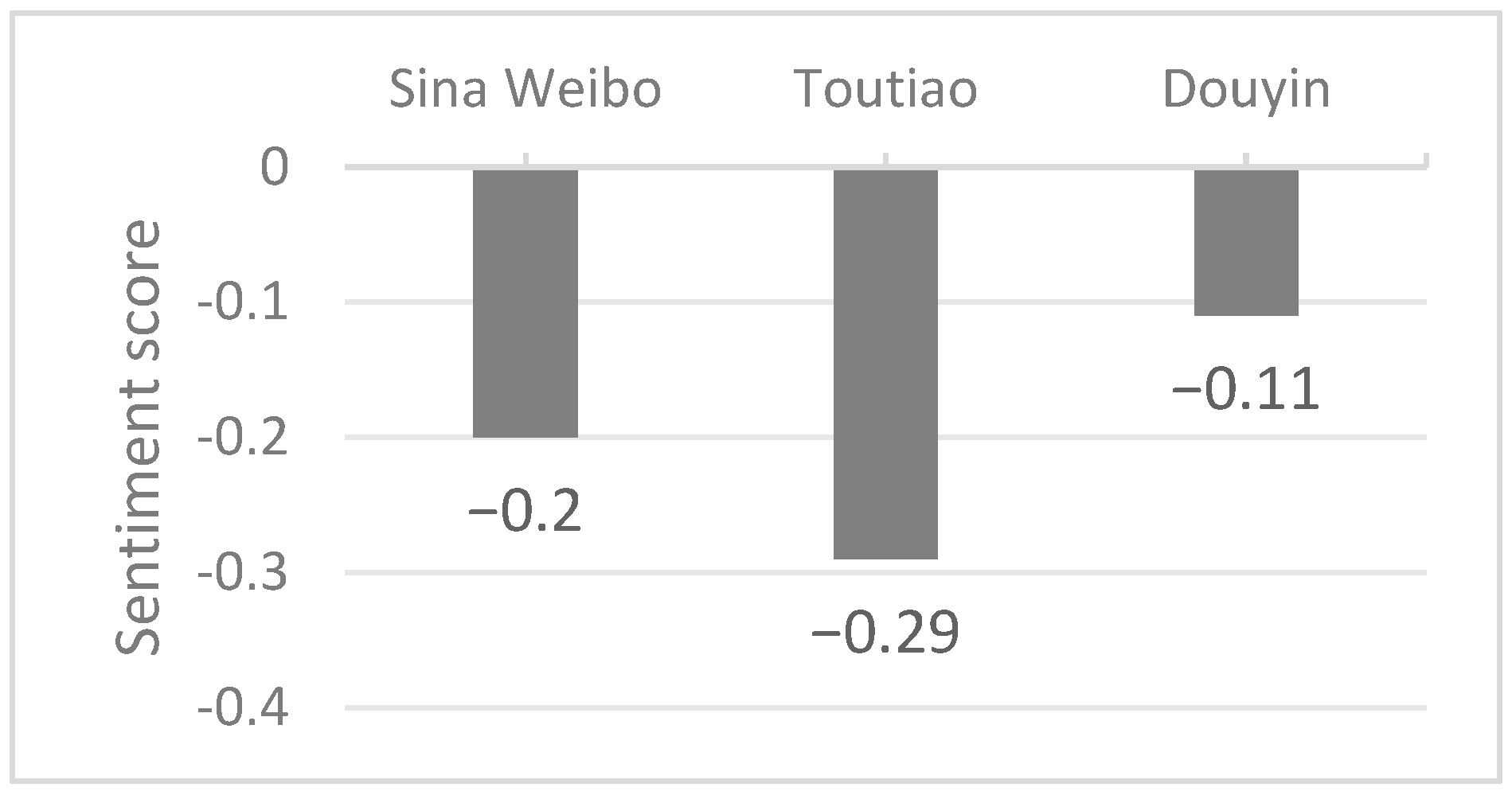
Figure 5 presents the average emotional scores of fertility-related texts across the three platforms. The results show that all three platforms exhibit negative average emotional values. Specifically, the average emotional score on Sina Weibo is −0.20, on Douyin is −0.11, and on Toutiao is −0.29.
From a comparative perspective, Toutiao records the lowest average emotional score among the three platforms, indicating a stronger overall negative emotional orientation in fertility-related discussions. Sina Weibo occupies an intermediate position, while Douyin shows the least negative average emotional score.
Overall, the cross-platform sentiment analysis reveals that fertility-related discussions on all three platforms are characterized by a general negative emotional tendency, with platform-specific differences in the magnitude of this tendency. These differences are directly reflected in the average emotional scores shown in
Figure 5.
5. Discussion
5.1. Temporal Sensitivity of Fertility Discourse: Event-Responsive Public Attention
The temporal analysis suggests that fertility-related discourse exhibits a high degree of sensitivity to issue-specific events, manifested in short-term discussion peaks embedded within a sustained baseline of public attention. Rather than emerging episodically, fertility discourse remains continuously present over time, while periodically intensifying around moments that foreground particular dimensions of reproductive life. This pattern indicates that fertility functions as a persistent public issue whose focus is temporarily reorganized by salient social and policy-related developments.
The first discussion peak observed in mid-August 2024 temporally coincided with public attention to a controversy involving assisted reproductive treatment. This event foregrounded issues such as medical ethics, privacy protection, and institutional accountability, drawing fertility discourse toward individual experiences and rights-related concerns. As an illustrative case, it highlights how fertility-related discussions may become temporarily concentrated around micro-level and experience-based topics when ethical and personal dimensions are made salient in the public sphere.
In contrast, the second peak in late October 2024 coincided with the circulation of information related to fertility-support policy systems. During this period, discussions displayed a stronger orientation toward institutional measures such as childcare services and fertility subsidies, while simultaneously incorporating references to individual constraints and lived experiences. This pattern suggests that policy-related developments may activate fertility discourse across both macro-level institutional considerations and micro-level practical concerns.
Taken together, these two peaks illustrate the event-responsive nature of fertility-related public attention. Rather than replacing ongoing discourse, event-centered moments function as catalysts that momentarily reorganize attention within an already active communicative field. Online public opinion does not operate as a static aggregation of views but emerges through collective, time-dependent shifts in attention and expression, in which events shape the intensity and configuration of discussion without displacing underlying structural concerns (
Zhang et al. 2021). From this perspective, fertility discourse can be understood as a continuously evolving conversation that is periodically restructured by socially salient events.
5.2. Spatial Inequality and the Uneven Geography of Fertility Discourse
The spatial distribution of fertility-related discussions reveals a clear pattern of regional concentration, with eastern coastal provinces emerging as the primary hubs of online participation, while central and western regions display comparatively lower levels of engagement. This uneven geography reflects not only differences in user volume but also broader disparities in the visibility of fertility-related issues within digital public spaces.
One plausible explanation for this concentration lies in uneven participation capacity across regions. Areas with higher levels of economic development—such as eastern coastal regions—may provide more favorable structural conditions for sustained online engagement, including denser communication networks and higher levels of platform activity. These conditions are likely to increase the visibility and persistence of fertility-related discussions within public communication spaces.
At the same time, spatial inequality in fertility discourse is not absolute. Several central and western provinces function as secondary discussion centers despite their geographic location, suggesting that population scale may partially offset regional disparities in online participation. This pattern indicates that spatial differences in fertility discourse are shaped by a combination of geographic location, demographic scale, and participation capacity rather than by regional attitudes alone.
Overall, the observed spatial concentration highlights the geographically uneven nature of digital public participation. Fertility discourse appears to be structured not only by individual experiences and policy contexts but also by structural conditions that influence who participates and which regional voices become more prominent in fertility-related public discussions.
5.3. Platform Differentiation and Discursive Configuration of Fertility Discourse
Building on the comparative distribution of themes across platforms, the findings demonstrate that fertility discourse is not articulated uniformly within the digital public sphere. Rather than reflecting fundamentally different fertility attitudes among users, cross-platform variation reveals how platform-specific communication environments selectively organize the visibility, salience, and expressive form of fertility-related issues. From a platformization perspective, social media platforms function not as neutral arenas of expression, but as infrastructural actors that actively shape public discourse through algorithmic recommendation, interaction design, and attention allocation mechanisms.
On Sina Weibo, fertility discourse is predominantly structured around gender relations, institutional arrangements, and rights-based claims. Quantitatively, Theme 9 (Youth Groups and Childbearing Gender) accounts for 29.67% of fertility-related content—the highest proportion among the three platforms—while Theme 5 (Childbearing-related Laws and Institutions) reaches 10.09%, far exceeding its representation on Douyin and Toutiao. This configuration reflects Weibo’s long-established role as a highly visible arena for public debate and policy-oriented discussion, where trending hashtags, repost mechanisms, and comment-based deliberation facilitate the articulation of institutional critique. In this environment, fertility is framed less as a private family choice than as a public issue situated at the intersection of gender equality, labor rights, and policy implementation. Such patterns align with Gillespie’s argument that platforms operate as custodians of public visibility: Weibo’s algorithmic and interactional structures privilege rights-based, contestational discourse, rendering institutional dimensions of fertility more publicly salient (
Gillespie 2014).
By contrast, Douyin exhibits a discursive configuration centered on family ethics, interpersonal relationships, and individualized childbearing choices. Themes related to everyday family life—particularly Theme 1 (Family Childbearing Ethics and Relationships, 20.64%) and Theme 3 (Marriage and Personal Childbearing Choices, 23.22%)—together account for nearly half of fertility-related content on the platform. Compared with Weibo and Toutiao, institutional and policy-oriented themes are relatively marginal. This pattern reflects the platform’s short-video format and engagement-driven recommendation logic, which favor emotionally resonant, scenario-based narratives rooted in concrete life experiences. Within Douyin’s attention economy, fertility issues are frequently articulated through dramatized family conflicts, personal dilemmas, and relational storytelling. As
Napoli (
2019) suggests, platforms structured around engagement metrics tend to amplify emotionally charged and conflict-oriented content, shaping fertility discourse toward experiential visibility rather than analytical or institutional framing (
Napoli 2019).
Toutiao presents a third discursive configuration, characterized by a stronger orientation toward macro-social pressures, policy interpretation, and expert-driven narratives. Theme 10 (Social Realistic Pressures Facing Childbearing, 15.08%) and Theme 4 (Childbearing Policies and Related Supporting Measures, 7.31%) reach their highest proportions on this platform, while Theme 2 (Childbearing Technologies and Related Services) is also more prominent than on Weibo and Douyin. As an information aggregation platform emphasizing long-form text and explanatory content, Toutiao provides a communicative environment conducive to structural analysis and rationalized discussion. Fertility discourse here is frequently framed as a societal issue embedded in economic conditions, demographic trends, and institutional design, rather than as an individualized moral or emotional concern.
Across platforms, themes explicitly labeled as fertility anxiety remain relatively marginal in proportional terms. However, the prominence of themes related to social pressure, institutional constraints, and policy conditions suggests that fertility-related concerns are more often articulated indirectly through references to concrete structural factors than through overt emotional expression. This finding underscores the importance of considering not only thematic focus but also discursive form: platform-specific visibility regimes shape how fertility anxieties are rendered publicly legible, privileging problem-oriented narratives over explicit affective disclosure.
Taken together, these findings demonstrate that platform differentiation produces distinct platformized configurations of fertility discourse. Drawing on the platformization of cultural production framework (
Nieborg and Poell 2018), fertility-related communication can be understood as being reorganized into different discursive production modes across platforms: rights-based institutional critique on Weibo, emotionally resonant family narratives on Douyin, and macro-social, policy-oriented interpretation on Toutiao. Platforms thus shape not the existence of fertility concerns themselves, but the discursive pathways through which such concerns become visible, discussable, and collectively recognized within the digital public sphere.
5.4. Platform Differentiation and Emotional Expression in Fertility Discourse
Through quantitative analysis of emotional tendencies in fertility-related public opinion texts across Douyin, Toutiao, and Sina Weibo, this study finds that all three platforms exhibit a negative average emotional orientation, with sentiment scores of −0.11 on Douyin, −0.29 on Toutiao, and −0.20 on Weibo (
Figure 5). At the descriptive level, this overall negative bias is consistent with the real-life pressures identified in the thematic analysis, including economic burden, work–family conflict, and institutional constraints. However, these quantitative patterns alone do not indicate that users hold uniformly negative fertility attitudes. Rather, they highlight systematic differences in how fertility-related emotions are publicly expressed across platform environments.
As open arenas for information dissemination, opinion exchange, and social issue discussion, Douyin, Toutiao, and Weibo all function as public discourse spaces. Prior research has shown that emotional expression strategies differ substantially between public and private communicative environments, particularly in terms of visibility, interaction security, and perceived social risk (
Bazarova and Choi 2014). Within this context, the observed concentration of negative emotions on public platforms can be interpreted through what this study conceptualizes as an emotional filtering mechanism. This mechanism refers to a patterned tendency whereby users selectively distribute fertility-related emotions across platforms with different functional orientations, rather than expressing the full emotional spectrum uniformly in all spaces.
Specifically, positive emotions associated with fertility—such as joy, fulfillment, and parent–child intimacy—may be more likely to circulate within private or semi-private platforms characterized by acquaintance-based interaction, where emotional sharing is socially safer and relationally bounded (
Bazarova 2012). By contrast, negative emotions appear more frequently in public platforms, where visibility, resonance, and issue amplification are more attainable. It should be noted that private platforms are not directly analyzed in this study; therefore, this interpretation is grounded in observed public-platform patterns and supported by existing literature on emotional expression in acquaintance-based social media, rather than by direct empirical testing within private spaces.
From this perspective, the negative emotional orientation observed across the three public platforms should be understood not as a direct reflection of pessimistic fertility attitudes, but as the outcome of problem-oriented communicative practices. When users encounter fertility-related difficulties, public platforms are often perceived as appropriate venues for seeking collective resonance, articulating grievances, or drawing attention to structural constraints. Emotionally negative and problem-focused content is more likely to gain visibility within public discourse environments oriented toward issue salience and debate (
Napoli 2019). This problem-focused emotional orientation is also consistent with recent research on “fertility fear” in Chinese social media, which shows that platform-mediated discourse tends to frame women’s reproductive experiences through risk, sacrifice, and moral responsibility, thereby intensifying the public visibility of negative fertility-related emotions (
Han 2025).
Platform-specific emotional patterns further illustrate this differentiated structuring. Toutiao exhibits the strongest negative orientation (−0.29), which is consistent with its positioning as a platform for policy discussion and macro-social analysis. Fertility discourse on Toutiao frequently frames childbearing as a structural issue embedded in economic pressure and institutional limitations, resulting in a cumulative affective tone characterized by pessimism and concern. On Sina Weibo, negative emotions are often articulated through confrontational debate and rights-based critique, particularly in discussions related to gender equality and policy implementation. Although affirmative viewpoints occasionally appear, the competitive and agenda-driven nature of public debate may render negative emotions more discursively prominent. Douyin, by contrast, shows a comparatively milder negative orientation (−0.11). While fertility-related stress is clearly present, negative emotions on Douyin are frequently embedded within personalized and narrativized life scenarios, where emotional expression is moderated through storytelling, humor, or aesthetic framing.
Importantly, the proposed emotional filtering mechanism should be understood as an analytical interpretation rather than as a causally verified process. It does not deny the presence of positive fertility-related content on public platforms, nor does it claim to capture users’ complete emotional experiences. Instead, it offers a conceptual lens for understanding why fertility discourse in public digital spaces tends to exhibit a problem-focused emotional profile. In this sense, the negative emotional bias observed across Douyin, Toutiao, and Weibo reflects both the structural pressures surrounding fertility and the platform-mediated organization of emotional expression.
Taken together, these findings suggest that platform differentiation shapes not only the thematic focus of fertility discourse, but also the modes through which fertility-related emotions are publicly articulated and circulated. Public platforms tend to privilege problem articulation and issue visibility, whereas positive emotional sharing is likely to be comparatively underrepresented in such environments. This platformized pattern of emotional expression contributes to a broader understanding of how fertility-related emotions are selectively filtered and structured within contemporary digital public spheres.
6. Conclusions
This study examined fertility-related user-generated content (UGC) on three major Chinese platforms—Douyin, Toutiao, and Sina Weibo—to investigate how fertility discourse is thematically organized and emotionally expressed across platformized public spheres. Drawing on large-scale textual data collected between June and December 2024 and employing topic modeling and sentiment analysis, the study provides a systematic cross-platform comparison of fertility discourse within contemporary Chinese social media environments. The findings reveal that fertility discourse is not uniformly articulated across platforms, but rather selectively structured through platform-specific communication logics that shape both thematic emphasis and emotional expression.
At the thematic level, the study identifies ten core topics clustered into three broader dimensions: family relationships and fertility ethics, policy- and technology-related issues, and social pressures surrounding childbearing. Cross-platform comparison demonstrates distinct discursive configurations. Douyin primarily foregrounds individualized and relational narratives embedded in everyday family life, emphasizing personal choice, intergenerational dynamics, and women’s lived experiences. Sina Weibo functions as a prominent arena for rights-based debate and institutional critique, with fertility frequently framed through gender relations, policy implementation, and public accountability. Toutiao, by contrast, situates fertility discourse within macro-social and structural contexts, privileging policy interpretation, demographic trends, and expert-oriented analysis. These differences do not suggest fundamentally divergent fertility attitudes among users; instead, they highlight how platform architectures organize the public visibility of fertility-related issues in different ways.
At the emotional level, sentiment analysis reveals a shared pattern of negative emotional orientation across all three platforms, albeit with varying intensity. Rather than interpreting this negative bias as a direct reflection of uniformly pessimistic fertility attitudes, this study argues that it should be understood in relation to the public nature of the platforms under investigation. As open discourse spaces oriented toward issue visibility and debate, these platforms tend to privilege problem-focused and conflict-oriented expressions. Building on this observation, the study proposes an emotional filtering mechanism as an analytical framework to explain how fertility-related emotions are differentially distributed across communicative spaces. Negative emotions, characterized by higher issue salience and resonance potential, are more likely to be articulated and amplified in public platforms, while positive emotions associated with intimacy, fulfillment, and relational warmth are more likely to circulate within private or semi-private, acquaintance-based environments. Importantly, this mechanism is proposed as an interpretive lens grounded in cross-platform patterns and the existing literature, rather than as a causally verified process.
Taken together, the findings contribute to fertility research in three main ways. First, empirically, the study provides a comprehensive, data-driven overview of fertility-related discourse across multiple social media platforms, capturing both thematic diversity and emotional complexity within naturally occurring communication. Second, theoretically, by integrating a platformization perspective, the study moves beyond content-centered or user-centered explanations and demonstrates how fertility discourse is actively organized through platform-specific visibility regimes, attention economies, and interaction logics. Third, conceptually, the proposed emotional filtering mechanism offers a novel way to understand why fertility-related public opinion tends to exhibit a problem-oriented emotional profile, highlighting the role of platform-mediated emotional organization rather than attributing emotional patterns solely to social reality pressures or individual attitudes.
Despite these contributions, this study has several limitations. The analysis focuses on highly visible UGC texts, which may underrepresent long-tail users and marginalized groups, such as rural populations or non-mainstream family forms. In addition, the study adopts a largely static analytical approach, leaving the dynamic diffusion paths of fertility discourse and cross-platform interaction effects unexplored. Moreover, while the emotional filtering mechanism is theoretically grounded and empirically plausible, its underlying psychological processes and causal dynamics require further investigation through mixed-methods designs or experimental approaches.
Nevertheless, the findings offer meaningful implications for both policy communication and platform governance. Policymakers may benefit from adopting platform-sensitive strategies when communicating fertility-related policies—for example, embedding policy messages within everyday life scenarios on Douyin, providing in-depth policy interpretation on Toutiao, and addressing rights-based concerns and public demands on Weibo. At the same time, platform operators and public institutions should remain attentive to the accumulation and amplification of negative fertility-related emotions in public discourse spaces and explore ways to facilitate more balanced emotional expression without suppressing legitimate problem articulation.
In conclusion, fertility in contemporary China should be understood not only as a demographic or socioeconomic issue, but also as a platform-mediated communicative phenomenon. By showing how platforms shape both the thematic pathways and emotional forms through which fertility concerns are publicly articulated, this study contributes to a more nuanced understanding of fertility discourse in the digital age and provides a foundation for future research on the intersection of population issues, media platforms, and public emotion.