

Children at the Centre: Considering the Whole Child in a National Model of Support for Children with a Parent in Prison
 , , ,
, , ,
Abstract
1. Introduction
- Review the existing literature and practices relating to support for children affected by parental imprisonment;
- Consider how the ‘school zone’ model in His Majesty’s Prison and Young Offender Institution (HMP and YOI) Parc operates and the extent to which it represents good practice;
- Consider what a national model of support for children affected by a parent’s imprisonment could look like.
- Phase one: Scene setting and foundations.
- Phase two: Review of HMP and YOI Parc School Zone model.
- Phase three: Foundation-building for a comprehensive model of support.
- Phase four: Final gathering of evidence to develop the model.
- Phase five: Presentation of the model within the final report.
2. The Literature
3. Methods
3.1. Phase One: The Literature, Policy, and Practice
3.2. Phase Two: Review of HMP and YOI Parc School Zone Model
- Review descriptive statistics.
- Observe delivery of a School Zone event.
- Undertake interviews.
- Facilitate focus groups with fathers in prison, children, and carers.
3.3. Phase Three: Foundation-Building
‘I found meeting and listening to other professionals involved with the care of children with a parent in prison helpful and [allowed] teachers a voice in the process who could feed back their own interpretation of that vital relationship with parents in custody.’(Education professional)
3.4. Phase Four: Final Gathering of Evidence
- Twelve prison staff from a range of designations from prisons not currently operating the School Zone model1 (Heads of Operations, Head of Skills and Learning, Reducing Reoffending, two Governors, an education practitioner, and wing and visits staff).
- Four education staff from different roles (primary school teacher, secondary school teacher, pupil referral unit (PRU) headteacher, education welfare officer (EWO), and a Thrive practitioner)2.
- Five Welsh Government policy stakeholders (social work, education, ACEs and trauma-informed practice, criminal justice).
- Four children and young people with experience of a parent’s imprisonment other than in HMP and YOI Parc.
- Three carers of children and young people with a parent in prison other than HMP and YOI Parc.
- Three parents (2 fathers and a mother) in a prison other than HMP and YOI Parc, plus two written responses from Welsh-speaking fathers in prison.
4. Findings
- Retaining a focus on a children’s rights approach while working within the confines of a prison environment;
- Reaching all children in Wales, regardless of where their parent is held or whether they visit the prison;
- Creating the infrastructure required in terms of training, collaboration, and funding to ensure services are accessible and sustained.
‘It helps me feel more comfortable in school as my teachers know the seriousness of what’s going on with Dad, so when I have a bad day, they have a better understanding.’(Young person)
‘This has really opened my eyes to what children and families go through—even the cost of getting here [the prison], never mind the emotional cost.’(Teacher)
‘We will understand their behaviour more now, and it will help us to provide consistent support.’(Teacher)
‘I can’t even begin to explain how beneficial this has been for me. Nobody in the outside world seems to understand the continual stress, devastation, emotions and daily obstacles that we go through more than they do.’(Parent)
| Megan’s Story Megan (not her real name) was 17 when her mother first went to prison. Although still a child, her needs were not considered in any of the criminal justice decisions regarding her mother: “I remember someone at court saying to my mum, ‘You’re living with your daughter’, but that was the only time I was ever mentioned.” Megan was left alone in the house with no money to buy food or essentials such as toiletries: “I had a social worker at the time, but I was just left in my house with no food. I couldn’t eat. I had no money for food or anything. The social worker was not with it at all, he didn’t understand what I was going through. He used to walk round with his briefcase and not do much.” The housing association that provided Megan’s mother’s flat took back the lease and said that Megan did not qualify for housing as she was under 18. She felt judged by her mother’s crime: “These two ladies who worked there spoke to me as if I was nothing. They did everything they could to undermine me. One of them said to me, ‘I wouldn’t do to my daughter what your mum has done to you.’” Megan was rendered homeless and was offered a place in a homeless shelter where she felt very unsafe. Over the last two years, Megan’s mother has been in and out of prison 11 times. Megan has spent that time sofa-surfing at friends’ houses, sleeping in her boyfriend’s car, and occasionally staying with extended family. The first time Megan’s mother was arrested (which did not lead to a custodial sentence), she was at school. Megan was aware that some staff knew, but she was not sure how they knew or what they knew: “The social care person in school found out mum had been arrested… the police or my social worker maybe told her. I wasn’t told they’d told her… it would’ve been better to tell me that school had been told.” No one at school asked her how she was or offered her support: “[A teacher] just said, ‘I heard about what happened with your mum.’” Megan’s experiences have left her with a clear sense of what would have made a difference at school and college: “They [teachers] should … have compassion and understanding… you need to actually understand what they’re going through… listen to people’s experiences… listen to everyone’s situation. Decisions have been made about me, but no one has ever asked me… schools could ask me what I need.” While she feels that information sharing is important (“It is good that college knows so that they can try and support you.”), she is clear that, “children and young people need to know who’s being told [and] asked their opinions about who should be told. The person who works with you should say, ‘Would you like the school or college to know?’” When her mother first went to prison, Megan approached the job centre for support with accessing universal credit: “This woman was really unhelpful. She said, ‘Get out, we can’t help you’. She didn’t listen to me or anything… I said, ‘Look I’m struggling, my mum’s gone to prison’, and she said, ‘You’re not 18, we can’t help you.’ She seemed in a bad mood. There was animosity from her, like she was judging me.” There were meetings about her (“My social worker, mum’s probation worker, and someone from college had a joint meeting… but there was nothing in the meeting about housing.”), but Megan felt no one actually listened to her, far less acted: “I felt nobody cared about me. They’re being paid, all these workers who were meant to help me, but nobody did anything.” Megan found visiting her mother in prison frightening: “It was very blunt. It was straightforward blunt—they should make it less scary. I saw tables with colouring books and stuff, but the general vibe was scary… it wasn’t welcoming” Prison staff did not help alleviate these fears: “They didn’t even speak to me, they treated us like an army: ‘Walk there, do this, don’t do that.’” She is clear what would help: “Prison staff should get training on what it’s like for kids… it would definitely help to hear from young people like me in training.” Megan has experienced small acts of kindness over the last two years: “College did help out of anyone; they gave me toiletries (shampoo/shower gel and stuff… I’m not sure how they knew, but college just knew [that mum was in prison].” Her mother’s probation practitioner showed compassion: “Before my mum’s release, my mum’s probation officer texted me to say, ‘Your mum’s coming out, call me if you need me.’ She is really nice and really understanding. She understood my situation.” And two neighbours each provided a meal for Megan (which she still remembers in detail two years later). These isolated incidents of compassion are not enough to ensure children and young people like Megan receive the support they need and deserve. As Megan says, “There should be more support from schools, social workers, and prisons—more overall support emotionally, being truly understood and practical help and support.” Megan is clear that the practical help must include housing for young people like her: “The housing people need to understand—housing is a massive part… your mum’s been taken away from you, but how can you live independently now? You will need support with housing and stuff because you’re just left out… you look at all your friends’ mums, and you realise you’re left out.” And while a collaborative approach is essential, “When people come into teams [around a child] and when they gather organisations together, they should actually do [something] instead of making it the child’s responsibility. They say they’re going to help but they don’t—that really lets the child down.” Megan’s story shines a light on the systemic failings of a criminal justice system that does not consider the impact on children. This report is an opportunity to ensure that those with the power to make changes listen to the children and young people impacted by their decisions. As Megan says, “The government should listen to people like me.” But listening is not enough; urgent action is required so that no more young people in Wales echo Megan’s words: “I have literally had no help. I am homeless right now. I have seen the worst things. I’ve watched my life fade away. All I’ve ever had is to be shut down. I wouldn’t wish what’s happened to me on my worst enemy.” |
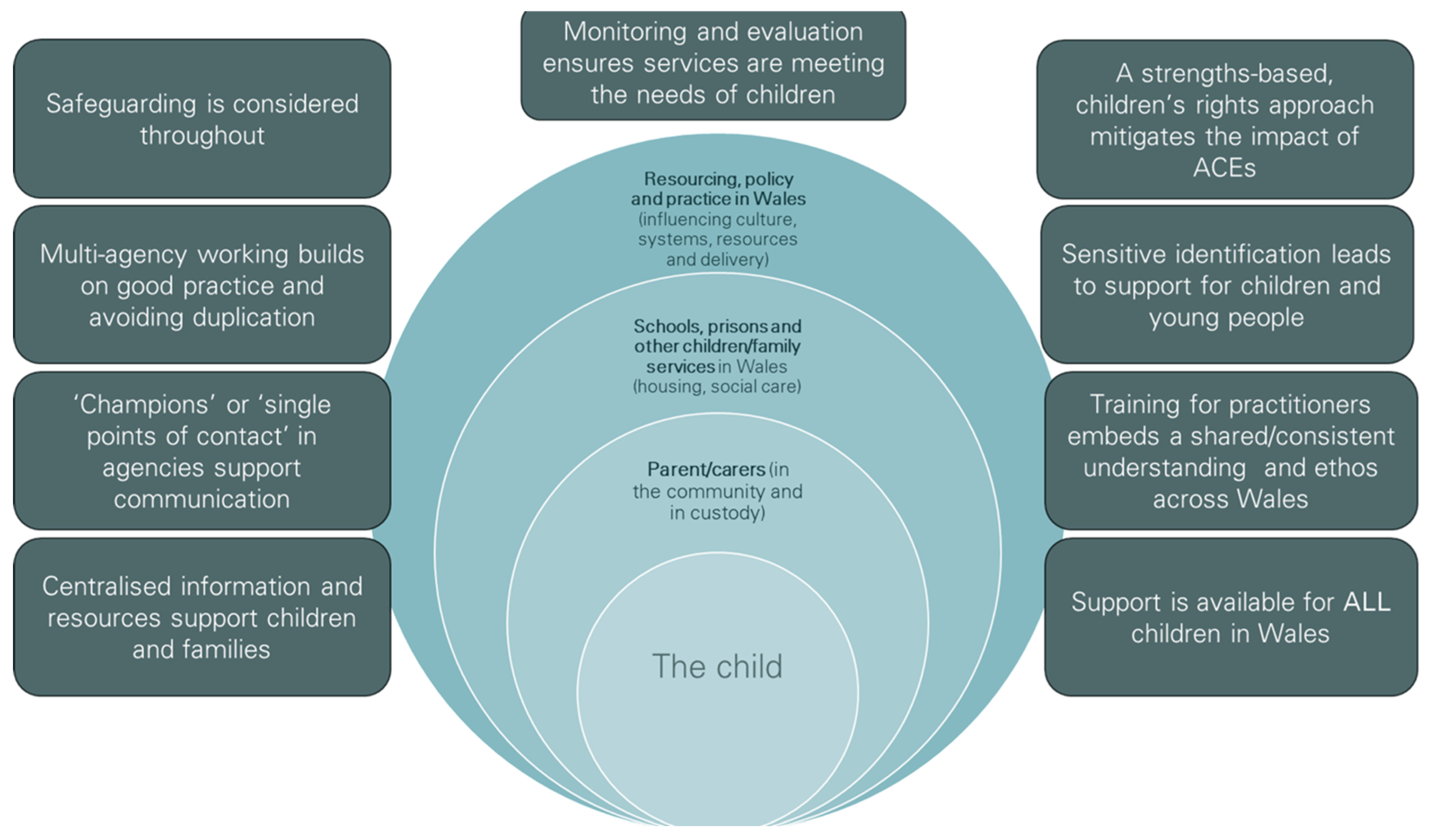
- A strengths-based, children’s rights approach to support.
- Effective policy and resourcing.
- Centralised access to information and resources.
- Multi-agency working.
- Training.
- Identification of children affected by parental imprisonment.
- Including all children in support.
- Safeguarding.
- Monitoring and evaluation.
4.1. A Strengths-Based, Children’s Rights Approach
4.2. Policy and Resourcing That Supports a National Model
4.3. Centralised Access to Information and Resources
4.4. Multi-Agency Working
4.5. Training
4.6. Sensitive Identification of Children When a Parent Goes to Prison
4.7. Including All Children in Support
4.8. Safeguarding
4.9. Monitoring and Evaluation
5. Discussion and Recommendations
- The rights of children and young people must be considered at all stages of a parent’s journey through the criminal justice system, recognising that children with a parent in the criminal justice system deserve support in and of their own right and not simply as a means of influencing their parent’s sentence or rehabilitation.
- A children’s rights-based approach requires a consistent, visible, national commitment to children affected by parental imprisonment, including a national commissioning model for the provision of support for children that promotes collaboration, sustainability, and nation-wide support.
- All children and families affected by imprisonment must have access to consistent and appropriate support, regardless of whether they visit or wish to remain in contact, and regardless of where the parent is held in prison.
- A rights-based approach requires a culture of collaboration for support for children affected by parental imprisonment. This includes development of a detailed understanding of the national training landscape for key professionals in relation to children affected by parental imprisonment—something that should be agreed, comprehensive, and consistent.
- Awareness about the impact of parental imprisonment across all agencies working with children and families must increase, ensuring that all government-funded or government approved training programmes provide consistent messaging; are underpinned by common principles (trauma-informed, destigmatising, children’s rights-centred, and strengths-based); are accessible to all professionals working with children and families; and are evidence-based, monitored against a common set of learning outcomes.
- Ongoing discussions about the identification of children with a parent in prison must avoid perpetuating stigma and should embrace the six key elements of safety, trust, choice, collaboration, empowerment, and cultural consideration crucial to trauma-responsive practice (Office for Health Improvement & Disparities 2022). Sensitivity to the methods, purpose, and use of identification is paramount.
- Schools should create environments in which families and children feel safe to disclose the imprisonment and, through training, staff should feel confident in knowing how to respond to that disclosure and provide appropriate support. Equally, prisons must be supported to create environments in which parents in custody feel safe to disclose that they have children, and prison staff should feel confident in knowing how to support parents in prison to engage with their child’s school, where appropriate. Schools, nurseries, youth services, and colleges, as well as universal, statutory, and third sector services, have a vital role to play in supporting children.
- The support offered to children with a parent in prison must be consistent nationally but flexible enough to allow for a diverse range of needs. Support for children with a parent in prison cannot rely solely on in-prison provision, as not all children visit prisons, and not all parents are imprisoned locally. Children and young people must have the opportunity to define what their needs are, so that progress is monitored against outcomes that are informed by their unique needs. Child impact assessments (Prison Reform Trust 2022; Beresford 2018) are one tool available to identify the needs of each individual child in their own words.
- Any national model must provide support for parents and carers of children affected by parental imprisonment.
- All agencies working to support children with a parent in prison must have robust child safeguarding policies in place that are clearly communicated to all partner organisations.
- Any national approach needs to develop an improved understanding of the number and needs of children affected by parental imprisonment across the country. It also needs to ensure that outcomes, informed by children’s unique needs, are central to any national model of support, ideally embedded within existing policies and supports to prevent it from being seen as an additional strain on time and resources.
| Evan’s story Evan (not his real name) was 13 when his mother went to prison. He was looked after by his grandmother who found the experience difficult and frightening: ‘We’re a normal, everyday family. We were in shock. It is absolutely petrifying for families.’ In contrast to Megan, who was left alone and unsupported, Evan’s story is one that demonstrates the difference that all agencies can make by having a kind and compassionate approach. This was evident right from the arrest, as Evan’s grandmother explains: ‘The police brought [Evan] round to ours after they’d arrested his mum. They phoned me and said they’re bringing him round to me in a normal car, not a police car. The police were lovely—their priority was [Evan]. They really were wonderful.’ Following the arrest and subsequent imprisonment, Evan and his grandmother connected with Pact, a third sector organisation that supports people in prison and their families in England and Wales. Evan’s grandmother is clear what difference this support has made to the family: ‘The Pact staff have been kind and gentle. They’ve held our hands through all of this and have given us amazing help and support.’ In the early days of Evan’s mother’s imprisonment, the family did not know what to do: ‘We were petrified about the thought of going into a prison.’ Pact staff offered practical advice about arranging a visit, including accompanying Evan and his grandmother on an initial visit. Evan’s grandmother was struck by the kindness they experienced in the prison: ‘The prison staff were amazing with the children—they could see we were nervous. We were so scared. They [prison staff] just put us at ease and explained everything, like what to expect when we got in [to the visits’ room].’ As well as practical help, Pact provided vital emotional support. Evan’s grandmother is clear about the importance of this: ‘We felt safe with Pact. Knowing we are not the only ones has made a huge difference.’ Pact staff liaised with Evan’s teachers about the support he may need at school. School staff were also invited to undertake Pact’s training on the impact of parental imprisonment on young people and their families. Evan’s teachers told Pact why this is so important: ‘The link with Pact was really helpful to improve our knowledge, and therefore support, of [students impacted by parental imprisonment].’ Evan’s grandmother agrees that support from organisations like Pact is key: ‘Pact helped the school to support us—they [the school] were doing that already, but it was better when Pact got involved.’ It is clear from Evan’s story that training and understanding for practitioners at all stages of the criminal justice system are key to ensuring families feel listened to and receive the support they need. As Evan’s grandmother says, ‘We’ve been very fortunate—the teachers, police, prison staff have all been so kind. You could tell they had a heart. I was imagining all sorts, but they were all very kind. I think they have all had an understanding of what it is like for children to have a parent in prison.’ When asked what has made the most difference to Evan and his family, Evan’s grandmother is in no doubt: ‘Being kind is really important. And listening to what the children are saying. Everyone has always given us our place in making decisions about [Evan]. I have always felt included.’ |
Author Contributions
Funding
Institutional Review Board Statement
Informed Consent Statement
Data Availability Statement
Conflicts of Interest
| 1 | As the project progressed, more prisons introduced the Invisible Walls School Zone model, which meant that some prison staff we interviewed were now familiar with that model in their prisons. |
| 2 | Considerable efforts were made to include additional education staff, but these did not come to fruition during the timescale for the project. |
References
- Baldwin, Lucy, and Rona Epstein. 2017. Short But Not Sweet: A Study of the Impact of Short Custodial Sentences on Mothers and Their Children. Leicester: De Montfort University. [Google Scholar]
- Beresford, Sarah. 2018. What About Me? The Impact on Children When Mothers Are Involved in the Criminal Justice System. London: Prison Reform Trust. [Google Scholar]
- Brown, Emily C. 2020. School counselor conceptualizations of the needs of children of incarcerated parents. Children and Youth Services Review 112: 1–9. [Google Scholar] [CrossRef]
- Children of Prisoners Europe. 2019. Children with Imprisoned Parents: Collecting Data with a Purpose. Available online: https://childrenofprisoners.eu/wp-content/uploads/2021/09/2019-Data-collection-report_final.pdf (accessed on 12 July 2024).
- Children of Prisoners Europe. 2020. Knowledge for Action: Data Collection as a Pillar for Change. Paris: Children of Prisoners Europe, Unpublished. [Google Scholar]
- Children of Prisoners Europe. 2022a. Building Partnerships Between Schools and Prisons: Briefing Paper. Paris: Children of Prisoners Europe. [Google Scholar]
- Children of Prisoners Europe. 2022b. Reading Between the Lines: A Toolkit to Help Schools Support Children with a Parent in Prison. Paris: Children of Prisoners Europe. [Google Scholar]
- Clancy, Anna, and Mike Maguire. 2017. Prisoners’ Children and Families: Can the Walls Be ‘Invisible’? Evaluation of Invisible Walls Wales. Wales: University of South Wales. [Google Scholar]
- Condry, Rachel, and Peter Scharff Smith. 2018. Prisons, Punishment, and the Family: Towards a New Sociology of Punishment? Oxford and New York: Oxford University Press. [Google Scholar]
- Cooper, Victoria, Jane Payler, Stephanie J. Bennett, and Lottie Taylor. 2023. From Arrest to Release, Helping Families Feel Less Alone: An Evaluation of a Worcestershire Pilot Support Project for Families Affected by Parental Imprisonment. Milton Keynes: The Open University. [Google Scholar]
- Council of Europe. 2018. Recommendation CM/Rec(2018)5 of the Committee of Ministers to Member States Concerning Children with Imprisoned Parents (2019). Available online: https://edoc.coe.int/en/children-s-rights/7802-recommendation-cmrec20185-of-the-committee-of-ministers-to-member-states-concerning-children-with-imprisoned-parents.html (accessed on 28 August 2023).
- Doka, Kenneth J. 1989. Disenfranchised grief. In Disenfranchised Grief: Recognizing Hidden Sorrow. Lexington: Lexington Books/D. C. Heath and Company, pp. 3–11. [Google Scholar]
- Estyn. 2020. Knowing Your Children—Supporting Pupils with Adverse Childhood Experiences (ACES). Available online: https://estyn.gov.wales/improvement-resources/knowing-your-children-supporting-pupils-with-adverse-childhood-experiences-aces/ (accessed on 8 December 2025).
- Families Outside. 2017. Guidance and Resources for Schools in Supporting Children Impacted by Imprisonment. Edinburgh: Families Outside. Available online: https://www.familiesoutside.org.uk/content/uploads/2017/03/Guidance-and-Resources-for-Schools-in-Supporting-Children-Impacted-by-Imprisonment-v.2.pdf (accessed on 12 July 2024).
- Families Outside. 2023. Paying the Price: The Financial Impact on Families of Imprisonment and Release. Available online: https://www.familiesoutside.org.uk/content/uploads/2023/03/MASTER-COPY-Financial-Impact-Report.pdf (accessed on 30 August 2024).
- Felitti, Vincent J., Robert F. Anda, Dale Nordenberg, David F. Williamson, Alison M. Spitz, Valerie J. Edwards, Mary P. Koss, and James S. Marks. 1998. Relationship of childhood abuse and household dysfunction to many of the leading causes of death in adults. American Journal of Preventive Medicine 14: 245–58. [Google Scholar] [CrossRef] [PubMed]
- Flynn, Catherine. 2017. Changing Minds to Change Lives: Bringing Research and Practice Closer Together to Improve Responses to Children with Imprisoned Parents. 2 July, Monash University, Australia. Available online: https://www.youtube.com/watch?v=dNIrYmeYLk0&t=4s (accessed on 5 August 2024).
- Flynn, Catherine, and Anna Eriksson. 2017. Children of prisoners. In The Palgrave Handbook of Australian and New Zealand Criminology, Crime and Justice. Cham: Springer International Publishing AG, pp. 437–48. [Google Scholar]
- Goldsmith, Carlie, and Denis Byrne. 2018. Scoping the Needs of Prisoners’ Families in West Sussex. Brighton: Sussex Prisoners’ Families. [Google Scholar]
- Jones, Adele, Bernard Gallagher, Marin Manby, Oliver Robertson, Matthias Schützwohl, Alex Hirschfield, Liz Ayre, Mirjam Urban, and Kathryn Sharratt. 2013. COPING: Children of Prisoners: Interventions and Mitigations to Strengthen Mental Health. Available online: https://childrenofprisoners.eu/wp-content/uploads/2013/12/COPINGFinal.pdf (accessed on 12 July 2024).
- Kincaid, Sarah, Manon Roberts, and Eddie Kane. 2019. Children of Prisoners: Fixing a Broken System. London: Crest Advisory. [Google Scholar]
- Loucks, Nancy, Sarah Beresford, Polly Wright, Ben Raikes, Alyson Rees, Freya Kenny, and Sylvia Stevenson. 2025a. Improving Wellbeing and Educational Outcomes for Children in Wales Affected by Parental Imprisonment: Literature, Policy, and Practice Reviews. Available online: https://www.gov.wales/sites/default/files/statistics-and-research/2025-03/improving-wellbeing-and-educational-outcomes-for-children-in-wales-affected-by-parental-imprisonment-literature-policy-and-practice-reviews.pdf (accessed on 8 December 2025).
- Loucks, Nancy, Sarah Beresford, Polly Wright, Ben Raikes, Alyson Rees, Freya Kenny, and Sylvia Stevenson. 2025b. Improving Wellbeing and Educational Outcomes for Children in Wales Affected by Parental Imprisonment: Scoping Study; Cardiff: Government Social Research 25/2025. Available online: https://www.gov.wales/sites/default/files/statistics-and-research/2025-03/improving-wellbeing-and-educational-outcomes-for-children-in-wales-affected-by-parental-imprisonment-scoping-study.pdf (accessed on 15 December 2025).
- Lösel, Friedrich, Lucy Markson, Karen Souza, and Caroline Lanskey. 2012. Risk and Protective Factors in the Resettlement of Imprisoned Fathers with Their Families. Milton: Ormiston Children and Families Trust. [Google Scholar]
- Mannay, Dawn, Eleanor Staples, Sophie Hallett, Louise Roberts, Alyson Rees, Rhiannon Evans, and Darren Andrews. 2015. Understanding the Educational Experiences and Opinions, Attainment, Achievement and Aspirations of Looked after Children in Wales. Available online: https://www.gov.wales/understanding-educational-experiences-and-opinions-attainment-achievement-and-aspirations-looked-0 (accessed on 12 July 2024).
- McGillivray, Candice. 2016. Rendering Them Visible: A Review of Progress Towards Increasing Awareness and Support of Prisoners’ Families. Edinburgh: Families Outside. Available online: https://www.familiesoutside.org.uk/content/uploads/2017/12/Rendering-Them-Visible-FINAL.pdf (accessed on 12 July 2024).
- Ministry of Justice. 2024. Official Statistics in Development: Estimates of Children with a Parent in Prison. Available online: https://www.gov.uk/government/statistics/estimates-of-children-with-a-parent-in-prison/official-statistics-in-development-estimates-of-children-with-a-parent-in-prison (accessed on 8 December 2025).
- Ministry of Justice and Welsh Government. 2019. Female Offending Blueprint for Wales. Available online: https://www.gov.wales/supporting-female-offenders (accessed on 29 August 2023).
- Minson, Shona. 2017. Who Cares? Analysing the Place of Children in Maternal Sentencing Decisions in England and Wales. Ph.D. thesis, University of Oxford, Oxford, UK. [Google Scholar]
- Morris, Amanda S., and Jennifer Hays-Grudo. 2023. Protective and compensatory childhood experiences and their impact on adult mental health. World Psychiatry 22: 150–51. [Google Scholar] [CrossRef] [PubMed] [PubMed Central]
- Myers, Barbara J., Tina M. Smarsh, Kristine Amlund-Hagan, and Suzanne S. Kennon. 1999. Children of incarcerated mothers. Journal of Child and Family Studies 8: 11–25. [Google Scholar] [CrossRef]
- Office for Health Improvement & Disparities. 2022. Working Definition of Trauma-Informed Practice. Available online: https://www.gov.uk/government/publications/working-definition-of-trauma-informed-practice/working-definition-of-trauma-informed-practice (accessed on 8 December 2025).
- Parental Imprisonment Collective. 2025. The Challenges Faced by Children Whose Parents Are Imprisoned. London: Firebird Foundation. Available online: https://static1.squarespace.com/static/680773aadffba9074cade2ce/t/68148d4ba16904739da9cc1c/1746177355608/FIRE002+PolicyPaper+V5.pdf (accessed on 9 December 2025).
- Philbrick, David. 1997. Child and Adolescent Mental Health and the Prisoner’s Child. Durham: NEPACS. [Google Scholar]
- Prison Reform Trust. 2022. A Child Impact Assessment Framework. Available online: https://prisonreformtrust.org.uk/project/women-the-criminal-justice-system/child-impact-assessment-project/ (accessed on 11 July 2024).
- Rees, Alyson, Charlotte Waits, and Zoe Bezeczky. 2023. Together a Chance. Evaluation of the Social Worker for Mothers in Prison Pilot Project, 2021–2023: Second Interim Report. Available online: https://orca.cardiff.ac.uk/id/eprint/161194/2/Together-a-Chance-Evaluation-Y2-Interim-Report-22-June-.pdf (accessed on 15 August 2023).
- Rees, Alyson, Eleanor Staples, and Nina Maxwell. 2017. Final Report June 2017: Evaluation of Visiting Mum Scheme. Available online: https://orca.cardiff.ac.uk/id/eprint/112243/1/Final-PACT-report-Final-version.-12.7.17.pdf (accessed on 15 August 2023).
- Rees, Alyson, Nina Maxwell, Jennifer Lyttleton-Smith, and Eleanor Staples. 2022. Visiting mum: Children’s perspectives on a supported scheme when visiting their mother in prison. Child Care in Practice 28: 247–62. [Google Scholar] [CrossRef]
- Roberts, Sarah. 2012. The Role of Schools in Supporting Families Affected by Imprisonment. Edinburgh: Families Outside. [Google Scholar]
- Robertson, Oliver. 2011. Collateral Convicts: Children of Incarcerated Parents. Geneva: Quaker United Nations Office. Available online: https://read-me.org/more-punishment/2022/10/1/collateral-convicts-children-of-incarcerated-parents-recommendations-and-good-practice-from-the-un-committee-on-the-rights-of-the-child-day-of-general-discussion-2011 (accessed on 15 December 2025).
- Robertson, Oliver, Kris Christmann, Kathryn Sharratt, Anne H. Berman, Martin Manby, Elizabeth Ayre, Liliana Foca, Romeo Asiminei, Kate Philbrick, and Cristina Gavriluta. 2016. Children of prisoners: Their situation and role in long-term crime prevention. In Women and Children as Victims and Offenders: Background, Prevention, Reintegration. Berlin/Heidelberg: Springer International Publishing, pp. 203–32. [Google Scholar]
- Sutherland, Lindsay, and Polly Wright. 2017. Supporting Children and Families Affected by a Family Member’s Offending—A Practitioner’s Guide. Available online: https://www.nicco.org.uk/userfiles/downloads/886%20-%20i-HOP%20PractitionersGuide_Interactive_Spreads.pdf (accessed on 14 September 2024).
- The Centre for Social Justice. 2022. The Golden Thread: Putting Family at the Heart of the Criminal Justice System. Available online: https://www.centreforsocialjustice.org.uk/library/the-golden-thread (accessed on 31 July 2023).
- Turney, Kristin. 2018. Adverse childhood experiences among children of incarcerated parents. Children and Youth Services Review 89: 218–25. Available online: https://www.sciencedirect.com/science/article/abs/pii/S0190740918300525?via%3Dihub (accessed on 28 August 2023). [CrossRef]
- Warren, Jeffrey M., Gwendolyn L. Coker, and Megan L. Collins. 2019. Children of incarcerated parents: Considerations for professional school counselors. The Professional Counselor 9: 185–99. [Google Scholar] [CrossRef]
- Welsh Government. 2018. 2018–2023: A Framework to Support Positive Change for Those at Risk of Offending in Wales; Cardiff: HM Prison & Probation Service in Wales. Available online: https://www.gov.wales/sites/default/files/publications/2019-03/framework-to-support-positive-change-for-those-at-risk-of-offending.pdf (accessed on 8 December 2025).
- Welsh Government. 2021. Framework on Embedding a Whole-School Approach to Emotional and Mental Well-Being. Welsh Government: Education Wales. Available online: https://www.gov.wales/framework-embedding-whole-school-approach-emotional-and-mental-wellbeing (accessed on 11 July 2024).
- Worden, J. William. 2009. Grief Counseling and Grief Therapy: A Handbook for the Mental Health Practitioner, 4th ed. Cham: Springer Publishing Company. [Google Scholar]


| Participant Group | Number of Participants | Consultation Method |
|---|---|---|
| Children | 10, aged 3–15 years | Focus group facilitated by three ASPIRE team members to enable children of different ages to engage in various ways depending on their age. For example, older children were supported to complete activity sheets, while younger children took part in discussion activities using flip chart paper, storytelling, and a fictional character with a father in prison.
|
| Fathers in custody | 8 | Focus group facilitated by two ASPIRE team members and recorded by an additional member of the team in a lounge room adjacent to the visits hall.
|
| Parents and carers | 6 (4 mothers and 2 grandmothers) | Focus group facilitated by two ASPIRE team members in a lounge room adjacent to the visits hall.
|
| Teachers | 23 (including 9 in leadership roles) | Semi-structured interviews with school staff around the parameter of the visits hall while families shared food together following the showcase event.
|
| Prison staff | 4 supervising the School Zone event, from a range of designations | Semi-structured interviews conducted one-to-one and in small groups of no more than three individuals.
|
| Invisible Walls Wales staff | 3 | Semi-structured interviews conducted one-to-one and in small groups of no more than three individuals.
|
| Showcase event participants | 16 fathers and their families | Observation
|
Disclaimer/Publisher’s Note: The statements, opinions and data contained in all publications are solely those of the individual author(s) and contributor(s) and not of MDPI and/or the editor(s). MDPI and/or the editor(s) disclaim responsibility for any injury to people or property resulting from any ideas, methods, instructions or products referred to in the content. |
© 2026 by the authors. Licensee MDPI, Basel, Switzerland. This article is an open access article distributed under the terms and conditions of the Creative Commons Attribution (CC BY) license.
Share and Cite
Loucks, N.; Beresford, S.; Wright, P.; Raikes, B.; Rees, A.; Kenny, F.; Stevenson, S. Children at the Centre: Considering the Whole Child in a National Model of Support for Children with a Parent in Prison. Soc. Sci. 2026, 15, 137. https://doi.org/10.3390/socsci15020137
Loucks N, Beresford S, Wright P, Raikes B, Rees A, Kenny F, Stevenson S. Children at the Centre: Considering the Whole Child in a National Model of Support for Children with a Parent in Prison. Social Sciences. 2026; 15(2):137. https://doi.org/10.3390/socsci15020137
Chicago/Turabian StyleLoucks, Nancy, Sarah Beresford, Polly Wright, Ben Raikes, Alyson Rees, Freya Kenny, and Sylvia Stevenson. 2026. "Children at the Centre: Considering the Whole Child in a National Model of Support for Children with a Parent in Prison" Social Sciences 15, no. 2: 137. https://doi.org/10.3390/socsci15020137
APA StyleLoucks, N., Beresford, S., Wright, P., Raikes, B., Rees, A., Kenny, F., & Stevenson, S. (2026). Children at the Centre: Considering the Whole Child in a National Model of Support for Children with a Parent in Prison. Social Sciences, 15(2), 137. https://doi.org/10.3390/socsci15020137