
Grit as a Key Factor in PhD Students’ Work Engagement and Burnout


Abstract
1. Introduction
1.1. Introduction
1.2. Job Demands and Work Exhaustion in Ph.D. Students
1.3. Job Resources and Work Engagement for PhD Students
1.4. Grit as a Mediator
1.5. The Job Demand–Resources Theory
2. Measures and Methods
2.1. Data Collection
2.2. Measures
2.2.1. Job Demands and Job Resources
2.2.2. Grit
2.2.3. Dependent Measurements
2.3. Statistical Analysis
2.3.1. The Dimensionality of the Measurements
2.3.2. Modeling the Effects of Resources and Demands on Exhaustion at Work and Work Engagement
3. Results
3.1. Factor Analysis and the Dimensionality of the Constructs
3.2. SEM Results for the Job Demands–Resources Model
3.2.1. Validation Tests
3.2.2. Path Modelling Results
4. Discussion
4.1. Discussion
4.2. Practical Implications
5. Conclusions and Future Research
Author Contributions
Funding
Institutional Review Board Statement
Informed Consent Statement
Data Availability Statement
Conflicts of Interest
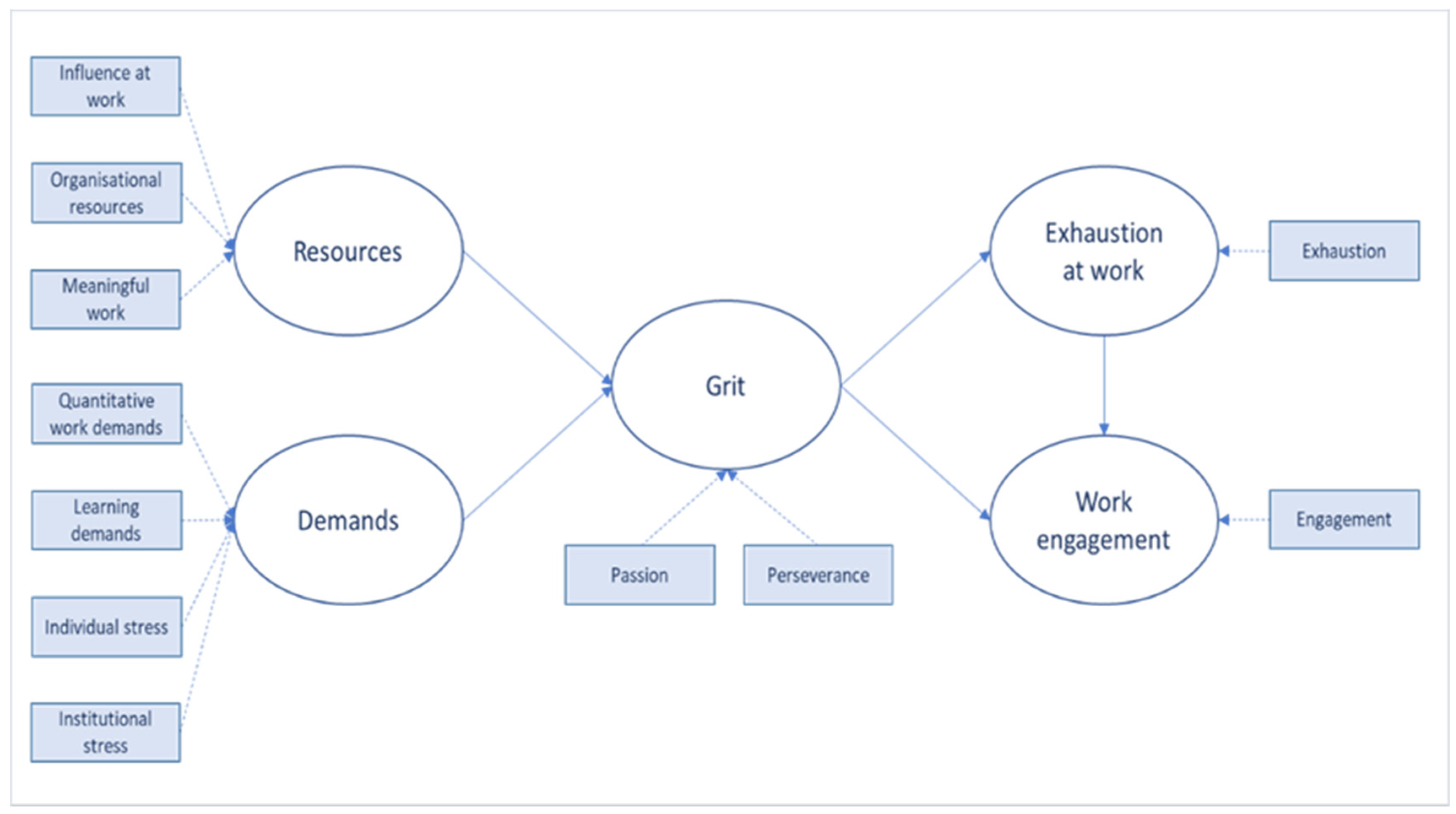
| 1 | In the first full model, institutional stress showed standardized loading being 0.006, while the loadings of the other manifest variables within Demands reached 0.812—Learning demands. A similar result indicated that Influence at work was not suitable for the model for PhD students (loadings equal to −0.061). |
References
- Acharya, Vrinda, Ambigai Rajendran, Nandan Prabhu, and Aneesha K. Acharya. 2024. Institutional, supervisory, and personal demands: Unravelling the challenge-hindrance demands in doctoral programs. Cogent Education 11: 2375052. [Google Scholar] [CrossRef]
- Albrecht, Simon L., Camille R. Green, and Andrew Marty. 2021. Meaningful work, job resources, and employee engagement. Sustainability 13: 4045. [Google Scholar] [CrossRef]
- Alhadabi, Amal, Said Aldhafri, Hussain Alkharusi, Ibrahim Al-Harthy, Hafidha AlBarashdi, and Marwa Alrajhi. 2019. Psychometric assessment and cross-cultural adaptation of the Grit-S Scale among Omani and American universities’ students. European Journal of Educational Research 8: 1175–91. [Google Scholar] [CrossRef]
- Ali, Parveen, Roger Watson, and Katie Dhingra. 2016. Postgraduate research students’ and their supervisors’ attitudes towards supervision. International Journal of Doctoral Studies 11: 227–41. [Google Scholar] [CrossRef] [PubMed]
- Aránega, Alba Yela, Rafael Castaño Sánchez, and Carmelo A. García Pérez. 2019. Mindfulness’ effects on undergraduates’ perception of self-knowledge and stress levels. Journal of Business Research 101: 441–46. [Google Scholar] [CrossRef]
- Bakker, Arnold B., and Evangelia Demerouti. 2014. Job demands-resources theory. In Work and Wellbeing: Wellbeing: A Complete Reference Guide, Volume III. Hoboken: John Wiley & Sons, Ltd. [Google Scholar] [CrossRef]
- Bakker, Arnold B., and Evangelia Demerouti. 2017. Job demands–resources theory: Taking stock and looking forward. Journal of Occupational Health Psychology 22: 273. [Google Scholar] [CrossRef] [PubMed]
- Bakker, Arnold B., Evangelia Demerouti, and Ana I. Sanz-Vergel. 2014. Burnout and work engagement: The JD–R approach. Annual Review of Organizational Psychology and Organizational Behavior 1: 389–411. [Google Scholar] [CrossRef]
- Beasy, Kim, Sherridan Emery, and Joseph Crawford. 2021. Drowning in the shallows: An Australian study of the PhD experience of wellbeing. Teaching in Higher Education 26: 602–18. [Google Scholar] [CrossRef]
- Bjaalid, Gunhild, Espen Olsen, Kjersti Melberg, and Aslaug Mikkelsen. 2020. Institutional stress and job performance among hospital employees. International Journal of Organizational Analysis 28: 365–82. [Google Scholar] [CrossRef]
- Chin, Wynne W., and Peter R. Newsted. 1999. Structural equation modeling analysis with small samples using partial least squares. Statistical Strategies for Small Sample Research 21: 307–41. [Google Scholar]
- Cohen, Emma D., and Will R. McConnell. 2019. Fear of fraudulence: Graduate school program environments and the impostor phenomenon. Sociological Quarterly 60: 457–78. [Google Scholar] [CrossRef]
- Cooper, Cary L. 1981. The Stress Check: Coping with the Stresses of Life and Work. Englewood Cliffs: Prentice Hall. [Google Scholar]
- Credé, Marcus, Michael C. Tynan, and Peter D. Harms. 2017. Much ado about grit: A meta-analytic synthesis of the grit literature. Journal of Personality and Social Psychology 113: 492–511. [Google Scholar] [CrossRef] [PubMed]
- Csikszentmihalyi, Mihaly. 1990. Flow: The Psychology of Optimal Experience. New York: Harper. [Google Scholar]
- Deci, Edward L., and Richard M. Ryan. 2012. Self-determination theory. In Handbook of Theories of Social Psychology. Edited by Paul A. M. Van Lange, Arie W. Kruglanski and E. Tory Higgins. Los Angeles: Sage Publications Ltd., pp. 416–36. [Google Scholar]
- Demerouti, Evangelia, Arnold B. Bakker, Friedhelm Nachreiner, and Wilmar B. Schaufeli. 2001. The job demands–resources model of burnout. Journal of Applied Psychology 86: 499. [Google Scholar] [CrossRef]
- Duckworth, Angela. 2016. Grit: The Power of Passion and Perseverance. New York: Scribner. [Google Scholar]
- Duckworth, Angela L., Christopher Peterson, Michael D. Matthews, and Dennis R. Kelly. 2007. Grit: Perseverance and passion for long-term goals. Journal of Personality and Social Psychology 92: 1087–101. [Google Scholar] [CrossRef]
- Duckworth, Angela L., Patrick D. Quinn, and Eli Tsukayama. 2021. Revisiting the factor structure of grit: A commentary on Duckworth and Quinn (2009). Journal of Personality Assessment 103: 573–75. [Google Scholar] [CrossRef] [PubMed]
- Duckworth, Angela Lee, and Patrick D. Quinn. 2009. Development and validation of the short grit scale (Grit–S). Journal of Personality Assessment 91: 166–74. [Google Scholar] [CrossRef]
- Dye, David A. 1996. The Organizational Assessment Survey; Washington, DC: United States Office of Personnel Management.
- Fusar-Poli, Paolo, Gonzalo Salazar de Pablo, Andrea De Micheli, Dorien H. Nieman, Christoph U. Correll, Lars V. Kessing, Andrea Pfennig, Andreas Bechdolf, Stefan Borgwardt, Celso Arango, and et al. 2020. What is good mental health? A scoping review. European Neuropsychopharmacology 31: 33–46. [Google Scholar] [CrossRef]
- Gardner, Susan K., and Bryan Gopaul. 2012. The part-time doctoral student experience. International Journal of Doctoral Studies 7: 63–78. [Google Scholar] [CrossRef]
- Gin, Logan E., Nicholas J. Wiesenthal, Isabella Ferreira, and Katelyn M. Cooper. 2021. PhDepression: Examining how graduate research and teaching affect depression in life sciences PhD students. CBE—Life Sciences Education 20: ar41. [Google Scholar] [CrossRef]
- González-Betancor, Sara M., and Pablo Dorta-González. 2020. Risk of interruption of doctoral studies and mental health in PhD students. Mathematics 8: 1695. [Google Scholar] [CrossRef]
- Gunawan, Dyah Ayu Kusumawardani, Nilam Widyarini, and Asmadi Alsa. 2025. Grit-enhancing intervention: A systematic review. International Journal of Psychology Sciences 7: 84–90. [Google Scholar] [CrossRef]
- Hair, Joseph F., Jeffrey J. Risher, Marko Sarstedt, and Christian M. Ringle. 2019. When to use and how to report the results of PLS-SEM. European Business Review 31: 2–24. [Google Scholar] [CrossRef]
- Hazell, Cassie M., Laura Chapman, Sophie F. Valeix, Paul Roberts, Jeremy E. Niven, and Clio Berry. 2020. Understanding the mental health of doctoral researchers: A mixed methods systematic review with meta-analysis and meta-synthesis. Systematic Reviews 9: 1–197. [Google Scholar] [CrossRef]
- Hwang, Mae-Hyang, and JeeEun K. Nam. 2021. Enhancing grit: Possibility and intervention strategies. In Multidisciplinary Perspectives on Grit. Edited by L. E. van Zyl, C. Olckers and L. van der Vaart. Cham: Springer, pp. 5–20. [Google Scholar] [CrossRef]
- Kearns, Hugh, Maria Gardiner, and Kelly Marshall. 2008. Innovation in PhD completion: The hardy shall succeed (and be happy!). Higher Education Research & Development 27: 77–89. [Google Scholar] [CrossRef]
- Keller, Franziska, Suzanne Dhaini, Matthias Briel, Sina Henrichs, Christoph Höchsmann, Daniel Kalbermatten, Nino Künzli, Annette Mollet, Christian Puelacher, Arno Schmidt-Trucksäss, and et al. 2018. How to conceptualize and implement a PhD program in Health Sciences—the Basel Approach. Journal of Medical Education and Curricular Development 5: 2382120518771364. [Google Scholar] [CrossRef] [PubMed]
- Levecque, Katia, Frederik Anseel, Alain De Beuckelaer, Johan Van der Heyden, and Lydia Gisle. 2017. Work organization and mental health problems in PhD students. Research Policy 46: 868–79. [Google Scholar] [CrossRef]
- Lindström, Kari, Margareta Dallner, Anna-Liisa Elo, Filippo Gamberale, Stein Knardahl, Anders Skogstad, and Einar Ørhede. 1997. Review of Psychological and Social Factors at Work and Suggestions for the General Nordic Questionnaire (QPSNordic). Copenhagen: Nordic Council of Ministers. [Google Scholar]
- Luneta, Kakoma. 2024. Recruitment and Selection of Doctoral Candidates. In Doctoral Supervision in Southern Africa: From Theory to Practice. Cham: Springer Nature, pp. 41–57. [Google Scholar]
- Luthans, Fred. 2002. Positive organizational behavior: Developing and managing psychological strengths. Academy of Management Perspectives 16: 57–72. [Google Scholar] [CrossRef]
- Mackie, Sylvia Anne, and Glen William Bates. 2019. Contribution of the doctoral education environment to PhD candidates’ mental health problems: A scoping review. Higher Education Research & Development 38: 565–78. [Google Scholar]
- Maslach, Christina, Susan E. Jackson, and Michael P. Leiter. 1996. Maslach Burnout Inventory Manual, 3rd ed. Palo Alto: Consulting Psychologists Press. [Google Scholar]
- Morell, Monica, Ji Seung Yang, Jessica R. Gladstone, Lara Turci Faust, Annette R. Ponnock, Hyo Jin Lim, and Allan Wigfield. 2021. Grit: The long and short of it. Journal of Educational Psychology 113: 1038–58. [Google Scholar] [CrossRef]
- Moukaddam, Nidal, Kimberly Parks, Hai Le, Lubna Khawaja, and Asim A. Shah. 2020. Burnout and suicide among physicians during times of stress. Psychiatric Annals 50: 536–41. [Google Scholar] [CrossRef]
- Naidoo-Chetty, Mineshree, and Marieta du Plessis. 2021. Job demands and job resources of academics in higher education. Frontiers in Psychology 12: 631171. [Google Scholar] [CrossRef] [PubMed]
- Pascoe, Michaela C., Sarah E. Hetrick, and Alexandra G. Parker. 2020. The impact of stress on students in secondary school and higher education. International Journal of Adolescence and Youth 25: 104–12. [Google Scholar] [CrossRef]
- Peluso, Daniel L., R. Nicholas Carleton, and Gordon J. G. Asmundson. 2011. Depression symptoms in Canadian psychology graduate students: Do research productivity, funding, and the academic advisory relationship play a role? Canadian Journal of Behavioural Science 43: 119. [Google Scholar] [CrossRef]
- Ray, Mary Elizabeth, Jessica Marie Coon, Ali Azeez Al-Jumaili, and Miranda Fullerton. 2019. Quantitative and qualitative factors associated with social isolation among graduate and professional health science students. American Journal of Pharmaceutical Education 83: 6983. [Google Scholar] [CrossRef] [PubMed]
- Rege, Mari, Paul Hanselman, Ingeborg F. Solli, Carol S. Dweck, Sten Ludvigsen, Eric Bettinger, Robert Crosnoe, Chandra Muller, Gregory Walton, Angela Duckworth, and et al. 2021. How can we inspire nations of learners? An investigation of growth mindset and challenge-seeking in two countries. American Psychologist 76: 755. [Google Scholar] [CrossRef]
- Regmi, Pramod R., Amudha Poobalan, Padam Simkhada, and Edwin van Teijlingen. 2021. PhD supervision in public health. Health Prospect: Journal of Public Health 20: 1–4. [Google Scholar] [CrossRef]
- Rimfeld, Kaili, Yulia Kovas, Philip S. Dale, and Robert Plomin. 2016. True grit and genetics: Predicting academic achievement from personality. Journal of Personality and Social Psychology 111: 780–89. [Google Scholar] [CrossRef]
- Schaufeli, Wilmar B. 2017. Applying the job demands-resources model. Organizational Dynamics 46: 120–32. [Google Scholar] [CrossRef]
- Schaufeli, Wilmar B., Akihito Shimazu, Jari Hakanen, Marisa Salanova, and Hans De Witte. 2019. An ultra-short measure for work engagement: The UWES-3 validation across five countries. European Journal of Psychological Assessment 35: 577–91. [Google Scholar] [CrossRef]
- Schaufeli, Wilmar B., Arnold B. Bakker, and Willem van Rhenen. 2009. How changes in job demands and resources predict burnout, work engagement, and sickness absenteeism. Journal of Organizational Behavior 30: 893–917. [Google Scholar] [CrossRef]
- Seijts, Gerard H., Gary P. Latham, and Meredith Woodwark. 2013. Learning Goals: A Qualitative and Quantitative Review. Abingdon: Routledge. [Google Scholar]
- Seligman, Martin E. P., and Mihaly Csikszentmihalyi. 2000. Positive psychology: An introduction. American Psychologist 55: 5–14. [Google Scholar] [CrossRef]
- Slemp, Gavin R., Mark A. Lee, and Lara H. Mossman. 2021. Interventions to support autonomy, competence, and relatedness needs in organizations: A systematic review with recommendations for research and practice. Journal of Occupational and Organizational Psychology 94: 427–57. [Google Scholar] [CrossRef]
- Sorrel, Miguel A., José Á. Martínez-Huertas, and María Arconada. 2020. It must have been burnout: Prevalence and related factors among Spanish PhD students. The Spanish Journal of Psychology 23: e29. [Google Scholar] [CrossRef]
- Southwick, Daniel A., Chia-Jung Tsay, and Angela L. Duckworth. 2021. Grit at work. Research in Organizational Behavior 39: 100126. [Google Scholar] [CrossRef]
- Tenenhaus, Michel, Silvano Amato, and Vincenzo Esposito Vinzi. 2004. A Global Goodness-of-Fit Index for PLS Structural Equation Modelling. Available online: https://www.sis-statistica.org/old/htdocs/files/pdf/atti/RSBa2004p739-742.pdf (accessed on 15 December 2025).
- Tenenhaus, Michel, Vincenzo E. Vinzi, Yves-Marie Chatelin, and Carlo Lauro. 2005. PLS path modeling. Computational Statistics & Data Analysis 48: 159–205. [Google Scholar] [CrossRef]
- Van Der Heijde, Claudia M., Lotte Douwes, and Peter Vonk. 2019. Mental health problems and support needs of PhD students: Bottlenecks of the PhD trajectory. European Journal of Public Health 29: ckz186.588. [Google Scholar] [CrossRef]
- Vinzi, E. Vincenzo, and Giorgio Russolillo. 2013. Partial least squares algorithms and methods. Wiley Interdisciplinary Reviews: Computational Statistics 5: 1–19. [Google Scholar] [CrossRef]
- Vinzi, E. Vincenzo, Laura Trinchera, and Silvano Amato, eds. 2009. PLS path modeling: From foundations to recent developments and open issues for model assessment and improvement. In Handbook of Partial Least Squares: Concepts, Methods and Applications in Marketing and Related Fields. Berlin: Springer, pp. 47–82. [Google Scholar]
- Vinzi, E. Vincenzo, Wynne W. Chin, Jörg Henseler, and Huiwen Wang, eds. 2010. Handbook of Partial Least Squares: Concepts, Methods and Applications in Marketing and Related Fields. Berlin: Springer. [Google Scholar]
- Zis, Panagiotis, Fotios Anagnostopoulos, and Panagiota Sykioti. 2014. Burnout in medical residents: A study based on the job demands-resources model. The Scientific World Journal 2014: 673279. [Google Scholar] [CrossRef] [PubMed]



| Variables | Organisational Resources | Meaningful Work | Quantitative Work Demands | Learning Demands | Individual Stress | Passion | Perseverance | Exhaustion at Work | Work Engagement |
|---|---|---|---|---|---|---|---|---|---|
| Organisational resources | 1.000 | 0.335 | −0.273 | −0.230 | −0.288 | 0.122 | 0.066 | −0.559 | 0.342 |
| Meaningful work | 0.335 | 1.000 | −0.193 | −0.392 | −0.270 | 0.182 | 0.127 | −0.556 | 0.600 |
| Quantitative work demands | −0.273 | −0.193 | 1.000 | 0.453 | 0.587 | −0.132 | 0.035 | 0.269 | −0.061 |
| Learning demands | −0.230 | −0.392 | 0.453 | 1.000 | 0.488 | −0.283 | −0.077 | 0.422 | −0.325 |
| Individual stress | −0.288 | −0.270 | 0.587 | 0.488 | 1.000 | −0.268 | −0.101 | 0.441 | −0.268 |
| Passion | 0.122 | 0.182 | −0.132 | −0.283 | −0.268 | 1.000 | 0.000 | −0.370 | 0.286 |
| Perseverance | 0.066 | 0.127 | 0.035 | −0.077 | −0.101 | 0.000 | 1.000 | −0.171 | 0.177 |
| Exhaustion at work | −0.559 | −0.556 | 0.269 | 0.422 | 0.441 | −0.370 | −0.171 | 1.000 | −0.575 |
| Work engagement | 0.342 | 0.600 | −0.061 | −0.325 | −0.268 | 0.286 | 0.177 | −0.575 | 1.000 |
| Resources | Demands | Grit | Exhaustion at Work | Work Engagement | Mean Communalities (AVE) | |
|---|---|---|---|---|---|---|
| Resources | 1 | 0.153 | 0.053 | 0.420 | 0.382 | 0.636 |
| Demands | 0.153 | 1 | 0.125 | 0.234 | 0.147 | 0.462 |
| Grit | 0.053 | 0.125 | 1 | 0.166 | 0.112 | 0.500 |
| Exhaustion at work | 0.420 | 0.234 | 0.166 | 1 | 0.330 | |
| Work engagement | 0.382 | 0.147 | 0.112 | 0.330 | 1 | |
| Mean Communalities (AVE) | 0.636 | 0.462 | 0.5 | 0 |
| R2 | F | p > F | R2 (Bootstrap) | Standard Error | Critical Ratio (CR) |
| 0.342 | 49.746 | 0.000 | 0.345 | 0.052 | 6.581 |
| Latent variable | Value | Standard error | t | p > |t| | Contribution to R2 (%) |
| Grit | 0.121 | 0.064 | 1.880 | 0.062 | 11.815 |
| Exhaustion at work | −0.526 | 0.064 | −8.179 | 0.000 | 88.185 |
| Direct Effects | Resources | Demands | Grit | Exhaustion at work | Work engagement |
| Resources | |||||
| Demands | 0.000 | ||||
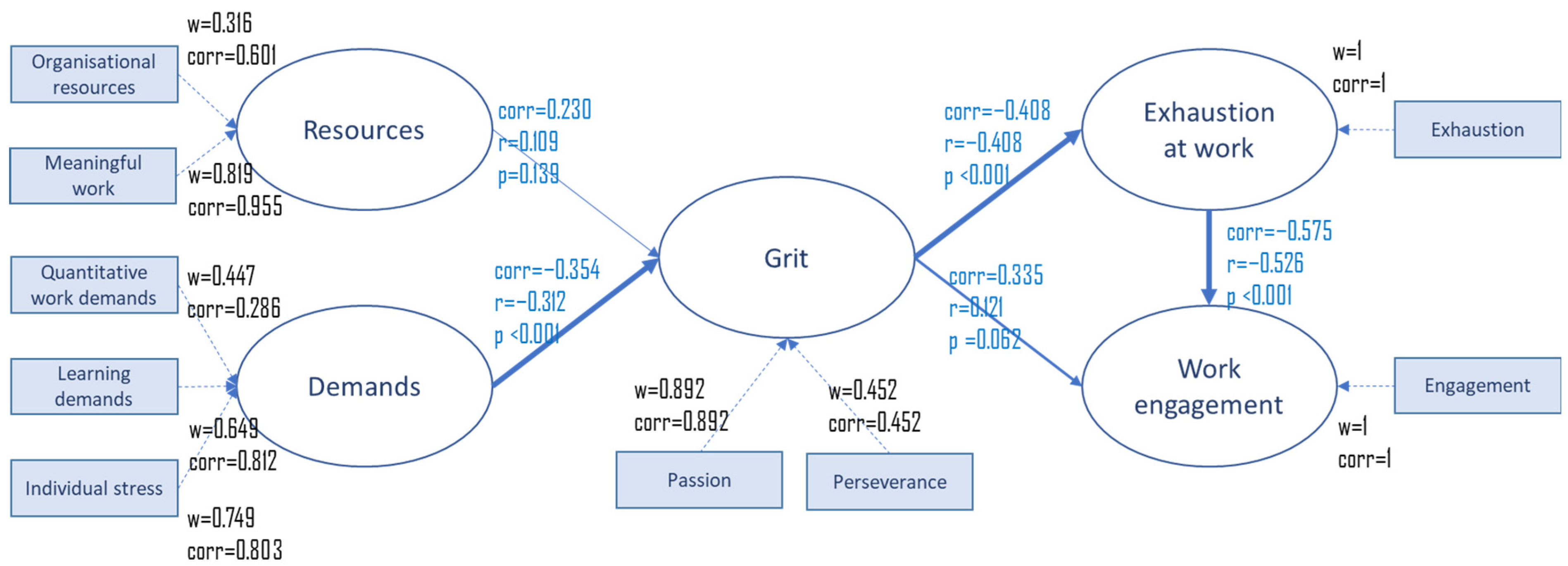
| Grit | 0.109 | −0.312 | |||
| Exhaustion at work | 0.000 | 0.000 | −0.408 | ||
| Work engagement | 0.000 | 0.000 | 0.121 | −0.526 | |
| Indirect Effects | Resources | Demands | Grit | Exhaustion at work | Work engagement |
| Resources | |||||
| Demands | 0.000 | ||||
| Grit | 0.000 | 0.000 | |||
| Exhaustion at work | −0.044 | 0.127 | 0.000 | ||
| Work engagement | 0.036 | −0.104 | 0.214 | 0.000 | |
| Total Effects | Resources | Demands | Grit | Exhaustion at work | Work engagement |
| Resources | |||||
| Demands | 0.000 | ||||
| Grit | 0.109 | −0.312 | |||
| Exhaustion at work | −0.044 | 0.127 | −0.408 | ||
| Work engagement | 0.036 | −0.104 | 0.335 | −0.526 |
Disclaimer/Publisher’s Note: The statements, opinions and data contained in all publications are solely those of the individual author(s) and contributor(s) and not of MDPI and/or the editor(s). MDPI and/or the editor(s) disclaim responsibility for any injury to people or property resulting from any ideas, methods, instructions or products referred to in the content. |
© 2026 by the authors. Licensee MDPI, Basel, Switzerland. This article is an open access article distributed under the terms and conditions of the Creative Commons Attribution (CC BY) license.
Share and Cite
Lillelien, K.; Menichelli, E.; Bjaalid, G. Grit as a Key Factor in PhD Students’ Work Engagement and Burnout. Soc. Sci. 2026, 15, 120. https://doi.org/10.3390/socsci15020120
Lillelien K, Menichelli E, Bjaalid G. Grit as a Key Factor in PhD Students’ Work Engagement and Burnout. Social Sciences. 2026; 15(2):120. https://doi.org/10.3390/socsci15020120
Chicago/Turabian StyleLillelien, Kaja, Elena Menichelli, and Gunhild Bjaalid. 2026. "Grit as a Key Factor in PhD Students’ Work Engagement and Burnout" Social Sciences 15, no. 2: 120. https://doi.org/10.3390/socsci15020120
APA StyleLillelien, K., Menichelli, E., & Bjaalid, G. (2026). Grit as a Key Factor in PhD Students’ Work Engagement and Burnout. Social Sciences, 15(2), 120. https://doi.org/10.3390/socsci15020120