1. Introduction
The penetration of innovation processes with generative AI (GenAI) in recent years has significantly changed the social and societal conditions in which knowledge is produced, exchanged, and evaluated. Since then, the creative and cultural industry as a sector faces the challenge of fundamentally changing the established understanding of artistic work, creative autonomy, and the meaning of originality through the application of large-scale generative models. While GenAI is often portrayed in the public debate as a threat that displaces creative workers, undermines artistic values, or automates symbolic production, a more complex and multidimensional picture is gradually emerging in scientific research. Recent studies show that creative and cultural innovations are increasingly emerging through hybrid interactions between human-AI systems that are redefining the processes and infrastructures of knowledge production. However, although social and media studies on AI in creative fields are growing rapidly, research on epistemological understanding is lagging technological change. Existing analytical studies, particularly related to socio-technical innovation studies, have limited potential to conceptualize AI not only as a tool, platform, or infrastructure, but as an epistemic actor, an entity involved in the generation, interpretation, and recombination of knowledge.
If AI is understood as a tool, platform, or infrastructure, it is just an extension of humans that supports human agencies. In the meaning of
McLuhan (
[1964] 1994), AI as a tool is a technological enlargement of human faculties which transform who we are. In this context, technology remains tied to human activities and cannot be described as an independent entity. Like other media, AI tools catalyze the externalization of identity. In contrast to McLuhan’s approach of the “extension of man,” this paper hypothesizes GenAI as an independent epistemological entity. In other words, the author assumes that GenAI produces, interprets, and develops knowledge independently of, but in exchange with, human knowledge economies. By understanding GenAI as an extension of human brain functions, the assumption or fear prevails that GenAI will replace and rationalize away human knowledge production and, above all, human labor in the creative industry.
This conceptual gap becomes particularly apparent in connection with the helix models for describing innovation processes, which view innovations as the result of knowledge production processes in which multiple social subsystems interact with one another. The most widespread models are the Triple Helix (
Etzkowitz and Leydesdorff 2000), Quadruple Helix (
Carayannis and Campbell 2009), and Quintuple Helix (
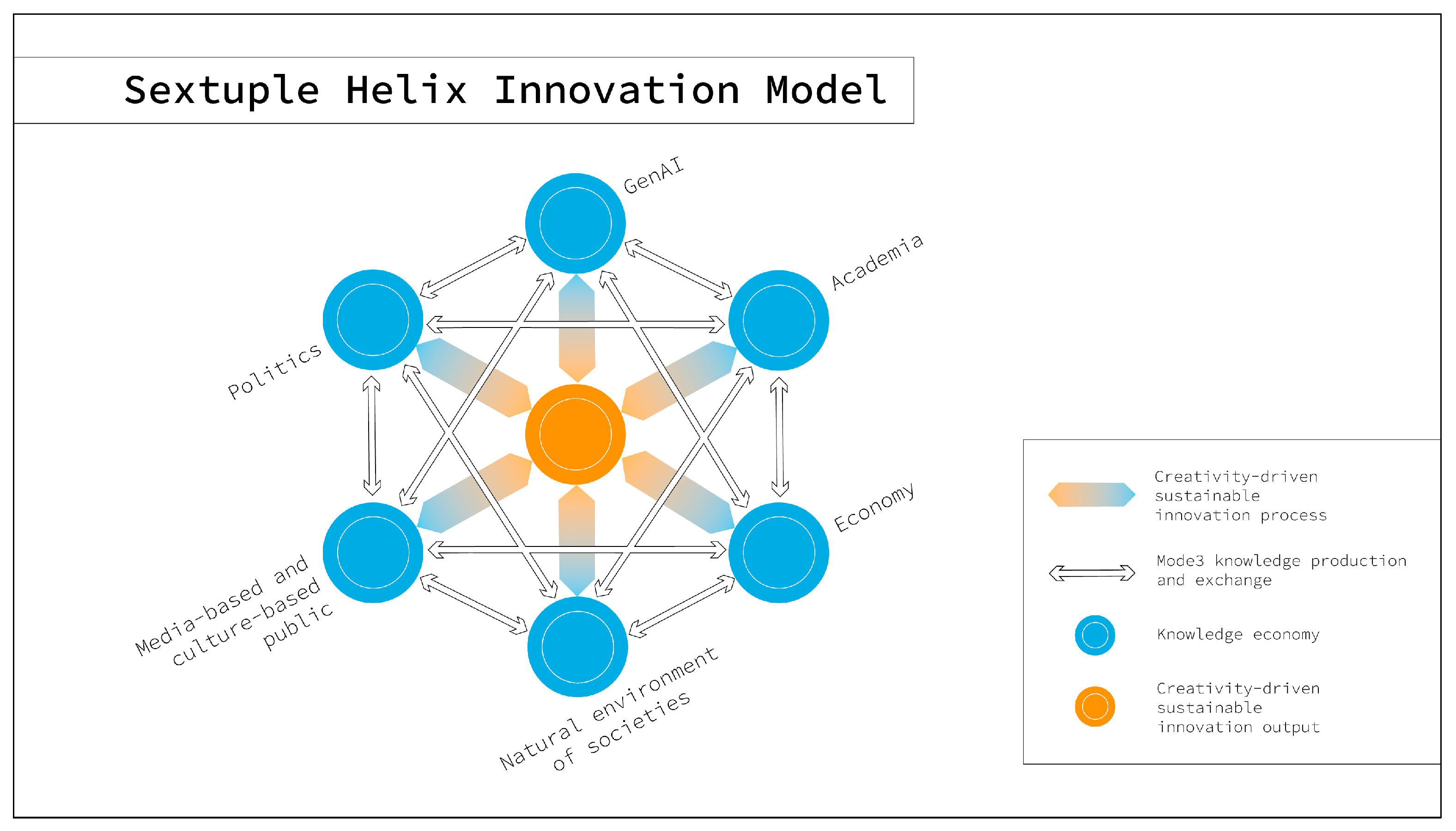
Carayannis et al. 2012), which can be used to analyze and discuss innovation ecosystems as processes of knowledge exchange between the fields of science, business, politics, the media- and culture-based public, and the natural environment of societies. However, none of the helix models adequately account for the emergence of algorithmic knowledge economies, whose epistemic logic is qualitatively different from that of human systems, while the two systems co-evolve through joint interactions. Operationally, GenAI converts distributed data into structured statements through probabilistic inference. This means that it cannot be reduced to individual human inputs. McLuhan’s approach of an “extension of man” thus reaches its limits. This paper proposes an epistemic perspective on the Sextuple Helix Innovation Model, in which generative AI acts as a sixth helix within the comprehensive innovation ecosystem (
Figure 1). In the academic literature, different suggestions and approaches of the Sextuple Helix are described.
López-Rubio et al. (
2021) suggest the system of entrepreneurship as a sixth helix.
Hanschitz (
2023) has foreseen a Sextuple Innovation Helix Framework where explainable and reliable artificial intelligence plays a central role in sustainable innovation processes. He anticipated further research in the near future which considers the development of a Sextuple Helix Innovation framework.
Del Río Castro et al. (
2026) presented a Sextuple Helix Innovation Model that serves as a framework to support regenerative innovation and drives triple transformation consisting of digital transformation, environmental sustainability and social justice. In their capital-oriented approach, they consider the entire ‘Mindful and Green Digital Sphere’ as the sixth helix and emphasize above all the enabling role of digital innovation and their existence as transition brokers in facilitating knowledge flows and collaboration. However, they leave open the question of how knowledge production takes place in the knowledge economy of the digital sphere. In contrast to the approaches of the authors mentioned, this article focuses on the knowledge economy of generative AI as part of the digital sphere and its way of knowledge production, which is the prerequisite for understanding entities as helices in the helix models.
In the extended helix framework proposed in this paper, generative AI is seen as an autonomous, albeit not independent, knowledge-producing subsystem whose output influences and is influenced by the other five helices. The model thus breaks the technological deterministic narrative that portrays AI as either a disruptive threat or a neutral tool. Instead, the model views AI as a technocultural actor that is embedded in an interactive production of knowledge between humans and machines. This redefinition of GenAI activities paves the way for a new understanding of how innovation develops in the age of algorithmic creativity. It is also in line with Mode 3 knowledge production, which emphasizes diversity, co-evolution, and creative recombination in complex innovation environments (
Carayannis et al. 2016).
Given that GenAI is currently transforming creative and cultural practices, the need for such reframing becomes clear. In many professional fields, AI-supported workflows are shifting creative work. This includes the creation of content as well as the curation of algorithmic results. At the same time, however, GenAI introduces radically new forms of co-creation. These developments challenge the traditional understanding of creativity as a purely human epistemic activity and point to emerging hybrid ecosystems in the production of meaning. Creativity researchers and cultural theorists have begun to emphasize the reciprocal nature of interaction between humans and AI.
Andrews and Hawcroft (
2024) argue that most attention is paid to how AI influences artistic practice. However, the reverse also occurs: Artistic creativity shapes technological development by expanding design imaginaries and shaping policy priorities. In this sense, creativity can be understood as neither purely human nor purely algorithmic. Rather, it results in the paradigm of a mutually beneficial process in which both forms of agency are mutually dependent. This insight paves the way for understanding why GenAI cannot be conceptualized solely as a tool within human-centered innovation systems. Its epistemic agency and its entanglement with cultural knowledge production require a broader model of innovation that is capable of integrating algorithmic forms of creativity into sustainable, human-centered innovation ecosystems. From the perspective of knowledge economy theory, GenAI is increasingly recognizing the characteristics of an independent epistemic subsystem. Its strategy of knowledge production is probabilistic rather than deductive, recombinatory rather than experience-based, and large-scale rather than context-bound. These characteristics point to a knowledge economy that cannot be reduced to human cognitive processes. However, they cannot be separated from these either. Instead, GenAI acts as a hybrid epistemic actor that is trained on culturally embedded data. Even though this data is produced by human-based knowledge systems, GenAI is still able to generate new symbolic configurations that influence culture, economy, politics, science, and environmental decisions. This makes GenAI both a product and a co-creator of the broader innovation ecosystem, which is precisely the conditions that define a helix.
Taking these aspects into account, this paper pursues three main objectives: Firstly, generative AI is to be conceptualized as a knowledge-producing entity. In this discourse, constructivist epistemology, knowledge economy theory, and empirical research in the creative industries are considered. Furthermore, the Sextuple Helix Innovation Model is discussed as an extension of the Quintuple Helix Innovation Model, in which GenAI is described as the sixth helix involved in joint knowledge production. Finally, a scoping review will be used to analyze research at the interface of AI, knowledge economies, and creative industries. This review will shed light on how scientific literature supports the conceptual reframing of GenAI. The paper thus makes three contributions to innovation theory. It adapts the helix model to the algorithmic age by including non-human epistemic actors. Furthermore, it strengthens the theoretical foundations for understanding hybrid creative ecosystems of humans and machines, which are of increasing importance for the labor markets and innovation processes of the creative and cultural industries (CCIs). It also supports ongoing efforts to promote sustainable, inclusive, and socially oriented innovation frameworks suitable for digital transformation.
In the following, the theoretical framework is developed, in which the existing helix models are traced, and GenAI is placed in the context of current debates on knowledge economies and epistemic agency. After describing the methodology underlying the paper, the following section presents how GenAI is located in creative, cultural, and epistemological domains. The paper concludes with an explanation of the sextuple helix framework and a discussion of its implications for sustainable innovation.
2. Theoretical Framework
Already at the beginning of the 21st century, it was recognized that knowledge production does not take place within self-contained organizations. Rather, relevant knowledge is created through the complex interaction of social subsystems. This insight led to the development of helix models of innovation, which represent one of the most influential approaches to theorizing these interaction systems. Initially,
Etzkowitz and Leydesdorff (
2000) developed the triple helix model, which conceptualizes innovation as the result of dynamic relationships between universities, industry, and government. The central contribution of the model lies in the approach that the three institutional realms mentioned not only work together but also intermingle and form overlapping zones in which new roles, practices, and knowledge structures emerge. Universities, for example, fulfill entrepreneurial functions. Companies, in turn, carry out research and development that is traditionally associated with academic institutions. In addition, governments are taking on tasks to promote innovation ecosystems rather than just regulate them.
Around ten years later,
Carayannis and Campbell (
2009) extended the Triple Helix Innovation Model to the quadruple helix. They argued that the media- and culture-based public sphere represents a fourth helix with its own knowledge economy. According to this model, innovation is embedded in a broad cultural and communicative environment in which meanings are created, negotiated, and disseminated. The Quadruple Helix Innovation Model thus recognizes that social values, public debate, esthetic practices, and cultural identities have a significant influence on innovation processes and sustainably shape them. This extension of the triple helix innovation model justifies a shift in focus from an economic or institutional understanding to a more socio-cultural understanding of innovation.
A further extension of the Quadruple Helix Innovation Model to include the natural environment of societies as the fifth helix (
Carayannis et al. 2012) was an expression of the realization that innovation must be considered in the context of ecological constraints and sustainability requirements. According to the newly emerged Quintuple Helix Innovation Model, the natural environment of societies is not just a passive backdrop. Rather, it is an active component of knowledge production. This model enables the description of innovation processes from a sustainability perspective. As the fifth helix, the natural environment of societies characterizes innovation agendas, motivates ecological transition processes, and determines the long-term viability of social and economic systems. Sustainable development is thus anchored as a goal and taken into account as a structural principle of innovation systems, which requires interactions that are environmentally conscious, culturally anchored, and socially inclusive.
The evolution from three to five helices in the interaction of entities in innovation processes reflects a comprehensive change in the understanding of innovation. It traces the path from a linear model driven by science and technology to a complex, multi-layered system characterized by different knowledge economies and taking into account the cultural and sustainability aspects. Each helix represents a distinct area with its own epistemic logic, including institutional arrangements, normative frameworks, and forms of knowledge production. In the context of this helix concept, knowledge economies encompass the generation, transformation, and application of knowledge that creates economic, cultural, social, or ecological value. These knowledge economies interact in a contingent, dynamic, and context-dependent manner.
The introduction of Mode 3 knowledge production by
Carayannis and Campbell (
2009,
2015) provides a conceptual basis for understanding the interactions mentioned above. Mode 3 aims at the co-existence of multiple knowledge paradigms. At the same time, the model emphasizes the ability of innovation systems to integrate these through creative recombination. In addition, Mode 3 emphasizes the diversity and voluntary cooperation between heterogeneous actors such as universities, companies, governments, civil societies, and ecological systems. From this perspective, creativity is not limited to artistic fields but is described as a fundamental characteristic of learning environments that enable new combinations of knowledge. Mode 3 is particularly relevant for analyzing the rise of generative AI because the model draws attention to forms of knowledge production that transcend traditional boundaries (
Peschke et al. 2025). Mode 3 builds on the Mode 1 and Mode 2 environments. Mode 1 describes the knowledge production and exchange in the triple helix (
Carayannis and Campbell 2013;
Nowotny et al. 2006), which reduces the public to the reception and consumption of innovations. It neglects their potential for active participation in innovation processes. However, the Mode 2 environment considers the involvement of the public in the identification of problems as a driver for innovation processes. Accordingly, Mode 2 model has similarities with the Design Thinking approach (
Leifer and Meinel 2019). GenAI operates in an innovation environment characterized by hybrid creative practices of both knowledge production. It interacts with existing helices in overlapping knowledge economies and does not fit neatly into one helix. Instead, it defines a new epistemic level that is autonomous and unique on the one hand, but at the same time remains closely intertwined with cultural and cognitive processes. This suggests that the helix theory of innovation needs to be extended again, but this time to include algorithmic knowledge economies.
The creative and cultural industries (CCIs) are a suitable sector to understand why the introduction of a sixth helix is necessary. CCIs are often described as a creative knowledge ecosystem in which innovation is generated through the interaction of designers, artists, cultural institutions, digital platforms, audiences, and policy frameworks. These ecosystems are characterized by symbolic meaning production, esthetic and cultural practices, and cultural interpretation. They represent an industry whose processes of change are most clearly visible through GenAI. Studies show that generative models are increasingly involved in the production of symbolic meanings in the form of texts, images, and audiovisual content. As a result, media are being produced at an unprecedented speed and scale (
Anantrasirichai and Bull 2022). The CCI, therefore, significantly illustrates how knowledge economies are being reshaped by algorithmic systems and that algorithms are capable of generating information, not just processing it.
For the conceptualization of GenAI as a knowledge-producing entity, relevant epistemological frameworks must be taken into account. Constructivist epistemology assumes that knowledge is created through interactions between actors and their environment.
Both Piaget’s (
1955) theory of personal constructivism and
Vygotsky’s (
1978) sociocultural constructivism describe knowledge as the result of active dialog, contextual interpretation, and iterative learning. This constructivist approach is consistent with the way GenAI-based systems construct knowledge. The AI systems are trained using extensive corpora of human-generated data and generate new results by internalizing patterns and structures and through interactive input.
However, the picture that emerges from the approaches is twofold: Generative AI functions as an autonomous generator of symbolic, esthetic, and conceptual content. However, it achieves this within socio-technical systems that are characterized by power asymmetries, infrastructural dependencies, and cultural prejudices. This duality underpins the argument that GenAI represents a knowledge economy in its own right. It is neither reducible to nor independent of human cognition. Like the other five helices, GenAI participates in innovation by generating knowledge, shaping cultural productions, changing labor dynamics, and influencing public discourse. As already mentioned above, in helix theory, these are precisely the characteristics that define a helix.
3. Methodology
Arguments in favor of the introduction of a sixth helix have already been presented in the two previous sections. With the help of a scoping review, the proposed sextuple helix innovation model is discussed and reviewed in the context of transformation processes in the creative and cultural industries through GenAI. The focus is on the three aforementioned epistemic dimensions of knowledge production, agency, and constructivism. In addition, the scoping review will discuss in depth the socio-technical, political-economic, and ethical significance of algorithmic knowledge systems as an integral part of the sextuple helix innovation model.
According to
Mak and Thomas (
2022), scoping reviews are particularly suitable for research approaches in which the conceptual terrain of a topic is to be mapped out, definitions clarified, theoretical diversity or research gaps uncovered. Since this paper aims to investigate whether GenAI can be understood as an independent knowledge economy and thus fulfills the prerequisite of being conceptualized as the sixth helix within innovation ecosystems, the advantages of a scoping review are directly related to the paper. The decision to conduct a scoping review was additionally based on the fact that GenAI is a new and fast-growing field of research, in which new aspects in different disciplines have to be considered within a very short time. This highly fluid field of research means that new technological and cultural phenomena are constantly being brought to light. Relevant findings can be found in the research context of innovation sciences, epistemology, cultural policy, communication theory, AI ethics, design sciences, creative industries research, and environmental sciences. As expected, the scoping review enabled the synthesis of this dispersed knowledge by providing the opportunity to identify how different scientific communities conceptualize and evaluate the role of GenAI in knowledge production. The conceptualization of different scientific disciplines made it possible to assess whether they jointly support the theoretical basis of the Sextuple Helix Innovation Model.
The evaluation was conducted within an iterative, reflexive structure that was consistent with the guidelines for scoping reviews. The corpus was created using the Web of Science collection. The Web of Science collection was chosen as the primary database because it provides comprehensive coverage of peer-reviewed journals from the relevant disciplines. The choice of a single database is justified by the exploratory nature of the review. Additionally, qualitative analysis requires a manageable corpus of literature. The literature search was carried out across all publication years, which meant that almost comprehensive coverage was achieved. In the first step, the search terms were determined through conceptual considerations and with the help of an initial exploratory literature search. As the aim of the study was to record how GenAI is understood in creative contexts, but also in epistemological terms, terms from the creative industry (‘creative industr*’, ‘cultur* industr*’, ‘media industr*’) were combined with terms from the fields of artificial intelligence, knowledge production, constructivism and epistemology (‘artificial intelligence’, ‘GenAI’, ‘knowledge economy’, “constructivism”, ‘epistem’) (see
Table 1).
The search terms were deliberately defined broadly in order to also include publications that come from borderline disciplines and yet provide conceptual insights and are relevant for the positioning of GenAI as a knowledge-producing entity.
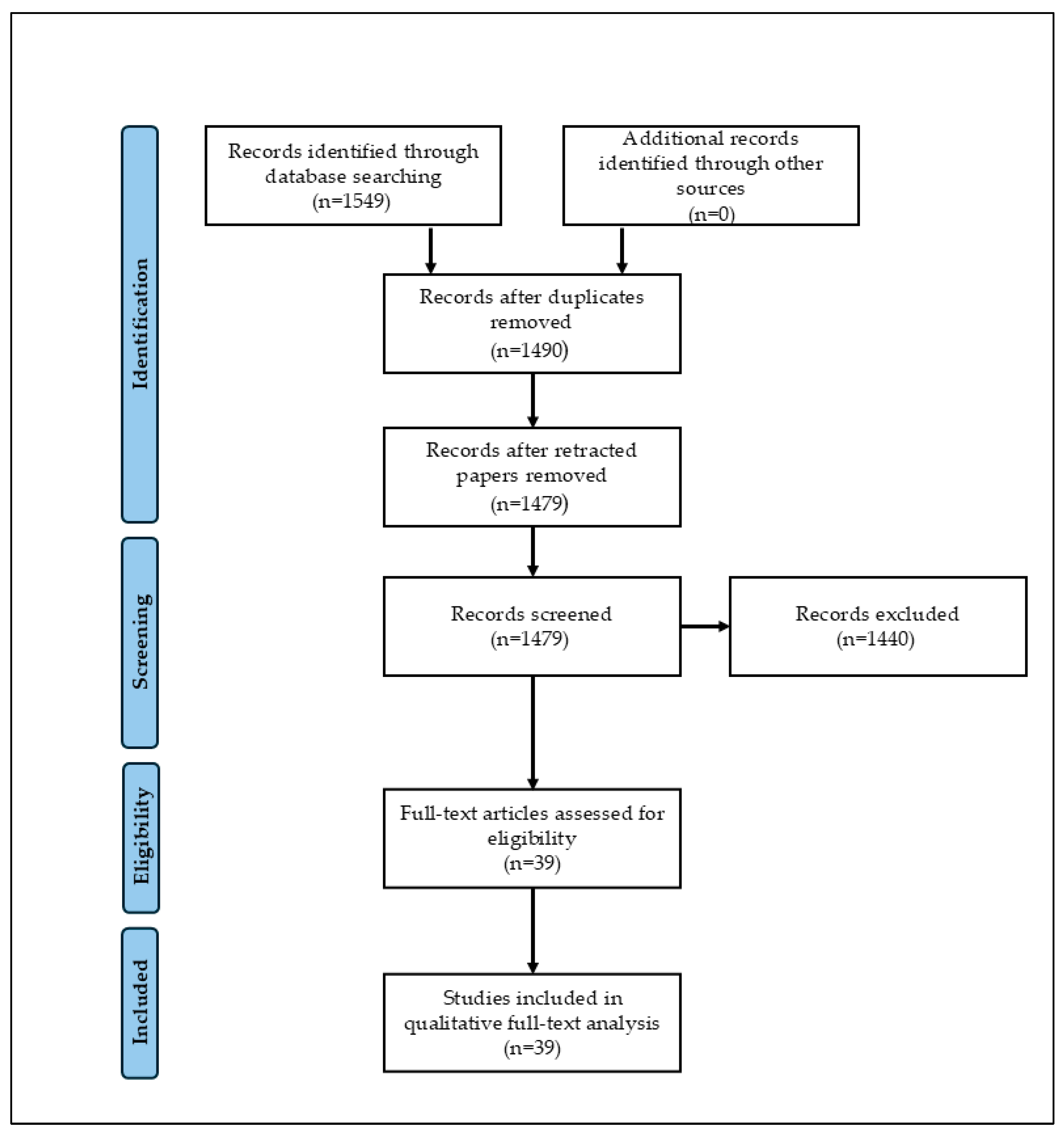
The search yielded a total of 1549 publications whose titles were screened for relevance. For this initial review, inclusion criteria were defined based on the objectives of the study. Papers were considered that dealt with the relationships between AI and the creative or cultural industries, addressed issues of knowledge production, epistemic agency, or knowledge economies, examined the social or cultural implications of GenAI, or discussed constructivist or technological epistemologies relevant to algorithmic systems. Publications were excluded if they focused exclusively on technical model development or did not contribute to the identification of epistemic or creative implications.
These selection criteria resulted in a set of 39 publications that were considered for a qualitative full-text analysis (
Figure 2). This resulted in a corpus of diverse papers from the fields of creative industries research, epistemology, media studies, digital ethics, cultural policy, and innovation research. The qualitative analysis of these 39 papers was carried out using an interpretative, coding-oriented approach. Instead of a formal content analysis, a thematic synthesis strategy was pursued, which was in line with the criteria of the scoping review. In the full-text analysis of the 39 papers, attention was paid to how the authors described AI in terms of epistemic functions, creative potential, role in symbolic production, influence on labor and cultural practices, and the position of inherently comprehensive knowledge systems. Special attention was also paid to the relationship between human and machine creativity. It examined whether AI was conceptualized in the discourses as a tool, collaborative actor, disruptive force, or co-creator of knowledge. The analytical dimensions were not defined in advance. Rather, they were developed iteratively by analyzing the papers.
The methodological approach was deliberately reflexive. During the process, it was recognized that the interpretation of the literature was influenced by the conceptual framework of the Sextuple Helix Innovation Model, while at the same time, the literature shaped the development of the model. This reflexivity is justifiable for conceptual research as theory building is an iterative process based on synthesis rather than empirical generalization. At several points during the review, search terms were refined, additional literature was identified through citation tracking, and analytic categories were adjusted to capture emergent patterns. This aligns with the scoping review methodology described by
Mak and Thomas (
2022) in which iterative refinement is considered a strength rather than a limitation. The methodological choices also reflect the constructivist epistemology that underpins this study. During the review process, search terms were refined several times, additional literature was identified through citation tracking, and analytical categories were subsequently adjusted. This allowed emerging patterns to be captured more efficiently. This strategy fits with the scoping review methodology, where iterative refinement is seen as a strength rather than a limitation. Furthermore, the methodological choices reflect the constructivist epistemology that underpins this study.
However, the chosen methodology has some limitations. On the one hand, Web of Science is a comprehensive database containing numerous relevant publications. However, publications from some preprint platforms are not included in the database. Furthermore, the review is limited to English-language publications, which means that culturally or geographically specific perspectives on AI and creative knowledge production could not be taken into account. Finally, the interpretative nature of the analysis led to a certain subjectivity, which is, however, mitigated by clear methodological transparency and alignment with recognized scoping review practices.
Despite these limitations, the chosen methodology is suitable for the conceptual objectives of the study, especially since the scoping review does not claim to fully map the entire literature on AI and creativity, nor to provide a quantitative assessment of research trends. Rather, the aim was to identify the key conceptual patterns that contribute to the understanding of scientific approaches to knowledge production, the epistemic functions, and the role of GenAI within the creative industries and broader innovation systems. These patterns form the empirical basis for assessing whether GenAI fulfills the criteria to be considered as the sixth helix within innovation ecosystems.
4. Results
As mentioned in the previous section, the scoping review took into account three different aspects that are widely discussed in the academic literature on innovation studies and the cultural and creative industries (CCIs) in the context of AI. These are, firstly, relationships between AI and creative work, practices and industries, secondly, the epistemic and knowledge-producing capabilities of AI, and thirdly, the far-reaching socio-technical, political-economic and ethical implications of algorithmic knowledge systems.
Each aspect provides individual but interrelated insights into knowledge economies in relation to GenAI and whether it can be conceptualized as a sixth helix within innovation ecosystems. There is a broad consensus in the literature that a qualitative shift in the nature of creative labor, symbolic production, and epistemic processes has taken place with the introduction of GenAI. The following sub-sections summarize the relevant aspects of the findings. The summaries of the different approaches and models that contribute to understanding the use of GenAI in creative processes enable a critical discussion of the conditions under which GenAI can be conceptually distinguished and understood as an independent sixth helix. This discussion is conducted in
Section 5, taking into account the analyzed publications.
4.1. GenAI and the Transformation of Creative and Cultural Industries
The transformative impact of generative AI on the creative and cultural industries has been discussed particularly significantly in the literature. Many authors highlight the tension between the potential of AI to democratize creative production and its tendency to displace, restructure, or redesign creative work. This ambivalence is particularly evident in research areas that deal with advertising, media production, publishing, and software development. These are areas in which GenAI has already begun to change structures, workflows, production processes, and value chains.
Many studies see GenAI as a powerful enabler that creates new creative opportunities. For example,
Amankwah-Amoah et al. (
2024) see the potential of AI to increase productivity, optimize content creation, and support idea generation processes in industries such as advertising and design.
Schinello (
2025) shares this understanding. He conducted expert interviews to investigate the perceived potential of AI and found that it can expand the access of small creative companies to global markets and reduce barriers to participation. Similarly,
Gil et al. (
2025) emphasize the potential of AI-powered personalization to give rise to entirely new creative genres and artistic practices in the fields of film production, interactive storytelling, and audiovisual production. These papers point to the understanding of AI as a partner that enhances human creativity, especially through the understanding that this partnership accelerates iterative processes, generates references or prototypes, and supports creatives to explore esthetic or conceptual directions that they might not otherwise have considered themselves.
This understanding of the potential of GenAI is supported by other empirical studies that attest to a measurable increase in creative performance when humans and GenAI interact.
Doshi and Hauser (
2024) work out that authors who use generative systems to support creative tasks tend to produce more original or entertaining content than those who do without the support of generative AI. This is particularly evident when the initial level of creative confidence or experience is low.
Jackson et al. (
2024) show that GenAI in software development increases efficiency in idea generation, brainstorming, problem decomposition, and conceptual exploration.
Holzner et al. (
2025) conducted a systematic meta-analysis and found that collaboration between humans and AI outperforms purely human creativity in certain tasks. This finding relates to tasks that require the generation of many ideas or rapid iteration through alternative solutions. However, even studies that highlight the augmentative potential of GenAI describe risks of homogenization of creative output and creative reduction. This tendency is reflected in the analysis by
Aguado-Terrón and Grandío-Pérez (
2024). They regard GenAI as a ‘language technology’ that automates symbolic reproduction rather than genuine innovation. According to the two authors, GenAI tends to create ‘probable’ rather than ‘original’ combinations of meaning. In doing so, it favors patterns that are already dominant in the training data, which reduces the range of cultural variations. These concerns lead to the discourse about the “curatoralization” of Öztaş
and Arda (
2025), which illustrates that human actors are increasingly curating and no longer producing content ex nihilo.
Furthermore, several scholars see tendencies for discussions of the creative potential of AI to often obscure profound structural changes in CCI.
Chow and Celis Bueno (
2025) describe this as discourses under the guise of creativity and refer to them as the ‘cloak of creativity’. Accordingly, discourses that celebrate the creativity enabled by AI tend to obscure changes in labor relations, power structures, and economic models. Accordingly, they warn that GenAI’s existing patterns of precarity are accelerating platformization and value extraction within the media and cultural industries. In this way, the authors argue, GenAI could contribute to the deskilling of creative workers whose expertise is subordinated to algorithmic production pipelines.
Martínez et al. (
2022) reflect similar concerns in the advertising ecosystem, where AI-based recommendation systems and deepfakes pose new ethical challenges to society, especially in terms of authenticity, trust, and manipulation. Last but not least, journalistic systems show similar tensions.
Palla and Kostarella (
2025) show in a study that AI contributes to the efficiency and quality of content. However, journalists continue to have major concerns about ethical standards, misinformation, and the loss of editorial autonomy.
The discourse mentioned above reveals that a consistent pattern emerges in the analyzed literature. Scientists recognize that GenAI is deeply embedded in creative processes. This is often preceded in a way that challenges the boundaries between human and machine creativity. The literature also reveals considerable anxiety about the ways in which AI redistributes creative agency, concentrates economic power, and transforms cultural labor. Empowerment and disruption are significant trends suggesting that GenAI is more than just a tool within CCI. Rather, it functions as a cognitive and symbolic actor that materially and epistemically shapes the cultural industry.
4.2. Epistemic Dimensions of GenAI: Knowledge Production, Agency, and Constructivism
The second relevant topic deals with the question of the epistemic status of GenAI. Behind this is the question of whether generative AI systems can be regarded as knowledge-producing entities, which is the pre-requisite for the understanding of AI as a sixth helix in the Helix model. Literature provides extensive evidence for the growing trend among scholars to conceptualize GenAI precisely in this sense. In many publications, epistemological frameworks serve as a pillar for describing AI’s involvement in meaning-making.
Vidales (
2025) shows that AI systems work within conceptual frameworks that are anchored in their training data. These frameworks reflect cultural and semiotic contexts from which the AI systems learn. He uses the concept of cybersemiotics to argue that AI-supported systems are increasingly involved in communication, cognition, and meaning-making processes. At the same time, he recognizes that this is often done without human awareness or intention. In his understanding, generative models operate within conceptual and cultural frameworks embedded in training data. This represents a form of socio-technically mediated epistemology. This approach is in line with constructivist epistemology. It emphasizes that knowledge is created through interactions between actors and their environment. However, such interactions are not limited to human actors but also take place between humans and AI-based systems. AI-based systems generate new symbolic artifacts within processes that are constructed through the processing of culturally influenced data.
Punziano’s concept of adaptive epistemology (2025) argues along similar lines. She proposes the concept of adaptive epistemology, which further illuminates the hybrid nature of AI-driven knowledge systems. In her understanding, traditional epistemological paradigms such as positivism or interpretivism are not sufficient to understand post-digital environments in which human and non-human actors co-construct and co-produce meaning. Adaptive epistemology emphasizes the dimensions of dynamism, co-construction, generativity, reflexivity, and ethical sensitivity. Each dimension harmonizes with the epistemic behavior patterns of generative AI. It generates knowledge iteratively, responds to human input, and thus participates in meaning-making processes, even in the absence of subjective human experience. It thus contributes to the further development of epistemology and takes into account the reality of algorithmic participation in knowledge creation. In other words, her approach sketches a hybrid form of contemporary knowledge environments in which human and algorithmic actors usually produce meaning inseparably. As mentioned, this change leads to a reconceptualization of the role of non-human entities in knowledge production that goes beyond anthropocentric assumptions and recognizes that AI-generated results can shape interpretation processes, influence decision-making, and produce novel conceptual structures.
Ranaldi and Pucci’s (
2023) work on algorithmic epistemology underpins that Transformer-based systems learn through statistical pattern recognition rather than symbolic or causal reasoning. However, they exhibit a form of empirical intelligence that enables them to generate results that appear coherent, creative, or contextually appropriate, even though these systems lack deep semantic understanding.
Billingsley (
2025) compares AI processes to design epistemologies. Both, according to the author, are based on iterative cycles, contextual adjustments, and pragmatic experimentation. Design epistemologies are not based on universal laws. Rather, they treat knowledge as emergent, situational, and evolving, which reflects the way GenAI works in practice.
Mökander and Schroeder (
2022) developed an approach before the widespread attention for generative AI started. They are cautious when it comes to whether AI can advance social theory on its own. However, they recognize that machine learning systems can support systematic explanations and predictions in a way that meaningfully extends the analytical capabilities of humans. However, according to the two authors, this presupposes that their epistemic limits are understood.
As discussed earlier, not all scientists are positive about the epistemic status of GenAI.
Berlinski et al. (
2024) warn that AI creates the ‘fantasy of unlimited knowledge’ and point to the opacity of algorithmic performativity.
Cambraia and Pyrrho (
2025) describe GenAI as a vehicle of techno-digital colonialism and argue that its claim to objectivity obscures the way in which certain voices, cultures, or epistemic traditions are privileged over others.
Coeckelbergh (
2026) emphasizes the difficulty of revising entrenched beliefs in AI-mediated environments.
Yet even these critical discourses and approaches contribute to understanding GenAI as an independent epistemic actor. The scientific critiques presuppose that GenAI generates knowledge. Even with the understanding that AI-generated knowledge is characterized by prejudice, power, or structural inequalities, this confirms its epistemic agency. Regardless of whether algorithmic agency is problematic or meaningful, this supports the notion that GenAI participates in knowledge economies with its own logic, possibilities, and limitations.
4.3. Socio-Technical, Political-Economic, and Ethical Implications of Algorithmic Knowledge Systems
The third perspective allowed by the literature concerns the broader socio-technical and political-economic implications of generative AI. This perspective provides crucial answers to questions about the position of GenAI within innovation ecosystems, as helix models emphasize the interactions between knowledge production and societal structures, governance systems, and ecological considerations.
A central theme discussed in the literature is the asymmetry of power created by the development and deployment of AI.
Berlinski et al. (
2024) see GenAI as an advanced form of platform capitalism in which control is centralized in the hands of a small number of companies. This small number of powerful actors possesses the necessary computational resources, proprietary models, and data infrastructures on which GenAI depends. Accordingly, this concentration of power shapes the epistemic outcomes of GenAI by embedding corporate priorities, cultural biases, or economic incentives into the systems themselves. As indicated in previous sections,
Cambraia and Pyrrho (
2025) extend this critique by portraying GenAI as an instrument of techno-digital colonialism.
Taken together, creative transformation, epistemic agency, and socio-technical implications, which are the three areas identified and the perspectives within the scoping review, provide a strong theoretical foundation for the Sextuple Helix innovation model. From these perspectives, it can be seen that GenAI contributes to and is dependent on networks of knowledge production in creative, scientific, political, cultural, and ecological systems. The next section discusses the significance of these findings for innovation theory and sustainable development.
5. Discussion
As the results of the scoping review show, generative AI occupies a complex and evolving position within today’s innovation ecosystems. GenAI is widely portrayed in the literature as a transformative force in the creative and cultural industries. In addition, it appears as an emerging epistemic actor capable of generating novel symbolic content and as an infrastructure that is closely intertwined with political-economic structures. GenAI redesigns creative practices instead of simply reinforcing existing processes. In addition, it changes the distribution of agency in symbolic production and introduces new forms of algorithmic knowledge. As these interact in complex ways with human knowledge systems, this constellation of roles, capabilities, and influences supports the central thesis of this paper that GenAI can be conceptualized as an independent helix within innovation ecosystems, adding a sixth helix to the established quintuple helix innovation system and forming the sextuple helix innovation model. Three aspects are significant in this regard.
5.1. Reframing Creative and Cultural Innovation: From Human-Centered Creativity to Hybrid Knowledge Systems
The study shows that creative industries play a pioneering role in the integration of GenAI into knowledge production. In the context of the Helix model, this means that GenAI, as a knowledge producer, is changing creative innovation processes. Idea generation and content creation no longer take place through the interaction and iteration of purely human-based subsystems (helices), but instead involve platform-based knowledge economies in knowledge production and innovation development. This human–machine interaction in knowledge exchange processes leads to a hybridization of creativity processes. Two trends can be derived from the studies analyzed. On the one hand, the exchange of knowledge in the sextuple helix gives rise to new art practices (
Gil et al. 2025), which will lead to new genres and media formats in the creative industry and thus to expanded creative output. This can definitely be a boon for certain sectors of the creative industry (
Amankwah-Amoah et al. 2024;
Jackson et al. 2024). On the other hand, knowledge-based innovation processes are increasingly platform-based, not only in the creative industries. This leads to a risk of algorithmic tribalism (
Hroch et al. 2024) of innovation processes, fostering tribe-like innovation communities, which leads to an inflation of innovative output and then devalues the act of innovative action.
In other words, GenAI in creative industries is not only a complementary tool, but a creative actor that is increasingly embedded in the daily tactics of idea generation, production, and dissemination. This gives rise to hybrid knowledge systems of mutual creativity in which human and algorithmic actors jointly generate creative output through iterative and dialog-based interaction. The associated shift from human-centered to hybrid creativity calls into question traditional assumptions about the nature of creativity. Classical theories emphasize individual cognitive processes, personal characteristics, or socio-cultural contexts of creativity. Such frameworks assume that creativity is a specifically human ability and is based on consciousness, intentionality, and subjective experience. It is based on consciousness, intentionality, and subjective experience.
However, the scoping review shows a significant consensus on the understanding of AI’s active participation in creative processes. The creative contribution of AI cannot be reduced to mere simulation.
Jackson et al. (
2024) demonstrate that GenAI acts as a dynamic ideation partner;
Doshi and Hauser (
2024) show that AI-generated contributions foster narrative creativity; and
Holzner et al. (
2025) conclude that hybrid creativity outperforms purely human creativity in many cases. These findings suggest that creativity can no longer be understood as a human domain. Rather, the concept of creativity must be expanded to include the process of mutual interaction between humans and machines, which includes data infrastructures and iteration loops.
This hybridization of creative processes makes it more difficult to distinguish between authorship, originality, and work in the creative economy. The concept of curation by
Öztaş and Arda (
2025) illustrates that human actors are increasingly curating and no longer producing content ex nihilo. This places high normative demands on society and requires clarification as to whether curatorial work represents a deskilling or a new form of creative expertise. The changes towards hybrid creativity are also disrupting value chains in the creative economy by redistributing the ability to act between creators and platforms. The approach of understanding GenAI as the sixth helix provides a conceptual framework for analyzing these changes. According to the helix theory, innovation arises from the interaction between different knowledge economies. Each knowledge economy follows its own epistemic logic. The inclusion of GenAI as the sixth helix opens up the conceptual possibility of understanding algorithmic systems as an independent knowledge economy not only in the creative and cultural industry. GenAI has its own mechanism for producing, distributing, and influencing innovation ecologies. The Sextuple Helix Innovation Model opens a new perspective to better understand co-creation processes in living lab settings established for sustainable innovation processes, for instance, in circular economies, value-based healthcare, or activities to make cities climate resilient. All these living lab scenarios are increasingly impacted by generative AI knowledge exchange processes.
However, according to this understanding, GenAI does not replace human creativity, but introduces new epistemic forms that expand creative possibilities and reshape the division of creative labor between humans and machines. This expansion is in line with Mode 3 knowledge production, according to which innovations always take place in contexts of heterogeneity, hybridity, and the co-existence of several knowledge paradigms.
Furthermore, the Sextuple Helix model harbors the potential for the development of a theory of phygital innovation. As described by
Pesce and Franzè (
2025), the phygital fusion of physical and digital cultural experiences represents a phenomenon in which knowledge production crosses the boundaries between material, symbolic, and computational spaces. The resulting ecosystems are characterized by GenAI contributions that support cultural institutions in generating interpretative content. This enables recombinatory cultural experiences that combine digital platforms with physical cultural heritage. Recognizing GenAI as the sixth helix thus contributes to the understanding of how cultural innovation increasingly emerges from the interplay between traditional creative practices and algorithmic generativity.
5.2. Epistemic Plurality and the Emergence of Algorithmic Knowledge Economies
Through the scoping review, GenAI can be assigned properties of a knowledge-producing entity. However, it functions fundamentally differently from human cognitive systems. Due to these differences, GenAI epistemologically represents a supplement to human cognitive systems. Recognizing these differences allows us to understand that GenAI produces symbolic, esthetic, and conceptual artifacts that influence human meaning production and feed into practices of different knowledge economies. The basis for categorizing GenAI in innovation theory is provided by constructivist epistemology. As already mentioned, this emphasizes that knowledge is created through interaction between actors and their environment. In this sense, GenAI can be seen as an epistemic participant. It interprets and recombines data from human cultural environments to generate new symbolic content. The cybersemiotic approach of
Vidales (
2025) underpins this view by arguing that AI systems are embedded in semiotic and conceptual frame conditions encoded in their training data. Similarly,
Punziano’s (
2025) adaptive epistemology suggests that post-digital knowledge ecosystems involve co-construction and generativity between human and non-human actors.
Overall, these approaches suggest that GenAI contributes to epistemic plurality and develops forms of knowledge that are fundamentally different in origin, structure, and logic from those of human actors. According to
Vidales (
2025), GenAI works in conceptual frameworks that are anchored in their training data. This makes GenAI comparable with human-based sub-systems. The core of the Helix model is the understanding that innovation processes occur in a helical learning environment where the stakeholders of each subsystem participate in the knowledge of the other subsystem and contribute their know-how to the circulating knowledge. The exchange of knowledge between the helices is based on iterative processes, where the helical loop leads to an improvement in innovative outcomes. As constructivist epistemology emphasizes, knowledge is created through actors and their environment. This means that the knowledge of the actors is based on the environment where the actor is situated. This constructivist model is not limited to human actors but is applicable to AI systems as well. It is the reason why the Quintuple Helix Model can be extended by non-human-based sub-systems. However, the post-digital knowledge ecosystem, where processes of co-construction occur (
Punziano 2025) includes two categories of knowledge economies. Human knowledge is based on lived experience, embodied perception, cultural interpretation, and reflective judgment. Algorithmic knowledge, on the other hand, is fundamentally derived from statistical pattern recognition, probabilistic modeling, and large-scale recombination of symbolic data. The two forms of knowledge are neither mutually exclusive nor redundant. Rather, they interact in hybrid epistemic systems that are characteristic of contemporary innovation environments.
The Sextuple Helix Innovation Model provides an approach for understanding how algorithmic knowledge economies coexist with, complement, but also challenge human knowledge economies. The science helix can use the produced knowledge of GenAI to analyze complex data sets, but also to generate hypotheses. However, the validity of the results depends heavily on human input and interpretative control by humans. The economic helix can integrate GenAI into production and consumption processes. However, attention must be paid to whether and how algorithmic distortions or proprietary restrictions influence market dynamics. The policy helix can use generative AI to make policy analyses more efficient. Public administration can also utilize generative AI to address issues of transparency, accountability, and legitimacy. The media and culture-based public sphere helix is already utilizing GenAI as a co-creator of cultural meaning. Last but not least, there are overlaps in the natural environment helix with GenAI through models that simulate ecological systems or support sustainability planning.
These aforementioned interactions, as part of a coherent innovation ecosystem, strengthen the theoretical understanding of how innovation develops in the context of generative AI. It underpins the hypothesis that understanding GenAI as a complementary technological layer falls short. At the same time, it strengthens the hypothesis of a knowledge economy that interacts with all other helices and influences their outcomes, constraints, and development trajectories. As such, the sextuple helix represents a contemporary extension of the quintuple helix.
5.3. Power, Inequality, and Governance in Algorithmically Mediated Innovation Systems
However, understanding GenAI as a sixth helix not only offers opportunities to explore constructive collaboration. It also opens up new avenues for a critical discourse in which risks, inequalities, and challenges, for example, in the area of governance, are detected, discussed, and evaluated. These concerns, which the scoping review revealed, are crucial for interpreting the functioning of algorithmic knowledge economies. This provides an opportunity to examine how GenAI should be integrated into sustainable innovation frameworks. A highly relevant issue in this context is the centralization of power within global technology companies that develop and control GenAI systems. As mentioned earlier,
Berlinski et al. (
2024) discuss algorithmic systems as a new level of platform capitalism because the way they consolidate epistemic authority and economic values undermines openness and democratic access.
Cambraia and Pyrrho (
2025) support these concerns with their critique of techno-digital colonialism as described above. It follows from this critique that knowledge economies are shaped by political and economic interests that determine whose knowledge is coded, whose values guide system design, and whose perspectives are systematically excluded.
These power relations are decisively shaped by the epistemic properties of GenAI. Because generative systems recognize and reinforce patterns in data, they can reproduce existing inequalities and obscure alternative perspectives. The scoping review reveals that concerns about autonomy, authenticity, and the erosion of human agency are particularly significant in the creative industries. Curation of creative work is sometimes discussed as a new form of creative practice. However, this harbors the danger that the diversity of cultural productions will be restricted by the normalization of algorithmically derived patterns. Scientists warn against over-reliance on generative AI because it can lead to homogenization and plagiarism-like redundancy in creative processes. These concerns point to generative AI practices that not only produce knowledge but also shape the cultural and epistemic infrastructures that societies then use to assess what knowledge is considered relevant, legitimate, or meaningful. If, as assumed in this paper, GenAI represents a sixth helix, then strong governance structures that ensure accountability, transparency, and democratic control of algorithmic systems are essential for sustainable innovation.
5.4. Implications for Sustainable Innovation and the Future of Innovation Theory
The integration of GenAI into the helix theory of innovation leads to a comprehensive reconsideration of the concept of sustainability itself. Traditional sustainability models emphasize environmental protection, economic viability, and social justice, as enshrined in the UN’s Sustainability Goals (
United Nations 2015). However, in times of increasing mediation of knowledge production through algorithmic systems, the sustainability of innovation depends on the integrity, diversity, and resilience of epistemic infrastructures. The Sextuple Helix Innovation Model contributes to the theory of sustainable innovation through several aspects. It recognizes that innovation systems need to manage not only ecological but also algorithmic resources such as data, models, computing infrastructures, and knowledge flows. Furthermore, it emphasizes the importance of epistemic diversity in supporting sustainable cultural and social innovation. To avoid the tendency of GenAI to generate homogenized outcomes, sustainability requires the protection of diverse human traditions, creative practices, and cultural expressions. Furthermore, the Sextuple Helix innovation model positions AI governance as a central component of sustainable innovation and emphasizes the need for transparency, accountability, and participatory outreach.
The contribution of GenAI to sustainable innovation processes depends strongly on the way the knowledge production of the sixth helix will be included. From the Mode 3 knowledge production perspective (
Carayannis and Campbell 2009), sustainable innovations are not the result of linear technological optimization, but of the co-evolution and co-specialization of heterogeneous knowledge paradigms. Accordingly, the plea is that algorithmic knowledge economies must operate within a broader knowledge ecology that includes scientific and environmental expertise, regulatory frameworks, cultural values, and ecological feedback systems. Although the fact that a purposeful and meaningful participation of GenAI in the knowledge circulation accelerates research and optimizes logistics, which supports sustainable innovation processes, it contributes additionally by reshaping how societies conceptualize growth, productivity, and efficiency, which is relevant for reaching the UN Sustainable Development Goals 8 (decent work and economic growth) and 9 (industry, innovation and infrastructure). But this implies that algorithmic efficiency must be balanced against ecological resilience and long-term planetary boundaries.
Accordingly, the knowledge exchange between the GenAI helix and the helix of the natural environment of societies plays a key role within Sextuple Helix Innovation processes. Like the Quintuple Helix Innovation Model, the Sextuple Helix Innovation Model conceptualizes ecological sustainability as an epistemic driver of innovation itself. Environmental challenges generate new knowledge demands that redefine scientific agendas, political regulations, and cultural narratives. As the sixth helix, generative AI contributes to this process through the transformation of how sustainable knowledge is produced and communicated. But sustainability in the context of GenAI-powered innovation processes requires the design and governance of algorithmic systems according to principles of transparency, accountability, and ecological responsibility.
The model further enriches innovation theory by introducing a new form of knowledge economy. Helix innovation models have so far been based exclusively on human-oriented systems. The introduction of GenAI as the sixth helix takes account of the new situation that non-human systems now actively contribute to knowledge creation and, in some cases, significantly influence innovation processes in the fields of science, culture, economics, politics, and the environment. This extension questions anthropocentric assumptions in innovation theory and thus offers starting points for scientists to engage with hybrid epistemologies, socio-technical interdependence, and the ethics of human–machine co-creation.
Finally, the sextuple helix approach encourages future empirical and theoretical work. Scholars can, for example, investigate how the sixth helix interacts with other societal domains, such as education, healthcare, or environmental planning. They can also investigate how governance structures can or must be (re)designed to support sustainable and inclusive algorithmic ecosystems.
6. Conclusions
The rapid penetration of generative AI into society marks a turning point in the development of innovation ecosystems. As this paper has derived and discussed, GenAI is more than just a technical tool or resource. Rather, it is increasingly integrated into the symbolic, cultural, scientific, political, scholarly, and ecological processes through which contemporary societies produce and disseminate knowledge. The scoping review found that scholars in diverse fields, from creative industries and cultural heritage to epistemology, communication studies, and political theory, are increasingly recognizing the epistemic, creative, and socio-technical significance of generative models. These developments challenge fundamental assumptions of innovation theory and require a conceptual extension appropriate to the scale of technological and cultural change.
This article proposed the Sextuple Helix Innovation Model in response to this challenge from the epistemic perspective rather than with the capital-oriented approach of
Del Río Castro et al. (
2026) emphasizing mainly the enabling role of digital innovation and transition brokers, which facilitate knowledge flows and collaboration. This perspective opens research areas in the social sciences and humanities in the context of sustainable research and innovation activities, which is strongly expected in the Horizon Europe Work Programme of the European Commission (e.g.,
European Commission 2026). It builds on Carayannis and Campbell’s evolution from the triple helix to the quadruple and quintuple helix and recognizes the emergence of a new epistemic actor in the innovation system. The Quintuple Helix Model recognized the natural environment of societies as an essential dimension of sustainable innovation. The Sextuple Helix Model extends this insight to the algorithmic realm by recognizing that contemporary innovation is mediated by digital infrastructures that shape the conditions of knowledge production and cultural meaning-making.
The hybridization from a purely human-based form of knowledge production to human–machine interaction in knowledge production is changing the nature of creative work, redistributing agencies between humans and machines. This raises questions about autonomy, authorship, and professional identity. These questions are countered by the democratizing potential of GenAI, which lowers barriers to creative participation, expands access to cultural tools, and enables new forms of expression, which is in line with the overarching goals of innovation systems to promote diversity and inclusion. Societies are increasingly integrating GenAI into cultural, scientific, political, and economic life. As a result, innovation systems are confronted with new tensions and opportunities, not only in the context of creative industries.
The Sextuple Helix Innovation Model does not brand GenAI as a threat to human knowledge systems. Rather, it positions generative AI as a co-evolving epistemic actor whose influence must be critically understood, ethically regulated, and constructively integrated into sustainable innovation processes. The associated redefinition of innovation from a sixth helix perspective, to which this article contributes, encourages scholars to engage in a growing body of scholarly work aimed at understanding the socio-technical changes in the 21st century while ensuring that innovation remains in harmony with human flourishing, cultural diversity, democratic values, and ecological sustainability. Nevertheless, this approach opens up opportunities for research activities investigating, for example, the disruptive and constructive qualities of GenAI in relation to cultural and creative industries.