
Article

Grit as a Key Factor in PhD Students’ Work Engagement and Burnout

1
Norwegian Centre for Learning Environment and Behavioural Research in Education, University of Stavanger, P.O. Box 8600, 4036 Stavanger, Norway
2
Department of Business Management and Development, University of Stavanger, P.O. Box 8600, 4036 Stavanger, Norway
3
Department of Health Technology, University of Stavanger, P.O. Box 8600, 4036 Stavanger, Norway
*
Author to whom correspondence should be addressed.
Soc. Sci. 2026, 15(2), 120; https://doi.org/10.3390/socsci15020120
Submission received: 16 December 2025 / Revised: 3 February 2026 / Accepted: 6 February 2026 / Published: 13 February 2026
(This article belongs to the Special Issue Job Stress and Burnout: Emerging Issues in Today’s Workplace)

Abstract

Background: This study aims to explore the potential factors that can support Ph.D. students in completing their theses in a timely manner while maintaining their mental well-being. Theory: Based on the JD-R model, we discriminate between two independent processes: (1) Job demands are a health impairment process that may lead to exhaustion and burnout. (2) Job resources are a motivational process that may lead to job satisfaction and engagement. In this study, we also wanted to explore grit as a potential mediator variable and how it could impact exhaustion at work and work engagement among Ph.D. students. Methods: A cross-sectional web-based survey design was used, from a sample of 194 Ph.D. students in Norway. Data were analyzed through structural equation modeling. Results: Our results indicated that demands at work, not resources, had a positive significant effect on Ph.D. students’ grit, which acted as a mediator variable for exhaustion at work and work engagement. Conclusions: This study improves our understanding of the factors affecting Ph.D. students’ mental well-being and sheds light on how institutions can optimize resources and demands to promote timely thesis completion while minimizing the risk of severe mental health challenges.

1. Introduction

1.1. Introduction

Being a Ph.D. student can offer numerous benefits, including the opportunity to engage deeply into new knowledge, contribute to important and meaningful work, acquire new skills, and develop one’s professional competence. At the same time, it is also accompanied by significant challenges that warrant careful consideration from both an organizational and on an individual level. This study aims to explore the potential factors that can support Ph.D. students in completing their theses in a timely manner while maintaining their mental well-being.

1.2. Job Demands and Work Exhaustion in Ph.D. Students

The demanding nature of conducting original research, writing a dissertation, and meeting academic expectations can overwhelm Ph.D. students, often leading to work exhaustion, burnout, and even depression. Studies indicate that between 30% and 70% of Ph.D. students, depending on their field of study, fail to complete their theses on time or at all (Gardner and Gopaul 2012).
There is evidence of a widespread crisis of decreasing mental health among Ph.D. students as a worldwide challenge, with evidence coming, for instance, from the US Spain (Sorrel et al. 2020) and the UK (Hazell et al. 2020). Good mental health can, in this context, be defined as a state of well-being that allows individuals to cope with the everyday stresses of life and work and be able to function productively (Fusar-Poli et al. 2020). In general, it has been found that mental health problems occur at a significantly higher rate among Ph.D. students than among the general population (Hazell et al. 2020). Among mental health diseases, depression is a crucial challenge (Van Der Heijde et al. 2019).
Work exhaustion in this context consists of burnout and depression, measured by the Maslach Burnout Inventory (Maslach et al. 1996). According to Maslach et al. (1996), burnout can be defined as emotional exhaustion, depersonalization of others, and reduced personal accomplishment. Moukaddam et al. (2020) conclude that burnout and depression can be seen as related, as they found that burnout is linked to factors such as lack of work–life integration, breakdown of work motivation, meaning derived from work, lack of control over work, lack of efficiency and resources, work overload and job demands and nonalignment of individual and organizational culture and values. Ph.D. students may, depending on the discipline, be exposed to several of these risk factors, such as working in solitary work environments, leading to feelings of loneliness and social isolation (Ray et al. 2019). They may also feel like they do not belong in academia or are incapable of completing their long-term goals (the degree), leading to feelings of self-doubt and insecurity (the so-called imposter syndrome) (Cohen and McConnell 2019). In addition, since the demands of a Ph.D. program can take up a significant amount of time, they may leave little room for other activities and relationships outside academia, leading to stress and burnout and a poor work–life balance (Levecque et al. 2017). All this on top of practical difficulties such as delayed data collection and challenges in getting their articles published on time.
Most likely, the abovementioned factors, in addition to other reasons such as financial worries and uncertain career possibilities (Mackie and Bates 2019), may explain why Ph.D. students are not completing their theses, and these factors may be related to both institutional and individual challenges. Institutional challenges can be linked to inadequate organizational resources, such as competent doctoral supervisors and sufficient peer support. Some research indicates that several interventions are needed in this field regarding both the quality and quantity of supervisors (Sorrel et al. 2020). Although a substantial body of research has long demonstrated that Ph.D. students are at elevated risk of delayed completion, noncompletion, and the development of mental health problems, academic institutions appear to continue operating as though these challenges are inevitable or peripheral (Levecque et al. 2017). This persistence of “business as usual” suggests a critical need for a dedicated research field aimed at identifying and developing organizational structures that can support doctoral candidates in overcoming demands so they can be able to complete their degrees within the expected timeframe while maintaining their health and wellbeing. When Ph.D. students face serious mental health challenges, many are forced to terminate their studies, both at a high individual cost and by losing research for universities (González-Betancor and Dorta-González 2020).
An individual challenge in completing a doctoral degree may relate to the extent to which one demonstrates perseverance, goal-directedness, and emotional stability when encountering obstacles in the pursuit of academic goals.
Selection of Ph.D. candidates is a complex process that varies across countries, disciplines, and institutional cultures. The most common practice is to prioritize cognitive abilities, typically reflected in strong examination results at the master’s level or prior experience with research projects (Luneta 2024). It is not customary to conduct psychological assessments of Ph.D. applicants before offering them a position.

1.3. Job Resources and Work Engagement for PhD Students

According to the Job Demands–Resources (JD-R) model (Demerouti et al. 2001), job resources such as organizational and social support, meaningful work tasks, and influence at work can play a crucial role in promoting work engagement and buffering against work exhaustion. These resources can help Ph.D. students to stay energized, focused, and committed to their academic goals, even under high work pressure.
Meaningful work and a sense of influence are especially important for maintaining motivation and mental well-being in high-pressure academic environments.
The original Job Demands–Resources (JD-R) model adopted, according to Bakker and Demerouti (2017), a top–down view of job design, assuming that organizations, through leadership styles and HR, could structure employees’ work environments by setting tasks, goals, and providing resources. Consistent with earlier job design theories (e.g., Hackman and Oldham’s job characteristics model and the demand–control and effort-reward imbalance models), employees are, within this perspective, conceptualized as reactive. However, this view has evolved in the recent development of the JD-R model (Bakker and Demerouti 2017), as it is now argued that employees take on a more proactive role in shaping their own workday and developing personal reward mechanisms or small strategies that can help them achieve their goals. It is in this context that the concept of “grit” becomes relevant.

1.4. Grit as a Mediator

Duckworth et al. (2007) introduced the psychological concept of grit, which combines perseverance and passion for long-term goals, particularly in the face of adversity or obstacles. Grit has been identified as a stronger predictor of success than both socioeconomic status and intelligence (Duckworth 2016).
Grit is in this study proposed as a mediating factor within the JD-R model. It may help explain why some Ph.D. students manage to maintain engagement and overcome exhaustion despite high demands, and it is considered a malleable trait that can be cultivated over time (Hwang and Nam 2021).
The trait grit is a noncognitive personality trait defined as having both passion and perseverance for meaningful long-term goals (Duckworth et al. 2007). Passion leads to strong engagement and motivation, whereas perseverance is the ability to keep going even in the face of adversity. The bifactor-validated grit scale consists of two subscales of the two constructs: perseverance and passion (Duckworth et al. 2007, 2021). People can inhabit different levels of grit and score lower on the passion subscale than on the perseverance subscale, or vice versa (Duckworth 2016). Although grit is in part genetically determined (Rimfeld et al. 2016), studies have shown that grit is a malleable trait that can be increased during a lifetime (Hwang and Nam 2021). Grit is equally distributed between men and women (Duckworth and Quinn 2009). Leadership, work culture, and job design are all factors that can encourage grit at work and lead to work engagement (Southwick et al. 2021). Duckworth and Quinn (2009) found that grit was the strongest predictor of completion of a highly intensive training program and graduation status among cadets at West Point Academy.
In this study, grit is hypothesized to reduce work exhaustion and improve work engagement, acting as a buffer between job demands and mental health outcomes and reduced work motivation and engagement. Previous research supports grit’s role in academic persistence and performance (Duckworth and Quinn 2009), and its relevance in high-pressure environments like doctoral programs. By including grit as a mediator, this study aims to contribute to better selection processes and institutional interventions that can support future PhD students’ well-being and success.

1.5. The Job Demand–Resources Theory

This study adopts the Job Demands–Resources (JD-R) model (Demerouti et al. 2001), which asserts that each occupation has unique resources and demands. We explored whether factors such as influence at work, organizational resources, and meaningful work serve as resources, while quantitative work and learning demands, along with individual and institutional stress, function as demands for PhD students.
We hypothesized that resources would improve work engagement and act as a buffer against work exhaustion, whereas demands would contribute to exhaustion and mental illness. Given the significant number of PhD students struggling to complete their theses on time, we also aimed to test whether grit functions as a mediator that reduce work exhaustion (Maslach et al. 1996) and improve work engagement (Schaufeli et al. 2009). Work exhaustion refers to a lack of energy and interest in one’s job, while work engagement involves vigor and a strong interest in one’s job (Schaufeli et al. 2019).
The overarching aims of this study are to hopefully provide valuable insights applicable to the selection process of PhD students while also contributing to the development of institutional interventions and support systems aimed at improving the mental well-being of PhD students and the timely completion of theses.
The Job Demands–Resources model (JD-R) (Demerouti et al. 2001) has been tested in numerous studies for over 20 years. The model distinguishes between job demands and job resources, which are seen as two categories of work characteristics that are found in all jobs and occupations (Demerouti et al. 2001). According to the JD-R model, we discriminate between two independent processes: (1) Job demands are a health impairment process that may lead to exhaustion and burnout. (2) Job resources are a motivational process that may lead to job satisfaction and engagement (Bakker and Demerouti 2014). When job demands exceed job resources, stress and burnout may ensue (Demerouti et al. 2001).
Job demands refer to demands at work that have either physical or psychological costs. In this study, job demands were measured by quantitative demands (heavy workload), and learning demands were defined as overly complex job tasks (Lindström et al. 1997). In this study, institutional and individual stress were included as job demands. Institutional stress was measured by rating items on how much stress the Ph.D. students experienced in relation to the organization’s policy and conflicting values with those of the organization (Bjaalid et al. 2020). Individual stress was measured by items from Cooper’s Job Stress Questionnaire (CJSQ) (Cooper 1981) that encompassed stress in relation to workload, making mistakes, feeling undervalued, time pressure and deadlines, opportunities for promotion, and the impact the workload has on the Ph.D. students’ private lives.
Job resources are factors that help achieve work goals, reduce job demands, and stimulate personal growth and development (Demerouti et al. 2001). The job resources included in this study were organizational resources, meaningful job tasks and influence at work (autonomy).
Autonomy (influence at work) was selected, as higher job demands may be mitigated or buffered with an appropriate degree of job autonomy, as discussed previously (Zis et al. 2014). In contrast, meaningful work has proven to be highly associated with employee engagement (Albrecht et al. 2021). Autonomy refers to the degree of control and independence that an individual has in their work. Autonomy is considered essential for job satisfaction because it allows individuals to make decisions, act on their own initiative, and express their creativity and ideas. According to several job-design theories and motivational theories, when individuals have autonomy in their work situation, they are more likely to feel a sense of ownership, purpose, and satisfaction in what they do, leading to higher job satisfaction (Deci and Ryan 2012). Naidoo-Chetty and du Plessis (2021) found that among academics, both autonomy and meaningful work were seen as resources.
Work engagement is a construct used in positive psychology (Seligman and Csikszentmihalyi 2000) and positive organizational behavior (Luthans 2002). Work engagement is a positive work-related state of mind that is characterized by both vigor and dedication toward work and job tasks (Schaufeli et al. 2009). Using a short version of the Utrecht Work Engagement Scale (UWES) measuring work engagement, we operationally define this concept as one-dimensional general work engagement, involving feeling enthusiastic and energetic both toward my work tasks and at my job (Schaufeli et al. 2019). Moreover, we developed a hypothesis addressing the relationship from “exhaustion at work” to “work engagement”. In fact, not only grit but also exhaustion may function as a mediator here. According to the Job Demands–Resources (JD-R) theory, employees’ experiences of job demands and resources jointly determine their levels of strain and motivation. Specifically, high job demands can lead to strain and exhaustion, whereas sufficient job resources can buffer the effects of high demands and foster engagement and motivation. Bakker and Demerouti (2017) emphasize that strain negatively predicts motivation, suggesting that when individuals experience exhaustion, their capacity to remain engaged is likely to diminish. Within this framework, grit as a personal resource reflecting perseverance and passion for long-term goals, may influence how individuals cope with job demands and utilize available resources. Consequently, it is reasonable to expect that exhaustion will be negatively related to engagement, and that grit may moderate or mediate this relationship.
The existing debate on selecting grit as dependent variable for its uncertain stability, its overlap with conscientiousness, and mixed evidence for predictive validity (Morell et al. 2021) highlights the importance of situating grit within a broader ecological framework. Institutional resources (such as supportive learning environments or easy access to mentoring) are known to influence motivation, engagement, and burnout, all of which are empirically linked to grit. When grit is conceptualized as a responsive capacity for sustained effort, it becomes reasonable to examine how institutional structures enable or inhibit its development. It also responds to critiques by reframing grit not as an innate virtue but as a psychosocial outcome (Gunawan et al. 2025), shaped by resource-rich or resource-poor contexts. This framing is consistent with research, showing that supportive environments enhance engagement and buffer against burnout—two pathways through which institutional resources may indirectly cultivate grit.
In this study, we also wanted to explore grit as a potential mediator variable and how it could impact exhaustion at work and work engagement. The following hypotheses were thus formulated:
H1: 
Job demands (such as quantitative demands, learning demands, individual stress and institutional stress) have a significant negative effect on grit in PhD students.
H2: 
Job resources (such as organizational resources, influence at work and meaningful work tasks) have a significant positive effect on grit in PhD students.
H3: 
Self-perceived grit mediates the effects of job demands and job resources on work exhaustion among PhD students.
H4: 
Self-perceived grit has both a direct effect and indirect effect—through exhaustion at work—on work engagement for PhD students.

2. Measures and Methods

2.1. Data Collection

The data used in this study were collected using a work environment questionnaire survey sent to all employees at a university on the west coast of Norway in March 2021. The questionnaire had two functions. It was a work environment survey initiated by the top management of the university and a survey for collecting data for an institutional research project focusing on bullying, social work environment, and work engagement for employees in the university sector. We clearly stated in the information letter, presented before participants accessed the survey, that they were required to provide consent, and that ethical approval had been obtained for using the collected data in research. The questionnaire included items consisting of general demographic characteristics, type of position at the university, and validated questions about how employees view and experience their workspace environment. The estimated time to complete the survey was 25 min. The survey included a range of validated questionnaires on themes relevant to the above issues. In total, 1670 employees received the questionnaire, and the overall response rate was 87% for the total sample of employees. From the population of respondents, a sample consisting of 251 Ph.D. students was selected. A total of 194 Ph.D. students completed the survey without missing answers for the questions investigated in this study and were thus included in the analyses. The average age of Ph.D. students was 33.5 years; 45.4 percent were male, and 54.6 percent were female Ph.D. students. The questions considered in this study are all based on validated Likert scales (see Section 2.2).

2.2. Measures

2.2.1. Job Demands and Job Resources

Job demand variables included quantitative work demands (heavy workload), learning demands (too complex job tasks), and two measurements for stress. Accordingly, quantitative demands were measured using the Nordic Questionnaire for Psychological and Social Factors at Work (QPS Nordic) (Lindström et al. 1997) with the following items: (1) Is your work unevenly distributed so it piles up? (2) Do you have to work overtime? (3) Do you have to work very fast? 4) Do you have enough time for your work tasks?
Learning demands were measured using another scale from the QPS Nordic instrument (Lindström et al. 1997) with the following items: (1) Are your work tasks too difficult for you? (2) Do you perform work tasks for which you need more training? (3) Is the pressure to learn new skills in your job too demanding?
Institutional stress and individual stress were measured using Cooper’s Job Stress Questionnaire (CJSQ) (Cooper 1981) with 5 items assessing institutional stress (Bjaalid et al. 2020). Items used to measure institutional stress were the following: How much work-related stress have you experienced concerning the following? (1) The organization’s policy, (2) Lack of power and influence, (3) My values conflicting with those of the organization, (4) The leadership not understanding the challenges of my work, and 5) The organization using the wrong parameters to measure the quality of my work. Items used to measure individual stress were workload, making mistakes, feeling undervalued, time pressure and deadlines, opportunities for promotion, the workload’s impact on my private life, and taking work home.
Job resource variables included organizational resources, autonomy, and meaningful work tasks.
Organizational resources were measured using the QPS Nordic instrument (Lindström et al. 1997) with the following questions rated on a 5-point scale from not very much at all to a very large degree. (1) Are employees treated fairly in your organization? (2) Do management trust employees to do their work well? (3) Do you have good future prospects in this organization? (4) Do you receive all the information you need to do your work well? Autonomy was measured using the autonomy scale from the Organization Assessment Survey (Dye 1996) with the following statements rated on a 5-point scale from not applicable to fully applicable: (1) I have sufficient influence in my work. (2) I am able to make my own decisions about how to organize my work. (3) There is room for me to use my own initiative in my job.
(4) I control my work situation the way I want it. Meaningful job tasks were measured with the ‘positive challenges at work’ scale from the QPS-Nordic instrument (Lindström et al. 1997). The items included the following questions: (1) Is your work challenging in a positive way? (2) Do you consider your work meaningful? (3) Do you regard your work as important? (4) Do you enjoy working on your tasks? (5) Is your job sufficiently interesting to motivate you strongly?

2.2.2. Grit

This study aimed to explore the possible mediator variable of self-perceived grit. Questions about grit were from the validated bifactor grit scale, measured on a 5-point Likert scale from not at all like me to very much like me. To avoid response bias, “passion” questions are reverse scored (Duckworth 2016). The grit scale consists of 10 questions, five questions for “passion” and five questions for “perseverance”. Given ongoing concerns about the psychometric stability of common grit measures across samples and cultural contexts, and the evidence that grit’s dimensions can behave differently across groups (Alhadabi et al. 2019; Credé et al. 2017; Morell et al. 2021), we evaluated the measurement model in our sample prior to structural modeling.
To reduce respondent burden and improve parsimony while preserving construct meaning, we derived a five-item subset from the grit scale described in Grit, the power of passion and perseverance (Duckworth 2016, p. 55). To do so, we have used both a priori, conceptual, and a posteriori, psychometric, criteria. Conceptually, items were selected to maintain coverage of the core content of each dimension, consistent with educational reviews highlighting that grit’s interpretability depends on dimensions’ operationalization. The two subscales were validated through a confirmatory factor analysis (check of standardized loadings, cross-loadings and internal consistency) of the sample before being applied to our model.
The final subset comprised three passion items ((1) New ideas and projects sometimes distract me from previous ones. (3) I often set a goal but later choose to pursue a different one. (7). My interests change from year to year.) and two perseverance items ((2) Setbacks don’t discourage me. I don’t give up easily. (10). I have overcome setback to conquer an important challenge.)). Because of this, we interpret results involving the constructs cautiously and report reliability/validity indices.

2.2.3. Dependent Measurements

The dependent measurements used in our analyses were work exhaustion and work engagement.
Work exhaustion was assessed with the following statements from the Maslach burnout inventory (Maslach et al. 1996) rated on a 6-point scale from disagree strongly to agree strongly. (1) I often feel disheartened at work and constantly consider leaving my job. (2) I have gradually experienced that I have less to give in emotional terms. (3) When I started my present job, I had greater expectations regarding the work and my own work input than I have now. (4) I often find it hard to concentrate on what is happening at work. (5) To be honest, I felt more valued in my previous work situation.
Work engagement was measured with a short version of the UWES (Schaufeli et al. 2009) measuring vigor, characterized by “high levels of energy and mental resilience while working, the willingness to invest effort in one’s work, and persistence even in the face of difficulties”, and dedication, characterized by “feelings of a sense of significance, enthusiasm, inspiration, pride, and challenge”. The following statements were rated on a 7-point scale from never in the past year to daily. (1) I feel strong and energetic at work. (2) I am enthusiastic about my job. (3) I am proud of the work that I do. (4) At my work, I always persevere, even when things do not go well (Schaufeli et al. 2019, pp. 74–75). We did not use the questions measuring absorption, which is akin to flow (Csikszentmihalyi 1990), since research indicates that absorption should be considered a consequence of work engagement rather than one of its components.
The items that will be used in the analyses are correlated as shown in Table 1.
Multicollinearity, which occurs when two or more independent variables in a linear regression model are highly correlated with each other, will be tested (see Section 3.2.1).

2.3. Statistical Analysis

2.3.1. The Dimensionality of the Measurements

To assess whether a set of variables is unidimensional and to test scale validity, the questions for each measurement are analyzed by factor analysis with the extraction method being a principal component analysis with varimax rotation. This will allow us to compress the variability in each measurement into a few factors. The factor scores can then be used in modeling methods such as structural equation modeling (SEM) (explained here below). Factor analysis was thus run on the measurements for the following constructs: job demands, job resources, grit, work exhaustion, and work engagement. The reliability of the scales is tested through Cronbach’s alpha coefficient. The results (see Section 3.1) indicate internal consistency and confirm the literature.

2.3.2. Modeling the Effects of Resources and Demands on Exhaustion at Work and Work Engagement

SEM was chosen to test the job demands–resources model and to uncover possible effects on work exhaustion and work engagement. SEM estimates a network of relationships that relate latent complex concepts (e.g., resources and demands), each measured by means of observable indicators (in this case, the factors from factor analysis run on the original measurement variables; see previous section).
The chosen SEM methodology was the partial least squares path model (PLS-PM)3 (Tenenhaus et al. 2005; Vinzi et al. 2010) since it is component-based and since it maximizes the amount of variance explained by the model. In addition, PLS-PM can achieve a high level of statistical power with small samples (Chin and Newsted 1999) and can handle complex models with various structural relationships and items per construct (Hair et al. 2019).
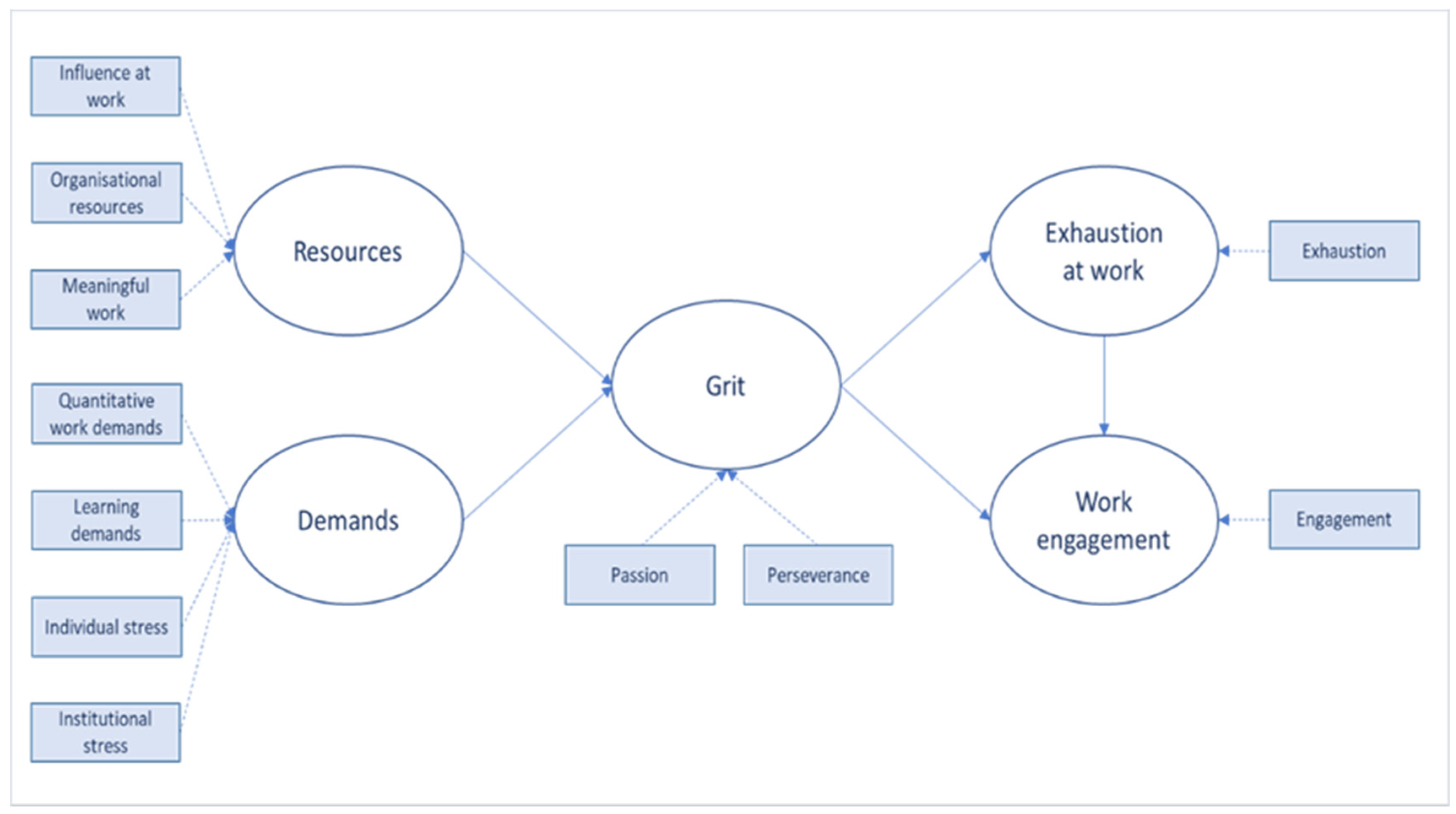
The model specification (Figure 1) followed the hypotheses included in the JD-R theory section and was applied to the sample of PhD students. PLS-PM is generally described by a measurement model, which creates a relation between the original variables and their own latent variable (measurement), and a structural model, which relates latent variables to each other according to the theoretical model to be tested. The measurement model was built as follows: (i) the manifest variables ‘meaningful work, ‘influence at work, and ‘organizational resources’ were related to their own latent variable ‘resources’;
(ii) the manifest variables ‘quantitative work demands’, ‘learning demands’, ‘institutional stress’, and ‘individual stress’ were related to ‘demands’; (iii) the manifest variables ‘passion’ and ‘perseverance’ were related to ‘grit’ and (iv) the first factor from factor analysis for the questions about exhaustion and engagement was related to the latent concepts ‘exhaustion at work’ and ’work engagement’, respectively. The structural model related the endogenous latent variables ‘Resources’ and ‘Demands’ to the exogenous latent variable ‘Grit’ through direct effects, while ‘Grit’ had a direct effect on ‘Exhaustion at work,’ a direct effect on ‘Work engagement’ and an indirect effect on ‘Work engagement’ through ‘Exhaustion at work’. Grit was thus considered a latent mediator variable.
The formative measurement model has to be tested for potential multicollinearity between items (variance inflation factor values below a threshold) and is validated through the analysis of weights (information about the contribution of each item to the construct measurement). The average R2 is instead used to evaluate the predictive performance for the structural model. The validation of the total model is given by the goodness of fit (GoF), meant as an index that is looking for a compromise between the performance of the measurement model and the structural model (Vinzi and Russolillo 2013).
Cronbach’s alpha is often used to test scale reliability and check the unidimensionality of a block in a reflective model (e.g., when each manifest variable reflects its latent variable).
Resources, demands, and grit are defined as formative in the PLS-PM since resources include two independent measurements (organizational resources and meaningful work), demands are formed by three measurements (quantitative work demands, learning demands and individual stress) and the latent variable grit is explained by two factors from factor analysis (see Section 3.1 for further details). This means that the block of manifest variables can be multidimensional, and this index plays no role. Exhaustion and work engagement are reflective since only one dimension is used (from factor analysis, see Section 3.1).
To run the analyses, we used the R 4.1.2 and XLSTAT software programs.

3. Results

3.1. Factor Analysis and the Dimensionality of the Constructs

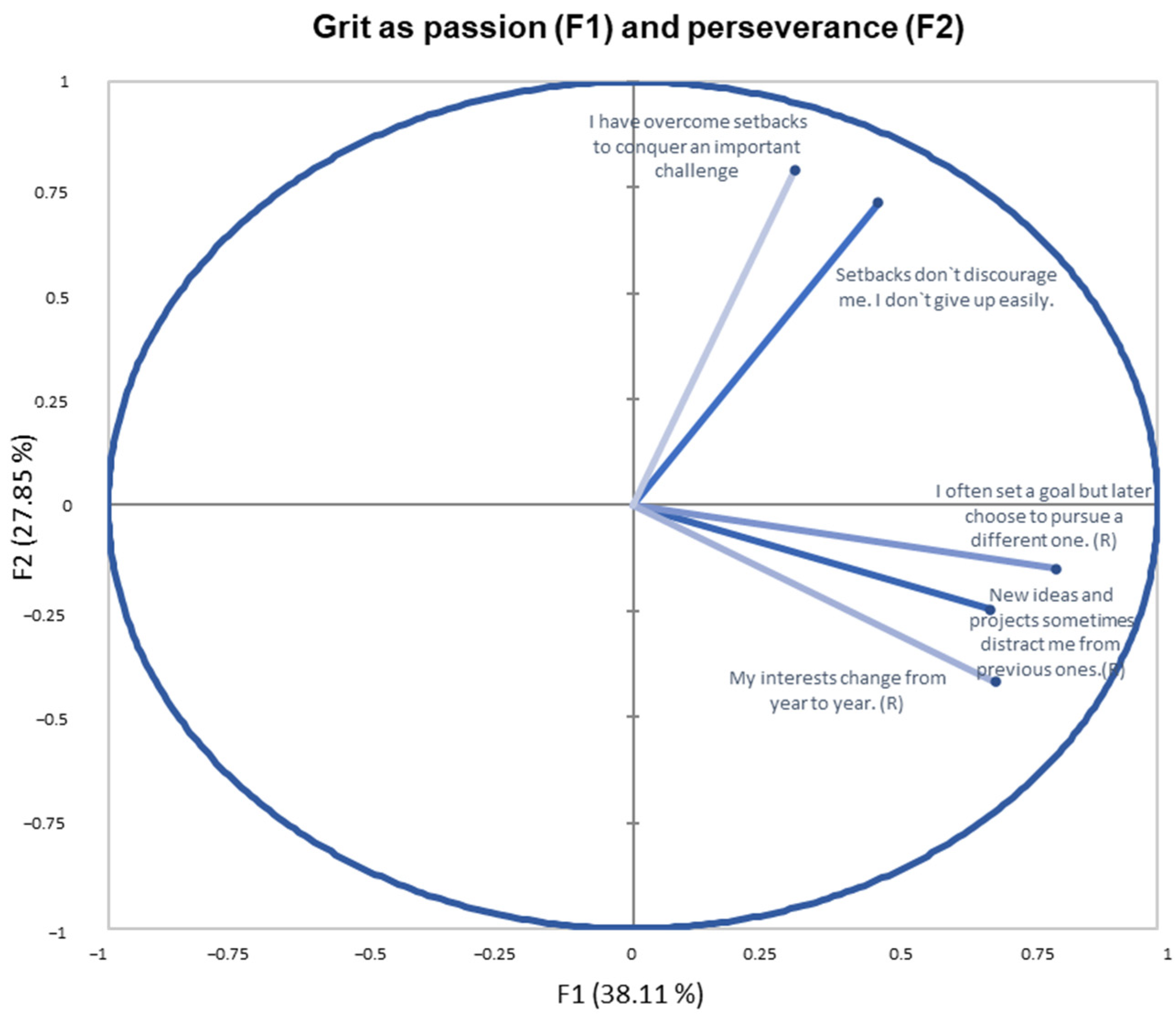
Most of the measurements were unidimensional (the eigenvalue for the first factor accounts for the variability of more than 1 original variable, and the slope in the scree plot is leveling off after the first factor). This indicates the validity of the scales and the possibility of using the factors from factor analysis in an SEM. The factor analysis results for the grit questions showed clear differentiation of two factors: “perseverance” (which includes the following: 1. Setbacks don’t discourage me. I don’t give up easily. 2. I have overcome setbacks to conquer an important challenge) and “passion” (including 1. New ideas and projects sometimes distract me from previous ones. R. 2. I often set a goal but later choose to pursue a different one. R. 3. My interests change from year to year. R) (see Figure 2). Thus, the construct validity of the scale was confirmed (Duckworth and Quinn 2009).
The Cronbach’s alpha values for the measurements are used to test scale reliability and are as follows: influence at work 0.818, organizational resources 0.768, meaningful work 0.913, quantitative work demands 0.763, learning demands 0.767, individual stress 0.862, institutional stress 0.84, grit 0.674 (two-dimensional, see Figure 2), exhaustion at work 0.876, work engagement 0.868. These results indicate internal consistency and confirm the literature.

3.2. SEM Results for the Job Demands–Resources Model

3.2.1. Validation Tests

The quality of a PLS-PM depends on the goodness of fit of both the measurement and structural models. For the measurement model, the test for potential multicollinearity between items was satisfied because the maximum variance inflation factor value was 2.001. Discriminant validity was also satisfied (the squared correlations are always smaller than the mean communalities; see Table 2).
To evaluate the predictive performance for the structural model, the average R2 (measuring the predictive performance) was satisfactory, equal to 0.342 (Table 3 shows statistics used to evaluate the goodness of fit of the model: R2, F, and p value > F). The contribution to R2 was equal to approximately 12% for grit and 88% for exhaustion at work.
In addition, the relative GoF value, which validates a PLS-PM globally (Tenenhaus et al. 2004), is equal to 0.934 and is thus larger than 0.9, which is satisfactory and meets the rule of thumb formulated by Vinzi and colleagues (Vinzi et al. 2009).

3.2.2. Path Modelling Results

The model, as specified in Figure 1, indicated that influence at work for Ph.D. students has a negative meaning and a low coefficient; thus, it cannot be included in Resources. An additional model was tested, where influence at work was a measurement for demands because of its negative meaning. Its weight was too low to provide a relevant contribution to the model; thus, this measurement was discarded.
While relevant for more general samples within a higher education institution (e.g., Naidoo-Chetty and du Plessis 2021), for the sample of Norwegian Ph.D. students, institutional stress does not play a major role1 in creating its latent variable demands; thus, it is excluded from the model.
The weak convergent validity of influence at work and institutional stress, indicated by their consistently low loadings, can also reflect some characteristics of the scope conditions of the doctoral role in Norway: (i) Norwegian Ph.D. students often have similar levels of “control/autonomy” within a program; limited spread and thus restricted variance can attenuate associations and depress loadings; (ii) Norwegian Ph.D. researchers occupy a hybrid student–employee position; so, generic “workplace influence” items may not capture scholarly autonomy versus organizational control, producing weak measurement coherence. Deeper reflections on this matter are given in the Discussion section.
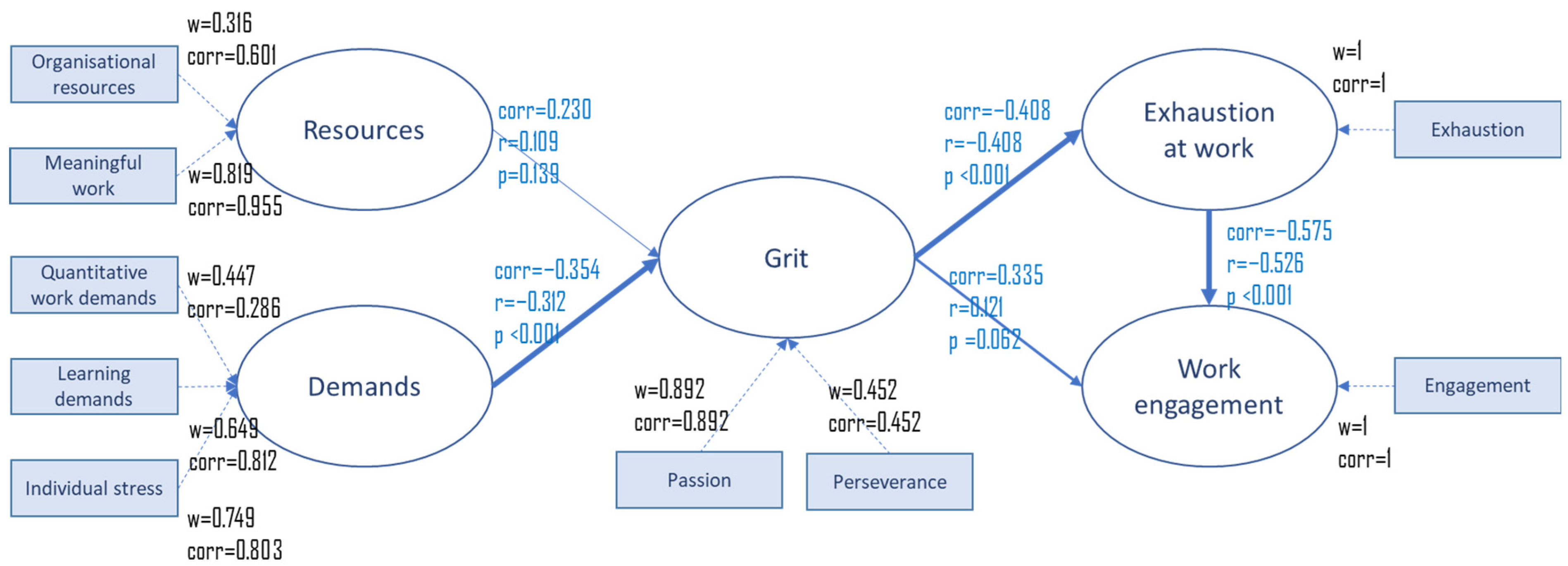
The resulting PLS-PM model, after discarding influence at work and institutional stress, shows robustness on the significance, direction and strength of the paths between latent variables. The model is depicted in Figure 3.
These results indicate that only demands, not resources, had a significant effect on PhD students’ grit. Thus H1 is fully supported, while H2 is not (resources have a positive effect on grit in Ph.D. students, but this effect is not significant). In addition, grit mediated the relationship between the independent latent variables, demands and resources, and the dependent constructs, specifically exhaustion at work (in a direct way) and work engagement (with an indirect effect through exhaustion, see Table 2). This means that the higher the level of demands, the lower the level of grit; thus, the more likely the students were to experience exhaustion at work. H3 is therefore supported. On the contrary, grit showed a borderline not/significant direct effect on engagement. The effect of exhaustion at work on engagement was instead very significant, being approximately 4 times stronger than the effect of grit (Table 4). Nevertheless, grit showed a significant indirect effect through exhaustion (coefficient = −0.214): the more grit and especially the less exhaustion, the more engagement at work. This complex indirect path reported an R2 for engagement being 0.342, where Exhaustion at work had a prominent contribution (see Table 3). It can thus be concluded that H4, which states both a direct and indirect effect of grit on work engagement for Ph.D. students, is just partially supported.
Regarding the measurement model, we also observed that individual stress and learning demands mainly constituted demands in terms of both weight and correlation. In this model, resources were mainly represented by meaningful work (Figure 3).

4. Discussion

4.1. Discussion

The focus of this study was to investigate the potential factors that can encourage Ph.D. students to complete their theses in a timely manner while maintaining their mental well-being. We expected demands to have a negative effect on grit and resources to have a positive effect on grit in a sample of Ph.D. students. Our model also postulated that self-perceived grit would be a mediator variable for experiencing exhaustion at work and work engagement in the same sample. Consistent with our first hypothesis, demands and resources have a positive and negative effect on grit; nevertheless, only demands showed a significant negative effect on grit. The selected variable for resources in this model (meaningful work and organizational resources) may not have proven to be the most relevant resources for Ph.D. students. The weak effects of resources may reflect restricted variance and sample homogeneity (e.g., similar employment conditions and baseline support), which can attenuate associations. Also, institutional stress showed low loadings in the PLS-PM. Institutional stress in doctoral settings often comprises heterogeneous stressors (e.g., bureaucracy, evaluation systems, funding pressures) that need not covary, making low reflective loadings plausible and consistent with potential formative or multidimensional structure. This is a very interesting and surprising finding since previous studies have shown that meaningful work and organizational resources are important for work engagement in the general employee population (Albrecht et al. 2021). Meaningful work is related to a job that allows for a sense of purpose and helps individuals feel like they are part of something larger than themselves. It allows an individual to focus on their strengths and to feel as though their work is having a positive impact on the organization or society; one would expect this to be an important resource for Ph.D. students as well (Schaufeli 2017).
One possible explanation for this surprising finding is that Ph.D. students may take the meaningful and interesting nature of their work for granted, after all, these intrinsic qualities are often what motivated them to pursue a doctoral degree in the first place. However, when they encounter the typical obstacles embedded in the Ph.D. journey such as high workload, stress, ambiguity, isolation, role complexity, time pressure, and potential supervisory conflicts, their ability to capitalize on meaningful work may be diminished. Research on doctoral education shows that such institutional, supervisory, and personal demands can threaten students’ well-being and hinder their progress when resources are insufficient (Acharya et al. 2024).
At this stage they might need help to advance their research. This may involve seeking support from their supervisor or colleagues to discuss potential problems, reading up on the latest developments in their field, and attending conferences. It is essential for Ph.D. students to be actively engaged in their research to make the most of their time as students and to remember the engagement that made them go into the project as Ph.D. students in the first place. Contextualizing the results within the Norwegian context, Ph.D. candidates are commonly full-time employees with standardized employment conditions, such as formalized contracts and collective arrangements, potentially raising the floor of key resources and reducing variability. Moreover, JD–R theory suggests resources may operate primarily as buffers under high demands; if demands are relatively uniform or the wrong demand–resource pairing is modeled, main effects may appear negligible. Finally, Norway’s strong regulatory attention to psychosocial work environment factors may further compress differences in perceived support and role clarity across workplaces. At the same time, baseline institutional support may be relatively high and variability in institutional stress may be restricted, attenuating measurement strength and structural effects.
In our second hypothesis, we expected that self-perceived grit would be a mediator variable in experiencing exhaustion at work for Ph.D. students. There was a significant negative relation between self-perceived grit and exhaustion at work. The lower grit is, the more likely one is to experience exhaustion at work. Our model, therefore, confirmed hypothesis two. Grit can be considered a valid mediator variable.
In our third hypothesis, we presumed self-perceived grit to be a mediator variable in experiencing work engagement for Ph.D. students. Our third hypothesis was only partially confirmed, as there was no direct significant and positive effect between grit and work engagement. However, the model depicts that the more exhausted an individual is at work, the less work engagement there is, with a significant negative relation between exhaustion at work and work engagement. These findings are consistent with previous empirical research showing a significant negative relation between exhaustion at work and work engagement. Studies have consistently found that increased exhaustion leads to decreased work engagement and vice versa (e.g., Bakker et al. 2014).
Autonomy is in general seen as one of the most crucial and important job resources (e.g., Zis et al. 2014), in this sample, it was negative, albeit not significantly. Although the variable was removed from the model, this finding warrants further research. One possible explanation for this rather surprising finding is that too much autonomy at work can be negative for a Ph.D. student if it is not managed in a way that allows for the meaningful achievement of research goals and progress. If the Ph.D. student feels isolated and left alone without direction or guidance on how to proceed with their research, in this situation, too much autonomy could lead to frustration and lack of motivation (Gin et al. 2021). It is therefore plausible that the experience of having to manage a large and complex task such as your doctoral dissertation on your own may make autonomy feel less comfortable or even burdensome, particularly when your perceived competence is low. Research grounded in Self-Determination Theory shows that autonomy is experienced as motivating primarily when it is accompanied by sufficient feelings of competence (Slemp et al. 2021). Studies of doctoral education further indicate that high personal and academic demands such as ambiguity, workload, and the sense of standing alone in one’s research, can threaten well-being when Ph.D. students feel under-resourced or lack mastery (Acharya et al. 2024).
Research has found that supervisors who provide Ph.D. students with frequent constructive feedback and help with time management are seen as effective supervisors (Ali et al. 2016).
Previous research has also shown that the most stressful thing for Ph.D. students is often the pressure to complete their degrees within a specific timeframe while also balancing multiple responsibilities (Pascoe et al. 2020). This includes pressure from supervisors, peers, and themselves to produce high- quality research and maintain high academic standards. Furthermore, the process of conducting original research can be unpredictable and time-consuming, leading to uncertainty and frustration for Ph.D. students. Factors such as financial uncertainty and future career possibilities can be burdensome as well (Mackie and Bates 2019). These stressors combined can make the pursuit of a Ph.D. a challenging and demanding experience and highlight the importance of self-care and organizational support systems for Ph.D. students.
The variables of quantitative workload, high learning demand, and individual stress were significant demands in our model. Ph.D. students tend to experience higher levels of stress from challenging and demanding tasks than from having an excessive workload. Institutional stress was not a demand and was therefore removed from the model. Institutional stress is the type of stress that can be caused by a variety of factors, such as feeling disconnected from the organization, disagreeing with the organization’s norms and values, or feeling overwhelmed by the organization’s rules and regulations. This type of stress is often a significant stress factor for employees in academia and hospitals (Bjaalid et al. 2020). One possible explanation for why this type of stress was not significant in our model could be that institutional stress is removed from the Ph.D. student’s immediate interest, similar to organizational resources. This could indicate that the Ph.D. students in the sample are mainly focused on their own immediate surroundings (e.g., their own research group, fellow Ph.D. students) and individual needs and may therefore perceive themselves as slightly separated from the rest of the organization living in a “Ph.D. bubble”. The temporary nature of their positions may also influence this finding.
Our model depicts that job demands, not job resources, had a significant impact on Ph.D. students’ grit. As grit acted as a buffer against exhaustion at work, having a structure around the Ph.D. students to keep the job demands at a reasonable level seems prudent. Notably, the level of exhaustion that individuals experience at work has an immense impact on work engagement, and being exhausted makes it difficult to stay motivated and engaged.

4.2. Practical Implications

Structured pods of Ph.D. students supporting each other (Beasy et al. 2021) could help alleviate individual stress and develop social support systems (Kearns et al. 2008). Mindfulness courses tailored explicitly to Ph.D. students could also be offered. Mindfulness has been shown to lower stress levels in undergraduate students (Aránega et al. 2019), and generalization to another population is questionable. Since autonomy was not computed as a valuable resource for Ph.D. students, further investigation of relevant resources for this group through a mixed-method study could prove helpful. Additionally, academic supervisors may benefit from training in how to furnish enough structure so that Ph.D. students do not become overwhelmed. Moreover, assisting Ph.D. students in breaking down significant long-term goals into smaller, more attainable subgoals can be beneficial (Gin et al. 2021). Having regular organizational check-ins and structure for progress in the Ph.D. process might suffice. This may also alleviate the factors of dividing a too complex and heavy workload (finishing the thesis) into achievable subgoals, such as finishing the first article (Seijts et al. 2013). The Basel Approach used in Switzerland is an example of a PhD program in Health Sciences that is put into 10 building blocks, “Student portfolio, PhD supervision, thematic training, financial support for external courses, interdisciplinary research seminars, student-initiated activities, top-up and extension stipends, research integrity, alumni-follow- up network, and website and promotional tools”, to ensure systematic follow-up of each Ph.D. student (Keller et al. 2018, p. 4). Our results suggest that more Ph.D. programs may want to adopt a similar systematic approach to support Ph.D. students’ progress.
The implication of the importance of grit in our study leads to an interesting question: regarding a high level of grit, do you either have it or not? Can grit be measured in a valid and reliable way in the recruitment of Ph.D. students, or can students learn or be trained to have grit early in their Ph.D. careers as a buffer against work exhaustion? The answer to the above questions will have a major impact on both selection and organizational care for future Ph.D. students if taken seriously.
It is also possible to measure levels of grit with various psychological tests and surveys in the recruitment process of Ph.D. students and to train students to have grit and develop their grit through coaching, mentoring, and other support services (Hwang and Nam 2021). Our findings indicate that early in a Ph.D. student’s career, it is beneficial to provide support and mentorship to help them develop their grit and resilience. This can help them stay focused on their work and prevent exhaustion when the going gets tough. Rege et al. (2021) found that intervention in growth mindset development in high school students in the US and Norway had a significant effect on increased challenge-seeking and completion of a math course. A growth mindset is a belief system that emphasizes the idea that our abilities can be developed and improved over time through hard work, dedication, and perseverance. There have been factors that indicate that a growth mindset precedes grit (Hwang and Nam 2021); therefore, developing a growth mindset in Ph.D. students could be helpful to increase their levels of grit, since our results indicate that grit can act as a buffer against exhaustion at work.

5. Conclusions and Future Research

The SEM results indicated that grit acted as a mediator variable for exhaustion at work. Demands at work, not resources, have a significant effect on Ph.D. students’ grit. Our model also showed that a higher level of exhaustion at work is significantly related to lower work engagement among PhD students.
Stress was divided into two factors, institutional stress (Bjaalid et al. 2020) and individual stress, measured as a factor in Cooper’s Job Stress Questionnaire (CJSQ) (Cooper 1981). Only individual stress posed as a demand. Meaningful work and organizational resources were not significant resources in this model, and determining what are considered relevant resources for Ph.D. students could prove beneficial. Our interpretation of these findings is still hypothetical and would benefit from follow-up research to reflect the preliminary nature of these insights.
A mixed-method study including qualitative interviews could offer further insight into this issue.
There were several limitations to this study, and we also identify them as numerous future opportunities for research. The limitations associated with the cross-sectional design in this study must be addressed. Because structural modeling using SEM has not been tested longitudinally, the causal directions proposed cannot be confirmed. The conclusion of this article is indeed prudent and consistent with the exploratory nature of this study. Furthermore, the organizational factors examined in these studies are not exhaustive; additional factors could have been included, depending on alternative organizational perspectives or theoretical approaches. With respect to generalizability, further research is needed to determine whether these findings hold across different cultures and organizational contexts.
In particular, we suggest controlling diversity measurements not included in this study, such as race, age, gender, nationality, and disabilities. Age has been found to be a significant factor in the risk of interruption of a Ph.D. (González-Betancor and Dorta-González 2020) but not in other studies (e.g., Levecque et al. 2017). Additionally, external stressors in Ph.D. students’ lives may play a role (e.g., Beasy et al. 2021; Hazell et al. 2020), which were not measured in this study, nor did we differentiate between Ph.D. students with three- or four-year (including 25% mandatory work for the last group) trajectories or between those who write monographs versus article-based theses. The stress may vary between these different conditions. Furthermore, measurements of the quality of the relationship between the Ph.D. students and their respective advisors were not included in this study. Previous research indicates that the quality of the advisor relationship is a high stress factor for many Ph.D. students and has been found to be a predictive variable of depression in graduate students (Peluso et al. 2011). By missing data on cultural diversity, the nuances of potentially more significant supervisory problems between Ph.D. students from countries with greater respect for authorities (e.g., China, India) and students from Western countries (Regmi et al. 2021) have not been collected. All these factors could be very interesting to combine in future research with the aim of determining how universities can encourage Ph.D. students to complete their theses in a timely manner while maintaining their mental well-being.

Author Contributions

Conceptualization, K.L., G.B., and E.M.; methodology, G.B. and E.M.; software, E.M.; validation, G.B., K.L. and E.M.; formal analysis, E.M.; investigation, K.L.; resources, K.L. and G.B.; data curation, E.M.; writing—original draft preparation, K.L., G.B., and E.M.; writing—review and editing, K.L., G.B. and E.M.; visualization, E.M.; supervision, G.B.; project administration, G.B.; funding acquisition, G.B., K.L. and E.M. All authors have read and agreed to the published version of the manuscript.

Funding

This research received no external funding.

Institutional Review Board Statement

This study was conducted in accordance with the Declaration of Helsinki, and approved by the Institutional Review Board of The Norwegian Centre for Research Data (protocol code 592667, 27 April 2021).

Informed Consent Statement

Informed consent was obtained from all subjects involved in this study.

Data Availability Statement

The data presented in this study are available on request from the corresponding author. The data are not publicly available due to privacy or ethical restrictions.

Conflicts of Interest

The authors declare no conflict of interest.

Note

1
In the first full model, institutional stress showed standardized loading being 0.006, while the loadings of the other manifest variables within Demands reached 0.812—Learning demands. A similar result indicated that Influence at work was not suitable for the model for PhD students (loadings equal to −0.061).

References

  1. Acharya, Vrinda, Ambigai Rajendran, Nandan Prabhu, and Aneesha K. Acharya. 2024. Institutional, supervisory, and personal demands: Unravelling the challenge-hindrance demands in doctoral programs. Cogent Education 11: 2375052. [Google Scholar] [CrossRef]
  2. Albrecht, Simon L., Camille R. Green, and Andrew Marty. 2021. Meaningful work, job resources, and employee engagement. Sustainability 13: 4045. [Google Scholar] [CrossRef]
  3. Alhadabi, Amal, Said Aldhafri, Hussain Alkharusi, Ibrahim Al-Harthy, Hafidha AlBarashdi, and Marwa Alrajhi. 2019. Psychometric assessment and cross-cultural adaptation of the Grit-S Scale among Omani and American universities’ students. European Journal of Educational Research 8: 1175–91. [Google Scholar] [CrossRef]
  4. Ali, Parveen, Roger Watson, and Katie Dhingra. 2016. Postgraduate research students’ and their supervisors’ attitudes towards supervision. International Journal of Doctoral Studies 11: 227–41. [Google Scholar] [CrossRef] [PubMed]
  5. Aránega, Alba Yela, Rafael Castaño Sánchez, and Carmelo A. García Pérez. 2019. Mindfulness’ effects on undergraduates’ perception of self-knowledge and stress levels. Journal of Business Research 101: 441–46. [Google Scholar] [CrossRef]
  6. Bakker, Arnold B., and Evangelia Demerouti. 2014. Job demands-resources theory. In Work and Wellbeing: Wellbeing: A Complete Reference Guide, Volume III. Hoboken: John Wiley & Sons, Ltd. [Google Scholar] [CrossRef]
  7. Bakker, Arnold B., and Evangelia Demerouti. 2017. Job demands–resources theory: Taking stock and looking forward. Journal of Occupational Health Psychology 22: 273. [Google Scholar] [CrossRef] [PubMed]
  8. Bakker, Arnold B., Evangelia Demerouti, and Ana I. Sanz-Vergel. 2014. Burnout and work engagement: The JD–R approach. Annual Review of Organizational Psychology and Organizational Behavior 1: 389–411. [Google Scholar] [CrossRef]
  9. Beasy, Kim, Sherridan Emery, and Joseph Crawford. 2021. Drowning in the shallows: An Australian study of the PhD experience of wellbeing. Teaching in Higher Education 26: 602–18. [Google Scholar] [CrossRef]
  10. Bjaalid, Gunhild, Espen Olsen, Kjersti Melberg, and Aslaug Mikkelsen. 2020. Institutional stress and job performance among hospital employees. International Journal of Organizational Analysis 28: 365–82. [Google Scholar] [CrossRef]
  11. Chin, Wynne W., and Peter R. Newsted. 1999. Structural equation modeling analysis with small samples using partial least squares. Statistical Strategies for Small Sample Research 21: 307–41. [Google Scholar]
  12. Cohen, Emma D., and Will R. McConnell. 2019. Fear of fraudulence: Graduate school program environments and the impostor phenomenon. Sociological Quarterly 60: 457–78. [Google Scholar] [CrossRef]
  13. Cooper, Cary L. 1981. The Stress Check: Coping with the Stresses of Life and Work. Englewood Cliffs: Prentice Hall. [Google Scholar]
  14. Credé, Marcus, Michael C. Tynan, and Peter D. Harms. 2017. Much ado about grit: A meta-analytic synthesis of the grit literature. Journal of Personality and Social Psychology 113: 492–511. [Google Scholar] [CrossRef] [PubMed]
  15. Csikszentmihalyi, Mihaly. 1990. Flow: The Psychology of Optimal Experience. New York: Harper. [Google Scholar]
  16. Deci, Edward L., and Richard M. Ryan. 2012. Self-determination theory. In Handbook of Theories of Social Psychology. Edited by Paul A. M. Van Lange, Arie W. Kruglanski and E. Tory Higgins. Los Angeles: Sage Publications Ltd., pp. 416–36. [Google Scholar]
  17. Demerouti, Evangelia, Arnold B. Bakker, Friedhelm Nachreiner, and Wilmar B. Schaufeli. 2001. The job demands–resources model of burnout. Journal of Applied Psychology 86: 499. [Google Scholar] [CrossRef]
  18. Duckworth, Angela. 2016. Grit: The Power of Passion and Perseverance. New York: Scribner. [Google Scholar]
  19. Duckworth, Angela L., Christopher Peterson, Michael D. Matthews, and Dennis R. Kelly. 2007. Grit: Perseverance and passion for long-term goals. Journal of Personality and Social Psychology 92: 1087–101. [Google Scholar] [CrossRef]
  20. Duckworth, Angela L., Patrick D. Quinn, and Eli Tsukayama. 2021. Revisiting the factor structure of grit: A commentary on Duckworth and Quinn (2009). Journal of Personality Assessment 103: 573–75. [Google Scholar] [CrossRef] [PubMed]
  21. Duckworth, Angela Lee, and Patrick D. Quinn. 2009. Development and validation of the short grit scale (Grit–S). Journal of Personality Assessment 91: 166–74. [Google Scholar] [CrossRef]
  22. Dye, David A. 1996. The Organizational Assessment Survey; Washington, DC: United States Office of Personnel Management.
  23. Fusar-Poli, Paolo, Gonzalo Salazar de Pablo, Andrea De Micheli, Dorien H. Nieman, Christoph U. Correll, Lars V. Kessing, Andrea Pfennig, Andreas Bechdolf, Stefan Borgwardt, Celso Arango, and et al. 2020. What is good mental health? A scoping review. European Neuropsychopharmacology 31: 33–46. [Google Scholar] [CrossRef]
  24. Gardner, Susan K., and Bryan Gopaul. 2012. The part-time doctoral student experience. International Journal of Doctoral Studies 7: 63–78. [Google Scholar] [CrossRef]
  25. Gin, Logan E., Nicholas J. Wiesenthal, Isabella Ferreira, and Katelyn M. Cooper. 2021. PhDepression: Examining how graduate research and teaching affect depression in life sciences PhD students. CBE—Life Sciences Education 20: ar41. [Google Scholar] [CrossRef]
  26. González-Betancor, Sara M., and Pablo Dorta-González. 2020. Risk of interruption of doctoral studies and mental health in PhD students. Mathematics 8: 1695. [Google Scholar] [CrossRef]
  27. Gunawan, Dyah Ayu Kusumawardani, Nilam Widyarini, and Asmadi Alsa. 2025. Grit-enhancing intervention: A systematic review. International Journal of Psychology Sciences 7: 84–90. [Google Scholar] [CrossRef]
  28. Hair, Joseph F., Jeffrey J. Risher, Marko Sarstedt, and Christian M. Ringle. 2019. When to use and how to report the results of PLS-SEM. European Business Review 31: 2–24. [Google Scholar] [CrossRef]
  29. Hazell, Cassie M., Laura Chapman, Sophie F. Valeix, Paul Roberts, Jeremy E. Niven, and Clio Berry. 2020. Understanding the mental health of doctoral researchers: A mixed methods systematic review with meta-analysis and meta-synthesis. Systematic Reviews 9: 1–197. [Google Scholar] [CrossRef]
  30. Hwang, Mae-Hyang, and JeeEun K. Nam. 2021. Enhancing grit: Possibility and intervention strategies. In Multidisciplinary Perspectives on Grit. Edited by L. E. van Zyl, C. Olckers and L. van der Vaart. Cham: Springer, pp. 5–20. [Google Scholar] [CrossRef]
  31. Kearns, Hugh, Maria Gardiner, and Kelly Marshall. 2008. Innovation in PhD completion: The hardy shall succeed (and be happy!). Higher Education Research & Development 27: 77–89. [Google Scholar] [CrossRef]
  32. Keller, Franziska, Suzanne Dhaini, Matthias Briel, Sina Henrichs, Christoph Höchsmann, Daniel Kalbermatten, Nino Künzli, Annette Mollet, Christian Puelacher, Arno Schmidt-Trucksäss, and et al. 2018. How to conceptualize and implement a PhD program in Health Sciences—the Basel Approach. Journal of Medical Education and Curricular Development 5: 2382120518771364. [Google Scholar] [CrossRef] [PubMed]
  33. Levecque, Katia, Frederik Anseel, Alain De Beuckelaer, Johan Van der Heyden, and Lydia Gisle. 2017. Work organization and mental health problems in PhD students. Research Policy 46: 868–79. [Google Scholar] [CrossRef]
  34. Lindström, Kari, Margareta Dallner, Anna-Liisa Elo, Filippo Gamberale, Stein Knardahl, Anders Skogstad, and Einar Ørhede. 1997. Review of Psychological and Social Factors at Work and Suggestions for the General Nordic Questionnaire (QPSNordic). Copenhagen: Nordic Council of Ministers. [Google Scholar]
  35. Luneta, Kakoma. 2024. Recruitment and Selection of Doctoral Candidates. In Doctoral Supervision in Southern Africa: From Theory to Practice. Cham: Springer Nature, pp. 41–57. [Google Scholar]
  36. Luthans, Fred. 2002. Positive organizational behavior: Developing and managing psychological strengths. Academy of Management Perspectives 16: 57–72. [Google Scholar] [CrossRef]
  37. Mackie, Sylvia Anne, and Glen William Bates. 2019. Contribution of the doctoral education environment to PhD candidates’ mental health problems: A scoping review. Higher Education Research & Development 38: 565–78. [Google Scholar]
  38. Maslach, Christina, Susan E. Jackson, and Michael P. Leiter. 1996. Maslach Burnout Inventory Manual, 3rd ed. Palo Alto: Consulting Psychologists Press. [Google Scholar]
  39. Morell, Monica, Ji Seung Yang, Jessica R. Gladstone, Lara Turci Faust, Annette R. Ponnock, Hyo Jin Lim, and Allan Wigfield. 2021. Grit: The long and short of it. Journal of Educational Psychology 113: 1038–58. [Google Scholar] [CrossRef]
  40. Moukaddam, Nidal, Kimberly Parks, Hai Le, Lubna Khawaja, and Asim A. Shah. 2020. Burnout and suicide among physicians during times of stress. Psychiatric Annals 50: 536–41. [Google Scholar] [CrossRef]
  41. Naidoo-Chetty, Mineshree, and Marieta du Plessis. 2021. Job demands and job resources of academics in higher education. Frontiers in Psychology 12: 631171. [Google Scholar] [CrossRef] [PubMed]
  42. Pascoe, Michaela C., Sarah E. Hetrick, and Alexandra G. Parker. 2020. The impact of stress on students in secondary school and higher education. International Journal of Adolescence and Youth 25: 104–12. [Google Scholar] [CrossRef]
  43. Peluso, Daniel L., R. Nicholas Carleton, and Gordon J. G. Asmundson. 2011. Depression symptoms in Canadian psychology graduate students: Do research productivity, funding, and the academic advisory relationship play a role? Canadian Journal of Behavioural Science 43: 119. [Google Scholar] [CrossRef]
  44. Ray, Mary Elizabeth, Jessica Marie Coon, Ali Azeez Al-Jumaili, and Miranda Fullerton. 2019. Quantitative and qualitative factors associated with social isolation among graduate and professional health science students. American Journal of Pharmaceutical Education 83: 6983. [Google Scholar] [CrossRef] [PubMed]
  45. Rege, Mari, Paul Hanselman, Ingeborg F. Solli, Carol S. Dweck, Sten Ludvigsen, Eric Bettinger, Robert Crosnoe, Chandra Muller, Gregory Walton, Angela Duckworth, and et al. 2021. How can we inspire nations of learners? An investigation of growth mindset and challenge-seeking in two countries. American Psychologist 76: 755. [Google Scholar] [CrossRef]
  46. Regmi, Pramod R., Amudha Poobalan, Padam Simkhada, and Edwin van Teijlingen. 2021. PhD supervision in public health. Health Prospect: Journal of Public Health 20: 1–4. [Google Scholar] [CrossRef]
  47. Rimfeld, Kaili, Yulia Kovas, Philip S. Dale, and Robert Plomin. 2016. True grit and genetics: Predicting academic achievement from personality. Journal of Personality and Social Psychology 111: 780–89. [Google Scholar] [CrossRef]
  48. Schaufeli, Wilmar B. 2017. Applying the job demands-resources model. Organizational Dynamics 46: 120–32. [Google Scholar] [CrossRef]
  49. Schaufeli, Wilmar B., Akihito Shimazu, Jari Hakanen, Marisa Salanova, and Hans De Witte. 2019. An ultra-short measure for work engagement: The UWES-3 validation across five countries. European Journal of Psychological Assessment 35: 577–91. [Google Scholar] [CrossRef]
  50. Schaufeli, Wilmar B., Arnold B. Bakker, and Willem van Rhenen. 2009. How changes in job demands and resources predict burnout, work engagement, and sickness absenteeism. Journal of Organizational Behavior 30: 893–917. [Google Scholar] [CrossRef]
  51. Seijts, Gerard H., Gary P. Latham, and Meredith Woodwark. 2013. Learning Goals: A Qualitative and Quantitative Review. Abingdon: Routledge. [Google Scholar]
  52. Seligman, Martin E. P., and Mihaly Csikszentmihalyi. 2000. Positive psychology: An introduction. American Psychologist 55: 5–14. [Google Scholar] [CrossRef]
  53. Slemp, Gavin R., Mark A. Lee, and Lara H. Mossman. 2021. Interventions to support autonomy, competence, and relatedness needs in organizations: A systematic review with recommendations for research and practice. Journal of Occupational and Organizational Psychology 94: 427–57. [Google Scholar] [CrossRef]
  54. Sorrel, Miguel A., José Á. Martínez-Huertas, and María Arconada. 2020. It must have been burnout: Prevalence and related factors among Spanish PhD students. The Spanish Journal of Psychology 23: e29. [Google Scholar] [CrossRef]
  55. Southwick, Daniel A., Chia-Jung Tsay, and Angela L. Duckworth. 2021. Grit at work. Research in Organizational Behavior 39: 100126. [Google Scholar] [CrossRef]
  56. Tenenhaus, Michel, Silvano Amato, and Vincenzo Esposito Vinzi. 2004. A Global Goodness-of-Fit Index for PLS Structural Equation Modelling. Available online: https://www.sis-statistica.org/old/htdocs/files/pdf/atti/RSBa2004p739-742.pdf (accessed on 15 December 2025).
  57. Tenenhaus, Michel, Vincenzo E. Vinzi, Yves-Marie Chatelin, and Carlo Lauro. 2005. PLS path modeling. Computational Statistics & Data Analysis 48: 159–205. [Google Scholar] [CrossRef]
  58. Van Der Heijde, Claudia M., Lotte Douwes, and Peter Vonk. 2019. Mental health problems and support needs of PhD students: Bottlenecks of the PhD trajectory. European Journal of Public Health 29: ckz186.588. [Google Scholar] [CrossRef]
  59. Vinzi, E. Vincenzo, and Giorgio Russolillo. 2013. Partial least squares algorithms and methods. Wiley Interdisciplinary Reviews: Computational Statistics 5: 1–19. [Google Scholar] [CrossRef]
  60. Vinzi, E. Vincenzo, Laura Trinchera, and Silvano Amato, eds. 2009. PLS path modeling: From foundations to recent developments and open issues for model assessment and improvement. In Handbook of Partial Least Squares: Concepts, Methods and Applications in Marketing and Related Fields. Berlin: Springer, pp. 47–82. [Google Scholar]
  61. Vinzi, E. Vincenzo, Wynne W. Chin, Jörg Henseler, and Huiwen Wang, eds. 2010. Handbook of Partial Least Squares: Concepts, Methods and Applications in Marketing and Related Fields. Berlin: Springer. [Google Scholar]
  62. Zis, Panagiotis, Fotios Anagnostopoulos, and Panagiota Sykioti. 2014. Burnout in medical residents: A study based on the job demands-resources model. The Scientific World Journal 2014: 673279. [Google Scholar] [CrossRef] [PubMed]
Figure 1. Model specification for PLS-PM, which is described by a measurement model (indicated by dashed arrows) relating the original variables to their own measurement (latent variable) and a structural model (indicated by solid arrows) relating latent variables to other latent variables.
Socsci 15 00120 g001
Figure 2. Grit 1 and Grit 2, passion and perseverance (F1 and F2 from factor analysis).
Socsci 15 00120 g002
Figure 3. PLS-PM results (the significance level is α = 0.05).
Socsci 15 00120 g003
Table 1. Collinearity matrix between dependent and independent variables used in the PLS-PM constructs.
VariablesOrganisational ResourcesMeaningful WorkQuantitative Work DemandsLearning DemandsIndividual StressPassionPerseveranceExhaustion at WorkWork Engagement
Organisational resources1.0000.335−0.273−0.230−0.2880.1220.066−0.5590.342
Meaningful work0.3351.000−0.193−0.392−0.2700.1820.127−0.5560.600
Quantitative work demands−0.273−0.1931.0000.4530.587−0.1320.0350.269−0.061
Learning demands−0.230−0.3920.4531.0000.488−0.283−0.0770.422−0.325
Individual stress−0.288−0.2700.5870.4881.000−0.268−0.1010.441−0.268
Passion0.1220.182−0.132−0.283−0.2681.0000.000−0.3700.286
Perseverance0.0660.1270.035−0.077−0.1010.0001.000−0.1710.177
Exhaustion at work−0.559−0.5560.2690.4220.441−0.370−0.1711.000−0.575
Work engagement0.3420.600−0.061−0.325−0.2680.2860.177−0.5751.000
Table 2. Discriminant validity for the PLS-PM.
ResourcesDemandsGritExhaustion at WorkWork EngagementMean Communalities (AVE)
Resources10.1530.0530.4200.3820.636
Demands0.15310.1250.2340.1470.462
Grit0.0530.12510.1660.1120.500
Exhaustion at work0.4200.2340.16610.330
Work engagement0.3820.1470.1120.3301
Mean Communalities (AVE)0.6360.4620.5 0
Table 3. R2, path coefficients, and impacts of the latent variables on work engagement.
R2Fp > FR2 (Bootstrap)Standard ErrorCritical Ratio (CR)
0.34249.7460.0000.3450.0526.581
Latent variableValueStandard errortp > |t|Contribution to R2 (%)
Grit0.1210.0641.8800.06211.815
Exhaustion at work−0.5260.064−8.1790.00088.185
Table 4. Direct, indirect, and total effects of the latent variables.
Direct EffectsResourcesDemandsGritExhaustion at workWork engagement
Resources
Demands0.000
Grit0.109−0.312
Exhaustion at work0.0000.000−0.408
Work engagement0.0000.0000.121−0.526
Indirect EffectsResourcesDemandsGritExhaustion at workWork engagement
Resources
Demands0.000
Grit0.0000.000
Exhaustion at work−0.0440.1270.000
Work engagement0.036−0.1040.2140.000
Total EffectsResourcesDemandsGritExhaustion at workWork engagement
Resources
Demands0.000
Grit0.109−0.312
Exhaustion at work−0.0440.127−0.408
Work engagement0.036−0.1040.335−0.526
Disclaimer/Publisher’s Note: The statements, opinions and data contained in all publications are solely those of the individual author(s) and contributor(s) and not of MDPI and/or the editor(s). MDPI and/or the editor(s) disclaim responsibility for any injury to people or property resulting from any ideas, methods, instructions or products referred to in the content.