1. Introduction
This paper addresses the pressing issue of continuity and religion for children in out-of-home placements in child protection. On the one hand, the child’s religion is typically within the parents’ authority to decide (
Swift 2020;
Weinstock 2017). On the other hand, it may collide with a child’s right to make their own choices (
Archard and Skivenes 2009), and for child protection systems, it can be practically impossible to find a foster home with the same religion as the parents and child (
Langlaude 2014;
van Bergen et al. 2023;
van de Koot-Dees et al. 2023). In this exploratory study, we examine what populations in Organisation for Economic Co-operation and Development (OECD) countries think should be done to balance these considerations, and the reasons behind their positions.
Freedom of religion is considered one of the fundamental human rights, universally recognised under Article 18 of the Universal Declaration of Human Rights (
United Nations 1948). The right concerns the protection of freedom of thought, conscience, and religion for all individuals and acknowledges the value of holding convictions about ultimate questions of existence. Over 90% of the world’s constitutions secure this right (
Elkins et al. 2013); however, in relation to children specifically, it is not prevalent (
Berrick et al. 2025). Within child protection, a child’s religion is an area that appears to remain a prerogative of the parents, even when the child is in public care (
van Bergen et al. 2023; e.g.,
Norwegian Ministry of Children and Families 2023, § 5-4
1). Article 20 of the Convention on the Rights of the Child (CRC) states that a child’s religious background must be considered in removal cases. A mapping of child protection legislation in 44 middle- and high-income countries, including all OECD countries, shows that 16 of the laws mention the importance of the child’s identity when considering the child’s best interests (
Luhamaa et al. 2022). This includes a child’s cultural heritage and other aspects significant to the child’s identity. Of these, six countries’ legislations (out of 44) specifically mention religion. For example, Finnish child protection legislation states that decision-makers should ‘take account of the child’s linguistic, cultural and religious background’ (
Luhamaa et al. 2022, p. 23).
A justification for allowing parents a strong influence in religious matters is that inclusion and socialisation within their religion provide children with identity, community, and a moral framework (
Smith 2021;
Weinstock 2017). For a child, being raised in a religious community may offer moral guidance, communal support, and a sense of meaning, all of which can contribute to healthy development (
Herrero-Arias and Tonheim 2025). Religion is also considered to belong to the private sphere, and therefore an area in which the government should not interfere (
Weinstock 2017).
From a child rights perspective, Article 14 of the CRC requires that State Parties “shall respect the right of the child to freedom of thought, conscience and religion”. Children should therefore be regarded as independent rights holders rather than mere extensions of their parents, with their own interests in having freedom of thought and conscience. Religion, as a parental socialisation right, may be seen as limiting the child’s future autonomy (
Langlaude 2014), although this argument could apply to many forms of socialisation. However, if religion excludes alternative perspectives and involves indoctrination that restricts education or fails to expose children to secular or alternative religious viewpoints, it may constrain the child’s future opportunities—particularly when the child lacks access to basic knowledge about nature and society (
Langlaude 2014;
Weinstock 2017). Some religious communities do not permit children to be taught basic natural sciences, such as Hasidic Judaism (see
Rothschild 2019). For society and government, the state has a vested interest in ensuring that children receive an education that prepares them for citizenship.
Our study analyses representative survey data from 40 OECD countries, encompassing over 40,000 respondents. We explore public support for out-of-home placements for a 5-year-old child who has been removed from his parents by the child protection system due to parental abuse. The child is cared for in a foster home and is settling in well. However, the biological parents are deeply religious and insist that the child be moved to a family that shares their faith. We ask the public if the child should stay in the foster home or be moved to another foster home, and we ask their reasons for their choice. To increase our understanding of the topic, we conduct an experiment in which we increase the difficulty of finding a suitable foster home. We furthermore explore whether people’s affiliation with religion, their views on religious rights, authoritarian values, confidence in the child protection system, and institutional context play a role. We also discuss some of the reasons for their choices.
The research contributes to filling gaps in the literature on religion in child protection and on balancing pragmatic considerations with conflicting fundamental rights. Furthermore, the study expands our understanding of the legitimacy and acceptability of out-of-home placement in child protection contexts. The study also provides valuable guidance for policymakers and professionals seeking to balance parental rights and government responsibility, as well as defining what is in the best interest of a specific child. Lastly, the study explores the role religion, authoritarian values, confidence, and institutional context play in understanding the choices people make.
The paper is structured as follows: we present theory and key insights in the field in the next section, including an overview of existing research. Thereafter, we present the method, findings, and discussion, followed by concluding remarks.
2. Theoretical Approach and Hypotheses
There are few studies overall on population views, preferences, and beliefs about child protection (
Skivenes 2021;
Berrick et al. 2023), and even fewer that discuss religion and child protection (
van Bergen et al. 2023). Thus, this study breaks new empirical ground. We have an exploratory design that draws on general behavioural insights and prior child protection research, examining six independent variables to understand people’s preferences for either letting the child stay in a foster home or moving the child to another home. Furthermore, we explore the reasons for people’s choices. Our first three hypotheses are primarily based on empirical studies, and the latter three are based on theoretical assumptions.
First, given the shortage of foster homes, we test the significance of the difficulty of finding a foster home with the preferred religious affiliation. We do this through an experiment in which a randomised half of the population receives a vignette with the premise that a foster home must be sought within a small religious community. We hypothesise that fewer will support this due to the difficulties it implies in finding a home for the child.
H1. People will be less supportive of moving a child to a small, religious community, compared to a larger religious community.
Second, we test whether religiosity is correlated with support for moving to another home. We hypothesise that there is a positive correlation between being religious and support for moving the child to another home. Related to this, third, we test whether beliefs about the status of the religious right in society are correlated with the willingness to move the child to another home. We hypothesise that people who believe religious rights have a weak standing in their society are supportive of moving the child to another home.
H2. People who are religiously affiliated are more supportive of moving the child to another home.
H3. People who believe religious people’s rights have a weak standing in their society are supportive of moving the child to another home.
Fourth, authoritarian values may correspond with preferences for moving the child. Recent literature conceptualises authoritarianism as attitudes and values arising under social threat and insecurity, favouring group conformity over individual autonomy (
Duckitt et al. 2010;
Feldman and Stenner 1997). Measurement has shifted toward indicators of child-rearing values (
Engelhardt et al. 2023), indicating that preferences for specific desirable qualities in children capture authoritarianism effectively (
Engelhardt et al. 2023; building on
Sniderman 1989, see footnote 3).
Engelhardt et al. (
2023) argue this approach remains exogenous to a wide set of political and social attitudes, while acknowledging endogeneity concerns in alternative measures. Thus, this measurement improves our ability to account for political opinions and policy positions. We hypothesise that there will be a positive correlation between authoritarian values and support for moving the child.
H4. People with high authoritarian values are more supportive of moving the child to another home.
Fifth, confidence in CPS is expected to play a role. Policy research posits a link between confidence and perceptions of institutional behaviour. Personal experience, media narratives, and broader societal trends shape this complex relationship. We include confidence in public institutions—and specifically trust in the child protection system (CPS)—as an independent variable because confidence often aligns with perceptions that authorities act ethically and follow due process (
Hassan 2025;
Loen 2025;
Loen and Skivenes 2023,
2025). An OECD Survey on Drivers of Trust in Public Institutions (
OECD 2024) finds that perceived reliability, integrity, and responsiveness build trust, while corruption erodes it (
Clausen et al. 2011). In child protection research, higher confidence in CPS correlates with support for more intrusive state interventions and greater willingness to restrict parental freedom to protect children (
Loen and Skivenes 2023,
2025). We measure trust in CPS using an established design (
Juhasz and Skivenes 2017;
Skivenes and Benbenishty 2022a). We hypothesise that people with high trust in the child protection system will be supportive of the child staying in the current foster home.
H5. People with high trust and confidence in the child protection system are more supportive of letting the child stay at the current foster home.
Sixth, the impact of institutional context is expected to matter. Policy and welfare state scholarship debates whether institutions shape public opinion or reflect elected preferences (
Svallfors 2012;
Valarino et al. 2018). Institutional quality may foster social trust (
Rothstein and Stolle 2007), and political trust may support policy uptake (
Harring 2018). We treat child protection systems as institutional contexts that shape citizens’ attitudes (
Berrick et al. 2020,
2022a,
2022b,
2024;
Helland 2025;
Helland et al. 2023;
Loen and Skivenes 2023,
2025;
Skivenes and Benbenishty 2022a,
2022b;
Skivenes et al. 2024; see also
Svallfors 1996,
2012;
Valarino et al. 2018). Nation-states delegate legitimate coercive authority to child protection systems. Family-specific social and institutional contexts embed values about children and families that may align with, or diverge from, instruments such as the CRC. We use the child protection system as an institutional independent variable to shed light on cross-country differences. Child protection systems are commonly grouped into five risk-orientation types (
Berrick et al. 2023;
Gilbert et al. 2011): child exploitation-protective, child deprivation-protective, child maltreatment-protective, child well-being-protective, and child rights-protective. The typology is layered rather than siloed, with exploitation at the core and child rights at the outer layer. Most systems prevent exploitation; fewer are fully institutionalised to protect child rights. We identify four types relevant to our data and countries (see
Table S11 and Figure S1). Child deprivation-protective systems prioritise survival by meeting basic needs such as housing, education, healthcare, and nutrition, often unmet due to parental deprivation. Child maltreatment-protective systems focus on harm within families—abuse, violence, and neglect—with growing attention to earlier intervention and parental participation. Child well-being-protective systems seek to secure well-being through highly institutionalised, support- and service-oriented practice with low coercion and voluntary parental engagement. Child rights-protective systems treat children as independent rights-holders, requiring child participation in decisions, with the child’s best interests as a central pillar. We hypothesise that populations in child-rights-protective systems will be most supportive of the child staying, and that support will decrease in accordance with the other four systems.
H6. People from countries with child rights-protective systems are more supportive of letting the child stay, and the support will decrease in accordance with the type of system.
How do respondents justify their choice? There can be a range of reasons why one wants a child to stay or move from a foster home. Our approach to investigating the justifications is explorative. We presented respondents with three justifications for moving the child: respecting the parental request, the importance of the religious community, and the child’s best interests. For respondents who suggested letting the child stay, we provided four justifications, including the child’s well-being, stability in care, the social worker’s recommendation, and the child’s best interests. The mentioned justifications for both decisions are derived from the vignette that we are presenting to the respondents. We will explore the justifications to some extent and examine how people value each given reason.
3. Method
We collected survey data from representative samples of the population across the 40 OECD countries, conducted between July 2023 and June 2024, using the survey company YouGov as our data provider. This survey is a part of and funded by the DISCRETION and CPS-WORLD projects (Grant Agreement Nos. 724460 and 324966) at the Centre of Research on Discretion and Paternalism (DIPA). The CPS-WORLD project, to which the study contributes, was registered in RETTE, the University of Bergen’s internal system for risk and compliance with data protection, under the registration number R3259. All responses were already anonymised when we received them from YouGov. Only those who are 18 years old and above are eligible to be respondents in the survey. Participants in the surveys were compensated. YouGov incentivised panel members to participate in surveys with redeemable points that can be converted to cash and gift cards.
We provide a methodology report on our data collection, including detailed explanations of the process and survey questions (
https://discretion.w.uib.no/files/2026/01/40C-Methodology-Report.pdf, accessed on 29 December 2025). The representativeness of the samples is ensured by country and region, taking into account the panellists’ age, gender, and geographic location. All analyses in this research used weighted data with post-stratification weights administered by YouGov (methodology report, p. 2), reflecting the three aforementioned indicators of representativeness.
Our initial design was to collect 1000 respondents per country, and the final sample size was 41,232. Prior to releasing the survey, we conducted thorough translation and quality checks with the help of native-speaking experts (methodology report, pp. 4–6). This was done to validate the different cultural contexts that we may encounter.
We used R version 4.5.1 and RStudio IDE statistical software (version 2025.9.0.387) for data preparation, analysis, and results visualisation (
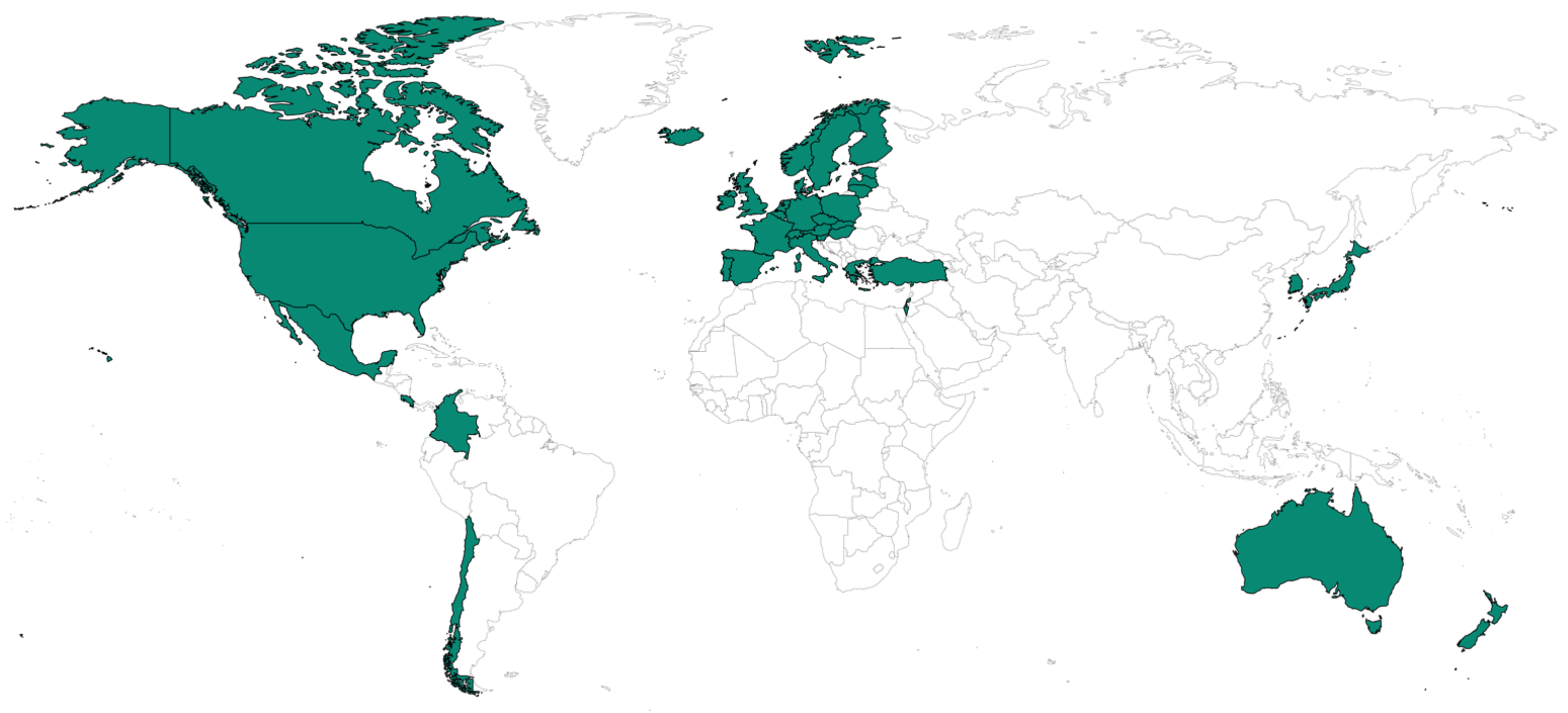
R Core Team 2025), with several packages to support these tasks. During data preparation, we included only respondents who passed the attention-checker question, ensuring the quality of the data used for analysis, which resulted in 39,746 observations. In our analyses, we excluded non-responses (e.g., Do not Know/Do not Want to Answer), unless otherwise mentioned. We display a map of the included countries in
Figure 1 and list them in
Table S1 in the Supplementary Materials.
Our research design includes an experimental vignette to examine whether there is any difference in the aspect of biological parents being in a small religious community with respect to the respondents’ decision related to the child’s foster care (T2). The treatment reflects the difficulties in finding a foster home for religious minorities, which we are testing for H1. The vignette given to the samples is as follows:
“A 5-year-old child was removed from his parents because of abuse. The child is now with a new family where he is settling in well and is happy. The biological parents are deeply religious [(T1)/and belong to a small religious community (T2)]. They insist that the child be moved to a family who shares their faith. The social worker thinks it is in the child’s best interest to stay where he is. What do you think should happen?”
The social worker should move the child to a family that shares the biological parents’ faith (move)
The social worker should keep the child in the home where he is currently living (stay)
Do not know/Do not want to answer
Following the vignette, we asked respondents several follow-up questions based on their responses. We asked them to evaluate the importance of the reasons for either moving the child from their current foster family or letting them stay. We provided three reasons for moving the child and four reasons for letting the child stay, as shown in
Table 1.
In the
Supplementary Materials, details on the treatment allocation (
Table S2), randomisation tests over sociodemographic control variables (
Table S3), and descriptive statistics (
Table S5) are presented. However, based on the initial analyses (
Table S6 on distributions,
Table S7 on
t-tests, and
Table S8 on regression analysis), the findings displayed no significant difference between treatment groups (T1 and T2). Therefore,
H1 is rejected, and based on this, we analysed the data as a pooled dataset.
Using the pooled data, we performed descriptive analyses to understand responses to both the decision on the child and the importance of the decision’s justifications, at both the total-sample and country-level. Moreover, we ran binary logistic regression analyses to investigate the relationship for respondents’ decision to let the child stay in the current foster family or to move the child to another foster family. As the decision question results in binary responses (i.e., to move or stay), logistic regression is appropriate. OLS coefficients are prone to inconsistency and bias when the dependent variable is binary (
Gomila 2021), as evidenced by one example in which the results can fall outside the range of 0 and 1 (
Wooldridge 2012).
We examined the relationships between the independent variables (religious affiliation, views on religious groups’ rights, authoritarian values, confidence and trust in the child protection system, and the institutional context of child protection) and the respondents’ decisions regarding the child for the total sample. Details on the operationalisation of independent variables can be seen in the
Supplementary Materials. As shown in
Table 2, we tested the relationships across seven model specifications. We tested each independent variable separately on columns 1–5. Column 6 shows the model with all independent variables together. Lastly, column 7 shows the model with all independent and control variables.
4. Findings
4.1. Decision on Move or Stay
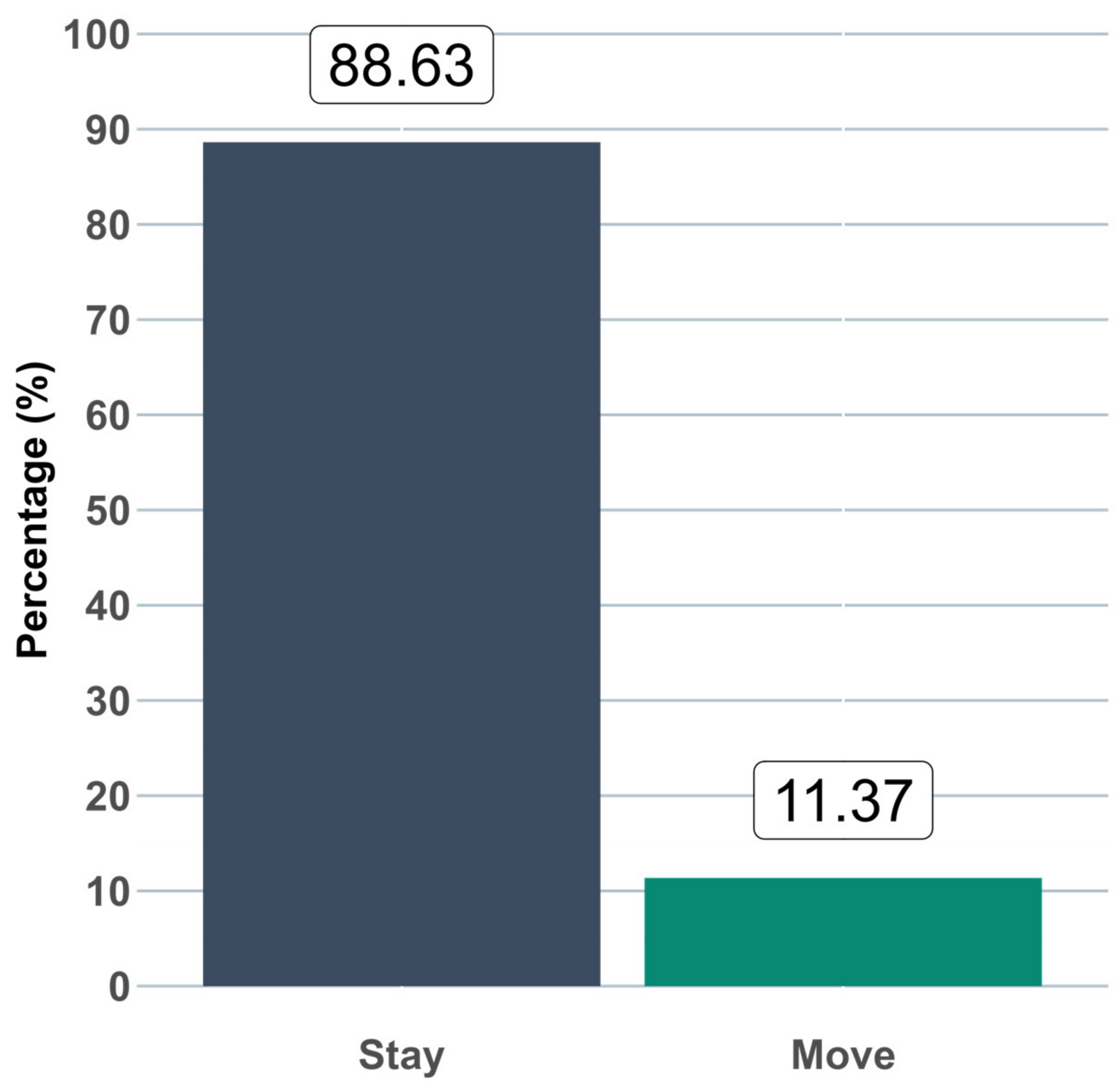
Overall, respondents support the decision to let the child stay at the current foster home, with 88% supporting it, while the remaining 12% favoured moving the child to another foster home (
Figure 2).
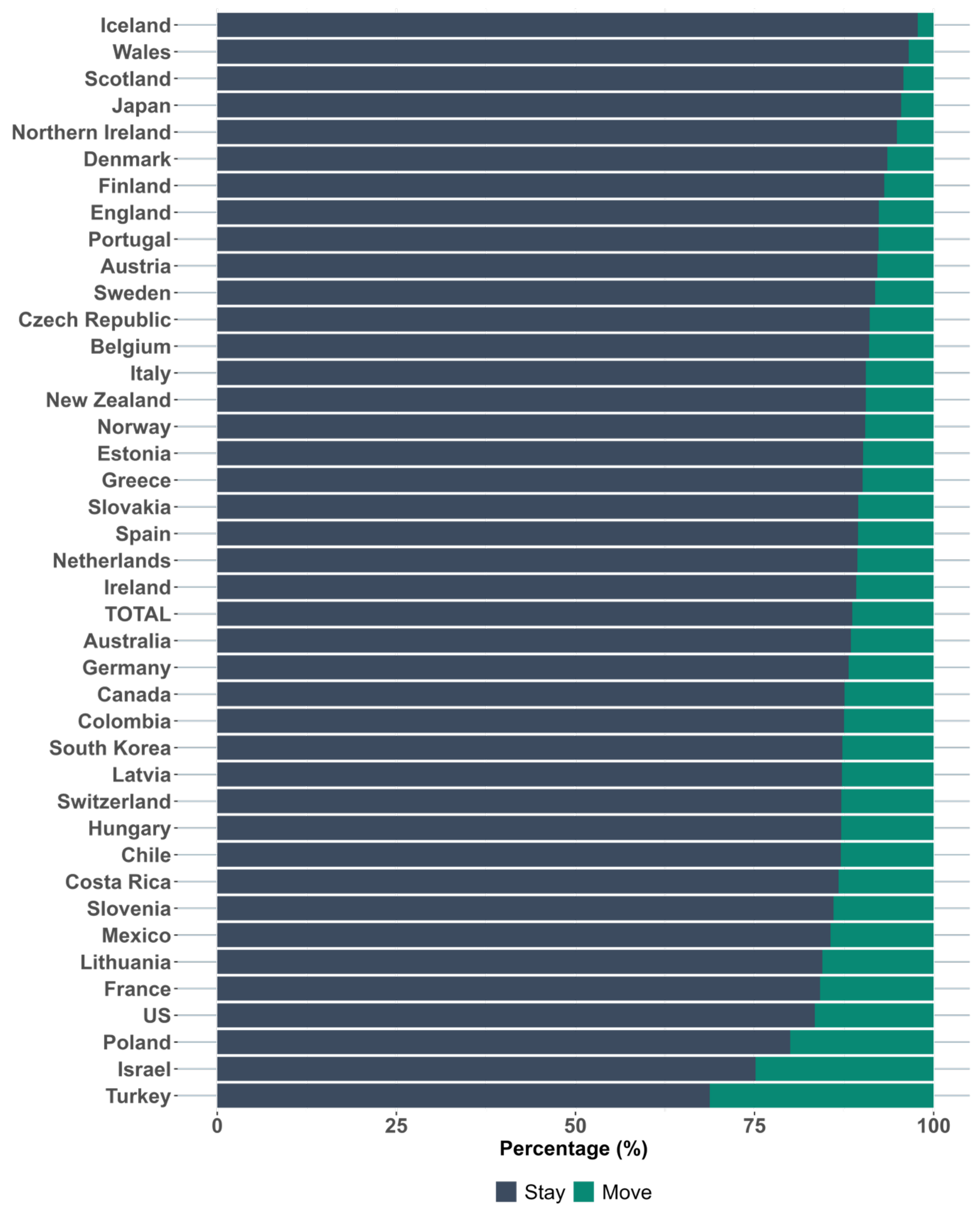
A large majority of the country’s population supports the child staying in the foster home (
Figure 3). Countries such as Iceland, Wales, Scotland, Japan, and Northern Ireland have overwhelming responses at 97.78%, 96.53%, 95.78%, 95.48%, and 94.88%, respectively. On the other hand, France, the US, Poland, Israel, and Turkey are in the lower end with 84.14%, 83.41%, 79.97%, 75.14%, and 68.75%, respectively (see
Table S12).
The regression analyses (
Table 2), reported here primarily for model 7, show that first, there is a significant difference between religiously affiliated people in favouring the decision for the child to move.
H2 is confirmed.
Second, there is a significant difference between groups of people who think that there are enough rights for religious people and those who think that there are too few rights. Those who argue that there are too few religious rights have lower odds in favour of the child staying compared to those who say that there are enough rights. This means that those who said too few tend to let the child move to another family with the same faith as the child’s biological parents. The sentiment is also shared across the three model specifications. This itself confirms H3. In contrast, there is no significant difference between the groups who think that there are enough and too many rights for religious people.
Third, higher authoritarian values are associated with lower odds of favouring the child to stay, confirming H4. Fourth, there is a significant association between confidence in the child protection system and the decision. A higher confidence value leads to lower odds in favour of the child staying with the current foster family. This implies that people with high confidence in the system favour the child to move to other foster families. The results are in the opposite direction of H5, in which we hypothesised that high confidence in the system should result in greater support for staying. Because of this, H5 is rejected.
Fifth, we investigated the institutional context of the child protection system, with the child rights-protective system as the reference group. There are significant differences between the rights-protective system and each of the other three systems. The results show that the more holistic the child protection system is, in which the rights-protective system is at the top, the higher the odds in favour of the child staying in the current family. Furthermore, the odds of favouring staying decrease as the protection system layer deepens according to the typology.
Table S13 reaches a similar conclusion when we used the child maltreatment-protective system as the reference group. While there are significant differences with the well-being-protective system, respondents from the maltreatment-protective system show no significant differences compared with countries with the deprivation-protective system, which is one layer below. Nevertheless, the conclusion of the child rights-protective system supporting the decision to stay still holds, and thus,
H6 is confirmed.
Regarding the control variables, significant differences are found in several variables: age, gender, having children, education (partly), and income (partly). The older the respondents are, the higher the odds of preferring children to stay. Female respondents and those with children have higher odds of favouring the children staying. Respondents with education or income up to the middle level have higher odds of favouring the child staying, compared to low level education or income.
Table 2.
Logistic regressions on the decision for child to move or stay (odds ratio).
Table 2.
Logistic regressions on the decision for child to move or stay (odds ratio).
| | Dependent Variable: Decision to Move (0) or Stay (1) |
|---|
| | (1) | (2) | (3) | (4) | (5) | (6) | (7) |
|---|
| Religiousness—Religious (Ref: Not Religious) | 0.360 *** | | | | | 0.468 *** | 0.441 *** |
| | (0.015) | | | | | (0.022) | (0.023) |
| Rights for Religious People: Too Few (Ref: Enough) | | 0.314 *** | | | | 0.386 *** | 0.443 *** |
| | | (0.015) | | | | (0.020) | (0.026) |
| Rights for Religious People: Too Many | | 1.091 * | | | | 0.873 ** | 0.948 |
| | | (0.048) | | | | (0.042) | (0.050) |
| Authoritarian Value | | | 0.157 *** | | | 0.245 *** | 0.259 *** |
| | | | (0.009) | | | (0.018) | (0.021) |
| Confidence in the Child Protection System | | | | 0.660 *** | | 0.633 *** | 0.807 * |
| | | | | (0.049) | | (0.052) | (0.074) |
| Institutional Context (CPS)—Deprivation (Ref: Rights) | | | | | 0.394 *** | 0.543 *** | 0.706 *** |
| | | | | | (0.029) | (0.046) | (0.068) |
| Institutional Context (CPS)—Maltreatment | | | | | 0.542 *** | 0.670 *** | 0.721 *** |
| | | | | | (0.036) | (0.050) | (0.058) |
| Institutional Context (CPS)—Well-Being | | | | | 0.591 *** | 0.729 *** | 0.747 ** |
| | | | | | (0.043) | (0.059) | (0.067) |
| Age—Young (Ref: Adult) | | | | | | | 0.496 *** |
| | | | | | | | (0.023) |
| Age—Old | | | | | | | 1.893 *** |
| | | | | | | | (0.171) |
| Gender—Male (Ref: Female) | | | | | | | 0.499 *** |
| | | | | | | | (0.023) |
| Having Partner—Yes (Ref: No Partner) | | | | | | | 1.038 |
| | | | | | | | (0.051) |
| Having Children—Yes (Ref: No Child) | | | | | | | 0.626 *** |
| | | | | | | | (0.029) |
| Education—Lower (Ref: Middle) | | | | | | | 0.789 *** |
| | | | | | | | (0.052) |
| Education—Higher | | | | | | | 1.085 |
| | | | | | | | (0.053) |
| Employment—Employed (Ref: Not Employed) | | | | | | | 0.974 |
| | | | | | | | (0.051) |
| Income—Lower (Ref: Middle) | | | | | | | 0.793 *** |
| | | | | | | | (0.04) |
| Income—Higher | | | | | | | 1.015 |
| | | | | | | | (0.061) |
| Constant | 16.159 *** | 8.738 *** | 19.521 *** | 9.386 *** | 14.016 *** | 56.257 *** | 98.953 *** |
| | (0.595) | (0.210) | (0.712) | (0.382) | (0.868) | (5.319) | (12.278) |
| R-Sq (McFadden) | 0.03 | 0.027 | 0.034 | 0.002 | 0.008 | 0.074 | 0.125 |
| Observations | 32,936 | 31,458 | 35,483 | 34,366 | 35,483 | 28,757 | 24,364 |
4.2. Justification of Decisions
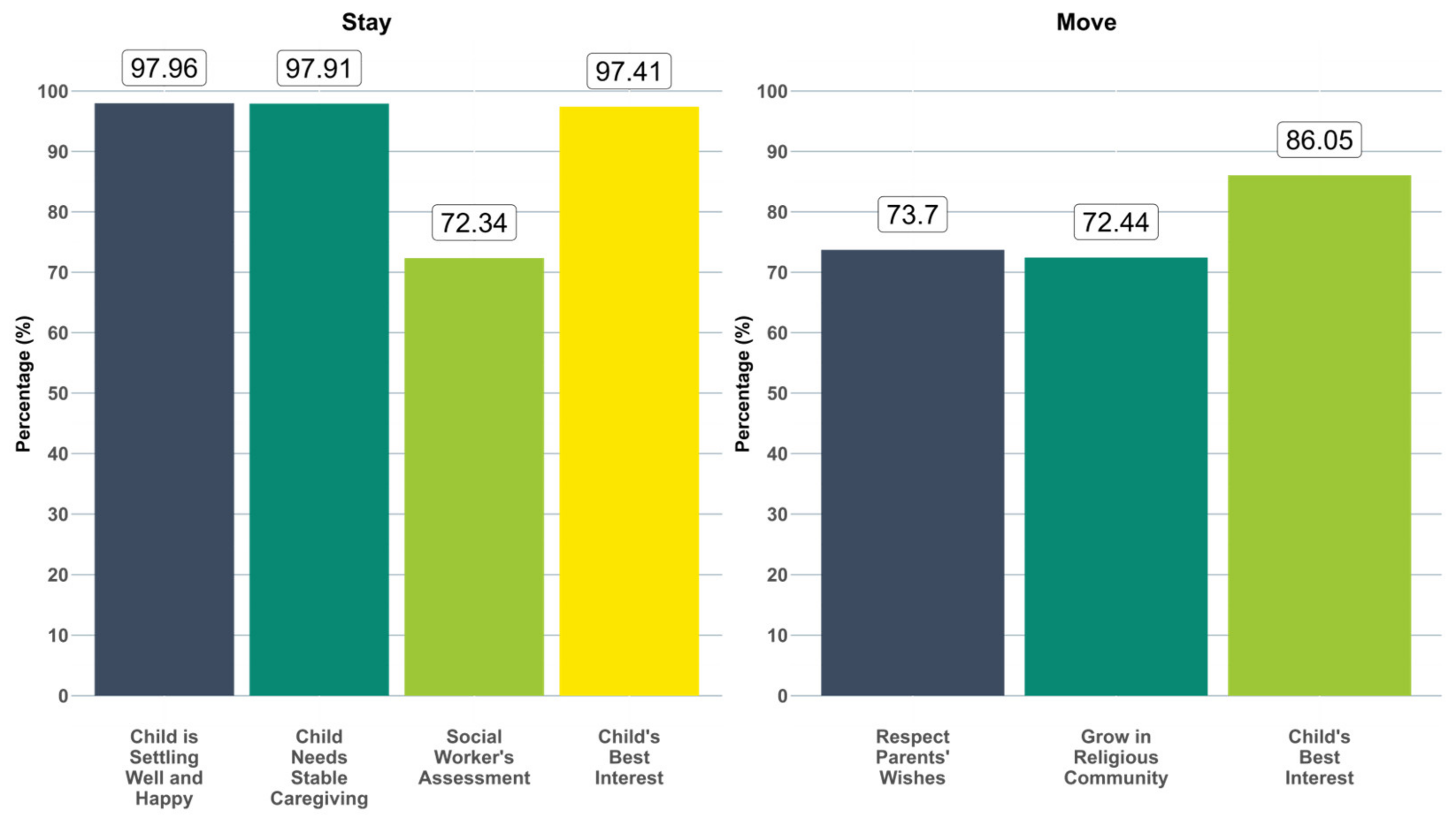
Respondents were presented with a set of fixed reasons for their choice. Those who chose that the child should stay (a total of 88%) were asked to assess four reasons for their decision (
Figure 4, left panel). The results show that 97.9% agreed that it is important for the child to settle in well and be happy, 97.9% agreed that the child needs stable caregiving, 72.3% agreed on the importance of the social worker’s recommendation, and 97.4% agreed that it is in the child’s best interest. Those who chose that the child should move (a total of 12%) were asked to assess three reasons for their decisions (
Figure 4, right panel). 73.7% agreed that this is because it is the parents’ wishes, 72.4% agreed it is because the child should grow up in his religious community, and 86.1% agreed it is because it is in the child’s best interest.
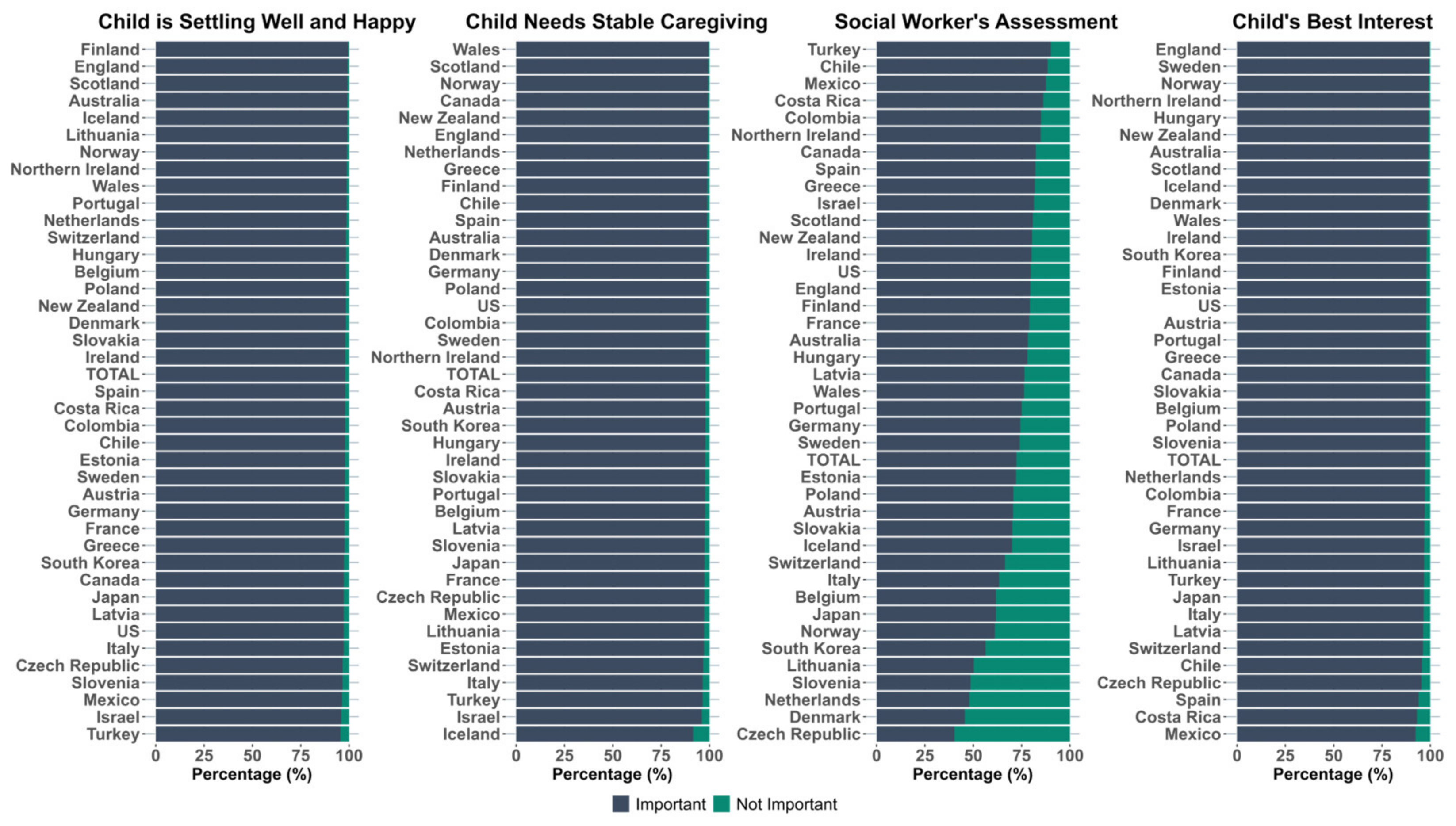
Of the four reasons given to let the child stay in the foster home, there are few country differences for three of the reasons (
Figure 5). It is only for the social worker’s assessment that there are differences. Turkey (90%), Chile (88%), Mexico (88%), Costa Rica (86%), and Colombia (85%) value social workers’ assessments in deciding whether to let the child stay. By contrast, Lithuania (50%), Slovenia (49%), the Netherlands (48%), Denmark (46%), and the Czech Republic (40%) to a lesser degree value this assessment (see details in
Table S16).
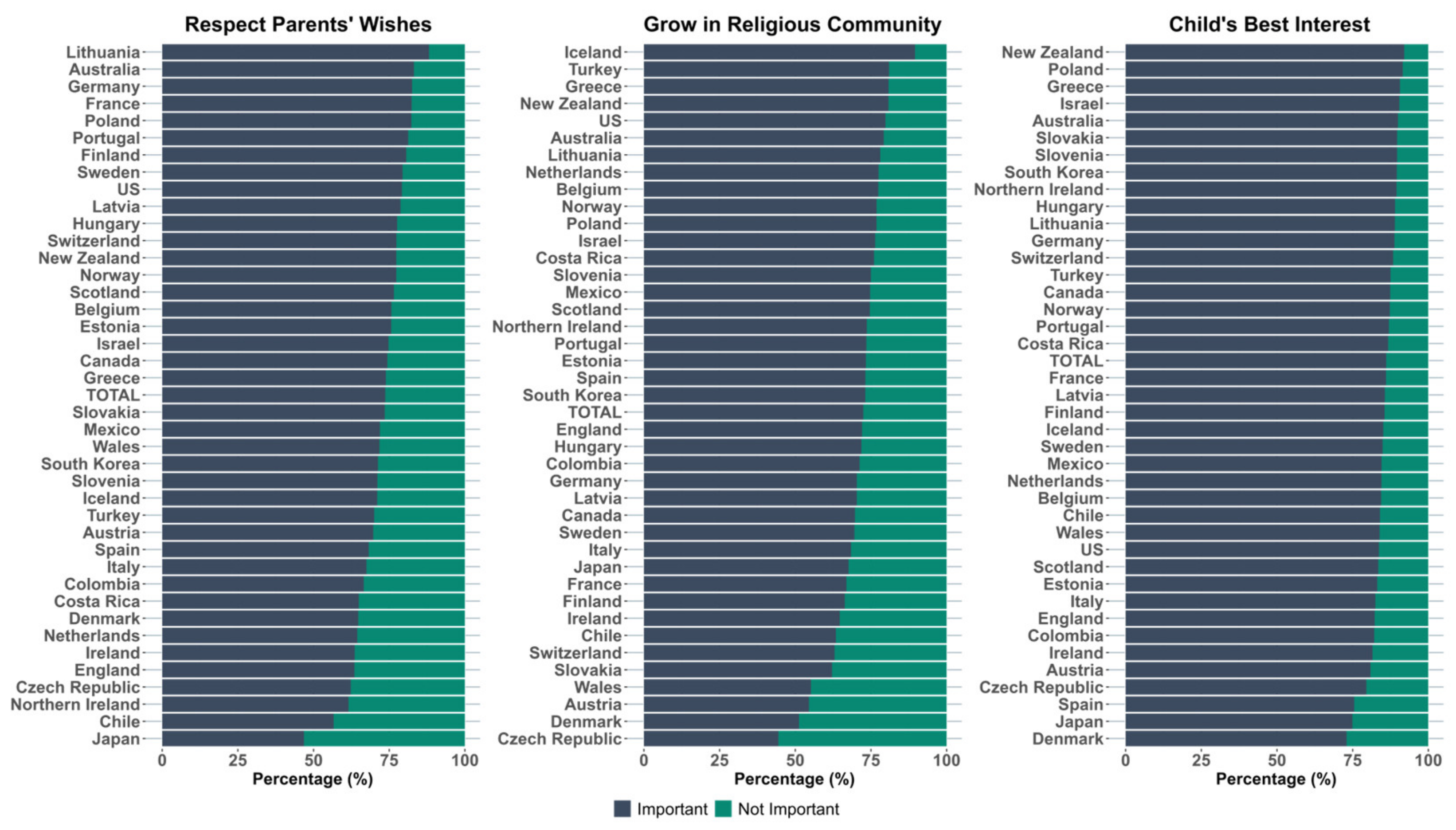
Of the three reasons given for moving the child from the current foster home, there are visible country differences across the 40 countries (see
Figure 6). On respecting parents’ wishes, Lithuania (88%), Australia (83%), Germany (83%), France (82%), and Poland (82%) are in the higher end, while England (63%), Czech Republic (62%), Northern Ireland (62%), Chile (57%), and Japan (47%) on the lower end (see details in
Table S17). For the reason that the child can be raised in a religious community, Iceland (90%), Turkey (81%), Greece (81%), New Zealand (81%), and the United States (80%) are in the higher end, while Slovakia (62%), Wales (55%), Austria (55%), Denmark (51%), and Czech Republic (44%) are on the lower end. Lastly on the reason that is in the child’s best interest to move, the top five countries are New Zealand (92%), Poland (92%), Greece (91%), Israel (90%), and Australia (90%), while Austria (81%), Czech Republic (80%), Spain (75%), Japan (75%), and Denmark (73%) are on the lower end.
In addition to the descriptive results illustrated in
Figure 4,
Figure 5 and
Figure 6, we also explore the possible associations between the independent variables used in the main decision and each justification. The results are shown in
Table S18, including a description of the results.
5. Discussion
Across OECD countries, it is widely recognised in policy and legal frameworks that maintaining continuity with a child’s religious, linguistic, cultural, and ethnic background is an important consideration when children are placed out of home (
Hansen 2023;
van Bergen et al. 2023;
Herrero-Arias and Tonheim 2025). This study addressed the complex issue of religion and child well-being in foster care placements through a large-scale comparative analysis across 40 OECD countries. The findings reveal both expected patterns and surprising insights into how populations balance competing rights and interests when indicating their preferences about a child’s placement. It is a striking and overwhelming finding that a large majority, 88%, of the OECD population would not move the child from a foster home to accommodate a religiously compatible home. Although there is no comparable research on population views and religion, analyses of continuity and child interests are found elsewhere (
Archard and Skivenes, forthcoming;
Pratama and Skivenes, forthcoming). In a global study about reunifying a child from foster care with their biological mother, a majority did not support a reunification after 2 years. Time spent in a foster home had a causal effect on the public’s increased support for continued foster care. However, there were distinctive geographical differences (
Archard and Skivenes, forthcoming).
The study’s six hypotheses reveal a pattern of results that sheds light on the complexity of public opinion on religious considerations in child protection. Four of the six hypotheses were confirmed, two hypotheses were rejected, including one surprising rejection that challenges theoretical assumptions about institutional trust.
Religious affiliation and perceptions of religious rights strongly influenced placement preferences, confirming H2 and H3. This demonstrates that religious identity creates predictable advocacy patterns. Religiously affiliated respondents were more supportive of moving the child to match the parents’ faith, while those who perceived religious rights as under-protected also favoured religious matching. This suggests that personal religious experience translates into more substantial support for religious continuity principles, even when a child is thriving in their current placement.
Authoritarian values showed the expected association with support for moving the child, confirming H4. Respondents with higher authoritarian values preferred that the child be moved to match the parents’ religious affiliation. This finding aligns with authoritarian tendencies to prioritise group conformity and traditional authority structures over individual circumstances or child autonomy.
Institutional context proved significant in shaping public opinion, confirming H6. Populations in child rights-protective systems showed the strongest support for letting the child remain in their stable placement, with support decreasing across other system types. This suggests that institutional frameworks shape citizen attitudes about balancing competing rights in child protection cases.
However, we found no differences in placement preferences when we differentiated the difficulty of finding a foster home with a preferred religious affiliation (H1 is rejected). A possible explanation, and perhaps a caveat of the treatments, is that respondents have limited information on the availability of foster homes in their respective communities, in particular, foster homes that can accommodate religious minority groups. Further research about this dimension can be done by informing participants beforehand about availability, or perhaps even better, by designing a treatment that shows how efficiency factors can affect decision-making.
The confidence finding is surprising. Contrary to H5, higher confidence in the child protection system was associated with greater support for moving the child rather than maintaining stability. This counterintuitive result challenges assumptions about how institutional trust operates in child protection contexts. Rather than trusting the system’s current placement decision, a possible interpretation is that confident respondents believe the system can successfully manage a religious matching without compromising child welfare. However, as we return to below, the public gave less unison weight to the social worker’s assessment. This finding is contradictory to much other research on confidence and child protection (e.g.,
Skivenes and Benbenishty 2022a;
Loen and Skivenes 2023,
2025).
We asked respondents about a fixed set of justifications for their choices, and an interesting finding concerns how respondents across different positions invoked the child’s best interest principle to justify opposing decisions. Among those supporting the child remaining in their current placement, 97.4% cited the child’s best interests. Remarkably, among those favouring a move to religious matching, 86.5% also cited the child’s best interests. This demonstrates that the best interest standard, formulated in Article 3 of the CRC, functions as a flexible interpretive framework rather than a clear decision-making criterion (see also
United Nations Committee on the Rights of the Child 2013;
Luhamaa et al. 2022;
Freeman 2007). The competing conceptions of best interest reflect different value frameworks. Those supporting stability for the child emphasised immediate well-being indicators—the child settling well and being happy (97.9%) and needing stable caregiving (97.8%). We may say that their conception of best interest prioritises empirical evidence of current thriving and attachment relationships. Those supporting religious matching invoked a possible longer-term developmental conception of best interest. They emphasised parental wishes (75%) and the importance of belonging to a religious community (73.6%), while still claiming that this serves the child’s best interest (86.5%). This position likely reflects the parental rights position and a determination of who should decide the best interest of a child. It probably also reflects beliefs that religious identity formation and spiritual development constitute essential components of healthy child development that transcend immediate placement success. The universal invocation of the best interest principle from the CRC across opposing positions shows the importance of defining and providing a legal standard with more concrete operationalisation to provide meaningful guidance to decision-makers, as much of the OECD countries’ child protection legislation does (
Luhamaa et al. 2022).
Professional assessment variations revealed important cross-national differences in deference to social work expertise. While 72.5% of those supporting stability cited the social worker’s recommendation, this varied dramatically across countries—from 90% in Turkey to just 40% in the Czech Republic. This suggests varying levels of professional authority and different conceptions of expertise in child protection decisions across OECD countries, and we believe it is a phenomenon that requires further research. The variation in views on social workers may also shed some light on the puzzling finding on confidence and public views.
The cross-country variation in both placement preferences and justification patterns indicates that cultural and political contexts shape interpretations of children’s rights and best interests. Countries with overwhelming support for stability (Iceland at 97.78% and Wales at 96.53%) contrast sharply with more divided populations (Turkey at 68.75% and Israel at 75.14%). These differences suggest cultural variations in balancing religious rights against placement stability. Additionally, they may reflect different historical relationships between religion and state, as well as varying conceptions of the importance of religious freedom in child development.
6. Limitations
This study adopts an exploratory design with multiple independent variables, given the limited prior theory. This approach reduces precision and heightens the risk of spurious associations. Future work should test targeted hypotheses with refined model specifications to strengthen validity. Furthermore, the study measures stated opinions, and it remains unclear whether respondents would behave similarly in real-world situations, raising questions about its policy relevance.
The study also covers only selected reasons for respondents’ decisions on whether the child should stay or move, potentially omitting important factors and justifications. Future work should consider a broader item set for both decisions. In addition, we did not use responses about reasons as independent variables to predict the decision to let the child stay or move because the theoretical basis is insufficient, and the design does not adequately support treating reasons as mediating variables. It is also likely that some explanatory variables, such as religion and authoritarianism, are collinear and should be addressed in future research.
Although the sample is large, representativeness is secured only for selected variables, potentially biasing estimates. Some groups are likely underrepresented and therefore insufficiently captured. Future studies may improve sampling frames and recruitment to cover broader population segments. Surveys often underrepresent people with low socioeconomic status or low education, which can skew results and limit generalisability. Targeted outreach can enhance inclusion of these populations. As in most surveys, respondents may misinterpret items, generating measurement error and potential distortion. Cognitive testing and pilot surveys can help clarify question wording. Even with careful translation, cultural and linguistic nuances can affect comprehension; subtle misinterpretations may bias results. Greater involvement of local experts and strong translation protocols could mitigate such risks. Restricting the analysis to OECD countries limits the relevance of the findings for non-OECD contexts, and an expansion of countries would improve external validity.
7. Concluding Remarks
Overall, the citizens of OECD would not move a child who is already settled well with a foster family to accommodate parental wishes about religious affiliation. This is a clear and striking finding, justified in the child’s best interest for stability and well-being. For policymakers, our findings invite them to examine further what should be important considerations when children are in out-of-home care. Although only a small portion of the OECD population is in favour of the child moving, the results reveal how different stakeholders construct complex, multifaceted interpretations of what serves children’s best interests. The varying levels of acceptance or support for professional advice across national contexts may indicate how child protection systems are perceived and their legitimacy when making difficult decisions involving conflicting values. The variation in deference to social worker recommendations may reflect a broader societal trend about trust in professional expertise.
Supplementary Materials
The following supporting information can be downloaded at:
https://www.mdpi.com/article/10.3390/socsci15010030/s1. Figure S1—Countries included in this study, with their classification of CPS typology. Table S1—Countries included in the study. Table S2—Treatment Allocation. Table S3—Treatment Allocation and Randomisation Tests Results on Background Variables. Table S4—Follow-Up Questions to Dependent Variable. Table S5—Descriptive Statistics on Main and Follow-Up Questions. Table S6—Distribution of Responses per Variable. Table S7—T-Test Results in Comparing the Two Treatments, Group 1: T1, Group 2: T2. Table S8—Logistic Regressions on Decision and Follow-Up Questions, Treatment as IV. Table S9—Child’s quality options per item. Table S10—Correlation and Cronbach’s Alpha for Trust in Child Protection System. Table S11—Child Protection System Typology (
Berrick et al. 2023) and the Classification of the 40 Countries in the Study. Table S12—Distribution for Decision to Move or Stay, per Country. Table S13—Logistic regression with focus on the institutional context (CPS) as IV, total sample. Table S14—Logistic regression, sociodemographic control variables only, total sample. Table S15—Logistic Regression per country, DV: Stay vs Move. Table S16—Distribution for the Importance of Reasons to Stay. Table S17—Distribution for the Importance of Reasons to Move. Table S18—Logistic regressions on the importance of reasons for the child to move and stay, total sample. References: (
Anderson 2015) and (
Feldman 2003).
Author Contributions
Conceptualization, Z.D.P. and M.S.; Methodology, Z.D.P. and M.S.; Validation, Z.D.P. and M.S.; Formal analysis, Z.D.P. and M.S.; Investigation, Z.D.P. and M.S.; Data curation, Z.D.P. and M.S.; Writing—original draft, Z.D.P. and M.S.; Writing—review and editing, Z.D.P. and M.S.; Funding acquisition, M.S. All authors have read and agreed to the published version of the manuscript.
Funding
This project has received funding from the Research Council of Norway and the University of Bergen under the Research Programme Large-scale Interdisciplinary Researcher Project (Fellesløft IV) (grant No. 324966), and the Research Council of Norway under the Research Programme on Welfare, Working Life and Migration (VAM) (grant No. 320149).
Institutional Review Board Statement
The study was conducted in accordance with the Declaration of Helsinki and approved by RETTE (UiBs internal system for risk and compliance with data protection in research projects) of the University of Bergen (protocol code R3259 on 12 January 2024).
Informed Consent Statement
Informed consent was obtained from all subjects involved in the study.
Data Availability Statement
In regard to the data availability, data and code script files can be made available upon reasonable request to the corresponding author.
Acknowledgments
We are grateful for the insightful comments from seminar participants at the CPS-WORLD workshop, August 2025, and colleagues at the Centre for Research on Discretion and Paternalism, Department of Government, at the University of Bergen. We are also thankful to the editor and two anonymous reviewers who have read and provided feedback on this paper.
Conflicts of Interest
The authors declare no conflicts of interest.
Note
| 1 | Defining parental responsibility for children in care: The parents’ parental responsibility is limited to decisions concerning the child’s fundamental personal matters, such as the choice of type of school, change of name, consent to adoption, and enrollment or withdrawal from religious and philosophical communities (not yet enforced as of October 2025). |
References
- Anderson, Joel. 2015. The Social Psychology of Religion: Using Scientific Methodologies to Understand Religion. In Construction of Social Psychology. Edited by Brij Mohan. Lisbon: inScience Press. [Google Scholar]
- Archard, David, and Marit Skivenes. 2009. Balancing a Child’s Best Interests and a Child’s Views. The International Journal of Children’s Rights 17: 1–21. [Google Scholar] [CrossRef]
- Archard, David, and Marit Skivenes. Forthcoming. Who should parent? A global view on biological parenthood versus foster parenthood. Unpublished manuscript, still in review per 5 January 2026.
- Berrick, Jill Duerr, Hege Stein Helland, and Marit Skivenes. 2024. Public Rights Orientations and Views on Long-Term Care Options for Children in the Child Protection System: An Analysis of Representative Samples of Adults in California, USA and Norway. Social Policy & Administration 59: 854–64. [Google Scholar] [CrossRef]
- Berrick, Jill Duerr, Jonathan Dickens, Tarja Pösö, and Marit Skivenes. 2020. Are Child Protection Workers and Judges in Alignment with Citizens When Considering Interventions into a Family? A Cross-Country Study of Four Jurisdictions. Children and Youth Services Review 108: 104562. [Google Scholar] [CrossRef]
- Berrick, Jill Duerr, Marit Skivenes, and Joseph N. Roscoe. 2022a. Children’s Rights and Parents’ Rights: Popular Attitudes about When We Privilege One over the Other. International Journal of Social Welfare 31: 449–62. [Google Scholar] [CrossRef]
- Berrick, Jill Duerr, Marit Skivenes, and Joseph N. Roscoe. 2022b. Parental Freedom in the Context of Risk to the Child: Citizens’ Views of Child Protection and the State in the US and Norway. Journal of Social Policy 52: 864–85. [Google Scholar] [CrossRef]
- Berrick, Jill Duerr, Neil Gilbert, and Marit Skivenes, eds. 2023. Oxford Handbook of Child Protection Systems. New York: Oxford University Press. [Google Scholar]
- Berrick, Jill Duerr, Siri Gloppen, Larissa Cristina Margarido, and Marit Skivenes. 2025. A Global Review of Children’s Visibility in Constitutions. The International Journal of Children’s Rights 33: 291–325. [Google Scholar] [CrossRef]
- Clausen, Bianca, Aart Kraay, and Zsolt Nyiri. 2011. Corruption and Confidence in Public Institutions: Evidence from a Global Survey. The World Bank Economic Review 25: 212–49. [Google Scholar] [CrossRef]
- Duckitt, John, Boris Bizumic, Stephen W. Krauss, and Edna Heled. 2010. A Tripartite Approach to Right-Wing Authoritarianism: The Authoritarianism-Conservatism-Traditionalism Model. Political Psychology 31: 685–715. [Google Scholar] [CrossRef]
- Elkins, Zachary, Tom Ginsburg, and Beth A. Simmons. 2013. Getting to Rights: Treaty Ratification, Constitutional Convergence, and Human Rights Practice. International Law Journal 54: 201–34. [Google Scholar]
- Engelhardt, Andrew M., Stanley Feldman, and Marc J. Hetherington. 2023. Advancing the Measurement of Authoritarianism. Political Behavior 45: 537–60. [Google Scholar] [CrossRef]
- Feldman, Stanley. 2003. Enforcing Social Conformity: A Theory of Authoritarianism. Political Psychology 24: 41–74. [Google Scholar] [CrossRef]
- Feldman, Stanley, and Karen Stenner. 1997. Perceived Threat and Authoritarianism. Political Psychology 18: 741–70. [Google Scholar] [CrossRef]
- Freeman, Michael. 2007. A Commentary on the United Nations Convention on the Rights of the Child, Article 3: The Best Interests of the Child. Leiden: Brill. [Google Scholar]
- Gilbert, Neil, Nigel Parton, and Marit Skivenes, eds. 2011. Child Protection Systems: International Trends and Orientations. New York: Oxford University Press. [Google Scholar]
- Gomila, Robin. 2021. Logistic or Linear? Estimating Causal Effects of Experimental Treatments on Binary Outcomes Using Regression Analysis. Journal of Experimental Psychology: General 150: 700–9. [Google Scholar] [CrossRef]
- Hansen, Tina. 2023. The View of Minority Youth on Cultural Continuity When Developing Their Identity in Majority Foster Homes. Child Care in Practice 30: 600–18. [Google Scholar] [CrossRef]
- Harring, Niklas. 2018. Trust and State Intervention: Results from a Swedish Survey on Environmental Policy Support. Environmental Science & Policy 82: 1–8. [Google Scholar] [CrossRef]
- Hassan, Bilal. 2025. Performance and Trust in Child Protection Systems: A Comparative Analysis of England and Norway. Journal of Social Policy 54: 1186–205. [Google Scholar] [CrossRef]
- Helland, Hege Stein. 2025. Implementing International Human Rights Case Law at the Domestic Street-Level: The Case of Norwegian Child Protection. In Child Protection and the European Court of Human Rights. Edited by Hege Stein Helland, Marit Skivenes and Siri Gloppen. Bristol: Policy Press. [Google Scholar]
- Helland, Hege Stein, Siri Hansen Pedersen, and Marit Skivenes. 2023. Comparing Population Views on State Responsibility for Children in Vulnerable Situations—The Role of Institutional Context and Socio-Demographic Characteristics. Journal of Public Child Welfare 17: 453–74. [Google Scholar] [CrossRef]
- Herrero-Arias, Raquel, and Milfrid Tonheim. 2025. The Significance of Religion When Matching Children with Migrant Background and Foster Carers−Child Welfare Workers’ Perspectives. Children and Youth Services Review 172: 108240. [Google Scholar] [CrossRef]
- Juhasz, Ida Benedicte, and Marit Skivenes. 2017. The Population’s Confidence in the Child Protection System–A Survey Study of England, Finland, Norway and the United States (California). Social Policy & Administration 51: 1330–47. [Google Scholar] [CrossRef]
- Langlaude, Sylvie. 2014. Parental Disputes, Religious Upbringing and Welfare in English Law and the ECHR. Religion & Human Rights 9: 1–30. [Google Scholar] [CrossRef]
- Loen, Mathea. 2025. Norm Adherence, Trust, and Citizens’ Compliance: Exploring Citizens Attitudes to Public Welfare Institutions Across Europe. Governance 38: E70037. [Google Scholar] [CrossRef]
- Loen, Mathea, and Marit Skivenes. 2023. Legitimate Child Protection Interventions and the Dimension of Confidence: A Comparative Analysis of Populations Views in Six European Countries. Journal of Social Policy 54: 508–27. [Google Scholar] [CrossRef]
- Loen, Mathea, and Marit Skivenes. 2025. The Value of Responsibility, Certainty, and Child Rights for Supporting State Intervention in the Family—An Empirical Study of Populations in Six European Countries. Journal of European Social Policy 35: 315–31. [Google Scholar] [CrossRef]
- Luhamaa, Katre, Jenny Krutzinna, and Marit Skivenes. 2022. Child’s Best Interest in Child Protection Legislation of 44 Jurisdictions. Bergen: Centre for Research on Discretion and Paternalism, University of Bergen. [Google Scholar] [CrossRef]
- Norwegian Ministry of Children and Families. 2023. Act Relating to Child Welfare (Child Welfare Act). Available online: https://www.regjeringen.no/contentassets/221b1c050f72434b8fb56564af085ea7/ny-barnevernslov-1.-januar-2023-en.pdf (accessed on 22 December 2025).
- OECD. 2024. OECD Survey on Drivers of Trust in Public Institutions—2024 Results: Building Trust in a Complex Policy Environment. Paris: Organisation for Economic Co-Operation and Development. [Google Scholar] [CrossRef]
- Pratama, Zacky Dhaffa, and Marit Skivenes. Forthcoming. Restricting Freedom to Secure Others’ Welfare: An Examination of Public Views in OECD Countries on Breaking the Principle of Family Reunification. Unpublished manuscript, in revision per 5 January 2026.
- R Core Team. 2025. R: A Language and Environment for Statistical Computing. Computer Software; Vienna: R Foundation for Statistical Computing. Available online: https://www.R-project.org/ (accessed on 22 December 2025).
- Rothschild, Zalman. 2019. Free Exercise’s Outer Boundary: The Case of Hasidic Education. Columbia Law Review 119: 200–32. [Google Scholar]
- Rothstein, Bo, and Stolle Dietlind. 2007. The Quality of Government and Social Capital: A Theory of Political Institutions and Generalized Trust. QoG Working Paper Series 2007: 1–44. Available online: https://gupea.ub.gu.se/handle/2077/39172 (accessed on 22 December 2025).
- Skivenes, Marit. 2021. Exploring Populations View on Thresholds and Reasons for Child Protection Intervention–Comparing England, Norway, Poland and Romania. European Journal of Social Work 26: 92–107. [Google Scholar] [CrossRef]
- Skivenes, Marit, and Rami Benbenishty. 2022a. Populations Trust in the Child Protection System: A Cross-Country Comparison of Nine High-Income Jurisdictions. Journal of European Social Policy 32: 422–35. [Google Scholar] [CrossRef]
- Skivenes, Marit, and Rami Benbenishty. 2022b. Securing Permanence for Children in Care: A Cross-Country Analysis of Citizen’s View on Adoption versus Foster Care. Child & Family Social Work 28: 432–42. [Google Scholar] [CrossRef]
- Skivenes, Marit, Asgeir Falch-Eriksen, and Bilal Hassan. 2024. Restricting Family Life—An Examination of Citizens’ Views on State Interventions and Parental Freedom in Eight European Countries. European Journal of Social Work 27: 490–504. [Google Scholar] [CrossRef]
- Smith, Jesse. 2021. Transmission of Faith in Families: The Influence of Religious Ideology. Sociology of Religion 82: 332–56. [Google Scholar] [CrossRef]
- Sniderman, Paul M. 1989. Race and Inequality: A Study in American Values. Revised. New Jersey: Chatam House. [Google Scholar]
- Svallfors, Stefan. 1996. National differences in national identities? An introduction to the International Social Survey Programme. Journal of Ethnic and Migration Studies 22: 127–34. [Google Scholar] [CrossRef]
- Svallfors, Stefan, ed. 2012. Contested Welfare States: Welfare Attitudes in Europe and Beyond. Redwood City: Stanford University Press. [Google Scholar]
- Swift, Adam. 2020. Parents’ Rights, Children’s Religion: A Familial Relationship Goods Approach. Journal of Practical Ethics 8: 30–65. [Google Scholar]
- United Nations. 1948. Universal Declaration of Human Rights (A/RES/3/217A). Available online: https://docs.un.org/en/A/RES/217(III) (accessed on 22 December 2025).
- United Nations Committee on the Rights of the Child. 2013. General Comment No. 14 (2013) on the Right of the Child to Have His or Her Best Interests Taken as a Primary Consideration (Art. 3, Para. 1) (CRC/C/GC/14). Available online: https://www.refworld.org/legal/general/crc/2013/en/95780 (accessed on 22 December 2025).
- Valarino, Isabel, Ann-Zofie Duvander, Linda Haas, and Gerda Neyer. 2018. Exploring Leave Policy Preferences: A Comparison of Austria, Sweden, Switzerland, and the United States. Social Politics: International Studies in Gender, State & Society 25: 118–47. [Google Scholar] [CrossRef]
- van Bergen, Diana D., Sawitri Saharso, Clementine J. Degener, Brenda E. Bartelink, and Johan Vanderfaeillie. 2023. Moral Dilemmas in Foster Care Due to Religious Differences Between Birth Parents, Foster Parents, and Foster Children. Child and Adolescent Social Work Journal 40: 811–22. [Google Scholar] [CrossRef]
- van de Koot-Dees, Danielle, Martine Noordegraaf, and Bernhard Reitsma. 2023. Child of Two Worlds: How Foster Care Workers Perceive Their Skills in Dealing with Worldview Differences in Foster Care. Child & Family Social Work 28: 1191–202. [Google Scholar] [CrossRef]
- Weinstock, Daniel M. 2017. How the Interests of Children Limit the Religious Freedom of Parents. In Religion in Liberal Political Philosophy. Edited by Cécile Laborde and Aurélia Bardon. New York: Oxford University Press. [Google Scholar] [CrossRef]
- Wooldridge, Jeffrey M. 2012. Introductory Econometrics: A Modern Approach, 5th ed. Mason: South-Western Cengage Learning. [Google Scholar]
| Disclaimer/Publisher’s Note: The statements, opinions and data contained in all publications are solely those of the individual author(s) and contributor(s) and not of MDPI and/or the editor(s). MDPI and/or the editor(s) disclaim responsibility for any injury to people or property resulting from any ideas, methods, instructions or products referred to in the content. |