1. Introduction
Climate crisis (CC) communication has emerged as a crucial field of study for understanding the interaction between global politics, science, and public opinion in the digital age (
Schäfer 2012). The complexity inherent to climate change, an issue that transcends direct experience and requires the mediation of diverse actors in order to acquire meaning (
Veltri and Atanasova 2017), positions social media platforms such as X (formerly Twitter) at the centre of this communicative landscape. This microblogging platform is distinguished by its usefulness as a political communication tool, enabling the rapid dissemination of information and opinions to diverse audiences (
Carrasco Polaino et al. 2024).
In this context, the Conferences of the Parties (COP) of the United Nations Framework Convention on Climate Change (UNFCCC) stand out as focal events of climate diplomacy, directing global attention toward negotiations and the urgency of the problem (
Bakaki and Bernauer 2017). The analysis of activity on X during these summits offers a unique window through which to examine how public debates are structured in real time, as shown in studies of COP25 in Madrid, COP21 in Paris, and COP27 in Sharm el-Sheikh (
Balbé and Carvalho 2017;
De-Lara et al. 2022;
Moret-Soler and Casero-Ripollés 2025). Comparative analyses of COP-related communication have shown that dynamics around these summits differ substantially across media arenas, with clear divergences between mainstream media coverage and social media discourse in terms of framing, tone and issue emphasis (
Sanford and Painter 2024).
Climate Communication on X During COPs
Research in climate communication has recognised that the X platform, as a text-based microblogging service (posts, mentions, hashtags), constitutes a highly attractive and viable data source for social network analysis (SNA) (
Freitas et al. 2025;
Luebke et al. 2025). Its architecture facilitates many-to-many communication, providing a channel that complements and often challenges the traditional function of mass media (
Falkenberg et al. 2022). The increasing attention to climate-related issues on X can influence perceptions of the severity of risk and stimulate citizen participation and climate action (
De-Lara et al. 2022). At the same time, this body of work has also highlighted the value of more focused, message-level analyses that examine how individual posts perform, circulate and are framed within specific event-centred conversations.
Climate summits, such as the COPs, function as powerful catalysts of online conversation (
Balbé and Carvalho 2017). Previous studies indicate that activity on the platform intensifies considerably during these events; for example, the number of interactions and communities detected around the climate topic has shown notable increases coinciding with key international summits (
Pupneja et al. 2023). This sustained interest over time makes the COPs a recurrent and productive subject of study (
Hopke and Hestres 2018).
Analyses of large-scale climate-related activity on X suggest that exposure to climate information on social media, active information seeking, and interpersonal discussion can be associated with higher participation in digital climate discourse. In this sense, X not only reflects public opinion but also plays an active role in its formation and mobilisation (
Bruns and Stieglitz 2012).
The climate communication sphere on X is inherently heterogeneous, composed of a multiplicity of actors competing for attention and discursive authority. Studies on COP25 have revealed a complex network structure. While traditional media and political elites remain primary sources of information for many, X enables non-elite actors—such as activists, bloggers, and concerned citizens—to attract significant attention, challenging classical informational hierarchies (
Newman 2017).
Within influence dynamics, it has been observed that government and political actors can exert considerable influence in Spanish-speaking networks, being the most frequently cited categories during the summits, which suggests strong attention to individual political figures (
Balbé and Carvalho 2017). However, the attention politicians devote to climate change varies; in an analysis of COP25, many politicians and institutions (with the exception of the UN and Bernie Sanders) exhibited strategies of omission or mere mention, indicating that the issue was not a widespread communicative priority for them (
De-Lara et al. 2022). While these studies provide important insights into actor configurations and influence patterns, they also illustrate the diversity of analytical entry points available for examining COP-related communication on X, ranging from network-based approaches to analyses centred on message characteristics and discursive dynamics.
Recent scholarship conceptualises climate communication as unfolding within a hybrid media system that operates as a contested space in which political, institutional and non-institutional actors compete for visibility and interpretative authority, particularly around salient climate events (
Eilders 2023).
Journalists and media professionals also exert notable influence. During COP25 in Madrid, posts from individual journalists generated the highest engagement despite a lower volume of activity compared to other actor categories (
Carrasco Polaino et al. 2024). This underscores the prominent role that communication professionals continue to play in moments of crisis (
Hopke and Hestres 2018).
Actors such as climate influencers—many of them young people designated by the UN—also play a crucial role. Analyses of COP27 showed that these actors use the platform strategically to position themselves as central reference points in the public debate rather than to directly challenge established power. Indeed, influencers from the Global South demonstrated a greater tendency to employ counter-hegemonic discourse to make visible and denounce the vulnerability of their regions to climate impacts (
Moret-Soler and Casero-Ripollés 2025).
Climate discourse on X is defined by its fragmented nature, where discussions are structured around diverse frames, actors, and narratives (
Rathnayake and Suthers 2025). A consistent finding is the ideological polarisation of the debate (
Falkenberg et al. 2022). Online climate discourse is highly politicised, showing a marked division between sceptics and advocates of climate action (
Wang et al. 2025). This polarisation is reflected in the presence of echo chambers, where users preferentially interact with like-minded content. However, network analysis has also revealed the existence of more open forums where information exchange between groups occurs, suggesting that debate structures are not always pure echo chambers (
De-Lara et al. 2022). These dynamics provide an important backdrop for understanding event-centred conversations, even when the analytical focus is placed on message-level indicators rather than on relational structures.
With regard to content, the use of hashtags not only unifies topics but also reflects the complexity of debates, spanning science, politics, economics, and activism (
Rathnayake and Suthers 2025). For instance, analyses of COP21 in Iberian languages identified a “domestication” of discourse, where journalistic coverage and debate focused on local impacts and national expression (
Arlt et al. 2018). Moreover, the preference for the term “cumbre clima” in Spanish, rather than the official denomination, suggests a simplification of the event as a gathering of high-level representatives, implying a view of the problem centred on elite responsibility (
Balbé and Carvalho 2017).
Text mining approaches have become central to the study of public attitudes toward climate change, allowing researchers to systematically examine emotional expression and sentiment across large volumes of textual data (
Mi and Zhan 2023). Emotion is a key factor in the dissemination of messages on X. Linguistic analyses show that climate discourse contains high proportions of words related to causality and, particularly, anger, exceeding baseline rates, an indication of an intense emotional tone in the debate (
Rivera and Jemielniak 2024;
Veltri and Atanasova 2017). In addition to cross-national analyses, applied studies have examined climate change sentiment on X in specific national contexts, demonstrating the analytical value of sentiment-based approaches for understanding public responses to climate-related issues (
Loureiro and Alló 2024). Emotionally charged messages, especially negative or confrontational ones (as seen in radical activist groups such as Extinction Rebellion), are more successful in generating interaction, though not necessarily in fostering deeper understanding of causes or solutions (
De-Lara et al. 2022). Discursive strategies range from open opposition by deniers to appeals for responsibility and stricter rules. In the case of youth activism, exemplified by Greta Thunberg, discourse centres on “making hidden problems visible” and positioning the influencer as an “agent of change” (
Moret-Soler and Casero-Ripollés 2025).
Finally, information dissemination relies heavily on multimodal components, with a strong presence of links to external sources in the most popular posts, reinforcing the role of X as a medium for information updating that depends on professionally generated content. Interactions on X (mentions, shares) allow researchers to capture connections centred on specific posts (
Dellmuth and Shyrokykh 2023). Empirical studies have increasingly combined engagement metrics with textual and lexical analyses to examine how climate-related policies and initiatives are communicated on Twitter and how these messages resonate with online publics (
Balcarova et al. 2024). Social Network Analysis techniques have been widely used to map underlying discursive structures, identifying not only actors but also seasonality, influencers, and key topics (
Freitas et al. 2025).
Work examining climate communication in the hybrid public sphere has shown that major climate-related actors and events often generate divergent responses across media arenas and online publics, reinforcing the value of analysing how tone, engagement and thematic emphasis vary within platform-specific conversations (
Wetts et al. 2024).
Against this background, the present study adopts a deliberately focused, message-level approach to the analysis of climate communication on X during COP30. Rather than examining network structures, interaction communities or patterns of influence among actors, the study concentrates on the characteristics and performance of individual posts articulated around the hashtag #COP30noBrasil. By analysing engagement, sentiment and lexical patterns across post types and formats, the article aims to offer an exploratory contribution to understanding how climate-related messages circulate and are taken up within an event-centred digital conversation. This positioning allows the study to capture meaningful dynamics of visibility, tone and thematic emphasis as they emerge within a temporally bounded context.
By focusing on a Brazil-hosted COP and on the conversation articulated around the official hashtag #COP30noBrasil, this study offers an event-centred, message-level perspective on how institutional agendas and territorially grounded concerns coexist and interact in digital climate communication during major summits.
In light of the above, this study poses the following research questions, which guide its objectives:
How is the conversation on X configured during the COP30 climate summit?
Are there significant differences between the engagement generated by posts and their format?
Likewise, are there relevant differences between the interaction index of these posts and their sentiment or polarity?
Do significant differences in engagement appear depending on whether the author of the post is recognized as having a verified X account or not?
Are there relevant differences between the polarity of original messages and that of replies to these messages?
What are the most frequent topics that appear in the conversation?
2. Materials and Methods
Data were collected using the Tweet Binder tool (
Niburski and Niburski 2020). A listening query was configured to retrieve all posts containing the hashtag #COP30noBrasil, the official tag promoted by the event organisers. The query was programmed to capture all messages published between 10 November 2025 and 21 November of the same year, corresponding to the start and end dates of the event.
Once collected, the data were organised into a dataset to compute key analytical variables, including an engagement or interaction index. Engagement on social media refers to the level of active interaction users establish with content through actions such as likes, replies or reposts. It captures the extent to which a post attracts attention, generates interest and encourages participation within a highly competitive communicative environment. Engagement was calculated as the sum of interactions generated by each post (reposts, favourites and replies) divided by the number of impressions. This normalised metric accounts for differences in content visibility, allowing engagement levels to be compared across posts with varying reach. It is therefore appropriate for assessing relative audience response at the message level in platform-based communication studies (
Kalum 2025;
Peralta 2025).
The follower–following ratio (FF ratio) was calculated to approximate participants’ popularity on the platform. This indicator expresses the relationship between the number of followers an account has and the number of accounts it follows, and is commonly used to estimate visibility and relative prominence on X. A high FF ratio is often interpreted as a sign of authority or relevance within the network, whereas low values may suggest a less influential presence or growth strategies based on reciprocal following. Although a simple metric, its analytical usefulness lies in providing an approximation of a user’s social status and positioning within the digital ecosystem.
Each post was analysed for sentiment using the Python library VADER 3.3.2. The VADER (Valence Aware Dictionary and sEntiment Reasoner) library (
Hutto and Gilbert 2014) is a sentiment analysis tool based on a lexical approach and a set of heuristic rules designed for short, informal texts typical of social media.
Its development responds to the need to capture affective nuances specific to digital language, incorporating a lexicon with valence scores for terms frequent in social media, as well as rules that adjust the interpretation of emotional tone according to the use of capitalisation, exclamation marks, emoticons, or intensity modifiers.
In this way, VADER enables a systematic estimation of content polarity through positive, negative and neutral sentiment scores, along with a compound index summarising the overall affective orientation of the text.
From a methodological perspective, VADER is widely used in research on online conversations due to its suitability for processing large volumes of data and its ability to provide consistent results in informal writing environments (
Thakur 2023;
Jain et al. 2023;
Barik and Misra 2024).
All posts were translated into English using the Python library googletrans (version 4.0), which provides programmatic access to Google’s machine translation service. This procedure allowed the corpus to be linguistically standardised before the application of sentiment analysis, ensuring that polarity scores were computed on texts expressed in a common reference language.
The automated translation was systematically applied to the entire dataset, regardless of the original language of each post, with the aim of preserving internal comparability across messages and reducing the influence of language distribution on sentiment estimates. While this approach does not fully eliminate the limitations inherent to machine translation, particularly with respect to cultural nuances, idiomatic expressions or ironic language use, it contributes to mitigating the bias associated with applying lexicon-based sentiment tools to multilingual corpora and is consistent with the exploratory and comparative orientation of the present study.
All fully structured and harmonised data were imported into the statistical analysis software SPSS Statistics version 24 (
IBM Corp 2016) in order to perform both descriptive and inferential quantitative analyses.
Before analysing differences between groups, the normality of the dependent variables was examined across the entire dataset. To this end, the Kolmogorov–Smirnov (
Massey 1951) and Shapiro–Wilk (
Royston 1992) tests were applied to the three metrics considered (engagement, polarity and FF ratio). In all cases, significance values below 0.05 were obtained, leading to rejection of the null hypothesis of normality. These results indicated that the distributions of the variables did not conform to the normal model, which ruled out the use of parametric tests in the inferential analysis.
Subsequently, normality was assessed within the groups defined by post format and user type. Again, both Kolmogorov–Smirnov and Shapiro–Wilk yielded significance values below 0.05 for all combinations, confirming that none of the variables met the normality assumption in any subgroup. In view of this situation, non-parametric statistics were employed. To analyse possible differences between groups, the Mann–Whitney U test was used (
MacFarland and Yates 2016), while Spearman’s correlation coefficient (
Restrepo and González 2016) was applied to examine relationships between variables. This ensured the methodological adequacy of the analysis and the validity of the conclusions derived from the study.
To examine the predominant themes in the conversation analysed, word clouds were generated from the textual content of the tweets. For this purpose, a preprocessing procedure was developed to clean and normalise the texts before analysis. First, information irrelevant to the semantic content—such as URLs, mentions, special characters and non-alphabetic symbols—was removed.
Then, the texts were converted to lowercase and a linguistic cleaning process was applied based on automatic language detection using the langdetect library (
Gangopadhyay 2025). Since the tweets were written in multiple languages, the language of each message was identified and lemmatisation was carried out only when the language was Spanish, English or Portuguese, using spaCy language models (es_core_news_sm, en_core_web_sm and pt_core_news_sm) (
Honnibal and Montani 2017). Likewise, stopwords in these languages were removed using NLTK resources (
Bird and Loper 2004) in order to facilitate the extraction of informative terms.
Once the texts had been preprocessed, two types of word clouds were generated using the wordcloud library (
Oesper et al. 2011). On the one hand, word clouds based on the absolute frequency of terms were constructed, allowing the most frequently repeated concepts in the corpus to be identified. On the other hand, word clouds based on TF–IDF weighting (
Wang et al. 2021), calculated with scikit-learn (
Pedregosa et al. 2011), were produced, which facilitated the detection of terms that were particularly representative of the dataset.
This procedure was applied separately to original posts and replies in order to examine thematic differences between the two groups. The entire process was implemented in a reproducible analysis environment using Google Colab (
Google 2025), which facilitated the integration and joint execution of the tools used. The combination of these techniques and the separation of post types provided a more complete and nuanced picture of the discursive content present in the conversation analysed.
3. Results
The analysis showed that most of the activity corresponded to retweets, which reached 801 interactions, equivalent to 70.3% of the total. In second place, 229 original posts were recorded (20.1%), while replies totalled 109, representing 9.6% (
Table 1). This distribution indicated a clear predominance of content redistribution over the creation of messages or conversational participation.
Regarding the type of participating users based on verification status, it was observed that most interactions in the analysed set came from unverified users, who accounted for 986 cases, equivalent to 86.6% of the total. In contrast, 153 interactions generated by verified users were identified, representing 13.4%. This distribution evidenced predominantly non-verified participation within the conversation analysed. Most original posts came from unverified accounts: 166 (72.5%) of the total. Verified accounts contributed 63 original tweets (27.5%). This distribution shows that, although verified accounts participated in the conversation, the main production of original content came from unverified profiles, reflecting broader and more widely distributed participation among general users.
Of the original posts, 119 (51.97%) corresponded to text format, while 110 (48.03%) included an image. This indicated diversity in the communicative strategies employed by users when addressing the topic.
After filtering the original posts, it was found that engagement presented a mean value of 2.33%, indicating a moderately low level of interaction. The median was 1.32%, showing that half of the posts obtained engagement at or below this value. The standard deviation was 3.00%, reflecting appreciable variability between posts. Likewise, a range of 16.67% was recorded, with values ranging from a minimum of 0.00% to a maximum of 16.67%, indicating notable differences in the capacity of content to generate interaction within the conversation analysed.
In the polarity analysis carried out with the VADER library on the original posts, a mean of 0.26 was obtained, suggesting a slightly positive general trend in the emotional tone of the publications. The median was 0.32, indicating that half of the messages showed a polarity equal to or greater than this value. A standard deviation of 0.38 was recorded, showing appreciable variability in the emotional expression of the content. Regarding dispersion, a range of 1.84 was observed, with values ranging from a minimum of −0.89 to a maximum of 0.94. This amplitude reflected the presence of negative, neutral and positive posts within the conversation, revealing notable heterogeneity in the emotional positioning expressed by users in the original posts.
Regarding the format of the original posts—distinguishing between text-only posts and those including an image or other visual resource—it was observed that the most frequent format was text, with 119 posts (52% of the total). In second place, 110 posts with images were recorded (48%), showing a relatively balanced distribution between the two formats. Taken together, the information evidenced that the production of original content leaned slightly toward the textual format, although images maintained an almost equivalent presence, reflecting diversity in the communicative strategies employed by users when generating posts within the conversation analysed.
3.1. Engagement Analysis
When engagement obtained by original posts was analysed based on whether the author’s account was verified or not, it was observed that mean engagement was slightly higher for unverified accounts (2.39%, SD = 3.21) compared to verified ones (2.10%, SD = 2.09). However, these descriptive differences were not statistically significant, as indicated by the Mann–Whitney U test (U = 1794; p = 0.562). The similarity between mean ranks (70.48 for unverified accounts and 75.30 for verified accounts) reinforced the absence of relevant differences between the two groups. The data thus showed that the level of engagement generated by original posts did not vary depending on whether the user’s account was verified.
When engagement was analysed (
Table 2) based on whether posts included visual elements, it was found that mean engagement was higher in posts with images (2.62%, SD = 2.77) than in text-only posts (2.01%, SD = 3.24). This descriptive difference was confirmed by the Mann–Whitney U test, which yielded a statistically significant result (U = 1931;
p = 0.015). Similarly, the mean ranks (79.25 for image posts and 63.00 for text posts) indicated that posts with images generated higher levels of interaction than exclusively textual ones. Overall, the results evidenced that the format of the original post influenced the engagement obtained within the conversation analysed. Posts accompanied by images registered significantly higher levels of interaction, while text posts showed a lower average and greater variability. This difference suggested that the use of visual elements favoured a more intense response from users.
Based on the correlational analysis, the relationship between engagement and the FF ratio was assessed using Spearman’s rho. The results showed a positive but low correlation (ρ = 0.15), which did not reach statistical significance (p = 0.08). Overall, the data suggested that the engagement generated by original posts did not depend on the FF ratio of the accounts that posted them. Thus, users with a higher proportion of followers relative to accounts followed did not obtain significantly higher levels of interaction, indicating that the impact of content was not determined by this structural indicator of the social network.
A correlation analysis also examined the relationship between engagement and the polarity of original posts. The results showed that the correlation between the two variables was very low and negative (ρ = −0.06), and did not reach statistical significance (p = 0.47). This indicated that no systematic association was observed between the emotional tone of the content and the level of interaction generated by the posts. Taken together, these results indicate that the engagement obtained by original posts was not related to their expressed polarity, such that more positive or negative content did not show a tendency to generate higher levels of interaction. This absence of association suggested that other factors, distinct from the emotional tone of the message, may have influenced the response received from users.
3.2. Polarity Analysis in the Conversation
When the polarity of messages was compared with that of replies to those messages, it was observed that the mean polarity of original posts (0.26, SD = 0.38) was higher than that of replies (0.06, SD = 0.36). This descriptive difference was corroborated by the Mann–Whitney U test, which showed a statistically significant result (U = 8242; p = 0.000). Likewise, mean ranks (188.01 for posts and 130.61 for replies) indicated that original messages presented a more positive emotional tone than user-generated replies. Overall, the data evidenced clear differences in emotional content depending on the type of post. While original posts showed more positive polarity, replies tended to display lower values, suggesting that conversational interaction was characterised by a more neutral or less positive tone compared to that used in the initial messages. This difference reflected distinct communicative dynamics between the initial production of content and the reactions elicited by those messages.
3.3. Analysis of Conversation Topics
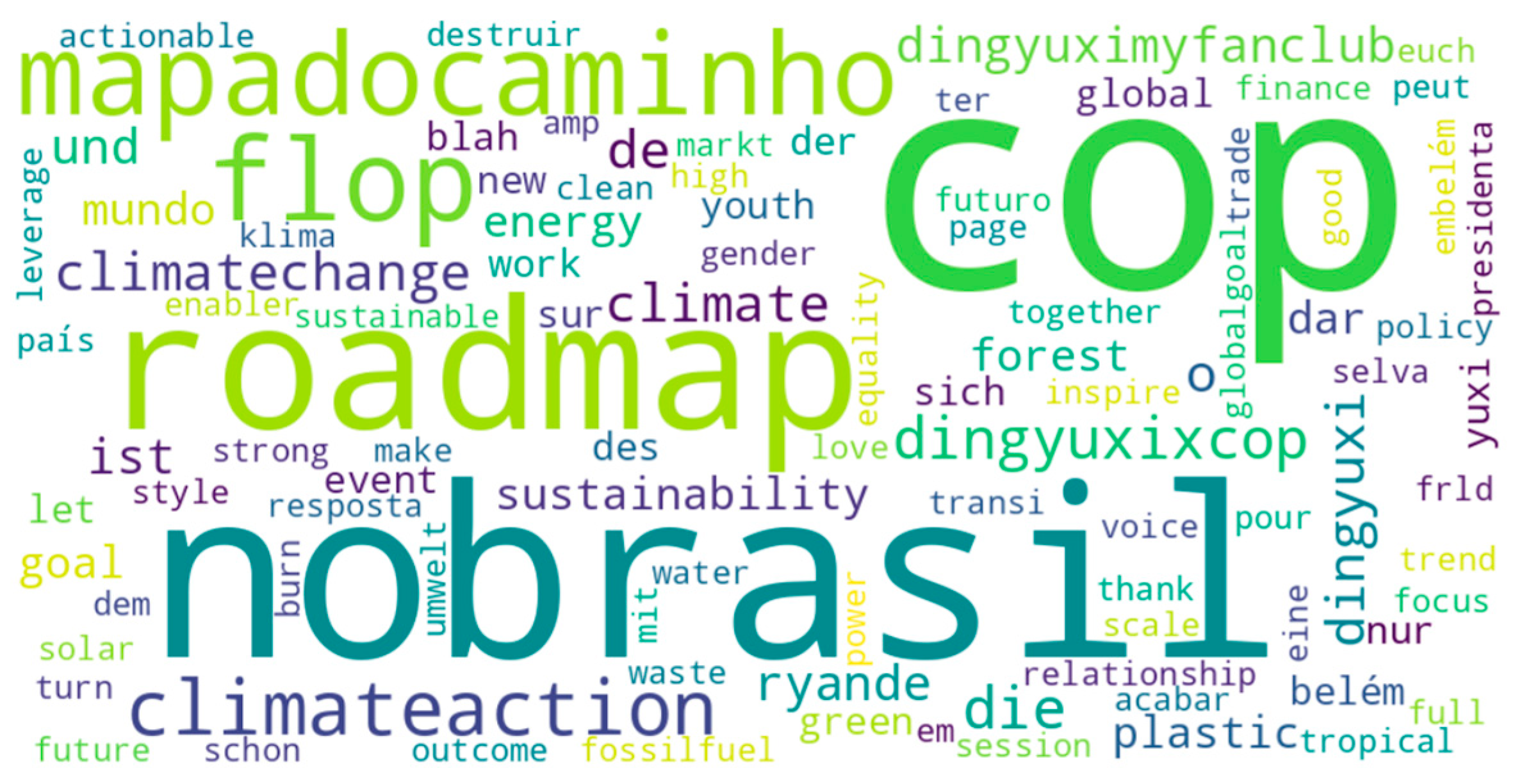
Based on the word clouds generated for the original posts (
Figure 1), several recurring terms were observed that allowed an initial identification of thematic foci. In the cloud based on simple frequency, words such as nobrasil, roadmap, mapadocaminho and cop stood out, directly alluding to the geographical context and the institutional framework around which the messages were articulated. Terms related to the climate sphere, such as climateaction or climatechange, were also identified, evidencing explicit references to the environmental agenda. The presence of vocabulary from several languages reflected the international dimension of the conversation, with contributions in Portuguese, English and German.
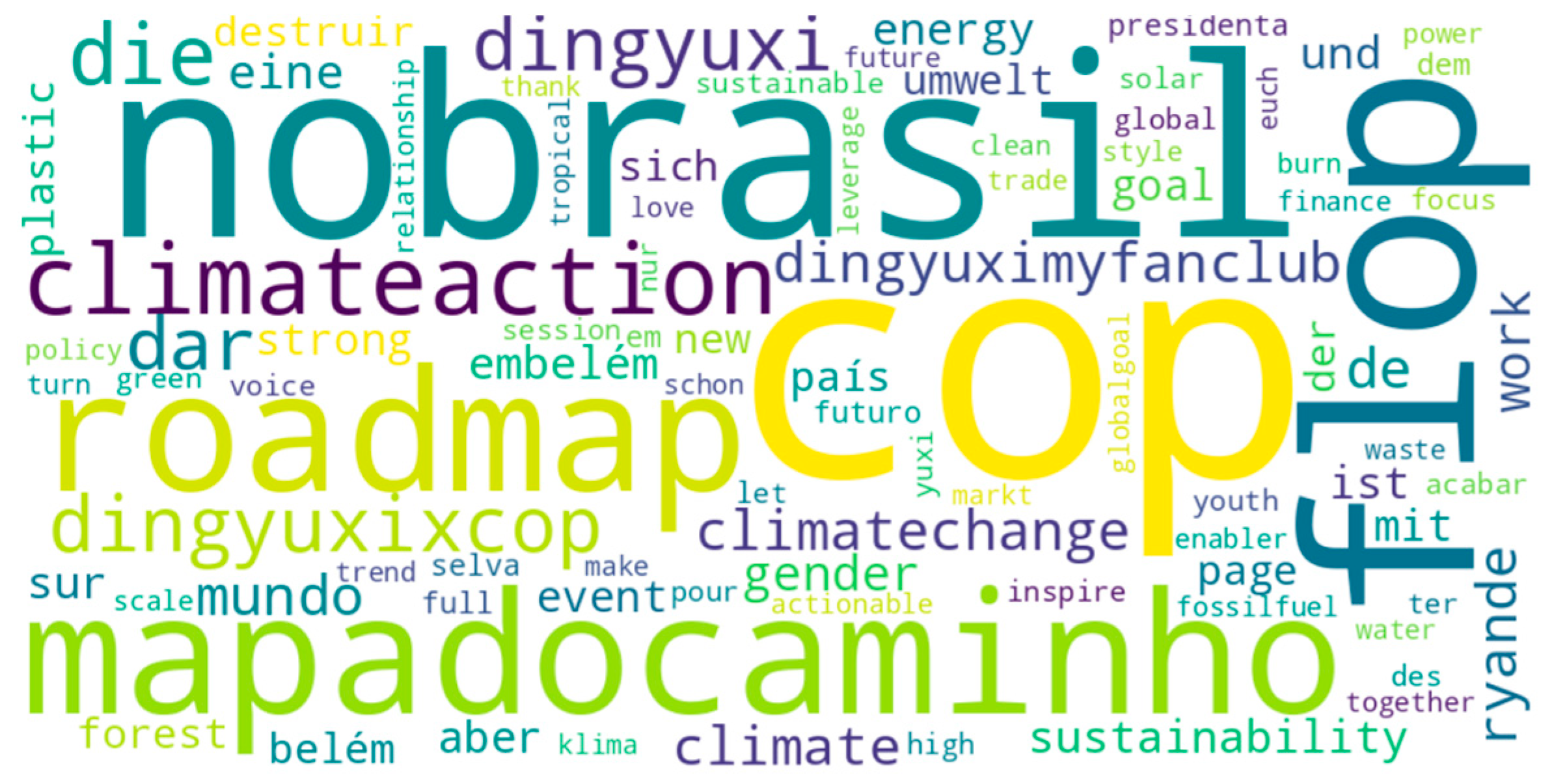
In the TF–IDF-weighted cloud for original posts (
Figure 2), distinctive terms emerged that provided a more nuanced perspective on representative themes. Words such as nobrasil, roadmap and mapadocaminho maintained their relevance, but more specific concepts such as gender, energy, sustainability and forest appeared, allowing the identification of a focus on concrete environmental and social issues. This weighting showed a conversation centred on climate planning, sustainability, and the relationship between Brazil and the global COP context.
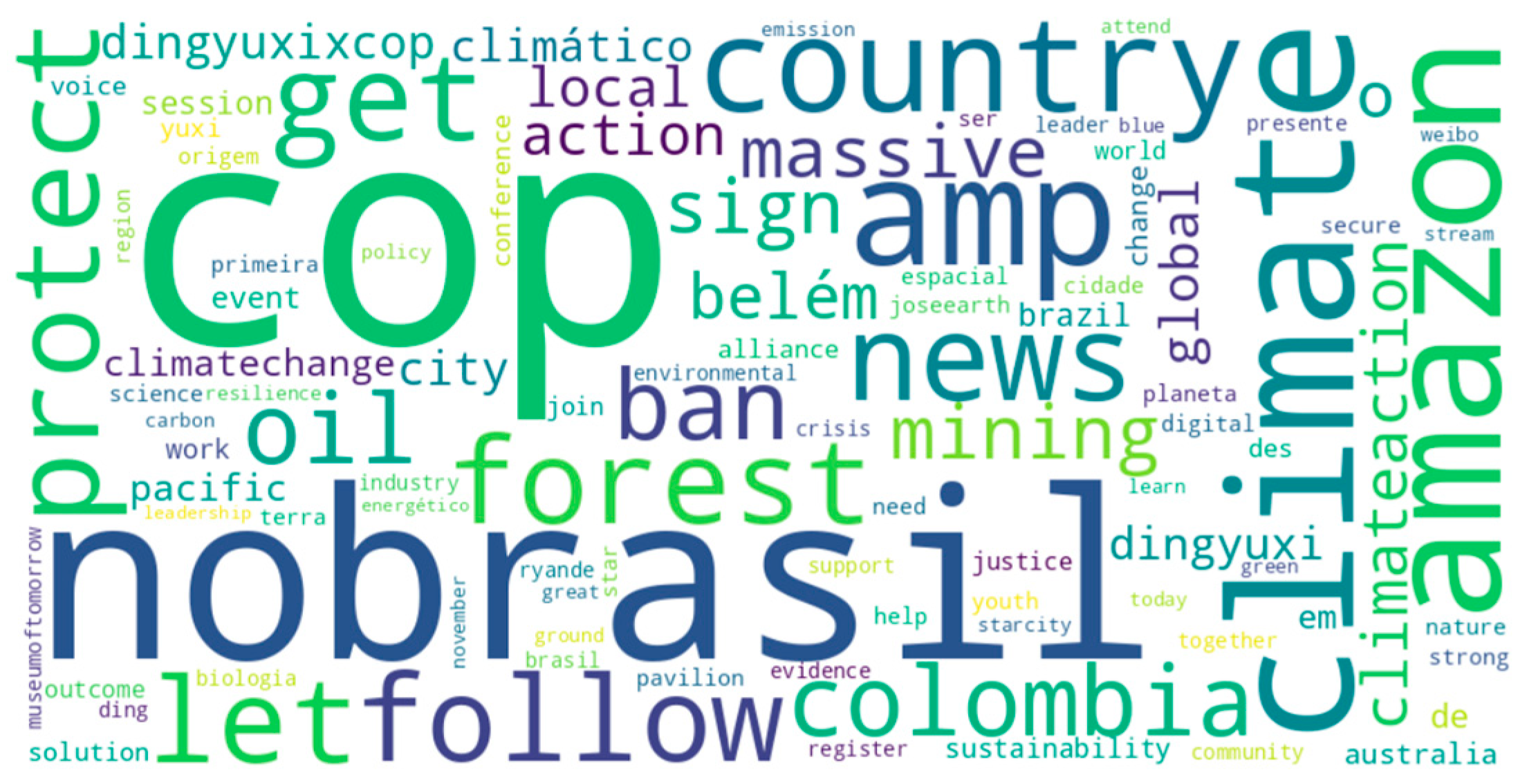
In the case of replies, the word clouds showed (
Figure 3) a partially different thematic pattern. In the simple frequency cloud, terms such as cop, nobrasil, climate, forest, country and oil predominated, suggesting that replies were articulated around broad themes linked to the COP, climate issues and natural resources. Compared to original posts, a greater emphasis was observed on words related to political actions or demands, such as ban, protect or sign, pointing to a more reactive and action-oriented tone.
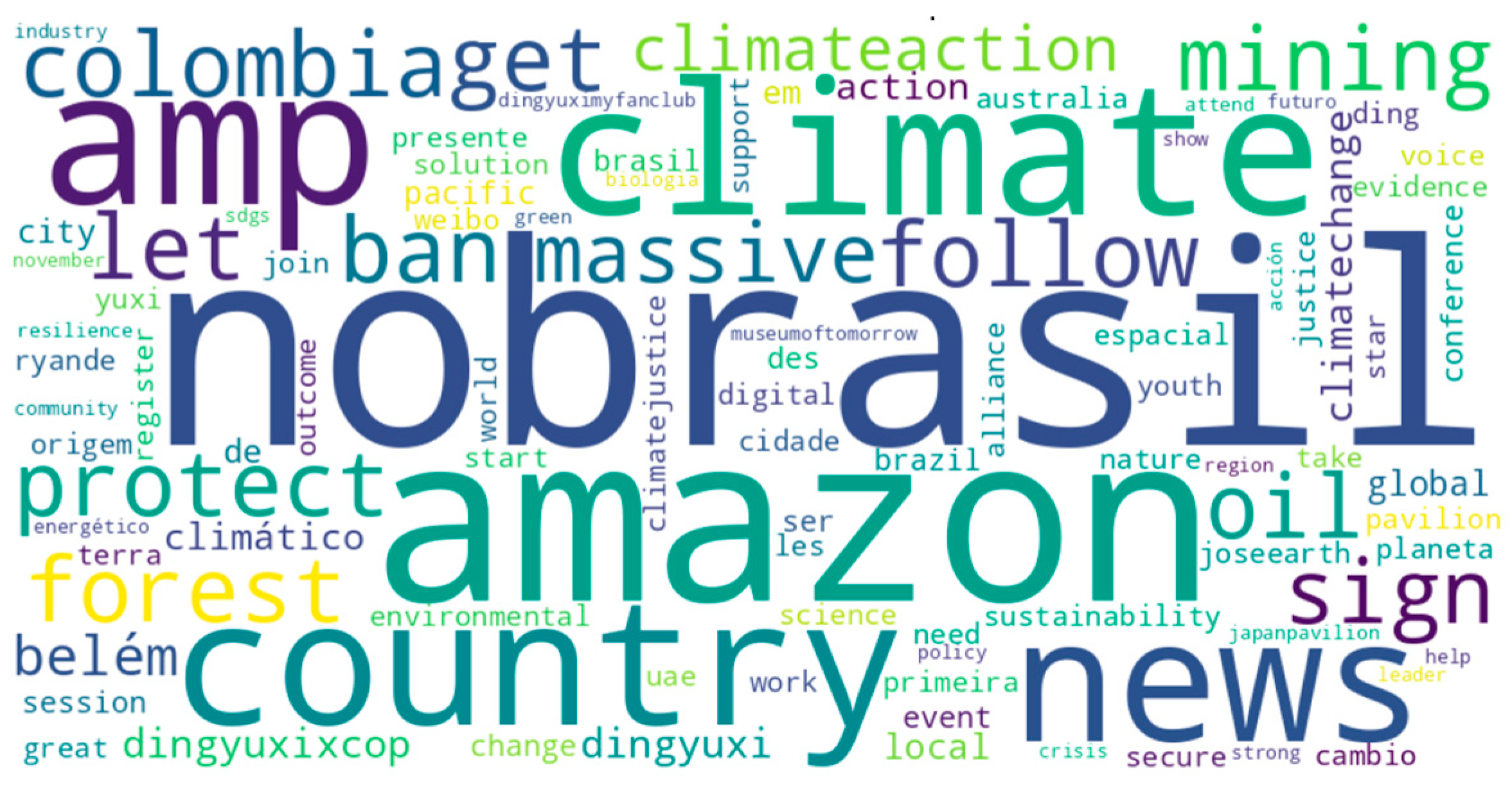
In the TF–IDF cloud for replies (
Figure 4), more specific and differentiating terms such as amazon, news, amp, protect, massive, mining and oil stood out, indicating that replies focused more intensely on topics related to the Amazon, resource extraction, information dissemination and advocacy actions. Compared to original posts, this weighting suggested that replies delved into themes related to environmental protection, mining and climate policies, with a more clearly defined focus on concrete territorial issues.
Taken together, the comparison between original posts and replies evidenced notable differences in thematic emphasis. While original posts showed discourse more oriented toward presenting agendas, events and general concepts linked to the COP, replies were characterised by more reactive content, with a greater presence of terms related to the Amazon, environmental protection and criticism of extractive activities. These differences suggested that the conversation evolved from information dissemination in initial messages toward the expression of more concrete concerns and positions in subsequent interactions.
4. Discussion
The results obtained allow for an initial characterisation of the conversation around the hashtag #COP30noBrasil on X during the COP30 climate summit. In terms of activity structure, a clear predominance of retweets over original messages and replies was observed, indicating that the dominant logic of participation was oriented toward content amplification rather than dialogic exchange.
This predominance of retweets is substantively meaningful in the context of a major diplomatic event such as a COP. It suggests that the hashtag functioned primarily as a channel for attention and redistribution rather than as a space for sustained deliberation. Much of the observable participation therefore took the form of relaying content that was already available, which is consistent with an event-driven communication dynamic in which visibility peaks are shaped by rapid circulation and repetition. This pattern does not imply the absence of engagement, but it does indicate that engagement was often expressed through amplification rather than through conversational uptake, which may help explain why replies represented a comparatively small share of the overall activity. Similar dynamics have been described in previous research on climate summits, where X functions primarily as a space for information circulation and agenda framing.
The predominance of unverified accounts in the production of original posts and in the overall dynamics of the conversation around #COP30noBrasil introduces a relevant nuance with respect to earlier research on communication during COPs, which has often highlighted the central role of institutional, political and professional media actors. In contrast, the present findings point to a more distributed pattern of participation, in which non-institutional users played a prominent role in the generation and circulation of content. This configuration is consistent with prior observations that social media platforms can facilitate the visibility of non-elite actors and partially challenge established informational hierarchies during climate-related events. In the context of a COP hosted in Brazil, this greater presence of unverified accounts may also reflect the appropriation of the debate by users seeking to articulate territorial, socio-environmental or climate justice–related concerns, complementing, and in some cases qualifying, the more institutional narratives associated with the summit.
Regarding engagement, the analyses did not show significant differences between verified and unverified accounts, even though the latter concentrated the majority of activity. This result could indicate that, at least within the framework of this hashtag and time period, verification status did not constitute a determining factor in explaining the capacity of posts to generate interaction. This finding contrasts partially with studies that highlight the prominent role of journalists, politicians, or “climate influencers” as especially influential nodes in previous summits, although in those studies, influence is often operationalised by combining network position, activity volume, and media impact rather than verification status alone.
By contrast, post format emerged as a relevant factor in explaining engagement levels. Posts incorporating images recorded higher mean values than those composed solely of text. This result appears consistent with the idea that climate communication on X increasingly relies on multimodal resources to capture attention and foster content circulation. In the specific context of a COP, where multiple actors compete for attention within a limited time window, the advantage of image-based posts may also reflect the need to convey complex environmental or political messages quickly and memorably. Visual elements can serve as anchors for attention in dense informational environments, facilitating rapid recognition and encouraging redistribution, even when users do not engage in extended textual interaction.
The correlational analysis further showed that neither the follower–following ratio nor message polarity was significantly related to engagement. The absence of an association between FF ratio and interaction level suggests that, in this case, the followers–following structure of participating accounts did not automatically translate into greater capacity to generate responses, which could highlight the importance of content and the specific context of the hashtag over the structural “popularity” of senders. Similarly, the lack of a significant correlation between polarity and engagement nuances the notion, frequently reported in the literature, that messages with greater emotional load—especially those with negative tone—always tend to achieve greater diffusion. In this dataset, original posts presented, on average, slightly positive and highly heterogeneous polarity, without this being reflected in clear interaction patterns. From a broader perspective, this pattern suggests that the #COP30noBrasil conversation operated as a temporally concentrated and event-driven communicative space, in which interaction was less dependent on stable indicators of influence and more responsive to the situational salience of the summit. In this sense, the hashtag may have functioned as a temporary arena that partially flattened conventional hierarchies of visibility, allowing messages to circulate and attract interaction regardless of the long-term popularity of their authors or the affective intensity of their tone.
The differences were more evident when comparing the polarity of original posts with that of replies. Initial messages displayed a significantly more positive average tone than replies, which tended toward values closer to neutrality. This shift could suggest that the conversation evolved from initial posts of a more informative or affirmative nature toward replies in which nuances, criticisms, or more complex positions were introduced, although without resulting in an overall predominance of negativity. This dynamic aligns, at least partially, with descriptions of X as a space where the dissemination of messages framed by actors promoting the climate agenda coexists with the expression of more heterogeneous responses from audiences.
The difference in average polarity between original posts and replies is particularly informative for understanding broader message-level dynamics of online climate engagement within the analysed hashtag. While original posts showed a mildly positive tone on average (mean compound score 0.26), replies tended to cluster much closer to neutrality (mean compound score 0.06), and this shift was statistically significant. Conceptually, this pattern is consistent with a communicative sequence in which initial messages function primarily as visibility and agenda-oriented statements, often framed in affirmative or promotional terms, whereas replies operate as a space for qualification, contestation, and the introduction of additional considerations that are not necessarily negative but are less affectively affirmative. In this sense, the movement from mild positivity to relative neutrality can be interpreted as a shift from message dissemination to more evaluative or deliberative engagement, in which users respond by adding nuance, raising concerns, or reframing the topic in more issue-focused terms. Importantly, given the multilingual nature of the corpus and the methodological steps taken to standardise sentiment estimation, these results should be interpreted as indicative of relative differences in tone between post types rather than as precise measurements of emotional intensity.
The thematic analysis using word clouds suggests that the conversation was strongly anchored in the Brazilian and Amazonian context. In original posts, terms such as nobrasil, roadmap and mapadocaminho, together with references to climateaction or sustainability, pointed to a focus on climate planning, Brazil’s role and global COP frameworks. In replies, however, words associated with the Amazon (amazon, forest), resource extraction (oil, mining) and demands for protection or bans (protect, ban) appeared with greater relative prominence. This thematic shift may indicate a greater lexical emphasis on issues related to environmental justice, extractivism and territorial protection, which echoes, to some extent, findings from other studies noting that narratives from the Global South often highlight regional vulnerability and question certain economic practices. At the same time, these lexical patterns, while consistent with the recurrent presence of brief references to the Amazon, resource extraction and protection demands across original posts and replies, do not constitute a systematic discourse analysis and should be understood as indicative tendencies in topic emphasis rather than exhaustive representations of discursive frames within the conversation.
Taken together, these findings characterise the #COP30noBrasil conversation during COP30 as an event-driven communicative space marked by content amplification through retweets, a majority involvement of unverified accounts and relatively low but uneven engagement across posts. The general tone of original messages tended toward slight positivity, while replies leaned toward less positive positions and were thematically more focused on the Amazon, natural resources, and protection demands. These findings may resonate with previous literature that portrays the digital climate sphere as a space simultaneously mediated by institutional narratives and shaped by local or regional concerns, although in this specific case, the available evidence remains limited for exploring that tension in depth.
5. Conclusions
Regarding the first research question, the analysed data indicate that the conversation around #COP30noBrasil was configured primarily as a flow of information redistribution, with a very high proportion of retweets and a relatively smaller presence of original messages and replies. Participation was predominantly from unverified accounts, which may indicate substantial involvement of non-institutional users in the dissemination of content related to the summit.
With respect to differences in engagement, it was observed that post format was significantly associated with interaction levels: posts containing images registered higher engagement than exclusively textual posts. By contrast, no significant differences were detected according to account verification status, suggesting that, in this case, verification did not appear to play a decisive role in audience response.
As for the relationship between engagement, polarity, and FF ratio, the analyses did not reveal significant correlations. These results suggest that neither the emotional tone of messages nor the followers–following ratio of accounts was systematically linked to the interaction level obtained by original posts within the analysed hashtag. This would therefore be a context in which other factors—such as content format, timing of publication, or association with specific campaigns—might play a more relevant role, although the present study does not allow these to be directly verified.
The comparison between the polarity of posts and that of replies showed clear differences: original messages displayed a more positive mean tone, whereas replies were closer to neutrality. This finding could be interpreted as an indication that subsequent interactions introduce nuances and, in some cases, less enthusiastic positions than those expressed in initial messages, even though an overall predominance of negativity was not observed.
Finally, the thematic analysis suggested that both original posts and replies revolved around the relationship between Brazil, the COP, and the climate crisis, but with different emphases. Initial messages focused more on agenda-setting, planning, and institutional dimensions, whereas replies placed greater emphasis on issues related to the Amazon, natural resources, mining, and protection demands, which may indicate particular sensitivity to the territorial and socio-environmental implications of the summit.
Taken together, these results provide an initial approximation to the configuration of the conversation around #COP30noBrasil on X during the COP30 climate summit and suggest that the analysis of future events could benefit from comparative designs (across different COPs, hashtags, or languages), from the integration of network analysis techniques, and from qualitative frameworks that allow deeper exploration of the nature of actors, discursive frames, and conflict or consensus dynamics present in the digital climate sphere.
6. Limitations
From a methodological perspective, the study presents several limitations that constrain the scope of its inferences, although these are consistent with the exploratory aim of the work. First, the analysis was restricted to a single hashtag and to a time interval limited to the dates of the summit. While this choice may have excluded other relevant segments of the broader COP30 conversation, it allowed the analysis to focus on the communicative flow articulated around the event itself. It also ensured temporal homogeneity of the corpus.
Focusing on the official hashtag also implies that certain segments of the broader COP30 conversation are likely under-represented, including users engaging through alternative, critical or campaign-specific hashtags, as well as discussions about the summit that did not employ any hashtag at all. As a result, the findings should be understood as capturing the dynamics of a visible, event-centred stream of communication rather than the full diversity of climate-related discussion surrounding COP30 on X.
The use of VADER on a multilingual corpus may introduce biases in the estimation of polarity for languages for which the tool is not specifically optimised. Nonetheless, VADER has been widely used in research analysing social media conversations that include multiple languages and registers. In this study, its use was considered methodologically appropriate because the analysis was internal and comparative rather than intended as an absolute quantification of sentiment. Although a translation step was applied to standardise the multilingual corpus prior to sentiment analysis, automated machine translation entails inherent limitations. Certain linguistic features, such as irony, sarcasm, culturally specific expressions or subtle emotional nuances, may not be fully preserved during translation, which could affect the accuracy of sentiment estimation. For this reason, the polarity scores reported in this study should be interpreted as indicative patterns rather than as precise measurements of emotional tone across languages.
Finally, social network analysis and detailed actor classifications were not incorporated, which limits the ability to draw firm conclusions about influence, polarisation, or community dynamics. However, this omission was consistent with the analytical focus of the study, which centred primarily on textual content and the formal characteristics of posts. Future research could expand this approach by combining it with structural metrics to deepen the understanding of circulation patterns and interactions among relevant actors.