
COVID-19 Oral Historias Project: Amplifying the Lived Experiences of San Antonio’s Hispanic Community

Abstract
1. Introduction
- 7 February 2020: Travelers evacuated from China arrive in San Antonio for a two-week quarantine at Lackland
- 13 February 2020: First case among evacuees
- 16 February 2020: Cruise ship Diamond Princess brought to Lackland Air Force Base.
- 28 February 2020: 11 positive cases at Lackland, with another patient flown in from California for treatment
- 29 February 2020: Released Lackland patient visited North Star Mall, later tested positive
- 2 March 2020: Nirenberg declares a public health emergency
- 11 March 2020: The WHO names the coronavirus crisis a pandemic
- 12 March 2020: Spurs games suspended
- 13 March 2020: First positive case in San Antonio unrelated to Lackland
- 13 March 2020: Fiesta postponed
- 16 March 2020: Schools close
- 18 March 2020: Restaurants, bars, gyms close
- 19 March 2020: Community spread announced
- 22 March 2020: First COVID-19 related death in Bexar County
- 23 March 2020: Nirenberg issues stay-at-home order
- 26 March 2020: Gov. Abbott issues mandatory self-quarantine for travelers to hot spots
- 28 March 2020: Economic relief bill ($2.2 trillion in aid)
- 31 March 2020: Gov. Abbott issues statewide stay-at-home order
- 12 April 2020: Churches livestream Easter ceremonies and parks closed for camping
- 22 April 2020: Big Give Emergency Relief Fund raises $500,000 for nonprofit groups experiencing strains on their services under COVID
- 1 May 2020: Abbott issues executive order to begin reopening economy
- 26 June 2020: Abbott orders bars to close, restaurants to limit capacity as numbers in San Antonio continue to spike
- 3 July 2020: Abbott issues a mask order for counties with 20+ cases
- 4 July 2020: Fireworks canceled or made drive-through events
- 28 July 2020: Summer peak of COVID-19 cases, approximately three weeks after 4th of July
- 31 July 2020: Spurs resume games in “bubble,” with quarantine for players/staff and regular testing
- 17 August 2020: Rocky start for school districts, with virtual learning giving way to mask mandates, social distancing measures, and intensive sanitizing
- September–October 2020: More holidays under the pandemic, with parks closed for Labor Day and Halloween safety measures in place
- 14 December 2020: Arrival of 6000 Pfizer vaccine doses for first responders
- 23 December 2020: Spurs start 2020–2021 season with no fans
- 29 December 2020: Announcement that vaccines would be opened to Texans over 65 and with certain health conditions
- 9 January 2021: Mass vaccination site at the Alamodome
- 16 January 2021: Winter peak of COVID-19 cases, approximately three weeks after Christmas
- 14–20 February 2021: Historic winter storm that canceled vaccine appointments, testing
- 15 February 2021: Four Spurs players positive for COVID
- 10 March 2021: Abbott rescinds mask requirement and limited capacity in restaurants against advice of experts
- 12 March 2021: Spurs fans return to in-person games
- March 2021 and on: Variable masking, decreased testing, and gradual return to “normalcy”
- However, wastewater analysis demonstrates that we, as a community, are far from “normalcy,” with regular spikes in COVID wastewater viral activity
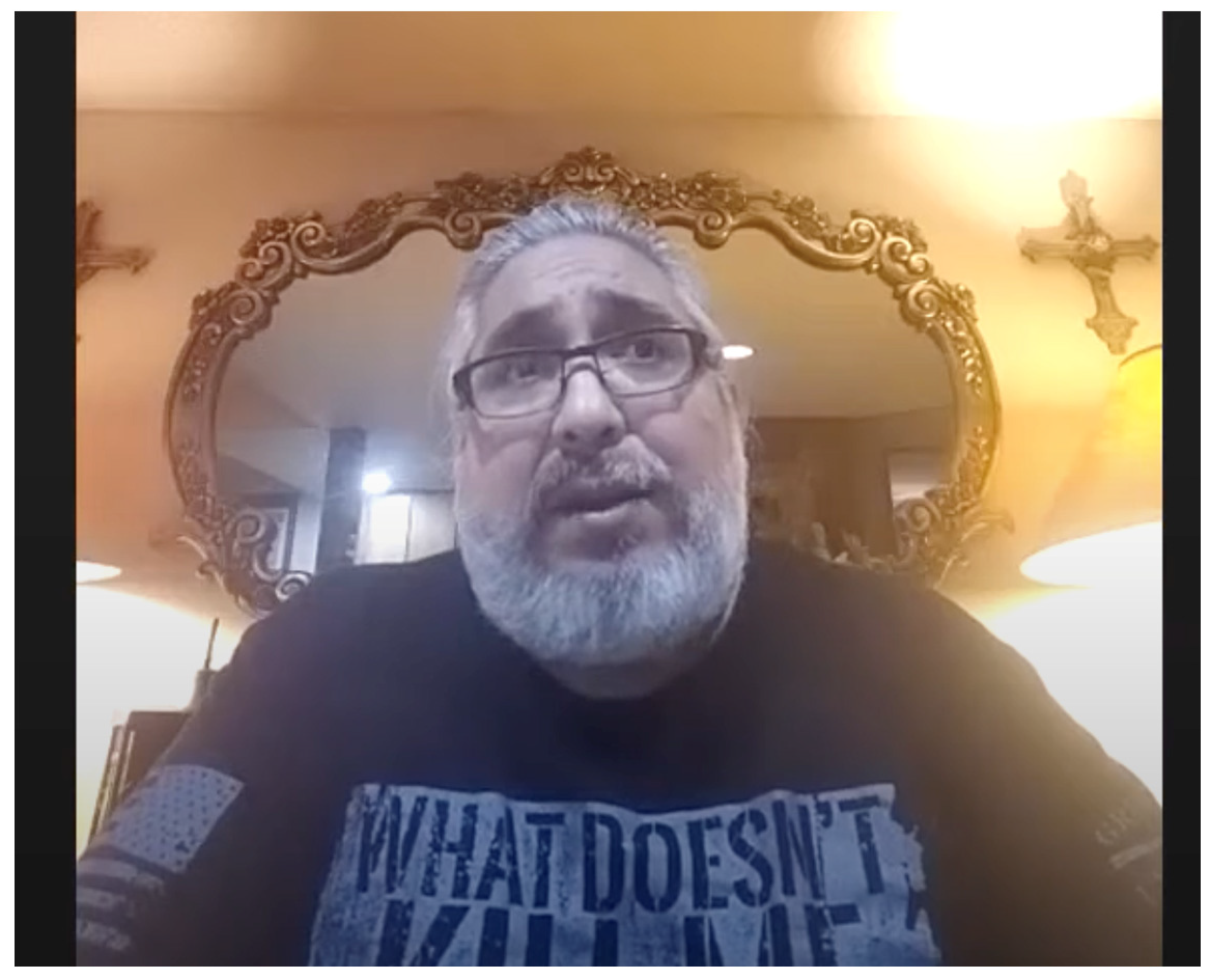
“I can remember the day, and I think it’s something that I’m not going to ever forget. We were, like I said, we were in Houston to see the show, and we had went out to eat. That’s actually the last time I stepped foot in a restaurant. I haven’t eaten in a restaurant in the 14 months, I haven’t—or 13 months. I haven’t been to a restaurant. But we were sitting in the restaurant in Houston, and they had a TV, and they said, ‘Breaking news,’ and the president was going to come out and talk. And we were already getting ready to leave, so my sisters and my brother-in-law walked out, and I stayed behind so I could see what the president was going to say. And I can remember he was saying, you know, ‘pandemic’ and ‘shutdown’ and stuff like that. It was amazing. I remember being, like, in awe, or in shock or terrified. And I walked out, and I went to the truck, and they were like, ‘You know, so what’s going on?’ because I stayed behind for maybe, you know, five minutes. They had to wait for me for, you know, maybe more than five minutes, I was watching what he was going to say.
And I got in the car, and they said it looked like I had seen a ghost, and then I told them, ‘I don’t know.’ I told them what I had heard… and all three of them were kind of like, ‘Yeah, like, whatever,’… kind of like it was going over their head. You know, they weren’t really comprehending … what was going to happen. And then all the way home I kind of, you know, broke it down for them a little bit from what I heard and what I understood, and I told them it’s basically, like, the president was saying, like, ‘The aliens have landed.’ You know what I mean? You see it in movies. You see it … on TV or you read about it, and you think… you know, the president comes out … like in, I don’t know… with those movies, like, with Tom Cruise and stuff like that, the president—or the 4th of July, that movie, too. So you never think it’s actually going to be real, but I told them that’s the way it is. That’s what I feel like. This is amazing. I go, ‘They’re shutting down football. They’re shutting down basketball.’ I think that same night or something like that, they said, ‘Tom Hanks and his wife have it,’ you know. It was like I can remember everything from that, like, one or two days, you know.
And then, again, not being able to—Robert, you know, coming in from our family, from London … and then not even being able to see him … and that was, you know, pretty weird, being in the same town too and not even being able to see each other because everybody was locked up. And then thinking, ‘Okay, well, you know, hopefully a week, maybe another week, maybe another week,’ and a week turned into a month, and a month turned into two months and then two months into six and then a year. And, I mean, it was amazing. But, yeah, March, I can definitely—I don’t think I’ll ever forget that weekend, you know, or that time. It was amazing.”
2. Materials and Methods
3. Narrative Themes
3.1. Navigating Conflicting Community Norms and Official Health Directives
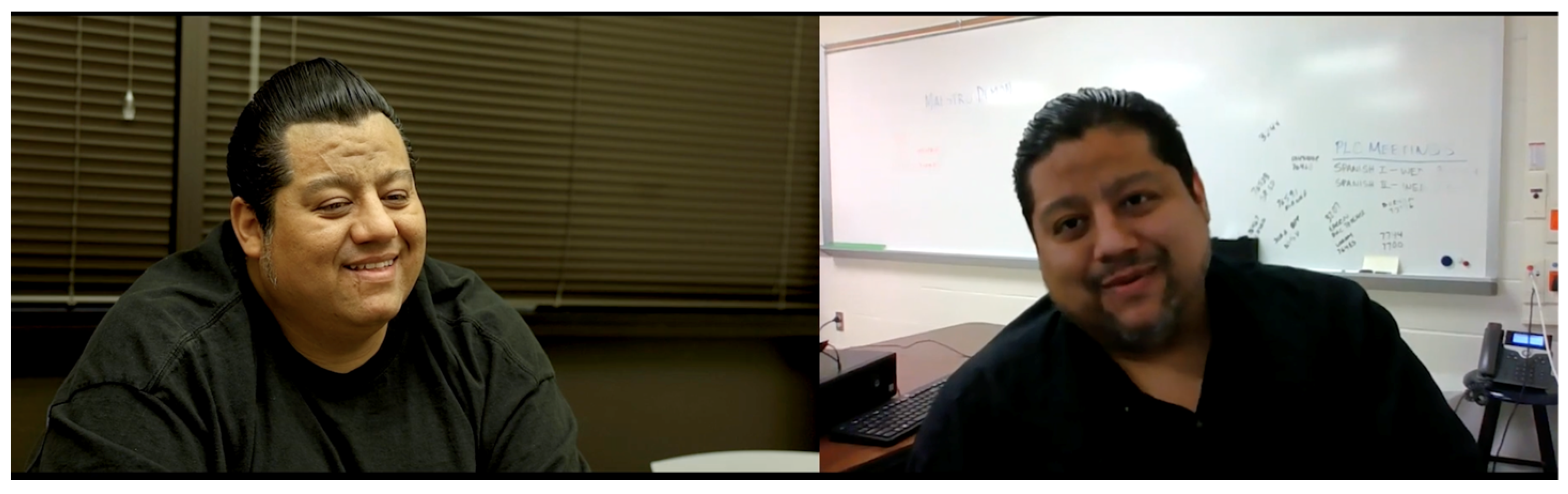
“Y pues, marzo, ya entrando el mes, pues ya fue ahora sí que…ya entré, no en pánico, pero ya empecé como que a preocuparme y a pensar… Y obvio, marzo, pues, es el mes del cumple de mi niña la grande, y es como que, no va a tener fiesta. Pero ya entonces empezó, como que: ‘Pero no podemos. O sea, se dice que no se pueden hacer fiestas, nada de reuniones’. Tuve que hacerle algo pequeñito, pero resulta de que no podías… después te decían, ¿no? Como que: ‘Trata de mantener una distancia y de no hablar tan cerca de alguien y de no soplar el pastel’. Entonces fueron esos cambios al momento como que… ya no sabías cómo actuar frente a nadie, ni con las personas de más confianza, porque yo tenía aquí dos, tres amigas, entonces era como que… O sea, sí, hablar del tema, porque fue de lo único de lo que se habló. ¿Qué está pasando? O sea, es una cosa seria, pero ya es como que… Pero…no te puedo abrazar, ¿no? Ahora se dice que no te puedo dar un beso de saludo, no nos podemos despedir como antes. Pues esto va serio y ya no sabíamos. Yo desde ahí, desde ese festejo, ya no supe cómo actuar con nadie. O sea, es: ‘Te abrazo, no te abrazo’. ‘Me despido, no me despido’. Entonces, por el hecho de disfrutar un poquito el rato y no hacerle pasar a la niña el trago amargo ahora sí de que: ‘¿Sabes qué? Yo ni estoy disfrutando esto’, ¿no? Ya, o sea, terminó todo. Y le dije a mi esposo: ‘No sé. No sé qué explicarles a ellas, no sé qué… No sé cómo me siento, pero sé que no estamos siendo nosotros’”.
‘And well, March, at the beginning of the month, well it was then that I started to, well, not panic, but I began to get worried and to think… And obviously, March, well, it’s my oldest daughter’s birthday month, and it’s like, she’s not going to have a party. But then it started, like, “But we can’t. I mean, they say we can’t have parties, no get-togethers.” I had to throw her something small, but it turned out you couldn’t… after they said, right, like, “Try to keep a distance and not talk too close to someone and to not blow on the cake.’ So those were the changes in that moment and… you didn’t know how to act with anybody, not even with the closest people in your life, because I had two, three friends, then it was like… I mean, yes, let’s talk about it, because it was the only thing anybody talked about. What’s going on? I mean, it’s a serious thing, but it was like… but… I can’t hug you, right? Now they say I can’t give you a kiss hello, we can’t say goodbye like before. But this is getting serious, and we didn’t know. From that moment, from that party, I didn’t know how to act with anybody. I mean, it’s, “do I hug you or not?” “Do I say goodbye or not?” So, I just tried to enjoy the moment a little and not make the girl [my daughter] swallow the bitter pill of: ‘You know what? I’m not even enjoying this,’ right? Yeah, I mean, it’s all over. And I said to my husband, “I don’t know… I don’t know how to explain this to them, I don’t know what… I don’t know how I feel, but I know that we’re not being ourselves.”’
3.2. Negotiating Anxieties Across Transnational Contexts
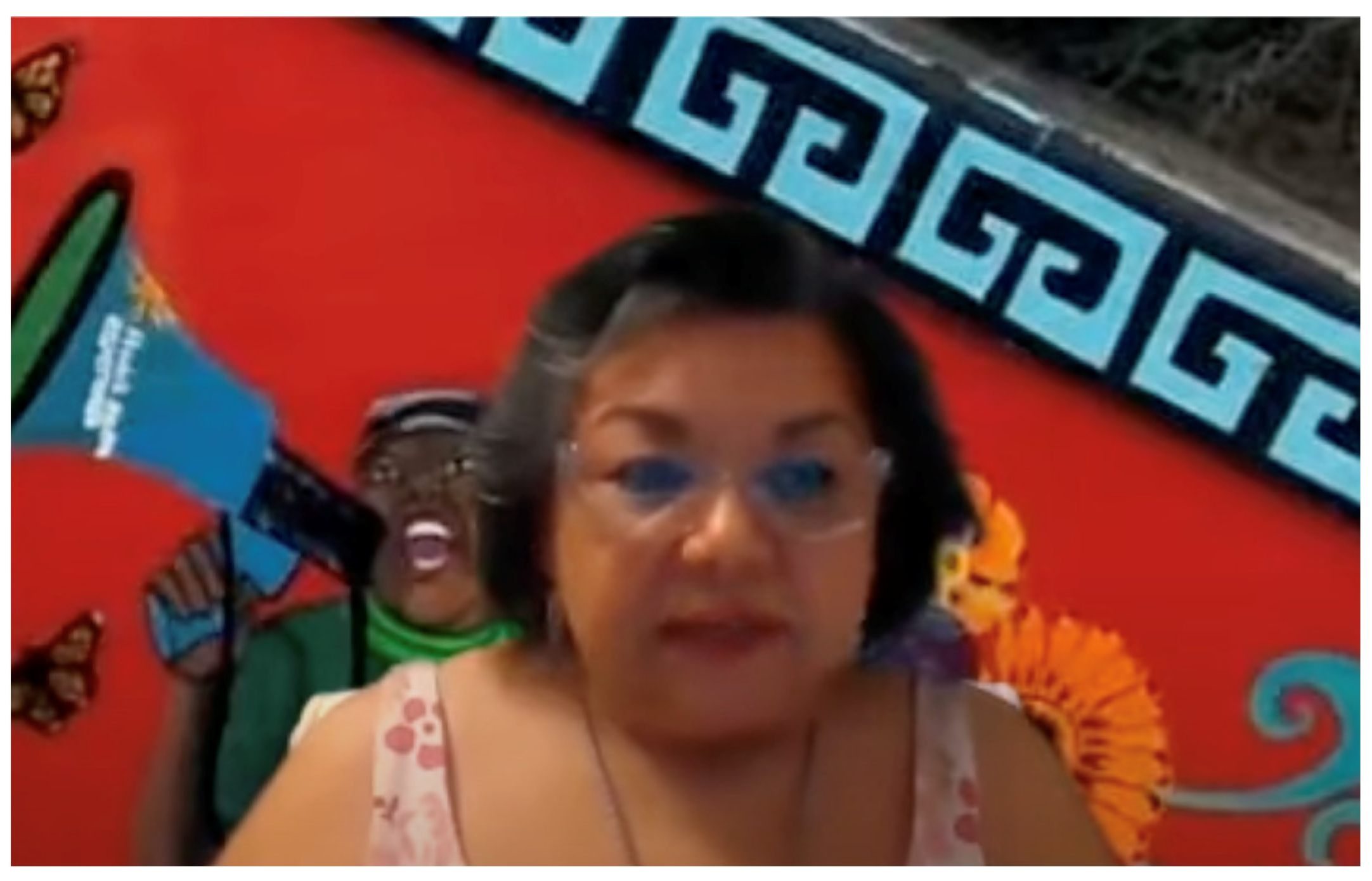
“Well, it made—You know, the work has been diminished in terms of numbers, but in terms of the levels of violence that I see and hear about by way of phone calls, crisis calls, what we refer to as crisis calls is much greater. And I think that the … the way they call it el encierro, you know, the quarantine has facilitated a lot more levels of violence to … be exposed and to come forth … than before. And so, … you just hear a lot more cruelty. There’s just—It’s more terrorizing and uglier than what I had been hearing about before. It’s terrible. It’s terrible, and it really has diminished … people’s capacity to help themselves. You know, people feel like real… They don’t want to go to the shelter. They’re afraid of going to the shelter. They feel like … they might get sick if they go to the shelter…to go live with people that they don’t know … and so they remain more vulnerable … if they go to family members’ homes or sister’s homes or neighbor’s homes … and that’s if they’ll take you in.
You know, that’s the other thing is that … your family is like—They don’t want to take you in because they’re scared too, … and either they’re scared of the virus, or they’re scared of the perpetrator coming and doing damage at their house. And so, it’s very hard right now for people that are living with this type of violence in their life, and they feel like they have a lot less options, and in terms of the resources in the community, I mean, some of them have gotten a little bit better because of all the funding that has come down to help communities with the virus and the impact of the virus, but, you know, so you get an extra 10 days from a hotel, you know, what’s that? When the 10 days are up, ¿luego qué? ‘then what’? So that’s hard too. Anyways, so it’s been very difficult…
At first I was feeling very, like, we can do this virtually, and, you know, because that’s kind of like my nature, right. Like, ¡sí se puede! ‘yes we can!’, right? And to have that kind of attitude, but it’s, you know, I do feel like, … like I’ve been cut off at the knees, you know, because you just can’t work at the same level, and you don’t have the same level of impact virtually as you did when you have people there in front of you, and you can hug them, and you can hold their hand, and you can bring them a box of tissues and a glass of water. You know what I’m saying? You’re just not as effective … as you are face-to-face, and I really feel that because I am very much hands-on in terms of my work as a social worker.”
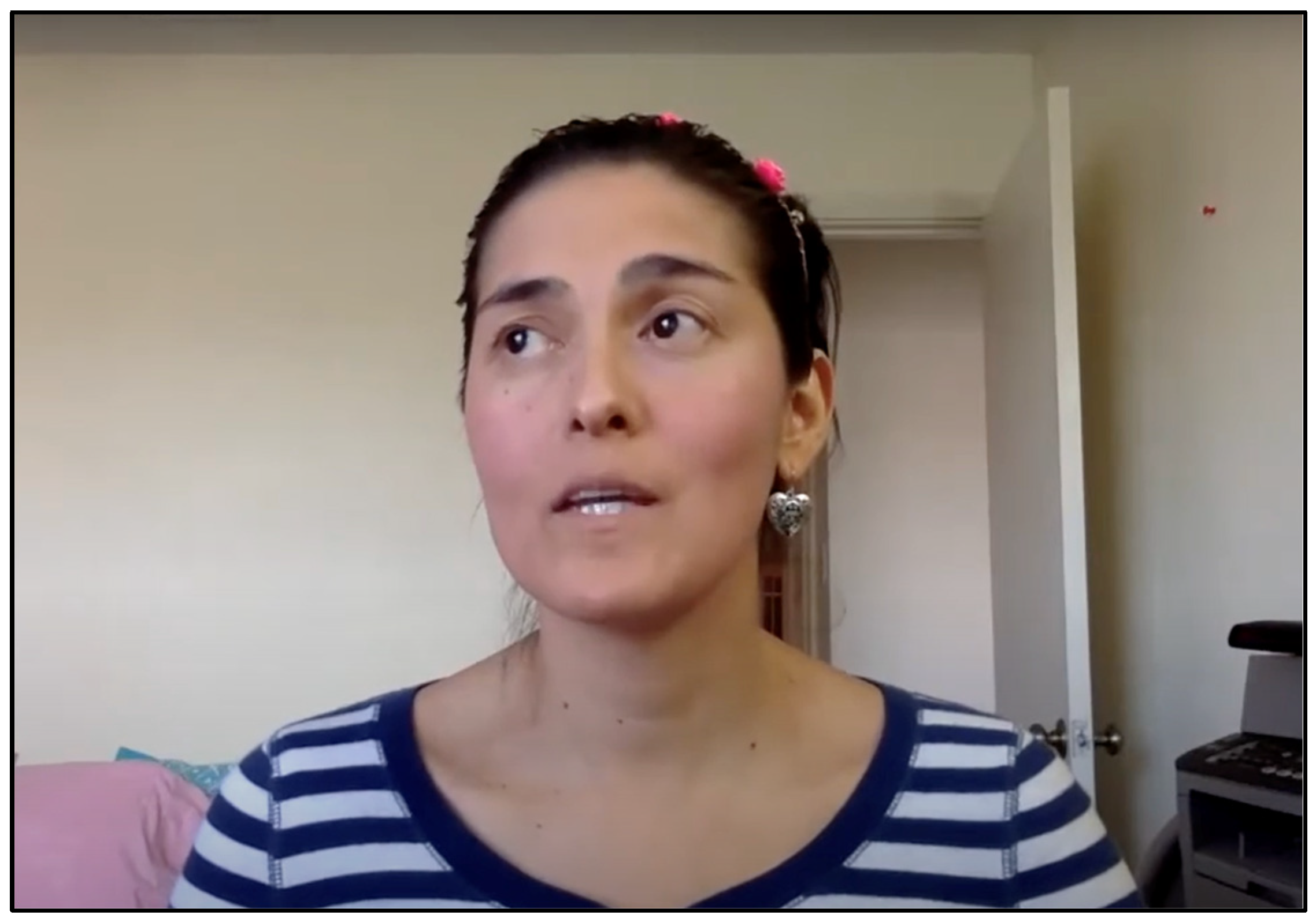
“Pues, al principio, ah… escuchaba rumores, verdad, acerca de este virus, pero no me imaginaba qué tan drástico iba a cambiar. No en lo personal, sino en… en… en la… en lo… en lo… en lo social, ¿no? Que estamos acostumbrados a salir fines de semana y cositas así, entonces, no me imaginaba qué tan grande iba a ser esto, ¿no? Pero, y entonces al principio como que le estaba tomando como que leve, quizás no tanto creía de lo que iba a pasar en el futuro y al principio yo… mi vida o mi rutina era normal, normal… hacer mis actividades, quizás, normal también… Pasando como dos meses sí me comenzó a preocupar porque pues yo vengo de Perú, ¿verdad? Entonces, allá esta situación se había hecho un caos, ya que muchas personas familiares se habían enfermado, entonces estábamos muy mal que… o sea, esto me afectó, dije: “Guau, esto sí es real. Eh… Y, entonces, no yo… Me puse nerviosa por lo que mi familia estaba pasando, entonces yo, a partir de ese momento, de lo que mi familia y la gente allegada estaba pasando por esta situación… entonces yo comencé a tomar más conciencia en mí misma y alrededor de mi familia de la gente.”
‘Well, at first, um, I heard rumors, right? About this virus, but I didn’t realize how drastically everything was going to change. Not personally, but… socially, right? We’re used to going out on weekends and things like that, so, I didn’t imagine how big this was going to be, right? And then at first, I was taking it kind of lightly, maybe I didn’t really believe what was going to happen down the road, and in the beginning, I… my life or my routine was normal, normal… my activities, maybe, were normal too… After about two months, I did begin to worry because, well, I come from Peru, right? Well, the situation had become a mess there, since many family members had gotten sick, and we were in such a bad state that… I mean, that impacted me, and I said, “Wow, this is real.” Um, and so, I don’t… I got nervous because of what my family was going through, so I, from that moment on, from what my family and close friends were going through in that situation… then I started to be more aware of myself and people around my family.’
3.3. Hopelessness and Hope
“Platico con amistades que viven fuera de Estados Unidos y fuera de México, y están en casa, ya tienen un mes, y le digo, ¿y cómo te sientes? Dice, ‘pues, de repente sí nos entra la desesperación, pero estamos vivos’. Dice, ‘mis vecinos de enfrente ya no viven. Se murieron todos’. Dijo, ‘¿y el vecino que vive a las dos cuadras? También ya se murieron todos’. Dijo, ‘entonces, la desesperación se me quita al pensar que estoy vivo’. Y, pues, sí. O sea, esto sí es cierto.”
Appreciating life, a gift taken from many family members, friends, and neighbors during the pandemic, helped many of the narrators stoke the embers of hope, when hope was hard to find. Simply dreaming about a better future can be considered an act of resistance, redefining both implicitly and explicitly (Bamberg and Andrews 2004) the disruption and loss of the pandemic.‘I talk with friends that live outside of the United States and outside of Mexico, and they have been home for a month. I ask them, “how do you feel?” And they say, “sometimes we feel hopeless, but we are alive.” They say, “my neighbors across the street, they aren’t alive anymore—they’re all dead.” And they said, “and my neighbors two blocks away, they’re all dead, too.” They said, “so the hopelessness goes away when I remember that I’m alive.” And well, yes, I mean, yes, that’s true.’
4. Contributions of the Corpus
5. Conclusions
Funding
Institutional Review Board Statement
Informed Consent Statement
Data Availability Statement
Acknowledgments
Conflicts of Interest
| 1 | The specific narratives presented below were selected if they concisely encapsulated the narrative theme identified and the narrators consented to appear in this article. |
References
- Alessi, Edward J., and Sarilee Kahn. 2023. Toward a trauma-informed qualitative research approach: Guidelines for ensuring the safety and promoting the resilience of research participants. Qualitative Research in Psychology 20: 121–54. [Google Scholar] [CrossRef]
- Bamberg, Michael, and Molly Andrews, eds. 2004. Considering Counter-Narratives: Narrating, Resisting, Making Sense. Amsterdam: John Benjamins Publishing. [Google Scholar]
- Census. 2023. San Antonio City, Texas. Available online: https://data.census.gov/profile/San_Antonio_city,_Texas?g=160XX00US4865000 (accessed on 17 March 2024).
- Centers for Disease Control and Prevention (CDC). 2022. Demographic Trends of COVID-19 Cases and Deaths in the US Reported to CDC. September 2. Available online: https://www.cdc.gov/covid/php/surveillance/index.html (accessed on 5 October 2024).
- Chappell, Whitney. 2021. COVID-19 Oral Historias Project. Available online: https://colfa.utsa.edu/modern-languages/research/covid-19-oral-historias-project.html (accessed on 17 July 2025).
- Corbin, Juliet M., and Anselm Strauss. 1990. Grounded theory research: Procedures, canons, and evaluative criteria. Qualitative Sociology 13: 3–21. [Google Scholar] [CrossRef]
- Davis, Lori Patton, and Samuel D. Museus. 2019. What is deficit thinking? An analysis of conceptualizations of deficit thinking and implications for scholarly research. Currents: Connecting Diversity Scholarship to Practice and Society 1: 117–30. [Google Scholar]
- Dean, Kristin. 2021. How Did We Get Here? A Look Back at a Year of COVID-19 in San Antonio. KENS5. March 9. Available online: https://www.kens5.com/article/news/health/coronavirus/covid-19-in-san-antonio-a-timeline-of-events-how-did-we-get-here/273-f910e3e3-5a3b-4ee3-a089-fc52a43a3f4c (accessed on 5 October 2024).
- Duan, Wei. 2020. Can Chinese Language Learning Reinforce English Supremacy? Available online: https://www.languageonthemove.com/can-chinese-language-learning-reinforce-english-supremacy/ (accessed on 5 October 2024).
- Gaitan, Michelle. 2023. COVID-19 Oral History Project at UTSA Documents Impact on Hispanic Community. UTSA Today. February 21. Available online: https://www.utsa.edu/today/2023/02/story/covid-oral-history-project-documents-impact-on-hispanic-community.html (accessed on 2 July 2025).
- Godrie, Baptiste. 2025. Resisting scientific extractivism: A post-extractivist policy of knowledge production with marginalised communities. Gateways: International Journal of Community Research and Engagement 18: 1–14. [Google Scholar] [CrossRef]
- González, Hector M., William A. Vega, and Wassim Tarraf. 2010. Health care quality perceptions among foreign-born Latinos and the importance of speaking the same language. Journal of the American Board of Family Medicine 23: 745–52. [Google Scholar] [CrossRef] [PubMed]
- Hu, Shouping, George D. Kuh, and Joy Gaston Gayles. 2007. Engaging undergraduate research students in research activities: Are research universities doing a better job? Innovative Higher Education 32: 167–77. [Google Scholar] [CrossRef]
- Lippi-Green, Rosina. 2012. English with an Accent: Language, Ideology, and Discrimination in the United States. London: Routledge. [Google Scholar]
- Mayotte, Cliff, and Claire Kiefer, eds. 2018. Say It Forward: A Guide to Social Justice Storytelling. Chicago: Haymarket Books. [Google Scholar]
- Oral History Association. 2024. Oral History: Defined. Available online: https://oralhistory.org/about/do-oral-history/ (accessed on 20 March 2024).
- Piller, Ingrid. 2017. Intercultural Communication: A Critical Introduction, 2nd ed. Edinburgh: Edinburgh University Press. [Google Scholar]
- Piller, Ingrid, Jie Zhang, and Jia Li. 2020. Linguistic diversity in a time of crisis: Language challenges of the COVID-19 pandemic. Multilingua 39: 503–15. [Google Scholar] [CrossRef]
- Rodriguez-Diaz, Carlos E., Vincent Guilamo-Ramos, Leandro Mena, Eric Hall, Brian Honermann, Jeffrey S. Crowley, Stefan Baral, Guillermo J. Prado, Melissa Marzan-Rodriguez, Chris Beyrer, and et al. 2020. Risk for COVID-19 infection and death among Latinos in the United States: Examining heterogeneity in transmission dynamics. Annals of Epidemiology 52: 46–53. [Google Scholar] [CrossRef] [PubMed]
- Rubin, Beth C., and Makeba Jones. 2007. Student action research: Reaping the benefits for students and school leaders. NASSP Bulletin 91: 363–78. [Google Scholar] [CrossRef][Green Version]
- Santos, Maricel G., Rachel Showstack, Glenn Martínez, Drew Colcher, and Dalia Magaña. 2022. Health Disparities and the Applied Linguist. London: Routledge. [Google Scholar]
- Torres, Raquel. 2023. UTSA Oral History Project Preserves the Uncertainty, Fear and Hope of Early Pandemic. San Antonio Report. Available online: https://sanantonioreport.org/utsa-hispanic-covid-19-oral-history-project/ (accessed on 14 July 2025).
- Traylor, Ana H., Julie A. Schmittdiel, Connie S. Uratsu, Carol M. Mangione, and Usha Subramanian. 2010. Adherence to cardiovascular disease medications: Does patient-provider race/ethnicity and language concordance matter? Journal of General Internal Medicine 25: 1172–77. [Google Scholar] [CrossRef] [PubMed]
- Wilder, Julius M. 2021. The disproportionate impact of COVID-19 on racial and ethnic minorities in the United States. Clinical Infectious Diseases 72: 707–9. [Google Scholar] [CrossRef] [PubMed]
- Zholobova, Anna. 2021. Linguistic innovation during the COVID-19 pandemic: The Spanish language case. XLinguae 14: 331–49. [Google Scholar] [CrossRef]


Disclaimer/Publisher’s Note: The statements, opinions and data contained in all publications are solely those of the individual author(s) and contributor(s) and not of MDPI and/or the editor(s). MDPI and/or the editor(s) disclaim responsibility for any injury to people or property resulting from any ideas, methods, instructions or products referred to in the content. |
© 2025 by the author. Licensee MDPI, Basel, Switzerland. This article is an open access article distributed under the terms and conditions of the Creative Commons Attribution (CC BY) license (https://creativecommons.org/licenses/by/4.0/).
Share and Cite
Chappell, W. COVID-19 Oral Historias Project: Amplifying the Lived Experiences of San Antonio’s Hispanic Community. Soc. Sci. 2025, 14, 711. https://doi.org/10.3390/socsci14120711
Chappell W. COVID-19 Oral Historias Project: Amplifying the Lived Experiences of San Antonio’s Hispanic Community. Social Sciences. 2025; 14(12):711. https://doi.org/10.3390/socsci14120711
Chicago/Turabian StyleChappell, Whitney. 2025. "COVID-19 Oral Historias Project: Amplifying the Lived Experiences of San Antonio’s Hispanic Community" Social Sciences 14, no. 12: 711. https://doi.org/10.3390/socsci14120711
APA StyleChappell, W. (2025). COVID-19 Oral Historias Project: Amplifying the Lived Experiences of San Antonio’s Hispanic Community. Social Sciences, 14(12), 711. https://doi.org/10.3390/socsci14120711