Article

Lack Support Systems and Women’s Political Participation in South Africa

by
Andile Sokani
Department of Sociology, Faculty of Economics, Development and Business Sciences, University of Mpumalanga, Cnr R40 & D725 Roads, Mbombela 1200, South Africa
Soc. Sci. 2025, 14(12), 693; https://doi.org/10.3390/socsci14120693 (registering DOI)

Submission received: 27 July 2025 / Revised: 17 September 2025 / Accepted: 17 September 2025 / Published: 30 November 2025
(This article belongs to the Section Gender Studies)

Abstract

This study explores the persistent barriers hindering women’s meaningful participation in South African politics, with a particular focus on the widespread lack of support that women encounter across various social and institutional domains. Despite South Africa’s progressive constitutional and legislative framework promoting gender equality, the research reveals that many women in politics face systemic non-support from family structures, peer networks, community members, political parties, and even fellow women leaders. Using a feminist political theory lens, particularly liberal and radical feminism, the study focuses on how these barriers constrain women’s political participation at the local level. The study specifically investigates how lack of support affects women’s ability to participate, exercise influence, and access decision-making in local governance. Qualitative data drawn from in-depth interviews highlights experiences of tokenism, exclusion from decision-making, inadequate mentorship, and intra-gender rivalry. Political parties, in particular, emerge as critical gatekeepers that publicly promote gender equity while privately reproducing male-dominated power structures. The study concludes that achieving substantive equality requires more than representational quotas; it demands a structural shift in political culture, values, and leadership practices to foster inclusive and supportive environments that empower women to lead authentically and effectively.

1. Introduction

This study examined the lack of support systems and its impact on women’s political participation in the Buffalo City Metropolitan Municipality in the Eastern Cape, South Africa. Despite the country’s progressive constitutional framework and longstanding commitments to gender equality, the participation of women in local government remained significantly constrained. Since South Africa’s transition to democracy in 1994, women had made considerable gains in national legislatures, positioning the country as a continental leader in gender representation (Bauer 2012; Stockemer 2011). However, these national-level achievements concealed persistent inequalities at the grassroots level, where women continued to be underrepresented in municipal councils and ward committees (Joseph 2022; McEwan 2003). Women faced a range of barriers not only in attaining political office but also in exercising influence once elected due to inadequate institutional, social, financial, and emotional support (Alkadry and Tower 2014; Ndjama 2025). The aim of the study is therefore to explore these barriers; the lack of support women experience across family, community, peer networks, political parties, and fellow women leaders; and to understand how these factors shape their participation and effectiveness in local politics. This gap illuminated deeper democratic shortcomings and underscored the need to interrogate the cultural, structural, and interpersonal dynamics that perpetuated women’s exclusion from local governance. Although the Constitution defined local government as a key site of participatory democracy and developmental governance, it remained a profoundly gendered space where patriarchal norms, institutional practices, and cultural expectations often undermined women’s leadership aspirations (Smith 2025a; Dhesi 2025). In rural and peri-urban areas in particular, traditional authority structures and entrenched gender roles functioned as gatekeepers, relegating women to the political periphery and deterring them from aspiring to leadership (Smith 2025b; Sairam and Madhavi 2026; Dhesi 2025). Even when formal mechanisms such as gender quotas were introduced, they often served symbolic purposes rather than transforming the masculine political cultures within political parties and communities (Krook 2006, 2016). As a result, access to political resources, mentorship, and decision-making platforms for women remained limited, reproducing cycles of exclusion that contradicted the principles of equality enshrined in the Constitution. By situating the study in the Buffalo City Metropolitan Municipality and employing an exploratory qualitative design, the research captures the lived experiences of women across multiple support domains, ensuring that the findings reflect both structural and interpersonal dynamics. The study found that one of the most significant barriers to women’s political participation was the widespread lack of support across multiple domains including family structures, peer networks, community members, political parties, and even among fellow women leaders. Drawing on feminist political theory, the study recognised that women’s political engagement was not only shaped by institutional frameworks but also by the social and cultural contexts that reinforced gendered expectations and constrained ambition (Milazzo and Goldstein 2019; Lowndes 2020; Lovenduski 2020). Within the family, women were often expected to prioritise caregiving roles, which discouraged political involvement (Morrell and Jewkes 2011; Helman and Ratele 2016). In many communities, especially those steeped in patriarchal values, women leaders were viewed with suspicion or deemed illegitimate (Kiamba 2009; Dhesi 2025). Despite public commitments to gender equity, political parties frequently maintained male-dominated cultures that restricted women’s access to support, networks, and decision-making spaces (Singh 2024; Dhesi 2025). Compounding these challenges was the complex dynamic within women’s intra-gender relations, where internalised patriarchy and competitive tensions sometimes undermined solidarity and collective progress (Singh 2024; Dhesi 2025). This multidimensional lack of support reflected the intersection of institutional, cultural, and interpersonal constraints, all of which continued to marginalise women within the local political landscape.

2. Literature Review

Barriers to women’s political representation are not confined to formal institutional structures but are produced and sustained through the interplay of social, cultural, and economic dynamics that condition access to political life (Sokani et al. 2025; Goetz 2003). The literature reveals that these barriers operate across multiple levels and must therefore be examined through an integrated framework that accounts for both structural and relational dimensions. This review adopts a thematic approach in order to synthesise the main contours of existing research while situating them in relation to the present study. Four themes that recur prominently in the field are considered: lack of family and social network support, community-level patriarchy, political party gatekeeping, and the paradox of women’s solidarity and exclusion. Alongside these well-established debates, the literature also draws attention to further structural constraints that require critical engagement, namely socio-economic inequalities, disparities in educational and cultural capital, and electoral and institutional barriers (Luckham and Goetz 2003). Taken together, this thematic organisation provides a comprehensive overview of the dominant debates, highlights areas of consensus and contention, and identifies conceptual gaps that the current study seeks to address.

2.1. Lack of Family and Social Network Support for Women in Local Politics

Dhesi (2025) and Vandana and Vezhaventhan (2024) contend that familial and social networks play a pivotal role in either facilitating or constraining women’s engagement in local politics, particularly within socio-cultural contexts where patriarchal and traditionalist norms are deeply entrenched. A growing body of literature underscores that women’s political participation is often impeded by the absence of support from immediate kin and broader social circles (Tseer et al. 2025; Shoukat and Awan 2025; Rahman and Hosen 2024). DeWitt (2023), for example, highlights the necessity of both affective and instrumental support from spouses and family members to enable women to navigate socio-political structures that are often hostile to their presence. Within many African patriarchal systems, normative gender roles perpetuate a dual burden on women positioning them simultaneously as primary caregivers and marginal political actors. This gendered division of labour functions as a structural barrier that not only curtails women’s political aspirations but also entrenches their subordination within both the domestic and public spheres (Bear and Pittinsky 2022; Ilodigwe and Uzoh 2024; Dhesi 2025). The dialectic between domestic responsibilities and political ambition produces a disjuncture wherein women’s political agency is systematically undermined by familial indifference or resistance. Consequently, the persistence of these gendered power relations contributes to the continued underrepresentation of women in local governance structures, where political legitimacy stays gendered and male-dominated (Dhesi 2025; Davis 2016; Iversen et al. 2010; McDonagh 2009).
Further complicating women’s political participation is the pervasive influence of sociocultural norms that dictate acceptable roles for women, often limiting their aspirations and opportunities. Research has shown that these norms not only hinder women’s involvement in politics but also perpetuate stereotypes that undermine their capabilities in leadership (Thelma and Ngulube 2024; Singh 2024; Chikwe et al. 2024a). In addition, structural barriers, including entrenched political cultures that resist women’s agency, worsen these challenges (Charrad 2010; Al-Thani 2025). Empirical findings show that the intersectionality of gender with other social categories such as class and ethnicity plays a crucial role in shaping women’s political experiences (Weldon 2006b; De Jong and Mügge 2024). Women need robust social networks, combined with supportive family structures, to navigate these barriers effectively and engage in meaningful political participation (Sokani et al. 2025; Singh 2024; Craft 2025). Together, these studies not only highlight the systemic and sociocultural limitations that women face but also underscore the need for broader reforms aimed at enhancing family and community support systems to enable women’s fuller participation in local governance.

2.2. Community-Level Patriarchy and Cultural Resistance to Women’s Leadership

Community-level patriarchy and cultural resistance significantly impede women’s leadership aspirations in local political contexts, particularly in rural and peri-urban settings where traditional gender roles typically prevail. In such contexts, women are often perceived as subordinate to men, confined to auxiliary or supportive roles rather than regarded as legitimate political actors or decision-makers (Smith 2025b; Galsanjigmed and Sekiguchi 2023). This gendered feeling is further reinforced by prevailing socio-cultural norms that view political engagement as inappropriate for women, particularly for those who are married or young, who are expected to embody traits such as humility, obedience, and domesticity (Dhesi 2025). This normative framework engenders a political culture in which women’s voices in community meetings are often marginalised, and their electoral ambitions actively discouraged by male elders and traditional authorities. The systemic nature of these constraints is clear in the reluctance of traditional leadership structures to collaborate meaningfully with elected female councillors, especially when their leadership challenges set up patriarchal hierarchies (Sigwela 2021). In many cases, such resistance manifests in insidious forms, including social exclusion, character attacks, or reputational shaming, all of which serve to isolate women further and obstruct their political trajectories (Alvinius and Holmberg 2023).
Moreover, the influence of community-level patriarchy extends far beyond issues of representation; it fundamentally shapes the lived experiences of women in leadership. Research consistently proves that women’s leadership is not merely about accessing formal positions of authority, but also about negotiating a complex web of cultural expectations, gendered norms, and social resistance (Edema 2025; Alrashidi and Ismail 2025; Kiamba 2009; Thelma and Ngulube 2024; Dolan et al. 2021). The absence of robust support from community structures often makes women vulnerable, as their initiatives are often met with scepticism or outright resistance. Female-led projects, particularly at the community level, tend to struggle for legitimacy, resources, and visibility, due to entrenched patriarchal biases that continue to privilege male leadership and authority (Farrell et al. 2024). Consequently, efforts aimed at empowering women must be contextually grounded, considering the subtleties of local cultural dynamics while simultaneously challenging regressive norms (Chikwe et al. 2024b; Götze et al. 2025). Addressing these structural impediments needs a deliberate shift in community attitudes towards gender and leadership, embracing the notion that women not only have the right to lead but also bring valuable, contextually informed perspectives to governance and decision-making (Kela et al. 2024). Cultivating such inclusive environments is therefore essential to strengthening women’s leadership and enhancing their effectiveness within local governance frameworks.

2.3. Political Party Gatekeeping and Gendered Patronage Networks

Political parties occupy a critical position as gatekeepers in shaping women’s trajectories in political leadership, acting simultaneously as both facilitators and barriers to female participation at all levels of political representation (Verge and Kenny 2013; Kunovich and Paxton 2005; Fox and Lawless 2011). While South Africa’s major political parties have adopted measures such as gender quotas and the formation of women’s leagues, their internal organisational cultures stay deeply patriarchal and male-dominated, especially within local structures (Dhesi 2025; Joseph 2022; Manuella 2017; Mgcotyelwa-Ntoni 2017; Myeni 2012). This entrenched culture often results in women being marginalised during candidate nomination processes, which tend to privilege individuals with access to powerful political networks and patronage systems networks from which women, particularly those without political lineage or set up connections, are systematically excluded (Dhesi 2025). The ramifications of such exclusion extend beyond first candidacy, often relegating women to “soft” portfolios that lack influence and visibility, thereby constraining their upward mobility within party structures (Mafatshe 2015). Moreover, the persistent lack of mentorship, financial resources, and institutional support compounds the challenges faced by women councillors looking to assert meaningful political influence. Studies further suggest that some political parties actively suppress female assertiveness, favouring compliant figures who keep party orthodoxy over those who advocate for transformative gender equity agendas (Verge 2020; Brechenmacher and Hubbard 2020; Chouchou Lyliane 2022). As a result, the internal dynamics of political parties often do not cultivate enabling and inclusive environments for the advancement of women’s leadership, thereby entrenching gendered inequalities within local political spheres.
The dynamics of political party gatekeeping are further compounded by the complex interplay between patronage networks and informal political practices, both of which obscure and obstruct women’s access to leadership. Empirical studies reveal that political patronage often privileges loyalty and personal connections over merit or competence, thereby reinforcing male-dominated decision-making hierarchies (Dhakal and Thapa 2024; Singh 2024; Mohamad 2018). This environment, shaped not only by overt party regulations but also by pervasive informal norms, creates conditions in which women’s political participation is systematically undermined (Milazzo and Goldstein 2019; Verge 2020). As such, while gender quotas have been widely adopted as a mechanism to enhance women’s representation, they often fall short of delivering substantive empowerment. Without parallel shifts in institutional cultures and structural reforms, quotas risk becoming symbolic gestures that do little to disrupt the status quo (Shangare 2022; Franceschet et al. 2012). The persistence of patronage politics highlights the urgent need for transformative reforms that go beyond numerical inclusion, focusing instead on dismantling entrenched systems of privilege that favour male dominance within party politics. Meaningful change requires political parties to adopt deliberate strategies that foster not only the inclusion of women but also their sustained advancement, ensuring that women are equipped with the resources, mentorship, and political space necessary to exercise effective leadership within local governance systems.

2.4. The Paradox of Women’s Solidarity: Competition, Isolation, and Internal Exclusion

The paradox of women’s solidarity within political contexts reveals a complex and often troubling dynamic, wherein the expected support from female peers can devolve into competition, isolation, and internal exclusion. Although feminist discourse has long championed the ideals of sisterhood and mutual empowerment, empirical evidence particularly from local government settings often underscores the fragmented nature of women’s political interactions (Wickström et al. 2021; Nanavaty 2025; Ring 2021). Studies show that women leaders are sometimes marginalised by their female colleagues, especially in political environments characterised by scarce resources and constrained opportunities for advancement. In such contexts, political achievement is perceived through a zero-sum lens, fostering rivalry rather than collaboration (Akande et al. 2025; Mishra 2025). This competitive atmosphere is further worsened by the absence of institutional mechanisms designed to promote female solidarity, such as structured caucuses, mentorship programmes, or support networks an absence that is particularly acute in rural and under-resourced areas. Moreover, the lack of a shared feminist political consciousness often leads women to internalise prevailing patriarchal norms instead of challenging them collectively, thereby perpetuating exclusionary behaviours and undermining transformative change (Patil 2013). These internal fractures not only weaken the collective ability of women in leadership but also contribute to emotional exhaustion and high attrition rates, as many women disengage from political life due to perceived isolation and a lack of support from their female counterparts.
Furthermore, competition among women in political spaces is often shaped by deeply embedded socio-cultural narratives that promote conformity and reinforce subordinate gender roles. Within the broader context of leadership, research suggests that women frequently experience pressure to exhibit communal and conciliatory behaviour in order to align with societal expectations, which in turn subjects them to heightened scrutiny and scepticism regarding their competence (Vyas-Doorgapersad and Shava 2022; Anigwe 2014; Li 2024; Bodalina 2019). This normative pressure can foster the emergence of the so-called “Queen Bee” phenomenon, wherein women in leadership may adopt exclusionary practices and reinforce gender stereotypes to distance themselves from other women, thereby contributing to intra-gender competition and fragmentation (Meschitti and Marini 2023). As a result, the willingness to support fellow women diminishes, perpetuating a cycle of disempowerment and eroding opportunities for collective advancement in political leadership. The absence of structured support systems and the lack of collective mobilisation further worsen these challenges, particularly in environments where women’s political participation is already marginalised (Singh 2024; Goetz 2003). Scholars argue that addressing these complexities requires the establishment of deliberate, institutionalised networks of support among women, alongside efforts to disrupt structural and cultural constraints that shape their participation (Weldon 2002; Pillay-Naidoo and Vermeulen 2023). The literature further suggests that fostering a culture of conscious solidarity and collaboration can contribute to shifting prevailing narratives and cultivating a more inclusive and enabling political environment for women (Weldon 2006a; Pless and Maak 2004).
While the themes of lack of family and social network support, community-level patriarchy, political party gatekeeping, and the paradox of women’s solidarity and exclusion highlight relational and cultural constraints, the literature further indicates that structural factors significantly shape women’s political participation in South Africa. Socio-economic inequalities, for instance, limit access to resources needed for political engagement and reinforce dependence on networks that may not be supportive (Armingeon and Schädel 2015). Similarly, disparities in educational and cultural capital affect women’s confidence, political literacy, and legitimacy in public spaces (Lowndes 2004). Electoral systems and institutional arrangements also continue to influence opportunities for representation, often reproducing gendered hierarchies despite legal frameworks intended to promote equality (Matlosa 2008). Integrating these dimensions provides a more comprehensive understanding of how both support systems and structural conditions intersect to shape the political trajectories of South African women.

2.4.1. Socio-Economic Barriers

Socio-economic inequalities remain one of the most pervasive obstacles to women’s political participation in South Africa, shaping both entry and sustainability in political roles. Political engagement requires access to financial resources for campaigning, constituency mobilisation, and public visibility, yet women often lack these resources due to gendered economic disparities and historical inequalities rooted in apartheid and systemic marginalisation (Ncube and Greenan 2003; Kriesi 2013). This economic disadvantage directly intersects with the study’s focus on support systems, as limited financial independence increases women’s reliance on networks familial, community, or political that may be absent, weak, or unsupportive, compounding barriers to political engagement (Singh 2024). Furthermore, exclusion from male-dominated business, political patronage networks, and access to credit restricts women’s ability to fund campaigns and maintain sustainable political careers (Singh 2024). In rural and peri-urban contexts, poverty interacts with geographic isolation to further limit political engagement, demonstrating that support systems are critical in mitigating socio-economic constraints (Kriesi 2013). While training programmes and gender-sensitive financing initiatives exist, their effectiveness is constrained when broader structural inequalities and insufficient support networks remain unaddressed (Oganetse and Phiri 2025). These findings underscore that socio-economic barriers are central to understanding women’s exclusion from political life in South Africa and highlight the essential role of support systems in enabling women’s participation.

2.4.2. Educational and Cultural Capital

Access to education and cultural capital is crucial for women’s political opportunities, as it shapes confidence, political literacy, and legitimacy within both party structures and public leadership spaces (Dahlum et al. 2020). In South Africa, disparities in educational attainment limit women’s capacity to compete effectively for political office and undermine their credibility in leadership roles (Thelma and Ngulube 2024). Beyond formal education, cultural capital including skills, symbolic authority, and access to influential networks acts as a key informal resource in political life (Jaraisy and Agbaria 2025). Women frequently face exclusion from elite political networks, mentorship, and informal decision-making spaces that are critical for political career development (Singh 2024). The study’s focus on support systems affirms how the absence of family, community, and party backing can prevent women from converting their educational and cultural resources into meaningful political engagement. Even highly educated women may encounter barriers to participation when these support systems are weak, illustrating how structural advantages are insufficient without relational reinforcement (Greguletz et al. 2019; Bangura and Mambo 2023). Thus, the intersection of education, cultural capital, and support systems is central to understanding the dynamics of women’s political participation in South Africa.

2.4.3. Electoral and Institutional Barriers

Electoral and institutional frameworks continue to shape opportunities for women’s political representation in South Africa. While proportional representation systems and gender quotas have been introduced to improve inclusion, these mechanisms often fail to overcome entrenched informal practices within parties and legislatures that marginalise women, such as placement in unwinnable constituencies or exclusion from influential committees (Bird et al. 2016; Singh 2024). Legal and institutional reforms alone are insufficient if not accompanied by robust support systems including mentorship, party backing, and family or community support that enable women to navigate complex political structures effectively (Rustin 2018). Political resistance, weak enforcement of quotas, and tokenistic implementation further limit women’s substantive influence, highlighting the interplay between structural barriers and support networks (Lestari and Kurniawan 2025). Within the context of this study, these findings demonstrate that institutional frameworks cannot be fully understood in isolation; the availability and quality of support systems are essential for ensuring that women’s representation translates into meaningful political participation. The evidence thus reinforces the study’s central focus on how the lack of support systems constrains women’s political trajectories in South Africa.

2.4.4. Feminist Political Theory

Feminist Political Theory seeks to critically examine how political systems, institutions, and ideologies have historically excluded women and how power is gendered within public and private domains (Lister 2012; McAfee and Howard 2009). Appearing from broader feminist movements, the theory interrogates the male-dominated nature of politics and calls for a transformation of political life to include women’s experiences, perspectives, and voices. It critiques liberal assumptions that view citizenship and political agency as neutral and universal, highlighting instead that these concepts have often been constructed around male norms and privileges (Lister 1997; Young 1989). At its core, the theory emphasises the importance of both representation and participation arguing that women’s political marginalisation cannot be addressed by numerical inclusion alone but requires a reimagining of political structures, cultures, and relationships. Feminist political theorists also draw attention to the interconnectedness of the public and private spheres, illustrating how domestic and community expectations profoundly shape women’s access to and experiences within political life (Graham 2024; Celis and Childs 2018).
Specifically, this study draws on three strands of feminist thought: radical, liberal, and intersectional feminism. Radical feminism highlights how patriarchal structures systematically privilege men and limit women’s access to political power, particularly through informal networks and societal norms (Topić-Rutherford et al. 2025; Jackson and Jones 1998). Liberal feminism focuses on legal equality, formal mechanisms, and individual rights, emphasising tools such as quotas and affirmative action to improve descriptive representation (Phillips 2001; Lovenduski 2001; Wendell 1987). Intersectional feminism examines how overlapping social identities, including gender, race, class, and rurality, compound disadvantage and shape experiences of exclusion (Carastathis 2016; Cho et al. 2013). These perspectives were selected over other approaches, such as post-colonial or Marxist feminism, because they directly address structural, relational, and identity-based barriers that influence support systems and women’s political participation in South African local politics.
Further, Feminist Political Theory explores how power runs through both formal mechanisms such as laws, quotas, and party systems and informal practices, such as social norms, familial expectations, and interpersonal relationships (Dhesi 2025). It highlights the ways in which gendered power relations are reproduced through institutions like political parties and reinforced by societal expectations that assign women to supportive, rather than leadership, roles. The theory does not simply advocate for women’s inclusion in existing systems but calls for their transformation. It proposes the development of feminist solidarities, institutional reforms, and the cultivation of political spaces where women are not only present but are empowered to lead, influence, and redefine politics on their own terms (Sweetman 2013). Moreover, the theory interrogates how women’s political journeys are shaped by intersectional factors such as race, class, and rurality, and demands that strategies to promote gender equity address these complexities rather than adopt one-size-fits-all solutions.
In operational terms, these theories guide this study’s analysis in three ways: radical feminism helps identify patriarchal norms in families, communities, and political parties that limit support for aspiring women leaders; liberal feminism informs the evaluation of formal mechanisms such as quotas and affirmative action, highlighting the difference between descriptive and substantive representation; intersectional feminism frames the analysis of how overlapping social identities influence the availability and effectiveness of support systems. This operationalisation ensures that theoretical insights are directly linked to the empirical investigation of how support systems, or their absence, affect women’s political participation.
In this study, Feminist Political Theory provides a valuable analytical lens through which to understand the multifaceted lack of support women experience in their pursuit of political participation at the local level. The findings reveal that women aspiring to political leadership are often unsupported by their families and friends, who continue to subscribe to traditional gender roles that find women in the domestic rather than the political sphere. From a feminist political perspective, this dynamic illustrates how the private sphere continues to shape political exclusion, reinforcing the artificial boundary between “home” and “politics” (Squires 2004; Phipps 2016). Community structures, steeped in patriarchal norms, also do not confirm women’s political ambitions, often subjecting them to scrutiny and resistance when they seek leadership roles. Similarly, political parties despite formal commitments to gender equality function as gatekeeping institutions that keep male dominance by sidelining women during candidate selection processes and offering little mentorship or financial support (Singh 2024; Ono and Endo 2024). While formal mechanisms such as gender quotas and affirmative action have improved the numerical representation of women, feminist theory emphasises that these measures alone do not ensure substantive political influence. Their strategic value is acknowledged, but they must be complemented by robust support systems including family, community, and party networks to enable women to participate meaningfully and exercise leadership.
Even more strikingly, fellow women are often reported as unsupportive, shaped by competitive political environments that discourage solidarity and reinforce a “Queen Bee” mentality, particularly in contexts where leadership opportunities are scarce. These patterns align with feminist political theory’s assertion that both institutional and interpersonal relations are saturated with gendered power. The theory thus helps to interpret the broader political and cultural context in which women’s exclusion is normalised, and it strengthens the study’s call for structural transformation, collective feminist consciousness, and the reconfiguration of political spaces to nurture women’s agency and support networks in local governance.

3. Methods

In May 2020, an exploratory qualitative inductive study was conducted in the Buffalo City In May 2020, I conducted an exploratory qualitative study using an inductive approach in the Buffalo City Metropolitan Municipality, Eastern Cape Province, South Africa, to understand the unequal support and women’s political participation in local politics. The inductive qualitative approach was chosen because it allows themes and patterns to emerge directly from participants lived experiences, making it particularly suitable for exploring under-researched contexts where little is known about how support systems affect women’s political engagement. The Buffalo City Metropolitan Municipality has a population of approximately 755,200 people and is primarily composed of low-income, urbanised Black-African communities (82.2%), with White (8.4%), Coloured (5.7%), and Indian (0.6%) minorities. This socio-economic and demographic context provides a critical backdrop for understanding the specific barriers and support structures that shape women’s political participation in local governance.
Data were gathered from female ward councillors and proportional representation (PR) councillors who are active members of the Buffalo City Metropolitan Municipality. Participants were purposively selected to ensure that they had direct experience navigating political structures and support networks, as the study’s focus is on women’s experiences in political participation and the challenges they face due to lack of support systems. Only women were selected because the study specifically investigates gendered barriers to political engagement, including relational, social, and institutional dynamics. Participants represented a range of political parties, including the African National Congress (ANC), Democratic Alliance (DA), Economic Freedom Fighters (EFF), United Democratic Movement (UDM), and Congress of the People (COPE), ensuring that the study captured diverse perspectives and experiences within different party structures. The participants’ ages ranged from 28 to 52 years, and they had varied educational qualifications, including diplomas, undergraduate, and postgraduate degrees. This diversity allowed for an in-depth understanding of how personal, educational, and party-related factors intersect with support systems to influence women’s political participation.
A total of ten key informant interviews were conducted. Each interview lasted approximately 60–90 min and was conducted in private municipal offices or participants’ homes, depending on the participants’ preferences, to ensure confidentiality, comfort, and openness. Prior to each interview, participants were briefed on the study’s objectives, and informed consent was obtained. All interviews were digitally recorded and transcribed verbatim by a trained research assistant, ensuring accuracy and reliability of the data. For data analysis, the transcribed interviews were coded and analysed using NVivo-12, employing thematic analysis to identify recurring patterns, categories, and overarching themes. The inductive approach allowed key themes to emerge naturally from participants’ narratives rather than imposing pre-existing assumptions. From this analysis, major themes were identified regarding the challenges women face in political participation, including lack of support from families, communities, and political parties, as well as the role of structural, socio-economic, and institutional factors.
Limitations of this methodological approach are acknowledged. The purposive sampling, while providing rich and detailed data, may limit the generalisability of findings beyond the Buffalo City Metropolitan Municipality. The small sample size and focus exclusively on women councillors mean that experiences of women in other political or community roles may not be fully captured. Additionally, participants’ responses may have been influenced by social desirability bias. Despite these limitations, the inductive qualitative approach provided valuable insights into the interplay between support systems and women’s political participation, directly addressing the study’s aim of understanding how relational, cultural, and structural factors shape political trajectories in the South African context. Below the table (Table 1) demonstrates the demographics of the participants

4. Results and Discussion

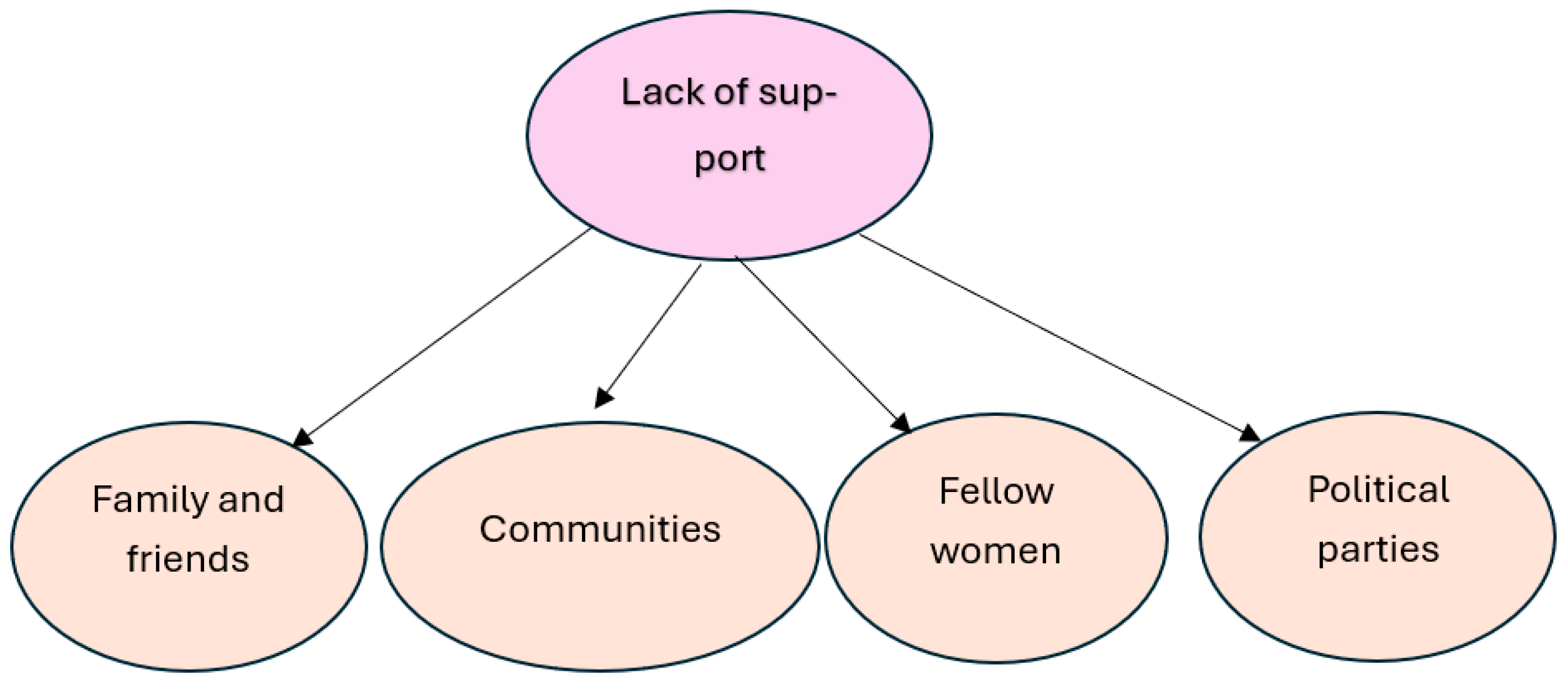
The diagram below (Figure 1) illustrates the key themes that have appeared from the findings, each of which is discussed in detail below, women’s political participation remains constrained by the absence of robust support systems across familial, community, peer, and institutional levels (Mgcotyelwa-Ntoni 2017; Hassim 2009).
Despite South Africa’s constitutional democracy and its extensive gender transformation initiatives in the post-apartheid period, this study revealed that the absence of robust support structures remained a formidable barrier to women’s full participation and success in political life (Mgcotyelwa-Ntoni 2017; Hassim 2009). This lack of support manifested across multiple, intersecting levels familial, communal, peer-based, and institutional highlighting the systemic and deeply entrenched nature of patriarchal resistance (Bierria et al. 2022). Participants consistently emphasised how these various sources of non-support operated simultaneously to exclude, demoralise, and silence women, thereby preventing meaningful political engagement. These were not isolated individual challenges, but symptoms of a broader structural and cultural crisis of gender inequality embedded within the political sphere (Okin 1994; Rozanova-Smith et al. 2025). South Africa currently has nearly half of its parliamentary seats occupied by women (Paxton et al. 2020), indicating strong representational figures on paper. Sub-Saharan Africa, more broadly, shows relatively high female representation in parliament (e.g., Ethiopia, Rwanda), yet evidence suggests that women’s numerical presence does not always translate into substantive policy impact, particularly regarding poverty alleviation, income inequality, or gender-based violence (Paxton et al. 2020; Tripp and Kang 2008). Family members often dissuaded women from pursuing political ambition (Montero 2025; Wauters et al. 2025), while communities regularly questioned or delegitimised female leadership (Dube and Pietersen 2025). In addition, intra-gender dynamics revealed troubling patterns, with fellow women at times failing to demonstrate solidarity or actively competing in ways that undermined collective empowerment (Hoxha 2023). Political parties, although formally committed to gender equity, frequently failed to provide the material, emotional, and organisational backing necessary for women to thrive in male-dominated spaces (Myhre 2025). These overlapping layers of exclusion did not merely reinforce each other they constituted a systemic structure that actively sustained women’s marginalisation in the political domain.
Analysis of interview data revealed that the challenges faced by women are not uniform, and significant patterns and contradictions emerge when considering party affiliation, geographical location, and socio-economic status. Class composition of women MPs was also noted as a key factor. Women from lower socio-economic backgrounds reported greater difficulty accessing campaign funding, mentorship, and political networks compared to women from middle or upper-class backgrounds, highlighting the influence of socio-economic class on barriers to political participation For example, women in opposition parties (EFF, UDM, COPE) reported more structural barriers due to limited party resources and deployment in hostile constituencies compared to ANC and DA members, who, while benefiting from better party infrastructure, still encountered tokenism and patriarchal gatekeeping. Age and experience also shaped perceptions of support: younger women expressed frustration over lack of mentorship and guidance, while older women cited community and familial scepticism as more persistent barriers. Women from rural constituencies reported heightened scrutiny by communities and families, whereas urban women experienced more peer competition but slightly more access to networks. The findings also reveal contradictory dynamics within support systems. Some families and communities provided conditional encouragement based on women’s perceived conformity to masculine political norms, while others actively discouraged participation. Similarly, fellow women were at times supportive but could also reinforce patriarchal expectations through competition or criticism. These contradictions illustrate that women navigate complex socio-cultural terrains where support is inconsistent and conditional.
The feminist political framework especially radical and liberal feminism proves essential in understanding the deep entrenchment of patriarchal norms that systematically disadvantage women across these dimensions (Wu 2025; Arora 2024). Radical feminism helps interrogate the cultural and symbolic violence that occurs within homes and political parties (Willis 1984; Rowland and Klein 1996), while liberal feminism focuses on the denial of equal access to institutional support, resources, and opportunity (Law 2019; Omwami 2021). Intersectional feminism is critical for analysing how factors such as class, age, and geography intersect with gender to compound the exclusion of women in political life (F. Williams 2021; Collins 2019). While women’s numerical representation is increasing, the findings suggest that these numbers do not automatically translate into meaningful influence over policy and governance. This aligns with Paxton et al. (2020), who argue that female presence in parliament does not guarantee substantive political outcomes. Constraints related to party hierarchy, socio-economic background, and lack of mentorship restrict women from fully impacting policy, demonstrating that representation alone is insufficient.

4.1. Lack of Support from Family and Friends

The family unit, often idealised as a source of emotional encouragement and moral support, emerged in this study as an unexpected yet significant site of resistance to women’s political participation. Many participants recounted how immediate family members particularly husbands, brothers, and even parents expressed scepticism, offered little encouragement, or in some cases displayed outright hostility towards their political ambitions. Rather than functioning as a supportive foundation, the family frequently operated as a primary enforcer of patriarchal expectations, discouraging women from stepping beyond traditionally sanctioned domestic roles. These findings align with research by Tripp (2025), who observed that kinship systems and household structures often act as barriers to women’s political engagement in Africa, and by Tamale (2020), who highlights how patriarchal family norms reproduce gendered hierarchies that constrain women’s agency. This internalised resistance not only undermined women’s confidence and aspirations but also contributed to their emotional isolation, financial vulnerability, and social marginalisation. The familial space, therefore, became a critical arena in which gendered power relations were reproduced, reinforcing the broader structural constraints that limit women’s meaningful participation in political life. Furthermore, this study found that familial support was conditional and varied according to marital status, age, and economic independence. Single women or those financially dependent on male relatives reported more pronounced resistance, highlighting that patriarchal control is enacted differently depending on social position and personal circumstances. These nuanced differences indicate that the family as a site of patriarchal enforcement is not uniform but structured according to intersecting social factors (A. Williams 2021; Hill Collins 2010). The lack of familial support extended beyond overt discouragement to include subtler mechanisms such as emotional coercion, social shaming, and restriction of access to resources needed for political engagement. These factors collectively hindered women’s agency and constrained their ability to navigate political structures effectively. This aligns with Kabeer’s (1999) empowerment framework, which emphasises that agency, resources, and achievements are interdependent; familial non-support directly compromises the agency and resource access that women require to attain meaningful political participation
“…I didn’t get enough support from my family, they believed that a male candidate will be more suitable for this position, so it was a bit difficult for me to attain this position.”
(Interviewee 7)
“…Lack of support from home or being a single parent would hurt a woman in leadership. Lack of support from your loved one is a big challenge because at the end of the day you do not have a shoulder close to lean on.”
(Interviewee 8)
“…Lack of support comes from my brothers who thought that I wasn’t fit for the position as a woman and the fact that they do not support the party in which I’m in… Only my brothers, they were like hayi suka wena (get away from here, you are not serious) you are just put there for bayakusebenzisa {they are just using you}… They still have that mentality of haysuka wena uthini na xa uthetha nabantu {how do you talk with people}.”
(Interviewee 1)
Feminist literature strongly reinforces these lived experiences of familial non-support, illustrating how deeply embedded patriarchal norms continue to shape women’s political trajectories. Ngara and Ayabam (2013) argue that such non-support is not limited to rural or less-educated households but is prevalent across all social classes, indicating the widespread internalisation of gendered ideologies regardless of educational or economic status. Families frequently adopt dominant societal beliefs that position politics as an inherently masculine domain, while women are relegated to caregiving and domestic responsibilities. This normative division of roles is rooted in enduring gender ideologies that prescribe “appropriate” spaces for men and women, thereby entrenching the exclusion of women from public and political leadership (Lazar 2005; Chong 2011). Liberal feminist scholars such as Dunn (2016) and Paxton et al. (2020) contend that this gendered bifurcation of the private and public spheres reflects broader systemic inequalities, where domestic responsibilities are framed as incompatible with political leadership. These normative frameworks do not question women’s competence but instead operate to structurally inhibit their access to decision-making spaces. Crucially, such family-based attitudes serve as gatekeepers of gendered power relations, subtly yet powerfully policing women’s ambitions. Beyond practical constraints, these dynamics also produce psychological barriers, as internalised notions of duty, modesty, and femininity suppress political aspiration and reinforce cycles of exclusion and self-doubt (Segal 2015; Pettygrove 2006).
Radical feminist theorists offer a complementary yet more critical perspective by locating the primary source of patriarchal power within the family structure itself. Dankwa (2018) contends that the family operates as the foundational site of patriarchal socialisation, where girls and women are taught from early childhood to accept subordination and male authority as natural and inevitable. Within this framework, the household emerges as a deeply politicised space in which gendered power hierarchies are both reproduced and maintained. Women’s political ambitions are often construed as acts of defiance against an entrenched social order, thereby delegitimising their aspirations and reinforcing their marginalisation (Wood and Thomas 2017; Baker and Palmieri 2023). Scholars such as Dhesi (2025) and Lowndes (2004) further reveal that many women are compelled to seek permission from male figures husbands, fathers, or elders before participating in political activities, a form of cultural gatekeeping that reinforces exclusion from the public sphere. This control is not always overt; it frequently manifests through subtler mechanisms such as emotional coercion, social shaming, and economic dependency, which collectively act to suppress women’s agency and silence dissent (Parpart 2013; Hecker 2024). These dynamics illuminate the intersection of gender and power within the private realm, affirming the radical feminist claim that the personal is political. The persistence of patriarchal norms within the domestic sphere has tangible implications for women’s broader political participation. Consequently, feminist critiques argue that efforts to advance women’s political empowerment must extend beyond formal institutional reform and directly confront the familial and cultural structures that uphold systemic gender inequality (Dhesi 2025; Noreen et al. 2025).

4.2. Lack of Support from the Community

Community-based resistance to women’s leadership emerged as a significant theme in the study’s findings. Many participants reported that their political aspirations were undermined by their communities, which, shaped by entrenched traditional and patriarchal norms, withheld support purely on the basis of gender. Despite demonstrating capability, dedication, and appropriate qualifications, these women were often overlooked in favour of male candidates who were perceived as more suitable for leadership roles. This pattern of rejection was not necessarily based on merit but rather on deeply internalised societal beliefs about gender and authority. The findings indicate that community perceptions of leadership remain strongly gendered, with women frequently viewed as lacking the assertiveness, emotional resilience, or decisiveness deemed necessary for public office. These attitudes contribute to the reproduction of gendered hierarchies at the local level, reinforcing barriers to women’s political advancement and legitimising their marginalisation within public decision-making spaces. The study also revealed that community support varied by geographic and socio-economic factors. Women from rural or historically marginalised communities faced more pronounced scepticism and delegitimisation, whereas urban women reported somewhat greater, though still limited, acceptance. This suggests that the barriers are compounded by intersecting social identities, in line with intersectional feminist theory (Yuval-Davis 2006; Collins 2019). Furthermore, community members often imposed informal sanctions on women who pursued leadership, including labelling them as disrespectful, unfeminine, or overly ambitious. These social sanctions operated alongside structural inequalities, intensifying the marginalisation of women in political spaces. This analysis demonstrates that community-level exclusion is not simply a cultural artefact but a structural mechanism that restricts access to social capital and legitimacy necessary for effective political engagement.
“…The main issue was the community; most were not supportive, but they wanted better living conditions, better service delivery through me.”
(Interviewee 3)
“I didn’t get enough support from my community, even from my family. They believed that a male candidate will be more suitable for this position.”
(Interviewee 7)
The pervasive lack of community support for women in politics closely aligns with findings from scholars such as Bidwell (2021), Hill Collins (2010), and Agarwal (2010), who emphasise that community structures often serve as key custodians of conservative gender norms particularly within local and rural settings. These scholars argue that communities function as powerful cultural gatekeepers, framing political leadership in exclusively masculine terms and systematically marginalising women who defy these entrenched expectations (Kiamba 2009; Dhesi 2025). Women who transgress these normative boundaries are frequently labelled as disrespectful, unfeminine, overly ambitious, or untrustworthy stigmas that serve to delegitimise their leadership potential and erode public credibility (Tripp 2015; Bauer and Burnet 2013). Such community-based sanctions reinforce patriarchal hierarchies by regulating women’s behaviour and curbing their recognition as legitimate political actors (Hassim 2006; Goetz 2020). From a liberal feminist perspective, this structural exclusion perpetuates gender inequality by denying women the community legitimacy and social capital essential for electoral viability and effective constituency engagement (Cummings and O’Neil 2015; Bolzendahl 2014). In the absence of communal endorsement, women face heightened risks of social backlash, isolation, and reputational harm, which further discourages political ambition (Lovenduski 2001; Paxton et al. 2007).
Intersectional feminist theory offers a particularly potent analytical framework for understanding this theme, as it underscores how overlapping social identities shape differentiated experiences of exclusion (Yuval-Davis 2006; Collins 2019). Women from rural areas, impoverished households, or historically marginalised ethnic communities face compounded forms of discrimination that intensify the barriers to political participation (Singh 2024; Chowdhury 2024). The convergence of gender, class, race, and age constructs a matrix of structural disadvantage that produces uniquely challenging conditions for political engagement, distinct even from those encountered by urban or middle-class women (Chant and McIlwaine 2013; Weldon 2006b). Olufemi (2020) contends that this exclusion is often a manifestation of deeply embedded social hierarchies that penalise women for occupying positions of visibility and authority, thus serving as a mechanism of social control. These insights affirm that even where progressive legal frameworks and gender quotas are in place, socio-cultural norms at the community level remain enduring and potent barriers to women’s full political inclusion (Paxton et al. 2007; Tripp and Kang 2008). As such, institutional reforms and legal rights, while necessary, are insufficient in isolation. A transformative approach must also confront the cultural and normative attitudes within communities that sustain exclusion. The intersectional lens thus calls for multidimensional strategies that target not only formal political institutions but also the grassroots social structures that shape the everyday realities of women’s political lives.

4.3. Lack of Support from Fellow Women

Ironically, one of the most disheartening and unexpected sources of non-support identified by participants was fellow women. Despite a shared understanding of the gendered barriers encountered in political spaces, many women reported a lack of solidarity from other women, who at times actively opposed their political advancement. Instead of fostering alliances or collective networks aimed at mutual empowerment, relationships among women in these contexts were often marked by rivalry, exclusion, and subtle sabotage. This dynamic reflects the pervasive phenomenon commonly referred to as the “pull-her-down syndrome,” wherein women, rather than uplifting one another, engage in behaviours that undermine each other’s progress. Importantly, the study found that the lack of solidarity was conditional, influenced by factors such as party affiliation, seniority, and access to leadership roles. Women in lower-ranking positions or opposition parties experienced heightened competition and received less support, reflecting structural rather than purely interpersonal dynamics. This underscores that intra-gender rivalry is often a product of systemic patriarchal pressures rather than individual disposition. Applying radical feminist theory, these findings illustrate that male-dominated political environments cultivate scarcity and competition among women, effectively preventing the formation of supportive alliances necessary for collective empowerment (Al Chami and Youssef 2024). From an empowerment perspective, the absence of intra-gender support directly limits women’s agency, reducing the potential for meaningful engagement and political advancement (Kabeer 1999). In this study, it is important to note that the issue of women not supporting one another was a common feature across all the political parties that participated.
“Sadly, you know us as females, we don’t support one another. We even prefer a man. If there is a position, especially those key leadership positions, women will never support another female they might as well prefer a man to lead.”
(Interviewee 10)
“It was tough and there were a lot of challenges… Mostly men supported me, and women bashed me. They were so hard on me; they could not believe I am capable to assume this position.”
(Interviewee 2)
“…Here in the municipality, we [females] don’t support each other at all. Women prefer to be led by men instead of a woman.”
(Interviewee 3)
“…The most painful part is that women didn’t support me; they preferred a male candidate for this position.”
(Interviewee 7)
Brooks (2023) offers a critical interrogation of the widely held notion of universal womanhood the assumption that all women share a homogenous status, ideology, and political ambition arguing that this essentialist perspective fails to account for the vast diversity of women lived experiences, identities, and socio-political positionalities. Such a homogenising view obscures the nuanced ways in which women themselves may internalise patriarchal ideologies and, paradoxically, function as agents in reinforcing the very structures that marginalise them (Tamez 2025; Mensah 2024). Scholars such as Ngara and Ayabam (2013) and Allen and Cutts (2017) reinforce this view by pointing to interpersonal dynamics such as jealousy, mistrust, and intra-gender competition as critical factors contributing to the fragmentation and weakening of women’s political networks. From a feminist political theory perspective, the absence of robust intra-gender solidarity fundamentally undermines the potential for transformative political change (Kittay 2019). The persistence of such divisions within gender groups represents a profound obstacle to women’s collective empowerment and hinders the establishment of a unified front capable of confronting patriarchal hegemony.
Radical feminist theorists contend that intra-female rivalry is not an innate or spontaneous occurrence but rather a calculated outcome of patriarchal systems strategically designed to maintain male dominance (Townsend 1999; Wolosky 2013). These systems, according to radical feminism, intentionally restrict access to leadership and power among women, thereby cultivating a culture of scarcity and competition rather than collaboration (Al Chami and Youssef 2024). Such a divide-and-conquer mechanism ensures the perpetuation of gendered hierarchies by fracturing potential alliances among women. Tripp (2015) further elaborates that without a conscious and collective feminist awakening fostered through political education and consciousness-raising these internalised divisions will continue to stymie progress towards gender equality. Feminist political theorists such as Crass (2013) thus call for intentional mobilisation efforts grounded in shared consciousness, mutual support, and political solidarity as vital tools to dismantle patriarchal rivalry and cultivate enduring networks of empowerment. In this light, the feminist political framework emerges as a critical analytical tool to unpack intra-gender dynamics and underscores the imperative of unity in the broader struggle for gender justice and inclusive political participation.

4.4. Lack of Support from Political Parties

The final dimension of this theme highlights the role of political parties as powerful gatekeepers in shaping and often constraining women’s political participation. While many South African political parties publicly champion gender equality and have introduced quota systems to boost female representation, the women in this study consistently reported a lack of genuine, sustained support from within their own party structures. The study revealed that party-based support was not uniform; women in opposition parties faced compounded challenges, including deployment to constituencies controlled by rival parties and lack of access to internal party networks. This conditionality illustrates how political party structures differentially affect women’s capacity to engage and succeed. Beyond resource limitations, participants described cultural and normative expectations within parties that demanded conformity to masculinised leadership norms. Women who sought to adopt collaborative, feminist leadership styles were often marginalised or excluded from strategic decision-making, demonstrating how party culture reinforces patriarchal power structures (Lorber 2001; Johnson and Phillips 2019). Using Kabeer’s (1999), framework, the absence of mentorship, strategic consultation, and institutional backing represents a clear constraint on both agency and resource access, thereby limiting women’s political achievements and reinforcing systemic marginalisation.
(Krook and Norris 2014; Olaitan 2023). Rather than being empowered, they frequently experienced tokenistic inclusion being placed in positions without meaningful consultation, strategic preparation, or the resources necessary to succeed. Common grievances included limited access to campaign funding, mentorship opportunities, and organisational backing (Bailey 2025; Weekes et al. 2025). These challenges are compounded for women in opposition parties, particularly when deployed to constituencies firmly controlled by dominant rivals, where their capacity to connect with and serve constituents is severely hindered. As one participant aptly put it,
“We are sent to fail given no money, no team, no support and then blamed when we do not win.”
(Interviewee 2)
“Well, I am a member of the opposition, which is EFF, so where I am deployed ANC dominates, so it was difficult sometimes for me to operate because of that.”
(Interviewee 4)
Other participants expressed similar frustrations:
“Being a woman in my party often feels like being a token visible, but invisible when it comes to real decision-making.”
(Interviewee 5)
“I was placed in a constituency where my party had no support. It was like being sent to the front lines without any weapons.”
(Interviewee 8)
“The party talks about gender equality, but when it comes to mentorship and funding, women are last in line.”
(Interviewee 2)
“If you don’t play the men’s game, you don’t get to play at all.”
(Interviewee 10)
“Our presence is celebrated in speeches but ignored in boardrooms.”
(Interviewee 7)
Bauer and Burnet (2013) critically contend that political parties frequently operate as patriarchal institutions shrouded in democratic rhetoric, where the inclusion of women serves more to legitimise party image than to enable genuine empowerment. While gender quotas and representational targets may symbolise progress, they often mask deeper structural inequalities that remain unaddressed. This tokenistic approach positions women not as empowered political actors, but as symbolic figures meant to satisfy external expectations of inclusivity. Shvedova (2005) aptly refers to this phenomenon as the “glass cliff,” where women are appointed to precarious or failing political roles, setting them up for inevitable blame when outcomes fall short. Within a liberal feminist framework, this exposes the limits of formal equality mechanisms such as quotas and affirmative action. While these instruments are essential to initiating inclusion, they fall short of achieving substantive equality unless accompanied by measures that ensure women have equitable access to capacity-building opportunities, mentorship, decision-making power, and the institutional resources required to navigate and influence the political landscape effectively (Cummings 2025). Without these enabling conditions, women are positioned within political systems that remain structurally indifferent if not hostile to their advancement.
Radical feminist theory extends this critique by asserting that male-dominated political institutions are not merely flawed but fundamentally exclusionary in their design. These institutions reward and perpetuate behaviours and values historically coded as masculine such as competitiveness, assertiveness, loyalty to patriarchal patronage networks, and adherence to hierarchical power structures (Lorber 2001; Johnson and Phillips 2019). As a result, the political arena becomes a space where alternative, feminist forms of leadership emphasising collaboration, empathy, inclusivity, and social justice are systematically devalued or suppressed. Women who challenge these dominant norms often encounter marginalisation, exclusion from strategic spaces, or direct retaliation. Conversely, women who conform to these masculinised expectations may achieve temporary success but risk reinforcing the very systems they might seek to disrupt (Fraser 2007; Hooks 2000). One interviewee powerfully observed,
“You’re either expected to act like one of the boys, or you’re told you don’t belong in the room.”
This dilemma encapsulates the profound paradox confronting many women in politics: they are expected to conform to an institutional culture rooted in patriarchal norms, while simultaneously being denied space to practise or promote alternative, feminist modes of leadership. The political arena often rewards assimilation into male-dominated structures, leaving little room for leadership models grounded in collaboration, equity, or social justice. Radical feminist scholars therefore call not simply for improved gender representation, but for a fundamental reconfiguration of political institutions challenging the entrenched values, practices, and hierarchies that sustain gendered power imbalances. As one participant starkly put it, “You are either with the men and play their game, or you stay on the sidelines watching your voice disappear” (Interviewee 7). Without a deep, structural transformation of party culture including changes to leadership norms, equitable distribution of resources, and inclusive decision-making processes women may continue to be visibly present in South African politics yet remain institutionally marginalised and politically disempowered.

5. Conclusions

Despite South Africa’s progressive constitutional democracy and post-apartheid gender transformation frameworks, this study demonstrates that a persistent and deeply entrenched lack of support for women in politics continues to pose a significant barrier to their substantive participation and advancement. Patriarchal resistance manifests systemically across multiple domains, including familial, communal, intra-gender, and institutional, creating intersecting structures of exclusion that reinforce women’s marginalisation at every level. These barriers include familial discouragement, the delegitimization of women’s leadership by communities, competition, lack of solidarity among women, and political party practices that rely on tokenistic deployments rather than genuine empowerment. The findings highlight that these barriers are not uniform but vary according to party affiliation, geographical location, socio-economic status, and age. Women in opposition parties face heightened structural challenges, rural women experience greater scrutiny from communities and families, and intra-gender dynamics remain a critical source of both support and obstruction. These patterns reveal the complex and conditional nature of support systems, demonstrating that women navigate highly variable socio-cultural and political terrains.
These empirical insights extend the critiques offered by feminist political theory: radical feminism exposes how patriarchal socialisation across both private and public spheres perpetuates subordination; liberal feminism reveals the persistent denial of access to equal opportunities, resources, and decision-making power; and intersectional feminism highlights how compounded identities such as class, race, and rural marginality intensify women’s exclusion from political life. Consequently, gender inequality in South African politics cannot be remedied through legal reforms or representational quotas alone. It reflects a broader cultural, institutional, and symbolic crisis that necessitates holistic and structural transformation. By systematically mapping these multi-level barriers and their contextual variations, the study provides a nuanced understanding of how political empowerment is differentially constrained. It also offers practical insights for political parties, communities, and feminist mobilisation strategies, emphasising where interventions are most needed. This research affirms that while legislative and policy advancements are essential, they remain insufficient in the absence of parallel shifts in socio-political attitudes, institutional cultures, and gendered power relations. Political parties, families, and communities function as critical gatekeepers, enforcing patriarchal norms that curtail women’s agency and undermine collective feminist mobilisation. The findings underscore that meaningful political empowerment for women requires more than numerical inclusion; it demands a fundamental reimagining of leadership norms, political practices, and the socio-cultural scripts that continue to exclude and silence women. Achieving gender justice and an inclusive democracy in South Africa therefore requires a sustained, multi-layered, and feminist-informed transformation across all sectors of society. Ultimately, this study contributes to the field of gender and politics by providing new insights into the differential barriers women face, clarifying the structural and intersectional dimensions of exclusion, and outlining strategies to promote substantive political participation for women.

6. Recommendations

To address the pervasive barriers identified in this study, it is imperative to recognise that the findings offer a foundation for future research aimed at deepening understanding of women’s political participation and empowerment. Future research could investigate the specific mechanisms through which families, communities, fellow women, and political parties either enable or constrain women’s political engagement. Longitudinal studies could track the career trajectories of women across different parties and regions to capture the evolving dynamics of support and opposition. Comparative studies could examine how variations in socio-economic status, geographic location, and age intersect with political party affiliation to shape opportunities and obstacles. Moreover, research could explore the effectiveness of intra-gender solidarity initiatives, mentorship programmes, and feminist political education interventions to determine which strategies most successfully mitigate structural barriers. By framing these insights as opportunities for further investigation rather than immediate policy prescriptions, the study positions itself as a stepping stone for new research that can empirically test and expand upon the patterns identified here. This research agenda could ultimately contribute to theory-building in the fields of gender and politics, providing nuanced evidence on how structural, cultural, and intersectional factors influence women’s political empowerment. Additionally, qualitative and mixed-methods approaches could be employed to capture the lived experiences of women in under-researched constituencies, including rural and historically marginalised areas, as well as those in smaller or opposition parties. These studies would complement existing knowledge, illuminate context-specific barriers, and inform future interventions with evidence grounded in women’s realities.

Funding

This research received no external funding.

Institutional Review Board Statement

The study was conducted in accordance with the Declaration of Helsinki, and approved by the University Research Ethics Committee (UREC) of [NAME OF UNIVERSITY] (protocol code: UREC/2018/07/05, date of approval: 5 July 2018).

Informed Consent Statement

Written informed consent has been obtained from the participant(s) to publish this paper.

Data Availability Statement

The can be found on request to the Author.

Conflicts of Interest

The authors declare no conflict of interest.

References

  1. Agarwal, Bina. 2010. Gender and Green Governance: The Political Economy of Women’s Presence Within and Beyond Community Forestry. New York: Oxford University Press. [Google Scholar]
  2. Akande, Adebowale, Vito Bobek, Jakob Lauring, David C. Coker, José Filipe Pinto, Estee Ti Akande, Mark Goodman, Cassandra Chaney, Fillipo Ferrari, Douglas Kellner, and et al. 2025. Power and Political Skill in the Workplace: Navigating Leadership, Followership, and Management Through Influence and Organizational Politics-Much Like the Weather. In Power, Politics, and Influence: Exercising Followership, Leadership, and Practicing Politics. Cham: Springer Nature Switzerland, pp. 3–34. [Google Scholar]
  3. Al Chami, Riad, and Moustafa Haj Youssef, eds. 2024. Challenging patriarchy: The transformation of women’s roles. In Impact of Patriarchy and Gender Stereotypes on Working Women: Exploring Its Past, Present and Future. London: Routledge, pp. 121–36. [Google Scholar]
  4. Alkadry, Mohamad G., and Leslie E. Tower. 2014. Women and Public Service: Barriers, Challenges, and Opportunities. London: Routledge. [Google Scholar]
  5. Allen, Peter, and David Cutts. 2017. Aspirant candidate behaviour and progressive political ambition. Research & Politics 4: 2053168017691444. [Google Scholar] [CrossRef]
  6. Alrashidi, Khadijah M. H., and Aziah Binti Ismail. 2025. Women Leaders’ Experiences at a Kuwaiti Higher Education Institution: Exploring the Leadership Labyrinth. International Journal of Learning, Teaching and Educational Research 24: 116–35. [Google Scholar] [CrossRef]
  7. Al-Thani, Hanan H. 2025. Qatari women leaders: Navigating structural and cultural barriers to empowerment. QScience Connect 2025: 2. [Google Scholar] [CrossRef]
  8. Alvinius, Aida, and Arita Holmberg. 2023. Blaming and shaming in the shadow structure: Individual resistance towards gender equality work as expressions of social conflict. Feminist Media Studies 23: 83–100. [Google Scholar] [CrossRef]
  9. Anigwe, Annette. 2014. Perceptions of Women in Political Leadership Positions in Nigeria. Doctoral dissertation, Walden University, Minneapolis, MN, USA. [Google Scholar]
  10. Armingeon, Klaus, and Lisa Schädel. 2015. Social inequality in political participation: The dark sides of individualisation. West European Politics 38: 1–27. [Google Scholar] [CrossRef]
  11. Arora, Poornima Pundhir. 2024. Various Theories & Methodologies on Feminism: A Study. Educational Administration: Theory and Practice 30: 1069–89. [Google Scholar]
  12. Bailey, Michael. 2025. Tokenism. In Diversity, Equity, and Inclusion in Veterinary Medicine. Hoboken: Wiley, pp. 215–28. [Google Scholar] [CrossRef]
  13. Baker, Kerryn, and Sonia Palmieri. 2023. Can women dynasty politicians disrupt social norms of political leadership? A proposed typology of normative change. International Political Science Review 44: 122–36. [Google Scholar] [CrossRef]
  14. Bangura, Priscilla S., and Alice W. Mambo. 2023. Barriers to female education and its impact on slow socio-Economic development of the family: A case of Africa international university. Research Journal of Education, Teaching and Curriculum Studies 1: 23–36. [Google Scholar] [CrossRef]
  15. Bauer, Gretchen. 2012. ‘Let there be a balance’: Women in African Parliaments. Political Studies Review 10: 370–84. [Google Scholar] [CrossRef]
  16. Bauer, Gretchen, and Jennie E. Burnet. 2013. Gender quotas, democracy, and women’s representation in Africa: Some insights from democratic Botswana and autocratic Rwanda. In Women’s Studies International Forum. Oxford: Pergamon, vol. 41, pp. 103–12. [Google Scholar]
  17. Bear, Julia B., and Todd L. Pittinsky. 2022. The Caregiving Ambition: What It Is and Why It Matters at Home and Work. New York: Oxford University Press. [Google Scholar]
  18. Bidwell, Nicola J. 2021. Rural uncommoning: Women, community networks and the enclosure of life. ACM Transactions on Computer-Human Interaction (TOCHI) 28: 1–50. [Google Scholar] [CrossRef]
  19. Bierria, Alisa, Brooke Lober, and Jakeya Caruthers, eds. 2022. Abolition Feminisms Vol. 2: Feminist Ruptures Against the Carceral State. Chicago: Haymarket Books. [Google Scholar]
  20. Bird, Melissa, Rachel L. Wright, and Caren J. Frost. 2016. Enhancing women’s health: A call for social work research. Social Work in Health Care 55: 732–51. [Google Scholar] [CrossRef] [PubMed]
  21. Bodalina, Kishan Naran. 2019. A Case Study of the Experiences of Women Leaders in the Gauteng East Education District Office. Johannesburg: University of Johannesburg (South Africa). [Google Scholar]
  22. Bolzendahl, Catherine. 2014. Opportunities and expectations: The gendered organization of legislative committees in Germany, Sweden, and the United States. Gender & Society 28: 847–76. [Google Scholar]
  23. Brechenmacher, Saskia, and Caroline Hubbard. 2020. Breaking the Cycle of Gender Exclusion in Political Party Development. Washington: Carnegie Endowment for International Peace. [Google Scholar]
  24. Brooks, Ruby Juanita. 2023. Femininity, Class, and Status: The Societal Devaluation of the Female Early Years’ Workforce. Doctoral dissertation, College of Arts, Humanities and Education, University of Derby, Derby, UK. [Google Scholar]
  25. Carastathis, Anna. 2016. Intersectionality: Origins, Contestations, Horizons. Lincoln: University of Nebraska Press. [Google Scholar]
  26. Celis, Karen, and Sarah Childs. 2018. Conservatism and women’s political representation. Politics & Gender 14: 5–26. [Google Scholar]
  27. Chant, Sylvia, and Cathy McIlwaine. 2013. Gender, urban development, and the politics of space. E-International Relations 4: 1–14. [Google Scholar]
  28. Charrad, Mounira M. 2010. Women’s agency across cultures: Conceptualizing strengths and boundaries. Women’s Studies International Forum 33: 517–22. [Google Scholar] [CrossRef]
  29. Chikwe, Chidinma Favour, Kevin Namiiro Kuteesa, and Ayo Amen Ediae. 2024a. Gender equality advocacy and socio-economic inclusion: A comparative study of community-based approaches in promoting women’s empowerment and economic resilience 2022. International Journal of Scientific Research Updates 8: 110–21. [Google Scholar] [CrossRef]
  30. Chikwe, Chidinma Favour, Nkechi Emmanuella Eneh, and Chidiogo Uzoamaka Akpuokwe. 2024b. Navigating the double bind: Strategies for women leaders in overcoming stereotypes and leadership biases. GSC Advanced Research and Reviews 18: 159–72. [Google Scholar] [CrossRef]
  31. Cho, Sumi, Kimberlé Williams Crenshaw, and Leslie McCall. 2013. Toward a field of intersectionality studies: Theory, applications, and praxis. Signs: Journal of Women in Culture and Society 38: 785–810. [Google Scholar] [CrossRef]
  32. Chong, Jinn Winn. 2011. The politics of the empowerment of women: Mapping enabling environments within narratives of femininity and power. William & Mary Journal of Race, Gender, and Social Justice 18: 523. [Google Scholar]
  33. Chouchou Lyliane, Irambona. 2022. Factors Affecting Women’s Participation in Politics: A Comparative Study of Kenya, Rwanda, South Africa, and Uganda. Master’s thesis, Linnaeus University, Växjö, Sweden. [Google Scholar]
  34. Chowdhury, Manali. 2024. Breaking Barriers: Advancing Women’s Political Participation and Leadership for Societal Change. Vidhyayana-An International Multidisciplinary Peer-Reviewed E-Journal. [Google Scholar] [CrossRef]
  35. Collins, Patricia Hill. 2019. The difference that power makes: Intersectionality and participatory democracy. In The Palgrave Handbook of Intersectionality in Public Policy. Cham: Springer International Publishing, pp. 167–92. [Google Scholar]
  36. Craft, Ethel. 2025. Advancing Women in Political Leadership: A Qualitative Study. Doctoral dissertation, Athabasca University, Athabasca, AB, Canada. [Google Scholar]
  37. Crass, Chris. 2013. Towards Collective Liberation: Anti-Racist Organizing, Feminist Praxis, and Movement Building Strategy. Oakland: PM Press. [Google Scholar]
  38. Cummings, Clare. 2025. Understanding power, culture and institutional change: A revised approach to political settlements analysis. New Political Economy 30: 114–26. [Google Scholar] [CrossRef]
  39. Cummings, Clare, and Tam O’Neil. 2015. Do digital information and communications technologies increase the voice and influence of women and girls. In A Rapid Review of the Evidence. London: Overseas Development Institute. [Google Scholar]
  40. Dahlum, Sirianne, Carl Henrik Knutsen, and Valeriya Mechkova. 2020. Female empowerment and economic growth. V-Dem Working Paper 103. [Google Scholar] [CrossRef]
  41. Dankwa, Shirley. 2018. Culture of family ideals and perceived subjugating positions of women in patriarchy society: The way forward. Culture 8: 6–12. [Google Scholar]
  42. Davis, Pamela R. 2016. The Political Impact of Caregiving-It’s a Woman’s World: An Inquiry of the Caregiving Landscape. Cincinnati: Union Institute and University. [Google Scholar]
  43. De Jong, Judith C., and Liza M. Mügge. 2024. Political representation and intersectionality: Perspectives of ethnically/racially minoritized citizens. Social Politics: International Studies in Gender, State & Society 31: 151–77. [Google Scholar]
  44. DeWitt, Michelle Crystal. 2023. Challenges Faced by Female Superintendents in Rural South Texas School Districts and Their Implications for Superintendent Preparation Programs. Doctoral dissertation, Texas A&M University-Corpus Christi, Corpus Christi, TX, USA. [Google Scholar]
  45. Dhakal, Naba Raj, and Khusboo Thapa. 2024. Challenges and Constraints: Examining Women Politicians’ Status in Decision-Making Within Political Parties. Bhairahawa Campus Journal 7: 1–14. [Google Scholar] [CrossRef]
  46. Dhesi, Christie. 2025. The Influence of Patriarchal Culture on Women’s Participation in Local Politics. Journal of Social, Culture & Humanitarian Research 1: 1–9. [Google Scholar]
  47. Dolan, Julie, Melissa M. Deckman, and Michele L. Swers. 2021. Women and Politics: Paths to Power and Political Influence. London: Bloomsbury Publishing PLC. [Google Scholar]
  48. Dube, Mbusiseni Celimpilo, and Christo Doniwen Pietersen. 2025. The Reflections of Women in School Leadership. In Women’s Leadership in African Education. Cham: Springer Nature Switzerland, pp. 161–72. [Google Scholar]
  49. Dunn, Michelle Elizabeth. 2016. ‘You will Go Far but no Further’: Applying a Gendered Lens to the Women Peace and Security Agenda in Post-Conflict Liberia. Ph.D. thesis, School of Political Science and International Studies, The University of Queensland, Queensland, Australia. [Google Scholar]
  50. Edema, Clementina. 2025. Game or no Game: Navigating Office Politics and Female Leaders Success Through the ‘Labyrinth’ Metaphor Lens. Ph.D. thesis, Inside Anna University, Chennai, India. [Google Scholar]
  51. Farrell, Maura, Simo Sarkki, Lorraine Holloway, Louise Weir, Hannu Heikkinen, Élise Lépy, Jasmiini Fransala, Niamh Nolan, Niamh McGuinness, Susanne von Muenchhausen, and et al. 2024. D1. 1 FLIARA Conceptual Framework. Brussels: European Commission. [Google Scholar]
  52. Fox, Richard L., and Jennifer L. Lawless. 2011. Gendered perceptions and political candidacies: A central barrier to women’s equality in electoral politics. American Journal of Political Science 55: 59–73. [Google Scholar] [CrossRef]
  53. Franceschet, Susan, Mona Lena Krook, and Jennifer M. Piscopo, eds. 2012. The Impact of Gender Quotas. New York: OUP USA. [Google Scholar]
  54. Fraser, Nancy. 2007. Feminist politics in the age of recognition: A two-dimensional approach to gender justice. Studies in Social Justice 1: 23–35. [Google Scholar] [CrossRef]
  55. Galsanjigmed, Enkhzul, and Tomoki Sekiguchi. 2023. Challenges women experience in leadership careers: An integrative review. Merits 3: 366–89. [Google Scholar] [CrossRef]
  56. Goetz, Anne Marie. 2003. Women’s political effectiveness: A conceptual framework. No Shortcuts to Power: African Women in Politics and Policy Making 3: 29–41. [Google Scholar]
  57. Goetz, Anne Marie. 2020. The politics of preserving gender inequality: De-institutionalisation and re-privatisation. Oxford Development Studies 48: 2–17. [Google Scholar] [CrossRef]
  58. Götze, Jacqueline, Stephan Klingebiel, and Maryam Khalid. 2025. Local Feminist Perspectives as Transformation Levers for Greater Gender Equality: Synthesis Study. (No. 9/2025). Bonn: IDOS Discussion Paper. [Google Scholar]
  59. Graham, Laura. 2024. Feminist legal theories. In Gender, Sexuality and Law: A Textbook. Northampton: Edward Elgar Publishing Ltd., vol. 8. [Google Scholar]
  60. Greguletz, Elena, Marjo-Riitta Diehl, and Karin Kreutzer. 2019. Why women build less effective networks than men: The role of structural exclusion and personal hesitation. Human Relations 72: 1234–61. [Google Scholar] [CrossRef]
  61. Hassim, Shireen. 2006. Women’s Organisations and Democracy in South Africa. Contesting Authority. Pietermaritzburg: University of KwaZulu-Natal Press. [Google Scholar]
  62. Hassim, Shireen. 2009. After apartheid: Consensus, contention, and gender in South Africa’s public sphere. International Journal of Politics, Culture, and Society IJPS 22: 453–64. [Google Scholar] [CrossRef]
  63. Hecker, Kerstin. 2024. Behind Closed Doors: On Covert Aggression and the Abuse of Power by Women in the Workplace. Toro Canyon: Pacifica Graduate Institute. [Google Scholar]
  64. Helman, Rebecca, and Kopano Ratele. 2016. Every day (in) equality at home: Complex constructions of gender in South African families. Global Health Action 9: 31122. [Google Scholar] [CrossRef]
  65. Hill Collins, Patricia. 2010. The new politics of community. American Sociological Review 75: 7–30. [Google Scholar] [CrossRef]
  66. Hooks, Bell. 2000. Feminism is for Everybody: Enthusiastic Politics. London: Pluto Press. [Google Scholar]
  67. Hoxha, D. 2023. Feminist Solidarity and Practice Among Women Politicians in Kosovo. Doctoral dissertation, University of Lodz, Vienna, Austria. [Google Scholar]
  68. Ilodigwe, Anthonia Onyinye, and Bonaventure Chigozie Uzoh. 2024. An appraisal on the impact of gender inequality and stereotypes on female participation in politics in Anambra State. African Journal of Social and Behavioural Sciences 14. Available online: https://journals.aphriapub.com/index.php/AJSBS/article/view/2717 (accessed on 27 July 2025).
  69. Iversen, Torben, Frances McCall Rosenbluth, and Frances Rosenbluth. 2010. Women, Work, and Politics: The Political Economy of Gender Inequality. New Haven: Yale University Press. [Google Scholar]
  70. Jackson, Stevi, and Jackie Jones, eds. 1998. Contemporary Feminist Theories. Edinburgh: Edinburgh University Press, vol. 23. [Google Scholar]
  71. Jaraisy, Imad, and Ayman Agbaria. 2025. Educational Influence on Political Culture: Insights from Israel’s Arab Political Elite. Middle East Critique, 1–22. [Google Scholar] [CrossRef]
  72. Johnson, Martha C., and Melanie L. Phillips. 2019. Gender politics. In Routledge Handbook of Democratization in Africa. London: Routledge, pp. 302–16. [Google Scholar]
  73. Joseph, Juliet Eileen. 2022. Unequal, undiversified and underrepresented: Women on the backburner in local decision making in South Africa’s local government. ScienceRise 3: 24–37. [Google Scholar] [CrossRef]
  74. Kabeer, Naila. 1999. Resources, agency, achievements: Reflections on the measurement of women’s empowerment. Development and Change 30: 435–64. [Google Scholar] [CrossRef]
  75. Kela, Sibabalwe, Sareesha Pillay, Thanduxolo Fana, Aluncedo Zikhali, and Matjhupe Tshidiso Muroa. 2024. An Assessment of Barriers and Enablers to Women Progression into Leadership Positions in the South African Public Higher Education Sector. Journal of Public Administration and Development Alternatives (JPADA) 9: 33–52. [Google Scholar] [CrossRef]
  76. Kiamba, Josephine M. 2009. Women and leadership positions: Social and cultural barriers to success. Wagadu Volume 6 Journal of International Women’s Studies 10: 89. [Google Scholar]
  77. Kittay, Eva Feder. 2019. Love’s Labor: Essays on Women, Equality, and Dependency. London: Routledge. [Google Scholar]
  78. Kriesi, Hanspeter. 2013. Democratic legitimacy: Is there a legitimacy crisis in contemporary politics? Politische Vierteljahresschrift 54: 609–38. [Google Scholar] [CrossRef]
  79. Krook, Mona Lena. 2006. Gender quotas, norms, and politics. Politics & Gender 2: 110–18. [Google Scholar] [CrossRef]
  80. Krook, Mona Lena. 2016. Contesting gender quotas: Dynamics of resistance. Politics, Groups, and Identities 4: 268–83. [Google Scholar] [CrossRef]
  81. Krook, Mona Lena, and Pippa Norris. 2014. Beyond quotas: Strategies to promote gender equality in elected office. Political Studies 62: 2–20. [Google Scholar] [CrossRef]
  82. Kunovich, Sheri, and Pamela Paxton. 2005. Pathways to power: The role of political parties in women’s national political representation. American Journal of Sociology 111: 505–52. [Google Scholar] [CrossRef]
  83. Law, Sylvia A. 2019. In defense of liberal feminism. In Research Handbook on Feminist Jurisprudence. Cheltenham: Edward Elgar Publishing, pp. 24–43. [Google Scholar]
  84. Lazar, Michelle M. 2005. Politicizing gender in discourse: Feminist critical discourse analysis as political perspective and praxis. In Feminist Critical Discourse Analysis: Gender, Power, and Ideology in Discourse. London: Palgrave Macmillan, UK, pp. 1–28. [Google Scholar]
  85. Lestari, Puji, and Ganda Febri Kurniawan. 2025. Intersectionality and Political Representation: Challenges and Policy Implications for Marginalized Women in Indonesia. Journal of Social Studies Education Research 16: 1–38. [Google Scholar]
  86. Li, Yating. 2024. Systemic and sociocultural factors impeding women’s political participation and leadership development: A Sociological inquiry. In SHS Web of Conferences. Les Ulis: EDP Sciences, vol. 187, p. 03016. [Google Scholar]
  87. Lister, Ruth. 1997. Citizenship: Towards a feminist synthesis. Feminist Review 57: 28–48. [Google Scholar] [CrossRef]
  88. Lister, Ruth. 2012. Citizenship and gender. In The Wiley-Blackwell Companion to Political Sociology. Oxford: Wiley-Blackwell, pp. 372–82. [Google Scholar]
  89. Lorber, Judith. 2001. Gender Inequality. Los Angeles: Roxbury. [Google Scholar]
  90. Lovenduski, Joni. 2001. Women and politics: Minority representation or critical mass? Parliamentary Affairs 54: 743–58. [Google Scholar] [CrossRef]
  91. Lovenduski, Joni. 2020. The political representation of women: A feminist institutionalist perspective. In Research Handbook on Political Representation. Cheltenham: Edward Elgar Publishing, pp. 210–21. [Google Scholar]
  92. Lowndes, Vivien. 2004. Getting on or getting by? Women, social capital, and political participation. The British Journal of Politics and International Relations 6: 45–64. [Google Scholar] [CrossRef]
  93. Lowndes, Vivien. 2020. How are political institutions gendered? Political Studies 68: 543–64. [Google Scholar] [CrossRef]
  94. Luckham, Robin, and Anne Marie Goetz. 2003. Democratic Politics. Can Democracy be Designed?: The Politics of Institutional Choice in Conflict-Torn Societies 2: 14. [Google Scholar]
  95. Mafatshe, Itumeleng. 2015. Gender Politics and Activism: A Comparative Study of African National Congress Youth League Branches in Seshego (Limpopo). Doctoral dissertation, Wits University, Johannesburg, South Africa. [Google Scholar]
  96. Manuella, Nyasha Gaspare. 2017. Gender Representation in Party Politics: A Case Study of Vhembe District in Limpopo, South Africa. Doctoral dissertation, University Name, South Africa. [Google Scholar]
  97. Matlosa, Khabele. 2008. Electoral system reform and implications for gender equality. Journal of African Elections 7: 95–108. [Google Scholar] [CrossRef]
  98. McAfee, Noëlle, and Katie B. Howard. 2009. Feminist Political Philosophy. Available online: https://plato.sydney.edu.au/entries/feminism-political/ (accessed on 27 July 2025).
  99. McDonagh, Eileen. 2009. The Motherless State: Women’s Political Leadership and American Democracy. Chicago: University of Chicago Press. [Google Scholar]
  100. McEwan, Cheryl. 2003. ‘Bringing government to the people’: Women, local governance, and community participation in South Africa. Geoforum 34: 469–81. [Google Scholar] [CrossRef]
  101. Mensah, Linda. 2024. Battling on multiple frontiers: An African feminist examination of women’s struggles in artisanal and small-scale mining (ASM). Cogent Social Sciences 10: 2399935. [Google Scholar] [CrossRef]
  102. Meschitti, Viviana, and Giulio Marini. 2023. The balance between status quo and change when minorities try to access top ranks: A tale about women achieving professorship. Gender in Management: An International Journal 38: 17–35. [Google Scholar] [CrossRef]
  103. Mgcotyelwa-Ntoni, Nwabisa Bernice. 2017. African Women’s Leadership Experiences and Outcomes of Gender Transformation Policies: A Case Study of Democratic National Government Departments in South Africa. Doctoral dissertation, University of KwaZulu-Natal, Howard College, Durban, South Africa. [Google Scholar]
  104. Milazzo, Annamaria, and Markus Goldstein. 2019. Governance and women’s economic and political participation: Power inequalities, formal constraints, and norms. The World Bank Research Observer 34: 34–64. [Google Scholar] [CrossRef]
  105. Mishra, Sonya. 2025. What is mine cannot be yours: How zero-sum perceptions of power and status shape men’s perceptions of ingroup harm from women’s hierarchical advancement. Journal of Personality and Social Psychology. [Google Scholar] [CrossRef] [PubMed]
  106. Mohamad, Maznah. 2018. Getting more women into politics under one-party dominance: Collaboration, clientelism, and coalition building in the determination of women’s representation in Malaysia. Southeast Asian Studies 7: 415–47. [Google Scholar]
  107. Montero, Camila. 2025. Opening the gates, keeping the guards: How intra-party democracy shapes Women’s access to party leadership. Party Politics, 13540688251378431. [Google Scholar] [CrossRef]
  108. Morrell, Robert, and Rachel Jewkes. 2011. Carework and caring: A path to gender equitable practices among men in South Africa? International Journal for Equity in Health 10: 17. [Google Scholar] [CrossRef]
  109. Myeni, Sithembiso Lindelihle. 2012. History Matters: Exploring Women’s Political Representation in Post Apartheid KwaZulu-Natal, South Africa. Manchester: The University of Manchester. [Google Scholar]
  110. Myhre, Emma. 2025. Political Parties and Gendered Political Representation in Sri Lanka: Low Descriptive Representation Despite Considerable Socio-Economic Advancement. Master’s thesis, McGill University, Montréal, QC, Canada. [Google Scholar]
  111. Nanavaty, Aara. 2025. Selective Sisterhood: Power, Race, and the Internal Division Within Feminist Waves in the United States. Bachelor’s thesis, Claremont Colleges, Claremont, CA, USA. [Google Scholar]
  112. Ncube, Lisa, and James Greenan. 2003. Entrepreneurial careers of women in Zimbabwe. Journal of Vocational Education Research 28: 217–58. [Google Scholar] [CrossRef]
  113. Ndjama, Joelle Danielle Ngo. 2025. Barriers Contributing to Women Underrepresentation in Decision-Making Positions in Higher Education Institutions: A Systematic Review. IIASS Innovative Issues and Approaches in Social Sciences 35: 91–106. [Google Scholar]
  114. Ngara, Christopher Ochanja, and Alexius Terwase Ayabam. 2013. Women in politics and decision-making in Nigeria: Challenges and prospects. European Journal of Business and Social Sciences 2: 47–58. [Google Scholar]
  115. Noreen, Naveeda, Rubeena Zakar, Uroosa Yousaf, Zoya Saqlain, Manahil Farhat, and Florian Fischer. 2025. Factors shaping women’s political participation in Pakistani society: An in-depth exploration. Journal of Gender Studies, 1–20. [Google Scholar] [CrossRef]
  116. Oganetse, Dimpho Kgakgamatso, and Dines Phiri. 2025. Gender-sensitive literacy policies in distance education: Overcoming barriers to women’s education in sub-Saharan Africa. In Literacy Policies for Equity and Inclusion. Palmdale: IGI Global Scientific Publishing, pp. 233–62. [Google Scholar]
  117. Okin, Susan Moller. 1994. Gender inequality and cultural differences. Political Theory 22: 5–24. [Google Scholar] [CrossRef]
  118. Olaitan, Zainab Monisola. 2023. Gender Quotas and the Substantive Representation of Women in African Politics: Case Studies of Botswana and South Africa. Doctoral dissertation, University of Pretoria, Pretoria, South Africa. [Google Scholar]
  119. Olufemi, Lola. 2020. Feminism Interrupted: Disrupting Power. London: Pluto Books. [Google Scholar]
  120. Omwami, Edith Mukudi. 2021. Liberal feminism in comparative education and the implications for women’s empowerment. Annual Review of Comparative and International Education 2020: 171–96. [Google Scholar]
  121. Ono, Yoshikuni, and Yuya Endo. 2024. The underrepresentation of women in politics: A literature review on gender bias in political recruitment processes. Interdisciplinary Information Sciences 30: 36–53. [Google Scholar] [CrossRef]
  122. Parpart, Jane L. 2013. 1 Choosing silence: Rethinking voice, agency, and women’s empowerment. In Secrecy and Silence in the Research Process. London: Routledge, pp. 15–29. [Google Scholar]
  123. Patil, Vrushali. 2013. From patriarchy to intersectionality: A transnational feminist assessment of how far we’ve really come. Signs: Journal of Women in Culture and Society 38: 847–67. [Google Scholar] [CrossRef]
  124. Paxton, Pamela, Melanie M. Hughes, and Tiffany D. Barnes. 2020. Women, Politics, and Power: A Global Perspective. Lanham: Rowman & Littlefield. [Google Scholar]
  125. Paxton, Pamela, Sheri Kunovich, and Melanie M. Hughes. 2007. Gender in politics. Annual Review of Sociology 33: 263–84. [Google Scholar] [CrossRef]
  126. Pettygrove, Margaret. 2006. Obstacles to Women’s Political Empowerment in Jordan: Family, Islam, and Patriarchal Gender Roles. Independent Study Project (ISP) Collection 358. Available online: https://digitalcollections.sit.edu/isp_collection/358/ (accessed on 27 July 2025).
  127. Phillips, Anne. 2001. Feminism and liberalism revisited: Has Martha Nussbaum got it right? Constellations: An International Journal of Critical & Democratic Theory 8: 249–66. [Google Scholar]
  128. Phipps, Alison. 2016. Who’s personal is more political? Experience in contemporary feminist politics. Feminist Theory 17: 303–21. [Google Scholar] [CrossRef]
  129. Pillay-Naidoo, Daphne, and Corlette Vermeulen. 2023. Seeking support through solidarity: Female leader’s experiences of workplace solidarity in male-dominated professions. Frontiers in Psychology 14: 1119911. [Google Scholar] [CrossRef] [PubMed]
  130. Pless, Nicola, and Thomas Maak. 2004. Building an inclusive diversity culture: Principles, processes and practice. Journal of Business Ethics 54: 129–47. [Google Scholar] [CrossRef]
  131. Rahman, Ahnaf Ashiqur, and Imran Hosen. 2024. Beyond Quotas: Addressing Barriers to Women’s Political Participation in Asia. Journal of Governance, Security & Development 4: 1–18. [Google Scholar]
  132. Ring, Jessica. 2021. Re-Tooling the Sisterhood: Conceptualizing ‘Meaningful Making’ through Maker Culture, Makerspace Politics, and Feminist ‘Little m’ Making-as-Activism. Doctoral dissertation, Carleton University, Ottawa, ON, Canada. [Google Scholar]
  133. Rowland, Robyn, and Renate Klein. 1996. Radical feminism: History, politics, action. In Radically Speaking: Feminism Reclaimed. North Geelong: Spinifex Press, pp. 9–36. [Google Scholar]
  134. Rozanova-Smith, Marya, Embla Eir Oddsdóttir, and Andrey N. Petrov. 2025. ‘They Say There’s More Equality…’: Women’s Perspectives on Progress and Setbacks in Gender Equality in Northern Iceland During Times of Crisis. Societies 15: 191. [Google Scholar] [CrossRef]
  135. Rustin, Carmine Jianni. 2018. Gender Equality and Happiness among South African Women. Ph.D. thesis, University of the Western Cape, Cape Town, South Africa. [Google Scholar]
  136. Sairam, Sakeerthi, and R. Madhavi. 2026. Women’s Leadership Aspirations in Higher Education: Navigating the Cultural and Societal Barriers. In Understanding Women’s Avoidance of Leadership in Higher Education. Palmdale: IGI Global Scientific Publishing, pp. 229–64. [Google Scholar]
  137. Segal, Lynne. 2015. Why Feminism? Gender, Psychology, Politics. Hoboken: John Wiley & Sons. [Google Scholar]
  138. Shangare, Ashleigh Rumbidzai Tesa. 2022. The Insufficiency of the Quota System: A Reconceptualisation and Meso-Analysis of Women’s Political Empowerment in Africa. Pretoria: University of Pretoria. [Google Scholar]
  139. Shoukat, Ghazala, and Sajid Mahmood Awan. 2025. Women and Politics: Empowering Women Leadership for Political Representation in Sindh: A Multi-Dimensional Analysis. Qlantic Journal of Social Sciences 6: 60–75. [Google Scholar] [CrossRef]
  140. Shvedova, Nadezhda. 2005. Obstacles to women’s participation in parliament. Women in Parliament: Beyond Numbers 33: 22–45. [Google Scholar]
  141. Sigwela, Noziphiwo Margaret. 2021. An Investigation into the Role of Women in the Spatial Planning and Development of Their Settlements That Are Under the Custodianship of Traditional Leaders: A Case Study of Cala in Sakhisizwe Municipality, Eastern Cape. Master’s thesis, University of Cape Town, Cape Town, South Africa. [Google Scholar]
  142. Singh, Sonakshi. 2024. Women in Politics: Barriers to Participation and Strategies for Inclusion. International Journal of Social Science Research (IJSSR) 1: 19–28. [Google Scholar]
  143. Smith, Hussein Kamaldeen. 2025a. Cultural and Societal Barriers to Women’s Leadership and Strategies to Overcome Them. Available online: https://www.researchgate.net/profile/Hussein-Smith/publication/387663039_Cultural_and_Societal_Barriers_to_Women’s_Leadership_and_Strategies_to_Overcome_Them/links/67768f85894c5520853e1149/Cultural-and-Societal-Barriers-to-Womens-Leadership-and-Strategies-to-Overcome-Them.pdf (accessed on 27 July 2025).
  144. Smith, Hussein Kamaldeen. 2025b. Transforming Traditional Norms: Education and Mentorship Strategies to Challenge Patriarchal Structures. Available online: https://www.researchgate.net/publication/387602523_Transforming_Traditional_Norms_Education_and_Mentorship_Strategies_to_Challenge_Patriarchal_Structures (accessed on 27 July 2025).
  145. Sokani, Andile, Sinelisiwe Thwala, and Motlagabo Gladys Matseke. 2025. A sociological investigation into the factors influencing women’s political participation in South Africa: A qualitative approach. International Journal of Research in Business and Social Science 14: 100–11. [Google Scholar] [CrossRef]
  146. Squires, Judith. 2004. Politics beyond boundaries: A feminist perspective. In What is Politics? The Activity and Its Study. Hoboken: John Wiley & Sons, pp. 119–34. [Google Scholar]
  147. Stockemer, Daniel. 2011. Women’s parliamentary representation in Africa: The impact of democracy and corruption on the number of female deputies in national parliaments. Political Studies 59: 693–712. [Google Scholar] [CrossRef]
  148. Sweetman, Caroline. 2013. Introduction, feminist solidarity, and collective action. Gender & Development 21: 217–29. [Google Scholar] [CrossRef]
  149. Tamale, Sylvia. 2020. Decolonization and Afro-feminism. Journal of Contemporary African Studies 39: 644–47. [Google Scholar]
  150. Tamez, Jazmin. 2025. Patriarchy and women’s autonomy: Examining its impact on rights. Sociological Imagination 60: 45–62. [Google Scholar]
  151. Thelma, Chanda Chansa, and Loveness Ngulube. 2024. Women in leadership: Examining barriers to women’s advancement in leadership positions. Asian Journal of Advanced Research and Reports 18: 273–90. [Google Scholar] [CrossRef]
  152. Topić-Rutherford, Martina, Karen Vollum-Dix, and Catherine Glaister. 2025. Women, masculinities and workplace culture in small and medium-size businesses in the Leeds City Region. International Journal of Organization Theory & Behavior. [Google Scholar] [CrossRef]
  153. Townsend, John Marshall. 1999. Male dominance hierarchies and women’s intrasexual competition. Behavioral and Brain Sciences 22: 235–36. [Google Scholar] [CrossRef]
  154. Tripp, Aili Mari. 2015. Women and Power in Postconflict Africa. New York: Cambridge University. [Google Scholar]
  155. Tripp, Aili Mari. 2025. The Changing Subfield of Comparative Politics and the Journal of Politics & Gender. Politics & Gender 21: 105–13. [Google Scholar]
  156. Tripp, Aili Mari, and Alice Kang. 2008. The global impact of quotas: On the fast track to increased female legislative representation. Comparative Political Studies 41: 338–61. [Google Scholar] [CrossRef]
  157. Tseer, Tobias, David Yaro Suaka, and Constance Awinpoka Akurugu. 2025. Unveiling Inequalities: Gender-Based Discriminatory Practices and Women’s Political Engagement in Northern Ghana. International Journal of Public Administration 48: 73–85. [Google Scholar] [CrossRef]
  158. Vandana, V., and D. Vezhaventhan. 2024. Navigating Patriarchal Norms: A Study on the Political Participation and Representation of Married Women in Chennai’s Local Governance. Library of Progress-Library Science, Information Technology & Computer 44: 15383. [Google Scholar]
  159. Verge, Tania, and Meryl Kenny. 2013. Contagion Theory Revisited: When Do Political Parties Compete on Women’s Representation? In EPSA 2013 Annual General Conference Paper. vol. 309. Available online: https://ecpr.eu/Events/Event/PaperDetails/1703 (accessed on 27 July 2025).
  160. Verge, Tània. 2020. Political party gender action plans: Pushing gender change forward beyond quotas. Party Politics 26: 238–48. [Google Scholar] [CrossRef]
  161. Vyas-Doorgapersad, Shikha., and Elvin Shava. 2022. A Situational Analysis of Women’s Leadership in South African Politics. African Journal of Gender, Society & Development 11. [Google Scholar] [CrossRef]
  162. Wauters, Bram, Robin Devroe, Audrey Vandeleene, and Hilde Coffé. 2025. Beyond Elections: Unpacking the Gender Gap in Political Ambition Across Political Roles. Journal of Women, Politics & Policy 46: 262–78. [Google Scholar] [CrossRef]
  163. Weekes, Arlene P., Shirleecia Ward, and Maureen Mguni. 2025. Beyond tokenism: Activism, resistance, and rebellion. Equality, Diversity, and Inclusion: An International Journal 44: 122–36. [Google Scholar] [CrossRef]
  164. Weldon, Sirje Laurel. 2002. Beyond bodies: Institutional sources of representation for women in democratic policymaking. The Journal of Politics 64: 1153–74. [Google Scholar] [CrossRef]
  165. Weldon, Sirje Laurel. 2006a. Inclusion, solidarity, and social movements: The global movement against gender violence. Perspectives on Politics 4: 55–74. [Google Scholar] [CrossRef]
  166. Weldon, Sirje Laurel. 2006b. The structure of intersectionality: A comparative politics of gender. Politics & Gender 2: 235–48. [Google Scholar]
  167. Wendell, Susan. 1987. A (qualified) defense of liberal feminism. Hypatia 2: 65–93. [Google Scholar] [CrossRef]
  168. Wickström, Alice, Rebecca W. B. Lund, Susan Meriläinen, Siri Øyslebø Sørensen, Sheena J. Vachhani, and Alison Pullen. 2021. Feminist solidarity: Practices, politics, and possibilities. Gender, Work & Organization 28: 857–63. [Google Scholar] [CrossRef]
  169. Williams, Annabelle. 2021. Why Women Are Poorer than Men and What We Can Do About It. London: Penguin UK. [Google Scholar]
  170. Williams, Fiona. 2021. Social Policy: A Critical and Intersectional Analysis. Hoboken: John Wiley & Sons. [Google Scholar]
  171. Willis, Ellen. 1984. Radical Feminism and Feminist Radicalism. Durham: Duke University Press, pp. 91–118. [Google Scholar]
  172. Wolosky, Shira. 2013. Feminist Theory Across Disciplines: Feminist Community and American Women’s Poetry. London: Routledge. [Google Scholar]
  173. Wood, Reed M., and Jakana L. Thomas. 2017. Women on the frontline: Rebel group ideology and women’s participation in violent rebellion. Journal of Peace Research 54: 31–46. [Google Scholar] [CrossRef]
  174. Wu, Qi. 2025. Exploring Postfeminist Humor as a Collective Form of Resistance to Anti-feminism in China: A Textual Analysis of Radical Feminist Discourse on Weibo. DiGeSt-Journal of Diversity and Gender Studies 12: 69–83. [Google Scholar] [CrossRef]
  175. Young, Iris Marion. 1989. Polity and group difference: A critique of the ideal of universal citizenship. Ethics 99: 250–74. [Google Scholar] [CrossRef]
  176. Yuval-Davis, Nira. 2006. Intersectionality and feminist politics. European Journal of Women’s Studies 13: 193–209. [Google Scholar] [CrossRef]
Figure 1. Key Themes Emerging from Findings.
Socsci 14 00693 g001
Table 1. Demographics.
NameJob TitleLevel of EducationMarital StatusPolitical Party
Interviewee 1PR CouncillorsDiplomaMarriedANC55
Interviewee 2CouncillorsDegreeSingleEFF42
Interviewee 3Ward CouncillorsCertificateSingleEFF39
Interviewee 4CouncillorsDegreeSingleDA45
Interviewee 5PR CouncillorsDiplomaDivorcedUDM40
Interviewee 6Ward CouncillorsCertificateSingleANC49
Interviewee 7CouncillorsMastersMarriedANC52
Interviewee 8Ward CouncillorsDegreeMarriedDA40
Interviewee 9PR CouncillorsCertificateMarriedCOPE48
Interviewee 10Ward CouncillorsDegreeMarriedCOPE51
Disclaimer/Publisher’s Note: The statements, opinions and data contained in all publications are solely those of the individual author(s) and contributor(s) and not of MDPI and/or the editor(s). MDPI and/or the editor(s) disclaim responsibility for any injury to people or property resulting from any ideas, methods, instructions or products referred to in the content.