1. Introduction
Rainer Werner Fassbinder’s 1972 working class family drama
Eight Hours Don’t Make a Day1 kicks off with a blast of
Sekt, a German sparkling wine that showers the guests of Oma Krüger’s birthday party with sticky, bubbly liquid. The blast sets a surprising, playful, and irreverent tone for the entire show, one that spreads joy among workers and family members alike, and culminates in a spirited fight against capitalism. As the workers eventually realize, this battle can only be waged through an attack on the very idea of work. Bypassing the mediation of trade unions, they take their struggle to the shop floor, directly confronting management in a manner that would result in the show’s cancellation five episodes into an eight-episode run.
As Richard Collins and Vincent Porter note, Fassbinder’s show was criticized from the right and the left as unrealistic and utopian (
Collins and Porter 1980, p. 247). Fassbinder’s contemporary Christian Ziewer referred derisively to it as a “fairy tale” (
Collins and Porter 1980, p. 241). More recently, this take has been reappraised to highlight the show’s radical potential (
Weigel 2018). Yet, as I would like to argue here, the series also develops a concrete program. This program concerns the simultaneous abolition of work and the heteronormative structures of domination that support it. In this regard, Fassbinder’s series may be illuminated via the abolitionist ideas of two Italian communists. The first is Mario Tronti, a founding figure in the
Operaismo movement, who claimed that the working class only has to “deny itself as a productive force” in order “to destroy capital” (
Tronti 1972, p. 22). The second is the gay communist Mario Mieli, who asserted that the “liberation of Eros and the achievement of communism” were two sides of the same coin (
Mieli 1980, p. 37).
The point of this comparison is not to demonstrate a one-to-one correspondence between Tronti and Mieli’s ideas and those of Fassbinder; nor is it to suggest that Fassbinder engaged with either author. Rather, for the purposes of this special issue, it is to highlight how Eight Hours articulates a politics of work refusal by undermining heteronormative institutions and relationships. In this respect, the series anticipates the erotically charged abolitionist ideas of thinkers and activists such as adrienne maree brown, M.E. O’Brien, and Sophie Lewis, whose projects depart from a narrow, masculine socialist imaginary that privileges formal labor to articulate a genuinely transformative social agenda that encompasses the social and emotional aspects of work.
According to brown, the “erotic is a resource within each of us that lies in a deeply female and spiritual plane, firmly rooted in the power of our unexpressed or unrecognized feeling” (
brown 2019, p. 14). Capitalism “robs our work of its erotic value”, while the abolition of the mutually supporting pillars of work and the family restores Eros to work, rejuvenating the connection between love and labor (
brown 2019, p. 14). For O’Brien, such abolitionism has the power to “lessen the coercion built into family structures by reducing the considerable material and personal costs to opting out of any given family arrangement. They also facilitate and aid people in forming unconventional and nonnormative kinship arrangements” (
O’Brien 2023, p. 170). Finally, for Lewis, even the temporary experience of such kinship arrangements in alternative social formations such as squats and encampments has the potential to set off a virtuous cycle: “people acquire a tiny taste of collective self-governance, of mutual protection and care, and suddenly, the list of demands, objectives, targets and desires becomes much longer and more ambitious than simply ‘affordable housing’” (
Lewis 2022, p. 49).
In many respects, Eight Hours embodies the forms this virtuous cycle can take. Nonnormative kinship arrangements of work and care—from wildcat strikes to underground kindergartens—do not simply satisfy individual and collective needs, but lead to further demands. Eros is the engine of this process. It manifests itself in characters who do not fit the mold—anarchic and marginalized characters such as Giuseppe Giuliano (Grigorios Karipidis), an Italian guest worker and the show’s sole non-straight role. Fluid in sexuality, Giuseppe plays one of the most radical parts in the series. Not only does he make passes at other male workers, he also comes up with the radical idea of demanding that workers be allowed to organize their own workday—an idea that he later realizes was not radical enough. Ultimately, roles like Giuseppe’s—as well as those of female characters such as Oma Krüger (Luise Ulrich) and Marion Andreas (Hanna Schygulla)—serve to destabilize heteronormative ways of looking and thinking. In this manner, they build an Eros-charged attack on work itself that ultimately aims neither at dignifying work, nor at showing how much workers suffer under the conditions of capitalism, but at ending the practice entirely.
2. Fairytales
For those interested in how cultural products produced under capitalist conditions can deliver radical messages to mass audiences,
Eight Hours is worth a second look, regardless of one’s connection to German labor politics. There are many dystopian TV series, but few utopian ones. Those focused on a collective that isn’t the nuclear family are still fewer. This, in itself, is a reason to watch. As Kristen Ghodsee points out, the experience of viewing a television show, especially at a young age (but not only), can open radical new possibilities. For her, the “whole
Star Trek franchise embodies the German philosopher Ernst Bloch’s idea of ‘militant optimism,’ a social and psychological commitment to imagining a better world and striving to make it real” (
Ghodsee 2023, p. 204). In the world of
Star Trek, according to Captain Jean-Luc Picard, “people are no longer obsessed with the accumulation of things. We’ve eliminated hunger, want, the need for possessions. We’ve grown out of our infancy” (Quoted in
Ghodsee 2023, p. 201). By contrast,
Eight Hours presents a more restrained vision of utopia. The show does not jump three-hundred years into the future and look back on how infantile humans once were. It does not seek faraway territories onto which to project a completely different world. Rather, it asks the question, what if life were ten percent better, if labor struggles were ten percent easier to win, if relationships had a ten percent greater chance of resolving themselves in non-hierarchical formations—wouldn’t that be utopia? Ok, then, what if life were ten percent better still? Far from being a gradualist approach, this line of questioning stages each gain, no matter how modest, as a revolutionary encounter designed to break through defeatist thinking.
Instead of “militant optimism”, which can quickly morph into a kind of “cruel optimism,”
Eight Hours presents a vision of the world more aligned with José Esteban Muñoz’s
Cruising Utopia (
Berlant 2011). Queerness, embodied in non-straight characters and nonnormative situations, is a utopian horizon that is “not yet here” (
Muñoz 2009, p. 22). Like most people, the characters in
Eight Hours have become so accustomed to “things just being the way they are”—a frequent refrain in the show—that even minor improvements appear revolutionary. These improvements are in fact revolutionary, not simply because they improve the characters’ lives, but because they lead to new struggles, new horizons. According to the show’s logic, it is not suffering that brings about change, but rather, joy. In this manner,
Eight Hours reveals that the choice between a fairytale and a realistic working-class drama—between utopia and a concrete program for collective liberation—is a false one.
To criticize a story as a fairytale is to say that it is somehow unrealistic or naïve, a children’s fantasy for adults. In leftist political space, being realistic means telling a story of hard-won struggle or defeat; a fairytale is synonymous with escapism and a lack of seriousness. Eight Hours is unique, I suggest, insofar as it balances both fairytale and realistic impulses without blending them into nonsense. The series builds a utopian space, but as this space grows it faces greater and greater challenges. Its survival is always tenuous, but not impossible.
3. Historical Context
Before turning to the series itself, it is important to briefly touch on its social and political context. As Ghodsee notes, utopian dreaming often follows on the heels of catastrophe and political uncertainty (
Ghodsee 2023, p. 10). Plato’s
Republic follows the Peloponnesian War and the collapse of Athenian democracy; More’s
Utopia followed the “discovery” of the Americas and the enclosure of common lands in Tudor England; Campanella’s
City of the Sun responded to a new heliocentric model of the universe and was published toward the beginning of the Thirty-Years War. Similarly, Fassbinder’s
Eight Hours addresses itself to the events of May 1968, which Immanuel Wallerstein famously characterized as a “revolution in the world-system” (
Wallerstein 1989).
For Wallerstein, the protests of 1968 in France, Germany, the U.S., Mexico, Czechoslovakia, and elsewhere formed a single world-historical event that not only simultaneously confronted U.S. hegemony and bureaucratic socialism, but also the perceived failures of “‘old left’ antisystemic movements”, whether communist, social-democratic, or third-world liberationist (
Wallerstein 1989, pp. 433–35). Fassbinder’s
Eight Hours positions itself in a post-1968 space in which the global left was still coming to terms with 1968’s promise and failures, as well as struggling to define what the events meant. This partially accounts for the series’s restrained utopianism. The limitations of mass mobilizations, general strikes, and student movements to coordinate and seize power was surely top of mind for Fassbinder as he developed a show that sought to model how to wrestle control from bureaucratized management. That the everyday challenges and successes of such a movement could be cast in a utopian light that inspired audiences to continue the struggle is part of the show’s lasting legacy.
In this struggle, the series’s focus is local. For the most part, it keeps global and even national politics outside its frame. That said, the context of West German politics still informed the show’s viewers. Like much of the world, West Germany was passing through a period of immense social upheaval, rendered all the more painful as its youth sought to confront the country’s Nazi past. At the same time, this period saw the rise of militant gay rights, feminist, anti-racist, and decolonial movements that challenged the boundaries of traditional leftist class struggle. Though partially decriminalized, homosexual relations were still prohibited under the infamous Paragraph 175 of the German penal code; women were still legally defined as homemakers with employment opportunities limited by their husbands’ approval; abortion was a criminal act under Paragraph 218; guest workers from Italy, Greece, and Turkey were subject to racist discrimination; and West Germany was an instrumental ally in the U.S.’s war on Vietnam.
Those who would challenge this state of affairs were frequently met with violent repression and slander in a sensationalist rightwing press led (then as now) by Axel Springer. On 2 June 1967, the student activist Benno Ohnesorg was murdered by a police officer while protesting a visit from the Shah of Iran. Less than a year later, on 11 April 1968, the leftwing sociologist Rudi Dutschke was shot in an attempted assassination that would lead to his untimely death in 1979. In response, organizations such as the Red Army Faction (RAF)—also known as the Baader-Meinhof Gang—began committing acts of counter-violence, including the bombing of buildings belonging to Springer’s media company, the kidnapping of politicians and business leaders, and the hijacking of Lufthansa Flight 181 along with members of the Popular Front for the Liberation of Palestine.
2As Karin Bauer notes, by 1972, the year of Fassbinder’s show, the panic surrounding the RAF had reached a fever pitch, catching cultural figures such as Nobel Prize laureate Heinrich Böll—who’d recently criticized Springer’s
Bild Zeitung for “fuelling a social climate of suspicion, public hysteria, and anti-intellectual resentment”—in the crossfire (
Bauer 2011, p. 1). Calls were made to drain the “swamp of [terrorist] sympathizers” such as Böll—a dynamic that has continued to dog defenders and critics of the RAF to this day (
Bauer 2011, p. 1). Fassbinder’s politics were shaped by this particular moment. In August 1967, having been twice rejected from the German Film and Television Academy Berlin, he joined the Munich Action-Theater, then under the direction of the radical couple Ursula Strätz and Horst Söhnlein (
Day 2021). Here, he would meet Andreas Baader and Gudrun Ensslin, both key figures in the first RAF generation. While Baader and Ensslin would go on to take the troupe’s Artaud-inspired “theater of cruelty” to the streets, culminating in the events of the German Autumn, Fassbinder would go on to make art films that, for the most part, kept ideology at arm’s length. Speaking about his 1974 film
Ali: Fear Eats the Soul, he stated that he was not “capable of providing a grand ideological scheme”; rather, he was interested in the “little opportunities” that reflect the possibility for greater change (
Fassbinder 1992, p. 12).
This same logic pervades the more hopeful
Eight Hours, which depicts the steady radicalization of workers through their confrontation with day-to-day problems—rent prices, impossible quotas, domestic violence, etc. The approach is inspired by Dutschke’s conception of revolution as a “long march through the institutions”—a phrase whose radical origins in the sociologist’s engagement with Mao Zedong and Che Guevara have often been obscured (
Frost 2022).
3 Eight Hours’ radical politics aligns Dutschke’s phrase with Antonio Gramsci’s “war of position”, which, as Daniel Frost points out, is vulnerable to charges of gradualism (
Frost 2022). The sunny tone of
Eight Hours may lead viewers to suspect the show is striking a similar compromise even as the series highlights the phrase’s militant potential.
As Sabrina Huck argues, Dutschke’s “long march is not a reformist strategy precisely because its end goal is the abolition of the existing structures and the institutions that reproduce them. It is a process of working politically from within, but by pushing boundaries through agitation not negotiation…” (
Huck 2020).
Eight Hours works through a similar method by bringing radical politics to the institution of television, the citadel of bourgeois values. In doing so, it articulates what Oskar Negt and Alexander Kluge called a “proletarian public sphere”—a space that allows for workers’ interests to coalesce into a living context that opposes the “illusory synthesis of the totality of society” as built on universal enlightenment values (
Negt and Kluge 1993, pp. 54–57). Though circumscribed by West German state television, this counter-space manifests itself in characters who develop their own revolutionary analysis in the home and on the shop floor, outside the traditional framework of trade unions. The show derives its radical ideas from apparently innocuous everyday scenarios, oftentimes on the basis of seemingly petit-bourgeois values and folk wisdom. By taking this wisdom to its logical extreme, it arrives at a radical conclusion: only the abolition of work can lead to the end of capitalism.
4. Production
That a provocative show like
Eight Hours was made at all may strike viewers today as remarkable. Commissioned for West German (FRD) public television,
Eight Hours was one of the FRD’s most controversial dramas. Centered on the growing class consciousness of a crew of toolmakers in Cologne, the show provoked an explosion of criticism and debate among conservative critics, leftists, and trade unionists alike (
Watson 1996, pp. 119–21;
Collins and Porter 1980, pp. 240–42, 246–49). At the time of its first broadcast, roughly fifty percent of West Germans worked in manufacturing (
Boddin and Kroeger 2025).
4 Westdeutscher Rundfunk (WDR)—a leader in high-quality, non-commercial, socially-engaged television—sought to meet the cultural demands of this audience by making yet another “worker film” (
Arbeiterfilm) that aspired to bring the lives and dreams of the working class to the screen. What they got instead was a radical call for the abolition of capitalism through the refusal to work; a TV-show that did not condescend to workers through the representation of their everyday struggles, but rather radicalized them into the knowledge that employers need workers, not the other way around.
Within a remarkably intersectional framework that appoints racialized guest workers and female characters to the intellectual vanguard of mobilization efforts,
Eight Hours deployed the contradictions between factory workers and management, on the one hand, and the familial-social roles of men and women, young and old, on the other, as its dual dramatic motors, converging on the anticapitalist insight that eight hours do not, in fact, make a day. Unsurprisingly, despite its popularity (the show captured “between 41 and 65 percent of the television audience for its various segments)”,
Eight Hours was cancelled after five episodes—that is, three episodes shy of the worker’s resolution to strike (
Watson 1996, p. 120).
The exact rationale for the cancellation is unclear. It seems likely that the series was becoming too radical for the executives at WDR, most notably the director-general Klaus von Bismarck (great nephew of Otto von Bismarck), who’d been tasked with delivering more socially-minded programming (
Watson 1996, p. 130). As Collins and Porter note, unlike his great uncle, von Bismarck was a liberal whose pluralistic beliefs were inspired by the philosopher Karl Jaspers. That said, to a certain extent, his enlightened pluralism had the same aim as the iron chancellor’s State Socialism (
Staatssozialismus): undermining the base of radical labor movements. For Otto, this meant creating a welfare state circumscribed by conservative Christian values, “[w]hoever has pensions for his old age is far more easy to handle than one who has no such prospect” (Quoted in
Taylor 1955, p. 203). For Klaus, in the sphere of public media, it meant balancing “the views of the established order with those of dissident individuals or groups”, all while making sure not to overtax the “limited understanding” of the average viewer, who might not grasp the “constructive role of dissenting points of view” (
Collins and Porter 1980, p. 235). Though refreshing and radical, especially by today’s standards, the worker film was designed to achieve this harmonious balance in a West German society that had only just begun to reluctantly process its fascist past.
A consensus candidate with limited experience in broadcasting, Bismarck was unanimously appointed director-general in 1961 by the conservative (CDU) and socialist (SPD) members of the Verwaltungsrat, a seven-member administrative council in charge of the WDR. His fifteen-year tenure was largely successful in bringing a number of worker films and series to fruition, including Rolf Schübel and Theo Gallehr’s Red Flags Can Be Seen Better (1971); Ingo Kratisch and Marianne Ludcke’s Wages and Love (1973) and Domestic Bliss (1975); and Christian Zwier’s Dear Mother, I’m Doing Fine (1972), Snowdrops Bloom in September (1974), and Walking Tall (1976). Yet his ability to balance competing factions in the Verwaltungsrat, as well as defend filmmakers from growing rightwing criticism, waned over the course of the 1970s, coinciding with the rise of neoliberalism and the decline of public television. By the time of Fassbinder’s death in 1982, the worker film was a thing of the past. During its heyday, Fassbinder’s series was an outlier in its call for direct action.
This call resulted in heavy criticism. Trade unions in particular groused that the show was unrealistic. More specifically, they felt the series did not portray “the significant roles they played in West German industrial management” (
Watson 1996, p. 121). Their sensitivity was well-founded insofar as their ineffectiveness was one of the show’s main targets. As Fassbinder notes, the unreleased episodes were intended to lead the unions back to the “grassroots”, to the struggle on the shop floor. This was a “revolutionary idea” that the unions could not countenance (Quoted in
Thomsen 2004, p. 134). As a result, their criticism had the effect of “uniting the CDU and SPD factions on the
Verwaltungsrat…against the series. The producers were instructed to abandon all further episodes unless they portrayed the procedural reality of negotiations with and within the
Betriebsrat”—the trade union organization—“over any future industrial conflicts within the series” (
Collins and Porter 1980, p. 247). Fassbinder, of course, refused. After all, his show was not a realist procedural but an anti-capitalist allegory in the spirit of Bertolt Brecht. This appears not to have resonated with the show’s management; however, given the show’s market share (see above), it appears to have resonated with the show’s working-class audience.
5. Love and Utopia
Deceptively simple on its surface,
Eight Hours deftly combines elements of family melodrama, social comedy, and the worker film to comment on the labor politics of its day. The series has two centers of gravity. The first is the working class Epp family, whose interpersonal dramas serve to elucidate the politics of labor, gender, and patriarchy.
5 In this sphere, the story revolves around the romance between the factory worker Jochen Epp (Gottfried John) and the newspaper office worker Marion Andreas (Hanna Schygulla), as well as that between Jochen’s grandmother—the anarchic and feisty Oma Krüger (Luise Ulrich)—and her lover, the recently widowed Gregor Mack (Werner Finck). The second center—in no way superior or subordinate to the first—is the factory where Jochen works. Here, Jochen, along with his colleagues—his best friend Manfred Müller (Wolfgang Zerlett), the self-doubting aspiring foreman Franz Miltenberger (Wolfgang Schenck), and the Italian guest worker Giuseppe Giuliano (Grigorios Karipidis)—navigate the Taylorist and Fordist policies of the West German factory.
Bridging the work-family divide in such a way that a revolution in one leads to a revolution in the other, Eight Hours presents these two spheres as interlocked in ways that the workers—starting, first and foremost, with the female characters—intuit, and progressively come to analyze in explicit terms. The series combines love and labor in ways that normally would come across as forced and stilted, but instead feel obvious and natural. Of course, I do not mean “natural” as “realistic”—that is, as approximating the typical conversations and relationships people actually have. Rather, I mean it in the sense of bringing viewers to the realization that one could—and perhaps should—relate matters of love to those of work. One should not, for instance, ask what a person does for a living to assess their worth as a potential romantic partner. Rather, one should do so to interrogate the structures of capitalist exploitation.
This, at any rate, is what Marion does on her first date with Jochen. Here she is attempting to guess what he does for a living:
Marion: Is your work useful?
Jochen: Yes.
Marion: Do you work with solid materials?
Jochen: Yes.
Marion: Would I use whatever it is you make?
Jochen: No.
Marion: No? It’s useful, but I wouldn’t use it?
Jochen: No.
[…]
Marion: If I could see the thing that you make, would I know what you can do with it?
Jochen: No.
Marion: Not that either. Then it’s something abstract.
Jochen: Abstract?…No.
Marion: So you work…on a solid material that is a useful product when it has been processed but that I wouldn’t recognize as something useful.
Jochen: Yes.
This conversation reads like a description of alienation under capitalism. For Marx, insofar as it is “appropriated by the capitalist” and “incorporated with capital”, the worker’s labor is already alienated in the process of production such “that it becomes a product alien to him [
fremder Produkt]” (
Marx 1990, p. 716). Marion’s flirtatious guessing game arrives at the same point: Jochen the factory worker is not recognizable (and, moreover, is less and less able to recognize himself) in the objects that he makes. What is more, as Jochen points out, these objects—namely, tools—are themselves hardly recognizable
as tools. They are not ordinary “hammers and crowbars”, but rather tools to be fitted into machines whose ultimate purpose is unknown.
What Marion’s question gets—and what Marx’s analysis struggles to capture—is the affective dimension of this alienation. A bullshit job is a drag on desire. Marion becomes pensive.
Jochen: Is something wrong?
Marion: No, nothing. I just think it’s odd that you make something I wouldn’t recognize.
Jochen: Yeah? Well—It’s normal. I mean—Most people do something…something they really couldn’t care less about. I mean—they earn their money doing it.
Marion: That’s true, but—It would make me sick making something that isn’t anything.
Marion’s disgust adds an affective dimension to the eight hours stolen from one’s day. In being so affected, she puts Jochen’s labor process—and thereby whole life—into question. Rather than play a woman who needs to be mansplained complicated man work, she plays one whose emotional understanding (equal parts emotional and analytical) estranges and undermines the “normalcy” of work, thus exposing the paradoxes of work in a capitalist system. The romantic relationship between Jochen and Marion thus becomes an engine for exposing, verbalizing, and analyzing these paradoxes—e.g., of work that is and is not one’s own, of objects that are something and nothing. In short, all that stems from the divorce between use and exchange value, and the pursuit of valorization for its own sake.
In undertaking this line of questioning, Marion not only serves a purpose in Jochen’s life (something she could not do with her former white-collar boyfriend), but also serves a purpose in her own. She is as perturbed by Jochen’s meaningless job as she is by her own work taking down classified ads from people she “couldn’t care less about”. Marion’s class position is slightly above Jochen’s. She is an office worker who could easily marry into the bourgeois managerial class. Both her coworker and her mother have high hopes for her; yet, in fairytale fashion, she falls in love with a man beneath her station. That said, Jochen and Marion’s love at first sight does not set in motion a tale of love conquering all. Rather, an inquiry into the workings of capital becomes the basis for their relationship. Their fairytale begins with an analysis of alienation. In turn, the end of capitalism becomes its utopian horizon. For their love to be complete, the couple cannot simply overcome their class divide and respective family dramas. They need to overcome capitalism. As they come to realize, this can only be achieved by seizing the means of production.
Eight Hours has been noted for its utopianism, a rather unusual feature for the pessimistic Fassbinder, whose subsequent films (1975’s Mother Küsters Goes to Heaven and 1979’s The Third Generation) featured blistering critiques of communists, anarchists, and revolutionaries of all kinds. As I mentioned above, Eight Hours was criticized for its unrealistic representation of the workplace and the negotiation process. Yet the show refrains from being too realistic on purpose. While the characters and situations are recognizably ordinary, their behaviors and actions hint at another possible world.
The point of
Eight Hours is not to show the drudgery or resolve of workers, but rather to offer what E.P. Thompson, in his study of William Morris, calls an “education of desire” (
Thompson 2011, p. 753). According to Thompson, Morris’s utopian “intention was to embody in the forms of fantasy alternative values sketched in an alternative way of life” (
Thompson 2011, p. 752). As opposed to a “moral education”, which always has in mind “a given end”, the “education of desire” is speculative and open-ended. In Morris’s words, it aims to “teach desire to desire, to desire better, to desire more, and above all to desire in a different way” (Quoted in
Thompson 2011, p. 753). “Morris’s Utopianism”, Thompson concludes, “liberates desire to an uninterrupted interrogation of our values and also to its own self interrogation” (
Thompson 2011, p. 753).
Something similar is at work in
Eight Hours. To be sure, its narrative and setting are not, strictly speaking, utopian. It does not combine the genres of travel literature and satire, as Fredric Jameson might point out, to create an “imaginary enclave” where the rules of society have been temporarily arrested (
Jameson 2005, p. 33). Nevertheless, it does challenge the viewer’s “libidinal investment”, to use Jameson’s term, in capitalism. This challenge comes by way of an attack on a phrase uttered, at one point or another, by most characters in the series: “That’s just the way it is”. It’s what Gregor Mack tells Oma Krüger when she has the mind to start her own old persons’ housing union. It’s what Franz Miltenberger tells Jochen when he fears he’ll never be good enough at math to pass his exams. Time and again, the phrase is overthrown by female characters such as Oma Krüger who ignore the rules and put their ideas directly into action, opening up a space to desire better.
To return to Jochen and Marion, one gets a sense of this utopia in how the couple are framed. Marion is filmed surrounded by flowers, as if speaking from a potential other world; a dreamed of place where labor does not get in the way of love. Collins and Porter dismiss this “recurrent foregrounding of flowers” in Fassbinder’s series as a “superfluous and mannered” ploy, a hollow attempt at a distancing effect that only serves “to disorientate, to create an irresolvable uneasiness in the relation of the spectator to the characters and the action of the spectacle” (
Collins and Porter 1980, pp. 241–42). They argue that the flowers “do not carry [a] motivated, correlative meaning…” This judgment couldn’t be further from the truth.
Indeed, the series all but hits the viewer over the head with the “correlative meaning” of flowers. A plaque above the door in the Epp family’s apartment reads: “Spread flowers of love during one’s lifetime and guard one another from heartache”. Flowers are, quite obviously, signs of love. Oma Krüger’s hat, for instance, is covered in flowers. By bringing her flowers, Jochen wins over Marion’s skeptical mother, who exclaims, “no one’s brought me flowers in ages”. Having resolved to ask Jochen’s sister Monika to marry him, Manfred whimsically eats a rose for courage. These flowers are part of a pattern that associates love with the exotic, the campy, and the unexpected. Manfred’s eating of the rose is a strange and unexpected gesture that falls just short of ridiculous. With the words, “here, this might help”, Marion gives it to him so he can give it to Monika. Instead, Manfred ingests the rose as if it contained special powers. The act is a reminder that a small but surprising move can dramatically alter a situation.
Fassbinder’s series does not move from theory to practice, but from practice to theory. Ideas emerge out of concrete situations and oftentimes when characters are facing rather mundane problems. Once again, love is the guide to addressing these problems in a properly Marxist way. Take, for instance, Gregor and Oma Krüger’s search for an apartment (episode 2). Oma meets Gregor in a park, where she spots him reading D.H. Lawrence’s Lady Chatterley’s Lover. Soon after, they decide to move in to together. The only problem is that, on their pensioner’s income, they can’t afford a single apartment in Cologne. During their search, they come across still more social problems, to which Oma offers ever more radical solutions. First, she suggests making public transport free, to facilitate their hunt. Then she suggests creating an old people’s housing association. Finally, after spotting a group of children playing in the street, she suggests starting a kindergarten. With the help of Jochen and his co-workers, and despite the city’s disapproval, they repurpose an abandoned library building for their project. Word gets out, but parents and community members come to their rescue, staging a sit-in with their children at city hall. The kindergarten survives, and Oma and Gregor are given a salary, which helps them afford an apartment.
As Fassbinder noted, the resolution to problems such as these has the structure of a fairy-tale. It is only in later episodes—especially those episodes that were never made—that the “fairy-tale tone” is “left behind”. Despite having left her abusive husband, Monika later commits suicide. The show thus develops “pessimistically”—from utopian possibility to the reality of struggle. “The private circumstances” of the Epp household “get even bleaker, and the political matters ever more concrete…” (
Thomsen 2004, p. 134). In this manner, Fassbinder avoids (or would have avoided, had the show been completed) the impression that his “utopia” depicted the reality of the workers’ struggle or was a blueprint for how this struggle ought to be conducted. It is not. Rather, it is intended to awaken a desire for a better world on the basis of the utopian possibilities contained in everyday circumstances.
6. “Towards a Gay Communism”
As mentioned above, female characters often take the lead in
Eight Hours. Oma Krüger comes up with all the ideas and Gregor is happy to bask in her brilliance. Marion proposes actions such as going on strike that Jochen only later realizes. Women are not supporting roles but driving forces in the plot. On the one hand, this hints at a latent “double burden” of reproductive labor that persists in social struggles, revolutionary movements, and socialist economies.
6 Women such as Marion not only work to make a living, but also work to maintain a supportive domestic environment and raise children. Marion, for instance, emotionally supports Jochen and raises her younger brother.
On the other hand, women are aligned with a challenge to heteronormative structures that classify different forms of work as productive (i.e., worthy of a wage) and unproductive. This is an overlooked feature in
Eight Hours. For a family drama, the show is refreshingly gay.
7 For one, masculine moments are performed in a kind of heterosexual drag. At home and at work, men over-perform their masculinity. Jochen’s colleagues tease him about his first date with Marion, implying he’s still a virgin. His father is prone to impotent outburst of rage at the slightest offense. Finally, more overt scenes of men showering together, scrubbing each other’s backs, and striking poses reminiscent of Tom of Finland also make their way into the series. This over performance begs the question: what’s really going on here? Is this simply a case of men being men? Or does the camaraderie hint at a different set of relations?
In the case of women, a corresponding dynamic appears to be at work. The possibility of lesbian relationships is occasionally hinted at in the show. Marion and Monika, for instance, befriend each other after Monika places an ad in the newspaper saying she’s looking for a “friend”. Their relationship remains platonic, but Monika’s eventual suicide suggests the narrative of a tragic lesbian.
8 To be sure,
Eight Hours does not go as far in this respect as a film such as Leontine Sagan’s 1931
Women in Uniform. Nor does it give as much attention to female relationships as male ones. (Another place to look might be Marion’s connection to her coworker). Nevertheless, the show does open up a space for thinking about romance without men.
This is not to suggest that
Eight Hours is directly engaged with the political question of gay rights. As Thomas Elsaesser points out, “even as a homosexual filmmaker”, Fassbinder “did not represent the post-Stonewall self-confidence of the gay movement” (
Elsaesser 1996, p. 16). Fassbinder’s gay lifestyle was more often the subject of press accounts and posthumous biographies than his films. It thus does not make sense to rehearse that history here, nor to read it into the show. Instead, I propose to look at
Eight Hours through the eyes of a self-confident gay activist—namely, Mario Mieli—to see how far the show’s representations of homosexuality can be pushed. While homosexuality is dealt with more explicitly in films such as
Fox and His Friends (1975) and
Querelle (1982), the topic comes closest to being the basis for a Marxist political project in
Eight Hours.9 However, unlike Mieli’s, the project is not overtly counter-cultural; rather it emerges in and through seemingly conservative tendencies of working class culture.
Mieli’s revolutionary project—the mutually reinforcing “liberation of Eros” and “achievement of communism”—proceeds via the “(re)conquest of transsexuality…” as the “
telos of the struggle for the liberation of Eros” (
Mieli 1980, pp. 18–19). Mieli uses the term ‘transsexual’ to designate the “infantile polymorphous and ‘undifferentiated’ erotic disposition, which society suppresses and which, in adult life, every human being carries within him either in a latent state, or else confined in the depths of the unconscious under the yoke of repression”. Heterosexuality, by contrast, is a negation of transsexual totality, one with oftentimes violent consequences. Heterosexual desire “involves the projection of the other sex that is latent within us onto persons of the ‘opposite’ sex”. As such, in the case of men, it “is an aspiration to
totality through the misconception both of the woman within himself and of the woman as she really is” (
Mieli 1980, p. 17).
Mieli’s project aligns the fight for women’s rights, worker’s rights, and gay rights. The “revolutionary proletariat and the movement of revolutionary women”, he argues “are the two faces of the communist/human-community party, and the movement of the revolutionary homosexuals is its ass” (
Mieli 1980, p. 255). Given the “very important functional role for the perpetuation of capitalism of the subordination of women and the sublimation of certain ‘perverse’ erotic tendencies in labour, the (re)conquest of transsexuality will coincide with the fall of capitalism and the rejection of alienated and alienating labour…” (
Mieli 1980, p. 19). Sexuality will then be freed from guilt and opened up to “artistic forms” of “positive sublimation” that will substitute themselves “completely for labour understood as alienated and coercive, and for the sterile and self-destructive sublimation in which the greater part of neurotic ‘free’ time is today lost” (
Mieli 1980, p. 255).
The utopianism of
Eight Hours is far less aggressive than Mieli’s, though it follows a similar course. As pointed out above, the series did not aim to confront its target audience, but rather to tease out the revolutionary implications of their already existing ideas and dispositions. This occurs through identifiable characters who interrogate their concrete situations using a combination of common sense and revolutionary instinct. As Fassbinder points out, “we discovered” that “the simpler the stories were, the more the viewers could do with them. The intellectuals and leftists charged that all that wasn’t true anymore, but they were wrong; it was still true for the viewer, because he had a chance to translate everything into something that related to himself and his own reality” (
Fassbinder 1992, p. 12). The show was not modeled primarily on the revolutionary insights of Marxist philosophers, but on the insights of ordinary “workers and union members” with whom Fassbinder had “an incredible number of discussions…” The workers “were able to take the so-called fairy-tales in
Eight Hours… and rethink them in terms of their own situation…” (
Fassbinder 1992, p. 158). The Brechtian move explains the show’s unique style and tone, as well as why its revolutionary message initially appears subdued.
In Eight Hours, the two faces corresponding to Mieli’s movement—the revolutionary proletariat and the struggle for women’s liberation—are easy enough to spot. The revolutionary proletariat is represented by Jochen and his colleagues, who do not start out as revolutionaries but rather become revolutionary over the course of eight episodes. In episode one, they engage in organized sabotage of the production schedule to force their employer to pay their reneged bonuses. By episode five, they are adopting militant postures in the organization of their own work schedule. The revolutionary women are represented by Oma and Marion. Not only do both demonstrate more revolutionary spontaneity and consciousness than the men; they also struggle on the home front to liberate other female characters such as Monika, who suffers under the totalitarian oppression of her Bismarck-loving husband, Harald. Here, the double burden of women’s roles is most evident.
But what of the revolution’s ass? The ass is more difficult to spot, most likely because it is hidden by the restrictive pants of West German public television. One finds this aspect of the revolutionary movement in the over-played masculinity described above. However, more concretely, one finds it in the figure of the Italian guest worker Giuseppe Giuliano. Admittedly, Giuseppe’s representation is problematic. He has relatively few lines in the series, despite playing a very important role. What few lines he does have typically concern food, and he is often presented as dumb to the point of not recognizing the brilliance of his own ideas.
Nevertheless, Giuseppe embodies a kind of homosexual vanguardism. In the first episode, while Janis Joplin plays on the jukebox, he makes a pass at one of his colleagues at a bar by asking him to dance. His colleague refuses, saying, “I don’t dance with men”, to which Giuseppe replies, “In Greece it makes no difference”. Giuseppe’s presenting himself as Greek in this instance is not a mistake or a sign of sloppy script writing. Rather, it is a reference to ancient Greece’s cultural link to homoeroticism. Goethe, as Robert D. Tobin notes, once remarked that “‘Greek love’ is as old as humanity…” (
Tobin 1996, p. 94). In English slang, to “go Greek” means to engage in sodomy. While, for his colleague, the fact that Giuseppe is Greek may be a matter of indifference (he is simply a foreigner); for Giuseppe, it is precisely the point. One might even think that he is having a bit of fun at his colleague’s expense.
The idea of Greece or Italy—or the south in general—as an exotic place where one can escape the strictures of heteronormativity is easy to find throughout German literature. One need only think of Johann Wolfgang von Goethe’s
Italian Journey, during which the poet discovered the “value of homosexuality” that would service much of his future work (
Tobin 1996, p. 97). According to Tobin, homosexuality plays a pharmacological role for Goethe (in the Derridean sense of pharmakon); its seductive powers account not only for bodily attraction, but for Socrates’s ability to bewitch his interlocutors (
Tobin 1996, p. 95).
10 In this regard, homosexuality may be viewed as part of the (re)education of desire that characterizes utopia for Thompson. In
Eight Hours, Giuseppe opens a space for seduction by asking his colleague (and soon-to-be comrade) to dance. This space is certainly
not Germany. Rather, it is a space where “the Norm”, to use Mieli’s term, is abolished, where gay or straight has no meaning. “Greece” as a utopian place is “polymorphous and perverse”—i.e., transsexual. It represents the political and social horizon of the initially undifferentiated state of human sexuality. Needless to say, this horizon has little to do with the actual political situation in either country, only what that country represents to the imagination.
The fact that Giuseppe is both foreign and homosexual (or at least open to homosexuality) are important aspects of his vanguardism. Later, in episode five, he will hit upon the most radical idea of the series—demanding that the workers be given autonomy in organizing their work. He hits upon this idea after receiving a letter from one of his friends in Italy, who describes how workers there won such a concession from their boss. The letter arrives when Giuseppe’s West German comrades are suffering from a crisis of imagination. They can’t think of anything to ask of their employer other than better access to niceties such as vending machines—demands that the trade unions are already making. Giuseppe’s suggestion of autonomy breaks through this impasse and helps organize the workers at a higher level.
At the same time, when their boss finds a way to exploit this new level of organization by extracting even more surplus value, Giuseppe, along with Marion, are the first to catch the trick, thus setting the workers on a collision course with management that would only be resolved in the unfinished episodes. In this regard, Giuseppe’s radicalism aligns with a historical tendency that sees migrant workers taking the lead in the West German labor struggle. To give just one example: on 24 August 1973, approximately one year after
Eight Hours was broadcast, thousands of Turkish guest workers at the Ford plant in Cologne went on a wildcat strike (
Huwer 2013). Though Giuseppe is oftentimes presented as comic relief, his character simultaneously points to utopian possibilities and already existing social realities.
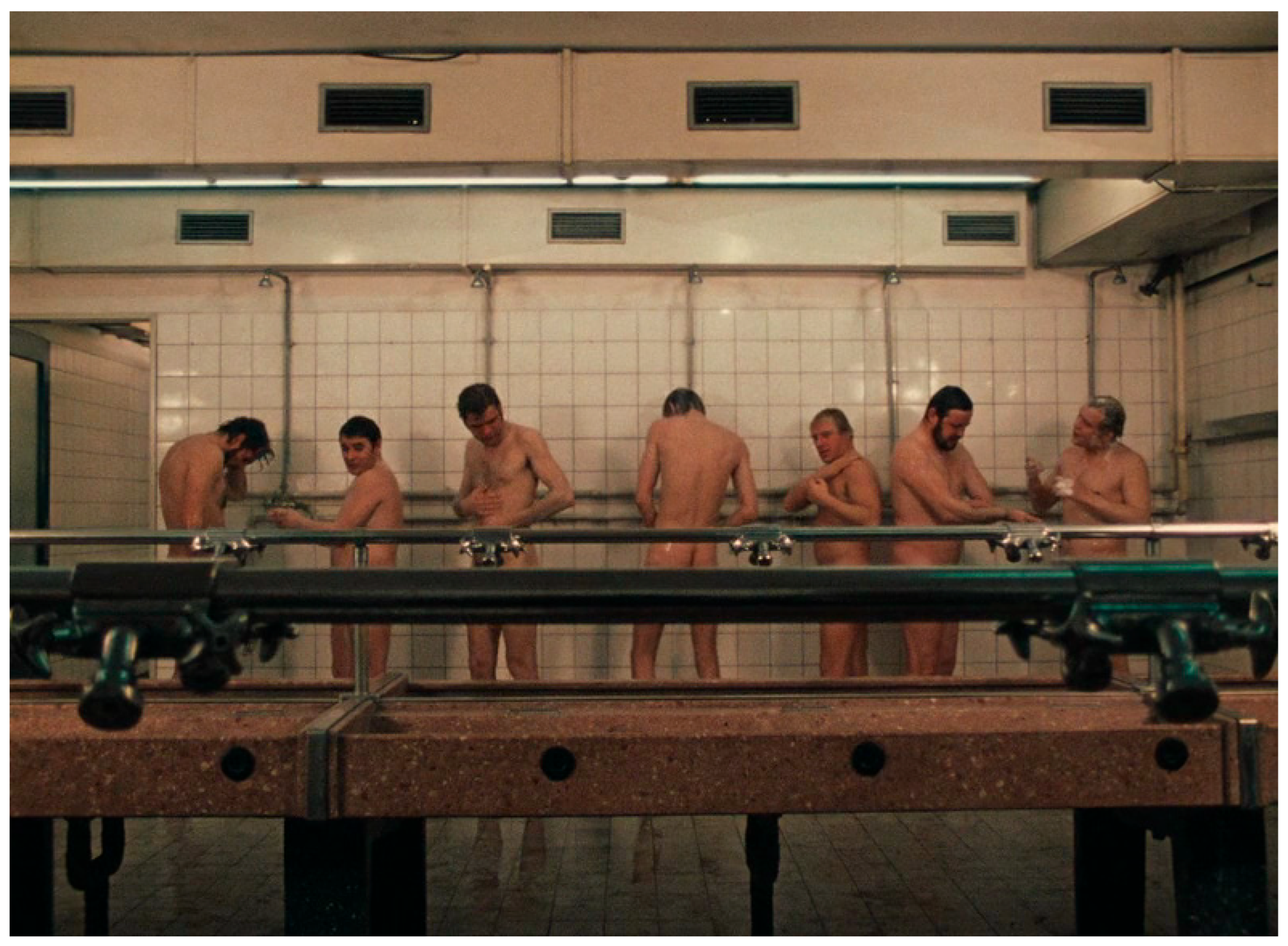
In Giuseppe’s character, one sees the unification of internationalist and gay tendencies within a burgeoning revolutionary consciousness. As this consciousness develops, it becomes more international, more polymorphous, more perverse. Again, given the restrictions of West German television, hints of this perversity are brief but clear. As mentioned above, they come in the form of scenes in which workers are placed in erotic, almost painterly groupings—scenes in which they shower together, wash one another, and discuss what is to be done. The framing of such scenes creates space for a new collectivity. The camera shows the workers standing in a row, their nudity barely hidden by a water pipe (
Figure 1). The viewer is placed in the position of another worker arriving in the shower room. The voyeurism of the scene is not sneaky or shameful. Rather, it invites the viewer into this sauna-like atmosphere to discuss labor politics.
As Mieli notes, in its “collective character”, the “‘system’ of homosexuality provides a belonging-together [
co-inereza] in which more and more people feel involved”. The homosexual revolutionary project is not individual, but collective. It faces “outward to involve the whole community” so that “homoeroticism spreads and is ‘contagious’” (
Mieli 1980, p. 108). The “contagion” of homosexuality as a pharmakon for the labor struggle—as a (re)education of desire—is a latent presence in scenes such as the one described above. Yet this beneficial contagion is not limited to male workers. It has many origins and vectors. It spreads from Oma and Gregor to Manfred and Monika, from Marion and Jochen to Marion’s colleague Irmgard and Jochen’s co-worker, Rolf. In this manner, Fassbinder is even able to tease out the radical potential of heterosexual relationships—the same way he is able to extract radical ideas from petit-bourgeois notions of honesty, fairness, and respect. These relationships do not remain bourgeois and monogamous for long. Marion, for instance, proposes moving into Jochen’s parents’ apartment with Rolf and Irmgard. Ostensibly, this proposition is intended to save money on rent; but implicitly it further undermines the stability of the nuclear family that began with Oma and Gregor’s free-spirited kindergarten. The “abolition of heterosexual primacy”, to quote Mieli, extends to new collectivities on the basis of already existing relations in the workplace and the rental market.
7. Abolish Work
In Eight Hours, liberated Eros points toward the abolition of work. Romantic scenes are interruptions of Taylorized time. When Marion and Jochen kiss, they stop traffic, forcing the state (in the form of a police officer) to intervene. When Irmgard talks about Rolf, she forces a client at the newspaper office to wait half an hour until she’s finished. Indeed, she and Marion do not even notice the client, who patiently listens to Irmgard’s lyrical descriptions. It is as if he too has entered into her utopian space. These spontaneous suspensions of time are not mere manifestations of inner subjectivity. They speak to a different temporality imprisoned by the workday.
A concrete politics of work refusal develops over the course of
Eight Hours, starting with romantic relationships and building toward a strike. These politics are not anarchic like those of Bob Black, who argued for “creating a new way of life based on play”, a “ludic revolution” (
Black 1985, p. 17). Rather, they are more militantly based in undermining the production process. As such, they resemble the politics of Mario Tronti. In his classic
Workers and Capital, Tronti argues that the left must avoid fetishizing work, of valuing it for its own sake as a noble expression of human dignity. Work is the form of capitalist exploitation. As wage-labor, it is the basis of capitalist production and the capitalist class: “the existence of a class of capitalists is based on the productive power of labour” (
Tronti 2019, p. 240). As such, labor is not the condition of itself, but rather the condition of capital. It is not the worker, but rather “the capitalist who creates work. The worker is the creator of capital. She in fact possesses a unique commodity that is the condition of all the other conditions of production” (
Tronti 2019, p. 241).
Capital, in other words, depends on labor, and not the other way around. In Jochen and Marion’s terms, work (or, more accurately, the form of industrial wage labor) is the tool necessary for the function of all the other tools—the abstract something and nothing that makes all the machinery run. It is for this reason that the worker’s movement should not seek to ameliorate its conditions by making demands via organizations such as trade unions. This is a trap that allows management to exploit “the workers’ antagonistic will-to-struggle as a motor for its own development” (
Tronti 2019, p. 239). Instead, the worker’s movement should organize around the refusal to work—that is, around the refusal to maintain the conditions of the capitalist system.
For Tronti, the strike is a classic example of such a refusal. “It is a way of saying ‘no’ to the offer of concrete labour at a particular point in the process, a momentary blockage of the labour process as a recurrent threat which cuts into the process of value creation” (
Tronti 2019, p. 241). Yet the strike is only the beginning. Crucially, for Tronti, this antagonistic will to refusal must find direct expression in the worker’s party. Without it, such a party cannot really claim to represent the interests of workers as such. Rather, such a party only represents workers’ interests within the conditions of the capitalist system. And ultimately, this amounts to representing the interests of capital itself.
To contemporary ears, the possibility of organizing an outright stoppage of work until capitalism is abolished may seem fanciful. However, at the time Tronti was writing in the 1960s, labor movements, especially those in Italy, commanded a far greater degree of power than they do today. Nevertheless, even under ideal conditions, organizing such refusal is easier said than done. It requires a redirecting of workers’ antagonistic energies. Eight Hours shows how this can develop organically on the shop floor. The series proceeds slowly from a desire to ameliorate the conditions of work, to the point of outright refusal, which is exactly when the network executives decide to pull the plug.
In episode one, for instance, the workers slow down production through sabotage—i.e., by “accidentally” making scrap of the firm’s would-be commodities. This is done in the interest of retrieving their bonuses, which had been cancelled after Jochen invented a time-saving production method. Here, we see an example of what Tronti describes: the workers’ antagonism to the boss is marshaled in the service of the boss’s goal of greater efficiency. It is only in breaking this bond that workers can set themselves on the path toward liberation.
This path takes the form of increased militancy. In episode three, the workers succeed in getting their own Franz Miltenberger promoted to foreman. They begin to develop a sense of autonomy. In episode five, this autonomy is challenged when the workers learn that the firm is planning to move to a cheaper location, thus upending their lives. In response, following Giuseppe’s suggestion, they demand the right to organize their own schedules, seemingly ripping this privilege away from the employer. Their new militancy allows them to make their quota ahead of schedule. But when, in accordance with the agreement, the employer takes half the profits from the time-saved, the workers—starting with Giuseppe and Marion—realize they’ve been tricked. Their antagonism has once again been turned against them, leading to reassessment.
As noted above, Eight Hours was cancelled before this process could reach the point of a strike. Nevertheless, the contours are clear. They take the form of Tronti’s theses on work refusal. The advantage of Fassbinder’s series is that it allows these theses to develop gradually through the logic of the workplace, the institution of the factory. This is the heart of Fassbinder’s Dutschke-inspired march through the institutions. One might call it a militant gradualism—an antagonistic position that develops through concrete situations in the workplace instead of borrowing its posture from a purely theoretical tract.