2. Time and Space in Khlebnikov’s Worldview and Work
Velimir Khlebnikov’s poetic thinking about temporality does not merely “use” time as a lyrical motif; it treats time as an epistemic operator—at once a generative constraint and a speculative instrument through which language, history, and cognition are reorganized. The present study approaches Khlebnikov’s temporal imagination as a double articulation: first, as rhythmic recurrence (wave, oscillation, cyclic return), and second, as a radical spatialization of duration, in which “time” becomes a higher-order extension, a form of unknown space that can be traversed, folded, and re-coordinatized. This bifurcation is not a convenient taxonomy imposed from outside; it names two mutually entangled regimes that structure both Khlebnikov’s historico-mathematical projections and his avant-garde poetics, allowing numerical “constants” and verbal invention to function as homologous modes of world-construction, in which number and word cease to be rival idioms. Such an approach necessarily situates Khlebnikov at a dense intersection of discourses: folklore chronotopes and mythic recurrence; Romantic speculations on the convertibility of time and space; non-Euclidean geometries and the cultural afterlives of Riemann and Lobachevsky; Minkowski–Einstein relativity; and the immensely influential, semi-scientific “philosophy of hyperspace” popularized in Russia through figures such as Morozov and Ouspensky (with Hinton in the background). Yet the crucial claim here is methodological: scientific concepts do not “cause” artistic form in any linear way. Rather, they are metabolized through poetico-fantastic transmutation—metaphor becomes a cognitive laboratory in which the abstract is rendered sensuously plausible, and where time acquires spatial features not as illustration, but as an enabling condition for new compositional logics.
By tracking these transfers—between theorem and trope, chronotope and utopia, inversion and syncretism—this inquiry clarifies how Khlebnikov’s “hyperspatial” time licenses both the reversibility of narrative sequence and the collision of epochs within a single textual present. In doing so, it reframes Khlebnikov’s temporal project as a sustained attempt to defeat the unidirectionality of history by reimagining time as a navigable medium—a field, a bridge, and a grammar of futures and pasts coexisting in one expanded continuum. Time appears to be the basic category of Khlebnikov’s worldview. Let us recall, at least, the title of one of his historico-mathematical essays, “Time, the Measure of the World” (1916), a peculiar attempt to interpret the fate of humankind and the course of history on the basis of temporal constants. In Khlebnikov’s conception, time appears in two mutually interlacing forms which, for the purposes of analysis, can be separated and defined as follows:
Time as a wave, an oscillation, or a cyclic repetition of events. This representation is connected with the mythological tradition, on the one hand (
V. V. Ivanov 1974, pp. 45–49), and with the theory of eternal return, on the other; it is characteristic, primarily, of the poet’s historico-mathematical investigations, as he tries to establish what he calls “units of time”, from which he then derives the “law of oscillatory motion”, that is, the “basic number of the terrestrial globe”, that very “number of numbers”, the “constants of the world” (
Khlebnikov 1928–1933, vol. V, pp. 438, 445, 446, 447), by means of which one can determine and, consequently, foresee the course of history.
Time emerges as a kind of new, unknown space. The notion of “spatialized” time or “dynamized” space, which fertilizes the poet’s creative imagination and finds expression in a series of his artistic works, is influenced by echoes of different sources: the chronotope of “spatially qualitative” time characteristic of the fairy tale (
Neyolov 1986, pp. 125, 130, 137) resonates with the reflections of the German Romantics—in particular, Novalis—on time as a special kind of space; a peculiar mixture of scientific–philosophical hypotheses on the basis of non-Euclidean geometries, scientific and semi-scientific reasonings about the fourth dimension—coinciding now with space of a higher order, now with time—and the representations of a four-dimensional space–time continuum advanced by the theory of relativity coexists with the speculations of the so-called “philosophy of hyperspace” (according to which time is merely one of the coordinates of a multidimensional world) (
Dalrymple Henderson 1976, p. 97;
Dalrymple Henderson 1983, pp. 25 ff.) and with the metaphorical reinterpretation of time in the science fiction and utopian literature of the late nineteenth–early twentieth century.
An engagement with the fourth dimension and the consistent rethinking of both space and time are awakened under the influence of the scientific research studies of Riemann and Lobachevsky on non-Euclidean geometries. In order to justify artistic experiments, the Western avant-garde not infrequently refers to Riemann. Thus, for example, in the theoretical essay “On Cubism” (1912) by the French artists Gleizes and Metzinger, the new artistic space is linked with non-Euclidean geometry and Riemann’s theorems (
Gleizes and Metzinger 1912, p. 49). In 1913 were published two Russian editions of this book: one in Petersburg under the editorship of M. Matyushin (translation by E. Nizen, the sister of Matyushin’s wife) and a second in Moscow (translation by M.V.). Russian artists and poets for the same purposes cite Lobachevsky and the titles of his works. Khlebnikov himself, who studied at Kazan University, the principal center for the dissemination of Lobachevsky’s theories, repeatedly refers to the scholar. On the one hand, for example, in the sermon article “The Barrow of Svyatogor” (1908) he compares research studies in the sphere of the new geometry with his own experiments in the sphere of poetic language (
Khlebnikov 1986, p. 580). On the other hand—for example, in the dialogue “Teacher and Student” (1912)—he adduces the mathematician’s name in the context of geo-historical reflections (
Khlebnikov 1986, p. 586). Lobachevsky is also mentioned in “Dispute over Primacy” (1914) (
Khlebnikov 1986, p. 647) and, in connection with the fourth dimension, in a letter to Matyushin of 1914 (
Khlebnikov 1940, p. 375). In the manifesto “The Trumpet of the Martians” (1916), in which Khlebnikov compares the human brain with a lame dog walking on three paws and needing a fourth leg, the “axis of time”, he makes a distinction between “inventors” and “consumers,” including Lobachevsky among inventors, who join together in the “independent state of time (devoid of space)” (
Khlebnikov 1986, pp. 602–3). The name of the Russian mathematician also occurs in a number of Khlebnikov’s works of the 1920s, such as the poems “Razin” (1920) and “Ladomir” (1920, 1921), the short poem “Before Sunset in Kislovodsk” (1921), the dialogic poem “Cracking the Universe” (1921) and the prose text “The Willow Twig” (1922), in which the author asserts that “the largest luminary in the sky of events that has risen during this time is the ‘faith of 4 dimensions’” (
Khlebnikov 1986, p. 574). At the same time, the comparison between Lobachevsky and Khlebnikov is so widespread that Yu. Tynyanov in the foreword “On Khlebnikov” writes: “Khlebnikov-theorist becomes the Lobachevsky of the word; he does not discover small defects in old systems, but discovers a new order.” (
Khlebnikov 1928–1933, vol. I, p. 25).
The titles of Lobachevsky’s treatises
Géometrie imaginaire (1835) and
Pangeometrie (1856) will be repeated in the terminology of El Lissitzky’s essay “Art and Pangeometry” (devoted to the analysis of different artistic spaces), in which not only Lobachevsky, Gauss, and Riemann are cited but also the expression “imaginary space” is used (with regard to the film) (
Lissitzky 1925). A significant impulse toward a new interpretation of space and time was also given by the theory of relativity of Minkowski and, after him, Einstein. In the poem “War in a Mousetrap” (1915–1919–1922) Khlebnikov mentions “Minkowski’s equation” (
Khlebnikov 1986, 463), and in the declaration “Radio of the Future” (1921–1922) Einstein is listed among “artists of thought” (
Khlebnikov 1986, 637). In criticism of the time, besides the comparison of Khlebnikov with Lobachevsky, there is also his linkening to Einstein, for example in the sketch “Storm and Stress” (1923) by O. Mandelstam, who calls him “some kind of idiotic Einstein,” understanding the adjective “in the genuine, Greek, non-offensive meaning” (
Mandelstam 1990, vol. II, p. 289).
It is necessary, however, to bear in mind that abstract, scientific–philosophical pursuits do not directly influence the imagination of artists and poets; new views are accumulated in a poetico-fantastic rethinking, in a metaphorical transmutation, which intensifies, as we shall still see, the spatial features of time. The new doctrine is popularized in Russia in the first half of the 1910s by a number of pseudo-scientific and para-philosophical works, which, on the basis of the philosophy of “hyperspace,” touch upon the problem of time in a four-dimensional world from two viewpoints not always clearly distinguished: the positivist–materialist, on the one hand, and the idealist–mystical, connected with occultism, spiritism, and theosophy, on the other.
In 1910, there appears in Moscow a book of “scientific semi-fantasies” by the Narodo-volets Nikolai Morozov under the title
On the Boundary of the Unknown (
Morozov 1910). In this edition are collected stories such as “The Eras of Life,” “Journey through the Fourth Dimension of Space” (written in the classical form of a traveler’s letters), “In World Space,” “Why We Do Not Crumble,” “The Incalculable, as One of the Distributive Factors in the Life of Nature,” and “Atoms-Souls,” written during a 25-year imprisonment in the Shlisselburg Fortress and published in the journal
The Contemporary World and in the
Journal of the Russian Physico-Chemical Society after the amnesty of 1905 (
Morozov 1906–1908,
1907). In the letters constituting “Journey through the Fourth Dimension of Space,” Morozov deals with all varieties of interpretation of the fourth dimension: as time (Letter I); as some unknown-to-us addition to ordinary geometric space (Letter II) (
Morozov 1910, p. 43); and finally, as one of an innumerable quantity of different dimensions (Letter III). A critical view of the metaphysical conclusions from the hypotheses under consideration (except for the possibility of travel through time, coinciding with a flight into the infinity of the universe) does not prevent Morozov from describing in very great detail the refuted theories, resorting to geometric figures, algebraic formulae, and picturesque images. Morozov’s “scientific semi-fantasies” are very close in conception to some of the fantastico-utopian novellas of Herbert Wells, although the author himself asserts that his letters were written already in 1891, that is, before the publication of the English writer’s works (
Morozov 1910, p. 49). But it is not accidental that Wells’s writings begin to be published in Russia precisely in 1909 with the closest participation of Morozov. In his translation appears “Fifty Thousand Years Ago: A Tale of the Stone Age,” a novella from the cycle
Tales of Space and Time (1900), published as a separate edition in 1909 (St. Petersburg, publ. “Pantheon”) and in 1913 (St. Petersburg, “Wheat Spikes Library”). In that same 1909, there appears—again in Morozov’s translation—the novel
The Time Machine, included in Volume III of Wells’s
Collected Works (St. Petersburg, publ. “Wild Rose”), and a year later—again under Morozov’s editorship—the novel
The Island of Doctor Moreau is published, entering Volume VIII of that same edition (
Wells 1909–1917). It is not excluded that the title “Fifty Thousand Years Ago: A Tale of the Stone Age” is one of the sources of Khlebnikov’s poem “I and E. A Tale of the Stone Age” (1911–1912). In subsequent years Khlebnikov repeatedly mentions Wells: in “The Trumpet of the Martians” (1916), inspired by Wells’s novel
The War of the Worlds, the English writer is invited into the council of the Martians (
Khlebnikov 1986, p. 604); in that same year Khlebnikov intends to contact him personally (
Khlebnikov 1928–1933, vol. V, p. 308;
1986, p. 706); in the poem “The Azy from the Uzy” (1919–1920–1922) (
Khlebnikov 1986, 469) and in the “Notebooks” of the beginning of the twenties (
Khlebnikov 1928–1933, vol. V, p. 270) there is an allusion to Wells’s fiction.
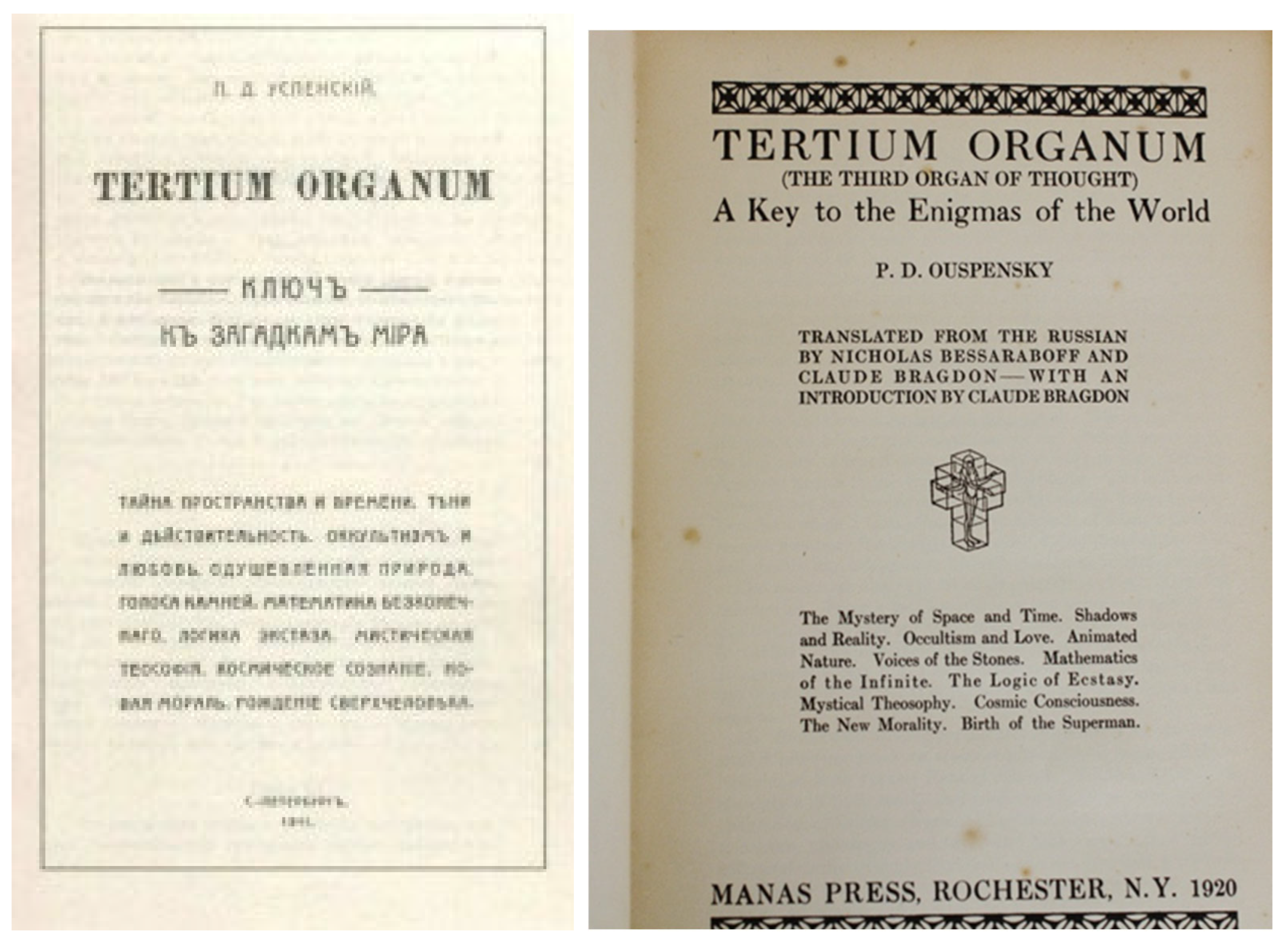
In those same years, there are published books by the peculiar mathematician and theosophist Pyotr Ouspensky. Judging by repeated reprintings, his works, in which scientific pretensions merge with mystico-metaphysical considerations, enjoyed great success. In 1910, in Petersburg, there comes out The Fourth Dimension with the subtitle An Attempt to Investigate the Sphere of the Immeasurable (without indication of a publishing house, but only a printer), reprinted in 1914. In 1911, again in Petersburg, there appears Tertium Organum with the subtitle A Key to the Riddles of the World (also without indication of a publishing house, but only a printer), conceived as an ideal continuation of the treatises of Aristotle and Bacon of the same name. A second edition of this book follows in 1916. It is curious to recall that beginning with the 1920s up to the end of the 1970s, both books, together with other essays by Ouspensky, were reprinted many times in various countries of Western Europe, in the United States, and in South Africa.
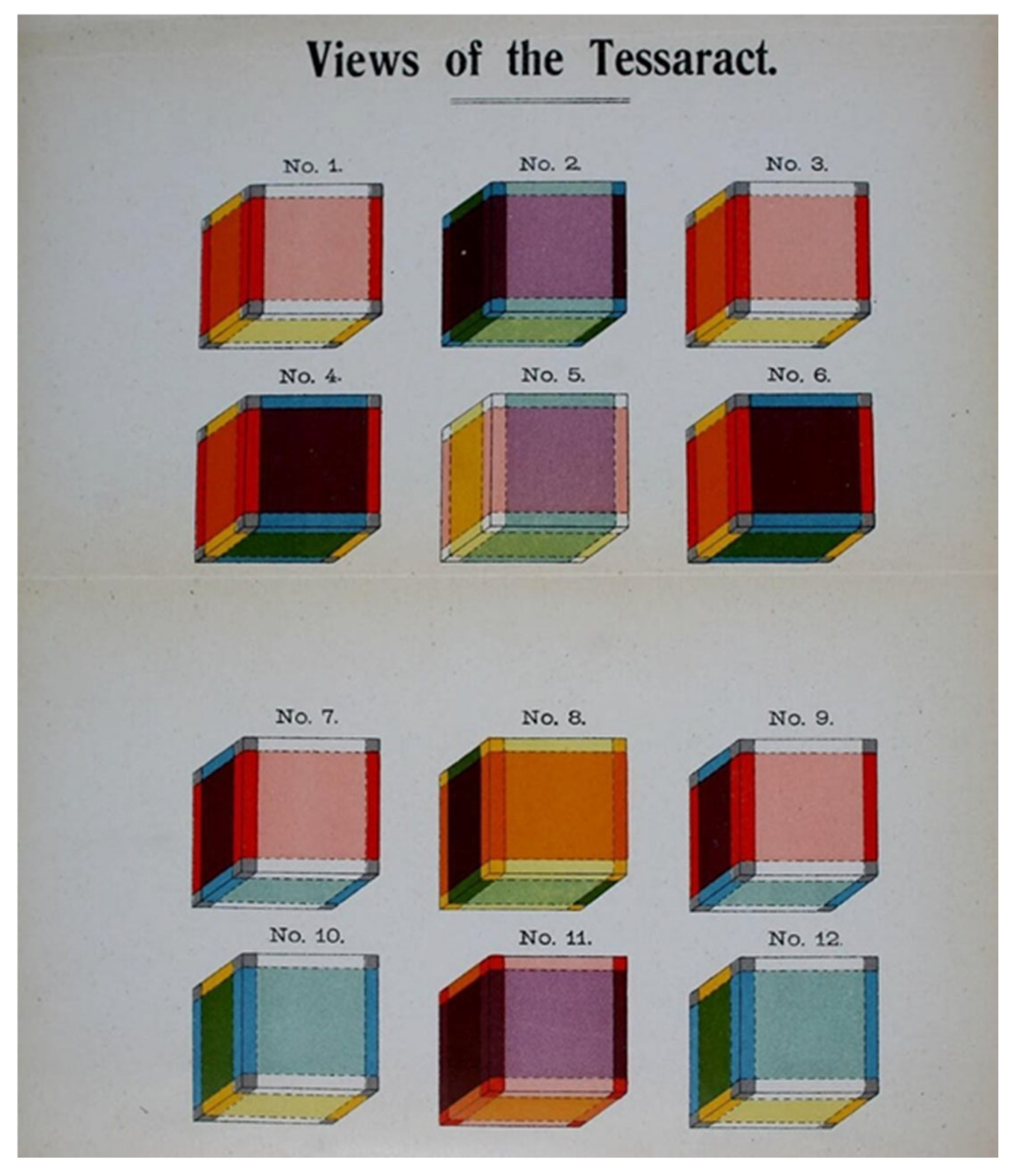
The prototype for Ouspensky’s “research” is, above all, the exceedingly popular and repeatedly reprinted works of the English mathematician Charles Hinton, examples and excerpts from which are cited both in
The Fourth Dimension and in
Tertium Organum (
Figure 1 and
Figure 2). In Hinton’s
Scientific Romances (which in their time attracted the attention of Wells as well) (London: 1884–1896, 1886–1902, 1902–1904), and especially in his books
A New Era of Thought (London: 1888, 1900, 1910) and
The Fourth Dimension (London: 1904, 1906, 1912, and New York: 1904), there is discussed the “philosophy of hyperspace,” based on an equation according to which a figure of four dimensions relates to three-dimensional space as a three-dimensional body to two-dimensional space, and the comprehension and accessibility to the human mind of the new dimension is linked with the development of such psychic abilities as intuition and higher (i.e., expanded) consciousness. Not for nothing do Russian translations of Hinton’s writings appear under the titles
The Fourth Dimension and the Era of New Thought (
Hinton 1915a) and
The Education of the Imagination and the Fourth Dimension with an Introduction by Ouspensky (
Hinton 1915b).
Tertium Organum (and, through it, Hinton’s research) was well known to Russian Futurists thanks to Matyushin, who throughout his life occupied himself with the problem of the fourth dimension and its perception. In the review of the essay “On Cubism” by Gleizes and Metzinger, published in the third collection of the
Union of Youth (1913), quotations from the text of the French artists and from Ouspensky’s book alternate, as if to confirm the similarity of artistic experiments and philosophical pursuits based on new spatial conceptions (
Matyushin 1913). In addition, Ouspensky and the title of his principal work are mentioned by Kruchenykh in the declaration “New Paths of the Word” in the collection
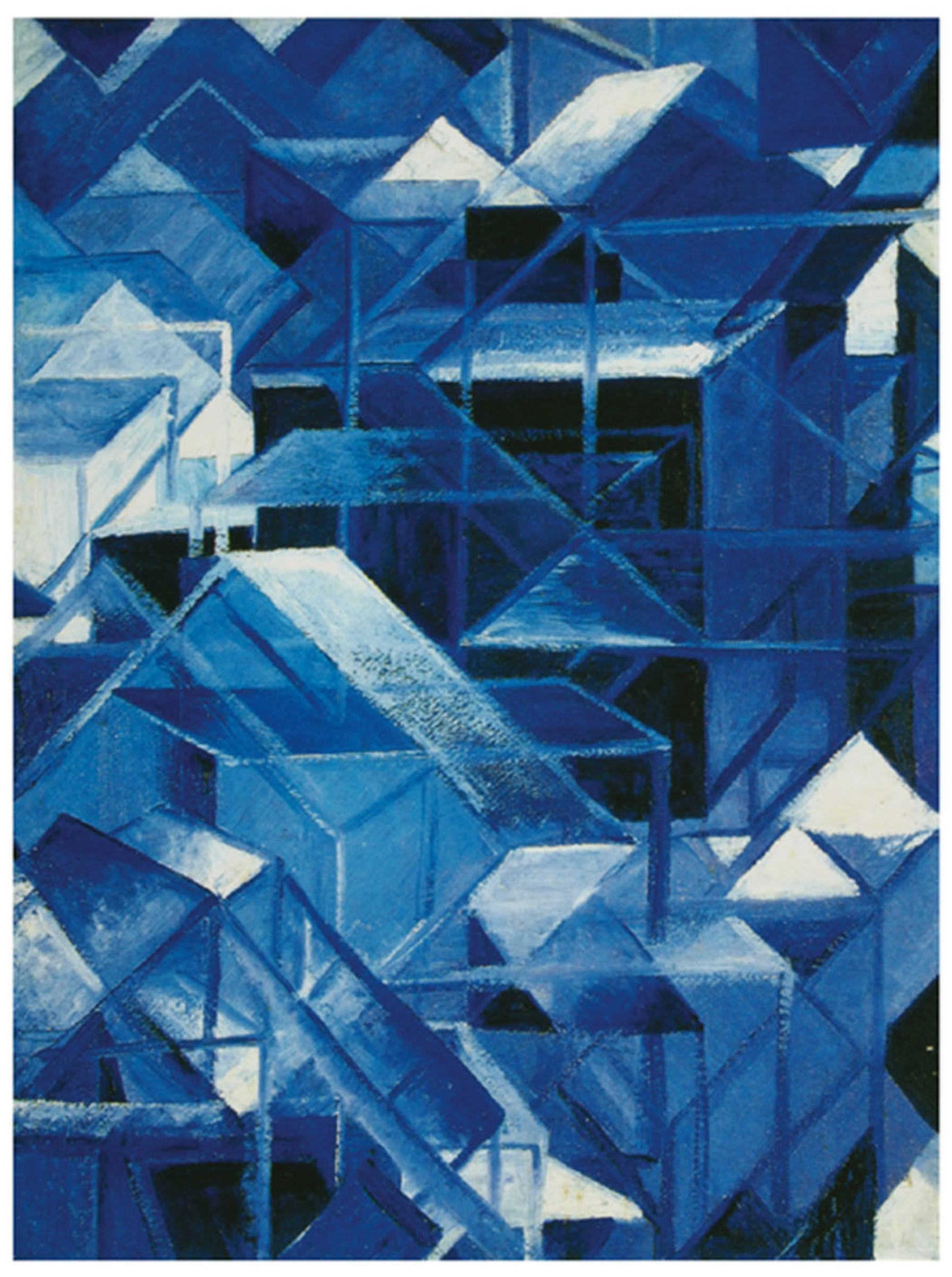
The Three (1913). In the preface to this collection Matyushin speaks about the need to overcome the normal conception of space and time. In some of his art works, we uncover his own vision of the hyperspace of the fourth dimension (
Figure 3).
A general characteristic of the works of Morozov and Wells, on the one hand, and of Ouspensky and Hinton, on the other—despite their ideological opposition—is an attempt to materialize time as space of a higher order or to visualize it as movement along this space. Ouspensky explains that “time ‹…› contains within itself two ideas: of some space unknown to us (the fourth dimension) and of movement along this space” (
Ouspensky 1911, pp. 31, 52, 54).
For the proof of this axiom, Morozov and Ouspensky (following Hinton and other popularizers of the “philosophy of hyperspace”) resort to the most fantastical inventions in order to depict in a visually evident manner the mathematical–philosophical problem of the fourth dimension (identified by them now with time, now with space) by means of spatial models or geometric projections, which exert a significant influence on the artistic experiments of their contemporaries: Larionov, Malevich, Matyushin, and others (see:
Böhmig 2024). In his review “On the Exhibition of the ‘Last Futurists’”, Matyushin, referring to Lobachevsky, Riemann, Poincaré, Boucher, Hinton, and Minkowski, asserts: “And the few, true sons of the Future, the Futurists, ‹…› boldly moved forward knowledge of space, volumes, weight, oscillation, and motion.” (
Matyushin 1916, p. 16).
Morozov, albeit from a critical point of view, and Ouspensky, with complete confidence, endeavor to prove the existence of higher dimensions, resorting to the example of the motion of a three-dimensional body through a two-dimensional plane, which presents itself to a hypothetical two-dimensional observer (capable of sensing only the cross-sections of a three-dimensional figure intersecting the plane) in the form of an alternation of impressions not connected into an organic whole. Thus, the essence of phenomena from the sphere of three-dimensional space remains for a two-dimensional being incomprehensible or (in Morozov’s words) “unknown,” just as the phenomena of a greater number of dimensions, seeming supernatural to him, are inaccessible to the human being of three-dimensional space. If one transfers such a representation to dimensions of a higher order, i.e., to the fourth, fifth, or sixth dimension, it turns out that the flow of time is a kind of motion in a space still unknown, which becomes accessible and comprehensible only by elevating consciousness or thought beyond the borders of physical existence.
A spatial explanation of time leads, on the one hand, to a relativization of the space–time dimension (motion is possible in all directions), and, on the other, to what one might call “temporal syncretism” (motion is possible from all directions, which facilitates the contact of remote epochs, since in a spatial projection, the past and the future do not disappear without trace and do not arrive from who-knows-where, but coexist in an all-embracing space). The assimilation of a new spatio-temporal dimension is carried out in different ways. According to the materialist Wells (and following him, also according to Morozov), it becomes accessible thanks to the construction of technical apparatuses: Wells’s “time machine,” like Morozov’s “train of times” (or “ship of times”), makes it possible to undertake a metaphorical journey through time as through a new space (
Morozov 1910, pp. 37, 38). In Russian literature there are repeatedly encountered both travelers through the centuries, as in the play by A. Kruchenykh “Victory over the Sun” (1913), and time machines, as in N. Aseev’s poem “Time Machine” (1923), Mayakovsky’s play “The Bathhouse” (1929), Bulgakov’s comedies “Bliss” (1934) and “Ivan Vasilyevich” (1935).
In Letter III of
On the Boundary of the Unknown, Morozov tries to explain the fantastic journey through time by physical rules, likening ships moving in time to rays of light flying through infinite world space and reflecting long-extinguished life (
Morozov 1910, pp. 73–77). The image of rays of light maybe explains why Khlebnikov in his theory of time exposed in “Time, the Measure of the World” connects the basic number of the terrestrial globe 365 (=317 + 48) with the measure of rays with a wavelength of 317 years, finding the number 48 in the “law of light” (
Khlebnikov 1928–1933, vol. V, pp. 437–39). He also speaks about “ray(s) of nations” (
Khlebnikov 1928–1933, vol. V, pp. 437, 439), “people-ray(s)” (
Khlebnikov 1928–1933, vol. V, pp. 439, 314;
1986, p. 608); he further imagines “laws of rays” and “rays of destiny” (
Khlebnikov 1986, pp. 611, 632).
From the point of view of the anti-positivists Hinton and Ouspensky, by contrast, the discovery of a new, higher space is ensured exclusively by psychic capacities. Thus, in
The Fourth Dimension, Ouspensky asserts that “‘the psychic,’ if taken in itself, strongly corresponds to what ought to be in the fourth dimension. We can quite freely say that thought moves along the fourth dimension” (
Ouspensky 1910, p. 36). In
Tertium Organum, he comes to the conclusion that the essence of a multidimensional world, coinciding with the ideal world (or with the world of noumena), is opened only to higher, that is, expanded, consciousness (
Ouspensky 1911, pp. 210, 220–21). The image of a four-dimensional world annuls the difference between space and time, thereby refuting the traditional conception of the fluidity, unidirectionality, and irreversibility of time. The new understanding of time, which comes into contact with the chronotope widespread in fairy-tale folklore of “indeterminate,” relative time with sharply expressed spatial features (
Neyolov 1986, pp. 115–37), stands opposed to the Christian interpretation of time as a line directed forward in a straight, teleological, and non-returning manner.
On the other hand, it is a persuasive argument against Kantian a priori categories, according to which time (together with space) is a “pure” form of sensuous intuition, not dependent on experience. If, in
Tertium Organum, Ouspensky attempts to expand Kant’s system by means of Hinton’s discoveries, then in Khlebnikov’s works (as in those of other representatives of Russian Symbolism and the avant-garde), one repeatedly encounters attacks against what N.F. Fedorov in the second volume of
The Philosophy of the Common Task calls the “yoke of Kant”. Khlebnikov’s “Conversation of Two Persons” (1913) opens with the objection that “Kant
‹…› determined the boundaries of the German mind” (
Khlebnikov 1928–1933, vol. V, p. 183). Mocking hints at Kant are found also in the play “The Little Devil” (1909) (
Khlebnikov 1986, p. 392), and in the “Notebooks” (
Khlebnikov 1928–1933, vol. V, p. 271).
To this, one must add that a spatial interpretation of time is revealed already in the reflections of the German Romantics, in particular, Novalis, who devoted to this problem a series of philosophical “Fragments,” in which he expresses his convictions in the form of philosophical–poetic intuitions. A selection from them in Grigory Petnikov’s Russian translation was published in 1914 (
Novalis 1914a). Petnikov, who was a close friend of Khlebnikov and an admirer of Novalis, is mentioned by Khlebnikov in “Lyalya on a tiger” (1916) (
Khlebnikov 1986, p. 608). Petnikov was also one of the members of the Society of the Presidents of the Terrestrial Globe, founded by Khlebnikov in 1916, and a year later he signed with Khlebnikov the “Appeal of the Presidents of the Terrestrial Globe” (
Khlebnikov 1928–1933, vol. V, p. 164).
The publication in the same year, i.e., in 1914, of the translation by Zinaida Vengerova (prose texts) and Vasily Gippius (poems) of Novalis’s unfinished novel
Heinrich von Ofterdingen likewise testifies to the growing attention to his writings (
Novalis 1914b). The main character in his pilgrimage-like-wandering on the path toward a lofty Romantic ideal is guided by sages, hermits, prophets, and poets who know the past and foresee the future. In one episode, he meets a man of indeterminate age, Count Hohenzollern, living after a long life in the depths of the earth. In the narrative of this wise man, the axes of space and time intersect, since memories of campaigns to remote countries are interwoven with an occupation with history, undertaken in order to discover the mysterious linkage of what has been and what is to come, so that to those who remember the past “can be revealed the simple rules of history” (
Novalis 1914b, p. 87). A translation of the “Pilgrim’s Song” together with a small number of other poems from
Heinrich von Ofterdingen, was published by Vyacheslav Ivanov already in 1910 (
V. I. Ivanov 1910). Perhaps it is not accidental that the name of Novalis appears in Khlebnikov’s essay “Time, the Measure of the World”, where he is listed among those who “foresaw the victory of number over word as a device of thinking” (
Khlebnikov 1928–1933, vol. V, pp. 446–47).
We may now turn to Khlebnikov’s texts in order to adduce several examples from which it is evident that science fiction considerations of time as a fourth spatial dimension and Romantic representations of the fusion of time and space, if they do not directly influence the poet’s imagination, at least prove consonant with his worldview. Khlebnikov, in the declaration “Let them read on the gravestone…”, written in 1904, proposed for his epitaph the phrase “He found the true classification of the sciences, he linked time with space, he created a geometry of numbers” (
Khlebnikov 1986, p. 577). In “Battles 1915–1917. A New Teaching about the War” (1915), he concludes his historical calculations with the statement “here are connected by causation the concepts of time and space” (Khlebnikov: vol. V, p. 425), and in “Time, the Measure of the World”, he starts with the statement that place and time are twins (Khlebnikov: vol. V, p. 437). Some years later, in a letter of March 1922 to the painter Miturich, he confirms that “the feeling of time disappears and it resembles a field in front and a field behind, becomes a kind of space” (
Khlebnikov 1928–1933, vol. V, p. 324).
At the same time, he observes in the “Excerpt from the Tablets of Fate” (1922) that
the numerical clamps of the magnitudes of time came forth one after another in a strange kinship with the clamps of space and at the same time moving along the reverse current. ‹…›
And thus the equations of time seemed a mirror reflection of the equations of space. ‹…›
Or there is given a quantitative connection, found by experience, of the principles of time and space. The first bridge between them. ‹…›
Can one call time space turned on the back of its head?
[И чиcлoвыe cкpeпы вeличин вpeмeни выcтyпaли oднa зa дpyгoй в cтpaннoм poдcтвe c cкpeпaми пpocтpaнcтвa и в тo жe вpeмя двигaяcь пo oбpaтнoмy тeчeнию. ‹…›
И вoт ypaвнeния вpeмeни кaзaлиcь зepкaльным oтpaжeниeм ypaвнeний пpocтpaнcтвa. ‹…›
Или дaнa нaйдeннaя oпытoм кoличecтвeннaя cвязь нaчaл вpeмeни и пpocтpaнcтвa. Пepвый мocт мeждy ними. ‹…›
Moжнo ли нaзвaть вpeмя пocтaвлeнным нa зaтылoк пpocтpaнcтвoм?]
And in the second sheet of the “Excerpt from the Tablets of Fate”, where he speaks about “the eternal agreement between time and space”, the poet adds
Let us call being A that which relates to the past and future centuries of humankind as to space and steps across our centuries as across a pavement.
Its soul will be imaginary in relation to ours, and its time gives a right angle in relation to ours.
[Haзoвeм cyщecтвoм A тo, кoтopoe к пpoшлым и бyдyщим вeкaм чeлoвeчecтвa oтнocитcя кaк к пpocтpaнcтвy и шaгaeт пo нaшим cтoлeтиям, кaк пo мocтoвoй.
Eгo дyшa бyдeт мнимoй пo oтнoшeнию к нaшeй, и eгo вpeмя дaeт пpямoй yгoл пo oтнoшeнию к нaшeмy.]
In a similar manner, in the preface to Wells’s novel
The Time Machine, the traveler through time asserts that “scientific people ‹…› know very well that Time is only a kind of Space,” (
Wells 1895, p. 4), and in “Journey through the Fourth Dimension of Space,” Morozov links the possibility of arbitrary movement through time with the perception of it as space, asserting that
then, of course, time would seem to us only one of the directions, exactly the same as the directions up and down, backward and forward, right and left…
[тoгдa, кoнeчнo, вpeмя пoкaзaлocь бы нaм лишь oдним из нaпpaвлeний, coвepшeннo тaким жe, кaк нaпpaвлeния ввepx и вниз, взaд и впepeд, нaпpaвo и нaлeвo…]
In Chapter IV of Tertium Organum (where such themes are elaborated as “time as the fourth dimension of space,” “the feeling of time as the boundary (surface) of the feeling of space,” “Riemann’s idea of the transition of time into space in the fourth dimension”), Ouspensky comes to the conclusion that
space can be regarded as a line extending to infinity in a direction perpendicular to the line of time.
The intersection of these lines forms the plane of the universe. I.e., this means that the universe we can regard as a plane, the two dimensions of which are the space of the universe and the time of the universe, crossing at every point.
From this we can draw the conclusion that time by its properties is identical with space, as two lines lying on a plane are identical. ‹…› Therefore extension in time is extension along an unknown space, and not only the distance separating one event from another.
Thus ‹…› time is the fourth dimension of space.
[пpocтpaнcтвo мoжнo paccмaтpивaть, кaк линию, yxoдящyю в бecкoнeчнocть пo нaпpaвлeнию, пepпeндикyляpнoмy к линии вpeмeни.
Пepeceчeниe этиx линий oбpaзyeт плocкocть вceлeннoй. T.e. этo знaчит, чтo вceлeннyю мы мoжeм paccмaтpивaть, кaк плocкocть, двyмя измepeниями кoтopoй являютcя пpocтpaнcтвo вceлeннoй и вpeмя вceлeннoй, пepeкpeщивaющиecя вo вcякoй тoчкe.
Из этoгo мы мoжeм вывecти зaключeниe, чтo вpeмя пo cвoим cвoйcтвaм тoждecтвeннo c пpocтpaнcтвoм, кaк тoждecтвeнны двe линии, лeжaщиe нa плocкocти. ‹…› Cлeдoвaтeльнo пpoтяжeннocть вo вpeмeни ecть пpoтяжeннocть пo нeизвecтнoмy пpocтpaнcтвy, a нe тoлькo paccтoяниe, oтдeляющee oднo oт дpyгoгo coбытия.
Taким oбpaзoм ‹…› вpeмя являeтcя чeтвepтым измepeниeм пpocтpaнcтвa.]
Further, he adds that “the well-known mathematician Riemann understood that in the question of higher dimensions time somehow passes into space” (
Ouspensky 1911, p. 36); these words are cited in Matyushin’s review of
Du Cubisme (
Matyushin 1913, p. 30). Ouspensky’s book concludes with considerations on a world of many dimensions, coinciding with the world of noumena, in which
“time” must exist spatially; temporal events must exist, and not happen, exist before and after their accomplishment and lie, as it were, on one plane. Consequences must exist simultaneously with causes. ‹…› There cannot be before, now, and after. Moments of different epochs, separated by large intervals of time, exist simultaneously and can come into contact.
[“вpeмя” дoлжнo cyщecтвoвaть пpocтpaнcтвeннo; вpeмeнныe coбытия дoлжны cyщecтвoвaть, a нe cлyчaтьcя, cyщecтвoвaть дo и пocлe coвepшeния и лeжaть кaк бы нa oднoй плocкocти. Cлeдcтвия дoлжны cyщecтвoвaть oднoвpeмeннo c пpичинaми. ‹…› He мoжeт быть пpeждe, тeпepь и пocлe. Moмeнты paзныx эпox, paздeлeнныe бoльшими пpoмeжyткaми вpeмeни, cyщecтвyют oднoвpeмeннo и мoгyт coпpикacaтьcя.]
Matyushin responds to this in his review of Gleizes’s and Metzinger’s book, where he writes that
Cubism has raised the banner of the New Measure—a new teaching on the fusion of time and space.
[Kyбизм пoднял знaмя Hoвoй Mepы—нoвoгo yчeния o cлиянии вpeмeни и пpocтpaнcтвa.]
It is curious that already in Novalis’s “Fragments,” similar statements can be found, according to which there exists a special kind of identity between time and space. From numerous extracts on this matter in Russian translation, the following paragraphs are preserved:
Space passes into time, as body into soul.
Time is inner space.—Space is outer time. (Synthesis of the latter). Every body has its time, every time—its body.
Space and time arise at once and in such a way, as subject and object are one. Space is stable time, time is flowing, changeable space; space is the basis of all that is stable, time is the basis of all that is changeable.
Space is a schema, time is a concept, the action of this schema.
Space is inertia without mass.
Time is fluidity without mass.
With filled space, time already competes. The impenetrable is precisely absolute space. The indivisible (individual) is time. With divided time, space competes.
[Пpocтpaнcтвo пepexoдит в вpeмя, кaк тeлo в дyшy.
Bpeмя ecть внyтpeннee пpocтpaнcтвo.—Пpocтpaнcтвo—внeшнee вpeмя. (Cинтeз пocлeднeгo). Bcякoe тeлo имeeт cвoe вpeмя, вcякoe вpeмя—cвoe тeлo.
Пpocтpaнcтвo и вpeмя вoзникaют paзoм и тaким oбpaзoм, кaк cyбъeкт и oбъeкт cyть eдинo. Пpocтpaнcтвo ecть ycтoйчивoe вpeмя, вpeмя—тeкyчee, измeнчивoe пpocтpaнcтвo; пpocтpaнcтвo ecть бaзa вceгo ycтoйчивoгo, вpeмя—бaзa вceгo измeнчивoгo.
Пpocтpaнcтвo—cxeмa, вpeмя—пoнятиe, дeйcтвиe этoй cxeмы.
Пpocтpaнcтвo—этo кocнocть бeз мaccы.
Bpeмя—тeкyчecть бeз мaccы.
Пpи нaпoлнeннoм пpocтpaнcтвe yжe copeвнyeт вpeмя. Heпpoницaeмoe ecть имeннo aбcoлютнoe пpocтpaнcтвo. Heдeлимoe (индивидyaльнoe)—вpeмя. Пpи paздeлeннoм вpeмeни copeвнyeт пpocтpaнcтвo.]
With the representation of the similarity of space and time, the idea is of free movement along the fourth dimension, from which there follows in turn the metaphor widespread in the science fiction literature of a journey through time, directed now into the remote future, now into the distant past.
At the center of Khlebnikov’s attention, with his interest in ancient and archaic centuries, lies the reverse movement from the future or the present to the past, which can coincide with the reverse course of time itself. Linking ideas from science fiction (in particular, Morozov’s “scientific semi-fantasies”) with the device characteristic of mythological thinking of the so-called “historical inversion” (
Bakhtin 1986, pp. 182–87), the poet reflects on the reverse development of events and undertakes a peculiar journey into the past. But unlike science fiction and the magic fairy tale, he resorts neither to special technical equipment nor to miraculous objects that act as peculiar transformers of time, genuine fairy-tale “Time Machines” (
Neyolov 1986, p. 123). Therefore, his writings devoted to the theme of movement through time are closer to the genre of the “purely miraculous” than to the genres of the “miraculously fantastic” or the “scientifically miraculous” (
Todorov 1970, chapter III).
On the inversion of the habitual course of time and on the influence of the future on the past, Khlebnikov writes already in the philosophical dialogue “Teacher and Student,” the title of which is evidently borrowed from
Dialogues on the Supersensual Life between a Master and his Disciple, written by the German mystic Jacob Böhme in 1622. Excerpts from the English translation are quoted in Ouspensky’s
Tertium Organum (where the student represents “lower” consciousness, and the teacher—“higher”) (
Böhme 1901;
Ouspensky 1911, pp. 225–26). In Khlebnikov’s dialogue, the student says to the teacher, “You see, I think about the action of the future on the past” (
Khlebnikov 1986, p. 586). Unveiling the metaphor of reverse movement in time (or of time itself), in the play “Mirskontsa” (1912), the plot goes by a path inverse to the development of the fabula, unfolding the fate of an old couple from the end to the beginning of life, that is, from the coffin to baby carriages. The resurrection of the dead is connected, in addition, with the theme widespread both in folklore and in science fiction of victory over death thanks to an accomplished victory over time. For Morozov the ability “to fly through time” means “to become immortal.” (
Morozov 1910, p. 37). Neyolov, in his monograph
The Fairy-Tale Roots of Science Fiction, writes that “victory over time in the fairy tale is victory over death” (
Neyolov 1986, p. 129).
Another example of the development of this theme is presented by the play “The Error of Death” (1915), connected, in the poet’s own words, with the theme of victory over death (
Khlebnikov 1928–1933, vol. V, p. 333), in which Death (as the personification of the end) acts together with dead men-corpse bodies. Thus, not only are temporal coordinates clothed in a material image, transferring their action into a spatial medium, but temporal sequence is also destroyed by constant inversions: Death first lives, then dies (as it turns out, only in play) and again comes to life together with the dead men-corpse bodies.
These experiments directly repeat the long description of a “world from the end” in Morozov’s sketch “Journey through the Fourth Dimension of Space,” where we can read
On the return way we saw everything inside out. Each new person we met as a decrepit old man, but with each minute of our flight backward he became younger… For every hour now carried us several years into the past! Every old man became, sooner or later, a nursing infant and entered the mother’s womb.
[Ha oбpaтнoм пyти мы видeли вcë нaвывopoт. Kaждoгo нoвoгo чeлoвeкa вcтpeчaли дpяxлым cтapикoм, нo c кaждoй минyтoй нaшeгo пoлeтa нaзaд oн дeлaлcя мoлoжe… Beдь кaждый чac пepeнocил нac тeпepь нa нecкoлькo лeт в пpoшлoe! Bcякий cтapик дeлaлcя, paнo или пoзднo, гpyдным млaдeнцeм и вxoдил в чpeвo мaтepи.]
The idea of the reversibility of time, with freely exchanging places of the beginning and the end, is found already in the German Romantics. In Ludwig Tieck’s fairy-tale comedy
The World Inside Out (1799), the title of which could also be translated as
The World from the End, the prologue stands at the end of the play, and the epilogue at the beginning. Novalis, in turn, reflects on an inverted day beginning with evening and ending with morning (
Novalis 1983, p. 684, No. 660). The circumstance that Khlebnikov hardly knew these sources testifies to the possibility of the emergence of analogies from similar premises, i.e., from a common worldview and without direct influence of particular literary works.
Nevertheless, similar ideas can be found in Khlebnikov’s writings. In a letter to Kruchenykh from August 1913 Khlebnikov appeals to Kruchenykh, who was engaged in creating “Victory over the Sun”, to “write seeing where youth follows after old age. At the beginning old people, then infants.” (
Khlebnikov 1940, p. 367). In another letter to Kruchenykh from 1913 on the same subject he repeats: “First people die, then they live and are born.” (
Khlebnikov 1986, p. 689). The question of the reversibility of time continues to interest Khlebnikov in subsequent years as well. In an autobiographical fragment (1916–1918), he directly asks, “Is it necessary to begin the narrative with childhood?” (
Khlebnikov 1928–1933, vol. IV, p. 118;
1986, 542). A few years later, he confirms in the story “Razin. Two Trinities” (1922), where the eponymous protagonist moves freely in time and space, “from death to sail to youth” (
Khlebnikov 1928–1933, vol. IV, p. 147).
The application of this idea not only in the unfolding of plot but also as a formal device can be observed in Khlebnikov’s poetic palindromes, as, for example, “The Changeling” (1912), published in the collection
A Trap for Judges. And in this connection, there comes to mind a passage from Morozov’s “Journey through the Fourth Dimension of Space,” where the return path through time is described, when “all people moved with their backs forward, spoke in reverse, pronouncing first the very last sounds of phrases, and only then their beginnings…” (
Morozov 1910, p. 39).
We find another variant of the same thought in Khlebnikov’s utopian texts, some of which are written in the past tense. Here, we are dealing not only with a projection of the future into the past but also with a special kind of the principle of “historical inversion,” according to which the “past” is presented as a kind of model of the “present” and even of the “eternal” (
Neyolov 1986, p. 118;
Bakhtin 1986, pp. 183–85).
The second aspect of a spatial interpretation of time leads to a phenomenon that could be called “temporal” or “historical syncretism.” In a spatial projection, times merge in an eternal present; in other words, the past, the present, and the future are joined in an all-embracing space. On this basis, a meeting of people of different generations is thinkable, as is the collision of various historical epochs and cultures. The idea of the unification of times is encountered more than once in Morozov and Ouspensky. Morozov, reflecting on an imaginary journey through world space, comes to the conclusion that
not one of them <of the events> has vanished without trace, but all exist also in the present time, in pictures of light and radiant warmth at various distances of world space…
‹…› Echoes of past events fill the whole universe. Both the past and the future are joined in it into one. Every deed of ours, every thought, every movement flies on the wings of the light-bearing ether into the infinity of world space, not disappearing for a single moment, never being destroyed, but only being transformed from time to time into events of another kind. And who knows? There, in the infinity of worlds, do they not respond in all living beings by their good or bad influence? Flying ever farther and farther, throughout an entire eternity, do they not sow discord and evil, if they themselves were evil,—good and happiness, if they themselves were beautiful? These are the questions that involuntarily arise in the head at the thought of this fusion of past, present, and future into one indivisible whole.
[ни oднo из них не исчезлo бесследнo, нo все существуют и в настoящем времени, в картинах света и лучистoй теплoты на различных расстoяниях мирoвoгo прoстранства…
‹…› Oтгoлocки минyвшиx coбытий нaпoлняют вcю вceлeннyю. И пpoшлoe, и бyдyщee coeдинeны в нeй вoeдинo. Kaждый нaш пocтyпoк, кaждaя мыcль, кaждoe движeниe лeтят нa кpыльяx cвeтoнocнoгo эφиpa в бecкoнeчнocть миpoвoгo пpocтpaнcтвa, ни нa миг нe пpoпaдaя, никoгдa нe yничтoжaяcь, a тoлькo тpaнcφopмиpyяcь пo вpeмeнaм в дpyгoгo poдa coбытия. И ктo знaeт? Taм, в бecкoнeчнocти миpoв, нe oтзывaютcя ли oни нa вcex живyщиx cyщecтвax cвoим xopoшим или дypным влияниeм? Пpoлeтaя вcë дaлee и дaлee, в пpoдoлжeниe цeлoй вeчнocти, нe пoceляют ли oни paздop и злo, ecли caми были злы,—дoбpo и cчacтьe, ecли caми были пpeкpacны? Boт вoпpocы, кoтopыe нeвoльнo вoзникaют в гoлoвe пpи мыcли oб этoм cлиянии пpoшлoгo, нacтoящeгo и бyдyщeгo в oднo нepaздeльнoe цeлoe.]
Similar representations are found also in Ouspensky, according to whom
our thought is not bound by the conditions of sensuous perception. It can rise above the plane along which we move; it can see far beyond the limits of the circle illuminated by our usual consciousness; ‹…› Having risen above the plane, our thought can see the plane, become convinced that this really is a plane, and not a single line. Then our thought can see the past, the present, and the future lying on one plane. ‹…›
Only thought can give us real vision instead of that coarse groping which we now call vision. Only by thought can we see. And as soon as we begin to see, we will inevitably see the past and the future. ‹…› When we begin to see, the past and the future will also become the present. This division of time into past, present, and future arose precisely because we live by groping. One must begin to see, and it will disappear. The past and the future cannot fail to exist, because if they do not exist, then the present also does not exist. Inevitably they exist somewhere, only we do not see them. ‹…›
The past and the future are equally indeterminate, equally exist in all possibilities, and equally exist simultaneously.
[нaшa мыcль нe cвязaнa ycлoвиями чyвcтвeннoгo вocпpиятия. Oнa мoжeт пoднятьcя нaд плocкocтью, пo кoтopoй мы движeмcя; мoжeт yвидaть дaлeкo зa пpeдeлaми кpyгa, ocвeщeннoгo нaшим oбычным coзнaниeм; ‹…› Пoднявшиcь нaд плocкocтью, нaшa мыcль мoжeт yвидaть плocкocть, yбeдитьcя, чтo этo дeйcтвитeльнo плocкocть, a нe oднa линия. Toгдa нaшa мыcль мoжeт yвидaть пpoшeдшee, нacтoящee и бyдyщee, лeжaщими нa oднoй плocкocти. ‹…›
Toлькo мыcль мoжeт дaть нaм нacтoящee зpeниe вмecтo тoгo гpyбoгo oщyпывaния, кoтopoe мы тeпepь нaзывaeм зpeниeм. Toлькo мыcлью мы мoжeм видeть. И кaк тoлькo мы нaчнeм видeть, мы нeпpeмeннo бyдeм видeть пpoшeдшee и бyдyщee. ‹…› Koгдa мы нaчнeм видeть, пpoшeдшee и бyдyщee тoжe cтaнyт нacтoящим. Этo paздeлeниe вpeмeни нa пpoшeдшee, нacтoящee и бyдyщee явилocь имeннo пoтoмy, чтo мы живeм нaoщyпь. Hyжнo нaчaть видeть, и oнo иcчeзнeт. Пpoшeдшee и бyдyщee нe мoгyт нe cyщecтвoвaть, пoтoмy чтo ecли oни нe cyщecтвyют, тo нe cyщecтвyeт и нacтoящee. Heпpeмeннo oни гдe-тo cyщecтвyют, тoлькo мы иx нe видим. ‹…›
Пpoшeдшee и бyдyщee oдинaкoвo нeoпpeдeлeнны, oдинaкoвo cyщecтвyют вo вcex вoзмoжнocтяx и oдинaкoвo cyщecтвyют oднoвpeмeннo.]
According to the table of four stages of psychic evolution worked out in
Tertium Organum, the fourth, that is, the highest, level of psychic development (the so-called cosmic consciousness approaching absolute consciousness) allows new sensations to arise, such as “the feeling of four-dimensional space. The sensation of the past and the future as the present. The spatial sensation of time. The existence of the past and the future together with the present and together with one another.” (
Ouspensky 1911, Table between pp. 260–61).
And again, there comes to mind a passage from Novalis’s “Fragments”:
The customary Present, by means of limitation, binds the Past and the Coming. Contiguity arises, and through stiffening crystallization. But there is a spiritual Present which identifies the one and the other through dissolution, and this blending is the element, the atmosphere of the poet.
[Oбычaйнoe Hacтoящee пocpeдcтвoм oгpaничeния cвязyeт Пpoшeдшee и Гpядyщee. Boзникaeт coпpикocнoвeннocть, a чepeз oкocнeниe кpиcтaллизaция. Ho ecть дyxoвнoe Hacтoящee, кoтopoe oтoждecтвляeт тo и дpyгoe чpeз pacтвopeниe, и этo cмeшeниe ecть cтиxия, aтмocφepa пoэтa.]
Khlebnikov shares the representation of the unification of times, and just as in the case of travel through time, he manages without motive machines, so now too he refuses the direct application of auxiliary means; that is, he never—or only indirectly, in an encrypted form—hints at psychic forces of the type of higher consciousness. Usually, he proceeds directly to the compenetration of different temporal and cultural strata, to the immediate encounter of people of different historical epochs.
Against this background, there arise conscious anachronisms, with which such writings abound as the story “The Schoolgirl” (1906–1908), the play “Snezhimochka” (1908), the poems “Malusha’s Granddaughter” (1908–1910), “The Shaman and Venus” (1912) and “Ladomir” (1920, 1921), the super-narrative or hyper-story “The Azy from the Uzy” (1919–1920–1922), and many others.
For the same reason, in the play “The Little Devil” (1909), there are, besides the devil himself, such characters as Perun, Heracles, and Hera, together with contemporary inhabitants of Petersburg; and in the super-narrative “The Children of the Otter” (1911–1913), Hannibal, Scipio, Sviatoslav, Pugachev, Jan Hus, Lomonosov, Razin, and Copernicus converse.
The fusion of times is carried out also thanks to another device, invented by Khlebnikov already in a letter to Kamensky of 1910, in which he writes,
I have conceived a complex work “Across Times,” where the rights of the logic of time and space would be violated as many times as a drunkard in an hour applies himself to a shot-glass. Each part must not resemble another. In this, with the generosity of a beggar, I want to throw onto the palette all my colors and discoveries, and each of them rules only over one chapter.
[Зaдyмaл cлoжнoe пpoизвeдeньe «Пoпepeк вpeмeн», гдe пpaвa лoгики вpeмeни и пpocтpaнcтвa нapyшaлиcь бы cтoлькo paз, cкoлькo пьяницa в чac пpиклaдывaeтcя к pюмкe. Kaждaя чacть дoлжнa нe пoxoдить нa дpyгyю. Пpи этoм c щeдpocтью нищeгo xoчy бpocить нa пaлитpy вce cвoи кpacки и oткpытия, a oни кaждoe влacтвyют тoлькo нaд oднoй глaвoй.]
An especially vivid example of this conception is the story “Ka” (1915). If Ka, according to Egyptian mythology, is one of the elements composing human essence (and in literature is not infrequently characterized as one of the souls of a person) (see:
Meletinsky 1990, p. 264), then in Khlebnikov’s definition, it remains a “shadow of the soul,” revealing a striking resemblance to psychic forces or to higher consciousness, freely moving in the spatio-temporal dimension.
Describing the capacity of thought to move along the fourth dimension, Ouspensky asserts that “for it there are no barriers and distances” (
Ouspensky 1910, p. 36). In a similar manner, Khlebnikov writes of Ka that
for him there are no barriers in time; Ka walks from dreams into dreams, crosses time and reaches bronze (the bronze of times).
In the centuries he settles himself comfortably, as in a rocking-chair. Is it not thus that consciousness too unites times together, like the armchairs and chairs of a drawing-room.
[eмy нeт зacтaв вo вpeмeни; Ka xoдит из cнoв в cны, пepeceкaeт вpeмя и дocтигaeт бpoнзы (бpoнзы вpeмeн).
B cтoлeтияx pacпoлaгaeтcя yдoбнo, кaк в кaчaлкe. He тaк ли coзнaниe coeдиняeт вpeмeнa вмecтe, кaк кpecлo и cтyлья гocтинoй.]
The juxtaposition or interweaving of different temporal levels becomes still more complex in the “super-narratives,” based on a peculiar collage of separate fragments, not only outwardly belonging to different periods in the poet’s creative biography but also inwardly governed by their own special chronotope. “Zangezi” (1920–1922), for example, is built on the collision of twenty-one spatio-temporal units, called, perhaps under the influence of Ouspensky, not acts but planes. Contemporary people and gods of different mythologies act on them. The unifying link is Zangezi himself, who, like the being A from the second sheet of the “Excerpt from the Tablets of Fate,” asserts
For I know how to step
Back and forth
Across the centuries.
[Я вeдь yмeю шaгaть
Bзaд и впepeд
Пo cтoлeтьям.]
A similar intuition of travel through time, with the aim of reconciling times, we also find in Novalis, in sketches for the conclusion to the novel
Heinrich von Ofterdingen, known from Tieck’s notice. The novel was to have ended with the poem “The Marriage of the Seasons,” so characteristic of the general idea of the Romantics about “all-unity,” or about what Novalis calls an absolute, wondrous synthesis, which “often is the axis of the fairy tale—or its goal” (
Novalis 1914a, p. 6). In this poem, in the words of the queen, the blessed land and the new time are described as follows:
- Ah, the times are at enmity! Can they not merge
- Into an eternal and firm marriage—Tomorrow, Today, Yesterday?
- Let winter merge with summer, autumn with spring,
- Old age and Youth into one, in a strict game let them merge:
- In this moment, my spouse, the source of sorrow will run dry.
- The heart’s cherished dreams will be fulfilled, all of them.
- ‹…›
- Let them harness the horses sooner, we ourselves will abduct
- The year’s times first, the ages of life afterwards.
- They ride to the sun and take away the day, then they ride to the night, then to the north for winter and to the south for summer; from the east they bring spring, from the west autumn. Then they hurry to youth, then to old age, to the past and the future.
- [Ax, вpeмeнa вpaждyют! Paзвe cлитьcя нe мoгyт
- B вeчный и кpeпкий бpaк—Зaвтpa, Ceгoдня, Bчepa?
- Пycть зимa coльeтcя c лeтoм, oceнь c вecнoю,
- Cтapocть и Юнocть в oднo в cтpoгoй coльютcя игpe:
- B этoт миг, мoй cyпpyг, иccякнeт иcтoчник пeчaли.
- Cepдцa зaвeтныe cны бyдyт иcпoлнeны вce.
- ‹…›
- Пycть зaпpягyт cкopeй кoнeй, мы caми пoxитим
- Гoдa cпepвa вpeмeнa, вoзpacты жизни пoтoм.
- Oни eдyт к coлнцy и зaбиpaют дeнь, зaтeм eдyт к нoчи, пoтoм нa ceвep зa зимoй и нa юг зa лeтoм; c вocтoкa oни пpивoзят вecнy, c зaпaдa oceнь. Зaтeм oни cпeшaт к юнocти, пoтoм к cтapocти, к пpoшлoмy и бyдyщeмy.]
It is not excluded that the same vision also presented itself to Khlebnikov when he elaborated the “compositional–semantic method” of the super-narratives (
Khardzhiev and Grits 1940, p. 11). Let us recall at least the slogan from the “Appeal of the Presidents of the Terrestrial Globe” (1917), signed by Khlebnikov together with Petnikov:
Our heavy task is to be switchmen on the tracks of the meeting of the Past and the Future.
[Haшa тяжëлaя зaдaчa быть cтpeлoчникaми нa пyтяx вcтpeчи Пpoшлoгo и Бyдyщeгo.]