1. Introduction
‘I do’, a two-word response to a range of queries: ‘Do you understand the question?’; ‘Who wants to go on holiday?’, ‘Who owns this coat?’ or ‘Who owns the rubbish all over the floor?’ While the response to each of the aforementioned questions may be the same, the outcomes of the responses differ: the person speaking confirms that the listener understands the question; a plan for a holiday is set in motion; someone claims ownership of a coat, or someone may hesitantly admit to leaving their rubbish on the floor. These examples demonstrate an everyday interaction between a speaker and an addressee in the English language, but ‘I do’ can also form the final part of a binding lifelong contract: ‘Do you take this person to be your lawful wedded wife/husband?’ When contextualised in this way, the words ‘I do’ not only have a lexical function but can be used to agree contracts or solemnly swear to ‘tell the whole truth and nothing but the truth’. While words provide important information in communication, their delivery and the context of the delivery become crucial to understanding an interaction. Context might refer to place, the narrative, or the way in which a speaker articulates their words. Understanding the context of an utterance is stressed by Judith Butler who cites the work of John Langshaw Austin: ‘to know what makes the force of an utterance effective, what establishes its performative character, one must first locate the utterance within a “total speech situation”’ (
Butler 1997, pp. 2–3). For Austin, it is not just necessary to understand the lexical content of ‘I do’, but it must be located in the speech situation or context (everyday conversation, marriage ceremony, courtroom, a song etc.).
In this article, I examine paralinguistic vocal modifiers in selected 1960s Motown songs. Paralanguage is a sub-category of nonverbal communication that constitutes the characteristics of speech that alter meaning, add nuance of expression, or convey emotion (
Cambridge Dictionary Online 2018;
Collins English Dictionary 2018; Wikipedia entry on
Paralanguage 2017). There are five categories of paralinguistic voice qualities (primary voice qualities, vocal qualifiers, vocal alternants, vocal modifiers and differentiators) and each category has a function in communication.
1 Very often, the categories overlap so that one or more categories are at play in communication. Take, for example, a bride rolling their eyes as they say ‘I do’ with a non-verbal ‘ugh’ and a melancholic descending drawl (‘Ugh! I doooooo’). Their lexical statement will result in a legally binding contract (marriage), but the non-verbal aspects of their speech (‘ugh’, drawled intonation) and bodily movements (eyeroll) have contradicted the linguistic content. The groom may not have registered these cues and might not realise that they are entering into a lifelong contract with an uninterested party. For the linguist Fernando Poyatos, the former analogy is an example of the basic triple structure that is central to communication: language (‘I do‘), paralanguage (‘ugh‘) and kinesics (eyeroll) (
Poyatos 1983, p. 129).
Now, let us imagine another example and think of a person in a court room expressing strong emotions of anger by shouting ‘I do’ as they prepare to ‘tell the whole truth’. Are they frustrated with the judicial process? Have they been questioned before? Or are they concealing some information by using their aggressive response as a defensive tactic? Lexical content is important for conveying information but, as the example of the bride and the person in the courtroom suggest, nonverbal content is central to understanding the nuances of communication. As Poyatos puts it: ‘What actually suffuses those words with life, then, is a series of paralinguistic and kinesic elements subtly interrelated in perfect mutual inherence, which support, emphasize or contradict them’ (
Poyatos 1993, p. 125). Such nonverbal aspects of speech are very often adopted into popular song, which relies on the interaction of everyday words and music (
Moore 2012, p. 3). My research on paralanguage is aligned with the sociologist Simon Frith who wrote that: ‘Pop songs celebrate not the articulate but the inarticulate, and the evaluation of pop singers depends not on words but on sounds—on the noises around the words’ (
Frith 1983, p. 35). That is, understanding the way in which a singer performs is central to popular song.
2This article focuses on vocal modifiers, which modify the production of verbal and nonverbal content. Take, for example, a person screeching while saying the word ‘help’ or the drawled articulation of ‘I do’ as given in the example above. The high-pitched, screeched vocal, reinforces the cry for help. Whereas the drawled vocal contradicts the affirming ‘I do’. Both examples modify the voice, emphasise the ‘noises around the words’, and contribute to the interactions between a speaker and an addressee.
For Poyatos, ‘modifiers (pharyngeal control, labial control, articulatory control, etc.) […can] support, emphasize or contradict the linguistic, kinesic and proxemic messages (
Poyatos 1975, 1976 Chapter 4)’ (cited in
Poyatos 1983, n. 1, p. 138). A vocal modifier heard on the outset of a sentence, for example, can function to reinforce the lexical content or can contradict the interpretation of an utterance. That is, often we know that a person is sad before they explain their sadness in words. For Greil Marcus, ‘words are sounds we can feel before they are statements to understand’ (Cited in
Frith 1983, p. 14). Take, for example, someone saying ‘I’m fine’ with a quivering voice that is verging on a cry-like vocal. Such examples permeate everyday communication and are very often adopted into popular song, which draws on everyday communication.
Taking The Miracles as a case study, one of Motown Records’ first acts, this article will address two aims: analyse vocal modifiers in songs recorded by The Miracles and celebrate a period of Black creativity and ingenuity that has not received ample attention in studies to date.
3 The case studies, four mono single RPMs from 1960 and 1967, examine the presence and function of vocal modifiers in The Miracles’ performances. The first three songs (‘Way over there’, ‘Shop around’ and ‘Who’s lovin’ you’) were all released as singles in 1960 and were also included on The Miracles’ debut album:
Hi… We’re The Miracles (1961). The final song, ‘I second that emotion’, was not released on an album and represents The Miracles’ later output. As the lead singer of The Miracles, later to be renamed Smokey Robinson and The Miracles, Smokey Robinson’s voice comes to the forefront of this study of vocal modifiers.
Writing by Carolyn Abbate, Alyssa Barna, Lori Burns, Freya Jarman, Victoria Malawey, Caroline McLaughlin, Dillon Parmer, Jonathan Sterne, and Nina Sun Eidsheim have focussed on studying voice in performance (
Burns and Watson 2010,
2013;
Burns 2005;
Burns and Woods 2004;
Burns et al. 2008,
2016;
Burns 1997;
Sun Eidsheim 2018;
Walther-Hansen 2020;
Jarman 2011;
Malawey 2020;
Barna and McLaughlin 2024). Parmer cites the musicologist Johan Sundberg who notes that ‘voice is not a stand-alone instrument unto itself, as we make the distinction between instruments and voices, musicians and singers. On the contrary, the voice belongs to the family of instruments that relies on air pressure to make its sound’ (
Sundberg 1991, pp. 106–8 cited in
Parmer 2022, p. 15). Thinking of voice in relation to air pressure aligns with the work of Sun Eidsheim who argues for voice as ‘transferable energy’ (
Sun Eidsheim 2015, p. 16). The writing of the aforementioned is an important starting point, for the physiological production of voice in performance has much to do with the articulation of vocal modifiers. Before presenting the case studies, it is necessary to briefly explore the physiology of voice and how it corresponds to this study of vocal modifiers.
2. Modified Singing
Voice is produced by a process called phonation, which involves transforming air pressure from the lungs into audible vibrations (
Duggan 2024, p. 12). In speech and song, air passes through the respiratory tract and is shaped by the oesophagus, vocal folds, larynx, pharynx, oral pharynx, and the soft palate.
4 In the upper areas of the mouth, the tongue, the lips, the labial cavities, the teeth, the inside of the cheeks and the nostrils are involved in different combinations (
Poyatos 1993, p. 67). For Poyatos:
the oral cavity is our true sound-box and principal communication instrument where, besides giving shape to all the phonologically agreed words for the exchange of almost countless messages in each individual language, we produce another vast repertoire of ‘unofficial’ yet equally symbolic and eloquent utterances with which at times we can convey the mental subtleties of a message otherwise impossible to put in words.
Under a section titled, ‘The sign-emitting activities and nonactivities of the human body’, Poyatos describes ‘a paralinguistic voice modifier while speaking (e.g., “Oh, it feels so good!”, drawled, with initial and final slight glottalization and an overriding creaky quality)’ (
Poyatos 1993, p. 13). And, as Poyatos outlines in the same book: ‘We could certainly express anguish with the single word “God!” said “with anguish”, doubt with the word “Maybe”, and fear with a fearful “Oh!”—and, as can be seen, we are already adding to them certain prosodic and paralinguistic modifiers’ (
Poyatos 1993, p. 124). Vocal modifiers, central to everyday communication, are connected to the physiology of voice, which is also useful for studying the singing voice.
According to the musicologist and opera singer, Dillon Parmer, singing involves managing four variable components:
- (1)
knowing how to maintain a continuous stream of air which though continuous can vary in pressure;
- (2)
knowing how to control a variable point of resistance found in the vibrating vocal folds which change in thickness and length to produce different pitches when they are met by that stream of air;
- (3)
knowing how to amplify those fundamental pitches in the cavities of the pharynx, mouth, and sinuses the first two of which can vary significantly in shape and size depending on vowel, volume, and frequency; and
- (4)
knowing how to maintain those variable configurations within the shifting musical and expressive demands constitutive of actual musical performance (
Parmer 2022, p. 9).
For Parmer, ‘It is possible to extend the scope of this third matrix to include what you do in actual performance, how you actually sing or play, shape or phrase, colour or animate the music’ (
Parmer 2022, p. 9). It is on the extension of point 3, alongside point 4, that this study of vocal modifiers is oriented. Vocal modifiers colour voice to shape a phrase, bring attention to an otherwise mundane passage, and can reinforce or contradict lexical content. In this way, vocal modifiers are bound up with the performer and the delivery of a song, for modifiers can convey the mental subtleties of a message otherwise impossible to put in words (
Poyatos 1993, p. 67). The latter point is especially important for studying Motown performers who generally do not write their own songs.
5 This makes Smokey Robinson one of the exceptions at Motown because he is either sole or co-author of the four songs discussed in this article.
Attention to voice in a study of popular song also questions the suitability of Western music notation and so this study uses Sonic Visualiser which was designed in 2010 to visualise recorded sound (
Cannam et al. 2010). The spectral panes presented below have frequencies on the Y axis (given in hertz) and the duration on the X axis, and the frequencies are read according to Curtis Roads’ Magic Frequencies (
Roads 2015, p.380). Roads provides a description and direction to the reader, from 30 hertz to 20 KHz and outlines layers in the spectrogram where certain voice qualities tend to reside. Roads’ categorisations of zones are useful for two reasons: firstly, in SV, a change in vocal quality can lead to a transition between zones in the spectral view. Secondly, vocal modifiers can be discussed in relation to these zones. That is, vocal modifiers tend to reside in the zones of mid-frequency harsh formants (1200–1800 Hz) and mid-frequency harsh pitches (800–1200 Hz).
With the subject (Motown), topic (vocal modifiers), method (voice and sound studies), and tools (spectral visualisation software) to hand, the next section will draw on some contextual information relating to The Miracles and examine the four selected songs for this article.
3. Vocal Modifiers and The Miracles
In 1955, Smokey Robinson, Bobby Rogers, Ronnie White, and Pete Moore formed a vocal group in Detroit, Michigan, called the Five Chimes. With the addition of Sonny Rogers the group later changed their name to the Matadors and, when Rogers was conscripted into the US army, his sister Claudette Rogers joined the group which was renamed The Miracles in 1958. The Miracles signed with Motown in 1959 and their single ‘Shop around’ (1960), released on Motown’s Tamla label, was the first Motown single to sell over one million copies (
The Current, Minnesota Radio 2020).
The Miracles’ success on the popular song circuit is notable for many reasons, but two are particularly important for this article: Firstly, The Miracles were Black artists managed by a Black owned record label, which makes their success on the 1960s US music circuit even more significant. Secondly, while the songs were not overly complicated (in 4/4 time, major keys, and full of repetition), there was something in the way that they were performing which appealed to 1960s listeners and subsequent decades of fans eager to listen to their songs.
6 Finally, it is important to note the limited technology available to Motown in its early years, for ‘Shop around’, like many of the pre-1961 Motown singles, was recorded on a two-track tape machine (
Flory 2017, pp. 44–45). That is, one track for the instrumental and one track for vocals.
The following four case studies provide examples of vocal modifiers and it is recommended that the reader listen to the recordings alongside the text and examples that follow.
‘Way over there’ was released on Motown’s Tamla label in February 1960 with ‘(You can) depend on me’ on side 2. The lyrics and music were written by Smokey Robinson who is credited on side 1. Not only is this song an example of Robinson’s early songwriting career, which would reach great heights, it demonstrates aspects of The Miracles’ performance style that would become central to their songs. On 22 September 1962, ‘Way over there’ appeared at No. 94 on the
Billboard Hot100 (
Billboard Magazine 1962, p. 4).
Billboard was a significant marker of success for popular song artists of the 1960s and, while No. 94 is not a significant placement, this initial appearance shows the presence of the song on the
Hot 100. It is also important to note that there are two versions of this song. This is because Berry Gordy had The Miracles re-record a second version a month after the first release with ‘a string section and then re-pressed the single with the new recording’ (
Devereux 2009, ‘Way over there’). The two versions have the same Motown catalogue number but, for the purpose of the analysis, this article examines the first recording without the strings backing.
Written in Ab major and in 4/4 time, the song is delivered from the perspective of a protagonist who is unsure if they should join their lover who is far away. For Steve Devereux, the song ‘is more upbeat and uptempo than the previous Miracles singles, Smokey
attacking the vocal with considerably more
brio and
raw throatiness than his customary smooth singing style’ (
Devereux 2009, ‘Way over there’).
7 Devereux’s description of Robinson ‘attacking’ the vocal that is ‘raw’ and ‘throaty’ is interesting for it juxtaposes aspects of this performance against Robinson’s more-familiar legato singing style. Moreover, the account stresses an aural change in Robinson’s voice, which is central to the reception of this song.
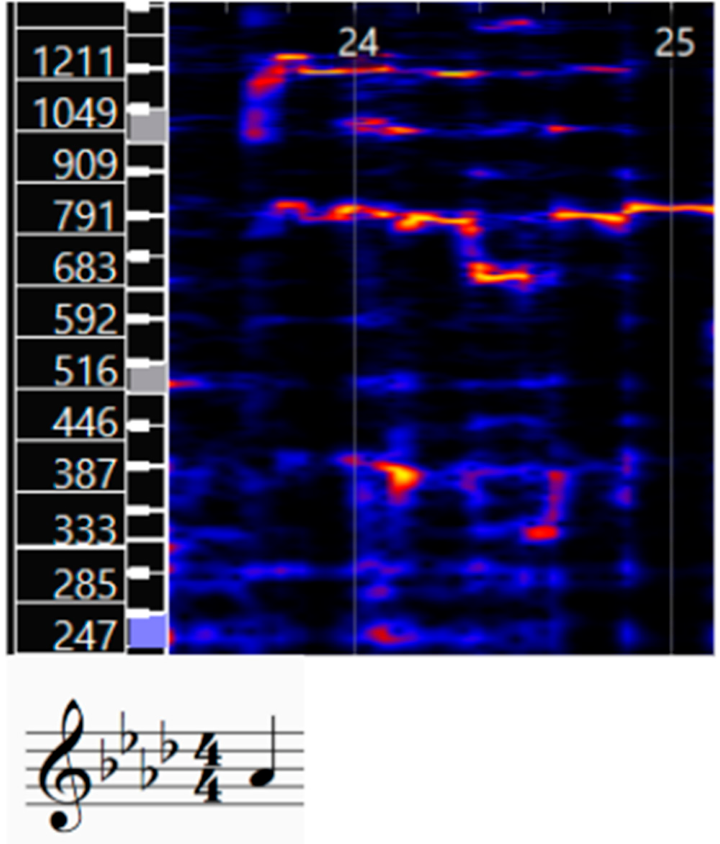
In the introduction, Robinson sings two non-lexical statements of ‘woah’, which lead into the first verse of the song. On certain lyrics, particularly ‘I’ and ‘they’ at the beginning of verse sections, Robinson sharply releases air through the pharynx, which gives the feeling of the pitch being propelled upwards and results in a screech-type sound. Just before 00:24 in
Figure 1, Robinson attacks the pitch that shoots upwards above 1211 Hz into the zone of mid-frequency harsh formants. Robinson holds the pitch momentarily before allowing his voice to decay and leads into the next lyric of the verse. This gives the vocal modifier a structural purpose which will be revisited.
Ab is around 440 Hz, which means that this resonance in the upper partials is significant for two reasons: it occurs in the zone of ‘strident mid-frequency harsh formants’ and it functions to attract attention in the song (
Roads 2015, p. 380). Subsequent statements just after 01:07 and after 01:58 also appear at the beginning of verse sections and are sung in a similar way.
At 02:28, Robinson sings a high-pitched sustained ‘ohh’. This vocal modifier, which gradually descends, has two functions that should be considered: firstly, the ‘ohh’ leads into the closing section of the song and, secondly, the vocal modifier is akin to the sound of a scream. A scream is a release or physiological expression of emotion (fear, joy, sadness) in communication. The former reinforces the structural function of the vocal modifier at the beginning of verses, but also marks the closing section of the song. The latter consideration of the vocal modifier in relation to the sound of a scream aligns with the subject of the song that longs for a romantic partner who is far away. The protagonist, performed by Robinson, yearns for their lover which is conveyed through the scream. Perhaps the scream-like sound is the protagonist releasing the frustration that they have encountered in trying to reach their ‘lover’ and is screaming out to them because they are far away.
This preliminary discussion demonstrates Robinson’s attention to voice, gives an example of a vocal modifier in The Miracles’ early songs and suggests that vocal modifiers may have a structural function in The Miracles’ performances. This latter point is important, for when writing about the Motown approach to musical form, Jon Landau omits vocals:
one other thing not strictly a part of the musical form must be mentioned. It is the Motown approach to the lead vocal. I haven’t included this as one of the basic characteristics of the Motown sound because I feel there is too great a variation among the Motown lead vocalists and because I don’t believe vocals can be stylized in the same way that other aspects of pop music can.
For Landau, vocals are not part of the form of Motown songs, but ‘Way over there’ features vocal modifiers at structural points of the song, which means that voice may be considered as part of the form. It is worth keeping this initial point about vocals and form in mind as we move to the next case study.
‘Shop around’, written by Berry Gordy and Smokey Robinson was released by Tamla Motown as a single in 1960 with ‘Who’s lovin’ you’ on side 2 (see Case study 3.3). ‘Shop around’ was The Miracles’ first single to sell more than a million records, and the song reached No. 1 on the
Billboard R&B Chart, No. 1 on
Cashbox Top 100 Pop Chart, and No. 2 on the
Billboard Hot 100. According to
Classic Motown, ‘after The Miracles’ first version of “Shop Around” was released around Detroit (as Tamla 53034) in September 1960, [Gordy] couldn’t sleep, worried that it wasn’t good enough (“too slow, not enough life”)’ (
The Miracles “Shop Around”. Classic Motown 2025). It is alleged that ‘[Gordy] called Smokey in the middle of the night and had him bring all The Miracles to the studio to lay down a new, faster take of the song. Gordy himself played piano, with Benny Benjamin (drums) and Ron Wakefield (sax) among the musicians’ (
The Miracles “Shop Around”. Classic Motown 2025). Such accounts not only offer insight into the different versions, they also show the dedication and time given to songs at Motown.
‘Shop around’ is an advice song, a classic song type in popular music, whereby the narrator or protagonist provides guidance to a listener or another person in a song (antagonist). Robinson, as the protagonist, narrates the fictional advice given by his mother to delay his entry into marriage and to browse for alternative partners. For even though he is of marital age, he is advised to look around at his options before settling down.
9 The song’s advice to slow down is contradicted by deliberate use of an upbeat tempo throughout. While the advice is problematic, the premise of the advice song dates back to nineteenth century popular music (
Tawa 1995). In the twenty-first century, one only need look at hip-hop and rap music for warnings pertaining to deceitful partners.
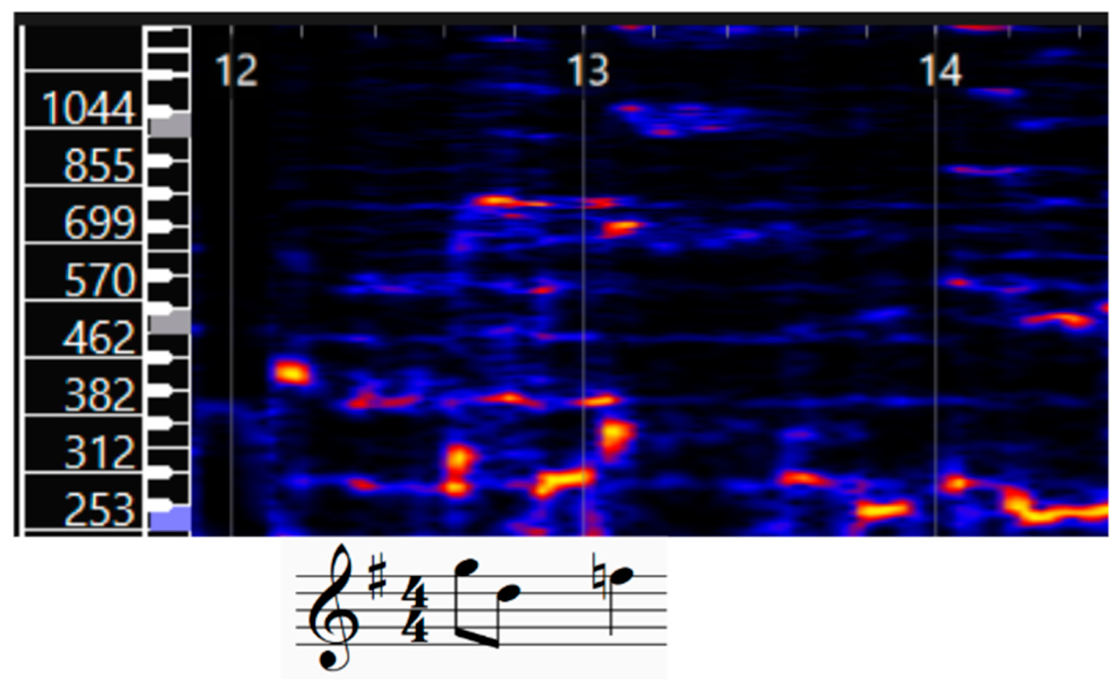
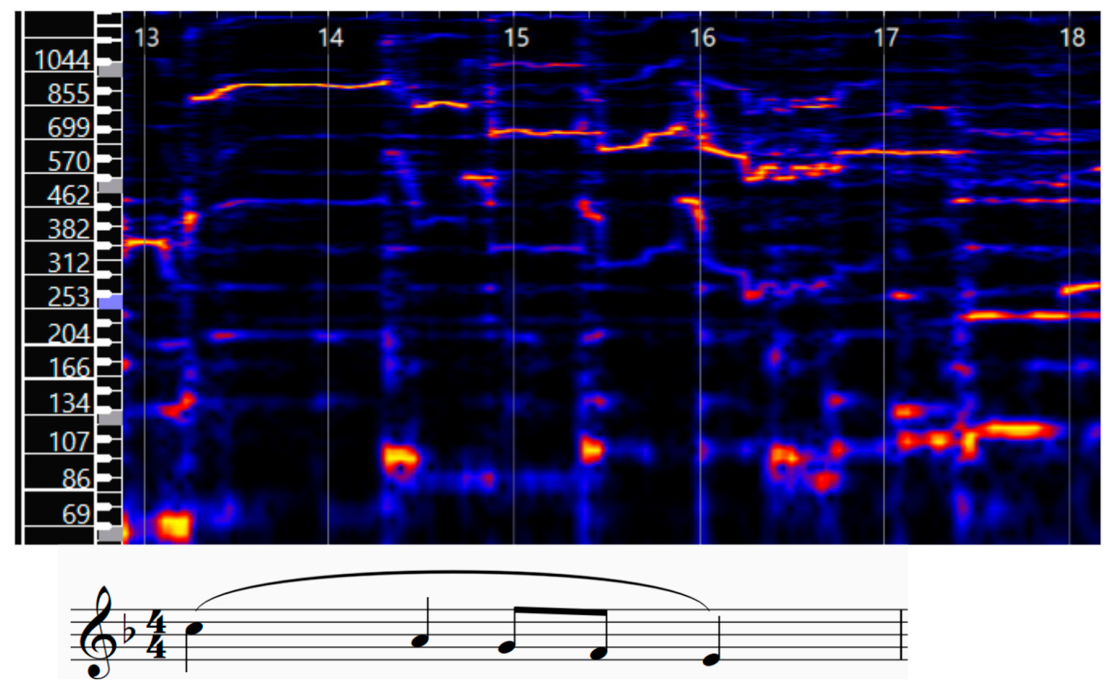
Similar to ‘Way over there’, at the beginning of each verse section, Robinson attacks the pitch which resonates in the upper frequencies. Just before 00:12 in
Figure 2, at 00:12, Robinson’s voice moves from 382 Hz to 699 Hz and resonates in the upper partials of 1044 Hz. The emphasis on the first lyric of the verse sections grabs the listener’s attention and works to imitate the mother figure offering advice in the song. This interpretation of a mother-figure is given because of the lyrics and the high-pitched vocal modifier situates Robinson’s voice in a range traditionally associated with female speech.
The dual function of the modifier in this song contributes to the narrative and expressive content. What initially appear as arbitrary words such as ‘there’s’ and ‘just’ are given a performative function through vocal modifiers which extend beyond the lexical context of the song. The reader might be thinking that the enunciation is connected to the lexical content, but this assumption may be refuted by looking at statements of the same words or phrases within the song.
Take ‘I’ve’, for example, which begins with the vowel ‘i’, and has an open-mouthed articulation that resonates high in the mouth. While a certain amount of articulation does affect resonance, it is not entirely connected to the phonetic structure of the word. To reinforce this point,
Figure 3 and
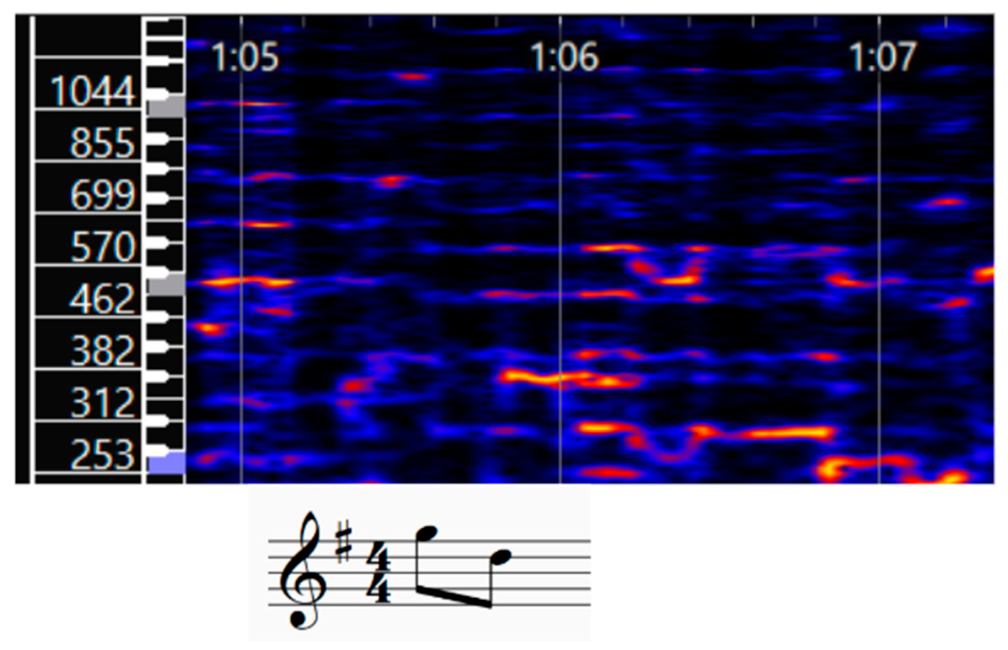
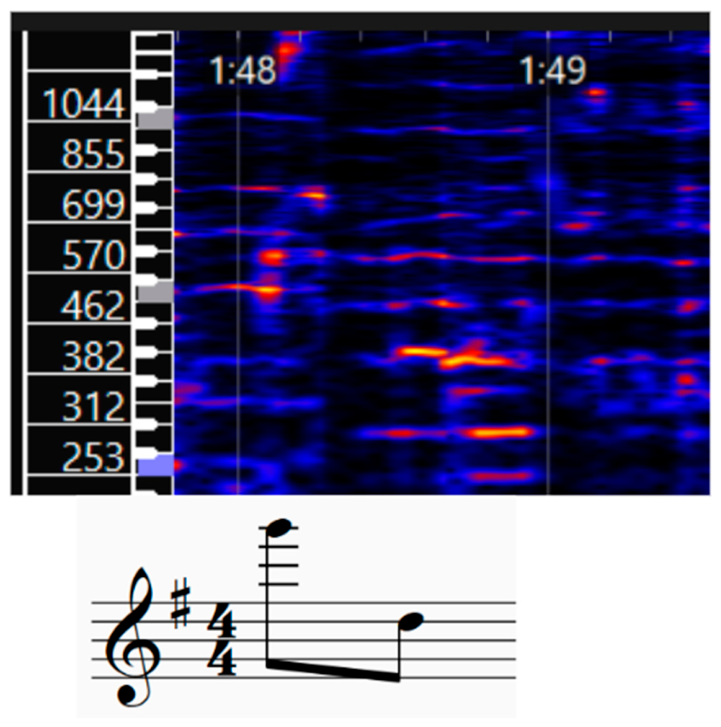
Figure 4 give two different articulations of ‘don’t’ in ‘Shop around’. The first is at 01:05 and the second is just before 01:48. While the lyrical content is the same, the vocal alongside the interpretation brought to the vocal within the context of the song is different.
In the first statement at 01:05, Robinson’s articulation of ‘don’t’ over two quaver beats is dull which gives rise to a horizontal line on the spectrogram just above 1044 Hz.
Figure 3.
‘Shop around’—Lyrics and music by Berry Gordy and William ‘Smokey’ Robinson, Tamla Motown, 1960, 01:05–01:07.
Figure 3.
‘Shop around’—Lyrics and music by Berry Gordy and William ‘Smokey’ Robinson, Tamla Motown, 1960, 01:05–01:07.
In
Figure 4, at 01:48, ‘don’t’ is repeated, but this time it gives rise to an arch-shape and the high G quaver pitch resonates in the upper partials of Robinson’s voice. Robinson’s voice slides upwards above 1044 Hz with a screech-like quality and descends slightly which gives rise to an arch-shaped articulation of the G pitch falling to D.
Figure 4.
‘Shop around’—Lyrics and music by Berry Gordy and William ‘Smokey’ Robinson, Tamla, 1960, 01:48–01:49.
Figure 4.
‘Shop around’—Lyrics and music by Berry Gordy and William ‘Smokey’ Robinson, Tamla, 1960, 01:48–01:49.
While the word is the same in
Figure 3 and
Figure 4, the articulation and the consequent interpretation brought to the words differ. The first statement places the protagonist in a calm correspondence while the second, sung with a vocal modifier, resonates high in the upper partials and gives rise to a panicked sound as if the protagonist is crying out in fear. Robinson might be embodying his fictional mother who is providing dating advice and encouraging Robinson to ‘Shop around’. Perhaps, in this case, the character of the mother does not feel heard after their first statement and conveys greater expression in the second.
‘Who’s lovin’ you’, written by Smokey Robinson, was released by Tamla Motown as a single in 1960 (side 2 of ‘Shop around’). The song is lament like as it tells the tale of a protagonist who regrets treating their partner badly and ponders about who is loving their partner now. Even though this song was first recorded and released by The Miracles, it has come to be best recognised by Michael Jackson’s performance with The Jackson Five on the Ed Sullivan show in 1969. According to Berry Gordy, as cited in
Classic Motown: ‘Michael [Jackson] sang “Who’s Lovin’ You” with the sadness and passion of a man who had been living with the blues and heartbreak his whole life’ (
The Miracles “Shop Around”. Classic Motown 2025). While Jackson’s version of ‘Who’s lovin’ you’ has become better known than The Miracles’ recording, aspects of The Miracles’ performance laid the foundations for this song. That is, throughout the song Robinson employs vocal modifiers to convey the protagonist’s sentiments and particular attention should be brought to the use of vocal modifiers on the pronoun ‘I’ throughout.
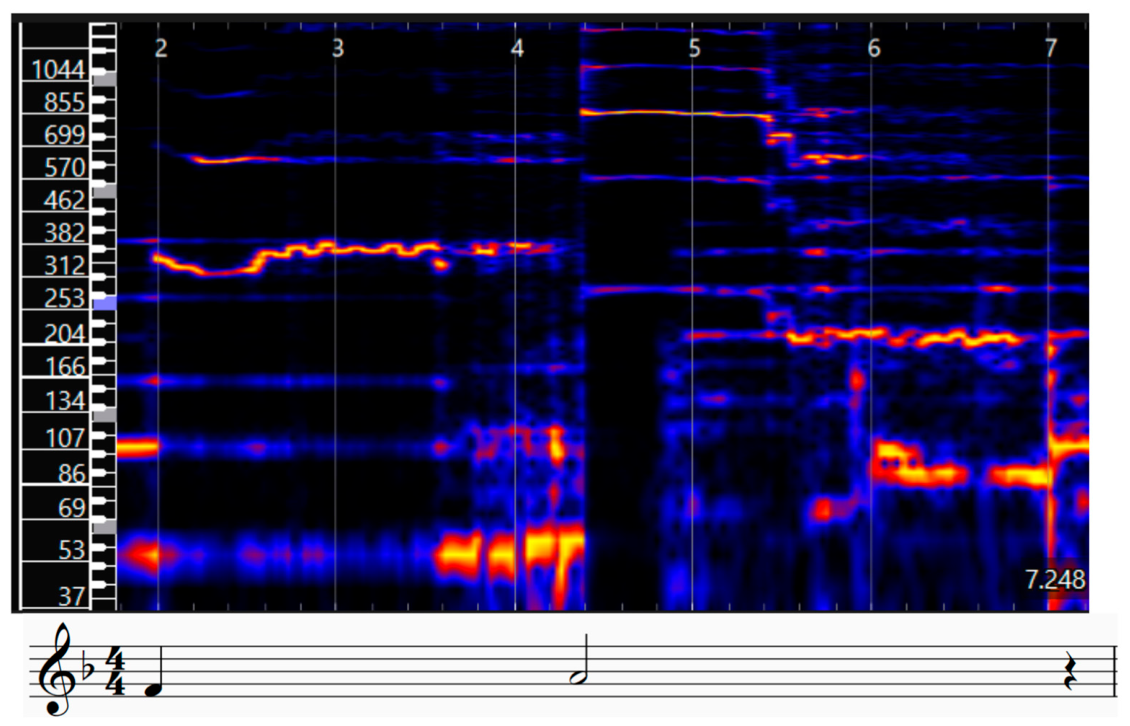
After 00:04 in
Figure 5, ‘I’ is sung as a minim over three seconds. Robinson’s voice resonates in the upper frequencies (between 855 Hz and above 1044 Hz) and then gradually falls to 231 Hz and prepares for the entrance of the word ‘had’.
Not only does this passage open the song, it sets the mood for the fall from the upper frequencies to lower ones and brings the listener from a high point to a low one. At 00:08, Robinson sings ‘had’ with a quivering resonance. The lyric ‘had’ also functions as a harbinger for the rhyming ‘bad’ heard later in the song. When reflecting on
Figure 5, the articulation of ‘had’ appears like a consequent of the previous statement ‘I’. That is, the lengthened ‘I’ over four seconds delays the arrival of the lyric and has two functions: it draws attention to the personal pronoun which focuses on the protagonist’s experience in the song and the delayed arrival of ‘had’ contributes to the later enunciation of ‘bad’ in the song.
Just after 00:13, Robinson articulates ‘bad’ at 382 Hz (see
Figure 6). Initially, the voice is in the lower register, but it resonates in the upper partials of 1044 Hz and then gradually descends to 570 Hz and is sung with a wavering resonance. Not only is the wavering resonance visible on the spectral view after 00:16, the wavering gives rise to the vocal modifier that occurs when someone is crying while trying to speak. The rapid glottal closure causes more air to pass through and results in a quivering resonance. In this short opening, the listener learns that the song is about Robinson’s experience and that it is a negative one. That is, pitch, word and lyric align to convey the sentiments of the song. The descent of the voice, alongside words that reinforce the articulation, function to heighten the melancholy in the song and reinforce Marcus’ statement above.
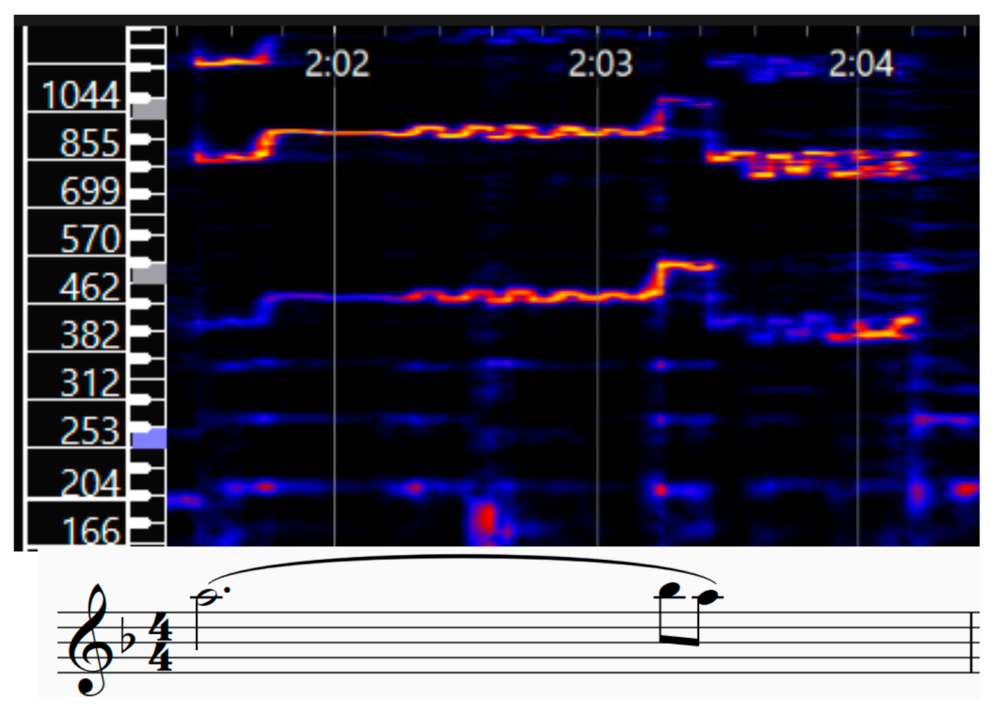
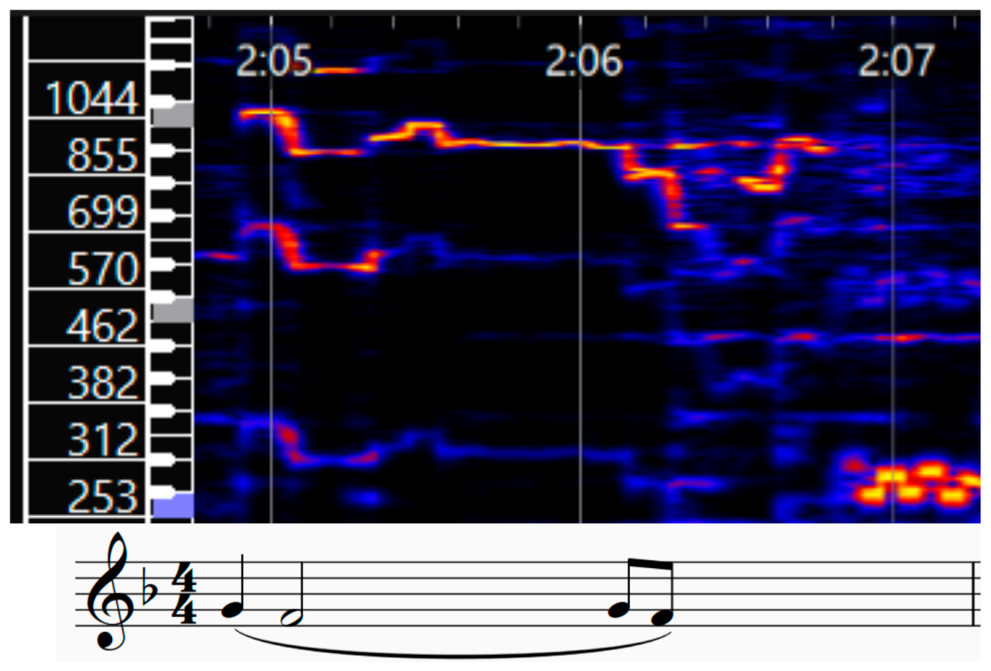
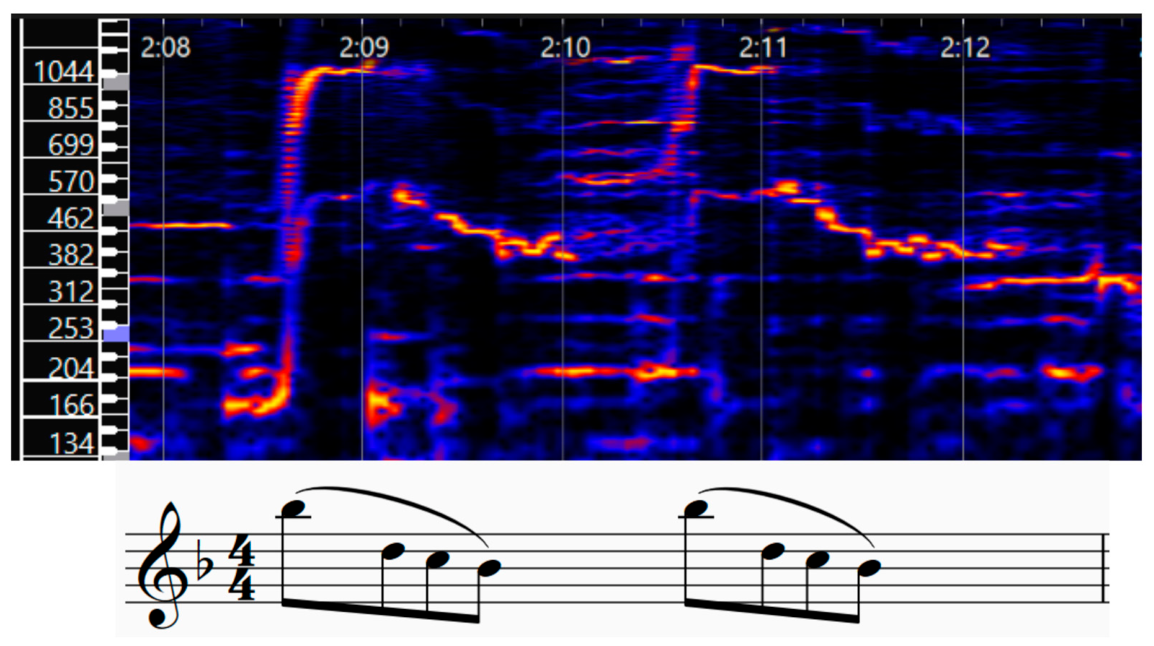
Later in the song, between 02:01 and 02:11, Robinson sings another phrase which includes four statements of ‘all’. Across the ten second phrase, each statement differs and builds toward a final statement just after 02:10. In
Figure 7, just after 02:01, the lyric is sung as a dotted minim and a two quaver beats and is three seconds in duration.
Initially, Robinson hits the pitch centrally and it reverberates in the upper partials above 1044 Hz, but then his voice decays slightly and wavers before sliding upwards again and downwards with a vibrato.
Figure 8 gives the second statement of ‘all’, just before 02:05, which is sung on the crotchet and followed by a minim on the pronoun ‘I’. In this example, ‘all’ is less than a second in duration and Robinson’s voice resonates in the upper partials of 1044 Hz.
The restatement of ‘I’ in
Figure 8 echoes the opening of the song. The articulation occurs in the upper partials, is over two seconds in duration, and builds towards a third statement of ‘I’. In the second statement, ‘all’ appears to function as an upbeat that builds towards the next statement of ‘I’. This enunciation differs from the previous statement, which not only challenges the listener’s expectations, it highlights the importance of vocal modifiers in performance.
Figure 9 gives Robinson’s two statements of ‘all’ just after 02:08. Robinson’s voice swells upwards to 1044 Hz for the third and fourth statements in the song. Both statements are less than a second in duration but sung with a vocal modifier.
The articulation of ‘all’ in this way suggests that the protagonist is crying out in desperation for the antagonist to hear them. What is more, the phrase (02:01–02:11) leads toward the lyric ‘cry’, which reinforces the vocal modifier expressing desperation and functions to overplay the emotional misfortune of the protagonist.
The ten second phrase, as sketched in
Figure 7,
Figure 8 and
Figure 9, is interesting for several reasons: it represents a climactic point in the song; the lengthened ‘I’ plays with the listener’s expectations and the two statements of ‘all’ with a vocal modifier overplay the frustrations of the protagonist. Up until this point in the song, the protagonist has pleaded with the antagonist and tried to reason with them. The above example represents the protagonist’s growing frustration and the vocal modifiers aurally express their upset as they grow weary trying to reconcile with the antagonist. ‘Who’s lovin’ you’ marks a development in Robinson’s use of vocal modifiers because the modifier helps to convey the song’s sentiment and emphasises the protagonist’s despair.
This example suggests that the narratives which accompany these songs are important, for with knowledge of the lyrics, the use of modifiers can serve to reinforce the characterisations conveyed in the song. This point is especially important for the final song to be discussed, ‘I second that emotion’, which is an example of The Miracles’ use of vocal modifiers in 1967.
‘I second that emotion’, written by Smokey Robinson and Al Cleveland, was released by Motown as a single in 1967. The song reached a height of No. 4 on The US Billboard Hot 100 singles chart and No. 1 on the US Billboard R&B Singles chart in December 1967. The song was a million-selling hit for The Miracles and their sixth hit overall.
Similar to the three songs discussed so far that address topics of love, ‘I second that emotion’ is a song whereby the antagonist has created an uncertainty for the protagonist. The antagonist appears to be playing with those who are showing them interest and they have rendered the protagonist in a state of confusion as they ponder what the antagonist is looking for. The protagonist states that if the antagonist feels that they can open up to the protagonist, that they will be there for them and this statement is reinforced by repetition of the title, ‘I second that emotion’, throughout.
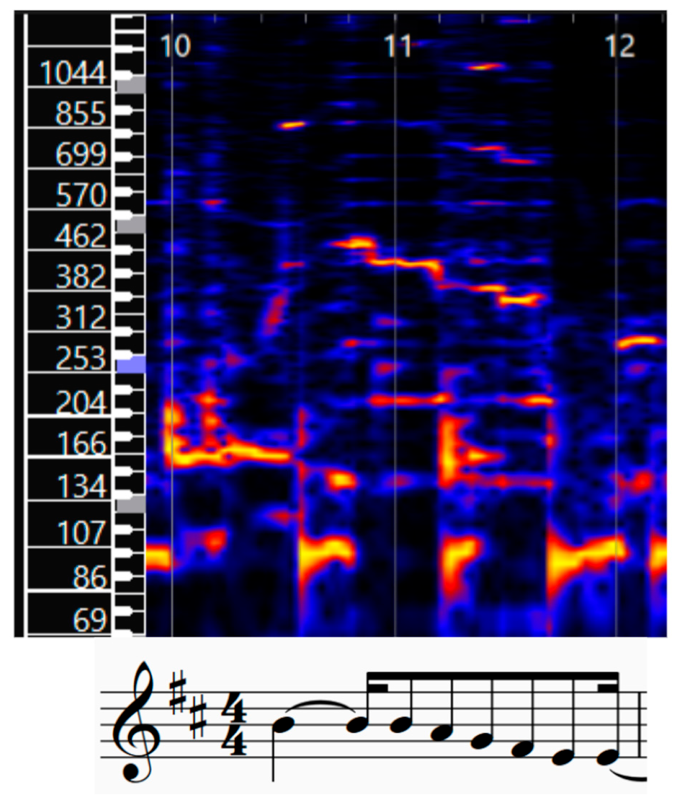
The opening lyric of the first two verse sections, which begin with ‘maybe’, are sung with a vocal modifier and are important narrative markers in this song.
Figure 10 gives the first syllable of the lyric which is sung on the crotchet and the second on the semi-quaver. Robinson hits the note centrally at first but then allows his voice to swell upwards before sliding down to sing the phrase. The vocal modifier on the first lyric in this song recalls the previous examples in ‘Way over there’, ‘Shop around’ and ‘Who’s lovin’ you’, while also grasping the attention of the listener. Furthermore, the vocal modifier on the lyric ‘maybe’ is reinforced by Poyatos’ example of ‘maybe’ as a vocal modifier as cited in
Section 2.
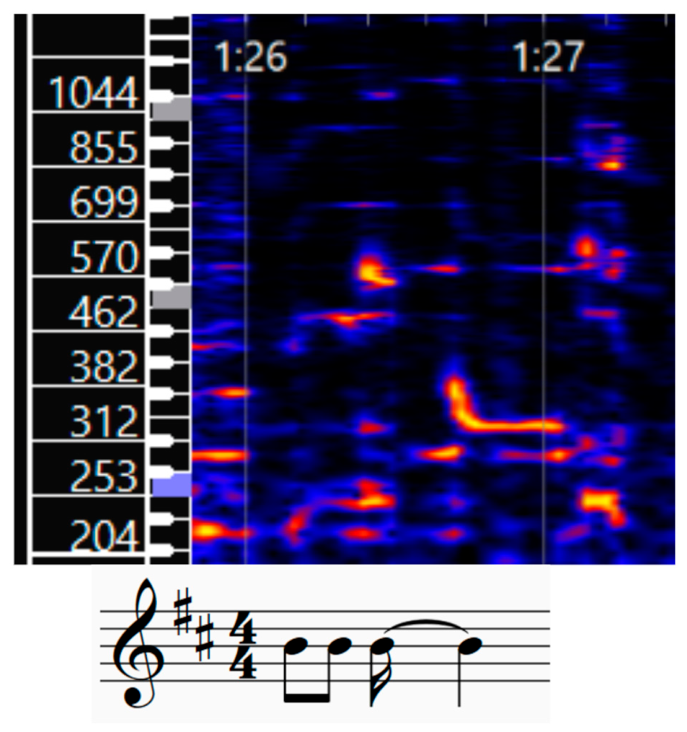
When reflecting on the example of ‘I do’ that opened this article, Robinson’s speech-like articulation of ‘I do’ at 00:34 and 01:26 is significant (see
Figure 11). This is because the two speech-like statements of ‘I do’ at 00:34 and 01:26 establish a pronunciation for these words in the song.
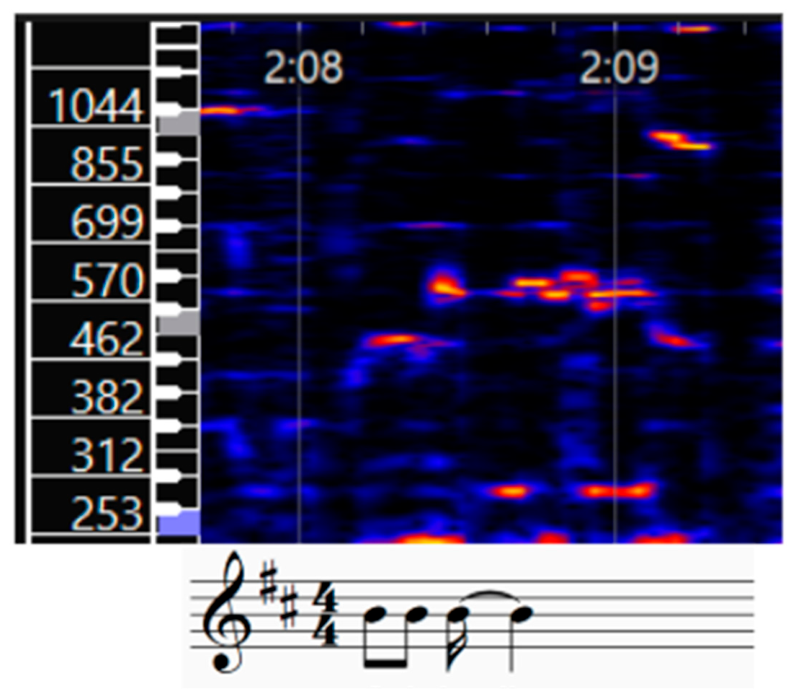
But, later in the song at 02:08, Robinson sings a vocal modifier on ‘I do’, which challenges the expectations of the listener.
Figure 12 gives Robinson’s articulation of ‘I do’, which is sung at 570 Hz and with a vibrato resonance.
Figure 12.
‘I second that emotion’—Lyrics and Music by Smokey Robinson and Al Cleveland, 1967, 02:08–02:09.
Figure 12.
‘I second that emotion’—Lyrics and Music by Smokey Robinson and Al Cleveland, 1967, 02:08–02:09.
The statement of ‘I do’ at 02:08, using a vocal modifier, is not only an example of a modifier occurring in the main point of the song, but the words are equally important. In the context of the song, which is an expression of unrequited love, ‘I do’ recalls the example of the marriage act as discussed in
Section 1. Austin calls this type of sentence a performative sentence or a performative utterance (shortened to performative) (
Austin 1975, p. 6). For Austin, ‘“I do (sc. Take this woman to be my lawful wedded wife)”—as uttered in the course of the marriage ceremony’ (
Austin 1975, p. 5). That is, ‘when I say, before the registrar or altar, &c., “I do”, I am not reporting on a marriage: I am indulging in it’ (
Austin 1975, p. 6). With this in mind, one might think of Robinson’s articulation in ‘I second that emotion’ as a performative utterance. That is, by combining the lexical articulation and vocal modifier, Robinson indulges in the song and expresses the emotions described in the lyrics.
4. I Do Conclude
The examples in this article detail the presence and function of vocal modifiers within and across four songs recorded by The Miracles. By analysing selected songs across a time period (1960 and 1967), it becomes possible to see how initial vocal modifiers become harbingers for a reappearance within and across songs. Take, for example, the vocal modifier heard on ‘don’t’ in ‘Shop around’ and ‘all’ in ‘Who’s lovin’ you’. While words and music lay important foundations for performers, it is through such paralinguistic voice qualities that singers convey their performances. For, as outlined by Parmer in
Section 2, singers colour and animate the music they are performing and vocal modifiers are just one example. Smokey Robinson adopts this role in all four songs discussed and, the inter-song changes of topic: longing and despair (‘Way over there’, ‘Who’s loving you’), indifference (‘Shop around’), and accepting the precarity of relationships (‘I second that emotion’), form an aural thread using modifiers across songs. One becomes accustomed to hearing vocal modifiers in songs of love and longing, which is reinforced by the elision of pitch and lyric on ‘I do’ in ‘I second that emotion’ in 1967.
While the analytical examples offer insight into The Miracles’ performances, some characteristics of vocal modifiers in popular song begin to emerge:
Modifiers may have a structural function, which can be heard in the verse sections of ‘Way over there’, ‘Shop around’, ‘Who’s lovin’ you’, and ‘I second that emotion’. While these are preliminary examples, they challenge Landau’s omission of vocals from form in Motown songs (
Landau [1969] 2007, p. 71).
Modifiers operate dynamically in and across songs, for modifiers are heard in examples from 1960 and 1967.
Modifiers are image-like because they conjure feelings of psychological upset such as the wavering cry-like resonance in ‘Who’s lovin’ you’.
Modifiers fall under Stephen Davies’ classification of meaning B in Art and Music. This is because ‘meaning B involves the intentional use of meaning A, or of a natural relation with potential for meaning A, to secure reference’ (
Davies 1994, p. 31). The use of a modifier to evoke longing is a natural relation of desperation to vocal modifiers. In this way, the vocal modifier functions to express the songs through an aural appearance of emotional characteristics. The relationship of the vocal modifier to its respective themes (unrequited love, despair, longing, frustration); enhances the aural connections within and across the selected songs. The study of vocal modifiers in performance further supports Simon Zagorski-Thomas’ concept of sonic cartoons which are embodied sound terms (
Zagorski-Thomas 2014, p. 9). That is, modifiers are a recurrent pattern of bodily experience, for it requires a tightened larynx and control of the air in the oral cavity and lungs. The physiological control extends to the pharynge and soft palate, muscular tension, and the shaping of the lips and lower mandible (jaw).
The significance of these utterances gives rise to expressive tropes, which are partly inherent and partly associative (
Davies 1994, p. 16). One becomes accustomed to hearing modifiers in songs of love or longing, but that does not mean that modifiers are inherently representative of love or longing. Modifiers may be understood in relation to Davies’ formulation of Jerrold Levinson’s study of musical truth. This is because modifiers express pleading and despair because the sound likens our experience of the emotion in communication (someone howling with sadness or screaming in pain) (
Davies 1994 p. 16). In ‘Who’s lovin’ you’, for example, the modifier (X) expresses the protagonist’s despair at losing the antagonist (Y). That is, Y qualifies the presence of X.
10Longing, frustration, and despair are paired through similar uses of modifiers in ‘Way over there’, ‘Shop around’, ‘Who’s lovin’ you’, and ‘I second that emotion’. The songs express X and Y as going together, for certain lyrics (‘cry’, ‘bad’, ‘love’, ‘please’, the performative utterance ‘I do’) are sung with vocal modifiers. Overtime vocal modifiers may proceed lexical content, for in the opening of ‘I second that emotion’, the modifier on ‘maybe’ expresses Y as succeeding X. ‘Maybe’ does not indicate despair, but through our knowledge of the use of this modifier in The Miracles’ previous songs, the listener may conjure ideas of psychological upset and uncertainty in a relationship.
While this article provides preliminary examples of modifiers in recorded performances by The Miracles, a future study would involve a larger corpus of performers in the 1960s and other decades. Take, for example, the analysis of ‘Who’s lovin’ you’, which the reader might have already connected to vocal modifiers in Jackson’s solo career. Some examples may include ‘Don’t stop till you get enough’ (1979), ‘Wanna be startin’ somethin’’ (1982), or ‘Bad’ (1987). ‘Wanna be startin’ somethin’’, for example, opens with screams and howls that are later heard in the song. A scream requires that the mandible is lowered, the tongue is also low in the mouth and the larynx is elevated. Understanding the physiological movement of a sound contributes to our aural perception. That is, the physiological and aural are intertwined and both are important for analysing voice. Or, as Sun Eidsheim puts it: ‘the sensory and the material go hand-in-hand’ (
Sun Eidsheim 2015, p. 12). Such nonverbal aspects of performance are central to our understanding of popular song, which might align with further studies of vocal performance and highlight the important role of performers in creating a musical experience.