1. Introduction
This article examines how tactile, drawing-based approaches to creating sound provide a counterpoint to contemporary computer music paradigms. It challenges the current emphasis on abstraction by prioritising the primacy of touch, physical gesture, and embodied knowledge in musical expression.
The work focuses on three influential mid-20th-century instruments that translated physical drawings into electronic sound, functioning not merely as experimental devices but as fully fledged musical instruments: Daphne Oram’s Oramics machine (1950s), Fernando von Reichenbach’s Catalina (1960s), and Iannis Xenakis’s UPIC system (1970s). These instruments broke down conventional musical notation and encouraged users to experience the transformation of hand-drawn images directly into sound.
My approach is both historical and practice-based. While contemporary music software has been informed by the development of the instruments discussed here, the physical presence and tactile playfulness of the original instruments has often been lost in translation. Ink, pencils and paper have been replaced by screens and tablets. Additionally, modern software is increasingly embedded within computer operating systems mediated by corporate interests and subject to hardware changes and competitive markets.
At the same time, the dematerialisation of experimental audio tools into software has enabled unprecedented accessibility and portability. This tension between the loss of the embodied interaction and the gain in accessibility raises fundamental questions about agency, pedagogy, and the conditions under which sound-making can be learned, practiced, and experienced today.
This analysis aligns with a broader theoretical framework, responding to Yuk Hui’s notion of cosmotechnics and the call for an epistemic revolution. Technologies are not neutral tools; they embody cosmologies—assumptions about how we know and relate to the world. While computational paradigms tend toward abstraction, these tactile, drawing-based instruments propose an alternative cosmotechnical orientation, where sound-making is inseparable from gesture, material resistance, and the direct movement of the body.
The visual arts are instrumental in creating new dispositifs—technical, aesthetic, and social arrangements that shape our relationship with technology. This article argues for a reappraisal of this visual role, directly responding to the Special Issue’s question: How do the visual arts lead to new ways of thinking and becoming with technology? I propose that the visual act of drawing is a possible mechanism for an epistemic revolution in sound.
By tracing the history of drawing sound, I demonstrate how artistic vision—through the tangible interface of a pencil and paper—can produce new technological relations that redefine the core concepts of music, knowledge, and participation.
Seen through this lens, the Oramics machine, Catalina, and UPIC system are more than historical artifacts; they are socio-political dispositifs that offer propositions for different, more embodied ways of knowing and experiencing sound. The mid-century pioneers anticipated modern concerns, but their technologies foregrounded tactility rather than abstraction, emphasising that musical interfaces can serve as sites of embodied knowledge.
This study is structured as follows:
Section 2 introduces the theoretical framework, detailing the cosmotechnical tension between the embodied concretisation of the historical instruments and the abstract logic of the modern Graphical User Interface (GUI).
Section 3,
Section 4 and
Section 5 present the three case studies (
Oramics, Catalina, and
UPIC), situating them within their political, financial, and pedagogical contexts to highlight their critique of contemporary avant-garde abstraction.
Section 6 introduces
L’UPIC Ludique, a contemporary reimagining of Xenakis’s instrument that foregrounds tactility and playfulness to reclaim the magical qualities lost in digital translation.
Section 7 concludes by arguing that the lessons from these drawn-sound instruments reinforce the need for public investment in collaborative spaces where artistic experimentation can shape technology, reflecting Hui’s vision of art as a catalyst for epistemic transformation.
2. Historical Precursors
Electronic music has a long history of experiments in generating sound through hand-drawn visual means. One significant strand of this practice emerged in the 1930s, when artists such as Rudolf Pfenninger and Oskar Fischinger explored the optical technique of drawing sound directly onto 35 mm film—an approach well documented in works such as
See This Sound (
Rainer et al. 2009).
These experiments built on a much longer lineage of visualised music, from mechanical organs to Athanasius Kircher’s Musurgia Universalis (1650), which depicts Hammersmith punching notes into a score played by a water-powered organ (
Zielinski 2006).
Continuing from these early experiments, the mid-20th century saw a series of projects that sought not only to visualise sound but to transform these methods into fully functioning musical instruments. Artists and engineers such as Daphne Oram, Fernando von Reichenbach, and Iannis Xenakis explored ways to translate drawn sounds directly into music, combining technical innovation with pedagogical and social motivations. These instruments emerged within specific political, financial, and institutional contexts, and their design reflects both the possibilities and the limitations of the technologies available at the time. By examining these projects, we can trace how many of their design features have been preserved, developed and concretised into contemporary music production software and speculate over what elements have been lost.
This concretisation refers to the notion described by Gilbert Simondon, whereby technologies undergo a process of becoming internally coherent (
Simondon 2017). This process typically drives technical objects toward greater internal integration and efficiency. While this has produced the highly efficient software environments now standard in 21st-century music production—environments that enable the manipulation of visual audio files and MIDI data—it has also paradoxically abstracted the user experience. The physical immediacy inherent in drawing directly onto film or paper has been replaced by the abstract logic of the Graphical User Interface (GUI). This abstraction is particularly evident in computational tools like quantisation in rhythm and pitch, where the software automatically corrects human input to conform to a rational, fixed grid. This process, while ensuring efficiency and internal integration for data manipulation and synchronisation, simultaneously removes the subtle, often imperfect traces of the performer’s embodied gesture and timing, prioritising the abstract mathematical model over lived, material resistance.
The very act of concretising of sound software has often come at the expense of the tactile, haptic affordances that defined the earlier drawn-sound instruments. This tension between the abstract efficiency of computational technology and the material engagement of the interface forms the central argument of this article.
As Yuk Hui argues, technologies embody cosmologies—assumptions about how we know and relate to the world. The modern computational paradigm privileges the abstract, efficient concretisation of the machine, reflecting a cosmology driven by optimisation and industrial logic. In contrast, the instruments examined in this article—Oramics, Catalina, and UPIC—prioritised the embodied, tactility of the interface, proposing an alternative cosmotechnical orientation in which the knowledge of sound is anchored in the physical gesture of the hand.
3. Oramics
The Oramics Machine, developed by Daphne Oram in the 1960s, represents one of the most ambitious efforts to translate drawing directly into musical sound. As P. D. Manning argues in
The Oramics Machine: From Vision to Reality (
Manning 2012), Oram’s project was remarkable not only for its technical ingenuity but also for the extraordinary level of individual commitment it required, particularly given the limited institutional support available to her.
Oram worked as a studio engineer at the BBC and was instrumental in the establishment of the BBC Radiophonic Workshop in 1958, where she briefly served as its first director. However, as Manning highlights, Oram resigned within a year—choosing instead to dedicate herself entirely to the private development of Oramics. This decision underscores both her artistic conviction and her desire to pursue sound technologies outside of institutional constraints which were less favourable to experimental sound and processes.
Oram’s departure was also arguably inflected by the gendered politics of the time; operating outside established, male-dominated institutions allowed her to pursue a radical vision for music-making that was deeply personal and pedagogical. Her decision positioned her Oramics machine outside the dominant currents of the post-war European avant-garde. While contemporaries in institutions like the Darmstadt School embraced abstraction through serialism and algorithmic processes, Oram instead privileged a direct, tactile engagement with sound through drawing. Her system offered a personal, private avant-garde, prioritising the composer’s embodied, visual gesture over the formal, abstract logic that often characterised the institutionalised electronic music studios of the era. The emphasis on drawing was thus a methodological and philosophical statement; she envisioned the future of electronic music not solely in abstract mathematical control, but in the immediate, haptic creativity of the human hand.
Technically, the Oramics system was both intricate and ambitious. Strips of 35 mm film carried hand-drawn shapes that passed through banks of photoelectric cells. The varying light intensities, determined by the opacity of the drawings, were converted into control voltages that modulated oscillators, filters, and amplifiers. Manning emphasises that Oram’s goal was to allow composers to draw different aspects of sound, including pitch, envelope, timbre, and dynamics—across multiple film “lanes,” thus unifying notation and synthesis in a single tactile medium. In doing so, Oram collapsed the separation between composition and sound production, advancing a radical vision for graphic music systems.
Financially and politically, Oram’s work was precarious. A partial grant from the Calouste Gulbenkian Foundation was crucial, though unusual, as the Foundation normally awarded institutions rather than individuals. Oram initially proposed not only the development of the Oramics machine but also the creation of a larger arts/science education centre that would foster interdisciplinary research and pedagogy. While the Foundation declined to fund the centre, it offered her £1000 in supplementary support on the condition that the Oramics machine be completed by spring 1966. Manning notes this payment came just in time, as Oram was facing pressure from her bank over credit arrangements. It is doubtful the project would have been realised without this support.
Manning also stresses that Oram’s aspirations were pedagogical as much as technical. She envisioned Oramics as the foundation for an educational space where artists, technologists, and students could explore new modes of sound together. This ambition positioned her not only as a pioneering inventor but also as a figure who sought to democratise access to electronic music through tactile, visual, and collaborative practices.
In this light, the Oramics machine was more than an eccentric invention: it embodied a vision of music as an interdisciplinary, social, and experimental practice. Though it never achieved the widespread dissemination of later software environments, its legacy lies in the way it foregrounded the relationship between drawn gesture, sound synthesis, and creative pedagogy—anticipating many of the later developments of computer sound manipulation such as wavetable manipulation. Her pioneering work has had recent recognition through the Daphne Oram Trust set up in 2007.
Pedagogically, Oram’s ambitions extended beyond composition and research. Through her proposals for an arts/science education centre, she attempted to create space for interdisciplinary learning and experimentation, engaging with other composers and technologists such as Hugh Davies and Tristram Cary. This dual focus on research and education reinforced her role as both an innovator in electronic sound and a mentor to emerging practitioners within the avant-garde music community. However, as noted, the sonic art centre she dreamed of was not funded and we can only speculate through her beautiful writings in her book “An individual note of music, sounds and electronics”, that such a centre would champion philosophical and technical explorations of sounds (
Oram 2016).
4. Catalina
Meanwhile, in Argentina a similar instrument was being constructed. The Convertidor Gráfico Analógico (Analog Graphic Converter), colloquially referred to as
Catalina, was developed by Fernando von Reichenbach at the Centro Latinoamericano de Altos Estudios Musicales (CLAEM; Latin American Center for Advanced Musical Studies) in Buenos Aires, Argentina. As Eduardo Herrera observes in
Elite Art Worlds (
Herrera 2020), both the institutional framework of CLAEM and the technological innovations it fostered are central to understanding the historical significance of
Catalina.
The device converted graphic notation into sound through the integration of closed-circuit television equipment, a paper transport mechanism that displaced hand-drawn graphics across a camera lens, and voltmeters that recorded score parameters. The resulting visual signal was reduced to black-and-white values, which in turn modulated voltage fluctuations; these voltages functioned as control signals capable of activating generators, filters, and modulators. This analog–visual design placed Catalina as a crucial technical bridge, using camera technology to achieve a tactile translation of hand-drawn scores into continuous electronic sound, preceding the UPIC’s digital processing.
Several composers incorporated the instrument into their compositional practice, most notably Eduardo Kusnir, whose La Panadería (1970) represents a significant work realised with Catalina. The device exemplified broader avant-garde tendencies in experimental music, particularly the exploration of graphic notation, electronic media, and novel compositional interfaces. In this respect, CLAEM and its most experimental projects, such as Catalina, stood at the intersection of local modernist aspirations and transnational avant-garde practice.
Its existence was made possible by CLAEM’s institutional infrastructure, which, as Herrera argues, emerged from the convergence of the Argentine state’s desire to project an image of modernity and progress with the financial and organisational support of the Rockefeller Foundation and the Torcuato Di Tella Institute. This dynamic echoes Frances Stonor Saunders’s analysis in The Cultural Cold War, which demonstrates how artistic and intellectual production was mobilised as a vehicle of cultural diplomacy during the ideological struggle against the Soviet Union.
Not all observers were convinced by its musical outcomes. As Herrera notes, music critic Eduardo García Belsunce argued that electronic works were closer “to industrial engineering” than to music and that electronic music studios had “not produced in many years of experiments, a single work that can be considered music and understood as art.”
Pedagogically, Catalina and CLAEM more broadly were directed towards graduate-level music students, providing funded fellowships for Latin American composers and facilitating international residencies and visits by composers from abroad, including Iannis Xenakis. In doing so, CLAEM cultivated both local talent and transnational exchange, reinforcing its role as a site of avant-garde innovation and cultural diplomacy.
5. The UPIC
The
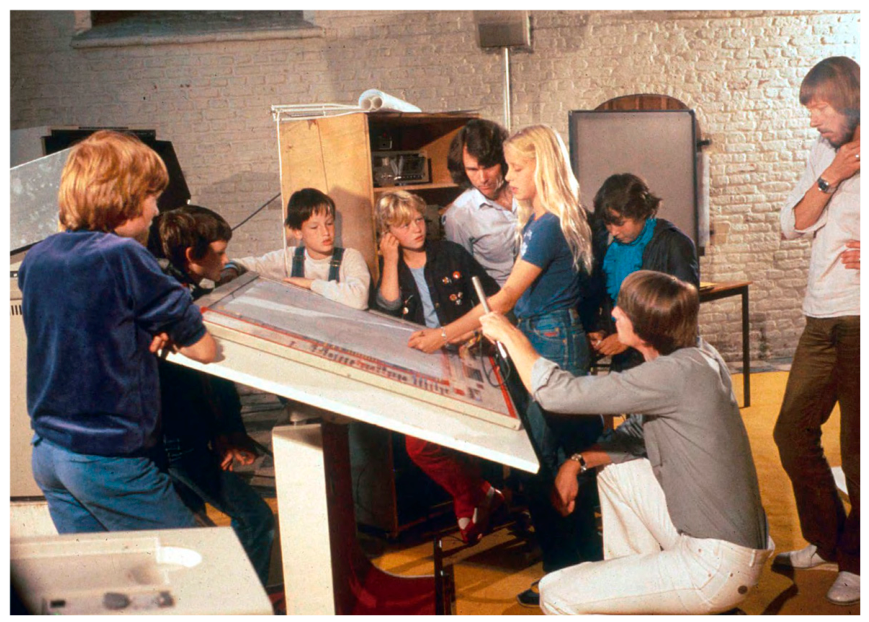
Unite Polyagogique Informatique du CEMAMu (UPIC), developed by Iannis Xenakis and his team of engineers ten years later, extended these ideas further by incorporating a primitive computer system. Built around a minicomputer linked to a large digitising drawing board—roughly the size of an architect’s desk, as shown in
Figure 1. The
UPIC allowed users to draw waveforms and envelopes directly onto the surface with a stylus. The computer then converted these into sound or control data. Shapes could be saved, manipulated, and combined, enabling an entirely new form of graphical composition.
Crucially, the UPIC was designed to resolve the inherent tension found in earlier electronic music: how to marry sophisticated synthesis with an immediate, intuitive, and non-abstract interface. The tactile drawing board inspired by Xenakis’ work as an architect was the democratising entry point, designed to bypass the specialised knowledge required by abstract score-reading or programming code.
There is some debate about whether these ideas were derived from Fernando von Reichenbach’s work in Argentina. Eduardo Herrera examines these debates, though they will not be pursued further here (
Herrera 2024).
The broader context of working in Paris after 1968, however, was markedly different. Xenakis was already a renowned composer and, as argued by Victoria Simon (
Simon 2017), was seeking to distinguish himself from the contemporary avant-garde (
https://amodern.net/article/democratizing-touch/ (accessed on 1 February 2026)). In particular, he positioned his work and new instrument as technologies that could democratise music-making, thereby setting himself apart from what were perceived as the elitist composers of the time, such as Pierre Boulez. This stance as a populist composer and inventor, Simon argues, also enabled him to secure greater access to government grants. As she observes: “The salient idea at the time was that amateur creativity, once unleashed, had the power to revolutionise society.”
Thus, the UPIC’s design was not just technical; it was a political manoeuvre within the European avant-garde, asserting that true innovation came from accessibility and the embodied knowledge of the many, rather than the intellectual abstraction of the few.
Xenakis, by all accounts, was a compelling orator and demonstrator, articulating the transformative potential of the instrument and its capacity to reshape the existing social order. He argued that “the use of existing instruments reinforced the social and political system from which they came and thus trapped the user into a sense of false liberation.” Furthermore, he “consistently stated to the press that the system (A UPIC) should not only be included in every classroom but that every person should own one as well.”
The extensive documentation surrounding this project illustrates the degree to which Xenakis developed and promoted this vision. The system was also toured through schools in France, underlining its educational potential, as well documented in
From Xenakis’s UPIC to Graphic Notation Today (
Weibel et al. 2020).
The hand-drawn sound wave experiments of Oram, von Reichenbach, and Xenakis were more than technical exercises: they were acts of artistic innovation that directly shaped digital signal processing and computer music software. These breakthroughs emerged from the collaboration of artists and engineers in creative environments, demonstrating that meaningful technological advances require the guidance of artistic vision.
6. L’UPIC Ludique: Revisiting the Playful
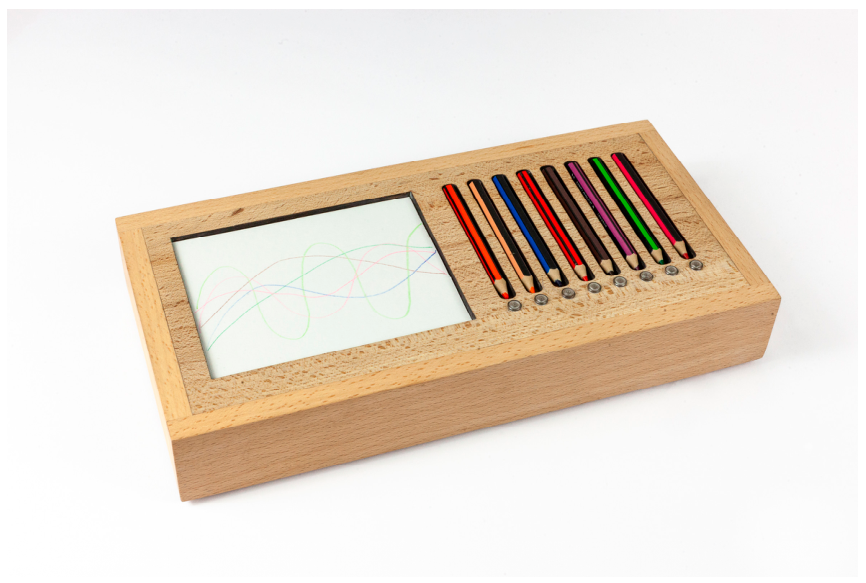
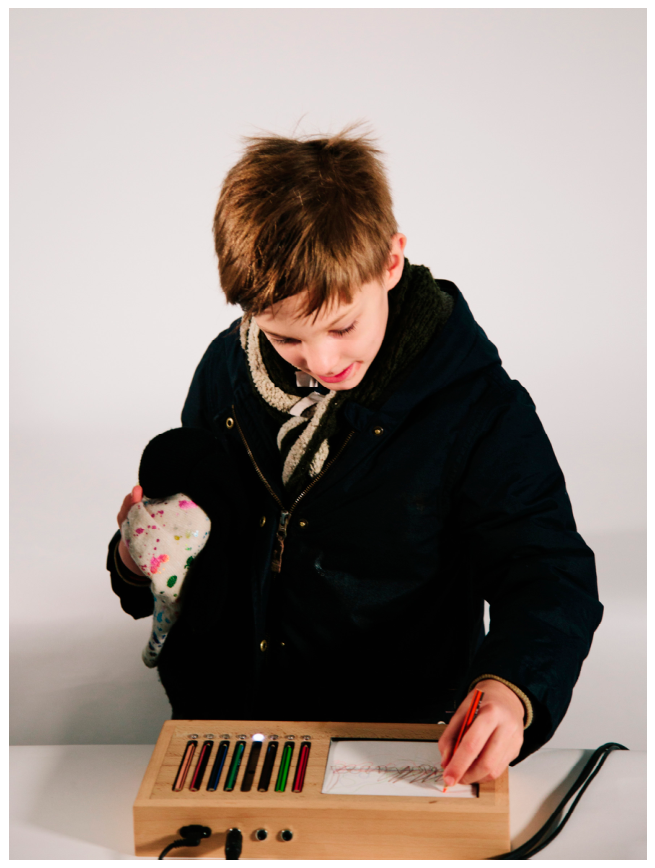
My own practice continues this lineage with L’UPIC Ludique, a reimagining of Xenakis’ UPIC as a children’s toy. With a stripped-back wooden interface, the instrument invites users to draw and manipulate raw audio waveforms using pencils and paper. Different coloured pencils control layers of the composition, from shaping audio waveforms to adjusting parameters and applying techniques such as granular synthesis.
By deliberately reducing the instrument to simple physical components, wood, pencils, paper, a touch-resistive screen and small computer within the wood, the instrument revisits the tactile physicality of the earlier instruments discussed and questions the dominance of screen-based interaction in digital music-making (see
Figure 2 and
Figure 3).
The instrument was initially prototyped during a Xenakis 2022 centenary celebration concert at Liverpool Hope University and developed from my longstanding interest in the connections between visual and sonic art, with a desire to make complex musical processes more accessible, tactile, and visible. In this respect, it resonates with Xenakis’ own pedagogical aspirations. As he noted:
“You don’t need any musical knowledge to use the table, and in fact it also serves as a pedagogical tool. We’re visited regularly by schoolchildren of seven or eight years of age, accompanied by their teachers. They draw fish, houses, trees—and can hear the result.”
Similarly, as Robert Frisus has observed:
“Xenakis imagined that even children could make such drawings and familiarise themselves with the (computer-assisted) sound results. He assumed that musical creativity is not only a privilege for the few, for example, only appreciated and promoted by specially trained people, but rather a broad potential without limitation based on individual age or educational levels.”
The
L’UPIC Ludique has been demonstrated at the New Interfaces for Musical Expression (NIME) Conference 2024 (
Blackmore 2025); Rogue Open Studio, Manchester 2025; and the Orpheus Institute, Ghent 2026. During these presentations it has struck me how revisiting and reframing a technology that is nearly fifty years old can surprise users of all ages. Audiences and users are often amazed and mesmerised that a pencil on paper can allow one to playfully generate electronic sound. In this sense, play functions not only as a pedagogical device but also as a form of artistic experimentation through which users explore the relationship between gesture, image, and sound.
Unlike the ubiquitous touchscreen devices of today, L’UPIC Ludique foregrounds tactility and haptic engagement. It asks whether some of the magical and playful qualities of Xenakis’ original UPIC have been lost in the transition to complex graphical interfaces and general-purpose computers. This “magical” quality should not be understood in a mystical sense but as a mode of interaction in which action, perception, and technical operation coincide without the layers of abstraction typical of contemporary interfaces. A pencil trace becomes a waveform, and the drawing is immediately heard.
Beyond its pedagogical use, L’UPIC Ludique also operates as a speculative interface that reflects on the conditions under which contemporary musical technologies are designed and experienced. By focusing on the relationship between gesture, surface, and sound synthesis, the instrument foregrounds processes that are typically hidden within Graphical User Interfaces and software abstractions. In this way, the project does not simply recreate an historical instrument but uses artistic practice as a method for interrogating the technological assumptions embedded in contemporary digital tools. The instrument proposes an alternative model of technological development in which artistic experimentation plays a formative role in shaping technical systems. A cosmology driven by local, tactile, gestural exploration rather than optimisation and industrial logic.
7. Conclusions
Today, in 2025, we have the technology to push the development of portable instruments that could be used within classrooms to teach novel techniques for sound production; yet, public sector support for artistic innovation within education and the public realm is at a low (
Ashton 2024). This lack of funding threatens the creation of spaces where artists, engineers, and audiences can interact, experiment, and co-create.
By tracing the transition from the physical sytems such as Oramics, Catalina, and UPIC system to contemporary software, this article has proposed a possible direction for digital lutherie—one rooted not in computation’s abstract logic, but in the embodied, tactile act of drawing. These historical instruments were not merely technical devices; they were socio-political dispositifs that challenged the prevailing avant-garde’s abstraction by insisting on the primacy of the hand and accessibility. Oram’s private resistance, von Reichenbach’s contested analog–visual bridge, and Xenakis’s populist push for accessible composition all highlight the power of the interface to embody different cosmologies.
Recent presentations of L’UPIC Ludique at open studios and NIME have demonstrated to me that the act of physically drawing on paper to create soundscapes can be magical and mesmerising for users of all ages. This underscores the continued pedagogical and creative relevance of the tactile and playful qualities inherent in these drawn-sound instruments. Revisiting this lineage shows that sonic thought is most powerfully shaped when it is anchored in gesture, friction, and the direct movement of the body—a mode of embodied knowledge that the abstract logic of the Graphical User Interface (GUI) often suppresses.
To meet Yuk Hui’s demand outlined in this journal, we must pressure governments and funding bodies to invest in centres that allow art to drive technological development. As Hui argues:
“Art must lead an epistemic revolution. It is not about using augmented reality, virtual reality, and artificial intelligence to produce new media art, but rather about how to use art to produce AR, VR, and AI. Media art, while promoting the use of digital media, may have yet to supersede the conceptual frameworks that previously structured it”
The case studies above demonstrate that such initiatives are not optional—they are essential. Without public investment in these collaborative spaces, we risk losing the capacity for art to shape the tools, concepts, and futures of our technological world.