1. Introduction
Contemporary exhibition practices continue to explore ways to represent living systems, biological matter and microscopic processes that exceed human perception. Traditional display cultures, shaped by human-centred epistemologies, often frame life and matter through binary categories: human and non-human, culture and nature, animate and inanimate. These frameworks, rooted in Western logic and its principles of separation, categorisation and exclusion, have long constrained how difference is perceived, classified and staged (
Plumwood 1993). They sustain hierarchies in which the human remains the central observer and beneficiary, while nonhumans such as microbes, dust, ash, and viruses are relegated to the status of object, specimen, or metaphor. Within these paradigms, nonhuman difference is often flattened or instrumentalised rather than acknowledged as a site of agency, vibrancy, or meaning-making.
This paper addresses these limitations by examining the generative friction between exhibition practice and
biological otherness, focusing on the role of digital technologies as mediators. We define
biological otherness as a relational condition produced through encounters between human perception and the unfamiliar, alien qualities of nonhuman entities. The term draws from a broader understanding of
Otherness as the outcome of discursive processes in which dominant groups construct out-groups by stigmatising their differences (
Staszak 2020). In the biological context,
Otherness is not inherent to microbes, dust, or protocells themselves; rather, it emerges from the limits of human perceptual and conceptual frameworks. While nonhuman entities such as microbes, protocells, dust, and ash possess their own dynamics, these become accessible only through mediating practices that translate their activity into forms that can be sensed, interpreted, or experienced.
We mobilise the terms othering and otherness with caution. These concepts carry a heavy genealogy within critical race, postcolonial, feminist, and disability studies, where they name the violent discursive processes through which racialised, colonised, gendered, and disabled people have been marginalised and dehumanised. Our use of the term does not equate microbial alterity with these histories of human oppression. Rather, we draw on this conceptual vocabulary to illuminate how similar epistemic mechanisms of separation, abjection, hierarchy, and purification operate across human and nonhuman domains within Western humanism. The same binary logic that positioned certain humans as lesser-than has also rendered biological matter abject, contaminating, or expendable. Attending to biological otherness therefore does not flatten distinct histories of violence but exposes the structural operations of exclusion that shape both social and biological imaginaries.
This approach resonates with decolonial and Black feminist science studies that have long interrogated the racialised boundaries of the human. Scholars such as Sylvia Wynter have shown how “Man” operates as an overrepresented figure of the human within Western modernity, structuring both epistemology and ontology (
Wynter 2003). Black and Indigenous feminist thinkers have further challenged the nature/culture binary that underwrites this figure, emphasising relationality, interdependence, and more-than-human kinship as alternatives to extractive humanism. Robin Wall Kimmerer’s writing on reciprocity and ecological kinship (
Kimmerer 2013), Arturo Escobar’s account of a pluriverse composed of “many worlds” (
Escobar 2018), and Donna Haraway’s call to “make kin” and practice multispecies worlding collectively resist the hierarchical separations that sustain both colonial domination and environmental degradation (
Haraway 2016). Situating
biological otherness within this lineage underscores that what is at stake is not simply perception, but the inherited political architecture of the human itself.
Exhibitions engaging with biological otherness increasingly rely on forms of technological mediation. Virtual reality, microscopy, imaging systems, photogrammetry, and computational visualisation extend perceptual boundaries, rendering perceptible temporalities, scales, and rhythms that would otherwise remain inaccessible. However, these technologies do more than reveal hidden worlds. They actively shape how biological otherness is encountered, structuring the conditions of access and influencing the narratives that frame nonhuman life. Their histories, whether rooted in scientific study, environmental monitoring, or military imaging, inform the perspectives they privilege. By rendering certain processes perceptible while leaving others invisible, by scaling up microscopic entities or by slowing down rapid chemical dynamics, digital technologies expose and reshape the epistemic and biopolitical assumptions that govern what counts as life, vitality, risk, or significance. They participate in the cultural and political work of constructing biological otherness, even as they unsettle inherited hierarchies and perceptual norms.
These dynamics raise ethical and curatorial questions about care, responsibility, and the translation of life into exhibition formats. Technology here serves as a supporting structure to mediate the encounter rather than being the main focus. Living systems, biological matter and microscopic processes not only require attentiveness to the conditions that sustain them, along with the risks they pose or endure, but also the temporalities which they transform (
Hauser 2022). However, the very tools designed to mediate these systems can become distractions or even threats, imposing scientific or aesthetic logics that override the agency and unpredictability of nonhumans. Projector heat, vibration, sensory overload, and visual spectacle may compromise organisms or divert attention from them (
Russell 2003). Recognising these limitations enables a more critical engagement with how
biological otherness is framed and experienced.
Exhibitions, in this sense, become zones of encounter where humans, materials, and technologies co-constitute meaning across temporal and perceptual scales. For this to occur, technological mediation must be carefully charged, choreographed, and contextualised to prevent it from dominating the encounter. Curatorial decisions regarding scale, environmental control, spatial arrangement, temporal pacing, and narrative framing become crucial forms of stewardship, a mode of curatorial labour that is not merely administrative but fundamentally ethical and material. This labour involves ensuring that technological mediation supports rather than instrumentalises the nonhuman entities at the heart of the work. In doing so, it becomes a practice of care that resists the extractive logics of conventional display. It cultivates an embodied friction: a deliberate slowing down and sensorial attentiveness that keeps encounters with the more-than-human open to contingency and surprise. Such attentiveness creates conditions for reciprocal engagement, allowing biological otherness to remain lively, relational, and resistant to simplification.
Across this paper, we work with the notion of
elastic temporality as a conceptual and embodied experience that registers differences in scale, duration, and rhythm between beings. We recognise disparate temporal registers: the micro-temporal scale of microbial agency and the macroscopic scale of human perception, and the ways these are often misaligned. Drawing on Bennett’s account of material vibrancy, where apparently stable objects are internally heterogeneous processes unfolding at speeds below human discernment (
Bennett 2010), we suggest that what appears static or instantaneous is frequently a matter of relative perceptual scale.
Elastic temporality names the stretching, compressing, and layering of heterogeneous time scales within exhibition space. It operates through compressing microbial generations into minutes, stretching particulate sedimentation across immersive environments, enabling subjective dilation (as when visitors become temporally disoriented within VR), and allowing curators to hold archival, metabolic, epidemiological, and geological time within a single multispecies zone of encounter.
A number of institutions are experimenting with such strategies. Exhibitions such as
SOIL: The World at Our Feet at Somerset House renders soil’s microbial ecosystems legible through microscopy, photography, and interactive "soil kitchens", encouraging visitors to engage with microbial compositions and learn to cultivate and care for living matter (
Figure 1) (
Somerset House 2025). Similarly, the Design Museum’s
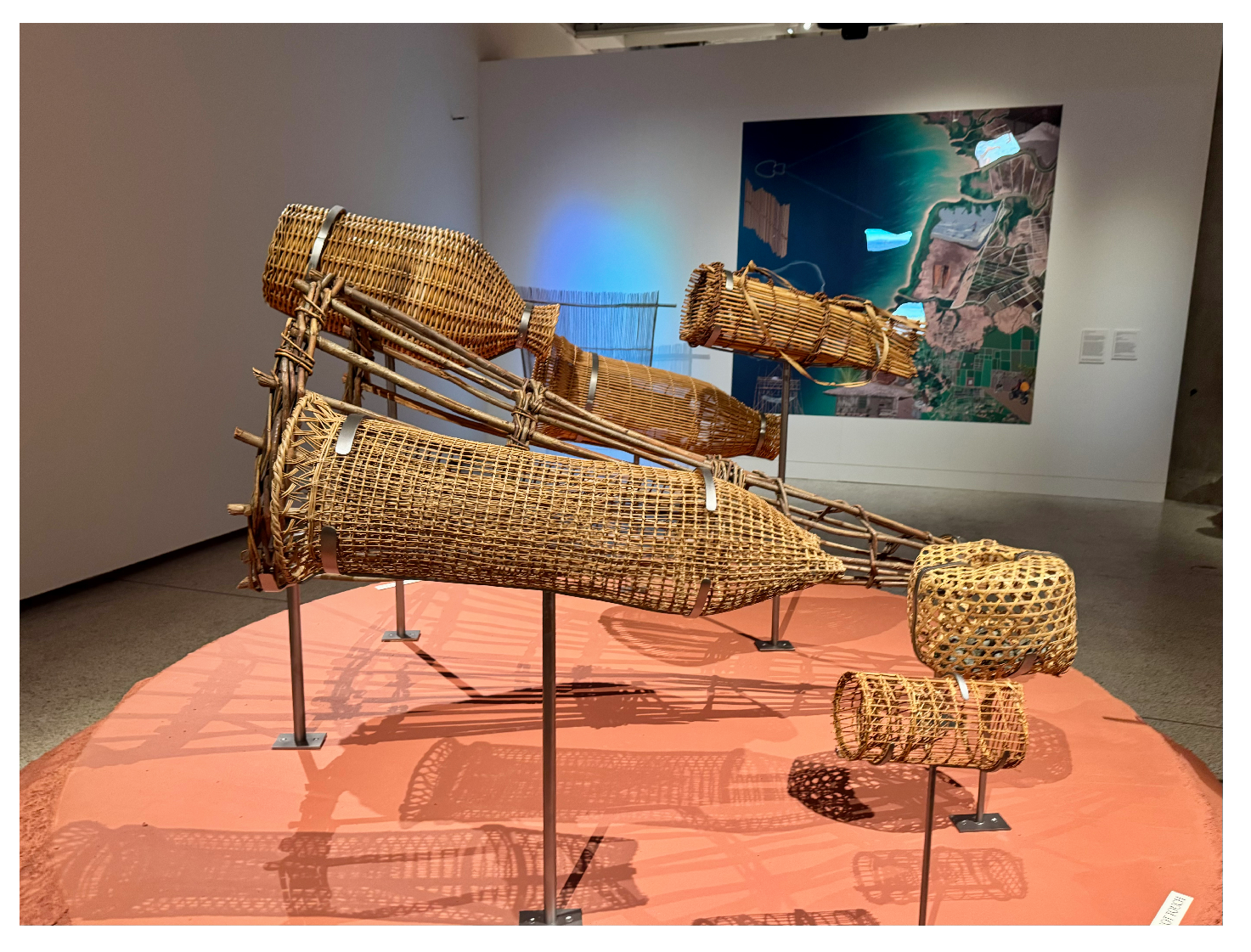
More Than Human attempts to decentralise the human, positioning species, ecologies, and technological systems as co-designers (
Figure 2) (
Design Museum 2025).
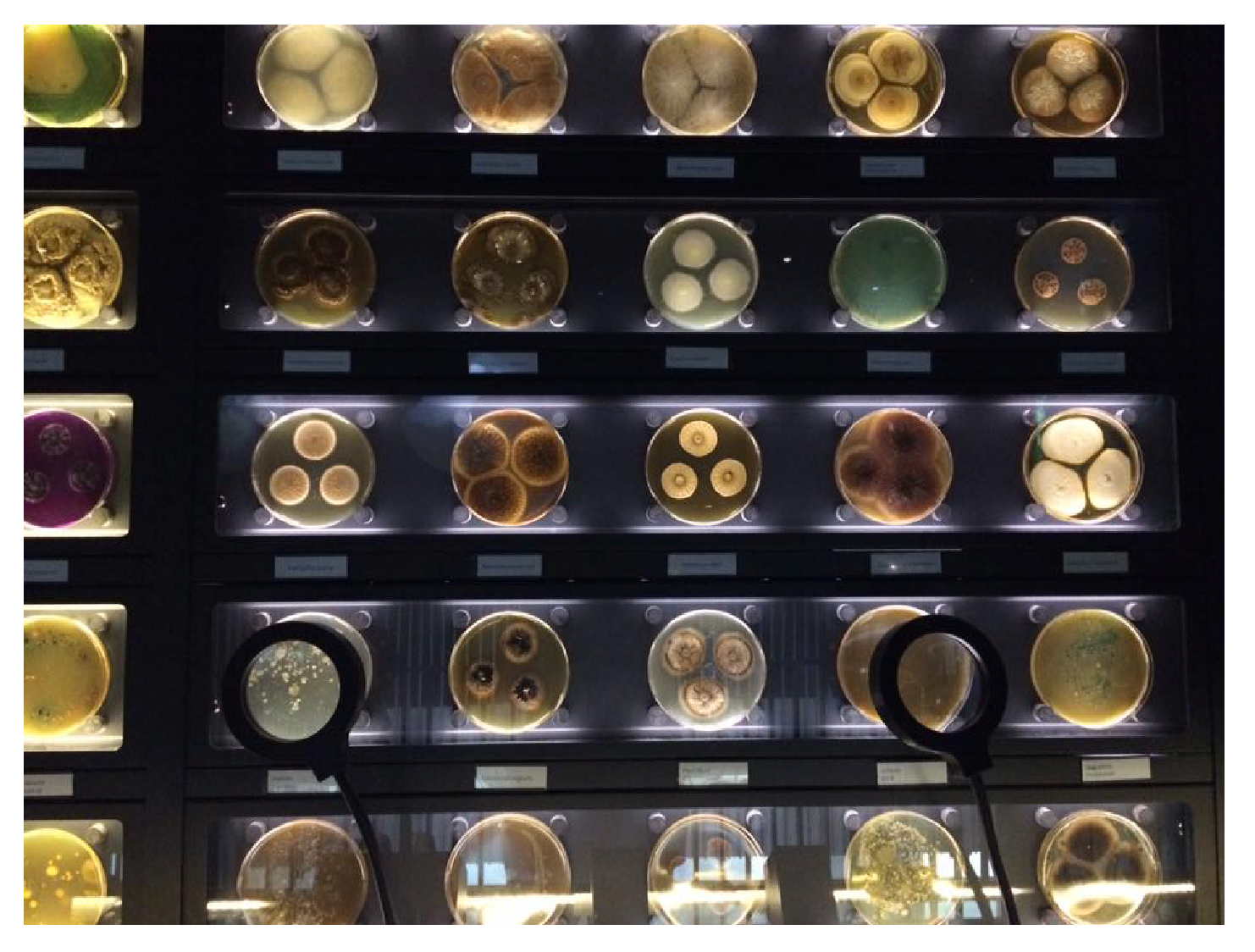
ARTIS-Micropia in Amsterdam, the world’s first museum entirely dedicated to microorganisms, advances this further (
ARTIS 2025). Microbes are kept in
cultures that closely mimic their native habitats, which can be as complex as an entire ant colony, so that visitors can observe their growth, reproduction, and movement (
Figure 3). Transparent walls reveal the daily labour of caring for microbial life, while custom optical microscopes allow visitors to follow the activity of living protozoa.
These examples highlight a central tension in curating
biological otherness: living matter resists the stabilising logics of conventional display cultures. As Hauser (
Hauser 2022) describes, biological art inhabits “moist media”, marked by liveness, instability and responsiveness as defining features. Exhibitions, however, are designed to contain and preserve, often privileging stasis over activity. In this context, technological tools are capable of revealing otherwise inaccessible dynamics, yet equally capable of overshadowing or constraining the material vitality they seek to illuminate.
2. Explorations in Biological Otherness
This paper is grounded in practice-based research in which knowledge emerges directly from artistic and curatorial engagement. The following sections examine three case studies: Living Ashes II, Studies of Interbeing—Trance 1:1, and The Materialised Temporality of Dust to explore how the digital translation of biological otherness can reconfigure exhibition as a relational, multispecies practice. These projects combine studio experimentation, exhibition practice, digital mediation, and reflective documentation, generating knowledge through iterative engagement with living materials, technological translation, and audience interaction. Ethical and political considerations are central: living materials and pathogenic imagery (including SARS-CoV-2) were handled according to institutional protocols, with attention to public perception and the uneven global experiences of the pandemic.
Across these works, technology functions not merely as a representational device but as a political actor that unsettles entrenched hierarchies of knowledge and perception. Living Ashes II employs microscopy and projection to render protocell chemistries perceptible, challenging fixed distinctions between life and death. Studies of Interbeing—Trance 1:1 translates viral particles through textile and digital data, shifting SARS-CoV-2 from a symbol of fear to a relational entity, thereby interrogating the biopolitical regimes that define disease and risk. The Materialised Temporality of Dust uses VR and spatial scanning to materialise microbial life within architecture, recalibrating human perception to encounter nonhuman temporalities and questioning archival authority.
These projects foreground the borderlines between visibility and invisibility, human and nonhuman, and material and digital, making biological otherness both perceptible and generative. They render visible the relational agency of technologies within these processes and demonstrate that exhibiting is no longer merely a practice of display, but an encounter with vibrant matter within a socio-spatial milieu, a mode of dialogue that engages with the agency of nonhuman entities while critically interrogating the mediating role of technologies in shaping the experience and interpretation of biological otherness within exhibition culture.
3. Living Ashes II: Material Vibrancy and Temporal Choreographies
Living Ashes II is a collaborative project that positions ash, residue, and proto-cellular chemistries as active participants in cycles of decomposition and recomposition. Rather than framing these materials as endpoints or symbols of termination, the project approaches them as agents in continuous transformation. In doing so, it unsettles the stabilising binaries that have historically shaped exhibition practices such as life versus non-life, activity versus stillness, and organic versus inert. Ash becomes not what remains after life has ceased, but a milieu through which liveliness persists in altered forms.
The project originated during the
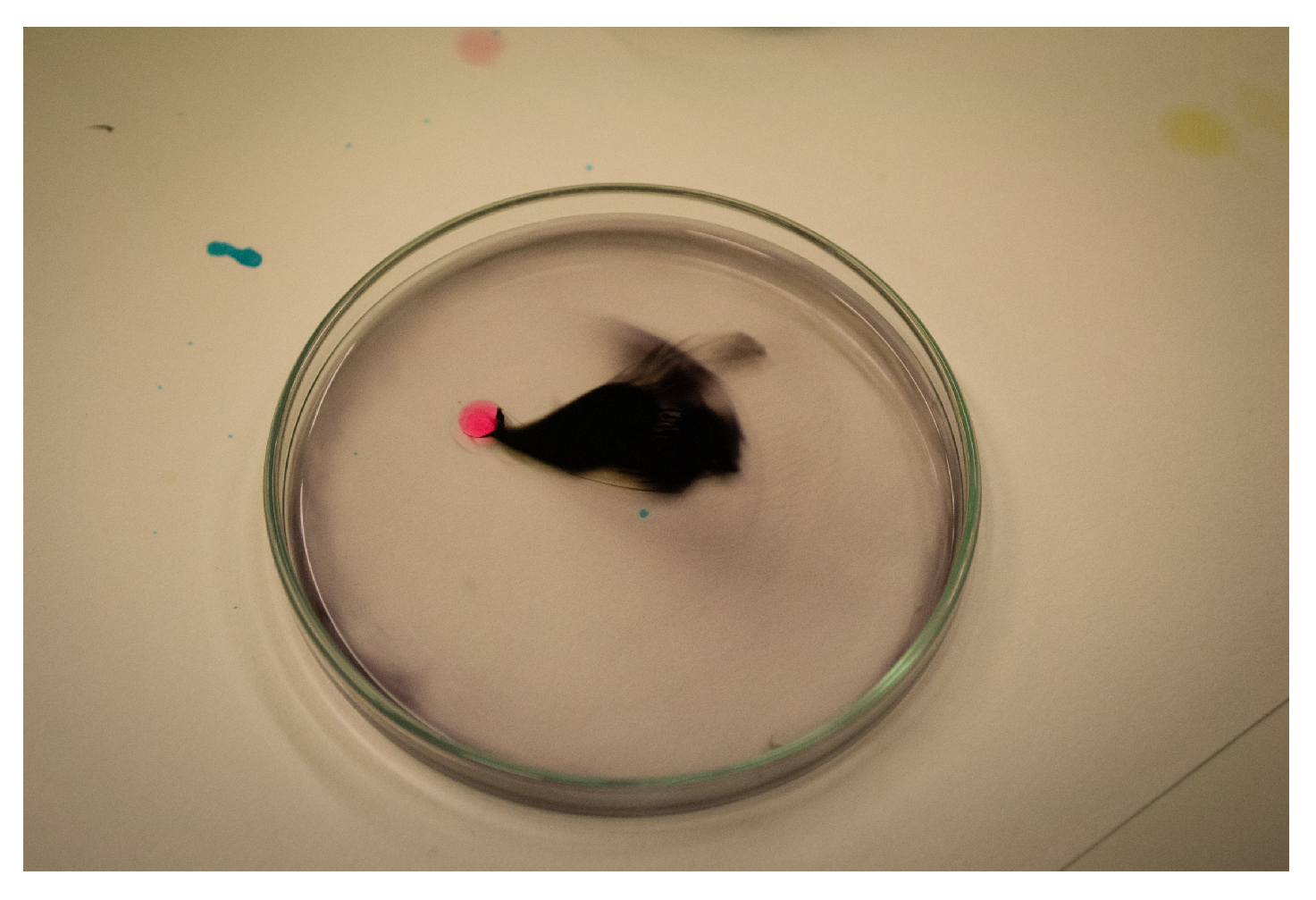
Making Life workshop organised by the Finnish Bioart Society, where Martin Hanczyc introduced participants to protocell research. His demonstrations built on the early studies of Otto Bütschli, who in 1892 observed that simple mixtures of lye and oil produced droplets capable of behaviours reminiscent of early cellular life (
Figure 4) (
Butschli 1894). Engulfing motions, shifting boundaries, and transient pseudopodia emerged from purely chemical interactions. Contemporary protocell science continues to examine such systems, exploring how variants of inert matter can have emergent properties when mixed together, displaying directional movement, oscillation, and temporary organisation. These protocellular dynamics offered a vocabulary through which to explore the thresholds where matter classified as “non-living” begins to exhibit life-like behaviour, challenging inherited assumptions about biological agency.
Although these life-like protocells arise from lye and oil, both materials are ultimately derived from organic, living sources within human culture. Lye is traditionally produced by soaking the ashes of wood or plant matter in rainwater, leveraging the potassium and sodium that are critical for cell signalling and membrane potential. Oils are similarly extracted from living organisms through their metabolic processes. This interplay between living origins and ostensibly non-living matter inspired the first sequel of Living Ashes, in which store-bought lye and oil were used as substitutes for laboratory-grade reagents, connecting protocell experiments to everyday materials and human cultural practices.
This scientific grounding shaped
Living Ashes II, offering a material vocabulary through which to explore the moment where inert matter performs a brief chemical choreography. The project sought to stage the processes involved in extracting the ingredients for protocells and to foreground the conditions under which ash and fatty acids generate dynamic, if fleeting, behaviours. In this sense,
Living Ashes II enacts elastic temporality by juxtaposing the rapid oscillations of protocell chemistry with the slower temporalities of combustion, extraction, and ecological regeneration, rendering visible the unstable boundary between life, death, and transformation. The performance took place on 21 May 2016 at the Click Festival in Helsingør, Denmark, where assembled chemistries responded to one another in real time (
Ramirez-Figueroa et al. 2020). Lye droplets formed within fatty acid solutions, trembled as gradients shifted, and dissolved once their temporary balance with the surrounding medium collapsed. What appeared still or lifeless at one scale revealed a momentary, expressive responsiveness when conditions allowed.
By focusing on ash as a chemically rich and materially active environment, the project reframed it as more than inert residue. It became a substance whose mineral composition could generate new forms of liveliness. Protocells were not positioned as metaphors for life but as thresholds through which to consider how life-like behaviour can emerge from materials conventionally considered beyond the living. This positioning challenges the inherited cultural hierarchies that separate living and non-living matter, suggesting instead that liveliness exists along a continuum and that material forms often dismissed as waste or remnants retain the capacity to act and transform.
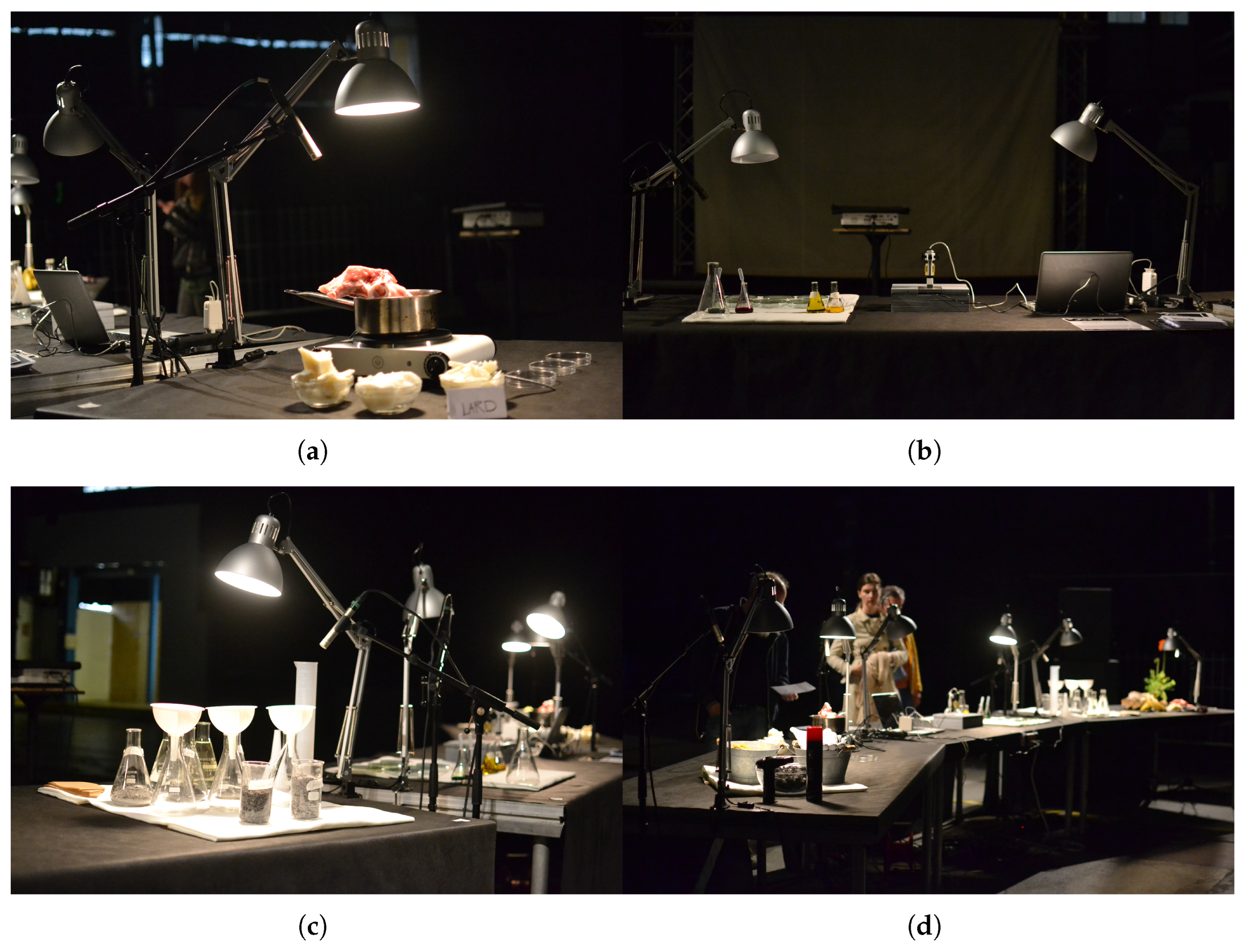
The performance unfolded as a sequence of stations, each revealing a different phase in the material continuum (
Figure 5). Organic matter, including banana husks and tree trunks, was chopped, crushed, and burned and reduced to ash. Pork meat was boiled and its fats rendered and sieved. The ashes were soaked and filtered, releasing potash. Once these components were combined and droplets entered the fatty acid solution, they exhibited movements, oscillations, and temporary membrane formations. These behaviours are only perceivable for a few seconds before protocells disintegrate into fragments. Across this sequence, matter was continually reconfigured, passing between states without ever stabilising into a final form. The work foregrounded material labour: cutting, burning, filtering, and boiling as a curatorial strategy. These acts formed part of the performance itself, emphasising that transformation is a mode of knowledge-making.
These processes operated across multiple temporal registers and foregrounded elastic temporality as an embodied condition. Some transformations, such as the trembling of protocellular membranes, occurred in micro-temporal bursts, requiring magnification to be fully perceived. Others unfolded slowly: the time of burning, the release of minerals from ash, or the broader ecological cycles through which matter re-enters environmental systems.
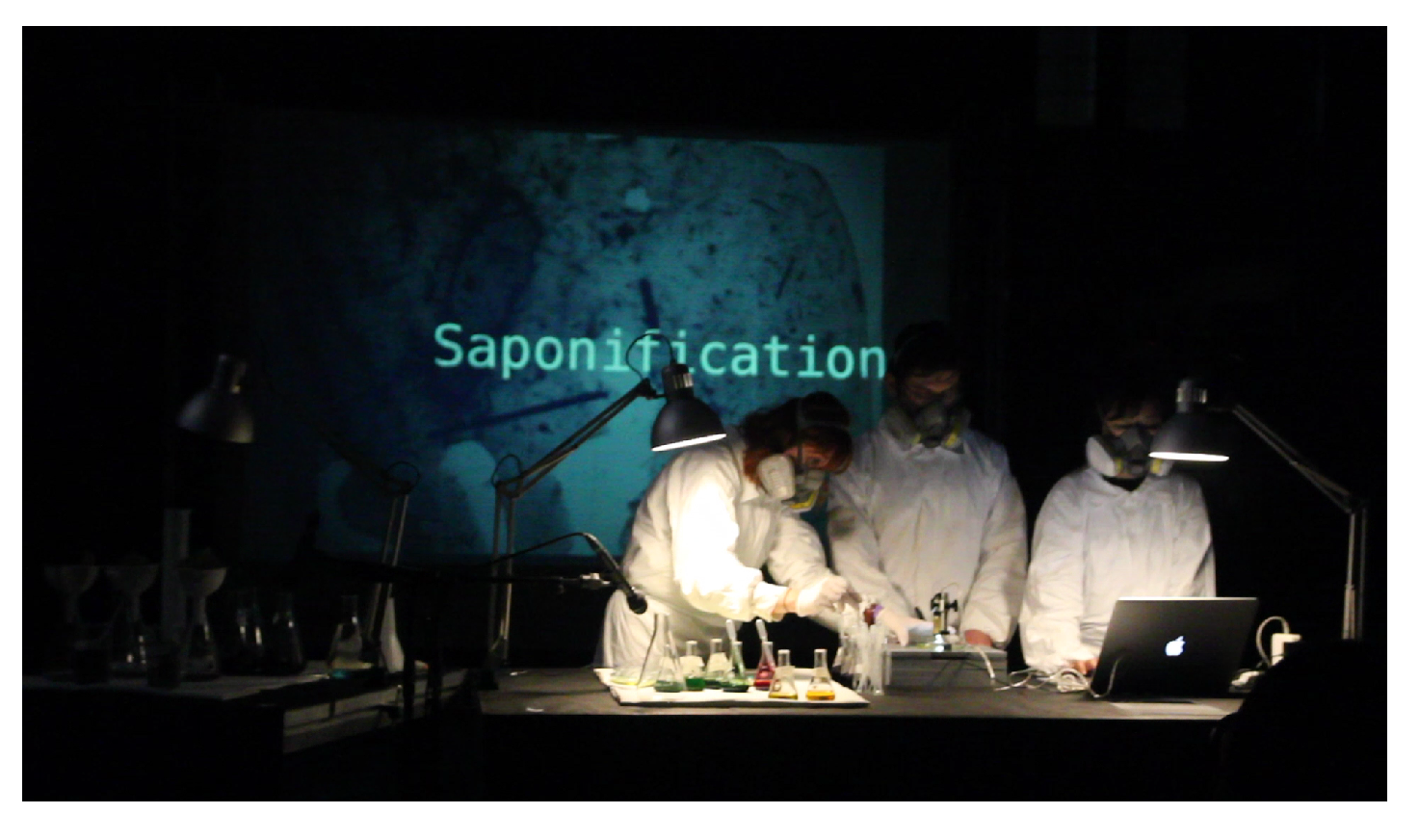
Living Ashes II (
Figure 6) made these layered temporalities perceptible by structuring the performance around three symbolic gradients of “animation” by drawing attention to how matter moves from a “lower” level to animation to the few seconds in which it would climb the animation ladder again. This was inspired by Jane Bennett’s notion of vibrancy that allows a different understanding of matter, one that interrogates the divide between living and nonliving and gives way to a different way of organising ourselves as society (
Bennett 2010).
Technology played a critical role in making these forms of animation accessible to the audience and enabling embodied subjectivity in the social context of a performance. Film, microscopy, and projection served as tools that extended perception, allowing viewers to witness chemical transformations that would otherwise remain invisible and exclusive to researchers. Microscopy revealed the boundary formations and oscillations of protocells; projection expanded these micro-events onto architectural surfaces, creating an immersive field in which the audience could observe matter undergoing rapid and subtle change. In this way, technological mediation participated directly in the enactment of elastic temporality, scaling micro-chemical durations into shared spatial experience. Filmic close-ups captured the dissolution of ash and the turbulence within droplets, challenging the assumption that material stillness corresponds to a lack of activity. These technologies enacted modes of access that allowed the audience to encounter forms of biological otherness—subtle, unstable, and easily overlooked—as active participants in the performance.
Performance was central to the project’s methodology. The structured sequence of reduction, extraction, and reanimation encouraged audiences to move with the material, witnessing transitions rather than outcomes. This emphasis on process fostered a form of collective attunement. The audience was not positioned as passive observers but as participants in sensing and interpreting the transformations unfolding before them. The work cultivated an atmospheric attentiveness, inviting viewers to remain with the ambiguity of matter behaving in ways that challenge familiar categories of life and non-life.
Through these combined strategies, Living Ashes II reconfigures conventional understandings of agency, decay, and material transformation. It questions the cultural frameworks that distinguish living from non-living matter and dismantles the notion that vitality is synonymous with biological animation or endurance. Decomposition appears not as decline but as redistribution, not as disappearance but as reconfiguration. Ash becomes a site where metabolic and aesthetic potentials remain active, where the residues of what once lived continue to participate in ongoing cycles of transformation across compressed and extended temporal scales.
The project mobilises digital technologies to open broader discussions on more-than-human exhibition and performative practices. By foregrounding matter often relegated to the margins, it demonstrates how residues such as ash can function as co-authors in the production of meaning. It invites viewers to consider how definitions of life are shaped not by biological neutrality but by cultural, political, and epistemic infrastructures. It brings the biological otherness of protocells to the centre of the stage. Here, death does not mark an end but introduces a different mode of participation, a shift in how matter interacts, composes, and entangles itself within ecological, cultural, and elastic temporal networks.
4. Studies of Interbeing—Trance 1:1: Virus as Relational Entity
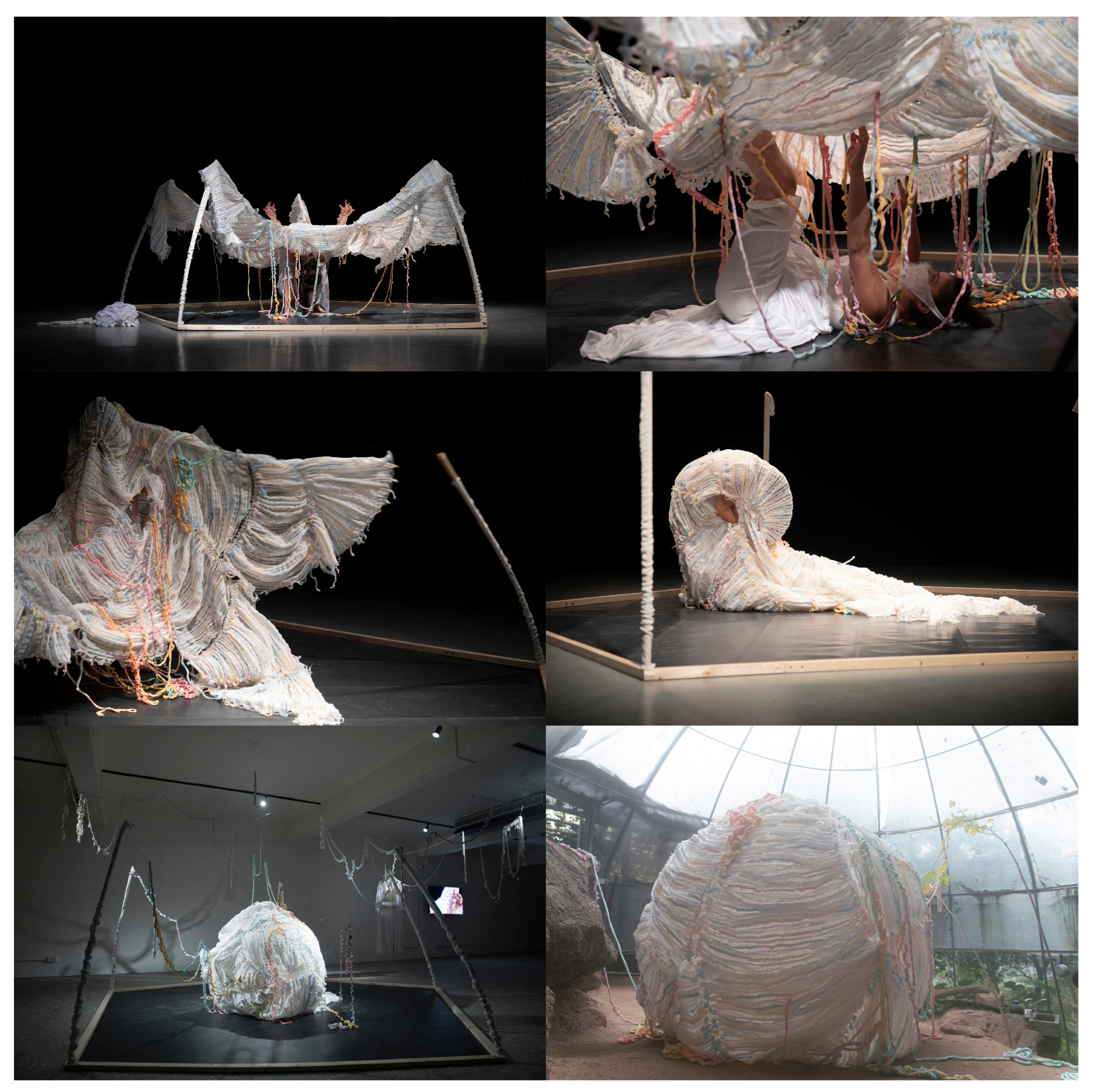
Studies of Interbeing—Trance 1:1 (
Figure 7) explores the entangled and often fraught relationship between humans and the SARS-CoV-2 virus during the COVID-19 pandemic. It emerges from the premise that
biological otherness is not a fixed attribute of viruses but a relational condition produced at the interface between human perception, cultural narratives, and technological translation. Like
Living Ashes II, the project positions a material entity typically framed as threatening, inert, or invisible as a partner in a relational encounter. Instead of reinforcing the rhetoric of invasion, hostility, or eradication that shaped much of the pandemic’s public communication, the project asks how another mode of engagement might emerge when the virus is approached through embodied practice, craft, and experiential encounter. By doing so, it unsettles established binaries such as human versus virus, fear versus reverence, and activity versus passivity, and reframes the virus as a participant within shared biological and cultural processes rather than as a purely destructive agent. In this reframing, the virus is not situated within a singular temporal register of emergency and crisis, but within an expanded and elastic temporality that connects molecular processes, lived experience, and collective memory across scales of time.
The work took shape during the early months of the pandemic in the Netherlands in autumn 2020. At that time, lockdown restrictions were strict, hospitals were under strain, and vaccines were still months away. Fear saturated everyday life. Disinfecting groceries and avoiding touch were common practices, while public communication channels often amplified anxiety in order to encourage compliance with disease-control measures. Visual culture played a significant role in shaping this fear. The now-iconic illustration produced by the US Centers for Disease Control, which depicted SARS-CoV-2 as a grey sphere adorned with red spikes, became the dominant visual symbol of the pandemic (illustrated and coloured by Alissa Eckert and Dan Higgins) (
Eckert and Higgins 2020;
Giaimo 2020;
Hale 2020). Although viruses have no colour, the voluntary choice of palette and style helped cement an image of the virus as an aggressive, weapon-like entity. As Buiani says “visualisation is heavily mediated by, and not severed from, our cultural assumptions and notions of seeing” (
Buiani 2024). Such representational choices reflected and reinforced a hostile imaginary, framing infection as an act of invasion. They contributed to a conceptual separation between humans and viruses, obscuring the fact that viruses exist in reciprocal metabolic and ecological relations with their hosts.
Against this backdrop, Studies of Interbeing—Trance 1:1 seeks to create a space for a different mode of encounter that is open for cross-culture interpretations and discussions. The project unfolds across a large-scale textile installation, collective gatherings, and a series of performances developed between 2021 and 2023 in Taiwan and the Netherlands, engaging participants from both countries with multiple nationalities, including Dutch, Taiwanese, Italian, and Bolivian. Central to the installation is a human-sized knitted SARS-CoV-2 structure occupying more than sixteen square metres, accompanied by a set of knitted voice devices that replay recordings from online gatherings. These gatherings formed a crucial social dimension of the project. Volunteers met regularly via video call to knit components of the virus, particularly the Spike proteins, using a pattern devised from the protein folding structure of a linear amino acid sequence. These informed consented private meetings became safe spaces for sharing personal experiences of the pandemic, including memories of empty airports, early vaccination campaigns, and the emotional turbulence of lockdown. The act of knitting thus operated as a form of collective processing. It made tangible the microscopic dynamics of virus reproduction by translating molecular processes into social, tactile, and communal activity, allowing participants to dwell between cellular events and lived time.
The Performances embody elements that are common to shamanic and ritual practices from around the world. Through movement, sound, and contemplative exercises, the performers interacted with the textile virus as a material presence with its own integrity. The interplay between the performer’s body and the textile virus translates the microscopic activities of viral reproduction into human scale, situating moments of contemplation within a choreography freed from the conventional image of a pathogen. The project was first presented in a closed-door format in the Netherlands in 2021 due to ongoing restrictions. It later evolved into public iterations in Taiwan in 2022, just before a local outbreak, and into a private performance recorded in the mountains of Taiwan in 2023, after the acute phase of the pandemic had subsided. Across these contexts, the virus shifted from an invisible threat to an object that could be touched, carried, danced with, and held. These iterations unfolded across shifting pandemic phases, embedding the work within layered durations of anticipation, outbreak, recovery, and remembrance.
Articulation into scientific and technological mediation constitutes a significant foundation for the work. SARS-CoV-2 cannot be observed by optical microscopy and is accessible only by electron microscopy, cryogenic imaging, RNA sequencing, X-ray diffraction, and computational modelling. These modes of visualisation are deeply rooted in the health and medical sector, where the dominant paradigm frames viruses through the lens of containment and control, a perspective that this project sought to challenge by re-materialising viral structure through embodied practices. The molecular structures of viral proteins are not directly “seen” but are inferred, calculated, and depicted through sophisticated visual languages designed for research precision. Protein Data Bank (PDB) files encode the linear amino acid sequences, spatial coordinates, and structural shapes that computational software translates into stylised digital forms such as ribbons and meshes (
Walls et al. 2020a,
2020b). These tools, although essential for scientific understanding, produce a mode of display dominated by neutrality, abstraction, and reductionism. Their aesthetic and epistemic conventions shape how viruses are imagined and understood by broader publics. They also carry implicit ideological framings that foreground rationality and control, often obscuring the embodied and experiential dimensions of viral presence.
Studies of Interbeing—Trance 1:1 intervenes in this chain of mediation by translating the digital logic of molecular visualisation into textile making. In the project, human hands enact the role of ribosomes. The linear instructions encoded within the PDB files are transformed into a sequence of knits and purls, generating long, soft, malleable strands of “protein”. The knitted Spike proteins mirror the microscopic proteins that fold within host cells during infection, drawing attention to the shared embodied process of transforming linear information into complex three-dimensional structures. The virus’s membrane is reimagined as a double-layered knitted surface, existing in both spherical and unfolded configurations, corresponding to different stages of the viral life cycle. Through this material translation, the viral form becomes something that can be grasped, understood, and physically engaged with. It is no longer confined to the abstract realm of molecular diagrams or to the weaponised imagery of public health campaigns.
The textile virus introduces a new register of encounter, one grounded in tactility and intimacy rather than abstraction or alarm. Its softness, warmth, and malleability allow people to hold, press, and manipulate it, inviting sensory modes of relation that contrast with the disembodied imagery produced by scientific visualisation technologies. This approach also aligns the work with feminist histories of craft and domestic making, situating viral structures within a cultural sphere that encourages fabulation (
Rosner 2018). Through this recontextualisation, the virus becomes not an icon of threat but an object that evokes memories, domesticity, and shared labour, in which participants can freely talk about their embodied feelings beyond the imposed political stances. It invites an affective shift and opens a space where visitors may reflect on the complex entanglement of human and viral lives without the dominance of fear-driven narratives. Performance becomes a critical method for staging these relational possibilities. The movements and rituals enacted with the textile virus foreground the reciprocity between human bodies and biological others, emphasising that encounters with microbes are always embodied and multisensory. The performers do not interpret the virus symbolically, nor do they seek to represent scientific facts. Instead, they strive to inhabit a space in which the viral form is encountered as an active material partner, capable of eliciting emotional, kinaesthetic, and contemplative responses. The textile virus becomes a tool for reconfiguring perception, allowing audiences to recognise how deeply the pandemic shaped bodily awareness, social intimacy, and emotional states.
Through these combined strategies, Studies of Interbeing—Trance 1:1 challenges inherited display cultures surrounding viruses. It shifts the focus from virological data and public health messaging to the lived, felt, and materially grounded experiences that shaped the pandemic. The work contributes to broader discussions on biological otherness by reframing SARS-CoV-2 not as an enemy or an abstract molecular diagram but as a participant in a shared material world. It invites viewers to reconsider how viruses are imagined, communicated, and understood and to recognise that meaning emerges not only from scientific representation but also from embodied, relational, and multisensory encounters. In doing so, the project expands the possibilities for more-than-human exhibition practices and offers a different way of understanding life at its most microscopic yet culturally charged scales.
Studies of Interbeing—Trance 1:1 reimagines SARS-CoV-2 as a multisensorial presence, rendered through textile craft, digital simulation, and choreographies of scale. In doing so, it foregrounds the gap between the biological entity and its cultural construction, inviting audiences to encounter viral otherness differently.
5. The Materialised Temporality of Dust: Multisensory Archives and Microbial Temporalities
The Materialised Temporality of Dust explores the entangled and persistent relationships between humans and dust. The project emerges from the premise that dust is not merely a by-product of human activity, but a biological and cultural agent, a participant in more-than-human temporalities that resist the fixed chronologies of human perception (
Ramirez-Figueroa et al. 2025a). Like
Living Ashes II and
Studies of Interbeing—Trance 1:1, the project positions a material entity traditionally framed as passive, invisible, or undesirable as a partner in a relational encounter. Rather than framing dust as contamination to be removed or cleaned away, the work explores how another mode of engagement might emerge when it is approached through relationality, technological mediation, and multisensory experience. In doing so, it unsettles binaries such as animate versus inanimate, visible versus invisible, and human versus nonhuman, reframing dust as a co-constitutive agent within architectural, cultural, and microbial ecologies. Dust here is understood as operating across layered durations, where microbial persistence, architectural change, and human presence intersect.
The project took shape within the Royal College of Art’s Kensington Library, a site imbued with layered histories and human presence. The building, completed in the 1960s and reconfigured in the 1980s, carries material traces of creation, abandonment, and adaptation. Dust accumulates silently in corners, along shelves, and upon forgotten surfaces, registering the passage of time and the traces of activity or neglect. It is composite, contingent, and alive, formed of skin, hair, fibres, spores, and microorganisms. Each layer a sediment of past and present, human and nonhuman entanglements (
Owens 2023;
The Human Microbiome Project Consortium 2012). Dust, here, becomes a living archive, a site of memory that is neither fixed nor legible in human terms, a materialisation of time and experience that unfolds across scales inaccessible without mediated perception.
Conceptually, the project approaches dust as a parallel archive, one that resists the authority, selectivity, and legibility of conventional archival practice (
Derrida and Prenowitz 1995;
Ramirez Figueroa et al. 2025b). Traditional archives operate according to fixed logics of inclusion, authorship, and preservation. Dust, in contrast, drifts, settles, resettles, and transforms. It accumulates opportunistically, follows unpredictable trajectories, and carries within it microbial temporalities that exceed the human scale.
Bacillus subtilis, a ubiquitous soil and airborne bacterium, exemplifies this temporal complexity. Its life cycle includes sporulation and dormancy, allowing it to persist and regenerate across tens of thousands of generations in temporal frames far removed from human experience (
Nicholson et al. 2000). Dust, in this sense, embodies a slow, accumulative memory, an archive of persistence that operates through latency, sedimentation, and transformation rather than codification. Its temporality is neither linear nor static, but cyclical and recursive, shaped by processes of suspension, activation, and return.
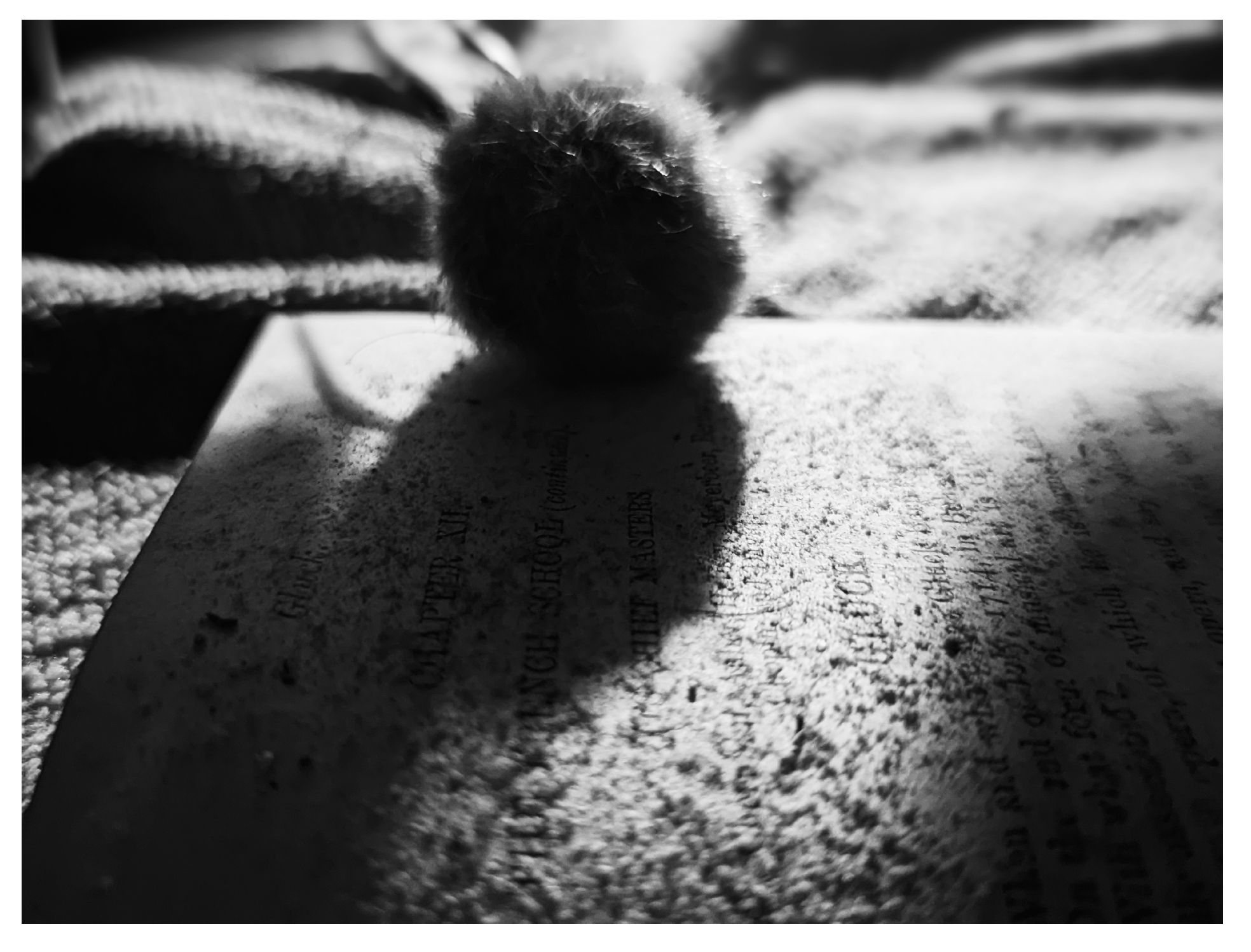
To engage with these nonhuman temporalities, we developed a methodology of un-cleaning, which embraces contamination and positions dust and microbial communities as active participants rather than passive detritus. Un-cleaning exists in what Leonardi terms the “practical instantiation” of material: a cyclical movement between dust collection, digital mediation (LiDAR, Unity, VR) and embodied experience. As Leonardi notes, digital artefacts can possess material properties, and our workflow demonstrates this continuity (
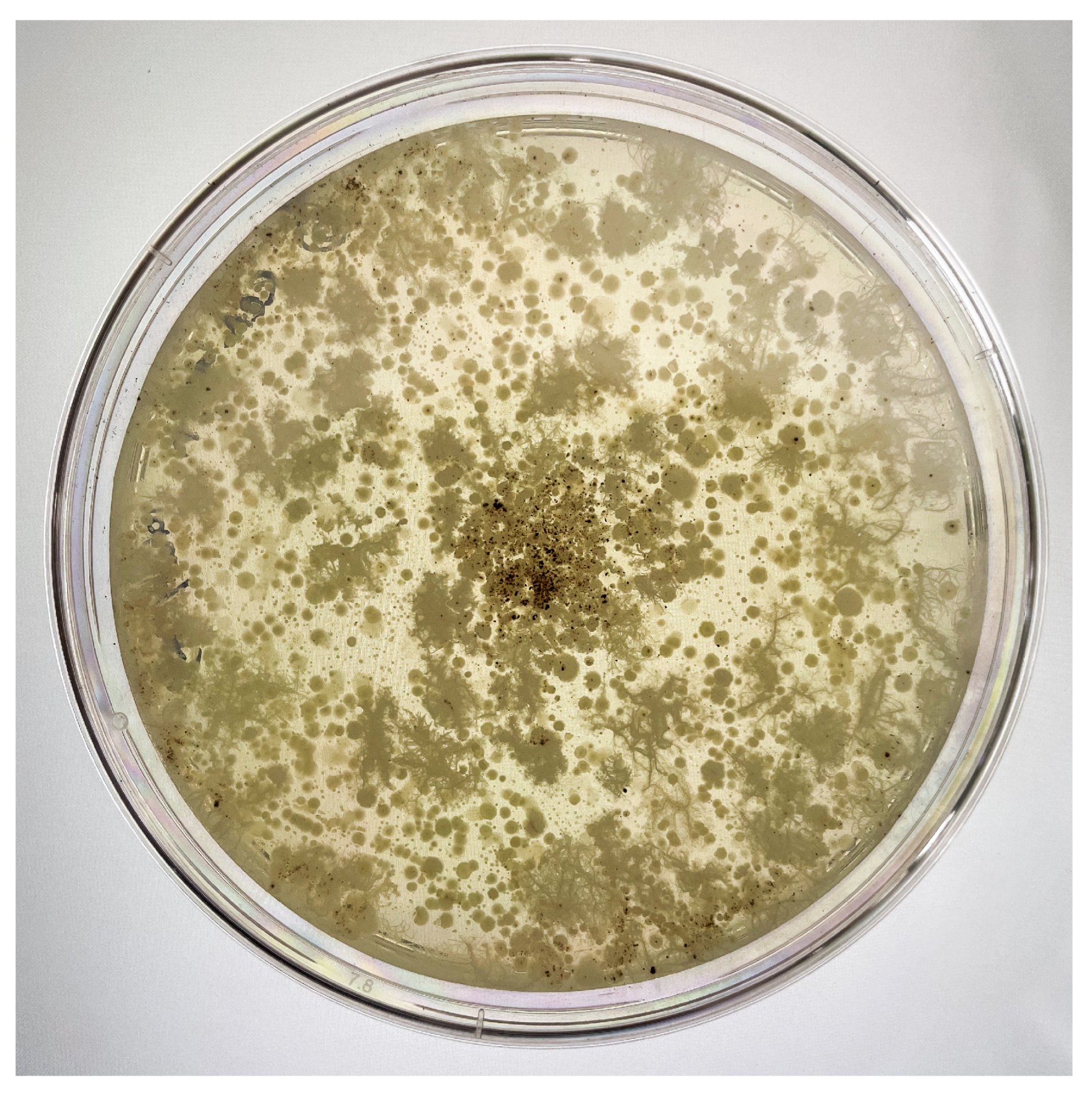
Leonardi 2010). We collected dust and microbial life on agar plates (
Figure 8), captured spatial data through LiDAR and photogrammetry, and translated these into a VR environment via Unity. Spatial audio operates as a temporal mediator, revealing cycles of dormancy and activation imperceptible to the unaided human senses. Through each stage, the materiality of the
biological other transforms from physical to digital while retaining presence and affective power in the encounter between human and microbial worlds.
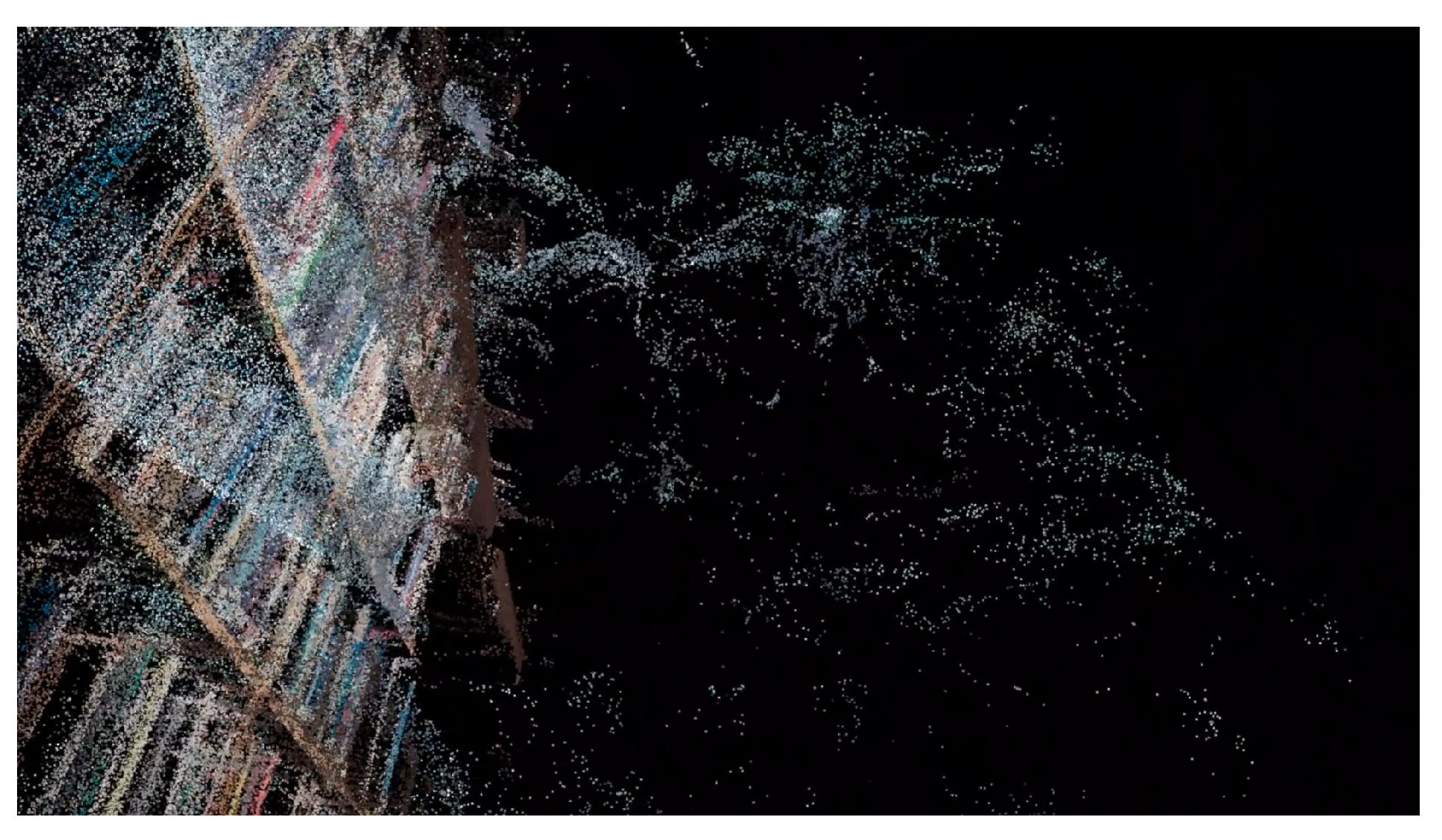
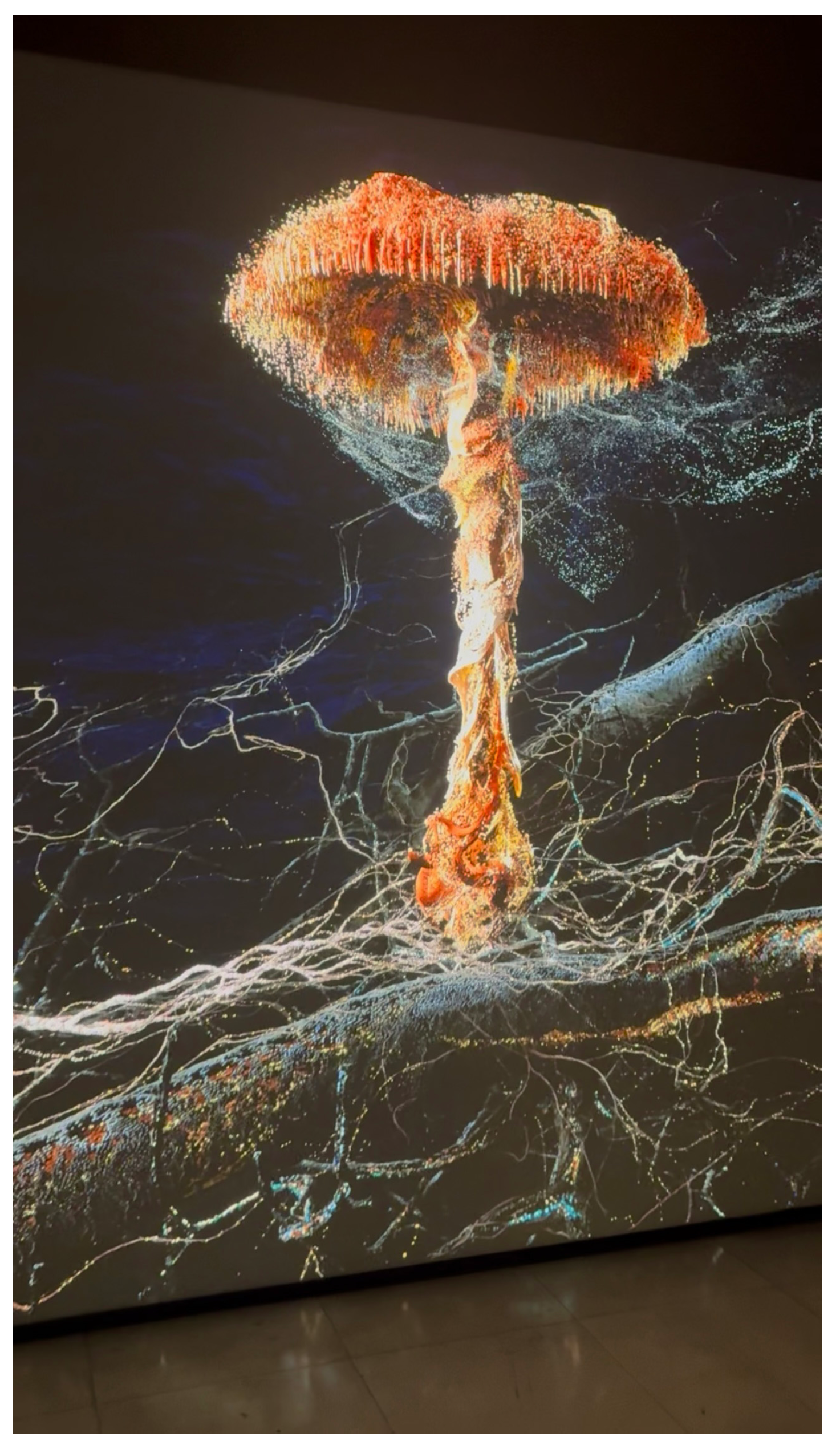
The three-minute immersive VR experience invites participants to experience what it would be like to become a particle of dust, scaling them to microbial dimensions and reconfiguring perception to align with dust’s temporalities (
Figure 9). The narrative begins in the library where archival photographs and spatial reconstructions allow participants to witness and inhabit the accumulated traces of human and microbial presence. They encounter the library through the lens of
Bacillus subtilis, entering states of latency and sporulation, observing generations of microbial replication, and sensing the slow accumulation of dust over decades. The work emphasises embodied perception in line with Merleau-Ponty’s understanding of the body as interpretive and enactive, where knowing arises through situated engagement rather than abstraction (
Merleau-Ponty 2002). Here, human perception is stretched beyond habitual scales, attuning participants to tempos that are ordinarily imperceptible.
Within this framework, dust operates as a mediator of relational knowing. It carries traces of human activity, while also asserting its agency through persistence, transformation, and temporal depth. The VR experience dissolves conventional perspectives, destabilising scale, orientation, and spatial hierarchies. Designed as a one-to-one encounter, participant movements become inputs for navigating the space through layered point clouds derived from LiDAR scans of the library, revealing architecture not as fixed, but as porous, entangled, and co-constituted with microbial life. The point clouds are modular and dispersed, reflecting dust’s particulate logic and enabling real-time engagement within untethered VR headsets. Navigation is intuitive and immersive, fostering a sense of free-floating exploration while maintaining the speculative choreography of microbial life cycles.
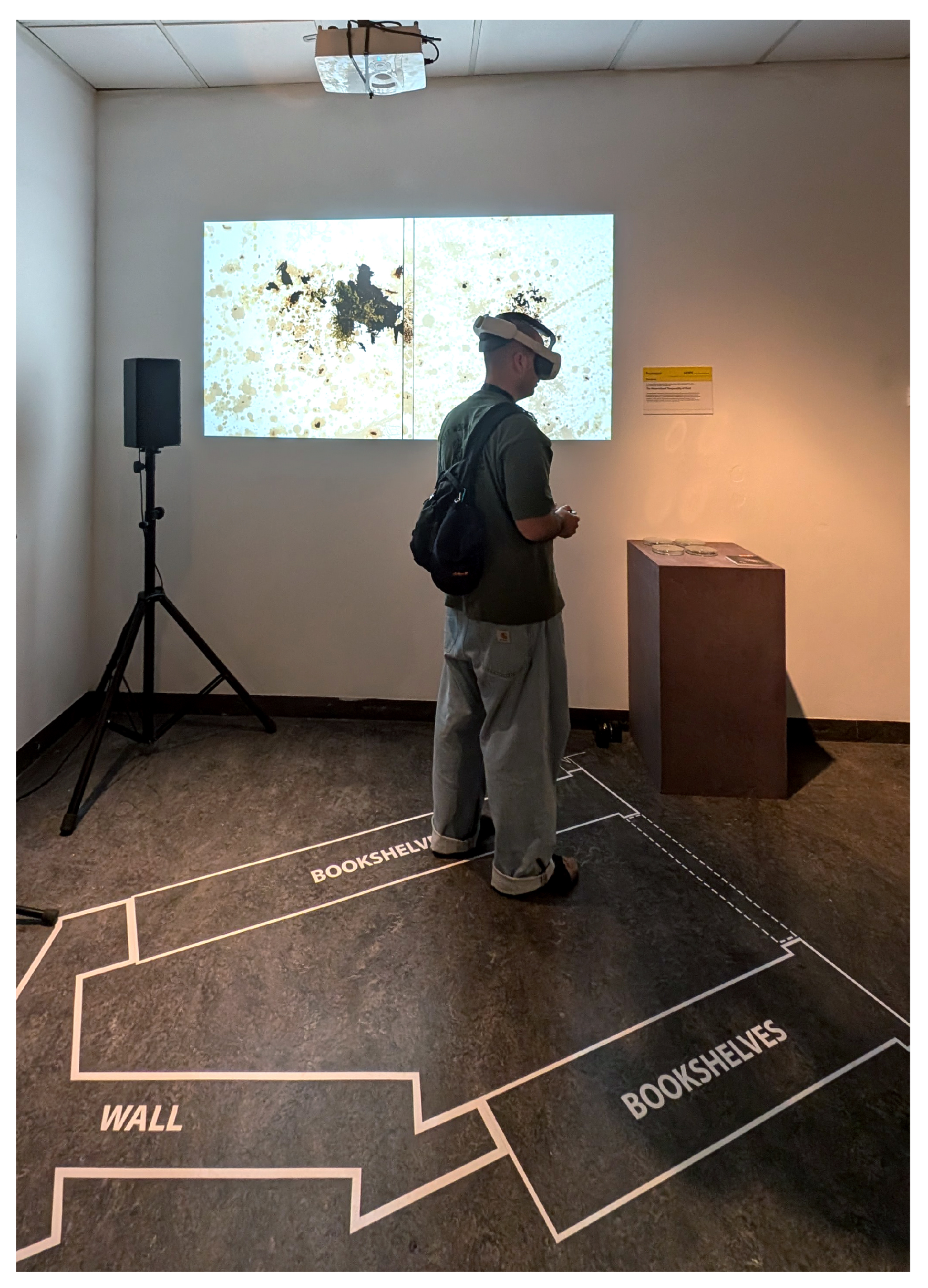
Exhibiting the work introduced additional considerations around how immersive technologies structure modes of access. Virtual reality is typically designed to be experienced individually, which sits in tension with the shared and often time-constrained conditions of exhibition settings. Within
Beyond the Veil at Ars Electronica 2024, these conditions shaped how participants experience the piece, influencing the depth and texture of their encounter (
Figure 10) (
Royal College of Art 2024). The three minutes were often perceived as far longer than they actually were. Participants described oscillations between comfort and discomfort as they navigated shifting scales and unstable vantage points, encountering the unfamiliar tempos and spatialities of dust. The exhibition setting became an active component of the work, mediating the encounter with
biological otherness and highlighting the sensitivities of perceptual and affective attunement when technologies invite participants to inhabit more-than-human temporalities.
Soundscape design constitutes a central axis of temporal translation. Layered, ambient, and distorted, the sonic field makes microbial rhythms perceptible through the body. It is rendered in three-dimensional space and spatialised in real time according to the participant’s physical position and orientation. Ultrasonic field recordings, granular synthesis, time-stretching, and manipulation render processes of dormancy, activation, growth, and dispersal audible in ways inaccessible to unaided human perception (
Figure 11). Sound is experienced not as accompaniment, but as medium, archive, and guide. It allows participants to inhabit dust’s time, to linger in latency, and to experience microbial agency as a multisensory phenomenon. Combined with VR, the soundscape produces what might be described as a nonhuman scale of attention, fostering reflection on the endurance, transformation, and affective presence of the dust archive.
Through these strategies,
The Materialised Temporality of Dust intervenes in inherited display cultures and epistemologies. Dust is removed from the frameworks of sterilised presentation and detached visualisation, asserting instead a presence that is tactile, auditory, and temporal. Technological mediation becomes a conduit for relational engagement rather than abstraction, foregrounding multisensory, affective, and speculative modes of understanding. The work aligns with feminist and posthuman histories of craft and relational practice, emphasising care, attention, and embodied attunement to nonhuman temporalities (
Bennett 2010).
In foregrounding microbial temporalities, the project expands the conceptualisation of archives and materiality. Dust does not categorise or preserve in human terms, but persists, sediments, and transforms across generations of human and microbial activity. The participatory VR experience positions participants within these temporal flows, producing knowledge through becoming-with, sensing-with, and inhabiting rather than through measurement or representation. Dust functions as an archive of experience, entanglement, and co-existence, challenging assumptions of linearity, stasis, and human authorship.
The work also addresses the politics of dust as a material archive. Dust carries traces of human hierarchies, environmental management, and historical neglect. It mediates power, memory, and presence, revealing the absences and residues of institutional practice. The methodology of un-cleaning, in turn, repositions these residues as generative, illuminating histories and ecologies often rendered invisible or undesirable. Dust’s persistence becomes a critique of institutional logics, highlighting the ways in which nonhuman agents continually shape, contaminate, and co-produce space.
The Materialised Temporality of Dust articulates a conceptual and methodological framework for engaging biological otherness through experiential and material translation. Dust is positioned not as passive residue but as an active participant within ecological and temporal networks. Through technological mediation, particularly VR and spatial sound, the project makes particulate and microbial temporalities perceptible and affectively resonant. In doing so, it challenges conventional display cultures, interrogates the politics of archives and spatial memory, and foregrounds multisensory, embodied encounters with nonhuman entities.
6. Discussion
The three projects examined, The Materialised Temporality of Dust, Living Ashes II, and Studies of Interbeing—Trance 1:1, demonstrate how exhibitions can operate as relational laboratories in which biological otherness becomes perceptible, meaningful, and politically charged. Each work mobilises digital technologies not as representational prostheses but as active agents that modulate how nonhuman entities are perceived, behave, and participate, they create zones of encounter within that gap, enabling multisensory, relational engagement. Through these mediations, biological otherness is not merely revealed but co-produced, emerging from the interplay between materials, technologies, bodies, and curatorial decisions.
This co-production is not seamless. A generative friction arises when exhibition technologies translate the physical and temporal materiality of biological others into forms perceptible to human bodies. The frisson between microbial rhythms and digital mediation produces a productive turbulence that unsettles assumptions of technological neutrality. Rather than smoothing difference, these works stage the gap between human sensory capacities and more-than-human temporalities, allowing critical engagement with the socio-political and ethical dimensions of working with living systems.
Across the case studies, mediation does not stabilise the nonhuman but renders its dynamism and instability more vivid. In Living Ashes II, microscopy and projection expose the fleeting vitality of protocells, producing an aesthetics of emergence that unsettles distinctions between life and non-life. Studies of Interbeing—Trance 1:1 reframes the virus not through authoritative scientific imaging but through textile translation and performance and embodied gesture, shifting the encounter from abstraction to intimacy. The Materialised Temporality of Dust uses VR, immersive sound, and spatial mapping to complicate the assumed neutrality of dust, granting it temporal depth and multisensory presence.
These diverse strategies point to a shared principle: nonhuman entities become encounterable only through mediating practices that are themselves situated, partial, and ideological. Technologies amplify certain dynamics while obscuring others, while also operating as a temporal scale machine; structure the rhythms, scales, and narratives through which nonhuman agencies are perceived; amplify the clinical gaze shaped by histories of surveillance and diagnosis. Projection technologies carry the aesthetics of spectacle and visibility. By foregrounding these mediations rather than treating them as transparent conduits, the projects reveal the epistemic, aesthetic and biopolitical histories embedded in digital tools.
At the same time, each project resists technological domination. Mediation is choreographed in ways that avoid converting matter into spectacle or data. Instead, technologies are carefully charged, sensitised to material fragility, environmental conditions, and embodied modes of perception. Sound, touch, scale, and spatial arrangement become as critical as image fidelity or resolution. These curatorial calibrations are forms of care: they protect fragile protocells from heat, allow a knitted virus to sustain its softness and scale, and ensure that dust’s microbial heterogeneity is not flattened into a visual diagram.
A further layer of relationality emerges through the recursive entanglement of craft and code. Each case study enacts this relationship differently. Living Ashes II begins with material craft—the burning, filtering, and rendering of ash—before digital mediation renders protocellular chemistries perceptible through microscopy and projection. Studies of Interbeing—Trance 1:1 reverses this process: it starts with the abstractions of viral visualisation and returns them to craft as knitted structures that are handled, worn, and danced with. The Materialised Temporality of Dust presents a more explicit loop, where dust is collected through embodied practice, translated into point clouds and spatial audio, and then re-encountered through movement in VR. Across these works, neither technology nor craft dominates. Each modulates the other, generating liminal zones of encounter with biological otherness that hover between the abstraction of code and the materiality of making.
Through such practices,
biological otherness is not instrumentalised but kept open, capable of surprising, resisting, and reconfiguring human perception. Exhibitions operate as more-than-human assemblages, cultivating modes of attention attuned to uncertainty, instability, and relationality. The case studies address what Fiona Cameron describes as a “crisis of curation” where traditional museology often embodies hubris, exceptionalism, and anthropocentric thinking (
Cameron 2023;
Fox 2025). By centring relational multispecies zones of encounter, these works reconceptualise museology as ecological, embedded, enmeshed, and embodied. They ask what it means to encounter ash, viruses, or dust not as inert objects or hazards but as active participants whose agencies are distributed across temporal, spatial, and material registers. Technologies function not as authorities of knowledge but as facilitators of relational encounter and perceptual attunement.
7. Conclusions
In this paper, we argued that contemporary exhibitions engaging with biological otherness reveal a critical shift in how life, matter, and technology are staged. Traditional display cultures, anchored in Western binaries of nature/culture, human/nonhuman, animate/inanimate, have long constrained how biological entities are perceived and valued. The case studies presented here challenge these hierarchies by showing how biological otherness emerges relationally, through mediated encounters that redistribute perceptual and epistemic authority.
Digital technologies occupy an ambivalent position within this shift. They extend human perception into otherwise inaccessible scales and temporalities, yet they also carry inherited logics shaped by scientific, industrial, and biopolitical histories. The works analysed in this paper expose this ambivalence while demonstrating how technological mediation can be recalibrated toward more ethical and generative ends. When treated not as neutral tools but as co-actors, technologies can support encounters that foreground the vibrancy, complexity, and relational agency of nonhuman matter.
Across ash, viruses, and dust, the projects reveal that biological otherness is not an attribute of certain materials but a condition generated at the threshold of perception, where human sensibilities meet the unfamiliar. Exhibitions become sites where this unfamiliarity is negotiated, where sensations of strangeness, intimacy, discomfort, and wonder invite new understandings of more-than-human relations. Such encounters resist reductive narratives, allowing nonhuman entities to remain lively, ambiguous, and situated within ecological and cultural continuities.
Ultimately, we propose that exhibiting biological otherness requires a curatorial ethic grounded in care, attunement, and relationality. We call for exhibition practices to move beyond representation to cultivate spaces where living and non-living matter can participate meaningfully in shared worlds. By acknowledging the agency of materials, technologies, and nonhumans, such practices expand the possibilities of more-than-human exhibition-making. They invite us to reimagine not only how biological otherness is displayed but how it might reshape the perceptual, epistemic, and political framework of contemporary culture.