3.1. Kolam in Public Spaces as Creative Place Making by Tamil Community in Singapore
Singapore has a significant Tamil population consisting of early migrants from South India and Sri Lanka who arrived at the time of colonization and recent migrants from around the globe. They form one of the three main ethnic groups that make up the nation. The majority of Tamils living in Singapore are Hindus and Tamil is one of the official languages, evident in signage and documents. Cultural practices are expressed through the celebration of festivals in homes, in public spaces such as temples during worship, and in retail spaces where items for personal, devotional, and domestic use are sold.
The harvest festival of Pongal is a time when Kolam drawings are seen in their abundance in Singapore. It was an opportunity to witness the performance of drawings created collectively in public spaces through chance encounters and as community events. Furthermore, it demonstrated how threshold spaces were determined within public spaces. The performance of rituals is part of the domestic lives of Tamil women often not on obvious display to catch the gaze of the broader public in a formal manner or even the members of the household.
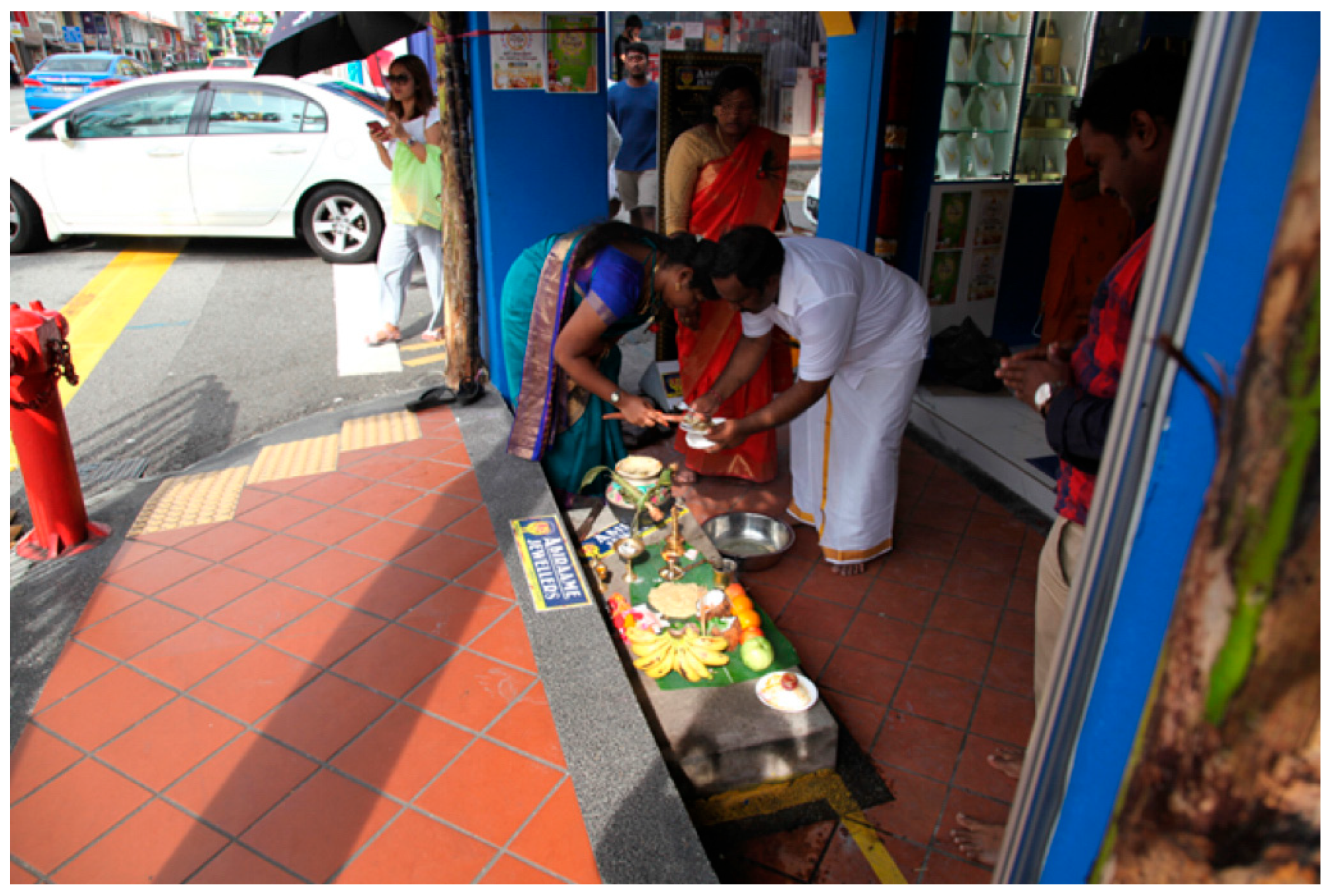
Retail stores in the Indian commercial quarter of Singapore became sites for
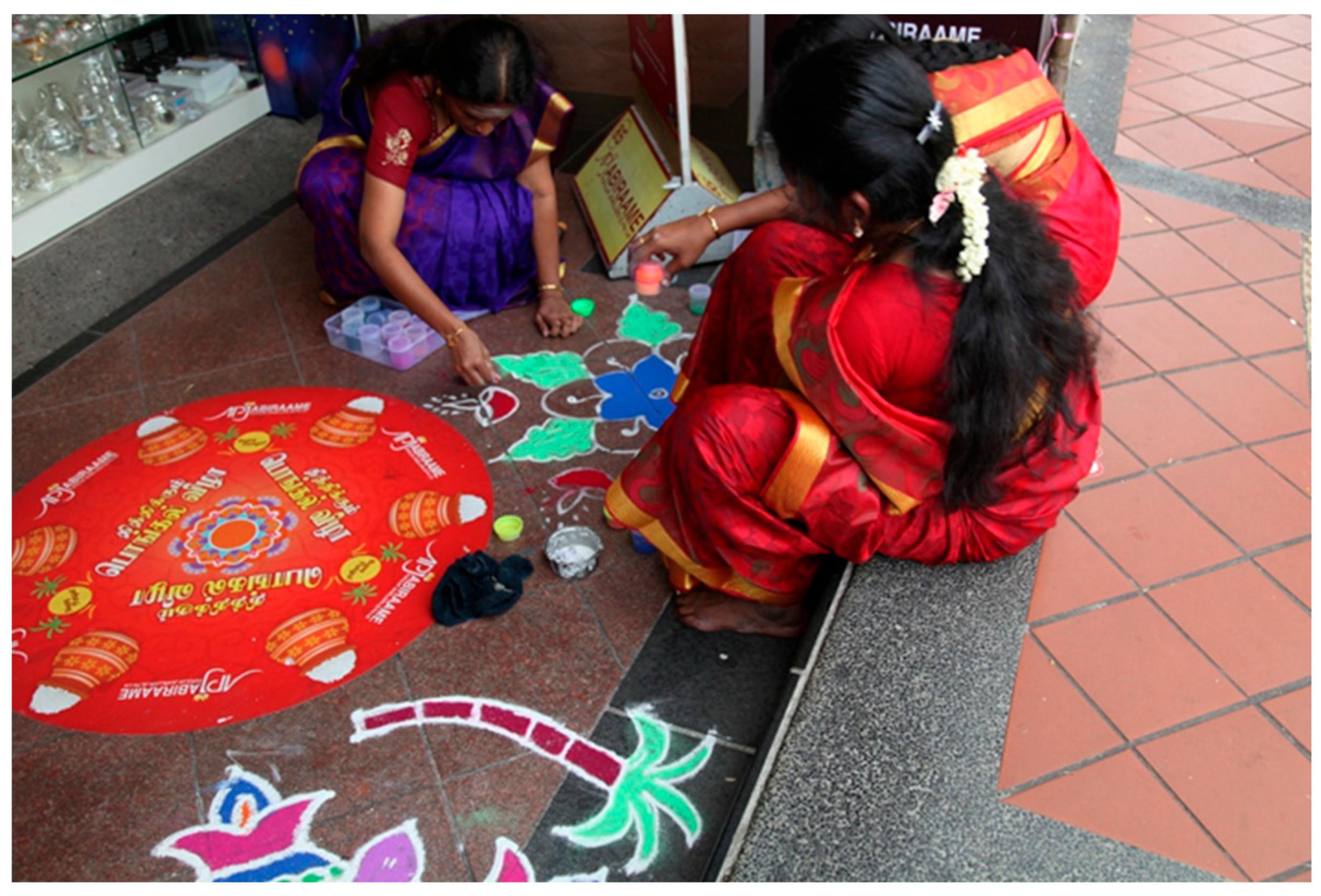
Kolam creations in a collective manner. Women associated with one store used a common public passageway directly opposite the store to create the ritual drawing (
Figure 1). It may have appeared an unconventional site when considered from a Euro-American and risk-averse perspective. The mere fact that the entrance intersected with a passageway for the public was the feature that lent itself as a signifier of a threshold, a ‘charged location’ to mark the site on this auspicious occasion. It enabled passersby to slow down, to notice, and pay reverence.
The wearing of vividly colored Saris that were richly designed, the adornment of bangles, and flowers in the hair reflected the festive nature of the occasion. The women, who were barefoot, squatted or sat on the raised footpath in order to bring their bodies close to the ground. They drew a communal
Kolam, using their fingers to deliver the rice flour mixed with vivid pigments. Casual conversations occurred during the creative process. The initial outline drawn using cloth dipped in rice flour slurry guided the development of the floral motif. The materials and items used in the creation of the
Kolam were present in proximity for the women to readily access. Witnesses observing the practice could draw a relationship between the materials and how they were being used in the
Kolam being drawn. A container with rice flour slurry and a rag were on the ground with an array of pigments in containers, an active site of creation. In addition to the ephemeral floral
Kolam being created, there was a modern version of the
Kolam applied as an adhesive sticker onto the floor to indicate the celebration. An ephemeral
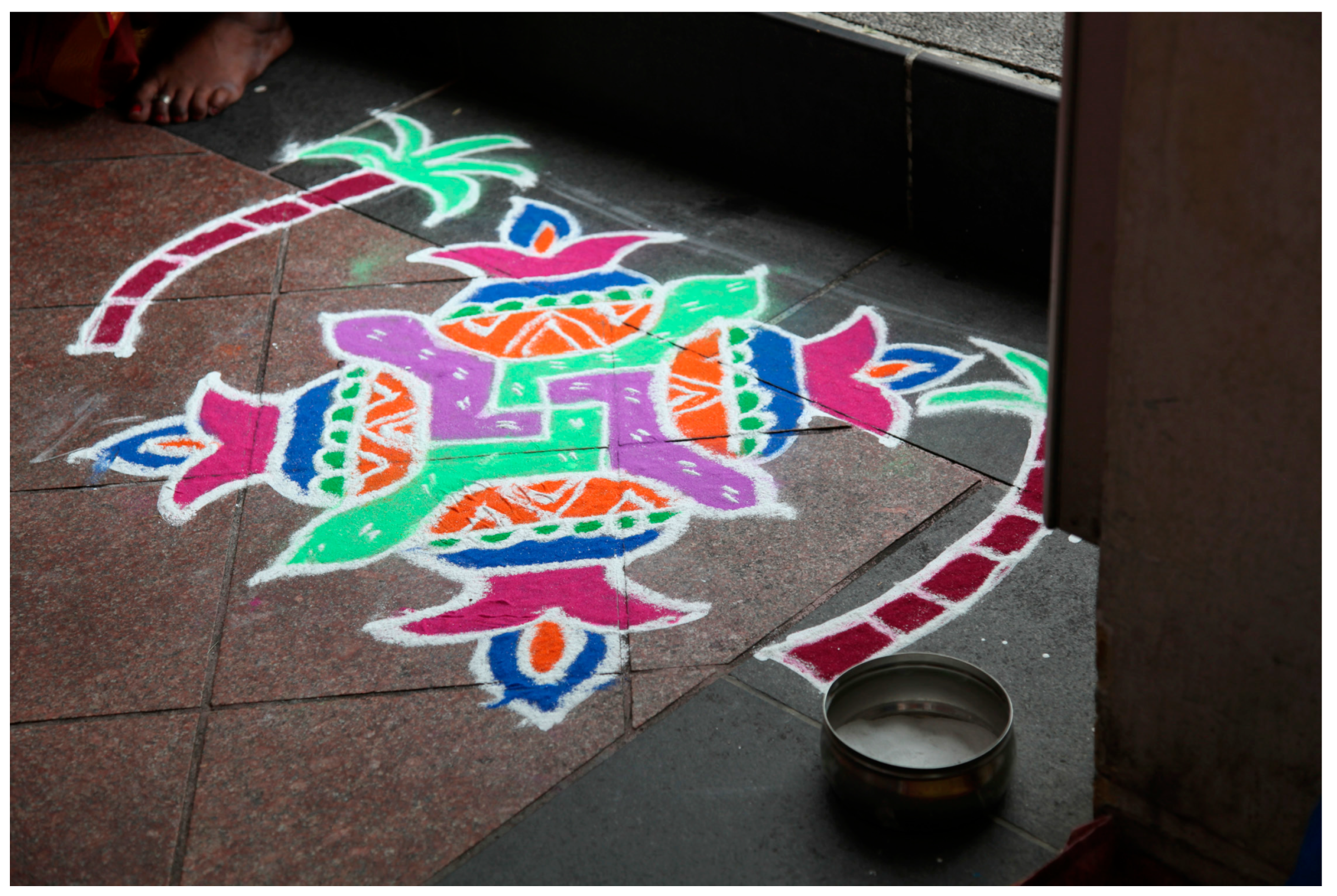
Kolam drawn earlier showed a recognizable pictorial form of
Pongal Kolam. It represented a decorative clay pot (
Figure 2) in which rice is boiled for harvest celebration.
A group gathered to celebrate in front of another store. Rice was cooked in a clay pot to serve to the community (
Figure 3) as a gesture of harvest. An act of offering on a banana leaf was made alongside. These devotional and social activities to celebrate the auspicious day occurred in proximity to a busy road and foot traffic, the senses absorbing the many sounds and activities of the urban surrounding, simultaneously.
New adhesive stickers of Kolam designs to replace the old and traces of ephemeral Kolam drawings during Pongal were visible across public spaces in the predominantly Tamil commercial sector of Singapore. Activities associated with the devotional, cultural and domestic domains became integrated as part of marking the Pongal festival in public spaces that included the ritual of Kolam. The occasion was shared with the Tamil community as well as with other ethnic communities in Singapore who often participate in aspects of the celebration.
3.2. Transformation of Public Spaces by Tamil Community in Australia on Auspicious Days
Tamil communities as part of the larger South Asian diaspora also gather in public spaces across various states in Australia to enact
Kolam drawings on auspicious occasions. A gathering of the Tamil community occurred in the Robelle Domain Parklands in Springfield, a suburb of Ipswich in Queensland, to celebrate
Pongal in 2023. The floor of the stage became the threshold site of an evolving performance of
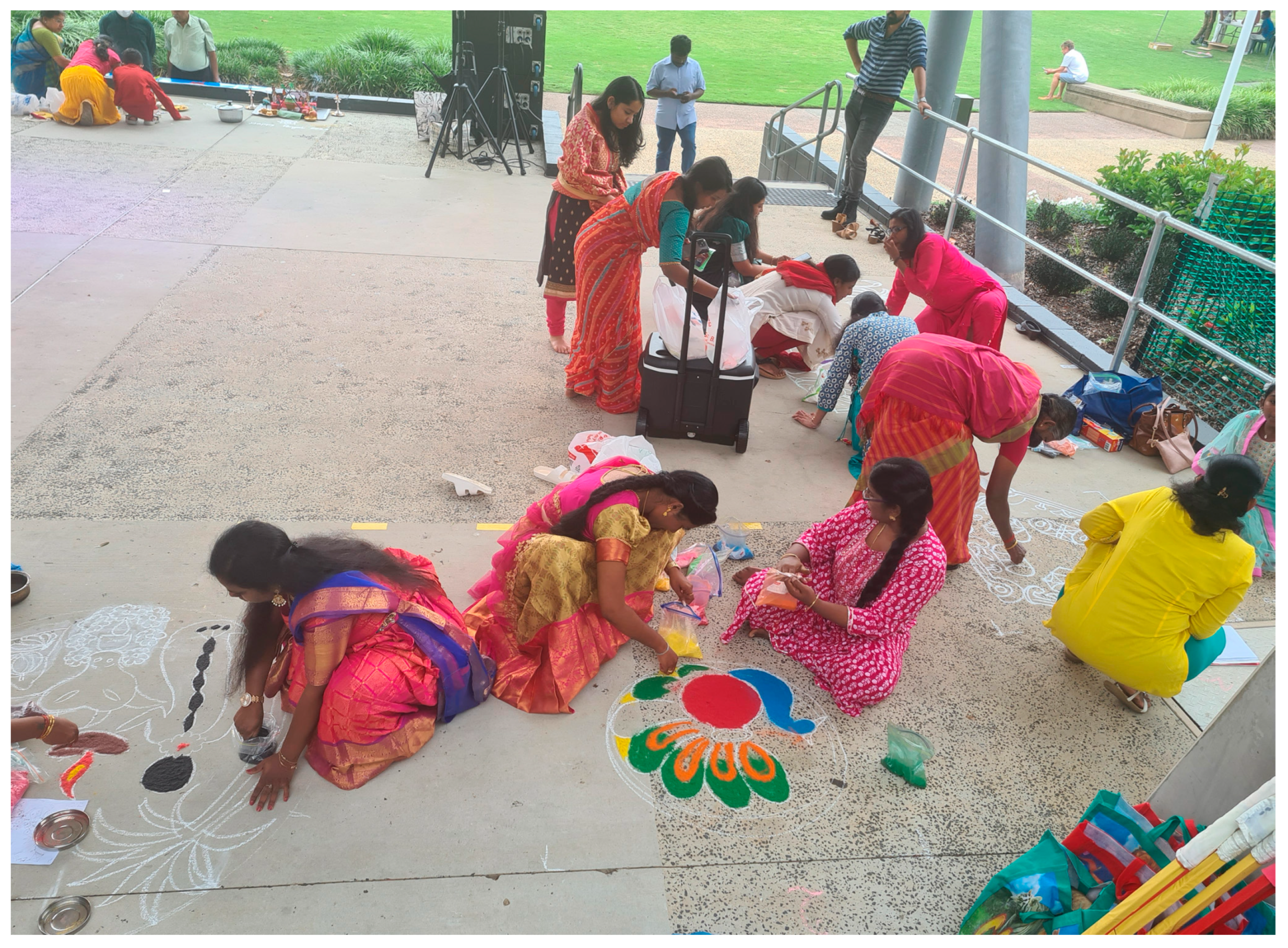
Kolam drawings made by groups of women. They took different positions across the vast space. Their performative bodies wearing vivid textiles, and bright pigments used in the rice flour to create the
Kolam designs were visible from a distance (
Figure 4). The stage was at the boundary of a parkland, providing a ritual platform to observe the performative creative acts as the array of elaborate
Kolam designs slowly evolved.
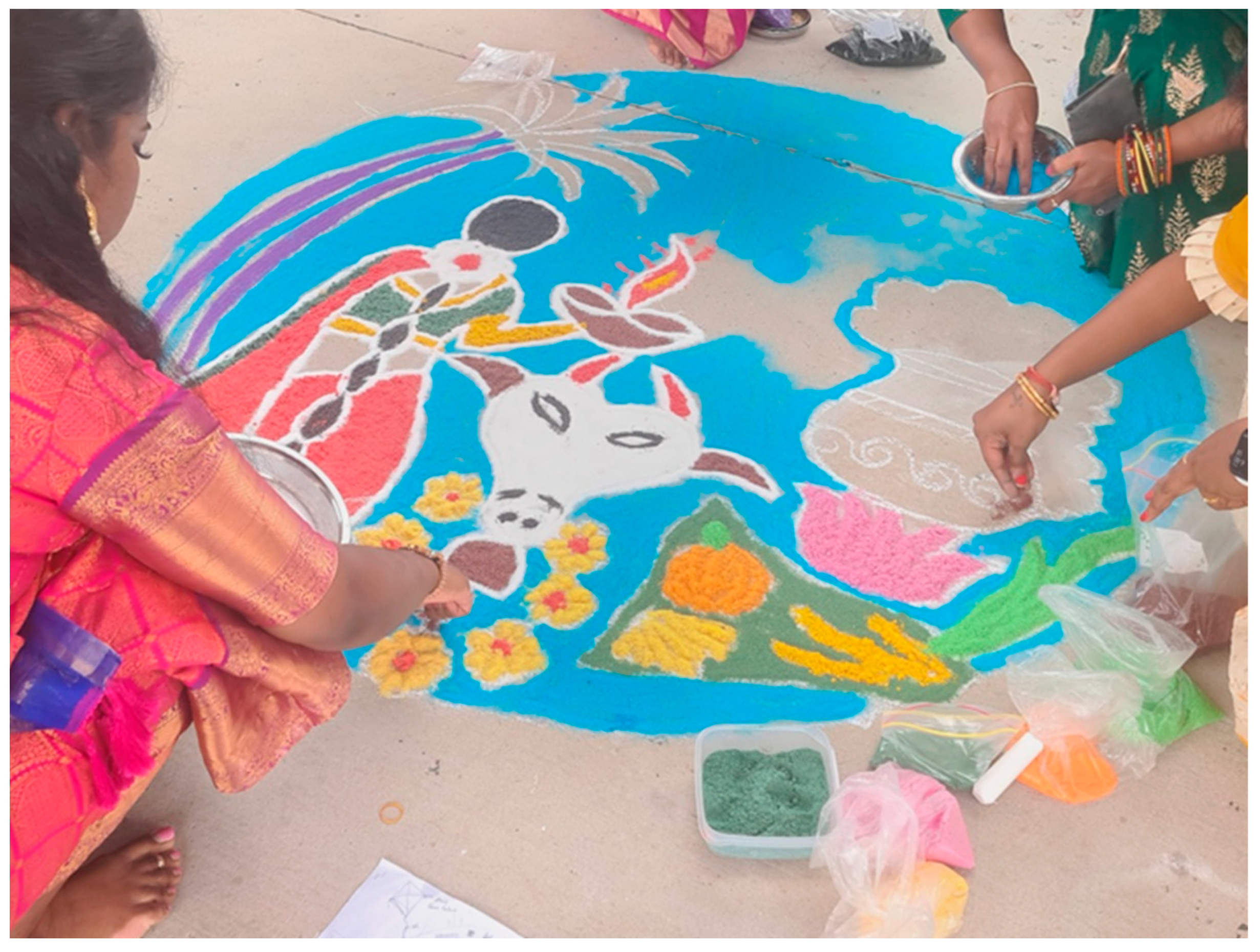
The women, spanning different generations, sat or bent their bodies close to the ground to perform the drawing. The simultaneous actions of their hands with bodies in motion allowed different sections of the drawing to gradually take shape (
Figure 5). Their regular practice enabled a fluidity of performance. Only minimal instructions on the sequence were needed to be exchanged between the participants. The women spoke of celebratory activities at home, food preparations, visiting the community, and involvement of their children, friends, or extended family on the day. Sounds of collaborative activity that conveyed a festive atmosphere, ambient sounds of the surroundings, filled the space. Traditional rituals were a ‘powerful source of bonding with other Tamils in the local area who shared knowledge and experience’ (
Jones 2016, p. 64), which was evident in this collective marking of
Pongal at Robelle Domain Parklands through
Kolam drawings.
A friendly competition was held to select the best Kolam drawing. Formal events followed, through gestures of devotional Puja and other rituals. The geometric and pictorial Kolam drawings remained as silent signifiers of the performative acts marking the threshold on this auspicious day for the Tamil community.
Deepavali, the festival of lights, is also a significant festival marked by the South Asian community across the globe. A large community event was organized by the Tamil community in Perth in 2018 to mark the occasion through the creation of a large
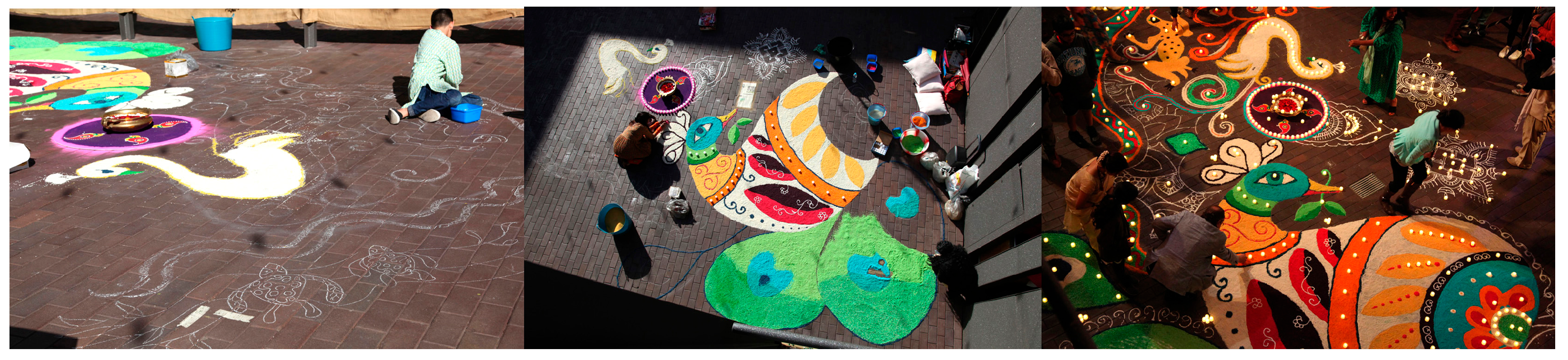
Kolam drawing. The event allowed an elaborate design, as shown in
Figure 6, to unfold over 12 h in a public space within the city center. It commenced in the morning and continued until nighttime with many from the local South Asian as well as wider community invited to participate in the performative ritual drawing. The design spanned the open courtyard of the cultural center serving as a threshold space separating the buildings that had many floors.
Figure 6 (left and middle) shows the chalk outline drawn on the paved ground with symbolic representations of fauna of the land and ocean in both South Asia and Australia as well as of flora. It captured the merging of the two regions relevant to the diaspora. The design adopted elements of the traditional
Kolam design as well as contemporary graphic designs to reflect the spectrum of expressions of the diaspora. Community participants from both the diaspora and broader public, including children, filled the designs using vividly colored rice. The activities were guided by advanced practitioners. The drawing evolved with the passing of the day. The fullness of the story, told through performative bodies, was most appreciated when viewed from a height. As night fell, a large gathering of the public participated by lighting lamps around the
Kolam to mark
Deepavali (
Figure 6 right), the drawing constantly being transformed throughout the day as an experiential encounter.
3.3. Threshold Crossing as a (Re)imagined Practice of Place Making in Suburban Melbourne
Performative enactments of the traditional Kolam carried out in public spaces on auspicious days demonstrated how the diaspora take agency to transform threshold spaces. Material expressions serve as cultural place making. The Kolam ritual was (re)imagined into a threshold encounter within a contemporary art practice. Here, it broadens the dialogue to include a wider community beyond the diaspora. It examines the many transformative states of the spatial, social, and material initiated upon the performance of the (re)imagined drawing. Transformative states as a human experience are not only encountered by migrants but also by wider society who have faced ‘crossings’ within their lives. Intrinsic characteristics of the traditional ritual informed the critical elements integrated into the contemporary (re)imagined construct in the clay and materials of the surroundings.
The project
Threshold Crossings was undertaken as an artist–researcher in residence at RMIT PlaceLab Brunswick in Melbourne, Australia, a newly established community-engaged initiative of the university. Transitional spaces in the inner-city suburb of Brunswick were explored as threshold sites for creative activations. It engaged the local community through (re)imagined contemporary installations of
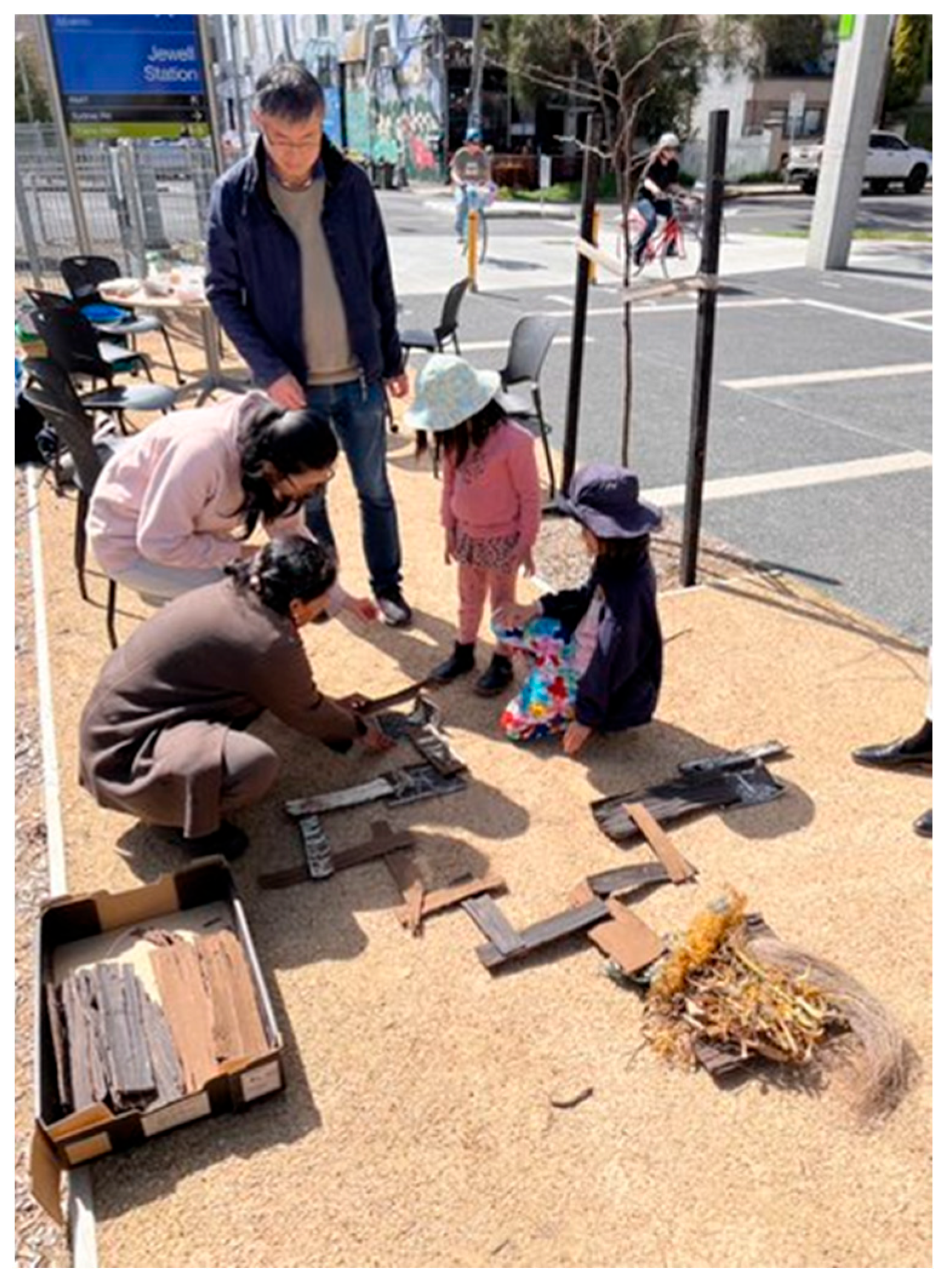
Threshold Crossings. RMIT PlaceLab was located at the intersection of functional spaces used by the community for different purposes. A site adjacent to the railway line that was in proximity to the PlaceLab was initially activated. A walking and cycle path was running alongside a railway line, the two separated by a wire fence. Activation allowed these intersectional spaces to be seen as passageways with the vitality to bring different parts of the community in movement within suburban spaces in contact. This was similar to sites described in Singapore. Passersby were engaged to create drawings using clay, natural pigments, and flora collected from distinct locations in Victoria (
Figure 7), responding to how they experience local spaces and the community. The participants consisted of children accompanied by adults and regular walkers working close by or living in the neighborhood. The materials used in the performative drawings were derived from land as is the case in the traditional
Kolam. These naturally sourced materials allowed participants to shift their familiar patterns of how drawings are performed. The tactility of materials through gestural acts shifted how participants responded. It brought the proximity of natural environments of outer suburbia and regional places to inner suburban spaces. The informal outdoor setting and nature of the materials allowed the participants to respond eagerly and with ease, resulting in individual responses. This preliminary activation served to establish the methodology with respect to the materials and process.
Threshold Crossing, as an installation of a material encounter, was created as a participatory act of assembling individual drawings with the local community. The creative place making as a performance on a suburban site occurred alongside the normal rhythms of passersby and cyclists using the paths (
Figure 8), the senses fully absorbing the encounter. The occasional train passed, with commuters also being able to observe this active suburban landscape. The performance of creative place making activated the space adjacent to the newly established RMIT PlaceLab Brunswick. It indirectly made the community aware of projects undertaken that address social, cultural, and political issues pertinent to the community.
The preliminary activation led to the development of a project with the residents of a social housing day center in Brunswick. The residents lived on the premises and used a common area on the ground floor as a place to gather. I arrived early on the day of the participatory activity to devote time to making observations. This allowed the opportunity to gauge how residents, staff and volunteers interacted with different spaces within the communal area and to assess what guided the formation of functional and social relationships. These observations were an important part of the methodology of the contemporary practice. It was adopted from witnessing how threshold sites functioned in performing the traditional
Kolam. As a member of the Tamil diaspora and as an invited artist, the traditional ritual of heritage could be (re)imagined, bringing relevance to a community in the inner suburbs of Melbourne. In this instance, the performative act of creation was to take place in the shared spaces of communal living. The traditional practice can often be a shared creation, activating the common space (
Laine 2013;
Kanagasundaram 2019), as demonstrated earlier in the paper. The contemporary artwork was to evolve as a series of visual drawings created by residents, to tell their stories through material dialogue.
A partial glass door was the entry that separated the grassed area of the outside and the common room where most of the activities took place in the residential social housing complex. Staff and volunteers arrived early to commence the activities for the day, crossing the threshold that separated the outside and the communal space. The large multi-purpose common room functioned as a space to eat, drink, and socialize. Meals were prepared in the adjoining kitchen. The common room was also a place where creative activity took place on a specific day of the week. A community garden that was well tendered by residents and staff was in proximity to the communal area. The nature of the interaction between the residents, many of the staff, and volunteers was informed by observations. How spaces were used for social and domestic purposes; the greetings upon arrival; and the casual chatter amongst different groups demonstrated familiarity, informality, and a level of care of the collective group. These observations informed how relational aspects of an existing site become integrated into a project with the community.
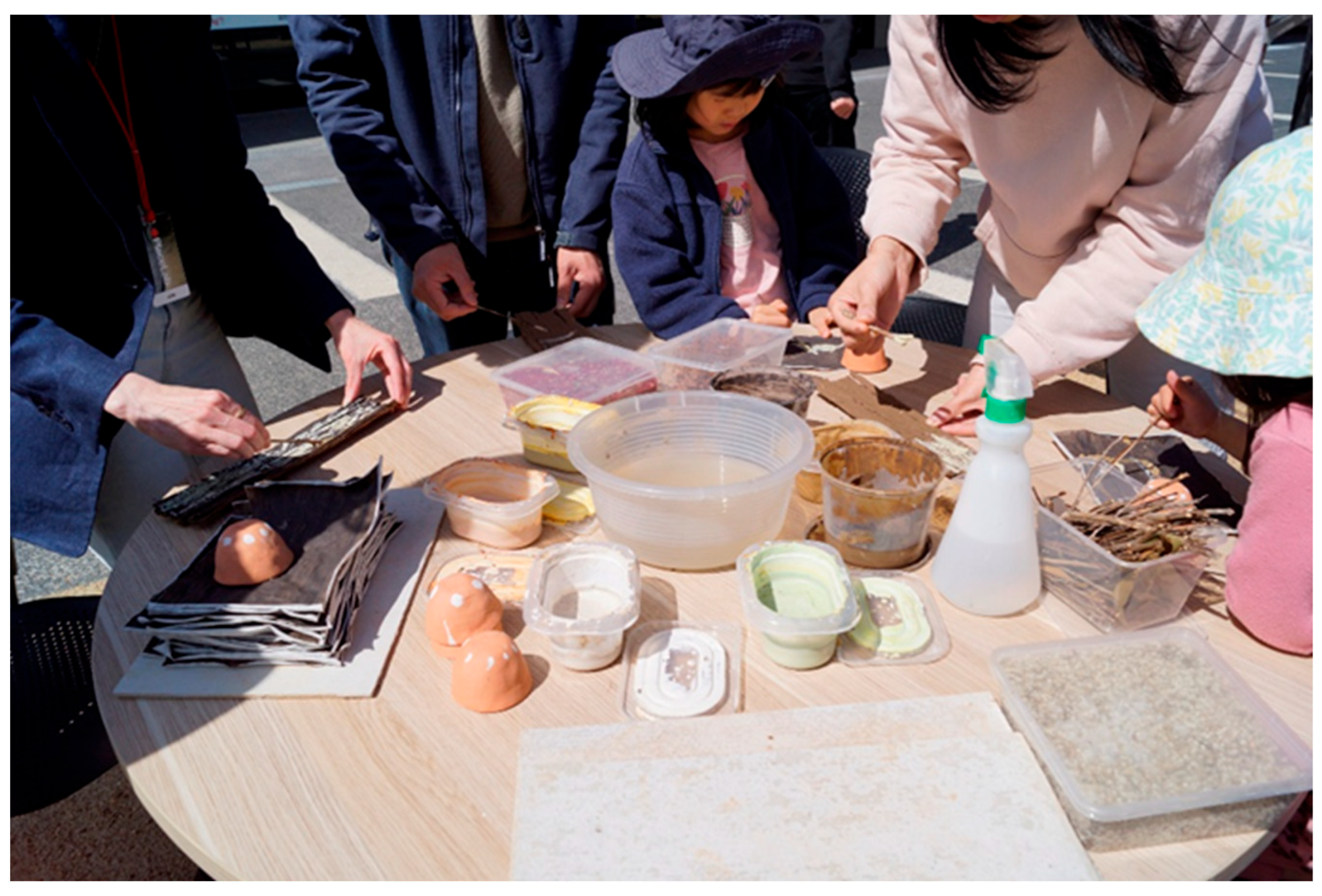
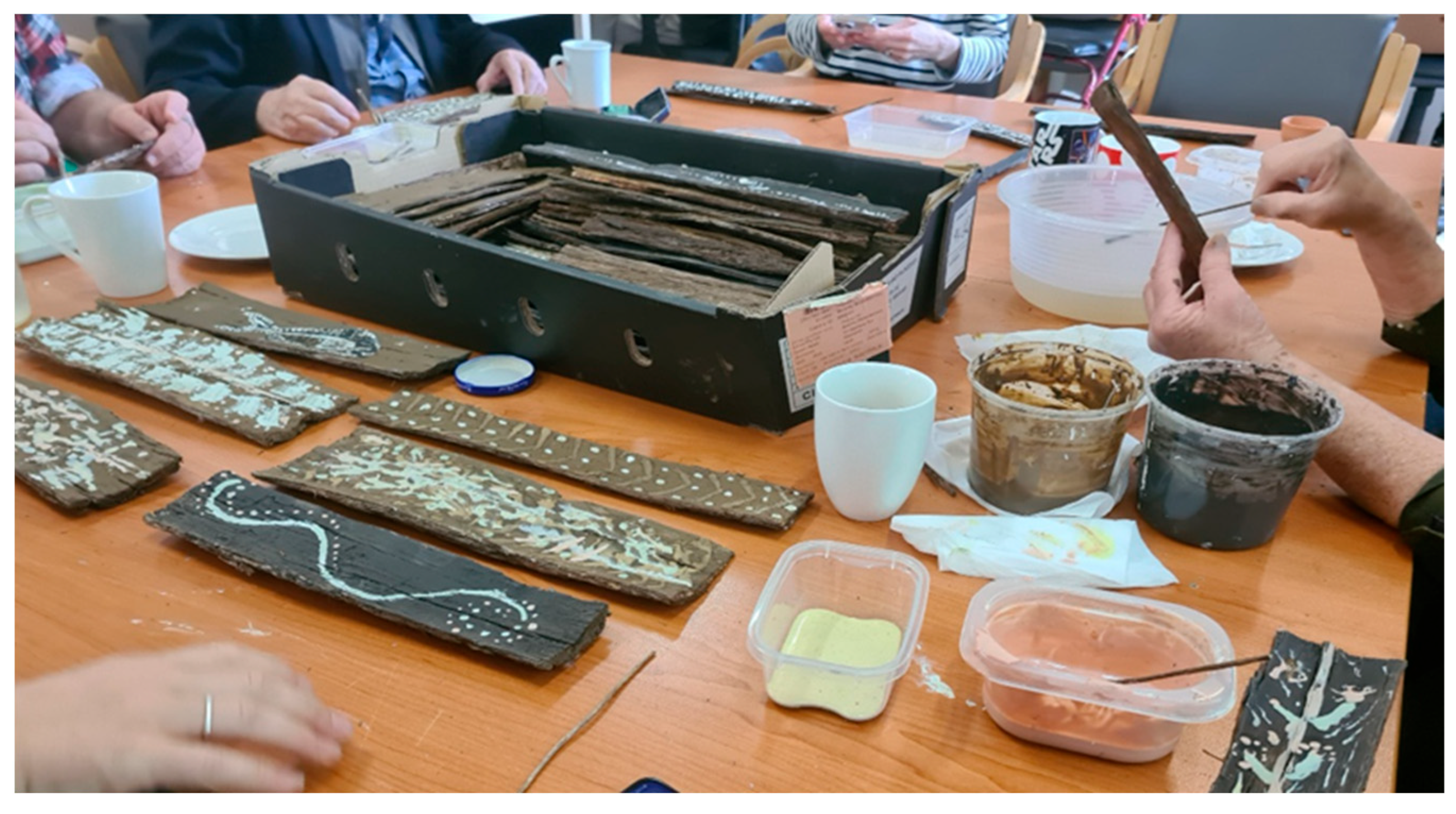
Materials to be used for the participatory activity were assembled at the center of the table (
Figure 9). The items included pieces of bark sourced from the artist’s location of practice, slips as slurries made from clay that had been sourced from different sites in Victoria, natural pigments, and tools for creating. About 10 people gathered including the staff member responsible for the weekly creative activity. They sat on chairs placed around the tables. Space was allowed for a participant with disability to position a wheelchair. Given the open space, the creative activities could be witnessed by others, some residents and staff intermittently joining the group to observe. I explained to the group that a threshold drawing of
Kolam is carried out by Tamil women of South Indian or Sri Lankan origins and that I was part of the community. I expanded to indicate rice flour was used to create designs on the ground of entrance ways by hand. The group learnt that the drawing acted as a welcome, conveying a message and that it gradually eroded over time as people moved across it or natural elements shifted the material. I invited the participants to take a clay-coated bark piece each to individually draw visual messages as a group activity using clay as a medium and twigs as drawing tools. Drawings created using material relevant to the Australian landscape were going to form a collective work,
Threshold Crossings, on a site that would become the chosen threshold.
Incorporating tangible materials of eucalyptus bark and twigs collected from the artist’s surroundings activated intangible relational connections and an imagined sense of living in the bush environment. It contrasted with the everyday surroundings of inner suburbia. Although the South Asian traditions from which the creative work was derived may have been unfamiliar, the presence of materials of the Australian landscape brought familiar connections. The participants began using these tactile materials as a medium with ease, using the tools provided. It required minimal guidance. Their expressions, hands in fluid motion and positions of their bodies indicated an attentiveness and an enthusiasm, allowing the works to unfold. The materials prompted participants to consider their own relationship to land, surrounding environments, and place. The clay used was sourced from various locations, namely, Merri-bek shire where the community-engaged activations were taking place, Nillumbik shire in the outer suburbia, and the regional area of Southwest Victoria. The latter was obtained during a visit prior to restrictions of the COVID pandemic, marking a time of change. The materiality of the clay bodies became a signifier of place.
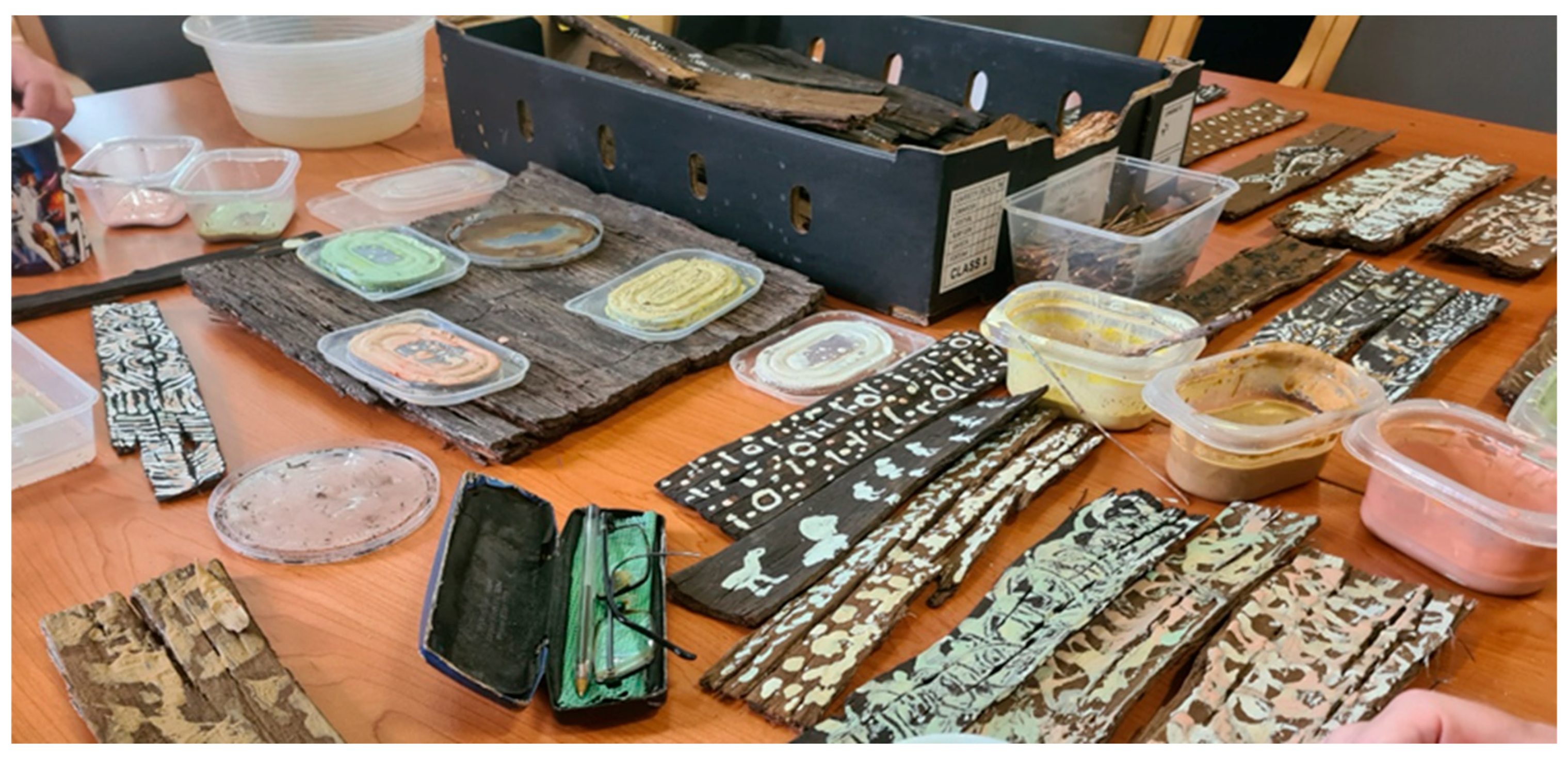
The participants created pictorial and abstract drawings in response to the cues provided at the commencement of the activity, explained in the Materials and Methods section. The drawings were created on clay-coated eucalyptus bark pieces. A clay slip containing natural pigments was applied, using twigs as drawing tools (
Figure 9). The materiality of raw clay on bark allowed the ephemeral characteristic of
Kolam to be translated within the contemporary work. Clay, as a material that has a connection to place, has the potential to be transformed (
Andreoletti 1999;
Peterson and Peterson 2012). Materials from the natural environment allowed the participants to experience the creative process in a different way. The senses of tactility and visual associations of the materials, activated relational connections. This disassociation from familiar materials and tools used in drawing led participants to have a freedom to respond. The material and the participant in the performance of drawing exercised their respective agencies to act in collaboration (
Barad 2007;
Bolt 2013;
Latour 2005).
Conversations accompanied the creative activity. One described their childhood growing up in a regional part of the state, the materials used triggering early memories. The place of the past was brought in proximity with the present through climate change and its impact seen through floods and the devastation of familiar regions. Flora and fauna were depicted in symbolic and pictorial form (
Figure 10). Another participant drew forests, inviting the natural landscape into the urban environment. The communal area was creatively captured in pictorial form as a place where people gathered to share food, socialize and engage in creative activities. The residents revealed that it was through staff, volunteers, and visitors that the ‘outside world’ entered their daily lives. Most residents had limited connections to experience distant regions beyond the proximity of their communal living in a frequent manner. A participant described their interest in art making, expanding on their process and materials. This prompted a few to state how important the creative activities were to their weekly rhythm. Some of the works previously created were described. One participant came forward to say, ‘would you like to hear my story?’, explaining their journey to the current place of social housing, a place that has become a sense of community. In response, another suggested a creative activity of making where each could tell their story. The participants exercised agency in contributing ideas to create a place of belonging through performing their stories as creative expression, collectively. Memories of childhood, their journeys to communal shared housing, lives prior to arriving, previous social connections and current connections to those within the social housing complex, description of their domestic space, and their day-to-day lives were described. These conversations were fluid whilst the participants created drawings in rhythmic succession. There were repetitive patterns incorporated in some drawings. The intangible and tangible relational elements of place, memory, materials, and human connections were having a dialogue, activated by the creative process.
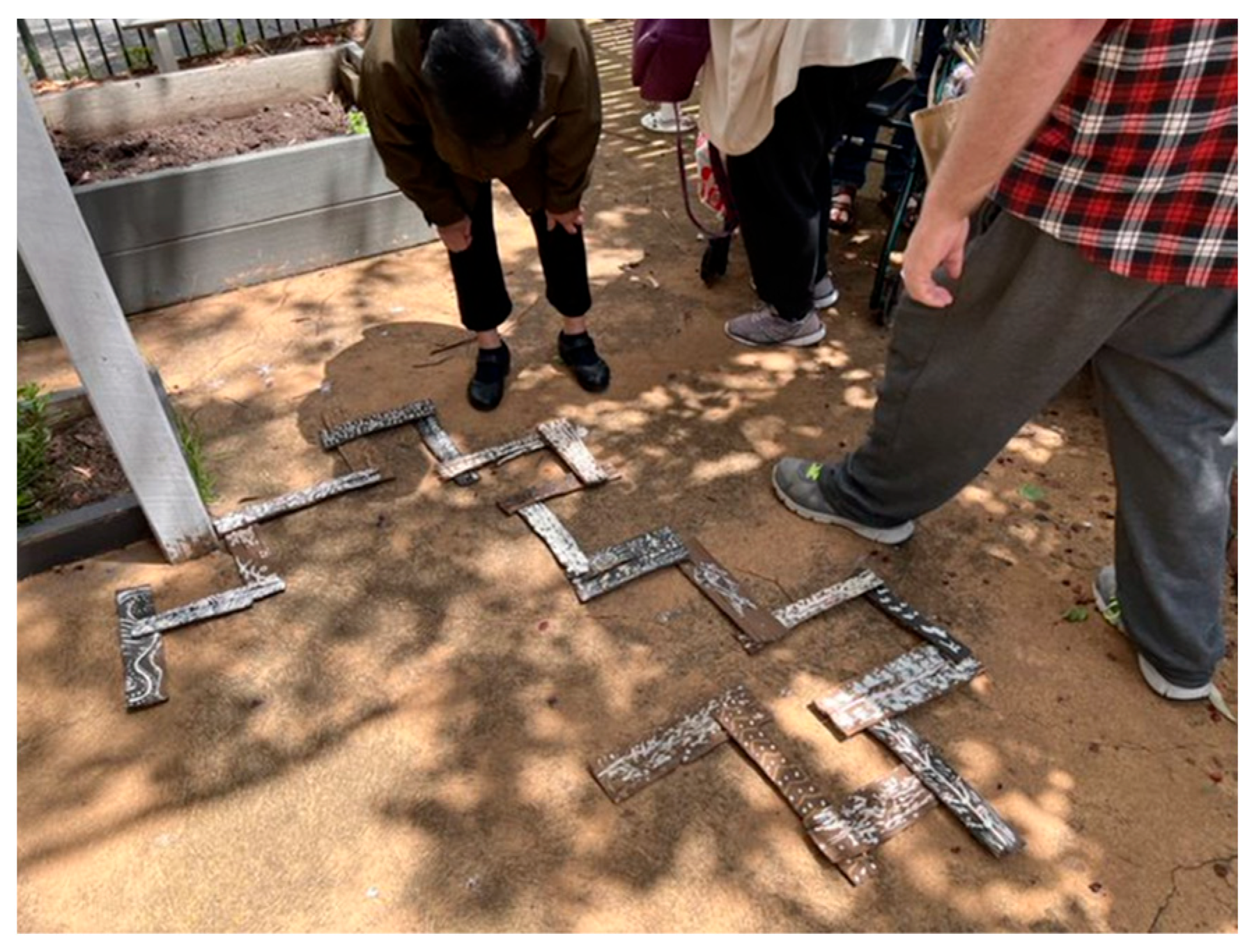
Residents identified the community garden as the site of the final assembly of the drawings. The garden not only connected the internal communal area to the outside environment but was also a site where nurturing of a space was expressed and experienced. The works were interlinked on the paved area around the garden beds (
Figure 11). The materials sourced from the natural environment, with stories captured in the form of creative drawings, were now integrated into the surroundings of the participants’ place of communal living. It gave the opportunity for residents to experience the constant change in the assembled drawings,
Threshold Crossings ll, through exposure to the natural elements of wind, rain, sun and movement of people, natural elements, and creatures that may frequent the space. Material transformation through fading and the loss of integrity would allow the works to merge with the existing surroundings as time passed.
Threshold Crossing ll as a creative encounter not only activated the site but also enlivened the intangible elements of the memory of creating the artwork. A few creative responses were retained to be displayed on the walls of the social housing complex, an initiative put forward by a member of staff. It served as a catalyst for recalling the participatory event. The ephemeral
Threshold Crossing ll as an encounter kept the site to enter the communal garden charged, whilst the more permanent displays served as archives for recalling the relational connections of a past event. This feature parallels that of the traditional
Kolam practice where the diaspora, through the enactment of the material practice, bring memories of events and transnational connections of the past in proximity with the present (
Jones 2016;
Kanagasundaram 2019).
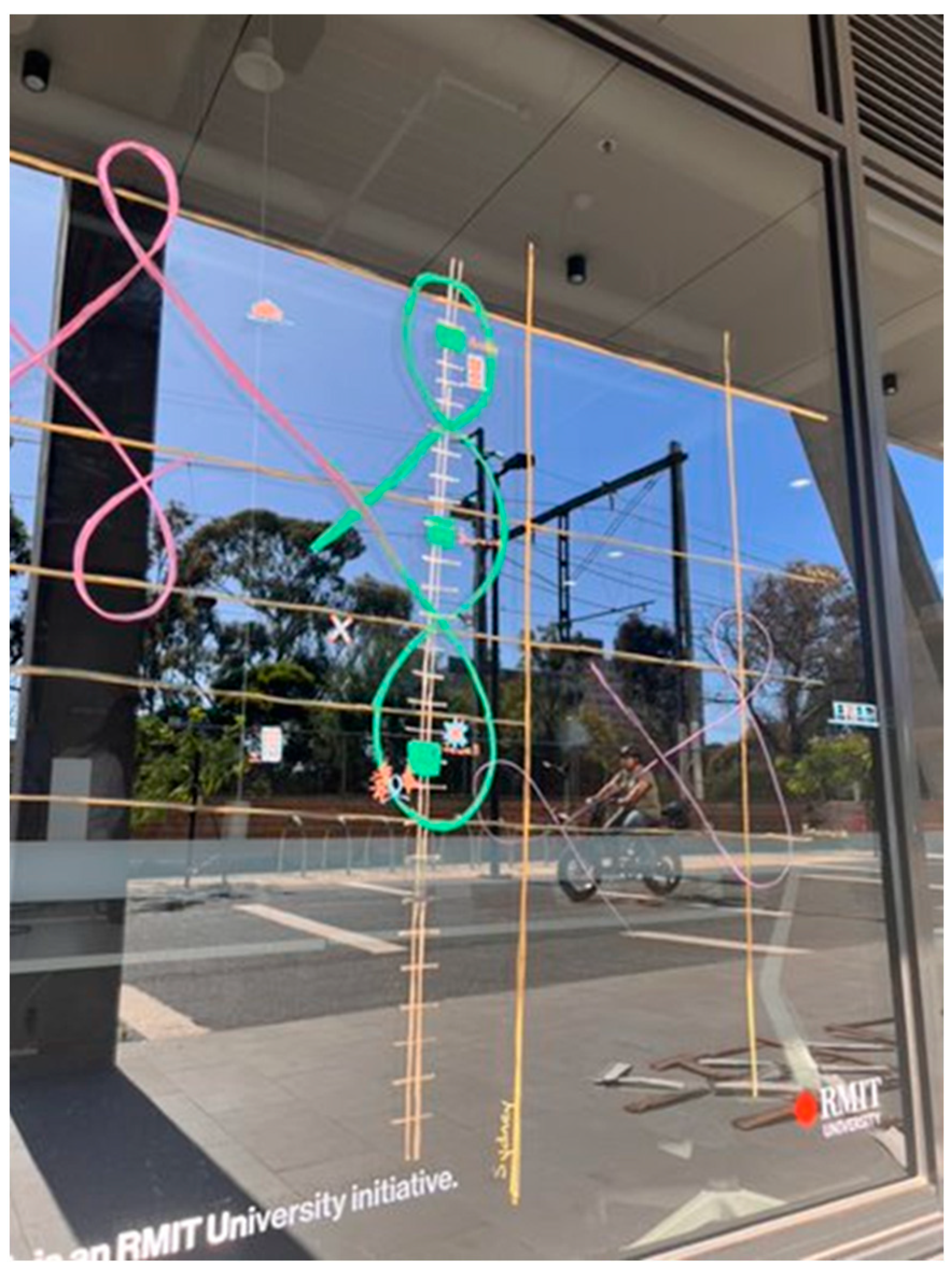
The glass wall and the concrete paved area forming the boundary of RMIT PlaceLab became surfaces on which a further (re)imagined drawing was created. It served as a pictorial map to reference the various sites of creative encounters of
Threshold Crossings across the local area (
Figure 12). The reflection on the glass surface captured the movement of people using the walking path, the commuter train, and cyclists whilst the pictorial map was simultaneously being created. The reflections and the map as a pictorial ritual drawing formed an ephemeral archive of momentary rhythms of suburbia to be experienced. Bodies in movement as part of the functional, social and creative landscape reflected the pulse of suburbia. Intersectional spaces and the movement of people across these mundane spaces are often not noticed. Creative activations highlight their vitality. These features are intrinsic to the traditional
Kolam from which the (re)imagined practice was adapted. Given the proximity of the Jewel railway station, the pictorial map alerted passersby to the community-engaged activities that may otherwise go unnoticed despite their proximity. The threshold activations became linked, providing opportunities to explore unfamiliar streets. The characteristics of the traditional form can be harnessed through their material, social, and performative agencies to (re)imagine a broader dialogue bringing the wider community beyond the diaspora into the conversation.