1. Introduction: Setting the Context
The following section is written in the present tense, but it should be noted that it does not refer to Falmouth University where I am currently employed.
Half the art school where I am working, have been working, has just been made redundant. I am making comics to document what is happening, surely humans of the future will want to know how badly we treated education, art education.
I am cooking dinner and listening to BBC Radio 4, someone from the UK government is creating the illusion that Pro Palestine protestors are naïve. Need to be protected. The official is saying that there is stuff that many of those people holding up placards peacefully calling for the end of starvation in Gaza don’t know, BUT if they did know what they, the official, knows they would not be there with their placards. The person talking would like to share this information with the radio listeners, with the Pro Palestine protesters, but they cannot. It is regrettable they say. The language mirrors that which I have been listening to for a month during the consultation period of my art school’s redundancy process: if only the naïve staff knew all that management knew they would know that there is no way, SIMPLY no way, that things could be done differently. They the management would like to share this information with us…us the workers…us the staff, but they cannot. It is not possible right now. They the management are unburdening us from the need to have agency in this matter. The officials are unburdening them, the protestors, from needing to get involved with the complex facts of Gaza.
Now what we don’t want is Facts. What we want is bewilderment. What we want is repetition. What we want is repetition. What we want is people in power saying the truth is not the truth.
I keep drawing. To distract myself from hating my drawing I am watching an American drama on a play-back service. It’s a fictional tale of political corruption and billionaire greed. The ad breaks are filled with invitations for those watching, specifically those young and watching, to join the military. A week or so passes and I am at the cinema watching a rom com about real love vs. materialism. Before the story begins, back-to-back adverts for the military, here also, tell of the opportunities for making friends. Not friends like the young people might have currently, BUT real friends. A chance to see the world and be “made”. Not like how they have been made when they were born, or made when they were raised by their families. But properly made. Made in the Royal Navy. There’s another narrative playing out about the possibility of extinguishing threats. The threats are not explicit but there are countdowns to show how close they are interwoven with dialogue that outlines the excitement of seeing the world while these threats are distinguished. Make friends. See the world. Desires of the young. Things teenagers might have dreamt about before going to university in the past. Do they still now? Or can they not because of the cost of living. Of education. Not of war, that cost is not mentioned. But the cost of living which prevents them from leaving home. Meanwhile in the press, politicians remind readers, viewers and listeners about how going to university causes debt. That the Mickey Mouse art degrees are the worst of them all.
At the end of World War 2, returning soldiers were part of rising demand for free higher education. Having risked their lives for the country, now, they argued, the State must allow them the chance for social mobility. An opportunity to escape the reality of being a solider.
I’m listening to the radio again. I am cooking again. The radio’s audience is being reminded of the bomb that was dropped on Hiroshima 80 years ago. Of a Japanese doctor, the only uninjured doctor in a hospital in Hiroshima. The story is balanced by another about the optimism for peace in the 1960s, by the boomer generation, many of them making art and singing about it. But now is 2025. Art is for Mickey Mouse:
…art was dead. Theatre and cinema were both dead. Literature was dead. The book was dead. Modernism, post modernism, realism and surrealism were all dead.
I tell my students that the arts are so powerful that the government, billionaires and related organisations are scared of artists, that it’s the only logical reason for the cuts, for why we are standing here mourning the loss of good staff and resources for making.
2. Controlling the Art School: Documenting HE Arts Education 2018–2025
Much has been written about neoliberal structures within higher education and the negative impact they have on their staff (e.g.,
Fleming 2021;
S. Ahmed 2021;
Silverio et al. 2021;
Maisuria and Helmes 2020;
Giroux 2002;
de Groot 1997;
Morrish 2020). This section will show how during HE Art School redundancies in the academic year 2024–25, it became apparent to me that these same structures are also negatively affecting art education by forming ideologies based on a division between physical and digital/virtual materials.
Let me start at the beginning of my thoughts about this. In 2018, I began drawing comics, writing songs and making videogames about the things I was witnessing and experiencing in Higher Arts Education (see
Dare and Yamada-Rice (
2021) for a write-up on the videogame and
Ikon et al. (
2021) for an example of a published song). To begin with, it helped with the stress that many of these events placed on me. Then, the more I began to draw, the more I read work critiquing the structures of neoliberal universities and the two flowed into each other. For example,
McCann et al. (
2020) write that:
…today’s universities feature corporate cultures and senior leadership teams disconnected from both staff and students, and intolerant of dissenting views.
Relatedly,
S. Ahmed’s (
2021) book ‘
Complaint’ presents a damming series of testimonies from academics who have tried to speak up within these corporate structures of senior management. I drew Comic 1:
‘Now is Not an Appropriate Time’ during the COVID pandemic when it was not uncommon for meetings to be held online with academic staff muted by management to prevent questions being asked without permission, thereby removing any possibility of sharing “dissenting views”.
The images in the comic replace management with faceless technology. On the one-hand this could be seen as a reference to ideas about governance presented by fiction writers such as
Orwell (
1949) in
‘1984’, but my intention was also that it serve as a critique of HE Senior Management’s desire to replace faculty expertise with tech solutions (see also Comic 12: ‘
AI Efficiencies’), by judging the idea to show that they too could be replaced.
In this way, I was also pulling in ideas by
Kress (
2010) who writes that in order to understand communication practices we must look to the entanglement of social, cultural and historic practices, which by default (although he doesn’t make it explicitly clear) includes politics:
Comic 3: ‘
Mourning’ and Comic 4: ‘“
Fire, Fire”’ also hint at HE’s inward-looking view. On the one-hand Universities want to be seen as doing the right thing, as in the case of mourning the Queen, but in reality, their concern with the metrics measuring student experience controls many of the decisions made.
Arthur (
2019) writes that student experience data collected in the ‘
National Student Survey’ is a core part of the audit culture in UK HE and responsible for management removing trust in its academic staff to make professional decisions. This, Arthur (ibid) argues, has in turn led faculty to believe that student experience data collected in relation to individual teaching modules are used as a mechanism for blame rather than pedagogical enhancement.

Several writers, but most notably
Fleming (
2014,
2021), draw upon
Foucault’s (
1978) concept of
‘Biopower’ to explain why academics, who are trained by the nature of their education to be critical readers, thinkers and makers, are to some degree accepting of such systems. Fleming (ibid) states that Biopower gives some agency to academics that might not be found in other workplaces as an incentive to work within other power structures that they have no control over (and arguably do them harm):
Academics enjoy substantial occupational freedoms. Yet they are also highly controlled through an array of techniques that interlink bios—life itself—with fixed performance targets.
As described above one of these fixed performance targets is measured through student satisfaction. Another connects to submission to the Research Excellence Framework (REF). The REF is used as a marker to indicate the quality of research undertaken by universities, by awarding publications and other research outputs a star ranking, with universities benefiting financially and in quality rankings when more 4-star outputs are submitted. Critiques of the REF system have shown how this star-based system undermines many processes that are common in the arts, such as creativity in research methods, places for and means of dissemination and the range of outputs made. One reason for this being that when universities prioritise short-term REF goals that conform to frameworks that show what can be awarded particular star ratings it becomes clear that it is easier for science subjects to meet the criteria without contorting the work that scientists do, but the same cannot be said for academics in the arts (
Sayer 2014).
Picking up
Foucault’s (
1978) term Biopower again, several of my comics have recurring themes about the huge volume of unpaid overtime that academics take on. The structures of the neoliberal university place a heavy burden of admin duties on academic staff, with many systems that were previously given to admin staff now falling in the remit of faculty. This means that academic work connected to research, for which staff typically have more agency, often now takes place in our own time. In other words, it could be argued that the “bio” in Foucault’s Biopower does not represent two equal strands of agency. At least not within contracted hours:
“Soon you will find out if you have enough stars to release you from a small amount of the unpaid work that you do.”
(Comic 5: 2 & ½ Stars)
The Universities and Colleges Union (UCU) in the UK reports that ‘university and college staff do two days unpaid work every week’ (
UCU 2022, np):
This is similar to
McCann et al.’s (
2020) findings when they ‘show that targets, league tables and measurements of quality…[are] contentious and inaccurate, these measures provided managerial justification for hostile restructuring’ (p. 433).
The same
UCU (
2022) report states how this level of overwork breaches government mandates. HE management is aware of the stress placed on staff by workload mechanisms such as staff surveys but chose to shield themselves from the responsibility of the effects this might have without making any systematic changes that could actually improve staff health:

In the academic year 2024–25 stresses on academic staff took a new turn. The Times Higher Education indicates that 20,000 faculty lost their jobs in that academic year (
Rowsell 2025), with the arts and humanities taking the biggest hit (
A. Ahmed 2024).
Hackley (
2025) writes that many of these redundancies have come about due to political changes, such as alterations to immigration rules that affect international students, whose higher course fees prop up those of home students which are capped and thus do not cover the full cost of delivery. However, there is an assumption in this that the way universities choose to make departments wholly responsible for their own financial stability is the only way. Yet entirely different business models are possible. For example, universities could share money across faculties to make art schools less susceptible to outside political ideologies that undervalue the arts in general, such as the decimation of arts education for under 18s, where ‘there is still not a universal entitlement to the arts in schools’ (
Tambling and Bacon 2023, p. 7). They go on to write that:
At every stage in the schooling system the arts are disadvantaged: at initial teacher recruitment and training through to a lack of support for arts teaching in primary schools. The prioritisation of EBacc (non-arts) subjects in secondary accountability measures has meant a reduction in the level of arts subjects, teachers and resources available, and therefore declining GCSE and A Level take-up. Dance and drama have no parity at inspection level, and film and digital media have been excluded from the national curriculum. We have an assessment regime that does not work for arts subjects, which require different kinds of measurement, and the investment required to develop these has not been made because of their perceived low status…Loss of subjects and teachers cannot easily be reversed. This downgrading of the arts is damaging for young people’s lives and aspirations, for the arts education workforce, for the workforce more widely, and for the health and diversity of the creative industries. And access to the arts is not equitable: we have a two-tier system, with the arts more highly valued in independent schools. There is still not a universal entitlement to the arts in schools.
Many of the points made by
Tambling and Bacon (
2023) above, such as the inadequate means for assessment, are the same as expressed in relation to the REF described earlier. However, in neither the literature on primary/secondary education nor in that connected to HE Arts can I find reflection on ideologies connected to materials, which I believe the above structures also promote.
Relatedly, my research career has been focused on children’s understanding of and desires for technologies. Over the span of my career to date this has been in relation to videogames and apps, then moving on to include virtual/augmented reality and most recently Artificial Intelligence (AI). Throughout this work, I (and the lovely team I work with) have repeatedly used hands-on art and design methods to include children in the research. Over the time in which I have been a researcher, children’s access to formal art education in the UK has been diminished. Further, a separation seems to have arisen in which digital materials and making, such as learning to code, have been placed under the banner of STEAM and STEM education and positioned away from the arts to align with sciences and mathematics (though not necessarily being used in a creative way). Meanwhile other forms of making with physical materials have been significantly reduced and branded as non-essential learning.
Simultaneously, I have learnt from my research that allowing children to make with a full range of analogue, digital and virtual materials in relation to projects on emerging technologies serves as a very engaging way for them to critique technologies, explore complex ideas of where power lies, who benefits from the design of tech being a certain way, and of course to come up with alternative visions. In other words, using the arts makes it possible for children not to just think about how technologies are now and learn skills such as coding, but to hack, make and question.
In the HE sector, art disciplines, their associated materials and the prestige they are seen as having also now seem to be viewed differently by Senior Management, with courses that use digital/virtual materials seemingly getting priority for their connection to fulfilling industry need. In higher arts education there is also a split between making with different materials. In some institutions the two are literally divided by departments and even buildings. Digital making is framed as a way of preparing students for the specific needs of industry, and analogue making is often framed as failing students by not allowing them to gain well paid employment upon graduation.
Observing recent redundancies in HE Art Schools led me to understand how the same structures have also affected what courses are kept. Although data do not seem to have been publicly published on this, my observations have been that during the redundancies of 2024–25, universities made the decision to cut courses, technicians and equipment that predominately used physical art materials over digital and virtual ones.
As expressed in the introduction, the cuts to HE Arts Education in that academic year played out against the backdrop of strengthening defence spending (such as was reflected in the increased adverts for military personnel described in the Introduction). Some universities, such as Plymouth, at the end of their period of redundancies in the arts, began publicly announcing their excitement at increased defence money coming into the city and the university via the UK Defence Growth Deals (
Williams 2025, np). This serves to further highlight a shift in ideologies and materials. For example, reports from the
UK Military of Defence (
2021) show how their view of the importance of digital materials in the form of developing and deploying emerging technologies is far removed from what many artists are comfortable with. In reading that report specifically on human augmentation of technologies, I was reminded of the work of
Crary (
2014) in ‘
24/7’, where he writes ‘as history has shown, war-related innovations are inevitably assimilated into a broader social sphere, and [technology designed to make] the sleepless soldier would be the forerunner of the sleepless worker or consumer’ (p. 3). In other words, digital materials are fully integrated with military ideals and then watered down for other uses. Thus, another reason digital materials are political is not just in their connection to feeding obvious creative industries such as games. Big Tech is also fuelling their own ideologies that are often entangled with the military or other beliefs that feel far removed from the arts. AI is a good recent example. Although there is a wealth of publications about the racist bias in LLMs (see e.g.,
Benjamin 2019;
Broussard 2023), how those funding its development, such as Musk and Altman, have ideals that fit with far-right political agendas (
McQuillan 2022,
Yamada-Rice et al. 2024) and causes environmental damage (
Crawford 2021), many universities are still primarily concerned with surface issues such as how they can make academic plagiarism easier. We should be asking ourselves why.

Deep critical reflection on where HE is going with its plans to cut the arts and humanities while taking up deals with some Big Tech companies and the military should be more widely investigated.
If we begin to unpack the shifting ideologies of HE, to the depth of thinking about which materials and technologies are favoured and how these connect to different disciplines and frame these decisions as ideological within the backdrop of Big Tech and politics, it is possible to gain a darker view of who gains from the removal of certain types of art education.

Instead, I wonder what would happen if children demanded their art education back, and if they, as well as students and staff in HE art education, refused to accept binaries between materials for making, so games courses would all use game engines, cardboard and drawing and fine art would equally use the full range of materials. This is not to say that some individual students or educators don’t already do this, but what if we consciously changed curricula to ensure all types of materials for making were included? At the very least perhaps we should question why structures in HE try to keep art materials divided, such as by prioritising some courses’ access to technologies, etc.
In this section I have described how the structures of the neoliberal university have caused ideologies to emerge that devalue the arts overall but then within this promote some materials of making above others. In the next section, I describe how the reflections made in my comics above progressed on to use speculative fiction and design to imagine new possibilities for HE Arts education that prioritise hybrid material making as a counterpoint to material ideologies described until here, and investment in students and staff above real estate.
4. Nomadic Postgraduate and Doctoral Studies in Experience Design
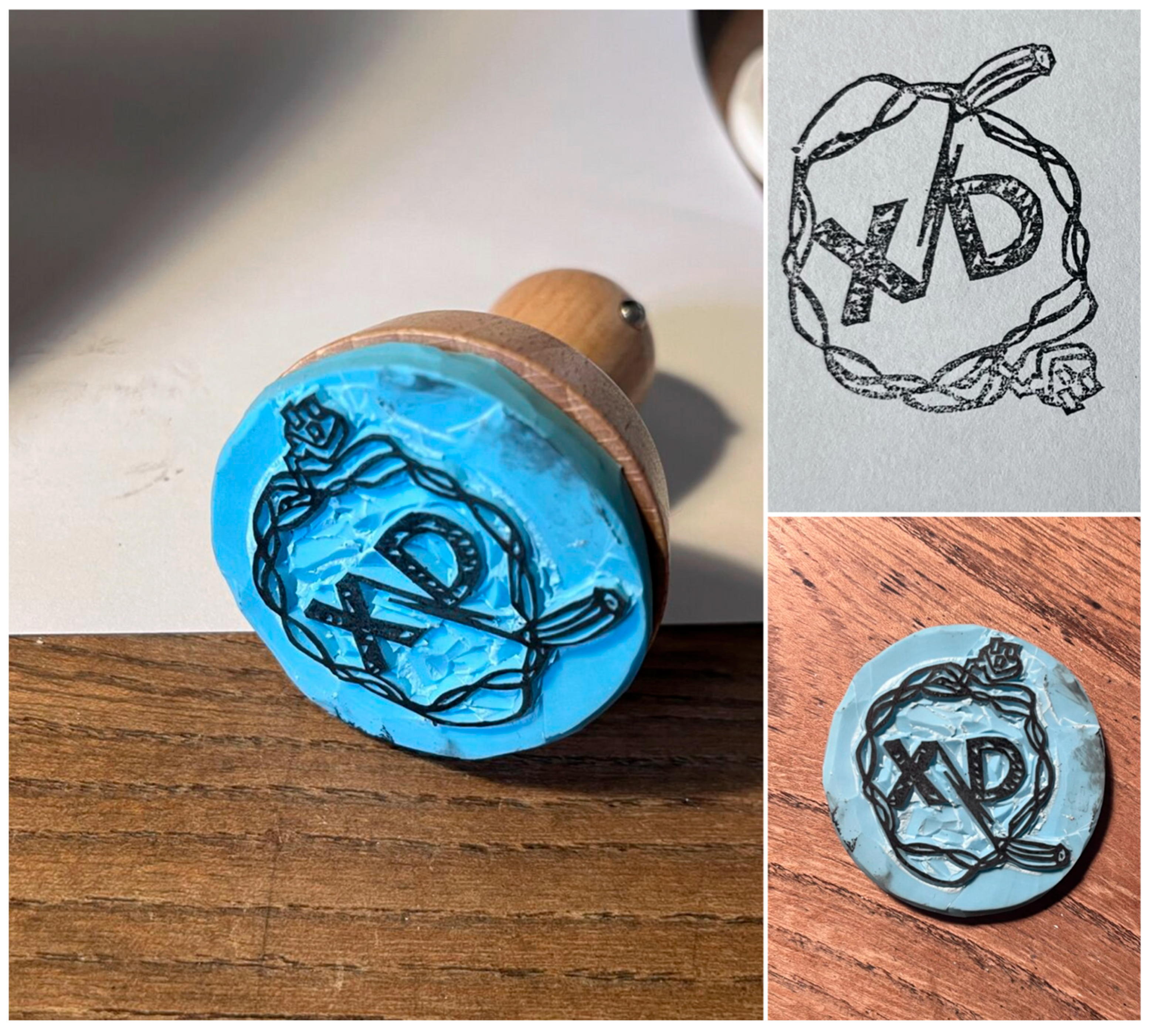
Right before the collapse of Higher Education at the end of the Late Capitalist period, I had spent my time protesting the standardisation of arts education. So tight was the top-down surveillance of teaching staff by management that any push back had to be subtle. One such example was to resist the mandatory use of Artificial Intelligence for providing student feedback on university templates by creating a homemade logo for the course I was leading at the time, MA Experience Design, and hand-carve it as a stamp (
Figure 1). The intention was to remind students looking at their feedback that individual approaches to education, even at micro levels, are possible. Students replied, as was the norm in those days with emojis that allowed me to know my intentions had been received.
This was the height of devaluing art educators and was part of a major collapse in art schools that took place in 2024. The UK-wide revolt by academic art staff and students led to the now famous, large-scale class action—“Artists v. HE Institutions”, that resulted in universities being forced to give up owning buildings. The court ruling stated universities had unilaterally prioritised real estate over the value of academic staff and technicians to the detriment of education, as well as student and staff wellbeing.
The removal of physical university buildings, because of the court ruling, led to the first year of nomadic Higher Education. As programme lead for MA and Doctoral studies in Experience Design at the time, I began to teach by seasons moving away from prior semesters.
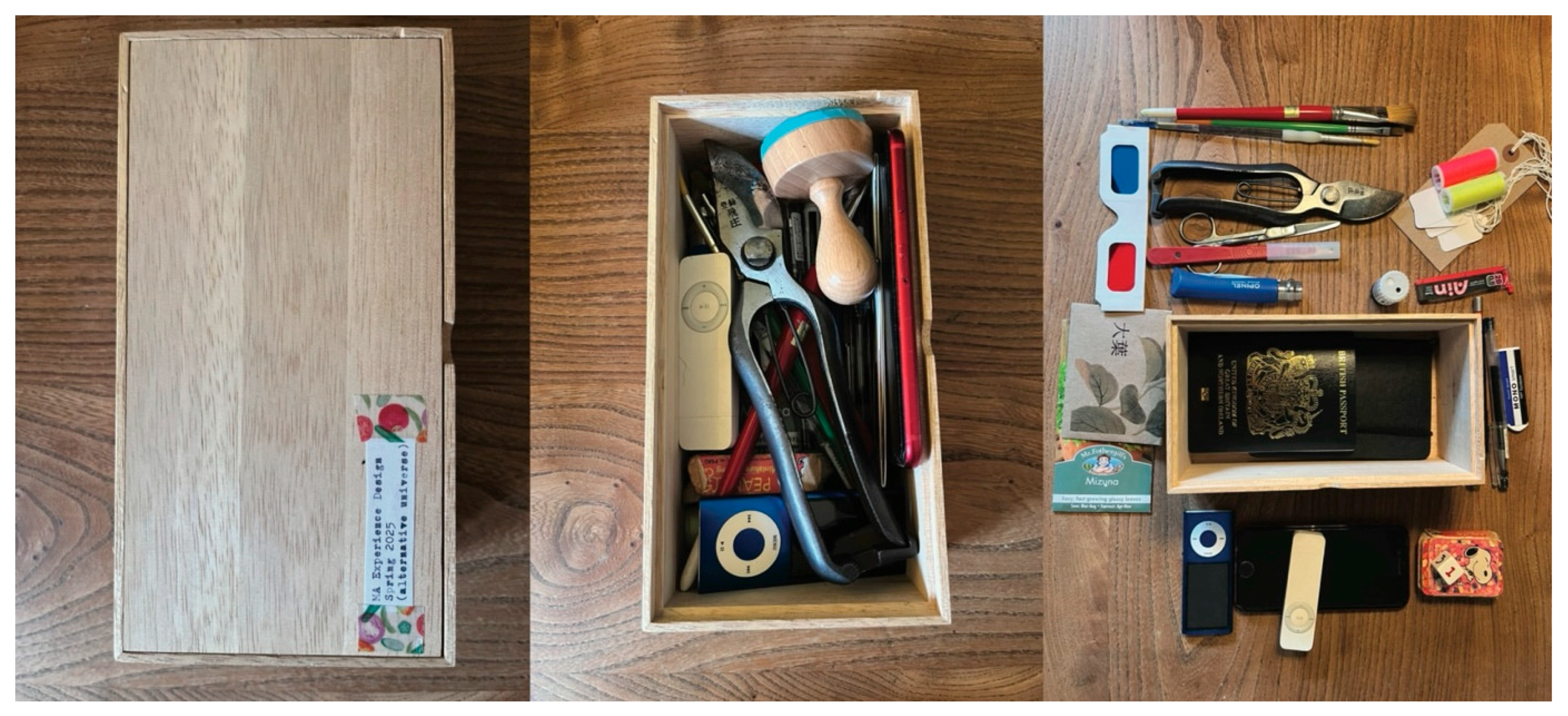
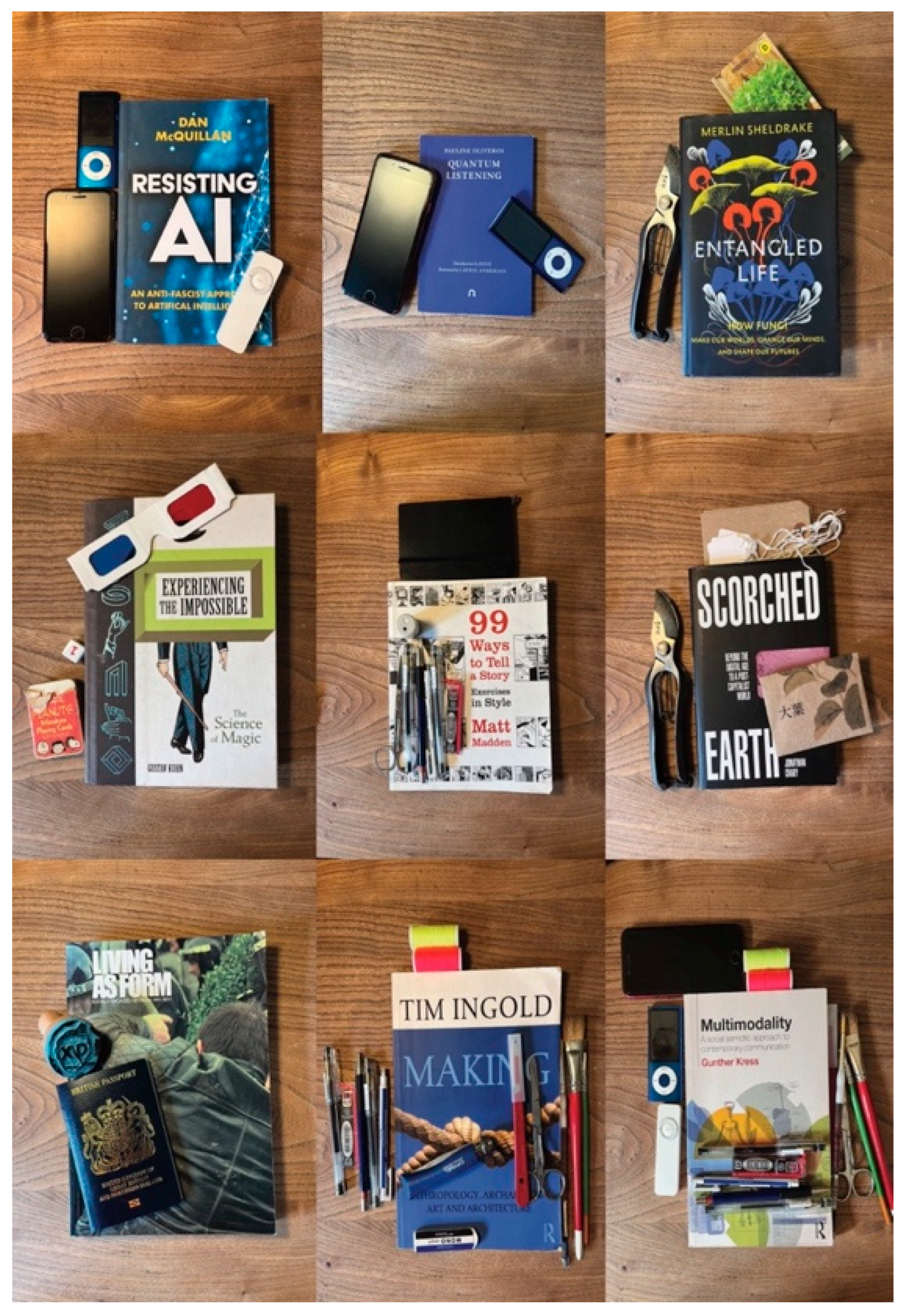
Figure 2 shows the toolkit used by students in the Spring of 2025 to engage with related theories through making while we travelled the breadth of the UK and further afield. The tools were selected following a decision to use hybrid arts practices and via a mapping exercise that linked them to what would previously have been known as the course reading list (
Figure 3). Old technologies were prioritised over new ones to promote sustainability, and we picked up paper and additional mark-making materials as we went along. The books were shared and rotated across the cohort to ease weight loads and swap notes, drawings and markings about them, in order to build collective knowledge and critiques.
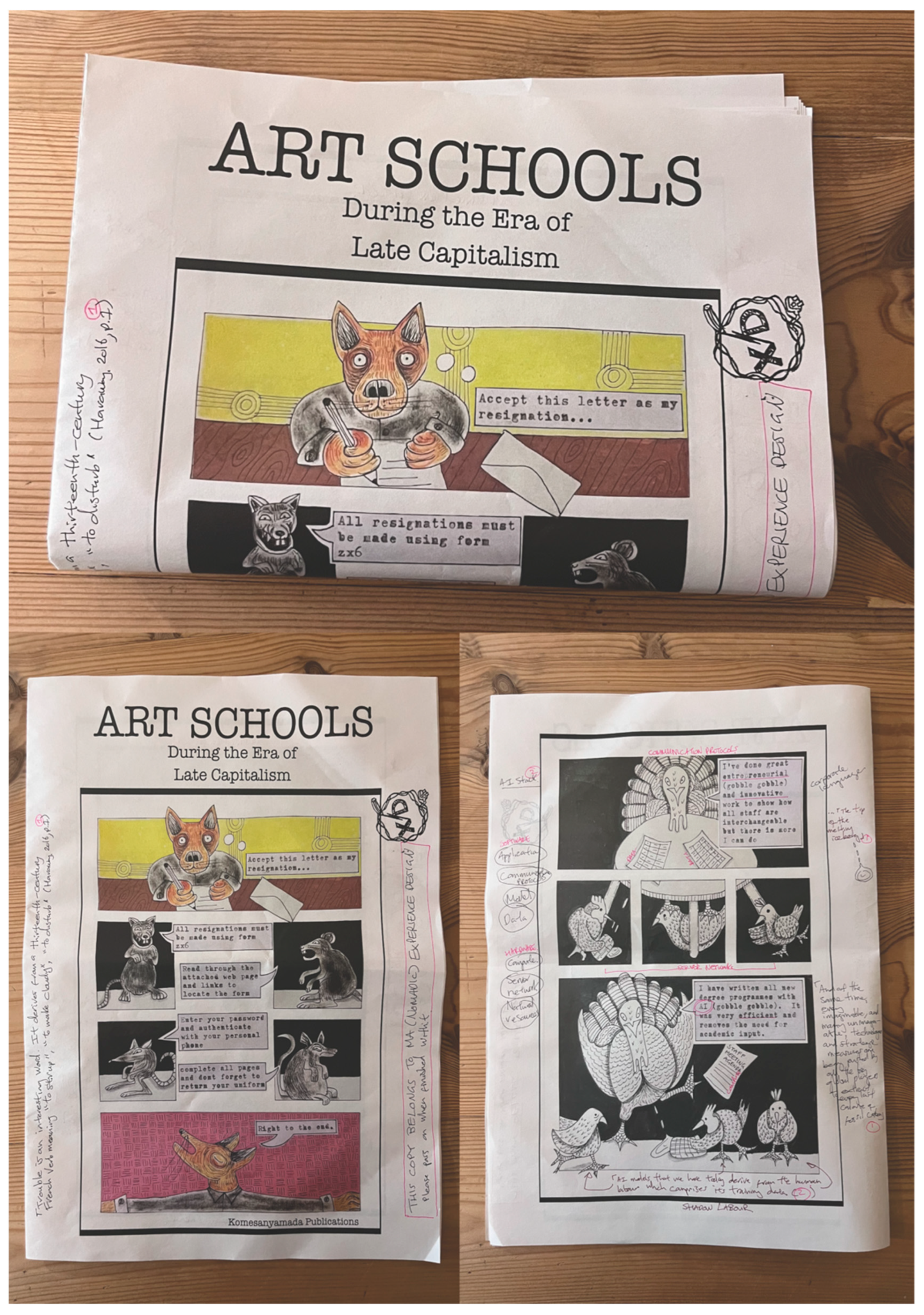
One of the readings was a copy of the out-of-print newspaper “
Art Schools During the Era of Late Capitalism” (
Figure 4). Looking back at the copy from one of the nomadic cohorts (I forget which exactly) it is possible to see how students and staff were working together to look for links between structures and language used by HE Senior Management and now-collapsed technologies such as AI (which were banned when more-than-human laws came into force in 2028). It appears the cohort were seeking understanding about why art schooling was so devalued during Late Capitalism.
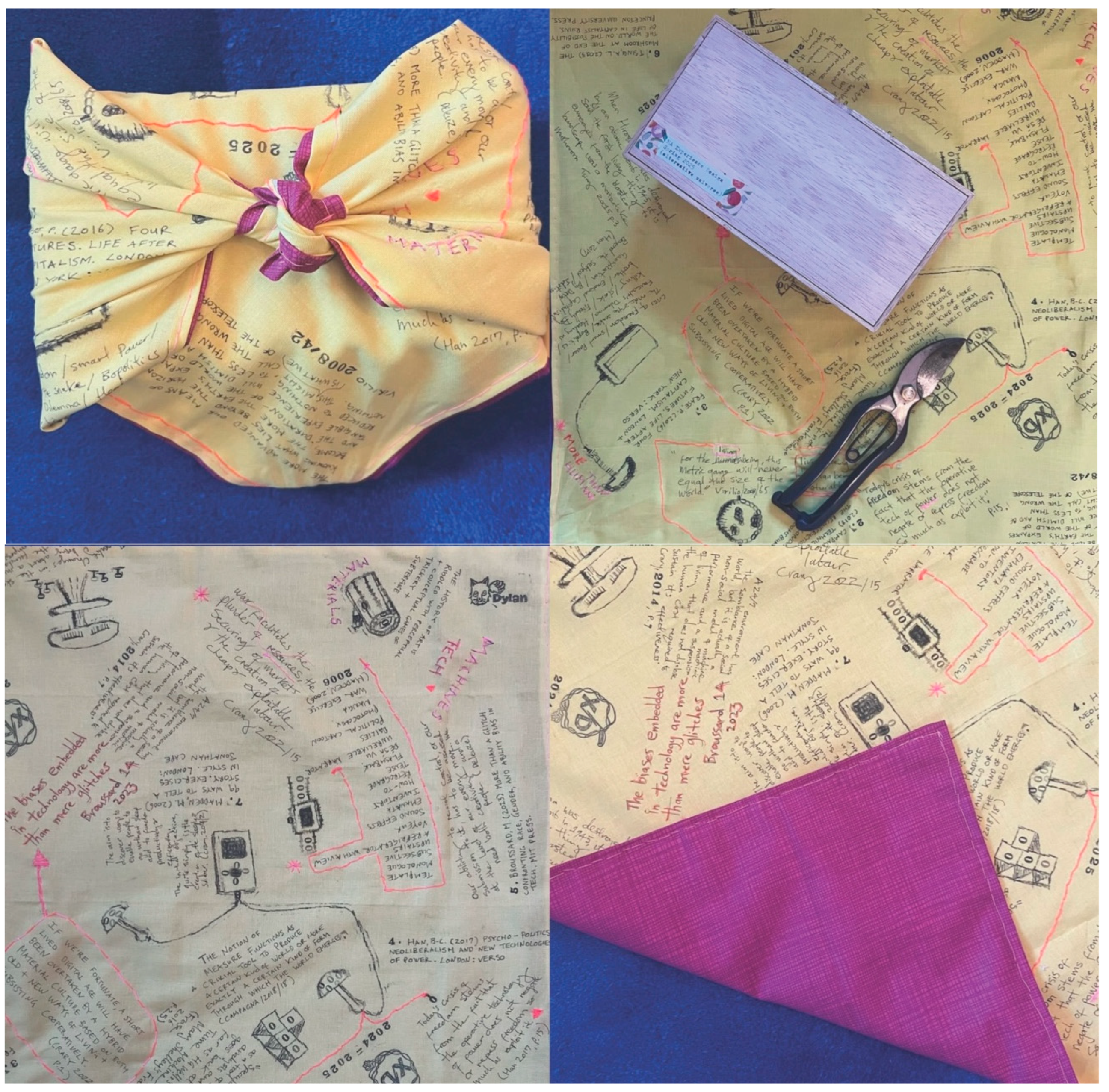
It is also worth noting that one of the other remaining artefacts from that period is a
Literature Review Furoshiki (
Figure 5) which was made originally in opposition to a move by universities at the end of Late Capitalism towards standardisation of online teaching materials for digital learning platforms. HE Art Schools tried to enforce this standardisation even during the first two years of nomadic education. Yet, in the first year of nomadic MA Experience Design, teaching staff and students took the decision to abandon digital learning platforms entirely after senior management implemented a peer-review system and a tick box check list to enforce their desired standardisation. Instead, Experience Design staff and students made personalised
Literature Review Furoshiki. These were used to wrap our toolkits, and we often swapped them between us as a means of sharing ideas as we travelled. As the academic year progressed these became a record of our collective learning. We wrote on one another’s furoshiki and swapped them back and forth. In this way, it was possible to make new connections, and many students reported enjoying reading once again as the slowness of stitching, drawing or printing their ideas onto the fabric reminded them that
Chat GPT (a former LLM, now extinct) emphasised speed and efficiencies which actually prevented an enjoyment of reading and forming new ideas.
At the end of that first academic year, we decided to formally announce that nomadic Experience Design does not believe in standardisation, nor the use of AI to develop new courses without staff input. Those sentiments seem so far away now that AI is a distant memory and the idea of standardisation in Arts Education is hard to believe, even though it has been well documented.