2. Remembering
Palestinian efforts to preserve the memory of erased villages culminated in the encyclopedic work of
Khalidi (
1992), who created an account of Palestinian villages erased throughout the establishment of the State of Israel. However, the Israeli erasure of Palestinian memory has by now gained attention from Israeli scholars as well. Since the 1980s, with the rise of a new generation of historians and the emergence of a post-Zionist approach within Israel, some prominent Israeli historians have uncovered documents and evidence of systematic destruction and concealment. Fighting against the government for transparency and access to confidential files in the national archives, Israeli historians like
Morris (
1988,
2004) and
Pappé (
2006) revealed the policy and practice of ethnic cleansing. This investigative drive continues today in the works of activist scholars such as cultural geographer
Yiftachel (
2006) and political historian
Raz (
2024), a leading figure at Akevot (“Traces”)—the Institution for Israeli–Palestinian Conflict Research.
The visual perspective on the Israeli–Palestinian conflict has been studied by art historians and scholars of visual culture and visual politics. From within Israel, art historians such as
Ankori (
2006),
Gal (
2009),
Musih (
[2021] 2023a,
[2021] 2023b) and
Ben-Zvi (
2014) have dedicated their work to the study and documentation of Palestinian art. Palestinian scholars, including
Laïïdi-Hanieh (
2006) and
Alloul (
2016), have expanded the theoretical understanding of Palestinian visual culture. My own work takes a different trajectory, following the theoretical approach laid by
Mirzoeff (
2011,
2023), who seeks to push the boundaries of visual culture and to deploy its study for political activism. Within the Israeli–Palestinian context, this path was developed by
Azoulay (
[2010] 2012),
Weizman (
2007),
Sela (
2018), and
Hochberg (
2015,
2021), whose work engaged deeply with the politics of the image and the act of seeing—or not seeing. Through this aesthetic lens on the erased, the unshown, and the invisible, I explore the political Israeli gaze at the Palestinian presence. Differing from art historical approaches, my project investigates visuality within the fields of heritage studies and affect theory, thereby tying together heritage, emotion, politics, and the visual.
Representational theory, that is, an iconographical and historical approach alone, however, cannot fully encompass and analyze visitors’ experiences at Alami House, as is the case with other heritage sites in contested territories or conflict zones. The scholarly discussion of contested heritage emerged in the late 1970s, alongside the postcolonial critique. Scholars such as
Meinig (
1979) and
Appadurai (
1981) theorized landscape and heritage in terms of identity politics and socio-political power. Building on Appadurai, we can assume “that discourse concerning the past between social groups is an aspect of politics, involving competition, opposition, and debate” (
Appadurai 1981, p. 202). Yet for analyzing Alami House, Appadurai’s further argument is particularly relevant: “Like all systems of norms, those concerning the past constitute a link between cultural concepts and social action. But unlike any other set of norms, this set is, necessarily, a code for societies to talk
about themselves, and not only
within themselves” (
Appadurai 1981, p. 218). This raises key questions: Which norms and practices crystallize through the restoration of Alami House? Can we see beyond the declared aims of stakeholders? And how does the visit to Alami House reflect and amplify the organizing cultural principles of Israeli Heritage-making? These questions, which informed this study, will form the heart of my analysis of Alami House.
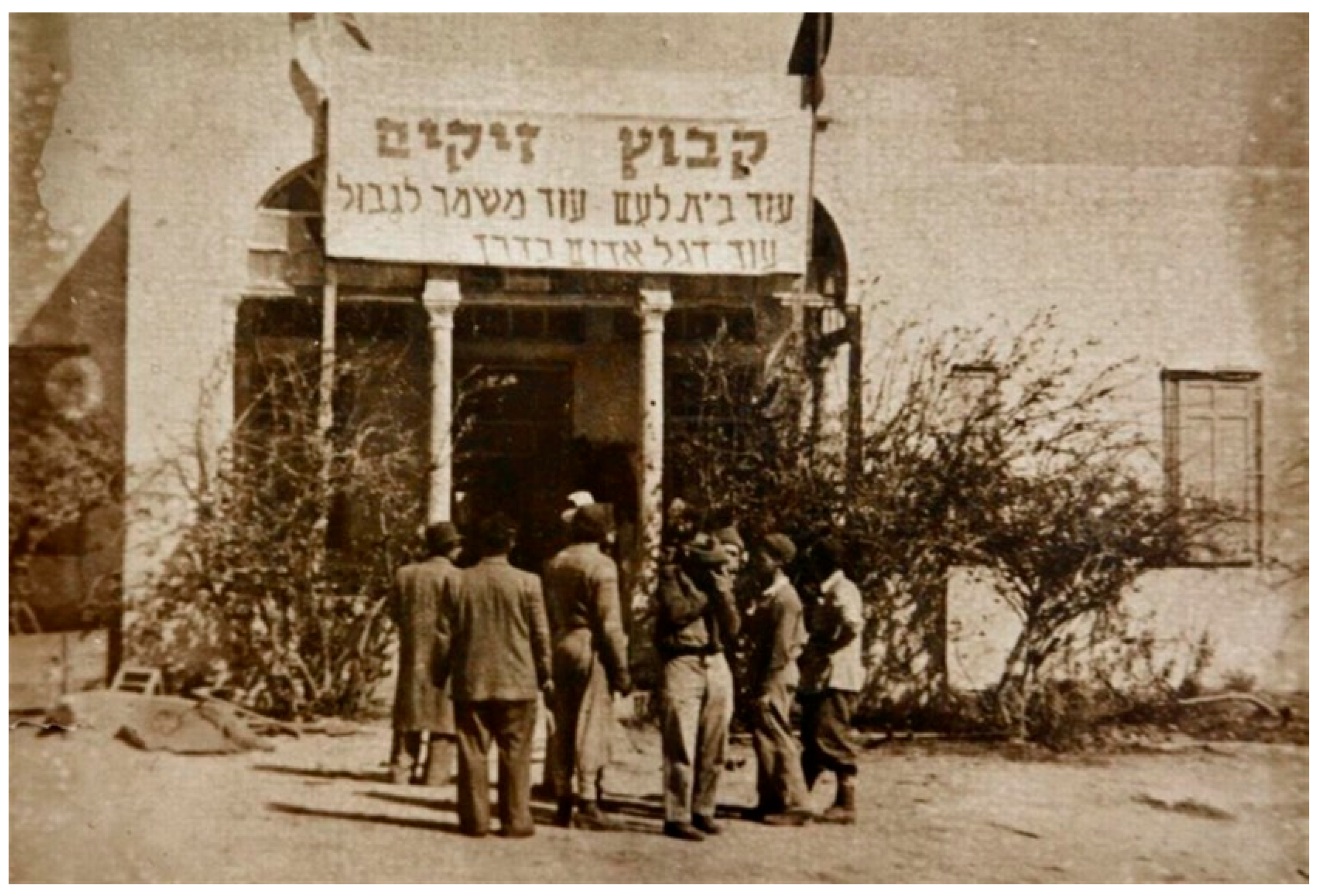
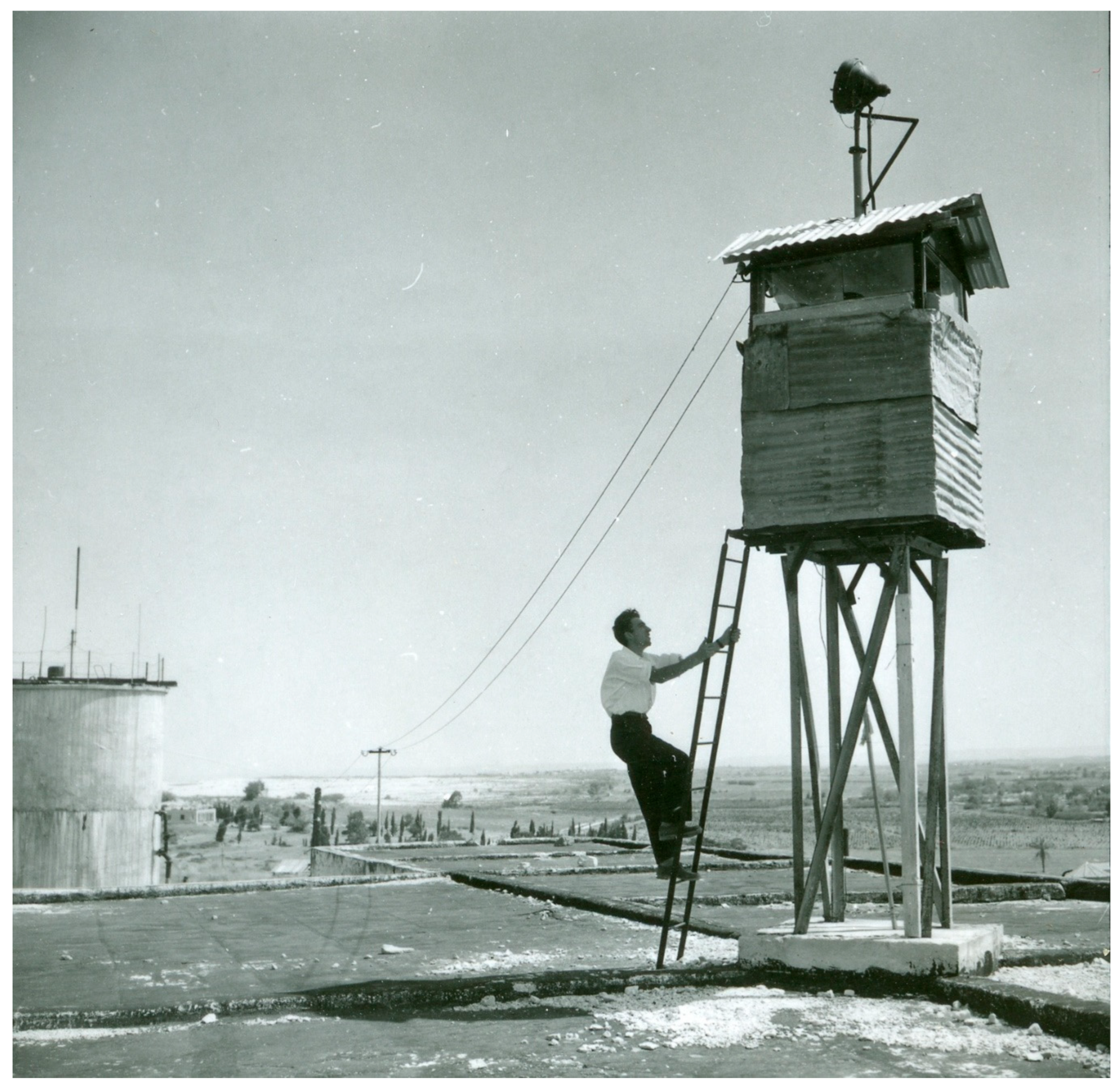
Braun documented the watchtower during the kibbutz’s ninth anniversary. Ziqim was established in 1949 by a group of young pioneers from the Hashomer Hatzair Zionist movement. On February 14th, they gathered to celebrate the event at a secluded, beautiful Arab house that served as the nucleus of the kibbutz’s expansion and development. The settlers adorned the house with the flag of the one-year-old Israeli state, and the entrance was covered with a handmade sign reading “Kibbutz Ziqim: another home for the people, another guard for the border” (
Figure 2). A newspaper report from 15 February 1949, described the celebration and quoted part of the kibbutz constitution: “Our constitution is a constitution of generations. It is soaked in blood and tears. We have striven in every way for the homeland. Our path is saturated in victims and destruction. We did not want that. We did not shelve our lofty ideas; we will preserve and nurture them” (
Kibbutz Ziqim Establishes a Foothold 1949, p. 3).
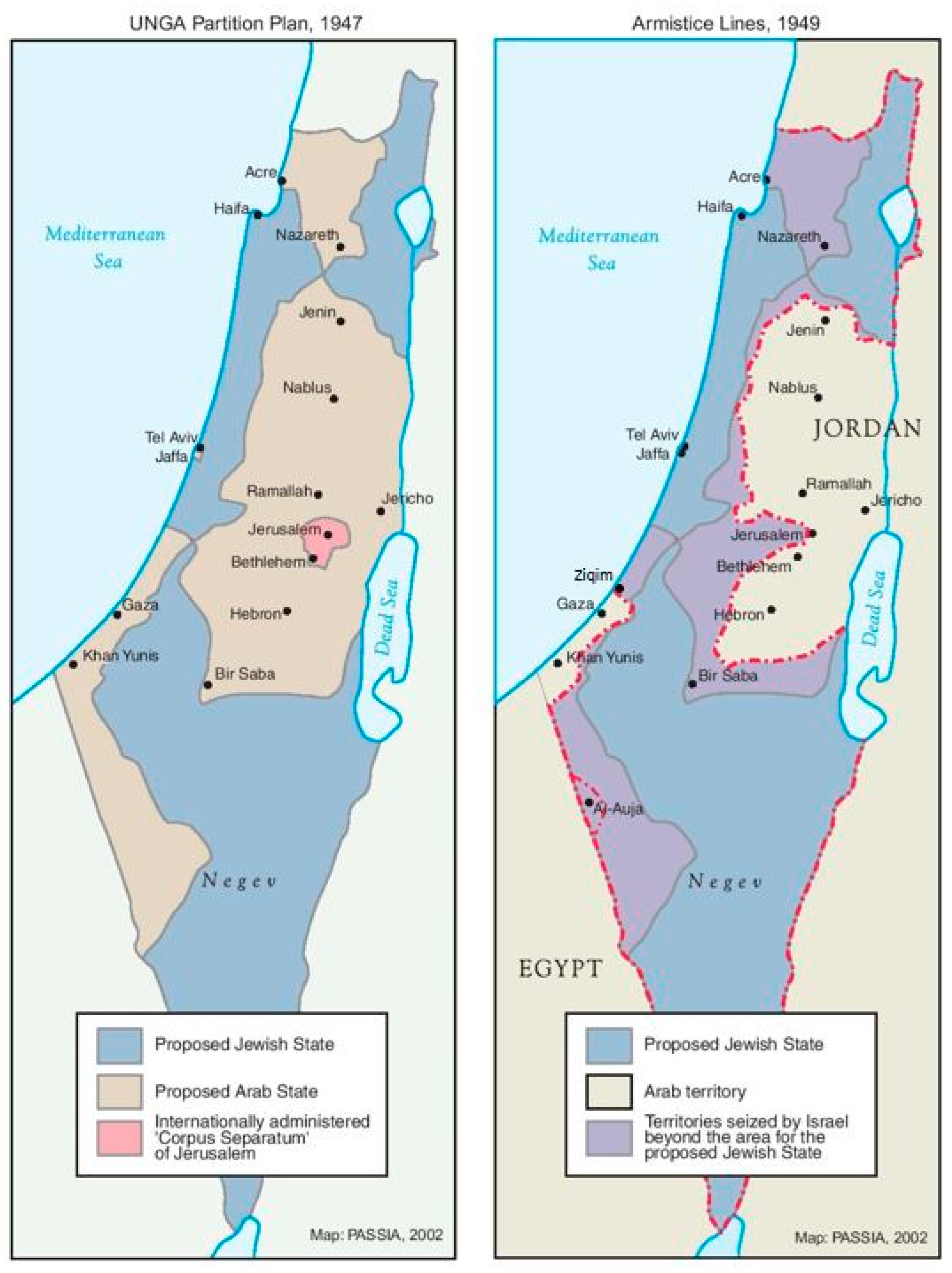
Ziqim was part of a row of settlements along the border with the Gaza Strip, later known as the Gaza Envelope. This border, however, shifted over time. When the UN Partition Plan was approved in 1947, the land on which Ziqim was later founded was designated as part of the proposed Palestinian state. Following the Arab League’s rejection of the plan and the 1948 War, the territory was captured by Israel and became part of the new state according to the 1949 armistice lines. The remaining part of the Gaza Strip came under Egyptian control (
Figure 3). Yet the original inclusion of this area within the Palestinian state was not arbitrary: it comprised numerous Arab villages inhabited by tens of thousands of Palestinians—contrary to the Zionist narrative of
terra nullius (
Svirsky 2010). According to the surveys compiled by Khalidi, approximately 60,000 Arabs fled from the Gaza District during the 1948 War—most towards Gaza City—becoming refugees in the Gaza Strip.
1 When Israel and Egypt signed a ceasefire agreement on 24 February 1949, ten days after Ziqim’s inauguration, this territory was officially incorporated into Israel, thus legitimizing the kibbutz under international law.
The land on which Kibbutz Ziqim was founded had previously belonged to the Arab village of Hiribya, inhabited by 2240 people until 1948 (
Khalidi 1992, pp. 101–2). The disastrous Israeli practice of village destruction is by now beyond scholarly dispute. Archival materials—though still partially restricted—provide abundant evidence of the systematic demolition of Arab houses during the 1948 War. In his book,
The Birth of the Palestinian Refugee Problem Revisited,
Morris (
2004, chap. 4–5, pp. 309–413) explains that Israeli leaders perceived Palestinian presence as dangerous to the existence of a Jewish state. Once the government decided against allowing refugees to return, their physical return had to be blocked, and a systematic practice emerged: abandoned Arab villages were either resettled by Jewish groups or destroyed to prevent return. This policy served both security and demographic aims. Yet, there was another aspect to this practice: it also created a new visual regime and landscape—one devoid of Palestinian history.
Ziqim was initiated in one of the two remaining Arab houses in Hiribya.
2 This distant, lavish house, distinct from the simpler homes in the village center, has an obscure history, with limited documentation. The available details rely largely on oral testimony.
3 The house is believed to have been built during the 1920s by Hafez al-Alami, a lesser-known member of the prominent Alami family, whose celebrated figure was Musa al-Alami, a brilliant legal scholar and diplomat, and the son of the Mayor of Jerusalem. Although the house is often misattributed to Musa al-Alami, as it adds to its historical prestige, a 1933 Hebrew newspaper report states that Hafez al-Alami hosted the British Minister of the Colonies at this family vacation home in Hiribya (
Gaza and the Minister of the Colonies 1933). Israeli journalist
Gilad (
2019), who recently researched the Alami House, attempted unsuccessfully to trace any descendants of this family branch.
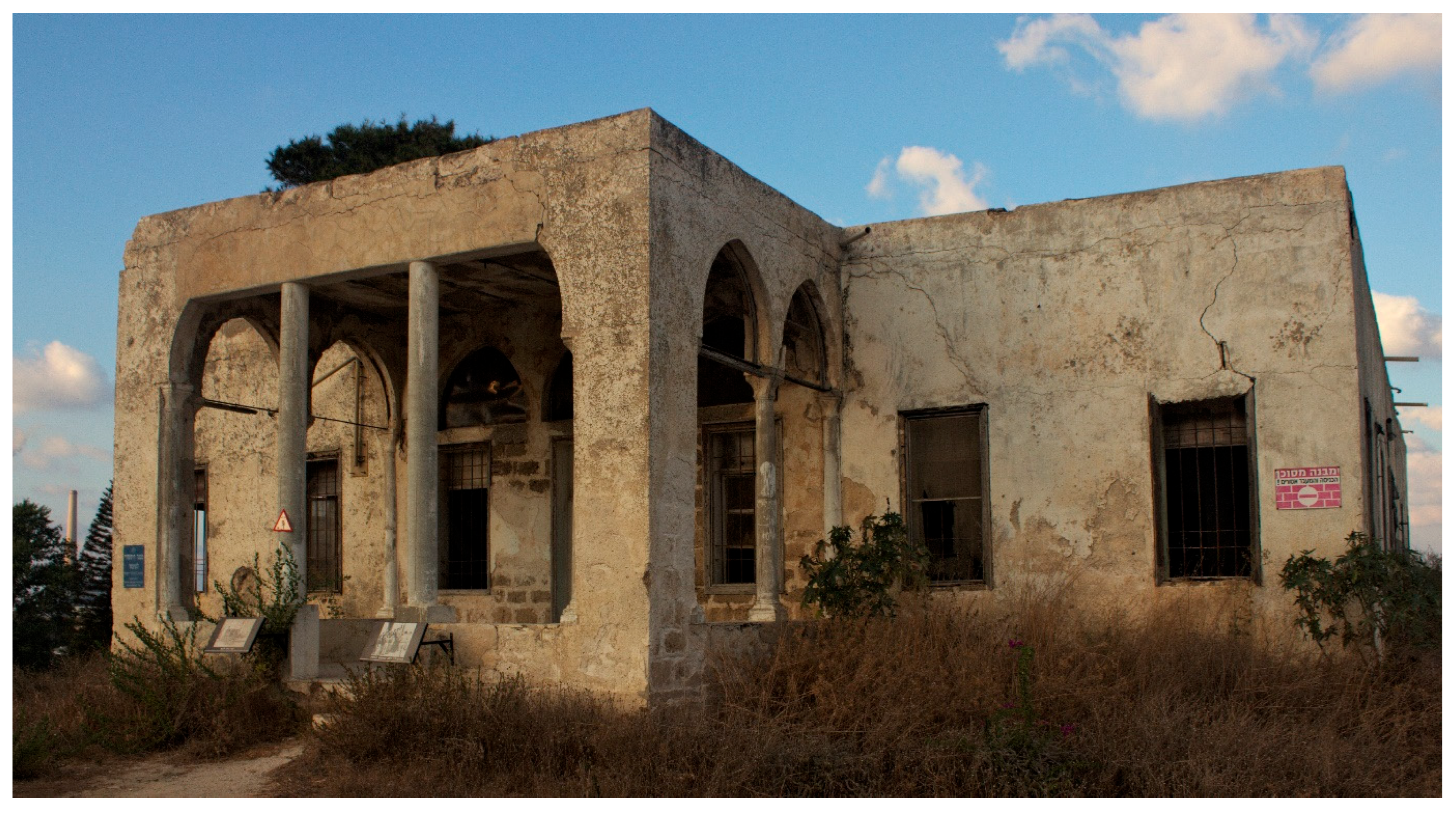
During the 1948 War, many groups of young Zionist pioneers participated in the dual mission of establishing the nascent Israeli state and setting a forceful presence along the borders as a defense practice. Several groups were dispatched to settle along the border of the Gaza Strip, which was then an Egyptian enemy territory. One such group, organized by Hashomer Hatzair, had prepared in the city of Rehovot for its settlement mission. In 1949, the conditions ripened, and Kibbutz Zikkim was founded in what they saw as the perfect spot: an “empty,” beautiful Arab home on a hill—Al-Alami House—overlooking Gaza. During the first months, the founding members resided in this building, which they called “the Arab house.” Gradually, small cottages were built around it, and the house served multiple purposes: a temporary shelter for refugees from war-torn Europe, a dining room, a children’s house, and a stable. Later, it served as a shop, warehouse, clubhouse, and pub. Eventually, the building was abandoned, and in the 1990s, it was declared structurally unsafe, and its use was prohibited (
Figure 4).
3. Disciplined Visuality
This point in the building’s history marked a significant crossroad in the context of heritage discourse. There are numerous cases of old Arab houses across Israel that were abandoned during the 1948 War, and that underwent divergent fates: some were inhabited by Israelis and privatized;
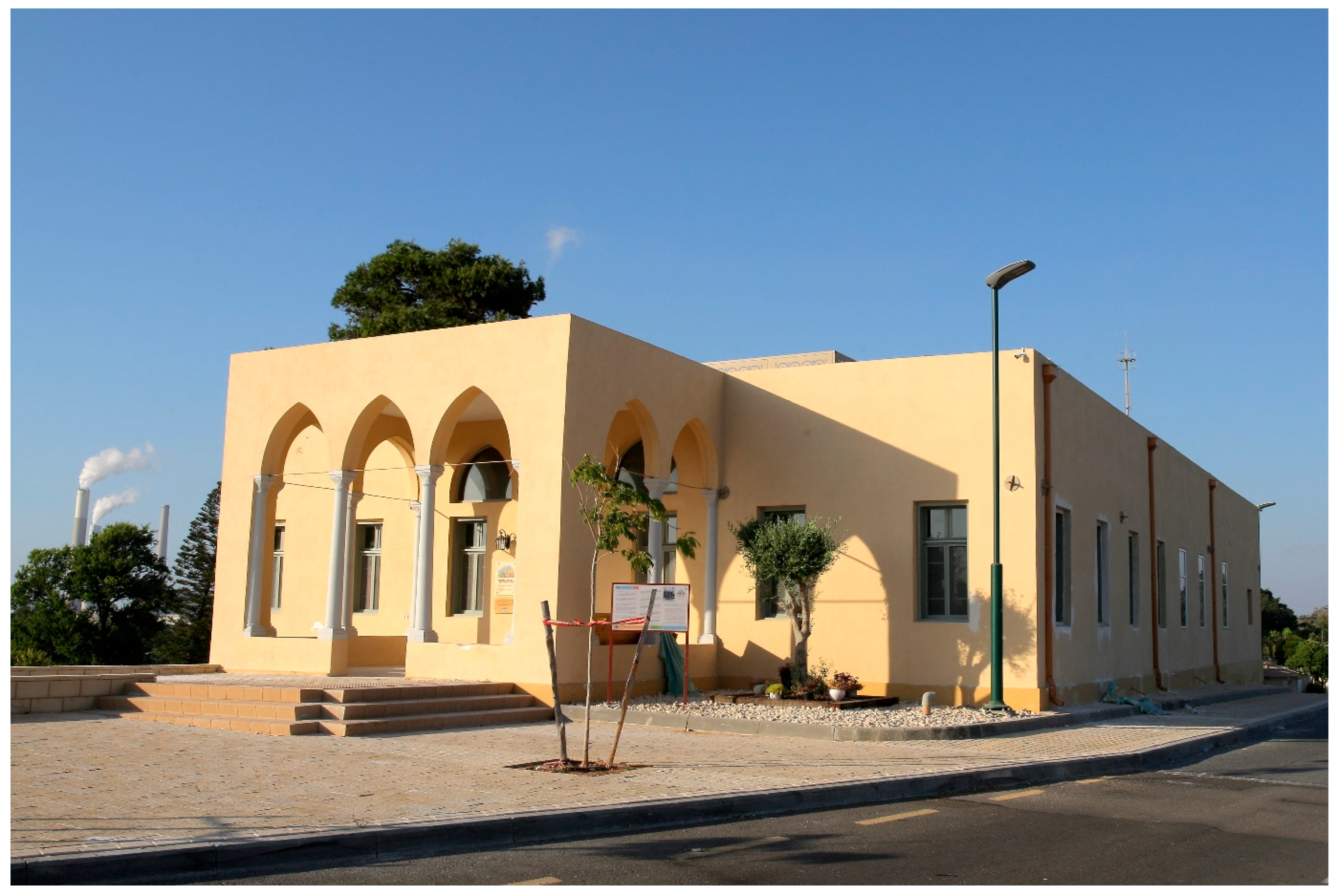
4 Others were demolished, erasing a historical layer that contradicted the Zionist motto of “a land without a people for a people without a land.” In many other cases, the houses were preserved but re-purposed, effacing the memory of their previous Palestinian owners. Such was the case, for example, with the building known as “The Palace”, an Arab house used by the founders of Kibbutz Nitzanim near Ziqim, which has since been converted into a field school managed by the Israeli Nature Protection Society (
Figure 5).
Many such preserved houses were turned into heritage sites, yet ones of national Israeli heritage, commemorating the founding of the settlement, or those killed in defense of it. In 2002, Kibbutz Karmia—a settlement close to Ziqim that was established in 1950 on the land which occupied the center of destroyed Hiribya—founded a memorial for members killed in Israeli wars, located in Hiribya’s former school building. Other kibbutzim, like Ziqim, which originated in Palestinian houses whose owners were expelled, eventually transformed those houses into museums narrating the history of the kibbutz—a form of heritage museum known in Israel as “Beit Rishonim” (House of the First Settlers). Elsewhere, I discuss the broader practice of transforming Palestinian heritage sites into Israeli heritage sites—particularly museums (
Milano, forthcoming). Such cases clearly participate in the creation of a curated and censored visuality, eliminating the Palestinian past. Through camouflage and appropriation, the institutionalization of Palestinian buildings under Israeli identity erases the visible traces of Palestinian history on that land. In this paper, however, I turn to a more theoretical discussion, returning to Alami House to conceptualize it as a site of disciplined visuality. By this term, I refer to a scopic regime in which what may be seen, learned, or remembered is not simply censored or removed, but carefully organized and managed. Whereas censored visuality operates through omission and prohibition, disciplined visuality functions through arrangement, framing, and spatial choreography: it determines the conditions under which certain histories may appear while simultaneously regulating their meaning and political implications. At Alami House, Palestinian presence is not entirely hidden but reintroduced in a controlled form—confined to the past and embedded within a narrative that ultimately reaffirms Israeli authority over the landscape.
Following years of neglect and its designation as a hazardous structure, Kibbutz Ziqim finally had to decide what to do with “the Arab house.” Several options were considered: demolition of the building; renovation as an art gallery—a less favored possibility given the nearby existing galleries;
5 Or restoration as a museum recounting the history of the kibbutz—the typical solution in comparable cases. But the members of Ziqim chose none of these options. Instead, as a kibbutz affiliated with the left-wing Hashomer Hatza’ir movement, the members made a more complex decision: to restore the house while preserving the name of its Palestinian founder. This meant creating a heritage site that conveys a layered narrative of entangled Palestinian and Israeli heritage.
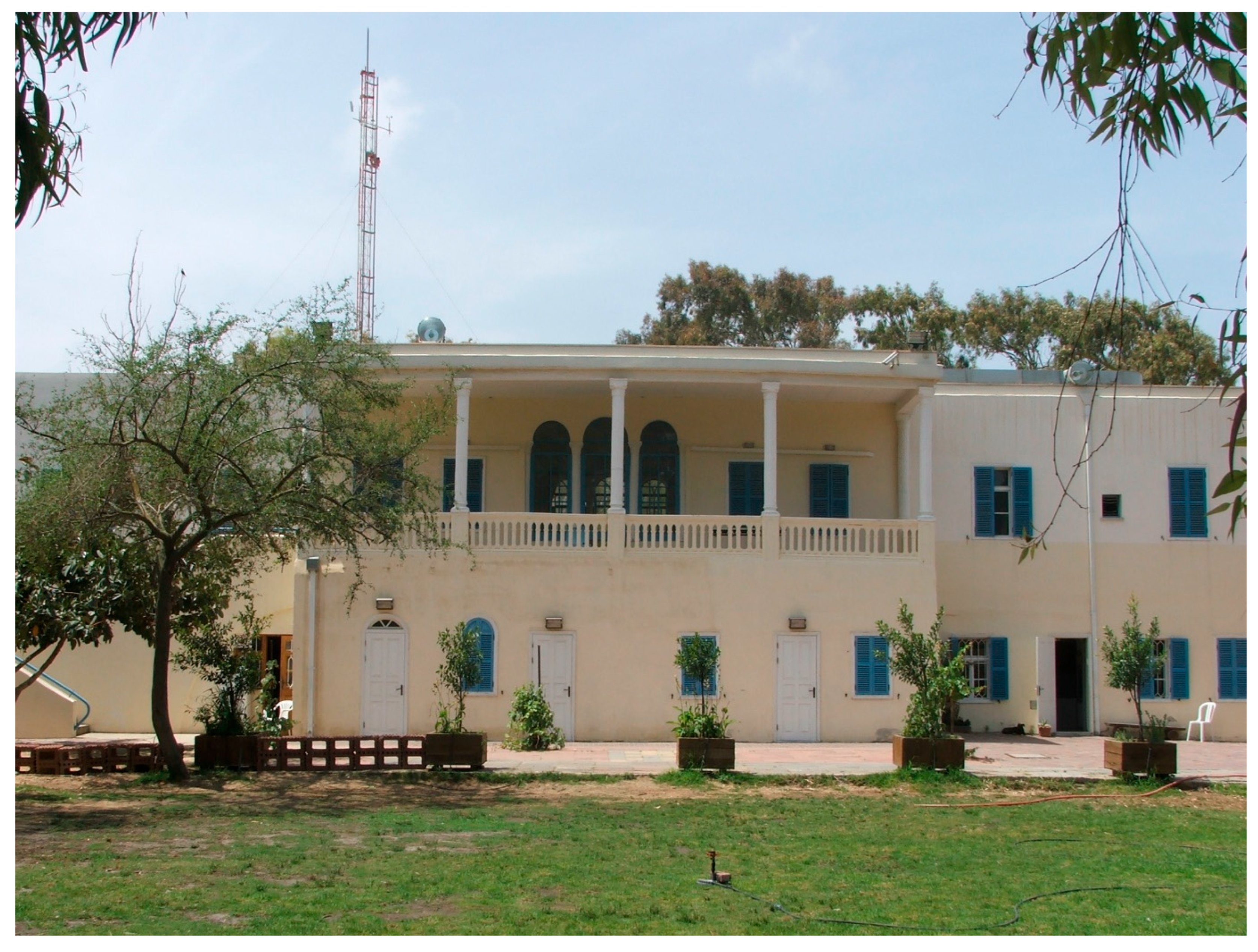
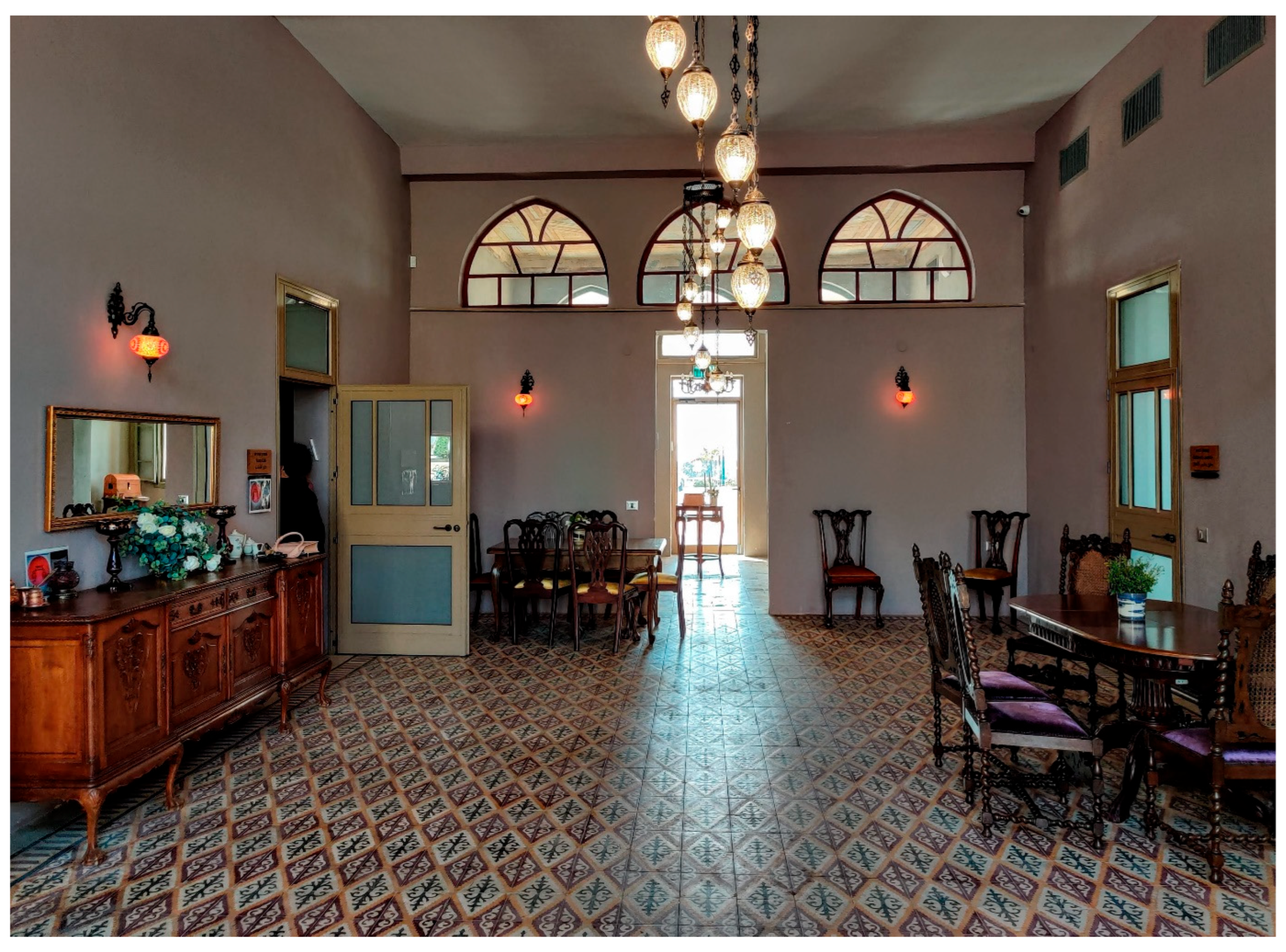
Architect Zvika Pasternak oversaw the renovation and conservation, which were supported financially by the Australian Jewish Fund, the Israeli Heritage Council, and the Kibbutz members themselves. The conservation process included not only the restoration of the walls, ceiling, and floor according to the original ground plan, but also period-appropriate furnishings and décor, in a style that conforms to the house’s original function (
Figure 6). In 2019, Alami House was opened to the public as an official heritage site, presenting the Palestinian history of the building and the Israeli history of Kibbutz Ziqim (
Figure 7).
4. Performative Heritage
In recent years, both empirical and theoretical studies of contested heritage have drawn extensively on affect theory, recognizing the subjective and emotive aspects of visitor experience and the constitutive role of imagination in shaping heritage agency. What began in 1957 with heritage scholar
Tilden’s (
[1957] 2007, chap. 5, pp. 59–67) principle of “Not instruction, but provocation” evolved into
Smith’s (
2020) framework of
Emotional Heritage. In another seminal book,
Uses of Heritage,
Smith (
2006, p. 84) argued that “What makes certain activities ‘heritage’ are those activities that actively engage with thinking about and acting out not only ‘where we have come from’ in terms of the past, but also ‘where we are going’ in terms of the present and future.”
Roni Gilat, a member of Ziqim, involved in managing Alami House, expressed a vision that invokes Smith’s thesis: “Keeping the name of the Alami family is a declaration that we aren’t hiding from that past. […] In my opinion, this move holds real promise for the future. I believe that this house will serve as a possible meeting place for Palestinians and Israelis. Not only because of its perfect location in the middle of the road between Ashkelon and Gaza, but also because of its history and that of its founders” (
Gilad 2019). This vision—combining past and present identities—offers one possible narrative stemming from the visit to Alami House.
From a material visual-culture perspective, the viewer encounters a historic home of Near Eastern aesthetic character. One original painted ceiling has been restored, and tiles similar to the originals were laid on the floor. The windows, light fixtures, and furniture recreate the building’s original ambiance. Yet materiality extends beyond the visual, encompassing bodily experience. The body interacts with the house, creating a platform in which the viewer’s identity—mediated by what
Waterton (
2014) called “affective and emotive values”—produces a bodily interpretation. Approaching heritage through affect theory, Waterton reconceptualized heritage not as something material, but as “practice, which, when thinking about the spaces of heritage, means shifting from static ‘site’ or ‘artefact’ to questions of engagement, experience, and performance” (p. 824).
This bodily dimension is crucial for understanding the politics of visuality at work in the site. Visuality does not refer merely to what is represented in images but to the social and spatial arrangements that organize how subjects come to see and interpret the world. At Alami House, this organization operates through the visitor’s embodied encounter with the material remains of a Palestinian home. Moving through the restored interior, the visitor does not simply observe a historical narrative but physically inhabits a space structured by overlapping temporal and political layers. The performative experience of walking through rooms furnished in an “Oriental” style, reading the wall texts, and recognizing the Palestinian origins of the house situates the visitor’s body within a landscape of contested memory. In this sense, the bodily encounter functions as a mechanism through which visuality is produced: it shapes how the Palestinian past becomes visible, legible, and ultimately contained within an Israeli heritage narrative. The visitor’s body thus becomes a site where the politics of seeing and remembering are rehearsed before the gaze is redirected outward toward the surrounding landscape.
One form of performativity pertains to Israeli Jewish identity. The typical Israeli visitor learns about the Alami family and confronts—visually, bodily, and intellectually—the Palestinian past embodied in the site. Significantly, the performative force arises not merely from representation, but from the
presentation of the Palestinian: not just as memory, but in material form. For Israeli-Jewish visitors of Arab descent, the house’s oriental character may evoke recognition of their own familial roots in the Middle or Near East. Such a play of identities reveals a heritage ontology that extends the notion of materiality to encompass both object and subject. The site thus assumes a bodily definition, and the concept of heritage demands, as Waterton suggested, “foregrounding notions of ‘becoming’ and ‘embodiment’” (p. 824).
6Materiality is not the only concept being invoked and challenged in Alami House. Due to its proximity to Gaza, the site also functions as a place of encounter, eliciting identity dynamics of self and other. Within the geopolitical context, these dynamics are saturated with affect, stemming, among other things, from power negotiations. Here, I must add another layer concerning Israeli visitors: the differing emotional conditions of the visit before and after 7 October 2023.
In terms of power dynamics between Israelis and Gazan-Palestinians, I posit that while the balance of power and control was intensified during the Gaza War, Israel’s dominance and the violence exerted upon Palestinians predated it. These are not products of the recent war, but rather integral to Israel’s longstanding agenda regarding Palestinian presence. Nevertheless, because this article focuses on visitor experience at Alami House—and the typical visitor is an Israeli Jew—it is crucial to acknowledge that Israeli perceptions of the Gazan-Palestinian have been profoundly affected by the tragic attack of 7 October 2023 (
Yingst 2024). Although I cannot fully nuance the complexities of the conflict here, it is fundamental for my discussion to recognize that the characteristics of the
Israeli gaze from Alami House toward Gaza today differ significantly from those prior to the war’s outbreak.
7 Within this context, I will critique the naivety of Ziqim members during the renovation, particularly in light of its implications during the Gaza War.
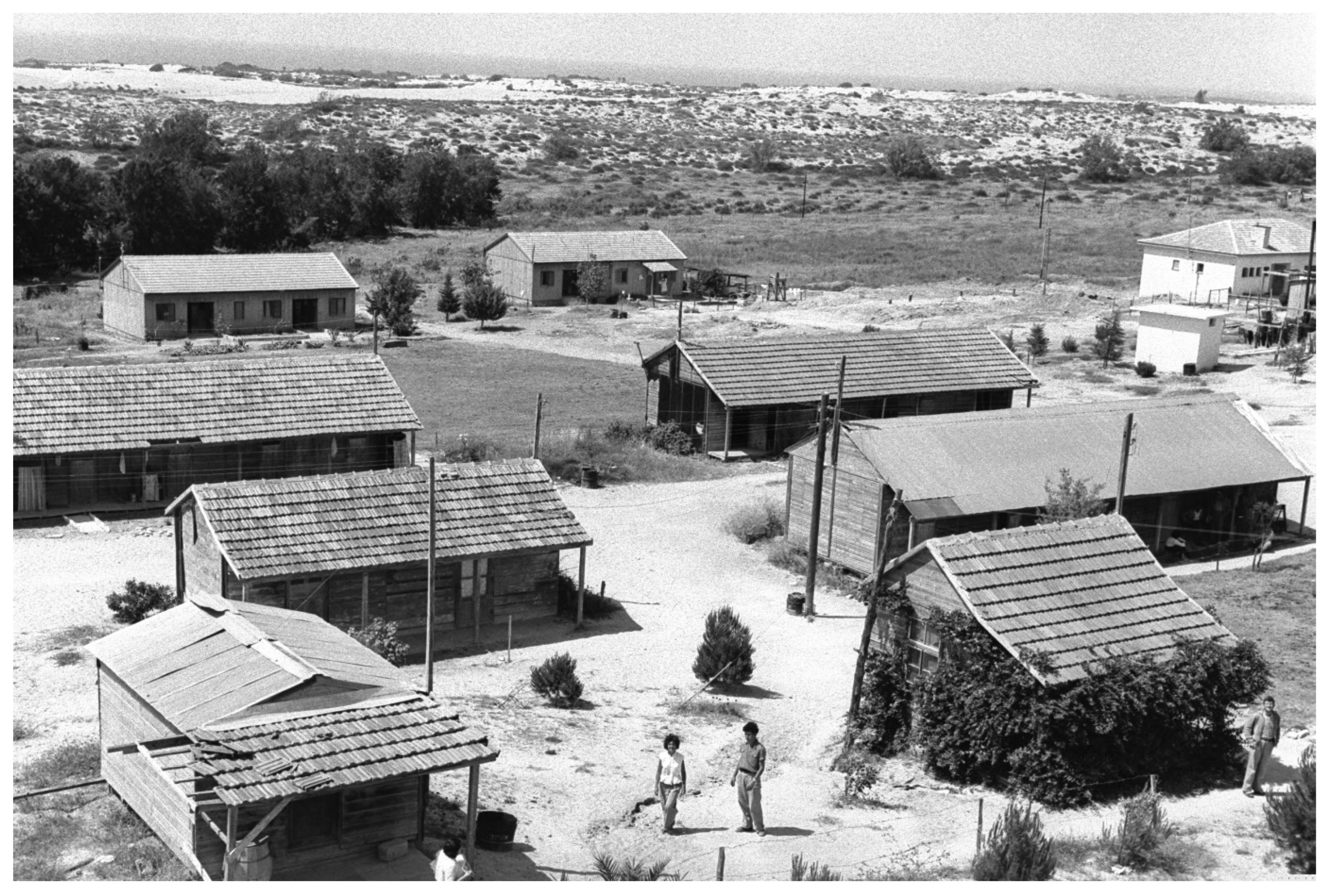
As part of the renovation of Alami House, architect Pasternak decided to create an observation point on the roof. While this constituted a restrained and modest structural change, he believed it would not do injustice to the place’s cultural heritage. From the perspective of Arab architectural tradition, this decision might be justified: the flat roof—strikingly different from the pitched roofs of the kibbutz houses (
Figure 8)—is typical of Arab homes and holds a significant role in domestic life throughout the Middle East. Rooftops in this region once served as living spaces: women would use them for leisure when public life was forbidden to them; laundry was hung to dry there; small gardens were nurtured; and during the hot summer nights, families slept under the open sky. Before air conditioning was introduced, such rooftops symbolized the rhythm and intimacy of Arab domestic culture. Pasternak’s decision, however, was motivated by didactic rather than ethnographic considerations. He sought to use the house not only to tell its own story but also, as he put it, to serve “visitors who want to learn about the surroundings” (
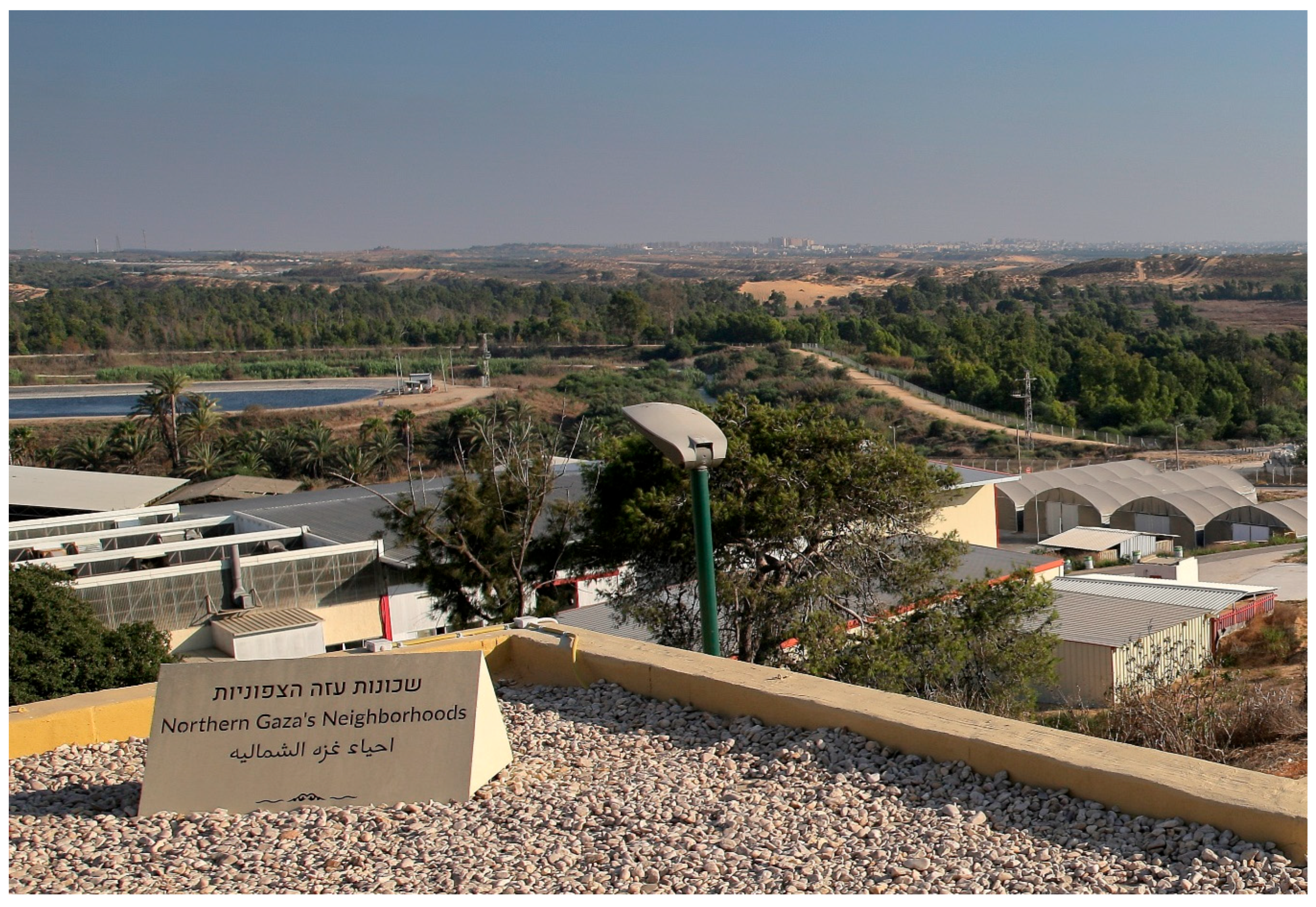
Gilad 2019), particularly the political geography of the Gaza Envelope. On the rooftop, visitors can observe the landscape of Ziqim and its environment. Written signs direct their gaze to key points of interest around the house: the historic water tower of the Kibbutz, the Shikma water reservoir, the Mediterranean shore, and, looking south, the northern neighborhoods of Gaza (
Figure 9).
At Alami House, the bodily dimension of the visit becomes central to the epistemological effect. Before 7 October 2023, the visit inside the house carried a didactic tone, with wall texts presenting the history of the Alami family up to 1947, alongside the history of the kibbutz from 1949 onward. The interior design reflected respect for the Arab style, acknowledging the former owners’ identity. For the Jewish visitor, this visible Arab identity represented, at best, a distant memory—covered by successive layers of material, social, and cultural history. The message conveyed by the renovated Alami House could thus be paraphrased as follows: We acknowledge that the land on which we stand once belonged to Palestinians, but history has taken its course, and this place became the home of the kibbutz. This sentiment, while common today across the Western world, coexists uneasily with the limited reach of decolonial discourse. In states that have employed settler-colonial practices in the past, such as the United States, Canada, or Australia, liberal gestures of acknowledgment rarely extend to any serious consideration of land restitution. In Israel–Palestine, this discourse is even more fraught, as for many Israelis, the question “who was here first” leads to the invocation of Biblical Jewish sovereignty. Thus, even among Israel’s leftist liberals, the visit to Alami House rarely provokes a sense of historical injustice. They may find relief in the tribute paid to the Alami family below, a gesture that helps sustain a deterministic narrative of history.
5. Self/Other Geopolitics
Current discussions of the relationship between self and Other build on the foundational postcolonial analyses of
Fanon (
[1952] 1967) and
Said (
1979), later expanded through concepts such as
Bhabha’s (
1994) notion of hybridity and
Mbembe’s (
[2000] 2001) theory of necropolitics. Within visual culture studies, these trajectories informed
Mitchell’s (
2002) work on colonial visuality and
Mirzoeff’s (
2011) formulation of countervisuality, both of which emphasize how regimes of seeing participate in structuring relations of power between colonizer and colonized. Building on this theoretical lineage,
Iaquinto et al. (
2024) proposed conceptualizing tourism encounters as geopolitical encounters, in which visiting a place becomes a mediated interaction with political identities and territorial conflicts. Although Alami House does not facilitate direct encounters between individuals, this framework underpins my analysis by illuminating how heritage sites in conflict zones stage imagined encounters between self and Other, positioning the visitor within a visual and spatial relationship to the Palestinian presence.
Alami House offers precisely such an imagined encounter between self and Other, simulating geopolitical interaction among ethnic, national, and political identities. Following the tour of the house’s interior, the visitor exits to the balcony and climbs to the roof via an external staircase accessible from the balcony. Considering the sentiment constructed downstairs, we may assume that the arrival on the rooftop is characterized by a feeling of merit—or at least indifference. The affective disposition visitors bring to the rooftop shapes their gaze toward the “Other.” In this case, the Other—the Palestinian in Gaza—is not abstract but concretely tied to the very people expelled from the land now occupied by the observer. The visitor’s body and gaze thus become performative, re-enacting the repression of the Other. The visibility of Gaza transforms the memory of the past into a living performance. The Other, represented as a historical memory on the ground floor, reappears visually and materially upstairs. In a sense, the view undermines decades-long efforts by the state to render Palestinians invisible in the Israeli landscape.
This movement from the interior of the house to the roof and the vista of the surroundings thus mirrors the shift from historical reflection to geopolitical positioning. From the rooftop of Alami House, the view is highly charged. The journalist Moshe Gilad described this view metaphorically: “If you squint, you can also see Jews and Arabs, refugees from Europe and from the Gaza Strip, Zionism and war. In a kind of horrifyingly realistic version of mini-Israel, it is as if someone has spread before you all the elements of the Middle Eastern sphere and mixed in a large dose of (sometimes literally) explosive current events” (
Gilad 2019). The experience is therefore not merely physical, but also epistemological in nature. The bodily experience elicits a process of embodiment rooted in the dynamics of identity politics, as the gaze operates simultaneously as a sensory, epistemological, and political tool.
To articulate the power dynamics embedded in this gaze, I draw on
Boime’s (
1991) concept of the
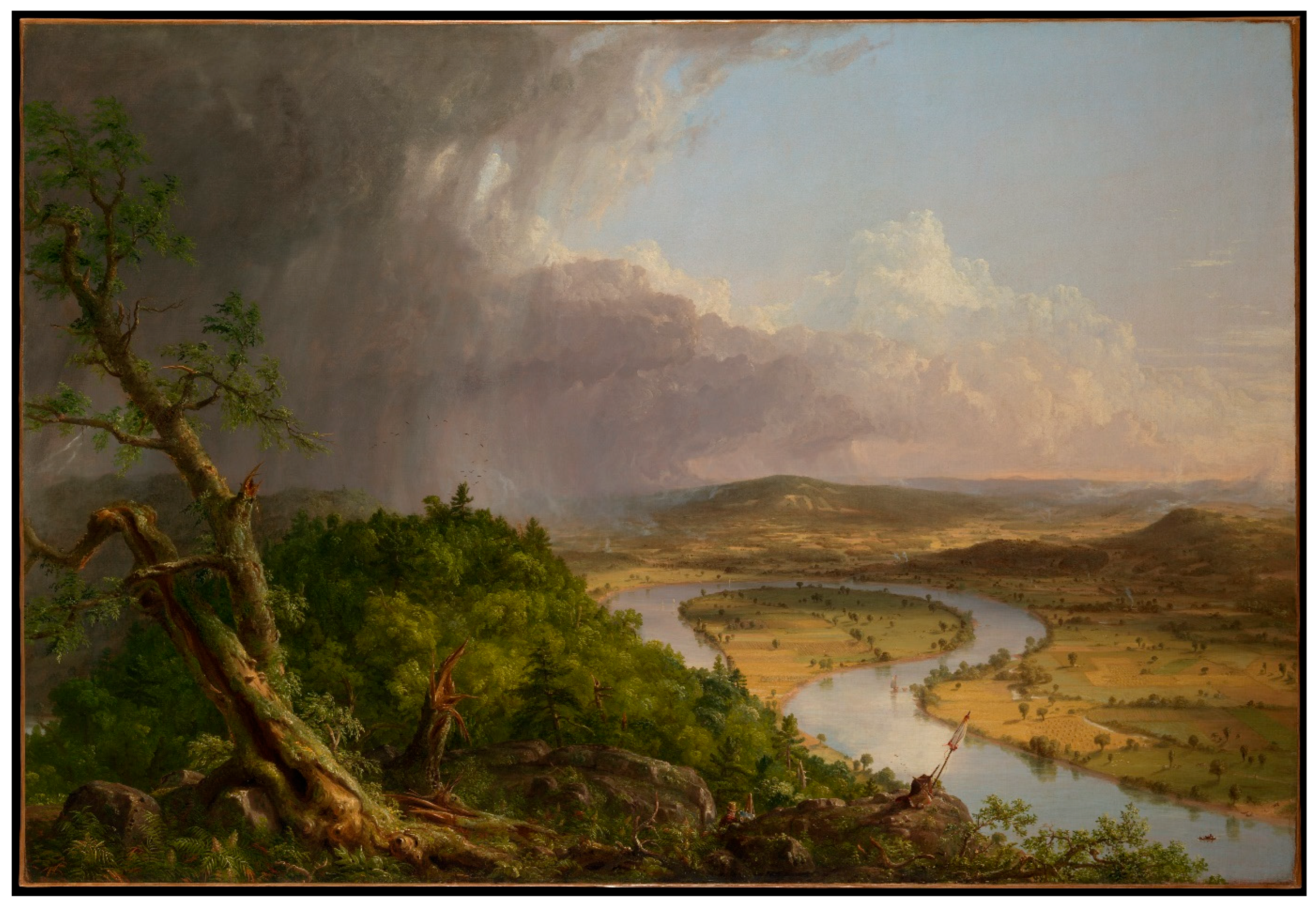
Magisterial Gaze, describing nineteenth-century American landscape painting. Boime coined this term to characterize a visualization of power dynamics epistemology in landscape painting, especially of the Hudson River School (
Figure 10). In such works, the elevated vantage point offers an expansive view of the landscape, stretching the land towards the horizon. It is meant to represent a land belonging to the viewer, or at least claimed by her.
8 These images relate to nineteenth-century territorial conflicts stemming from the American ideology of Manifest Destiny, which dismissed prior human presence and was driven by an ambition to conquer and dominate the land, as well as to subdue and control its indigenous inhabitants. The high viewpoint in these paintings thus conferred both epistemological and material superiority.
My intention in invoking Boime’s concept is not to suggest that direct imperial ambitions are embedded in any gaze from above, but to recognize the inherent sense of mastery that such a position entails. Considering the gaze from Alami House’s rooftop towards Gaza—and more so when one stands physically atop an abandoned Palestinian house—one cannot ignore the negotiation of power between self and Other. The Jewish visitor experiences bodily and sensory superiority in relation to the Palestinian. Regardless of political stance, the embodied experience is one of power and control, with visuality serving as its medium.
Setting aside moral reflection, the visual reality remains one of separation and domination: the gaze from Alami House’s rooftop toward Gaza embeds a feeling of ownership. The Palestinian image is literally beneath one’s feet, and is perceived as an identity pushed outside the frame of the present. It is seen, yet is perceived as part of the past. While the state of Israel has relegated Palestinian identity to the realm of memory, and its presence on the ground floor of Alami House to be associated with the past, the gaze from the rooftop re-presents it. Nevertheless, the operation of the gaze is of a dual nature: on one hand, it disrupts Israel’s visual erasure of the Palestinian; on the other, it reaffirms Jewish-Israeli dominance over the land, the Palestinian narrative, and even the Palestinian body.
A similar duality arises in Werner Braun’s photograph that opened this article, though visuality is manipulated differently there: In the photo, the viewer’s perspective merges with that of the photographer, facing the sea, and rendering the Palestinian invisible. Yet invisibility here does not equal absence: the Palestinians are visualized through allusion. The watchtower, as noted earlier, implies Palestinian presence and danger, marking it as a threat to the Israeli haven. Its function was not merely defensive but also visual: it structured a particular regime of looking in which the Palestinian was imagined as an approaching enemy whose presence justified vigilance and protection. Over the decades separating Braun’s photograph from the renovation of Alami House, however, a different visual regime gradually emerged. A new Israeli generation grew up within a landscape from which Palestinian presence had largely been removed or rendered materially invisible. This generation absorbed the Palestinian not as a visible social and spatial reality but as an abstract political category—what might be described as a conceptual or epistemic figure rather than a physically present community. At the same time, Israel’s continued control over the West Bank and Gaza cultivated a broader cultural sense of security, dominance, and territorial mastery.
9 Within such conditions, the Palestinian no longer needed to be constantly visualized as an imminent threat.
It is precisely within this transformed visual and political environment that Alami House becomes significant. Unlike Braun’s photograph, which maintains the Palestinian as an invisible but feared presence, the heritage site partially reintroduces the Palestinian into the visible landscape. Yet this reappearance is carefully regulated. The Palestinian returns not as a contemporary subject or political agent but as a historical layer, safely confined to the past and absorbed into a narrative of Israeli continuity and victory. In this sense, the heritage site does not simply reveal what had been hidden; rather, it reorganizes the terms of visibility itself. The Palestinian becomes visible only through a framework that neutralizes political immediacy and translates presence into memory. The gaze, the visible, and the conceptual order of visuality thus operate together as mechanisms of heritage construction, structuring how the past is seen and how power over the landscape is imagined and legitimized. This shift from the security logic, that is, visualizing the Palestinian as a threat, to the heritage logic, that is, visualizing the Palestinian as a past, contributes to our comprehension of visuality as a regime that reorganizes power through visibility.
6. Visualizing Invisibility
After 7 October 2023, when the Israeli army began bombing Gaza, this negotiation shifted—not only in intensity but also in essence. While this might sound obvious, my interest in this shift is not rooted in visitors’ emotions or thoughts, but in the concept of visuality itself: how changing visibility functions as a mechanism of heritage construction. After all, in contested landscapes, those in power can reshape visibility to align with their cultural narratives and serve their interests and values (
Shalom et al. 2023).
The Hamas attack on 7 October 2023 killed approximately 1200 people—mostly civilians, including women, children, and the elderly—in a single day. While the Israeli army repelled Hamas fighters and reclaimed the occupied territories within twenty-four hours, Israeli society was left shocked, grieving, and angered. The savage calls for revenge did not linger. Inflammatory rhetoric burst not only on social media but also among the political leadership. American journalist Mark Landler reported in November 2023: “Calls for Gaza to be ‘flattened,’ ‘erased’ or ‘destroyed’ had been mentioned about 18,000 times since Oct. 7 in Hebrew posts on X […]. The phrases were only mentioned 16 times in the month and a half before the war” (
Landler 2023).
10 Prime Minister Benjamin Netanyahu vowed to turn Gaza “into rubble;”
11 Minister Avi Dichter promised “a Gazan Naqba” (
Da Silva 2023); Vice-Chair of the Israeli parliament, Nissim Vaturi, called to “erase Gaza”;
12 And in July 2025, the Minister of Heritage, Amihai Eliyahu—who in 2023 suggested dropping a nuclear bomb on Gaza—bragged that “the [Israeli] government is racing ahead for Gaza to be wiped out” (
Minister says Israel racing ahead to wipe out Gaza 2025). These expressions have been widely cited in discussions of Israeli war crimes in Gaza. Here, however, I propose reading them within a broader rhetorical context that includes not only linguistic signs but also the visual significances derived from them—as acts that shape the epistemology of seeing.
While the ethnic cleansing and the erasure of Palestinian villages around 1948 have received considerable attention, few historians—and even fewer scholars of visual culture—acknowledge that this practice continued in subsequent wars. Moreover, ethnic cleansing was executed not only through the erasing of Palestinian villages. Of the many manifestations of erasure that are still practiced in Israel, I will mention only a few: the physical demolition of occupied villages remains a common military practice, evident in both the West Bank and the Bedouin villages of the Negev region. Another form of erasure appears in the appropriation and repurposing of Palestinian structures, as in the case of Karmia’s memorial hall, mentioned earlier, or the Great Mosque of Beersheba, which has been converted into an Israeli museum (
Laor-Sirak 2020). A third manifestation occurs in Israeli heritage museums located in contested regions, which intentionally omit Palestinian heritage while celebrating Jewish presence—such as in the Golan Archaeological Museum.
13 As these examples show, museums, and particularly heritage museums, function as key instruments in the erasure of Palestine and of the Palestinian. Sometimes their role is physical, through reuse of structures; at other times, it is epistemic, shaping perception and knowledge through visual means. Heritage museums play a central role in the invisibilization of Palestine and therefore serve as agents of a politically designed visuality that has profound epistemological effects.
Despite the seemingly progressive intentions of Kibbutz Ziqim’s members, their tribute to the Alami family carries limited decolonial significance. The ground floor acknowledges the site’s prior Palestinian identity but presents it as a superseded layer of history, overlaid by the founding of the Israeli kibbutz. The rooftop literalizes this stratification, embodying the higher, dominant layer built atop the earlier one. After the outbreak of the Gaza War, however, ascending the roof acquired new meaning. Following years of gazing at the Other from afar, the Palestinian presence suddenly became immediate and threatening, reigniting the desire for control. Alami House quickly became a sought-after site for media interviews about 7 October and the Gaza Envelope. Its rooftop offered an ideal vantage point—visually dramatic yet symbolically defensive. Looking toward Gaza was no longer a reflective gaze upon the Other but, once again, a metaphorical look from a watchtower. Like in the kibbutz’s early years, the Palestinian was recast as an enemy to be eliminated.
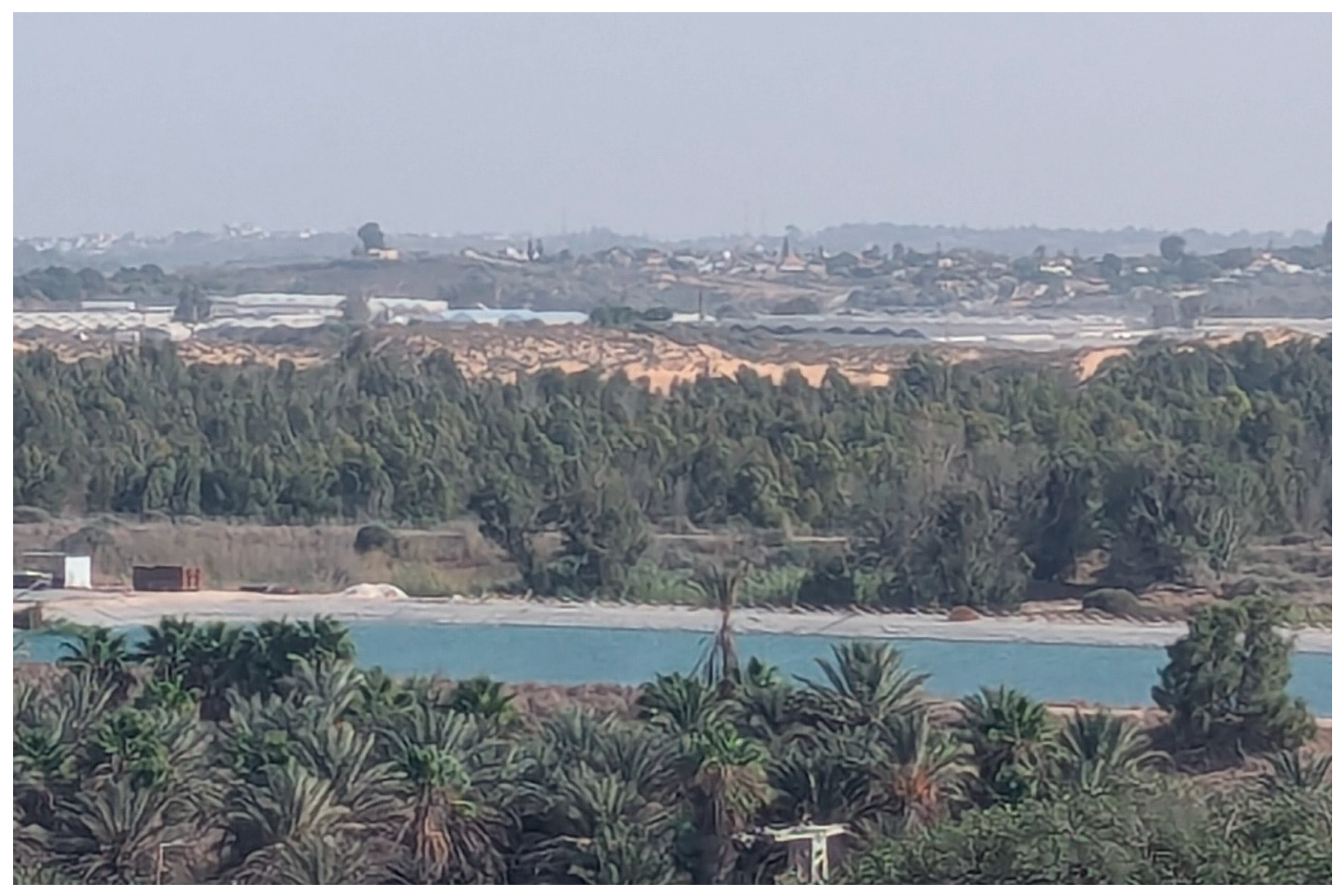
For two years, during the war, standing on Alami House’s rooftop became a haunting experience. Located just a few kilometers from Gaza City, the site offered direct sensory access to the war. From this roof, one could see and hear the constant bombing of Gaza: explosions echoed every few minutes, and clouds of dust rose into the sky. Gradually, the once-visible urban horizon of Gaza disappeared, blurred into a smear of grey (
Figure 11). Even on clear days, the vista was opaque, as if erasure itself had materialized in the air. The Palestinian presence—whether human, political, or territorial—became invisible yet perceptible in its invisibility. Its destruction was sensed, heard, and seen as a
thing, a tangible process of elimination. Performance, therefore, continued to play a vital role in the epistemic and emotional dimensions of Alami House—even outside its touristic context. The
presentation of Gaza, and by extension of the Palestinian, was now paradoxical: simultaneously displayed and effaced, visualized and erased. In an ironic reversal, the act of erasure—the very practice that had been hidden for decades, or at least executed discreetly—became the most visible element. To see the erasure was, in a sense, to witness the erased—to be presented with it. The duality embedded in Alami House thus reemerged during the war, when destruction itself became a visible performance of power—one that replaced one presence with another.
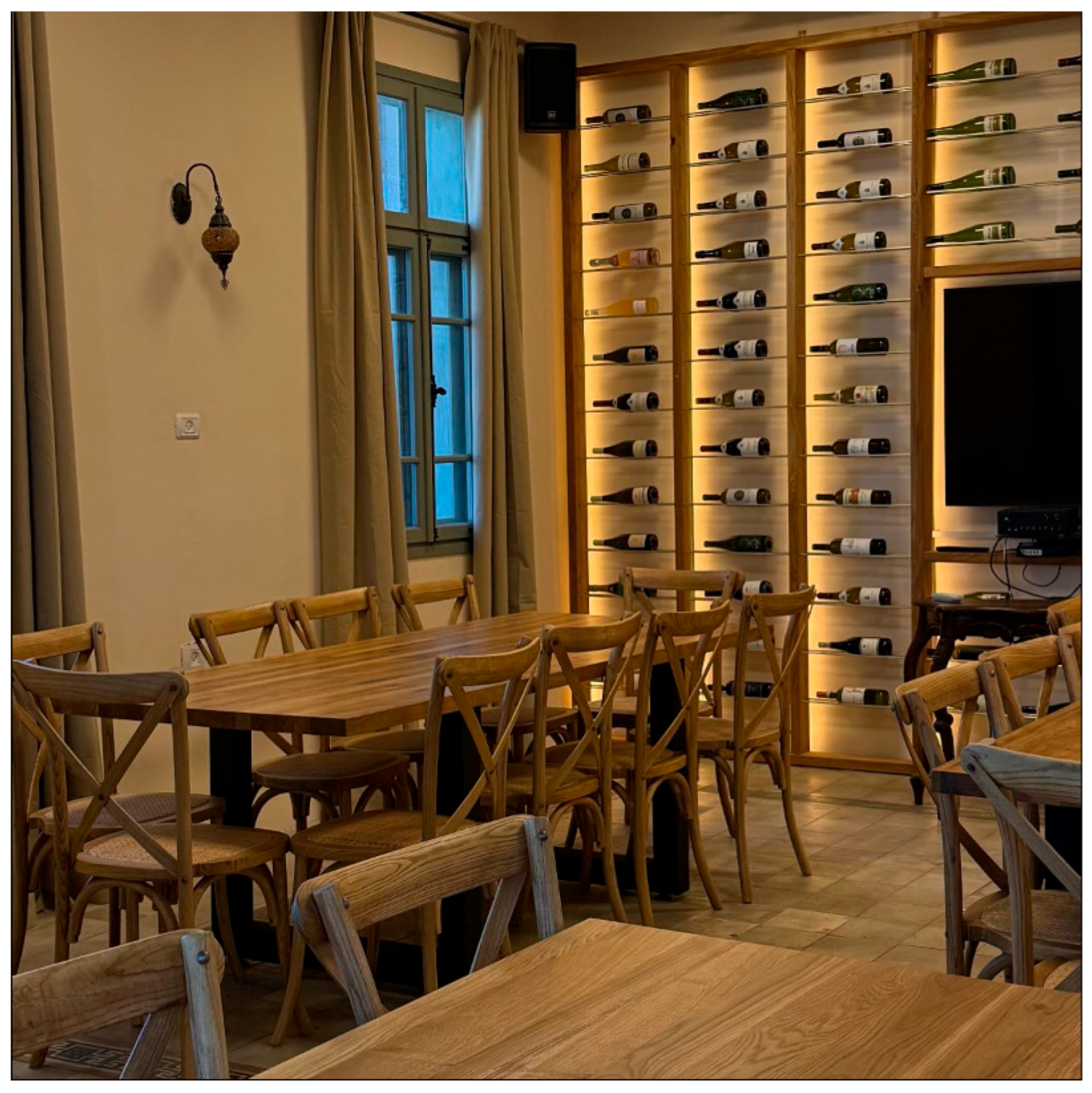
Although Alami House was not directly hit during the 7 October attack, Kibbutz Ziqim was at the center of one of that day’s fiercest battles, known as the Ziqim Battle. Armed kibbutz members fought Hamas troops until evening, when IDF forces arrived, at last, and evacuated them and their families. The evacuation was completed the next morning, and it was not until the summer of 2024—still during the war—that some families returned to their homes and began restoring the kibbutz. Before the war, a small café operated on the porch of Alami House, complementing the historical tour and hosting small private events there. In January 2025, the Café reopened as Alami Wine Bar, after an extensive renovation of the house (
Figure 12). The wall text remained, but the interior design underwent a dramatic change: Arabic furniture and décor were replaced with a sleek, Western modern aesthetic befitting a contemporary upscale restaurant. The house’s new identity was no longer hybrid, dual, or layered. The Palestinian dimension was erased, and Israeli identity once again dominated the space. Performatively and conceptually, the new interior rejects dualism and complexity, reasserting the elimination of the Palestinian from sight.
On the outside, and especially when sitting or standing on the rooftop, visuality becomes even more powerful in the play of presentation and elimination. Gazing towards the Gaza Strip, one can no longer see the city’s northern neighborhoods. This time, it is not because of the dust, but because they simply no longer exist. The horizon is flat. The erasure of Gaza as a rhetorical or metaphorical concept has materialized into a visible absence. The blunt expressions of Israeli politicians have, through the IDF, been translated into a physical reality perceptible to the senses. Invisibility, once a goal, has now been achieved. From the rooftop of Alami House, Gaza can no longer be seen—not in the sense of distance or atmosphere, but because there is literally nothing left to see.
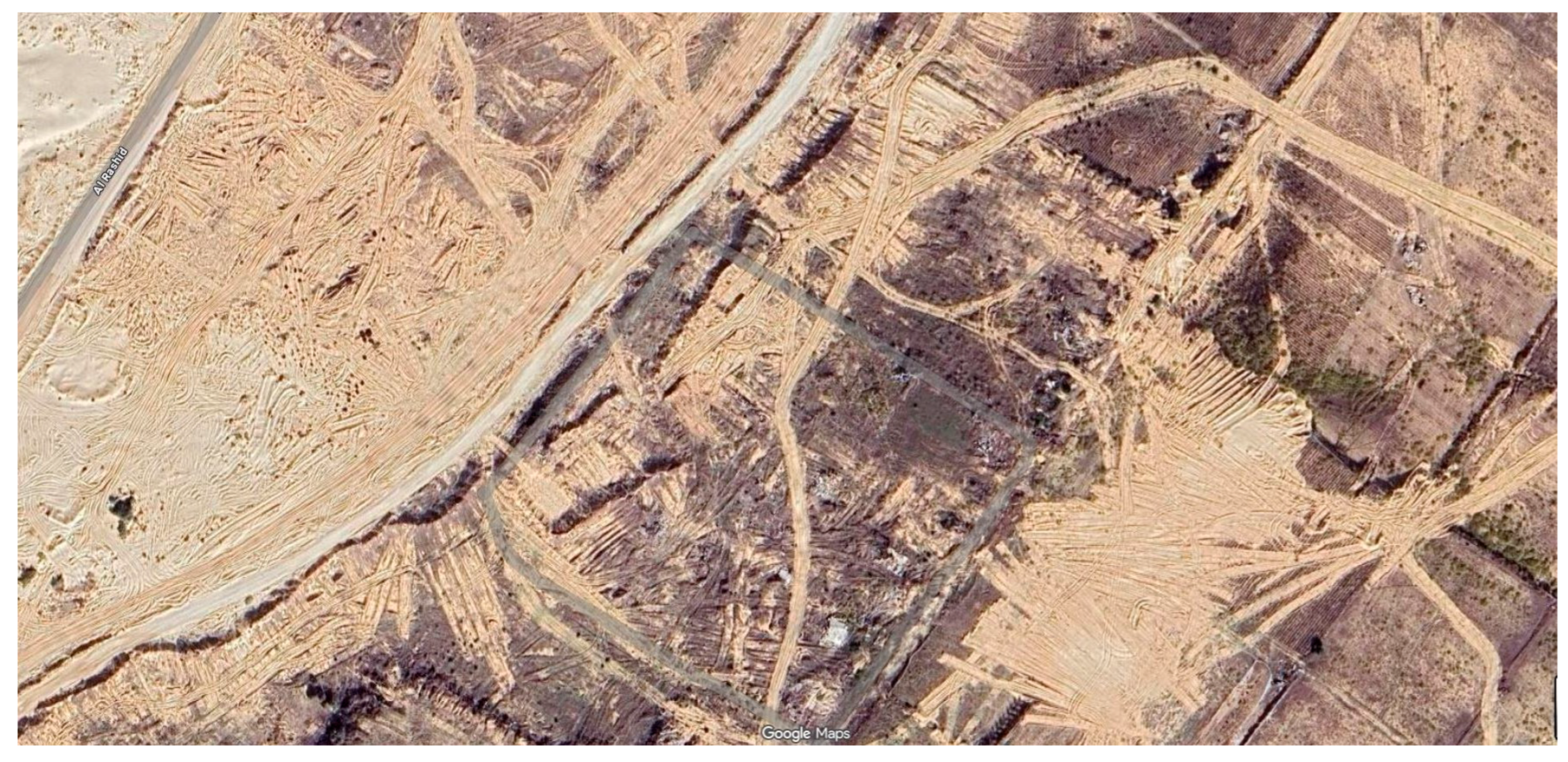
Countless news reports have documented the destruction of Gaza during this war, and comparisons of satellite images of Gaza before and after the bombardment clearly demonstrate the vast erasure of the urban landscape (
Hasson et al. 2025;
Ziadah 2025;
Sandes 2026). An enlargement of a satellite view of As-Saifa (
Figure 13)—the northernmost village in the Gaza Strip—shows the tracks of a Caterpillar D9 armored bulldozer used by the IDF to flatten houses and fields. The nearby neighborhoods of Beit Lahia and Beit Hanoun, once visible from Alami House’s rooftop, have suffered similar devastation (
McKernan 2024).
On Passover Eve, April 2025, both neighborhoods were evoked on prime-time national television as objects of in/visibility. Journalist and Ziqim resident Almog Bokker, reporting for N12—the most popular news channel in Israel—invited viewers to visit Alami House during the holiday season:
I would like to end with a place close to my heart—Alami House. It’s a new wine bar in Kibbutz Ziqim where you can enjoy good food and wine, but that’s not all. You can also sign up for a guided tour of the kibbutz to learn about its history from its founding until 7 October, and meet with its members, who have been through a lot and have recently come back home. When you arrive and stand at the lookout from the rooftop of Alami House, you can see the Gaza Strip—Beit Hanoun, Beit Lahia—which is destroyed, completely demolished, from one side, and the amazing restoration of the kibbutz, from the other.
14
Paradoxically, Bokker invites his fellow Israelis to see something that cannot be seen—something that could once be seen from this lookout, but has since been destroyed. Its invisibility now demands to be observed. The function of the lookout thus shifted: from showing the Palestinian to showing the Palestinian’s absence or erasure. The visitor now arrives not merely to see, but to engage in an act of
seeing the invisible, a performance of looking at what has been made to disappear. This act of seeing the invisible, I suggest, encapsulates the paradoxical ontology of Israeli visuality. Significantly, the use of elevated vantage points in the Gaza Envelope as platforms from which to watch the destruction of Gaza became a recognizable practice during the war. One such site even acquired the nickname “Sderot Cinema,” where chairs and sofas were arranged for spectators facing the horizon (
Minisini 2025).
15 In this context, watching the bombardment took on the character of a spectacle. The vantage point transformed the distant violence into a visible event, and the presence of viewers turned the act of looking into a collective performance. The scene thus echoed the performative logic discussed earlier in relation to Alami House: visuality was not merely a matter of witnessing events but of staging a particular relationship between observer and observed. The spectators’ elevated position, safely removed from the site of destruction, reinforced a hierarchy of power in which the erasure of Gaza became both visible and publicly consumable. In this sense, the spectacle of watching the bombardment exemplifies how visuality operates performatively, producing and reaffirming political relations through the embodied act of looking. In the sense of seeing invisibility, the performative function of the rooftop complements that of the interior space of Alami House today. Inside, Palestinian identity has been eliminated from view; outside, the land of Gaza remains, just as the Arab architecture of Alami House still stands. Yet the material visuality of both spaces has changed, emphasizing Israeli dominance in the present, while relegating Palestinian presence to the past. This continuity extends back to the house’s original transition—from an Arab home to an Israeli-Jewish one—when it first embodied the assertion of Israeli control over a Palestinian past through the act of conceptual invisibilization. Later, when coexistence seemed a plausible aspiration for Ziqim’s members, the Palestinian past was selectively reintroduced into visibility. This presentation of the Palestinian, however, was always filtered through a paternalistic gaze, symbolized by the lookout on Alami House’s rooftop. By the early 2000s, Gaza no longer represented an Other to be feared, as it had in Braun’s 1958 photograph. Yet this perception was abruptly overturned on 7 October 2023. Once again, the Palestinian was an enemy to be feared, and the rooftop could be imagined as a modern watchtower. As a lookout, the rooftop regained its function only after the conditions were reorganized: when this Other was eliminated entirely from sight, recharging the gaze with a sense of dominance and superiority.
A straight line thus connects Braun’s 1958 photograph to the current function of Alami House. Israeli culture, and by extension the Israeli state, has always been preoccupied with the visibility of the Palestinian. Whether through the demolition of Arab villages in 1948 and subsequent wars, the exclusion of Palestinian narratives from heritage sites and museums, or the censorship of films recounting Palestinian stories related to the conflict, Israel has intertwined its rhetoric of defense with an ongoing visual erasure of the Palestinian. Visuality—and consequently, the institutions that produce and regulate it, such as museums and heritage sites—has served as a powerful mechanism for managing the conceptual presence of the Palestinian. Through its transformation and performative re-articulation within a conflictual space, the Alami House exemplifies how visuality is politically orchestrated to shape cultural agendas surrounding the Israeli–Palestinian conflict. Alami House thus exposes how the politics of seeing and unseeing operate not as opposites but as complementary practices—through which Israeli visual culture constructs its power to render the Palestinian simultaneously present, absent, and perpetually at the threshold of visibility. In this sense, this case study encapsulates the politics of seeing and unseeing that have long shaped Israeli visuality: a regime in which the Palestinian presence must be made visible only through the very gestures that deny its existence.