1. Introduction
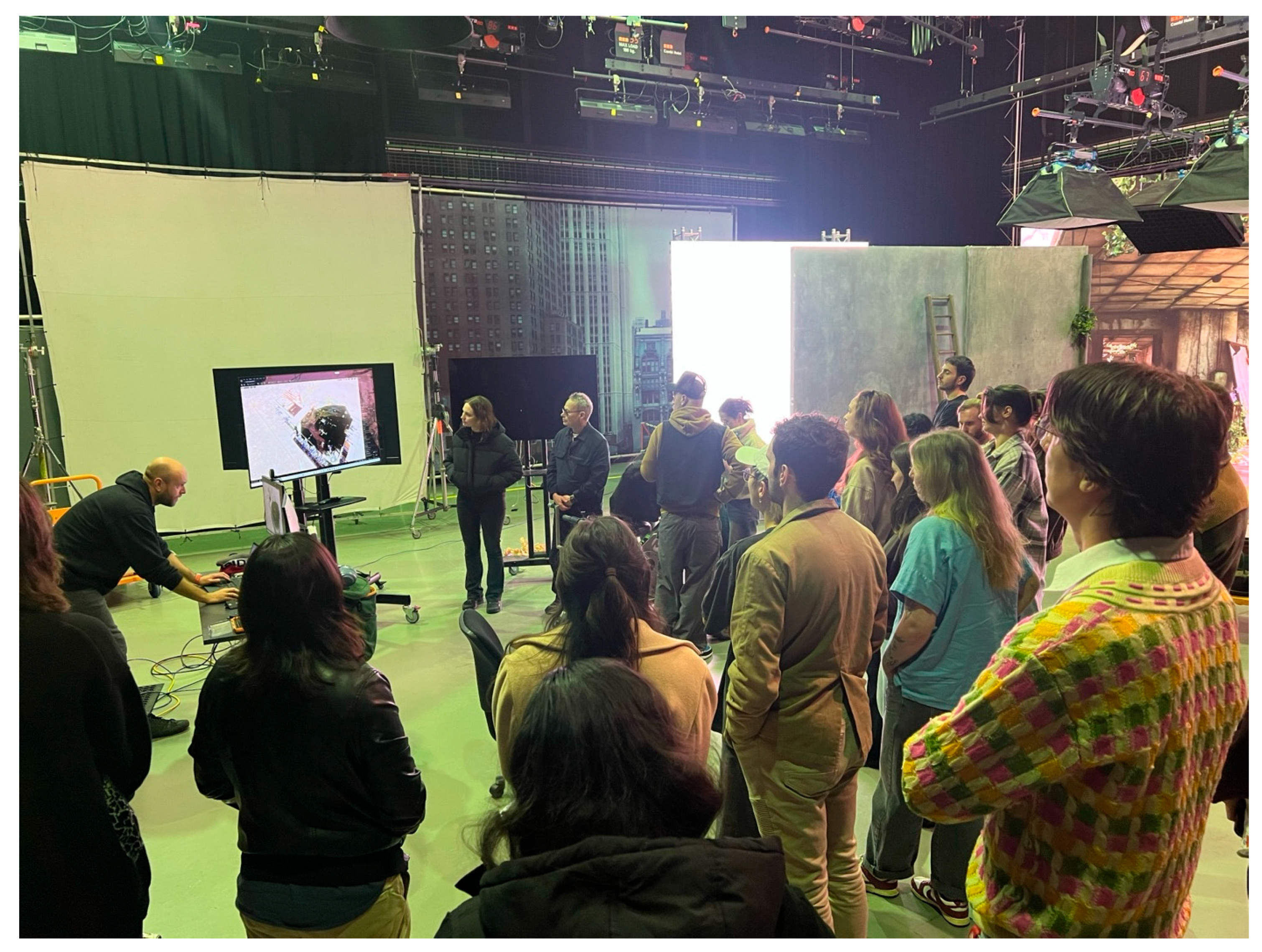
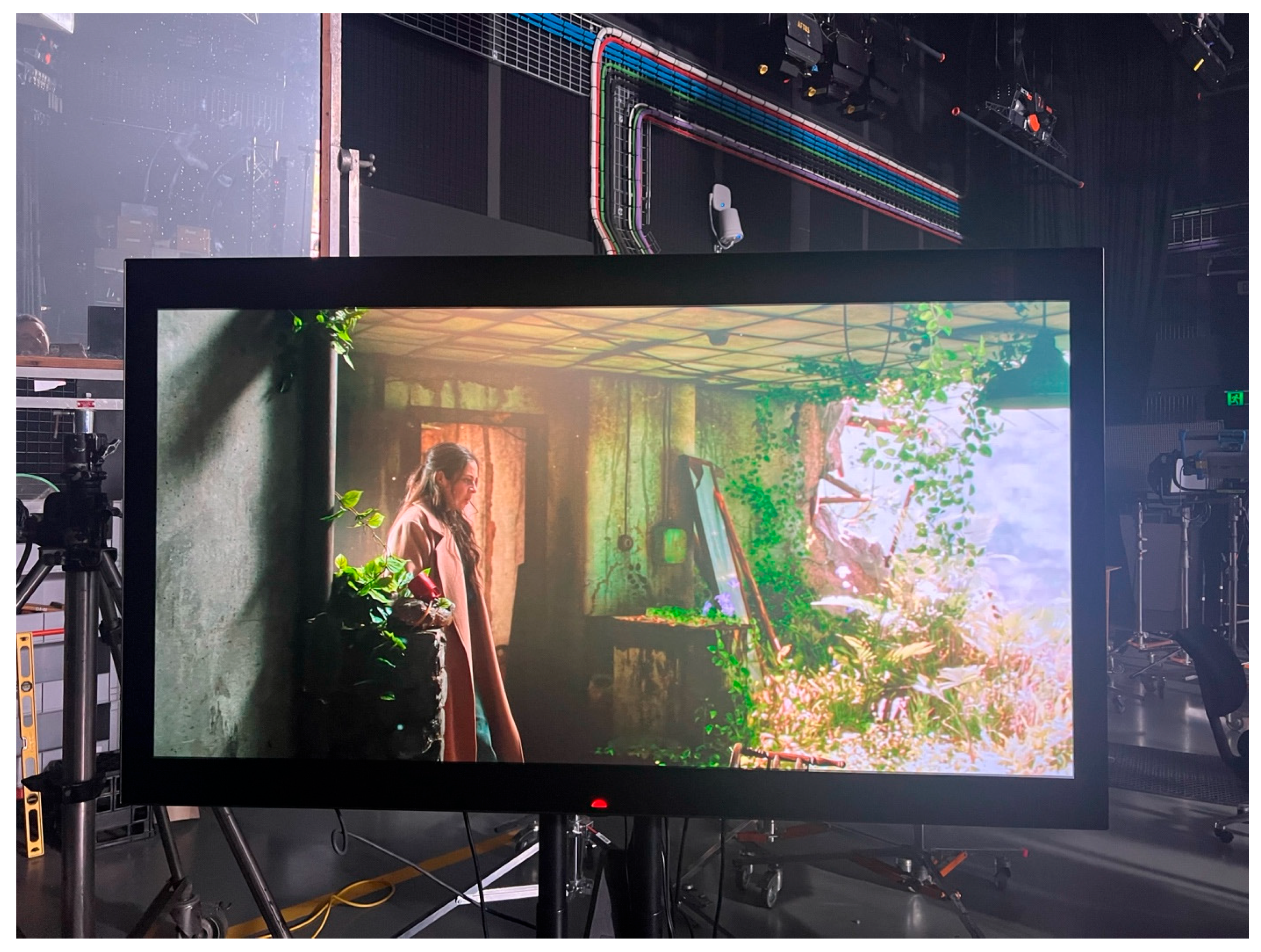
In a studio at the Australian Film, Television and Radio School (AFTRS), an interdisciplinary group of Master’s students stand in front of a monitor, watching intently as a production design student adjusts a mirror’s angle. Behind them, a curved LED wall
1 displays a photorealistic digital environment, an overgrown bunker rendered in real-time through Unreal Engine
2. Physical set elements, including scenic flats and set dressing, are built on the stage floor in front of the LED wall; the camera captures both simultaneously, integrating physical and virtual space in a single in-camera image without post-production compositing. As the mirror tilts, the digital world appears captured within its reflective surface. What emerges is not a technical trick, but a spatial phenomenon long recognised within scenographic practice: what Josef Svoboda described as
psycho-plastic space—an elastic, responsive environment in which physical space, light, projection and perception fuse into a unified spatial experience (cited in
Burian 1971). The students have experienced through embodied practice a scenographic principle that predates digital technology by half a century (
Figure 1).
This moment exemplifies the central argument of this article: that virtual production should not be understood primarily as technological innovation, but as a circular return to scenographic practice. While contemporary discourse frequently frames LED volumes and real-time rendering as transformative tools that revolutionise screen production, this study positions virtual production instead as a reactivation of spatial, collaborative, and embodied practices that predate digital cinema but were gradually obscured by industrial workflows. Drawing on scenographic theory and critical accounts of contemporary screen production workflows, this article argues that virtual production restores a mode of integrated spatial authorship in which environment, light, performance, and camera are conceived and experienced simultaneously. European scenographers from Adolphe Appia to Josef Svoboda articulated spatial practice as temporal, responsive, and relational—principles that industrial screen production increasingly fragmented through green screen workflows and post-production dependency. Virtual production, by contrast, enables these principles to re-emerge through real-time, shared spatial experience.
This practice-led research examines a single-day intensive workshop conducted at AFTRS in 2025, analysing how participants encountered scenographic principles through embodied interaction with LED volume technology. Rather than treating the workshop as a pedagogical model to be replicated, it is approached here as an analytical site through which broader questions of spatial authorship and collaborative practice can be examined. Drawing on Katriina
Ilmaranta’s (
2023) concept of
situated authorship and theories of distributed cognition, the study demonstrates how scenographic thinking emerged through collective discovery mediated by material, technological, and spatial conditions.
In this article, circular return describes a process in which new technologies do not produce entirely new practices but reassemble and render visible modes of working that were previously displaced by industrial and technological change. Unlike linear production models that organise creative labour across discrete production phases, circular return restores conditions for integrated practice by recombining space, collaboration, and perception. Virtual production serves here as a process through which the dynamics of scenographic integration can be examined in contemporary screen practice. While existing literature has tended to emphasise technical capability, industrial efficiency, or workflow transformation (
Kadner 2021;
Zwerman and Okun 2023), this study foregrounds the spatial, perceptual, and relational dimensions of LED volume production. By situating virtual production within scenographic frameworks, the article offers an alternative account of its significance for screen practice.
The workshop serves as a case study through which broader questions of spatial authorship, collaborative perception, and scenographic thinking can be explored. Analysis draws on documentation of the workshop process, the completed screen artefact, and reflective observation to identify moments of collective discovery. The discussion proceeds in five sections. Following the Introduction and historical framing of integration, fragmentation, and return, it establishes a conceptual foundation through the frameworks of situated authorship and distributed cognition, locating spatial agency as emergent and relational. It then outlines a scenographic theoretical framework, drawing on the work of Appia and Svoboda, to define scenography as a temporal, integrated spatial practice. The central case study analysis examines how participants rediscovered scenographic principles through embodied interaction with LED volume technology, identifying specific spatial strategies that emerged through collaborative experimentation. The concluding discussion reflects on the implications of these findings for understanding authorship and spatial practice in contemporary screen production.
2. From Integration to Fragmentation to Return
Understanding the significance of virtual production requires recognising not only what it enables, but what industrial screen practices progressively displaced. Early screen production was characterised by holistic spatial thinking, in which environment, lighting, performance, and camera were conceived together as a unified spatial event. From Méliès cinema of attractions through to the Hollywood studio era, production designers shaped screen worlds in direct relation to camera movement, lighting effects, and performer choreography, working within studio systems that privileged spatial control and immediacy (
Gunning 1986;
Heisner 1990). William Cameron Menzies’ work on
Gone with the Wind (1939), for which he became the first practitioner credited as Production Designer, exemplifies this integrated approach. In the Atlanta Burning sequence, Menzies pre-designed camera position, coloured lighting, and performer choreography across thirty-three detailed storyboards (
Curtis 2015). Working from a scale miniature, he designed space, light, and action simultaneously; on the night itself, it was Menzies who called ‘Action’. Spatial environment, camera, and performance were inseparable elements, conceived together at the design stage.
Yet this integration existed within persistent material constraints. As Jane
Barnwell (
2004) notes, production designers have always navigated a fundamental choice between location shooting and studio construction, each offering distinct affordances and limitations. Locations may provide material authenticity but can impose constraints relating to access and modification; studios enable greater degrees of manipulation but are bound by physical scale, construction timelines and resources. Crucially, both approaches constrain spatial depth and extension: building deep sets with convincing diminishing perspective requires substantial resources while locations may not offer ideal spatial configurations. These constraints have shaped production design practice throughout cinema history. Techniques such as forced perspective, matte paintings, and miniatures emerged as pragmatic responses to these constraints, extending spatial depth while necessarily limiting camera movement and the degree to which performers and crew could share a simultaneous, immersive experience of the story world.
The widespread adoption of digital compositing and green screen workflows in the late twentieth-century reconfigured these conditions. While chroma key technologies expanded spatial possibility, they also enforced a separation of creative labour. Spatial design, lighting, cinematography, and visual effects remain sequentially organised, with creative decisions distributed across departments and production phases rather than negotiated collectively in shared space. Production designers increasingly cede responsibility for spatial coherence beyond the physical set, handing over designs to post-production pipelines governed by different temporalities, tools, and authorship structures. Industrial labour conditions limit sustained involvement in post-production, effectively confining the production designer’s role to what is captured in camera. Cinematographers cannot sculpt integrated environments, as green screen requires flat, even lighting and frames that anticipate the needs of post-production. While the presence of VFX supervisors on set represents an attempt to bridge this division, their role remains oriented toward technical continuity, ensuring post-production requirements are met during shooting, rather than enabling the kind of simultaneous spatial authorship that scenographic practice demands. Each discipline operates sequentially, communicating through documentation rather than shared spatial experience. This is not to suggest that integrated spatial thinking disappeared from screen practice during the latter half of the twentieth century. Many production designers continue to pursue scenographic coherence within the constraints of studio and location-based production. However, these practices operate against increasingly fragmented industrial workflows that limit simultaneity, shared perception, and iterative spatial testing—conditions that virtual production now makes structurally available again.
Virtual production is frequently framed as a technological solution to these problems. However, its significance is more precisely understood through what Lev
Manovich (
2007) terms
deep remixability: the recombination of existing media logics and production practices at the level of workflow rather than surface aesthetics alone. From this perspective, LED volume production does not invent new spatial principles. Rather, it reassembles practices of scenography, cinematography, and lighting that had been separated by digital industrialisation, restoring their collective reciprocity through real-time and shared spatial feedback. As production designer James
Chinlund (
2022) has observed in industry discussions on virtual production, this shift enables designers to “finish our thoughts” and to “reclaim” spatial authorship that had been displaced by green screen processes.
By rendering complex digital environments visible to all collaborators during production, virtual production collapses distinctions between pre-production, production, and post-production, re-establishing space as a shared, responsive medium. Cinematographers capture the world-space rather than partial images awaiting completion; production designers observe immediately how material choices interact with digital depth; performers respond to environments that are perceptually present rather than imagined. These conditions restore what scenographic practice has always entailed: the orchestration of space, light, movement, and material into a unified experiential field. This spatial logic was never absent from screen production but was displaced by workflows that privileged efficiency and post-production synthesis. Virtual production represents not technological innovation but a circular return—a reactivation of scenographic principles that predate industrial fragmentation.
3. Situated Authorship and Distributed Cognition
If virtual production enables a return to integrated spatial practice, it also necessitates a reconsideration of how authorship operates within such conditions. Traditional models of screen authorship, shaped by auteur theory and reinforced by industrial hierarchies, struggle to account for creative agency distributed across space, technology, and collaboration. To understand how spatial decisions are made and negotiated within virtual production, this article draws on the complementary frameworks of situated authorship and distributed cognition.
Situated authorship offers a critical lens through which to examine production design as an embodied and perceptual practice.
Ilmaranta (
2023) identifies the production designer’s work as fundamentally anticipatory: designers “see as the camera” while also “seeing as the eventual viewer,” mentally inhabiting future points of perception as spatial scenarios are conceived. Authorship, in this sense, does not reside in the imposing of fixed visual outcomes, but in the programming of spatial possibilities—designing environments that enable, constrain, and invite particular forms of cinematic movement. Virtual production makes spatial-camera relationships immediately visible in three-dimensional space where production designers, cinematographers, directors, and performers engage with authorship through shared and iterative negotiation.
While situated authorship accounts for how spatial agency is positioned perceptually, it does not fully explain how understanding develops within such collaborative environments. Distributed cognition, as articulated by Edwin
Hutchins (
1995), provides a complementary framework by locating cognition not within individual minds, but across networks of people, tools, and material systems. In virtual production, knowledge emerges through the interaction with LED panels, camera tracking systems, digital environments, and physical materials, forming a socio-technical assemblage in which no single participant holds complete authority. This distributed cognition becomes particularly evident in moments of collective discovery. Spatial solutions do not emerge solely from pre-existing conceptions, but through iterative experimentation made possible by real-time feedback. Decisions are shaped by what becomes apparent in the moment: how reflective surfaces capture digital depth, how atmospheric elements interact with light, how camera movement activates parallax
3. Understanding arises through doing, seeing, and adjusting together.
Within the workshop, participants developed a shared spatial literacy through engagement with the environment itself, negotiating meaning collectively through action. Together, situated authorship and distributed cognition articulate a model of spatial authorship that is relational and emergent. Authorship is neither singular nor fully intentional; it arises through the alignment of perception, material conditions, and collaborative practice. This framework is essential for understanding virtual production as an environment in which spatial agency becomes visible and collectively enacted.
4. Methodological Framework and Workshop Design
4.1. Scenographic Practice
Scenography provides a framework for understanding spatial practice as a holistic and integrated mode of meaning-making. As Arnold Aronson observes, “we are spatial creatures; we respond instinctively to space” (
Aronson 2005, p. 1). In virtual production, this instinctive engagement is foregrounded, as spatial effects are encountered in real-time rather than imagined or deferred. Scenographic theory builds on this perceptual foundation, conceptualising space, light, sound, and movement not as discrete elements, but as interdependent components of a unified spatial event. Scenography constitutes an “all-encompassing visual-spatial construct,” grounded in this fundamental human capacity for spatial perception (
Aronson 2005, p. 7). Spatial experience, in this sense, is not merely decorative or supportive of narrative, but operates as a primary carrier of meaning. Despite the centrality of spatial practice to screen production, screen scholarship has historically struggled to adequately account for it. Production design has often been subsumed under mise-en-scène or attributed to directorial vision, rendering spatial authorship difficult to theorise within auteur-based frameworks (
Barnwell 2004;
Wille 2015). As
Barnwell (
2005, p. 118) argues:
The notion that it is the designer who designs the sets is easily grasped, but it is more difficult to come to terms with the fact that [they] might compose each and every angle that is subsequently shot, since at first sight this activity appears to encroach onto the creative territory of the film’s director.
This theoretical marginalisation tends to treat spatial elements as subordinate to narrative or performance, rather than as generative forces that shape perception, movement, and affect. Scenographic theory, developed within theatre and performance studies, offers conceptual tools for recognising spatial authorship as collaborative, temporal, and materially grounded practice.
Recent scenographic scholarship extends this understanding of distributed authorship. Rachel
Hann’s (
2019) concept of
scenographics describes scenography as exceeding the work of a singular scenographer, emerging instead through the coordination of costume, light, sound, material, and spatial orientation. This perspective aligns with understandings of spatial authorship as collective and relational, foregrounding how meaning is produced through the interaction of multiple disciplines within shared spatial conditions.
Light occupies a central role within this tradition. For Appia, light was the animating force of scenographic space, capable of activating both the actor and the environment through its capacity to shape rhythm, depth, and movement (
Bablet and Bablet 1982). For Appia, scenography unfolded as a temporal event activated by bodies in motion rather than as a fixed visual composition. Svoboda extended this thinking by treating scenography as a kinetic practice, in which spatial experience is constituted through holistic creation enacted collectively within shared space (
Burian 1971). Together, these theorists articulate scenography as a practice concerned with space as lived, activated, and co-authored. Against this theoretical backdrop, virtual production renders scenographic principles newly visible within screen production, providing the conditions examined through the case study that follows.
4.2. Workshop Context
The workshop took place within AFTRS’ Discipline Studio programme for first-year Master of Arts Screen students specialising in production design, cinematography, directing, and producing. This single-day intensive marked participants’ first hands-on engagement with LED volume virtual production technology. Working collaboratively within the volume, students developed a short screen sequence that integrated physical set pieces with a real-time digital environment, allowing spatial, camera, lighting, and performance decisions to be encountered and negotiated collectively within a shared spatial field. The compressed timeframe was a defining condition of the workshop. Learning processes typically distributed across multiple sessions were concentrated into a single day, requiring students to rely on collective problem-solving and iterative experimentation in the moment. Unlike conventional production workflows, where departments develop work independently before later synthesis, students encountered spatial design, cinematography, lighting, and performance as interdependent from the outset.
The AFTRS LED volume comprises a curved LED wall four metres high by eight metres wide, driven by Unreal Engine with camera tracking to maintain accurate perspective and parallax. Digital environments respond dynamically to camera movement, producing an elastic spatial experience rather than a static backdrop. Crucially, the wall functions simultaneously as scenic image and active light source, shaping both the visual field and the illumination of performers and physical elements within the space. Overhead, a grid of interactive SkyPanel fixtures
4, controlled via DMX
5, synthesised and matched the colour temperature, intensity, and directional qualities of light emitted by the LED wall. This ceiling-based lighting system extended illumination across multiple planes, enabling light to be experienced as a spatial volume. Throughout the workshop, moving images were generated through a hybrid configuration in which physical foreground elements were captured in camera simultaneously with a real-time rendered digital environment displayed on the LED volume.
With these conditions, students positioned and adjusted physical set elements in direct relation to the digital environment, negotiating depth, composition and materiality across physical and virtual space. Lighting decisions were developed in response to the virtual light sources embedded within the digital world and realised through the SkyPanels alongside practical studio lighting. Real-time rendering enabled immediate evaluation of how physical materials, reflective surfaces, atmospheric elements, and camera movement interacted spatially and luminously, supporting iterative, embodied decision-making in the moment.
4.3. Research Methods and Research Positionality
This study adopts a practice-led research approach grounded in participant observation and reflective analysis. The workshop was designed and facilitated collaboratively by discipline mentors in production design, directing, and cinematography at AFTRS. Alongside the facilitation of the workshop, the author documented the creative process as researcher, occupying a dual role that shaped access to the research site and analytical interpretation. The workshop was structured to enable student-led exploration, with mentors present primarily to address technical questions rather than to direct spatial or narrative decisions.
The analysis draws on video documentation of workshop activity, photographic records of evolving spatial configurations, screen captures of final frames, and contemporaneous field notes. Analysis focused on identifying moments where scenographic understanding emerged through embodied experimentation and collective negotiation, evidenced by iterative reconfiguration in response to real-time feedback. While the author’s disciplinary expertise informs interpretation, emphasis is placed on observable actions and material outcomes rather than on self-reported learning. The workshop serves as a case study through which broader questions of spatial authorship and collaborative practice may be examined.
5. Results: Scenographic Discoveries Through Collaborative Practice
5.1. Virtual Scouting: Exploring Spatial Possibilities
The workshop began with collaborative virtual scouting using an existing Unreal Engine asset: an abandoned concrete bunker with broken roof sections, receding corridors, and invasive vegetation. Although the digital bunker environment was sourced from the Unreal Engine marketplace, this did not diminish the role of production design within the workshop. As with location-based production, students did not author the digital environment’s architecture but engaged scenographically with its spatial logic—interpreting, extending, activating, and transforming it through physical staging, material replication, lighting, and camera choreography. In this sense, authorship resided not in the origination of form, but in the scenographic orchestration of space as a temporal and performative event. Working with AFTRS Virtual Production Supervisor, Alexander Hoetzer, students navigated the three-dimensional asset in real time, exploring how camera position, movement, and framing revealed different spatial qualities (
Figure 2). This exploration unfolded simultaneously with consideration of physical staging, as students identified where tangible foreground elements might integrate with the digital environment.
Rather than functioning as a location-finding exercise, virtual scouting operated as a scenographic process through which spatial relationships were actively discovered. While this process shares parallels with traditional location recces—where directors, production designers and cinematographers collectively walk through a site and anticipate potential shots—virtual scouting differs in its capacity for real-time spatial transformation. As students moved through the digital bunker, architectural depth and passages suggested particular patterns of movement, framing, and performance. Corridors implied camera trajectories and diminishing perspective; vertical structures produced rhythms of light and shadow; missing roof sections oriented attention toward light sources and atmospheric effects. This process exemplifies what Kathleen
Stewart (
2014, p. 119) describes as
worlding: the moment when “an assemblage of elements comes to hang together” as a coherent experiential world. The bunker cohered as a world through students’ exploratory navigation of the space, considering how its spatial affordances might be extended, activated, or interrupted. In doing so, they worked within what Peter Brook describes as a “sympathy of tempo”—a scenographic alignment with the rhythms and movements implied by space itself, rather than an imposition of predetermined action (
Brook [1968] 1996, p. 101). Spatial coherence emerged through attunement to the temporal qualities of the environment as it was explored and anticipated collectively. In this sense, students were also practicing what Ilmaranta describes as “seeing as the camera”—moving through the digital space while imagining how compositional elements would appear when framed (
Ilmaranta 2023, p. 35). Students began identifying which spatial qualities the digital asset provided, and which would require physical extension, developing dual awareness of space-as-designed and space-as-experienced-through-camera. Unlike traditional workflows where spatial design and camera coverage are typically developed through two-dimensional sketches, construction drawings, scale models and storyboards, virtual scouting enabled spatial and cinematographic considerations to develop together. Camera possibilities suggested physical set placement; architectural features shaped anticipated performance movement; lighting conditions embedded in the digital environment informed decisions about atmosphere and materiality. Spatial authorship emerged through shared exploration, establishing a collective understanding of the world as a screen space shaped through action.
5.2. World-Responsive Storytelling: Character and Backstory Development
As the bunker took shape through virtual scouting and placement of set pieces within space, directing students developed character and backstory in direct dialogue with the space itself—responding to its architectural form, material decay, and implied temporality. Story was not imposed upon the environment, but emerged through engagement with the world as it was being explored, framed and assembled.
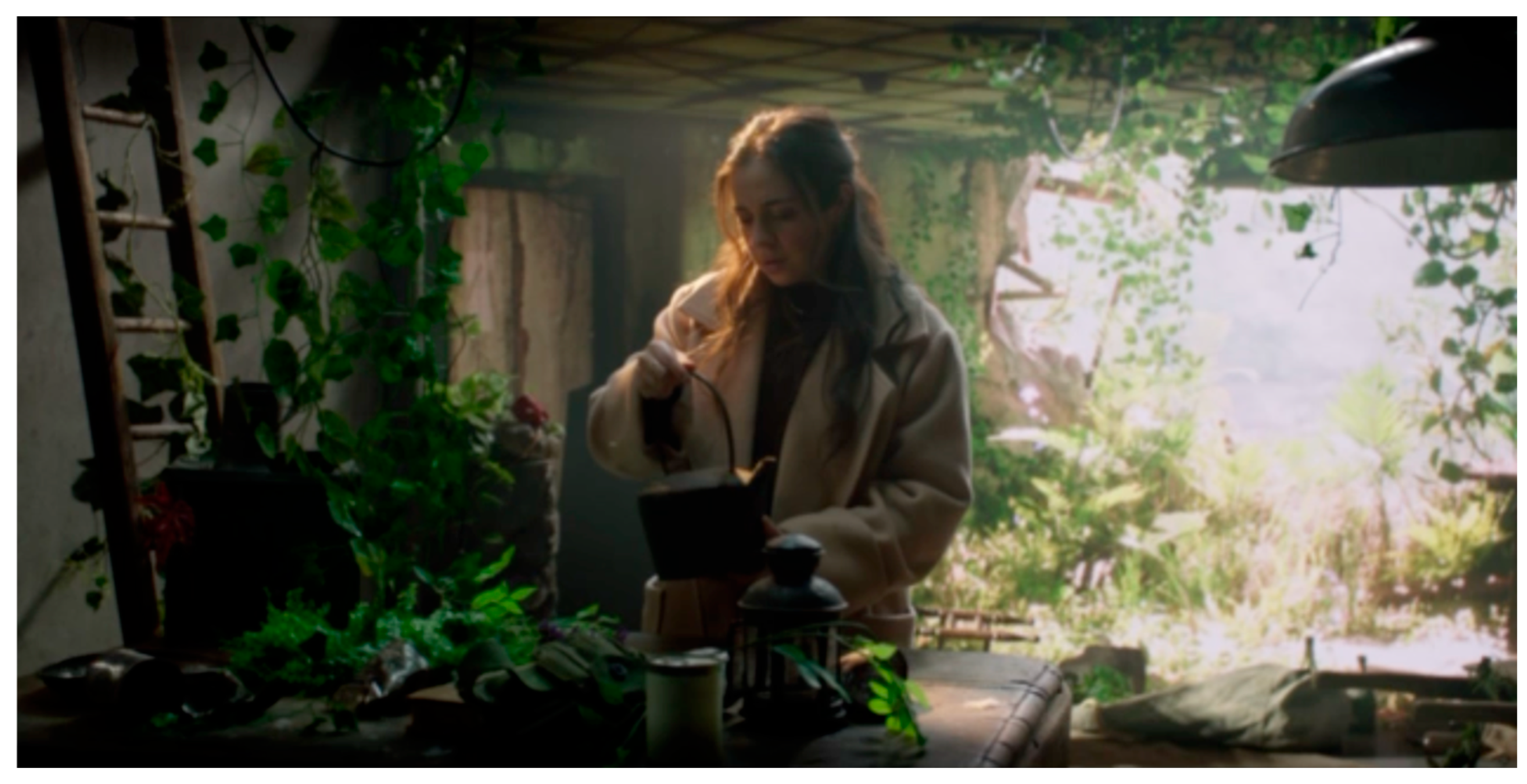
The abandoned bunker suggested post-apocalyptic associations; invasive vegetation implied the passage of time and nature’s reclamation; the discovery of objects within the space prompted narrative speculation around return, memory, and loss. The character that emerged—a young woman encountering significant artefacts within the ruins—was shaped through collective interpretation of spatial cues (
Figure 3). In this sense, narrative functioned as an extension of scenographic exploration, emerging from the possibilities of the environment rather than a pre-determined script. This process aligns with approaches to world-building articulated by Alex
McDowell (
2019) and Juan
Díaz Bohórquez (
2021), in which story emerges from the internal logic of a world rather than being imposed upon it. However, within the workshop context, world-building was not treated as a discrete conceptual phase. Instead, narrative, performance, and spatial composition evolved together through interaction with the environment, reinforcing the primacy of spatial conditions in shaping story.
Spatial organisation directly informed performance and camera movement. The placement of set pieces in relation to the LED wall shaped pathways for the performer’s movement, while the relationship between physical foreground elements and digital background constrained and enabled framing choices. Performance was choreographed in response to these spatial conditions, with directing decisions emerging from how the performer could move, pause, and interact within the hybrid physical–digital environment. Crucially, narrative development occurred alongside material and technical decision-making. Directors, production designers, and cinematographers negotiated story beats in response to lighting conditions, spatial depth, and the performer’s embodied interaction with the environment. This collaborative circularity enabled scenographic principles of space, movement, light, and action to develop in concert as an integrated spatial event.
5.3. Physical-Digital Integration: Constructing Unified Space
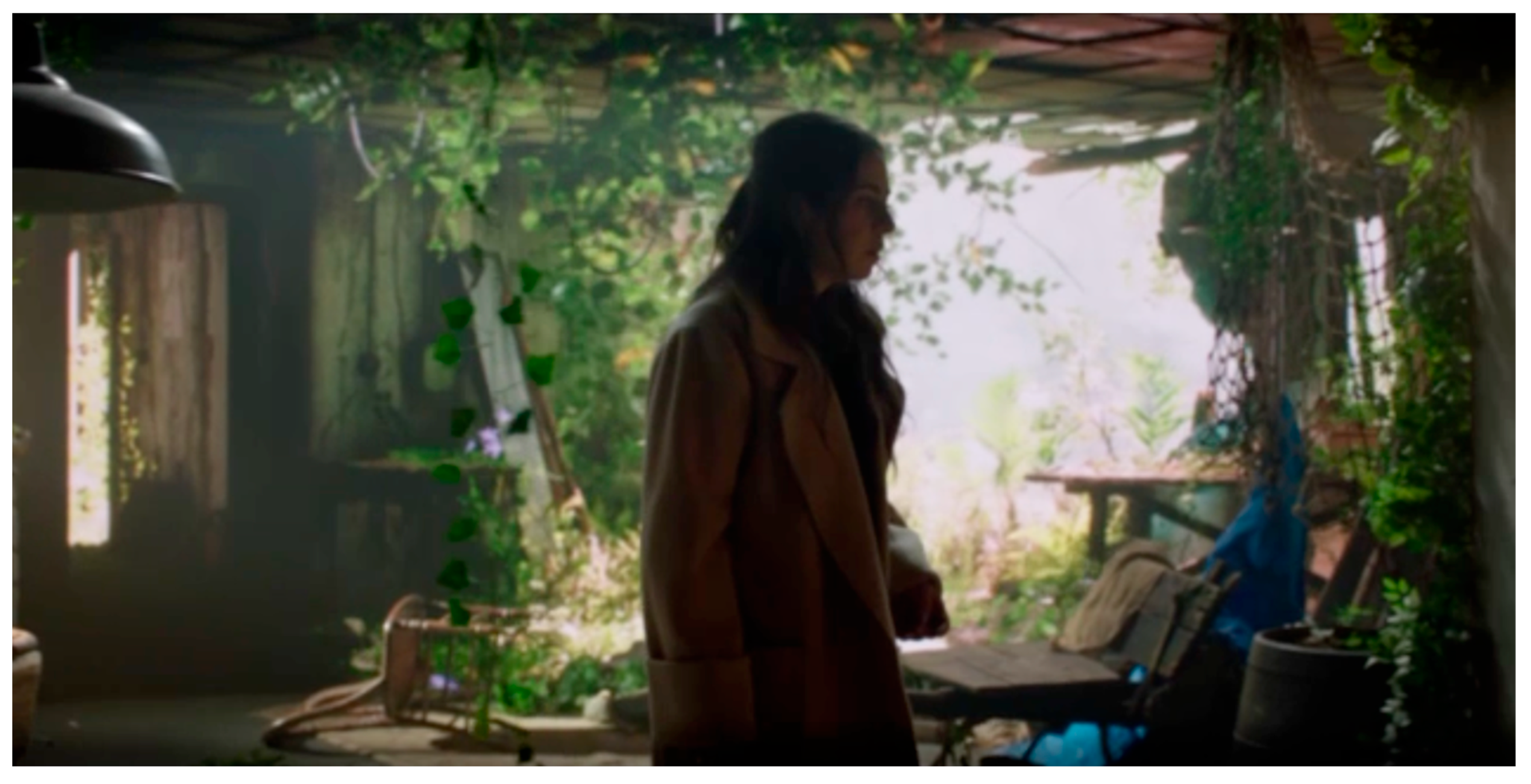
Students collaborated with the Props and Staging team to position stock flats in relation to the digital bunker environment displayed on the LED volume. The configuration of the curved wall imposed clear spatial constraints: camera framing needed to orient toward the digital background, limiting the depth available for physical set piece placement and performance action. A critical decision emerged around the junction between the physical flats and the LED volume. Rather than attempting seamless continuity where the studio floor meets the wall—an area particularly difficult to resolve due to material colour, perspective, and lighting calibration—students introduced a deliberate architectural separation between the physical foreground and the digital background. This gap became a performative threshold (
Figure 4): the performer entered the frame as if emerging from behind a corner, with the space between physical and digital elements operating as an active zone of transition rather than a seam to be concealed.
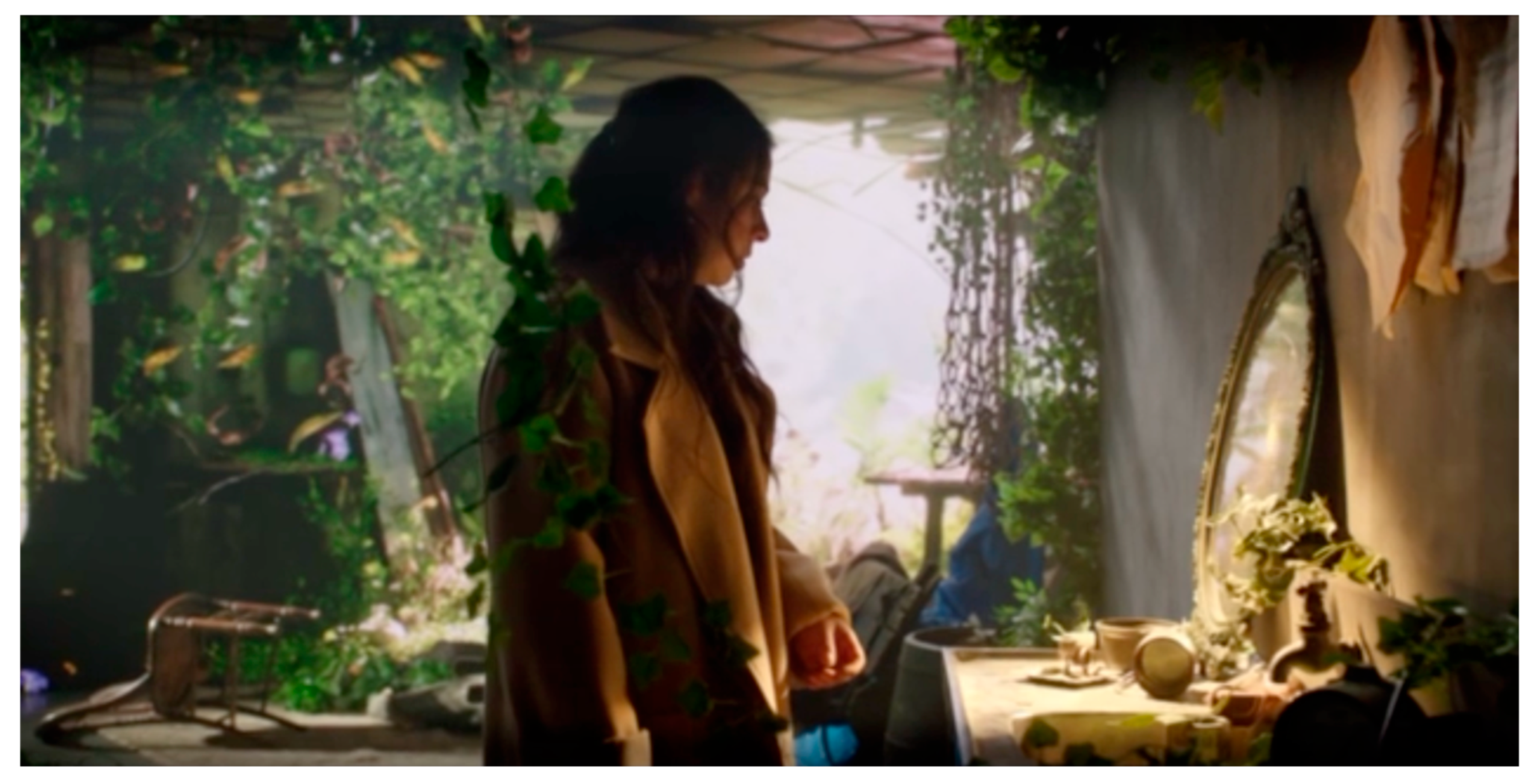
Material decisions reinforced this strategy. A physical pipe positioned adjacent to the gap disguised the edge of the flat while simultaneously echoing the bunker’s industrial language. Artificial vines were suspended from overhead battens, extending digital vegetation into the physical space; an industrial pendant lamp replicated fixtures present within the rendered environment. Students achieved chromatic and textural alignment: a physical blue tarp matched digital asset colours; the scenic-painted flats matched the bunker’s aged concrete (
Figure 5). Through this embodied material knowledge, students established visual rhythm that unified space across physical-digital realms, demonstrating how multiple sensory registers—material, colour, texture, light—must align to achieve spatial integration. These decisions reflect a scenographic understanding of space as relational and activated through use. Like theatre practitioners working with painted backdrops, students recognised that the performer could not physically interact with the two-dimensional LED environment. Attention therefore focused on the foreground as the primary site of action, with the digital environment extending depth, atmosphere, and context beyond it.
The workshop’s most significant scenographic discovery emerged through the placement of a prop mirror. Students identified a mirrored surface within the digital environment and chose to replicate it materially, translating a digital spatial cue into a physical scenographic device. Through iterative material experimentation, students realised that reflective surfaces could fold the digital environment back into the physical performance space. The mirror captured the LED volume’s rendered world while remaining anchored within the tangible foreground, allowing the performer to appear simultaneously within and before the digital environment. This effect was possible because the LED volume’s real-time rendering continuously updated the reflected environment in geometric correspondence with camera movement, producing accurate parallax between physical and virtual elements. The mirror therefore did not capture a flat image but a spatially responsive virtual depth; one that shifted with the camera as a physical environment would. This configuration enacted psycho-plastic space: an elastic, responsive spatial condition in which physical and virtual elements fuse into a unified experiential field. Importantly, this outcome was not planned in advance. It emerged through iterative testing, adjustment, and collective observation as students responded to what became perceptually apparent within the space. Through this process, students encountered scenographic principles not as abstract theory, but as practical solutions discovered through material engagement and shared spatial perception.
5.4. Embodied Realisation: Activating the Fused Space
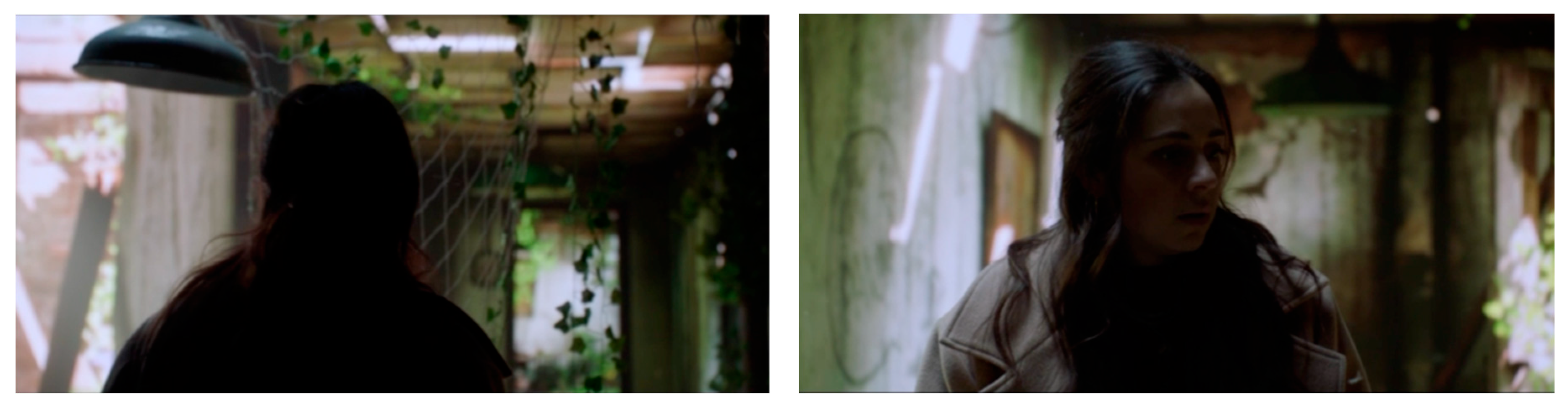
The final phase of the workshop tested spatial decisions in motion, as performance, camera movement, lighting, and atmosphere activated the assembled physical-digital environment. Camera movement produced pronounced parallax effects as tracked rendering adjusted the digital environment in response to physical motion. As the camera moved through the foreground space, spatial depth appeared to shift and breathe, producing an elastic sense of volume rather than a static backdrop. Students encountered these relationships kinaesthetically, observing how spatial composition changed through movement rather than remaining fixed. The space was no longer something to be viewed, but something navigated and negotiated. This became particularly evident when students executed a French reverse. By navigating to the opposing viewpoint within Unreal Engine, they achieved a 180-degree reverse angle while strategically coordinating physical and digital elements. In the initial shot, students hung a physical industrial lampshade left of frame; for the reverse angle, a digital replica of the lampshade was positioned on the right side deep in the background of the digital environment (
Figure 6). This realisation of coverage revealed a sophisticated understanding of spatial authorship in virtual production: students realised they could distribute scenic elements across physical and digital realms to serve cinematic convention, enacting what
Ilmaranta (
2023, p. 39) describes as “dynamic staging scenarios” in which spatial composition programmes multiple viewing possibilities. These spatial decisions emerged through iterative physical exploration as students engaged with the physical and digital space, testing how camera position, performer action, and scenic elements interacted.
The activation of space through movement reflects Appia’s insistence that scenographers design “with [their] legs, not with [their] eyes,” emphasising embodied spatial knowledge over purely visual conception (as cited in
Payne 1993, p. 96). For Appia, space becomes meaningful through rhythm, resistance, and bodily negotiation. This principle was enacted through the LED volume’s real-time feedback, which allowed students to experience spatial relationships physically and immediately, adjusting camera paths, performer movement, and staging in response to how the space behaved rather than how it appeared in abstraction. Space emerged as rhythmic and temporal, shaped through action rather than composition alone.
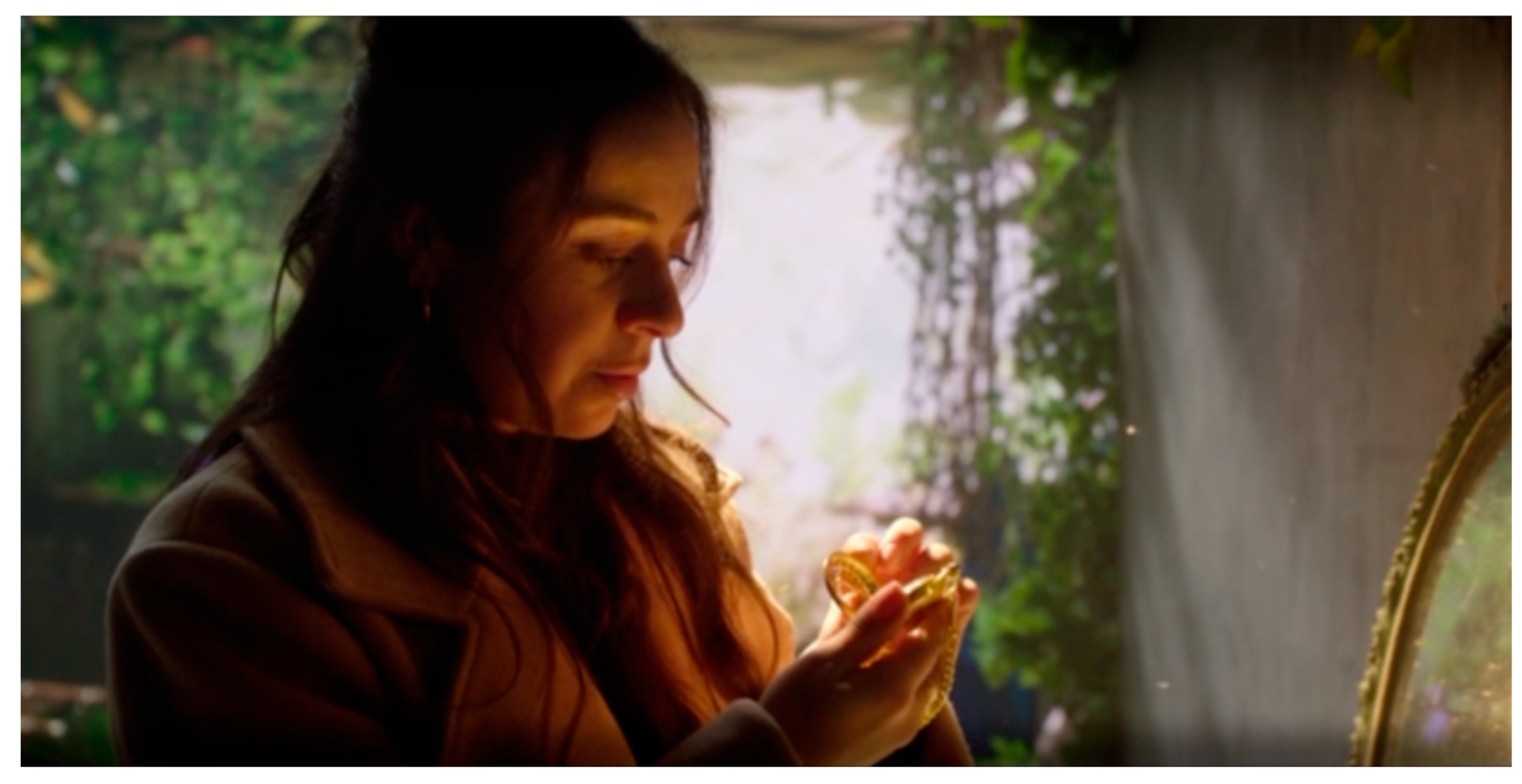
Lighting further animated this rhythmic spatial field. The LED volume functioned simultaneously as dynamic background and active light source, illuminating the performer from within the digital environment itself. Students developed a deliberate contrast between the digital sunlit expanse beyond the bunker and the warmer, filtered light entering through ruptures in the ceiling. This was achieved by combining rendered light, atmospheric haze, and controlled practical sources. When the performer examined a metallic fob-watch, students observed how digital light caught its surface and redirected illumination onto her face. They enhanced this effect with a practical light that produced a magical dancing quality on the performer’s face (
Figure 7). Light is an essential element to scenographic design, melding the physical and psychological in space.
Atmospheric effects intensified this embodied activation. Fine particles of duck down moved through the space, catching light from both practical sources and the LED panels, responding dynamically to performer gesture. When the performer blew dust from a box lid, particles caught light from multiple directions, demonstrating how light animates the relationship between space and performer. These particles created temporal continuity across physical and digital realms, exemplifying what Appia described as scenography’s temporal unfolding through bodies in motion (
Bablet and Bablet 1982).
Embodied scenographic activation was further intensified through the introduction of wind as a physical atmospheric effect. During a meditative dolly-out shot, at the moment the mirror and fob-watch were revealed, a gust of air generated by a large board caused papers attached to the bunker wall to lift and flutter. This unifying spatial event emerged through embodied timing, exemplifying Appia’s insistence that scenographic space is designed through bodily engagement and rhythm. Wind functioned as a spatial action that synchronised camera movement and performance, completing the scenographic event through motion and tempo.
Through this tactile engagement with materials in space, students demonstrated what Robert Edmond Jones described as the “brains that are in our fingers”—an embodied knowledge of how materials behave under specific conditions. Jones writes that “we have to know the instant we see and touch a fabric what it will look like on the stage both in movement and in repose” (
Jones 1941, p. 87). Material decisions were guided by immediate sensory feedback: how dust moved through light, how reflective surfaces redirected illumination, how textures registered when activated by performance. These discoveries emerged through cycles of testing, observation, and reconfiguration as participants collectively assessed how spatial effects registered in camera. The LED volume’s immediacy enabled all participants to perceive spatial consequences simultaneously, supporting collective sense-making through action.
6. Discussion: Implications for Screen Pedagogy
6.1. Virtual Production as Circular Return
The workshop demonstrates that virtual production does not simply accelerate or optimise existing screen workflows, but reconfigures the conditions under which spatial practice becomes visible and actionable. While LED volume technologies are frequently framed as disruptive innovation, the findings presented here suggest a different reading: virtual production functions as a circular return, reactivating integrated modes of spatial authorship that were historically central to scenographic practice but obscured by the screen industry’s industrial fragmentation. Rather than reinforcing hierarchical divisions between production design, cinematography, direction and performance, the LED volume produced a shared perceptual field in which spatial decisions were negotiated collectively and in real-time. Space, light, movement, and material were co-developed as a spatial event. In this sense, the significance of virtual production lies less in its capacity for visual spectacle, than in its ability to restore simultaneity, visibility, and embodied decision-making within screen production.
6.2. Scenographic Integration as Screen Practice
Viewed through a scenographic lens, the workshop demonstrates that integrated spatial practice is not a technological outcome but a mode of screen making enacted through coordinated engagement with space, light, movement, and material. These findings align with long-standing scenographic principles articulated by Appia and Svoboda, in which space acquires meaning through activation, rhythm, and shared experience. Virtual production renders these principles visible within contemporary screen contexts by enabling spatial decisions to be tested, adjusted, and experienced in real time through embodied collaboration.
This reframing challenges the marginalisation of production design within dominant screen theory. Beginning with scenographic integration clarifies that production designers do not simply supply visual backgrounds, but construct spatial architectures that inform performance, camera movement, and perception. By treating scenography as a generative practice, the findings foreground spatial integration as a primary driver of meaning-making. The LED volume enables collaborators to engage with space as an active, responsive medium.
6.3. Extending Production Design Theory
The findings of this study extend production design theory by reframing spatial practice as an epistemic, collaborative, and scenographic mode of screen making. The workshop demonstrates that scenographic practice provides a more adequate framework for understanding production design practice than mise-en-scène theory, which has historically struggled to account for spatial authorship as an emergent, collaborative, and temporally activated practice. As D’Arcy observes, scenic design is “often neglected, with visual design elements relegated to part of the mise-en-scène in cinema or simply as ‘wallpaper’ in television” (
D’Arcy 2019, p. i). This marginalisation positions production design as subordinate to directorial vision rather than as a generative spatial practice in its own right (
Barnwell 2004;
Ilmaranta 2023). Scenographic theory, developed in theatre contexts where spatial authorship has clearer recognition, offers alternative conceptual tools for interpreting the workshop’s discoveries. Across the French reverse, atmospheric continuity, and material repetition, students enacted what
Aronson (
2005, p. 7) defines as an “all-encompassing visual-spatial construct,” in which space, light, and movement operate as a unified practice rather than additive design layers.
Two theoretical frameworks clarify how this scenographic understanding emerged. Distributed cognition (
Hutchins 1995) explains how spatial knowledge develops across participants, tools, materials, and environmental conditions rather than residing within the minds of individuals. The LED volume externalised spatial relationships through real-time feedback, allowing collaborators to jointly observe, test, and adjust scenographic decisions. Situated authorship (
Ilmaranta 2023) clarifies how agency operated within this distributed system: production designers, cinematographers, and directors exercised anticipatory perception—“seeing as the camera”—while inhabiting space physically and projecting how movement, light, and material would register. These frameworks align with Svoboda’s conception of scenography as space that “lives, breathes, and dynamically participates” (
Burian 1971). The workshop demonstrated this principle through spatial responsiveness. When the camera moved, the LED volume responded through parallax adjustment. When the performer moved, the gap between physical and digital space became a performative threshold. Lighting from both practical and digital sources fused into a unified world atmosphere. Rather than a static composition, space operated as a temporal event shaped through action. This responsive spatial practice exceeds mise-en-scène theory, which remains largely frame-bound and ocular-centric.
7. Conclusions
This article has argued that virtual production represents a circular return to scenographic practice, reactivating integrated modes of spatial authorship that have long underpinned screen storytelling but were obscured by industrial workflows. Through a practice-led analysis of a virtual production workshop, the study demonstrates how scenographic principles—well established within theatre but marginalised in screen theory—emerge through embodied, collaborative engagement with space, light, movement, and material. By reframing virtual production as a circular return, this research challenges dominant models of screen authorship that privilege sequential workflows and singular directorial vision. The findings foreground spatial orchestration as a primary mode of meaning-making produced through activation, rhythm, and shared perception. The study further extends production design theory by positioning spatial practice as epistemic, arising through distributed cognition and situated authorship within socio-technical assemblages.
While this study is situated within an educational context, its findings suggest broader implications for how scenographic thinking, spatial authorship, and collaborative practice might be supported within both screen pedagogy and professional production environments. The significance of virtual production therefore lies less in efficiency or spectacle than in its capacity to support materially grounded, collective modes of spatial thinking that have long underpinned effective screen storytelling. Recognising virtual production as a scenographic and cognitive environment invites renewed attention to production design as a central site of meaning-making within contemporary screen practice.
Funding
This research received no external funding.
Institutional Review Board Statement
Ethics approval was not required for this study in accordance with the Australian National Statement on Ethical Conduct in Human Research (NHMRC, ARC, Universities Australia). The research involved non-interventional, observational analysis of an educational workshop conducted as part of standard coursework, with no collection of personal or sensitive data and no identification of individual students. All analysis was based on de-identified documentation of process and creative artefacts. The study posed negligible risk to participants and therefore did not require Human Research Ethics Committee (HREC) approval.
Informed Consent Statement
Informed consent was obtained from participants for the use of de-identified observational data and visual materials generated during the workshop for research and publication purposes.
Data Availability Statement
The original contributions presented in this study are included in the article. Further inquiries can be directed to the author.
Acknowledgments
The author gratefully acknowledges the discipline mentors Pearl Tan, Tom Gleeson, Virginia Mesiti, and Alexander Hoetzer, as well as production staff Annie Wright, Kath Davis, and Jasmine Bishop, for their support in delivering the workshop. The author also thanks Eleni Cassimatis, whose performance is central to the screen artefact documented in this research. Finally, the author thanks the Master’s students whose creative work, curiosity, and collaborative spirit made this research possible. The author has reviewed and agreed to the published version of the manuscript.
Conflicts of Interest
The authors declare no conflicts of interest.
Abbreviation
The following abbreviation is used in this manuscript:
Notes
| 1 | An LED wall is a stage environment constructed from LED panels that display real-time rendered digital environments. Also referred to as an LED volume. When synchronised with camera tracking systems, the virtual environment updates in real-time to reflect the camera’s optical position, creating the illusion of spatial depth within the filmed frame. Unlike green screen workflows, where physical and digital elements are composited in post-production, LED volume shooting integrates both at the point of capture. |
| 2 | The digital environments in this workshop were rendered using Unreal Engine, a real-time 3D game engine widely adopted in virtual production for its capacity to generate interactive environments that respond to camera tracking data during filming. |
| 3 | Parallax refers to the apparent shift in spatial relationships between foreground and background elements as the camera moves. |
| 4 | SkyPanels are programmable LED light fixtures widely used in film and television production for their ability to replicate a broad range of colour temperatures and intensities. |
| 5 | DMX (Digital Multiplex) is a standard lighting control protocol that allows multiple fixtures to be operated from a single interface. In virtual production, DMX integration enables physical lighting to be synchronised with the digital environment in real-time, ensuring consistent illumination across both. |
References
- Aronson, Arnold. 2005. Looking into the Abyss: Essays on Scenography. Ann Arbor: University of Michigan Press. [Google Scholar]
- Bablet, Denis, and Marie-Louise Bablet, eds. 1982. Adolphe Appia 1862–1928: Actor-Space-Light. London: Calder. [Google Scholar]
- Barnwell, Jane. 2004. Production Design: Architects of the Screen. New York: Wallflower Press. [Google Scholar]
- Barnwell, Jane. 2005. Between Realism and Visual Concept: The Role of the Production Design in Contemporary British Cinema. Journal of British Cinema and Television 2: 117–29. [Google Scholar] [CrossRef] [Scilit]
- Brook, Peter. 1996. The Empty Space: A Book About the Theatre: Deadly, Holy, Rough, Immediate, 1st ed. New York: Touchstone. First published 1968. [Google Scholar]
- Burian, Jarka M. 1971. The Scenography of Josef Svoboda. Middletown: Wesleyan University Press. [Google Scholar]
- Chinlund, James. 2022. VFX Collaboration. Paper presented at The Production Designers Gathering, Spetses, Greece, October 18–22. [Google Scholar]
- Curtis, James. 2015. William Cameron Menzies: The Share of Films to Come. New York: Pantheon Books. [Google Scholar]
- D’Arcy, Geriant. 2019. Critical Approaches to TV and Film Set Design. London and New York: Routledge. [Google Scholar]
- Díaz Bohórquez, Juan. 2021. Emergent Atlas: World Building Process and Methods. SCRN2021 Production Design Workshop. AFTRS, September 14.
- Gunning, Tom. 1986. The cinema of attractions: Early film, its spectator and the avant-garde. Wide Angle 8: 63–70. [Google Scholar]
- Hann, Rachel. 2019. Beyond Scenography. London: Routledge. [Google Scholar]
- Heisner, Beverly. 1990. Hollywood Art: Art Direction in the Days of the Great Studios. Jefferson: McFarland. [Google Scholar]
- Hutchins, Edwin. 1995. Cognition in the Wild. Cambridge: MIT Press. [Google Scholar]
- Ilmaranta, Katriina. 2023. Toward production design metaphor: Implications of situated authorship and meaning-making. Baltic Screen Media Review 11: 26–43. [Google Scholar] [CrossRef] [Scilit]
- Jones, Robert Edmond. 1941. The Dramatic Imagination. New York: The Arts Books. [Google Scholar]
- Kadner, Noah. 2021. The Virtual Production Field Guide. Cary: Epic Games, vol. 1. [Google Scholar]
- Manovich, Lev. 2007. Deep Remixability. Artifact: Journal of Virtual Design 1: 76–84. [Google Scholar] [CrossRef] [Scilit]
- McDowell, Alex. 2019. Storytelling shapes the future. Journal of Future Studies 23: 105–12. [Google Scholar] [CrossRef]
- Payne, Darwin Reid. 1993. Scenographic Imagination, 3rd ed. Carbondale: Southern Illinois University Press. [Google Scholar]
- Stewart, Kathleen. 2014. Tactile compositions. In Objects and Materials. Edited by Penny Harvey, Eleanor Casella, Gillian Evans, Hannah Knox, Christine McLean, Elizabeth B. Silva, Nicholas Thoburn and Kath Woodward. London: Routledge, pp. 119–27. [Google Scholar]
- Wille, Jakob Ion. 2015. Film As Design: Design of Moving Images in Film and TV Series. Ph.D. thesis, Copenhagen Business School, Copenhagen, Denmark. [Google Scholar]
- Zwerman, Susan, and Jeffrey A. Okun, eds. 2023. The VES Handbook of Virtual Production. London and New York: Routledge. [Google Scholar]
| Disclaimer/Publisher’s Note: The statements, opinions and data contained in all publications are solely those of the individual author(s) and contributor(s) and not of MDPI and/or the editor(s). MDPI and/or the editor(s) disclaim responsibility for any injury to people or property resulting from any ideas, methods, instructions or products referred to in the content. |