Article

Rock Varnish Dating, Surface Features and Archaeological Controversies in the North American Desert West


1
Rock Art Research Institute, University of the Witwatersrand, Johannesburg 2017, South Africa
2
School of Geographical Sciences and Urban Planning, Arizona State University, Tempe, AZ 85287, USA
*
Author to whom correspondence should be addressed.
Arts 2026, 15(1), 6; https://doi.org/10.3390/arts15010006 (registering DOI)
Submission received: 21 August 2025 / Revised: 3 December 2025 / Accepted: 10 December 2025 / Published: 1 January 2026
(This article belongs to the Special Issue Advances in Rock Art Studies)

Abstract

Archaeological surface features on desert pavements, including geoglyphs, are notoriously difficult to assess. Lacking temporally diagnostic artifacts, they may be impossible to place chronologically, limiting their inferential utility. Not surprisingly, controversies have developed in the North American desert west over certain of these features. We describe methods for chronometrically constraining the ages of desert pavement features using three approaches to rock varnish dating: varnish lamination (VML), lead-profile dating, and the cation ratio (CR) as an additional tool. Each of these techniques may be applied to rock varnished cobbles that have been upthrust into areas previously cleared of the original pavement through cultural or natural processes. We use these methods to resolve two archaeological issues: the age of the intaglios (geoglyphs) along the lower Colorado River corridor and whether the Topock (or ‘Mystic’) Maze is the product of Precontact Indigenous or late-nineteenth-century railroad construction. Ethnographic analysis allows us to contextualize these features and to consider two additional issues: the antiquity of the Yuman speakers’ cultural pattern in the lower Colorado River region and the function of the Topock Maze.

1. Introduction

Surface archaeological features and sites are common if not ubiquitous in the North American desert west. Despite their pervasiveness, these types of archaeological remains—lithic scatters, petroglyphs, rock alignments and cairns, and geoglyphs, cleared circles, and trails in desert pavements—are problematic in the sense that their chronological placement is often unknown, limiting their inferential value. Indeed, in certain cases it is unclear whether specific features are human or natural in origin, complicating cultural heritage management (Caldwell et al. 2011; Bullard et al. 2012). In select cases, these features can be chronometrically dated, however, using rock varnish dating techniques. We describe and discuss these techniques and two issues in their application in the following sections. We then demonstrate the use of three techniques and the inferential implications of the resulting chronometric ages for two empirical case studies that help resolve long-existing controversies: the age of the intaglios (geoglyphs) along the lower Colorado River and thus the antiquity of the Yuman cultural pattern in this region and whether the so-called Topock (“Mystic”) Maze is a Precontact-era Indigenous sacred site or instead a by-product of late-nineteenth-century railroad construction.
We start with a brief discussion of rock varnish itself before turning to the methodological approaches and issues involved in its dating that we utilized. We next discuss the methodology of ethnographic analysis, including historical linguistic reconstructions, that we have followed before concluding with the results of our empirical studies and their implications for understanding the Precontact past of this region and the ritual importance of the Topock Maze.

Rock Varnish

Rock varnish is a paper-thin deposit that accumulates naturally on rock surfaces. It is composed of more than half clay minerals, Mn and Fe oxides that typically vary between a quarter to a half, and minor and major trace elements (Dorn 2024). Although it can form in any environment, rock varnish is most commonly recognized in arid regions (hence its non-technical label as ‘desert varnish’), where it typically appears in two forms: a chocolate brown to blue-black varnish on exposed rock surfaces and orange varnish found under ground-bands along the base of pavement rocks, as well as in cracks themselves (Dorn 1998). Rock varnish dating involves the first of these two rock coatings, and is the focus of the following discussion and analyses.
The clay minerals that are transfixed to lithic surfaces forming a rock varnish coating are derived from windblown dust and can vary based on regional geology (Dorn 2025). Despite this variability, Mn-oxides typically dominate, commonly resulting in varnish’s dark appearance. The clay particles, Mn- and Fe-oxides and trace elements that comprise this coating are fixed to rock surfaces by biotic and abiotic processes, including the effects of budding bacteria (Chaddha et al. 2024; Dorn 2024). Rock varnish is then an accumulated biogeochemical coating, not a patina formed from the chemical alteration of the underlying lithic surface, as it is sometimes incorrectly labeled.
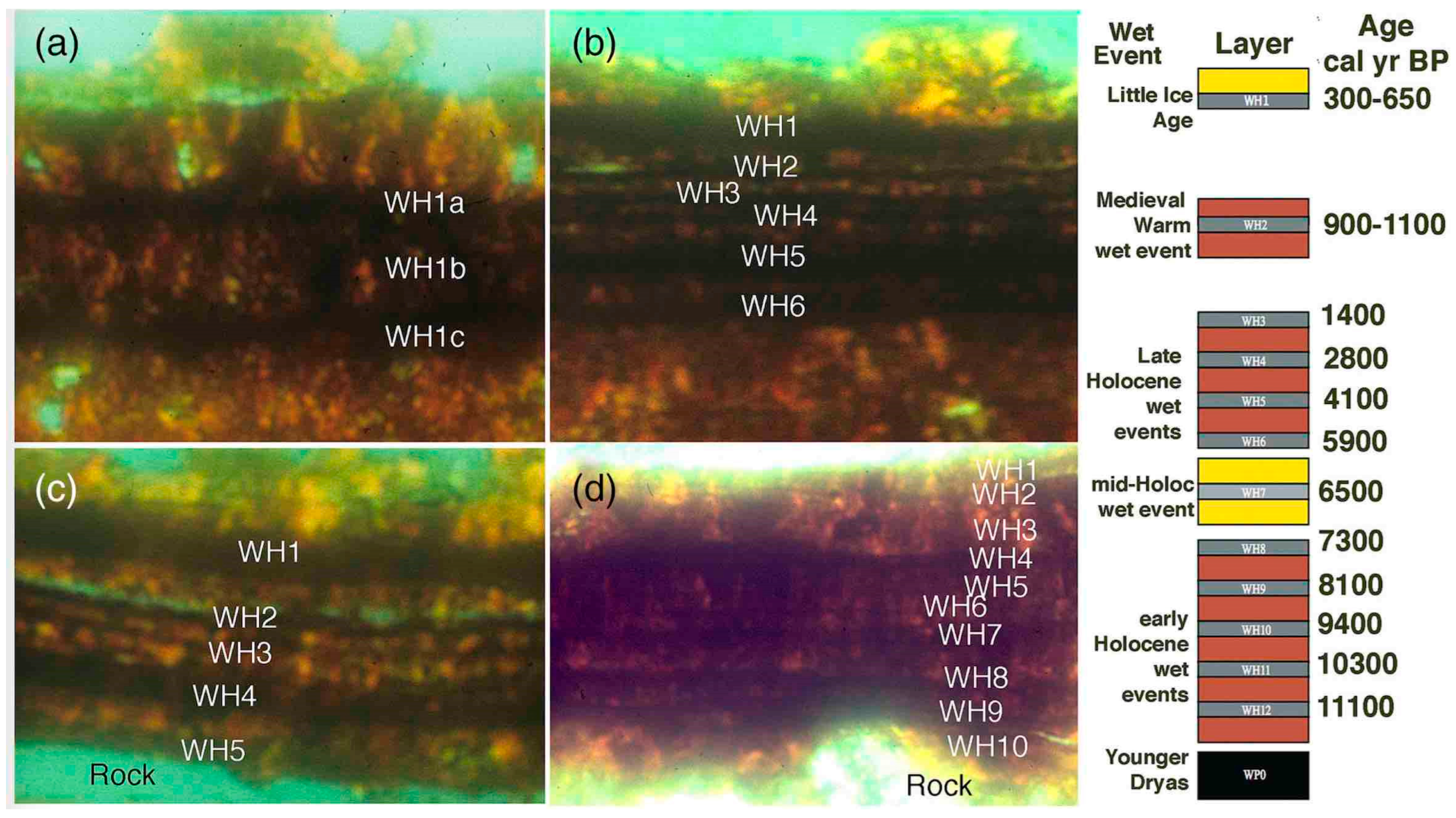
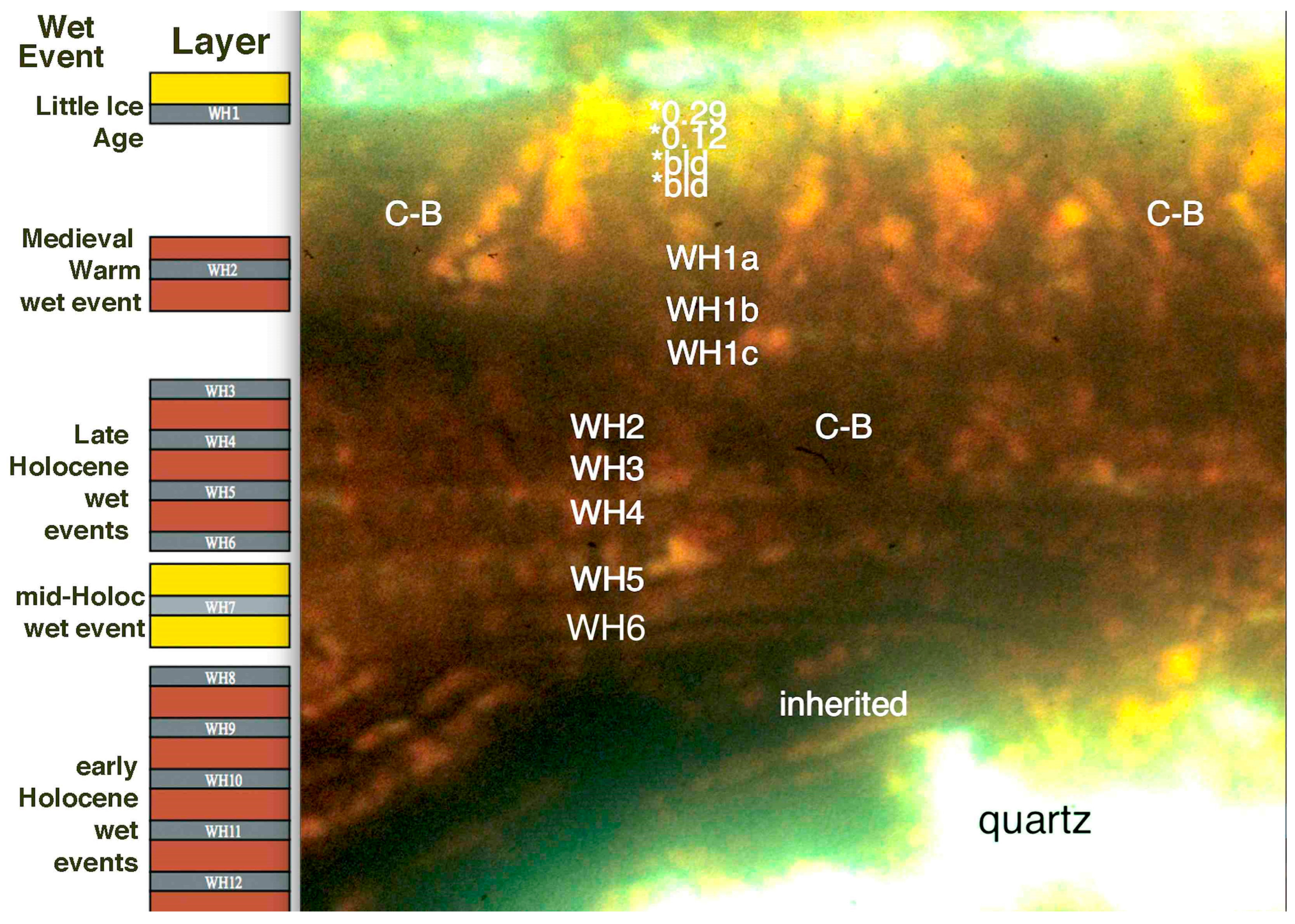
Rock varnish’s development and its chemical constituents are also influenced by major paleoclimatic changes. During wetter periods, varnish is Mn-enriched; drier periods instead result in less Mn accumulation such that Fe dominates. Over time, as paleoclimatic conditions alternate, this results in a microstratigraphy of Mn- versus Fe-rich layers that is visible in ultrathin sections (Perry and Adams 1978; Liu et al. 2025). These changes appear as contrasting color differences using optical microscopy, with black (Mn-rich), orange (Mn-low), and yellow (Mn-very low) layers (Figure 1). Varnish develops first in small pockets or micro-basins on a rock surface, which, accordingly, typically preserve the most complete varnish layering sequence. This fact has important implications for rock varnish dating, discussed below.
It is important to note some additional caveats about varnish formation processes. First, multiple factors can impact or alter these processes and the preservation of complete layering sequences. Acid-producing lithobionts such as fungi (e.g., Burford et al. 2003; Favero-Longo et al. 2011; Favero-Longo and Viles 2020), for example, may develop as climatic conditions change or may be more prevalent in some environmental settings, and their acids can dissolve the Mn from rock varnish (Dorn 2019, 2024). Second, this (and other factors) may result in an irregular distribution of potential varnish sampling micro-basins useful for archaeological dating, which in turn may impede systematic sampling (Whitley 2013). Finally, there are other rock alterations that are Mn- and/or Fe-rich, including weathering rinds and case hardening that incorporate varnish components (Dorn 1998), and these may be visually mistaken for rock varnish without in situ technical analysis. All of these circumstances must be considered in archaeological applications of rock varnish dating.

2. Background and Methods: Rock Varnish Dating Techniques, Sampling Procedures, and Ethnographic Analyses

A series of different techniques have been developed and applied to rock varnish dating for archaeological purposes (Dorn 1994, 2001), not all of which have been successful. We discuss three here that have been frequently used in recent archaeological applications: varnish microlamination (VML), cation ratio (CR), and lead-profile dating.1
It is important to emphasize that, regardless of the chronometric approach employed, there is a time lag between the first exposure of a rock surface, such as the recently engraved groove of a petroglyph or the exposure of an upthrust cobble in an intaglio, and the initial development of a rock varnish coating. Although we provide new data relevant to this time lag below, here it is adequate to note that prior observations revealed that rock varnish starts to form in millimeter-sized rock surface depressions, or micro-basins, in hot deserts within a century. We observed this at Fort Paiute in the Mojave Desert (Dorn et al. 1986; Bamforth and Dorn 1988), on an intaglio made in the 20th century called the “Fisherman” (Dorn 1998), discussed below, and on a 20th-century engraving at South Mountain, Phoenix (Dorn et al. 2012). These prior findings do not indicate that an entire rock surface starts to revarnish within a century; it does not. The process starts in a few micro-basins initially and then slowly begins to cover other parts of a rock surface. As discussed below, this fact has implications for the use and efficacy of different varnish dating techniques and sampling strategies.2

2.1. VML Dating

Perry and Adams (1978) first observed alternating Mn- and Fe-rich microstratigraphic layers in rock varnish thin sections. These micron-scale laminations develop as a result of climatic changes (Liu and Broecker 2007; Liu et al. 2000, 2025). As they demonstrated, the resulting layered patterning visible in an ultrathin section can be used to determine the age of the sample when compared to a regional sequence developed using independently dated surfaces as calibration control points. VML dating is then conceptually analogous to tree ring dating, but it does not have the same chronological resolution as dendrochronology. When varnish grows slowly, as commonly occurs in hot deserts (Dorn 1998), the temporal resolution is low, and a sequence only records major climatic signals such as large glacial pulses. Where varnish grows more rapidly, as it does in moister microenvironments (Spilde et al. 2013; Dorn 2024) such as the north versus south face of some boulders, however, roughly millennial-scale climatic events may be recorded throughout the Holocene (Liu and Broecker 2007; Liu et al. 2025).
VML sampling requires the removal of a complete layering sequence from a rock varnished surface. This may be obtained mechanically, by carefully hand-prying off the varnish layer from a micro-basin using a tungsten needle, or by taking a hollow core sample, which preserves the varnish sequence. It is necessary to obtain multiple micro-basin samples from the surface being dated to ensure that the most complete layering sequence is obtained. Sampling petroglyphs requires the removal of intact micro-basins from within the pecked-out area that defines the image, whereas, for upthrust cobbles in cleared areas in desert pavements, they may be taken from anywhere on the exposed surface. We note that the area removed is typically only a few millimeters in diameter.
Liu and Broecker (2007, 2008a, 2008b) and Broecker and Liu (2001) identified and calibrated a Late Pleistocene—Holocene Mojave VML sequence (see Figure 1). This has been expanded into the lower Sonoran Desert with additional calibration points from radiocarbon-dated landslides (Dorn 2014) and is used in this paper. Liu and Broecker (2007) further noted—and Dorn (2014) verified—that when varnish grows fast enough, WH1 is often subdivided into three visible layers (e.g., Figure 1a) formed in the wetter phases of the Little Ice Age, about 300, 500, and 650 calendar years before the present. The chronological implications of this sequence have been described as follows:
“twelve wet event dark layers and thirteen dry event lighter layers … bracket the period from 300 yrs cal BP to 12,500 yrs cal BP. The lengths of the intervals between wet events vary from 250 to 1800 years, with an average of 970—roughly 1000 years. The resulting correlated VML ages are certainly not as precise as radiocarbon ages, but they are adequate for age assignment to the broad time periods comprising the regional cultural historical sequence”.
(Whitley 2013, p. 4)
VML, notably, has been subjected to, and verified by, blind testing using cosmogenically dated geomorphic surfaces (Liu 2003; Marston 2003). VML has also been used to date artifacts, petroglyphs, constructed surface features, and geomorphic surfaces in Africa, the Middle East, and North and South America (Carbonelli and Collantes 2019; Cerveny et al. 2006; Liu et al. 2021, 2025; Baied and Somonte 2013; Whitley et al. 2017), even though its primary use has been in geomorphology (Liu and Broecker 2008b, 2013). VML dating, for example, was used to predict that debris flows could be a major hazard in metropolitan Phoenix (Dorn 2010), a prediction that was confirmed in 2014 (Dorn 2016).

2.2. Lead-Profile Dating

The industrial revolution caused a significant increase in atmospheric pollutants, including lead (e.g., Candelone et al. 1995). One result is that rock varnish surfaces exhibit an observable increase, or spike, in lead (Pb), beyond the natural background levels in the rock coating. This lead spike only occurs in the very surface-most micrometers of rock varnish that accumulated in the 20th century. We identify the presence of lead in a VML sequence with an electron microprobe, using a focused micron-size beam for 200 s, which lowers the detection limit to 0.06% PbO (Dorn 1998). This 20th-century lead spike has subsequently and independently been verified in rock varnish as resulting from the manganese and iron scavenging of lead (Fleisher et al. 1999; Hodge et al. 2005; Hoar et al. 2011; Nowinski et al. 2013; Spilde et al. 2013; Sims et al. 2022).
Lead-profile dating was first used to determine if the “Fisherman” intaglio near Quartzsite, Arizona, noted above, was pre-20th century in age or a more recent potential fake. As discussed below, rock varnish coatings from upthrust cobbles within this geoglyph were sampled, all of which were exclusively characterized by the lead spike, indicating a recent/20th-century age for the creation of this surface feature (Dorn 1998). Note that this does not preclude the possibility that this feature may be Indigenous in origin since the ritual practice involved in the use of these geoglyphs has continued into the twenty-first century (Whitley 2014). That this intaglio is stylistically and thematically dissimilar from other examples, combined with its recent age, however, suggest that it may be Euro-American rather than Native American in origin.
Lead-profile dating has also been used to authenticate historical inscriptions (Dorn et al. 2012). An important use of this technique is the way we have employed it here: as an internal check, it verifies that the youngest Holocene rock varnish microlaminations at 300 (WH1a), 500 (WH1b), and 650 (WH1c) cal yr BP, correlated with three wet phases of the Little Ice Age (Liu and Broecker 2007; Liu et al. 2025), are likely correct, as discussed above. Repeating a point noted previously, rock varnish dating is best conducted using multiple techniques (Dorn 1994, 2001), as we employ lead-profile dating here.

2.3. CR Dating

The development of CR dating in the early 1980s (Dorn 1983; Dorn and Oberlander 1981) yielded the first calendrical age constraints on petroglyphs (rock engravings), resulting in the first chronometric rock art ages (Dorn and Whitley 1983, 1984). This technique is based on cation exchange processes in rock varnish that leach out mobile trace elements (K and Ca) more rapidly than stable elements (Ti) through capillary action (Dorn and Krinsley 1991). The resulting rate of change can be calibrated using independently dated control surfaces, such as river and lake terraces, and is used to provide minimum-limiting age estimates for a rock varnish coating (Dorn et al. 1990).
While CR dating has been independently replicated in a number of regions globally (e.g., Pineda et al. 1990; Zhang et al. 1990; Plakht et al. 2000; Sarmast et al. 2017; Ntokos 2021) and has successfully been subjected to blind tests in its archaeological use (Loendorf 1991; Bamforth 1997), it has certain analytical weaknesses. Varnish growth, as noted above, starts in micro-basins, with initial cation leaching likewise beginning at discrete points rather than continuously and uniformly across a rock surface. This discontinuity requires the removal (through mechanical abrasion of varnish within the micro-basins) and chemical analysis of a bulk sample in order to obtain an average value for the coating as a whole (Dorn 1994, p. 24). The resulting age estimates often have large error margins, and they can underestimate the true age of a varnish surface (see, e.g., Whitley 2013, Table 1), despite efforts to exclusively sample within micro-basins and thereby minimize contamination from the younger portions of a varnish coating. The most important weakness of the technique, however, is its basis in biogeochemical processes, which can potentially reverse over time. Despite these issues, a blind test matching CR to VML dating yielded comparable even if not fully equivalent results, demonstrating its value for broad-spectrum temporal analysis, such as identifying the age range of a corpus of petroglyphs or a surface artifact assemblage. But like obsidian hydration dating, CR is not appropriate for confident age assignments for individual specimens (Whitley 2013, p. 7). Given the considerable advantages of VML discussed above, we employ CR dating below as a subsidiary confirmation of the age assignment of a VML sequence.

2.4. Methods of Dating Surface Features in Desert Pavements

Dating surface features in desert pavements is based on the fact that the cobbles on the landforms in our study region are alluvial in origin, with the natural process of transporting these materials scouring off any prior rock coatings. Subsequently the wetting and drying of fines and the accumulation of silt push buried cobbles upwards, onto the ground surface, in areas that have been previously cleared of these accumulative ground coverings (Springer 1958; Haff and Werner 1996; Adelsberger and Smith 2009 Adelsberger et al. 2013; Haff 2014; Ugalde et al. 2020). When surface archaeological features involve the disturbance of the desert pavement (e.g., in the making of an intaglio or sleeping circle), VML, CR, and lead-profile dating can be used to provide a minimum-limiting age estimate on the subsequently upthrust lithic clasts and thus on the creation of the archaeological feature. Two technical matters involved in dating desert pavements using such an approach warrant discussion here. These are the time lag involved in the upthrust of cobbles onto the surface in a disturbed desert pavement area and the larger issue of the time lag in the initiation of varnish development on unvarnished rock surfaces of all kinds, noted briefly above.

2.4.1. Time Lag in Desert Pavement Regeneration

A variety of observers have claimed that desert pavement regeneration begins within a few months to a few years (Péwé 1978; Haff and Werner 1996; Dietze and Kleber 2012). We monitored the rate of pavement reformation in meter-scale disturbance plots created by Troy Péwé in the Sonoran Desert outside of Mesa and Quartzsite, Arizona (Péwé 1978; Bales and Pewe 1979), to test these estimates, for over four decades. We continued monitoring these pavements with Péwé’s permission, even after his passing in 1999.
It was important for our purposes to consider only those cobbles that emerged from the subsurface after Péwé cleared these sample plots and to ensure that any sampled cobbles were not remnants of the original pavement nor were inherited contaminants through disturbances of some kind from the surrounding areas. In addition to periodic monitoring, we focused only on those cobbles with inclusions of millimeter-scale fragments of pedogenic carbonate. Such carbonate coatings develop on buried clasts (Springer 1958; McAuliffe and McDonald 2006; Haff 2014), and precipitation would dissolve the carbonate once exposed on the ground surface after a few decades, allowing us to eliminate the possibility that our sampled cobbles were remnants of or derived from the original pavement surface. Note that thick calcium carbonate coatings can persist in surface contexts, potentially for thousands of years, as we have demonstrated previously (Cerveny et al. 2006). In the current case, the very small size of the carbonate fragments would be susceptible to weathering in a short period of time, guaranteeing recent exposure of the clasts.
We found that it took 14 years at the Mesa site and 22 years at the Quartzsite site for previously buried cobbles to emerge and start reforming a new desert pavement. The implication is that desert pavements begin to regenerate within a few decades of disturbances to them, indicating that rock varnish dating of subsequent upthrust clasts can provide an archaeologically reasonable minimum estimate of the age of manufacture of these types of surface features.
We stress that pavement generation and regeneration is an ongoing process. The length of time it takes to form a completely intact pavement, measured by radiocarbon and optically stimulated luminescence, can range from about 5000–6000 years in the Mojave Desert to about 12,000 years in Death Valley, California, when cobble sizes are under approximately 10 cm (Seong et al. 2016). The samples we collected are thus from pavements that are still regenerating, and they tend to have even smaller cobble sizes. We emphasize that the varnish ages presented here are minimum estimates for the age of a pavement-disturbing event.

2.4.2. Time Lag in the Initiation of Revarnishing

It is also important to stress that, regardless of the chronometric approach employed, there is a time lag between the first exposure of a rock surface, such as the newly engraved groove of a petroglyph or the exposed surface of an upthrust cobble, and the initial development of a rock varnish coating—the start of its revarnishing for petroglyphs and the initiation of varnishing on upthrust cobbles. As noted above, prior observations demonstrated that rock varnish is present in millimeter-sized rock surface depressions, or micro-basins, in hot deserts within approximately a century, but the varnish only slowly begins to cover other parts of an exposed rock surface. Varnish age across a surface then varies from point to point, a fact which is critical in terms of effective chronometric sampling.
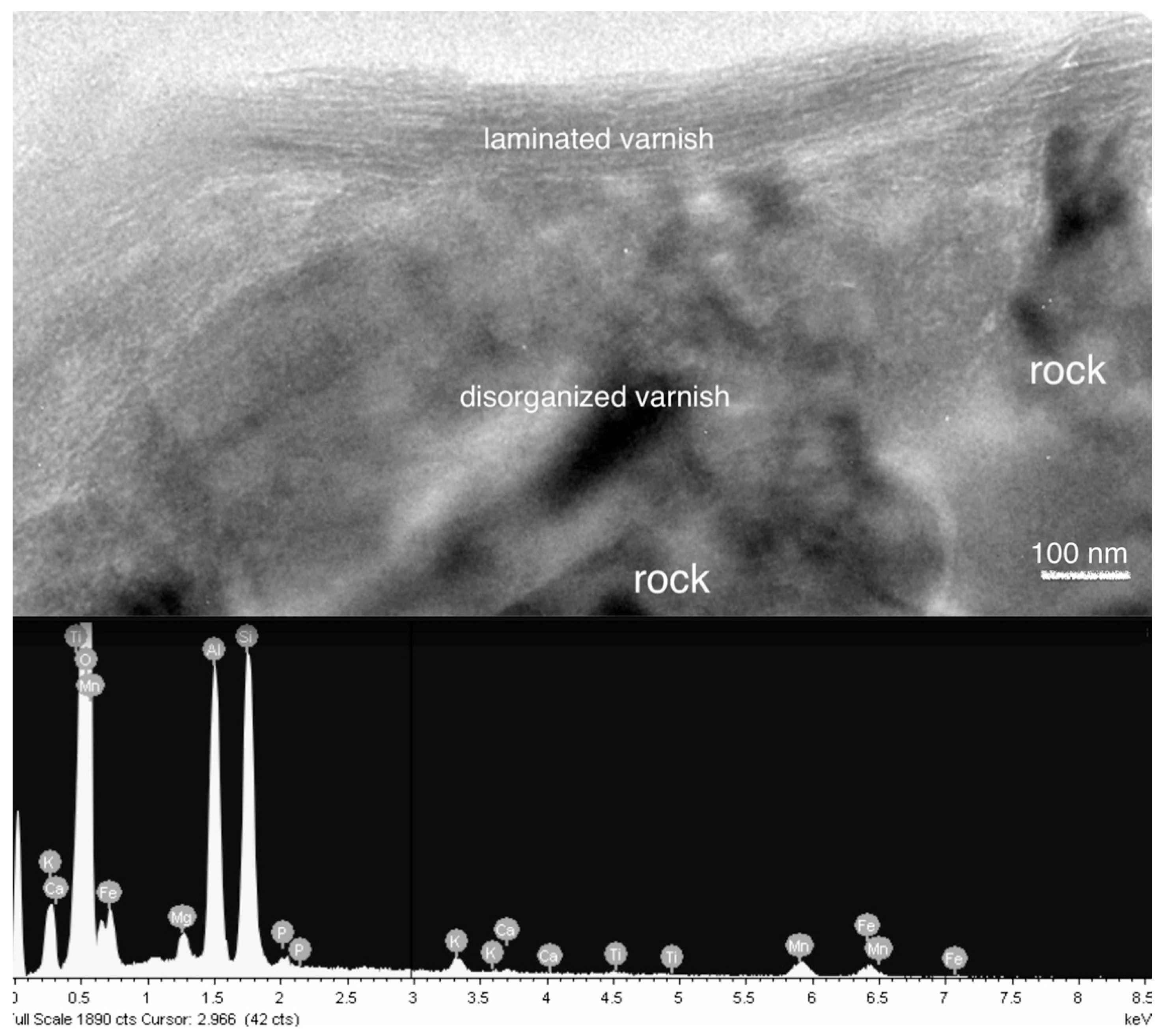
We used the opportunity afforded by the pavement regeneration study, discussed above, to improve the understanding of this time lag in the start of surface revarnishing. Although rock varnish was not detectable on most of the previously buried cobbles we observed on the ground surface at Péwé’s Mesa study locale, two had started to develop a varnish coating after 19 years of surface exposure. These coatings, however, were only visible using electron microscopy (Figure 2), not with the light microscopy used for VML and, as expected, were restricted to micro-depressions on the cobble surfaces. This finding illustrates the great variability in varnish accretion rates (cf. Spilde et al. 2013). This fact does not impact the reliability of VML, Pb-Profile, or CR dating using a sampling procedure focusing on multiple micro-basins, designed to account for this variability. But this invalidates methods that sample indiscriminately and rely on varnish accumulation rates.
We further assessed the revarnishing time lag using a natural petroglyph-like feature—a 0.5 cm wide scar on a rock surface, created by a landslide in the McDowell Mountains, Scottsdale, Arizona. A radiocarbon age of 1180–1290 cal year BP, obtained from a crushed paloverde tree under the landslide feature (Dorn 2014), provides a useful age constraint on the natural event that created this scar. This allowed us to assess the variability of rock varnish ages in different micro-basins within this feature, using VML dating, along with the rate and degree to which rock varnish spread across this groove, using X-ray mapping (Friel and Lyman 2006) to identify varnished micro-basins.
Only two of 10 VML cross-sections from micro-basins in the scar had the WH2 microlamination, thereby matching the radiocarbon age. The remainder provided younger estimates: four had the WH1 (Little Ice Age) microlamination at their base, and four were post Little Ice Age (younger than 300 cal yr BP). It may thus take roughly 1000 years for rock varnish to coat an exposed surface, with the ages of different specific micro-basins on this surface varying by that same number of years, illustrating that varnish development is not continuous across lithic exposure. We accordingly only use the oldest VML sequence for each feature in our age estimates, because the oldest VML provides the smallest time lag between cobble exposure and the onset of varnishing and is likely the closest to the true age of the feature. These methodological issues emphasize the importance of using a varnish dating technique like VML that can provide close minimum-limiting ages by sampling multiple micro-basins.

2.5. Methodological Principles of Ethnographic Analysis

We contextualized and interpreted our chronometric results with an analysis of existing ethnographic data collected by multiple anthropologists from Yuman-speaking tribal members, primarily the Mohave and Quechan. In addition to older published ethnographic data, we include recently collected information from contemporary tribal consultants and spokespersons. These accounts demonstrate continuity in the retention of traditional knowledge, given that the recent commentary correlates with the earlier recorded information, some of which is over a century old.
We followed the procedures and approaches to ethnographic analysis outlined by Whitley (2005, 2007, 2011) in our analyses. These emphasize four key methodological principles. The first is that ethnographic reports typically provide “raw data” that itself must be interpreted, rather than complete answers to specific questions. This is because the questions that anthropologists raise to their informants are rarely those that an archaeologist may be interested in, with archaeologically useful information often included in asides or seemingly tangential commentary. The second point is that ethnographic analysis is an iterative process that requires careful reading, and re-reading, the reports, after specific clues to meaning are successively identified.
Third, this iterative process is especially important when the interest is religious beliefs and symbolism. These topics can only be understood when the ethnographic data are contextualized in terms of the metaphysical beliefs—the ontological and epistemological commitments—of the informants. The failure to recognize this last fact caused archaeologists to claim for decades that Native Americans knew nothing about rock art, for example, because researchers attempted to interpret the ethnographic commentary from a Western, scientific perspective and were unable to do so. This further caused archaeologists to argue that rock art pre-dated the ethnographic tribes and that it was necessarily created by earlier peoples. What should have been obvious, however, is that religious beliefs of all types are matters of faith, not empirical science, and do not make logical or empirical sense in Western terms, regardless of the religion involved. Substantial ethnographic data on the making and meaning of rock art then exists, once it is understood that this can only be identified through careful reading and re-reading the ethnographic accounts and only understood in terms of Indigenous, not Western, ontological perspectives.
Fourth, as in most qualitative analyses, there are varying levels of reliability to or inferential strength of an ethnographic interpretation. Assessment factors may include the existence and numbers of confirming accounts; whether these were collected by different anthropologists, at different times, from different informants; and whether a particular interpretation fits a larger regional ethnographic pattern. The best results involve confirming results from multiple sources that correlate with regional beliefs and practices. We have followed these principles in our ethnographic analysis of the significance and meaning of the Topock Maze, as discussed below.

Linguistic and Ethnic Group Histories: Background and Methods

Our interpretive concern with respect to the ages of the intaglios involves a central problem in this part of the far west: the age of Yuman speakers’ (Mohave, Quechan and, historically, Halchidoma and other smaller tribal groups) arrival in the lower Colorado River region. The implications of the ages of the intaglio tradition to their origins have been recognized by von Werlhof (1995), and the data we present below is directly relevant to this issue. Existing interpretations of this topic, however, are only partly based on archaeological data, with significant—sometimes over-riding—weight given to historical linguistic reconstructions. Yet even a quick reading of the existing literature demonstrates that few archaeologists understand the methodological limitations of the different historical linguistic methods. This and a larger problem—what we mean by an ‘archaeological culture’—then warrant discussion here to better contextualize our results and our interpretation of their implications.
It is important to emphasize at the outset that there is no perfect correlation between language, culture, and physical/biological (“racial”) type, as the first half century of Boasian anthropological research demonstrated conclusively (Whitley 2020, 2021). But the parallel fact is that we cannot reduce a culture to an adaptive system or artifact assemblage. Cultures instead are defined in contemporary anthropological terms as cognitive systems of shared symbols and meanings, often tied to common ritual and belief systems, not sets of norms, artifact assemblages, or types, nor adaptive strategies, as many archaeologists still assume (Whitley 1992, 2020, 2024). As Sahlins (1985) has emphasized, furthermore, different aspects of human social life change at different rates, with technological and economic factors shifting quickly while belief and ideological systems—which is to say cultures—are much slower to change. Indeed, as Steward noted, a century of acculturation among the adjacent Numic (Paiute and Shoshone) speakers
“has not wiped out all Indian practices. Acculturation has consisted primarily of modifications of those patterns necessary to adjust to rural white culture … The Shoshoni retain, however, many practices and beliefs pertaining to kinship relations, child-rearing, shamanism, supernatural power and magic”.
Religion, a set of beliefs and practices related to supernatural agents and a supernatural realm, is often but not always a proxy for culture. It does not serve this role for large-scale societies, like our contemporary Western world with proselytizing religions (Keane 2003), but full concordance often exists between the cultures of small-scale societies, like those found in the North American desert west and their non-proselytizing religions (e.g., Harris 1940, p. 55; Opler 1940, p. 136; Siskin 1983, p. 11; Laird 1976, p. 24). Religious remains, including sacred objects and evidence of ritual practices, are then the most useful category of archaeological remains for studying cultural continuity and change, and intaglios fall within this category. Even if we cannot, with complete certainty, equate culture, as signaled by religious practices, with language and ethnicity alone, an assumed equivalence is reasonable in certain cases. A series of matters concerning the linguistic history of the Yuman language family then warrant discussion in light of our chronometric ages and their possible importance as an expression of an early cultural system for Yuman speakers along the lower Colorado River and because of the heavy reliance archaeologists have placed on linguistic reconstructions.
These start with the fact that many linguists assume that the Baja California peninsula was a linguistic dead-end in terms of the initial Late Pleistocene migration and colonization of the west coast, resulting in the development of an isolated speech community in this restricted area that eventually developed into the ancestral Yuman (and Cochimi) languages. This standard reconstruction posits that this initial colonization was followed by successive migrations northwards, out of this cul-de-sac homeland, creating a kind of linguistic stratigraphy, as it is sometimes described (Shaul 2020; cf. Massey 1961, 1966; Kowta 1984; von Werlhof 1995), yielding the relatively late arrival of Yuman speakers in the lower Colorado River region. But this reconstruction entails at least one significant confounding empirical problem. This is the 200 km separation between the Pai-speaking branch at the northern extreme of the Yuman languages, with the Iipay and Tiipay (“Diegueño”) in the coastal San Diego area and the Yavapai, Walapai, and Havasupai (“Upland Yumans”) in central- and north-western Arizona. This is typically, though not plausibly, explained by a very late, very rapid, hypothesized migration and thus split of Pai speakers in one direction or the other (e.g., Laylander 2015).
A more parsimonious reconstruction would suggest instead that there was an extra-peninsular Proto-Yuman heartland in southern California and/or the Colorado River Delta region, as Mixco (2006) argues, based on linguistic borrowing and reconstructed ecological terms. The separation over time into distinct speech communities and, ultimately, individual Yuman languages occurred at least partly (if not largely) in situ rather than primarily due to migrations. The geographical separation of the Pai resulted again in separation, in part or wholly, from the later movement of Takic speakers southwards into former Yuman territory, splitting the Pai apart, as Hinton (1991) first suggested, rather than exclusively due to late-dating Pai migrations. This last possibility accommodates the physical anthropological evidence suggesting that the Cupan branch (Gabrielino, Luiseño, Cupeño, and Cahuilla) of these Takic speakers were originally biologically Yuman or, alternatively, that a substantial proportion of Yuman speakers were absorbed into the in-moving Takic to account for the physical similarities (summarized by Sutton 2009), as well as the equivalences in their mythic corpora (cf. Kroeber 1906; Waterman 1909). It also fits with the genetic evidence (Monroe et al. 2013) and comparative trait studies (Jorgensen 1980) that suggest an earlier split for the Pai languages. Relatively greater antiquity, rather than recent arrival, then is a plausible even if unproven expectation for the Yuman speakers along the lower Colorado River.
The subtext of this first suggestion are estimates for the various divergences in the Yuman and surrounding language families, the second pertinent issue concerning the linguistic history of this region and its relevance to the origins of the lower Colorado River Yuman speakers. Three general approaches to the history of languages have been employed in the far west, an understanding of which is necessary for clarifying their value to archaeological interpretation, as well as for reconstructing the cultural history in this river region. The most common of these approaches involves linguists’ guesstimates commonly offered, insofar as we have been able to determine, with little or no detailed analytical basis but apparently based on very general analogies (e.g., Golla 2007). These guestimates appear tied to the following assumptions:
“The rule of thumb (derived from the study of languages with hundreds of years of written documentation…) is that after about 2000 years, language changes tend to have obscured the clear sorts of correspondences [for grouping language families and detecting borrowing, while] … After 5000 years there are few [such] correspondences”.
The implications are that (1) all languages change at approximately the same speed, universally, regardless of population size and density, interaction networks, communication transmission and storage systems, demographic structure, or social complexity and that (2) the written texts of the Indo-European, Egyptian, and Semitic language families, the source of these estimates, are appropriate analogical models for the rate of linguistic changes, even to all manner of small-scale oral cultures and societies. Since language divergence and change is at least partly based on (if not heavily influenced by) the social structure of the speech communities using a given tongue, the nature of their interactions with speakers of surrounding languages (cf. Babel et al. 2013), and the differences in the various types of population movement and replacement that may occur (cf. Eshleman et al. 2004; Kemp et al. 2010), these assumptions are empirically implausible from the start (cf. Greenhill et al. 2023, p. 85).
But even more severe, from an archaeological perspective, is the temporal limit that such assumptions necessarily impose on the past, with the observable linguistic differences then required to have developed solely in the last few thousand years. Taken at face value and in aggregate, a synthesis of the far western Precontact past using these linguists’ guestimates would require numerous and frequent in- and out-migrations of different peoples, as if the far west were little more than a transit corridor for population displacements. Only occasionally is there a (right or wrong) logic suggested that would explain the cause for such movements (Bettinger and Baumhoff 1982, Diamond and Bellwood 2003, and Sutton 2009 are some notable exceptions). Even more rarely is there a plausible description offered concerning where those populations that were forced out or replaced moved, and the larger downstream demographic ripple effects of these geographical shifts. The effective result is models of linguistic change without people involved or social interactions considered. The similarities and close relationships between many far western Native American languages, instead, are more likely then a reflection of “a normal foraging adaptation in an arid region” (Shaul 2014, p. 66) resulting from a linguistic network rather than a dialectical chain, as opposed to numerous, necessarily recent population movements, as the guestimates require, despite the absence of archaeological data in their support.
A second, superficially more analytical approach to linguistic history is glottochronology. This has suggested that the core Yuman languages split up between 3500 and 1300 YBP (Shaul and Hill 1998). Note however that Shaul (2014) is no longer willing to assign specific dates to linguistic divergences, tacitly questioning his previously published estimate. This change in perception reflects a widespread rejection of glottochronology, the nature and problems of which are well described as follows:
“Glottochronology uses the percentage of shared ‘cognates’ between languages to calculate divergence times by assuming a constant rate of lexical replacement or ‘glottoclock’. Cognates are words inferred to have a common historical origin because of systematic sound correspondences and clear similarities in form and meaning. Despite some initial enthusiasm, the method has been heavily criticised and is now largely discredited. Criticisms of glottochronology, and distance-based [statistical] methods in general, tend to fall into four main categories: first, by summarizing cognate data into percentage scores, much of the information in the discrete character data is lost, greatly reducing the power of the method to reconstruct evolutionary history accurately; second, the clustering methods employed tend to produce inaccurate trees when lineages evolve at different rates, grouping together languages that evolve slowly rather than languages that share a recent common ancestor; third, substantial borrowing of lexical items between languages makes tree-based methods inappropriate; and fourth, the assumption of a strict glottoclock rarely holds, making date estimates unreliable. For these reasons historical linguists have generally abandoned efforts to estimate absolute ages”.
The disqualifying problems inherent to glottochronological analysis are further emphasized by the fact that language changes sometimes involve punctuated bursts rather than gradual, progressive evolution (Atkinson et al. 2008), as glottochronology would require.
The third approach to linguistic history is the use of computational phylogenetic models derived from evolutionary biology. These overcome the four main problems with glottochronology, and they employ linguistic, genetic, and archaeological data to calculate dates for language change, with the archaeological and genetic data calibrating the linguistic rates. Although this approach has not yet been applied to the Yuman languages, to our knowledge, Greenhill et al. (2023) have provided an analysis of the neighboring Uto-Aztecan language family which has implications for the Yuman problem—the temporal relationship of the Yuman speakers to the neighboring Takic branch of Uto-Aztecan speakers and their residence in southern California. There is widespread agreement that the Yuman peoples were north of the Baja peninsula earlier than the Takic (e.g., Hinton 1991; Elliot 1994; Sutton 2009; Shaul 2014; Field 2018). Initially the arrival of the Takic in California was widely assumed to be linked to a southern origin and intrusive migration northwards of Uto-Aztecan speakers out of Mexico, perhaps associated with the spread of maize agriculture (e.g., Hill 2001). This necessarily placed Uto-Aztecan speakers in the region relatively late and, by implication, also accommodated a relatively more recent date for the presence of Yuman speakers. The alternative hypothesis was a northern origin for Uto-Aztecan speakers as a whole, including the Takic branch (Fowler 1983). Although this was initially a minority opinion, recent phylogenetically based reevaluations of Proto-Uto-Aztecan linguistic history provide significant support for the northern origin hypothesis, as well as deeper time depth for these people in the region (Merrill 2012; Merrill et al. 2009; Greenhill et al. 2023). The Proto-Uto-Aztecan language had differentiated into its own distinctive speech community about 4000 years ago at minimum, based on these latest reconstructions, in the central Mojave Desert adjacent to the Colorado River corridor. Assuming this reconstruction is correct, Yuman speakers would then necessarily have been in place outside of the Baja peninsula prior to about 4000 years ago.
Note, however, that the archaeological data that Greenhill et al. used in their analyses were from reports that partly based their chronologies on the discredited Lamb (1958) glottochronological study of the Numic branch of Uto-Aztecan, potentially biasing the phylogenetic results towards a younger estimated date. This was pointed out in personal correspondence with Simon Greenhill, who kindly re-ran his analyses with those data removed. This yielded no appreciable difference in the results and thus his estimated 4000 YBP date for the development of Proto-Uto-Aztecan in the Mojave Desert (email communication to Whitley, 18 July 2024). Unanswered, however, is a related question: what effect would the inclusion of earlier archaeological ages based on evidence suggesting much longer-term Numic cultural continuity, extending back into the Terminal Pleistocene (Whitley 2013; Whitley et al. 1999), have on the calculated estimate for Proto-Uto-Aztecan in the region?
Regardless of the answer to that specific question, this review of historical linguistical methods indicates that there is no reason to infer that Yuman speakers were relatively late arrivals in the region. Instead, and in fact, it suggests that they may have been living along the lower Colorado River region much earlier than previously suggested. The rock varnish minimum ages for the intaglios, discussed below, support this inference.

3. Age of the Colorado River Intaglios

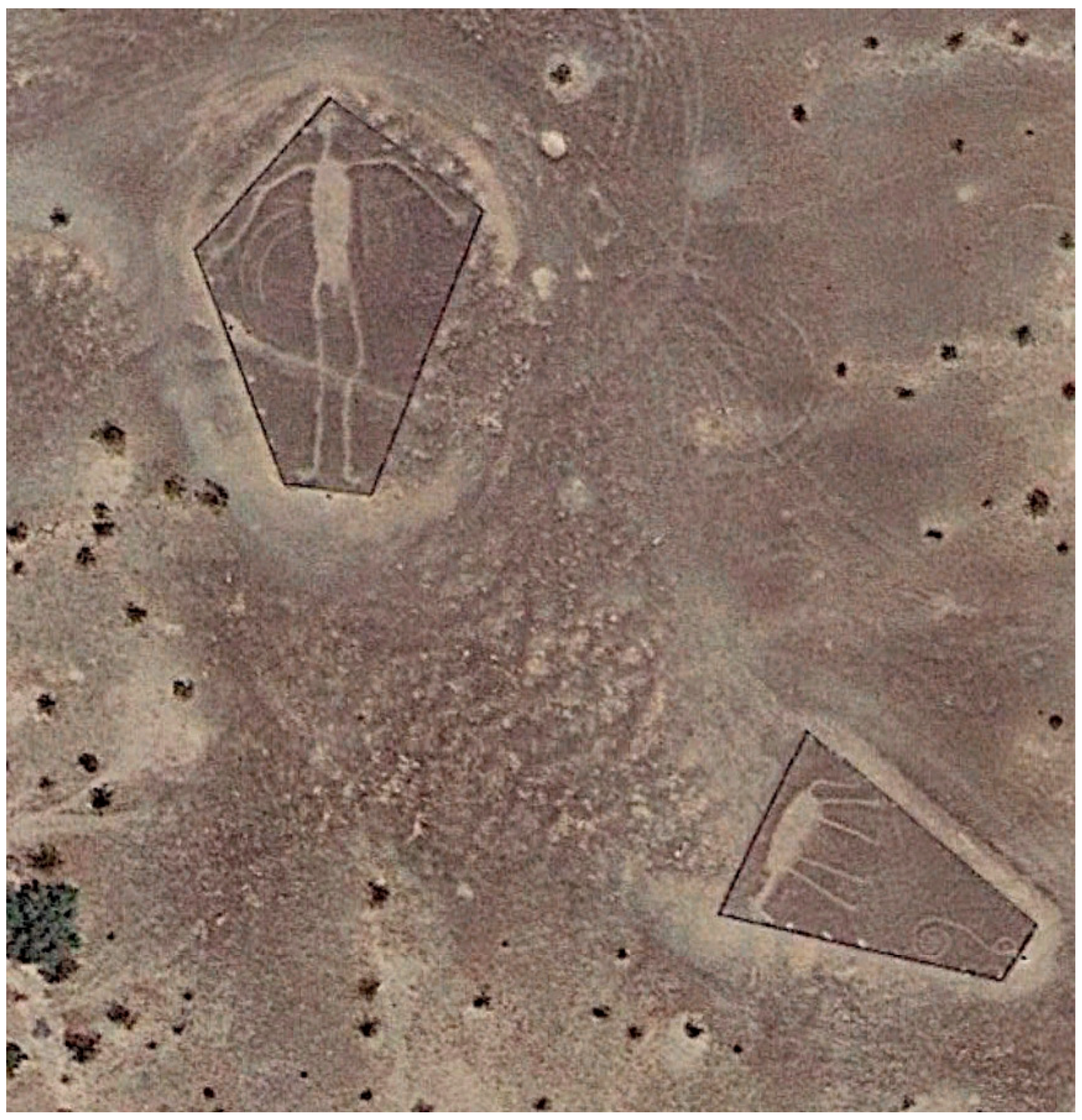
Substantial, popular interest has developed over the last half century in the intaglios (geoglyphs or earth figures) found on the alluvial terraces along the lower Colorado River in California and Arizona. These commonly include very large (tens of meters in their maximum dimension) stick-like human figures, rarer depictions of animals (mountain lions, lizards, snakes), and geometric patterns like spirals and zigzags, often associated with cleared paths and circles (Figure 3). Like the more famous Nazca Line intaglios of Peru, much of this popular appeal involves spurious claims about putative associations with ancient aliens when, in fact, there is Native American ethnography on the meaning and ritual use of these surface features (Bourke 1889; B. Johnson 1985; von Werlhof 2004; Whitley 2014, 2023). This demonstrates that the sites are specific locations of mythic events for the River Yuman-speaking Quechan and Mojave; that the motifs portray the actors and events that occurred at each location; and that the sites were—and at least until two decades ago continued to be—used for ritual pilgrimages undertaken to re-experience the creation of the world. They are somewhat then akin to the commemorative and ceremonial purposes of the Catholic Stations of the Cross, on a landscape scale.
While there is widespread professional archaeological acknowledgement of the Indigenous ritual origin of these surface features, their age has been uncertain, as has the potential antiquity of the associated pilgrimage and ritual belief systems tied to them. This is important in part because the history of Yuman-speaking peoples in this region is uncertain, as discussed above. There is archaeological consensus that Yuman speakers were present along the river corridor by at least 700 CE (Schroeder 1979), based on the development of the Hakatayan/Patayan archaeological “culture,” but their initial arrival in this region is unresolved. Many archaeologists suggest a relatively late River Yuman arrival (e.g., von Werlhof 1995; Laylander 2001, 2010, 2015). Linguistic evidence, however, discussed above, alternatively suggests that they may have been present much earlier, especially if the Colorado River Delta and/or Colorado Desert area is the homeland for the Proto-Yuman language, as Mixco (2006) and others (Law 1961) have hypothesized. Our varnish dates were partly intended to help resolve that question.

3.1. VML and CR Ages on Intaglios

At the request of the Bureau of Land Management El Centro, Needles, and Yuma field offices, we collected upthrust cobbles from the culturally cleared areas within intaglios at a series of sites, accompanied by members of the Fort Yuma Quechan Tribe Historic Preservation Office and the Fort Mojave AhaMakav Cultural Society. Table 1 presents a compilation of rock varnish minimum-limiting ages for these intaglios, found on both sides of the lower Colorado River, including new VML, CR, and lead-profile ages. Included in the table are newly calibrated CR ages from a prior study (von Werlhof et al. 1995)3 in addition to the new chronometric estimates. The VML ages represent the oldest microstratigraphic sequence observed from 10 cobbles analyzed from inside each of these features. Control cobbles from the unaltered desert pavement surrounding each feature were also analyzed. These “controls” were all Late Pleistocene in age, precluding the possibility that our sampled cobbles in the archaeological features were contaminated by the surrounding intact desert pavement.
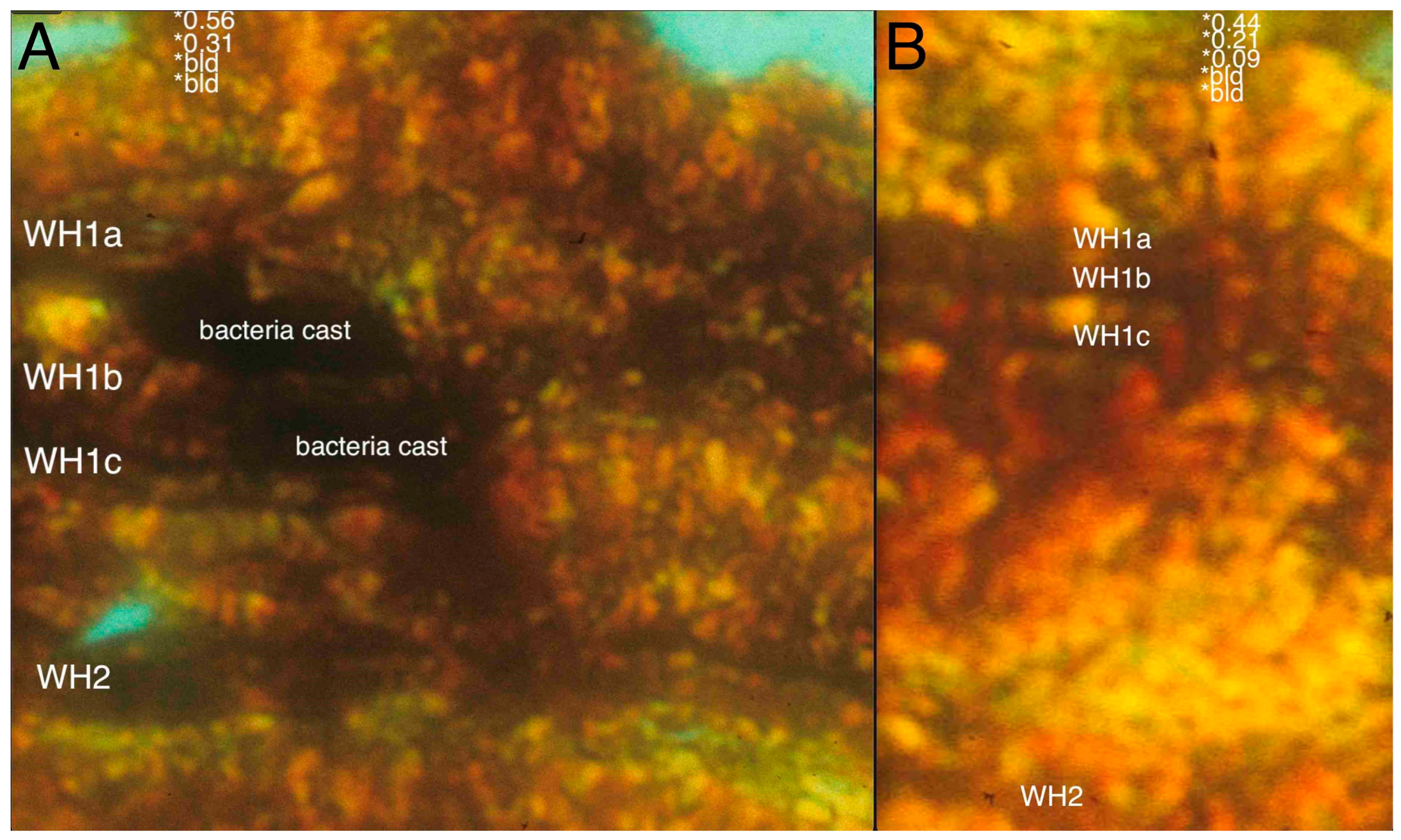
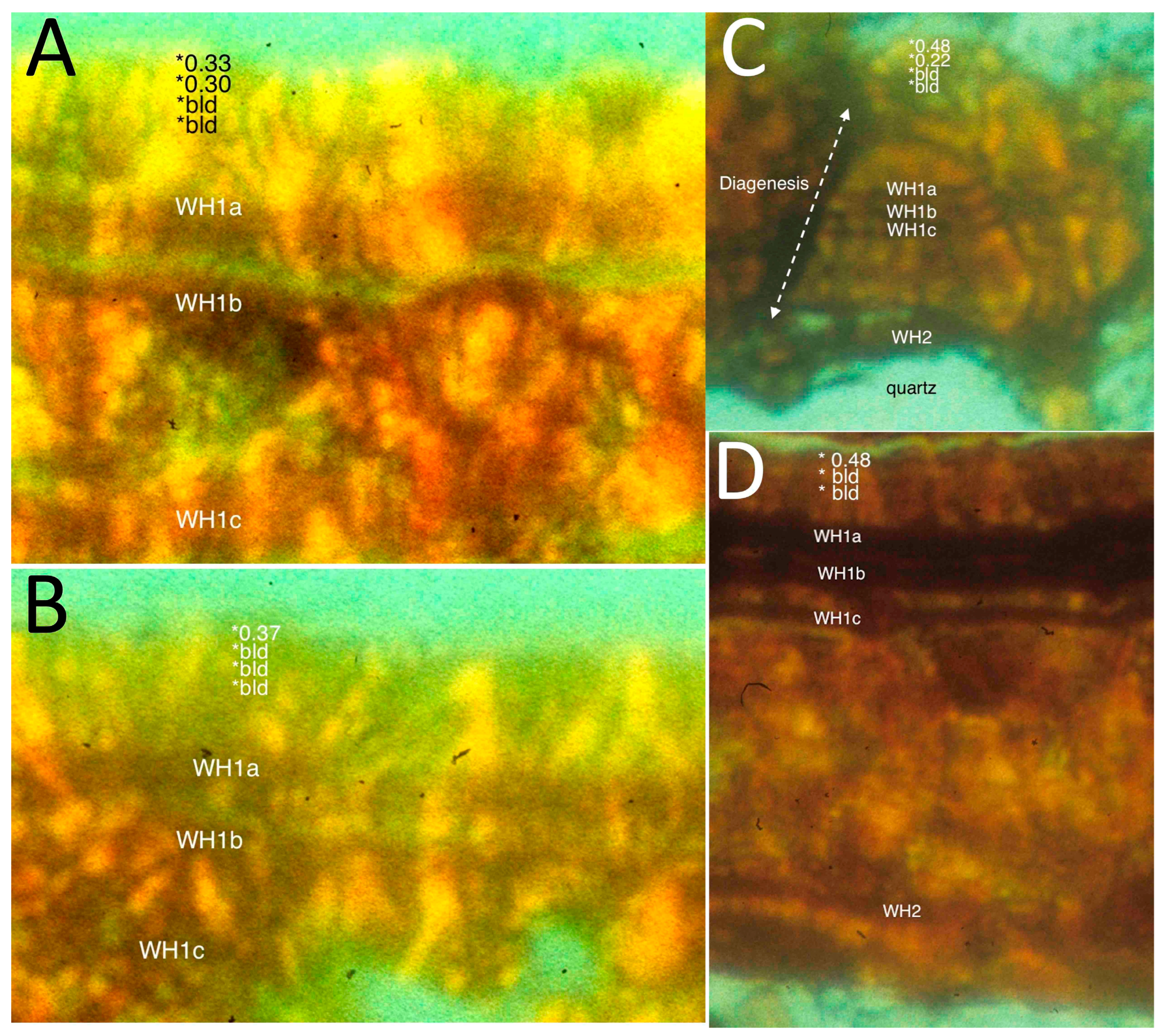
The minimum-limiting age estimates range from 650 to 5900 cal yr BP, or from the Late Precontact period to the middle Holocene. Figure 4 presents the oldest of the observed VML sequences for two intaglios from the Ripley Complex, Arizona, perhaps the largest intaglio site along the Colorado River. An orange layer underneath the black WH2 layer is shown in Figure 4A, indicating that its varnish began to develop between WH2 and WH3, or from 1100 to 1400 cal yr BP. Figure 4B displays only a very small section of the orange laminae, with the black WH2 layer as its basal layer. Since varnishing always post-dates exposure of an alluvial pavement clast, and since upthrust cobble exposure itself takes time, an appropriate minimum age assignment would be 1100 to 1400 cal yr BP for both intaglios.
Note that an area labeled “bacteria cast” in Figure 4A is a cluster of budding bacteria, with their cellular casts encrusted in Mn and Fe. These casts are normally dissolved and remobilized as varnish grows (cf. Dorn 2024), but some preserved areas may occur where varnish is particularly fast growing. This is consistent with preservation of the three Little Ice Age wet events, present in both profiles and indicative of relatively quick varnish development. Lead-profile dating is also consistent with these analyses, as are the CR ages.
That both Ripley intaglio VML ages fall within the same time range suggests that the two geoglyphs may have been created in the same event, or at least during the same general time period. This possibility is enhanced by the CR ages from the famous Blythe Giants site, all three of which are internally consistent, with average dates of 1000–1100 cal yr BP. This perhaps indicates that at least some of these sites were planned compositions rather than accretions of motifs added over time. Note further that there seems to be a cluster of minimum ages roughly occurring in the first millennium of the Common Era, when the CR dates on samples without accompanying VML ages are included. This may represent a period of intensified ritual activity.
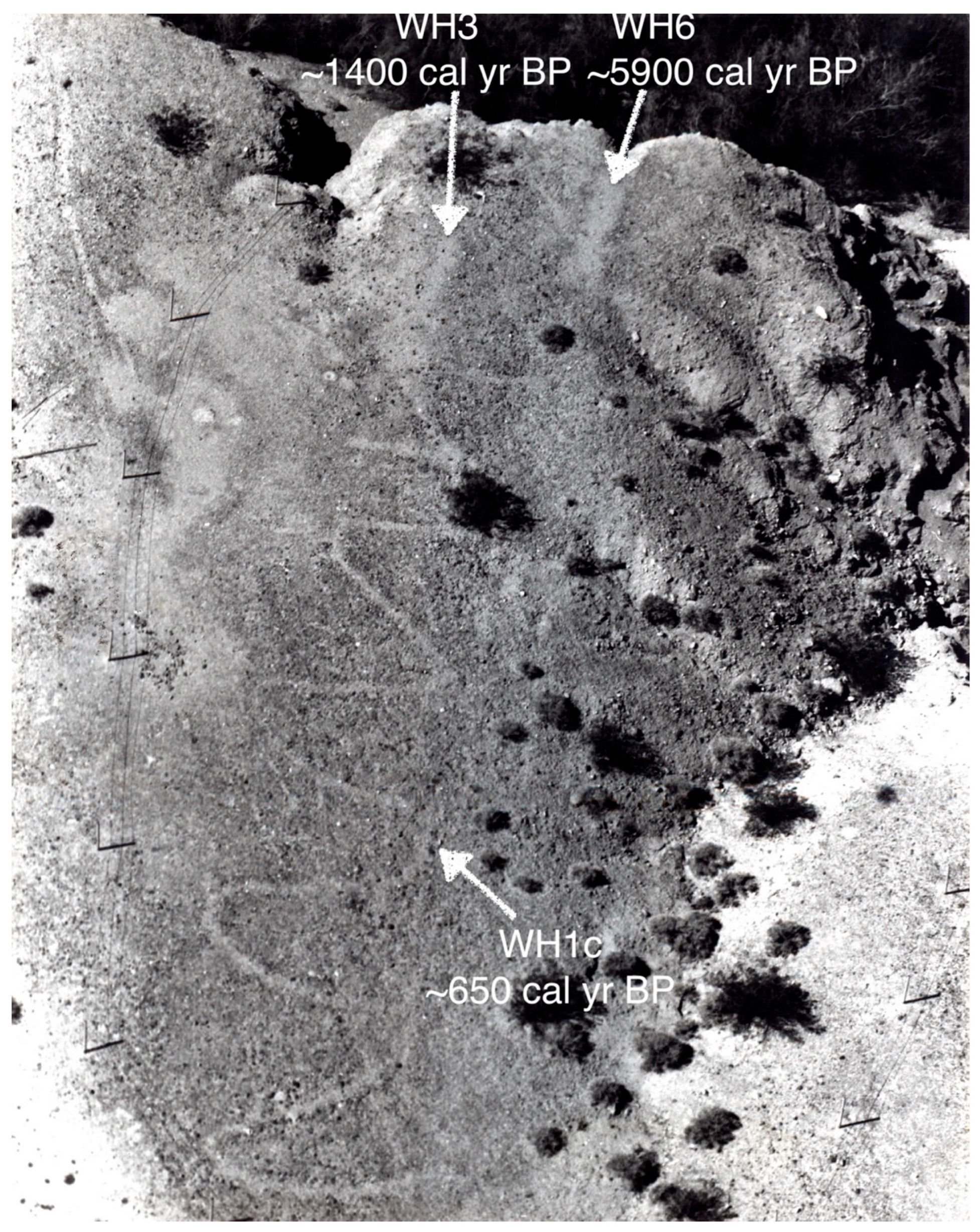
The Quien Sabe Point site, however, presents a very different circumstance. Figure 5 shows three previously undated geoglyphs from this locale. Ages indicated by the oldest VML sequence from each of the sampled intaglios are presented in Figure 6. These range from 650 to 5900 cal yr BP, which is corroborated by the CR estimates, suggesting that new intaglios were added to this site over a very long period. This demonstrates both the long-term continuity in the use of a specific location for rituals, as has been documented in other Native American cases (e.g., Sundstrom 1996; Whitley et al. 1999), as well as change over time in the sense that new motifs were successively added to the markers, signaling these locations as sacred. This last fact counters any claim that the intaglio ritual tradition was somehow ahistorical—that is, unchanging over time—given that it involved the addition of new symbolic elements and, as indicated by the results from the Blythe Giants and Ripley sites, additional sites/ritual locations over time.
We emphasize, again, that the oldest VML and associated CR ages for each intaglio are the most appropriate estimates because all varnish dates are minimum-limiting ages. This is due to time lags in pavement reformation and in varnishing. The 5900 cal yr BP age for one of the Quien Sabe anthropomorphs relative to the other two dates from this site, however, raises an obvious question of reliability. This early date is supported by the VML age distribution of the other nine sampled cobbles from this specific intaglio. Two of these have the same WH6 sequence (5900 cal yr BP) age; five have the WH3 sequence (1400 cal yr BP); and two have WH1c at their base (650 cal yr BP). The VML age distribution for these ten sampled cobbles from a single intaglio could reflect ongoing pavement reformation processes, ongoing lag in varnishing, or some combination of these processes. The age distribution might also reflect imperfect “upkeep” (that is, periodic clearing of newly upthrust cobbles in the intaglio), since we know that, in a relevant parallel case, ritual initiates were required to maintain the Trail of Dreams by tamping down this trail used in their puberty rites with logs (Whitley 2014). Since the VML age of the adjacent pavement control cobbles is at least 36 ka, we are confident that WH6 (5900 cal yr BP) is an accurate minimum age assignment for the oldest of the intaglios and not a result of contamination from the surrounding pavement.
The results from the Singer Complex (Figure 7) warrant brief discussion. This site is located in an area where armored infantry troops trained during World War II, west of the river corridor, and pavement disturbance from tanks is visible in the immediate site area. This has led to questions about the authenticity of this site. Are the geoglyphs Indigenous in origin or instead the result of military activities of some kind (cf. Casey 1992)? This last possibility might seem supported by the site’s location, some distance from where most other intaglio sites occur, and due to the relatively unique nature of its intaglios—very long, snake-like forms. The 1900 cal yr BP resolves that question, demonstrating that these intaglios long pre-date Euro-American arrival in North America.

3.2. Implications of the Intaglio Ages

There are two issues concerning our intaglio rock varnish ages, ranging from 650 to almost 6000 years ago, that warrant discussion. The first is methodological. It concerns the fact that dating desert pavements is predicated on the processes that re-generate these surfaces over time, as new cobbles are upthrust into a cleared surface. The important question then is how an intaglio can persist for as long as 6000 years, given that much younger archaeological features may sometimes be buried under desert pavements as they re-form (e.g., Ahlstrom and Roberts 2001). The likely explanation, as noted above, is that these geoglyphs were actively even if not perfectly maintained, keeping them (mostly) clear of newly upthrust cobbles over the millennia. Ethnographic evidence indicates that the cleared surface of the so-called Trail of Dreams, which runs through desert pavement and was used for the puberty initiation run of Quechan boys, was tamped down periodically by the boys, using logs, so that it would be cobble-free (Whitley 2014). It is likely that a similar practice existed for the intaglios themselves and that this accounts for their persistence.
There is then a plausible even if not conclusive argument suggesting that the 5900-year antiquity of the intaglios reflects an early and, ultimately, enduring River Yuman religious and ritual system given the localization of the intaglios along the river corridor (von Werlhof et al. 1995, p. 259; Billo et al. 2013, p. 1298; Wright et al. 2024, p. 83) where these peoples resided. This would comprise a third long-lived North American rock art tradition, joining the Great Basin petroglyphs (Whitley 2013, 2019; Whitley et al. 1999) and the Pecos River pictographs (Steelman et al. 2025), each of which also lasted for thousands of years. The three traditions provide a stark contrast to the changes in subsistence strategies and artifact assemblages over the same time periods in these three respective regions. This points, on the one hand, to the poverty of adaptive patterns and tool-making practices for understanding the cognitive and religious lives in Precontact Native America (Whitley 2013). But it does not, on the other, imply that these traditions were necessarily timeless and ahistorical, as is sometimes alleged. Such criticisms are based on confusions about the nature of religious change, in that they assume that historical changes necessarily require catastrophic breaks or massive shifts in practice and belief. As Bloch (1986, 1992) has illustrated, religious change over time often instead may involve a persistent core of ritual practice that alternately is elaborated and embellished, followed by a retrenchment to the basic pattern. Such a pattern of change, in fact, can be cited for the desert west, where the historical Ghost Dance developed out of traditional Paiute and Shoshone beliefs. With the failure of its prophecies, however, the Basin religion returned to its core of traditional beliefs and practices (Jorgensen 1986). There is justification in assuming that similar processes of religious expansion and retraction, in other words, may have occurred along the Colorado River, contributing to persistence yet also variability over time.

4. Age, Origin, and Meaning of the Topock Maze

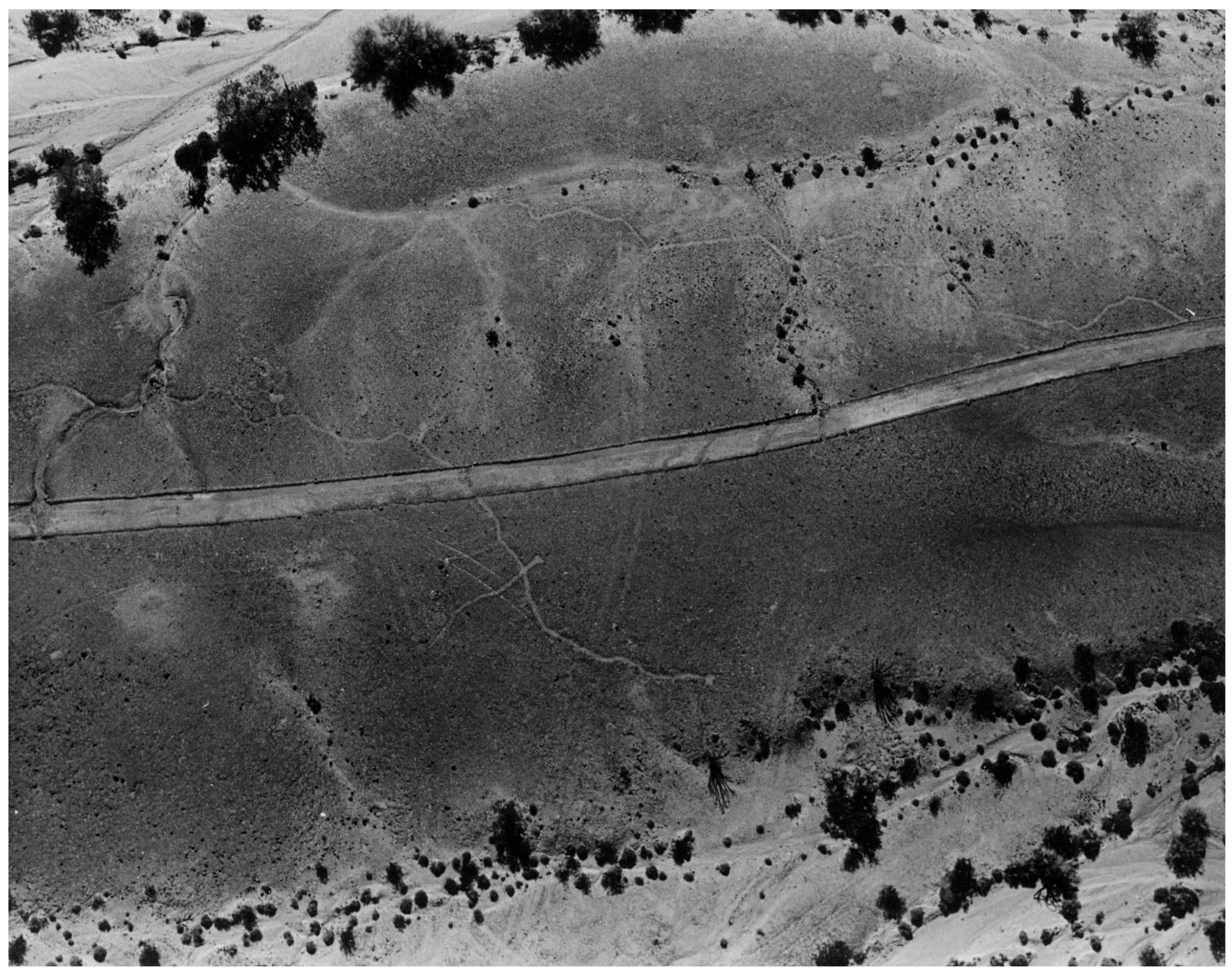
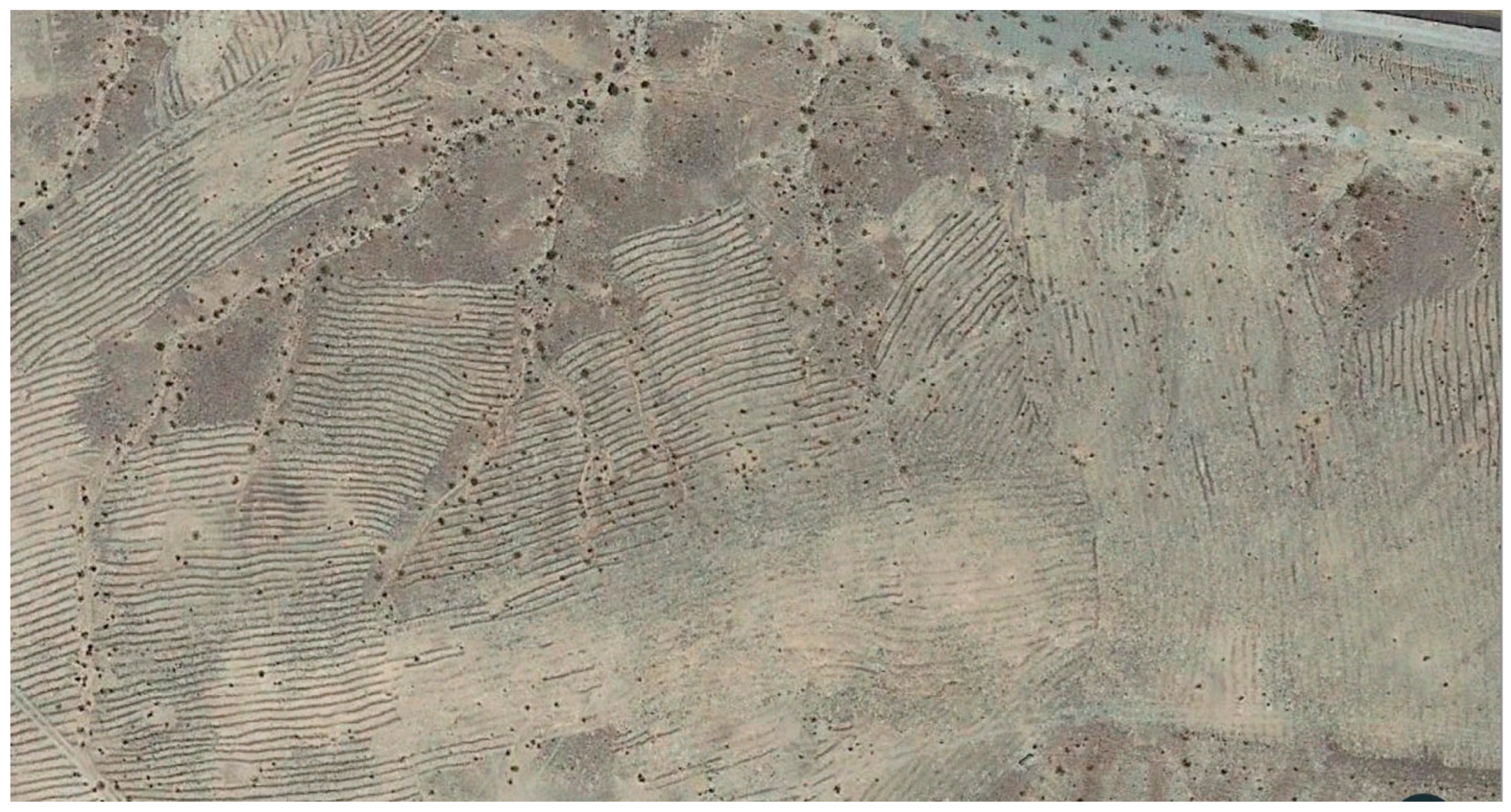
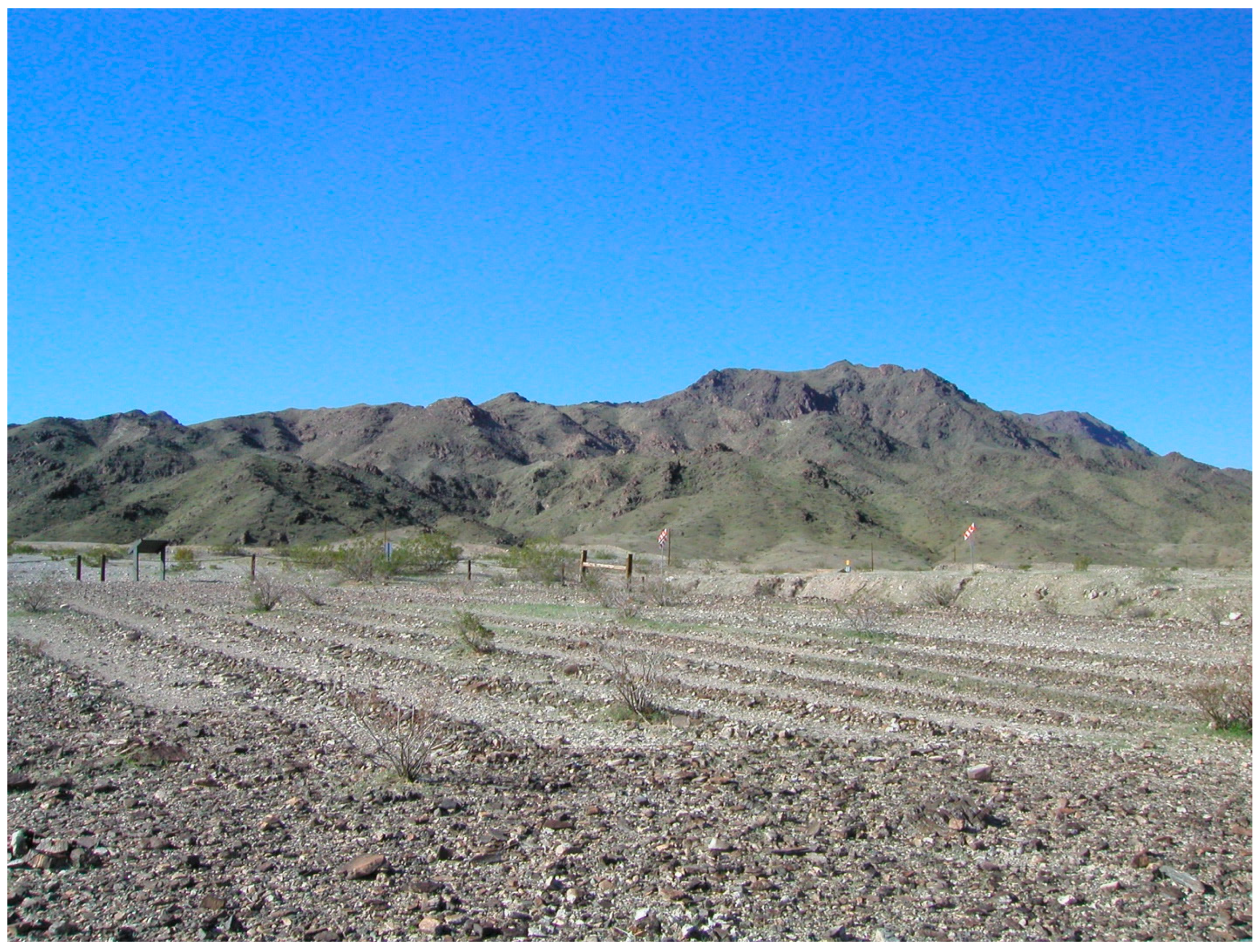
Few surface rock features are visually more impressive, and more controversial, than the Topock (or ‘Mystic’) Maze geoglyph site (CA-SBR-219). Located on adjacent Colorado River terraces near Needles, California, the site consists of an extensive series of low, linear gravel rows that have been scraped into the desert pavement, creating numerous parallel cleared paths, each about 1.3 m wide (Figure 8 and Figure 9); despite the name, these cleared paths do not form an actual maze. The site area has been heavily impacted by over a century of development, starting with the Atlantic and Pacific Railroad right-of-way through the site in 1893. The subsequent construction of Interstate-40 and the railroad grade now divide the locality into northern and southern areas. The southern section is bounded by a PG&E pipeline compression station and county wastewater treatment plant on the east and west, respectfully, with steep terrain to the south, while the northern portion has been impacted by a variety of projects, including the construction of a marina along the river. Extant sections of the gravel alignments today cover about 13 hectares (34 acres), while the remnants suggest that it may have originally been, very roughly, 100+ hectares (247 acres) in size. The site was listed on the National Register of Historic Places (NRHP) in 1978, signaling its importance as a heritage resource.
Controversy over the origin and function of the site has long existed (see Haenszel 1978; Musser-Lopez 2011), however, despite its NRHP listing, with some contending that the site resulted from the collection of gravel for railroad track ballast. This argument has been putatively supported by an early article describing construction techniques for the 1893 Red Rock Bridge, which crosses the Colorado River at this location. This states in part that, for construction purposes,
The process of gathering [gravel] was to rake these fragments of [surface] stone into windrows and haul them by wagon to a pile where convenient to load into a car when needed … Indian labor was used very successfully for this as well as for labor about the caisson.
Ethnographic and archaeological evidence, in contrast, supports an Indigenous religious origin and use of the site that pre-dates the railroad and bridge. Edward S. Curtis, writing at the turn of the century for example, published an ethnographic account of the Topock Maze, stating the following:
The Mohave Indians near-by have utilized the area so marked, in recent years, as a maze into which to lure and escape evil spirits, for it is believed that by running in and out through one of the immense labyrinths one haunted with a dread may bewilder the spirits occasioning it, and thus elude them.
It has been further reported that this ritual was specifically followed by warriors returning from travel outside Mohave territory who were concerned with ensuring that they would not be contaminated by their exposure to foreign dangers manifest in ghostly spirits (Haenszel 1978).
The unpublished ethnographic notes of John Peabody Harrington (n.d.), also written early in the twentieth century, further support a Mohave origin for the site. Harrington’s notes include an account of a discussion he had with Arthur Woodward, an early California archaeologist, about the site. According to Harrington, Woodward was aware that bridge construction had resulted in the creation of gravel windrows on the Arizona side of the Colorado River, but Woodward was certain that the much larger “maze” on the California side was Indigenous. Supporting this conclusion, Woodward noted that it originally included a large anthropomorphic intaglio, similar to the giant earth figures that are documented in numerous places along the river. What may be a small segment of this motif is still present at the site (Haenszel 1978). The intaglios depict mythic actors, were placed at the locations of mythic events, and were used in a ritual pilgrimage that celebrated the creation of the world (Whitley 2014), as described above.
Malcolm Rogers was the first archaeologist to publish information on the site, although his written discussion was brief. But his unpublished notes, written prior to 1939, concur with and elaborate on Woodward’s observations to Harrington. Rogers states in part that
Early settlers claim that when the Santa Fe R.R. [originally the Atlantic and Pacific] was built (1893) several acres of the lower end were gathered up for ballast for the RR tracks and that a large shrine at the lower [i.e., northern] end on the River Trail was at the same time destroyed. This shrine contained potsherds and artifacts. In the assemblage was [sic] stone axes and some turquoise jewelry. The informant F.M. Kelley of Needles said that near the base toward the river there was previous to this a large intaglio human figure similar to those at [another site]. Mohaves in early days disclaim having built the maze and that it had always been there but that in the old days they used it for ceremonial purposes occasionally.
Rogers’ unpublished account suggests that, while the site is in fact Indigenous in origin, it was created in Precontact times, was used ritually, and a portion of it was destroyed for railroad track ballast. This reconciles the contrasting non-Indigenous versus Indigenous accounts of its origin.
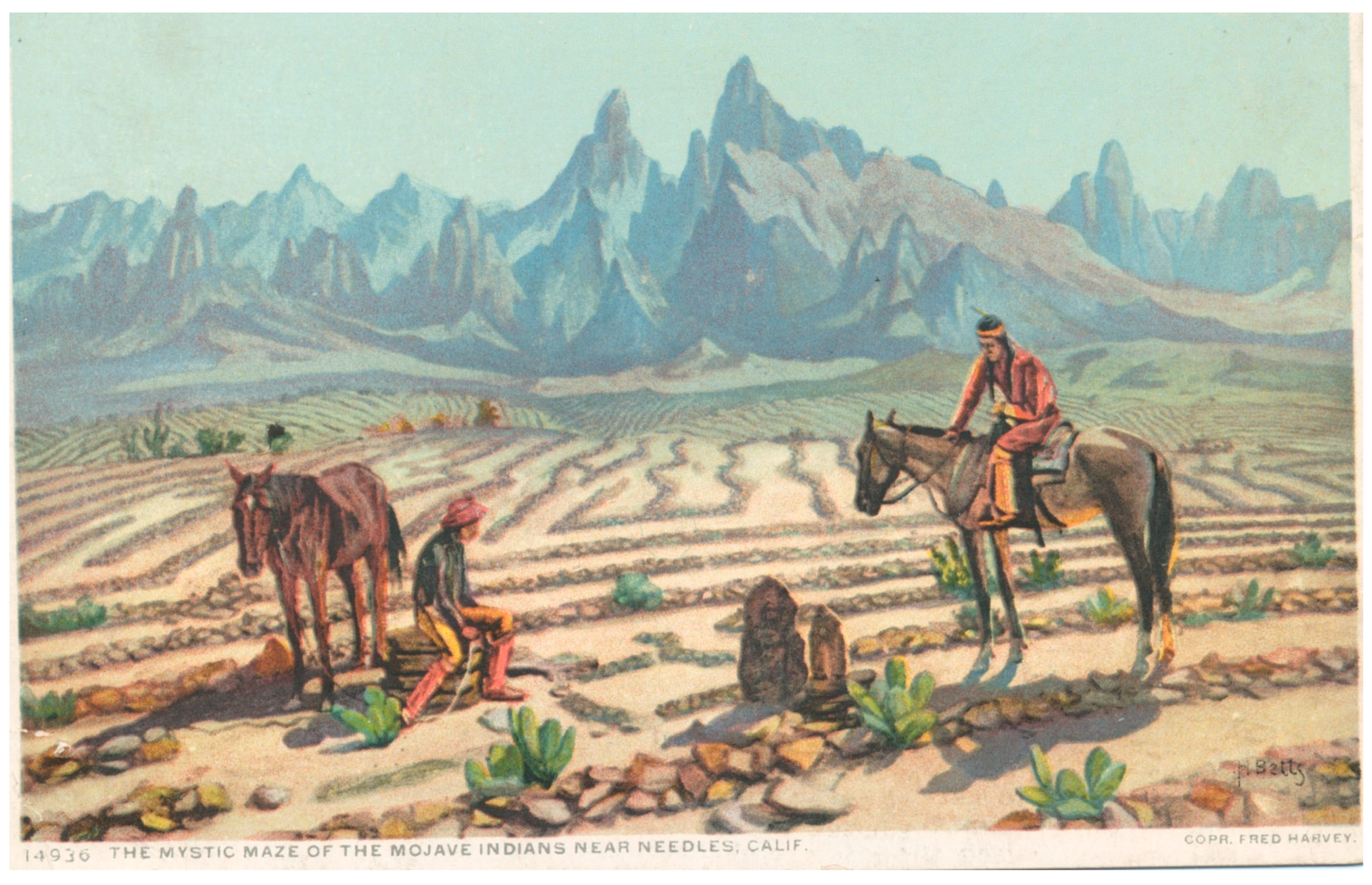
Widespread public perception has also acknowledged the Indigenous origin of the Topock Maze from the turn of the century onward, pointing to its ritual importance. A Fred Harvey Company postcard (Figure 10) dating from the early 1900s, for example, is a painting of the site showing the gravel rows, a rock shrine, and two Native Americans with horses. These postcards were sold at restaurants (“Harvey Houses”) at rail stations and were thus widely distributed across the West. Popular accounts, similarly, have associated it with the land of the dead and/or the Mohave mourning ceremony, though somewhat ambiguously (Haenszel 1978; Meloy 2003).
A third interpretation of the origin of the Topock Maze developed during the 1970s when Robert F. Heizer and C. William Clewlow, Jr. mapped and sampled the site to test the hypothesis that it resulted from Indigenous farming practices (personal communication from Clewlow to Whitley 1977). They took soil samples for pollen analysis and, finding none that could be the result of Indigenous farming practices, concluded that the site instead resulted from railroad gravel operations. Although they did not publish their study, Clewlow provided a useful summary included in Musser-Lopez’s (2011) discussion of the site.
More recently, Musser-Lopez (2013) has revived the railroad track ballast hypothesis, in part by arguing that the gravel rows were created partly using horse-drawn Fresno or Buck scrapers. As is clear, this would require a recent—less than 150 years—age for the site. It would further discount the Indigenous knowledge that has supported a ritual use for the locale, including the rationale for recent tribal efforts to protect the site.

4.1. VML and Lead-Profile Dating of the Topock Maze

Ten cobbles were collected from within the cleared pathways between the cobble rows from the extant southern section of the Topock Maze, along with three control cobbles from an adjacent, unaltered desert pavement area as controls. Four cobbles from within the archaeological feature had varnish coatings, with a VML sequence that started to form when microlamination WH2 (Wet Holocene 2) was deposited, about ~900–1100 cal yr BP, providing the oldest age estimate for the surface feature. The corresponding CR ages for these for cobbles are 1200 ± 400; 1150 ± 400; 950 ± 400; and 850 ± 350 cal yr BP.
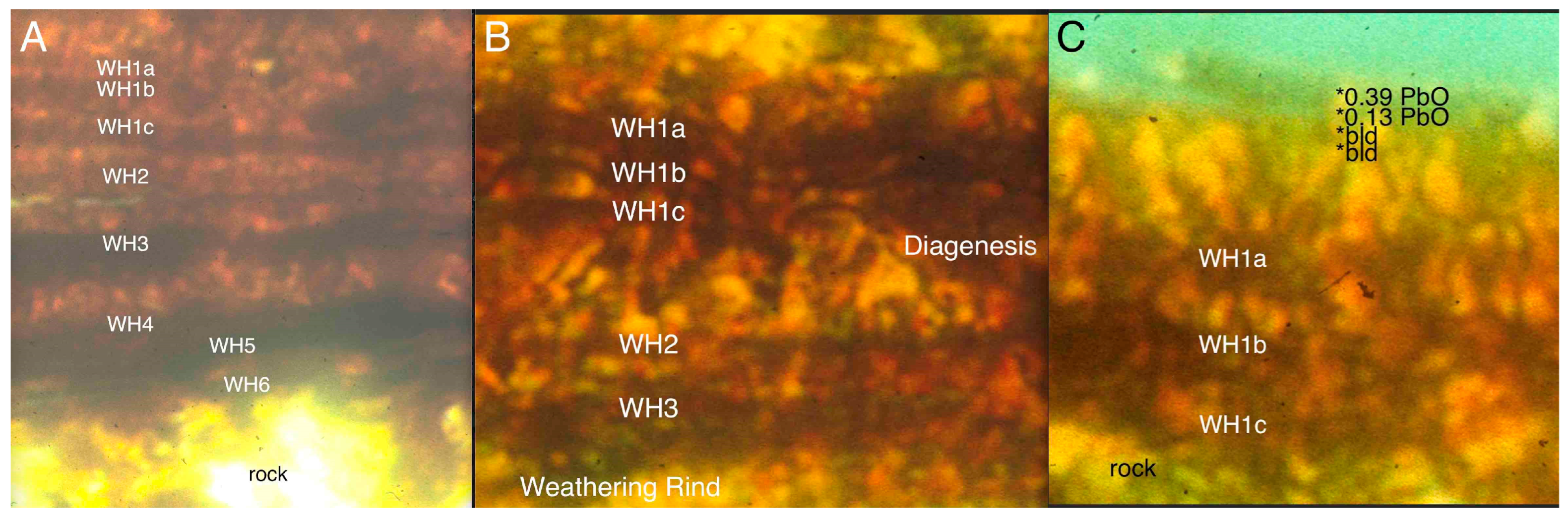
The other six cobbles had younger VML and CR ages. It is instructive to provide here the range of younger ages for the Topock Maze, because they are all consistent with the finding that this feature is prehistoric. The microlamination sequence for five other cobbles started at the WH1c (Wet Holocene 1c) layer, deposited about 650 cal yr BP (Figure 11, while one cobble had a microlamination sequence falling between 650 and 900 cal yr BP. The CR ages for the other six cobbles are 700 ± 350; 700 ± 350; 700 ± 350; 600 ± 250; 550 ± 250; and 400 ± 250 cal yr BP.
Lead-profile dating was also employed, yielding findings that are consistent with the VML and CR ages in two ways. First, all ten cobbles had surface lead spikes with background levels of lead underneath, confirming that the Topock Maze is pre-20th century in age. Second, the lead values are measured every micron; this provides overlap in measurements, but it also gives a stratigraphic perspective on where the 20th century (high PbO values in Figure 11) spike ended in relationship to when the Little Ice Age ended, at about 300 cal yr BP (WH1a in Figure 11).
These results likely reflect one or more different possibilities that are not mutually exclusive: the process of upthrusting cobbles into the cleared paths was ongoing; younger results reflect a time lag in the revarnishing process; and/or cleared pathways were imperfectly maintained. This uncertainty demonstrates the importance of multiple samples for age determinations. We conclude, accordingly, that the Topock Maze is about 900 years old at minimum.
The natural pavement control cobbles collected outside the Topock Maze had much older VML sequences that were late Pleistocene age. There was one exception (Figure 12). A cobble collected about 0.5 m from the maze showed an angular unconformity produced by varnish erosion followed by a new sequence of VML deposited on top of the eroded surface. The new varnishing started during WH6 (about 5900 cal yr BP). The cause of this unconformity is unknown, although it is not due to wind abrasion. We speculate that it may be evidence of a mid-Holocene construction phase at this feature, and we include this information partly to emphasize that our varnish ages are minimum-limiting dates.

4.2. Function, Meaning and Symbolism of the Topock Maze

VML, CR, and lead profile results are all consistent with the interpretation that the Topock Maze is at least 900 years old and thus represents a Precontact feature, not a recent railroad-related activity. It is important to emphasize, however, that the upthrust sampled cobbles from within the surface feature were exclusively derived from the extant portion of the site—a relatively small area at its southern extreme. The large majority of the site to the north had been destroyed, including an intaglio that was once associated with the gravel rows. As with the intaglios, discussed above, it is possible (if not likely) that this surface feature was ritually maintained over time, to prevent the regeneration of a complete pavement surface. It is also unlikely that the feature was created during a short period of time, given its large size, the labor required to create a construction this massive, and the small-scale society that occupied the river corridor in Precontact times.
We accordingly do not suggest that 900 years necessarily represents the maximum antiquity of this feature but instead that it is simply the currently identifiable minimum age of the southernmost section of the site. It is plausible, if not likely, that the northern destroyed sections of the feature were built at different times, perhaps much earlier. For example, the unconformity seen in the varnish in Figure 12, dating about 5900 cal yr BP, could potentially reflect earlier construction activity, as noted above. This emphasizes again that our derived chronometric ages are minimum-limiting constraints and not necessarily estimates of the overall antiquity of this feature and its associated ritual practice.
But the Pre-Contact rock varnish age on and the cryptic ethnographic and popular descriptions of the Topock Maze provided above beg an important question: are there additional ethnographic data that support and augment our understanding of its symbolic meaning, ritual function, and use? Perhaps not surprisingly, there is, in fact, significant but heretofore overlooked evidence important to fully understand this cultural landscape feature. It starts with interviews obtained in the last few decades which support the earlier reported ethnographic accounts. But what is also included is overlooked information from older ethnographic studies about traditional fears of travel outside of Mohave territory and its association with ghosts and thus the need to conduct rituals to nullify this ‘foreign contamination.’ Further information is provided, more generally, about the association of Topock with beliefs about the spirits of the dead and thus its symbolic importance as a religious place along the Colorado River.
Recent accounts provided by Mohave tribal members about the Topock Maze, first, have been summarized as follows:
“interviewees suggested that stories or songs telling of its construction were present in the Mojave culture, but these stories are only told in some family lines and are not known by everyone … Other interviews in the 20th Century suggested that the Mojave would use the Maze to purify themselves by running through the Maze or by navigating through the Maze without walking over a windrow, leaving evil spirits or ghosts in the Maze, or that the purpose of the Maze is to help the deceased atone for their life before fully passing to the afterlife”.
This corroborates the earlier accounts claiming that the Topock Maze was used for ritual purification involving the shedding of ghosts obtained while travelling outside of Mohave lands.
Second, according to Devereux (1961, p. 129), helping to explain this perceived need, a “’xenophobia of fear’ is a major theme in [traditional] Mohave culture,” causing them to “refrain from all close contact with other tribes, and even more with intimate connections with alien races.” Alien contamination illness, ahwe: hahnok, was in fact one of three categories of disease linked to ghosts (Devereux 1961, p. 21), and contact with foreigners was thought the chief cause of insanity (ibid, p. 32); “the Mohave experience one and the same type of dread in connections with aliens, magical powers, and the ghosts of the deceased” (ibid, p. 133). Their fear of aliens and thus ghosts was linked to their beliefs that “the soul of the dead person draws them to the land of the shadows” (Devereux 1937a, p. 411; our translation), that is, the Land of the Dead.
The paradox is that the Mohave were great travelers and warriors, with trading, raiding, and scalping all putatively exposing them to this contaminating illness. Scalpers were especially subject to the “nefarious influence of scalps, prisoners and aliens,” which resulted in fainting, hollering at night, and more general aberrant behavior (Devereux 1937a, p. 43). According to Fathauer:
“The scalper, being a shaman, has power over this disease and can cure people afflicted with it. The scalps … bring beneficial power to the tribe after they have been tamed. The scalper, then, contributes to tribal welfare by his power to tame the scalps and to cure the “enemy sickness.” He also directs one of the most important Mohave ceremonies [the Mourning Ceremony]. Scalper is one of the most important religious statuses”.
A ritual, conducted by the scalper, or “Ghost Doctor,” was then required to “tame” the scalps, that is, to nullify the dangerous power they otherwise contained and that resulted in alien contamination sickness. Subsequently,
“When the scalper returns with the war party he turns the scalps over to the kwaxot, or custodian of the scalps, who is the principal Mohave religious leader. The custodian of the scalps prepares a great celebration in honor of the returning warriors … After the feast the custodian of the scalps places them in large pottery ollas for safekeeping”.
The Mohave were also renowned for capturing girls and young women, but not men, on their raids. Because of these females’ potential for introducing foreign illness, “a ceremony had to be made over them else they would bring sickness into the land; and even after purification they seem more generally not to have been married” (Fathauer 1951a, p. 275). Fathauer notes, however, that
The female captives are given by the custodian of the scalps to some of the old men who need wives. Young men are afraid to take these women because of the ‘enemy sickness’ but the old men are glad to have them since they have lived a long time and do not have long to live under any circumstances.
Mohave ethnography then supports the implications of this limited commentary on the ritual use of the Topock Maze in the sense that the Mohave considered themselves spiritually contaminated, by ghosts, while traveling outside their lands and from interactions with foreigners, despite the fact that this was a relatively common experience, especially for traders and warriors conducting raids. It also demonstrates that specific rituals were conducted to prevent the ghost sickness that could result from some of these activities. It follows that a ritual would be necessary to ensure good health after foreign travel more generally, and thus the Topock Maze may have served that purpose, as suggested by an account by Curtis (1908) and a recent account.
Third, there is, furthermore, important ethnographic evidence that explains the logic of the ritual use of the Topock Maze as a place to “lose” a foreign ghost after traveling outside of Mohave territory, based on its association with spirits and the Land of the Dead. Although there is minor variation (or confusion) in the specific geographical details, three different accounts all clearly refer to the Topock area. (Note that the general toponym ‘Topock’ strictly refers to a small, census-designated community in Arizona, immediately across the Colorado River from the ‘maze’ in California, possibly explaining the confusion.) These start with Bourke’s early publication, which stated,
“That other sharp, high mountain, down there near the Needles, in Arizona, was also a spirit mountain; that was where the Mojaves went when they died. (It was the Mojave Elysium)”.
Devereux augmented Bourke’s account, despite some degree of uncertainty over the meaning of his informant’s comments. He noted that
The entrance to the “land of the dead” (cilia’yt) is somewhere near Needles, California, almost by the Colorado River on the Arizona side. There is something that looks like a big invisible “wash” containing a big invisible shed [i.e., ritual ramada] near a place called Ahatcku-pi’lyk, which is but a few feet [sic] from the land of the dead.
The Mohave in fact held that the afterworld was at or near the confluence of the Colorado River and the Bill Williams Fork. It most likely was in the sandy Chemehuevi Valley on the western, California side of the Colorado across from the confluence of the two rivers, roughly 20 miles southwest of Topock, with its name variously transcribed as cilia’yt (ibid.), calya: at (Devereux 1961, p. 146), sil’aid (Wallace 1947, p. 256), salya:yt (Stewart 1973, p. 316), and saly’at, “the Happy Hunting Ground,” from selye’aya, ‘sand’ (Munro et al. 1992, p. 160; cf. Kroeber 1948), although some instead claimed that it was under the Colorado River or in sand dunes on the Arizona side of the river (see Bourke 1889, p. 174; Harrington 1910, p. 333; Kroeber 1902, p. 280; 1925, p. 727; Devereux 1935, p. 114; Devereux 1961, p. 146; Drucker 1941, p. 148; Laird 1976, p. 134). Regardless, Fathauer clarified the earlier comments, observing that
“Following cremation, the soul remained near the site of the [funeral] pyre four days. At the end of this time the soul changed into a ghost which was then able to see the road to the afterworld. This started at Topock and ran south into the desert in the neighborhood of the Bill Williams River”.
(Fathauer 1951b, p. 605; emphasis added)
Fathauer’s account is confirmed by recent ethnographic data which state that “The Topock Maze … is the passageway to the next dimension, to the land of those who have passed on” (BLM 2012, p. 50). The Topock Maze locale was then the portal to the trail to the land of the dead, which, following the widespread belief of Yuman speakers, ran to the south. Regardless of the exact location of the afterworld, the Topock Maze was the place from which ghosts departed towards that destination and was, symbolically, the entrance to the Land of the Dead. It was thus the appropriate location for a ritual intended to send off ghosts to a location where they would be harmless to living people.
That the maze was the start of the path to the Land of the Dead suggests a potential additional ceremonial use of this locale, beyond its employment by those returning to their home needing ritual purification. This is implied by a comment by Devereux who stated that, “when a man dies his relatives often request a shaman to visit the land of the dead to check up if he reached it” (Devereux 1937b, p. 419).
“When rumors spread that a person has died as a result of evil practices, the members of their family send a bona fide sorcerer to visit the land of the dead to see if the deceased’s soul has arrived there. If the messenger does not encounter this soul, it is ipso facto proof that the soul is being held captive somewhere by the sorcerer”.
Sometimes a shaman would even transport an individual to this ghostly realm to visit the deceased.
The ghost doctor also could take people to the spirit world, although he did not encourage this because it was dangerous. He warned the person who wished to see a dead relative: ‘Be careful. If our hands slip apart, I’ll have to look for you all night. If I don’t find you before morning we will both be stuck here.’ The shaman and the person who was to accompany him dressed in their best clothes and painted themselves. About twilight they built a small brush shelter and then lay down to sleep with their hands clasped. In less than an hour they were transported to the afterworld. The ghost doctor knew exactly where the person’s family was, so they went directly there
It is possible, although far from certain, that these rituals to enter the Land of the Dead occurred at the Topock Maze location.
There is, finally, one other implication of the Topock Maze that warrants brief mention. This concerns the implications of its original size of roughly 250 acres. This surface feature is, by any measure, a monumental construction, a trait not previously thought associated with the small-scale, low-population-density horticultural societies like the Mohave. It seems unlikely that a surface architectural feature of this size could have been created in a single episode, given these constraints. The most likely scenario would be its construction over multiple generations, perhaps with additions to its size occurring whenever it was used ritually, much as male puberty initiates were tasked with maintaining the Trail of Dreams used in their ritual run noted above. The angular unconformity evident in the varnish coating of a control cobble (Figure 12) would be consistent with ongoing construction over a much longer period of time, with the varnish erosion event occurring at WH6 or 5900 cal yr BP.

5. Conclusions

The use of three different rock varnish dating techniques, all of which have been replicated and blind-tested, has allowed us to resolve two longstanding controversies concerning surface features on desert pavements in the North American desert west. The intaglios along the lower Colorado River, first, represent an example of ritual activity in this region. Rock varnish dates on these extend back to 5900 years B.P., demonstrating the existence of a lengthy religious tradition and artistic practice. Although only occasionally is there a perfect correlation between culture, language, and physical/biological type, we believe the mid-Holocene age of these geoglyphs may signal the presence of Yuman-speaking peoples in this area by that early date. This in turn would suggest that existing archaeological models and linguistic reconstructions arguing for a much more recent arrival of Yuman speakers are wrong. Instead, our evidence supports other reconstructions suggesting that the lower Colorado River and southernmost California region may have been the original homeland of these peoples.
Second, the Topock Maze has long been a source of popular fascination and professional debate. Some have argued that it is a by-product of late-nineteenth-century railroad construction, while others, including the Mohave tribe, have contended that it is both Indigenous in origin and that it was used for ritual purposes. Our chronometric ages indicate that the extant portion of this large construction, originally roughly 250 acres in size, is at least 900 years old. Other, now destroyed, sections could have been older or younger. Our review of pertinent ethnographic data, furthermore, indicates that it represented the start of the path to the Land of the Dead; hence, it was understandably associated with ghosts and spirits and is correspondingly a place of great religious importance.

Author Contributions

Conceptualization, R.I.D. and D.S.W.; methodology, R.I.D. and D.S.W.; formal analysis, R.I.D. and D.S.W.; investigation, R.I.D. and D.S.W.; data curation, R.I.D.; writing—original draft preparation, D.S.W.; writing—review and editing, R.I.D. and D.S.W. All authors have read and agreed to the published version of the manuscript.

Funding

This research received no external funding.

Institutional Review Board Statement

Not applicable.

Informed Consent Statement

Not applicable.

Data Availability Statement

VML data archived at the School of Geography and Urban Planning, Arizona State University, Tempe.

Acknowledgments

The field studies conducted for this research occurred over a number of decades and were aided by numerous people, as well as government and tribal agencies. We thank Bureau of Land Management archaeologists Connie Smith, Boma Johnson, Sally Cunkelman, and John R. Murray for requesting and assisting with our studies; the AhaMakav Cultural Society/Fort Mojave Tribal cultural resources office and the Fort Yuma Quechan Historic Preservation Office; and Lorey Cachora, Jay von Werlhof, and Harry Casey for their various contributions to our fieldwork. We thank reviewers and editors for their help in improving the paper; the opinions expressed in this paper are our own.

Conflicts of Interest

The authors declare no conflicts of interest in the publication of this research.

Notes

1
An additional experimental technique, AMS-Weathering Rind Organics dating (Dorn et al. 1986), was developed and applied archaeologically in the 1990s (e.g., Whitley and Dorn 1993). This was predicated on the assumption that rock varnish coatings were closed systems that were not subject to contamination by older or younger organic material, as was repeatedly emphasized in publications where it was employed. This assumption proved invalid, and the technique was withdrawn (Dorn 1996, 1997). Despite this notification, a subsequent, widely promoted controversy resulted, including accusations of scientific misconduct (Beck et al. 1998). The scientific basis of this controversy, the three separate investigations concluding that no misconduct occurred on the part of the accused, and the legal defamation case that resulted are covered in detail in Whitley (2009, 2013). Here it is adequate to emphasize that the AMS-WRO controversy had no implications for the efficacy or utility of the dating techniques discussed in this paper.
2
The three dating methods used here focus on microdepressions where varnish first formed, as revealed by the oldest VML sequence. Recent papers have instead attempted to use pXRF to date revarnished petroglyph grooves (Macholdt et al. 2019; Andreae et al. 2020, 2023; Andreae and Andreae 2022; Pingitore and Lytle 2003; Lytle et al. 2008, 2011; A. K. Rogers 2010; J. A. Johnson 2018; Guagnin et al. 2025). In contrast with VML, which provides the closest minimum age, pXRF indescriminately measures some varnish, but mostly non-varnish chemical materials in its analysis of an 8 mm spot size without regard to time lags, with the goal of measuring Mn accumulation, but not knowing if the Mn being analyzed is from varnish or other surface materials. We note that Bard (1979) demonstrated decades ago that the accumulation of Mn in rock varnish is not systematically related to sample age, a conclusion that has not been addressed let alone resolved by proponents of the pXRF approach. Dorn and Whitley (Forthcoming) present a more detailed analysis of these methodological issues.
3
The focus of von Werlhof et al. (1995) was to present the experimental AMS-WRO results. The authors at that time cautioned that “These [AMS-WRO] results must, however, be placed under the cloud of uncertainty that hangs over the entire field of AMS dating of rock art: the untested assumption surrounding contemporaneity of organics in a surface context” (von Werlhof et al. 1995, p. 257). Since von Werlhof et al. (1995) also published uncalibrated (K + Ca)/Ti ratios for comparison, these were calibrated for this study to provide additional minimum-limiting chronometric ages, but the AMS-WRO ages were not used in the calibration. See Bamforth and Dorn (1988) for details on the calibration employed for these CR ages.

References

  1. Adelsberger, Katherine A., and Jennifer R. Smith. 2009. Desert pavement development and landscape stability on the Eastern Libyan Plateau, Egypt. Geomorphology 107: 178–94. [Google Scholar] [CrossRef]
  2. Adelsberger, Katherine A., Jennifer R. Smith, Shannon P. McPherron, Harold L. Dibble, Deborah I. Olszewski, Utsav A. Schurmans, and Laurent Chiotti. 2013. Desert pavement disturbance and artifact taphonomy: A case study from the eastern Libyan plateau, Egypt. Geoarchaeology 28: 112–30. [Google Scholar] [CrossRef]
  3. AECOM. 2010. Draft Environmental Impact Report for the Topock Compressor Station Groundwater Remediation Project. Sacramento: California Department of Toxic Substance Control. [Google Scholar]
  4. Ahlstrom, Richard V. N., and Heidi Roberts. 2001. Desert pavement and buried archaeological features in the Arid West: A case study from southern Arizona. Journal of California and Great Basin Anthropology 23: 1–26. [Google Scholar]
  5. Andreae, Meinrat O., Abdullah Al-Amri, Tracey W. Andreae, Alan Garfinkel, Gerald Haug, Klaus Peter Jochum, Brigitte Stoll, and Ulrike Weis. 2020. Geochemical studies on rock varnish and petroglyphs in the Owens and Rose Valleys, California. PLoS ONE 15: e0235421. [Google Scholar] [CrossRef]
  6. Andreae, Meinrat O., and Tracey W. Andreae. 2022. Archaeometric studies on rock art at four sites in the northeastern Great Basin of North America. PLoS ONE 17: e0263189. [Google Scholar] [CrossRef]
  7. Andreae, Meinrat O., Tracey W. Andreae, Julie E. Francis, and Lawrence L. Loendorf. 2023. Age estimates for the rock art at the Rocky Ridge site (Utah) based on archaeological and archaeometric evidence. Journal of Archaeological Science: Reports 48: 103875. [Google Scholar] [CrossRef]
  8. Atkinson, Quentin D., Andrew Meade, Chris Venditti, Simon J. Greenhill, and Mark Pagel. 2008. Languages evolve in punctuational bursts. Science 319: 588–88. [Google Scholar] [CrossRef]
  9. Babel, Molly, Andrew Garrett, Michael J. Houser, and Maziar Toosarvandani. 2013. Descent and diffusion in language diversification: A study of Western Numic dialectology. International Journal of American Linguistics 79: 445–89. [Google Scholar] [CrossRef]
  10. Baied, Carlos A., and Carolina Somonte. 2013. Mid-Holocene geochronology, palaeoenvironments, and occupational dynamics at Quebrada de Amaicha, Tucuman, Argentina. Quaternary International 299: 80–89. [Google Scholar] [CrossRef]
  11. Bales, J. T., and Troy L. Pewe. 1979. Origin and rate of desert pavement formation—A progress report. Journal of the Arizona-Nevada Academy Science 14: 84. [Google Scholar]
  12. Bamforth, Douglas B. 1997. Cation-ratio dating and archaeological research design: Response to Harry. American Antiquity 62: 121–29. [Google Scholar] [CrossRef]
  13. Bamforth, Douglas B., and Ronald I. Dorn. 1988. On the nature and antiquity of the Manix Lake Lithic Industry. Journal of California and Great Basin Anthropology 10: 209–26. [Google Scholar]
  14. Bard, James C. 1979. The Development of a Patination Dating Technique for Great Basin Petroglyphs Utilizing Neutron Activation and X-Ray Fluorescence Analyses. Unpublished doctoral dissertation, University of California, Berkeley, CA, USA. [Google Scholar]
  15. Beck, Warren, Douglas J. Donahue, A. Timothy Jull, G. Burr, W. S. Broecker, G. Bonani, I. Hajdas, and E. Malotki. 1998. Ambiguities in direct dating of rock surfaces using radiocarbon measurements. Science 280: 2132–39. [Google Scholar] [CrossRef]
  16. Bettinger, Robert L., and Martin A. Baumhoff. 1982. The Numic spread: Great Basin cultures in competition. American Antiquity 47: 485–503. [Google Scholar] [CrossRef]
  17. Billo, Evelyn, Robert Mark, and Donald E. Weaver. 2013. Sears Point Rock Art Recording Project, Arizona, USA. American Indian Rock Art 40: 1283–302. [Google Scholar]
  18. BLM. 2012. Cultural and Historic Properties Management Plan (CHPMP), Topock Remediation Project. Lake Havasu: BLM, vol. 1. [Google Scholar]
  19. Bloch, Maurice. 1986. From Blessing to Violence: History and Ideology in the Circumcision Ritual of the Merina of Madagascar. Cambridge: Cambridge University Press. [Google Scholar]
  20. Bloch, Maurice. 1992. Prey into Hunter: The Politics of Religious Experience. Cambridge: Cambridge University Press. [Google Scholar]
  21. Bourke, John G. 1889. Notes on the cosmogony and theogony of the Mojave Indians of the Rio Colorado, Arizona. The Journal of American Folklore 2: 169–89. [Google Scholar] [CrossRef]
  22. Broecker, Wallace S., and Tanzhou Liu. 2001. Rock varnish: Recorder of desert wetness? GSA TODAY 11: 4–10. [Google Scholar] [CrossRef]
  23. Bullard, Thomas., Jamie Trammell, Scott Bassett, Todd Caldwell, D. Sabol, R. Schumer, S. Bacon, S. Baker, G. Dalldorf, and M. Dennis. 2012. LanDPro: Landscape Dynamics Program. Reno: Desert Research Institute. [Google Scholar]
  24. Burford, Euen P., Marena Fomina, and Geoffrey M. Gadd. 2003. Fungal involvement in bioweathering and biotransformation of rocks and minerals. Mineralogical Magazine 67: 1127–55. [Google Scholar] [CrossRef]
  25. Caldwell, Todd, Eric McDonald, Steven Bacon, Rina Schumer, and Thomas Bullard. 2011. Cleared Circles: Anthropogenic or Biogenic? Use of Non-invasive Geophysical Techniques to Determine Origin. In Symposium on the Application of Geophysics to Engineering and Environmental Problems. Houston: Society of Exploration Geophysicists, p. 581. [Google Scholar]
  26. Candelone, Jean-Pierre, Sungmin Hong, Christian Pellone, and Claude F. Boutron. 1995. Post-Industrial Revolution changes in large-scale atmospheric pollution of the northern hemisphere by heavy metals as documented in central Greenland snow and ice. Journal of Geophysical Research: Atmospheres 100: 16605–16. [Google Scholar] [CrossRef]
  27. Carbonelli, Juan Pablo, and Mirian M. Collantes. 2019. Early Human Occupations in the Valleys of Northwestern Argentina: Contributions to Dating by the Varnish Micro-Laminations Technique. In Advances in Geomorphology and Quaternary Studies in Argentina. Edited by Pablo Bouza, Jorge Rabassa and Andrés Bilmes. Amsterdam: Springer, pp. 262–82. [Google Scholar]
  28. Casey, Harry. 1992. Earthen Art: Geoglyphs and Rock Alignments—The Mysterious Prehistoric Ground Drawings Found in the Deserts of Southwestern United States. Privately printed. [Google Scholar]
  29. Cerveny, Niccole V., Russell Kaldenberg, Judith Reed, David S. Whitley, Joseph M. Simon, and Ronald I. Dorn. 2006. A new strategy for analyzing the chronometry of constructed rock features in deserts. Geoarchaeology 21: 281–303. [Google Scholar] [CrossRef]
  30. Chaddha, Amritpal Singh, Anupam Sharma, Narendra Kumar Singh, Amreen Shamsad, and Monisha Banerjee. 2024. Biotic-abiotic mingle in rock varnish formation: A new perspective. Chemical Geology 648: 121961. [Google Scholar] [CrossRef]
  31. Curtis, Edward. 1908. The North American Indian. Norwood: Plimpton Press, vol. 2. [Google Scholar]
  32. Devereux, George. 1935. Sexual Life of the Mohave Indians: An Interpretation in Terms of Social Psychology. Berkeley: University of California Press. [Google Scholar]
  33. Devereux, George. 1937a. L’envoûtement chez les Indiens Mohave. Journal de la Société des Américanistes 29: 405–12. [Google Scholar] [CrossRef]
  34. Devereux, George. 1937b. Mohave Soul Concepts. American Anthropologist 39: 417–22. [Google Scholar] [CrossRef]
  35. Devereux, George. 1961. Mohave Ethnopsychiatry and Suicide: The Psychiatric Knowledge and the Psychic Disturbances of an Indian Tribe. Washington, DC: Bureau of American Ethnology Bulletin No. 175. [Google Scholar]
  36. Diamond, Jared M., and Peter Bellwood. 2003. Farmers and their languages: The first expansions. Science 300: 597–603. [Google Scholar] [CrossRef] [PubMed]
  37. Dietze, Michael, and Arno Kleber. 2012. Contribution of lateral processes to stone pavement formation in deserts inferred from clast orientation patterns. Geomorphology 139: 172–87. [Google Scholar] [CrossRef]
  38. Dorn, Ronald I. 1983. Cation-ratio dating: A new rock varnish age-determination technique. Quaternary Research 20: 49–73. [Google Scholar] [CrossRef]
  39. Dorn, Ronald I. 1994. Dating petroglyphs with a 3-tier rock varnish approach. In New Light on Old Art: Advances in Hunterer-Gatherer Rock Art Research. Edited by D. S. Whitley and L. Loendorf. UCLA Institute for Archaeology Monograph Series, no. 36. Los Angeles: University of California, pp. 12–36. [Google Scholar]
  40. Dorn, Ronald I. 1996. Uncertainties in the radiocarbon dating of organics associated with rock varnish: A plea for caution. Physical Geography 17: 585–91. [Google Scholar] [CrossRef]
  41. Dorn, Ronald I. 1997. Constraining the age of the Coa Valley (Portugal) engravings with 14C. Antiquity 71: 105–15. [Google Scholar] [CrossRef]
  42. Dorn, Ronald I. 1998. Rock Coatings. Amsterdam: Elsevier. [Google Scholar]
  43. Dorn, Ronald I. 2001. Chronometric Techniques—Rock Engravings. In Handbook of Rock Art Research. Edited by David S. Whitley. Walnut Creek: AltaMira Press, pp. 167–89. [Google Scholar]
  44. Dorn, Ronald I. 2010. Debris flows from small catchments of the Ma Ha Tuak Range, Metropolitan Phoenix, Arizona. Geomorphology 120: 339–52. [Google Scholar] [CrossRef]
  45. Dorn, Ronald I. 2014. Chronology of rock falls and slides in a desert mountain range: Case study from the Sonoran Desert in south-central Arizona. Geomorphology 223: 81–89. [Google Scholar] [CrossRef]
  46. Dorn, Ronald I. 2016. Identification of debris-flow hazards in warm deserts through analyzing past occurrences: Case study in South Mountain, Sonoran Desert, USA. Geomorphology 273: 269–79. [Google Scholar] [CrossRef]
  47. Dorn, Ronald I. 2019. Anthropogenic interactions with rock varnish. In Biogeochemical Cycles: Anthropogenic and Ecological Drivers. Edited by Katerina Dontsova, Zsuzsanna Balogh-Brunstad and Gaël Le Roux. Washington: American Geophysical Union, Geophysical Monograph, vol. 251, pp. 267–83. [Google Scholar]
  48. Dorn, Ronald I. 2024. Rock varnish revisited. Progress in Physical Geography 4: 389–419. [Google Scholar] [CrossRef]
  49. Dorn, Ronald I. 2025. Revisiting the importance of clay minerals in rock varnish. American Mineralogist 110: 1341–42. [Google Scholar] [CrossRef]
  50. Dorn, Ronald I., and David H. Krinsley. 1991. Cation-leaching sites in rock varnish. Geology 19: 1077–80. [Google Scholar] [CrossRef]
  51. Dorn, Ronald I., and David S. Whitley. 1983. Cation-ratio dating of petroglyphs from the Western United States, North America. Nature 302: 816–18. [Google Scholar] [CrossRef]
  52. Dorn, Ronald I., and David S. Whitley. 1984. Chronometric and relative age-determination of petroglyphs in the Western United States. Annals, Association of American Geographers 74: 308–22. [Google Scholar] [CrossRef]
  53. Dorn, Ronald I., and David S. Whitley. Forthcoming. Why pXRF Petroglyph Dating Does Not Work. Paper in Preparation.
  54. Dorn, Ronald I., and Theodore M. Oberlander. 1981. Rock varnish origin, characteristics, and usage. Zeitschrift fur Geomorphologie 25: 420–36. [Google Scholar] [CrossRef]
  55. Dorn, Ronald I., Douglas B. Bamforth, Thomas A. Cahill, J. C. Dohrenwend, B. D. Turrin, A. J. T. Jull, A. Long, M. E. Macko, E. B. Weil, D. S. Whitley, and et al. 1986. Cation-ratio and accelerator-radiocarbon dating of rock varnish on archaeological artifacts and landforms in the Mojave Desert, eastern California. Science 223: 730–33. [Google Scholar]
  56. Dorn, Ronald I., Gordon Moore, Eduardo O. Pagán, Todd W. Bostwick, Max King, and Paul Ostapuk. 2012. Assessing early Spanish explorer routes through authentication of rock inscriptions. Professional Geographer 64: 415–29. [Google Scholar] [CrossRef]
  57. Dorn, Ronald I., Thomas A. Cahill, Robert A. Eldred, Thomas E. Gill, Bruce H. Kusko, Andrew J. Bach, and Deborah L. Elliott-Fisk. 1990. Dating rock varnishes by the cation ratio method with PIXE, ICP, and the electron microprobe. International Journal of PIXE 1: 157–95. [Google Scholar] [CrossRef]
  58. Drucker, Phillip. 1941. Culture Element Distributions: XVII: Yuman-Piman. Berkeley: University of California Press. [Google Scholar]
  59. Elliot, Eric. 1994. “How” and “Thus” in UA Cupan and Yuman: A case of areal influence. In Report 8 Survey of California and Other Indian Languages. Proceedings of the Meeting of the Society for the Study of the Indigenous Languages of the Americas and the Hokan Penutian Workshop. Edited by Margaret Langdon and Leane Hinton. Berkeley: University of California Press, pp. 149–69. [Google Scholar]
  60. Eshleman, Jason A., Ripan S. Malhi, John R. Johnson, Frederika A. Kaestle, Joseph Lorenz, and David G. Smith. 2004. Mitochondrial DNA and prehistoric settlements: Native migrations on the western edge of North America. Human Biology 76: 55–75. [Google Scholar] [CrossRef] [PubMed]
  61. Fathauer, George H. 1951a. Religion in Mohave social structure. Ohio Journal of Science 51: 273–76. [Google Scholar]
  62. Fathauer, George H. 1951b. The Mohave “Ghost Doctor”. American Anthropologist 53: 605–7. [Google Scholar] [CrossRef]
  63. Favero-Longo, Sergio E., and Heather A. Viles. 2020. A review of the nature, role and control of lithobionts on stone cultural heritage: Weighing-up and managing biodeterioration and bioprotection. World Journal of Microbiology and Biotechnology 36: 100. [Google Scholar] [CrossRef]
  64. Favero-Longo, Sergio Enrico, Claudia Gazzano, Mariangela Girlanda, Dl Castelli, Mauro Tretiach, Claudio Baiocchi, and Rosanna Piervittori. 2011. Physical and chemical deterioration of silicate and carbonate rocks by meristematic microcolonial fungi and endolithic lichens (Chaetothryiomycetidae). Geomicrobiology Journal 28: 732–44. [Google Scholar] [CrossRef]
  65. Field, Margaret. 2018. Sacred water and water-dwelling serpents: What can Yuman oral tradition tell us about Yuman prehistory? Journal of the Southwest 60: 2–25. [Google Scholar] [CrossRef]
  66. Fleisher, Martin, Tanzhuo Liu, Wallace S. Broecker, and Willard Moore. 1999. A clue regarding the origin of rock varnish. Geophysical Research Letters 26: 103–6. [Google Scholar] [CrossRef]
  67. Fowler, Catherine S. 1983. Some lexical clues to Uto-Aztecan prehistory. International Journal of American Linguistics 49: 224–57. [Google Scholar] [CrossRef]
  68. Friel, John J., and Charles E. Lyman. 2006. Tutorial review: X-ray mapping in electron-beam instruments. Microscopy and Microanalysis 12: 2–25. [Google Scholar] [CrossRef]
  69. Golla, Victor. 2007. Linguistic Prehistory. In California Prehistory: Colonization, Culture, and Complexity. Edited by Terry L. Jones and Kathryn A. Klar. Lanham: AltaMira Press, pp. 71–82. [Google Scholar]
  70. Gray, Russell D., and Quentin D. Atkinson. 2003. Language-tree divergence times support the Anatolian theory of Indo-European origin. Nature 426: 435–39. [Google Scholar] [CrossRef] [PubMed]
  71. Greenhill, Simon J., Hannah J. Haynie, Robert M. Ross, Angela M. Chira, Johann-Mattis List, Lyle Campbell, Carlos A. Botero, and Russell D. Gray. 2023. A recent northern origin for the Uto-Aztecan family. Language 99: 81–107. [Google Scholar] [CrossRef]
  72. Guagnin, Maria, Guillaume Charloux, and Abdullah M. AlSharekh. 2025. The Rock Art of Saudi Arabia Life-Sized Reliefs of Camels and Equids: The Camel Site in Saudi Arabia. Available online: https://www.bradshawfoundation.com/middle_east/saudi_arabia_camel_site/life_sized_reliefs_camels_equids_camel_site_saudi_arabia/index.php (accessed on 27 March 2025).
  73. Haenszel, Arda M. 1978. The Topock Maze: Commercial or Aboriginal? San Bernardino County Museum Association Quarterly No. 26(1). San Bernardino: San Bernardino County. [Google Scholar]
  74. Haff, Peter K. 2014. Biolevitation of pebbles on desert surfaces. Granular Matter 16: 275–78. [Google Scholar] [CrossRef]
  75. Haff, Peter K., and B. T. Werner. 1996. Dynamical processes on desert pavements and the healing of surficial disturbances. Quaternary Research 45: 38–46. [Google Scholar] [CrossRef]
  76. Harrington, John P. 1910. Review of The Religious Practices of the Diegueño Indians by T.T. Waterman. American Anthropologist 12: 329–35. [Google Scholar] [CrossRef]
  77. Harrington, John P. n.d. Papers: Southern California and Great Basin—Mojave. National Anthropological Archives. Washington: Smithsonian Institution.
  78. Harris, Jack S. 1940. The White Knife Shoshoni of Nevada. In Acculturation in Seven American Indian Tribes. Edited by Ralph Linton. New York: D. Appleton-Century, pp. 39–116. [Google Scholar]
  79. Hill, Jane H. 2001. Proto-Uto-Aztecan: A community of cultivators in central Mexico? American Anthropologist 103: 913–34. [Google Scholar] [CrossRef]
  80. Hinton, Leanne. 1991. Takic and Yuman: A Study in Phonological Convergence. International Journal of American Linguistics 57: 133–57. [Google Scholar] [CrossRef]
  81. Hoar, Kenneth, Piotr Nowinski, Vernon Hodge, and James Cizdzie. 2011. Rock varnish: A passive forensic tool for monitoring recent air pollution and source identification. Nuclear Technology 175: 351–59. [Google Scholar] [CrossRef]
  82. Hodge, Vernon F., Dennis E. Farmer, Tammy Diaz, and Richard L. Orndorff. 2005. Prompt detection of alpha particles from Po-210: Another clue to the origin of rock varnish? Journal of Environmental Radioactivity 78: 331–42. [Google Scholar] [CrossRef]
  83. Johnson, Boma. 1985. Earth Figures of the Lower Colorado and Gila River Deserts: A Functional Analysis. Phoenix: Arizona Archaeologist No. 20. [Google Scholar]
  84. Johnson, Jack A. 2018. Case Studies in Geoarchaeometry. Unpublished Doctoral dissertation, University of Washington, Washington, DC, USA. [Google Scholar]
  85. Jorgensen, Joseph G. 1980. Western Indians: Comparative Environments, Languages, and Cultures of 172 Western American Indian Tribes. San Francisco: W.H. Freeman. [Google Scholar]
  86. Jorgensen, Joseph G. 1986. Ghost Dance, Bear Dance, and Sun Dance. In Handbook of North American Indians. Washington, DC: Smithsonian Institute, vol. 11, pp. 660–72. [Google Scholar]
  87. Keane, Webb. 2003. Self-interpretation, agency, and the objects of anthropology: Reflections on a genealogy. Comparative Studies in Society and History 45: 222–48. [Google Scholar] [CrossRef]
  88. Kemp, Brian M., Angélica González-Oliver, Ripan S. Malhi, Cara Monroe, Kari Britt Schroeder, John McDonough, Gillian Rhett, Aandrew Resendéz, Rosenda I. Peñaloza-Espinosa, Leonor Buentello-Malo, and et al. 2010. Evaluating the farming/language dispersal hypothesis with genetic variation exhibited by populations in the Southwest and Mesoamerica. Proceedings of the National Academy of Sciences USA 107: 6759–64. [Google Scholar] [CrossRef]
  89. Kowta, Mark. 1984. The ‘layer cake’ model of Baja California prehistory revised: An hypothesis. Pacific Coast Archaeological Society Quarterly 20: 1–16. [Google Scholar]
  90. Kroeber, Alfred L. 1902. Preliminary sketch of the Mohave Indians. American Anthropologist 4: 276–85. [Google Scholar] [CrossRef]
  91. Kroeber, Alfred L. 1906. Two myths of the mission Indians of California. The Journal of American Folklore 19: 309–21. [Google Scholar] [CrossRef]
  92. Kroeber, Alfred L. 1925. Handbook of the Indians of California. Washington: Bureau of American Ethnology, Bulletin 78. [Google Scholar]
  93. Kroeber, Alfred L. 1948. Seven Mohave Myths. Anthropological Papers. Berkeley: University of California Berkeley, vol. 11, pp. 1–70. [Google Scholar]
  94. Laird, Carobeth. 1976. The Chemehuevis. Banning: Malki Museum. [Google Scholar]
  95. Lamb, Sydney. 1958. Linguistic Prehistory in the Great Basin. International Journal of American Linguistics 24: 95–100. [Google Scholar] [CrossRef]
  96. Law, Howard W. 1961. A Reconstructed Proto-Culture Derived from Some Yuman Vocabularies. Anthropological Linguistics 3: 45–57. [Google Scholar]
  97. Laylander, Donald. 2001. The question of Baja California’s prehistoric isolation: Evidence from traditional narratives. Memorias Balances y Perspectivas de la Antropología e Historia de Baja California 2: 73–85. [Google Scholar]
  98. Laylander, Donald. 2010. Linguistic prehistory and the archaic-late transition in the Colorado Desert. Journal of California and Great Basin Anthropology 30: 141–55. [Google Scholar]
  99. Laylander, Donald. 2015. Three hypotheses to explain Pai origins. Pacific Coast Archaeological Society Quarterly 50: 115–30. [Google Scholar]
  100. Liu, Tanzhuo. 2003. Blind testing of rock varnish microstratigraphy as a chronometric indicator: Results on late Quaternary lava flows in the Mojave Desert, California. Geomorphology 53: 209–34. [Google Scholar] [CrossRef]
  101. Liu, Tanzhuo, and Wallace S. Broecker. 2007. Holocene rock varnish microstratigraphy and its chronometric application in drylands of western USA. Geomorphology 84: 1–21. [Google Scholar] [CrossRef]
  102. Liu, Tanzhuo, and Wallace S. Broecker. 2008a. Rock varnish evidence for latest Pleistocene millennial-scale wet events in the drylands of western United States. Geology 36: 403–6. [Google Scholar] [CrossRef]
  103. Liu, Tanzhuo, and Wallace S. Broecker. 2008b. Rock varnish microlamination dating of late Quaternary geomorphic features in the drylands of the western USA. Geomorphology 93: 501–23. [Google Scholar] [CrossRef]
  104. Liu, Tanzhuo, and Wallace S. Broecker. 2013. Millennial-scale varnish microlamination dating of late Pleistocene geomorphic features in the drylands of western USA. Geomorphology 187: 38–60. [Google Scholar] [CrossRef]
  105. Liu, Tanzhuo, Christopher J. Lepre, and Sidney R. Hemming. 2021. Rock varnish record of the African Humid Period in the Lake Turkana basin of East Africa. The Holocene 31: 1239–49. [Google Scholar] [CrossRef]
  106. Liu, Tanzhuo, Wallace S. Broecker, John W. Bell, and Charles W. Mandeville. 2000. Terminal Pleistocene wet event recorded in rock varnish from the Las Vegas Valley, southern Nevada. Palaeogeography, Palaeoclimatology, Palaeoecology 161: 423–33. [Google Scholar] [CrossRef]
  107. Liu, Tanzhuo, Wallace S. Broecker, Sidney R. Hemming, Helena Roth, Zachary C. Dunseth, Guy D. Stiebel, and Mordechai Stein. 2025. Holocene rock varnish microstratigraphy in the Dead Sea basin and Negev Desert: Chronometric application and climatic implication. Quaternary Science Reviews 352: 109146. [Google Scholar] [CrossRef]
  108. Loendorf, Lawrence L. 1991. Cation-ratio varnish dating and petroglyph chronology in southeastern Colorado. Antiquity 65: 246–55. [Google Scholar] [CrossRef]
  109. Lytle, Farrel, Manneta K. Lytle, and Keith Stever. 2011. Dating Black Canyon Petroglyphs by XRF Chemical Analysis, Appendix A. In Ethnographic and Archaeological Inventory and Evaluation of Black Canyon, Lincoln County, Nevada. Volume 1: Report and Appendices. Edited by A Gilreath, G. Bengston and B. Patterson. Washington, DC: Far Western Anthropological Research Group, Report to US Fish and Wildlife Services. [Google Scholar]
  110. Lytle, Farrel, Manetta Lytle, Alexander K. Rogers, Alan P. Garfinkel, Caroline Maddock, William Wight, and Clint Cole. 2008. An Experimental Technique for Measuring Age of Petroglyph Production: Results on Coso Petroglyphs. Paper presented at the 31st Great Basin Anthropological Conference, Portland, OR, USA, October 15–18. [Google Scholar]
  111. Macholdt, Dorothea S., Klaus Peter Jochum, Abdullah Al-Amri, and Meinrat O. Andreae. 2019. Rock varnish on petroglyphs from the Hima region, southwestern Saudi Arabia: Chemical composition, growth rates, and tentative ages. The Holocene 29: 1377–96. [Google Scholar] [CrossRef]
  112. Marston, Richard A. 2003. Editorial note. Geomorphology 53: 197. [Google Scholar] [CrossRef]
  113. Massey, William C. 1961. The cultural distinction of aboriginal Baja California. In Homenaje a Pablo Martínez del Río en el Vigésimo Quinto Aniversario del la Primera Edición de Los Orígenes Americanos. Mexico City: Instituto Nacional de Antropología e Historia, pp. 411–22. [Google Scholar]
  114. Massey, William C. 1966. Archaeology and ethnohistory of Lower California. In Archaeological Frontiers and External Connections. Handbook of Middle American Indians. Austin: University of Texas Press, vol. 4, pp. 38–58. [Google Scholar]
  115. McAuliffe, Joseph R., and Eric V. McDonald. 2006. Holocene environmental change and vegetation contraction in the Sonoran Desert. Quaternary Research 65: 204–15. [Google Scholar] [CrossRef]
  116. Meloy, Ellen. 2003. The Anthropology of Turquoise: Reflections on Desert, Sea, Stone and Sky. New York: Vintage. [Google Scholar]
  117. Merrill, William L. 2012. The historical linguistics of Uto-Aztecan agriculture. Anthropological Linguistics 54: 203–60. [Google Scholar] [CrossRef]
  118. Merrill, William L., Robert J. Hard, Jonathan B. Mabry, Gayle J. Fritz, Karen R. Adams, John R. Roney, and Art C. MacWilliams. 2009. The diffusion of maize to the southwestern United States and its impact. Proceedings of the National Academy of Sciences USA 106: 21019–26. [Google Scholar] [CrossRef]
  119. Mixco, Mauricio J. 2006. The indigenous languages. In The prehistory of Baja California: Advances in the Archaeology of the Forgotten Peninsula. Edited by Don Laylander. Gainesville: University Press of Florida, pp. 24–41. [Google Scholar]
  120. Monroe, Cara, Brian M. Kemp, and David Glenn Smith. 2013. Exploring prehistory in the North American Southwest with mitochondrial DNA diversity exhibited by Yumans and Athapaskans. American Journal of Physical Anthropology 150: 618–31. [Google Scholar] [CrossRef] [PubMed]
  121. Munro, Pamela, Nellie Brown, and Judith G. Crawford. 1992. A Mojave Dictionary. UCLA Occasional Papers in Linguistics 10. Los Angeles: University of California. [Google Scholar]
  122. Musser-Lopez, Ruth A. 2011. “Mystic Maze” or “Mystic Maize”: The Amazing Archaeological Evidence. SCA Proceedings 25: 1–24. [Google Scholar]
  123. Musser-Lopez, Ruth A. 2013. Rock and Gravel Row Mounds/Aggregate Harvesting Near Historic Railroads in the Desert and Basin Regions of California and Nevada. Nevada Archaeologist 26: 73–84. [Google Scholar]
  124. Nowinski, Piotr, Vernon F. Hodge, Shawn Gerstenberger, and James V. Cizdzie. 2013. Analysis of mercury in rock varnish samples in areas impacted by coal-fired power plants. Environmental Pollution 179: 132–37. [Google Scholar] [CrossRef] [PubMed]
  125. Ntokos, Demitrios. 2021. Age estimation of tectonically exposed surfaces using cation-ratio dating of rock varnish. Catena 200: 105167. [Google Scholar] [CrossRef]
  126. Opler, Marvin K. 1940. The southern Ute of Colorado. In Acculturation in Seven American Indian Tribes. Edited by Ralph Linton. New York: D. Appleton-Century, pp. 119–203. [Google Scholar]
  127. Perry, Randall Stewart, and John B. Adams. 1978. Desert varnish: Evidence for cyclic deposition of manganese. Nature 276: 489–91. [Google Scholar] [CrossRef]
  128. Péwé, Troy L. 1978. Guidebook to the Geology of Central Arizona. Arizona Bureau of Geology and Mineral Technology Special Paper 2. Tucson: Arizona Geological Survey. [Google Scholar]
  129. Pineda, Carlos A., Max Peisach, Leon Jacobson, and C. Garth Sampson. 1990. Cation-Ratio Differences in Rock Patina on Hornfels and Chalcedony Using Thick Target PIXE. Nuclear Instruments and Methods in Physics Research B49: 332–35. [Google Scholar] [CrossRef]
  130. Pingitore, Nicholas E., and Farrel W. Lytle. 2003. Desert Varnish: Relative and Absolute Dating Using Portable X-Ray Fluorescence. AGU Fall Meeting Abstracts 2003: B21C-0719. [Google Scholar]
  131. Plakht, Josef, Natalia Patyk-Kara, and Nina Gorelikova. 2000. Terrace Pediments in Makhtesh Ramon, Central Negev, Israel. Earth Surface Processes and Landforms: The Journal of the British Geomorphological Research Group 25: 29–39. [Google Scholar] [CrossRef]
  132. Rogers, Alexander K. 2010. A chronology of six rock art motifs in the Coso Range, Eastern California. American Indian Rock Art 36: 23–36. [Google Scholar]
  133. Rogers, Malcolm. n.d. Unpublished 1939 Report No. M-78 on the Mystic Maze, on File at the San Diego Museum of Man.
  134. Rowe, Samuel M., S. W. Robinson, and Henry H. Quimby. 1891. Red Rock Cantilever Bridge. Transactions American Society of Civil Engineers 25: 662–720. [Google Scholar] [CrossRef]
  135. Sahlins, Marshall. 1985. Islands of History. Chicago: University of Chicago Press. [Google Scholar]
  136. Sarmast, Masoomeh, Mohammad Hady Farpoor, and Isa Esfandiarpour Boroujeni. 2017. Soil and desert varnish development as indicators of landform evolution in central Iranian deserts. Catena 149: 98–109. [Google Scholar] [CrossRef]
  137. Schroeder, Albert H. 1979. Prehistory: Hakataya. In Handbook of North American Indians: Volume 9, Southwest. Edited by Alfonso Ortiz and William C. Sturtevant. Washington, DC: Smithsonian Institution, pp. 100–7. [Google Scholar]
  138. Seong, Yeong B., Ronald I. Dorn, and Byung U. Yu. 2016. Evaluating the life expectancy of a desert pavement. Earth Sciences Reviews 162: 129–54. [Google Scholar] [CrossRef]
  139. Shaul, David L. 2014. A Prehistory of Western North America: The Impact of Uto-Aztecan Languages. Albuquerque: University of New Mexico Press. [Google Scholar]
  140. Shaul, David L. 2020. Baja California Languages: Description and Linguistic Prehistory. UC Berkeley Publications of the Survey of California and Other Indian Languages. Available online: https://escholarship.org/uc/item/3w42j7x8 (accessed on 27 March 2025).
  141. Shaul, David L., and Jane H. Hill. 1998. Tepimans, Yumans, and Other Hohokam. American Antiquity 63: 375–96. [Google Scholar] [CrossRef]
  142. Sims, Douglas B., Amanda C. Hudson, John E. Keller, Michael Strange, Andressa Cristhy Buch, David Ferrari, Giavanna M. Fernandez, Juan Garcia-Hernandez, Bailey D. Kesl, and Sean Torres. 2022. Trace elements migrating from tailings to rock varnish laminated sediments in an old mining region from Nelson, Nevada, USA. International Journal of Sediment Research 37: 202–13. [Google Scholar] [CrossRef]
  143. Siskin, Edgar E. 1983. Washo Shamans and Peyotists: Religious Conflict in an American Indian Tribe. Salt Lake City: University of Utah Press. [Google Scholar]
  144. Spilde, Michael N., Leslie A. Melim, Diana E. Northup, and Penelope J. Boston. 2013. Anthropogenic lead as a tracer for rock varnish growth: Implications for rates of formation. Geology 41: 263–66. [Google Scholar] [CrossRef]
  145. Springer, M. E. 1958. Desert pavement and vesicular layer of some soils of the desert of the Lahontan Basin, Nevada. Proceedings Soil Science Society America 22: 63–66. [Google Scholar] [CrossRef]
  146. Steelman, Karen L., Carolyn E. Boyd, and J. Phillip Dering. 2025. Mapping the chronology of an ancient cosmovision: 4000 years of continuity in Pecos River style mural painting and symbolism. Science Advances 11: eadx7205. [Google Scholar] [CrossRef]
  147. Steward, Julian. 1955. Theory of Culture Change: The Methodology of Multilinear Evolution. Chicago: University of Chicago Press. [Google Scholar]
  148. Stewart, Kenneth M. 1973. Witchcraft among the Mohave Indians. Ethnology 12: 315–24. [Google Scholar] [CrossRef]
  149. Sundstrom, Linea. 1996. Mirrors of Heaven: Cross-Cultural Transference of the Sacred Geography of the Black Hills. World Archaeology 28: 177–89. [Google Scholar] [CrossRef]
  150. Sutton, Mark Q. 2009. People and Language: Defining the Takic Expansion into Southern California. Pacific Coast Archaeological Society Quarterly 41: 31–93. [Google Scholar]
  151. Ugalde, Paula C., Jay Quade, Calogero M. Santoro, and Vance T. Holliday. 2020. Processes of Paleoindian site and desert pavement formation in the Atacama Desert, Chile. Quaternary Research 98: 58–80. [Google Scholar] [CrossRef]
  152. von Werlhof, Jay. 1995. Geoglyphs in Time and Space. Proceedings of the Society for California Archaeology 8: 61–68. [Google Scholar] [CrossRef]
  153. von Werlhof, Jay. 2004. That They May Know and Remember, Volume 2: Spirits of the Earth. Ocotillo: Imperial Valley College Desert Museum Society. [Google Scholar]
  154. von Werlhof, Jay, Harry Casey, Ronald I. Dorn, and Glenn A. Jones. 1995. AMS 14C age constraints on geoglyphs in the lower Colorado River region, Arizona and California. Geoarchaeology 10: 257–73. [Google Scholar] [CrossRef]
  155. Wallace, William J. 1947. The Dream in Mohave Life. The Journal of American Folklore 60: 252–58. [Google Scholar] [CrossRef]
  156. Waterman, Thomas T. 1909. Analysis of the Mission Indian creation story. American Anthropologist 11: 41–55. [Google Scholar] [CrossRef]
  157. Whitley, David S. 1992. Prehistory and Post-Positivist Science: A Prolegomenon to Cognitive Archaeology. Archaeological Method and Theory 4: 57–100. [Google Scholar]
  158. Whitley, David S. 2005. Introduction to Rock Art Research. Walnut Creek: Left Coast Press, Inc. [Google Scholar]
  159. Whitley, David S. 2007. Indigenous Knowledge and 21st Century Archaeological Practice: An Introduction. SAA Archaeological Record 7: 6–8. [Google Scholar]
  160. Whitley, David S. 2009. Cave Paintings and the Human Spirit: The Origin of Creativity and Belief. New York: Prometheus Books. [Google Scholar]
  161. Whitley, David S. 2011. Rock Art, Religion and Ritual. In Oxford Handbook of the Archaeology of Ritual and Religion. Edited by Tim Insoll. Oxford: Oxford University Press, pp. 307–26. [Google Scholar]
  162. Whitley, David S. 2013. Rock art dating and the peopling of the Americas. Journal of Archaeology 2013: 713159. [Google Scholar] [CrossRef]
  163. Whitley, David S. 2014. Jay von Werlhof’s Trail of Dreams. Pacific Coast Archaeological Society Quarterly 50: 47–60. [Google Scholar]
  164. Whitley, David S. 2019. Early Northern Plains Rock Art in Context. In Dinwoody Dissected: Looking at the Interrelationships Between Central Wyoming Petroglyphs. Edited by Danny N. Walker. Laramie: Wyoming Archaeological Society, pp. 21–31. [Google Scholar]
  165. Whitley, David S. 2020. Cognitive Archaeology Revisited: Agency, Structure and the Interpreted Past. In Cognitive Archaeology: Mind, Ethnography and the Past in South Africa and Beyond. Edited by David S. Whitley, Johannes H. N. Loubser and Gavin Whitelaw. London: Routledge, pp. 19–47. [Google Scholar]
  166. Whitley, David S. 2021. Rock Art, Shamanism and the Ontological Turn. In Ontologies of Rock Art: Images, Relational Approaches and Indigenous Knowledge. Edited by Oscar Moro Abadia and Masrtin Porr. London: Routledge, pp. 67–90. [Google Scholar]
  167. Whitley, David S. 2023. Ethnography, Shamanism, and Far Western North American Rock Art. Boletín del Museo Chileno de Arte Precolumbino 28: 275–99. [Google Scholar] [CrossRef]
  168. Whitley, David S. 2024. Thinking, for Example in and About the Past: Approaches to Ideational Cognitive Archaeology. In Oxford Handbook of Cognitive Archaeology. Edited by Thomas Wynn, Karenleigh A. Overmann and Frederick L. Coolidge. Oxford: Oxford University Press, pp. 339–69. [Google Scholar] [CrossRef]
  169. Whitley, David S., and Ronald I. Dorn. 1993. New Perspectives on the Clovis vs. Pre-Clovis Controversy. American Antiquity 58: 626–47. [Google Scholar] [CrossRef]
  170. Whitley, David S., Calogero Santoro, and Daniela Valenzuela. 2017. Climate Change, Rock Coatings and the Archaeological Record. Elements 13: 183–86. [Google Scholar] [CrossRef]
  171. Whitley, David S., Ronald I. Dorn, Joseph M. Simon, Robert Rechtman, and Tamara K. Whitley. 1999. Sally’s Rockshelter and the Archaeology of the Vision Quest. Cambridge Archaeological Journal 9: 221–46. [Google Scholar] [CrossRef]
  172. Wright, Aaron M., Lorey Cachora, and Nathalie O. Brusgaard. 2024. An Ecology of the Yuman-Patayan Dreamland. In Sacred Southwestern Landscapes: Archaeologies of Religious Ecology. Edited by Aaron M. Wright. Salt Lake City: University of Utah Press. [Google Scholar]
  173. Zhang, Yu-Ming, Tanzhuo Liu, and Shu-wei Li. 1990. Establishment of a Cation-Leaching Curve of Rock Varnish and its Application to the Boundary Region of Gansu and Xinjiang, Western China. Seismology and Geology 12: 251–61. [Google Scholar]
Figure 1. Holocene rock varnishes of varying ages seen in ultrathin sections from the Sonoran Desert. The darker layers are richest in Mn and form during wetter time periods of the Holocene. The orange layers contain much less Mn and form during drier periods. Yellow layers form during the driest periods. We use here Liu and Broecker’s (2007) Holocene calibration for varnish microlaminations shown on the right. The calibration displays wet Holocene (WH = wet Holocene) layers, denoted by WH1 through WH12. Note that section thicknesses do not necessarily correlate with age. The thicknesses of these sections are as follows: (a) 25 µm; (b) 25 µm; (c) 45 µm; (d) 40 µm. Particularly wet microenvironments, such as on the shaded side of a boulder, can have faster rates of varnish accumulation that records greater detail in a wet Holocene period, such as three wet phases of WH1.
Arts 15 00006 g001
Figure 2. At the Mesa cleared pavement patch, high-resolution transmission electron microscopy (top image) and energy-dispersive spectroscopy (bottom) reveal varnish formation in small microdepressions after 19 years of exposure. This incipient varnish first accumulated as unlaminated or disorganized varnish. The energy-dispersive spectrometry analysis is that of typical rock varnish, and it is on a spot of disorganized varnish. Then, laminated varnish with a similar chemistry formed on top of the more disorganized material.
Arts 15 00006 g002
Figure 3. Air photo of the so-called “Blythe Giant Figures,” California, on a terrace above the Colorado River. One of the two anthropomorphic intaglios (encircled by a fence) is shown here; it is about 52 m long. The anthropomorphs portray the creator god Mastamho and his twin brother. The quadruped is Hatakulya, one of two mountain lion spirit-beings who helped in the creation, with a spiral underneath. Minimum varnish ages (Table 1) indicate that these intaglios are at least 1000–1100 years old. Other scars in the desert pavement were created by off-road vehicles (Google Earth).
Arts 15 00006 g003
Figure 4. VML sequences on Ripley Complex intaglios: (A) cross and (B) large anthropomorph. The orange basal layer of the cross VML puts its age between 1100 and 1400 cal yr BP, and the black WH2 basal layer is 1100 cal yr BP. CR ages in Table 1 and lead profile analyses indicated on the VML sequences are particularly useful here, because they provide additional confidence that the three Little Ice Age wet periods (WH1a, WH1b, WH1c) are correctly identified in this VML sequence. Lead measurements are designated by asterisks in stratigraphic sequence in the figure, and bld means below limit of detection. Each of these sections has a thickness of ~12 µm.
Arts 15 00006 g004
Figure 5. Air photo of the Quien Sabe Point site, showing the estimated VML ages for three motifs: a long zigzag at the bottom and middle, and two anthropomorphs at the top with their legs extending to the cliff edge along the Colorado River. (Photo courtesy of Harry Casey; large creosote bushes, approximately 2 m in diameter, for scale.)
Arts 15 00006 g005
Figure 6. The oldest VML sequences for each of the three sampled intaglios at the Quien Sabe Point site (see Figure 5). (A) Oldest VML age of ten cobbles sampled from the older anthropomorph is WH6; section thickness is 45 µm. (B) Oldest VML age of ten cobbles sampled from the younger anthropomorph is WH3; section thickness is 25 µm. (C) Oldest VML age of ten cobbles sampled from a zigzag/‘snake’ figure; section thickness is 17 µm. Note the lead-profile dating measurements, indicated by asterisks, and the spike of lead in the upper few microns, consistent with the assignment of the Little Ice Age WH 1 wet periods in all three profiles. Bld means below limit of detection.
Arts 15 00006 g006
Figure 7. Air photo of the Singer Complex site showing two long snake-like intaglios, a graded dirt road, and fainter tank tracks resulting from World War II armored infantry training exercises. (Photo courtesy of Harry Casey; double-lane dirt road bisecting photo for scale).
Arts 15 00006 g007
Figure 8. Air photo of a portion of the southern section of the Topock Maze. (Google Earth; single-lane dirt road, lower left, for scale).
Arts 15 00006 g008
Figure 9. Ground view of SW area of Topock Maze showing intact desert pavement in foreground, parallel “maze” rows in center, and disturbed pipeline corridor towards middle right (David S. Whitley; 3-ft high fence posts for scale at end of row).
Arts 15 00006 g009
Figure 10. Turn-of-the-century Fred Harvey Company postcard containing a painting of Topock Maze, showing the shrine originally associated with this site.
Arts 15 00006 g010
Figure 11. (AD) VML sequences on four cobbles collected from the Topock Maze. The distance between lead profile analyses (asterisks) is 1 micron, and bld is below limit of detection, demonstrating that Industrial Revolution surface spikes are underlain by background levels of lead. The area of “diagenesis” in (C) shows an area of Mn-Fe leaching and reprecipitation. Varnish thicknesses range between 17 µm and 30 µm.
Arts 15 00006 g011
Figure 12. “Control” cobble collected outside the Topock Maze displays an angular unconformity where much older varnish (“inherited”) is truncated via erosion. Then, the VML sequence started, with WH6 deposited on the eroded varnish. C-B indicates the presence of cyanobacteria that dissolved varnish and then resulted in infilling the areas of disturbed laminations. Asterisks indicate lead-profile samples, and bld means below limit of detection. Varnish thickness is 30 µm at the deepest. The Holocene VML calibration of Liu and Broecker (2007) is displayed for reference (WH1 occurs in this section as Little Ice Age Layers WH1a–c, because of the varnish accumulated fast enough to record these climatic events).
Arts 15 00006 g012
Table 1. Minimum rock varnish ages for intaglios obtained in this and prior research, as explained in the text, using three different rock methods. The CR ages without matching VML ages have been calibrated from raw data presented in von Werlhof et al. (1995), using the procedures in Bamforth and Dorn (1988).
Intaglio, SiteVML Age
cal yr BP
CR Age
cal yr BP
Lead Profile
Zigzag/Snake, Quien Sabe 650500 ± 300Pre-20th century
Stick Figure, Winterhavenn/a *750 ± 300n/a
Anthropomorph, Pilot Knobn/a850 ± 350n/a
Anthropomorph 1, Blythe Giantn/a1000 ± 350n/a
Quadruped, Blythe Giantn/a1100 ± 400n/a
Anthropomorph 2, Blythe Giantn/a1100 ± 400n/a
Anthropomorph, Ripley Complexbetween 1100–14001200 ± 450Pre-20th century
Cross, Ripley Complexbetween 1100–14001250 ± 450Pre-20th century
Largest Anthropomorph, Quartszite n/a1350 ± 350n/a
Amorphous Form, Quartszite Airportn/a1400 ± 400n/a
Anthropomorph, Quien Sabe14001500 ± 450n/a
Lizard Figure, Ripleyn/a1600 ± 500n/a
‘Snake’ Head, Singer Complexn/a1900 ± 550n/a
‘Snake’, Museum complex near Ocotillon/a2900 ± 750n/a
Schneider Dance Circle, Yuha Mesan/a3200 ± 750n/a
Anthropomorph, Quien Sabe59006100 ± 1200n/a
* n/a—not available.
Disclaimer/Publisher’s Note: The statements, opinions and data contained in all publications are solely those of the individual author(s) and contributor(s) and not of MDPI and/or the editor(s). MDPI and/or the editor(s) disclaim responsibility for any injury to people or property resulting from any ideas, methods, instructions or products referred to in the content.