1. Introduction
How does digital technology mediate decision-making and shape our understanding of disaster recovery? Post-disaster digital mediation is characterized by the administrative use of what has been termed “operational images.” Originally conceptualized by German filmmaker Harun Farocki in the 2000s and later elaborated by media theorist Jussi Parikka, operational images are designed not for interpretation but for action—“targeting, analyzing, comparing, tracking, navigating, extracting, trapping, projecting, forecasting, measuring, and quantifying” (
Parikka 2023, p. 96). During the period following the 2011 triple disaster—a magnitude-9.0 earthquake, a tsunami along the Pacific coast, and the subsequent TEPCO Fukushima Daiichi nuclear accident—operational images such as maps, satellite images, and aerial photography, combined with Geographic Information Systems (GIS), played a crucial role in disaster response and recovery. While indispensable, such images also reframe nature as a force to be managed and controlled, contributing to what
Buell (
2001) calls the “foreshortening” of the “environmental unconscious,” defined as “the impossibility of individual or collective perception coming to full consciousness […] of physical environment and one’s interdependence with it” (p. 22).
1 Yet, Buell also points to a “residual capacity” within the environmental unconscious to reawaken ecological awareness (p. 22). Disasters can activate this capacity: destruction makes us newly aware of dormant natural forces and the necessity of reweaving our relationship with them. However, digital operational images often displace this awareness, folding it back into a collective unconscious while sustaining administrative control. I propose to call this visual phenomenon the “digital unconscious.”
In an era when the visual is inseparable from disaster governance, the concept of the environmental unconscious directs our attention to latent catastrophes—those ignored or beyond prediction. Cinema addresses this perceptual challenge by bringing what lies in the background into the foreground. Film scholar
Fay (
2023), drawing on Walter Benjamin’s notion of “the optical unconscious,” highlights cinema’s capacity, especially of analog film, to capture not only a past beyond the director’s perception but “a secret or hidden history of the future unfolding” (p. 16). She argues that under contemporary conditions marked by extreme weather, cinematic foregrounds and backgrounds can invert. Similarly,
Marran (
2018) critiques the tendency of relegation of the natural environment to a mere backdrop. In her analysis of Noriaki Tsuchimoto’s documentaries on Minamata disease, she underscores how Tsuchimoto stages landscapes not as stable backdrops for human action (p. 89), but as “mutual constitution of self and the world within the film frame” (p. 56).
2Situated within this lineage, Japanese independent filmmaker Haruka Komori’s post-disaster films, produced with digital technologies, illuminate the potential of the digital to shape alternative audiovisual understandings of post-disaster recovery, in contrast to both other forms of post-disaster digital mediation and analog photography. While her use of digital cameras reflects the practical conditions of independent filmmaking, it also enables specific visual qualities that distinguish her cinematic style. Komori has engaged with her artistic practice since the 2011 disaster, documenting the local stories and landscapes of affected areas through extended stays and presenting them primarily in filmic works. At the time of the disaster, she was a graduate student at Tokyo University of the Arts. In the aftermath, she began volunteering alongside Natsumi Seo, an artist and writer who was her classmate from the same university. In 2012, the two relocated to Rikuzentakata City in Iwate Prefecture, one of the areas devastated by the tsunami, and then underwent extensive ground-raising works. Komori and Seo formed an “artist duo,” residing in the city for three years before moving to Sendai, where they continued their practice centered on Rikuzentakata. Sensitive to the ethical implications of filming survivors, Komori built close relationships with local residents. Her films document not only the psychological struggles of communities but also local mourning rituals.
Komori’s films and her collaborative work with Seo have attracted growing scholarly attention for their engagement with landscape transformation caused by the land-raising project and its psychological effects on residents. Existing scholarship has emphasized their creative approaches based on collaboration with local communities (
Aoyama 2022), the intermedial dimensions of their installation works (
Hosogaya 2020), methodologies addressing the transmission of disaster memory to those without direct experience (
Motegi 2025;
Rydzek 2025), and the affinity of their workshop-based practices with the “art project” scene (
Rydzek 2025). Despite this emerging body of research, the expressive possibilities enabled by Komori’s use of digital photography remain largely unexplored. This article, therefore, connects the social and ethical dimensions of post-disaster recovery with the ontological dimensions of digital photography, which have received limited attention in prior scholarship. By comparing Komori’s practice with several examples of the operational images employed in the post-disaster recovery efforts by administrative and research bodies, I aim to demonstrate how her films articulate a post-disaster reawakening of ecological awareness through her particular digital aesthetics, thereby eliciting the latent capacity of the digital unconscious. In doing so, I argue that her work offers an alternative vision of recovery—one rooted not in spatial management or predictive planning, but in physical attachment to place, trust in the future, and imaginative engagement with survivors and the dead.
2. Operational Images in Post-Disaster Recovery (and Its Consequences)
Digital cartographic imaging technologies have accompanied post-disaster phases from the immediate aftermath to long-term recovery. For example, the Geospatial Information Authority of Japan (GSI) provided both analog and digital materials—maps, aerial photographs, and other imagery—to agencies such as the Prime Minister’s Office and the Ministry of Land, Infrastructure, Transport and Tourism (MLIT) (
Otsuka et al. 2011). The Japan Aerospace Exploration Agency (JAXA) also contributed to early damage assessments. The agency provided observational images and data obtained through remote sensing by the Advanced Land Observing Satellite Daichi on 12 and 14 March 2011, to the National Institute for Land and Infrastructure Management of the MLIT (
Toda and Miyazaki 2014, pp. 1033–34). Remote sensing was crucial when aerial observations were restricted above the surrounding areas of the Fukushima Daiichi Nuclear Power Plant (
Miyazaki et al. 2016, pp. 171–72). To visualize reconstruction progress, Geospatial Information Authority of Japan, Ministry of Land, Infrastructure,
Transport and Tourism (
2021) and the
Reconstruction Agency (
n.d.) published comparative aerial photographs showing conditions before and after the disaster. Released for the 10th anniversary, these images underscore how much the affected areas have changed. Digital tools have continued to evolve in response to the frequent natural disasters since 2011. Publicly available GIS-based hazard maps—especially GSI’s “Layered Hazard Map”—now allow users to overlay data on flood, landslide, storm surge, and tsunami risks, along with road hazards and local terrain information (
Ministry of Land, Infrastructure, Transport and Tourism of Japan n.d.).
These “operational images” turn disaster-affected landscapes into two- or three-dimensional imagery and datasets for measurement, prediction, and intervention, which were instrumental in implementing land readjustment projects during the reconstruction process. The plan for Rikuzentakata City in Iwate Prefecture can be read as illustrating both the scope and consequences of such operations, relying heavily on flattened, data-driven cartographic images. After the tsunami destroyed much of the city’s infrastructure, Rikuzentakata undertook an extensive land-raising project, which included dismantling a nearby mountain. Along with constructing a seawall, municipal authorities planned a new urban center in the Takata district, elevating low-lying coastal areas to mitigate future tsunami risks while building public and commercial facilities and residential zones.
Seo (
2019) observes that despite the return to “normal” life, the reconstruction caused a “second loss”: the erasure of the original townscape prior to the tsunami (p. 224). This new surface conceals the memories of residents who had taken root in the land, as well as the labor of reconstruction. Admiring the creativity that residents showed during the “provisional”
3 days of recovery, in mourning, interacting with others in different situations regarding the extent of damage, tending to damaged landscapes, and reconnecting severed time and space (p. 18), Seo fears that such moments will be forgotten or
foreshortened as ordinary life resumes (p. 20).
While a swift response and long-term safety measures are essential, such efforts often frame recovery as a top-down administrative process. As
Bodenhamer (
2021, pp. 3–4) notes, GIS renders space in coordinates and attributes but “tells us nothing about the meaning of what we see.” Human relationships with disaster-stricken land cannot be fully captured by data alone, and recording and transmitting these relationships is vital for long-term disaster awareness. Recognizing this, the
Reconstruction Agency (
2025a) designated “passing down memories and lessons” as a key goal of the second phase of the Reconstruction plan (p. 15). To that end, it produced a tourist guidebook to promote commemorative museums built in the affected areas (
Reconstruction Agency 2025b).
Many filmmakers have contributed to disaster transmission while based at the Sendai Mediatheque, a lifelong learning facility in Sendai City, Miyagi Prefecture. Among them, Komori has created works that foreground personal experiences often absent from official narratives. As
Komori (
2019) emphasizes, her subjects are expressive performers: Teiichi Sato in
Trace of Breath (2016) writes memoirs in multiple languages; Hiromi Abe in
Listening to the Air (2018) is a radio host; and the four young participants in
Double Layered Town/Making a Song to Replace Our Positions (2019)
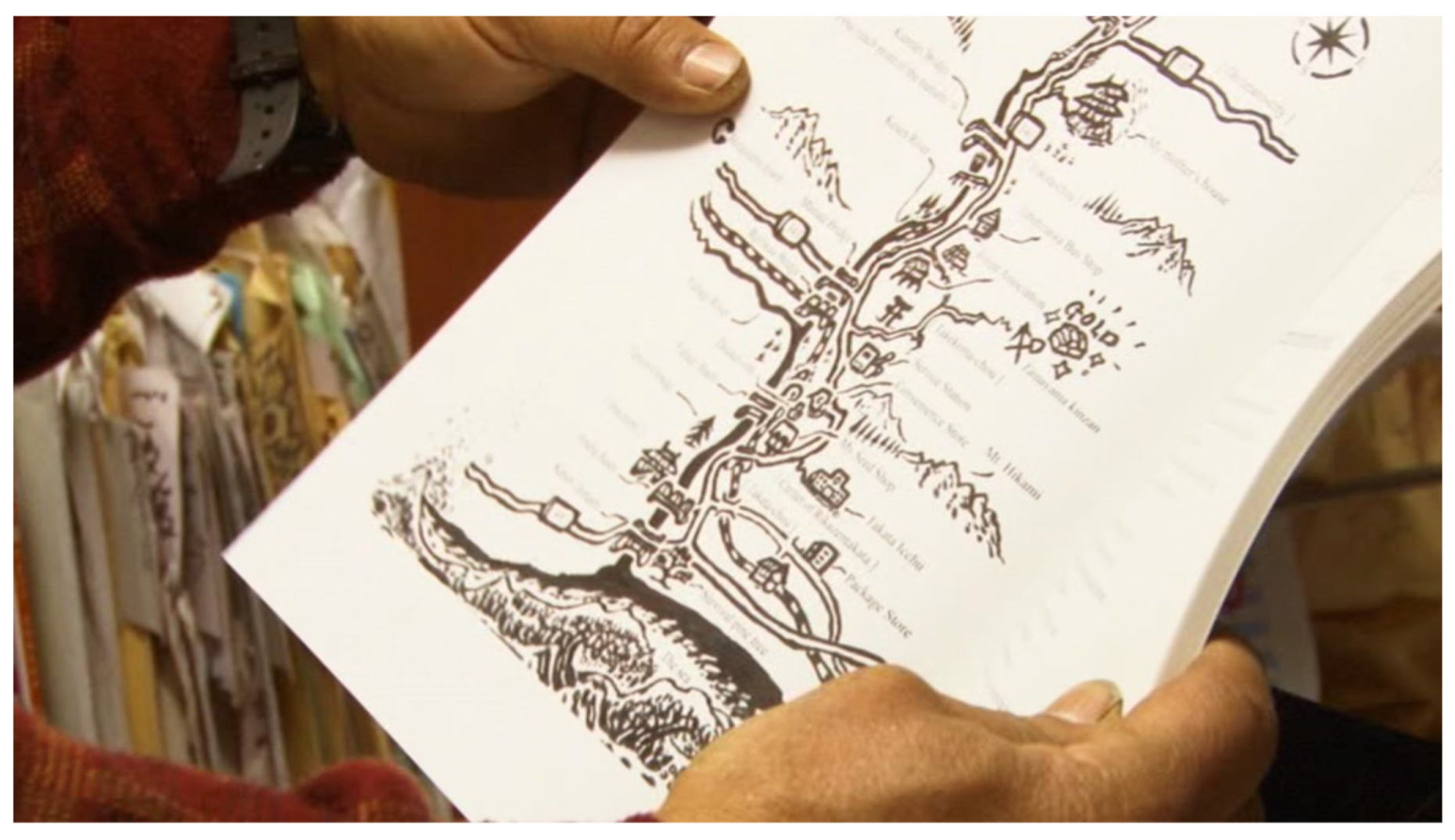
4 are actors or musicians. Komori documents their efforts to narrate their experiences, while weaving together official spatial imagery and personal lived space. Sato looks at post-tsunami aerial photos on his computer and shows a map of Rikuzentakata drawn from memory by himself (
Figure 1). Abe consults online weather maps for her broadcasts. A traveler in
Double Layered Town accompanies a local resident who operates a drone. These images are part of everyday life, but their use is neither manipulative nor administrative. Instead, they reconnect the past and present of Rikuzentakata and mediate between the sky and the community. Komori’s camera carefully captures how these individuals use their bodies and voices to engage with the land and the deceased. Her edited images reveal the layered relationships between people and place that lie beneath the flat surface of operational imagery. In what follows, I examine Komori’s works in chronological order to explore how her thematic focus shifts from ground to sky, and how cinema can offer a complementary understanding of the unconscious embedded in the cartographic surface.
3. Trace of Breath: Surfacing “Wonder” of the Post-Disaster Ordinary Life
Komori’s first feature-length film,
Trace of Breath, restores a profound connection to the land and an awareness of the modest scale of human existence amid nature. The documentary follows the daily life of Teiichi Sato, who runs a seed store in Rikuzentakata. Filming took place from January 2013 to June 2016, concluding when Sato had to close his store due to land-raising work. While centering on Sato,
Trace of Breath also shows the developing relationship between Sato and Komori. The spectator often sees Sato speaking to the young director—23 years old at the time—who remains off-camera. Still in the early stages of her career and without an established filmmaking methodology, she carried a handheld digital camera and stayed close to the people she felt compelled to keep watching. The mobility and responsiveness of the handheld digital camera enabled her to follow and capture Sato’s daily routines.
Komori (
2017a) reveals that a tripod would have been unsuitable, as this would imply a predetermined framing—an asymmetrical relationship in which the filmmaker gives instructions to the subject. Instead, she preferred to stay with Sato and respond to him in a familiar manner, emblematic of their evolving, parent–child-like relationship.
5Fully conscious of her status as an “outsider” in Rikuzentakata (
Komori 2017a), Komori’s cinematography invites the viewer to share her candid sense of admiration for Sato’s everyday life, composed of numerous “wonders.” As film scholar Catherine Wheatley observes, wonder arises both from encountering something new and from seeing the familiar in a new way. With respect to the latter,
Wheatley (
2023) argues that film is a medium capable of producing moments of wonder, in which “we find ourselves blinking at a familiar object or image or situation that suddenly appears
as if anew” (pp. 191–92; emphasis in original). Both aspects of wonder apply to
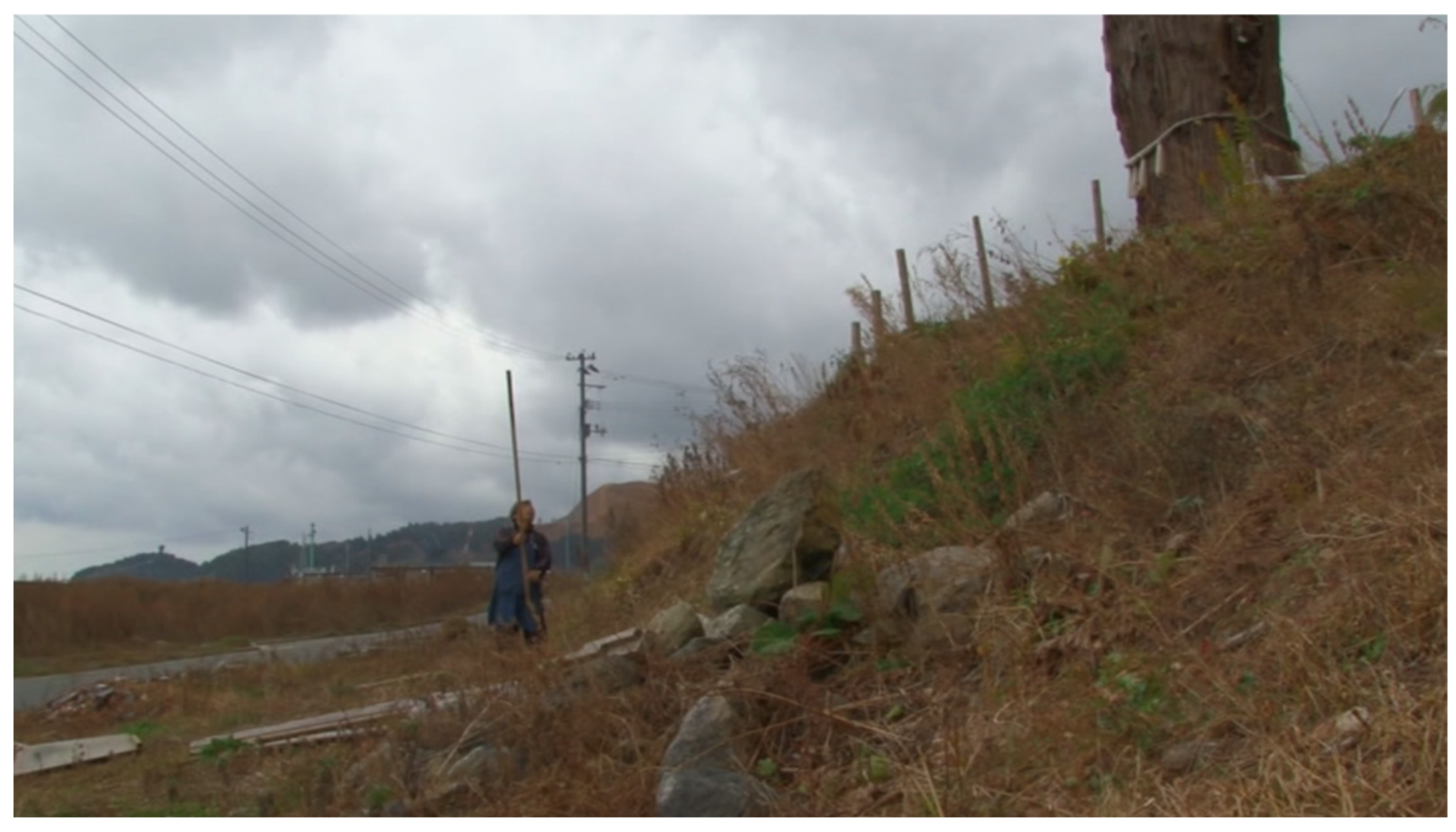
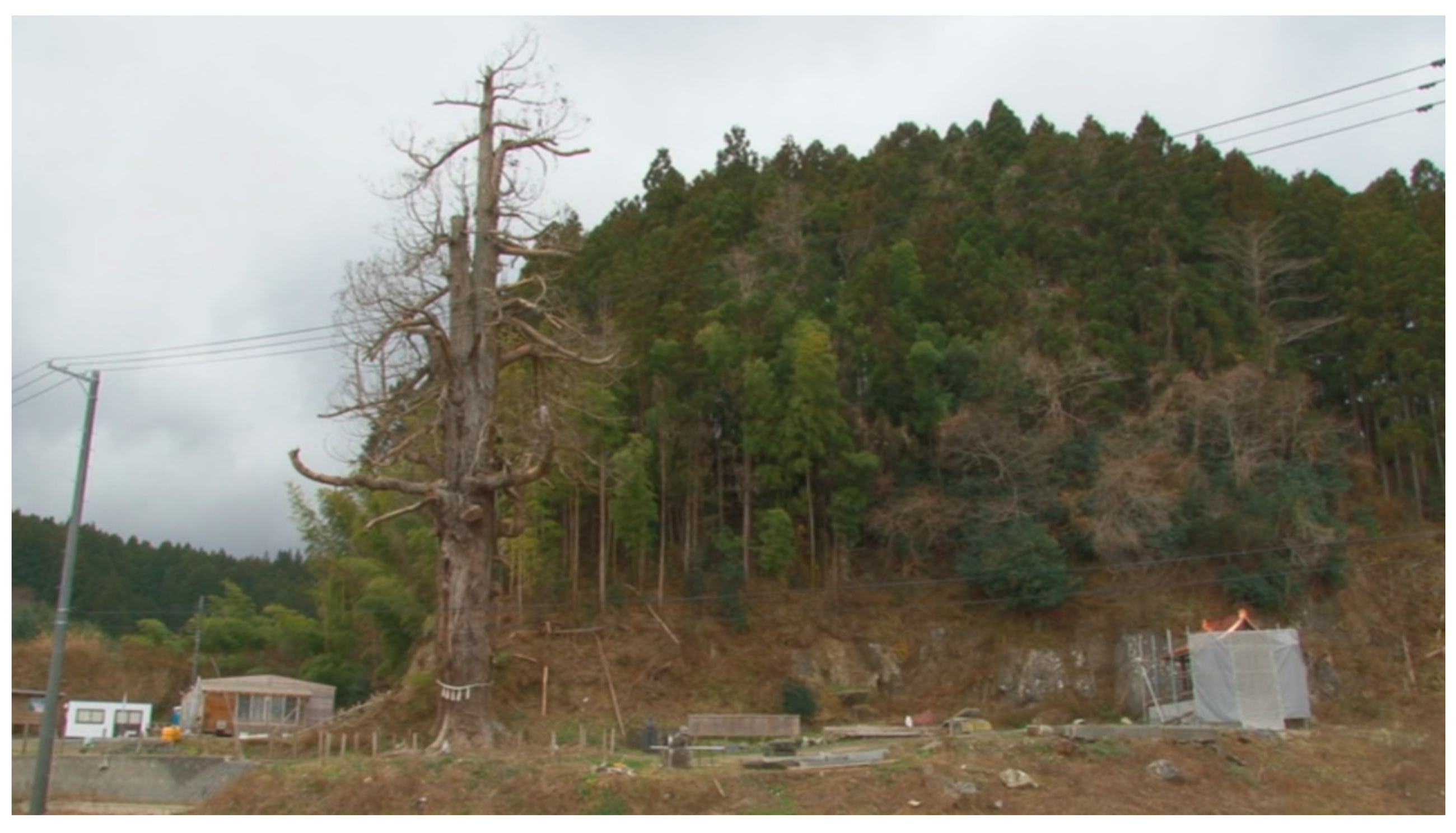
Trace of Breath. First, Sato himself is an extraordinary individual. He rebuilt a prefabricated store and resumed business in August 2011, the same year as the tsunami, in which he lost his home, store, and greenhouse. He dug a well using empty cans. Working at his seed store during the day, he spends his free time writing memoirs to self-publish in English and Chinese, which he had taught himself after the tsunami. He reads the texts aloud daily in a brave, resonant tone. In one scene, Sato takes Komori outside his store to visit the compost shed and the community’s holy cedar tree. He teaches her how to make fertilizer for seedlings, showing and explaining the functions of lime, chicken manure, cow and bird compost, rice paddy soil, and leaf mold collected from nearby mountains. Sato then demonstrates how to measure the height and age of a cedar tree to infer the height of a tsunami that struck Rikuzentakata possibly 400 years ago. By capturing Sato’s attempts to measure the historical scale of past tsunamis using the holy cedar tree and physical tools, Komori’s wide-angle shots visually emphasize the contrast between natural scale and human scale. One scene shows Sato’s wooden pole still unable to reach the hill where the sacred tree grows (
Figure 2 and
Figure 3). His bodily measuring resituates the disaster within a human scale, in stark contrast to remote sensing.
Film scholars
Beugnet and Wheatley (
2023) point out that, in an era in which visual technologies rescale everyday real-world phenomena, “the centrality of the human body in our system of measurement has always been unsettled” (p. 2). Digital maps vary in scale depending on screen size and user manipulation, contributing to a distorted perception of disaster scale and, by extension, of risk management capacity. While “non-anthropomorphic scaling systems” (p. 2) dominate public disaster management,
Trace of Breath re-centers Sato’s individual, embodied,
anthropomorphic approach. The dismantling of Sato’s well further underscores the extent to which human livelihood is rooted in the earth. At the end of the demolition process, Sato pulls a pipe from the ground that stretches vertically toward the sky. Framed without his body in view, the camera follows the pipe as it ascends—prompting the spectator to wonder about its length—until gravity pulls it back to the ground, disappearing from the frame (
Figure 4). Far exceeding human height, the pipe evokes the physical effort exerted by Sato using only cans and visualizes humanity’s deep dependence on natural resources like water.
Komori (
2017b) suspects that Sato wanted her to film this act of demolition. Their shared complicity in capturing this life-sized performance highlights both the human–nature scale difference and their interconnection.
4. Listening to the Air: Acts of “Entrusting”
The final shot of
Trace of Breath anticipates Komori’s second feature documentary,
Listening to the Air, where the thematic focus shifts from ground to sky and from past to future. The film centers on Hiromi Abe, who has been a radio personality at
Rikuzentakata Disaster FM in Iwate Prefecture for about three and a half years. In parallel with
Trace of Breath between 2013 and 2018 (with a break in 2015 when Abe’s program ended), the creation of
Listening to the Air began as a record of Abe’s work at the radio station (
Komori 2019). Komori struggled to gather enough material, as she was developing
Trace of Breath while working six days a week at a soba restaurant in Rikuzentakata (
Komori 2016a,
2020b). In 2017, Abe and her husband reopened their restaurant on elevated land. Still keen to document Abe’s life journey, Komori resumed filming and conducted an interview in 2018. The film interweaves this interview with footage of Rikuzentakata—loosely linked to Abe’s reflections and edited largely in chronological order. Komori was drawn to Abe, as she had been to Sato in
Trace of Breath, by her “sincerity in communicating” at Disaster FM, where she “listened to the voices of the townspeople and connected them through those voices” (
Komori 2020a). As a “listener,” Abe served as a mediator, allowing residents to share thoughts on the town’s reconstruction and the personal memories of its inhabitants.
Abe herself lost her parents, home, and restaurant in the tsunami. Rather than directly addressing Abe’s psychological wounds, Komori wanted to highlight the collective mourning of the Rikuzentakata community (
Komori 2020b). Scenes of memorial events appear frequently, including the 2014
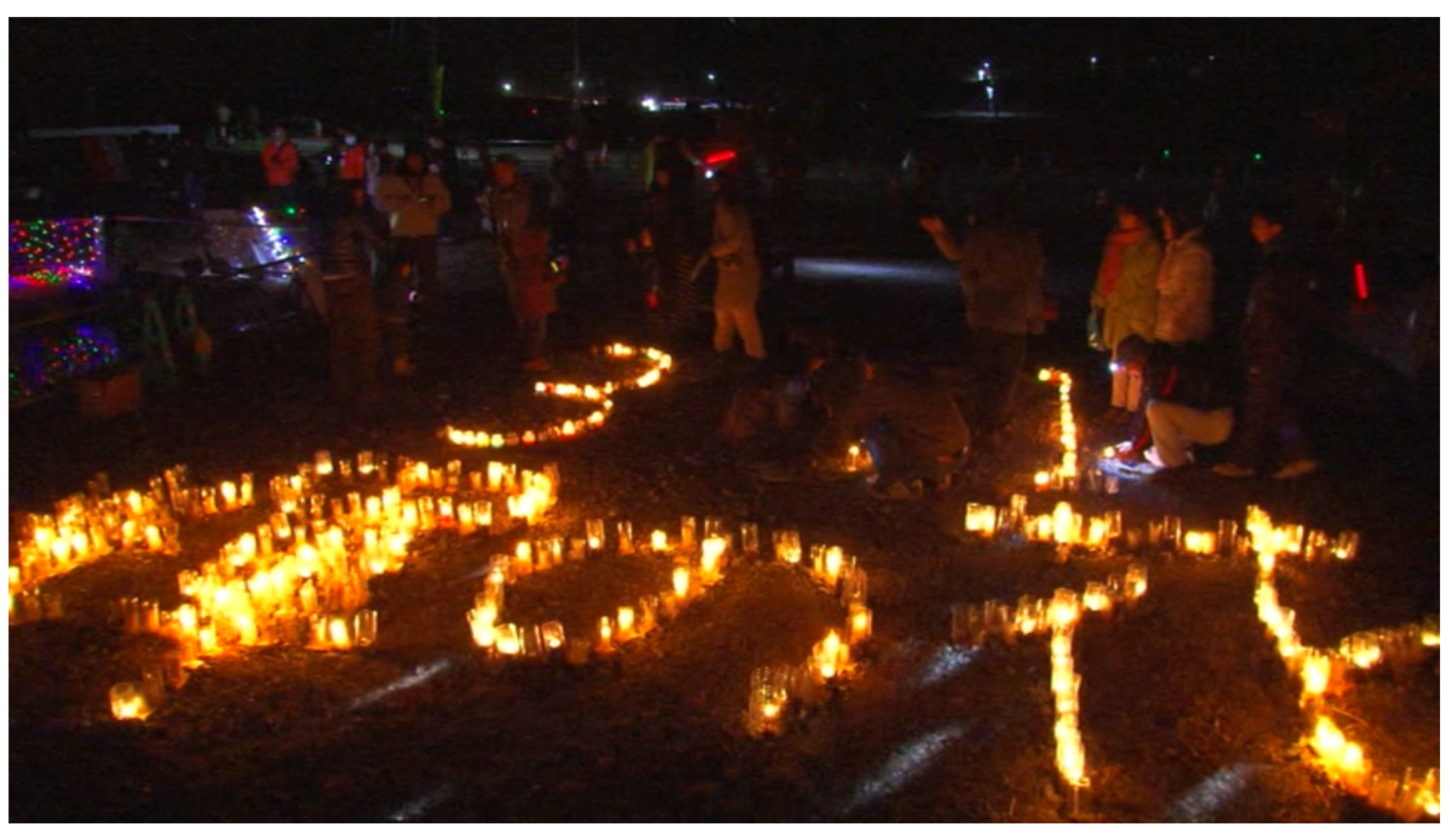
Tanabata summer festival that Abe covered—the last one held in the “lower” town. Nocturnal scenes of temporary altars with vivid lighting and candle-lit messages emphasize the texture of light captured digitally (
Figure 5). Abe’s absence in some shots signals that the film is not solely about her, but about the town’s connections to the dead. To Komori, these invisible ties are heard in Abe’s frequent use of “we,” suggesting her intent to speak to both the living and the dead. Komori observes that Abe’s thoughts for the deceased were “directed toward the sky rather than the ground” (
Komori 2020b). Influenced by Abe, Komori shifted her visual focus, harnessing film’s capacity as a medium to capture movement—the “kinetic energy” of natural elements such as the wind—reminiscent of Leonardo da Vinci’s attempts to depict air in its visible state (
Aumont 2021, p. 24). The change appears in shots linking earth and sky, such as the annual
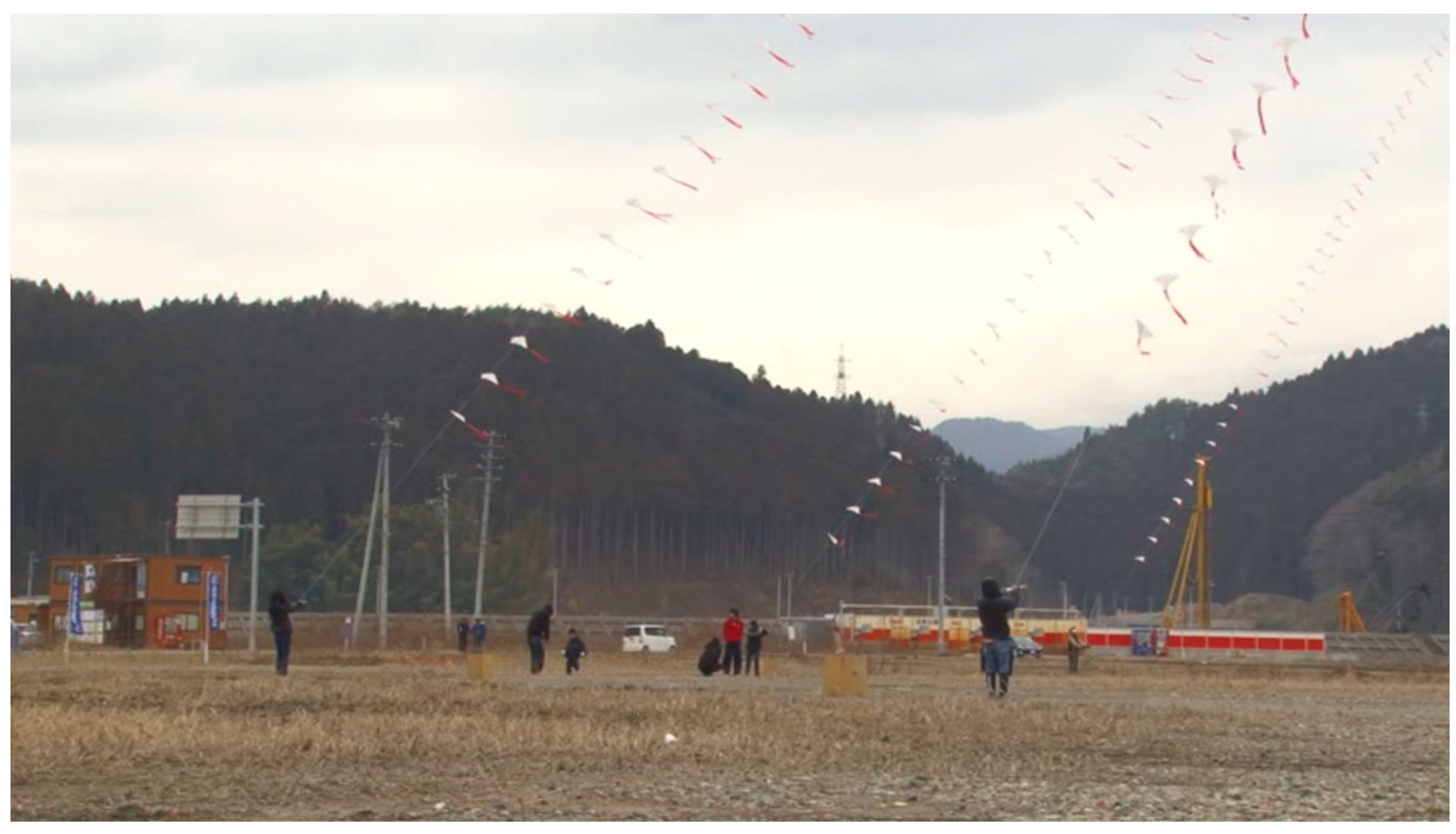
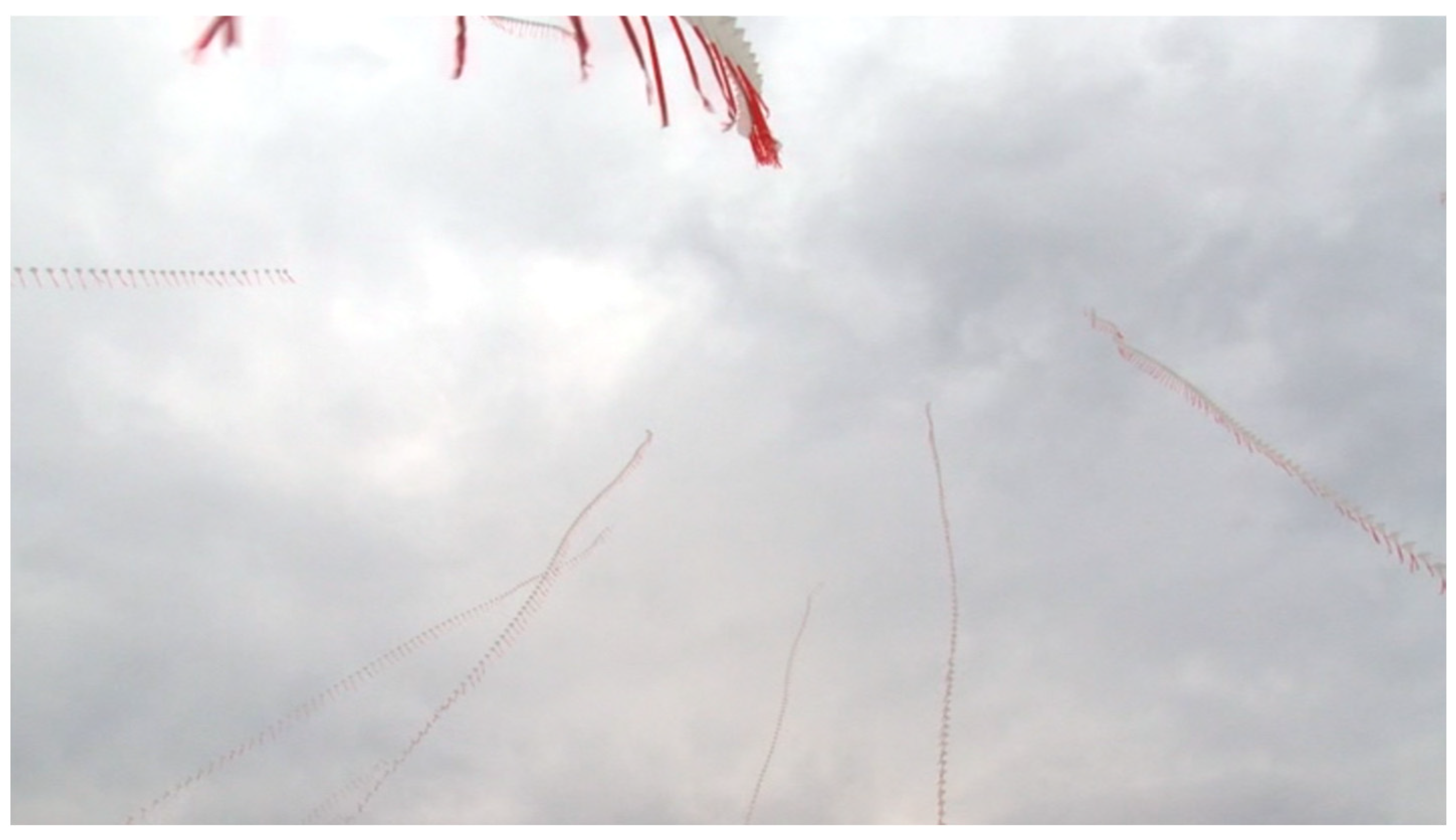
Kesen Tenbata kite-flying event on March 11, when kites are flown, each one representing one of the tsunami victims. The date also marks Abe’s silent prayer broadcast on Disaster FM. The kite sequence is paired with Abe’s reflections on that shared moment. A low-angle shot of kite strings swaying in the wind draws the viewer’s gaze skyward—to where the dead are imagined to reside (
Figure 6 and
Figure 7). Tethered yet airborne, the kites embody how the community, to borrow Silvestra Mariniello’s word,
entrusts its mourning to the elemental movement of the wind. In her essay on
Hirokazu Kore-eda’s (
1998)
After Life,
Mariniello (
2022) writes that cinema, bound to life, death, and memory, is entrusted with “the power to make us think about life, death, memory, and cinema itself” (pp. 4–5). In
After Life, the deceased select a cherished memory to be filmed and relived before passing on. Mariniello associates, albeit implicitly, this act with analog film’s indexical tie to the past of physical reality.
By contrast, Komori’s digital filmmaking in
Listening to the Air is marked by overexposure, which erases detail and, consequently, leaves little trace of physical reality in the image. Rather than preserving and thereby reliving the past, this digital aesthetic articulates mutability and the indeterminate future of the townspeople’s lives. The overexposure is most evident in the film’s final sequence. Here, blown-out highlights—produced by the digital camera sensor’s limited tolerance for brightness in comparison to analog film—translate into a paucity of visual data, which in turn suggests the difficulty of envisioning a certain future. Whereas the guides in
After Life transform into the past selves of the deceased in order to record and create videotapes for the latter, the final sequence of
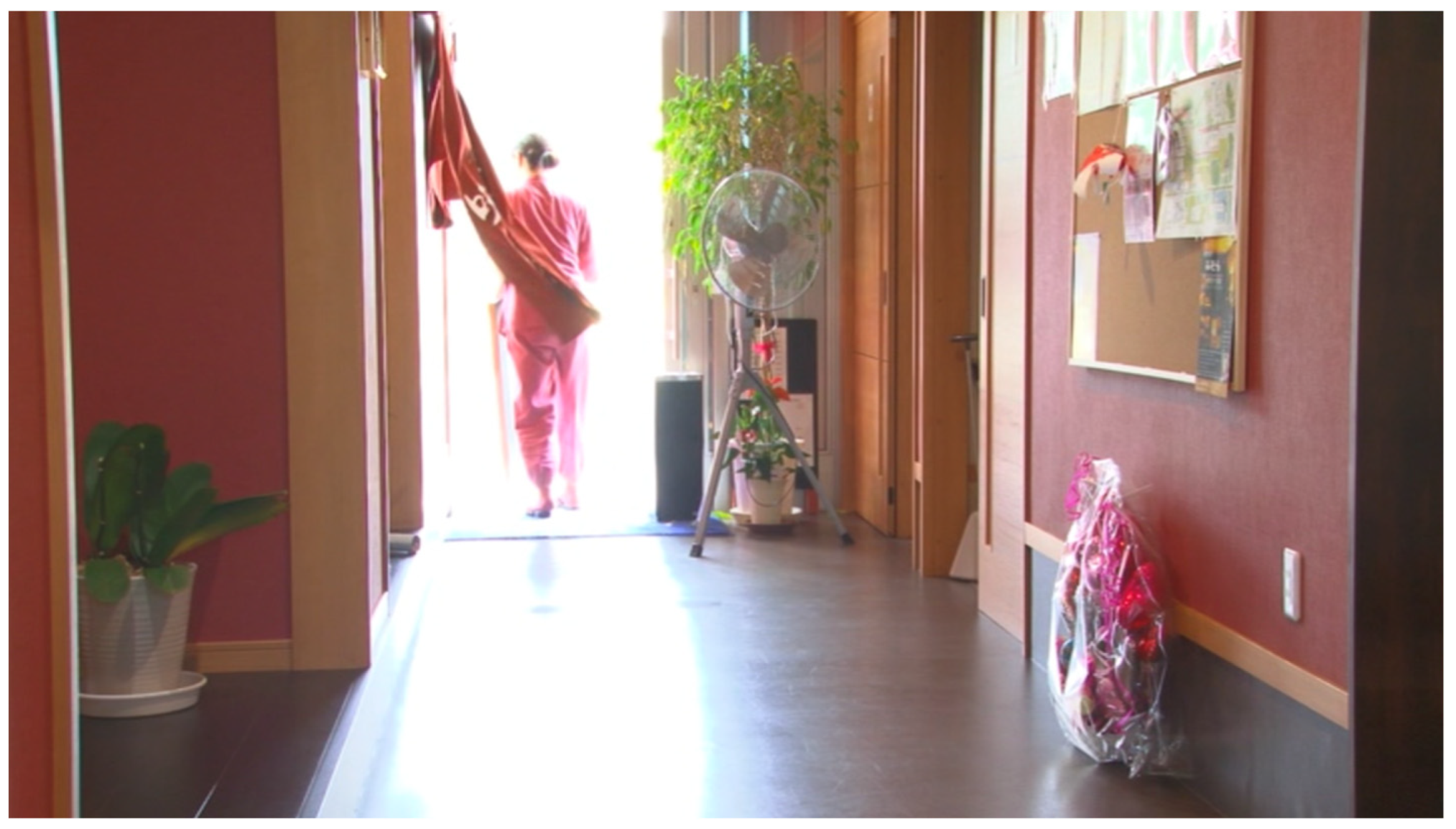
Listening to the Air presents Abe’s transformation into a restaurant owner, signifying her orientation toward the future rather than a return to her past self. In a later interview, Abe admits she nearly gave up on reopening, having lost so much. During the six years and nine months of reconstruction, she often looked back, drifting between past and present. But since reopening, she finds herself looking ahead in the rebuilt town. In one shot, Abe, dressed in uniform, opens the restaurant door from inside. Sunlight streams through the doorway and swaying curtains, creating a white zone into which she disappears and reappears. The digital camera’s perception offers no data or no view beyond the zone. The overexposure stages a threshold beyond which the future remains unpredictable. Abe’s in-and-out movement in this zone suggests an individual stepping into an unknowable future (
Figure 8). Her voice, speaking in the collective “we” (referring to herself and her husband), overlays everyday scenes of Rikuzentakata: children playing baseball, people walking home, construction workers rebuilding. These images and Abe’s words depict how the community slowly reconstructs its future on flattened land. Yet,
Komori (
2020a) reminds us that reconstruction coexists with uncertainty: depopulation and the risk of future disasters remain. To entrust one’s life to the future is to accept vulnerability and the possibility of unfulfilled hopes. Still, Abe chooses hope—believing that the dead watch over the living. The film entrusts to the viewer’s imagination the memory of survivors reweaving ties with the dead—and, in doing so, envisioning their future.
5. Double Layered Town: Multi-Layering for Imaginative Engagement
In
Double Layered Town, a documentary based on a two-week workshop held by Komori and Seo in Rikuzentakata in September 2018, the memories of the temporary reconstruction period are entrusted to a group of four young individuals. Conceiving the workshop as an experimental space for inheriting and transmitting stories of disaster experiences, Komori and Seo recruited participants who had been high-school age or younger at the time of the 2011 disaster and not directly affected by it. These participants, as “travelers,” stayed with Rikuzentakata residents, listened to their stories, retold them in their own words before Komori’s camera, and read aloud to the city’s residents a fictive story written by Seo in 2015. The film ends with a reflective session among the four participants.
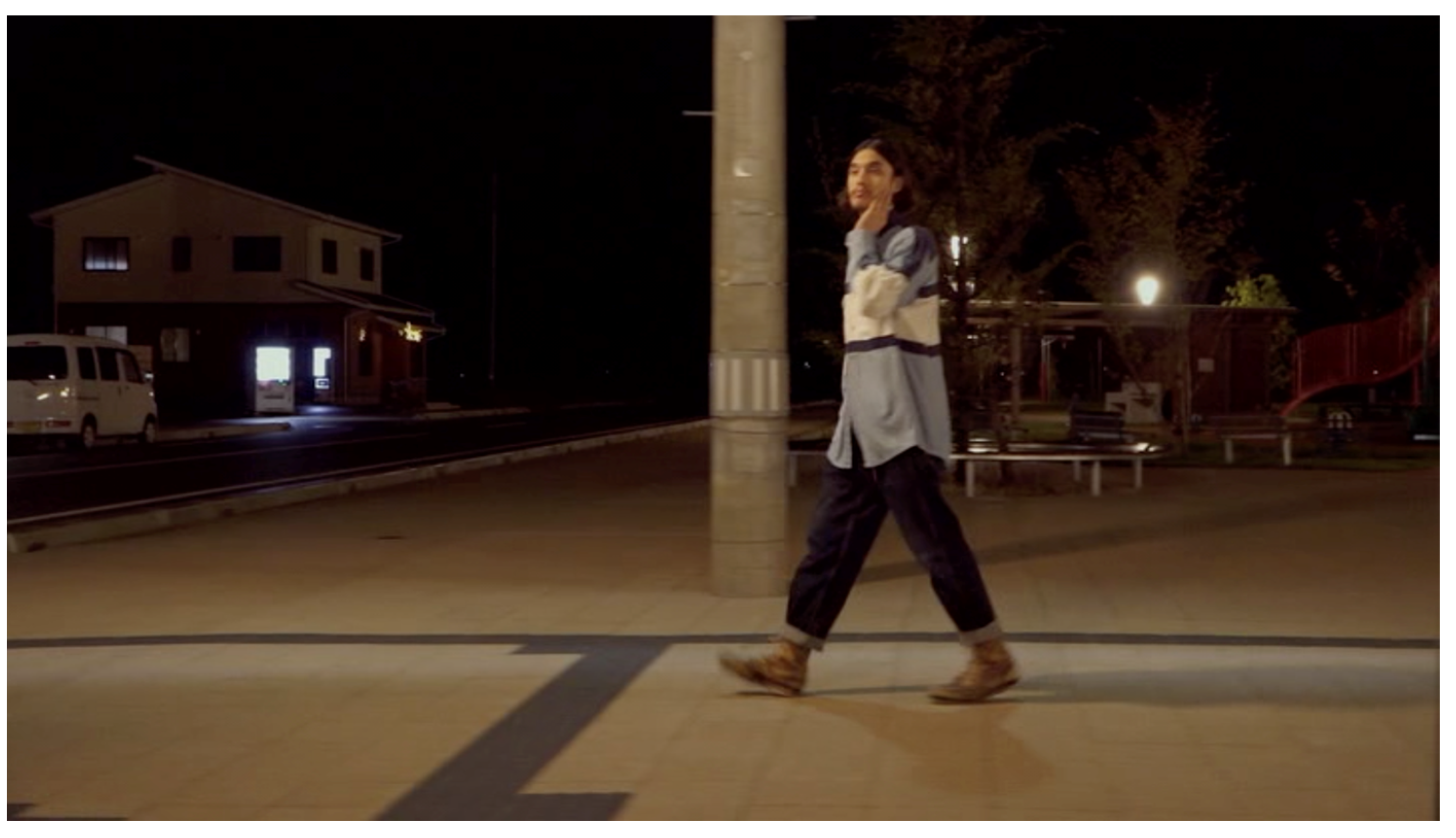
6One key moment features the second participant, who tries to imagine the emotions of the story’s protagonist during his preparation for reading. His voice narrates the fictional story by Seo, set in Rikuzentakata in 2031, depicting a future in which the land-raising project is complete and the “lower town” and “upper town” coexist. The story’s protagonist, modeled on a now-deceased resident, becomes the traveler’s object of imaginative reconstruction. Prior to reading, he explains that, to understand this person, he met with those who had known him, and that through this process, the imaginary person began to resemble himself or his friends. As the narration begins, ambient sound fades, drawing the viewer into the story. In the narrated story, the protagonist describes summer festival floats, which are shown in
Listening to the Air. The traveler’s solitary nighttime gait contrasts with the festival scenes of
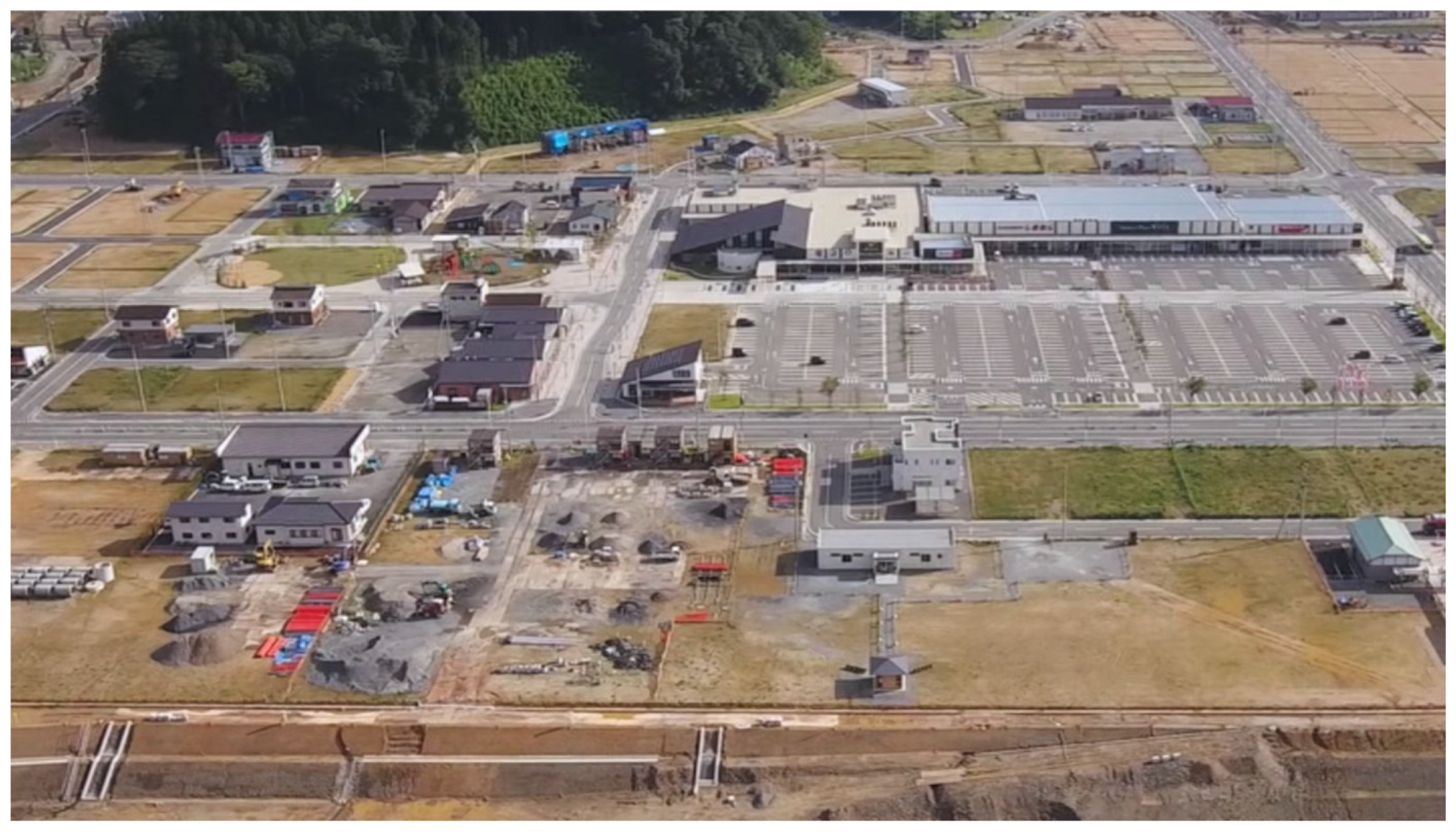
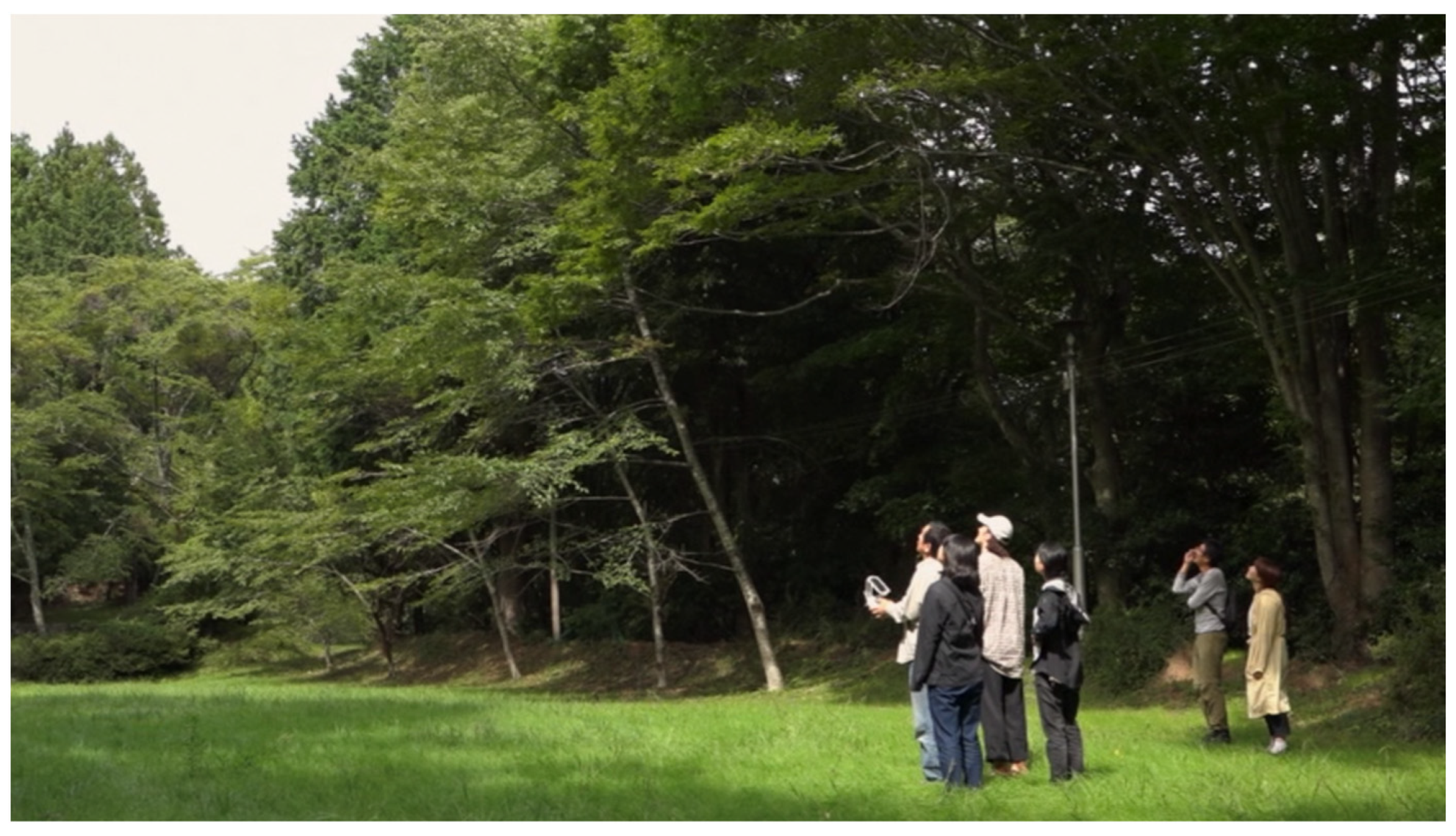
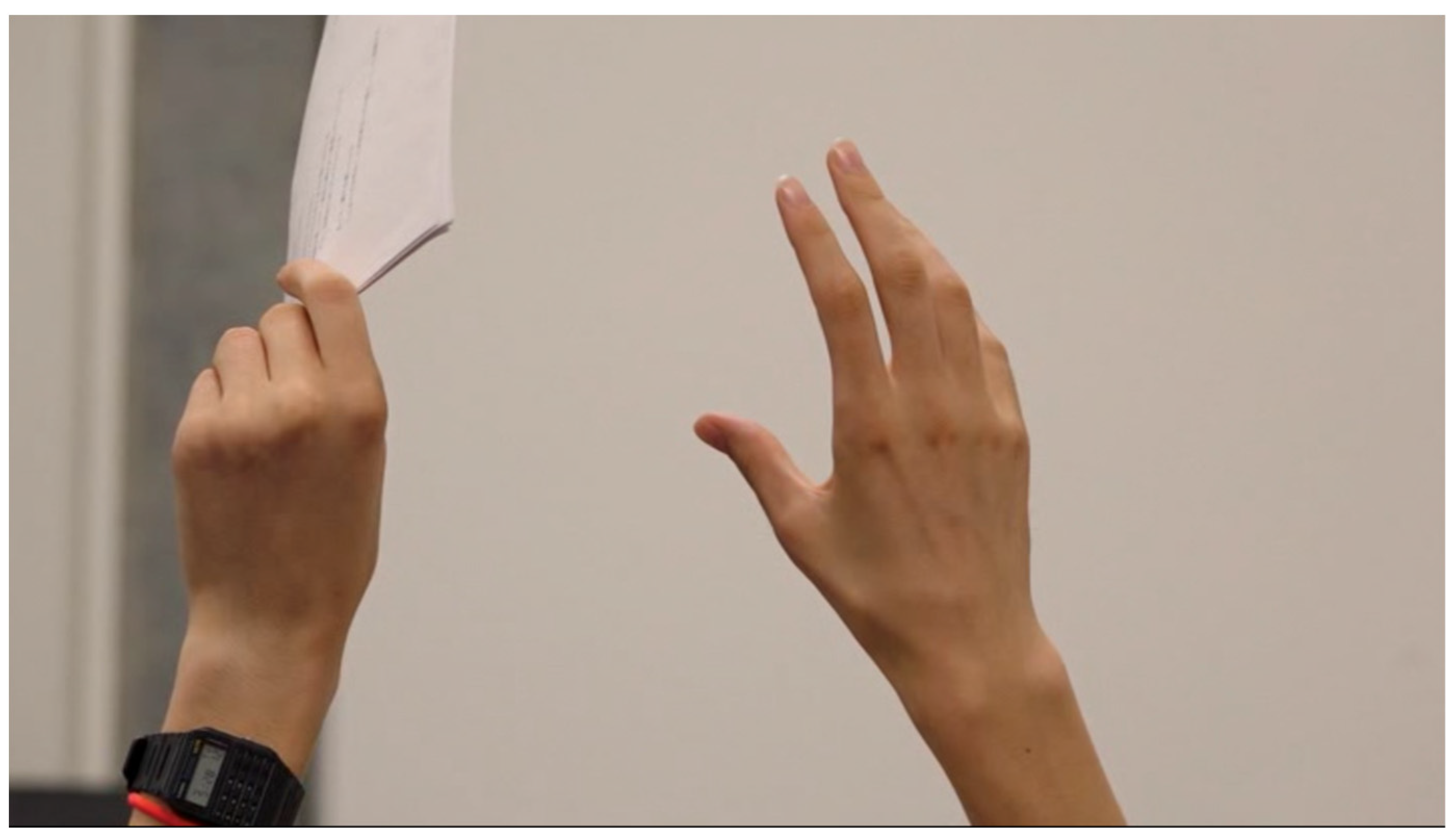
Listening to the Air, where floats parade through streets to lively cries. Along with the narration, the tracking shot invites the viewer to imagine the festival floats, whose memory lies beneath the ground on which he walks. Then comes drone footage shot by a Rikuzentakata resident, with the shown area corresponding to the one that the traveler just traversed. Offering a view from an even higher vantage point, the drone’s horizontal movement reveals both grid-like developments and vast open land, testifying to the area’s transformation. In the narrated story, the protagonist remains in the “lower town,” and years later, hears the sounds of drums, flutes, and footsteps from the “upper town,” imagining the festival and its townscape through sound. Subsequent shots show residents and the traveler operating the drone, gazing skyward. In the final shots, the traveler lies on the floor, seemingly absorbed in the text. A close-up of his hands reaching toward the sky visually links him to the story’s protagonist, who also imagines the “upper town” (
Figure 9,
Figure 10,
Figure 11 and
Figure 12).
Blurring the boundary between documentary and fiction, this sequence creates a multi-layered experience, where what is imagined through narration and what is understood through moving images commingle. Moreover, drone footage becomes a medium of imaginative engagement. Its mechanical vision flattens the townscape into an artificial, miniature surface. As with aerial photography used for online hazard maps, this visual flattening enables the superimposition of various kinds of layers—risk data, memory, and fictional ones. In June 2018, Seo noted that since reconstruction had begun, residents had started “watching over” the changing landscape with drones. She writes that the rupture between past and present makes it difficult to reconnect the two from the ground, but drones offer a means of visually bridging these temporal layers (
Seo 2021, p. 133). This connection extends beyond time—it also links the perspectives of the living and the dead.
Seo (
2025) revealed that the drone had been operated by a now-deceased resident who appears in the film. Retrospectively, it embodies his perspective as a witness to the reconstruction. Like
Listening to the Air,
Double Layered Town connects the dead in the sky with the living on the ground. The digital drone footage holds multiple viewpoints: the protagonist, the drone’s mechanical gaze, the drone operator, and the traveler, thereby serving as an interface where past, present, and future; reality and fiction; and the perspectives of the living and the dead gently converge. Incorporating the reading of a fictional text, the sequence’s editing turns the traveler into a mediator between the land’s memories and the spectator’s imaginative engagement.