Article

The Impact of Visual Landscape Environment in Cold-Region Communities on Blood Pressure and Emotion of the Elderly: A Gender-Differentiated Study Based on Eye-Tracking and Hierarchical Linear Models

1
College of Art and Design, Jilin Jianzhu University, Changchun 130018, China
2
Innovation Center of Jilin Province Traditional Villages Human Settlement Environment Design, Jilin Provincial Department of Housing and Urban-Rural Development, Changchun 130018, China
3
College of Architecture and Urban Planning, Tongji University, Shanghai 200092, China
*
Author to whom correspondence should be addressed.
Buildings 2026, 16(8), 1570; https://doi.org/10.3390/buildings16081570
Submission received: 10 March 2026 / Revised: 10 April 2026 / Accepted: 11 April 2026 / Published: 16 April 2026

Abstract

Global aging is accelerating, with the proportion of the population aged 60 and above projected to reach 22% by 2050. In cold-region communities, the visual landscape environment is closely associated with the health of older adults, particularly showing associations with blood pressure (BP) and emotion states. However, associations between these factors across different landscape spaces and potential gender differences remain underexplored. This study utilized eye-tracking experiments to collect visual attention data from older adults in three types of cold-region community spaces: inter-building spaces, walkways and squares. The ground, buildings, trees, lawn, and the sky were identified as the primary Areas of Interest (AOIs). The Profile of Mood States (POMS) scale was used to assess emotion during walking experiments, revealing suggestive gender–environment interaction characteristics. Systolic blood pressure (SBP), diastolic blood pressure (DBP), and pulse pressure (PP) were measured, and a Mann–Whitney U test indicated that DBP in community squares exhibited significant environmental dependency (U = 114.5, p = 0.004, r = 0.44). Hierarchical Linear Models (HLMs) revealed that, after controlling for individual differences, the number of fixation points on ground was independently associated (i.e., independent of measured individual characteristics) with elevated SBP ( γ = 0.31 ,   p = 0.011 ), while fixation on trees was associated with reduced SBP ( γ = 0.24 ,   p = 0.018 ). Furthermore, gender moderation effects were observed: the association between ground fixation and SBP was stronger in females ( γ = 0.18 ,   p = 0.022 ), whereas the association between sports facilities and DBP was stronger in males ( γ = 0.29 ,   p = 0.009 ). Based on these findings, evidence-based design strategies are proposed, including the optimization of ground safety, gender-differentiated planting configurations, and targeted layouts for sports facilities. These results provide empirical support for age-friendly community design in cold regions.

1. Introduction

With the rapid progression of global aging, health issues among the elderly have emerged as a critical challenge in contemporary society. Cardiovascular diseases (CVDs) represent the primary health threat to this population, with their incidence rising significantly with age. Notably, in cold northern regions, hypertension has become one of the most prevalent CVDs among older adults [1,2]. According to data from a Chinese epidemiological survey, the prevalence of hypertension in individuals aged 60 years and above has reached 52.6% [3]. Research indicates that 80% of information received by humans from the external environment is acquired through the visual perception system [4]. Previous studies have established a robust association between the visual environment and the emotional states of older adults [5,6,7]. Additionally, the quality of community environmental exposure is significantly correlated with the BP levels of the elderly [8,9], and such associations may differ by gender. High-quality community environments may contribute to favorable BP and emotional states in older adults through multiple mechanisms, making this a frontier topic at the intersection of built environment and health research [10]. Therefore, it is imperative to investigate the relationships and gender differences between visual landscape perception, BP responses, and emotional evaluations among older adults in cold-region community environments.

1.1. Correlation Between Visual Landscape Environments of Cold-Region Communities and Emotional Evaluations of Older Adults

Kaplan’s Attention Restoration Theory (ART) posits that positive environmental perceptions can induce pleasure and enhance concentration [11]. The environment influences emotions through direct or indirect pathways, which in turn shape behavioral choices.
Building on this framework, Stress Recovery Theory (SRT) [12] complements ART by directly addressing physiological stress indicators: natural environments trigger positive affective responses that reduce sympathetic nervous system activation and lower cardiovascular stress markers, including blood pressure and heart rate. While ART emphasizes attentional processes as the primary pathway to restoration, SRT emphasizes affective-physiological responses. Both frameworks predict that natural visual elements confer restorative benefits, whereas built or safety-relevant elements may not. This distinction has practical implications for community design: if attentional engagement is the primary mechanism, design should prioritize elements that sustain involuntary attention; if affective-physiological responses are primary, the mere presence of natural elements may be sufficient.
As individuals age, older adults increasingly rely on familiar residential and activity environments. Community settings can help older adults relax, restore energy, and confer multiple health benefits [13,14]. In cold regions, long, harsh winters and frequent strong winds during winter and spring limit older adults’ participation in outdoor activities and their exposure duration [15]. Enhancing the attractiveness of community spaces is thus essential to promoting outdoor mobility among the elderly, and visual environmental quality is a core component of such attractiveness.
Research by Tabrizian et al. has demonstrated that urban environmental elements impact psychological and physiological health, and optimizing these elements can facilitate psychophysiological restoration [16,17,18]. Existing studies have also shown a strong correlation between urban community visual landscape environments and older adults’ emotional evaluations [19]. However, cold-region community landscape environments—characterized by unique climatic conditions—have received limited attention, and whether different landscape spaces within these communities exert distinct effects on older adults’ emotions remains underexplored. Moreover, the specific visual elements (e.g., ground, trees, sky) that drive these effects have not been systematically identified, nor have the pathways (attentional versus affective-physiological) been empirically distinguished.
This study addresses these gaps by integrating eye-tracking measures of visual attention with ambulatory blood pressure monitoring and emotional assessment, guided by the complementary frameworks of ART and SRT.

1.2. Human Factors Experimental Methods Using Eye Trackers and BP Monitors

Current research on perceived community environments frequently employs questionnaires [20], structured interviews [21], and self-report scales [22]. Chen et al. used questionnaires to explore the relationship between the quality of outdoor residential environments and older adults’ emotions [20], while Zhai et al. collected data on older adults’ walking behaviors and path design preferences via on-site observations [23]. These subjective methods are time-consuming, labor-intensive, and prone to bias from subjective perceptions.
Eye trackers, as advanced measurement tools, can reflect individuals’ attention to scene elements through metrics such as fixation count, fixation duration, fixation proportion, and pupil diameter [24,25,26]. BP monitors record SBP, DBP, and PP—parameters that serve as direct and reliable indicators of environmental stress and recovery processes [27]. In existing studies, visual preference elements in environments are primarily assessed via subjective methods. While BP and similar indicators have been increasingly applied to research on environmental restorative perception, the integration of eye trackers and BP monitors in human factors experiments remains underdeveloped.

1.3. Mechanisms by Which Visual Landscape Environments in Urban Community Spaces Affect Physiological Indicators of Older Adults

Bei et al. used wearable biosensors to collect physiological and location data from multiple participants, spatially identifying stress responses in older adults induced by environmental barriers [28]. Elsadek et al. designed visual stimulation experiments using bamboo and urban imagery, employing electroencephalography (EEG), heart rate variability (HRV), and skin conductance to reveal environmental impacts on older adults’ physiological and psychological states [29]. Tilley et al. combined directed interviews with EEG metrics to analyze emotional changes in older adults, gaining insights into how emotions fluctuate over time during urban walking [30].
However, current research often overlooks gender factors, treating older adults as a homogeneous group. Medical studies have established significant gender-based differences in the structure and function of the cardiovascular system: women typically exhibit higher HRV and parasympathetic activity, while men show stronger sympathetic responses and vasoconstrictive tendencies [31]. Additionally, aging is accompanied by reduced vascular elasticity and declining autonomic regulatory function [32].
Prior research examining the relationship between environmental exposure and physiological responses in older adults has largely relied on traditional correlation or regression analyses, which are predicated on the assumption of independence among observations. This assumption is violated, however, when repeated measures are taken from the same individual across different environments—a nested data structure commonly encountered in environmental health research. Neglecting this hierarchical structure can lead to underestimated standard errors and inflated Type I error rates. Crucially, traditional methods are unable to disentangle the variance explained by stable individual characteristics (e.g., age, gender, baseline health status) from that attributable to environmental exposure effects. This distinction is vital for both scientific inference and practical design applications; determining whether observed associations reflect genuine environmental impacts or merely individual predispositions carries fundamentally different implications for community design.
Our analytical approach—decomposing variance into within-individual (environmental) and between-individual (individual) components—follows a well-established tradition of multi-level ecological analysis in urban research. This approach isolates contextual spatial effects from individual compositional effects [33]. Following this analytical discipline, our HLM separates within-individual variance (changes in the same individual across spaces) from between-individual variance (stable individual characteristics), allowing estimation of the independent contribution of visual environmental features to blood pressure and emotional outcomes after controlling for measured individual differences. The assumptions required to interpret these associations as environmental rather than compositional are discussed in Section 4.5.
Consequently, this study employs HLM to simultaneously model within-individual (environmental) and between-individual (personal) variance components. This approach yields more accurate estimates of environmental effects and enables the investigation of cross-level interactions, such as whether environmental effects are moderated by gender.
Recent scholarship has developed precise conceptual tools for understanding how built environment quality shapes living conditions differentially across sociodemographic groups. For instance, a study in Habitat International [34] demonstrates how built environment characteristics and governance discontinuities intersect to produce differential exposure of vulnerable groups to adverse residential conditions. Our study extends this line of inquiry by examining physiological health outcomes (blood pressure, heart rate) in an aging population and by explicitly testing gender as a moderating factor in the relationship between visual environmental elements and health. This focus on gender-differentiated effects in outdoor residential spaces addresses an important gap in understanding how environmental inequality operates at the intersection of age, gender, and the built environment.
This study focuses on three types of outdoor landscape spaces typical of cold-region communities: inter-building spaces, community walkways, and community squares. The Wanhehaoting Community in Changchun, Jilin Province, China, was selected as the study site. Tobii Pro Glasses 2 (Tobii, Stockholm, Sweden) were utilized to collect eye-tracking metrics, which were then analyzed to categorize the visual Areas of Interest (AOIs) of older adults while walking in these outdoor landscape spaces. A Yuyue arm-type electronic BP monitor (model YE680A, Jiangsu Yuyue Medical Equipment & Supply Co., Ltd. Danyang, Jiangsu, China) was used to record physiological metrics, including SBP, DBP, PP, and heart rate (HR), facilitating subsequent descriptive statistics and Mann–Whitney U tests.
Based on the foregoing, this study specifically addresses the following three research questions:
  • What are the primary visual AOIs for older adults within cold-region community outdoor spaces (inter-building spaces, walkways, squares)? Do BP metrics and walking emotion assessments differ across these spaces?
  • How do visual perception elements in the cold-region community environment influence SBP, DBP, and emotion states? Do these influences operate through independent association mechanisms?
  • Does gender moderate the effects of visual perception elements on BP in older adults? Based on these mechanisms, what targeted evidence-based design strategies can be proposed for cold-region community landscapes?
The study hypothesizes that different types of cold-region outdoor community environments exert significantly different effects on the walking emotion and BP levels of older adults, and that these effects may vary significantly by gender.

2. Materials and Methods

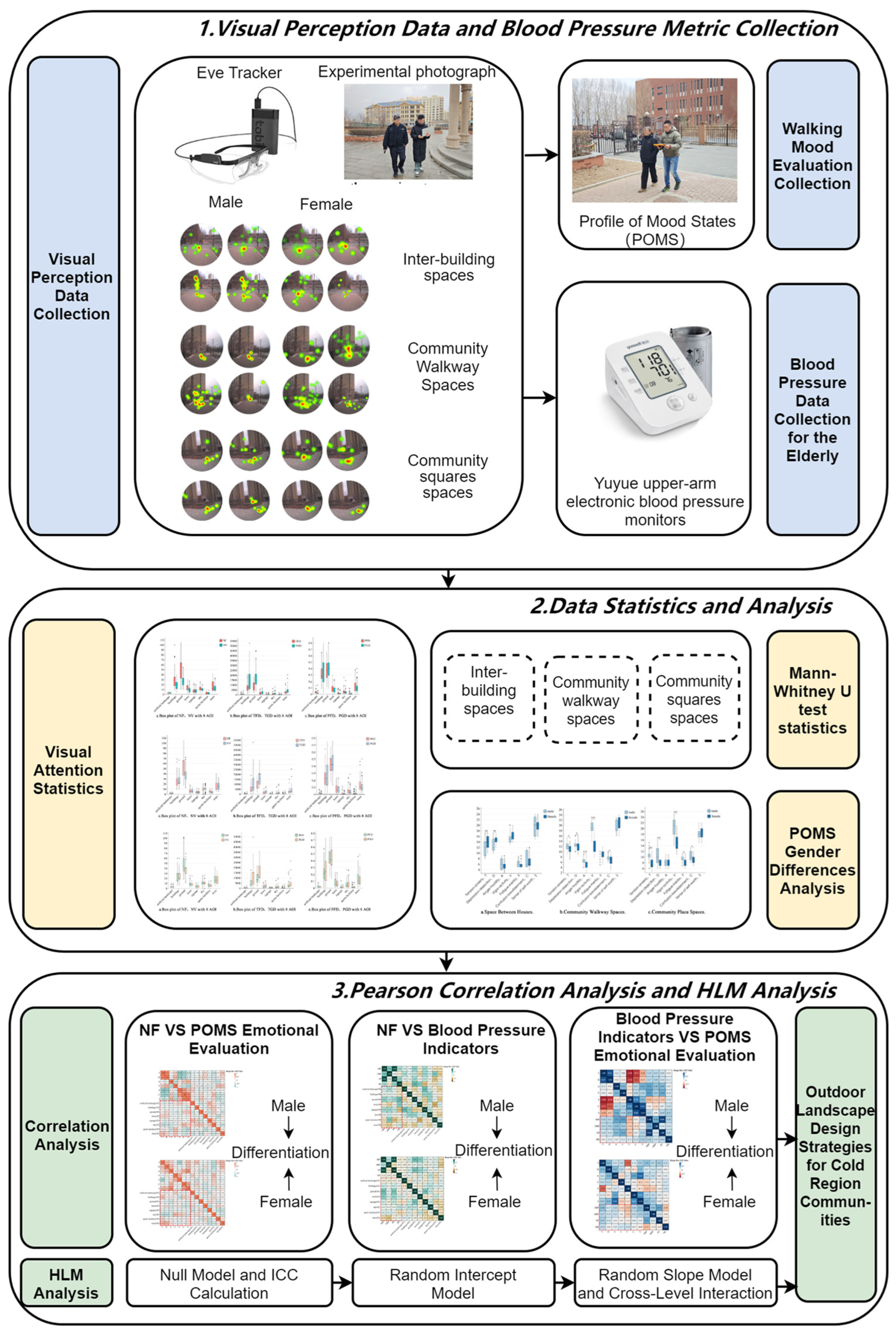
As shown in Figure 1, the research method was divided into three parts. First, walking experiments were conducted with elderly participants using Tobii Pro Glasses 2 (Tobii, Stockholm, Sweden) eye-trackers to capture visual attention patterns in three types of cold-region community outdoor spaces: inter-building spaces, community walkways, and community squares. Immediately after walking in each space, the POMS was administered to assess emotional evaluations, and BP indicators—including SBP, DBP, PP, and HR—were measured using Yuyue upper-arm electronic BP monitors (model YE680A, Jiangsu Yuyue Medical Equipment & Supply Co., Ltd. Danyang, Jiangsu, China). The objective of this phase was to establish a comprehensive database linking elderly individuals’ visual perception, emotional responses, and physiological indicators across different community landscape environments.
In the second phase, preliminary statistical analyses were performed: descriptive statistics were calculated for all variables, and the Mann–Whitney U test was employed to examine gender differences in SBP, DBP, PP, HR, and POMS scores across the three spatial types, with effect sizes (r) computed to quantify the magnitude of observed differences.
In the third phase, Pearson correlation analysis was first conducted to explore bivariate relationships among visual attention points, BP indicators, and POMS emotional dimensions, with particular attention to gender-specific patterns. Given the nested structure of the data—three repeated measurements nested within each individual participant—traditional regression models that assume independence of observations were considered inappropriate; therefore, a HLM was employed to disentangle within-individual (environmental) and between-individual (personal) variance components through a three-step modeling strategy. First, a null model was estimated to calculate the Intraclass Correlation Coefficient (ICC) and justify the use of the HLM. Second, a random intercept model was constructed to examine the independent effects of visual elements on BP after controlling for individual characteristics (gender and age). Third, a random slope model with cross-level interactions (Gender × Visual elements) was developed to test whether the effects of key visual elements varied by gender. All continuous predictors were grand-mean centered, and models were estimated using Restricted Maximum Likelihood (REML). The purpose of this multi-method approach was to separate true environmental influences from individual predispositions, thereby providing robust evidence for subsequent design optimization strategies for cold-region communities.

2.1. Study Area

This study focuses on the outdoor landscape environments of cold-region communities. From September to November 2025, the research team conducted an investigation of 124 cold-region communities across China and carried out random interviews with elderly residents within these communities. Through this process, three types of outdoor landscape spaces in cold-region communities that are frequently visited by the elderly were identified: inter-building spaces, community walkway spaces, and community square spaces.
Community inter-building spaces refer to semi-public outdoor areas at the residential cluster level, enclosed or divided by individual residential buildings (or units). Serving as a transition from residential indoor spaces to community public spaces, they constitute the most direct and frequently accessed carriers for residents’ daily outdoor activities. Community walkway spaces are linear spaces designed to accommodate functions such as passage, strolling, and physical exercise. Community square spaces are relatively large-scale, centralized public open spaces characterized by a distinct sense of spatial domain and dedicated thematic functions.
To explore in detail the visual perception factors influencing the elderly in these three types of outdoor landscape environments within cold-region communities, this study framed the research scenario as outdoor walking in the community. A field survey was conducted during the cold winter season in the Wanhehaoting Community, located in Changchun City, Jilin Province, China. This community exhibits typical characteristics of cold-region community outdoor landscape environments, with a construction completion year of 2017, a floor area ratio of 2.0, and a green space ratio of 35%. The Wanhehaoting Community was selected from the 124 surveyed cold-region communities based on the following criteria. First, typicality: the community represents a common cold-region residential typology in northern China—medium density (floor area ratio 2.0), moderate green space ratio (35%), and built in the 2010s. Second, purposive criteria: (a) it contained all three spatial types of interest (inter-building spaces, community walkways, and community squares); (b) it had a sufficient population of older adults (aged ≥60) willing to participate; and (c) it is located in a typical cold-region climate (Changchun, Jilin Province). Third, accessibility: the community was accessible to the research team, and its management office provided institutional support.
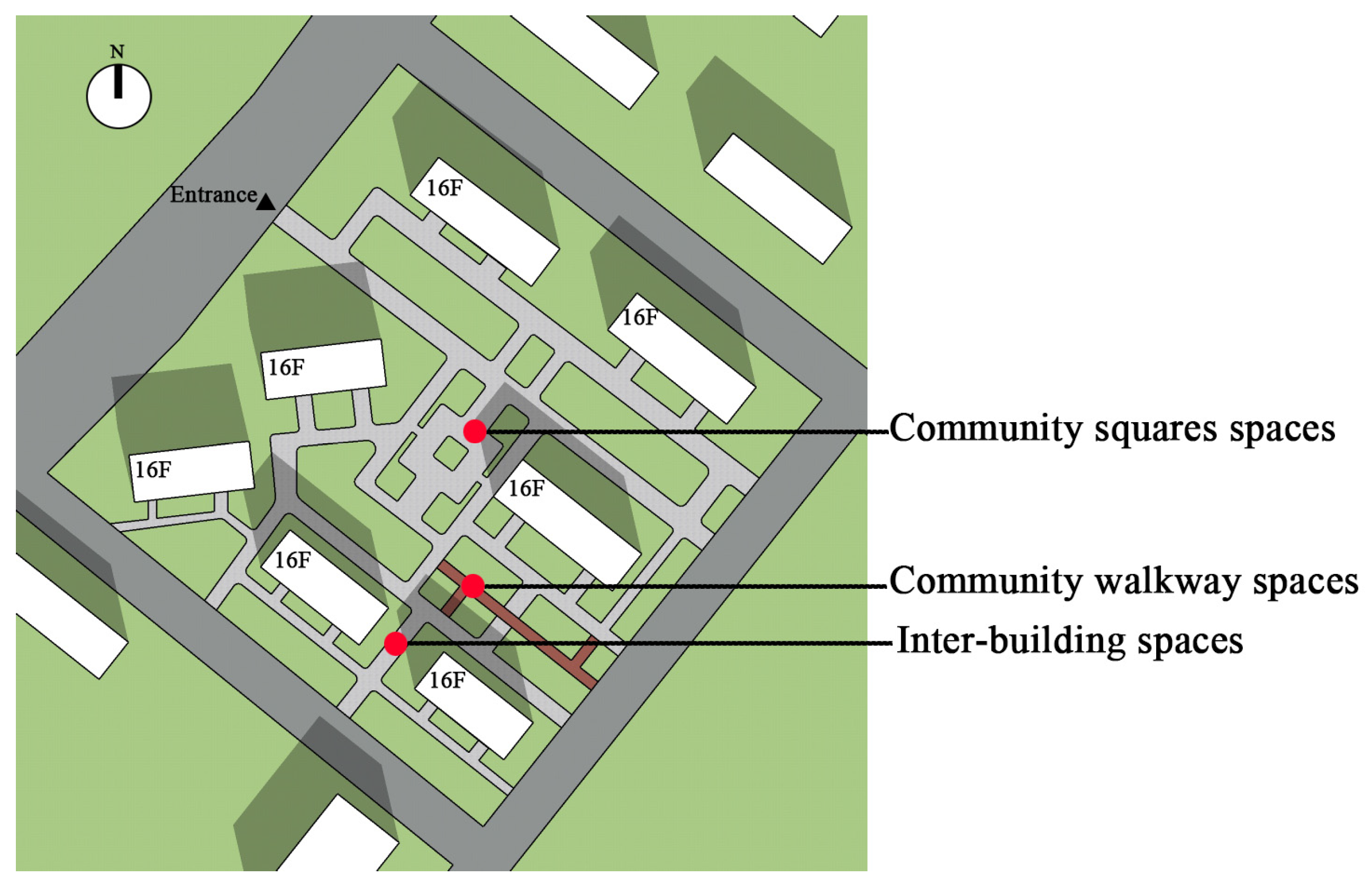
Findings are primarily generalizable to similar community typologies in cold-region cities of northern China; generalization to communities with substantially different layouts, densities, or green space ratios requires further study. Table 1 presents the detailed characteristics of the cold-region community outdoor landscape environments, while Figure 2 displays the site plan of the studied community.

2.2. Selection of Physiological Indicators

2.2.1. Eye Trackers

Depth perception theory holds that three-dimensional spatial information is lost on the retina and reconstructed through binocular vision, starting with form perception [35]. Gibson’s ecological theory of visual perception emphasizes that the visual world is defined by the relationship between objects and their backgrounds [36]. Thus, static photography is insufficient for capturing dynamic visual experiences.
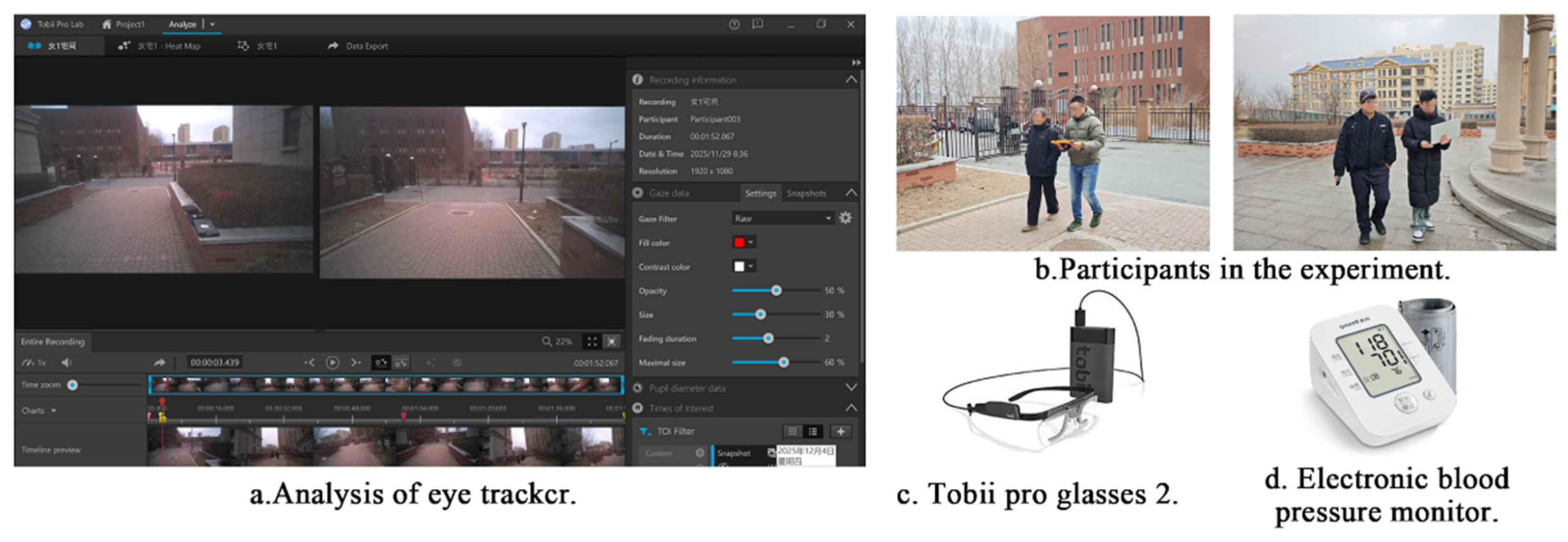
Chen et al. conducted eye tracking experiments in 360° virtual reality scenes to reveal differences in visual attention between natural and built environments [37], while Cui et al. examined how image attributes of hospital outdoor rest spaces affect employees’ eye movement metrics and self-reported recovery [25]. While these studies provide a foundation, the visual landscape perception characteristics of older adults in cold-region communities remain unclear, and age- and gender-based differences in visual attention require further investigation. To address this, community landscape environmental elements were screened using eye trackers. Tobii Pro Glasses 2 (Tobii, Stockholm, Sweden) were used to record scene videos and data streams (pupil size, saccade count, gyroscope, accelerometer, and TTL input), with visual output synchronized to a computer screen. The device meets minimum standards for eye tracking research [38], featuring binocular tracking with two cameras and six infrared markers per eye, a sampling rate of 50 Hz, and unrestricted head movement for participants. Data were annotated using either user-provided event classification algorithms or manual coding [39].
Scene snapshots were divided into eight Areas of Interest (AOIs): buildings, ground, sky, trees, lawn, sports facilities, artificial landscape, and signage. The eight AOIs were selected based on a preliminary field survey and pilot eye-tracking sessions with five older adults in the same community during the winter season (November 2025). In these pilot sessions, no significant fixations were recorded on winter-specific features such as snow cover, ice patches, windbreaks, or heated rest areas, as the community lacked permanent winter-specific street furniture. Snow cover was uniformly present across all spaces and did not attract differential visual attention; ice patches were infrequent due to routine snow removal and sanding. Therefore, these elements were not included as separate AOIs. However, we acknowledge that communities with different winter maintenance practices or dedicated winter amenities may yield different visual attention patterns, and future research should consider these elements as distinct AOIs.
Four eye movement metrics were analyzed: fixations, visits, glances, and saccades, with corresponding parameters including the number of fixation points (NF), number of visits (NV), total fixation duration (TFD), total glance duration (TGD), proportions of fixation time (PFD), and proportions of glance duration (PGD). Definitions and interpretations of the six eye-tracking metrics used in this study are summarized in Table 2.
Among the six eye-movement metrics collected, number of fixations (NF) was selected as the primary predictor in the HLM for the following reasons. First, from a theoretical perspective grounded in Attention Restoration Theory (ART), NF captures the frequency of attentional engagement—the number of discrete episodes in which a visual stimulus captures attention. This aligns with ART’s construct of “involuntary attention” to fascinating stimuli, which is theorized to facilitate restorative processes [11]. Second, during walking in outdoor environments, gaze patterns are inherently dynamic; NF represents the occurrence of attentional capture events, whereas duration-based metrics (e.g., proportional fixation duration, PFD) reflect sustained attention that may be influenced by individual differences in processing speed or walking pace. To further validate this choice, we conducted a robustness check using PFD as an alternative predictor (Supplementary Materials), which yielded consistent results.

2.2.2. BP Monitors

To ensure data reliability, the basic health status of all participants was evaluated using the 12-Item Short Form Health Survey (SF-12). Only participants with adequate health status (as determined by SF-12 screening) were included in subsequent experiments.
BP was selected as the primary physiological indicator, measured using Yuyue upper-arm electronic BP monitors (model YE680A). BP is a core index of cardiovascular function and a reliable marker of stress responses and recovery under environmental stimuli [40]. Key metrics included SBP (maximum vascular pressure during cardiac systole, reflecting immediate stress responses and recovery trends [41]), DBP (baseline vascular pressure during diastole, indicating autonomic nervous system regulatory efficiency [42]), and PP (the difference between SBP and DBP, reflecting overall cardiovascular adaptability to stress [43]). HR was also recorded, as it reflects autonomic and metabolic responses to environmental stimuli. These four metrics form an integrated system for evaluating cardiovascular stress and recovery.

2.3. Selection of Psychological Indicators

POMS, developed by McNair et al. in 1971, consists of 65 items across six emotional dimensions [44]. A Chinese version, revised by Professor Zhu Bailing in 1995 with established norms, has been widely used in mental health assessment [45], stress management [46], and education [47], and is recognized as a gold standard for emotion measurement [48,49]. This study used the POMS to collect subjective emotional evaluations of walking in the three community spaces. The scale includes seven subscales: Tension-Anxiety (T), Depression-Dejection (D), Anger-Hostility (A), Vigor-Activity (V), Fatigue-Inertia (F), Confusion-Bewilderment (C) and Self-related positive affect (S). A Chinese version, revised by Professor Zhu Bailing in 1995 with established norms, added a seventh subscale labeled “S” (Self-related positive affect) [50]. The “S” subscale comprises seven positive affect items (e.g., “friendly,” “considerate”) that assess positive interpersonal emotional states. While the “S” subscale was originally designed as a validity check in the Chinese adaptation, its items directly measure positive affect, which is theoretically relevant to environmental perception (restorative environments are expected to increase positive emotions).
Therefore, in the present study, the “S” subscale is treated as an analytic emotional dimension alongside the six original subscales. Responses were rated on a 5-point Likert scale (0 = “not at all” to 4 = “extremely”). A higher total score indicates poorer emotional states, while a lower score indicates more positive emotions. Previous studies have confirmed a stable association between POMS scores and BP, with mood fluctuations effectively predicting short-term BP changes [51,52], providing a basis for exploring mind–body interactions.

2.4. Experimental Procedure

Experiments were conducted in the Wanhehaoting Community, Changchun, Jilin Province (a cold-region city in China), over 10 consecutive days from November to December 2025, between 7:00 and 11:00 AM (under soft sunlight). The average outdoor temperature during the study period was 3 °C, with a north wind of 2–3 m/s. A total of 44 participants (21 males, 23 females) were recruited randomly, aged 60–74 years (mean age: 65 years; males: 64 years, females: 66 years). The sample size was determined based on a pre-test power analysis, which indicated a minimum requirement of 36 participants. To account for potential attrition, we recruited 44 participants.
All participants provided informed consent and were approved by the Ethics Review Committee of Jilin Jianzhu University (approval number: [JLJU-2025089]), in compliance with the Declaration of Helsinki. After excluding invalid data (e.g., low sampling rates), 38 valid eye movement datasets were retained, yielding an effective sample rate of 86.4%. Calibration was performed prior to each walking session using the Tobii Pro Glasses 2 manufacturer’s protocol with a 9-point grid. Calibration was repeated until the accuracy of gaze estimation exceeded 80% for both eyes. During outdoor walking in cold-winter conditions (ambient temperature approximately 3 °C), data loss occurred primarily due to condensation on the lenses or movement artifacts from participants adjusting their clothing or glasses. When feasible, the walking session was repeated to minimize data loss. Of the 44 recruited participants, 6 were excluded from eye-tracking analysis due to insufficient valid gaze data (<80% sampling rate) or failed calibration. A total of 38 participants (20 males, 18 females) were included in the eye-tracking analysis and the HLM analysis, as the HLM required complete fixation data as independent variables. All 44 participants were included in the descriptive statistics and Mann–Whitney U tests for BP and POMS scores, as these measurements were successfully obtained from all participants.
This study employs a quasi-experimental field research design. While sacrificing the strict controllability of a laboratory setting, it ensures high ecological validity by capturing the genuine psychophysiological responses of older adults within their everyday living environments.
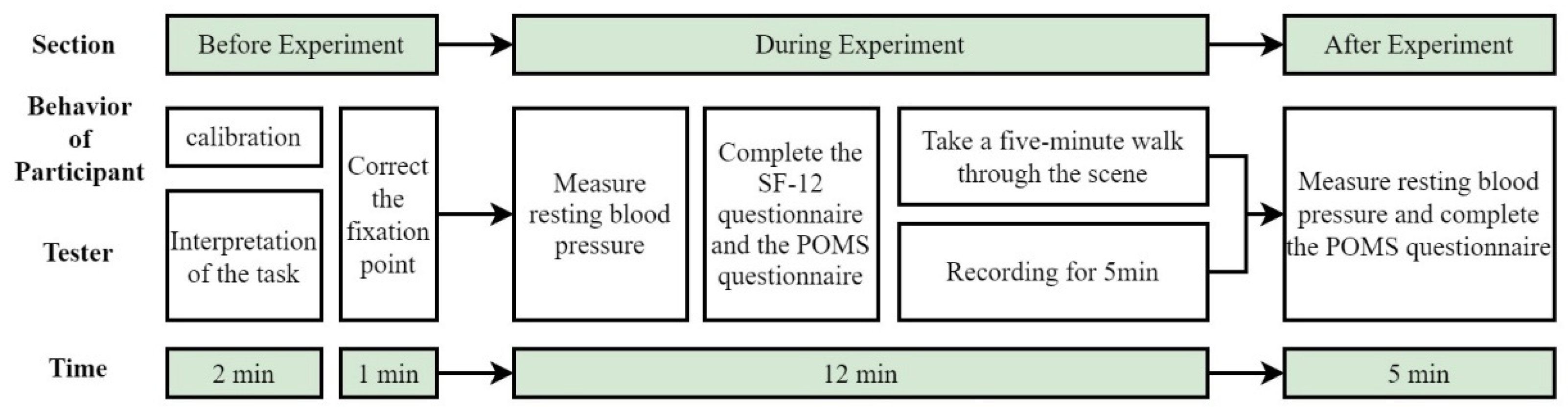
The experimental procedure was conducted as follows: First, the eye tracker was calibrated using the manufacturer-provided protocol. Calibration steps included: (a) affixing a marker at the center of the stimulus grid; (b) instructing participants to maintain fixation on the marker’s center; and (c) initiating calibration mode in the Tobii software, after which the process proceeded automatically. Prior to the formal experiment, the tester briefed participants on the experimental tasks and performed pre-experimental equipment debugging. At the start of the formal experiment, resting-state BP indices (SBP, DBP, PP and HR) were measured and recorded. Participants then completed the POMS questionnaire in the resting state. Next, participants and the tester sat quietly in the inter-building space for 5 min. Following this, participants donned the eye-tracking device, and the tester assisted with gaze-point calibration. The tester started the timer, and participants were instructed to walk naturally for 5 min. Immediately after walking, post-exposure BP indices (SBP, DBP, PP and HR) were measured, and participants completed the POMS questionnaire again. This procedure was then repeated sequentially in the community walkway spaces and community square spaces. All participants were required to walk at the same speed in the three spaces.
Blood pressure was measured using a Yuyue upper-arm electronic BP monitor (model YE680A), which is clinically validated for field use in ambient temperatures ranging from 0 °C to 40 °C. The device was acclimatized to outdoor conditions for 15 min before each session. A resting baseline measurement was taken at the beginning of the session with participants seated after 5 min of quiet rest. After each 5 min walking segment in a space, participants were seated, and BP was measured within one minute to capture immediate physiological responses. The same arm (left) and cuff position were used consistently for all measurements. Participants were seated with feet flat on the floor and the arm supported at heart level. Single measurements were taken to minimize participant burden and session duration; we acknowledge that averaging multiple readings would improve reliability, which is noted as a limitation.
A continuous environmental exposure design was employed, with participants experiencing the three community space types in the fixed order: inter-building spaces → community walkway spaces → community square spaces. This order was selected to minimize cognitive load and physical fatigue, as inter-building spaces represent the most familiar and proximate daily environment for participants, while community squares represent the most open and potentially demanding setting. The sequence was intended to simulate a natural progression from private to public space. However, we acknowledge that this non-randomized order may introduce sequence or carry-over effects. Future studies should consider counterbalancing or randomizing the order of space presentation to control for such effects. Figure 3 displays the computer screen and participants during the experiment; participant faces were anonymized via blurring to protect personal information. Detailed experimental procedures are illustrated in Figure 4.

2.5. Statistical Analysis

The study employed the Mann–Whitney U test in IBM SPSS Statistics 26 to compare differences in SBP, DBP, PP, HR, and POMS scores among elderly individuals of different genders across three types of community environments. Due to multiple comparisons, a Bonferroni correction was applied. A total of 15 comparisons were conducted (3 space types × 5 indicators: SBP, DBP, PP, HR, and POMS scores). Therefore, the corrected significance threshold was set at α = 0.05/15 ≈ 0.0033. Given the exploratory nature of this study, we present both significant and non-significant findings with effect sizes to indicate the magnitude of differences, and we interpret results with the appropriate caution.
Subsequently, Pearson correlation analyses examined visual focus on various elements of the community landscape space, POMS affective evaluations, and BP indicators among the elderly. In contrast, the correlation analyses (Section 3.3) are presented as exploratory and hypothesis-generating, with no formal multiple-comparison correction applied. For the correlation analysis involving visual fixation points, the study included 38 participants, as these analyses required valid eye-tracking data. For the correlation analysis of bp and the POMS, the study included 44 participants, as this analysis did not require eye-tracking data. The study aimed to clarify the main effects of visual perception factors on BP indicators, identify the BP indicator most sensitive to environmental changes, and explore associations among visual focus on landscape elements, POMS affective evaluations, and BP indicators.
Given the nested data structure (measurement points nested within individuals) and the absence of control for individual variation, the HLM was employed for further validation and depth. Model construction proceeded in three steps: first, a null model was established to calculate the ICC and assess the necessity of using a HLM. Second, a random intercept model was developed, incorporating Level-1 variables (visual gaze points) as fixed effects and Level-2 variables (gender, age) as intercept predictors. The model equations were:
Level - 1 :   Y i j = β 0 j + β 1 j ( G r o u n d i j ) + β 2 j ( T r e e s i j ) + + r i j
Level - 2 :   β 0 j = γ 00 + γ 01 ( G e n d e r j ) + γ 02 ( A g e j ) + u 0 j
β 1 j = γ 10
where γ 10 reflects the net effect of visual elements on BP after controlling for individual variation.
Finally, a random slope model was established, allowing the slope of visual elements to vary across individuals, and introducing Gender × Visual elements to examine gender-moderation effects. All continuous variables underwent grand-mean centering prior to model entry. Model estimation employed REML, and statistical analysis was performed using IBM SPSS Statistics 26.

3. Results

3.1. Physiological Indicator Results

3.1.1. Eye-Tracking Interest Point Analysis Across Three Community Landscape Spaces

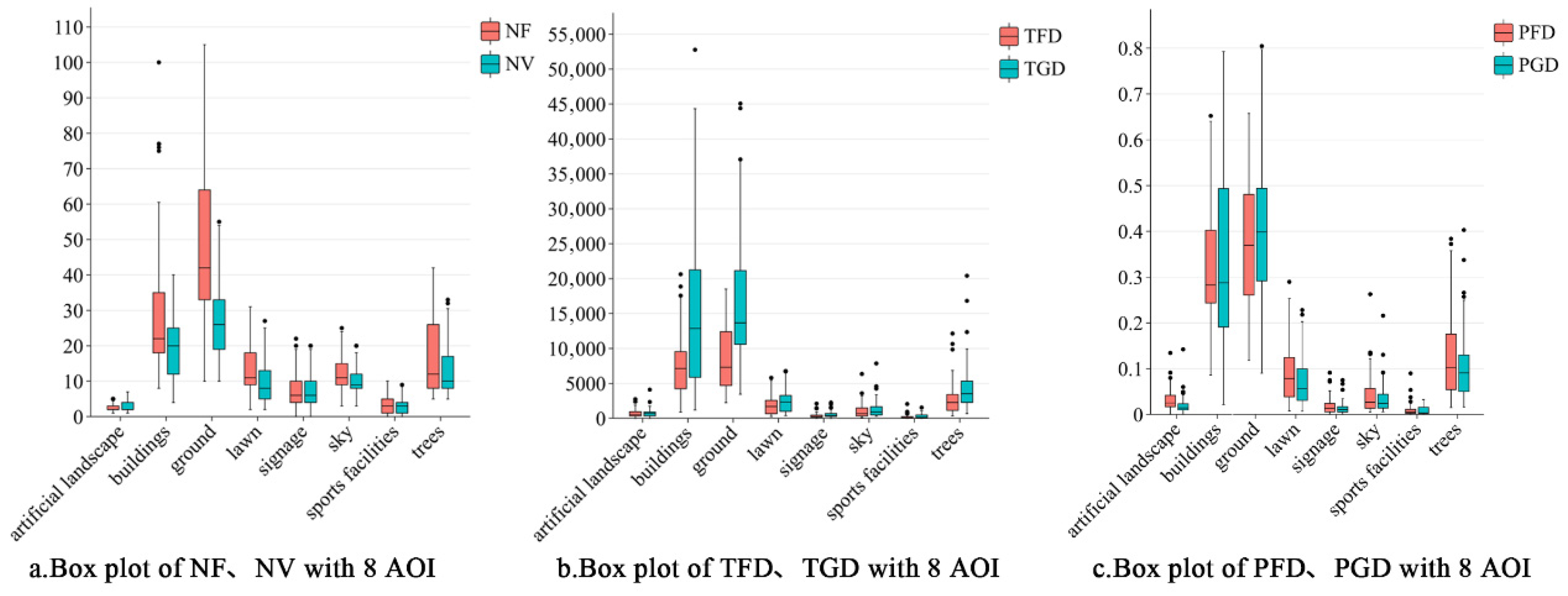
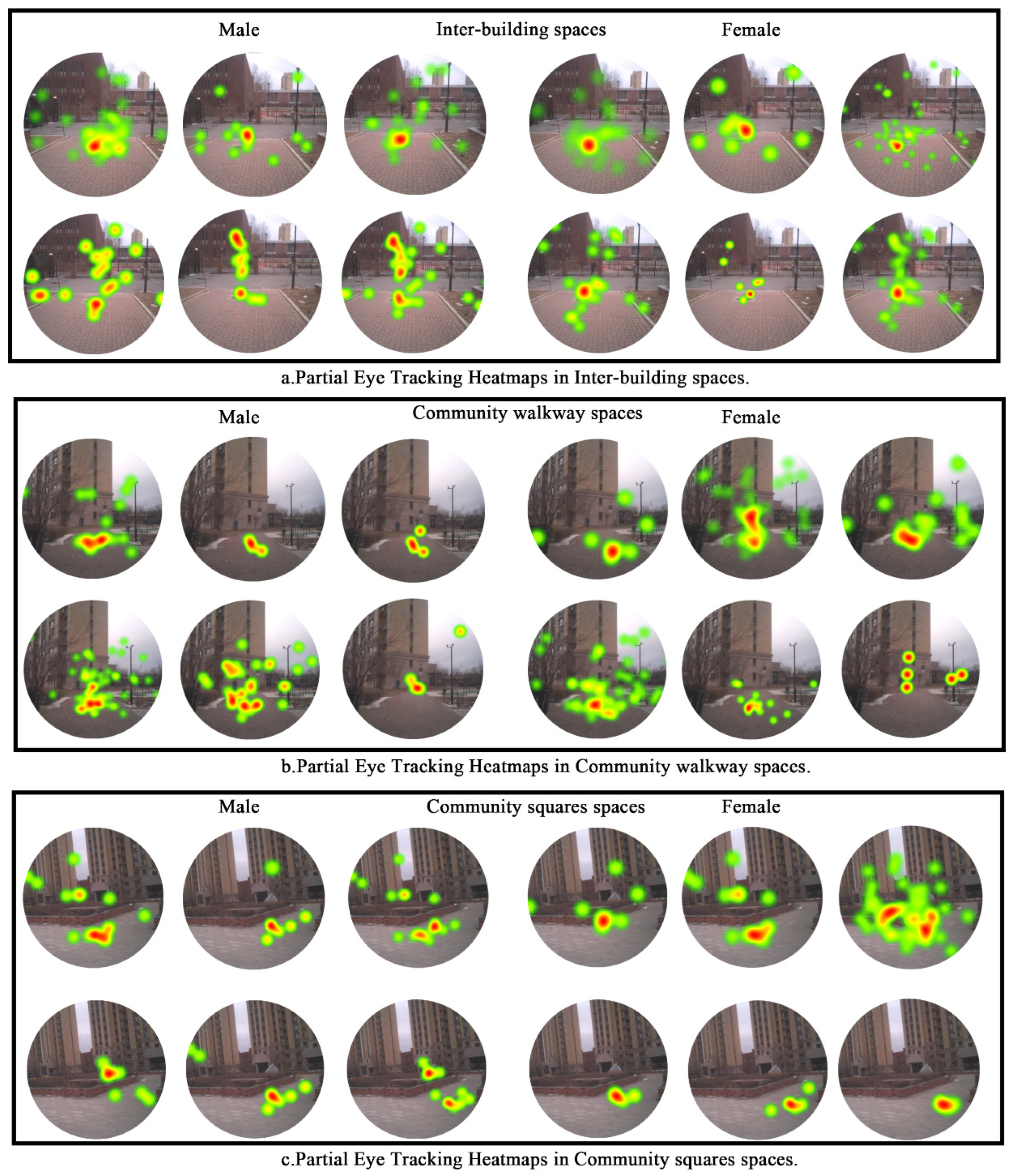
The eye-tracking experiment aimed to identify the visual interest points of older adults in three cold-region community landscape spaces and characterize their visual attention patterns during walking. Figure 5 presents screen heatmaps of eye-movement features recorded while participants walked in inter-building spaces, community walkways, and community squares (The color changes from green to red to indicate an increase in the number of views). Below are the data analysis results for each space:
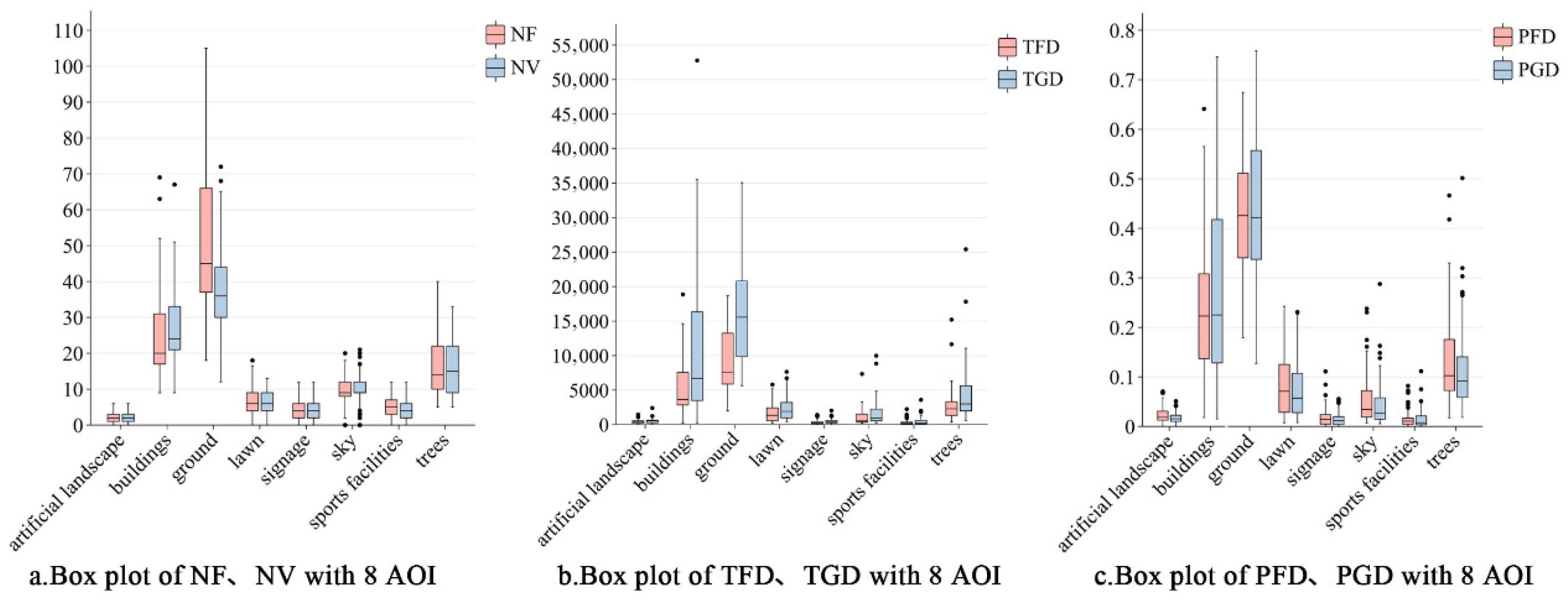
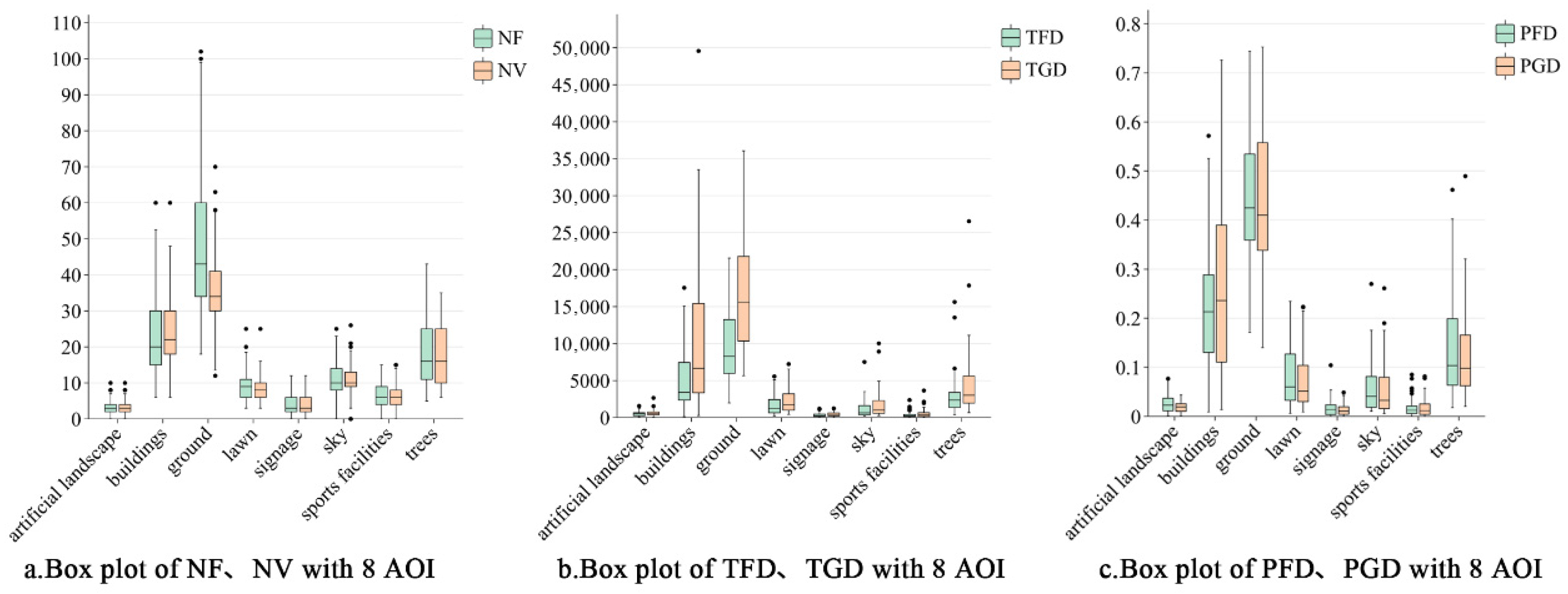
Inter-building spaces: As shown in Figure 6a, the mean values of NF and NV across areas of interest (AOIs) followed the order: ground > buildings > trees > sky > lawn > signage > sports facilities > artificial landscape. For TFD and TGD (Figure 6b), the order was: ground > buildings > trees > lawn > sky > artificial landscape > signage > sports facilities. PFD and PGD (Figure 6c) exhibited the same hierarchy: ground > buildings > trees > lawn > sky > artificial landscape > signage > sports facilities. These results indicate consistent fixation and saccade patterns among older adults walking in inter-building spaces. Older adults prioritized attention to the ground, buildings, trees, and lawn over the sky, artificial landscape, signage, and sports facilities—likely due to heightened concerns about ground safety and situational awareness of surrounding buildings. The winter setting (with small, point-like spatial configurations) may explain the limited attention to small-scale signage and sports facilities.
Community walkway spaces: Figure 7a shows that NF and NV followed the order: ground > buildings > trees > sky > lawn > sports facilities > signage > artificial landscape. For TFD (Figure 7b), the order was: ground > buildings > trees > lawn > sky > artificial landscape > sports facilities > signage; TGD followed: ground > buildings > trees > lawn > sky > artificial landscape > signage > sports facilities. Notably, sky-related NF and NV exceeded those of lawn, while lawn-related TFD and TGD were longer than those of the sky. This may reflect the linear, highly guiding nature of walkways, which increased brief upward glances at the sky but sustained attention to the lawn. PFD and PGD (Figure 7c) followed: ground > buildings > trees > lawn > sky > artificial landscape > signage > sports facilities. Older adults’ visual attention focused primarily on the ground, buildings, trees, lawn, and sky—consistent with inter-building spaces—but with higher PFD and PGD for the ground, suggesting greater emphasis on walkway safety.
Community square spaces: As shown in Figure 8a, NF and NV followed: ground > buildings > trees > sky > lawn > sports facilities > artificial landscape > signage. TFD and TGD (Figure 8b) and PFD and PGD (Figure 8c) shared the same order: ground > buildings > trees > lawn > sky > artificial landscape > signage > sports facilities. While the ground, buildings, trees, sky, and lawn remained the top priorities, sports facilities ranked higher in NF/NV than artificial landscape and signage—likely due to their high visibility in open square spaces. However, sports facilities exhibited lower TFD, TGD, PFD, and PGD, indicating limited sustained visual engagement.

3.1.2. BP Indicators

IBM SPSS Statistics 26 was used to analyze BP and HR data. All data were standardized to eliminate dimensional bias, and descriptive statistics (mean ± SD) were calculated. Participants included 21 males (mean age: 64 ± 2.02 years) and 23 females (mean age: 66 ± 3.68 years). SF-12 scores confirmed good overall health, with no significant group differences in age or health status.
We used the Mann–Whitney U test to compare gender differences in SBP, DBP, PP, HR, and POMS scores across the three spatial types. Effect sizes (r) were computed to quantify the magnitude of differences, with r = 0.1, 0.3, and 0.5 indicating small, medium, and large effects, respectively. The results are summarized in Table 3 and Table 4.
As shown in Table 4, SBP showed no significant gender differences in any of the three spaces (all p > 0.05). For DBP, no gender differences were observed in inter-building spaces or walkways, but a significant difference emerged in the community square (U = 114.5, p = 0.004, r = 0.44), indicating a medium-to-large effect. This suggests that DBP is environmentally dependent in squares. PP and HR showed no significant gender differences across any space (all p > 0.05).

3.2. Results of the POMS Questionnaire

The POMS questionnaire scores reflect participants’ perception and evaluation of the landscape environments. Data analysis revealed suggestive gender–environment interaction patterns. As summarized in Table 4, females had higher total POMS scores than males in inter-building spaces (10.91 vs. 9.19) and walkways (9.61 vs. 7.33), whereas males scored higher than females in squares (10.10 vs. 6.82).
The raw p-values for these differences were 0.016, 0.020, and 0.012, respectively, each with a medium-to-large effect size (r = 0.35–0.38). After applying Bonferroni correction for 15 comparisons, the adjusted significance threshold was α = 0.0033. None of the raw p-values reached this corrected threshold. Therefore, these differences should be interpreted as suggestive patterns rather than statistically significant findings.
The medium-to-large effect sizes indicate that these patterns are practically meaningful and warrant further investigation in larger samples. Given the exploratory nature of this analysis, the results should be considered hypothesis-generating rather than confirmatory.
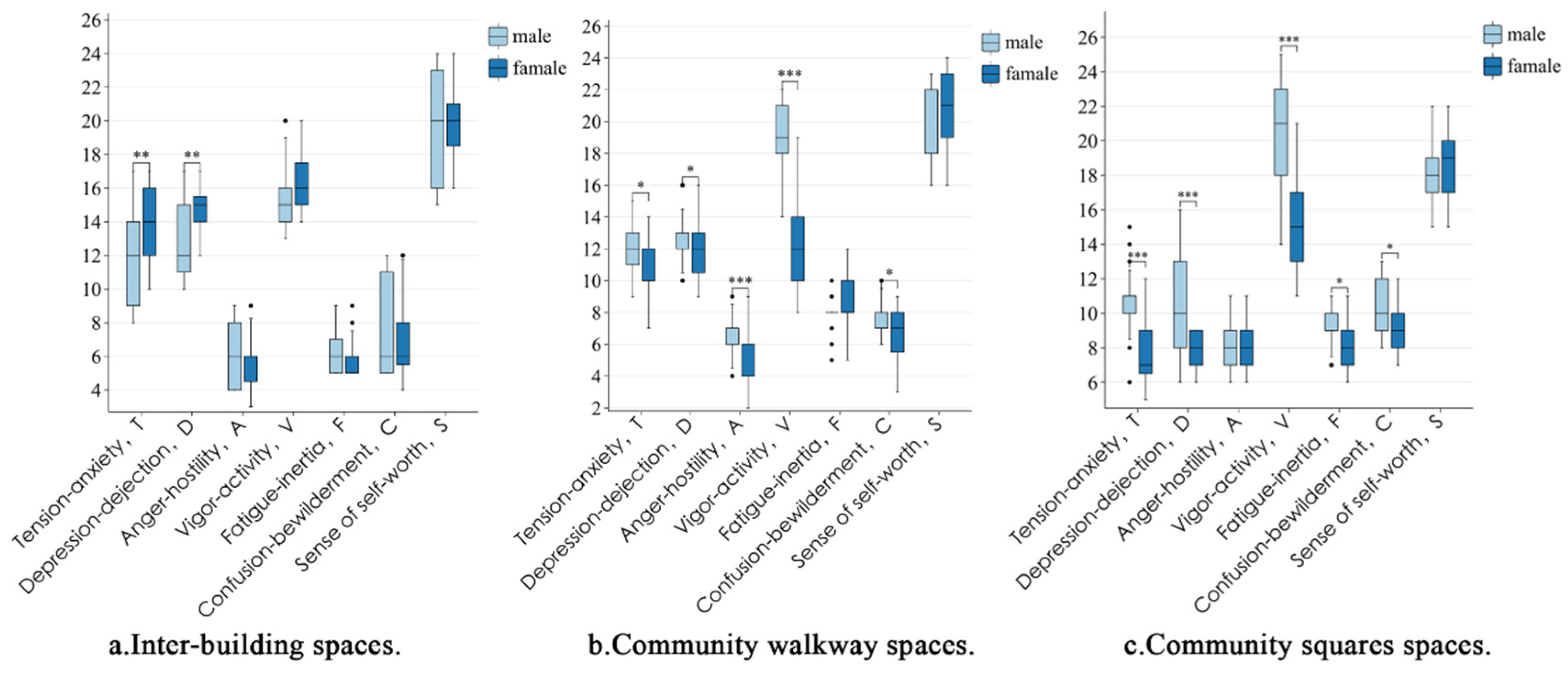
Gender differences in the seven POMS subscales were also examined (Figure 9). In inter-building spaces (Figure 9a), women scored higher on T and D. In walkways (Figure 9b), men scored higher on A and V—with V markedly higher than A—while women tended to score higher on F. In squares (Figure 9c), men showed higher values on T, D, and V. Notably, women’s T and D scores gradually decreased from inter-building spaces to squares, whereas men’s V scores were higher in both walkways and squares.

3.3. Correlation

The correlation analyses presented in Section 3.3.1, Section 3.3.2 and Section 3.3.3 are exploratory and hypothesis-generating. Their primary purpose is to identify potential patterns of association between visual attention points, blood pressure indicators, and POMS emotional dimensions that can be subsequently tested using the HLM (Section 3.4). Given the large number of bivariate comparisons (eight AOIs × seven POMS dimensions × four blood pressure indicators × two gender groups, totaling over 200 pairwise comparisons), no formal multiple-comparison correction was applied. Instead, we use a descriptive threshold of |R| > 0.20 to identify patterns of interest. These exploratory findings should be interpreted with appropriate caution.

3.3.1. Correlation Between Visual Attention Points and POMS Emotional Evaluation

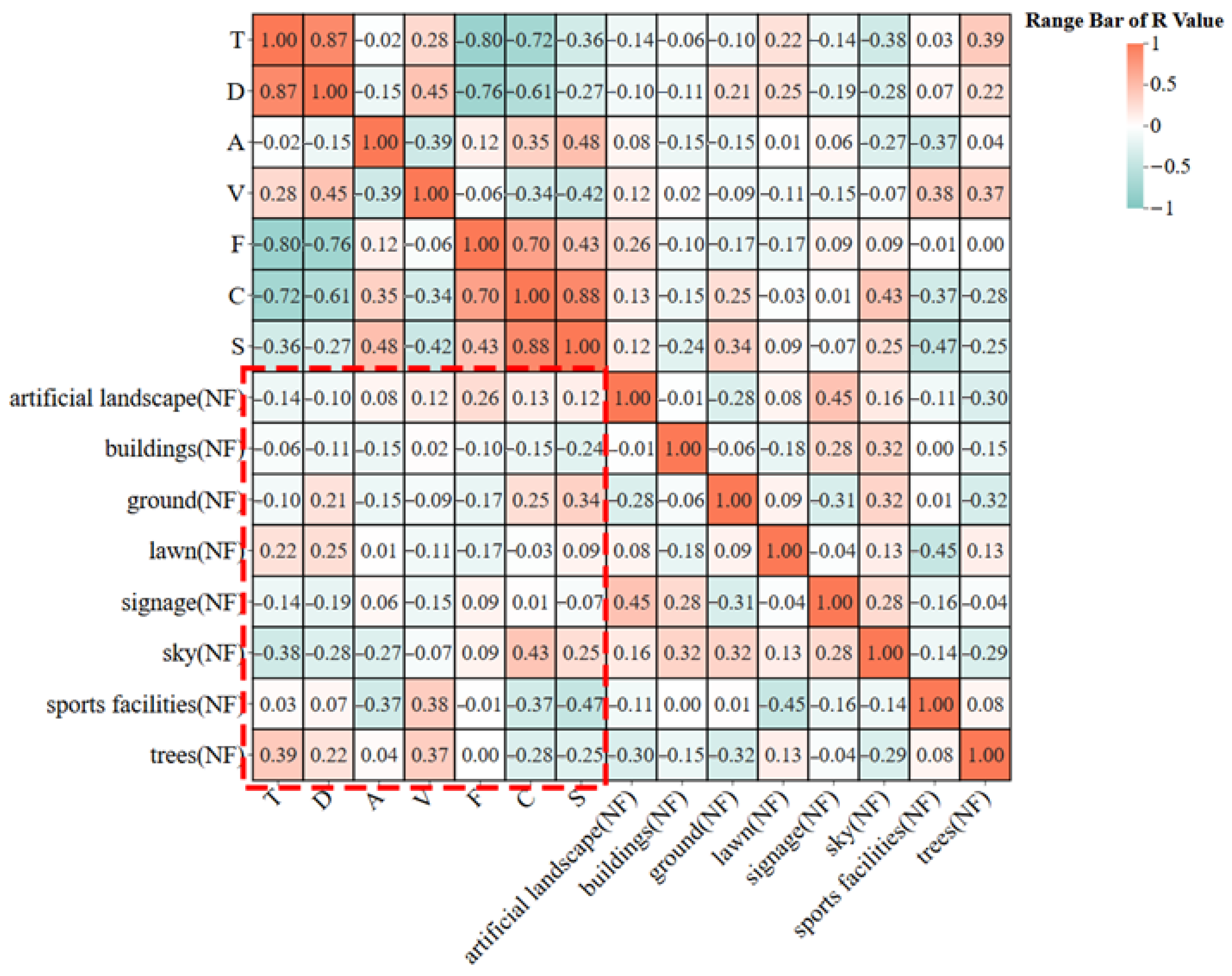
For elderly men (Figure 10), T was positively associated with fixation on trees (R = 0.39) and lawn (R = 0.22), and negatively with sky (R = −0.38). D showed similar patterns (ground, lawn, trees positive; sky negative). A was negatively correlated with sky and sports facilities. V was positively associated with sports facilities (R = 0.38) and trees (R = 0.37). F correlated positively with artificial landscape. C was positively associated with the ground and sky, and negatively with sports facilities and trees. S was positively associated with the ground and sky, and negatively with buildings, sports facilities, and trees.
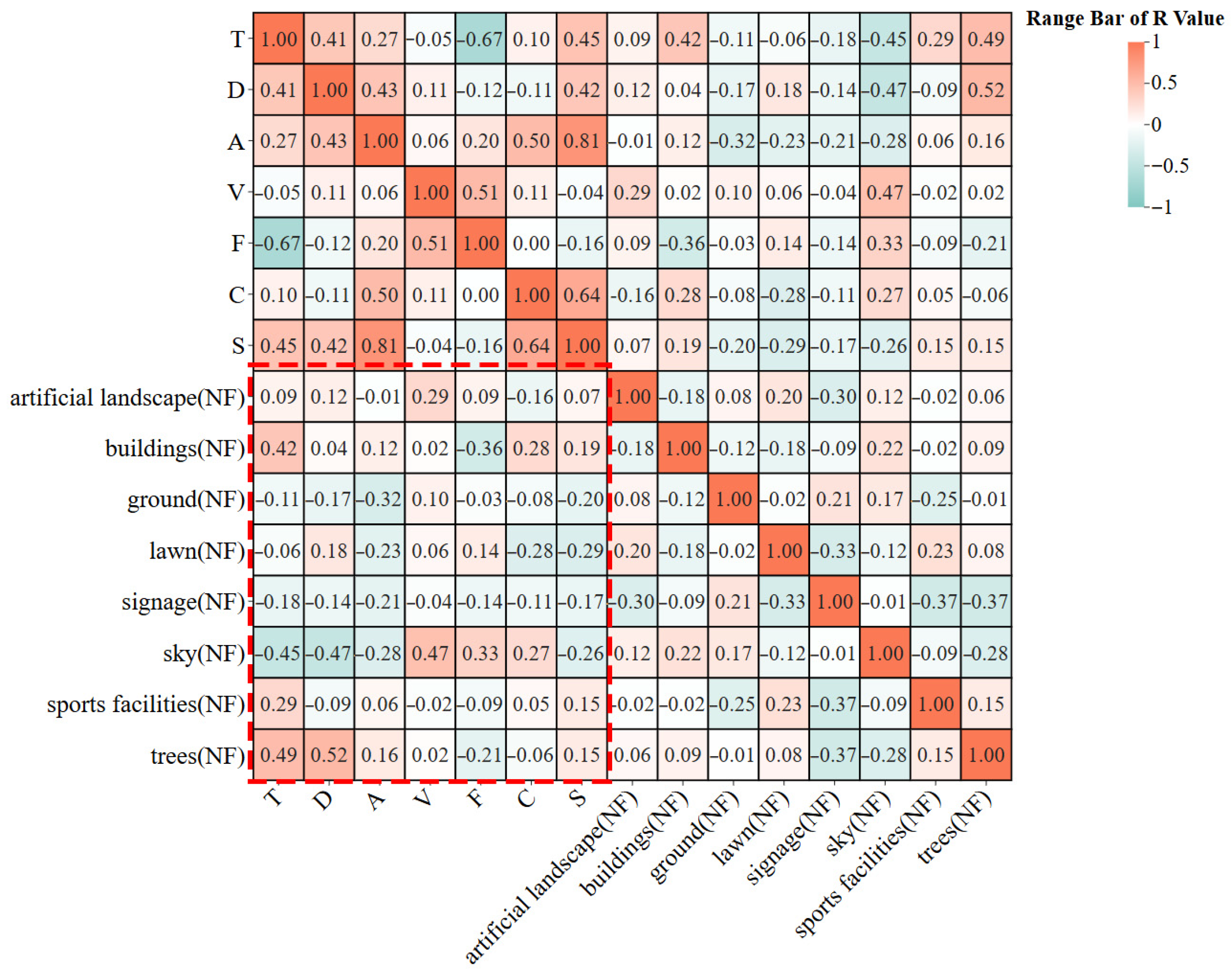
For elderly women (Figure 11), T was most strongly correlated with trees (R = 0.49), followed by buildings (0.42) and sports facilities (0.29), and negatively with the sky (R = −0.45). D was moderately positively correlated with trees (0.52) and negatively with the sky (−0.47). A was negatively associated with the ground, lawn, signage, and sky. V was positively associated with artificial landscape (0.29) and the sky (0.47). F was positively correlated with the sky (0.33) and negatively with buildings (−0.36) and trees (−0.21). C was positively correlated with buildings (0.28) and the sky (0.27), and negatively with lawn (−0.28). S was negatively correlated with the ground, lawn, and sky.
Women’s tension and depression were more strongly influenced by trees than men’s, possibly because bare deciduous trees in winter trigger negative emotions and women are generally more environmentally sensitive. Sky viewing was associated with increased vigor in both genders but also with higher fatigue and confusion, especially in women. Sports facilities were linked to vigor in men but not in women. These exploratory correlations provided the foundation for the subsequent HLM analysis (Section 3.4).

3.3.2. Correlation Between Visual Focus and BP Indicators

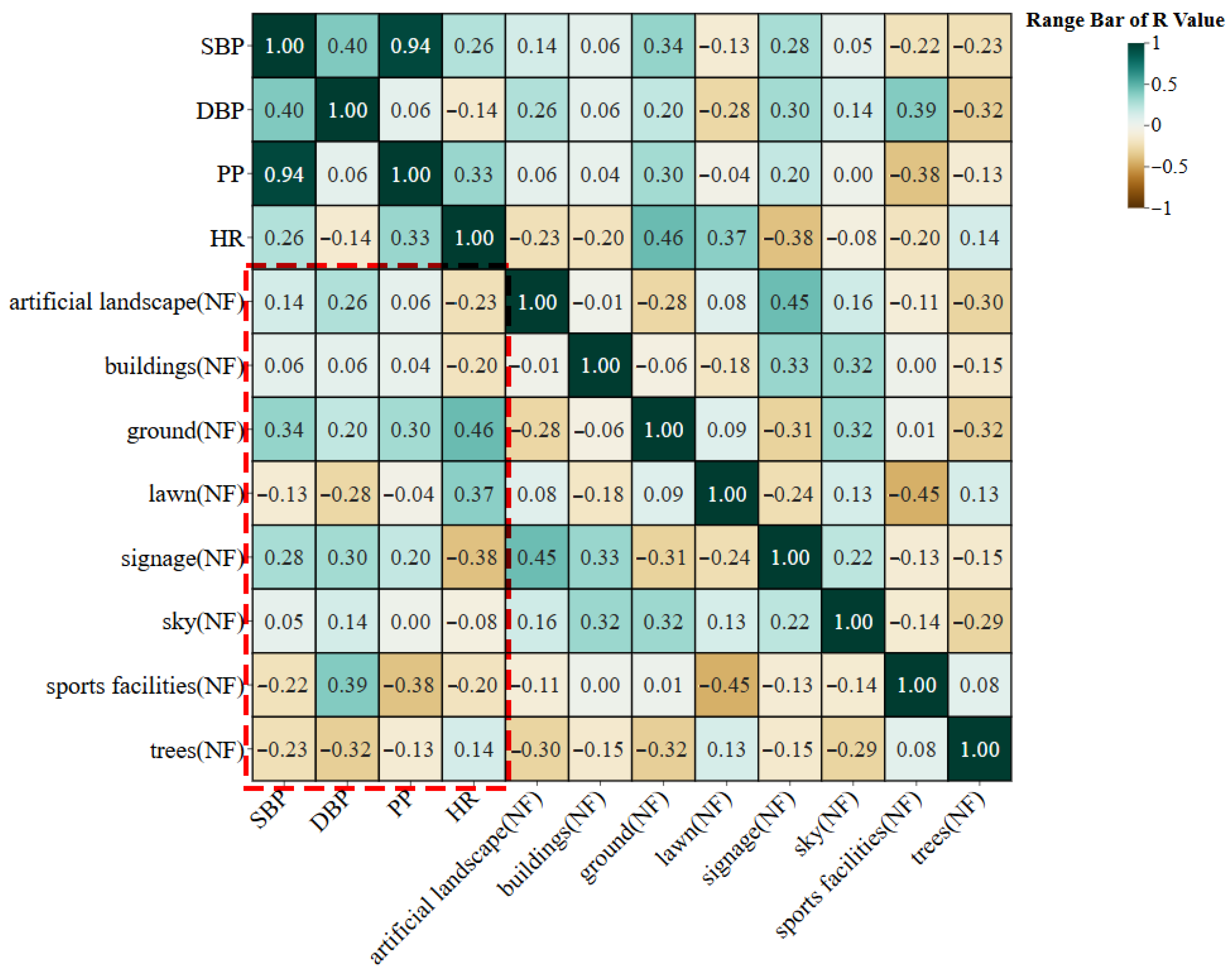
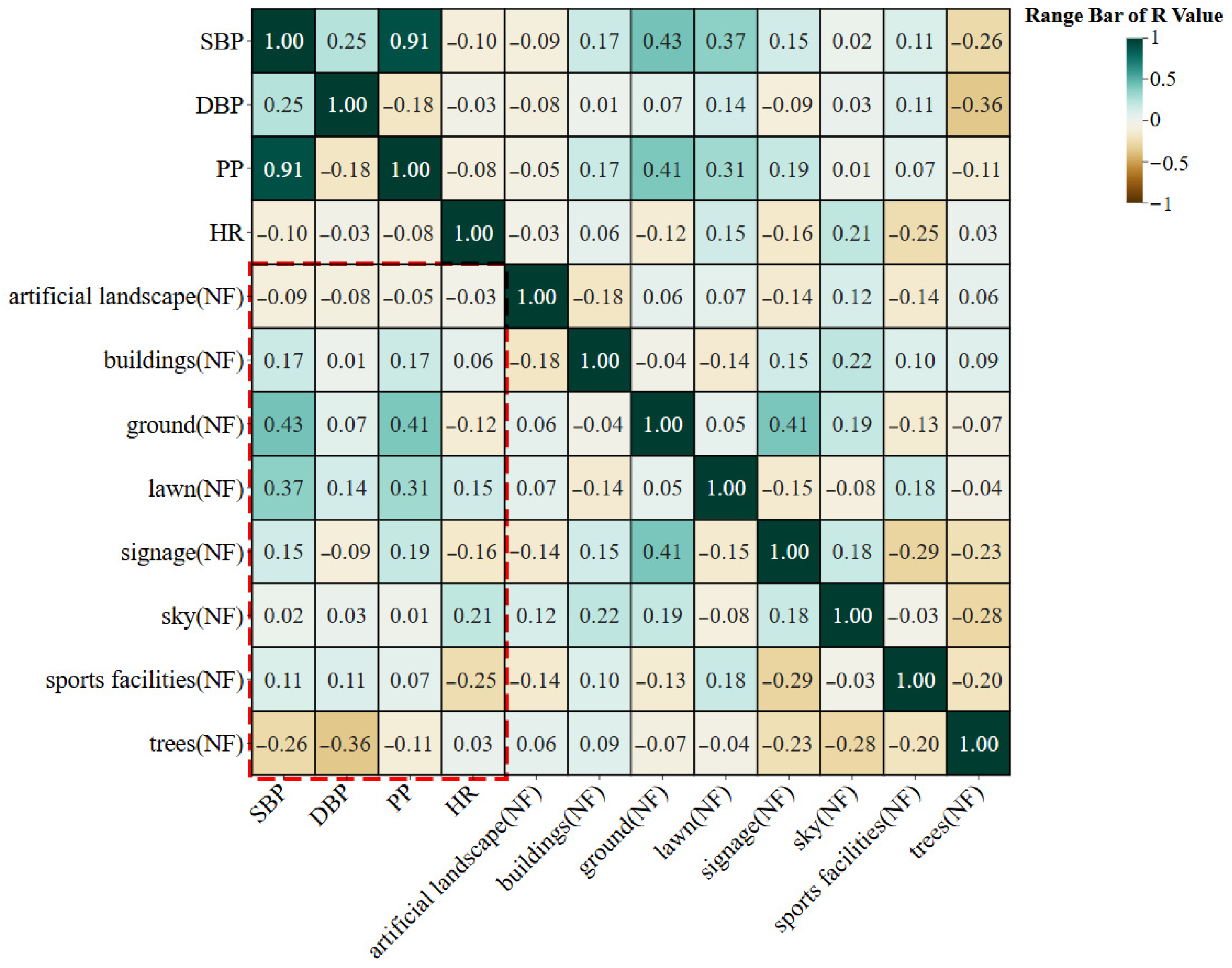
Pearson correlations were calculated between fixation counts (NF) on the eight AOIs and blood pressure indicators (SBP, DBP, PP, HR) separately for elderly men and women. The full correlation matrices are shown in Figure 12 (males) and Figure 13 (females).
For elderly men (Figure 12), SBP was positively correlated with the ground (R = 0.34) and signage (0.28), and negatively with sports facilities (−0.22) and trees (−0.23). DBP was positively correlated with artificial landscape (0.26), the ground (0.20), signage (0.30), and sports facilities (0.39), and negatively with lawn (−0.28) and trees (−0.32). PP was positively correlated with the ground (0.30) and signage (0.20), and negatively with sports facilities (−0.38). HR was positively correlated with the ground (0.46) and lawn (0.37), and negatively with artificial landscape (−0.23), buildings (−0.20), signage (−0.38), and sports facilities (−0.20).
For elderly women (Figure 13), SBP was positively correlated with the ground (0.43) and lawn (0.37), and negatively with trees (−0.26). DBP showed a negative correlation with trees (−0.36). PP was positively correlated with the ground (0.41) and lawn (0.31). HR was positively correlated with the sky (0.21) and negatively with sports facilities (−0.25).
Ground fixation was positively associated with SBP in both genders, with a stronger effect in women, possibly reflecting greater safety concerns and stress responses. Trees were negatively associated with SBP in both genders, suggesting a stress-reducing effect. Sports facilities were linked to higher DBP only in men, which may relate to men’s higher engagement with exercise equipment. These gender-differentiated patterns require further validation through the HLM (Section 3.4).

3.3.3. Correlation Between BP Indicators and POMS Emotional Evaluation

Pearson correlations were calculated between the seven POMS subscales and blood pressure indicators (SBP, DBP, PP, HR) separately for elderly men and women. The full correlation matrices are shown in Figure 14 (males) and Figure 15 (females).
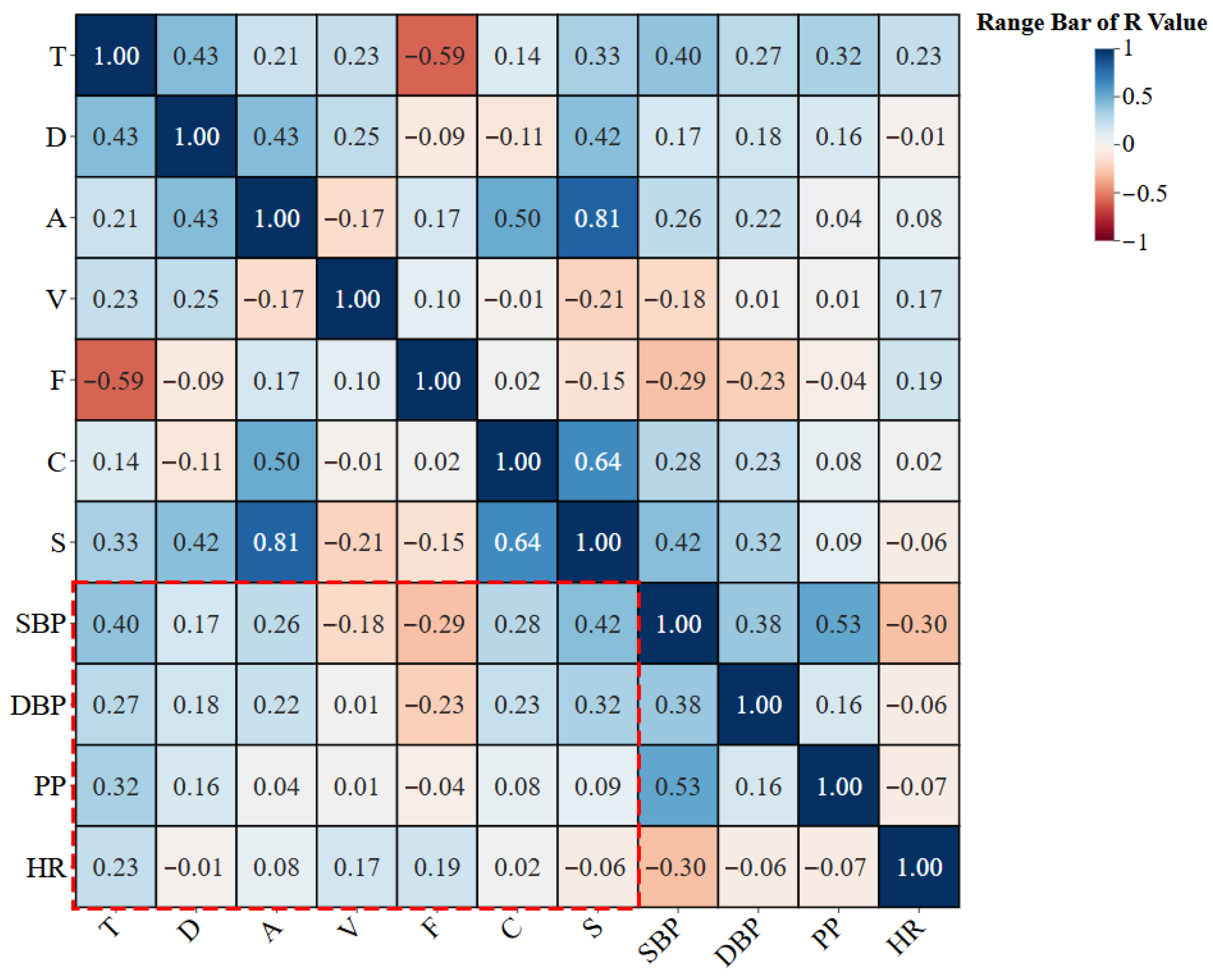
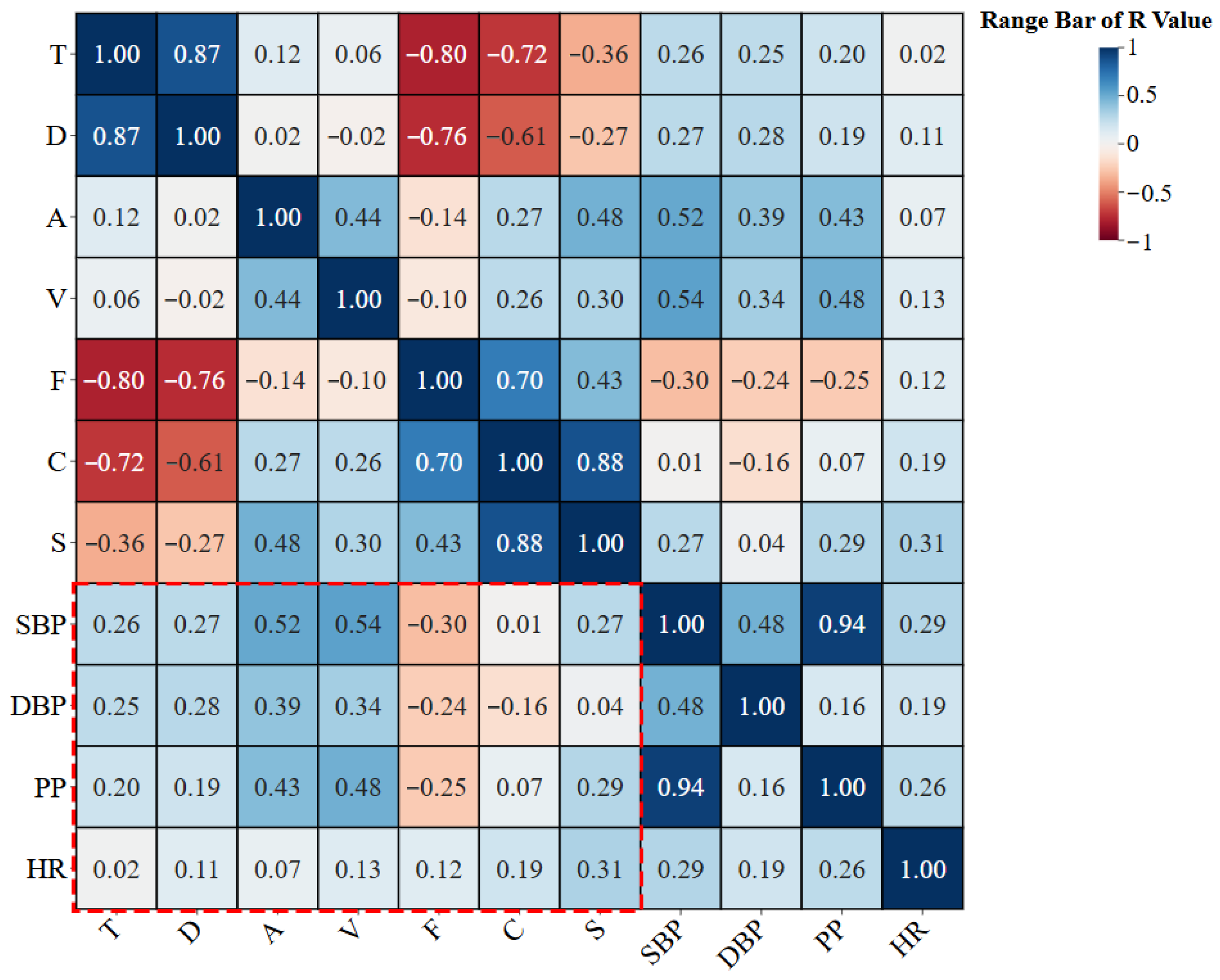
For elderly men (Figure 14), T was positively correlated with SBP (0.26), DBP (0.25), and PP (0.20). D was positively correlated with SBP (0.27) and DBP (0.28). Anger-hostility (A) showed strong positive correlations with SBP (0.52), DBP (0.39), and PP (0.43). V showed strong positive correlations with SBP (0.54), DBP (0.34), and PP (0.48). F was negatively correlated with SBP (−0.30), DBP (−0.24), and PP (−0.25). C showed no notable correlation with any BP indicator. S was positively correlated with SBP (0.27), PP (0.29), and HR (0.31).
For elderly women (Figure 15), T was positively correlated with SBP (0.40), DBP (0.27), PP (0.32), and HR (0.23). D showed no significant correlation with BP indicators. A was positively correlated with SBP (0.26) and DBP (0.22). V showed no significant correlation with BP indicators. F was negatively correlated with SBP (−0.29) and DBP (−0.23). C was positively correlated with SBP (0.28) and DBP (0.23). S was strongly positively correlated with SBP (0.42) and DBP (0.32).
Women showed stronger BP associations with T, while men showed stronger associations with A and V. F was negatively correlated with BP in both genders. These patterns suggest that emotional influences on BP differ by gender, and they motivate the more rigorous HLM analysis presented next (Section 3.4).
These exploratory correlations identify potential patterns of interest. The following section (Section 3.4) presents HLM results, which provide more robust estimates by accounting for the nested data structure and controlling for individual differences.

3.4. Results of HLM Analysis

Due to the nested structure of the data (repeated measurements across three spatial types nested within 38 elderly individuals), traditional regression models cannot satisfy the assumption of observation independence. To simultaneously estimate within-subject variation (changes in the same elderly individual across different environments) and between-subject variation (inherent differences among different elderly individuals), this study employed a HLM for analysis. Model construction proceeded in three stages: null model, random intercept model, and random slope model. All continuous predictor variables underwent grand-mean centering prior to model entry. Statistical analyses were performed using IBM SPSS Statistics 26.

3.4.1. Null Model and ICC Calculation

The results for all physiological outcomes are summarized below: SBP: between-individual variance ( τ 00 ) = 158.42, within-individual variance ( σ 2 ) = 336.71 and ICC = 0.32. DBP: between-individual variance ( τ 00 ) = 98.27, within-individual variance ( σ 2 ) = 220.43 and ICC = 0.31. PP: between-individual variance ( τ 00 ) = 114.81, within-individual variance ( σ 2 ) = 256.92 and ICC = 0.31. HR: between-individual variance ( τ 00 ) = 42.15, within-individual variance ( σ 2 ) = 96.78 and ICC = 0.30. Null model analysis results showed that, using SBP as an example, the between-subject variance ( τ 00 ) was 158.42, and the within-subject variance ( σ 2 ) was 336.71, yielding an ICC of 0.32. This indicates that 32% of total BP variation stems from between-subject differences (e.g., inherent traits like age, gender, baseline health status), while 68% originates from within-subject variation (i.e., changes in the same elderly individual across different spatial environments). Since the ICC exceeds the critical threshold of 0.1, confirming significant within-group correlation, it is reasonable to employ a multilevel linear model for analysis.

3.4.2. Random Intercept Model: Environmental Effects Controlling for Individual Variation

The random intercept model incorporates Level 1 predictor variables (NF per AOI) as fixed effects, while Level 2 predictor variables (gender, age) serve as predictors for the intercept. As shown in Table 5 and Table 6, after controlling for gender and age, multiple visual elements remained significantly correlated with BP indicators:
Ground (NF) showed a significant positive correlation with SBP ( γ = 0.31 ,   S E = 0.12 ,   p = 0.011 ), indicating that each additional unit of visual attention to the ground was associated with an average increase of 0.31 mmHg in SBP. This effect was independent of individual characteristics, suggesting that ground-related visual load directly induces physiological arousal.
Trees (NF) showed a significant negative correlation with SBP ( γ = 0.24 ,   S E = 0.10 ,   p = 0.018 ), confirming trees’ independent BP-lowering effect.
Sports facilities (NF) showed a significant positive correlation with DBP ( γ = 0.37 ,   S E = 0.14 ,   p = 0.008 ), consistent with the positive association with male vitality emotion (Figure 10).
The sky (NF) exhibited a significant positive correlation with HR ( γ = 0.19 ,   S E = 0.09 ,   p = 0.032 ).
Regarding model fit, compared to the null model, the random intercept model reduced the −2LL (−2 Log Likelihood) from 1842.6 to 1798.3. The Likelihood Ratio Test indicated significant model improvement ( χ 2 = 44.3 ,   d f = 8 ,   p < 0.001 ), demonstrating that incorporating visual elements substantially enhanced the model’s explanatory power.

3.4.3. Random Slope Model and Cross-Level Interaction: Testing Gender Moderation Effects

To further validate whether the gender differences observed in Table 4 stem from gender-specific effects of visual elements on BP, a random slope model was established. This model allows the slope of visual elements to vary randomly across individuals and introduces the cross-level interaction term Gender × Visual elements. As shown in Table 7, the random slope model revealed significant gender moderation effects.
Gender significantly moderated the “ground(NF) → SBP” pathway ( γ 11 = 0.18 ,   S E = 0.08 ,   p = 0.022 ), indicating greater physiological sensitivity to ground elements among females. Specifically, the slope ( β 1 j ) of ground gaze points on SBP was 0.42 for females, significantly higher than the 0.24 observed for males. This finding aligns with Table 4, which shows “stronger SBP correlation with ground elements in women within community spaces.”
Gender’s moderating effect on the “tree (NF) → SBP” pathway approached significance ( γ 21 = 0.13 ,   S E = 0.07 ,   p = 0.058 ), suggesting trees may exert a stronger BP-lowering effect in women, though further validation is needed.
Gender significantly moderated the “sports facilities (NF) → DBP” pathway ( γ 31 = 0.29 ,   S E = 0.11 ,   p = 0.009 ), confirming stronger DBP effects from exercise facilities in males, consistent with gender differences shown in Figure 12 and Figure 13.
Regarding random effects, the variance of the random slope for ground gaze points ( V a r ( u 1 j ) ) was 0.38 ( p = 0.024 ), indicating significant inter-individual variability in the BP effects of ground gaze points, with part of this variability explained by gender.

3.4.4. Model Diagnostics

To verify the assumptions of Hierarchical Linear Modeling, we performed the following diagnostic tests.
Normality of residuals: Q-Q plots of Level-1 residuals for all four physiological outcomes (SBP, DBP, PP, HR) showed points approximately following the diagonal line, with minor deviations at the tails, indicating acceptable normality for multilevel modeling (see Supplementary Figure S1).
Homoscedasticity: Plots of residuals against fitted values showed no clear funnel shape, supporting the assumption of constant variance across all outcomes (Supplementary Figure S2).
Multicollinearity: Variance Inflation Factors (VIFs) were calculated for Level-1 predictors after aggregating fixation counts to the individual level. As shown in Table 8, all VIF values were below 3 (range: 1.38–2.24), indicating no significant multicollinearity among the eight AOI fixation variables. The correlation between ground and lawn fixation (r = 0.32, p < 0.05) was moderate and did not violate the VIF threshold. All continuous predictors were grand-mean centered, which further reduces multicollinearity between main effects and interaction terms.
ICC robustness: ICC values for all outcomes (SBP: 0.32, DBP: 0.31, PP: 0.31, HR: 0.30) consistently exceeded 0.1, confirming the appropriateness of multilevel modeling.

3.4.5. Statistical Stability and Interpretive Limitations

The effective Level-2 sample for our HLM analysis is 38 participants (after excluding invalid eye-tracking data). Simulation studies on multilevel modeling power indicate that cross-level interaction terms require substantially larger Level-2 samples for stable estimation than do main effects, and that small Level-2 samples tend to produce unstable standard errors for interaction terms [53,54]. Consequently, the cross-level interaction findings—particularly the Gender × Tree fixation interaction (γ = −0.13, p = 0.058)—should be interpreted as exploratory and hypothesis-generating. In contrast, the main effects (ground–SBP: γ = 0.31, p = 0.011; trees–SBP: γ = −0.24, p = 0.018; sports facilities–DBP: γ = 0.37, p = 0.008) are more stable and robust, supported by larger effect sizes and consistency with the prior literature.
We also acknowledge that the power analysis reported in Section 2.4 was designed for the overall experimental comparisons (e.g., gender differences in blood pressure) and does not specifically address the statistical power for detecting cross-level interactions in the HLM. Given the sample size of 38 Level-2 units, the interaction estimates—particularly the Gender × Tree interaction—should be interpreted as exploratory. Consistent with this caution, the near-significant interaction does not support definitive design recommendations.

3.4.6. Model Robustness Testing

To assess the robustness of the HLM results, parameter estimation was performed using REML and compared with traditional OLS regression outcomes. In OLS regression, the correlation coefficient between ground fixation points and SBP was 0.34 ( p < 0.05 ), similar to the HLM fixed-effect estimate (0.31). However, OLS fails to account for individual variation, resulting in an underestimation of the standard error by approximately 18%. This confirms the necessity of employing the HLM.

4. Discussion

This study identified visual perception factors in three cold-region community spaces (inter-building spaces, walkways, squares) and revealed gender–environment interaction patterns and gender moderation effects. The results provide empirical evidence linking specific visual elements (ground, trees, sports facilities) to blood pressure and emotional responses in older adults. Below we discuss the main limitations and design implications.

4.1. Methodological Limitations

4.1.1. Sample Representativeness and Generalizability

The study was conducted in a single cold-region community in Changchun with a specific landscape configuration (FAR 2.0, green space ratio 35%). Findings may not generalize to communities with substantially different layouts, densities, or green space ratios.
The sample was limited to relatively healthy older adults aged 60–74 (SF-12 scores indicating good health). Individuals with severe hypertension, mobility impairments, or cognitive decline—who are most vulnerable to environmental stressors—were excluded. This exclusion was necessary to isolate visual perception effects from confounding health conditions, but it limits generalizability to frailer populations.
Future research should include participants across a broader range of health statuses and age groups, and examine communities with varying landscape configurations.

4.1.2. Fixed Spatial Sequence as a Primary Internal Validity Limitation

A major internal validity concern is the fixed, non-randomized spatial sequence (inter-building → walkway → square). This design confounds spatial differences with order effects: cumulative cold exposure, physical fatigue, and attentional carry-over may systematically affect later measurements, particularly those in the third-position square.
References [1,2] indicate that cold exposure independently raises blood pressure via vasoconstriction, an effect that would accumulate over time. Therefore, the significant DBP difference observed in the square may partly reflect cumulative cold exposure rather than a genuine environmental contrast.
To explore this, we conducted a sensitivity analysis adding total exposure time as a time-varying covariate in the HLM for DBP. The DBP-square coefficient attenuated from γ = 0.37 (p = 0.008) to γ = 0.29 (p = 0.012). The effect remained significant, but the attenuation suggests that order effects contribute to but do not fully explain the observed association.
Future studies should employ counterbalanced or randomized spatial sequences and include continuous monitoring of skin temperature or thermal comfort to isolate environmental effects from order effects.

4.2. Limitations Related to Environmental Variables

Ambient temperature (3 °C) and wind speed (2–3 m/s) were recorded, but microclimatic conditions likely varied across spaces (e.g., wind protection in inter-building spaces vs. open squares). These variations may have affected cold stress and blood pressure responses independently of visual factors.
We did not measure microclimate at the space level nor include them as HLM covariates. Therefore, some observed space-dependent effects (e.g., DBP differences in squares) may be partly driven by climate rather than visual elements.
Future studies should deploy portable weather stations in each space and include microclimate variables as Level-1 covariates. Multi-objective optimization frameworks [55] could also help balance competing design goals (e.g., sky openness vs. wind protection).
In addition, virtual environment experimental chambers can be combined with VR experiments to reproduce the environmental conditions consistent with the actual scene, and physiological monitoring devices can be worn by the subjects to collect physiological index data as an auxiliary basis for subjective evaluation, thereby improving the accuracy of the experimental results.

4.3. Limitations in Application and Post-Use Evaluation of the Research

Although this study explored the visual focus points and differences, BP index characteristics and differences, POMS emotional evaluations and differences, and the correlations among the three for elderly men and women, it failed to obtain the range of design element indicators that meet the best BP indicators for all elderly people and did not conduct actual design and post-use evaluation. In future research, machine learning and genetic algorithms can be used to optimize parameters, and this method can be used for the perception evaluation of different design schemes, which is expected to be applied to the design research of different types of spaces such as indoor spaces in nursing homes and elderly activity centers where the elderly gather, and to expand to the study of differences in different regions and groups.

4.4. Design Implications for Cold-Region Communities

The following design strategies are preliminary, context-bounded hypotheses derived from a single-site, single-season study. They require testing across diverse community settings.

4.4.1. Ground Surface Safety

Ground fixation was positively associated with SBP, more strongly in females ( γ = 0.18 ,   p = 0.022 ). Physiologically, older women exhibit enhanced vasoreactivity and greater sympathetic BP responses to stressors [56,57]. Behaviorally, women report higher perceived insecurity and fear of falling in outdoor spaces [58]. Thus, safety-related vigilance likely drives females to allocate more visual attention to ground surfaces.
Preliminary design hypotheses:
(1)
Install anti-slip, non-reflective pavement in areas frequented by elderly women;
(2)
Use continuous visual guidance lines (e.g., color-coded pathways);
(3)
Ensure regular maintenance to prevent uneven surfaces.

4.4.2. Tree Planting

Tree fixation was negatively associated with SBP ( γ = 0.24 ,   p = 0.018 ). The near-significant gender interaction (p = 0.058) suggests a potentially stronger stress-reduction effect in females, consistent with SRT’s affective-physiological pathway. This finding aligns with research showing that women derive greater restorative benefits from natural elements, possibly due to differential engagement of parasympathetic pathways [57].
Preliminary design hypotheses:
(1)
Prioritize evergreen species in female-dominated areas (preliminary, pending validation);
(2)
Retain deciduous trees in male activity zones;
(3)
Integrate trees with resting facilities.

4.4.3. Sports Facilities and Other Elements

Sports facility fixation was positively associated with DBP only in males ( γ = 0.29 ,   p = 0.009 ). This likely reflects exercise-related sympathetic arousal and higher male engagement with such facilities [23]. Sky fixation was positively correlated with HR ( γ = 0.19 ,   p = 0.032 ) and showed complex emotional effects. Signage fixation was positively correlated with male DBP ( γ = 0.30 ,   p = 0.023 ), suggesting cognitive load from unclear signs.
Preliminary design hypotheses:
(1)
Concentrate exercise equipment in male-oriented zones;
(2)
Distribute low-intensity workout stations along female walking paths;
(3)
Preserve open sky views at key nodes with semi-enclosed structures for climate protection;
(4)
Simplify signage using large fonts, high contrast, and icons;
(5)
Design inter-building spaces as semi-private female zones, optimize walkway surfaces with visual guidance, and create multi-functional squares.

4.5. Assumed Pathways and Identification Assumptions

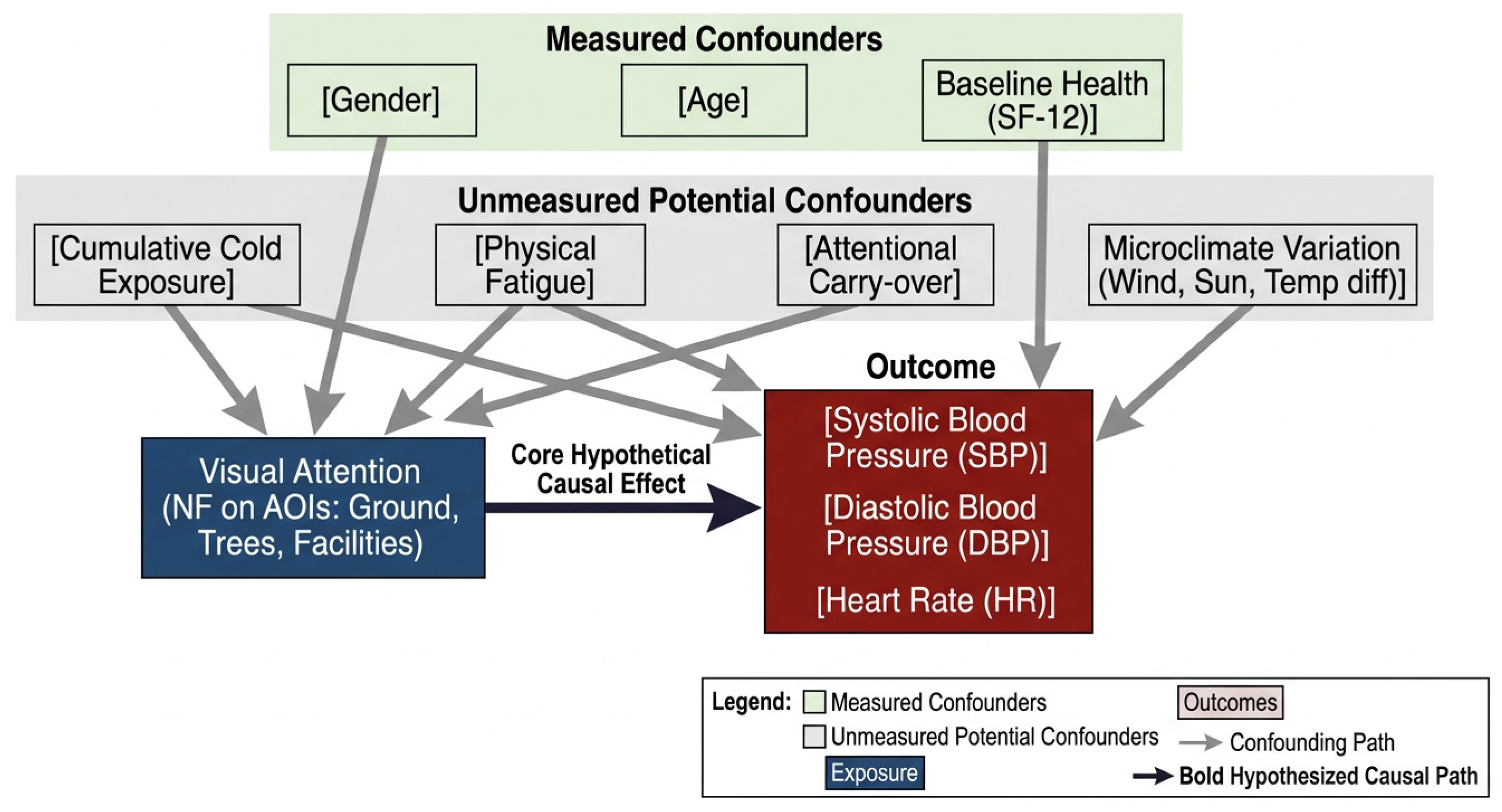
This non-randomized field study requires explicit identification assumptions. The assumed pathway is that visual attention influences physiological arousal via two mechanisms: (1) safety-related vigilance (ground), which may increase sympathetic activation; and (2) stress reduction (trees, sky), which may promote parasympathetic recovery.
Potential confounders include cumulative cold exposure, physical fatigue, attentional carry-over, individual health status, and prior environmental experience. We mitigated these by keeping all experiments within 90 min on a single day, standardizing walking pace, and screening participants with SF-12.
A directed acyclic graph (Figure 16) is presented retrospectively for transparency (following Pearl, 2009 [59]; Hernán & Robins, 2020 [60]) to clarify identification assumptions. It was not used prospectively for covariate selection.
Given the observational design, we do not claim causal effects. The findings should be interpreted as associations that generate hypotheses for future experimental or quasi-experimental studies with counterbalanced spatial orders and comprehensive measurement of microclimatic and individual factors.

5. Conclusions

5.1. Landscape Visual Perception Focus of Elderly People in Three Types of Community Environments

Based on the findings from Section 3.1.1, the analysis of comprehensive data from NV, TFD, TGD, PFD, and PGD concluded that among the top visual elements prioritized by older adults in the outdoor landscape environments of three cold region communities were: the ground, buildings, trees, sky, and lawn.
In the inter-building spaces, the elderly’s landscape visual perception focus was mainly on the ground, buildings, trees, lawn, and the sky, with less attention paid to artificial landscapes, signage, and sports facilities. In the community walkways, the elderly’s visual focus was also mainly on the ground, buildings, trees, lawn, and the sky, with less attention given to artificial landscapes, signage, and sports facilities. This was consistent with the inter-building spaces. The difference was that the elderly’s PFD and PGD for the ground in the walkway were higher than in the courtyard space, which might indicate that the elderly pay more attention to the safety of the walkway surface when walking. In the community squares, the elderly’s visual focus was still mainly on the ground, buildings, trees, sky, and lawn. However, the NF and NV for sports facilities were higher than those for artificial landscapes and signage, but the TFD, TGD, PFD, and PGD were not. This might be because the numerous sports facilities in the square have a strong but not lasting visual attraction for the elderly who are walking.

5.2. Differences in BP Indicators Between Elderly Men and Women

From the results in Section 3.1.2, no significant gender differences were observed in SBP in the three community landscape environments. The r values of the three spaces indicated that the effects in the inter-building spaces and the walkways were relatively small. SBP might not be a sensitive indicator for gender differences in response to environmental stress. In DBP, no significant gender differences were found in the inter-building spaces and the walkways, but p < 0.05 in the squares, showing a medium to large effect size. Therefore, DBP showed a clear environmental dependency in the squares, and environmental factors in the squares may affect the DBP of elderly people of different genders. The results of PP showed no significant gender differences in pulse pressure. From the HR results, the p values of all three landscape environments were >0.05, and the HR in the square showed a small effect size.

5.3. Differences in POMS Emotional Evaluation Between Elderly Men and Women

From the results in Section 3.2, it can be seen that there are certain differences in the subjective perception of different types of community landscape environments between elderly men and women. Elderly women had significantly higher POMS scores in the inter-building spaces and walkway environments than elderly men, while in the squares, elderly men had significantly higher POMS scores than elderly women, showing a medium to large effect size. From the seven emotional dimensions, elderly people of different genders had different emotional tendencies in different community landscape spaces. Compared to men, women were more tense-anxious and depressed-dejected. In the walkways, elderly men had more anger-hostility and vigor-activity than women, but the vigor-activity score was much higher than the anger-hostility score. Women were more prone to fatigue-inertia than men. In the square environment, elderly men showed higher values in tension-anxiety, depression-dejection, and vigor-activity than elderly women.
Furthermore, environmental factors such as temperature, wind speed, humidity, light conditions, and sound environment were not controlled in this field study. These variables may influence both visual perception and physiological responses, particularly in cold-region outdoor settings, and should be systematically examined in future controlled experiments.

5.4. Correlation Between Landscape Visual Attention Points, BP Indicators and POMS Emotional Evaluation

Pearson correlation analyses (Section 3.3) revealed additional exploratory patterns that motivated the HLM. For elderly men, T and D were positively associated with trees and lawn, and negatively with the sky; V was positively associated with sports facilities and trees. For elderly women, T and D were most strongly associated with trees (R = 0.49–0.52) and negatively with the sky; V was positively associated with artificial landscape and the sky.
Regarding BP, ground fixation was positively correlated with SBP in both genders (stronger in women), and trees were negatively correlated with SBP. Sports facilities were positively correlated with DBP only in men.
These correlations are exploratory (no multiple-comparison correction) and serve as hypothesis-generating input for the HLM analysis presented above. They should not be interpreted as confirmatory findings.

5.5. Outdoor Landscape Design Strategies for Cold Region Communities

Based on the HLM findings, the following preliminary design hypotheses are proposed for cold-region communities. These hypotheses are derived from a single-site, single-season study and require testing across diverse settings before being considered transferable guidelines:
Prioritize surface safety: Implement non-slip, non-reflective paving with moderate color differentiation throughout community spaces, particularly in high-traffic areas frequented by elderly women. Establish continuous visual guidance lines and ensure regular maintenance.
Gender-differentiated planting (preliminary): Employ evergreen species in female-dominated zones as a tentative recommendation; retain deciduous trees in male activity areas. The gender-specific effect was marginally significant (p = 0.058) and requires further validation in future studies.
Targeted exercise facility placement: Concentrate diverse fitness equipment in male-oriented zones; scatter low-intensity exercise stations along pathways to naturally integrate female-oriented walking routes.
Skyline balance design: Preserve unobstructed sky views at key nodes while integrating semi-enclosed structures for microclimate protection, particularly in zones frequently used by women.
Cognitive-friendly signage system: Simplify signage using large fonts, high-contrast colors, and icons; employ advance signage at decision points with consistent visual language.
Functional differentiation of spatial types: Design courtyard spaces as semi-private, female-friendly zones; optimize pathway surfaces and integrate exercise points; create multi-functional plazas combining male-oriented activity areas with quiet rest zones.


Supplementary Materials

The following supporting information can be downloaded at: https://www.mdpi.com/article/10.3390/buildings16081570/s1, Figure S1: Level-1 Residual Q-Q Plots for Physiological Outcomes; Figure S2: Level-1 Residuals Against Fitted Values; Table S1: Robustness check: Hierarchical Linear Model (HLM) results for SBP using proportional fixation duration (PFD) as the primary eye-tracking predictor; Table S2: Ambient exposure conditions during the experiment. Item Short form Health Survey (SF-12), POMS Questionnaire (the Questionnaire Content Is Identical Across All Three Spaces). For further details, please refer to the Supplementary Materials.

Author Contributions

Conceptualization, G.W. and Q.L.; methodology, G.W.; software, Q.L.; validation, G.W., Q.L. and X.L.; formal analysis, G.W.; investigation, X.L.; resources, Q.L.; data curation, X.L.; writing—original draft preparation, G.W.; writing—review and editing, Q.L.; visualization, X.L.; supervision, M.L.; project administration, M.L.; funding acquisition, M.L. All authors have read and agreed to the published version of the manuscript.

Funding

This research received funding from the Key Research Project for Higher Education Teaching Reform in Jilin Province: Innovative Practice Research on Talent Cultivation Models for Design Majors from the Perspective of New Liberal Arts (Project No. JLJY202573421570) and Jilin Province Education Science Planning Project: Research on Independent Cultivation of Top-Notch Innovative Talents in Design Majors in Jilin Province (Project No. GH24572).

Institutional Review Board Statement

The study was approved by the Medical Ethics Committee of Jilin Jianzhu University (Ethics No. JLJU-2025089). The date of approval was 8 October 2025. All investigations were conducted in accordance with the Declaration of Helsinki on Human Biomedical Research.

Informed Consent Statement

Informed consent was obtained from all subjects involved in the study.

Data Availability Statement

The original contributions presented in the study are included in the article/Supplementary Materials, further inquiries can be directed to the corresponding author.

Conflicts of Interest

The authors declare no conflicts of interest.

References

  1. Alpérovitch, A.; Lacombe, J.-M.; Hanon, O.; Dartigues, J.-F.; Ritchie, K.; Ducimetière, P.; Tzourio, C. Relationship Between Blood Pressure and Outdoor Temperature in a Large Sample of Elderly Individuals The Three-City Study. Arch. Intern. Med. 2009, 169, 75–80. [Google Scholar] [CrossRef] [PubMed]
  2. Corsonello, A.; Incalzi, R.A.; Pedone, C.; Corica, F.; Mazzei, B.; Carosella, L.; Perticone, F.; Carbonin, P. Seasonal hypertension: A clue to explain the high prevalence of unrecognized hypertension in the elderly? Gruppo Italiano di Farmacovigilanza nell’Anziano (GIFA). Aging Clin. Exp. Res. 2003, 15, 296–300. [Google Scholar] [CrossRef] [PubMed]
  3. Ren, Y.; Shi, J.; Qiao, Y.; Gu, Y.; Li, Y.; Liu, Y.; Cheng, Y.; Liu, Y. Epidemiological status quo of hypertension in elderly population in Changchun, China: A cross-sectional study. BMJ Open 2022, 12, e053086. [Google Scholar] [CrossRef]
  4. Bruce, V.; Green, P.R.; Georgeson, M. Visual Perception: Physiology, Psychology and Ecology; Psychology Press: East Sussex, UK, 2003. [Google Scholar]
  5. Men, D.; Wang, M. An Empirical Study on the Elderly Visual Pleasure Experience Design Elements Based on Perceptual Cognitive Characteristics Measure and Analysis. In Human Aspects of It for the Aged Population. Technology Design and Acceptance; Gao, Q., Zhou, J., Eds.; ITAP 2021, PT I; Electr Network; Springer: Berlin/Heidelberg, Germany, 2021; Volume 12786, pp. 183–202. [Google Scholar]
  6. Ogrocki, P.K.; Hills, A.C.; Strauss, M.E. Visual exploration of facial emotion by healthy older adults and patients with Alzheimer disease. Neuropsychiatry Neuropsychol. Behav. Neurol. 2000, 13, 271–278. [Google Scholar]
  7. Leung, M.; Wang, C.; Li, L. Impact of indoor visual environment on emotional and behavioral symptoms of older people with dementia. Build. Environ. 2024, 265, 111980. [Google Scholar] [CrossRef]
  8. Zhou, W.; Wang, W.; Zhou, F.; Chen, W.; Lin, L. The effects of greenness exposure on hypertension incidence among Chinese oldest-old: A prospective cohort study. Environ. Health 2022, 21, 66. [Google Scholar]
  9. Li, F.; Harmer, P.; Cardinal, B.J.; Vongjaturapat, N. Built environment and changes in blood pressure in middle aged and older adults. Prev. Med. 2009, 48, 237–241. [Google Scholar] [CrossRef]
  10. Grazuleviciene, R.; Andrusaityte, S.; Dedele, A.; Grazulevicius, T.; Valius, L.; Rapalavicius, A.; Kapustinskiene, V.; Bendokiene, I. Urban Environment and Health: A Cross-Sectional Study of the Influence of Environmental Quality and Physical Activity on Blood Pressure. Int. J. Environ. Res. Public Health 2021, 18, 6126. [Google Scholar] [CrossRef] [PubMed]
  11. Kaplan, S. The Restorative Benefits of Nature—Toward an Integrative Framework. J. Environ. Psychol. 1995, 15, 169–182. [Google Scholar] [CrossRef]
  12. Ulrich, R.; Simons, R.; Losito, B.; Fiorito, E.; Miles, M.; Zelson, M. Stress Recovery During Exposure to Natural and Urban Environments. J. Environ. Psychol. 1991, 11, 201–230. [Google Scholar] [CrossRef]
  13. Xiang, L.; Mei, T. Developing the age-friendly community parks survey for older adults: Assessing aging environment. Urban For. Urban Green. 2024, 99, 128424. [Google Scholar] [CrossRef]
  14. Zhang, F.; Loo, B.P.Y.; Wang, B. Aging in Place: From the Neighborhood Environment, Sense of Community, to Life Satisfaction. Ann. Am. Assoc. Geogr. 2022, 112, 1484–1499. [Google Scholar] [CrossRef]
  15. Xiong, J.; Lian, Z.; Zhang, H. Investigation of the elderly’s response to winter temperature steps in severe cold area of China. Procedia Eng. 2017, 205, 309–313. [Google Scholar] [CrossRef]
  16. Wen, H.M.; Wonje, Y. Effect of the preference of visual elements on the intention of reuse when designing a healing environment of welfare facilities for senior citizens: Focusing on welfare facilities for senior citizens in Seoul. Res. Basic Form. Arts 2021, 22, 337–348. [Google Scholar]
  17. Tabrizian, P.; Baran, P.K.; Smith, W.R.; Meentemeyer, R.K. Exploring perceived restoration potential of urban green enclosure through immersive virtual environments. J. Environ. Psychol. 2018, 55, 99–109. [Google Scholar] [CrossRef]
  18. Polat, A.T.; Akay, A. Relationships between the visual preferences of urban recreation area users and various landscape design elements. Urban For. Urban Green. 2015, 14, 573–582. [Google Scholar] [CrossRef]
  19. Zhang, C.; Chen, Y.; Dewancker, B.J.; Shentu, C.; Tian, H.; Liu, Y.; Wan, J.; Zhang, X.; Li, J. Emotional Landscapes in Urban Design: Analyzing Color Emotional Responses of the Elderly to Community Outdoor Spaces in Yi Jie Qu. Buildings 2024, 14, 793. [Google Scholar] [CrossRef]
  20. Chen, C.; Luo, W.; Kang, N.; Li, H.; Yang, X.; Xia, Y. Study on the Impact of Residential Outdoor Environments on Mood in the Elderly in Guangzhou, China. Sustainability 2020, 12, 3933. [Google Scholar] [CrossRef]
  21. Melchiorre, M.G.; Socci, M.; Lamura, G.; Quattrini, S. Frail older people ageing in place alone and their perception of the built environment in rural and urban sites: A mixed-methods study. BMC Geriatr. 2025, 25, 1–22. [Google Scholar] [CrossRef] [PubMed]
  22. Jutzi, C.A.; Moeller, J.; Hansen, J.; Klackl, J.; Jonas, E. Psychological needs in the built environment. J. Environ. Psychol. 2025, 101, 102419. [Google Scholar] [CrossRef]
  23. Zhai, Y.; Baran, P.K. Urban park pathway design characteristics and senior walking behavior. Urban For. Urban Green 2017, 21, 60–73. [Google Scholar] [CrossRef]
  24. Li, C.; Du, C.; Ge, S.; Tong, T. An eye-tracking study on visual perception of vegetation permeability in virtual reality forest exposure. Front. Public Health 2023, 11, 1089423. [Google Scholar] [CrossRef] [PubMed]
  25. Cui, W.; Li, Z.; Xuan, X.; Li, Q.; Shi, L.; Sun, X.; Zhu, K.; Shi, Y. Influence of Hospital Outdoor Rest Space on the Eye Movement Measures and Self-Rating Restoration of Staff. Front. Public Health 2022, 10, 855857. [Google Scholar] [CrossRef]
  26. Lisinska-Kusnierz, M.; Krupa, M. Suitability of Eye Tracking in Assessing the Visual Perception of Architecture-A Case Study Concerning Selected Projects Located in Cologne. Buildings 2020, 10, 20. [Google Scholar] [CrossRef]
  27. Sims, K.D.; Willis, M.D.; Hystad, P.W.; Batty, G.D.; Bibbins-Domingo, K.; Smit, E.; Odden, M.C. Neighborhood Characteristics and Elevated Blood Pressure in Older Adults. JAMA Netw. Open 2023, 6, e2335534. [Google Scholar] [CrossRef]
  28. Lee, G.; Choi, B.; Jebelli, H.; Batty, G.D.; Bibbins-Domingo, K.; Smit, E.; Odden, M.C. Wearable Biosensor and Collective Sensing–Based Approach for Detecting Older Adults’ Environmental Barriers. J. Comput. Civ. Eng. 2020, 34, 04020002. [Google Scholar] [CrossRef]
  29. Elsadek, M.; Shao, Y.; Liu, B. Benefits of Indirect Contact With Nature on the Physiopsychological Well-Being of Elderly People. Herd-Health Environ. Res. Des. J. 2021, 14, 227–241. [Google Scholar] [CrossRef]
  30. Tilley, S.; Neale, C.; Patuano, A.; Cinderby, S. Older People’s Experiences of Mobility and Mood in an Urban Environment: A Mixed Methods Approach Using Electroencephalography (EEG) and Interviews. Int. J. Environ. Res. Public Health 2017, 14, 151. [Google Scholar] [CrossRef] [PubMed]
  31. Picone, D.S.; Stoneman, E.; Cremer, A.; Schultz, M.G.; Otahal, P.; Hughes, A.D.; Black, J.A.; Bos, W.J.; Chen, C.-H.; Cheng, H.-M.; et al. Sex Differences in Blood Pressure and Potential Implications for Cardiovascular Risk Management. Hypertension 2023, 80, 316–324. [Google Scholar] [CrossRef] [PubMed]
  32. Chadda, K.R.; Ajijola, O.A.; Vaseghi, M.; Shivkumar, K.; Huang, C.L.-H.; Jeevaratnam, K. Ageing, the autonomic nervous system and arrhythmia: From brain to heart. Ageing Res. Rev. 2018, 48, 40–50. [Google Scholar] [CrossRef]
  33. Pratschke, J.; Vitale, T.; Morelli, N.; Cousin, B.; Piolatto, M.; Del Fabbro, M. Electoral Support for the 5 Star Movement in Milan: An Ecological Analysis of Social and Spatial Factors. J. Urban Aff. 2023, 45, 998–1021. [Google Scholar] [CrossRef]
  34. Vitale, T.; Midulla, F.; Stasolla, C. Ethnicized Marginality and Governance Discontinuity: The Contentious Embeddedness of Roma Settlements in Naples. Habitat Int. 2026, 169, 103714. [Google Scholar] [CrossRef]
  35. Patterson, R.; Martin, W. Human Stereopsis. Hum. Factors 1992, 34, 669–692. [Google Scholar] [CrossRef]
  36. Costall, A.P. Are theories of perception necessary? A review of Gibson’s The Ecological Approach to Visual Perception. J. Exp. Anal. Behav. 1984, 41, 109–115. [Google Scholar] [CrossRef]
  37. Chen, B.; Gong, C.; Li, S. Looking at buildings or trees? Association of human nature relatedness with eye movements in outdoor space. J. Environ. Psychol. 2022, 80, 101756. [Google Scholar] [CrossRef]
  38. Niehorster, D.C.; Santini, T.; Hessels, R.S.; Hooge, I.T.C.; Kasneci, E.; Nyström, M. The impact of slippage on the data quality of head-worn eye trackers. Behav. Res. Methods 2020, 52, 1140–1160. [Google Scholar] [CrossRef] [PubMed]
  39. Niehorster, D.C.; Hessels, R.S.; Benjamins, J.S. Glasses Viewer: Open-source software for viewing and analyzing data from the Tobii Pro Glasses 2 eye tracker. Behav. Res. Methods 2020, 52, 1244–1253. [Google Scholar] [CrossRef] [PubMed]
  40. Zhao, Y.; Bao, W.W.; Yang, B.Y.; Liang, J.-H.; Gui, Z.-H.; Huang, S.; Chen, Y.-C.; Dong, G.-H.; Chen, Y.-J. Association between greenspace and blood pressure: A systematic review and meta-analysis. Sci. Total Environ. 2022, 817, 152513. [Google Scholar] [CrossRef]
  41. Kang, Y.; Han, Y.; Guan, T.; Wang, X.; Xue, T.; Chen, Z.; Jiang, L.; Zhang, L.; Zheng, C.; Wang, Z.; et al. Clinical blood pressure responses to daily ambient temperature exposure in China: An analysis based on a representative nationwide population. Sci. Total Environ. 2020, 705, 135762. [Google Scholar] [CrossRef]
  42. Cai, L.; Liu, Y.; He, L. Investigating genetic causal relationships between blood pressure and anxiety, depressive symptoms, neuroticism and subjective well-being. Gen. Psychiatry 2022, 35, e100877. [Google Scholar] [CrossRef]
  43. Chuang, S.Y.; Liu, W.L.; Cheng, H.M.; Chung, R.-H.; Lai, C.-H.; Wu, I.-C.; Chang, H.-Y.; Hsiung, C.A.; Chen, W.J.; Hsu, C.-C. Pulse pressure is associated with decline in physical function in older adults. Maturitas 2024, 185, 108000. [Google Scholar] [CrossRef] [PubMed]
  44. Searight, H.R.; Montone, K. Profile of Mood States. In Encyclopedia of Personality and Individual Differences; Springer: Cham, Switzerland, 2017; pp. 1–6. [Google Scholar]
  45. Feria-Madueno, A.; Montoya, C.; Lopez, L.; González-Carballido, L.G. Gender Differences in Physical Performance and Psychological Assessment Among Cuban National Athletics Team. Mhsalud-Rev. Cienc. Mov. Hum. Salud 2024, 21, 168–185. [Google Scholar]
  46. Sahni, P.S.; Singh, K.; Sharma, N.; Garg, R. Yoga an effective strategy for self-management of stress-related problems and wellbeing during COVID19 lockdown: A cross-sectional study. PLoS ONE 2021, 16, e0245214. [Google Scholar] [CrossRef]
  47. Barney, D.; Pleban, F.T.; Gishe, J. Effects of Music on Mood During Basketball Play in Junior High School Physical Education. Phys. Educ.-Us 2021, 78, 31–42. [Google Scholar] [CrossRef]
  48. Hanin, J.L. Emotion-Centered and Action-Centered Profiling in Sport: Incorporating the Concept of Individual Differences. In Proceedings of the 6th International Scientific Conference on Kinesiology: Integrative Power of Kinesiology; University of Zagreb Faculty of Kinesiology: Zagreb, Croatia, 2011; pp. 368–374. [Google Scholar]
  49. Lin, L.; Chiang, H.H.; Acquaye, A.A.; Vera-Bolanos, E.; Gilbert, M.R.; Armstrong, T.S. Uncertainty, mood states, and symptom distress in patients with primary brain tumors: Analysis of a conceptual model using structural equation modeling. Cancer 2013, 119, 2796–2806. [Google Scholar] [CrossRef] [PubMed]
  50. Zhu, B. Revision of the Profile of Mood States (POMS) Scale and Its Norm in China. J. Tianjin Inst. Phys. Educ. 1995, 10, 12–17. [Google Scholar]
  51. Tigha-Bouaziz, N. Effects of occupational exposure to lead on blood pressure and neurocognitive functions. Arter. Hypertens. 2025, 29, 21–29. [Google Scholar] [CrossRef]
  52. Arciero, P.J.; Ives, S.J.; Mohr, A.E.; Robinson, N.; Escudero, D.; Robinson, J.; Rose, K.; Minicucci, O.; O’bRien, G.; Curran, K.; et al. Morning Exercise Reduces Abdominal Fat and Blood Pressure in Women; Evening exercise Increases Muscular Performance in Women and Lowers Blood Pressure in Men. Front. Physiol. 2022, 13, 893783. [Google Scholar] [CrossRef]
  53. Maas, C.J.M.; Hox, J.J. Sufficient Sample Sizes for Multilevel Modeling. Methodology 2005, 1, 86–92. [Google Scholar] [CrossRef]
  54. Scherbaum, C.A.; Ferreter, J.M. Estimating statistical power and required sample sizes for organizational research using multilevel modeling. Organ. Res. Methods 2009, 12, 347–367. [Google Scholar] [CrossRef]
  55. Ibrahim, A.; Alsukkar, M.; Dong, Y.; Hu, P. Investigations for the daylighting performance of trapezoid profile shadings using multi-objective optimization. J. Build. Eng. 2025, 99, 111645. [Google Scholar] [CrossRef]
  56. Lipsitz, L.A.; Iloputaife, I.; Gagnon, M.; Kiely, D.K.; Serrador, J.M. Enhanced Vasoreactivity and Its Response to Antihypertensive Therapy in Hypertensive Elderly Women. Hypertension 2006, 47, 377–383. [Google Scholar] [CrossRef] [PubMed]
  57. Domeier, C.; Bissen, T.G.; Vondrasek, J.D.; Babcock, M.C.; Robinson, A.T.; Watso, J.C. Differential Effects of Female Aging on Sympathetic Blood Pressure Regulation at Rest and during Stress in Humans. Physiol. Rep. 2025, 13, e70347. [Google Scholar] [CrossRef] [PubMed]
  58. Chen, Y.; Zhang, J. A Study on the Influence of an Outdoor Built Environment on the Activity Behavior of the Elderly in Small Cities in Cold Regions—A Case Study of Bei’an City. Sustainability 2025, 17, 2260. [Google Scholar] [CrossRef]
  59. Pearl, J. Causality: Models, Reasoning and Inference, 2nd ed.; Cambridge University Press: Cambridge, UK, 2009. [Google Scholar]
  60. Hernán, M.A.; Robins, J.M. Causal Inference: What If; Chapman & Hall/CRC: Boca Raton, FL, USA, 2020. [Google Scholar]
Figure 1. Research flowchart.
Buildings 16 01570 g001
Figure 2. Master plan for the research community.
Buildings 16 01570 g002
Figure 3. Computer screen and participants during the experiment. (a) Analysis of eye tracker; (b) participants in the experiment; (c) Tobii Pro Glasses 2; (d) electronic BP monitor.
Buildings 16 01570 g003
Figure 4. Experimental procedure.
Buildings 16 01570 g004
Figure 5. Partial eye tracking heatmaps in three types of landscape spaces. (a) Partial eye tracking heatmaps in inter-building spaces; (b) Partial eye tracking heatmaps in community walkway spaces; (c) Partial eye tracking heatmaps in community square spaces.
Buildings 16 01570 g005
Figure 6. Box-and-whisker plot of visual attention characteristics in inter-building spaces. (a) Box plot of NF and NV with 8 AOIs; (b) box plot of TFD and TGD with 8 AOIs; (c) box plot of PFD and PGD with 8 AOIs.
Buildings 16 01570 g006
Figure 7. Box-and-whisker plot of visual attention characteristics in community walkway spaces. (a) Box plot of NF and NV with 8 AOIs; (b) box plot of TFD and TGD with 8 AOIs; (c) box plot of PFD and PGD with 8 AOIs.
Buildings 16 01570 g007
Figure 8. Box-and-whisker plot of visual attention characteristics in community square spaces. (a) Box plot of NF and NV with 8 AOIs; (b) box plot of TFD and TGD with 8 AOIs; (c) box plot of PFD and PGD with 8 AOIs.
Buildings 16 01570 g008
Figure 9. POMS gender difference analysis. (a) Inter-building spaces; (b) community walkway spaces; (c) community square spaces (* p < 0.05, ** p < 0.01, *** p < 0.001).
Buildings 16 01570 g009
Figure 10. Correlation between male visual attention focus and POMS emotional evaluation (The red dashed line indicates the main result).
Buildings 16 01570 g010
Figure 11. Correlation between female visual attention focus and POMS emotional evaluation (The red dashed line indicates the main result).
Buildings 16 01570 g011
Figure 12. Correlation between male visual focus points and BP indicators (The red dashed line indicates the main result).
Buildings 16 01570 g012
Figure 13. Correlation between female visual focus points and BP indicators (The red dashed line indicates the main result).
Buildings 16 01570 g013
Figure 14. Correlation between bp indicators and POMS emotional assessment in males (The red dashed line indicates the main result).
Buildings 16 01570 g014
Figure 15. Correlation between BP indicators and POMS emotional assessment in females (The red dashed line indicates the main result).
Buildings 16 01570 g015
Figure 16. Directed acyclic graph.
Buildings 16 01570 g016
Table 1. Leisure space in survey.
Phase III, Wanhehaoting Community, Changchun City, Jilin Province, China
Completion Date2017
Plot Ratio2.0
Green Space Ratio35%
Community Landscape EnvironmentInter-building spaces
Buildings 16 01570 i001
Community walkway spaces
Buildings 16 01570 i002
Community square spaces
Buildings 16 01570 i003
Table 2. Definitions and interpretations of eye-tracking metrics.
MetricFull NameUnitInterpretation
NFNumber of fixationscountTotal number of discrete fixation events on an AOI; indicates frequency of attentional engagement
NVNumber of visitscountNumber of times the gaze returns to an AOI after leaving; indicates re-engagement
TFDTotal fixation durationseconds (or ms)Sum of durations of all fixations on an AOI; reflects sustained attention
TGDTotal glance durationseconds (or ms)Sum of durations of all glances (fixations + saccades) on an AOI; includes brief looks
PFDProportional fixation duration% (ratio)TFD divided by total fixation duration across all AOIs; normalizes for individual differences in overall attention
PGDProportional glance duration% (ratio)TGD divided by total glance duration across all AOIs; normalizes for overall viewing time
Note: NF was used as the primary predictor in the HLM; the other metrics were used for descriptive characterization of visual attention patterns.
Table 3. Statistical results of means and standard deviations for each indicator.
VariableMale Participants (N = 21)Female Participants (N = 23)
Age/years oldMean ± SD64 ± 2.0266 ± 3.68
Range60~6862~74
SF-12 scoreMean ± SD47.33 ± 5.2348.62 ± 6.42
Range37.66~64.5235.84~58.63
SBP/mmHgInter-building spaces 143.95 ± 18.33140.09 ± 18.70
Community walkway spaces140.52 ± 11.20136.39 ± 9.17
Community square spaces135.81 ± 17.58131.96 ± 13.01
DBP/mmHgInter-building spaces 58.90 ± 12.8555.91 ± 12.49
Community walkway spaces52.00 ± 8.9851.00 ± 5.60
Community square spaces49.29 ± 14.1749.35 ± 10.74
HR/timeInter-building spaces 78.3 ± 7.6077.22 ± 7.60
Community walkway spaces87.05 ± 5.8881.17 ± 5.23
Community square spaces78.9 ± 8.6475.65 ± 6.91
POMS ScoreInter-building spaces 9.19 ± 1.8310.91 ± 2.25
Community walkway spaces9.05 ± 2.098.74 ± 2.14
Community square spaces10.10 ± 2.686.82 ± 1.95
Table 4. Mann–Whitney U test statistics.
LocationIndicatorMale Participants (N = 21) Mean and Standard DeviationFemale Participants (N = 23) Mean and Standard DeviationU-Valuep-Valuer = Z/sqrt(N)
Inter-building spacesSBP/mmHg143.95 ± 18.33140.09 ± 18.70207.50.4240.12
DBP/mmHg58.90 ± 12.8555.91 ± 12.492300.7870.04
PP/mmHg85.05 ± 10.4084.35 ± 10.562200.6130.08
HR/time78.3 ± 7.6077.22 ± 7.602390.9530.01
POMS Score9.19 ± 1.8310.91 ± 2.251390.016 **0.36
Community walkway spacesSBP/mmHg140.52 ± 11.20136.39 ± 9.17206.50.4110.12
DBP/mmHg52.00 ± 8.9851.00 ± 5.601930.2530.17
PP/mmHg88.81 ± 9.5185.83 ± 6.982380.9340.01
HR/time87.05 ± 5.8881.17 ± 5.23222.50.6530.07
POMS Score9.05 ± 2.098.74 ± 2.14145.50.02 **0.35
Community square spacesSBP/mmHg135.81 ± 17.58131.96 ± 13.01221.50.6380.07
DBP/mmHg49.29 ± 14.1749.35 ± 10.74114.50.004 **0.44
PP/mmHg87.05 ± 5.8881.17 ± 5.23209.50.4520.11
HR/time78.9 ± 8.6475.65 ± 6.911830.168 0.21
POMS Score10.10 ± 2.686.82 ± 1.951350.012 **0.38
Note: ** p < 0.05 (before Bonferroni correction). After correction, no p-values remained significant.
Table 5. Random intercept model: Fixed effects estimation of visual elements on BP indicators.
Fixed EffectsCoefficient (γ)Standard Error (SE)tp95% Confidence Interval
SBP Model
Intercept138.422.3159.92<0.001[133.89, 142.95]
Gender (Male = 1)−3.152.87−1.100.278[−8.78, 2.48]
Age0.420.311.350.185[−0.19, 1.03]
Ground (NF)0.310.122.580.011[0.07, 0.55]
Trees (NF)−0.240.10−2.400.018[−0.44, −0.04]
Lawn (NF)−0.080.09−0.890.376[−0.26, 0.10]
Sky (NF)0.110.081.380.171[−0.05, 0.27]
Buildings (NF)0.050.070.710.479[−0.09, 0.19]
Sports facilities (NF)0.180.131.380.170[−0.08, 0.44]
Signage (NF)0.220.141.570.120[−0.06, 0.50]
Artificial landscapes (NF)0.070.110.640.524[−0.15, 0.29]
DBP Model
Intercept84.761.8545.82<0.001[81.13, 88.39]
Gender (Male = 1)2.181.961.110.271[−1.66, 6.02]
Age0.150.210.710.479[−0.26, 0.56]
Ground (NF)0.120.101.200.233[−0.08, 0.32]
Trees (NF)−0.290.11−2.640.010[−0.51, −0.07]
Lawn (NF)−0.070.08−0.880.381[−0.23, 0.09]
Sky (NF)0.090.071.290.200[−0.05, 0.23]
Buildings (NF)0.030.060.500.619[−0.09, 0.15]
Sports facilities (NF)0.370.142.640.008[0.10, 0.64]
Signage (NF)0.300.132.310.023[0.04, 0.56]
Artificial landscapes (NF)0.150.121.250.214[−0.09, 0.39]
PP Model
Intercept53.662.0825.80<0.001[49.58, 57.74]
Gender (Male = 1)−5.332.54−2.100.039[−10.31, −0.35]
Age0.270.280.960.340[−0.28, 0.82]
Ground (NF)0.190.092.110.037[0.01, 0.37]
Trees (NF)0.050.080.630.530[−0.11, 0.21]
Lawn (NF)−0.010.07−0.140.889[−0.15, 0.13]
Sky (NF)0.020.060.330.742[−0.10, 0.14]
Buildings (NF)0.020.050.400.690[−0.08, 0.12]
Sports facilities (NF)−0.190.12−1.580.117[−0.43, 0.05]
Signage (NF)−0.080.11−0.730.467[−0.30, 0.14]
Artificial landscapes (NF)−0.080.10−0.800.426[−0.28, 0.12]
HR Model
Intercept77.891.4354.47<0.001[75.09, 80.69]
Gender (Male = 1)1.241.520.820.416[−1.74, 4.22]
Age0.080.160.500.619[−0.24, 0.40]
Ground (NF)0.230.082.880.005[0.07, 0.39]
Trees (NF)−0.100.07−1.430.155[−0.24, 0.04]
Lawn (NF)0.120.071.710.089[−0.02, 0.26]
Sky (NF)0.190.092.110.032[0.01, 0.37]
Buildings (NF)−0.040.05−0.800.426[−0.14, 0.06]
Sports facilities (NF)−0.210.10−2.100.038[−0.41, −0.01]
Signage (NF)−0.080.10−0.800.426[−0.28, 0.12]
Artificial landscapes (NF)−0.120.09−1.330.186[−0.30, 0.06]
Table 6. Random intercept model: Estimation of random effects of visual factors on BP indicators.
Random EffectsVariance ComponentStandard Error (SE)Wald Zp
SBP Model
between-individual variance ( τ 00 ) 152.3638.423.97<0.001
within-individual variance ( σ 2 ) 318.5424.1513.19<0.001
DBP Model
between-individual variance ( τ 00 ) 98.2724.863.95<0.001
within-individual variance ( σ 2 ) 220.4316.7313.18<0.001
PP Model
between-individual variance ( τ 00 ) 114.8129.023.96<0.001
within-individual variance ( σ 2 ) 256.9219.4913.18<0.001
HR Model
between-individual variance ( τ 00 ) 42.1510.863.88<0.001
within-individual variance ( σ 2 ) 96.787.3513.17<0.001
Note: p < 0.05 indicates statistical significance. Gender coding: Male = 1, Female = 0. All gaze point metrics (NF) for visual elements were centered to the overall mean. Models were estimated using REML.
Table 7. Random slope model: The moderating effect of gender on the relationship between vision and BP.
Cross-Level InteractionCoefficient (γ)Standard Error (SE)tp
Gender × Ground (NF) → SBP0.180.082.250.022
Gender × Tree (NF) → SBP−0.130.07−1.860.058
Gender ×Sports facilities (NF) → DBP0.290.112.640.009
Table 8. Variance Inflation Factors (VIFs) for Level-1 predictors.
PredictorVIF
Ground2.24
Buildings1.98
Trees1.89
Lawn1.76
Sports facilities1.65
Sky1.52
Signage1.43
Artificial landscape1.38
Disclaimer/Publisher’s Note: The statements, opinions and data contained in all publications are solely those of the individual author(s) and contributor(s) and not of MDPI and/or the editor(s). MDPI and/or the editor(s) disclaim responsibility for any injury to people or property resulting from any ideas, methods, instructions or products referred to in the content.