Impact of Thermal Energy Storage on the Seasonal Performance of an Air-to-Water Heat Pump Under Real Microclimatic Conditions



Abstract
1. Introduction
- (i)
- A systematic eight-year assessment of TES influence using measured hourly microclimatic data rather than TMY datasets;
- (ii)
- Isolation of storage volume effects under identical boundary conditions across multiple locations;
- (iii)
- Quantification of seasonal efficiency gains achievable through a simple, non-predictive, and practically applicable operating strategy.
2. Materials and Methods
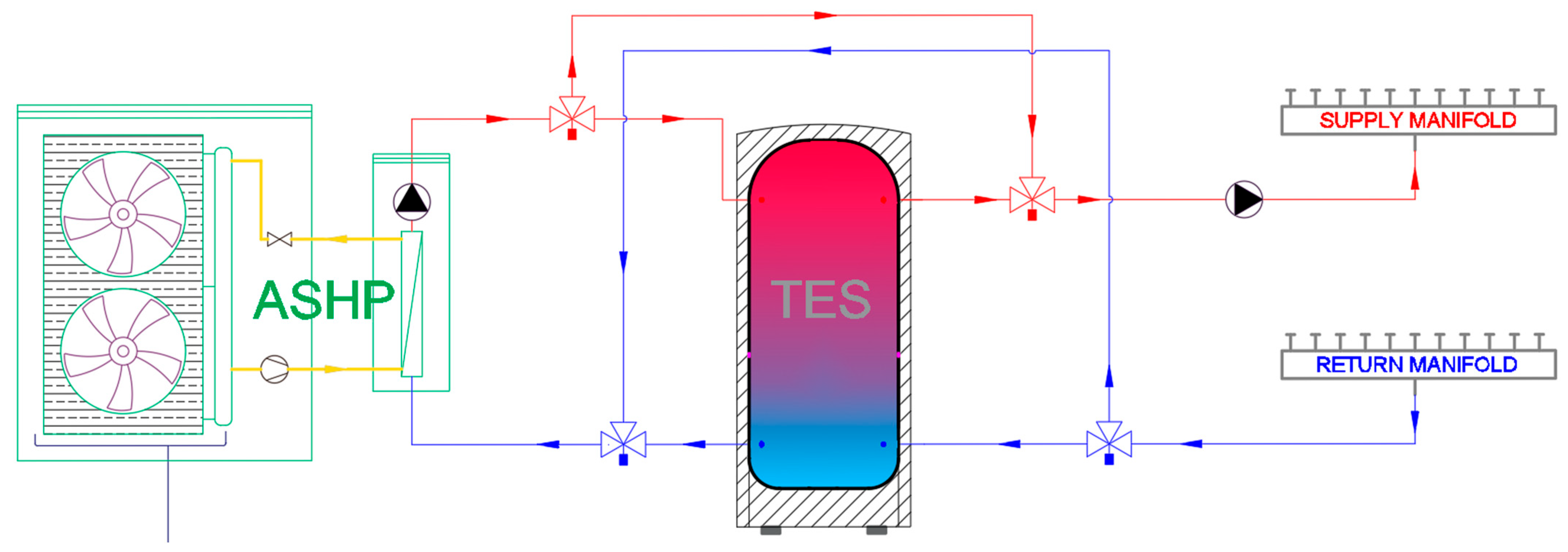
2.1. Heating System Description and Case Study Definition
2.2. Building Thermal Energy Demand Model
2.3. Heat Pump Performance Modeling
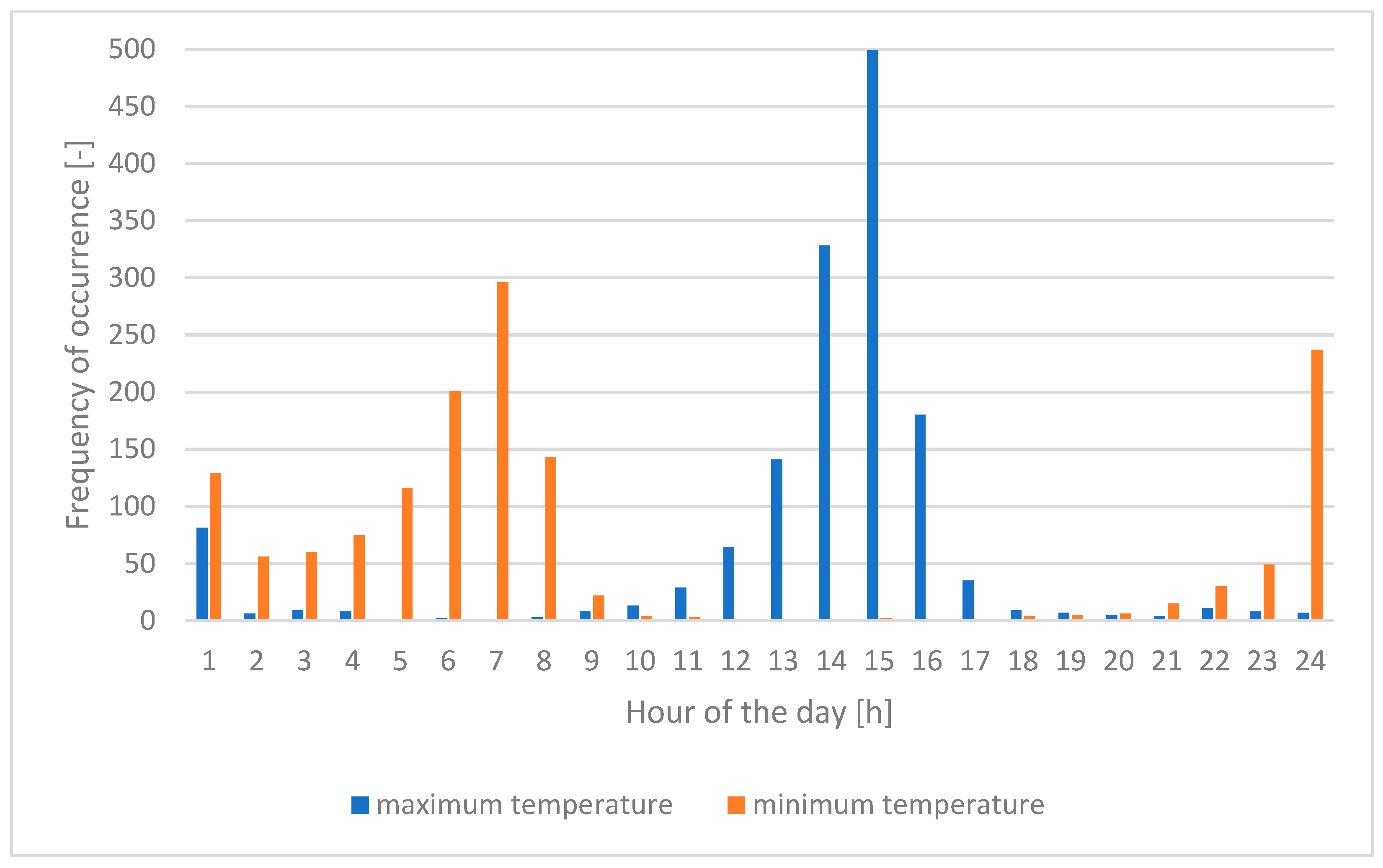
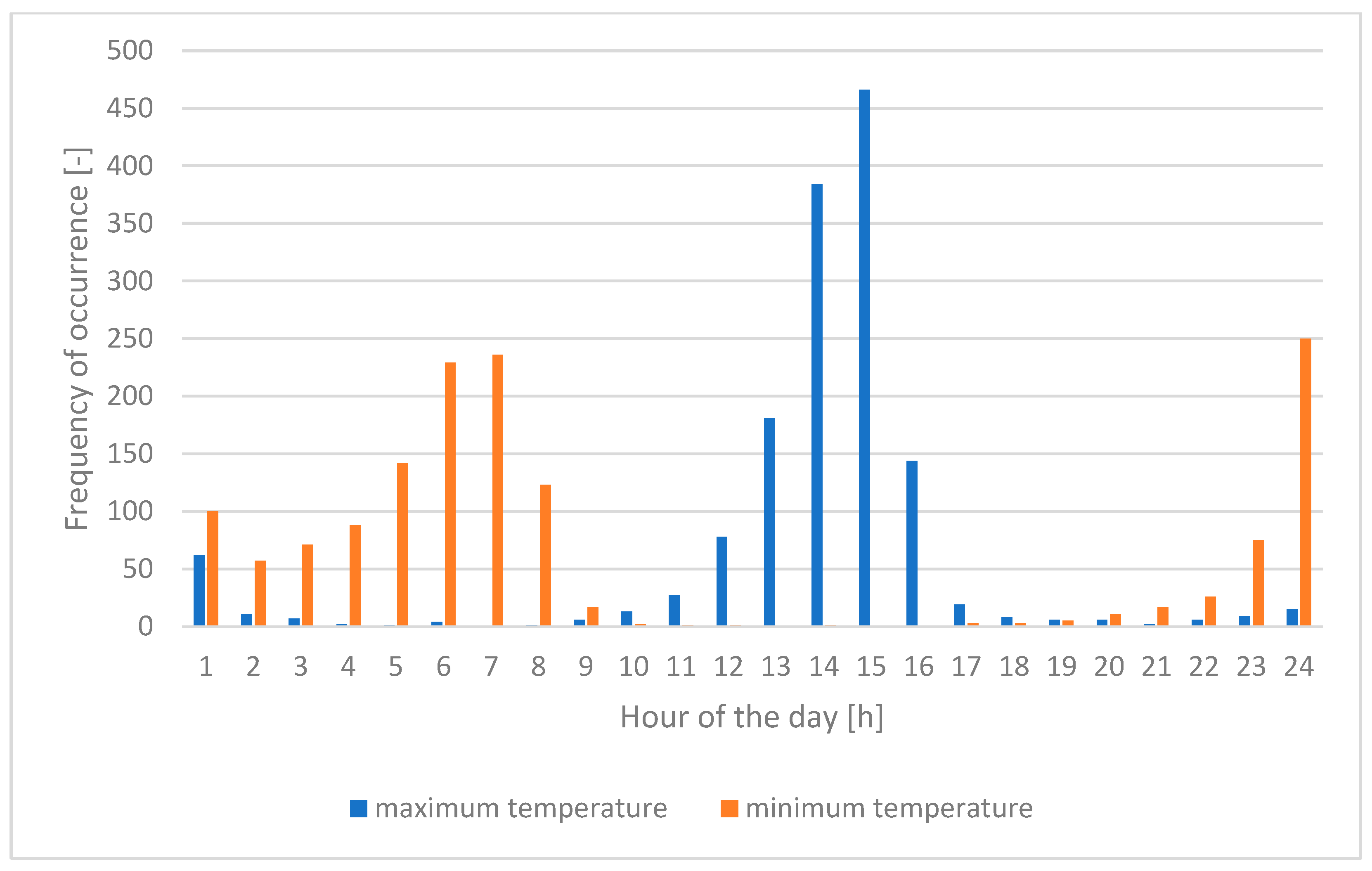
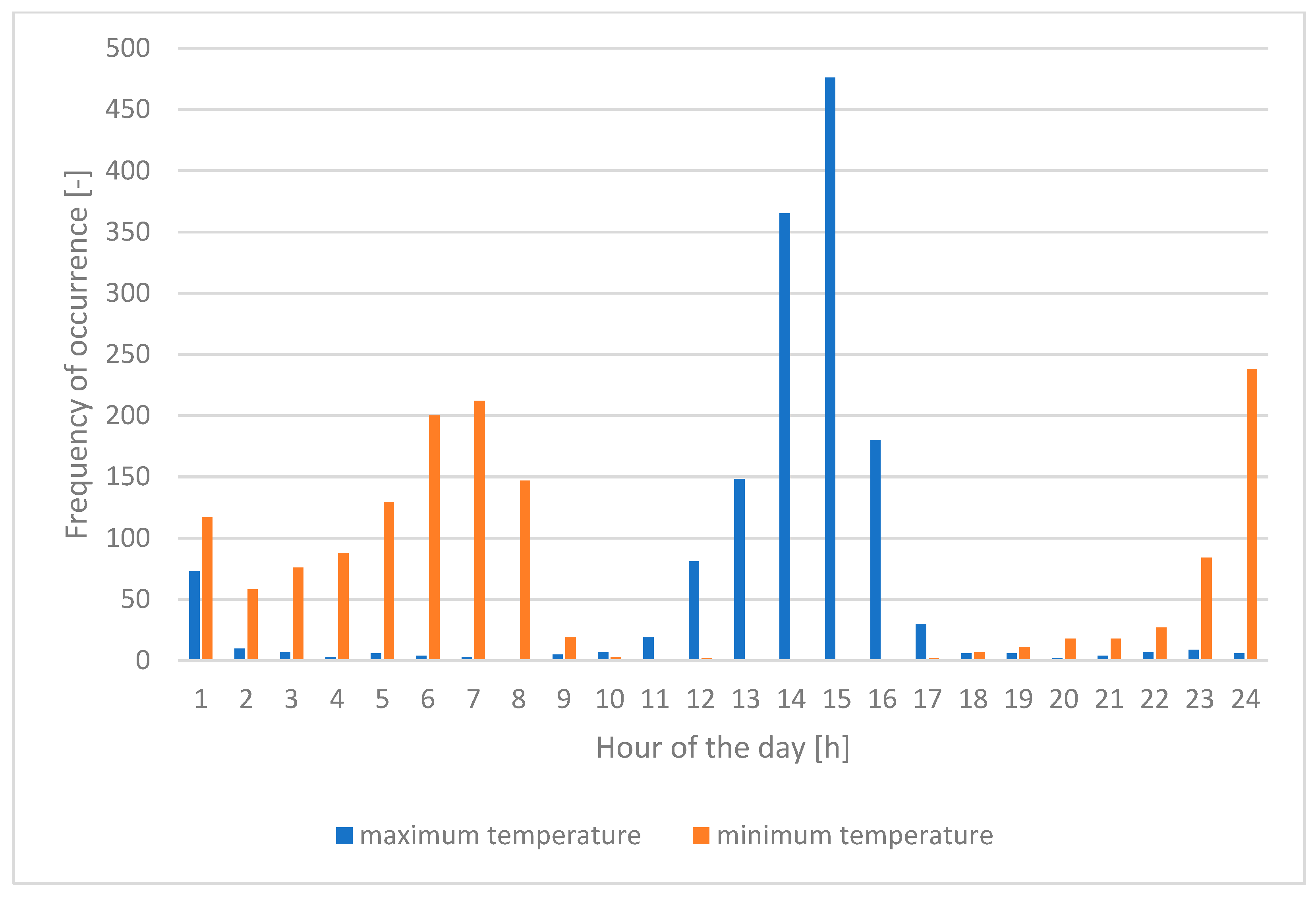
2.4. Microclimatic Data and Analysis Methodology
2.5. TES Modeling and Operating Strategy
- (1)
- calculation of hourly building heating demand based on measured meteorological data;
- (2)
- determination of ASHP operating conditions and corresponding COP values;
- (3)
- TES charging/discharging logic implementation;
- (4)
- calculation of hourly electrical consumption;
- (5)
- seasonal aggregation of results;
- (6)
- repetition of the procedure for all storage volumes and operating schedules.
3. Results
3.1. Statistical Summary of Seasonal Performance Improvements
- −
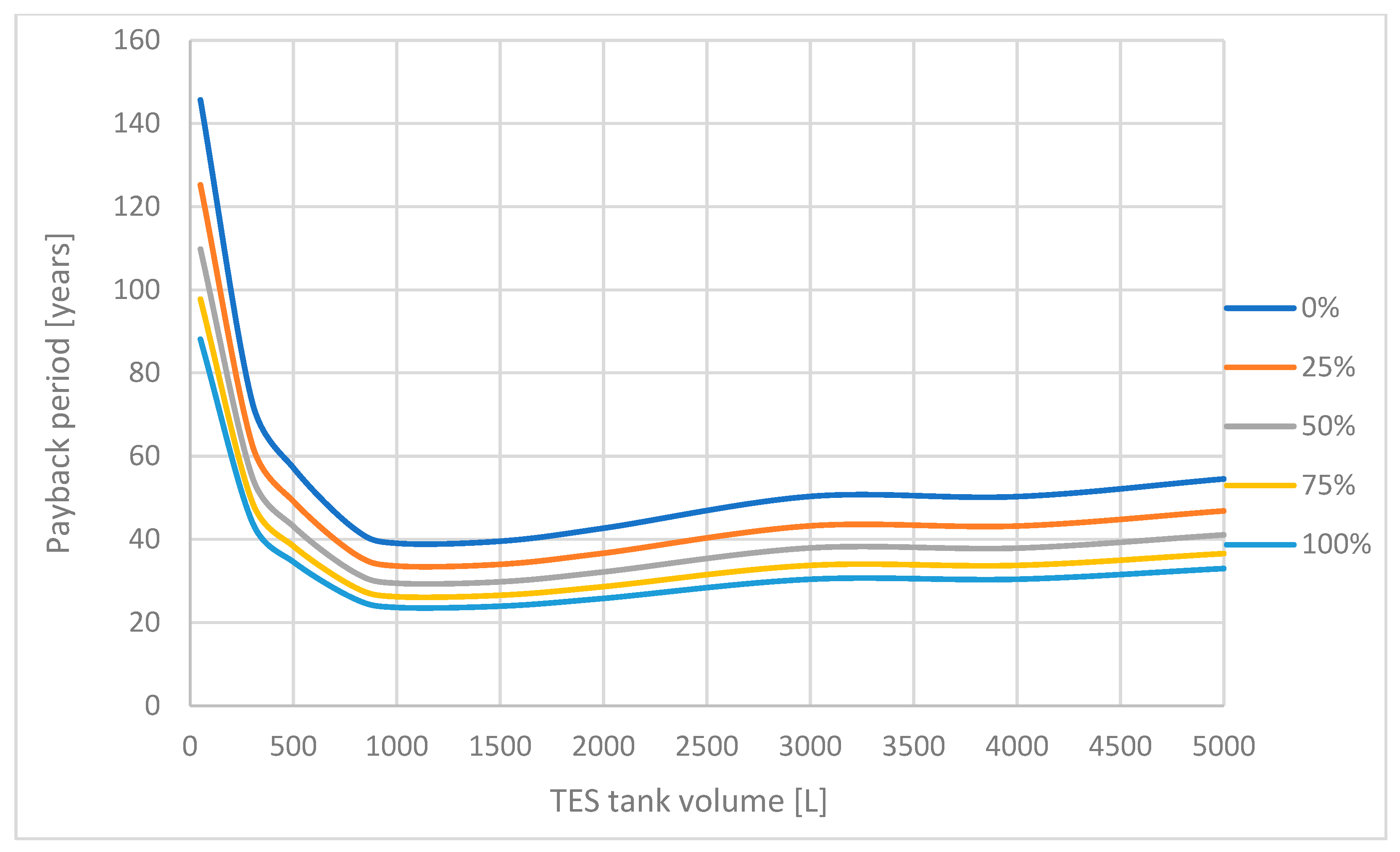
- 1500 L insulated thermal storage tank: €935;
- −
- Additional circulation pump: €130;
- −
- Installation fittings: €70;
- −
- Installation and mounting works: €300.
3.2. Key Quantitative Findings
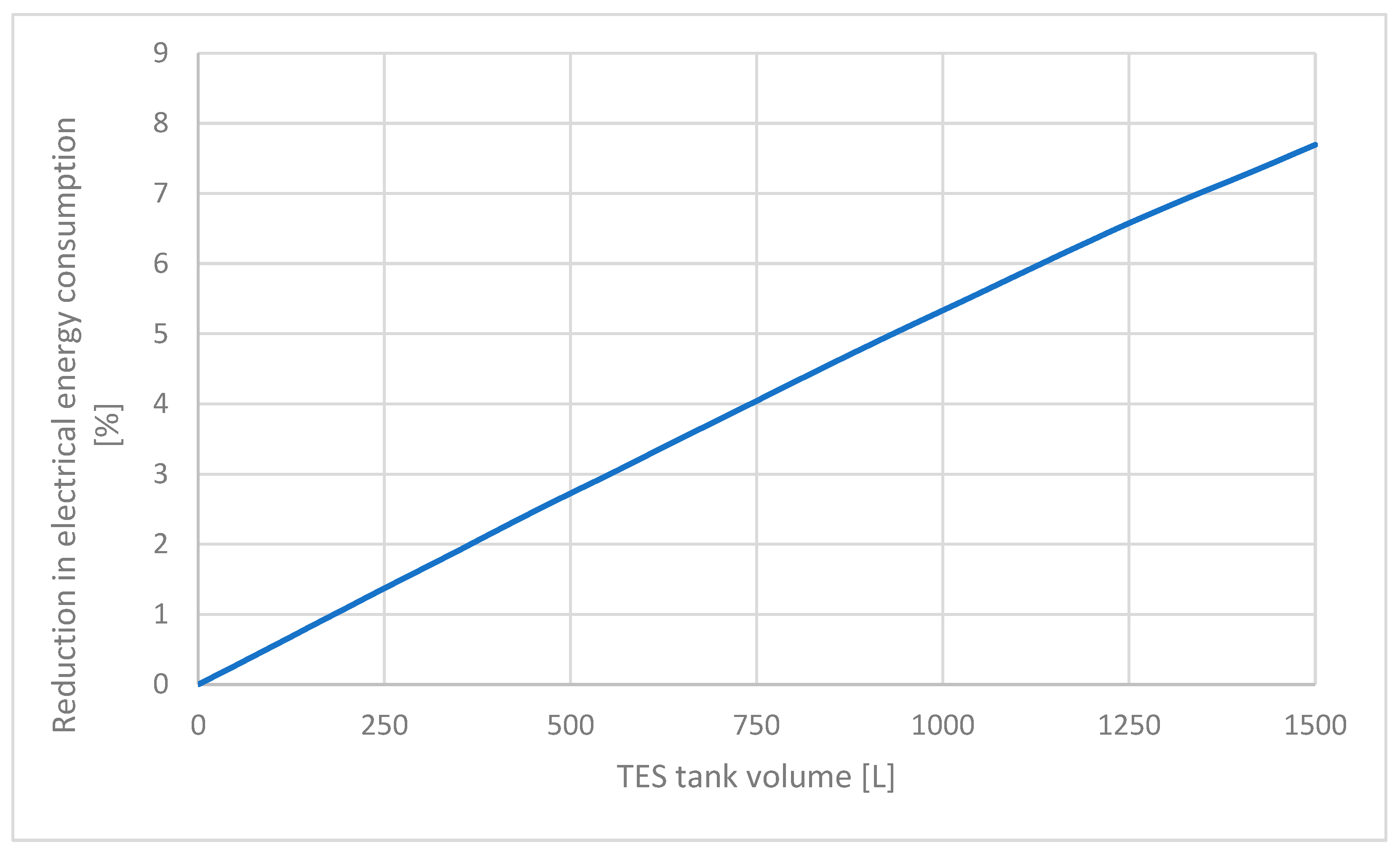
- TES integration reduces annual electricity consumption by 4.8–9.1%.
- The average multi-year reduction equals 7.02%.
- SCOP increases by approximately 0.22 (≈7%).
- The highest relative improvements occur under less favorable microclimatic conditions.
- Energetic saturation is observed above approximately 1000–1500 L storage volume.
4. Discussion
Limitations of the Study
5. Conclusions
Author Contributions
Funding
Data Availability Statement
Conflicts of Interest
Abbreviations
| COP | Coefficient of Performance |
| SCOP | Seasonal Coefficient of Performance |
| SPBT | Simple Payback Time |
| TES | Thermal Energy Storage |
| TMY | Typical Meteorological Year |
References
- European Parliament. European Parliament Resolution of 15 January 2020 on the European Green Deal, 2956; European Parliament: Strasbourg, France, 2020; Available online: https://www.europarl.europa.eu/doceo/document/TA-9-2020-0005_EN.html (accessed on 14 January 2026).
- European Parliament. European Parliament Resolution of 14 March 2019 on Climate Change—A European Strategic Long-Term Vision for a Prosperous, Modern, Competitive and Climate Neutral Economy in Accordance with the Paris Agreement, 2582; European Parliament: Strasbourg, France, 2019; Available online: https://www.europarl.europa.eu/doceo/document/TA-8-2019-0217_EN.html (accessed on 14 January 2026).
- International Energy Agency (IEA). Global Status Report for Buildings and Construction 2019; IEA: Paris, France, 2019; Available online: https://www.iea.org/reports/global-status-report-for-buildings-and-construction-2019 (accessed on 20 January 2026).
- Aktemur, C.; Çakır, M.T.; Çakır, M.F. Optimising of Thermal Insulation Thickness Based on Wall Orientations and Solar Radiation Using Heating-Degree Hour Method. Case Stud. Therm. Eng. 2024, 60, 104725. [Google Scholar] [CrossRef]
- Zhang, Z.; Ren, J. Research on Summer Environmental Thermal Comfort Model of Buildings in Hot Summer and Cold Winter Area. Teh. Vjesn. 2024, 31, 1632–1641. [Google Scholar] [CrossRef]
- Zelazna, A.; Pawlowski, A. Review of the Role of Heat Pumps in Decarbonization of the Building Sector. Energies 2025, 18, 3255. [Google Scholar] [CrossRef]
- Yu, M.; Li, S.; Zhang, X.; Zhao, Y. Techno-Economic Analysis of Air Source Heat Pump Combined with Latent Thermal Energy Storage Applied for Space Heating in China. Appl. Therm. Eng. 2021, 185, 116434. [Google Scholar] [CrossRef]
- Đuranović, M.; Živić, M.; Stojkov, M.; Lujić, R. Analysis of Energy Consumption of a Thermo-Technical System with an Absorption Heat Pump. Teh. Vjesn. Tech. Gaz. 2024, 31, 967–972. [Google Scholar]
- Mouzeviris, G.A.; Papakostas, K.T. Study on Air-to-Water Heat Pumps Seasonal Performances for Heating in Greece. Energies 2022, 15, 279. [Google Scholar] [CrossRef]
- Wu, D.; Xue, Y.; Chen, Y.; Huang, X.; Huang, S.; Zhang, J. Experimental Investigation on Charging Performance of a Thermally Integrated Pumped Thermal Energy Storage System Incorporating a Two-Stage Heat Pump. Renew. Energy 2026, 259, 125132. [Google Scholar] [CrossRef]
- Heier, J.; Bales, C.; Martin, V. Combining Thermal Energy Storage with Buildings—A Review. Renew. Sustain. Energy Rev. 2015, 42, 1305–1325. [Google Scholar] [CrossRef]
- Rahjoo, M.; Caggiano, A.; Berardi, U.; Prabhu, A.; Dolado, J.S. Reviewing Numerical Studies on Sensible Thermal Energy Storage in Cementitious Composites: Report of the RILEM TC 299-TES. Mater. Struct. Constr. 2025, 58, 40. [Google Scholar] [CrossRef]
- Rehman, O.A.; Borri, E.; Palomba, V.; Frazzica, A.; Brancato, V.; Botargues, T.; Cabeza, L.F. Analysis on Integration of Heat Pumps and Thermal Energy Storage in Current Energy System: From Research Outputs to Energy Policies. J. Energy Storage 2024, 97, 112795. [Google Scholar] [CrossRef]
- Ayalew, B.S.; Andrzejczyk, R. Recent Advancements in Latent Thermal Energy Storage and Their Applications for HVAC Systems in Commercial and Residential Buildings in Europe—Analysis of Different EU Countries’ Scenarios. Energies 2025, 18, 4000. [Google Scholar] [CrossRef]
- Buonomo, B.; Rita Golia, M.; Manca, O.; Nardini, S. A Review on Thermal Energy Storage with Phase Change Materials Enhanced by Metal Foams. Therm. Sci. Eng. Prog. 2024, 53, 102732. [Google Scholar] [CrossRef]
- Zhou, J.; Wu, W.; Bellamy, L.; Bishop, D. Thermal Energy Storage–Coupled Heat Pump Systems: Review of Configurations and Modelling Approaches. Renew. Sustain. Energy Rev. 2026, 226, 116226. [Google Scholar] [CrossRef]
- Osterman, E.; Stritih, U. Review on Compression Heat Pump Systems with Thermal Energy Storage for Heating and Cooling of Buildings. J. Energy Storage 2021, 39, 102569. [Google Scholar] [CrossRef]
- Wang, Z.; Wang, F.; Li, G.; Song, M.; Ma, Z.; Ren, H.; Li, K. Experimental Investigation on Thermal Characteristics of Transcritical CO2 Heat Pump Unit Combined with Thermal Energy Storage for Residential Heating; Elsevier: Amsterdam, The Netherlands, 2020; Volume 165, ISBN 8613227006940. [Google Scholar]
- Arteconi, A.; Hewitt, N.J.; Polonara, F. Domestic Demand-Side Management (DSM): Role of Heat Pumps and Thermal Energy Storage (TES) Systems. Appl. Therm. Eng. 2013, 51, 155–165. [Google Scholar] [CrossRef]
- Lyu, W.; Wang, Z.; Li, X.; Deng, G.; Xu, Z.; Li, H.; Yang, Y.; Zhan, B.; Zhao, M. Influence of the Water Tank Size and Air Source Heat Pump Size on the Energy Saving Potential of the Energy Storage Heating System. J. Energy Storage 2022, 55, 105542. [Google Scholar] [CrossRef]
- D’Ettorre, F.; Conti, P.; Schito, E.; Testi, D. Model Predictive Control of a Hybrid Heat Pump System and Impact of the Prediction Horizon on Cost-Saving Potential and Optimal Storage Capacity. Appl. Therm. Eng. 2019, 148, 524–535. [Google Scholar] [CrossRef]
- Liu, X.; Chen, W.; Li, F.; Du, S.; Yao, G.; Zhang, P.; Xu, K.; Wang, Z. Research on Parameter Optimization and Control Strategy of Air Source Heat Pump Coupled with Thermal Energy Storage System. Buildings 2025, 15, 2870. [Google Scholar] [CrossRef]
- Pospíšil, J.; Špiláček, M.; Kudela, L. Potential of Predictive Control for Improvement of Seasonal Coefficient of Performance of Air Source Heat Pump in Central European Climate Zone. Energy 2018, 154, 415–423. [Google Scholar] [CrossRef]
- Conti, P.; Franco, A.; Bartoli, C.; Testi, D. A Design Methodology for Thermal Storages in Heat Pump Systems to Reduce Partial-Load Losses. Appl. Therm. Eng. 2022, 215, 118971. [Google Scholar] [CrossRef]
- Carutasiu, M.B.; Necula, H. Assessing the Impact of Air-Source Heat Pumps in a Residential Building’s Retrofit Process. Buildings 2024, 14, 3708. [Google Scholar] [CrossRef]
- Wu, P.; Wang, Z.; Li, X.; Xu, Z.; Yang, Y.; Yang, Q. Energy-Saving Analysis of Air Source Heat Pump Integrated with a Water Storage Tank for Heating Applications. Build. Environ. 2020, 180, 107029. [Google Scholar] [CrossRef]
- Li, Y.; Zhang, N.; Ding, Z. Investigation on the Energy Performance of Using Air-Source Heat Pump to Charge PCM Storage Tank. J. Energy Storage 2020, 28, 101270. [Google Scholar] [CrossRef]
- Fitzpatrick, P.; D’Ettorre, F.; De Rosa, M.; Yadack, M.; Eicker, U.; Finn, D.P. Influence of Electricity Prices on Energy Flexibility of Integrated Hybrid Heat Pump and Thermal Storage Systems in a Residential Building. Energy Build. 2020, 223, 110142. [Google Scholar] [CrossRef]
- Gibb, D.; Johnson, M.; Romaní, J.; Gasia, J.; Cabeza, L.F.; Seitz, A. Process Integration of Thermal Energy Storage Systems—Evaluation Methodology and Case Studies. Appl. Energy 2018, 230, 750–760. [Google Scholar] [CrossRef]
- HRN EN 12831-1:2017; Energy Performance of Buildings—Method for Calculation of the Design Heat Load—Part 1: Space Heating Load. Croatian Standards Institute (HZN): Zagreb, Croatia, 2017.
- HRN EN ISO 13790:2008; Energy Performance of Buildings—Calculation of Energy Use for Space Heating and Cooling. Croatian Standards Institute: Zagreb, Croatia, 2008.
- MathWorks MATLAB; The Matworks, Inc.: Natick, MA, USA, 2023.




| Parameter | Value |
|---|---|
| Window U-value | 1.00 W/m2K |
| Door U-value | 1.05 W/m2K |
| Wall U-value | 0.24 W/m2K |
| Floor U-value | 0.26 W/m2K |
| Ceiling U-value | 0.18 W/m2K |
| Thermal bridge correction coefficient | 0.05 W/m2K |
| Internal heat gains | 6 W/m2 |
| Thermal zone assumption | Single thermal zone |
| Solar gains | Calculated using measured hourly solar radiation data |
| Ventilation losses | Calculated according to HR EN ISO 13790 [31] methodology based on total heated volume |
| Year | Annual Thermal Energy Demand for Heating [kWh] | SCOP, Without a Storage Tank [-] | SCOP, with a Storage Tank [-] | Reduction in Electrical Energy Consumption [%] | Annual Thermal Energy Demand for Heating [kWh] | SCOP, Without a Storage Tank [-] | SCOP, with a Storage Tank [-] | Reduction in Electrical Energy Consumption [%] | Annual Thermal Energy Demand for Heating [kWh] | SCOP, Without a Storage Tank [-] | SCOP, with a Storage Tank [-] | Reduction in Electrical Energy Consumption [%] |
|---|---|---|---|---|---|---|---|---|---|---|---|---|
| Gradište | Osijek | Slavonski Brod | ||||||||||
| 2018 | 7433 | 3.05 | 3.19 | 4.79 | 7754 | 3.03 | 3.18 | 4.96 | 7855 | 3.02 | 3.20 | 5.88 |
| 2019 | 6299 | 3.18 | 3.38 | 6.32 | 6675 | 3.16 | 3.38 | 7.00 | 6870 | 3.12 | 3.37 | 8.28 |
| 2020 | 6860 | 3.19 | 3.39 | 6.22 | 7221 | 3.16 | 3.37 | 6.54 | 7402 | 3.12 | 3.36 | 7.70 |
| 2021 | 7688 | 3.13 | 3.34 | 6.77 | 7784 | 3.13 | 3.35 | 7.30 | 8059 | 3.08 | 3.32 | 8.01 |
| 2022 | 7349 | 3.13 | 3.36 | 7.29 | 7078 | 3.16 | 3.42 | 8.21 | 7018 | 3.14 | 3.42 | 9.11 |
| 2023 | 5746 | 3.26 | 3.49 | 6.99 | 6442 | 3.23 | 3.45 | 6.96 | 6432 | 3.19 | 3.47 | 8.75 |
| 2024 | 5137 | 3.27 | 3.51 | 7.23 | 6320 | 3.18 | 3.42 | 7.30 | 6268 | 3.17 | 3.44 | 8.36 |
| 2025 | 6238 | 3.20 | 3.40 | 6.14 | 7952 | 3.03 | 3.20 | 5.62 | 7346 | 3.10 | 3.31 | 6.80 |
| Year | Gradište— Charging Start Time [h] | Gradište—Discharge Start Time [h] | Osijek—Charging Start Time [h] | Osijek— Discharge Start Time [h] | Slavonski Brod—Charging Start Time [h] | Slavonski Brod—Discharge Start Time [h] |
|---|---|---|---|---|---|---|
| 2018 | 14 | 1 | 14 | 1 | 14 | 1 |
| 2019 | 15 | 24 | 14 | 24 | 14 | 1 |
| 2020 | 15 | 1 | 14 | 1 | 14 | 1 |
| 2021 | 14 | 1 | 14 | 1 | 14 | 2 |
| 2022 | 15 | 1 | 14 | 1 | 15 | 2 |
| 2023 | 14 | 1 | 14 | 1 | 14 | 1 |
| 2024 | 15 | 24 | 14 | 24 | 14 | 24 |
| 2025 | 15 | 1 | 14 | 1 | 14 | 2 |
Disclaimer/Publisher’s Note: The statements, opinions and data contained in all publications are solely those of the individual author(s) and contributor(s) and not of MDPI and/or the editor(s). MDPI and/or the editor(s) disclaim responsibility for any injury to people or property resulting from any ideas, methods, instructions or products referred to in the content. |
© 2026 by the authors. Licensee MDPI, Basel, Switzerland. This article is an open access article distributed under the terms and conditions of the Creative Commons Attribution (CC BY) license.
Share and Cite
Đuranović, M.; Živić, M.; Batistić, I.; Kozak, D. Impact of Thermal Energy Storage on the Seasonal Performance of an Air-to-Water Heat Pump Under Real Microclimatic Conditions. Buildings 2026, 16, 1432. https://doi.org/10.3390/buildings16071432
Đuranović M, Živić M, Batistić I, Kozak D. Impact of Thermal Energy Storage on the Seasonal Performance of an Air-to-Water Heat Pump Under Real Microclimatic Conditions. Buildings. 2026; 16(7):1432. https://doi.org/10.3390/buildings16071432
Chicago/Turabian StyleĐuranović, Matej, Marija Živić, Ivan Batistić, and Dražan Kozak. 2026. "Impact of Thermal Energy Storage on the Seasonal Performance of an Air-to-Water Heat Pump Under Real Microclimatic Conditions" Buildings 16, no. 7: 1432. https://doi.org/10.3390/buildings16071432
APA StyleĐuranović, M., Živić, M., Batistić, I., & Kozak, D. (2026). Impact of Thermal Energy Storage on the Seasonal Performance of an Air-to-Water Heat Pump Under Real Microclimatic Conditions. Buildings, 16(7), 1432. https://doi.org/10.3390/buildings16071432