Article

Finite Element Study of Lightweight-Concrete-Filled Hollow-Flanged Cold-Formed Steel Beams Under Bending–Shear Interaction

1
School of Engineering, University of Surrey, Guildford GU2 7XH, UK
2
Faculty of Engineering and Environment, Northumbria University, Newcastle upon Tyne NE1 8ST, UK
*
Author to whom correspondence should be addressed.
Buildings 2026, 16(7), 1370; https://doi.org/10.3390/buildings16071370 (registering DOI)
Submission received: 10 February 2026 / Revised: 15 March 2026 / Accepted: 25 March 2026 / Published: 30 March 2026
(This article belongs to the Collection Advanced Concrete Materials in Construction)

Abstract

This study presents a comprehensive numerical investigation into the combined bending–shear behaviour of hollow-flanged cold-formed steel (HFCFS) beams filled with lightweight concrete (LWC). Although previous research has independently examined the pure bending and pure shear responses of these composite members, their structural performance under simultaneous bending and shear remains unexplored. In this work, advanced three-dimensional finite element (FE) models were developed in ABAQUS to simulate the nonlinear behaviour of LWC-filled HFCFS beams subjected to various shear-span ratios. The modelling approach was validated using published experimental data and extended through a systematic parametric study that considered three beam geometries, two steel yield strengths (350 MPa and 450 MPa), two lightweight-concrete strengths (30 MPa and 50 MPa), and aspect ratios ranging from 1.5 to 3.5. The results demonstrated a clear progression of governing failure modes, from web shear buckling at low aspect ratios to combined shear–flexure interaction at intermediate spans and flexural-dominated failure at larger spans. Normalised shear and bending demand–capacity ratios (V/Vu and M/Mu) were used to identify the dominant limit state, revealing a predictable transition from shear-controlled to flexure-controlled behaviour. The findings enhance the understanding of composite thin-walled steel–concrete systems under combined actions and highlight the need for dedicated design rules for CF-HFCFS beams operating within the bending–shear interaction domain.

1. Introduction

Cold-formed steel (CFS) members are increasingly used in modern construction due to their high strength-to-weight ratio, ease of fabrication, and economic advantages over hot-rolled steel sections [1,2,3]. Their use can significantly reduce material consumption, construction time, and overall cost, making them attractive solutions in building and modular construction systems [4,5]. However, the thin-walled nature of CFS sections makes them susceptible to local, distortional, and lateral–torsional buckling, as well as pronounced shear deformations, particularly in flexural members with unstiffened compression flanges [6,7]. To overcome these shortcomings, hollow-flanged CFS (HFCFS) sections were introduced, providing torsionally rigid, closed-flange elements that reduce local buckling susceptibility and enhance bending stiffness by shifting more material away from the neutral axis [2,8].
Although HFCFS beams offer improved stability, they remain vulnerable to local buckling in the compression flange and web, especially under high bending or shear demands. To address these limitations, researchers investigated concrete infill within the hollow flanges, which provides confinement and support to the thin steel walls, delays buckling, and significantly improves the structural response. Concrete-filled HFCFS (CF-HFCFS) beams have demonstrated enhanced bending resistance, stiffness, ductility, and energy absorption capacity, leading to their increasing use in lightweight floors, bridge components, and modular buildings [2,9]. Prior studies have shown that the infill restrains flange distortion, reduces local buckling, and increases both flexural and shear strength across various hollow-flange geometries such as pentagonal, tubular, and rectangular flanges [2,8,9,10,11,12].
Despite these advantages, the relatively high self-weight of normal-weight concrete (NWC) can introduce handling challenges and increase demands on thin CFS webs. Recently, lightweight concrete (LWC) has emerged as a suitable alternative, offering reduced density, improved thermal and acoustic performance, frost resistance, and better fire resistance, while lowering transportation and construction costs [13,14]. Several studies confirmed that replacing NWC with LWC in composite CFS members can maintain or improve structural capacity without significantly increasing instability risks [15,16,17]. Moreover, the development of high-strength LWC has expanded the applicability of lightweight composites in slender steel sections where minimising infill weight is critical. Several studies have demonstrated that high-strength lightweight concrete can be produced by incorporating lightweight aggregates with only fine aggregates (nominal size < 4.75 mm) [18], which enhances the flowability, homogeneity, and strength of the concrete mixture [19,20]. Recent work demonstrated that LWC infill can enhance flexural capacity by up to 55% in CF-HFCFS beams, while effectively delaying local buckling of the compression flange [21].
Building on these developments, separate research efforts have investigated the pure flexural behaviour of LWC-filled HFCFS beams and the pure shear behaviour of similar systems, establishing validated finite element (FE) models and proposing simplified design approaches for each loading condition [21,22]. These studies confirmed that concrete infill enhances bending stiffness, increases ultimate moment capacity, improves shear resistance, and significantly modifies the failure modes. However, both bodies of work purposefully isolated bending from shear or vice versa by selecting span lengths, load configurations, and boundary conditions that prevented interaction effects. As a result, the combined bending–shear behaviour of lightweight-concrete-filled HFCFS beams remains largely unexplored.
This gap is critical from a practical perspective. In real structural applications, such as short-span floor beams, edge beams around openings, and beams supporting concentrated loads, CFS members typically experience simultaneous bending and shear, and the interaction between these actions governs the overall strength and failure mode. For hollow-flanged sections with thin webs and flanges, the presence of LWC infill may influence the transition between bending-dominated and shear-dominated failure, modify buckling patterns, enhance composite action, and alter post-buckling behaviour. Yet no systematic study has investigated how LWC infill affects bending–shear interaction, nor has any design method been proposed for predicting the interaction capacity of CF-HFCFS beams.
Therefore, this study focuses on a comprehensive numerical investigation into the combined bending and shear behaviour of hollow-flanged cold-formed steel beams filled with lightweight concrete. Advanced nonlinear three-dimensional FE models are developed by extending the validated modelling strategies from prior flexural and shear studies. The models are used to (i) characterise the global response and governing failure modes under combined actions, (ii) quantify the influence of geometric and material parameters (steel thickness, section depth, steel grade, and LWC strength), (iii) assess the interaction between bending and shear capacities, and (iv) identify the role of LWC infill in improving resistance and delaying buckling under multiaxial demand. Based on the numerical results, insights into the interaction mechanism are discussed. The practical applications of these composite beams include lightweight composite floor systems, modular construction beams, short-span beams, concentrated-load support, and edge beams around openings in buildings

2. FE Modelling

2.1. General

A nonlinear three-dimensional finite element (FE) modelling framework was developed using ABAQUS 2024 [23] to simulate the structural response of HFCFS beams filled with lightweight concrete under combined bending and shear actions. The modelling approach builds upon the validated FE techniques established in previous studies on the flexural and shear behaviour of concrete-filled HFCFS beams [21,22]. The new modelling configuration adapts these methods to capture the complex interaction between bending and shear, with the span arrangement and load positioning intentionally designed to generate varying degrees of interaction.
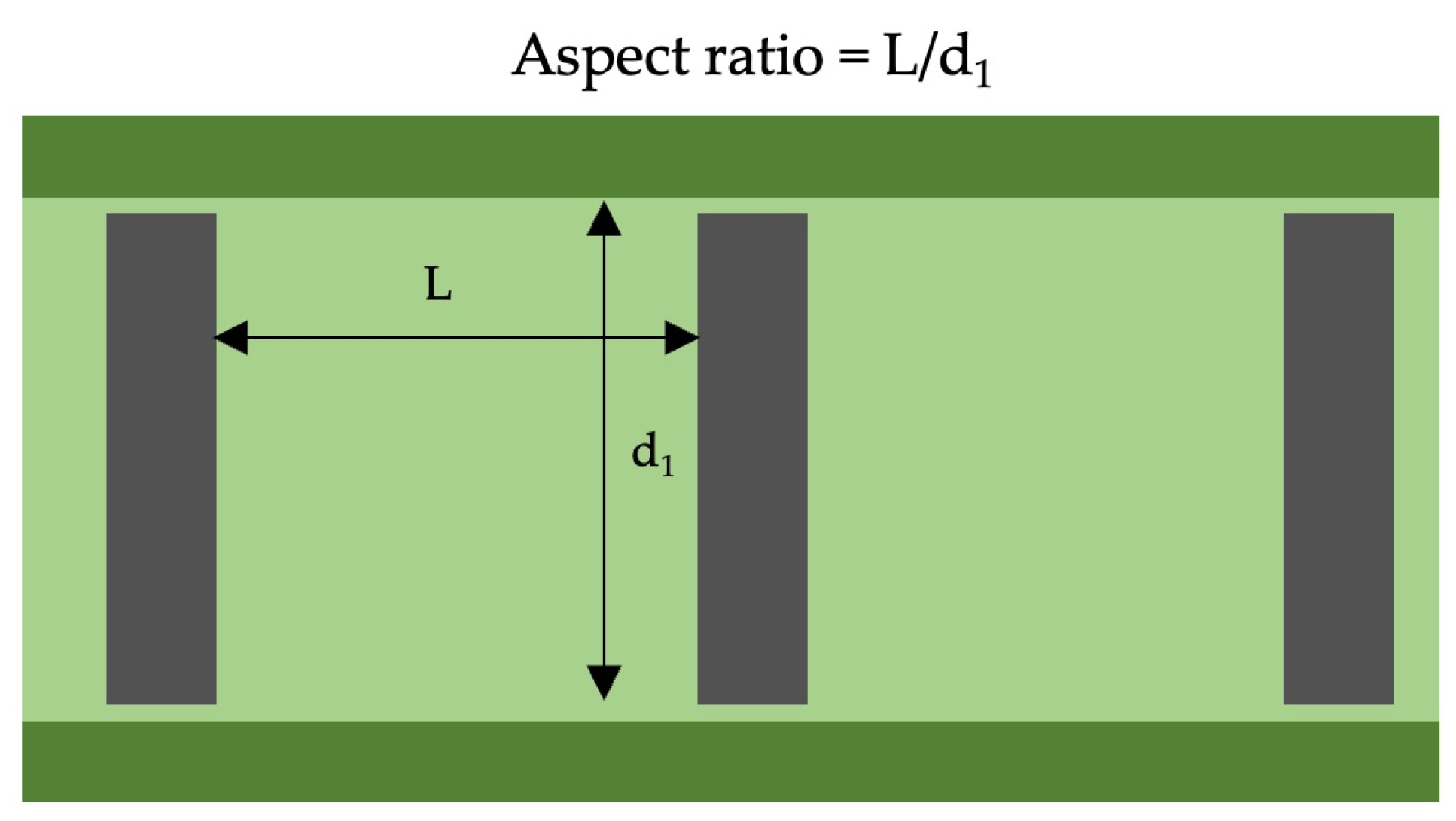
In the present study, both bare HFCFS beams and lightweight-concrete-filled HFCFS (CF-HFCFS) beams were simulated. A series of aspect ratios (L/d1)—1.5, 2.0, 2.5, 3.0, and 3.5—was considered to generate structural responses ranging from shear-dominant to bending-dominant, thereby enabling a systematic investigation of bending–shear interaction.

2.2. Element Types and Mesh Refinement

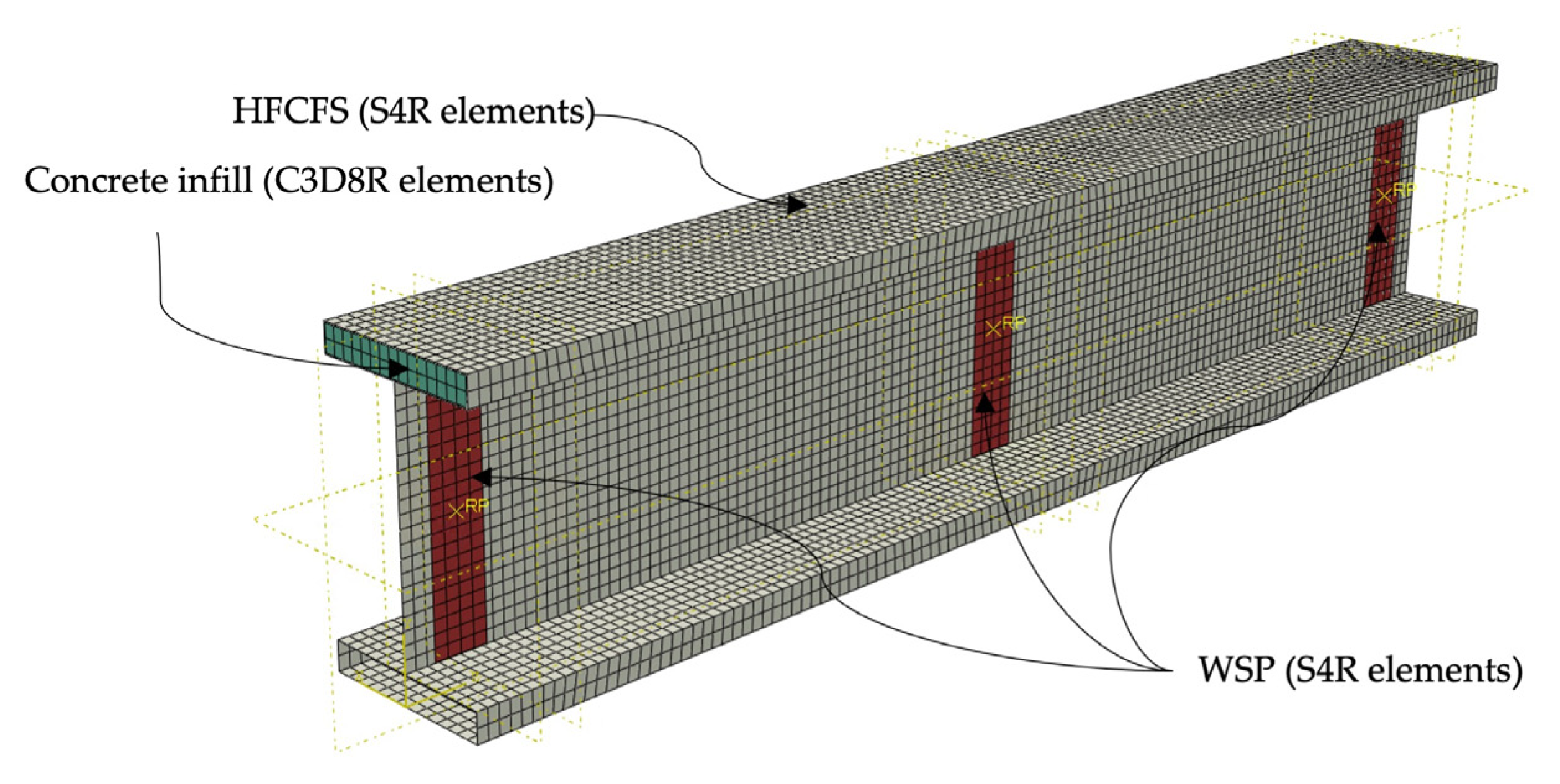
Consistent with prior validated models, the steel section was modelled using four-node reduced integration shell elements (S4R), which provide accurate representation of thin-walled behaviour under combined actions (see Figure 1). The lightweight-concrete infill was represented using eight-node brick elements (C3D8R), appropriate for capturing confinement effects, cracking, and shear transfer mechanisms [24]. Mesh convergence studies indicated that a mesh density of 10 × 10 mm for both the steel and concrete parts ensured accurate capture of local buckling patterns and stress gradients while maintaining a reasonable computational cost [21,22].

2.3. Material Models

Cold-formed steel was modelled using an elastic–perfectly plastic material model with a Young’s modulus of 200 GPa and a Poisson’s ratio of 0.3 [25,26]. This approach is consistent with earlier studies that demonstrated its suitability for simulating thin CFS sections subjected to bending, shear, and combined actions [21,22]. Strain hardening and residual stress effects were omitted as their influence on global behaviour was found to be minimal [27].
LWC (30 MPa and 50 MPa grades) was modelled using the Concrete Damage Plasticity (CDP) model to represent cracking in tension and crushing in compression. The CDP parameters were defined as follows: dilation angle = 15°; eccentricity = 0.1; fb0/fc0 = 1.16; Kc = 0.667; viscosity parameter = 0.0001. The constitutive relationships for confined lightweight concrete were derived from Lim and Ozbakkaloglu’s [28] model, as successfully applied in previous flexural and shear studies on CF-HFCFS beams. A Poisson’s ratio of 0.2 and density appropriate for lightweight concrete were adopted. The adopted stress–strain equations for confined compressive behaviour and tensile behaviour are given in Appendix A.

2.4. Steel–Concrete Interaction

A surface-to-surface interaction was used to define contact between the steel shell and concrete infill. Tangential behaviour was modelled using a penalty friction formulation with a friction coefficient of 0.57, calibrated and validated previously for similar composite systems [21,22]. Hard contact was used in the normal direction to prevent artificial penetration while enabling realistic bearing stresses to develop at the interface. This interface modelling is essential in bending–shear studies, as slip and partial composite action influence both the stiffness and failure progression.

2.5. Initial Imperfection

To capture realistic buckling behaviour, initial geometric imperfections were introduced in the FE model. The first buckling mode obtained from eigenvalue analysis was used as the imperfection shape with an amplitude equal to 0.34 t, following the recommendations by Schafer and Peköz [29] for cold-formed steel members. Here, ‘t’ is the thickness of the section.

2.6. Boundary Conditions and Loading Scheme

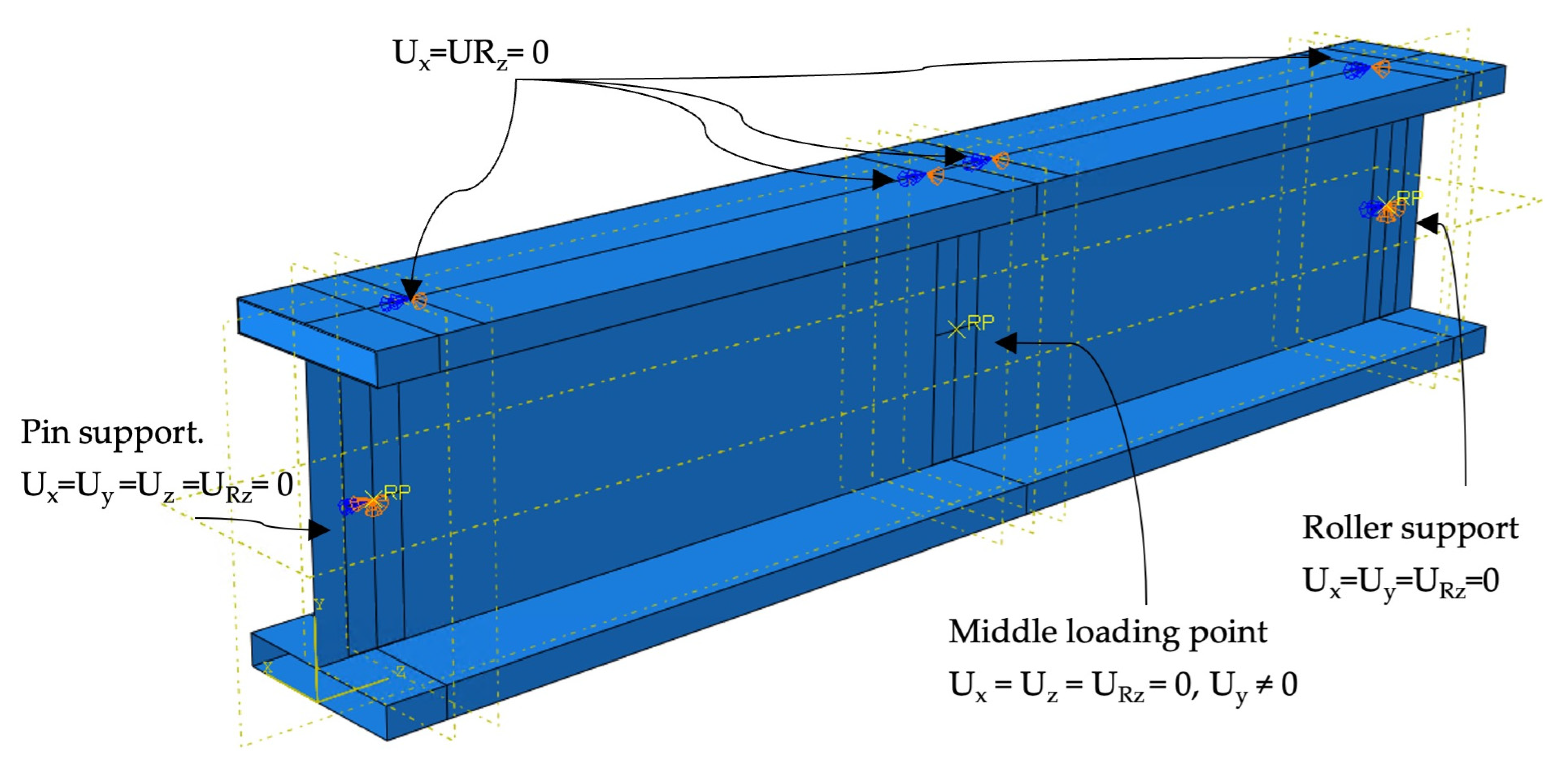
Unlike previous flexural or shear-only studies that intentionally eliminated interaction effects, the present modelling adopts a three-point loading configuration designed to generate bending–shear interaction by varying the shear span. Each beam was simply supported at its ends, with one support modelled as a pin and the other as a roller. A vertical displacement-controlled load was applied at a central loading point. As per Figure 2, the shear span-to-depth ratios (aspect ratios) were adjusted to produce aspect ratios (L/d1) of 1.5, 2.0, 2.5, 3.0, and 3.5, where
  • Lower ratios (1.5–2.0) → shear-dominated interaction;
  • Intermediate ratios (2.0–2.5) → balanced bending–shear response;
  • Higher ratios (3.0–3.5) → bending-dominated interaction.
To avoid premature lateral–torsional buckling (LTB) and isolate the bending–shear mechanism, lateral restraints were provided at the top flange at regular intervals, following strategies previously employed in flexural simulations. Rigid web support plates (WSPs) were tied to the beam section at the supports and loading point to prevent indentation and capture realistic load transfer (see Figure 3). WSPs were also introduced to prevent web indentation and local crippling. This modelling approach isolates the bending–shear behaviour from web crippling effects.

2.7. Validation of FE Numerical Models

The FE models were validated using a two-stage validation strategy:
  • Validation of bare frames (without concrete infill).
  • Validation of composite beams (with concrete infill) with combined bending and shear action.
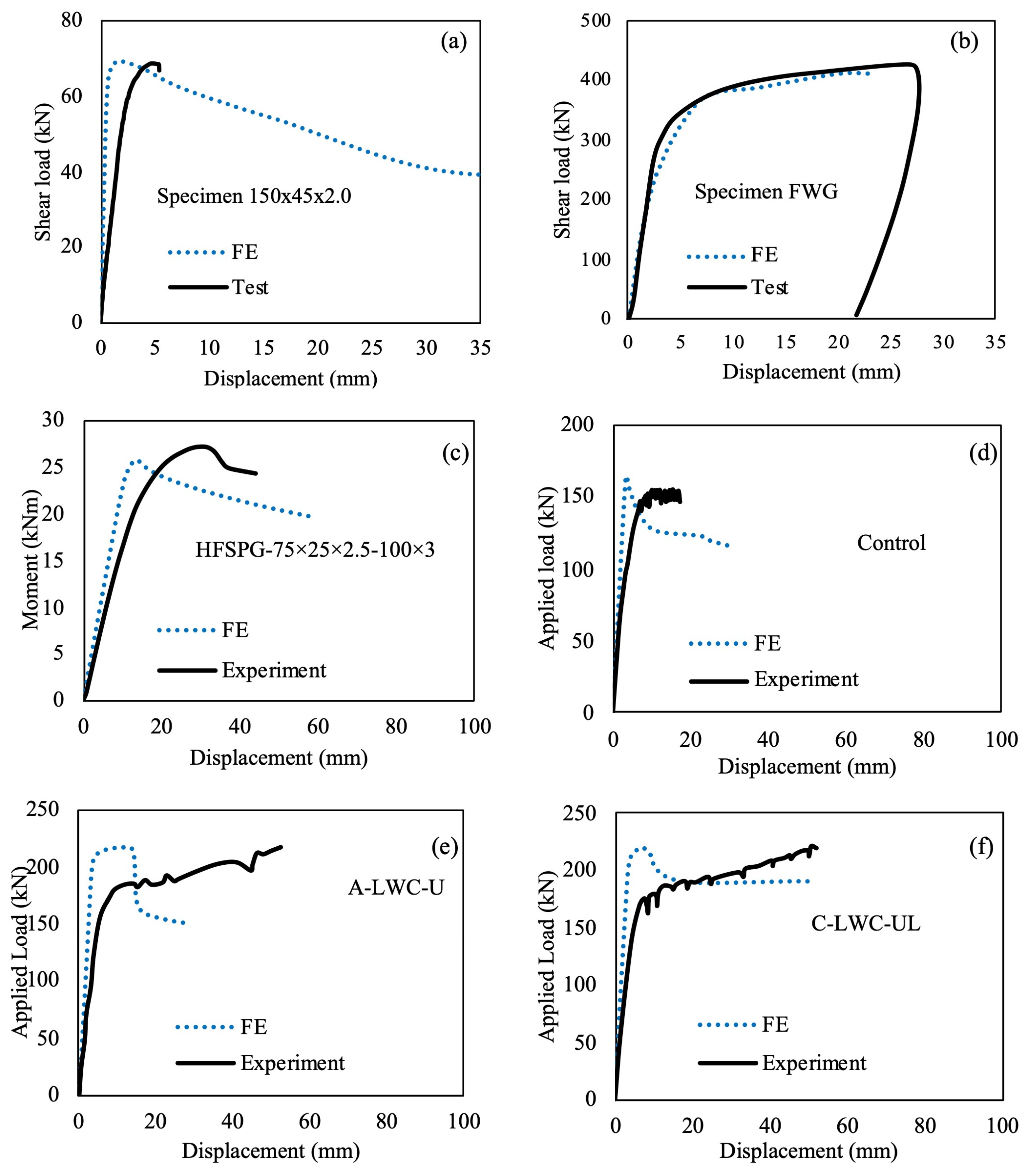
The consistency of material models, contact behaviour, element types, and failure patterns across both domains provides confidence in the predictive capability of the FE framework for combined action analysis. Figure 4 compares the load vs. displacement relationships between the experiment and the FE models. Additionally, Table 1 details a comparison of ultimate loads and moments from the tests and FE models. The failure mode comparison can be found in the authors’ previous studies [21,22]. The discrepancy between the FE and experimental initial stiffness is attributed to idealised modelling assumptions such as simplified material constitutive laws, omission of residual stresses, and idealised boundary conditions. Since the primary objective of the study was to evaluate ultimate capacity and failure modes, these simplifications were considered acceptable.

2.8. Parametric Study

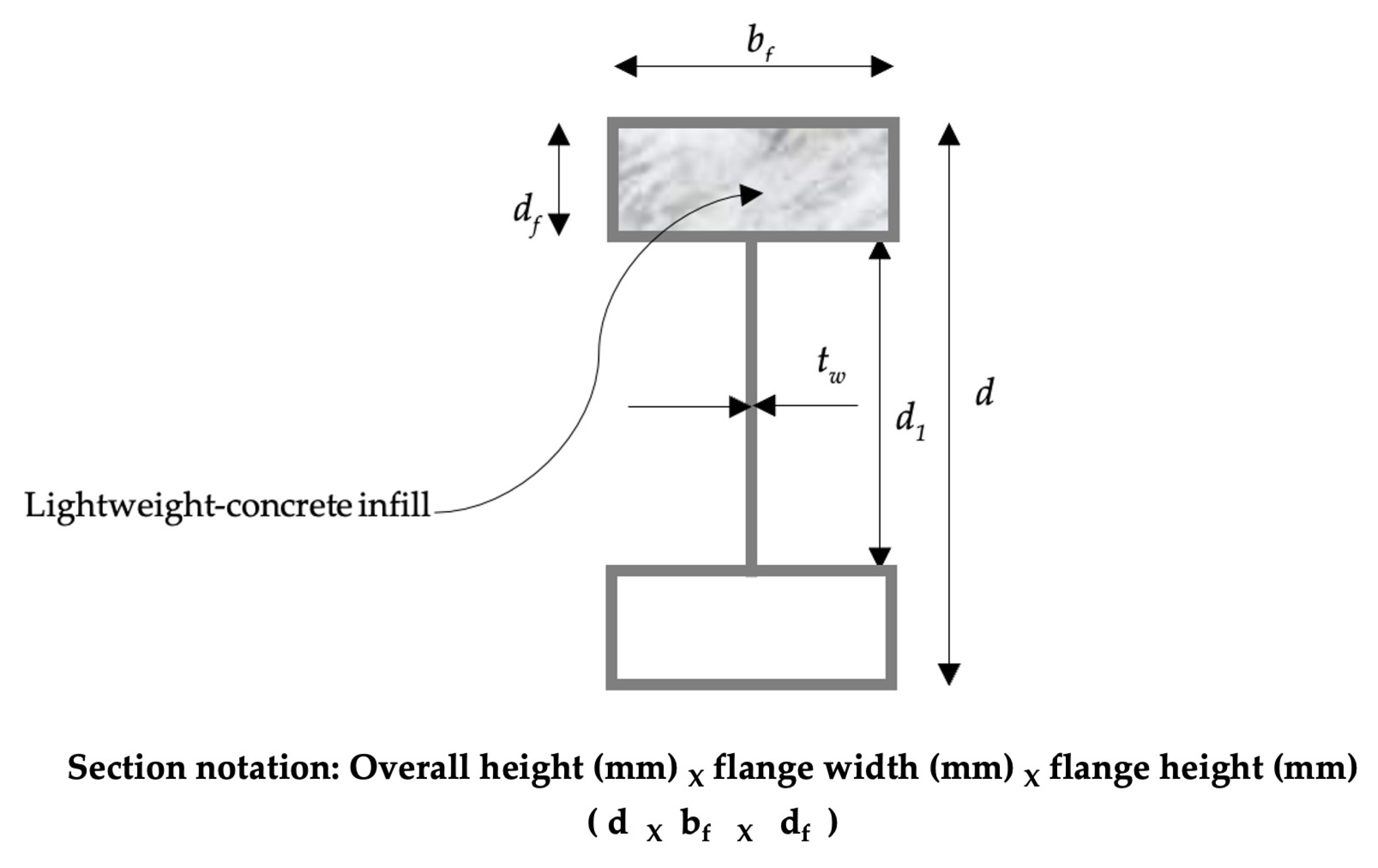
A comprehensive parametric study was conducted to evaluate the influence of key geometric and material parameters on the combined bending–shear behaviour of CF-HFCFS beams. The study considered three representative hollow-flange geometries, 150 × 90 × 15 mm, 200 × 120 × 20 mm, and 250 × 150 × 50 mm, selected to capture the response of small, medium, and large sections commonly used in lightweight steel construction (see Figure 5). For each geometry, two steel yield strengths (350 MPa and 450 MPa) and two lightweight-concrete strengths (30 MPa and 50 MPa) were examined to quantify the effects of material variation on bending and shear capacity. The aspect ratio (shear span-to-depth ratio) was varied systematically from 1.5 to 3.5 in increments of 0.5 to investigate the behavioural transition from a shear-dominated to bending-dominated response. For each configuration, the ultimate shear force and bending moment were extracted from the FE simulations and normalised against their corresponding design capacities to establish the governing failure mode. This structured parametric plan enabled a detailed assessment of how geometry, steel grade, concrete strength, and loading configuration collectively affect the interaction behaviour of CF-HFCFS beams.

3. Results and Discussion

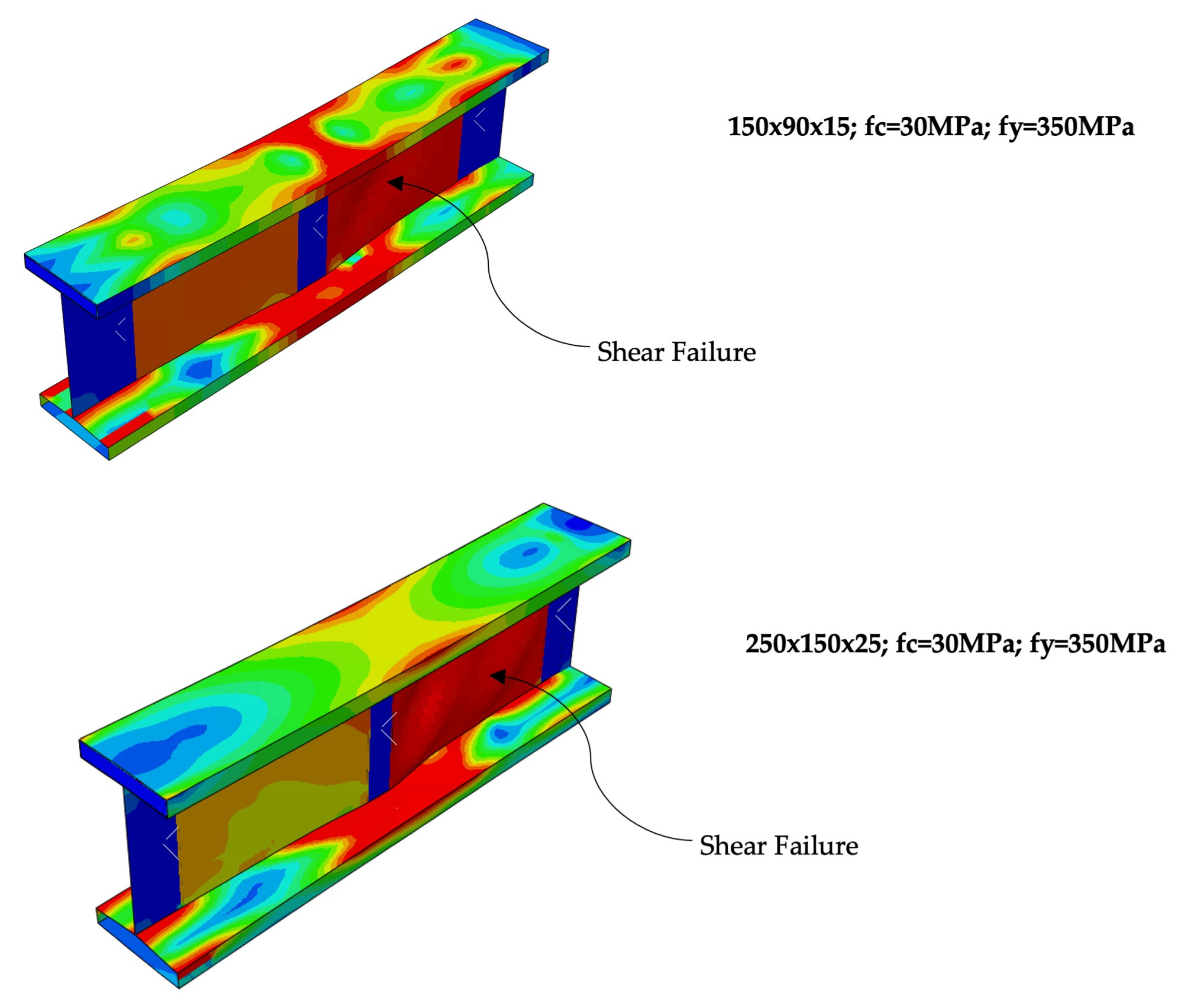
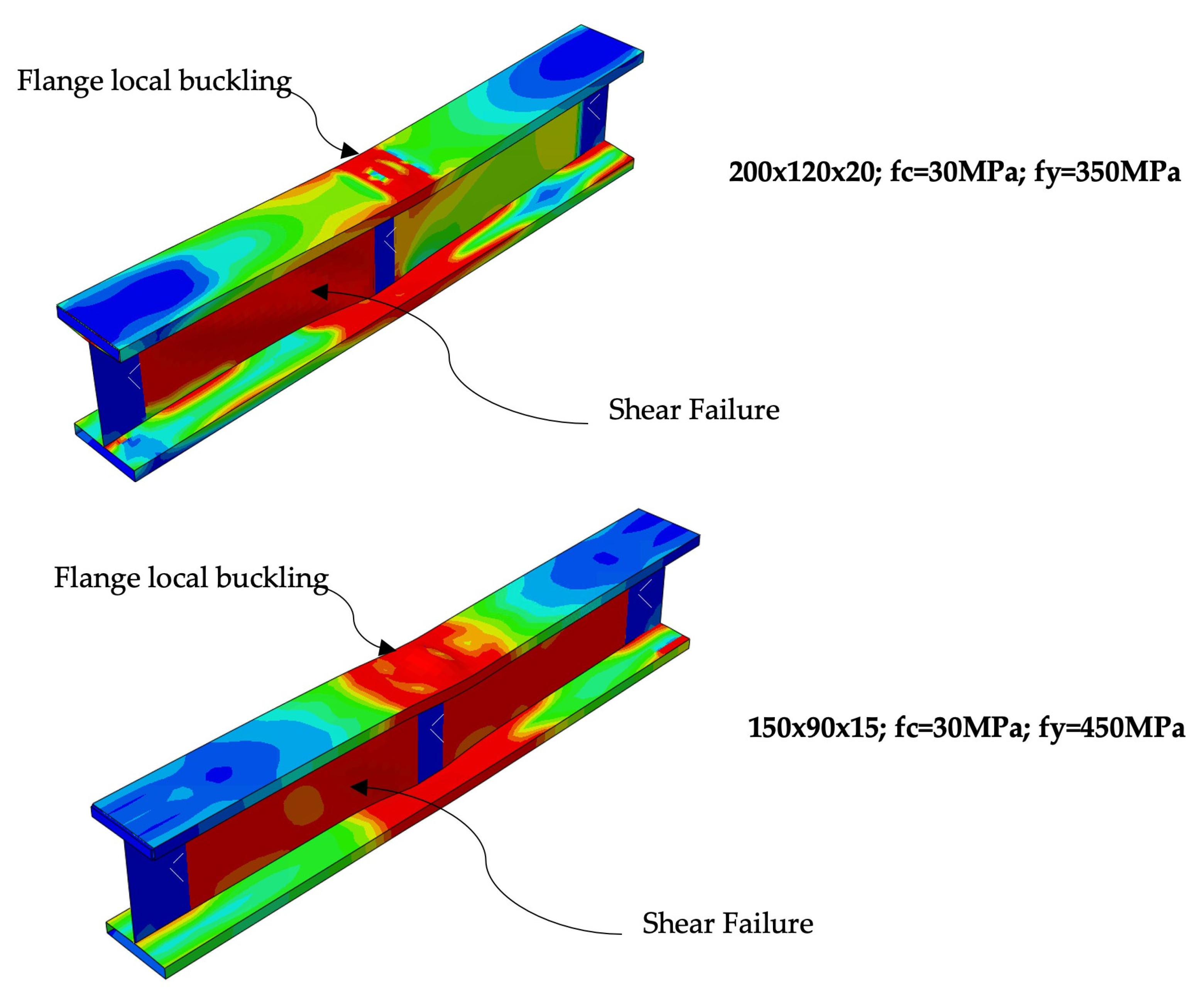
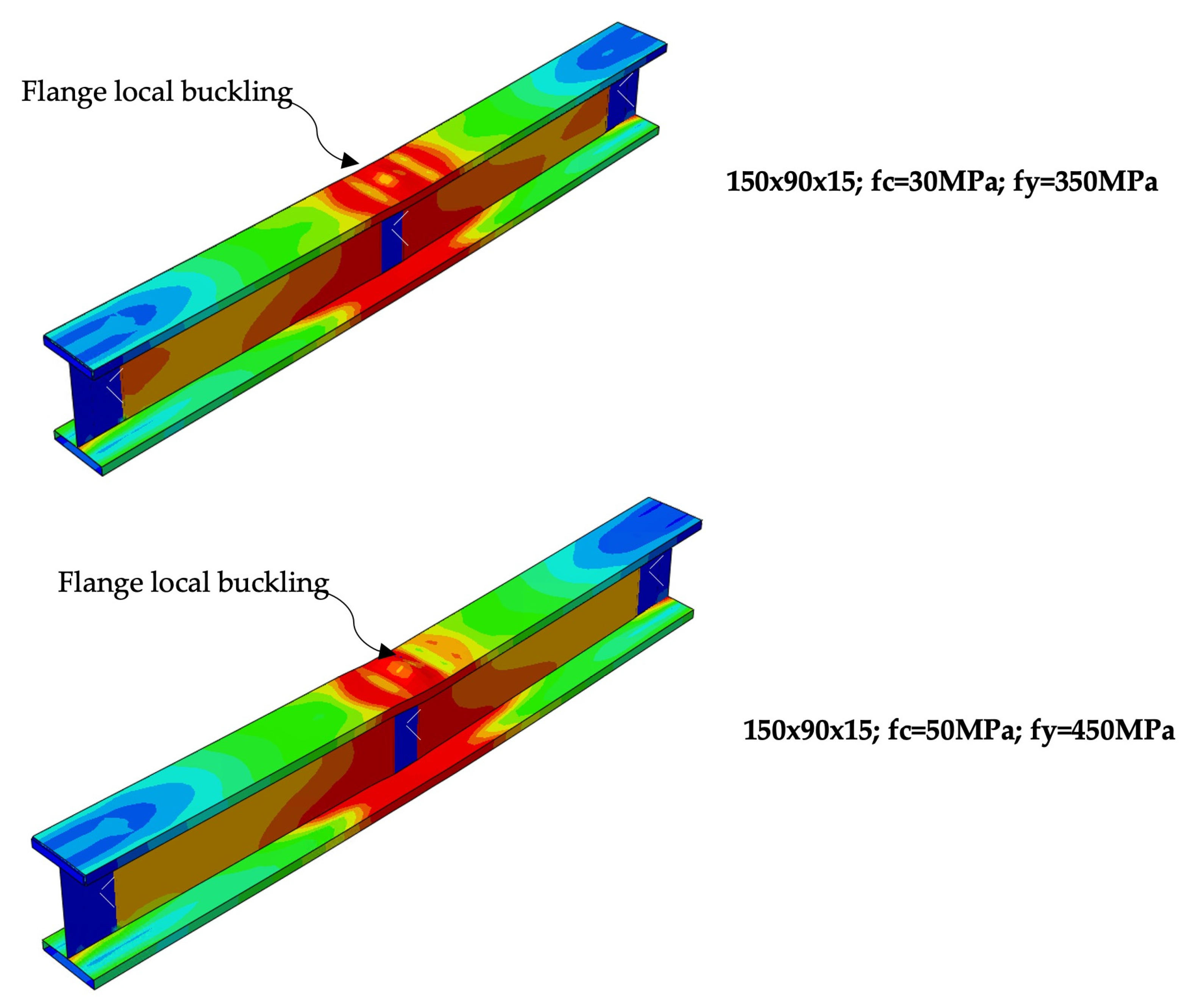
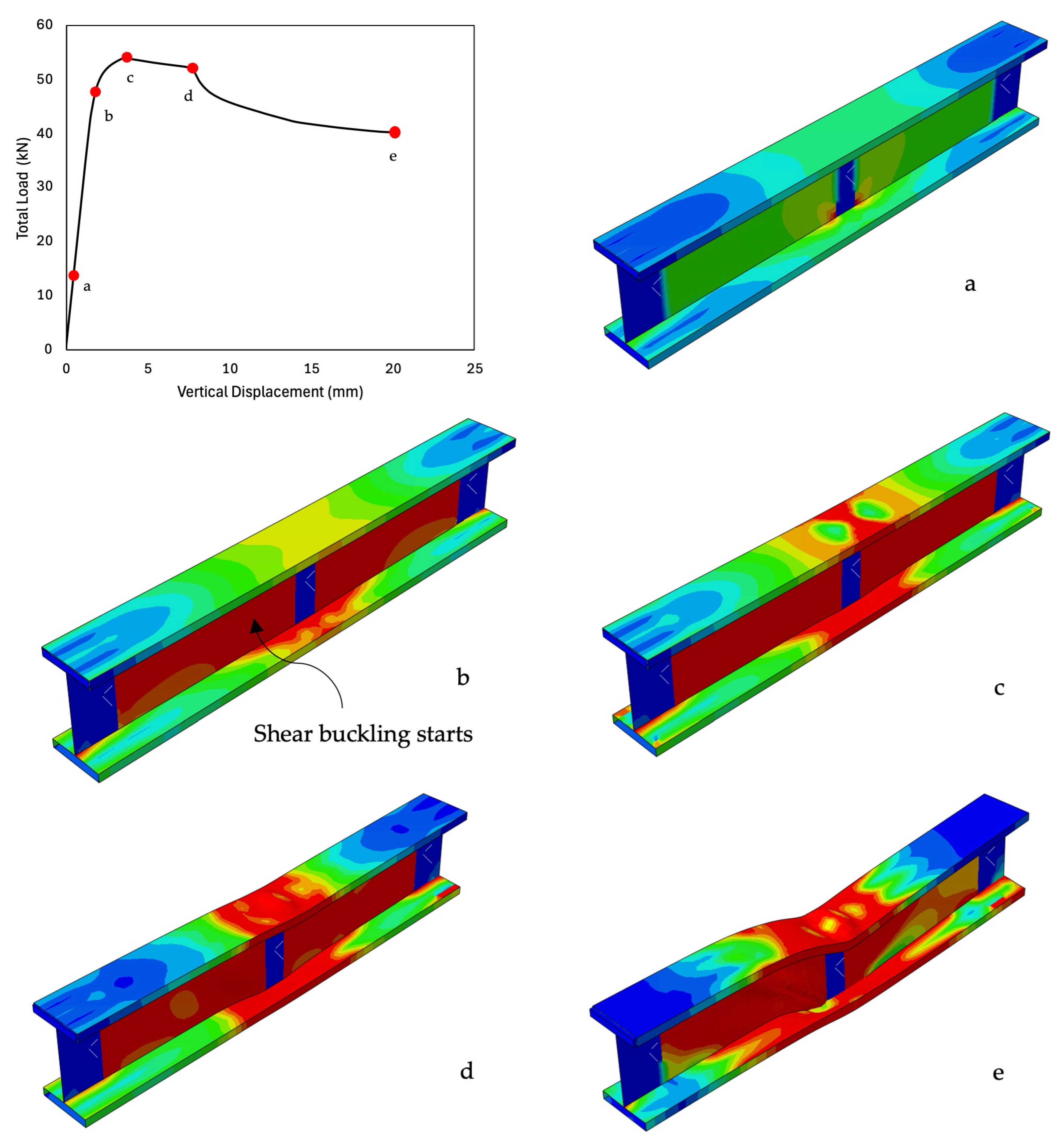
The numerical results for CF-HFCFS beams subjected to combined bending and shear actions were evaluated across shear-span ratios (aspect ratios) of 1.5, 2.0, 2.5, 3.0 and 3.5. The finite element simulations revealed a clear progression of failure modes as the shear-span ratio increased from 1.5 to 3.5, demonstrating the transition from shear-dominated behaviour to a flexure-governed response. Figure 6, Figure 7 and Figure 8 illustrate the representative failure modes of CF-HFCFS beams at aspect ratios of 1.5, 2.5, and 3.5, respectively. In addition, Figure 9 presents the detailed failure mode progression for the 150 × 90 × 15 mm specimen at an aspect ratio of 2.5, showing the sequential development of deformation from initial shear distortion to combined shear–flexure interaction and ultimately to the final collapse mechanism. This visual evidence supports the observed shift in governing behaviour across aspect ratios. The structural behaviour was interpreted using the ratios V/Vu and M/Mu, where the governing failure mode corresponds to the higher of the two ratios. These ratios provide a clear indicator of whether shear or bending demands control the limit state under combined action. Vu is the shear strength, calculated from [22] (provided in Appendix B), and Mu is the section moment capacity, calculated from [21] (provided in Appendix C). The ultimate shear force and bending moment were obtained from the peak load of the FE load–displacement curve. For the simply supported beam with central loading, the shear force equals half of the applied load, and the bending moment equals the shear force multiplied by the shear span. The key observations and behavioural transitions across aspect ratios are discussed below.

3.1. Behaviour of CF-HFCFS Beams at Aspect Ratio of 1.5 (Shear-Dominant Region)

Table 2 summarises the FE-derived ultimate shear forces, ultimate bending moments, design-based shear and bending capacities, and the corresponding demand–capacity ratios (V/Vu and M/Mu) for beams with an aspect ratio of 1.5. For beams with an aspect ratio = 1.5, the behaviour was strongly shear-dominated. Across all specimens, V/Vu values (0.90–1.07) were consistently much higher than the corresponding M/Mu values (0.35–0.41), indicating that shear demand approached or exceeded the shear capacity while bending demand remained well below its limit. This shear-controlled behaviour occurred across all steel grades, concrete strengths, and section sizes, confirming that at short shear spans, the web shear stresses were the primary driver of failure. Although higher steel strength increased absolute shear and moment capacity, the relative ratios remained firmly shear-controlled. The effect of lightweight-concrete strength was minimal, as expected, since shear resistance is governed predominantly by the steel web. Larger sections occasionally exceeded their theoretical shear capacity (V/Vu > 1.0) but still exhibited an M/Mu well below 0.45, reinforcing that failure was initiated by web shear buckling. Thus, the aspect ratio 1.5 marks the lower-bound region of the interaction domain where shear effects are overwhelmingly dominant.

3.2. Behaviour of CF-HFCFS Beams at Aspect Ratio of 2.0 (Transition Toward Balanced Bending–Shear Interaction)

Table 3 presents the FE-derived capacities and corresponding V/Vu and M/Mu ratios for beams with an aspect ratio of 2.0. At an aspect ratio = 2.0, the behaviour remained principally shear-controlled but with clear signs of increasing flexural participation. Shear ratios (0.84–1.04) continued to exceed bending ratios (0.47–0.54), but the difference between V/Vu and M/Mu narrowed considerably compared with AR = 1.5. This indicates the onset of genuine bending–shear interaction and reflects the higher bending curvature generated by the increased shear span. While shear continued to govern, the higher M/Mu ratios show that bending demand became an influential contributor to the overall deformation response. The influence of steel strength again shifted absolute capacities upward but did not fundamentally alter the governing mode. Concrete strength had a minimal impact on shear ratios and only a modest influence on bending ratios due to increased composite stiffness. The behaviour of larger sections (e.g., 200 × 120 × 20 and 250 × 150 × 50) approached near-balanced conditions, but V/Vu remained higher in every case. Thus, AR = 2.0 represents a transition zone where shear still governs but bending effects become markedly more significant.

3.3. Behaviour of CF-HFCFS Beams at Aspect Ratio of 2.5 (Balanced Bending–Shear Interaction Region)

Table 4 summarises the FE results and interaction indices for beams with an aspect ratio of 2.5. A further shift toward balanced interaction was observed at an aspect ratio = 2.5, where bending and shear demands contributed more comparably to failure. Shear ratios reduced slightly to 0.80–0.99, while bending ratios increased to 0.46–0.65. The difference between V/Vu and M/Mu was the smallest observed among the first three aspect ratios, indicating meaningful interaction-controlled behaviour. Shear tended to remain marginally higher than bending and thus still governed the failure mode, but the proximity of the two ratios suggests that both mechanisms actively contributed to capacity degradation. Steel strength increased both shear and moment capacities proportionally, preserving the relative interaction pattern. Concrete strength again had a minor influence, primarily affecting flexural stiffness. Section geometry played a more pronounced role at this aspect ratio: smaller sections approached flexural limits more rapidly (higher M/Mu), while deeper sections with larger webs maintained stronger shear influence. Overall, AR = 2.5 represents the centre of the interaction domain, where neither bending nor shear overwhelmingly governs and where combined-mode failure becomes most apparent.

3.4. Behaviour of CF-HFCFS Beams at Aspect Ratio of 3.0 (Transition into Bending-Dominant Behaviour)

Table 5 presents the FE-derived capacities and interaction ratios for beams with an aspect ratio of 3.0. At an aspect ratio = 3.0, the behaviour transitioned further toward a bending-dominated response. Shear ratios continued to decrease (0.82–0.94), while bending ratios reached their highest levels to date (0.57–0.74), approaching or matching the shear ratios in several cases. In some specimens, M/Mu exceeded V/Vu, indicating the emergence of bending-controlled failure modes, particularly in smaller sections with reduced web area. Larger sections still showed shear ratios slightly above bending ratios, but the gap was small, illustrating a near-balanced limit state. The progression of deformation also shifted: flexural curvature and flange buckling became more prominent, while web shear buckling initiated later in the loading sequence. The increasing contribution of bending relative to shear signifies that AR = 3.0 lies on the boundary between interaction-dominated and flexure-dominated behaviour and marks a critical point in the bending–shear interaction envelope.

3.5. Behaviour of CF-HFCFS Beams at Aspect Ratio of 3.5 (Bending-Dominant Region)

Table 6 summarises the FE-derived ultimate shear forces and bending moments for beams with an aspect ratio of 3.5. At an aspect ratio = 3.5, the beams exhibited clearly bending-governed behaviour, marking the upper-bound region of the interaction domain. Available FE data showed V/Vu values as low as 0.73–0.78, while M/Mu values consistently matched or exceeded these ratios (0.73–0.77). The equality or dominance of the bending ratio across all computed cases confirms that failure was controlled by flexural instability rather than shear buckling. The reduction in shear ratios reflects diminished shear demand due to the longer shear span, while the increase in bending ratios corresponds to higher curvature and compression demands in the flange and concrete infill. The absence of converged FE results for larger sections suggests that flexural instability (e.g., flange local buckling or concrete crushing) may have governed before reaching a distinct shear failure state. Overall, AR = 3.5 defines the flexure-dominated regime, where bending curvature governs capacity and shear effects are secondary.

3.6. Average Interaction Ratios vs. Aspect Ratio

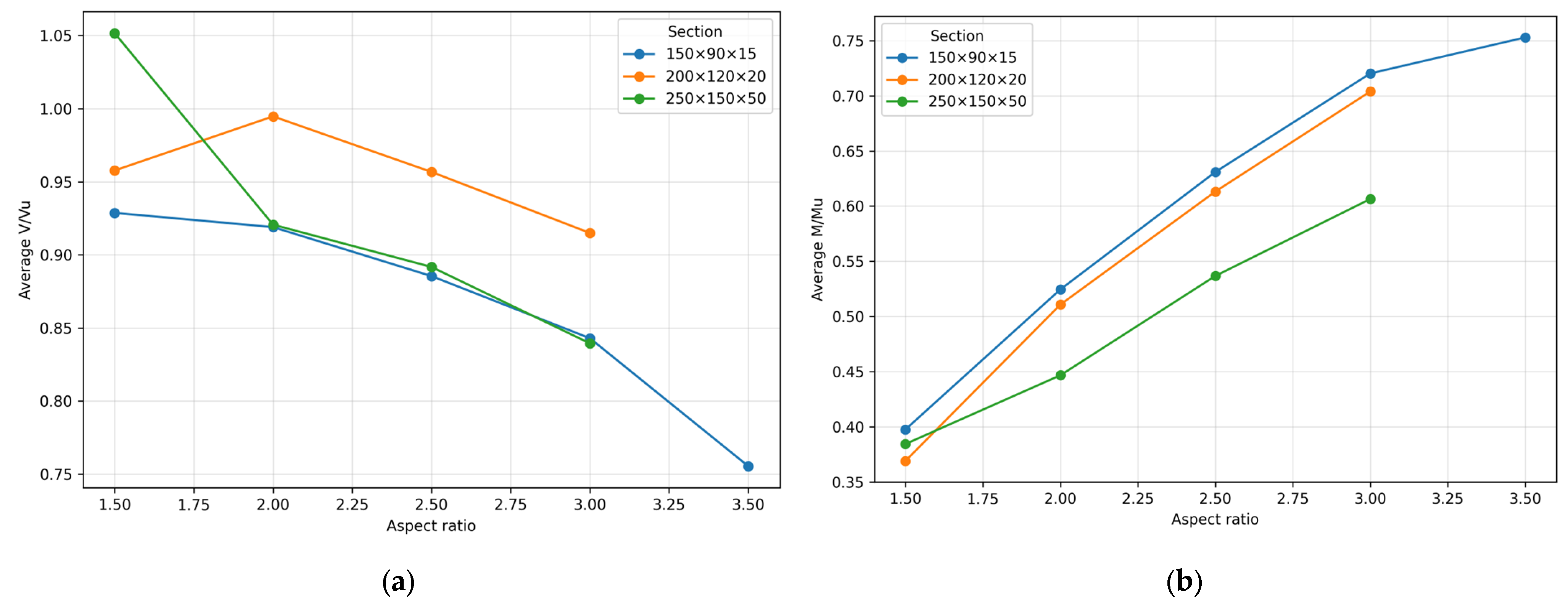
In order to better illustrate the interaction behaviour between bending and shear, the variation in the normalised interaction ratios V/Vu and M/Mu with aspect ratio is presented in Figure 10. The results indicate a clear trend in which V/Vu gradually decreases while M/Mu increases as the aspect ratio increases from 1.5 to 3.5. This opposite trend reflects the progressive transition of structural behaviour from a shear-dominated response at small shear spans to flexure-controlled behaviour at larger aspect ratios.

3.7. Bending–Shear Interaction Relationship

The interaction between bending and shear in CF-HFCFS beams can be further interpreted using the normalised ratios V V u and M M u , where V and M represent the ultimate shear force and bending moment obtained from the FE analysis, while Vu and Mu denote the corresponding shear and bending capacities predicted using the design equations proposed in the previous pure-shear and pure-bending studies. These normalised parameters provide a convenient basis for evaluating the combined utilisation of shear and bending resistance.
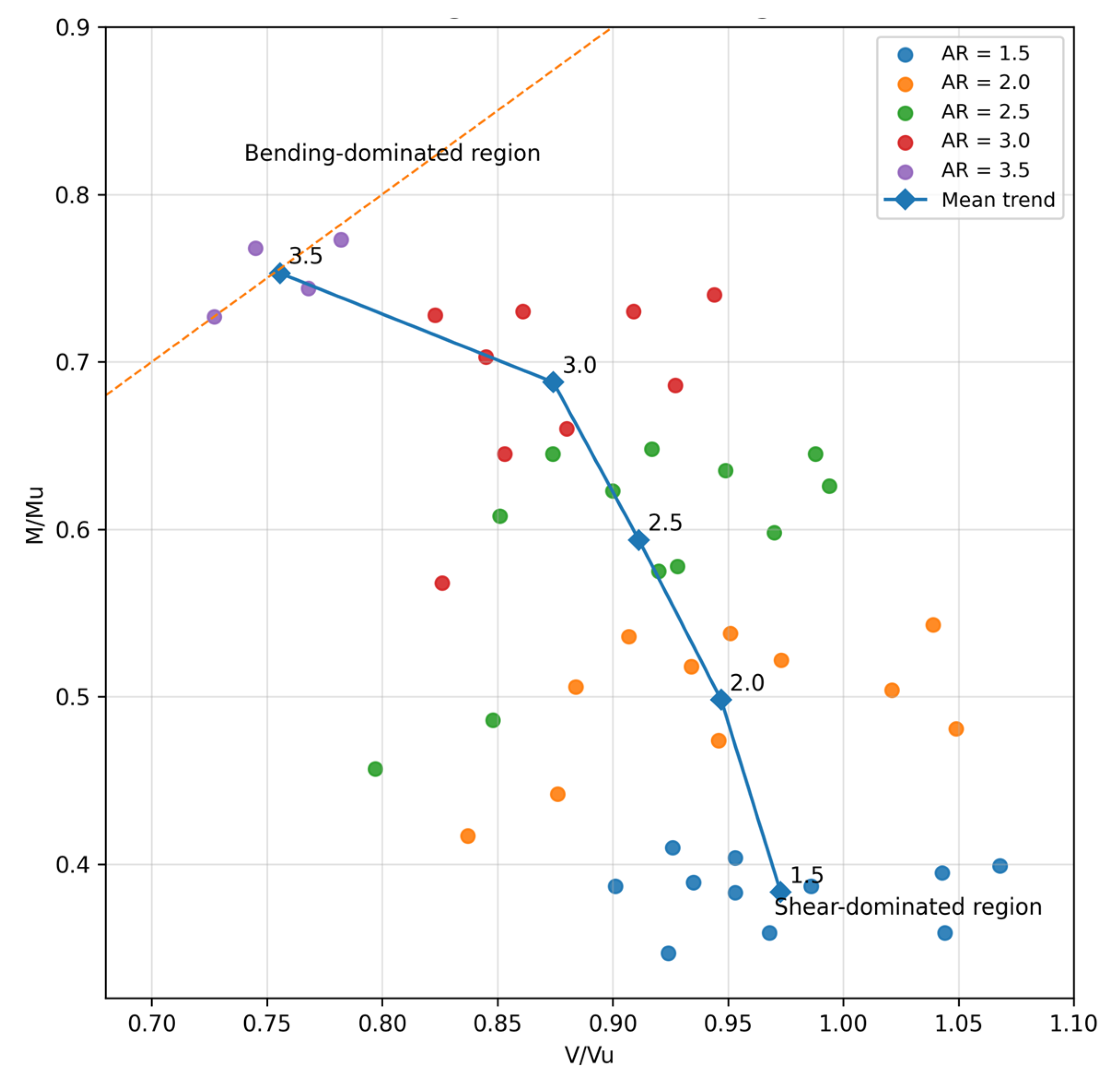
The FE results presented in Table 2, Table 3, Table 4, Table 5 and Table 6 and illustrated in the bending–shear interaction diagram (Figure 11) reveal a clear transition of failure behaviour as the aspect ratio increases. For specimens with small aspect ratios, the ratio V V u approaches unity while M M u remains relatively small, indicating that the structural response is predominantly governed by shear resistance. As the aspect ratio increases, V V u gradually decreases while M M u increases, reflecting the growing contribution of flexural effects. At higher aspect ratios, the bending utilisation becomes comparable to or larger than the shear utilisation, indicating a shift toward flexure-controlled behaviour.
Based on the distribution of the FE failure points in the interaction diagram, a preliminary empirical interaction relationship can be derived to describe the average combined bending–shear behaviour of CF-HFCFS beams. Regression of the normalised FE results suggests that the interaction between shear and bending may be approximately represented by
0.79 V V u + 0.50 M M u = 1.0
where V V u and M M u represent the normalised shear and bending utilisation ratios, respectively. This relationship captures the general trend of the FE results and provides a practical graphical representation of the transition between shear-dominated and flexure-dominated behaviour.
For design interpretation, a simplified lower-bound interaction envelope can also be expressed in the form
0.77 V V u + 0.37 M M u 1.0
which represents a conservative boundary for the present numerical dataset. This expression provides a preliminary interaction envelope that may assist in evaluating the combined utilisation of bending and shear resistance in CF-HFCFS beams.
It should be emphasised that the proposed interaction relationships are derived from the current finite element parametric study covering a limited range of geometric and material parameters. While the expressions provide useful insight into the bending–shear interaction behaviour of the investigated sections, further experimental validation and broader parametric calibration would be required before developing a generalised design formulation suitable for inclusion in structural design standards.
The proposed interaction representation provides a convenient framework for visualising and quantifying the combined bending–shear behaviour of CF-HFCFS beams and may serve as a basis for the future development of unified design provisions for this structural system.

3.8. Limitations of the Study

Although the present numerical study provides important insights into the bending–shear interaction behaviour of lightweight-concrete-filled hollow-flanged cold-formed steel beams, several limitations should be acknowledged. The FE models employ simplified material constitutive laws and idealised boundary conditions, which may not fully capture all aspects of experimental behaviour such as residual stresses and manufacturing imperfections. In addition, the study focuses on three representative cross-sections and a limited range of material properties. Other parameters such as different flange geometries, connection conditions, and loading configurations were not considered. Furthermore, the proposed interaction observations are based on numerical simulations and should be validated through dedicated experimental investigations in future research.

4. Conclusions

This study numerically examined the behaviour of lightweight-concrete-filled hollow-flanged cold-formed steel (CF-HFCFS) beams subjected to combined bending and shear actions and established a clear interaction framework governing their structural response. Using validated finite element models, the research quantified how aspect ratio, section geometry, steel grade, and concrete strength influence the transition between shear-dominated, interaction-controlled, and bending-governed failure modes. The results revealed a predictable and progressive shift in governing mechanisms, ranging from web shear buckling at shorter shear spans to composite flexural instability at longer spans, demonstrating that neither pure bending nor pure shear design provisions sufficiently capture the behaviour of these composite thin-walled systems under simultaneous actions. The findings collectively highlight the need for a dedicated bending–shear interaction approach for CF-HFCFS beams and provide the fundamental behavioural evidence necessary to support future design formulation. Key findings are listed below.
  • At a low aspect ratio (1.5–2.0), web shear buckling initiated failure, with V/Vu approaching or exceeding unity while M/Mu remained below ~0.55. The diagonal shear field governed the limit state irrespective of steel grade, concrete strength, or section size.
  • With the aspect ratio of 2.5, V/Vu and M/Mu values converged (typically 0.80–0.99 vs. 0.46–0.65), indicating a coupled shear–flexure failure mechanism. Both web shear deformation and flange local buckling contributed significantly to the ultimate capacity.
  • At the aspect ratio of 3.0, a marked reduction in V/Vu (0.82–0.94) coupled with the highest M/Mu values (0.57–0.74) signalled the onset of bending-controlled behaviour. Failure increasingly manifested as flange local buckling and concrete compression crushing.
  • At the aspect ratio of 3.5, M/Mu equalled or exceeded V/Vu in all available cases, confirming flexural instability as the governing failure mode. Web shear effects became secondary as curvature demands dominated the structural response.
  • Smaller sections approached flexural limits sooner due to lower bending stiffness, whereas deeper sections maintained shear dominance over a wider aspect ratio range due to greater web depth and shear area.
  • Higher Fy increased ultimate shear and bending capacities but did not alter governing failure modes, reinforcing that aspect ratio (not steel grade) is the primary driver of mode transition.
  • The proposed graphical interaction representation provides a practical tool for visualising the transition between shear-controlled and flexure-controlled behaviour of CF-HFCFS beams.
  • A preliminary bending–shear interaction relationship was proposed based on the FE results, enabling a simplified assessment of the combined utilisation of shear and bending resistance. This interaction representation provides a useful basis for future development of unified design approaches for CF-HFCFS beams.

Author Contributions

Conceptualization, M.S. and K.P.; Methodology, M.S. and K.S.; Software, M.S. and K.S.; Validation, M.S. and K.S.; Formal analysis, M.S. and T.K.; Investigation, K.S.; Writing—original draft, M.S.; Writing—review and editing, M.S., K.P. and T.K.; Visualisation, K.P.; Supervision, M.S. and K.P.; Project administration, M.S. All authors have read and agreed to the published version of the manuscript.

Funding

This research received no external funding.

Data Availability Statement

The original contributions presented in this study are included in the article. Further inquiries can be directed to the corresponding author.

Acknowledgments

The relevant technical, financial, and other necessary research facilities were contributed by the University of Surrey.

Conflicts of Interest

The authors declare no conflicts of interest.

Appendix A. Confined Compressive Stress–Strain and Tensile Stress–Strain Relationship for Lightweight Normal and Lightweight High-Strength Concrete [28]

E c = 4400 f c o   ρ c , f 2400 1.4
f c = f c c ε c / ε c c r r 1 + ( ε c / ε c c ) r           i f         0 ε c ε c c
f c = f c c f c c f c , r e s 1 + ε c     ε c c ε c , i     ε c c 2           i f         ε c ε c c
f t = E c   ε t                 i f                 ε t ε l c t m
f t = f l c t m ε l c t m / ε t 0.8           i f             ε t > ε l c t m
Ec = elastic modulus of lightweight concrete; f’co = compressive strength; ρc,f = density; f c = compressive stress; εlctm = ultimate tensile strain; f t = ultimate tensile stress.

Appendix B. Proposed Design Equation for Ultimate Bending Capacity (Mu) of Lightweight-Concrete-Infilled HFCFS Beams [21]

M u = γ m W s c m f s c y
γ m = 1.39 ln ξ + λ 1 6.27
ξ = A s f s y A c f c k
λ 1 = b f t f 4.41
f s c y = 1.90 + 1.91 ξ f c k
ξ = confinement factor; A c =   concrete cross-sectional area;   A s = steel cross-sectional area; f s y =   yield strength of steel; f c k = characteristic strength of concrete; f s c y = nominal yield strength of the composite beam;   M u =   moment capacity of the composite section; γ m = flexural strength index; W s c m = section modulus of the composite beam.

Appendix C. Proposed Design Equation for Ultimate Shear Capacity (Vu) of Lightweight-Concrete-Infilled HFCFS Beams [22]

V c r = k v π 2 E t 3 12 ( 1 ν 2 ) d 1
V y = 0.6 A w f y
q s = 1 + f c f y 1.507
F o r   0.4 < λ 0.703                               V u = 1 + 0.33 1 λ 0.703 V y · q s
F o r   λ > 0.703                                               V u = 1 0.13 V c r V y 0.23 V c r V y 0.23 V y · q s
λ = V y / V c r
V c r = elastic shear buckling capacity; V y = shear yielding capacity; λ = slenderness of web; q s = improvement factor; f c = compressive strength of concrete; f y = yield strength of the steel.

References

  1. Macdonald, M.; Heiyantuduwa, M.A.; Rhodes, J. Recent developments in the design of cold-formed steel members and structures. Thin-Walled Struct. 2008, 46, 1047–1053. [Google Scholar] [CrossRef]
  2. Gao, F.; Yang, F.; Liang, H.; Zhu, H. Numerical study and strength model of concrete-filled high-strength tubular flange beam under mid-span load. Eng. Struct. 2021, 229, 111654. [Google Scholar] [CrossRef]
  3. Sifan, M.; Upasiri, I.; Poologanathan, K.; Popo-Ola, S.; Suntharalingam, T.; Thirunavukkarasu, K. Fire performance and design of LSF wall panels with 3D printed concrete and steel lipped channel sections. J. Struct. Fire Eng. 2025, 17, 98–129. [Google Scholar] [CrossRef]
  4. Szewczak, I.; Rzeszut, K.; Rozylo, P. Structural behaviour of steel cold-formed sigma beams strengthened with bonded steel tapes. Thin-Walled Struct. 2021, 159, 107295. [Google Scholar] [CrossRef]
  5. Thirunavukkarasu, K.; Thushanthan, K.; Poologanathan, K.; Gunalan, S.; Kanthasamy, E.; Sifan, M.; Higgins, C. Web crippling design of Cold-Formed sigma sections-IOF load case. In Structures; Elsevier: Amsterdam, The Netherlands, 2025. [Google Scholar]
  6. Gowri, P.M.; Manu, S. Experimental Study on Flexural Behaviour of Cold formed Hollow Flanged Z–Sections. Int. Res. J. Eng. Technol. 2018, 5, 364–369. [Google Scholar]
  7. Siahaan, R.; Keerthan, P.; Mahendran, M. Lateral distortional buckling of rivet fastened rectangular hollow flange channel beams. J. Constr. Steel Res. 2018, 144, 295–309. [Google Scholar] [CrossRef]
  8. Gao, F.; Yang, F.; Zhu, H.; Liang, H. Lateral-torsional buckling behaviour of concrete-filled high-strength steel tubular flange beams under mid-span load. J. Constr. Steel Res. 2021, 176, 106398. [Google Scholar] [CrossRef]
  9. Gao, F.; Zhu, H.P.; Zhang, D.H.; Fang, T.S. Experimental investigation on flexural behavior of concrete-filled pentagonal flange beam under concentrated loading. Thin-Walled Struct. 2014, 84, 214–225. [Google Scholar] [CrossRef]
  10. Hassanein, M. Fundamental behaviour of concrete-filled pentagonal flange plate girders under shear. Thin-Walled Struct. 2015, 95, 221–230. [Google Scholar] [CrossRef]
  11. Semko, V.; Mahas, N.; Fenko, O.; Sirobaba, V.; Hasenko, A. Stability of light steel thin-walled structures filled with lightweight concrete. In IOP Conference Series: Materials Science and Engineering; IOP Publishing: Bristol, UK, 2019. [Google Scholar]
  12. Semko, O.; Dariienko, V.; Sirobaba, V. Deformability of Short Steel Reinforced Concrete Structures on Light Concrete. 2018. Available online: https://dspace.kntu.kr.ua/items/3fe91490-ff3e-4358-8b35-f31c45b5b129 (accessed on 24 March 2026).
  13. Sifan, M.; Nagaratnam, B.; Thamboo, J.; Poologanathan, K.; Corradi, M. Development and prospectives of lightweight high strength concrete using lightweight aggregates. Constr. Build. Mater. 2023, 362, 129628. [Google Scholar] [CrossRef]
  14. Sifan, M.; Nguyen, H.; Nagaratnam, B.; Thamboo, J.; Poologanathan, K.; Makul, N. Efficient mix design method for lightweight high strength concrete: A machine learning approach. Structures 2023, 55, 1805–1822. [Google Scholar] [CrossRef]
  15. Al Zand, A.W.; Hosseinpour, E.; Badaruzzaman, W.H.W.; Ali, M.M.; Yaseen, Z.M.; Hanoon, A.N. Performance of the novel C-purlin tubular beams filled with recycled-lightweight concrete strengthened with CFRP sheet. J. Build. Eng. 2021, 43, 102532. [Google Scholar] [CrossRef]
  16. Abou-Rayan, A.M.; Khalil, N.N.; Zaky, A.A. Experimental investigation on the flexural behavior of steel cold-formed I-beam with strengthened hollow tubular flanges. Thin-Walled Struct. 2020, 155, 106971. [Google Scholar] [CrossRef]
  17. Al-Shaar, A.A.; Göğüş, M.T. Flexural behavior of lightweight concrete and self-compacting concrete-filled steel tube beams. J. Constr. Steel Res. 2018, 149, 153–164. [Google Scholar] [CrossRef]
  18. Sohel, K.M.A.; Al-Jabri, K.; Zhang, M.H.; Liew, J.Y.R. Flexural fatigue behavior of ultra-lightweight cement composite and high strength lightweight aggregate concrete. Constr. Build. Mater. 2018, 173, 90–100. [Google Scholar] [CrossRef]
  19. Trabelsi, A.; Kammoun, Z. Mechanical properties and impact resistance of a high-strength lightweight concrete incorporating prickly pear fibres. Constr. Build. Mater. 2020, 262, 119972. [Google Scholar] [CrossRef]
  20. Allahverdi, A.; Azimi, S.A.; Alibabaie, M. Development of multi-strength grade green lightweight reactive powder concrete using expanded polystyrene beads. Constr. Build. Mater. 2018, 172, 457–467. [Google Scholar] [CrossRef]
  21. Sifan, M.; Gatheeshgar, P.; Navaratnam, S.; Nagaratnam, B.; Poologanathan, K.; Thamboo, J.; Suntharalingam, T. Flexural behaviour and design of hollow flange cold-formed steel beam filled with lightweight normal and lightweight high strength concrete. J. Build. Eng. 2021, 48, 103878. [Google Scholar] [CrossRef]
  22. Sifan, M.; Gatheeshgar, P.; Nagaratnam, B.; Poologanathan, K.; Navaratnam, S.; Thamboo, J.; Corradi, M. Shear performance of lightweight concrete filled hollow flange cold-formed steel beams. Case Stud. Constr. Mater. 2022, 17, e01160. [Google Scholar] [CrossRef]
  23. ABAQUS. Finite Element Software Documentation; Dassault Systèmes Simulia Corporation: Providence, RI, USA, 2021. [Google Scholar]
  24. Mohamed, M.S.; Thamboo, J.A.; Jeyakaran, T. Experimental and numerical assessment of the flexural behaviour of semi-precast-reinforced concrete slabs. Adv. Struct. Eng. 2020, 23, 1865–1879. [Google Scholar] [CrossRef]
  25. Lifsey, J.; Sifan, M.; Poologanathan, K.; Gray, D.T.; Kajaharan, T.; Elilarasi, K.; Higgins, C. Flexural behaviour and design of modular construction optimised CFS beams with circular web openings. Case Stud. Constr. Mater. 2025, 23, e05220. [Google Scholar] [CrossRef]
  26. Lifsey, J.; Gray, D.T.; Sifan, M.; Poologanathan, K.; Lingaretnam, J.; Popo-Ola, S.; Higgins, C. Web crippling design of modular construction optimised beams under interior-two-flange (ITF) loading. Adv. Struct. Eng. 2025, 13694332251369094. [Google Scholar] [CrossRef]
  27. Wang, L.; Young, B. Design of cold-formed steel channels with stiffened webs subjected to bending. Thin-Walled Struct. 2014, 85, 81–92. [Google Scholar] [CrossRef]
  28. Lim, J.C.; Ozbakkaloglu, T. Stress–strain model for normal- and light-weight concretes under uniaxial and triaxial compression. Constr. Build. Mater. 2014, 71, 492–509. [Google Scholar] [CrossRef]
  29. Schafer, B.W.; Peköz, T. Computational modeling of cold-formed steel: Characterizing geometric imperfections and residual stresses. J. Constr. Steel Res. 1998, 47, 193–210. [Google Scholar] [CrossRef]
  30. Keerthan, P.; Mahendran, M. Experimental studies on the shear behaviour and strength of LiteSteel beams. Eng. Struct. 2010, 32, 3235–3247. [Google Scholar] [CrossRef]
  31. Wang, Y.; Shao, Y.; Chen, C.; Katwal, U. Prediction of flexural and shear yielding strength of short span I-girders with concrete-filled tubular flanges and corrugated web-I: Experimental test. Thin-Walled Struct. 2020, 148, 106592. [Google Scholar] [CrossRef]
  32. Perera, N.; Mahendran, M. Section moment capacity tests of hollow flange steel plate girders. J. Constr. Steel Res. 2018, 148, 97–111. [Google Scholar] [CrossRef]
Figure 1. Mesh refinement of CF-HFCFS beam model.
Buildings 16 01370 g001
Figure 2. Aspect ratio of CF-HFCFS beam.
Buildings 16 01370 g002
Figure 3. Boundary conditions of CF-HFCFS beam model.
Buildings 16 01370 g003
Figure 4. Load vs. vertical displacement relationship comparison between test results ((a) [30], (b) [31], (c) [32], and (df) [16]) and FE model results.
Buildings 16 01370 g004
Figure 5. Notation of the specimen for the parametric study.
Buildings 16 01370 g005
Figure 6. Failure modes of CF-HFCFS beams at aspect ratio of 1.5.
Buildings 16 01370 g006
Figure 7. Failure modes of CF-HFCFS beams at aspect ratio of 2.5.
Buildings 16 01370 g007
Figure 8. Failure modes of CF-HFCFS beams at aspect ratio of 3.5.
Buildings 16 01370 g008
Figure 9. Failure progression of section 150 × 90 × 15 (fc = 30 MPa; fy = 350 MPa) with aspect ratio = 2.5. (a) in the elastic region; (b) at end of elastic region; (c) at the ultimate load; (d) after the ultimate load; (e) after significant deformation.
Buildings 16 01370 g009
Figure 10. (a) Average V/Vu vs. aspect ratio; (b) average M/Mu vs. aspect ratio.
Buildings 16 01370 g010
Figure 11. Bending–shear interaction diagram.
Buildings 16 01370 g011
Table 1. Comparison of ultimate loads and moments from tests and FE models. Specimen notations as defined in [16,23,30,31].
ResearchersSpecimen NotationTestFETest/FE
Keerthan and Mahendran [30]150 × 45 × 2.068.5 kN69.0 kN0.99
200 × 60 × 2.088.2 kN86.4 kN1.02
200 × 60 × 2.5119.3 kN116.5 kN1.02
250 × 60 × 2.090.1 kN99.5 kN0.91
250 × 75 × 2.5139.6 kN139.4 kN1.00
300 × 75 × 2.5143.7 kN155.5 kN0.92
Wang et al. [31]
Perera and Mahendran [32]
FWG425.2 kN410.6 kN1.04
HFSPG-75 × 25 × 2.5-100 × 327.4 kNm25.9 kNm1.06
HFSPG-75 × 25 × 1.6-100 × 316.2 kNm15.7 kNm1.03
HFSPG-75 × 25 × 1.6-150 × 1.622.2 kNm22.3 kNm1.00
HFSPG-75 × 25 × 1.6-200 × 1.628.9 kNm29.5 kNm0.98
HFSPG-65 × 35 × 2.5-100 × 331.9 kNm27.6 kNm1.16
Abou-Rayan, Khalil [16]Control154.9 kN165.2 kN1.07
A-LWC-U217.3 kN217.1 kN1.00
C-LWC-UL219.2 kN219.3 kN1.00
Mean1.01
COV5.8%
Table 2. Parametric study results for CF-HFCFS with the aspect ratio = 1.5.
Specimen (d × bf × df)
(mm)
fc (MPa)fy (MPa)Ultimate Shear Force V (kN)Ultimate Bending Moment M (kNm)Ultimate Shear Capacity Vu (kN)Ultimate Moment Capacity Mu (kNm)V/VuM/Mu
150 × 90 × 153035048.598.7952.521.430.9260.41
3045060.7710.9863.827.160.9530.404
5035048.598.7953.922.700.9010.387
5045060.7710.986528.220.9350.389
200 × 120 × 203035059.6414.3662.637.480.9530.383
3045075.0518.0676.146.680.9860.387
5035059.5214.3364.441.260.9240.347
5045075.0518.0677.550.310.9680.359
250 × 150 × 503035074.7822.4871.756.951.0430.395
3045093.0227.9587.170.091.0680.399
50350--73.764.45--
5045092.5727.8288.777.481.0440.359
Table 3. Parametric study results for CF-HFCFS with the aspect ratio = 2.0.
Specimen (d × bf × df)
(mm)
fc (MPa)fy (MPa)Ultimate Shear Force V (kN)Ultimate Bending Moment M (kNm)Ultimate Shear Capacity Vu (kN)Ultimate Moment Capacity Mu (kNm)V/VuM/Mu
150 × 90 × 153035047.6311.4852.521.430.9070.536
3045060.714.6163.827.160.9510.538
5035047.6311.4853.922.700.8840.506
5045060.714.616528.220.9340.518
200 × 120 × 203035060.9419.5562.637.480.9730.522
3045079.0925.3576.146.681.0390.543
5035060.9419.5564.441.260.9460.474
5045079.0925.3577.550.311.0210.504
250 × 150 × 503035062.8425.1871.756.950.8760.442
3045072.9329.2287.170.090.8370.417
50350--73.764.45--
5045093.0837.2888.777.481.0490.481
Table 4. Parametric study results for CF-HFCFS with the aspect ratio = 2.5.
Specimen (d × bf × df)
(mm)
fc (MPa)fy (MPa)Ultimate Shear Force V (kN)Ultimate Bending Moment M (kNm)Ultimate Shear Capacity Vu (kN)Ultimate Moment Capacity Mu (kNm)V/VuM/Mu
150 × 90 × 153035045.8913.8152.521.430.8740.645
3045058.4817.5963.827.160.9170.648
5035045.8913.8153.922.700.8510.608
5045058.4817.596528.220.90.623
200 × 120 × 203035059.4223.8162.637.480.9490.635
3045075.1630.1176.146.680.9880.645
5035059.2423.7464.441.260.920.575
5045075.1630.1177.550.310.970.598
250 × 150 × 503035071.2635.6871.756.950.9940.626
3045080.8640.4887.170.090.9280.578
5035062.5131.373.764.450.8480.486
5045070.7235.4188.777.480.7970.457
Table 5. Parametric study results for CF-HFCFS with the aspect ratio = 3.0.
Specimen (d × bf × df)
(mm)
fc (MPa)fy (MPa)Ultimate Shear Force V (kN)Ultimate Bending Moment M (kNm)Ultimate Shear Capacity Vu (kN)Ultimate Moment Capacity Mu (kNm)V/VuM/Mu
150 × 90 × 153035043.2115.652.521.430.8230.728
3045054.9519.8363.827.160.8610.73
50350--53.922.70--
5045054.9519.836528.220.8450.703
200 × 120 × 203035056.9227.3762.637.480.9090.73
3045071.8534.5376.146.680.9440.74
5035056.6427.2364.441.260.880.66
5045071.8534.5377.550.310.9270.686
250 × 150 × 503035061.1736.7571.756.950.8530.645
30450--87.170.09--
5035060.8936.5873.764.450.8260.568
50450--88.777.48--
Table 6. Parametric study results for CF-HFCFS with the aspect ratio = 3.5.
Specimen (d × bf × df)
(mm)
fc (MPa)fy (MPa)Ultimate Shear Force V (kN)Ultimate Bending Moment M (kNm)Ultimate Shear Capacity Vu (kN)Ultimate Moment Capacity Mu (kNm)V/VuM/Mu
150 × 90 × 153035039.0916.4652.521.430.7450.768
3045049.92163.827.160.7820.773
5035039.1916.553.922.700.7270.727
5045049.9221.016528.220.7680.744
200 × 120 × 2030350--62.637.48--
30450--76.146.68--
50350--64.441.26--
50450--77.550.31--
250 × 150 × 5030350--71.756.95--
30450--87.170.09--
50350--73.764.45--
50450--88.777.48--
Disclaimer/Publisher’s Note: The statements, opinions and data contained in all publications are solely those of the individual author(s) and contributor(s) and not of MDPI and/or the editor(s). MDPI and/or the editor(s) disclaim responsibility for any injury to people or property resulting from any ideas, methods, instructions or products referred to in the content.