Article

Healing-Oriented Street Space Model: A Multidisciplinary Multi-Stakeholder Approach for High-Density Cities


by
Qi Liu
1,*,
Ning Jia
1,
Ke Shi
2,* and
Bingbing Fan
3
1
School of Human Settlements, North China University of Water Resources and Electric Power, Zhengzhou 450046, China
2
School of Civil Engineering and Environment, Zhengzhou University of Aeronautics, Zhengzhou 450046, China
3
The Bartlett, University College London, London WC1E 6BT, UK
*
Authors to whom correspondence should be addressed.
Buildings 2026, 16(7), 1354; https://doi.org/10.3390/buildings16071354
Submission received: 22 February 2026 / Revised: 14 March 2026 / Accepted: 26 March 2026 / Published: 29 March 2026
(This article belongs to the Section Architectural Design, Urban Science, and Real Estate)

Abstract

In the 21st century, rapid urban development during global urbanization has led to high-density environments. These settings have become a significant cause of stress-related health problems for residents. Healing street design plays an important role in helping address mental health challenges caused by this process. Current research often focuses on healing elements and methods from only a single field. As a result, it lacks the integration of multidisciplinary and multi-stakeholder perspectives. To address this gap, this paper formed a Delphi expert panel with multidisciplinary scholars, urban managers, and practicing designers. The panel developed a quantitative evaluation model. This model covers four core dimensions: Safety (0.3210), Attractiveness (0.1080), Friendliness (0.2155), and Comfort (0.3553). It also includes eleven healing elements, such as Pedestrian Right-of-Way (0.4131), Night Lighting (0.3209), Visual Landscape (0.759), Street Furniture (0.4000), and Street Scale (0.3274). Using this model, the healing potential of Jingliu Road in Zhengzhou was assessed. The analysis identified the overall healing potential, core healing dimensions, and shortcomings of the street. This finding provides a clear direction for future healing-oriented street design. This paper builds a healing system for pedestrian spaces in high-density urban streets in China. It thus offers an evidence-based scientific tool for environmental design. Healing environments have expanded from less accessible spaces, such as squares and parks, to interactive and accessible streets. This transition enhances urban spaces’ capacity to address residents’ mental health concerns and promotes public health. Additionally, this paper offers specific recommendations for planners and policymakers to prioritize healing elements in urban renewal projects.

1. Introduction

The 21st-century urbanization has transformed global living patterns, with high-density urban environments emerging as a double-edged sword, simultaneously driving economic vitality while exacerbating unresolved public health challenges. Despite extensive research on urban development, the association between high-density settings and residents’ stress-related health outcomes remains underexplored, particularly in rapidly urbanizing regions like China. Yet, this rapid urban expansion has exacerbated environmental pollution, traffic congestion, and social isolation, which in turn pose significant threats to residents’ physical and mental well-being [1,2,3]. Specifically, high-density urban environments characterized by spatial compression, noise pollution, and limited green space directly contribute to increased risks of emotional disorders, anxiety [4,5], and even severe psychological conditions [6].
Moreover, the effects of urban living on mental health are long-term and intricately connected to the built environment. A study published in The Lancet Psychiatry indicates that urbanization is associated with an increased risk of mental health issues [7], particularly among young people [8,9]. Narrowed living spaces and highly crowded public places act as specific stressors [10], leading to phenomena such as “nature deficit disorder” due to a lack of exposure to natural environments [11]. Consequently, addressing these mental health challenges requires a paradigm shift towards enhancing the restorative and healing functions of urban environments.

1.1. From “Healthy Streets” to “Healing Streets”

The concept of healing streets is derived from healthy streets. Healthy streets encompass three aspects: promoting physical health, mental health, and public health. Key strategies include optimizing the physical environment, facilitating physical activity, reducing environmental cognitive load, enhancing residents’ sense of security and belonging, fostering social interaction and equity, and leveraging the health-supporting functions of diverse street components [12]. Since 2010, renewal projects centered around the concept of healthy streets have been promoted and applied as policies in countries such as the US, Canada, and the UK. The healthy streets approach primarily focuses on physiological health through walkability and physical safety. In contrast, healing streets not only meet the physical space requirements of healthy streets but also highlight the mechanism of environmental psychology in transitioning from “physical comfort” to “psychological healing”. In high-density urban streets, micro-scale continuous landscapes and water features help reduce cortisol levels [13,14], while visual elements and interactive installations enhance social engagement and community belonging. These streets are designed to promote mental health through evidence-based spatial interventions, offering residents opportunities for psychological relaxation, emotional connection, emotional calmness, and a sense of hope and vitality [15,16,17,18]. As the most frequently used public space in high-density cities, streets provide unique daily healing experiences for residents.

1.2. Theoretical Foundations and Policy Context

The design of healing environments has deep historical roots, from ancient temples, gardens, and natural sanctuaries to Florence Nightingale’s advocacy for fresh air and greenery in 19th-century healthcare architecture [19,20,21]. In modern urban design, these practices are grounded in rigorous scientific frameworks, specifically Stress Recovery Theory (SRT) [22] and Attention Restoration Theory (ART) [23]. SRT posits that visual engagement with natural features facilitates recovery from physiological stress, while ART suggests that environments characterized by “soft fascination” help replenish depleted cognitive resources.
While these theories were initially developed for parks and healthcare landscapes, their systematic translation into everyday street design requires further development. Streets offer only fragmented, micro-scale contact with nature compared to parks, and their ubiquity positions them as critical intervention points. Studies have demonstrated that even limited exposure to street greenery, bird sounds, and human-scale proportions can significantly reduce stress [13,14,24,25,26,27,28,29,30]. However, translating these psychological principles into systematic street design criteria remains a challenge.
This need aligns with contemporary policy frameworks. The United Nations Sustainable Development Goals (SDGs), particularly Goal 3 (Good Health and Well-being) and Goal 11 (Sustainable Cities and Communities), emphasize the need for inclusive urban environments that promote both physical and mental health [31,32]. Similarly, China’s “Healthy China 2030” initiative prioritizes the development of walkable, health-promoting public spaces [33]. These policy commitments create an urgent need for evidence-based tools to guide healing street design under resource constraints.

1.3. Research Gaps and Study Objectives

Despite growing policy support and theoretical foundations, challenges remain in effectively translating these principles into healing street design practice.
First, systematic frameworks that turn psychological theories into measurable design parameters remain underdeveloped. Existing tools, like the Healthy Streets Indicators, offer useful guidance but often lack precise thresholds—for example, optimal greenery density or width-to-height ratios for safety perception. As a result, the current design often relies on subjective judgment, limiting consistent use of empirical evidence.
Second, a few assessment approaches use weighting mechanisms to prioritize interventions when resources are limited. In densely populated urban renewal areas, planners must make hard choices. Should they prioritize pavement continuity or focus on visual landscaping? Without a scientific prioritization system that shows the order of healing needs, decision making is often fragmented or ineffective. Unweighted checklists do not account for the relative impact of design elements.
This study aims to address existing gaps by developing a weighted assessment model that integrates principles of environmental psychology into healing street design for high-density cities. The model uses Delphi expert consultations to identify quantitative “healing elements” and the Analytic Hierarchy Process (AHP) to weight their importance. The model features a dual-validation mechanism that combines “healing potential” and “environmental quality” to verify therapeutic effects. “Healing elements” identified via Delphi consultations represent the objective healing potential of street space, while resident questionnaires provide feedback on subjective environmental quality. This two-way verification prevents the model from being just an “environmental quality checklist” and enables proactive improvement by optimizing potential elements. The model is used for both pre-intervention evaluation and post-occupancy assessment. Empirical validation is conducted in Zhengzhou, China. Since the 2019 walkability-focused renewal of Jingliu Road in Zhengzhou, no systematic evaluation of its impact has been conducted. The model can assess the quality of street renewal and its healing potential, helping upgrade spaces from “walk-friendly” to healing-oriented.

2. Materials and Methods

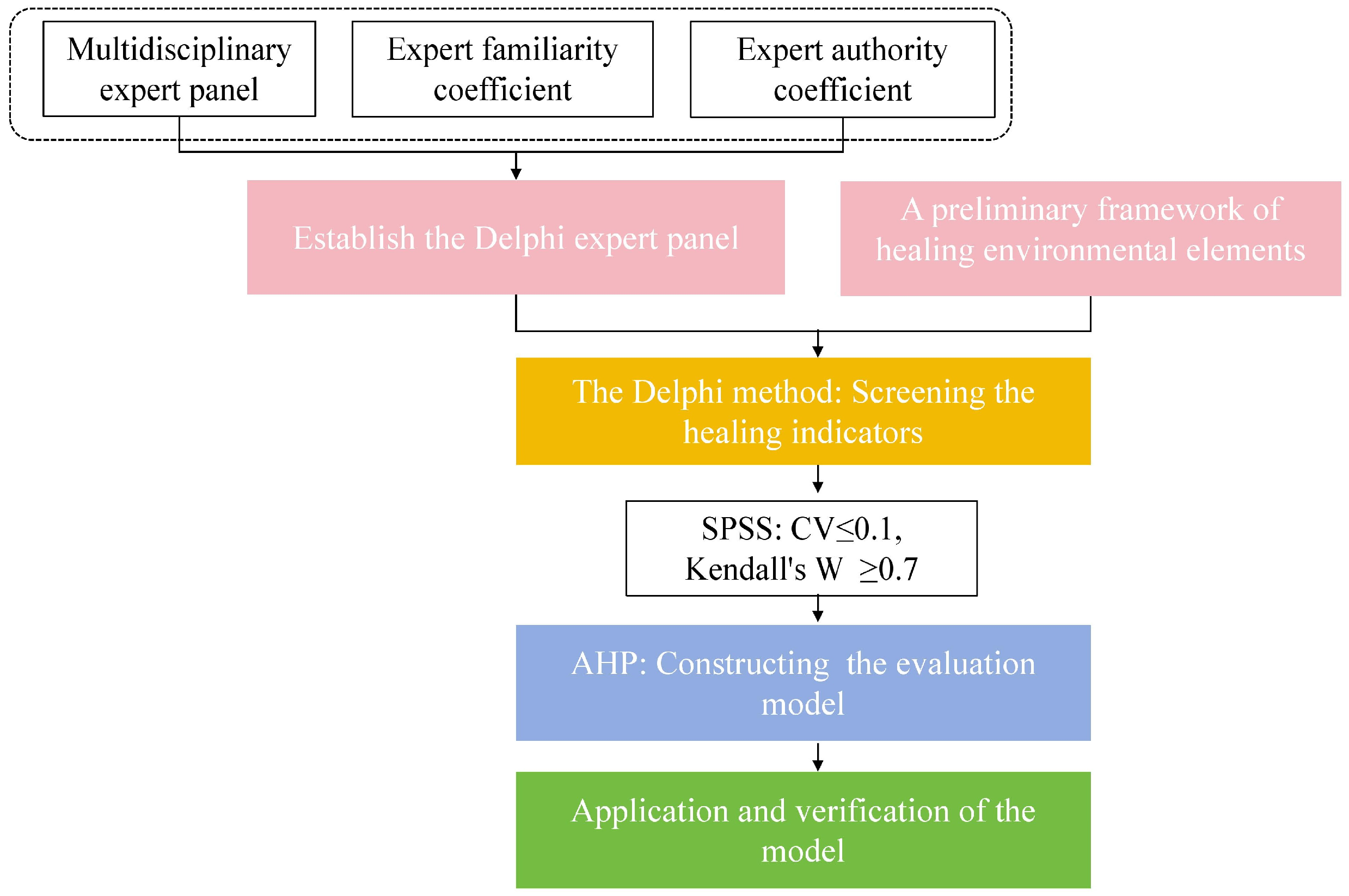
This research integrates the Delphi method with the AHP system. Through a multi-stage, progressive design of “forming a Delphi expert group–screening healing indicators through multiple rounds of consultation–quantifying weights and building a model-validating with an empirical questionnaire”, it forms a complete closed loop from theoretical construction to practical application, as shown in Figure 1. This approach ensures the scientific nature of indicator screening, strengthens the rigor of the model, and provides systematic methodological support for evaluating the street pedestrian environment.

2.1. The Process of Expert Selection

This research ensures scientific validity and practical relevance by including diverse professional perspectives. The expert panel includes researchers, design practice experts, and policy management experts from multiple disciplines.
Multidisciplinary researchers should focus on urban environments, environmental remediation, and environmental psychology, drawing on interdisciplinary backgrounds. Preference is given to scholars who have conducted in-depth research in high-density urban environments and public health, as this enables robust analysis of how street spaces impact human physical and mental health from perspectives such as architecture and environmental science.
Design practice experts should have practical experience in high-density urban projects. Areas include urban planning, architectural design, landscape design, and urban renewal. Priority is given to practice duration, project scale, and implementation effects. Experts must systematically understand innovative design and practical implementation. Emphasis should be on balancing humanistic needs and space efficiency in complex urban environments.
Policy management experts are administrators with experience in urban planning, policy formulation, and implementation. They must understand urban logic and the implementation of governance policies. Selection emphasizes broad urban planning management, diverse policy project involvement, and skill in interpreting public policy. Experts must recommend practical ways to implement street healing environments, including policy design, regulatory enforcement, and resource allocation.
These three types of experts form a closed-loop of “theoretical support–practical implementation–policy coordination” to ensure the academic depth of the research conclusions. By combining design experience with policy perspectives, this research enhances the model’s practical application value and provides comprehensive guidance for optimizing the healing environment of urban streets.
To ensure practical, targeted input, this study used the Expert Familiarity Coefficient (Cs) to select expert panels. As shown in Table 1, Cs is ranked in five levels [34]: “very familiar” (1), “familiar” (0.8), “generally familiar” (0.6), “slightly familiar” (0.4), and “unfamiliar” (0.2).
Eighteen experts were invited to participate in the study. Among them, five experts selected the “very familiar” option, seven experts selected familiar, two selected generally familiar, two selected slightly familiar, and two selected unfamiliar. After excluding those who were “slightly familiar” and “unfamiliar,” fourteen experts were selected for the Delphi consultation.
Meanwhile, this study utilizes the expert participation rate and Expert Authority Coefficient to validate and refine the expert team. The expert participation rate is a crucial indicator that clearly influences the quality of research outcomes. High participation not only reflects experts’ interest but also directly impacts the reliability of collected data by ensuring surveys are completed thoroughly, thus mitigating missing or biased data.
Experts received the distribution plan for the questionnaire before participating. Table 2 shows a 100% expert participation rate.
This paper uses the Expert Authority Coefficient ( C r ) to verify the scientificity and accuracy of expert data. The formula for C r is
C r = ( C a + C s ) / 2
where C a represents the coefficient of Judgment Basis based on theoretical analysis, practical experience, peer understanding, and intuition (values are shown in Table 3).
Utilizing statistical methods, the calculated C r value exceeding 0.7 indicates a significant level of expert consensus, which contributes to the reliability of the research findings, as detailed in Table 4.

2.2. The Process of Establishing a Healing Model

An expert team comprising multidisciplinary and multi-stakeholder members was established, and three rounds of Delphi consultation combined with AHP were employed to develop a context-specific restoration framework tailored to high-density urban streets in China.
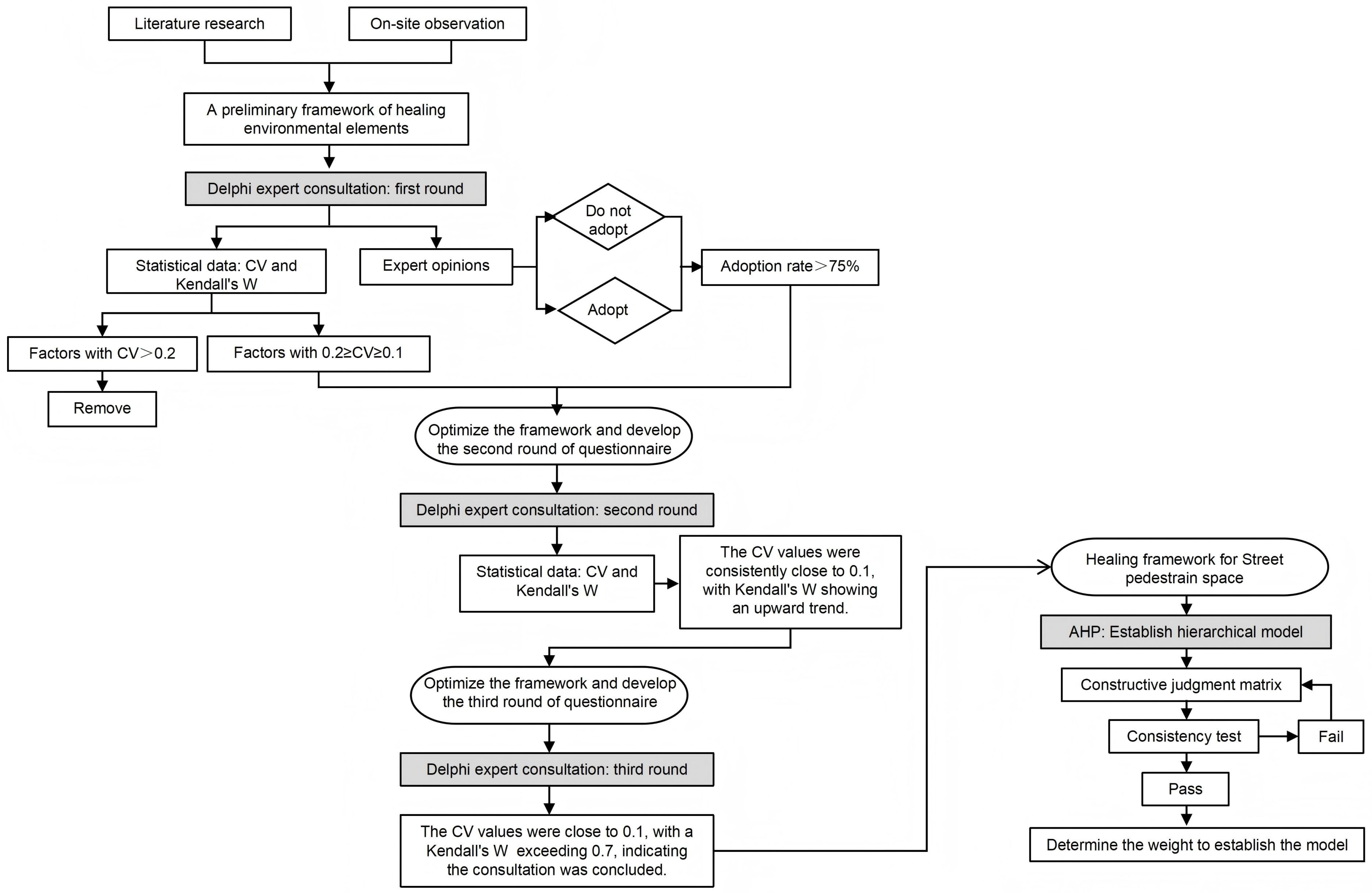
The research process followed a systematic workflow: a comprehensive review of the existing literature on restorative environments was conducted, followed by on-site investigations on high-density streets in Zhengzhou. This approach served as the basis for an initial framework of healing elements. Three rounds of expert consultations were carried out to refine and validate the healing factors and dimensions, ensuring alignment with local urban contexts and expert consensus. AHP was applied to construct a pairwise comparison matrix, enabling the quantification of relative weights for each therapeutic element. The detailed workflow for this process is summarized visually in Figure 2.
Step 1: A comprehensive literature review on healing environments was conducted using CNKI, Scopus, and WOS. To ensure contextual relevance, researchers also used findings from on-site observations of high-density urban streets. Four dimensions and thirteen environmental elements were identified and classified, as shown in Table 5.
Step 2: Conduct the first round of Delphi consultation. This includes the following: (1) Indicator screening: Experts evaluate the healing importance of four healing dimensions and thirteen factors, and may supplement or delete factors. This study used a five-point Likert scale (1: very unimportant, 2: unimportant, 3: neutral, 4: somewhat important, 5: very important). (2) Data analysis and questionnaire modification: SPSS Statistics 27 calculated the coefficient of variation (CV) and Kendall’s coefficient of concordance (Kendall’s W). (3) Revise the second-round questionnaire based on expert feedback and quantized data.
CV was used to quantify the dispersion of expert evaluation for a specific indicator. The formula for CV is
C V = σ / μ × 100 %
where σ denotes the standard deviation and μ denotes the mean.
A CV value near 0.1 shows experts’ ratings are highly consistent and concentrated, producing reliable results.
Kendall’s W evaluated expert consistency across indicators, supporting robust assessments. A value above 0.7 indicates high consistency, meaning expert consultation can end. Over three Delphi consultation rounds, Kendall’s W increased progressively and exceeded 0.7, as shown in Table 6. Analysis of CV and Kendall’s W objectively shows the degree of expert opinion concentration and consistency, strengthening research reliability and validity.
Step 3: In the second round, experts evaluated the 35 opinions from the first-round questionnaire as either “adopt” or “do not adopt” (see Figure 2 for the process). They reviewed the statistical results—including the mean, standard deviation, and CV—and rescored only those factors with CV above 0.1 to ensure reliability. The second-round questionnaire was developed from first-round results, aiming to stimulate critical thinking and promote consensus on controversial issues.
Step 4: The third-round questionnaire was designed, drawing on the findings from the second round. Schematic diagrams were used to visually display environmental factors, and the literature was used to provide background explanations of their origins. The questionnaire included the following components: (1) a restatement of the purpose of the round and the refined scoring guidelines; (2) the results of the second-round questionnaire, including mean values, CV, and Kendall’s W, reflecting the variability and consensus among responses; and (3) a targeted revision of items showing relatively high variability in the second round. The results of the third-round questionnaire indicated that all CV values were less than 0.1, and Kendall’s W was 0.714. When Kendall’s W exceeded 0.7, it indicated a high level of consistency among expert opinions, signaling the conclusion of the Delphi consultation. Through the three rounds of Delphi consultation, four core dimensions (Safety, Attractiveness, Friendliness, Comfort) and 11 healing factors were identified.
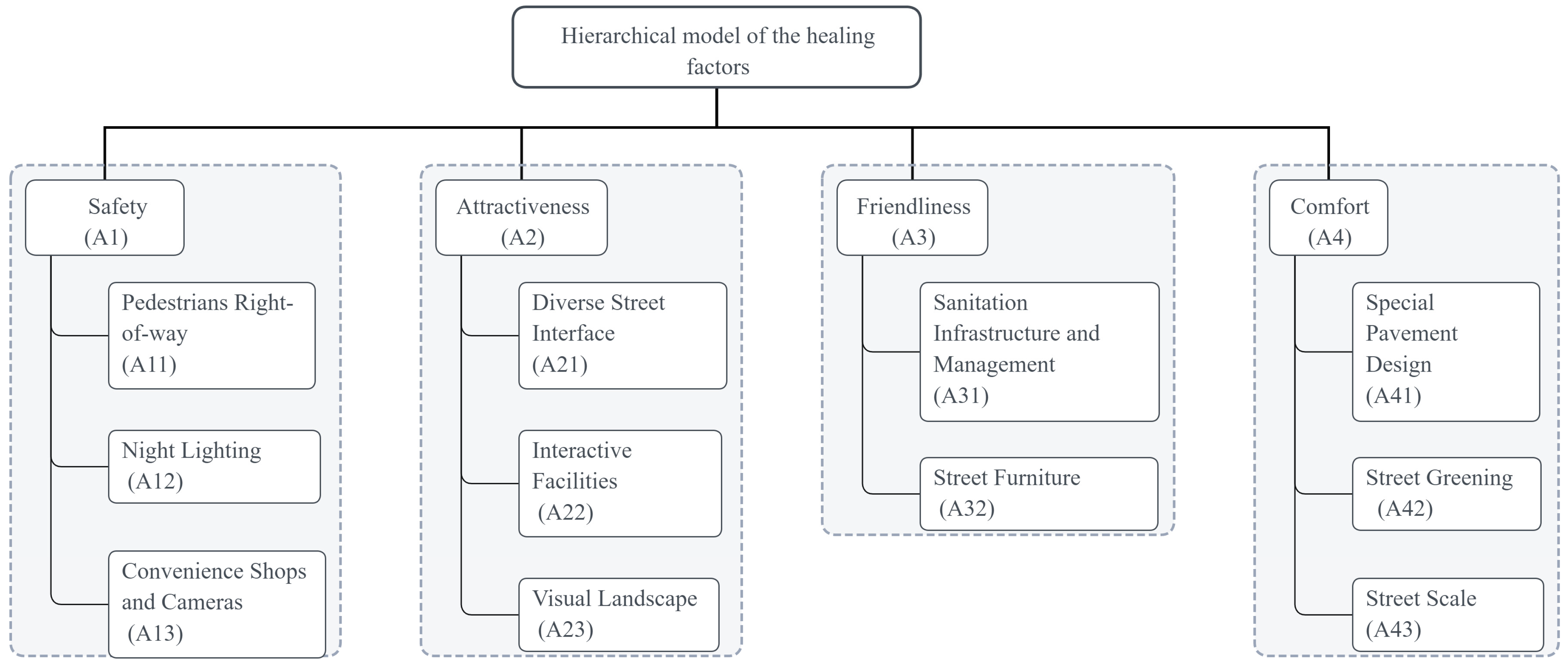
Step 5: Building on the results from Step 4 and the Delphi method findings, this study developed a three-level structure of healing factors for the street pedestrian environment, as shown in Figure 3.
For the target layer and criterion layers A1–A4, a judgment matrix was used to compare each pair of healing elements, establishing a pairwise comparison matrix as seen in Table 7. Using this method, pairwise comparison matrices were established for A11–A13, A21–A23, A31–A32, and A41–A42. The pairwise comparison matrix was normalized, and the weight vector of each element was computed using the eigenvector method.
To ensure logical consistency in the matrix, the CR value is calculated. A CR value less than 0.1 indicates satisfactory consistency. The weights obtained are assigned to each healing element, forming a prioritized ranking to support further research and decision making. The consistency index (CI) and consistency ratio (CR) were calculated for the judgment matrices at both the criterion layer and factor layer.
As shown in Table 8, the criterion layer’s maximum eigenvalue (λ_max) was 4.137, yielding a CI of 0.046. With a random index (RI) of 0.882 for a 4 × 4 matrix, the resulting CR value was 0.052—well below the 0.1 threshold—which confirms the consistency of the criterion layer matrix and validates the expert input.
At the factor layer, the consistency of each dimension’s sub-indicators was evaluated. For the Safety dimension, the CI and CR were 0.001, indicating high consistency. For the Comfort dimension, the CI was 0.027, and the CR was 0.051, meeting the required threshold. The Attractiveness and Friendliness dimensions both exhibited perfect consistency, as shown in Table 9.

2.3. Empirical Research Design

Based on the healing evaluation model outlined in this paper, an empirical study of the healing potential assessment of Jingliu Road in Zhengzhou City was conducted. This model can verify the healing potential of the updated street projects and identify the advantages and shortcomings of the street environment in influencing residents’ healing experiences. Meanwhile, it provides evidence-based guidance for street-healing-oriented design.
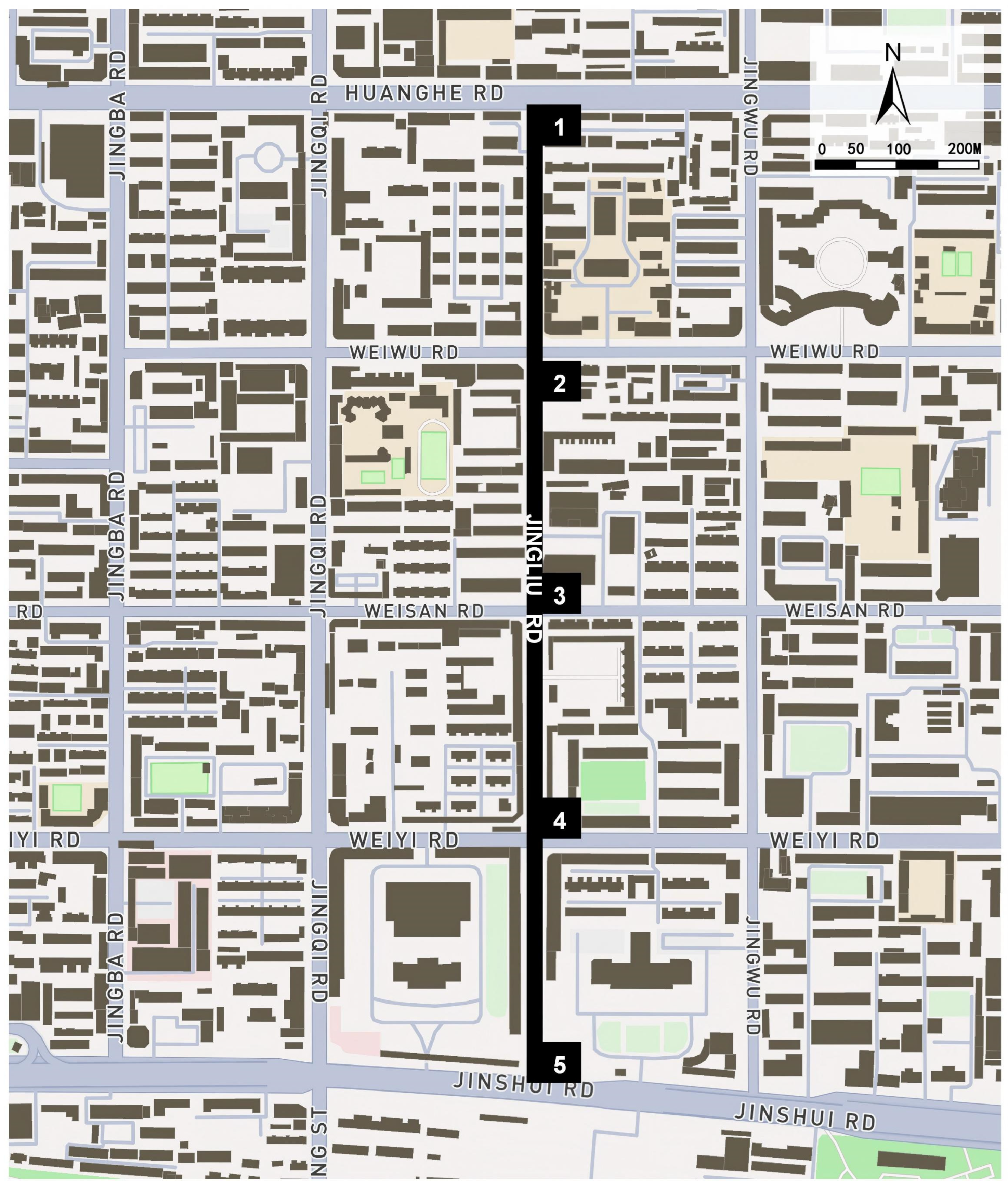
Jingliu Road is situated in Jinshui District, Zhengzhou, Henan Province. Located in the core area of Zhengzhou’s main urban district, it extends from Huanghe Road (north) to Jinshui Road (south). The street lies within Shengwei Community, which is a densely populated residential neighborhood with a well-connected transportation network. Due to its strategic location and urban setting, Jingliu Road serves as a critical link between residential zones and diverse urban public service facilities, embodying the typical spatial structure of high-density urban streets in China. The base map in Figure 4 is a vector block map created by the author on the Mapbox platform (https://www.mapbox.com, accessed on 22 February 2026). Based on the layout of streets and buildings in the study area, it is generated by adjusting the display styles of roads, building blocks, and green spaces. This map aims to intuitively display the locations of the sample streets and the division method for the four street sections, providing a basic reference for subsequent analysis of the current situation.
Since 2019, the street has undergone phased renovations, resulting in four distinct zones. The primary focus was on Section 2–3, where, in 2019, a 1.1-m-wide “urban running track” was added to the west sidewalk. In 2023, this area was further upgraded with a rainbow fitness path, children’s play facilities, and leisure seats. Simultaneously, illegal buildings were demolished, sidewalk space was expanded, and a pocket park and reading promenade were constructed. Section 3–4 also completed its child-friendly renovation in 2023, adding similar amenities and benefiting from environmental remediation. French plane trees now line both sides of Jingliu Road, creating a shaded, slow-moving space. This study conducts segmented healing potential assessments to integrate evaluations across street sections, better capture the street’s overall healing potential, and identify key healing elements. This approach provides a reusable design logic and evidence-based decision support for healing-oriented urban street design.
Questionnaire data were collected on-site, enabling direct resident interaction and ensuring feedback grounded in real-life experiences. The questionnaire assessed satisfaction with eleven environmental elements. Meanwhile, on-site observations collected descriptive data on the street environment to help validate the questionnaire results.
The questionnaire followed three core principles: (1) Scale Design: A 5-point Likert scale (1 = Strongly Disagree, 5 = Strongly Agree) quantified respondents’ opinions; (2) Variables and Items: Eleven core variables, each measured by at least two items, helped reduce bias from misunderstanding or emotions; (3) Recovery and Screening: Of 260 questionnaires distributed, 231 were returned. Excluding incomplete or inconsistent responses, 210 valid questionnaires yielded an 80.8% response rate.
In this study, the questionnaire’s reliability was evaluated using Cronbach’s alpha. With a sample size of 210 and 29 items, the computed alpha was 0.904, as shown in Table 10. Cronbach’s alpha measures internal consistency, with values from 0 to 1. Generally, coefficients above 0.70 are acceptable; those exceeding 0.90 indicate excellent consistency.
Data analysis was conducted using Microsoft Excel, focusing on: (1) comparing healing effects across four street sections to identify performance disparities and assess Jingliu Road’s overall healing potential; (2) systematically identifying key healing elements and weak links to provide evidence-based directions for future improvement.

3. Results

3.1. A Healing Framework for High-Density Urban Streets

In this study, we imported the expert evaluation data into SPSS to compute the mean, standard deviation, and CV for each factor, as shown in Table 11. Typically, the CV value exceeding 0.2 indicates a lack of consensus among experts, leading to the removal of the index. Indexes with a CV above this threshold are marked with an asterisk (*). This study retained factors with values between 0.1 and 0.2 and continued optimization in the second round of expert consultation.
The first round of Delphi consultation collected 35 valid expert responses. Feedback centered on four core dimensions: proposing new indicators, clarifying hierarchical relationships between indicators, resolving conceptual ambiguities, and revising indicator nomenclature. Of these, 30 responses had an adoption rate exceeding 75%. The remaining five were not adopted, as they conflicted with this study’s theoretical framework.
Based on statistical results and qualitative insights from the first round, targeted adjustments were finalized without altering the fundamental structural framework. Specifically, the indicators “Community Identity Element” and “A Sense of Belonging” were removed. Conversely, a new indicator, “Sanitation Infrastructure and Management,” was added to explicitly address the role of hygiene facilities in alleviating pedestrians’ discomfort and anxiety, thereby enriching the coverage of environmental health dimensions. Additionally, three indicators were renamed for precision and clarity: “Proper Lighting” was revised to “Night Lighting,” emphasizing the importance of illumination for pedestrian safety at night; “Transparency of the Architecture” became “Diverse Street Interface,” highlighting the interactive and esthetic qualities of varied building facades; and “Visual Art” was updated to “Visual Landscape,” to better encompass the full range of visual elements in street spaces.
To enhance expert understanding and ensure the accuracy of subsequent evaluations, detailed explanatory notes were added to specific indicators. The indicator “Convenience Shops and Cameras” was clarified to mean a moderate presence of convenience stores with visible surveillance. The previous indicator, “Barrier-Free Paving,” was combined with suggestions on guided Special Pavement Design after “A Sense of Belonging” was removed, resulting in a new indicator called “Pavement Design.” This unified indicator now addresses accessibility features, tactile guidance, child- and intergenerational-friendly zoning, and material and color considerations. Furthermore, the indicators “Rest Facilities” and “Humanity Care Facilities” were merged to create a single indicator, “Street Furniture,” reflecting the diverse and supportive role of street furniture in pedestrian experience.
These updates to the indicator framework and their outcomes following the second round of expert consultation are detailed in Table 12.
The second Delphi round improved expert consensus. All factors had CVs between 0.10 and 0.15, showing moderate dispersion. Kendall’s W rose from 0.51 to 0.638, showing a substantial increase in consistency over the first round. These results confirmed that the adjusted indicator framework gained wider expert recognition.
To refine the consultation process and improve evaluation accuracy, we revised the questionnaire. Schematic diagrams clarified environmental factor hierarchies and simplified complex indicator relationships. We also added concise literature-based explanations for each factor to clarify their origins and relevance to street healing. These changes reduce ambiguity and ensure that experts evaluate indicators with a shared understanding.
The revised questionnaire, incorporating these optimizations, served as the basis for the third round of Delphi consultation. Detailed results of the third round are presented in Table 13.
The third round of Delphi consultation marked the end of the expert consensus-building process. The CVs for all factors were close to 0.1, indicating minimal dispersion in expert ratings and strong agreement on indicator importance. At the same time, Kendall’s W increased from 0.51 in the first round to 0.714, exceeding the critical 0.7 threshold for scientific validity in Delphi studies. This rise in consensus metrics confirmed that expert opinions had converged, meeting the criteria for ending the consultation process.
AHP was used to allocate weights to the criterion and factor layers. Pairwise comparison matrices assessed the relative significance of the indicator. The standard AHP procedure calculated the weights. The characteristic vector, corresponding to the maximum eigenvalue of the judgment matrix, was found using the eigenvalue method. Final weights were obtained by normalizing this vector. Table 14 details the weight values.

3.2. Healing Potential of “Jingliu Road” Street

This study adopted a hierarchical weighted average method to systematically quantify the healing Potential of “Jingliu Road” Street and its four sections. The assessment framework was built on four primary dimensions (A1–A4) and eleven secondary healing factors (A11–A13, A21–A23, A31–A32, A41–A43), with weights derived from expert consensus (Table 11). For the four dimensions, scores of its secondary factors were weighted and summed to generate dimension-level scores:
A i = j = 1 n ( S i j × W i j ) ( i = 1 ,   2 ,   3 ,   4 ; n = 11 )
where Sij is the score of the j-th secondary factor under the i-th primary dimension, and Wij is the weight of the j-th secondary factor under the i-th primary dimension.
To derive the comprehensive healing score for each section, a weighted summation approach was employed using the dimension-specific weights (A1: 0.321, A2: 0.1080, A3: 0.2155, A4: 0.3553) as coefficients. The formula for the section-level score is Scoresection = A1 × 0.321 + A2 × 0.1080 + A3 × 0.2155 + A4 × 0.3553. The healing potential index for Jingliu Road was determined by averaging the comprehensive scores across the four street sections. This aggregated index reflects the street’s holistic healing potential, integrating both section-level variations and dimension-specific contributions. Detailed values are shown in Table 15.
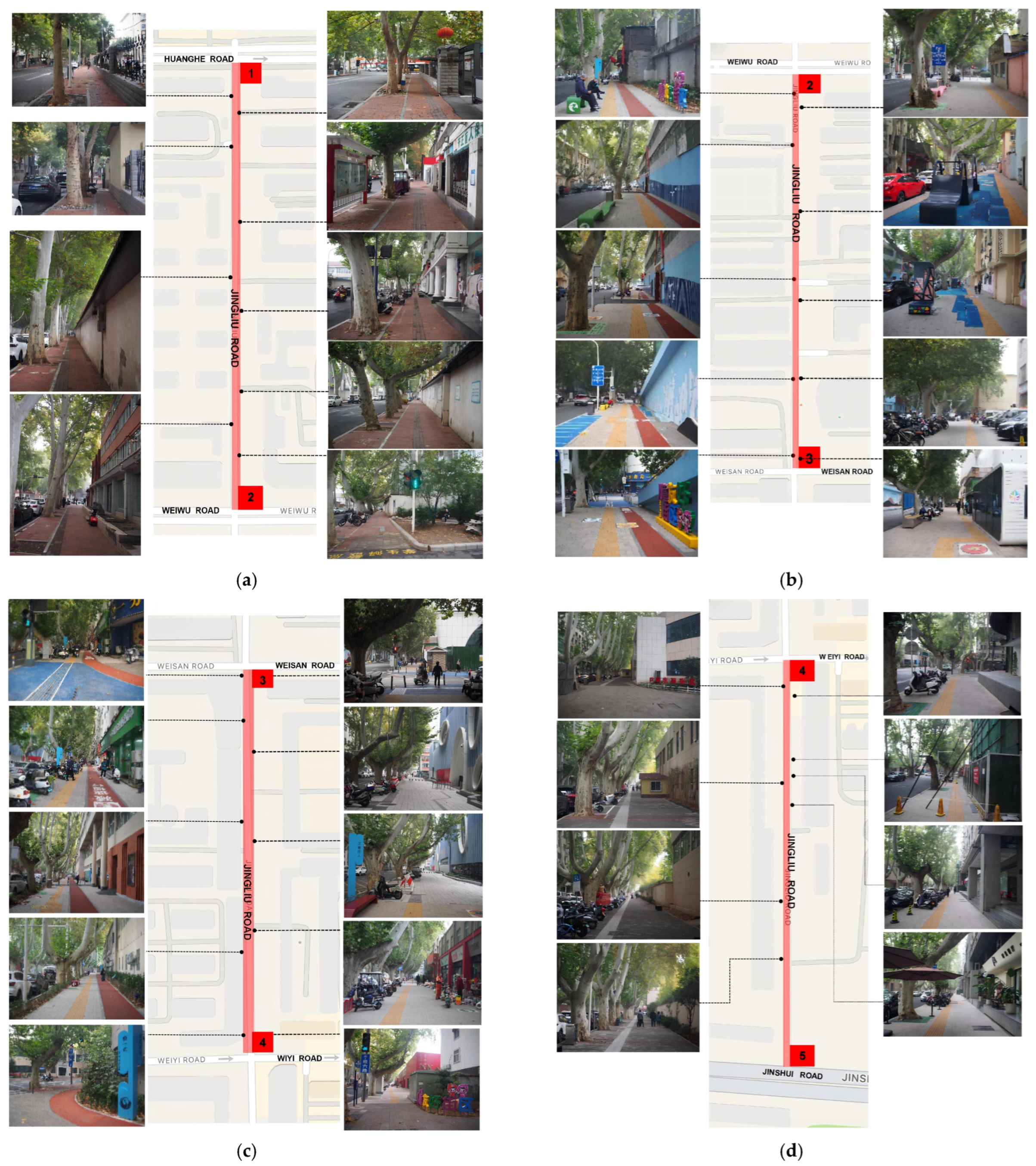
The healing potential of Jingliu Road is at a “good” level, but there is still clear room for improvement. The four street sections reveal the advantages, shortcomings, and development potential of “Jingliu Road” Street. In addition to the quantitative results, the image in Figure 5 validates the evaluation results.
The 3–4 street section received the highest comprehensive healing score (3.6008), with balanced performance in four dimensions. Its indicators of Comfort (3.832934), Safety (3.560637), and Friendliness (3.368) all rank among the top. According to on-site observations, the sidewalk in this section is flat, allowing pedestrians to flow freely. This street section has a high degree of greenery and shade, forming a pleasant tree canopy layer, which enhances the perceptual experience of the green environment. There is a wide variety of community-supporting functions along the street, including community bookstores, Chinese and Western restaurants, hotels, fruit shops, pharmacies, and community service centers. Both quantitative data and on-site observations indicate that this section has the best overall healing effect.
Following the previous section, the 2–3 section scores 3.5971 and has the highest Safety score (3.561524) among all samples. On-site research found that the street’s road surface is flat and continuous, and the sidewalk is designed with functional zoning, including an exclusive pedestrian space.
The 4–5 section scored 3.3854. Quantitative data shows that it has relatively high scores in Safety and Comfort, but its Attractiveness (3.089892) and Friendliness (3.124) are relatively low. Combined with on-site research, it was confirmed that there are problems, such as monotonous spatial design and insufficient interactive elements, in this street section.
The 1–2 section has the lowest score (2.9369) and fails to reach the “neutral” threshold. Its Attractiveness (2.859397) performs weakly, and it lacks Friendliness (2.958) and Comfort (2.877264). On-site research shows that the minimum width of the sidewalk on this section is 2.4 m, and the spread of tree roots has caused uneven pavement in some sections, affecting the smooth passage of pedestrians. It has obvious deficiencies in spatial charm, environmental quality, and social support, and it is the key target for future renovation and improvement.
The evaluation of four street sections along “Jingliu Road” by urban residents reveals the key healing elements and improvement directions that influence the walking healing experience. The results are as follows:
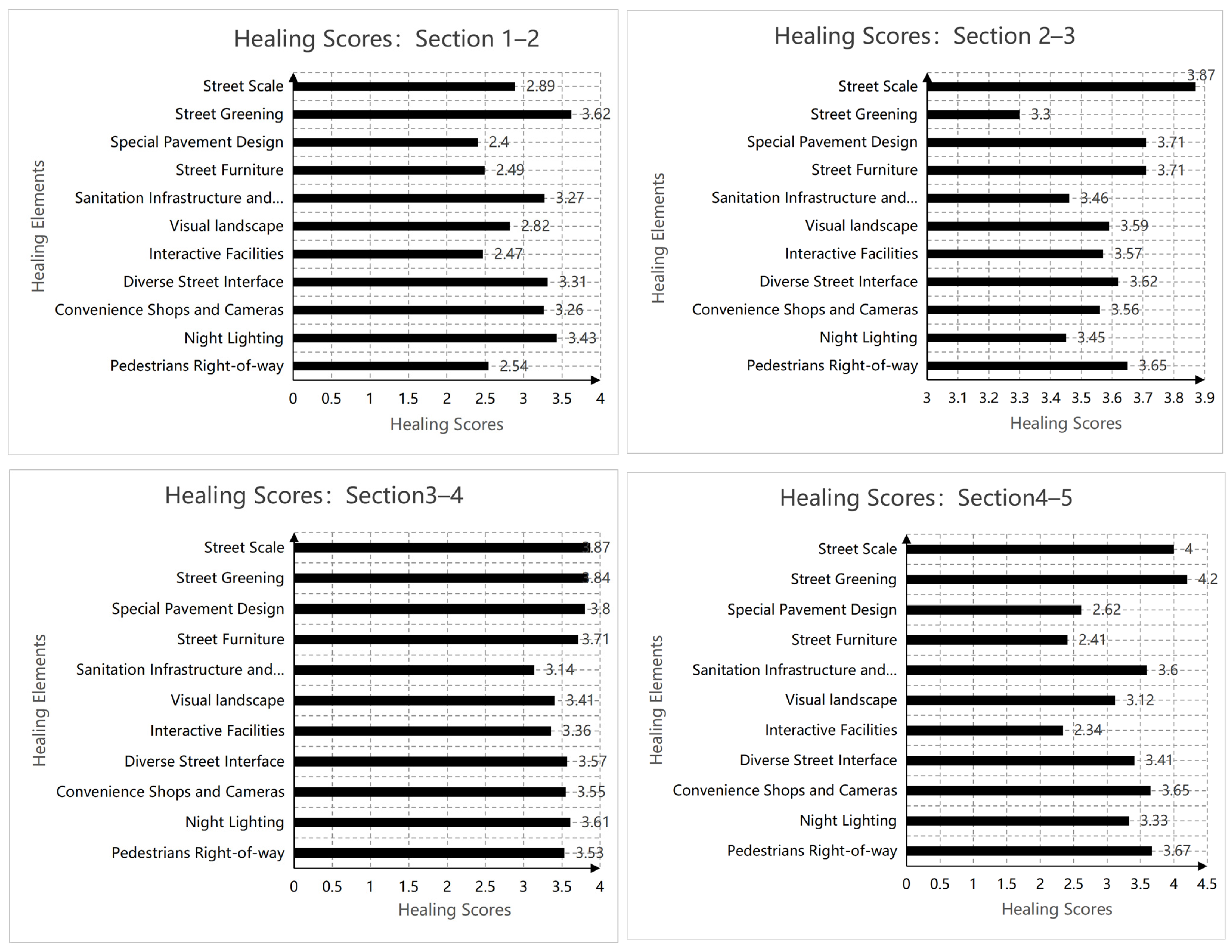
Section 1–2 is a street segment with aging residential areas. Figure 6 shows results from this study’s scoring system: a score of 3 means average healing function, and 4 means satisfactory healing function. Street Greening receives the top score of 3.62. Night Lighting is next at 3.43. Diverse Street Interface (3.31), Sanitation Infrastructure (3.27), and Convenience Shops and Cameras (3.26) also score relatively high. Special Pavement Design (2.4), Street Furniture (2.49), Interactive Facilities (2.47), and Pedestrian Right-of-Way (2.54) score lower. Street Scale (2.89) and Visual Landscape (2.82) fall in the middle range. These data help direct and guide future improvements to the section’s healing functions.
Section 2–3 performs better in the street system. Figure 6 shows scores of various healing elements. Street Scale scores highest, with 3.87, highlighting its key healing role. Special Pavement Design and Street Furniture follow at 3.71 each, showing strong healing effects. Diverse Street Interface (3.62), Pedestrian Right-of-Way (3.65), Visual Landscape (3.59), Interactive Facilities (3.57), and Convenience Shops and Cameras (3.56) score between 3.56 and 3.65, suggesting similar contributions. Street Greening (3.31), Sanitation Infrastructure and Management (3.46), and Night Lighting (3.45) show average performance, but still have potential to improve. These variations show how each healing element contributes to the street-healing environment.
Section 3–4 demonstrates a robust performance within the street system. Notably, Street Scale attains the highest healing score of 3.87, standing out prominently and indicating its significant role in the healing potential. Following closely, Street Greening (3.84) and Special Pavement Design (3.80) suggest considerable advantages in terms of healing effects. Elements such as Street Furniture (3.71), Night Lighting (3.61), Diverse Street Interface (3.57), Convenience Shops and Cameras (3.55), and Pedestrian Right-of-Way (3.53) form a cluster with scores ranging from 3.53 to 3.71. This similarity implies they contribute comparably to the street’s healing function. In contrast, Visual Landscape (3.41) and Interactive Facilities (3.36), while indicating average performance, still offer potential for improvement to meet higher evaluation standards. Lastly, the score of environmental Sanitation Infrastructure and Management is 3.14. Although it exceeded the passing line, it remains at an average level and is the element that most needs improvement at present. Overall, each healing element of this section of the road meets the basic healing requirements.
Section 4–5, a street section dominated by government office buildings, exhibits a polarized performance in healing function. Street Greening attains the highest score of 4.2, indicating a satisfactory healing function. Street Scale scores 4.0, also indicating satisfactory performance. Elements such as Sanitation Infrastructure And Management (3.6), Convenience Shops and Cameras (3.65), and Pedestrian Right-of-Way (3.67) register scores above 3.5, indicating performance between average and satisfactory. In contrast, Special Pavement Design (2.62), Street Furniture (2.41), and Interactive Facilities (2.34) have scores significantly below 3, indicating below-average healing effects. These objective data, combined with on-site investigations that identified issues in design Friendliness, Comfort, and Attractiveness, provide a clear direction for subsequent improvements to the section’s healing functions.

4. Discussion

The weighted assessment model in this study reveals a clear “hierarchy of healing needs” for high-density urban streets. It underscores the critical role of systematic weighting in prioritizing design interventions under resource constraints. Comfort (35.5%) and Safety (32.1%) received higher weights than Friendliness (21.6%) and Attractiveness (10.8%). Maslow’s theory supports this logic by showing that, in stressful urban settings, residents focus first on basic physiological and safety needs. Emotional needs at the social level follow, then esthetic and knowledge-seeking needs [52]. This finding aligns with environmental psychology and risk perception. If safety hazards are present, residents focus on survival threats and cannot relax [22,30,53]. This is why the “Safety” dimension outweighs “Attractiveness” in this study. For urban renewal in high-density districts, resource allocation should first improve key infrastructure, such as pavement continuity and lighting, before funding decorative elements. Without a solid “Safety–Comfort” foundation, even attractive streetscapes may fail to support psychological recovery. This weighted approach quantifies resource allocation in ways unweighted tools cannot.
The key findings are as follows: (1) the “Visual Landscape” was highly weighted (0.759) within the “Attractiveness” dimension, and (2) “Street Greening” had a vital role in the case study scores. These results indicate that even fragmented natural elements on urban streets help reduce stress, supporting SRT and ART in street design. “Soft fascination” from street trees and vegetation is highly effective at restoring attention in dense urban areas [19,20]. Accordingly, increasing the “Green View Ratio” is not only an ecological indicator but also a vital public health strategy. The framework translates psychological theories into actionable design parameters, bridging theory and practice in urban design.
The diagnostic value of this weighted framework is clear from the “deficit trap” seen in Section 1–2. This area has mature street trees and high greening potential, yet received the lowest healing score (2.94). The assessment shows that poor “Pavement Design” (due to root-induced damage) and the lack of “Interactive Facilities” cause this low score. This highlights that planting trees alone is not enough if infrastructure reduces walking comfort. The framework’s ability to find such “qualitative mismatches” is a key improvement over simple binary assessments (like “has greenery” vs. “lacks greenery”). It quantifies the importance of eleven indicators in four areas, so planners can tell the difference between “green streets” and truly “healing streets.” This changes street design from subjective art to evidence-based practice, making sure interventions focus on what most harms the environment’s restorative value.
The core of this research lies in constructing a universal framework adapted to the characteristics of high-density urban streets. However, a key limitation emerged during the research process: the purpose of this research, using Delphi-AHP, is to provide an operational decision-making tool for high-density urban planning [34,54]. However, the quantitative method fails to adequately capture the cultural embeddedness of qualitative experiences. Although the research has balanced subjective and objective criteria through the consensus of multidisciplinary experts, regional cultural differences in qualitative experiences, such as “A Sense of Belonging” and “Comfort,” remain difficult to fully capture with quantitative indicators. This limitation means that the adaptability of the evaluation results in cities with significant cultural context differences needs further verification. It also suggests that quantitative indicators are the “starting point of standardization” rather than “absolute truth”. The research recommends that future users should adjust the weights in combination with local cultural contexts to avoid misinterpreting the “universal healing hierarchy”.

5. Conclusions

This study developed a weighted assessment framework integrating multidisciplinary and multi-stakeholder perspectives to operationalize healing street design for high-density cities. Providing a quantitative approach to prioritize interventions under resource constraints, this research yields the following key conclusions:
(1)
Through Delphi consultations and AHP analysis, the framework established a hierarchical weighting system comprising four dimensions—Comfort (35.5%), Safety (32.1%), Friendliness (21.6%), and Attractiveness (10.8%)—and eleven healing indicators. Empirical validation in Jingliu Road, Zhengzhou, demonstrated effective diagnostic capability, with overall healing scores ranging from 2.94 (Section 1–2) to 3.60 (Section 3–4). The weighted system successfully identified critical deficiencies that traditional unweighted assessments would overlook, enabling evidence-based prioritization.
(2)
The framework supports urban renewal by offering a quantitative tool for planning and evaluation. Unlike qualitative lists, it assigns weight to healing elements, guiding efficient resource use. Integrating these indicators into municipal guidelines can help create psychologically restorative streets, aligning with SDGs 3 and 11.
(3)
Future research should broaden investigations to cities or countries with varied cultural, social, and economic contexts. Comparative analysis will strengthen the evaluation framework’s generalizability and identify context-specific adaptation strategies. Building on this, policy support and community co-construction can be integrated. Evaluation tools should be embedded in local policy, and street intervention plans should be co-created with residents to form a sustainable “design–implementation–maintenance” loop, ensuring interventions’ long-term efficacy. Mixed-methods research should also be used to combine objective physiological data—such as electroencephalogram and heart rate variability—with subjective perceptions for assessing design impacts on mental health and urban livability.

Author Contributions

Conceptualization, Q.L.; methodology, Q.L.; software, K.S.; validation, N.J.; formal analysis, N.J.; data curation, K.S.; writing—original draft preparation, Q.L.; writing—review and editing, Q.L. and B.F. All authors have read and agreed to the published version of the manuscript.

Funding

This study is the result of the general research project of humanities and social sciences in colleges and universities of Henan Province (project code: 2026-ZZJH-079 and approval date: June 2025).

Institutional Review Board Statement

The study was conducted in accordance with the Declaration of Helsinki and was approved by the School of Civil Engineering and Environmental, Zhengzhou University of Aeronautics (protocol code: ZUA20251012677, approved 12 October 2025).

Informed Consent Statement

Informed consent was obtained from all subjects involved in the study.

Data Availability Statement

The data presented in this study are available on request from the corresponding author. The data are not publicly available, due to ethical restrictions protecting participant confidentiality.

Conflicts of Interest

The authors declare that the research was conducted in the absence of any commercial or financial relationships that could be construed as a potential conflict of interest. The study was funded by the Education Department of Henan Province. The funder did not participate in the study design, data collection, analysis or interpretation, manuscript writing, or decision making on the publication of the results.

Abbreviations

The following abbreviations are used in this manuscript:
AHPAnalytic Hierarchy Process
CaCoefficient of Judgment Basis
CsExpert Familiarity Coefficient
CrExpert Authority Coefficient
Kendall’s WKendall’s Coefficient of Concordance
CVCoefficients of Variation
CIConsistency Index
CRConsistency Ratio
RIRandom Index

References

  1. Wu, E.R. High-Density Urban Design: Realizing Sustainable Development of Society and Environment; China Architecture and Building Press: Beijing, China, 2014; Available online: https://item.kongfz.com/book/32427736_5_4_1.html (accessed on 16 March 2026).
  2. Cui, M.Y.; Zhuang, Y.; Ye, Y. Design strategies for high-density built environments oriented towards holistic health. Urban Plan. Int. 2025, 40, 84–95. [Google Scholar] [CrossRef]
  3. Wu, J. Lectures on Selected Contemporary China Urban Issues: A Summary-Problems and Challenges of the Development Mode of the Urbanization with Chinese Characteristics. College of Architecture and Urban Planning, Tongji University. (n.d.). Available online: https://caup.tongji.edu.cn/caupen/83/84/c11036a295812/page.htm (accessed on 16 March 2026).
  4. Zhang, S.Y.; Lin, S.N.; Li, Z.G.; Guo, Y. Influence of neighborhood environmental perception on self-rated health of residents in cities of China: A case study of Wuhan. Hum. Geogr. 2019, 34, 32–40. [Google Scholar]
  5. Wang, Y.S.; Gu, T.T.; Chu, H.C. Effect of environmental condition on health of urban and rural residents in China. Chin. J. Public Health 2020, 36, 1264–1267. [Google Scholar] [CrossRef]
  6. Mueller, D.P. The current status of urban-rural differences in psychiatric disorder: An emerging trend for depression. J. Nerv. Ment. Dis. 1981, 169, 18–27. [Google Scholar] [CrossRef]
  7. Lederbogen, F.; Kirsch, P.; Haddad, L.; Streit, F.; Tost, H.; Schuch, P.; Wüst, S.; Pruessner, J.C.; Rietschel, M.; Deuschle, M.; et al. City living and urban upbringing affect neural social stress processing in humans. Nature 2011, 474, 498–501. [Google Scholar] [CrossRef] [PubMed]
  8. Xu, J.; Liu, N.; Polemiti, E.; Xu, J.; Liu, N.; Polemiti, E.; Garcia-Mondragon, L.; Tang, J.; Liu, X.; Lett, T.; et al. Effects of urban living environments on mental health in adults. Nat. Med. 2023, 29, 1456–1467. [Google Scholar] [CrossRef] [PubMed]
  9. Hu, C.; Gong, C.; Peng, K.; Wang, F. The urban micro-restorative green spaces that promote public psychological health. Time Archit. 2022, 5, 38–45. [Google Scholar] [CrossRef]
  10. Hannon, E.; Anselimus, S.M.; Bardikoff, N.; Bulc, B.; Germann, S.; Gonsalves, P.P.; Melendez-Torres, G.J.; Ospina-Pinillos, L.; Sinha, M.; Wanjiru, M. Why cities matter for adolescent mental health and wellbeing. Lancet 2023, 403, 708–710. [Google Scholar] [CrossRef]
  11. Berman, M.G.; Jonides, J.; Kaplan, S. The cognitive benefits of interacting with nature. Psychol. Sci. 2008, 19, 1207–1212. [Google Scholar] [CrossRef] [PubMed]
  12. Zhang, X.; Jiang, B. Cultivating perseverance: A natural education approach for urban preschool children. Landsc. Archit. 2019, 26, 40–47. [Google Scholar] [CrossRef]
  13. Harries, B.; Chalmin-Pui, L.S.; Gatersleben, B.; Griffiths, A.; Ratcliffe, E. Designing a wellbeing garden’ a systematic review of design recommendations. Des. Health 2023, 7, 180–201. [Google Scholar] [CrossRef]
  14. Tan, S.H.; Li, J. Restoration and stress relief benefits of urban park and green space. Chin. Landsc. Archit. 2009, 25, 79–82. [Google Scholar]
  15. Yu, Y.; Jiang, Y.Q.; Li, L. Health Approach of Urban Public Space: Connotation, Elements and Framework of the Healthy Street. Chin. Landsc. Archit. 2021, 37, 20–25. [Google Scholar] [CrossRef]
  16. Xu, L.Q.; Hu, Y.Z. A new model of healthy street. Time Archit. 2020, 33–41. [Google Scholar] [CrossRef]
  17. Qi, Y.T. Research on the Health Benefits of Street Walking Space Based on Walking Behavior and Healing Environment. Master’s Thesis, Beijing Forestry University, Beijing, China, 2022. [Google Scholar] [CrossRef]
  18. Ige-Elegbede, J.; Pilkington, P.; Orme, J.; Williams, B.; Prestwood, E.; Black, D.; Carmichael, L. Designing healthier neighbourhoods: A systematic review of the impact of the neighbourhood design on health and wellbeing. Cities Health 2020, 6, 1004–1019. [Google Scholar] [CrossRef]
  19. Velarde, M.D.; Fry, G.; Tveit, M. Health effects of viewing landscapes-Landscape types in environmental psychology. Urban For. Urban Green. 2007, 6, 199–212. [Google Scholar] [CrossRef]
  20. Tenngart, I.C.; Hagerhall, C.M. The restorative effects of natural environments: A literature review. J. Environ. Psychol. 2008, 28, 165–180. [Google Scholar] [CrossRef]
  21. Zhang, L.Z. Optimized Research on the Creation of Healing Environments in General Hospital Architecture; Dalian University of Technology: Dalian, China, 2015. [Google Scholar]
  22. Ulrich, R.S. Aesthetic and affective response to natural environment. In Behavior and the Natural Environment; Altman, I., Wohlwill, J.F., Eds.; Springer: Berlin/Heidelberg, Germany, 1983; pp. 85–125. [Google Scholar]
  23. Kaplan, S. The restorative benefits of nature: Toward an integrative framework. J. Environ. Psychol. 1995, 15, 169–182. [Google Scholar] [CrossRef]
  24. Bowler, D.E.; Buyung-Ali, L.M.; Knight, T.M.; Pullin, A.S. A systematic review of evidence for the added benefits to health of exposure to natural environments. BMC Public Health 2010, 10, 456. [Google Scholar] [CrossRef] [PubMed]
  25. Dinas, P.C.; Koutedakis, Y.; Flouris, A.D. Effects of exercise and physical activity on depression. Ir. J. Med. Sci. 2011, 180, 319–325. [Google Scholar] [CrossRef]
  26. Stobbe, E.; Sudimac, S.; Kühn, S. Birdsongs alleviate anxiety and paranoia in healthy participants. Sci. Rep. 2011, 12, 16513. [Google Scholar] [CrossRef]
  27. Panțiru, I.; Ronaldson, A.; Sima, N.; Dregan, A.; Sima, R. The impact of gardening on well-being, mental health, and quality of life: An umbrella review and meta-analysis. Syst. Rev. 2024, 13, 45. [Google Scholar] [CrossRef]
  28. Olszewska-Guizzo, A.; Fogel, A.; Escoffier, N.; Sia, A.; Nakazawa, K.; Kumagai, A.; Dan, I.; Ho, R. Therapeutic garden with contemplative features induces desirable changes in mood and brain activity in depressed adults. Front. Psychiatry 2022, 13, 757056. [Google Scholar] [CrossRef]
  29. Gehl, J. Life Between Buildings: Using Public Space; The Danish Architectural Press: Copenhagen, Denmark, 1971. [Google Scholar]
  30. Ulrich, R.S.; Simons, R.F.; Losito, B.D.; Fiorito, E.; Miles, M.A.; Zelson, M. Stress recovery during exposure to natural and urban environments. J. Environ. Psychol. 1991, 11, 201–230. [Google Scholar] [CrossRef]
  31. United Nations. Transforming Our World: The 2030 Agenda for Sustainable Development. 2015. Available online: https://sdgs.un.org/goals (accessed on 16 March 2026).
  32. United Nations. Goal 11: Sustainable Cities And Communities. 2015. Available online: https://www.un.org/sustainabledevelopment/cities/ (accessed on 16 March 2026).
  33. State Council of China. “Healthy China 2030” Planning Outline. 2016. Available online: http://www.gov.cn/zhengce/2016-10/25/content_5124174.htm (accessed on 16 March 2026).
  34. Linstone, H.A.; Turoff, M. The Delphi Method: Techniques and Applications; Addison-Wesley: London, UK, 1975. [Google Scholar]
  35. Jacobs, J. The Death and Life of Great American Cities; Random House: New York, NY, USA, 1961. [Google Scholar]
  36. Huo, D.; Chen, F.; Chen, B. Landscape design strategies for healthy aging-in-place in communities: Case studies from Suzhou, China. Buildings 2024, 14, 3427. [Google Scholar] [CrossRef]
  37. Chen, J.; Zhang, Z.; Long, Y. Strategies for improving street space quality oriented towards public health: From the perspective of spatial disorder. Urban Plan. 2020, 44, 35–47. [Google Scholar]
  38. Sheng, K.; Liu, L.; Zhou, X. Research on Child-Friendliness Streets Based on Behavioral Characteristics and Right-of-Way Priority. The Paper. 2024. Available online: https://m.thepaper.cn/newsdetail_forward_28610632?utm_source=chatgpt.com (accessed on 16 March 2026).
  39. Zhang, N.; Dun, S. Research on urban public art design innovation based on intelligent interactive experience. J. Orient. Des. 2023, 3, 51–57. [Google Scholar]
  40. Ren, R. Evaluation and Renewal Strategies of Ancient City Street Vitality Based on the Concept of Sharing. Master’s Thesis, Southeast University, Nanjing, China, 2022; pp. 45–52. [Google Scholar] [CrossRef]
  41. Gehl, J. Cities for People; Island Press: Washington, DC, USA, 2010; Available online: https://book.douban.com/subject/4846027/ (accessed on 16 March 2026).
  42. Shen, Z.M. Community building based on emotional design theory. Design 2023, 8, 2316–2322. Available online: https://www.hanspub.org/Journal/PaperInformation?paperID=76495 (accessed on 16 March 2026).
  43. Zhang, Z.; Peng, M.; Li, Y. Analysis of healing factors in visual art therapy. Art Apprec. 2022, 35, 13–16. Available online: https://kns.cnki.net/kcms2/article/abstract?v=jpN_MAf5WI7P5gawKDjecmqz16McjtIqgqfZ3Az91VSfjB37K24RRgkjbo0wSOpic0sOrXaExy1hcISCS3d3liMTGKN0hSOT7SSkJzcKaZ0E6nvzQQRynYFdUfdp_T8CmenG58PS9rY06t1r3bfkPWXBXSsPZY__fyEVk7CRih8t-YggmO7EyQ==&uniplatform=NZKPT&language=CHS (accessed on 16 March 2026).
  44. Wu, Z.; Lei, H. An evaluation analysis of the child-friendliness oriented urban street space: From the perspective of “Embodied mind” In embodied cognition. J. Xi’an Univ. Archit. Technol. (Soc. Sci. Ed.) 2022, 41, 33–42. [Google Scholar] [CrossRef]
  45. Tan, B. Research on Barrier-Free Design of Urban Public Spaces. Master’s Thesis, Hunan University, Changsha, China, 2013. [Google Scholar] [CrossRef]
  46. Hunter, R.F.; Cleland, C.; Cleary, A.; Droomers, M.; Wheeler, B.W.; Sinnett, D. Environmental, health, well-being, social and equity effects of urban green space interventions: A meta-narrative evidence synthesis. Int. J. Environ. Health Res. 2019, 29, 285–293. [Google Scholar]
  47. Yang, B.; Wang, Q. Study on urban street space planning based on walkability. J. Jilin Jianzhu Univ. 2018, 35, 0077-05. [Google Scholar]
  48. Wu, R.; Pan, Z.L.; Liu, Y.; Li, Z.G. The effect of streetscape greenery on residents’ mental health: A case study of Guangzhou. Geogr. Res. 2021, 40, 2272–2291. [Google Scholar] [CrossRef]
  49. Wang, R.; Helbich, M.; Yao, Y.; Zhang, J.; Liu, P.; Yuan, Y.; Liu, Y. Urban greenery and mental wellbeing in adults: Cross-sectional mediation analyses on multiple pathways across different greenery measures. Environ. Res. 2019, 176, 108535. [Google Scholar] [CrossRef] [PubMed]
  50. Zhang, C.M.; Li, W.; Fan, Q.D.; Hu, J.; Wang, D.M.; Ping, X.Y.; Li, W.J. The influence of vegetation environment on thermal experience in hot summer: A case study from perspectives of fitting scale and gender disparity. Buildings 2024, 14, 3036. [Google Scholar] [CrossRef]
  51. Gehl, J. Life Between Buildings: Using Public Space; Van Nostrand Reinhold: New York, NY, USA, 1987. [Google Scholar]
  52. Qin, J.Q.; Ma, W.J. Abraham Maslo-The discoverer of self-realization and human potential. Pop. Psychol. 2024, 2–3. Available online: https://kns.cnki.net/kcms2/article/abstract?v=jpN_MAf5WI5kspzlv_68rV44D7MpMS_TB2qB-Bf3Ohb_fmPRsff2fbNGEuE9CNon06lT02c1Vi777SgCFyA0Xx90krl5Nse8Ni4td-hLsQpAR_AOQLdyujeajW0TZG024vLiv3Az7IYHeNNVbQpfYqOBjVZbyg6JNIeZCIKxuF4Dom3jDNnasw==&uniplatform=NZKPT&language=CHS (accessed on 16 March 2026).
  53. Slovic, P. Perception of risk. Science 1987, 236, 280–285. [Google Scholar] [CrossRef] [PubMed]
  54. Lynch, K. The Image of the City; MIT Press: Cambridge, MA, USA, 1960; Available online: https://www.doc88.com/p-9465205104064.html (accessed on 16 March 2026).
Figure 1. Research flowchart.
Buildings 16 01354 g001
Figure 2. Research flowchart for model establishment.
Buildings 16 01354 g002
Figure 3. Hierarchical model of the healing factors.
Buildings 16 01354 g003
Figure 4. The location of Jingliu Road and four street sections.
Buildings 16 01354 g004
Figure 5. Current environmental status of four street sections: (ad) street images of sections 1–2 to 4–5, respectively.
Buildings 16 01354 g005
Figure 6. Comparison of healing element scores across four street sections.
Buildings 16 01354 g006
Table 1. Five-level scoring system for expert familiarity.
Very FamiliarFamiliarGenerally FamiliarSlightly FamiliarUnfamiliar
10.80.60.40.2
Table 2. Expert participation rate of three rounds.
Number of QuestionnairesRecycling QuantityExpert Participation Rate
First Round1414100%
Second Round1414100%
Third Round1414100%
Table 3. Judgment Basis and scoring system.
Judgment BasisInfluence Degree
BigMiddleSmall
Theoretical
Analysis
0.50.40.3
Practical Experience0.30.20.1
Peer Understanding0.10.10.1
Intuition0.10.10.1
Table 4. Expert Authority Coefficient (Cr).
C a C s C r
0.9070.6060.756
Table 5. Healing element framework and references.
DimensionsReferencesElements References
SafetyJacobs, J. (1961) [35]
Huo, D., Chen, F. & Chen, B. (2024) [36]
Pedestrian Right-of-WayChen, J., Zhang, Z., Long, Y. (2020) [37]
Qi, Y.T. (2022) [17]
Sheng, K., Liu, L., Zhou, X. (2024) [38]
Proper LightingZhang, N.W., Dun, S.T. (2023) [39]
Convenience Shops and CamerasJacobs, J. (1961) [35]
Community Identity ElementChen, J., Zhang, Z., Long, Y. (2020) [37]
AttractivenessKaplan, S. (1995) [23]
Ren, R. (2022) [40]
Transparency of the ArchitectureGehl, J. (2010) [41]
Interactive FacilitiesChen, J., Zhang, Z., Long, Y. (2020) [37]
Shen, Z.M. (2023) [42]
Visual ArtKaplan, S. (1995) [23]
Zhang, Z., Peng, M., Li, Y. (2022) [43]
FriendlinessWu, Z., Lei, H. (2022) [44]Barrier-Free PavingTan, B. (2013) [45]
Rest FacilitiesHunter, R. F., et al. (2019) [46]
Humanity Care Facilities Huo, D., Chen, F., Chen, B. (2024) [36]
ComfortYang, B., Wang, Q. (2018) [47]
Chen, J., Zhang, Z., Long, Y. (2020) [37]
A Sense of BelongingShen, Z.M. (2023) [42]
Street GreeningUlrich, R.S. (1983) [22]
Wu. R, Pan, Z.L., et al. (2021) [48]
Wang, R.Y., et al. (2019) [49]
Zhang et al. (2024) [50]
Space ScaleChen, J., Zhang, Z., Long, Y. (2020) [37]
Gehl, J. (1987) [51]
Table 6. The comparison of Kendall’s W in Delphi consultation with three rounds.
NKendall’s W
First-round140.51
Second-round140.638
Three-round140.714
Table 7. The judgment matrix and weight value of the criterion layer A1–A4.
A1A2A3A4Feature VectorWeighting Values
A112211.4140.3210
A20.510.3080.3330.4760.1080
A30.53.2510.50.9490.2155
A413211.5650.3553
Table 8. Consistency test results of the criterion layer.
The Biggest Characteristic RootCIRICRConsistency Test
4.1370.0460.8820.052Pass
Table 9. Consistency test results of the factor layer.
CIRICRConsistency Test
A10.0010.5250.001Pass
A20.0310.5250.059Pass
A3000Pass
A40.0270.5250.051Pass
Table 10. Overall Cronbach’s alpha reliability coefficient of the questionnaire.
Sample CapacityItems Cronbach.α
210290.904
Table 11. The CV value of the first round. CVs above 0.2 are marked with an asterisk (*).
DimensionsFactorsMeanStandard DeviationCV
SafetyPedestrian Right-of-Way4.64290.633320.136406125
Proper Lighting4.50.650440.144542222
Convenience Shops and Cameras3.78570.699290.18471881
Community Identity Element3.71430.825420.222227607 *
AttractivenessTransparency of the Architecture3.85710.770330.199717404
Interactive Facilities3.71430.611250.164566675
Visual Art4.35710.633320.145353561
FriendlinessBarrier-Free Paving4.21430.699290.165932658
Rest Facilities3.71430.611250.164566675
Humanity Care Facilities2.92860.615730.210247217 *
ComfortA Sense of Belonging4.64290.497250.107099011
Street Greening4.85710.363140.074764777
Space Scale4.64290.497250.107099011
Table 12. The CV value of the second round.
DimensionsFactorsMean Standard DeviationCV
SafetyPedestrian Right-of-Way4.71430.468810.099444244
Night Lighting4.57140.646210.141359321
Convenience Shops and Cameras3.35710.497250.148118912
AttractivenessDiverse Street Interface3.64290.497250.136498394
Interactive Facilities3.35710.497250.148118912
Visual Landscape4.78570.425820.088977579
FriendlinessSanitation Infrastructure and Management4.64290.497250.107099011
Street Furniture3.71430.468810.126217591
ComfortPavement Design4.64290.497250.107099011
Street Greening4.85710.363140.074764777
Street Scale4.64290.497250.107099011
Table 13. The CV value of the third round.
DimensionsFactorsMean Standard DeviationCV
SafetyPedestrian Right-of-Way4.71430.468810.099444244
Night Lighting4.85710.363140.074764777
Convenience Shops and Cameras3.07140.267260.087015693
AttractivenessDiverse Street Interface3.85710.363140.094148454
Interactive Facilities3.14290.363140.11554297
Visual Landscape4.85710.363140.074764777
FriendlinessSanitation Infrastructure and Management4.64290.497250.107099011
Street Furniture3.85710.363140.094148454
ComfortPavement Design4.71430.468810.099444244
Street Greening4.85710.363140.074764777
Street Scale4.71430.468810.099444244
Table 14. The weight value of the criterion layer and factor layer.
Criterion LayerWeight ValueFeature VectorFactor LayerWeight Value
A10.32101.414A110.4131
A120.3209
A130.2659
A20.10800.476A210.1482
A220.0925
A230.759
A30.21550.949A310.6000
A320.4000
A40.35531.565A410.4126
A420.2599
A430.3274
Table 15. The weighted scores of Jingliu Road in the four dimensions of Safety, Attractiveness, Friendliness, and Comfort.
Street SectionsSafetyWeight ValueAttractivenessWeight ValueFriendlinessWeight ValueComfortWeight ValueHealing Capacity
1–2 3.0167950.32102.8593970.10802.9580.21552.8772640.35532.9369
2–3 3.5615243.5915193.563.6554543.5971
3–43.5606373.4280643.3683.8329343.6008
4–53.5552093.0898923.1243.4821923.3854
Disclaimer/Publisher’s Note: The statements, opinions and data contained in all publications are solely those of the individual author(s) and contributor(s) and not of MDPI and/or the editor(s). MDPI and/or the editor(s) disclaim responsibility for any injury to people or property resulting from any ideas, methods, instructions or products referred to in the content.