Healing-Oriented Street Space Model: A Multidisciplinary Multi-Stakeholder Approach for High-Density Cities


Abstract
1. Introduction
1.1. From “Healthy Streets” to “Healing Streets”
1.2. Theoretical Foundations and Policy Context
1.3. Research Gaps and Study Objectives
2. Materials and Methods
2.1. The Process of Expert Selection
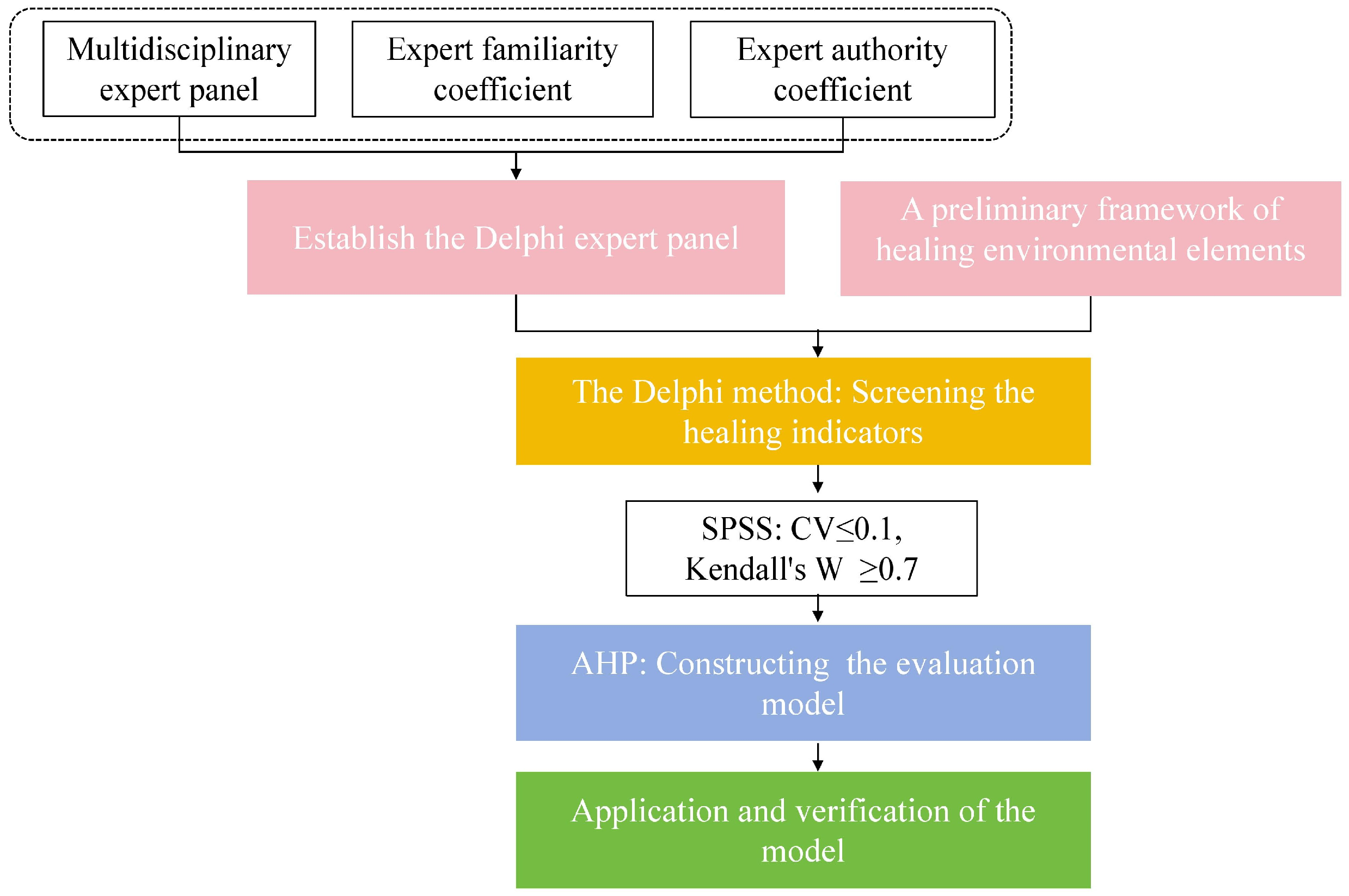
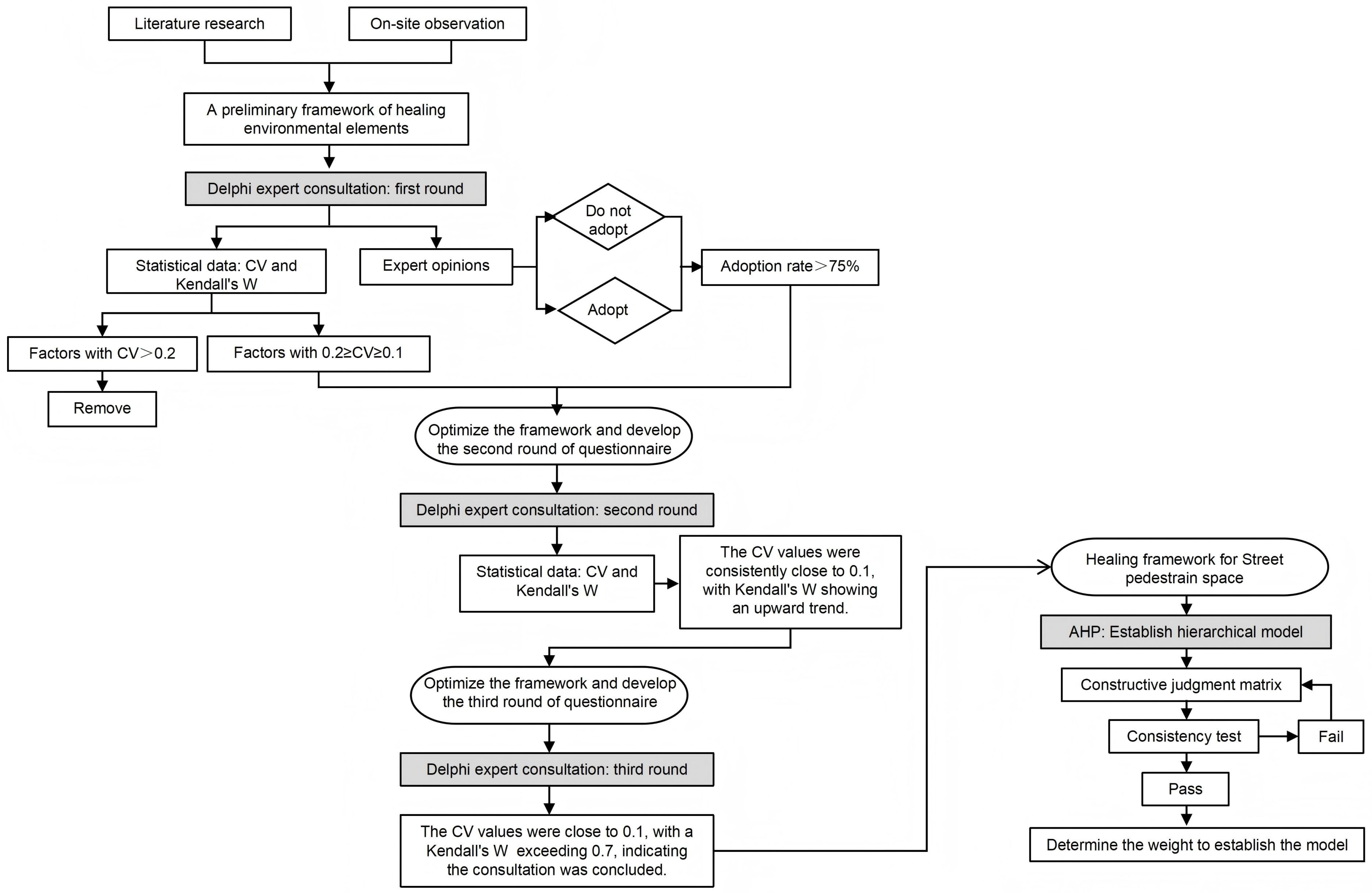
2.2. The Process of Establishing a Healing Model
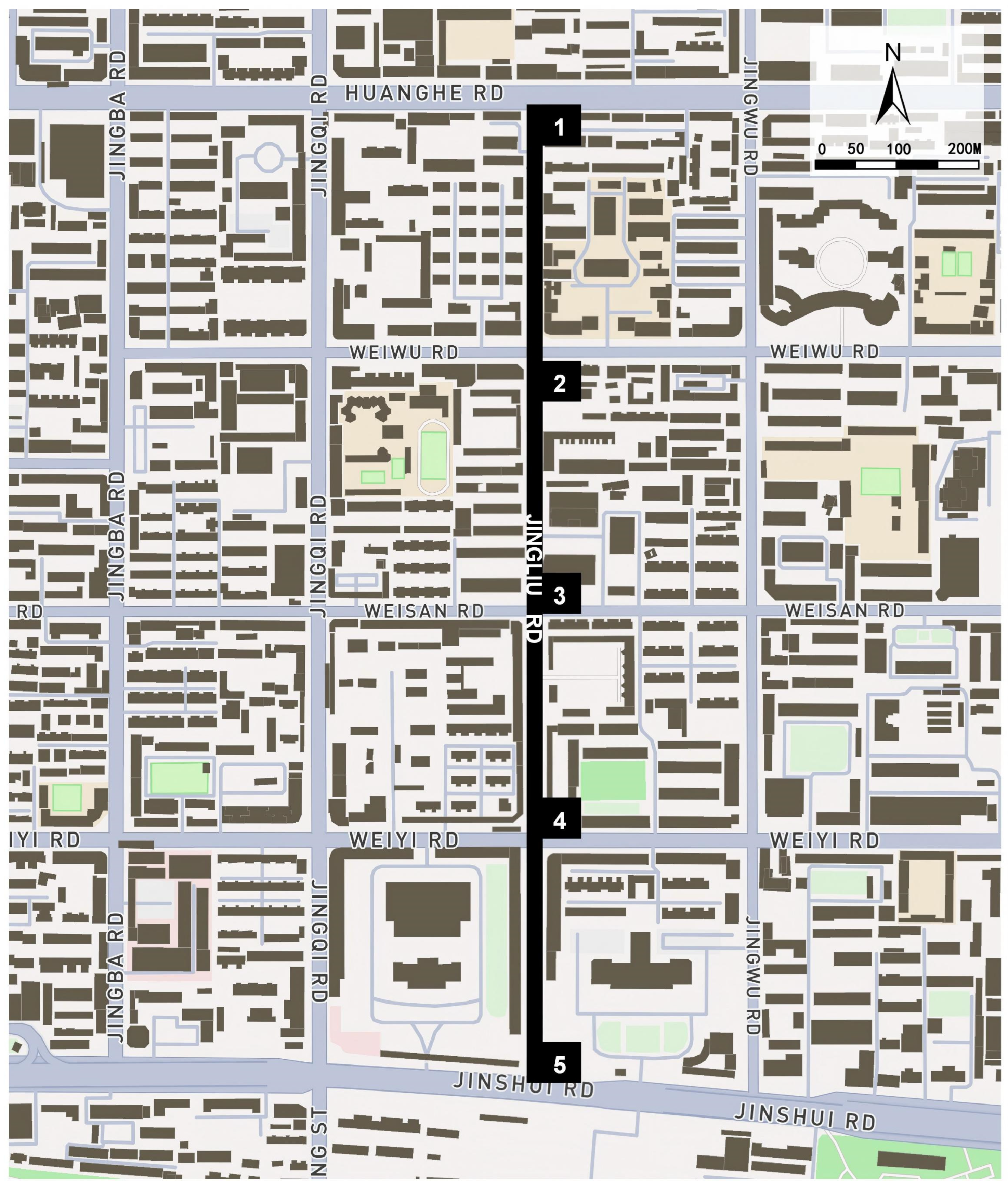
2.3. Empirical Research Design
3. Results
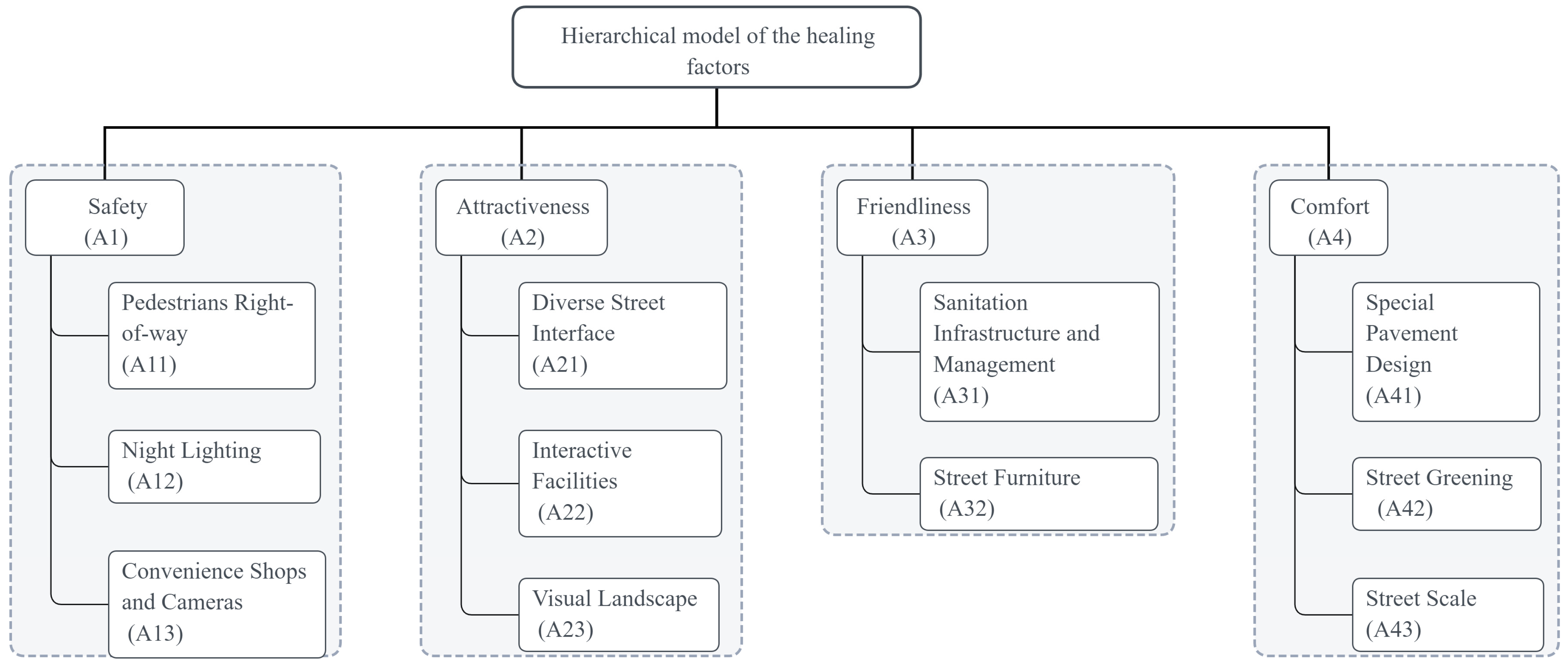
3.1. A Healing Framework for High-Density Urban Streets
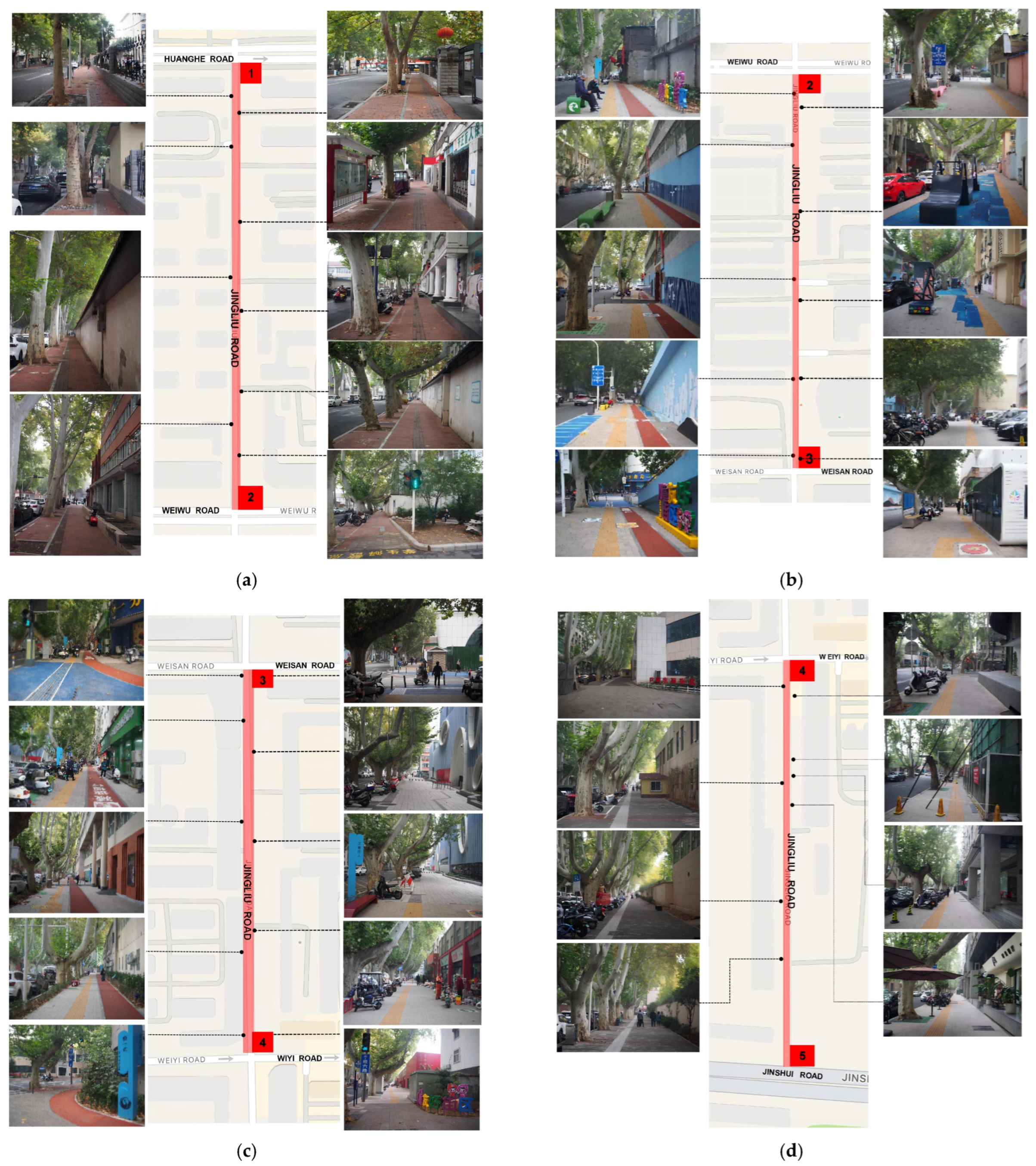
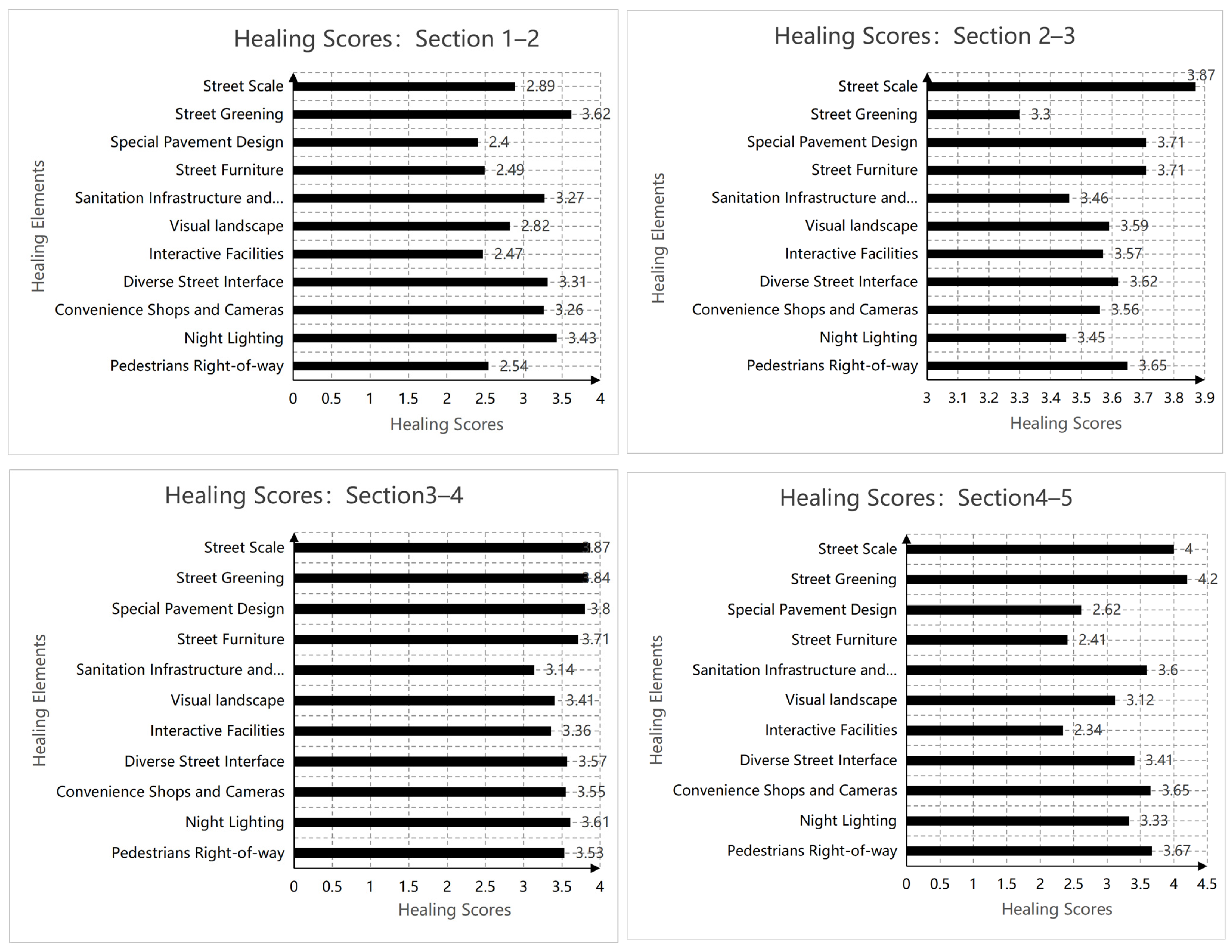
3.2. Healing Potential of “Jingliu Road” Street
4. Discussion
5. Conclusions
- (1)
- Through Delphi consultations and AHP analysis, the framework established a hierarchical weighting system comprising four dimensions—Comfort (35.5%), Safety (32.1%), Friendliness (21.6%), and Attractiveness (10.8%)—and eleven healing indicators. Empirical validation in Jingliu Road, Zhengzhou, demonstrated effective diagnostic capability, with overall healing scores ranging from 2.94 (Section 1–2) to 3.60 (Section 3–4). The weighted system successfully identified critical deficiencies that traditional unweighted assessments would overlook, enabling evidence-based prioritization.
- (2)
- The framework supports urban renewal by offering a quantitative tool for planning and evaluation. Unlike qualitative lists, it assigns weight to healing elements, guiding efficient resource use. Integrating these indicators into municipal guidelines can help create psychologically restorative streets, aligning with SDGs 3 and 11.
- (3)
- Future research should broaden investigations to cities or countries with varied cultural, social, and economic contexts. Comparative analysis will strengthen the evaluation framework’s generalizability and identify context-specific adaptation strategies. Building on this, policy support and community co-construction can be integrated. Evaluation tools should be embedded in local policy, and street intervention plans should be co-created with residents to form a sustainable “design–implementation–maintenance” loop, ensuring interventions’ long-term efficacy. Mixed-methods research should also be used to combine objective physiological data—such as electroencephalogram and heart rate variability—with subjective perceptions for assessing design impacts on mental health and urban livability.
Author Contributions
Funding
Institutional Review Board Statement
Informed Consent Statement
Data Availability Statement
Conflicts of Interest
Abbreviations
| AHP | Analytic Hierarchy Process |
| Ca | Coefficient of Judgment Basis |
| Cs | Expert Familiarity Coefficient |
| Cr | Expert Authority Coefficient |
| Kendall’s W | Kendall’s Coefficient of Concordance |
| CV | Coefficients of Variation |
| CI | Consistency Index |
| CR | Consistency Ratio |
| RI | Random Index |
References
- Wu, E.R. High-Density Urban Design: Realizing Sustainable Development of Society and Environment; China Architecture and Building Press: Beijing, China, 2014; Available online: https://item.kongfz.com/book/32427736_5_4_1.html (accessed on 16 March 2026).
- Cui, M.Y.; Zhuang, Y.; Ye, Y. Design strategies for high-density built environments oriented towards holistic health. Urban Plan. Int. 2025, 40, 84–95. [Google Scholar] [CrossRef]
- Wu, J. Lectures on Selected Contemporary China Urban Issues: A Summary-Problems and Challenges of the Development Mode of the Urbanization with Chinese Characteristics. College of Architecture and Urban Planning, Tongji University. (n.d.). Available online: https://caup.tongji.edu.cn/caupen/83/84/c11036a295812/page.htm (accessed on 16 March 2026).
- Zhang, S.Y.; Lin, S.N.; Li, Z.G.; Guo, Y. Influence of neighborhood environmental perception on self-rated health of residents in cities of China: A case study of Wuhan. Hum. Geogr. 2019, 34, 32–40. [Google Scholar]
- Wang, Y.S.; Gu, T.T.; Chu, H.C. Effect of environmental condition on health of urban and rural residents in China. Chin. J. Public Health 2020, 36, 1264–1267. [Google Scholar] [CrossRef]
- Mueller, D.P. The current status of urban-rural differences in psychiatric disorder: An emerging trend for depression. J. Nerv. Ment. Dis. 1981, 169, 18–27. [Google Scholar] [CrossRef]
- Lederbogen, F.; Kirsch, P.; Haddad, L.; Streit, F.; Tost, H.; Schuch, P.; Wüst, S.; Pruessner, J.C.; Rietschel, M.; Deuschle, M.; et al. City living and urban upbringing affect neural social stress processing in humans. Nature 2011, 474, 498–501. [Google Scholar] [CrossRef] [PubMed]
- Xu, J.; Liu, N.; Polemiti, E.; Xu, J.; Liu, N.; Polemiti, E.; Garcia-Mondragon, L.; Tang, J.; Liu, X.; Lett, T.; et al. Effects of urban living environments on mental health in adults. Nat. Med. 2023, 29, 1456–1467. [Google Scholar] [CrossRef] [PubMed]
- Hu, C.; Gong, C.; Peng, K.; Wang, F. The urban micro-restorative green spaces that promote public psychological health. Time Archit. 2022, 5, 38–45. [Google Scholar] [CrossRef]
- Hannon, E.; Anselimus, S.M.; Bardikoff, N.; Bulc, B.; Germann, S.; Gonsalves, P.P.; Melendez-Torres, G.J.; Ospina-Pinillos, L.; Sinha, M.; Wanjiru, M. Why cities matter for adolescent mental health and wellbeing. Lancet 2023, 403, 708–710. [Google Scholar] [CrossRef]
- Berman, M.G.; Jonides, J.; Kaplan, S. The cognitive benefits of interacting with nature. Psychol. Sci. 2008, 19, 1207–1212. [Google Scholar] [CrossRef] [PubMed]
- Zhang, X.; Jiang, B. Cultivating perseverance: A natural education approach for urban preschool children. Landsc. Archit. 2019, 26, 40–47. [Google Scholar] [CrossRef]
- Harries, B.; Chalmin-Pui, L.S.; Gatersleben, B.; Griffiths, A.; Ratcliffe, E. Designing a wellbeing garden’ a systematic review of design recommendations. Des. Health 2023, 7, 180–201. [Google Scholar] [CrossRef]
- Tan, S.H.; Li, J. Restoration and stress relief benefits of urban park and green space. Chin. Landsc. Archit. 2009, 25, 79–82. [Google Scholar]
- Yu, Y.; Jiang, Y.Q.; Li, L. Health Approach of Urban Public Space: Connotation, Elements and Framework of the Healthy Street. Chin. Landsc. Archit. 2021, 37, 20–25. [Google Scholar] [CrossRef]
- Xu, L.Q.; Hu, Y.Z. A new model of healthy street. Time Archit. 2020, 33–41. [Google Scholar] [CrossRef]
- Qi, Y.T. Research on the Health Benefits of Street Walking Space Based on Walking Behavior and Healing Environment. Master’s Thesis, Beijing Forestry University, Beijing, China, 2022. [Google Scholar] [CrossRef]
- Ige-Elegbede, J.; Pilkington, P.; Orme, J.; Williams, B.; Prestwood, E.; Black, D.; Carmichael, L. Designing healthier neighbourhoods: A systematic review of the impact of the neighbourhood design on health and wellbeing. Cities Health 2020, 6, 1004–1019. [Google Scholar] [CrossRef]
- Velarde, M.D.; Fry, G.; Tveit, M. Health effects of viewing landscapes-Landscape types in environmental psychology. Urban For. Urban Green. 2007, 6, 199–212. [Google Scholar] [CrossRef]
- Tenngart, I.C.; Hagerhall, C.M. The restorative effects of natural environments: A literature review. J. Environ. Psychol. 2008, 28, 165–180. [Google Scholar] [CrossRef]
- Zhang, L.Z. Optimized Research on the Creation of Healing Environments in General Hospital Architecture; Dalian University of Technology: Dalian, China, 2015. [Google Scholar]
- Ulrich, R.S. Aesthetic and affective response to natural environment. In Behavior and the Natural Environment; Altman, I., Wohlwill, J.F., Eds.; Springer: Berlin/Heidelberg, Germany, 1983; pp. 85–125. [Google Scholar]
- Kaplan, S. The restorative benefits of nature: Toward an integrative framework. J. Environ. Psychol. 1995, 15, 169–182. [Google Scholar] [CrossRef]
- Bowler, D.E.; Buyung-Ali, L.M.; Knight, T.M.; Pullin, A.S. A systematic review of evidence for the added benefits to health of exposure to natural environments. BMC Public Health 2010, 10, 456. [Google Scholar] [CrossRef] [PubMed]
- Dinas, P.C.; Koutedakis, Y.; Flouris, A.D. Effects of exercise and physical activity on depression. Ir. J. Med. Sci. 2011, 180, 319–325. [Google Scholar] [CrossRef]
- Stobbe, E.; Sudimac, S.; Kühn, S. Birdsongs alleviate anxiety and paranoia in healthy participants. Sci. Rep. 2011, 12, 16513. [Google Scholar] [CrossRef]
- Panțiru, I.; Ronaldson, A.; Sima, N.; Dregan, A.; Sima, R. The impact of gardening on well-being, mental health, and quality of life: An umbrella review and meta-analysis. Syst. Rev. 2024, 13, 45. [Google Scholar] [CrossRef]
- Olszewska-Guizzo, A.; Fogel, A.; Escoffier, N.; Sia, A.; Nakazawa, K.; Kumagai, A.; Dan, I.; Ho, R. Therapeutic garden with contemplative features induces desirable changes in mood and brain activity in depressed adults. Front. Psychiatry 2022, 13, 757056. [Google Scholar] [CrossRef]
- Gehl, J. Life Between Buildings: Using Public Space; The Danish Architectural Press: Copenhagen, Denmark, 1971. [Google Scholar]
- Ulrich, R.S.; Simons, R.F.; Losito, B.D.; Fiorito, E.; Miles, M.A.; Zelson, M. Stress recovery during exposure to natural and urban environments. J. Environ. Psychol. 1991, 11, 201–230. [Google Scholar] [CrossRef]
- United Nations. Transforming Our World: The 2030 Agenda for Sustainable Development. 2015. Available online: https://sdgs.un.org/goals (accessed on 16 March 2026).
- United Nations. Goal 11: Sustainable Cities And Communities. 2015. Available online: https://www.un.org/sustainabledevelopment/cities/ (accessed on 16 March 2026).
- State Council of China. “Healthy China 2030” Planning Outline. 2016. Available online: http://www.gov.cn/zhengce/2016-10/25/content_5124174.htm (accessed on 16 March 2026).
- Linstone, H.A.; Turoff, M. The Delphi Method: Techniques and Applications; Addison-Wesley: London, UK, 1975. [Google Scholar]
- Jacobs, J. The Death and Life of Great American Cities; Random House: New York, NY, USA, 1961. [Google Scholar]
- Huo, D.; Chen, F.; Chen, B. Landscape design strategies for healthy aging-in-place in communities: Case studies from Suzhou, China. Buildings 2024, 14, 3427. [Google Scholar] [CrossRef]
- Chen, J.; Zhang, Z.; Long, Y. Strategies for improving street space quality oriented towards public health: From the perspective of spatial disorder. Urban Plan. 2020, 44, 35–47. [Google Scholar]
- Sheng, K.; Liu, L.; Zhou, X. Research on Child-Friendliness Streets Based on Behavioral Characteristics and Right-of-Way Priority. The Paper. 2024. Available online: https://m.thepaper.cn/newsdetail_forward_28610632?utm_source=chatgpt.com (accessed on 16 March 2026).
- Zhang, N.; Dun, S. Research on urban public art design innovation based on intelligent interactive experience. J. Orient. Des. 2023, 3, 51–57. [Google Scholar]
- Ren, R. Evaluation and Renewal Strategies of Ancient City Street Vitality Based on the Concept of Sharing. Master’s Thesis, Southeast University, Nanjing, China, 2022; pp. 45–52. [Google Scholar] [CrossRef]
- Gehl, J. Cities for People; Island Press: Washington, DC, USA, 2010; Available online: https://book.douban.com/subject/4846027/ (accessed on 16 March 2026).
- Shen, Z.M. Community building based on emotional design theory. Design 2023, 8, 2316–2322. Available online: https://www.hanspub.org/Journal/PaperInformation?paperID=76495 (accessed on 16 March 2026).
- Zhang, Z.; Peng, M.; Li, Y. Analysis of healing factors in visual art therapy. Art Apprec. 2022, 35, 13–16. Available online: https://kns.cnki.net/kcms2/article/abstract?v=jpN_MAf5WI7P5gawKDjecmqz16McjtIqgqfZ3Az91VSfjB37K24RRgkjbo0wSOpic0sOrXaExy1hcISCS3d3liMTGKN0hSOT7SSkJzcKaZ0E6nvzQQRynYFdUfdp_T8CmenG58PS9rY06t1r3bfkPWXBXSsPZY__fyEVk7CRih8t-YggmO7EyQ==&uniplatform=NZKPT&language=CHS (accessed on 16 March 2026).
- Wu, Z.; Lei, H. An evaluation analysis of the child-friendliness oriented urban street space: From the perspective of “Embodied mind” In embodied cognition. J. Xi’an Univ. Archit. Technol. (Soc. Sci. Ed.) 2022, 41, 33–42. [Google Scholar] [CrossRef]
- Tan, B. Research on Barrier-Free Design of Urban Public Spaces. Master’s Thesis, Hunan University, Changsha, China, 2013. [Google Scholar] [CrossRef]
- Hunter, R.F.; Cleland, C.; Cleary, A.; Droomers, M.; Wheeler, B.W.; Sinnett, D. Environmental, health, well-being, social and equity effects of urban green space interventions: A meta-narrative evidence synthesis. Int. J. Environ. Health Res. 2019, 29, 285–293. [Google Scholar]
- Yang, B.; Wang, Q. Study on urban street space planning based on walkability. J. Jilin Jianzhu Univ. 2018, 35, 0077-05. [Google Scholar]
- Wu, R.; Pan, Z.L.; Liu, Y.; Li, Z.G. The effect of streetscape greenery on residents’ mental health: A case study of Guangzhou. Geogr. Res. 2021, 40, 2272–2291. [Google Scholar] [CrossRef]
- Wang, R.; Helbich, M.; Yao, Y.; Zhang, J.; Liu, P.; Yuan, Y.; Liu, Y. Urban greenery and mental wellbeing in adults: Cross-sectional mediation analyses on multiple pathways across different greenery measures. Environ. Res. 2019, 176, 108535. [Google Scholar] [CrossRef] [PubMed]
- Zhang, C.M.; Li, W.; Fan, Q.D.; Hu, J.; Wang, D.M.; Ping, X.Y.; Li, W.J. The influence of vegetation environment on thermal experience in hot summer: A case study from perspectives of fitting scale and gender disparity. Buildings 2024, 14, 3036. [Google Scholar] [CrossRef]
- Gehl, J. Life Between Buildings: Using Public Space; Van Nostrand Reinhold: New York, NY, USA, 1987. [Google Scholar]
- Qin, J.Q.; Ma, W.J. Abraham Maslo-The discoverer of self-realization and human potential. Pop. Psychol. 2024, 2–3. Available online: https://kns.cnki.net/kcms2/article/abstract?v=jpN_MAf5WI5kspzlv_68rV44D7MpMS_TB2qB-Bf3Ohb_fmPRsff2fbNGEuE9CNon06lT02c1Vi777SgCFyA0Xx90krl5Nse8Ni4td-hLsQpAR_AOQLdyujeajW0TZG024vLiv3Az7IYHeNNVbQpfYqOBjVZbyg6JNIeZCIKxuF4Dom3jDNnasw==&uniplatform=NZKPT&language=CHS (accessed on 16 March 2026).
- Slovic, P. Perception of risk. Science 1987, 236, 280–285. [Google Scholar] [CrossRef] [PubMed]
- Lynch, K. The Image of the City; MIT Press: Cambridge, MA, USA, 1960; Available online: https://www.doc88.com/p-9465205104064.html (accessed on 16 March 2026).



| Very Familiar | Familiar | Generally Familiar | Slightly Familiar | Unfamiliar |
|---|---|---|---|---|
| 1 | 0.8 | 0.6 | 0.4 | 0.2 |
| Number of Questionnaires | Recycling Quantity | Expert Participation Rate | |
|---|---|---|---|
| First Round | 14 | 14 | 100% |
| Second Round | 14 | 14 | 100% |
| Third Round | 14 | 14 | 100% |
| Judgment Basis | Influence Degree | ||
|---|---|---|---|
| Big | Middle | Small | |
| Theoretical Analysis | 0.5 | 0.4 | 0.3 |
| Practical Experience | 0.3 | 0.2 | 0.1 |
| Peer Understanding | 0.1 | 0.1 | 0.1 |
| Intuition | 0.1 | 0.1 | 0.1 |
| 0.907 | 0.606 | 0.756 |
| Dimensions | References | Elements | References |
|---|---|---|---|
| Safety | Jacobs, J. (1961) [35] Huo, D., Chen, F. & Chen, B. (2024) [36] | Pedestrian Right-of-Way | Chen, J., Zhang, Z., Long, Y. (2020) [37] Qi, Y.T. (2022) [17] Sheng, K., Liu, L., Zhou, X. (2024) [38] |
| Proper Lighting | Zhang, N.W., Dun, S.T. (2023) [39] | ||
| Convenience Shops and Cameras | Jacobs, J. (1961) [35] | ||
| Community Identity Element | Chen, J., Zhang, Z., Long, Y. (2020) [37] | ||
| Attractiveness | Kaplan, S. (1995) [23] Ren, R. (2022) [40] | Transparency of the Architecture | Gehl, J. (2010) [41] |
| Interactive Facilities | Chen, J., Zhang, Z., Long, Y. (2020) [37] Shen, Z.M. (2023) [42] | ||
| Visual Art | Kaplan, S. (1995) [23] Zhang, Z., Peng, M., Li, Y. (2022) [43] | ||
| Friendliness | Wu, Z., Lei, H. (2022) [44] | Barrier-Free Paving | Tan, B. (2013) [45] |
| Rest Facilities | Hunter, R. F., et al. (2019) [46] | ||
| Humanity Care Facilities | Huo, D., Chen, F., Chen, B. (2024) [36] | ||
| Comfort | Yang, B., Wang, Q. (2018) [47] Chen, J., Zhang, Z., Long, Y. (2020) [37] | A Sense of Belonging | Shen, Z.M. (2023) [42] |
| Street Greening | Ulrich, R.S. (1983) [22] Wu. R, Pan, Z.L., et al. (2021) [48] Wang, R.Y., et al. (2019) [49] Zhang et al. (2024) [50] | ||
| Space Scale | Chen, J., Zhang, Z., Long, Y. (2020) [37] Gehl, J. (1987) [51] |
| N | Kendall’s W | |
|---|---|---|
| First-round | 14 | 0.51 |
| Second-round | 14 | 0.638 |
| Three-round | 14 | 0.714 |
| A1 | A2 | A3 | A4 | Feature Vector | Weighting Values | |
|---|---|---|---|---|---|---|
| A1 | 1 | 2 | 2 | 1 | 1.414 | 0.3210 |
| A2 | 0.5 | 1 | 0.308 | 0.333 | 0.476 | 0.1080 |
| A3 | 0.5 | 3.25 | 1 | 0.5 | 0.949 | 0.2155 |
| A4 | 1 | 3 | 2 | 1 | 1.565 | 0.3553 |
| The Biggest Characteristic Root | CI | RI | CR | Consistency Test |
|---|---|---|---|---|
| 4.137 | 0.046 | 0.882 | 0.052 | Pass |
| CI | RI | CR | Consistency Test | |
|---|---|---|---|---|
| A1 | 0.001 | 0.525 | 0.001 | Pass |
| A2 | 0.031 | 0.525 | 0.059 | Pass |
| A3 | 0 | 0 | 0 | Pass |
| A4 | 0.027 | 0.525 | 0.051 | Pass |
| Sample Capacity | Items | Cronbach.α |
|---|---|---|
| 210 | 29 | 0.904 |
| Dimensions | Factors | Mean | Standard Deviation | CV |
|---|---|---|---|---|
| Safety | Pedestrian Right-of-Way | 4.6429 | 0.63332 | 0.136406125 |
| Proper Lighting | 4.5 | 0.65044 | 0.144542222 | |
| Convenience Shops and Cameras | 3.7857 | 0.69929 | 0.18471881 | |
| Community Identity Element | 3.7143 | 0.82542 | 0.222227607 * | |
| Attractiveness | Transparency of the Architecture | 3.8571 | 0.77033 | 0.199717404 |
| Interactive Facilities | 3.7143 | 0.61125 | 0.164566675 | |
| Visual Art | 4.3571 | 0.63332 | 0.145353561 | |
| Friendliness | Barrier-Free Paving | 4.2143 | 0.69929 | 0.165932658 |
| Rest Facilities | 3.7143 | 0.61125 | 0.164566675 | |
| Humanity Care Facilities | 2.9286 | 0.61573 | 0.210247217 * | |
| Comfort | A Sense of Belonging | 4.6429 | 0.49725 | 0.107099011 |
| Street Greening | 4.8571 | 0.36314 | 0.074764777 | |
| Space Scale | 4.6429 | 0.49725 | 0.107099011 |
| Dimensions | Factors | Mean | Standard Deviation | CV |
|---|---|---|---|---|
| Safety | Pedestrian Right-of-Way | 4.7143 | 0.46881 | 0.099444244 |
| Night Lighting | 4.5714 | 0.64621 | 0.141359321 | |
| Convenience Shops and Cameras | 3.3571 | 0.49725 | 0.148118912 | |
| Attractiveness | Diverse Street Interface | 3.6429 | 0.49725 | 0.136498394 |
| Interactive Facilities | 3.3571 | 0.49725 | 0.148118912 | |
| Visual Landscape | 4.7857 | 0.42582 | 0.088977579 | |
| Friendliness | Sanitation Infrastructure and Management | 4.6429 | 0.49725 | 0.107099011 |
| Street Furniture | 3.7143 | 0.46881 | 0.126217591 | |
| Comfort | Pavement Design | 4.6429 | 0.49725 | 0.107099011 |
| Street Greening | 4.8571 | 0.36314 | 0.074764777 | |
| Street Scale | 4.6429 | 0.49725 | 0.107099011 |
| Dimensions | Factors | Mean | Standard Deviation | CV |
|---|---|---|---|---|
| Safety | Pedestrian Right-of-Way | 4.7143 | 0.46881 | 0.099444244 |
| Night Lighting | 4.8571 | 0.36314 | 0.074764777 | |
| Convenience Shops and Cameras | 3.0714 | 0.26726 | 0.087015693 | |
| Attractiveness | Diverse Street Interface | 3.8571 | 0.36314 | 0.094148454 |
| Interactive Facilities | 3.1429 | 0.36314 | 0.11554297 | |
| Visual Landscape | 4.8571 | 0.36314 | 0.074764777 | |
| Friendliness | Sanitation Infrastructure and Management | 4.6429 | 0.49725 | 0.107099011 |
| Street Furniture | 3.8571 | 0.36314 | 0.094148454 | |
| Comfort | Pavement Design | 4.7143 | 0.46881 | 0.099444244 |
| Street Greening | 4.8571 | 0.36314 | 0.074764777 | |
| Street Scale | 4.7143 | 0.46881 | 0.099444244 |
| Criterion Layer | Weight Value | Feature Vector | Factor Layer | Weight Value |
|---|---|---|---|---|
| A1 | 0.3210 | 1.414 | A11 | 0.4131 |
| A12 | 0.3209 | |||
| A13 | 0.2659 | |||
| A2 | 0.1080 | 0.476 | A21 | 0.1482 |
| A22 | 0.0925 | |||
| A23 | 0.759 | |||
| A3 | 0.2155 | 0.949 | A31 | 0.6000 |
| A32 | 0.4000 | |||
| A4 | 0.3553 | 1.565 | A41 | 0.4126 |
| A42 | 0.2599 | |||
| A43 | 0.3274 |
| Street Sections | Safety | Weight Value | Attractiveness | Weight Value | Friendliness | Weight Value | Comfort | Weight Value | Healing Capacity |
|---|---|---|---|---|---|---|---|---|---|
| 1–2 | 3.016795 | 0.3210 | 2.859397 | 0.1080 | 2.958 | 0.2155 | 2.877264 | 0.3553 | 2.9369 |
| 2–3 | 3.561524 | 3.591519 | 3.56 | 3.655454 | 3.5971 | ||||
| 3–4 | 3.560637 | 3.428064 | 3.368 | 3.832934 | 3.6008 | ||||
| 4–5 | 3.555209 | 3.089892 | 3.124 | 3.482192 | 3.3854 |
Disclaimer/Publisher’s Note: The statements, opinions and data contained in all publications are solely those of the individual author(s) and contributor(s) and not of MDPI and/or the editor(s). MDPI and/or the editor(s) disclaim responsibility for any injury to people or property resulting from any ideas, methods, instructions or products referred to in the content. |
© 2026 by the authors. Licensee MDPI, Basel, Switzerland. This article is an open access article distributed under the terms and conditions of the Creative Commons Attribution (CC BY) license.
Share and Cite
Liu, Q.; Jia, N.; Shi, K.; Fan, B. Healing-Oriented Street Space Model: A Multidisciplinary Multi-Stakeholder Approach for High-Density Cities. Buildings 2026, 16, 1354. https://doi.org/10.3390/buildings16071354
Liu Q, Jia N, Shi K, Fan B. Healing-Oriented Street Space Model: A Multidisciplinary Multi-Stakeholder Approach for High-Density Cities. Buildings. 2026; 16(7):1354. https://doi.org/10.3390/buildings16071354
Chicago/Turabian StyleLiu, Qi, Ning Jia, Ke Shi, and Bingbing Fan. 2026. "Healing-Oriented Street Space Model: A Multidisciplinary Multi-Stakeholder Approach for High-Density Cities" Buildings 16, no. 7: 1354. https://doi.org/10.3390/buildings16071354
APA StyleLiu, Q., Jia, N., Shi, K., & Fan, B. (2026). Healing-Oriented Street Space Model: A Multidisciplinary Multi-Stakeholder Approach for High-Density Cities. Buildings, 16(7), 1354. https://doi.org/10.3390/buildings16071354