Article

KCY’s University-Campus-Planning Practice: “Compositionalism” and Its Sino-American Cross-Cultural Knowledge Pathway

by
Bo Lv
and
Gang Feng
*
School of Architecture, Tianjin University, Tianjin 300072, China
*
Author to whom correspondence should be addressed.
Buildings 2026, 16(7), 1345; https://doi.org/10.3390/buildings16071345
Submission received: 6 February 2026 / Revised: 4 March 2026 / Accepted: 16 March 2026 / Published: 27 March 2026
(This article belongs to the Section Architectural Design, Urban Science, and Real Estate)

Abstract

This study examines the campus-planning projects (1920–1937) of Kwan, Chu & Yang, Architects & Engineers (KCY), a major Chinese firm, against the backdrop of Sino-American cross-cultural knowledge transfer. It argues that their work exhibited a distinct compositional tendency derived from the partners’ U.S. Beaux-Arts education and contemporary American planning theory. Through historical analysis and case studies of four university projects, this research examines how composition-based spatial unity engaged with specific Chinese site conditions. The results indicate that early projects negotiated irregular boundaries, while later ones grappled with complex topography, such as historic gardens and hills. Although often unrealized, these grand schemes embodied a scientific planning methodology and served as aspirational blueprints. This study concludes that compositional practice was a significant part of China’s architectural modernization, representing both a professional design approach and a cultural response to the quest for modernity and national identity.

1. Introduction

In the late nineteenth century, China began learning from Western “modern” technological achievements and ideological concepts. After the 1890s, emulating Western university education systems and their physical construction models became common practice—a boom in construction that continued until it was interrupted by the War of Resistance against Japan and the Chinese Civil War (late 1930s–1940s). Campus construction from the 1890s to the 1930s thus comprised the inception period of Chinese university campus development, laying the material foundation for many contemporary prestigious institutions [1,2,3,4].
The architects leading campus-planning projects during this period predominantly possessed American educational or professional backgrounds—they were either American architects working in China or Chinese architects who had studied abroad. Consequently, these projects were deeply influenced by American models. As Jeffrey W. Cody observes, by the 1890s, the United States had become closely associated with the “tendency to modernize”, and American standards gradually became synonymous with “modern,” “progressive,” or “developed” [5]. In the late nineteenth- and early twentieth-century United States, “composition” had become nearly synonymous with “design” ([6], p. 136). Composition theory—which originated in ancient Rome, was developed through the French Beaux-Arts, and had been institutionalized in American architectural education by the late nineteenth century—was the core methodology implemented by American architects handling complex public projects, especially campus planning ([7], ([8], p. 208)). Against this dual context—with the U.S. representing “modernity” and composition as the core design method—campus planning in China, led by American-trained individuals, also involved the systematic application of composition theory.
The focus of this article—KCY, Architects & Engineers—was a firm founded by China-born, U.S.-trained architects. As the earliest established and largest Chinese-owned architectural design firm in modern China, it holds an important position in the history of modern Chinese architecture. (Founded in 1920, KCY, Architects & Engineers, expanded to include nine partners by 1949, with a stable staff of over fifty employees. In 1934, the drafting room (atelier) of its headquarters in Tientsin could accommodate twenty large drawing tables. The firm completed over 130 built projects between 1920 and 1949.) Its founder, S. S. Kwan, leveraged family reputation and personal connections to establish relationships with high-level government officials [9,10]. The “troika” of Kwan, Chu Bin, and Yang Tingbao—all selected through Tsinghua College for architectural programs at American universities—represented an intellectual elite with outstanding professional expertise. These advantages enabled KCY to undertake numerous important, large-scale public projects, including several key Chinese university-campus-planning commissions that exhibited a significant tendency toward “compositionalism”.
By employing the term “compositionalism”—rather than merely “composition”—this study foregrounds a critical distinction: the concepts transferred were not simply technical procedures but a comprehensive design doctrine—a consciously held paradigm carrying specific assumptions about architectural order, professional expertise, and modernity. It is worth noting that this usage has no direct connection with “Constructivism” in the art field, which refers principally to the avant-garde artistic movement that emerged in Russia around 1913–1917. However, the design thinking advocated by the Constructivist movement presents interesting contrasts to Beaux-Arts composition theory—contrasts that ultimately positioned Constructivism as a force of “rebellion” against the Beaux-Arts tradition in the subsequent development of modern architecture. In the American educational context in which KCY’s partners were trained, composition was taught not as one approach among many but as the essence of architectural design—a purportedly universal methodology capable of resolving complex programmatic requirements into unified spatial wholes. When transplanted to China, this methodology retained its character as an aspirational system: it promised to impose rational order on chaotic sites, to symbolize institutional hierarchy through spatial hierarchy, and to align Chinese university building practices with international standards of progress.
Despite its rich historical significance, a critical gap in research on this period remains. Existing studies, whether macro-historical surveys or single-case analyses, have predominantly focused on stylistic genealogies, technological transfer, or biographical narratives, and few have engaged substantively with “composition” as a core design methodology—the very intellectual apparatus through which the American-trained architects of KCY’s generation conceptualized spatial order. Where composition has been addressed, it remains either undertheorized or confined to isolated cases, leaving the broader cross-cultural knowledge pathway that carried Beaux-Arts compositional logic from the United States to China and its systematic application across multiple projects by a single firm unexplored.
This study addresses this gap through an integrative examination of three interconnected strands: the history of modern Chinese university campus planning, American Beaux-Arts composition theory, and its cross-cultural transmission as a purportedly universal design method. The core objectives are threefold: first, to reveal the compositional tendency within KCY’s design methodology through its campus projects; second, to analyze the American-dominated knowledge transmission path that fostered this tendency; and third, to explore the potential and limitations exposed when composition theory interacted with the concrete realities of the Chinese “site”. By employing “compositionalism” as a historiographical framework—treating composition not as static dogma but as an evolving mode of design thinking that carried specific epistemological assumptions—this study offers a new interpretive pathway distinct from conventional stylistic, technological, or biographical histories. It argues that for KCY and its contemporaries, composition was not merely a technical procedure but a deeply internalized professional creed and a cultural medium through which China’s first generation of academically trained architects sought to align local practice with global standards of progress.

2. Literature Review

This research is primarily based on the history of modern Chinese architecture. Its scope also includes related fields such as the history of American university campus planning, the Beaux-Arts system, and its composition theory.
Scholars in the field of modern Chinese architectural history have produced a substantial body of work focusing on university projects and their architects, encompassing a variety of perspectives. Existing scholarship can be broadly divided into two categories: the first aims to trace and analyze macro-historical contexts (e.g., Cai Ling [1], Feng Gang [2], Chen Xiaotian [3], Xu Weiguo [4]), while the second concentrates on specific case studies or projects led by actors with specific cultural identities (e.g., Li Haiqing [11], Dong Xiaoxiao [12], Liu Yishi [13,14,15], etc. [16,17,18,19,20,21,22,23,24,25,26,27,28,29,30]). Furthermore, two additional strands of research frequently address university campuses: some studies center on specific architects (e.g., Cody on Henry Murphy [31], Jiang Chunqian on the Allied Architects [32]) and others focus on specific geographic regions (e.g., Peng Changxin on the Lingnan area [33], Wang Hechi on educational architecture in Nanking [34], etc. [35,36]).
These studies have investigated campus planning from diverse angles, including stylistic history, technological history, architect biography, and regional architectural history. However, most either prioritize documenting the historical evolution of campus layouts or attempt to identify potential Western (primarily American) prototypes. Few engage substantially with the question of composition as a core design methodology.
Within this body of work, the research of Jeffrey W. Cody [30] and Dong Xiaoxiao [12] is particularly relevant, although it leaves room for further development. Cody identified recurring axial patterns in Chinese Christian university planning, labeling them “American geometries,” but did not fully explicate the underlying compositional theory. Dong provided an insightful analysis of the conflict and negotiation between composition and topography in the National Central University case but did not expand her single-case study to explore the broader Sino-American cross-cultural knowledge pathway giving rise to the theory itself.
The U.S. educational background of KCY’s partners inherently connects their practice to contemporary American campus-planning models. In this domain, Paul V. Turner’s Campus [37] and the series of studies by Richard P. Dober [38,39,40,41] are seminal comprehensive works. Turner’s research traces the material history of the American campus, arguing it constitutes a unique architectural type—“a uniquely American place”, “a kind of city in microcosm”, and “a vehicle for expressing the utopian social visions of the American imagination”. Dober’s work, while more concerned with late-20th-century design principles, also outlines earlier historical characteristics and notes the prevalence of Beaux-Arts training among architects. Beyond these syntheses, monographs on the planning history of specific American institutions, such as the University of California, Berkeley [42], MIT [43], and Columbia University [44], provide crucial historical source material. Nonetheless, due to their different foci, none of these works sufficiently detail the precise methodological role of Beaux-Arts composition theory in that era’s campus planning, nor do they examine the phenomenon of this American model’s transmission to China.
In Western discourse, composition theory was criticized as rigid dogma following the rise in modernist architecture. However, its intrinsic methodological value has been re-evaluated over the past two decades. The work of French scholar Jacques Lucan [8] is pivotal. Lucan systematically traces the intellectual genealogy of composition since the mid-18th century, advancing a core argument: composition as a mode of design thinking never vanished but has continually evolved by confronting internal challenges. This insight is fundamental to the present study.
Scholarship also exists on the connections between the Beaux-Arts system and China. For example, the volume edited by Jeffrey W. Cody [45] gathers essays discussing the Beaux-Arts and Chinese practice. Research by Chinese scholars such as Shan Yong, Li Hua, and Wang Yanzhe [46,47,48] also touches upon the localization of the Beaux-Arts system and composition theory in China. However, these studies primarily address topics like pedagogical influences, stylistic adaptation, and cross-cultural comparisons of axial principles. They do not deeply explore the specific impact of composition theory on modern Chinese university campus planning, nor do they undertake a dedicated study of the campus-planning achievements of KCY, a firm emblematic of U.S. Beaux-Arts training.
Therefore, this study’s unique contribution lies in its integrative examination of three interconnected strands: the history of modern Chinese university-campus-planning practice, American Beaux-Arts composition theory, and the cross-cultural transmission of this theory as a purportedly universal design method. The core objectives are as follows: first, to reveal the compositional tendency within KCY’s design methodology through its campus projects; second, to analyze the American-dominated international knowledge transmission path that fostered this tendency; and finally, to explore the potential and limitations resulting from the interaction of composition theory with the concrete realities of the Chinese “site”.
Building on these foundations, this study employs “compositionalism” as an analytical framework that operates across two interrelated registers. The methodological register examines how composition functioned as a design procedure—the systematic translation of programmatic requirements into spatial hierarchies through axial organization and symmetrical enclosure. The cultural–political register interrogates what the pursuit of compositional order signified within China’s quest for modernity—how this purportedly universal method was embraced as a marker of professional legitimacy, a symbol of scientific progress, and a medium for articulating national aspirations. Together, these two registers structure the analysis of the three interconnected strands outlined in the Introduction: the history of Chinese campus planning, American Beaux-Arts composition theory, and the cross-cultural transmission of this theory to China.

3. Materials and Methods

3.1. Case Selection and Scope

This study takes KCY’s campus-planning projects from 1922 to 1937 as core case examples. These projects constitute significant components of modern Chinese architectural heritage and provide definitive samples for examining the historical practice and cross-cultural transmission of composition theory. Through systematic primary source research, this study identifies KCY’s major campus projects from this period and selects four for in-depth case analysis: Nankai University (Tientsin), Northeastern University (Shenyang), Tsinghua University (Peking), and National Central University (Nanking). This selection encompasses variations in institutional type, geographic location, site conditions, and project chronology, enabling comparative analysis of how compositional principles interacted with diverse contextual factors.

3.2. Primary Sources

The research combines historical investigation with architectural analysis of primary sources, including.
(1) university publications (yearbooks and commemorative issues) [49,50,51,52,53,54,55,56,57]; (2) university historical archives and collected works/oral histories of key figures [58,59,60,61,62,63,64,65,66]; (3) KCY-related collected works and memoirs [67,68,69]; (4) theoretical literature on campus planning in 1890s–1930s American journals and the planning archives of some U.S. universities; (5) core Beaux-Arts composition theory textbooks [70,71,72,73,74]; and (6) historical maps of project cities [75,76,77,78].
Sources were drawn from multiple repositories: the National Index to Chinese Newspapers and Periodicals (Shanghai Library), the China Historical Documents Database (National Library of China), the Digital Archives and Integration Query System for Maps (Academia Sinica, Taiwan, China), and U.S. digital archives, including HathiTrust and the Internet Archive.

3.3. Research Method

The study proceeded in three stages. First, based on a review of the literature from the 1890s onward, it traced the integration of composition theory with American campus-planning practice from the late nineteenth to the mid-twentieth century. Second, it analyzed how this American model was introduced to and applied in China by U.S.-trained architects, such as those working for KCY, during the 1920s and 1930s. Third, through a systematic examination of primary sources, it reconstructs KCY’s major campus projects and subjects four selected cases to detailed architectural analysis.

3.4. Analytical Framework: Composition, Site, and the Tension Between Rule and Reality

The case analyses are structured around the conception of spatial unity central to Beaux-Arts composition theory (elaborated in Section 4). Within this framework, the design objective is to organize building programs into a “legible regularity” within a given site by means of an axial system, with each axis corresponding to a spatial zone symmetrically enclosed by architectural interfaces.
For any real-world university site, two parameters of the “site” fundamentally condition the pursuit of compositional unity: boundary and topography. The boundary determines the spatial scope within which this legible regularity can be pursued, whether defined by conservative property lines or speculative development limits. Topography, with its inherent irregularities—unavoidable undulations, valuable vegetation, and existing structures—enters into productive tension with the symmetrical spatial hierarchy imposed by the axial system.
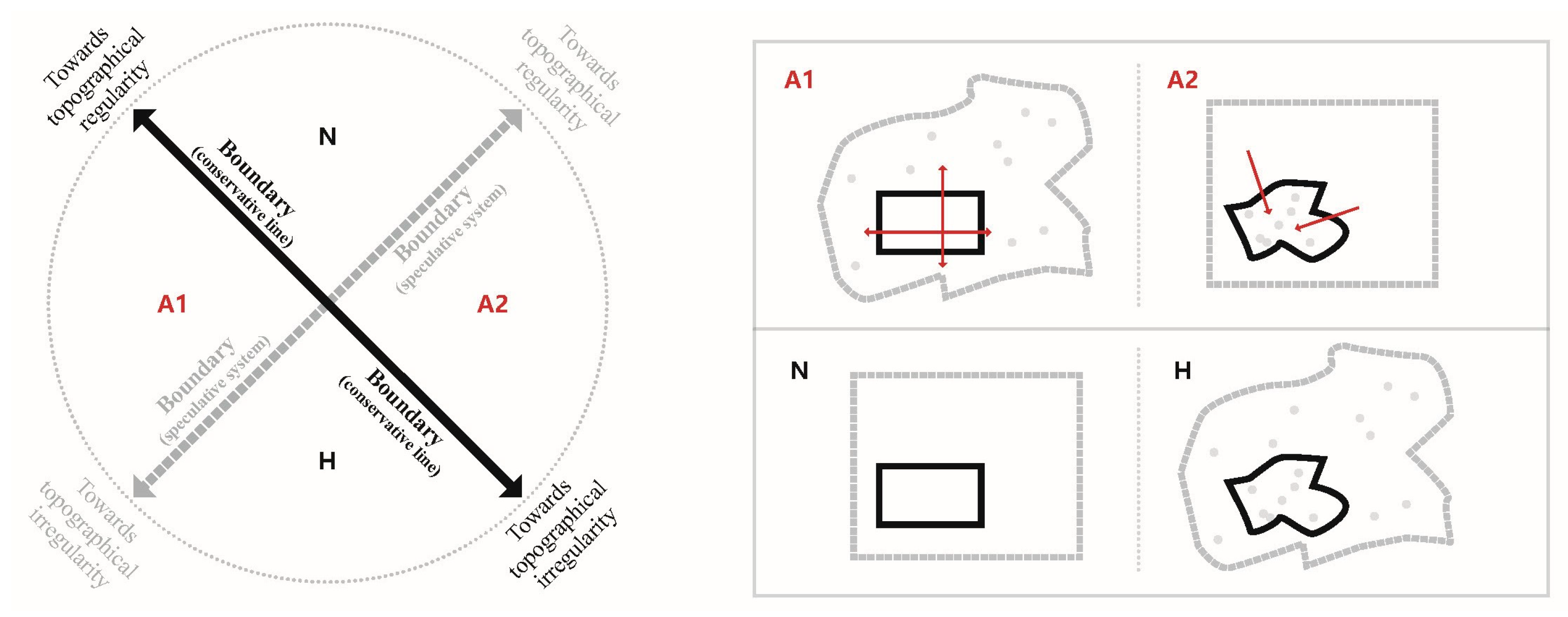
Composition-oriented campus planning thus entails a continuous negotiation between the axial system (aspiring to rule-based regularity) and the site (occupying an irregular reality). This tension can be schematized into an analytical model comprising two site types and four quadrants (Figure 1).
The model posits the following hypothetical relationships:
Quadrant A1 assumes that sites defined by a conservative boundary exhibit clearer topographical regularity than those with a speculative boundary. The axial conception here tends toward outward expansion of compositional order from a smaller to a larger domain.
Quadrant A2 assumes the inverse: sites defined by a speculative boundary exhibit clearer topographical regularity than those confined to conservative limits. The axial conception here tends toward an inward anchoring of compositional order from a larger to a smaller domain.
In practice, A1 and A2 are rarely absolute. Both belong to the first site type, characterized by the predominance of autonomous Beaux-Arts logic. When functional parameters such as efficiency or cost conflict with formal ideals, architectural discourse can robustly defend the latter.
Quadrant H represents a fundamentally different condition: sites where neither boundary yields discernible regularity nor where the potential elements of regularity are so diverse and competing that the site resists synthesis. Here, the heteronomous character of the site prevails. When concessions in efficiency or cost cannot secure compositional unity, the legitimacy of the latter is itself questioned, impeding realization or altering the logic of the compositional form.
Quadrant N represents a hypothetical extreme of H, a condition under which boundaries approach infinity, subsuming all irregularities into a neutral regularity: a featureless plane devoid of variation or memory. This scenario has no analog in practice.
The case studies correspond to the two site types outlined above. Section 5 addresses projects (Nankai and Northeastern) whose primary challenge lay in negotiating boundary conditions—falling within the first site type (Quadrants A1/A2). Section 6 addresses projects (Tsinghua and National Central University) whose primary challenge lay in engaging with topography—exemplifying the second site type (Quadrant H). This analytical framework, grounded in the theoretical discussion of Section 4, provides a consistent lens for comparative analysis across the four cases.

4. The Application of Composition Theory in American University-Campus-Planning Practice and KCY Architects’ American Educational Background

4.1. The Integration of Composition Theory and American Campus Planning

From the late 18th to the 19th century, composition developed as the core concept of the French Beaux-Arts system, which was systematized by Julien Guadet in Éléments et Théorie de L’Architecture.
From the late 19th century, as the Beaux-Arts system was introduced to the U.S., its methods and philosophy became largely equated with architecture itself. By the early 20th century, nearly all young American architects were trained in it ([7], p. 5). Composition emerged as key design terminology in the U.S. around 1900 ([7], p. 58), constituting architects’ core professional knowledge.
Concurrently, American universities reformed and expanded. Facing a need to expand campuses, clients sought professional architects who could apply new methodological tools, aiming to avoid chaos and establish inspiring master plans.
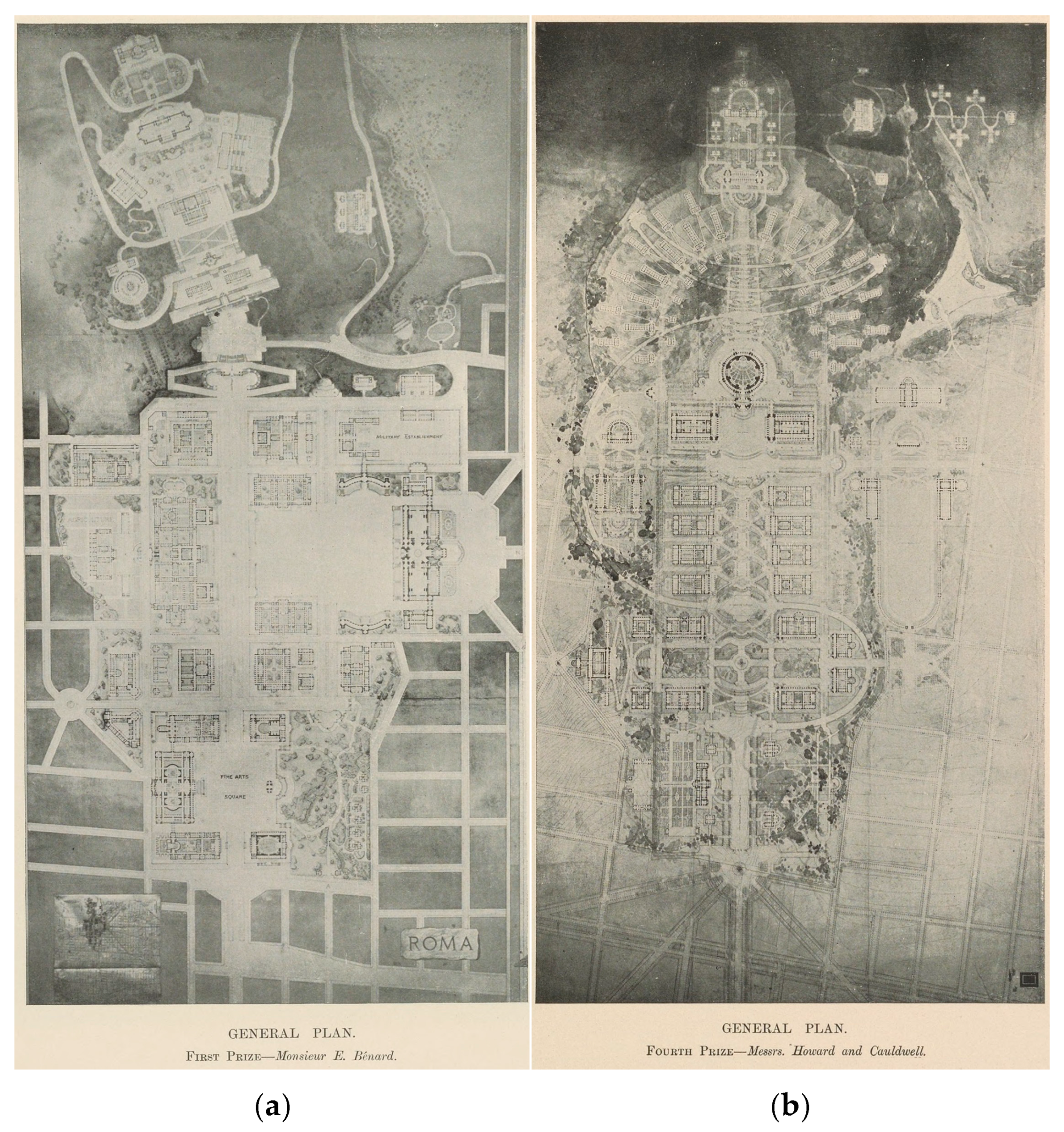
Composition theory, which was then being localized in America, was widely applied campus planning. A pivotal event in its adoption was the 1895–1899 international competition to plan the University of California, Berkeley, campus.
The competition entries were strongly Beaux-Arts oriented. Berkeley’s Bernard Maybeck spent two years in Europe and involved Guadet in drafting the program ([42], p. 29); ([79], p. 42). The program redefined the “University (The “program” for this competition, accompanied by a topographic map of the campus site, was distributed in 24 countries and regions worldwide in English, French, and German, including to the Ministry of Foreign Affairs in Peking, China.)” as follows:
“By ‘university’ is meant the collection of all the buildings necessary for the teaching of higher branches of learning. Each department of instruction will have, …… its own building or buildings. …… include provision for the residence of the students. Important divisions for the common use and service are to be provided. Provision for free access and easy communication, both open and covered, …… is an essential part of the Programme. …… the general arrangement should assume an imposing aspect, of a serious and noble character, that will at the same time harmonize with the picturesque nature of the grounds, their situation and topography” ([80], p. 15).
The results confirmed the importance of composition: all shortlisted architects had Beaux-Arts backgrounds, including the winner Emile Bénard and the ultimately appointed John Galen Howard ([8], p. 197). The Berkeley competition established a paradigm through which composition theory became a professional standard in American campus planning (Figure 2).
The broader context was the City Beautiful Movement, inspired by the 1893 Chicago World’s Fair’s “White City” and Daniel Burnham’s “make no little plans” ethos, which motivated university clients to commission grand master plans ([82], pp. 53–59). The Competition of Berkeley Board of Regents member Jacob Reinstein stated his hope that the campus “shall rival the dreams of the builders of the Columbian Exposition” (Originally published in a periodical on 23 December 1895; specific publication details require further verification. Cited secondarily from the work of Loren W. Partridge) ([83], p. 11).
Thus, composition theory found fertile ground in American campus planning from the late 19th to early 20th centuries, ultimately giving rise to a new planning model centered on spatial unity.

4.2. “Campus” as an “Element of Composition”

Within the framework of compositional unity, campus components (rooms, corridors, halls, courtyards, etc.) were classified into hierarchical, combinable planar “elements of composition”. Work began by identifying the principal element based on the program’s core purpose, establishing a functional hierarchy. The architect then organized all elements into a unified whole. As Guadet stated, “There is always something that dominates whose dimensions must surpass all others. …… Then something that may appear as a type of average dimension, then something smaller than the rest. …… properly perceived this hierarchy of proportions, …… will prevent compositions from being unstudyable, if not truly successful” ([70], V1, p. 141).
Guadet categorized elements into “surfaces utiles” (specific-use rooms/spaces), “communications nécessaires” (service corridors, stairs), and “surfaces neutres,” referring to spaces with “circulations” of both use and movement, which he called “the very soul of the composition” (l’âme même de la composition) ([70], V1, p. 117; V4, p. 199).
Composition did not demand overall symmetry but unity based on the symmetry of each local element (each enclosed space or “pièce”). As Lucan put it, symmetry was “local,” not “global” ([8], p. 17). This logic was embodied by the practice of starting with axes, which controlled local symmetry and organized global relations. As Guadet explicitly pointed out, “The axis is the key to drawing and the key to composition. …… in an architectural drawing, one must first proceed by means of axes”, and “symmetry is an obvious regularity, a regularity of wisdom” ([70], V1, pp. 40, 128).
In American university projects, as institutions could no long be contained in a single building, daily movement between labs, libraries, and dorms—much of it outdoors—constituted intellectual activity. These outdoor spaces became “surfaces neutres”.
Thus, in campus composition, the core “elements” were often not the specific buildings but the outdoor spaces they defined and enclosed—a series of enclosed space (pieces) recognized as the “campus”. As John Galen Howard noted regarding Berkeley, “It should not, then, be considered in itself a change of parti if the Library for example be moved from the western to the eastern side of a square, or the Mining Building from the southwest corner to the northeast corner of the plan. …… a mere shuffie of the buildings among themselves cannot justly be considered a material change. …… As long as is preserved the fundamental idea of great composition, ……so long the integrity of the plan will be maintained, however its details may change.” ([84], p. 276).
The scale and organization of the “campus” as an element varied. However, the site’s “urban/rural” character universally influenced the campus and its hierarchy. Following French theory, American practice distinguished sites: in the city, they were restricted and closed; in the countryside, they were free and spacious ([70], V1, p. 95). Sites were categorized as having an “exterior silhouette” (rural, prioritizing comfort) or being “enclosed between given lines” (urban, prioritizing economy) ([71], p. 190).
This dichotomy aligned with the functional principle of “air and light”. Rural/unclosed sites required open plans with courts and open spaces to maximize sunlight and air ([71], p. 201); ([72], p. 142).
Consequently, open-scaled, often symmetrically arranged “campus” spaces with solid or void interfaces became a common formal feature.

4.3. KCY’s American Educational Heritage and Its Major Campus Projects in China

The movement to study overseas in the United States stands as the most influential and successful chapter in twentieth-century Chinese educational history [85]. In the early 1900s, Chinese students pursued American education through two primary pathways. The first and more common path was to receive Boxer Indemnity funding. These scholars were predominantly from Tsinghua College, although there was a smaller number of “special students” who were not enrolled at Tsinghua. The second means of accessing American education was self-financing; this group comprised students who had previously studied at American-founded Christian colleges in China and young Chinese students who were born or raised in the United States.
KCY’s three partners belonged to the first group: all were Tsinghua-selected Boxer Indemnity scholars who subsequently received architectural training in America. Statistics indicate that by 1936, Tsinghua had sent no fewer than 1378 government-funded students to the United States. Among those who returned, approximately one-third pursued careers in various industrial sectors [85]. This cohort included a small but professionally significant group of architecture students. Documentary evidence confirms that by the mid-1930s, at least 42 Chinese nationals—including both Boxer Indemnity scholars and self-financed students—had studied architecture in America and subsequently engaged in architectural practice or related educational work upon returning to China. Of these, nearly 80 percent were Tsinghua alumni.
Wilma Fairbank observed that “At the time, the place to study architecture in the world was Paris. But these people [the Chinese students] were getting Boxer Indemnity grants to study in America. And so, if you wanted to study architecture, the thing to do [was] go to the place where there is the most distinguished French architect that would be able to give you a Beaux-Arts angle on things.” ([45], p. 197).
Examination of the institutional affiliations of these 43 architects confirms this pattern: over 80 percent attended East Coast universities with strong Beaux-Arts lineages—the University of Pennsylvania (thirteen), MIT (six, plus one who received professional training), Cornell (two), Columbia (two, plus three who received professional training or studied in related fields)—or Midwestern institutions such as the University of Minnesota (two). Among the remaining institutions, some—such as the University of Michigan (five) in the Midwest—also possessed diverse architectural educational traditions that included Beaux-Arts components (Appendix A, Table A1).
From the late nineteenth century to the mid-1920s, the typical American Beaux-Arts educational model paired an American department chair with a French-trained specialist responsible for the core curriculum. Both MIT and the University of Pennsylvania employed this model ([86], p. 92).
KCY’s three partners received their architectural training within this broader context of systematic Sino-American educational exchange and the institutionalization of Beaux-Arts pedagogy in the United States. Their alma maters, MIT (S. S. Kwan) and the University of Pennsylvania (Chu Bin and Yang Tingbao), were deeply influenced by the Beaux-Arts system (Kwan Sung Sing studied in the Department of Architecture at MIT from 1914 to 1917, earning a Bachelor’s degree. Chu Bin and Yang Tingbao studied in the Department of Architecture at the University of Pennsylvania from 1918 to 1922 and 1921–1925, respectively, both earning Master’s degrees).
MIT hired French architect Constant Désiré Despradelle in 1893 to establish Beaux-Arts teaching. He was a Berkeley competition prize-winner and briefly on its board, and he later drafted plans for MIT’s new site ([43], pp. 27–34). William Welles Bosworth, the architect of MIT’s final plan, was a Beaux-Arts-trained MIT alumnus and former Pan-American Exhibition resident architect ([43], pp. 60–61). Evidence suggests that Kwan later interned with Charles Allerton Coolidge, the consulting architect for the Rockefeller-funded Peking Union Medical College ([87,88], pp. 29–30).
From 1903, Penn was a Beaux-Arts stronghold under Paul Philippe Cret, who taught Yang Tingbao and mentored him as an intern ([89], pp. 72–77). Cret stated that America sought “composition and design” from France [90].
S. S. Kwan returned to Tientsin in 1919 and founded “S.S.KWAN & Co. Architects & Engineers” in 1920. Chu and Yang joined as partners in 1924 and 1927, respectively, and the firm was renamed to “KWAN, CHU & YANG. Architects & Engineers”. A division of labor emerged: Kwan handled client relations, Chu finances, and Yang design ([10], pp. 67–68).
Historical records confirm KCY’s involvement in at least six major campus projects from 1920 to 1937, including planning for national institutions like Northeastern, Tsinghua, Central, and Sichuan Universities. A less-noted early project was Nankai University (1922), a private institution and KCY’s first university commission during Kwan’s solo practice. KCY was also responsible for the 1930 Tangshan Campus of National Jiaotong University, though these drawings are missing.
Influenced by American Beaux-Arts education and campus-planning trends, KCY architects naturally regarded the spatial unity of “composition” as a paramount value in Chinese campus design.

4.4. Results

This section established (1) the historical context of Beaux-Arts composition theory’s application in American campus planning since the late 19th century, (2) the educational link connecting this American model to KCY’s Chinese architects, and (3) a list of KCY’s major Chinese campus projects (1920–1937).
The Berkeley competition redefined the university program type. For architects defaulting to “composition” as “design”, the core objective became achieving spatial unity by transforming programmatic content into campus-shaped elements of composition organized via a hierarchy of proportions. This model was adopted by KCY’s U.S.-trained architects in China.
Importantly, achieving good composition was not a purely formal exercise involving complex, site-specific features. The core challenge was that campus elements required rule-based, symmetrical order, while real sites often contained random irregularities.
Thus, composition theory provided principles and goals, but when faced with site realities conflicting with the ideal, the architects had to skillfully transform opposition into new unity or make local sacrifices for overall balance. This background is crucial for analyzing KCY’s project-specific strategies.

5. The Interaction Between Composition and Boundary: KCY’s Nankai and Northeastern University Plans

5.1. The Antagonism of “Composition” and “Boundary”

“Site” encompasses a dialectical concept: it is both a specific physical locale defined by clear boundaries and a system that extends into and connects with a broader context ([91], pp. 3–5). However, within the historical context of modern China, the boundaries for university campus planning were often not a stable, predetermined given but a variable fraught with uncertainty. This uncertainty constituted the primary challenge for compositional practice. The ambiguity was twofold: positively, siting campuses on the rural outskirts of cities held the theoretical potential for future expansion; negatively, even planned land acquisitions were perpetually at risk of falling through.
Therefore, how a university defined its site boundary constituted a fundamental dilemma in achieving compositional spatial unity: within what definitive, enclosed area should the architect organize the compositional elements and their hierarchy? This question of scale and definition was the foundational premise upon which spatial unity depended.
KCY’s two early university projects—Nankai and Northeastern Universities—demonstrate how the organization of compositional form was profoundly shaped by an active engagement with the specific characteristics of the site boundary.

5.2. Nankai University Campus Plan

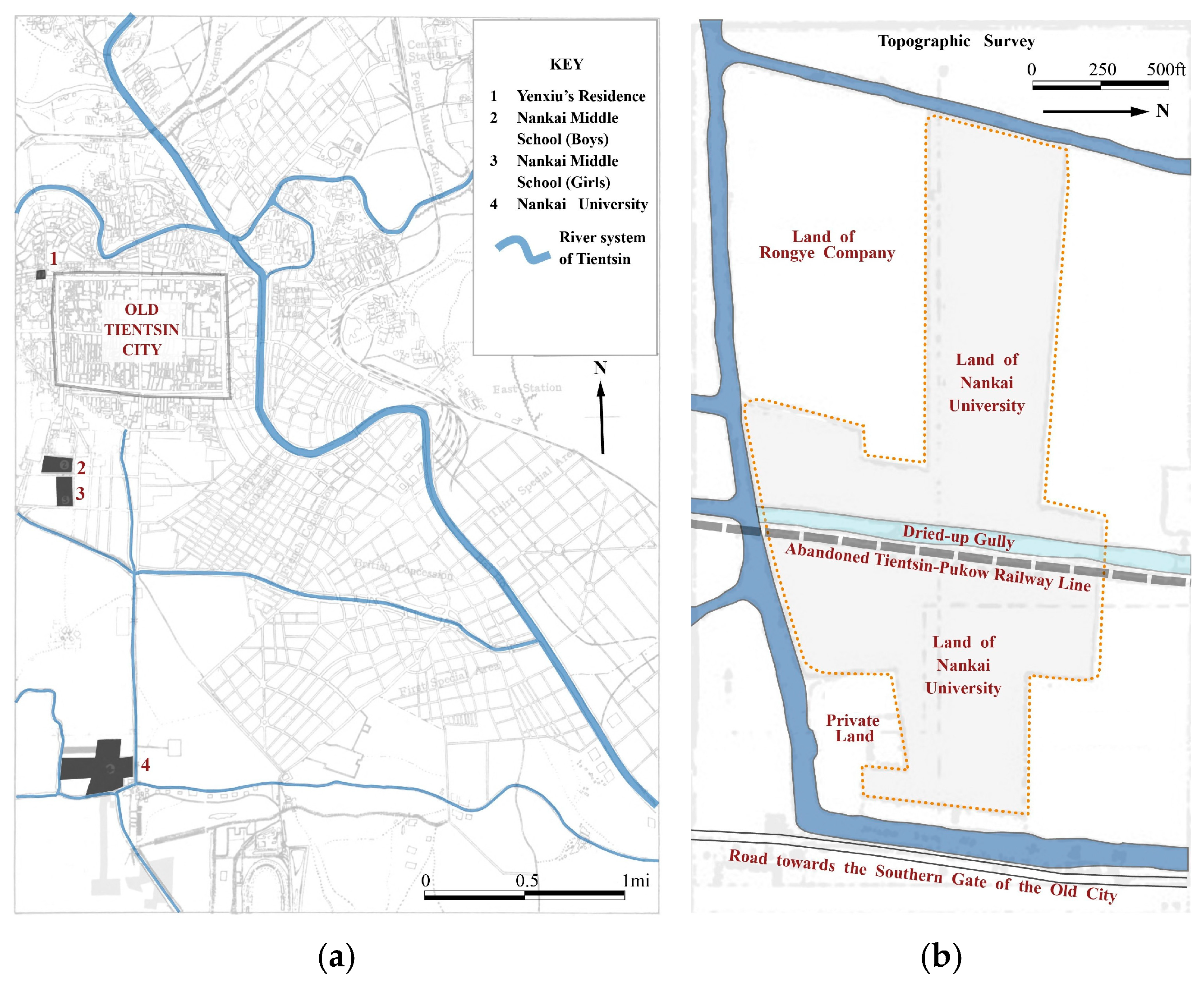
Founded in 1919, Nankai University initially occupied a single building adjacent to its middle school. By 1920–1921, having been unable to expand nearby, the university acquired a new site of approximately 270 mu north of Balitai village in Tientsin’s southern suburbs. Crucially, the site’s boundaries were not only irregular but also uncertain: its southwestern and southeastern edges bordered plots slated for future purchase—a 160 mu parcel owned by the Rongye Company and a 30 mu private holding—whose acquisition was far from guaranteed ([60], V1, pp. 157–159). The acquired land itself formed an irregular cruciform shape traversed by a north–south ditch and bounded by small streams, described as “surrounded by watery wasteland” (Figure 3).
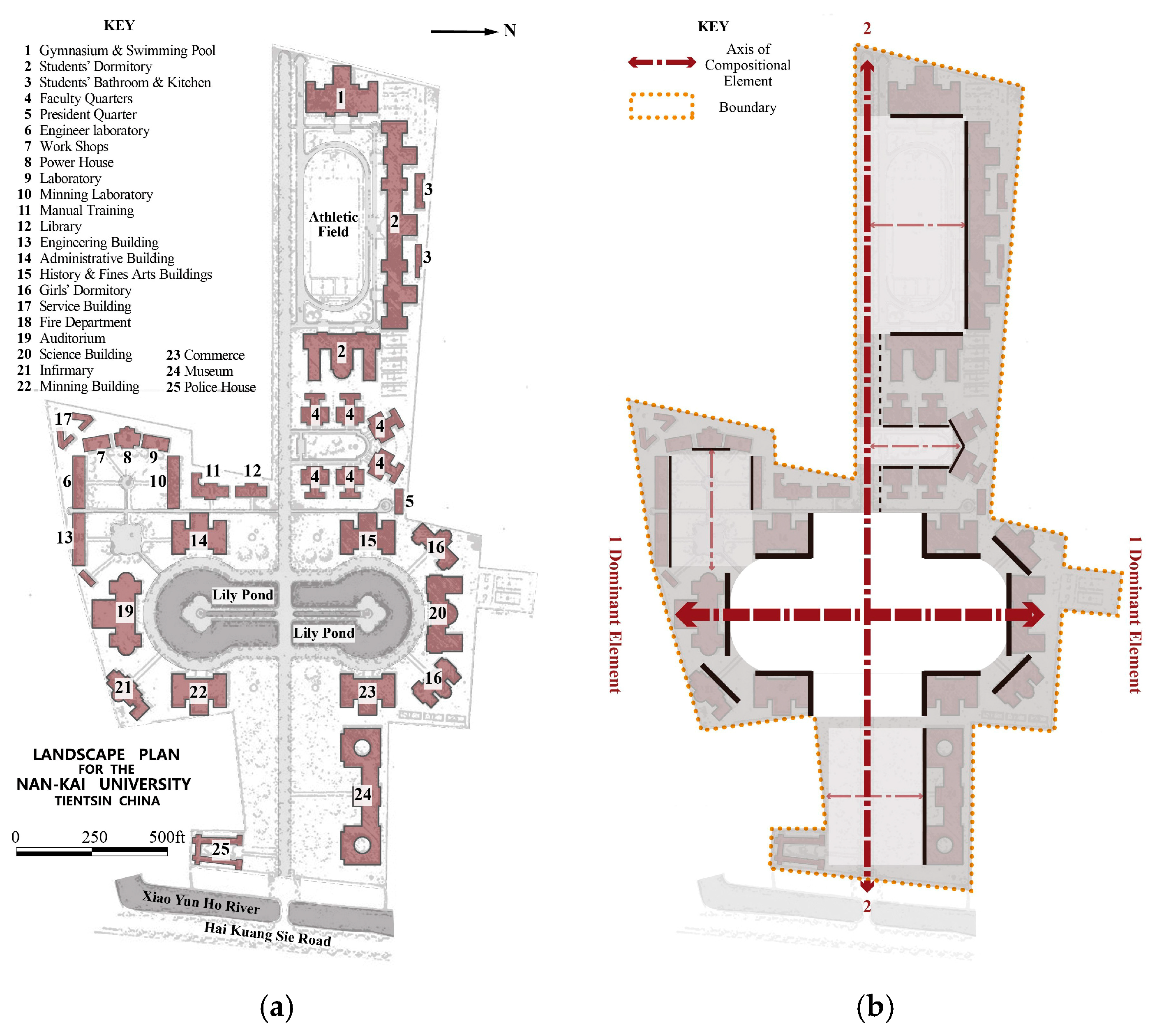
S. S. Kwan secured the commission through his Tsinghua network and completed the site survey and master plan between April and May 1922. His core strategy was pragmatic: he organized the composition strictly within the irregular, legally controlled boundary. Following the cruciform contour of the plot, he arranged buildings along the edges to enclose “campus” spaces of differing hierarchies. The relatively regular, concentrated north–south arm of the cross was established as the dominant element, housing the main teaching buildings. The east–west arm became a secondary axis, accommodating dormitories and sports fields to the west, with the main entrance connecting to the city road at the eastern terminus. Thus, the site boundary constraint was transformed into the direct generator of the compositional form.
To maximize the spatial scale of this dominant north–south element, the architect made deliberate trade-offs and formal compromises. This resulted in an exceptionally compact layout for the core teaching precinct, with the girls’ dormitory and infirmary squeezed into a 45-degree corner. Furthermore, the western section of the secondary east–west axis did not have a symmetrically enclosed interface due to the boundary limitations (Figure 4).
Clearly, incorporating the future adjacent land would have allowed for a better composition. However, faced with the uncertainty of land acquisition, both the university administration and the architect opted for a conservative, pragmatic strategy to design the campus based solely on the existing, irregular, controlled boundary. History later confirmed the prudence of this approach. The private southeastern plot was not acquired until 1930, and the southwestern Rongye Company land was not incorporated into the campus before its wartime relocation.
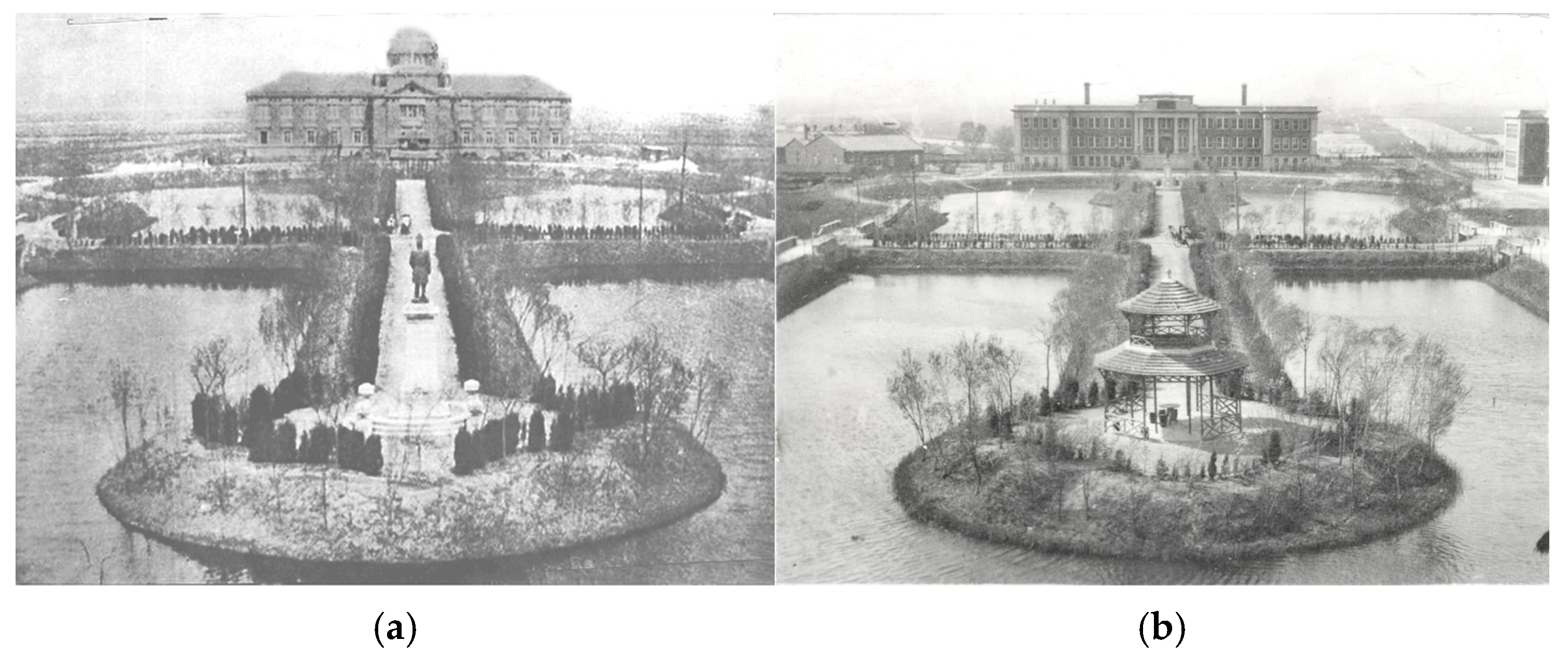
Despite the boundary constraints, Kwan sought to enhance the grandeur of the composition within the dominant area of the north–south axis through landscape intervention. He widened the existing ditch, transforming it into a series of north–south-oriented symmetrical, canal-linked ponds. This ‘canal-pond’ motif—a classic vocabulary for grand composition—had Western antecedents in seventeenth- to nineteenth-century French formal gardens and found widespread use in late nineteenth-century American expositions and civic centers. Given that Kwan studied at MIT while his alumnus, William Welles Bosworth (a former resident architect for the Pan-American Exposition), was formulating plans for the institute’s new campus, it is highly probable that Kwan drew inspiration from this source (Figure 5).
Simultaneously, this design inadvertently achieved a form of cultural translation. In the Chinese tradition, formal water features like the “Pan Pool” (panchi) were emblematic of classical imperial academies (Piyong, Pangong). Thus, this Western compositional device unintentionally resonated with the imagery of China’s ancient “Da Xue (Great Learning)” institution, embedding a Beaux-Arts landscape vocabulary within a site whose historical associations subtly inflected its meaning.
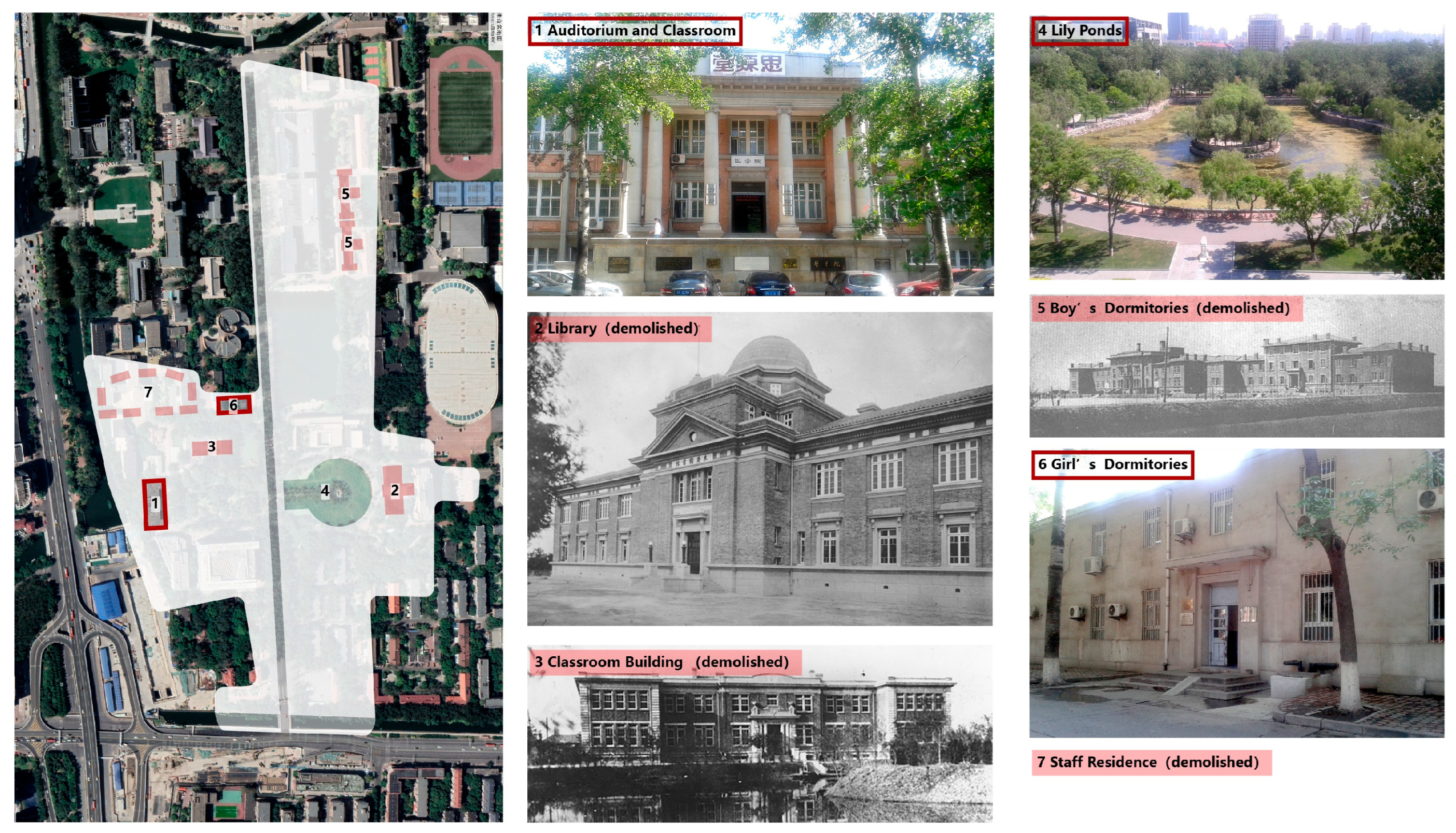
Ultimately, funding constraints limited the project’s realization: by 1937, only three of the ten buildings planned for the north–south axis had been constructed (Figure 6). Yet the Nankai plan’s significance lies less in its partial execution than in its demonstration of how composition theory could—through pragmatic adaptation to boundary uncertainty—generate coherent order from irregular conditions while simultaneously negotiating between Western methodological inheritance and local cultural resonance.

5.3. Northeast University Campus Plan

Between 1928 and 1929, following Zhang Xueliang’s ascent to leadership in China’s Northeast and his appointment as president of Northeastern University, KCY secured its second major campus-planning commission.
Northeastern University had been founded in 1923 under Wang Yongjiang, who acquired over 500 mu near the Qing Zhaoling Mausoleum north of Shenyang for its science, engineering, and agriculture colleges. An Austrian architect, Rolf Geyling, had already designed a main teaching building on the site. When Zhang Xueliang assumed leadership of Northeast and became university president in 1928, he donated personal funds to consolidate the arts and law colleges—then housed in the old city—with the sciences at the Zhaoling site, commissioning KCY (which by then included partners Chu Bin and Yang Tingbao) for a unified master plan.
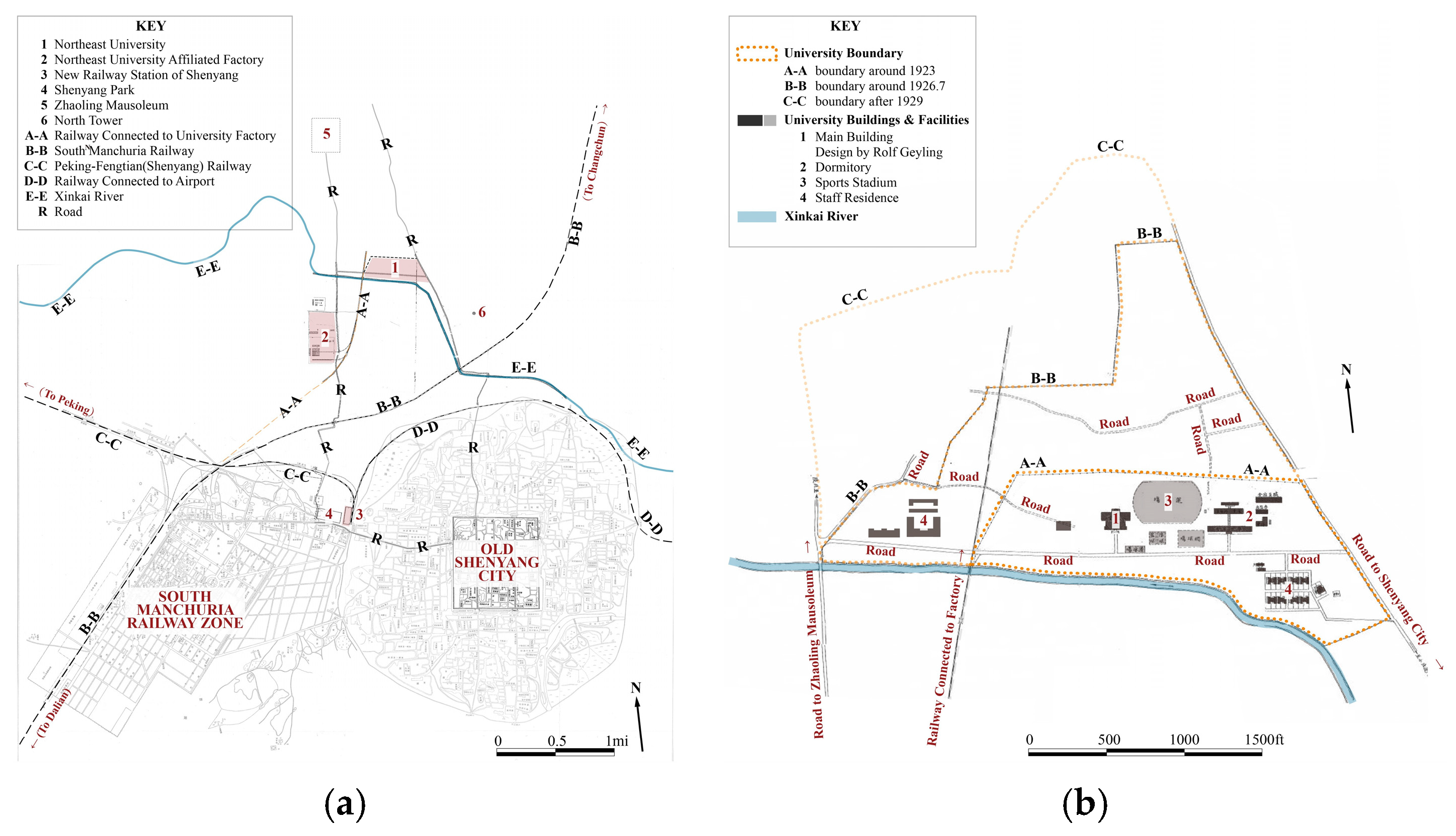
When KCY began its work, the campus already had a basic framework: a central main teaching building was flanked by student dormitories to the east and west, with faculty villas to the east, laboratories to the north of the main building, and a sports field at the northeastern corner. These existing facilities were arranged roughly linearly along the east–west-oriented southern boundary (the Xinkai River). Under Wang Yongjiang, the campus land had been extended northward, forming a near-triangular outline: the eastern boundary was defined by a northwest–southeast road, the western boundary abutted the grounds of the Zhaoling Mausoleum, and the two converged in the north.
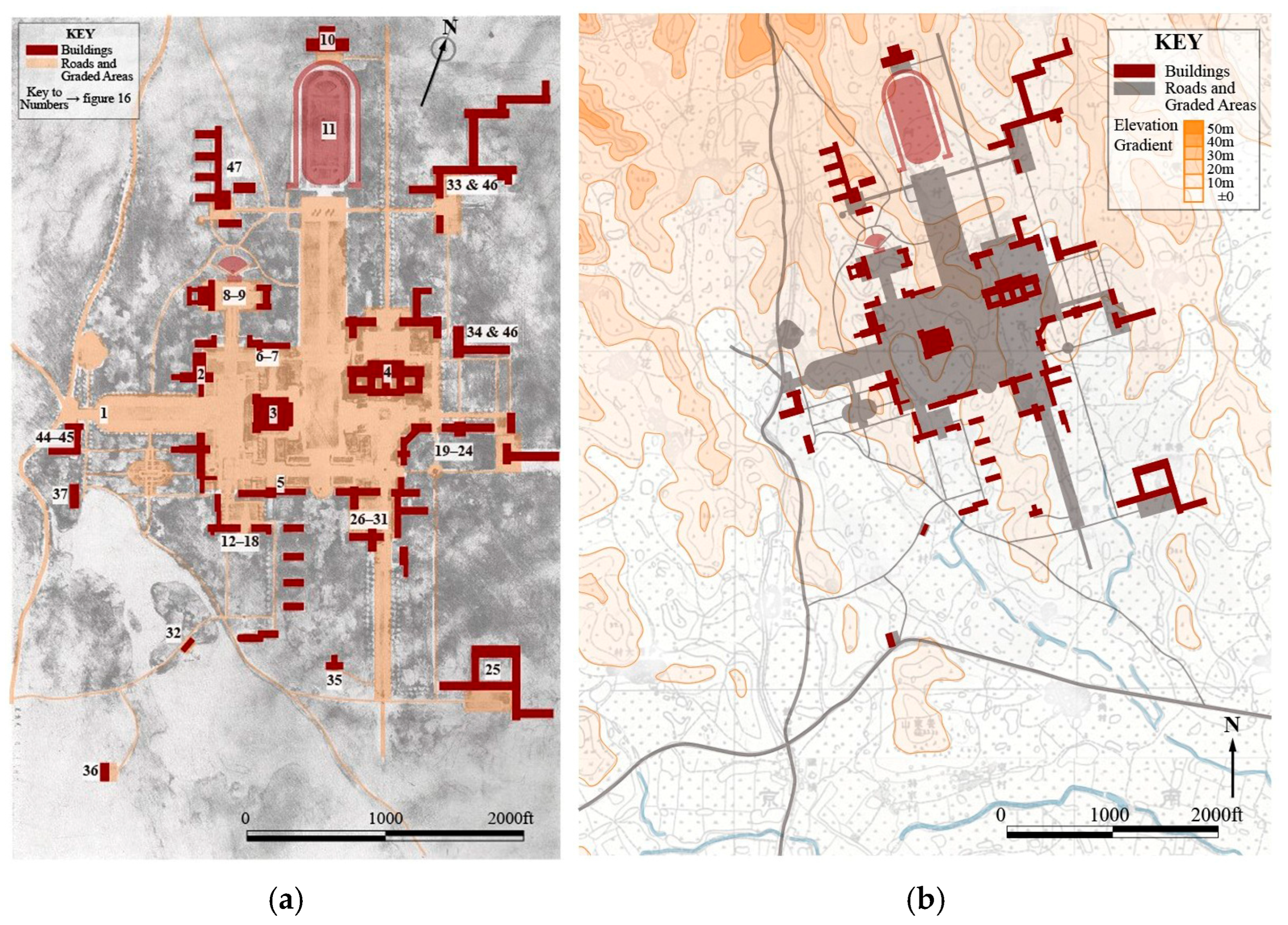
Within the site and slightly to the west was a north–south railway line, which connected at its southern end to a university-run factory area. Of greater significance for the plan was the new Shenyang station for the Jingfeng Railway, which was designed concurrently by KCY. Situated west of the old city wall, its location happened to fall precisely on the southward visual axis projected from the campus. This presented the architects with a remarkable opportunity to integrate a major urban transportation hub as a grand visual terminus for the campus’s central axis (Figure 7).
With the Northeastern University project, KCY continued the principle of maximizing enclosed space by fully utilizing the actual site boundaries. However, unlike the compromises necessitated by Nankai’s cramped conditions, the more ample and regularly shaped triangular plot at Northeastern allowed the architects to implement this principle more logically and completely.
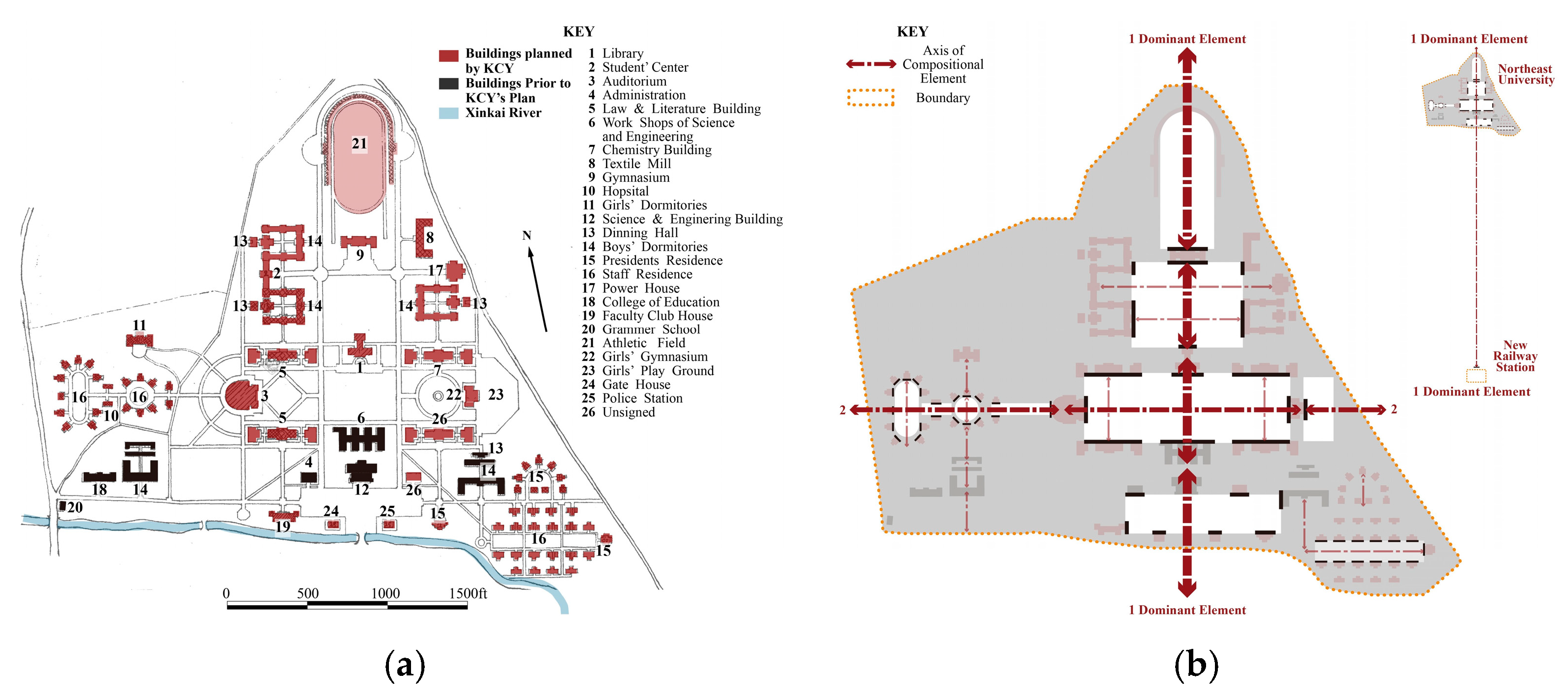
Benefiting from the generous, geometrically defined site, the architects employed a classic “T”-shaped axial structure, using the triangle’s base as the east–west cross-axis and a northward line from its midpoint as the primary north–south axis. This clear geometric framework immediately established the campus’s dominant spatial element. The ample space permitted building masses to be laid out without crowding and congestion, and each “campus” space along the “T”-shaped axes could be symmetrically enclosed by architectural facades.
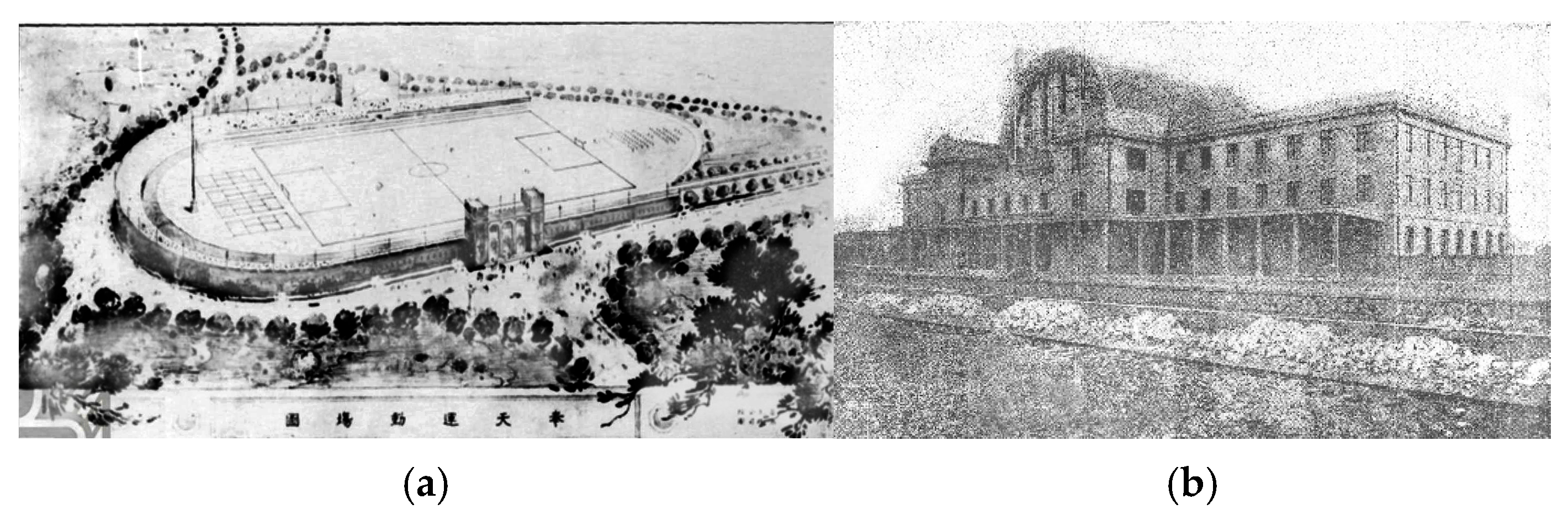
The elements of composition along the north–south axis were organized into a rich spatial sequence. From south to north, it connected four distinct “campus” spaces of varying depth and width, extending (1) from the Main Gate to the existing Main Teaching Building; (2) from the existing Engineering Laboratories to the proposed Library; (3) from the Library to the Gymnasium; and (4) terminating at the University Sports Field. Placing the sports field at the end of the central axis not only efficiently utilized the tapered northern tip of the site and linked conveniently to nearby dormitories but also reflected a contemporary ethos among Chinese elites that linked physical vigor to national strength—Zhang Xueliang himself was a strong proponent of athletics, emphasizing that “a nation’s prosperity depends not only on vast territory and abundant resources, but also on the robust health and spirit of its people” ([63], pp. 309–311). He planned to host the 1929 North China Athletic Meet at the university’s stadium.
By incorporating the distant railway station as visual terminus—extending the main axis southward beyond the site’s physical limits—KCY transformed the campus boundary from a line of legal control to a field of visual influence. This design bridged the two sub-classifications in the analytical framework (Figure 1) grounded in the boundary characteristics of Quadrants A1 and A2.
The east–west cross-axis defined another major compositional element: a large teaching precinct enclosed primarily by the Auditorium, Library, and various departmental buildings. This was the largest single enclosed space on campus, with its eastern and western edges conveniently defined by the site’s boundary road and the right of way of the former factory railway line (which no longer crosses the campus), respectively. The area west of the Auditorium was developed with faculty villas, forming a secondary “campus” that extended the horizontal axis (Figure 8 and Figure 9).
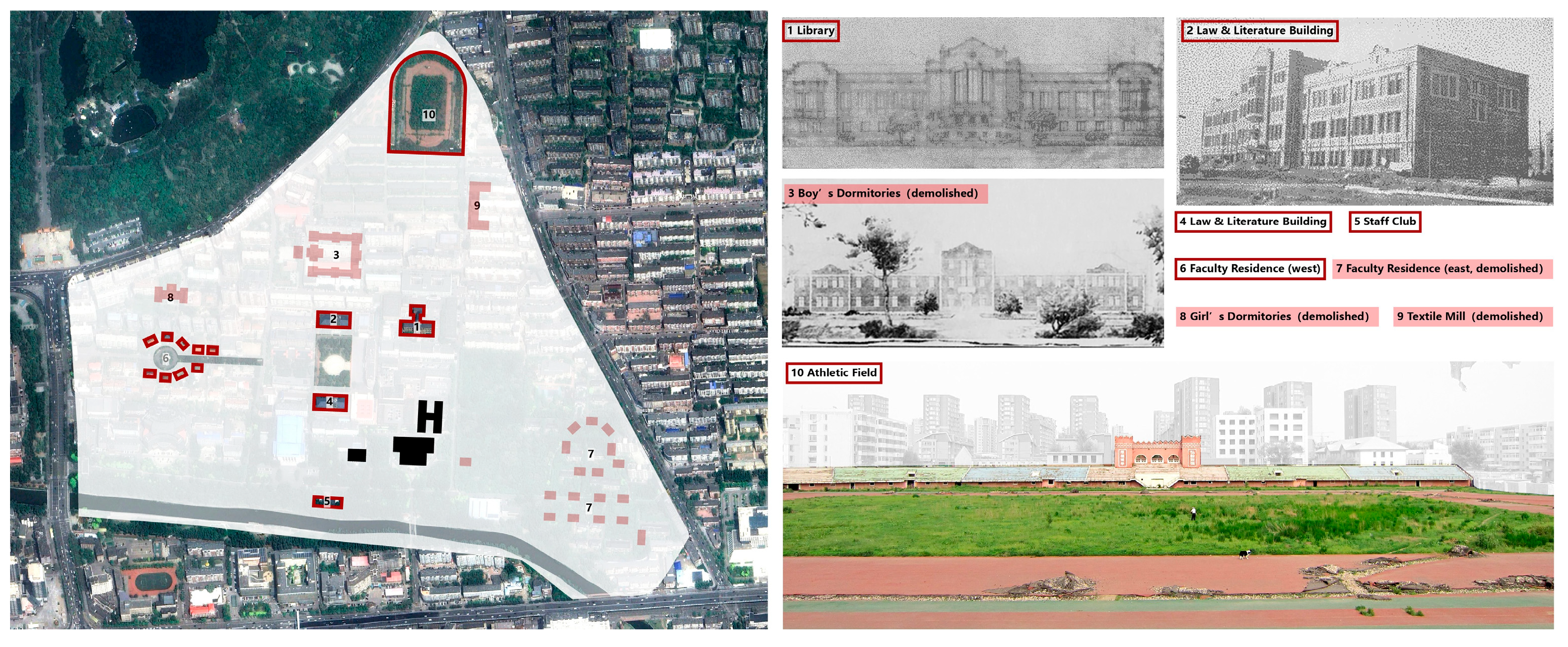
The Mukden Incident of 18 September 1931, cut short the implementation of the pln. By then, only the Library, Arts and Law College, and sports field had been completed (Figure 10). However, like Nankai, the Northeastern plan’s significance transcends its fragmentary realization: it demonstrates the composition’s capacity to not only organize a bounded territory but also project order beyond visible limits, transforming the campus from a self-contained precinct into a node within an extended visual field.

5.4. Results

In summary, KCY’s early campus plans for both Nankai and Northeastern Universities demonstrate a consistent pursuit of compositional spatial unity. The principal challenge in achieving this goal stemmed directly from the uncertainty or peculiar outline of the site boundaries.
In the Nankai case, confronted with an irregular, controlled boundary and conservative expansion prospects, the architects’ strategy involved sacrificing the symmetry of secondary “campus” spaces and compressing the spacing of peripheral buildings to prioritize maximizing spatial scale for the dominant element.
At Northeastern University, more regular and generous boundary conditions allowed for a more symmetrical organization of compositional elements. More significantly, the architects skillfully incorporated the Jingfeng Railway Shenyang Station—which was designed by KCY and located three kilometers away—as the visual terminus of the campus’s main axis. This move creatively established an extended, non-physical visual and cultural “boundary” beyond the site’s tangible limits, tightly integrating the campus with its broader northern suburban context. This extension from a “physical boundary” to a “visual axis” reflects an evolution in compositional thinking from mere “physical delimitation” to “visual control”.
Furthermore, both schemes employed a radial, star-shaped road network. This strategy effectively linked the dominant element at the core with secondary elements scattered across fragmented plots along the periphery, thereby minimizing unused or residual land.
It must be noted, however, that both the Nankai and Northeastern sites featured relatively flat and regular topography, which did not pose a significant challenge to the compositional scheme. This challenge emerged in subsequent projects for Tsinghua University and National Central University, where complex terrain was the central obstacle.

6. The Interaction Between Composition and Topography: KCY’s Tsinghua and National Central University Plans

6.1. The Antagonism of “Composition” and “Topography”

The regular forms desired for compositional “campus” elements typically presuppose open, level terrain. Real sites, however, are imbued with randomness: irregular slopes, natural vegetation, water bodies, and existing structures or pathways. All construction necessarily begins with the fundamental act of leveling land and creating platforms, yet this process transcends mere questions of earthwork economics or landscape aesthetics: it touches upon the deeper cultural significance of “building” as a human act ([65], pp. 114–115).
Consequently, campus-planning composition is primarily concerned with seeking a balance between a regular, conceived order and the inherent irregularity of the land. This balance is governed by two principles: first, the willingness to transform the terrain at considerable cost to achieve a clear compositional ideal; second, the recognition that the compositional ideal itself should, ideally, derive from and honor the overall character of the topography.
The first principle is illustrated in the Columbia University project, where Charles Follen McKim argued in correspondence with F. L. Olmsted that the “method of getting at the merits of each composition by arithmetic is just a little ludicrous, …… in order to accomplish a distinct purpose, you would have immediately rejected any plan which might have been presented at less cost as unwisely economical if it failed to accomplish this.” ([44], p. 39).
The second principle was demonstrated in the Berkeley competition, where an important factor in the ultimate rejection of the winning scheme by Emile Bénard was its failure to align with the site’s natural visual axis from the hills to the bay, just as president Wheeler wrote to the patron, “The more I study the plan of Mr. Bénard…… the more certain I am that……I do not think it is right we should undertake a plan which would involve five to ten million dollars of expenditure for grading. …… The most serious oversight involved in it, …… seems to me to be this: the main axis of the plan steers for University Avenue instead of for the Golden Gate, …… a line drawn from the Golden Gate to the top of the hill…… If this axis were used the amount of grading would be reduced to a minimum.” ([42], p. 48).
These American precedents establish that resolving the conflict between composition and topography hinges on finding an equilibrium between “transforming the terrain to a preconceived ideal” and “adapting the composition to resonate with the site’s inherent features”. This was the core design challenge KCY faced in its later projects for Tsinghua and National Central Universities.

6.2. Tsinghua University Campus Plan

Tsinghua University presented a unique historical and topographic context. Established between 1909 and 1911 as a preparatory college for U.S.-bound students, its campus was located in Peking’s northwestern suburbs—the very alma mater of KCY’s three partners. An early master plan had been drafted by American architect Henry Murphy in 1914, but its systematic implementation stalled after its champion, President Chou Yi Chun, left his post in 1918. Subsequent development proceeded in a piecemeal fashion, with gaps filled without an overarching vision.
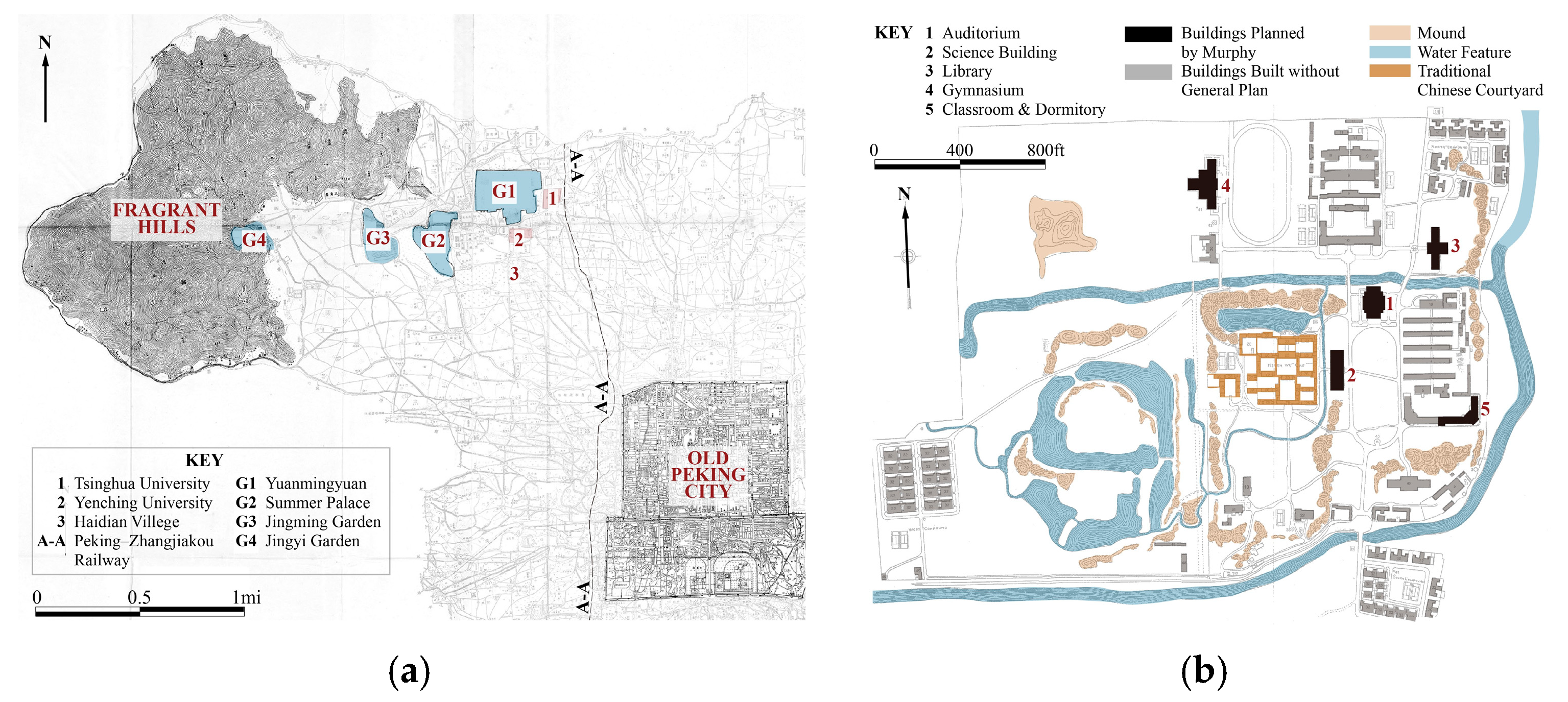
The site itself was situated on the grounds of the former Qing dynasty imperial garden, Xi Chun Yuan, which, by the 20th century, carried over two centuries of historical memory (During the Kangxi reign (1662–1722), the status of Xi Chun Yuan surpassed that of the Yuanming Yuan. The garden was bestowed upon Kangxi’s third son, Yunzhi (Yun Zhi). Emperor Kangxi visited the garden ten times historically, celebrated his birthday there eight times, and personally inscribed its plaque). Originally part of the expansive “The Three Mountains and Five Gardens” landscape in the western suburbs of Peking, it was formally divided in the 1820s into an eastern section (“Tsinghua Yuan”) and a western section (“Jin Chun Yuan”) [92]. When the preparatory college was built on the eastern section in the early 1900s, the garden landscape had been fallow for over a decade. Murphy’s plan had proposed unified development for both sections—the preparatory college in the east and a future university in the west—but construction was concentrated in the east, driven more by immediate necessity than compositional coherence. During this period, the university also cultivated a tradition of poetic inscription of identifying the “Eight Views of Tsinghua,” half of which drew directly on the rustic scenery of the western Jin Chun Yuan ruins [15], thereby intertwining the memory of the historical landscape with the institution’s emerging identity (Figure 11).
A turning point came in 1928 with the establishment of the Nanking Nationalist Government. Luo Jialun, who was closely connected to the new regime, was appointed president and initiated aggressive reforms, centralizing authority and treating the creation of a unified, planned physical environment as integral to the university’s transformation. Luo was highly critical of the existing haphazard development, stating, “The distribution and design of a university’s buildings are intimately related to its academic ideals and developmental plans… When I arrived, Tsinghua had only four substantial buildings… The rest were structures added here and there without any overall arrangement” [64]. It was in this context that KCY was commissioned around 1930 to develop a new campus plan. They faced a dual challenge: first, to integrate and strategically reuse a collection of existing, disparate buildings, and second, to address the vast, semi-wild western section—the Jin Chun Yuan ruins—a site enriched with deep historical memory.
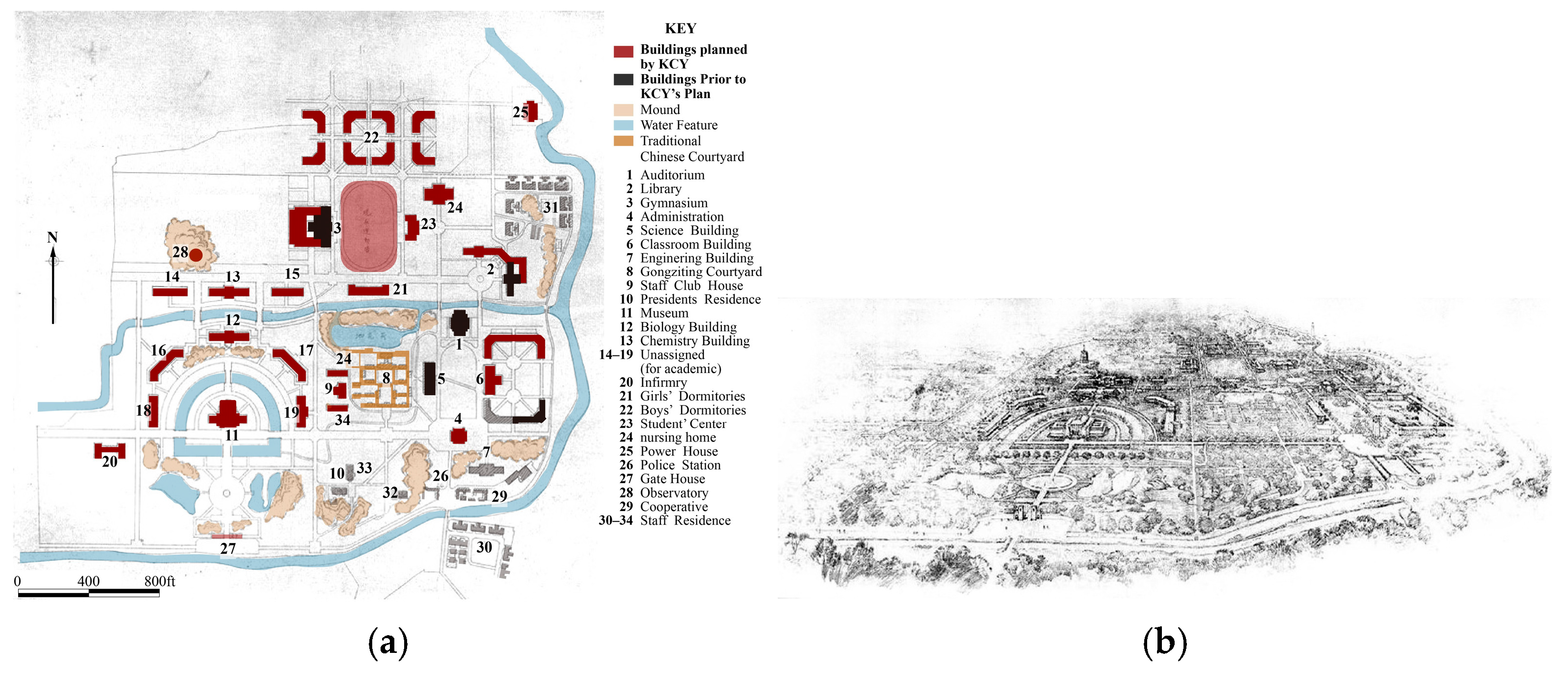
KCY’s strategy was to organize the whole plan into three primary, relatively independent north–south axial precincts of decreasing scale: a western natural sciences area, an eastern administrative and teaching zone, and a northern student life district. These three “campus” elements were then intersected and unified by two widened east–west “avenue” elements, creating an interlocking “three vertical, two horizontal” framework (Figure 12).
To reinforce this compositional order, KCY made significant compromises at the level of individual building design. The most telling example is the Administration Building in the eastern precinct. To ensure its mass presented a formal façade as the visual terminus for the key east–west avenue, the architects abandoned a more efficient rectangular plan for a centralized, monumental silhouette akin to the Auditorium. This decision clearly demonstrates that, under the overriding goal of compositional unity, the practical functional requirements of a single building could be subordinated.
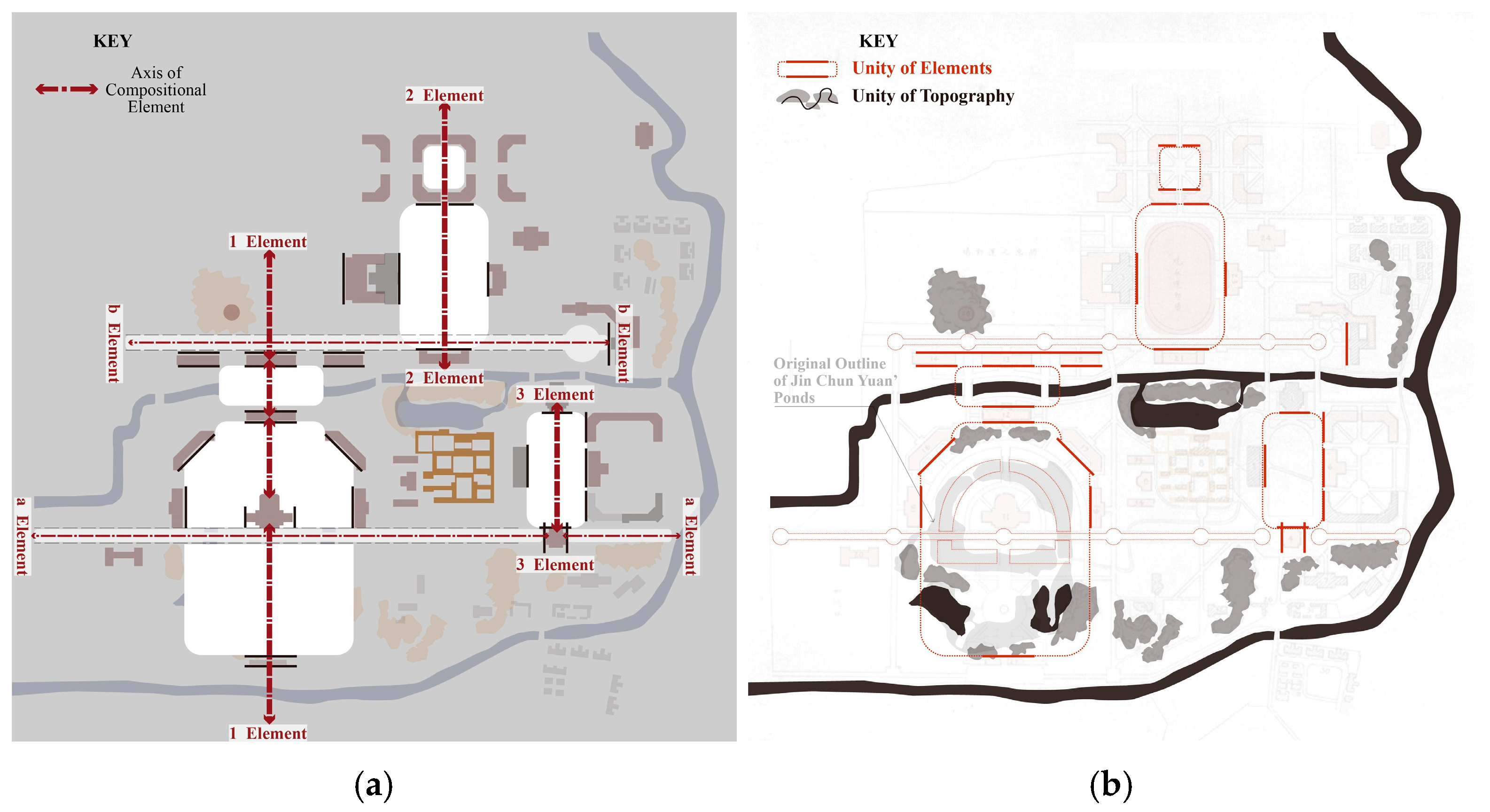
However, the irregular topography of the garden ruins—with their lakes, streams, and hills—posed an insurmountable obstacle to realizing a strict Beaux-Arts hierarchy. The three most important spatial elements—the western “campus” and the two east–west “avenues” flanking it—could not be symmetrically, continuously, and fully enclosed by architectural facades. The intended clear hierarchy of spaces appeared forced and compromised. This conflict was most acute in the treatment of the western Jin Chun Yuan area. The architects’ approach seemed hesitant: they regularized a natural lakeshore into a geometric canal, attempting to make nature an obedient “entourage” to architectural order, yet simultaneously preserved several of the original hills, allowing one to obstruct the primary façade of the planned Biology Building.
This ambivalence reveals a fundamental conflict: to transform the topography for a regularized composition would destroy the layered memory embedded in the centuries-old imperial garden; conversely, the rule-based regularity and unity demanded by the Beaux-Arts ideal are inherently incompatible with such picturesque irregularity (Figure 13).
The Tsinghua case ultimately exposes a core characteristic of traditional composition theory: it operates on the a priori assumption that formal unity—manifested as a clear, “pyramidal” hierarchy of parts—is the primary goal. Within this logic, unified space is decomposed into a finite set of symmetrical, enclosed, and hierarchically scaled elements, represented by a corresponding axis system. However, a site like the Tsinghua gardens possesses a different, “diffuse” unity. It resembles a continuous field, a landscape of infinite “dust” variation within an open system resistant to abstraction into a definitive diagram ([65], p. 235). The attempt to govern such diffuse unity with a clear, linear axis system creates an inherent and irreconcilable tension.
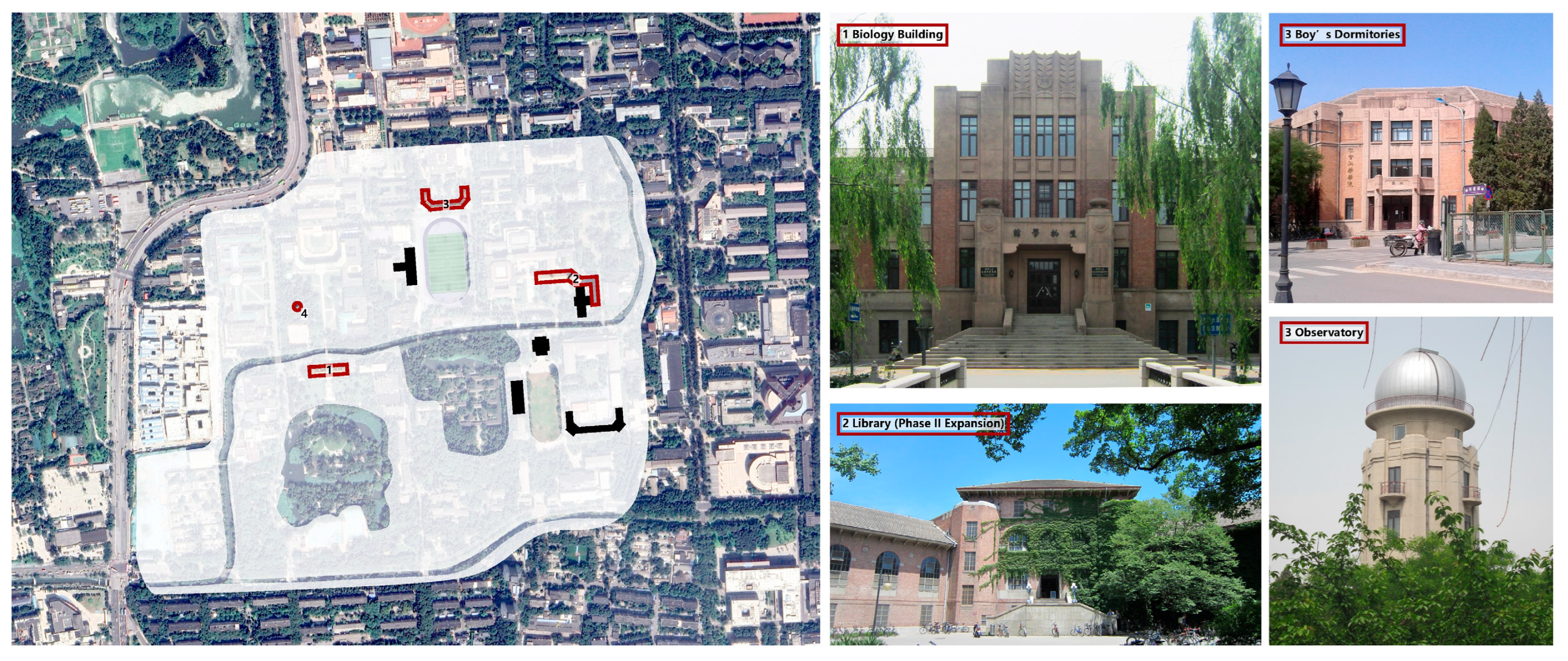
In practice, the plan was ill-timed. President Luo Jialun was forced to resign within months of the plan’s completion due to political shifts, and campus construction lost its most powerful advocate. Although building continued under his successor, Mei Yiqi, it no longer adhered to KCY’s unifying blueprint. By the time of the 1937 relocation, only a few structures from the plan, such as the Biology Building and a library expansion, had been realized (Figure 14). The Tsinghua project stands as a testament to the vulnerability of compositional ideals in the face of political instability and complex historical sites.

6.3. National Central University Campus Plan

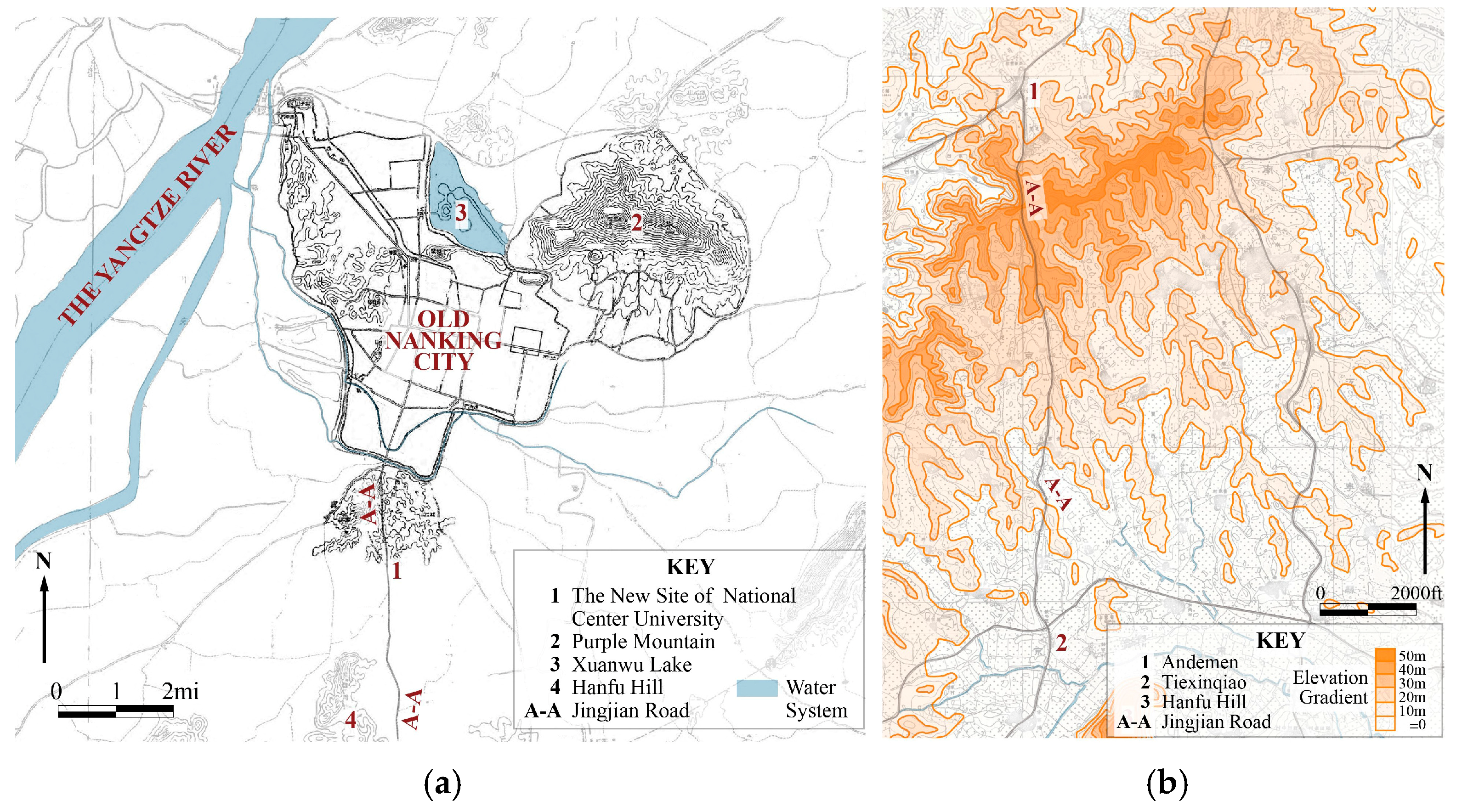
In 1932, Luo Jialun was appointed president of National Central University in Nanking, the national capital. Beginning the following year, he spearheaded efforts to relocate the university from its confined northern city site to a new campus in the southern suburbs. After three years of deliberations, a location was finalized in 1935: a rugged, hilly area known as “Shizigang,” located south of Yuhuatai and north of Niushou Mountain.
The topography was extremely complex. The landform consisted of a long, narrow north–south ridge in the north adjoining a flatter ravine to the south, with elevation differences exceeding 40–50 m. The ravine collected seasonal rainwater, forming ponds that drained southward. The Jingjian Road bisected the site from north to south along its western edge, creating a primary eastern zone and a secondary western zone. These conditions presented severe planning challenges (Figure 15).
The university’s design brief explicitly required preserving the site’s existing hills, woods, slopes, and ponds while resolving drainage. It also offered some flexibility, suggesting that the northern ridge might be incorporated later and that facilities could reasonably extend beyond the official boundary [56]. The task demanded balance between respecting the natural environment and providing visionary planning.
The project carried significant political and symbolic weight. Politically, it was seen as competing with the new campus of National Sun Yat-sen University in Guangzhou, representing a contest of ideological “orthodoxy” between the Nanking central government and southwestern political forces (At the time, the Southwest Political Council in Guangzhou, controlled by the Guangxi clique warlord Chen Jitang and Kuomintang right-wing veteran Zou Lu, among others, stood in confrontation with Chiang Kai-shek’s Nanking central government. National Sun Yat-sen University, under its jurisdiction, had already initiated the construction of its new Shipai campus in early 1930. Both Guangzhou’s Sun Yat-sen University and Nanking’s Central University initially projected enormous construction budgets ranging from 10 to 20 million yuan for their campuses) ([93], pp. 106–117). Militarily, the undulating terrain was perceived as advantageous for aerial defense, a point Luo Jialun mentioned to the university community [66].
In 1936, the university organized a limited competition among 11 Chinese architectural firms, 8 of which submitted entries. After an anonymous review, KCY placed first, followed by the firms of Doon Dayu and Robert Fan. Notably, the top three designs were all by U.S.-educated architects.
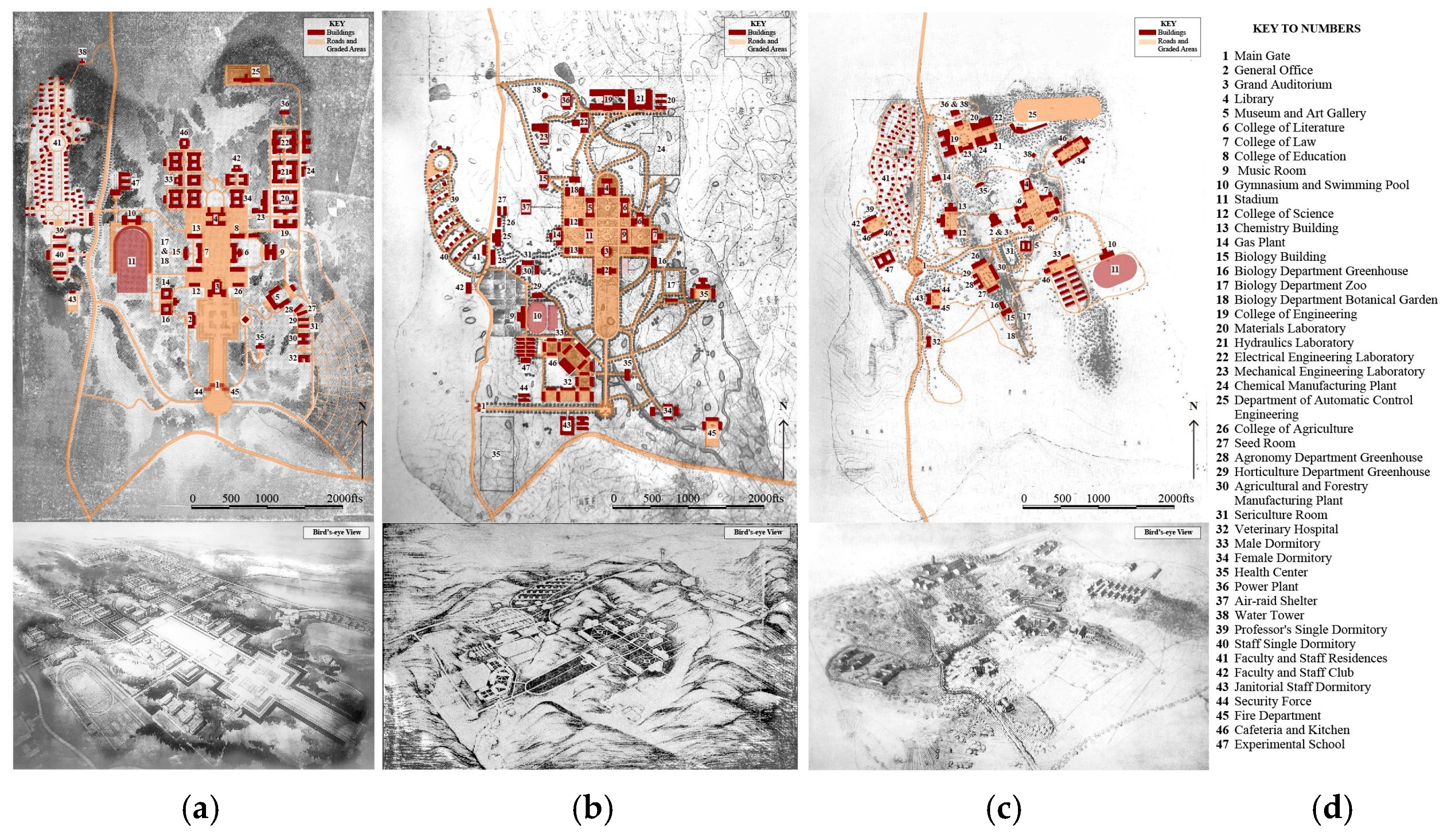
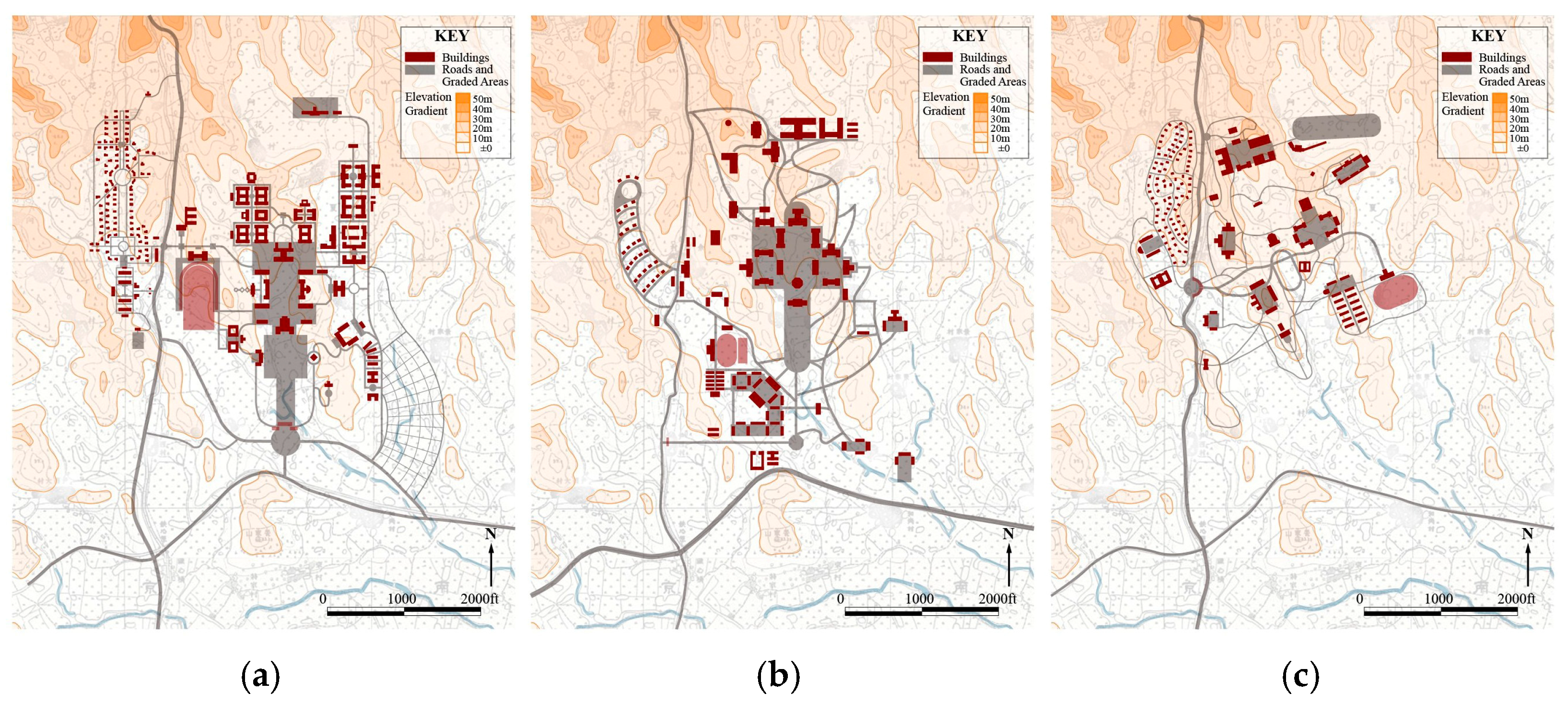
The shortlisted schemes shared common features: major academic buildings on the northern high ground, faculty housing west of the highway, and an attempt to let the composition follow the ridge’s form. However, their strategies for “balancing” composition with topography differed markedly (Figure 16).
Robert Fan’s scheme adopted a loosely “site-specific” approach, allowing individual college clusters to adapt informally to the terrain. Although this plan achieved good building–site relationships, it failed to organize these clusters into a coherent whole with a clear hierarchical order, leaving the campus without a unifying spatial structure.
Doon Dayu’s scheme imposed a strong compositional order centered on a monumental administrative and teaching complex. However, this order was localized and costly. It failed to integrate other functional areas effectively, required massive earthworks for the library’s terraces, pushed dormitories into flood-prone lowlands, and constrained the sports field. The scheme sacrificed overall functionality and economy for the sake of local composition.
KCY’s winning scheme succeeded by applying two clear principles to establish order on the difficult terrain. First, it imposed a strong, overriding orthogonal “grid”. All major buildings and roads were contained within this “latitude–longitude matrix”; even 45-degree rotations served to accentuate key nodes within this system. Second, it substituted “visual axes” for “physical enclosure”. On irregular slopes where a symmetrical, enclosed “campus” was impractical, the architects used a strongly directional “avenue” and symmetrically composed terminal building facades to define space visually, minimizing excavation, the technique that had been employed earlier at Tsinghua (Figure 17).
Despite winning the competition, KCY was not awarded the final commission. The university administration instead entrusted the project to the Su, Yang & Lei Architects (SYL), which had not participated in the contest. Its principal, Su Gin-djih, was a University of Michigan graduate. Only one preliminary plan by SYL survives (Figure 18).
As Dong Xiaoxiao noted, SYL’s scheme made crucial adjustments: it slightly rotated the main axis to better align with the hill’s contours and adopted a “windmill” plan to organize the building groups ([12], pp. 32–34). This adjustment was highly symbolic. It replaced KCY’s strictly orthogonal, enclosed hierarchy with an open, rotating centrifugal pattern. The result was a scheme that adapted well to the topography while maintaining an organic whole. This new approach stemmed from Su Gin-djih’s education at Michigan under the modernist pioneer Eliel Saarinen.
The dual nature of architectural education at Michigan—which housed both traditional Beaux-Arts instructors (The Beaux-Arts tradition at the university is represented by figures such as Albert Rousseau, who studied in Paris for five years and taught at the University of Michigan from 1915 to 1931 (serving as a professor after 1925)) and progressive figures like Emil Lorch—enabled this shift ([86], pp. 119–120). Lorch advocated “pure design” and abstract form studies, influencing figures like Frank Lloyd Wright ([94], p. 262). Michigan thus provided Su with a perspective that extended beyond the Beaux-Arts vision dominant on the East Coast.
Sigfried Giedion described Frank Lloyd Wright’s early prairie house plans as “windmill” forms ([95], p. 400), and Jacques Lucan characterized them as representing an “open, centrifugal compositional order” in opposition to the Beaux-Arts “pyramid” ([8], p. 340).
Thus, Su Gin-djih’s success represented both the chance occurrence of his personal acquaintance with Eliel Saarinen and the inevitable outcome of the distinct modernist inclination within his education, which differed from that of the East Coast universities attended by KCY’s partners. The National Central University project became a site at which two different conceptions of compositional order confronted and succeeded one another in China.
The contrast between KCY’s Beaux-Arts approach and SYL’s alternative reflects a deeper theoretical divergence in conceiving architectural unity. To elucidate this distinction, Table 1 outlines two fundamental logics of compositional unity—architecture as a “concretion” versus architecture as an “organism”—which underpin the respective design strategies of KCY and SYL regarding the National Central University plan (Table 1).
This theoretical framework illuminates why KCY’s orthogonal, hierarchically enclosed scheme—rooted in the Beaux-Arts tradition of composition as a “concretion”—stood in stark contrast to SYL’s windmill plan, a topographically adaptive approach, which resonated with an emerging “organic” conception of architectural order. The displacement of KCY’s winning entry by SYL’s alternative thus marked not merely a change in designer but also a subtle yet significant shift in the very logic of compositional unity.
Unfortunately, with the outbreak of full-scale war in 1937 and the university’s retreat to the interior, the Shizigang project was abandoned, and not a single building was constructed.

6.4. Results

In the Tsinghua and National Central University projects, KCY faced challenges that extended beyond “boundaries” to involve the more fundamental issue of “topography”. The nature of these challenges differed significantly: Tsinghua’s terrain was a cultural heritage site, a historical garden whose value lay in its layered memory, while Central University’s site was a complex natural and strategic asset.
Altering such terrain meant potentially diminishing its unique value. The architects’ approach, therefore, was to optimize adaptation to irregular topography by flexibly adjusting the regularity and completeness of the compositional elements themselves, while upholding the overarching goal of compositional unity.
On a deeper level, the grandeur and unity pursued through composition resonated with the mission of university-building in the modern nation-state. Since the Humboldtian reforms, “University, …… is assigned the dual task of …… the production and inculcation of national self-knowledges, ……. is identified as the institution that will give reason to the common life of the people, while preserving their traditions” ([96], p. 15). For Luo Jialun, representing the Nanking government, constructing a “magnificent” campus was a political undertaking. Therefore, KCY’s insistence on compositional unity was not solely a professional pursuit but also a response to nationalist aspirations, where altering a historical site or a site with complex natural values could be rationalized in service of “forging a national symbol”.

7. Discussion

Previous research on modern Chinese university campuses has employed stylistic, technological, biographical, or regional approaches, often focusing on American architects or Christian institutions. This study diverges by constructing a “history of composition” narrative. It centers on the Chinese firm KCY, situating its practice within Sino-American cross-cultural transmission. As a design methodology, “composition” possessed a strong cross-cultural and universal character, representing a shared core of professional knowledge.
The core findings of this study are described below.

7.1. Composition as a Method: From Program to Spatial Hierarchy

Despite significant differences across the four projects, KCY’s consistent pursuit of compositional unity confirms the stability of composition theory as its core design principle. Second, the interaction between the compositional ideal and site reality shows a clear evolution: early projects contended with “boundaries,” while later ones grappled with “topography,” reflecting a progressive refinement of KCY’s strategic responses.
Following this method, architects translated abstract institutional values into a relatively precise program—a functional interpretation of the university’s mission through an idealized lens. Concurrently, they sought a site capable of accommodating this program as a bounded, pre-existing physical territory—often located in suburban rural areas that theoretically allowed future expansion. Regardless of contextual variations, spatial unity remained the overarching goal and was achieved primarily by pairing functional hierarchy with compositional element hierarchy.
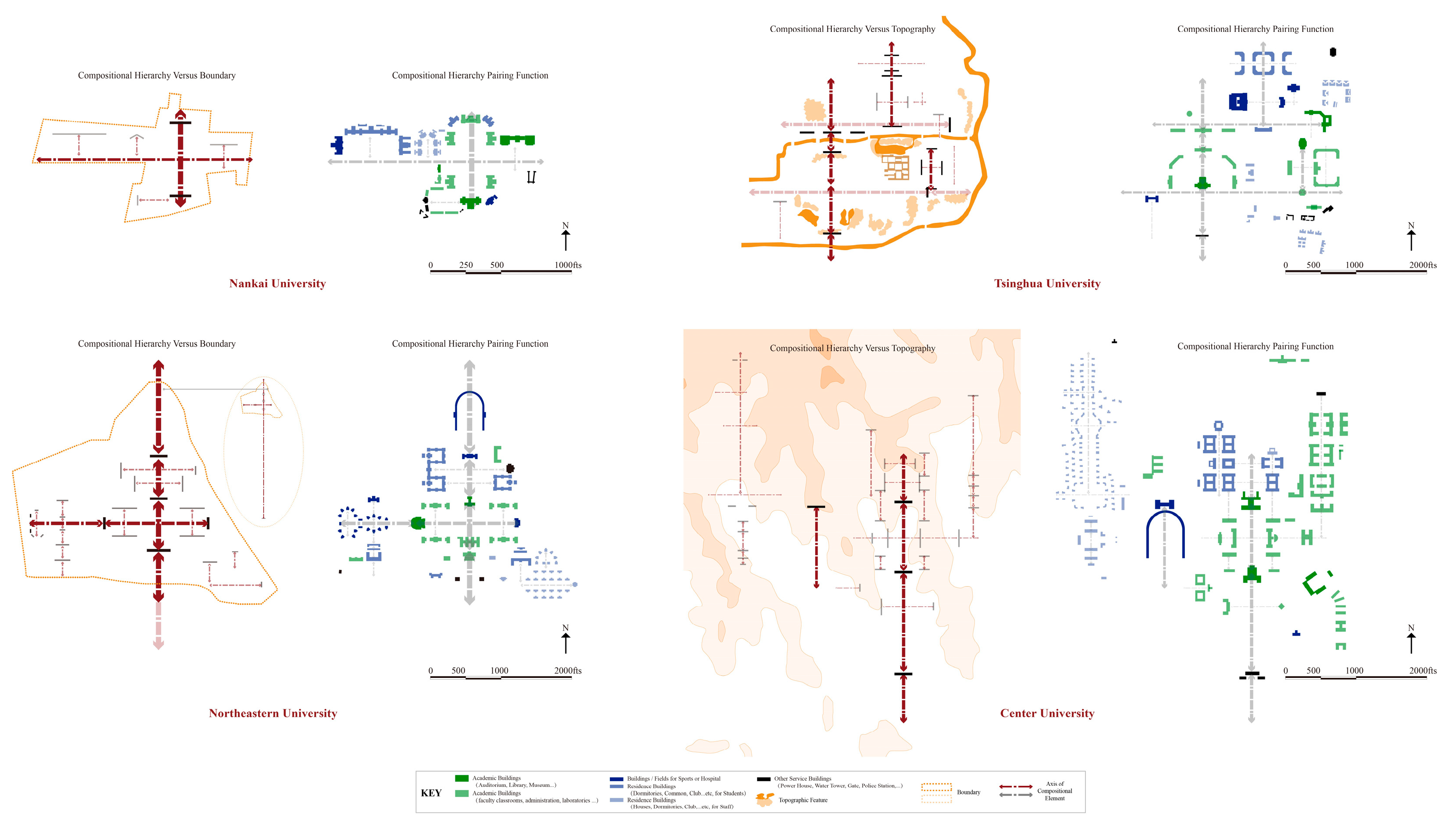
This pairing operated as follows: By analyzing the diverse activities outlined in the program, the architects constructed a hierarchy of functions—a structure remarkably consistent across institutions. The library, auditorium, gymnasium, and main teaching buildings were deemed more important than departmental buildings; academic buildings took precedence over dormitories; and core disciplines outweighed emerging ones in spatial allocation. Simultaneously, by synthesizing the site’s comprehensive characteristics, the architects projected this functional hierarchy onto a legible, rule-based axial system. Each axis corresponded to a “campus” space symmetrically enclosed by buildings, thereby establishing a hierarchy of compositional elements that embodied the functional order in spatial terms (Table 2 and Figure 19).

7.2. The Fragile Path to Realization: Sino-American Contrasts and Local Constraints

The National Central University case signifies a potential paradigm shift. The rejection of KCY’s competition-winning scheme in favor of SYL’s alternative suggests a move from a Beaux-Arts “hierarchical, enclosed order” toward a modernist “continuous, open order”. Crucially, the underlying design ideal of “seeking spatial unity” persisted across this transition, indicating not a clean break but a degree of methodological continuity and transformation between Modernism and the Beaux-Arts.
To some extent, the flexible, open, and generative characteristics of this new organic order might have facilitated a shift toward a more adaptive “procedural” approach to programming—one that acknowledges the inherent limitations of any era’s foresight. Such an approach, based on probabilistic projections and dynamic control, could mitigate the risk of producing overly ambitious yet ineffective blueprints. Yet the university, as a major public institution entrusted with shaping national identity and rationalizing civic life, remained inexorably linked to material forms that evoke monumentality and grandeur.
The historical circumstances of the United States and China during this period, however, could hardly have been more different. America’s global ascendancy in the late nineteenth and early twentieth centuries—with its industrial output surpassing Britain, France, and Germany by 1894 and its military dominance established in the Far East and Pacific after 1898—provided unprecedented private wealth for campus philanthropy. Against this backdrop emerged a generation of extraordinarily wealthy philanthropists—Rockefeller, Stanford, Carnegie, Hearst, who, as Paul Turner observed, “chose higher education and its architectural planning as principal objects of their munificence—and as a means to immortality” ([37], p. 169). This unprecedented private wealth provided a robust foundation for ambitious campus schemes.
China, by contrast, was mired in poverty, weakness, and chronic crisis. University development lacked both stable economic support and an institutionalized social environment. The interplay of uncertain educational funding, personalistic administrative structures, and brief historical windows of opportunity collectively thwarted the realization of KCY’s inspirational compositional plans.
Among the four projects, Nankai University—as a private institution—faced the most acute and persistent financial pressures. In the early 1920s, President Chang Poling was compelled to solicit donations from a precarious array of sources: regional warlords (such as Li Shun, military governor of Jiangsu), specific political factions (such as Duan Qirui’s government), industrial enterprises (such as the Nanyang Brothers Tobacco Company), foreign Christian organizations (such as the YMCA), and their associated philanthropic foundations (such as the Rockefeller Foundation and the China Foundation for the Promotion of Education and Culture (CFPEC), which administered U.S. Boxer Indemnity funds). However, he had to maintain a careful distance from these patrons to preserve institutional autonomy and avoid public criticism. Chang’s brother, Chang Peng-chun, a Nankai faculty member, recorded in his 1925 diary: “Endowment income exists, but it is meager—far from sufficient for university development. Nankai’s greatest problem is lack of money. Chang Poling’s entire work is fundraising… If not for financial constraints, he would not need to flatter. Money is important, but one must preserve personal dignity” ([61], pp. 218–219). When the Nanking National Government replaced the Peking government in 1928, Nankai’s financial situation not only failed to improve but was also complicated by new challenges: the new national universities supported by the Nanking government enticed some Nankai faculty members by offering higher salaries, and Chang Poling, formerly a trustee of the CFPEC, was unexpectedly removed when the foundation was reorganized under central government intervention ([62], p. 188).
For Northeastern, Tsinghua, and Central Universities—despite their advantages in regional or central government funding—implementation remained highly dependent on the will and fate of their presidents. Internal power struggles within Chinese political factions, coupled with Japanese invasion—first in the Northeast and later throughout China—drastically curtailed the brief construction windows available under these presidents’ tenures (Table 3). Even the funding advantages of these public institutions were merely relative to private universities; educational funding shortages remained an undeniable reality ([62], p. 168).
The realization of composition-based campus planning has always depended heavily on stable collaboration between client and architect—a point true even in contemporaneous America. As early as 1910, New York critic Montgomery Schuyler presciently observed, “The original architect, essaying to set a point of departure for his successors, is commonly found to have done so in the sense only that they depart from his work as speedily and as widely as possible” ([37], p. 188).
However, it bears reiterating that the value of compositional campus planning was never measured solely by complete, precise realization. The inspirational power of these visionary blueprints—their capacity to galvanize fundraising and strengthen the confidence of university communities and the broader public in the enterprise of higher education—constituted an equally important dimension of their significance. As Columbia University trustee John Pine wrote in 1914, “While the adoption of a comprehensive plan does not insure its realization, it is none the less essential for an intelligent beginning, and it has often proved that the mere existence of such a plan has done much to further its realization” ([37], p. 188).

7.3. Composition as an Aspirational Blueprint

In the tumultuous context of modern China, the value of these grand, often unrealized schemes extended far beyond their physical implementation. They provided clients, architects, and society at large with a compelling vision of modernity, order, and national strength. These functions of inspiring morale and providing direction through physical planning aligned closely with the ethos of the contemporary American City Beautiful Movement. Therefore, the practice of compositional campus planning can also be understood as a form of cultural action through which modern China sought to engage with global modernity and articulate its own national identity.

7.4. KCY’s Typicality and Composition as a Generational Consensus

The foregoing discussion has established composition as an “aspirational blueprint” through which Chinese architects engaged with global modernity. A final question remains: to what extent was KCY’s compositional practice unique among its cohort of American-educated Chinese architects? The comparative evidence suggests that KCY’s distinctiveness lay less in methodological innovation than in the exceptional concentration and geographic scope of its campus commissions—a concentration that renders the firm an ideal lens for examining how a broadly shared professional paradigm was enacted across diverse site conditions.
Among Chinese architects with American training who were active before 1937, most undertook only one or two university planning projects, which were typically located near their practice or teaching base. Table A2 summarizes the fragmented landscape of these endeavors.
During the war and immediate postwar period (1937–1949), the Allied Architects (Hua Gai Architects)—founded by Chao Shen, Chen Benjamin Chih, and Tung Chuin, all Tsinghua- and Penn-educated—emerged as significant practitioners of campus planning. Their commissions included Guangxi University in Guilin (1940), Greater China University’s Huaxi campus (1940), the postwar expansion of Nankai University in Tientsin (1946), a new campus for Jinan University in Shanghai (1947), and Jiangnan University in Wuxi (1947). Notably, the Huaxi and Jiangnan schemes exhibited formal characteristics—asymmetrical, centrifugal layouts—that resonated with the modernist evident in SYL’s Central University plan, suggesting that the paradigm shift described in the previous section was not an isolated instance but part of a broader dissemination of modernist design thinking during the wartime and postwar eras. Nevertheless, with the exception of partial construction at Huaxi and Jiangnan, most of these schemes remained unexecuted, and surviving documentation is largely limited to aerial perspectives [32].

7.5. Epilog: Compositional Legacies Beyond 1949

This analysis has focused on the period 1920–1937, when KCY and its contemporaries first transplanted Beaux-Arts composition theory to Chinese soil. A comprehensive examination of the theory’s subsequent fate in the People’s Republic of China lies beyond the scope of this study, as it belongs to a distinct historical epoch marked by fundamental shifts in political ideology and institutional frameworks. Nevertheless, a brief sketch of the continuities and transformations that followed may help to contextualize the longer-term resonance of the compositional paradigm.
After 1949, the new state’s architectural discourse turned decisively toward the Soviet Union. The doctrine of “Socialist Realism”—which held the classical architectural heritage of the West to be an essential component of “modern architecture” under socialist values—was reinterpreted within the Chinese context as the guiding principle of “national in form, socialist in content”. Crucially, despite their differences in stylistic advocacy, both Socialist Realism and its Sino-Soviet synthesis remained firmly anchored in the Beaux-Arts conception of spatial unity: a closed, hierarchical order achieved through symmetrical elements and axial gradation. The organic, topological logic of spatial unity championed by the modernist movement—already glimpsed in the aborted schemes of SYL at Central University and the Allied Architects at Jiangnan University—was consciously rejected as the esthetic dross of the class enemy [97]. This ideological censure effectively delayed the mainstreaming of modernist design thinking in China until the reform era.
Indirect evidence of the enduring grip of compositional thinking can be found in the three most influential architectural textbooks used in Chinese universities throughout the 1980s: Composition of Architectural Space (《建筑空间组合论》), Principles of Residential Design (《住宅建筑设计原理》), and History of Chinese Architecture (《中国建筑史》). All three remained fundamentally grounded in the Beaux-Arts paradigm of spatial unity [47]. As Li Hua observed, in post-1949 China, the narrative of “modernism” was less a critical opposition to the Beaux-Arts than a set of elements absorbed into its evolutionary sequence ([47], p. 243).
Concrete traces of this continuity can also be discerned in the physical evolution of the campuses examined in this study. In the early 1950s, nationwide institutional restructuring reassigned departments and altered the affiliations of many university sites. Among KCY’s four projects, only Nankai and Tsinghua retained both their academic mission and their original locations. Both institutions commissioned new master plans in the 1950s—neither fully realized—that sought to expand upon the pre-war compositional frameworks. The main classroom buildings erected at that time, while clad in the stylistic language of Socialist Realism, were inserted into site plans that remained unmistakably indebted to Beaux-Arts principles of axial order and symmetrical enclosure [98,99].
Thus, while a full account of the post-1949 evolution of campus planning lies beyond the chronological boundaries of this paper, it is evident that the compositional logic embodied in KCY’s schemes did not simply vanish with the political rupture of 1949. Instead, it was partially absorbed, transformed, and, in some respects, reinforced by the new ideological environment—a persistence that underscores the deep roots of Beaux-Arts thinking in China’s architectural modernization and invites further investigation beyond the scope of the present study.

8. Conclusions

The campus-planning practice of KCY, Architects & Engineers, demonstrates how China’s first generation of professionally trained architects actively adopted and applied American-localized Beaux-Arts composition theory as a scientific, purportedly universal design methodology.
This study reveals that the application of the compositional method was characterized by a constant negotiation with the contingencies of the “site”. This negotiation manifested concretely at two levels: first, contending with the uncertainty of boundaries and second, engaging in a dialog with the irregularity of topography. Together, these constituted the primary practical constraints in the process of realizing the compositional ideal.
Despite these significant constraints, compositional planning practice held fundamental value in modern China. As a scientific methodology, it represented a conscious pursuit of “modernity” and professional rigor, with its purported universality offering a discourse that could transcend mere stylistic debates. More importantly, as an “aspirational blueprint,” even when its physical form remained incomplete, the unified, grand vision it projected provided vital spiritual impetus for an era preoccupied with national construction and cultural renewal.
By introducing the perspective of a “history of composition” and a cross-cultural analytical framework and by using KCY as a detailed case study, this study offers a new interpretive pathway for research into the history of modern Chinese university campus planning—one distinct from stylistic, technological, or biographical histories—thereby complementing and enriching existing scholarship.
Concurrently, further aims of this study are to refocus scholarly attention on “composition” as a classical yet evolving design methodology and to deepen our understanding of its complex and multifaceted role in the modernization of Chinese architecture.
The research also has implications for contemporary heritage conservation. Many surviving modern university campuses exist as “fragmentary” ensembles, with their original, comprehensive planning ideals often obscured or forgotten. The “compositional” schemes and the methodological and epochal aspirations they embodied, which this study has sought to elucidate, are key to understanding the complete “significance” of these fragmented heritage sites. As heritage theory suggests, heritage value is a product of social “construction” and “authorization” [100]. This paper posits that the “compositional scheme” itself should be regarded as a form of “intangible heritage” or a distinct “historical layer” requiring active interpretation and presentation and not merely as passive background context for understanding the physical remains. Therefore, excavating and analyzing KCY’s compositional schemes and their underlying intellectual context serve to provide a richer, more historically grounded and culturally nuanced narrative for the contemporary interpretation and valuation of these historical campus environments.

Author Contributions

Conceptualization, B.L. and G.F.; Methodology, B.L. and G.F.; Investigation, B.L.; Resources, B.L. and G.F.; Writing—original draft, B.L.; Writing—review & editing, B.L.; Visualization, B.L.; Supervision, G.F.; Funding acquisition, G.F. All authors have read and agreed to the published version of the manuscript.

Funding

This research received no external funding.

Data Availability Statement

Restrictions apply to the availability of these data. Data was obtained from the National Index to Chinese Newspapers and Periodicals (Shanghai Library) and the China Historical Documents Database (National Library of China) and are available from the authors with the permission of the respective institutions.

Conflicts of Interest

The authors declare no conflicts of interest.

Appendix A

Table A1. U.S. educational institutions attended by 42 Chinese architects (as of mid-1930s). (source: author, based on biographical information from [68]).
PathBirthArchitectUOUMNUIUCUMichHarvardMITYaleColumbiaPrattSUNYCornellUpenn
Boxer
Indemnity
scholars
TH 19111888Chuang Tsin (庄俊) B N.D.
TH 19111892Loo Pang Chieh (罗邦杰) M
TH 19131892Kwan Sung Sing (关颂声) N.D.B
TH 19131894Lu Yen Chih (吕彦直) B
TH 19151893Moo Jenyin Y (巫振英) B
TH 19161893Lin Shu-min (林澍民) B+M
TH 19161895Chang Kuangchi (张光圻) B
TH 19181896Chu Bin (朱彬) B+M
TH 19201898Chao Shen (赵深) B+M
TH 19211901Yang Tingbao (杨廷宝) B+M
TH 19221899Doon Dayu (董大酉) B+M Ph.D
TH 19231901Liang Ssu Cheng (梁思成) N.D. B+M
TH 19231902Chen Benjamin Chih (陈植) B+M
TH 19241903Huang Jia Hua (黄家骅) B N.D.
TH 19251900Tung Chuin (童雋) B+M
TH 19261905Kuo Yuan-hsi (过元熙) M B
TH 19261907Huang Hsueh-Shih (黄学诗) B+M
TH 19271907Wang Haupin Pearson (王华彬) B
TH 19271907Ha Harris Wen (哈雄文) B
TH 19281908Liang Yen (梁衍) B
TH 19291911Sah Benn Yuan (萨本远) M B
special
students
1890Li Jingzhai (李敬斋) B
1904Lin Whei-Yin (林徽因) M B
Christion
Colleges
Students
C.C.C.1889Yeung Sik-chung (杨锡宗) B
1909Lei Wai Paak (李惠伯) B
S.J.C.1893Fan Robert (范文照) B
U. SH1906Su Gin-djih (徐敬直) B+M
Other
Self-financed
students
1899Lau Fook Tai (刘福泰)B+M
1900Lee Poy Gum (李锦沛) N.D. N.D. N.D.N.D.B
1902Chen yu-hwa (陈裕华) B M
1902Wong Yook Yee (黄玉瑜) B
1902Chan Wing-gee (陈荣枝) B
1903Harry Tam Whynne (谭垣) B+M
1908Yang Jenken (杨润钧) B
Abbreviations: (1) TH for Tsinghua; C.C.C. for Canton Christian College; S.J.C. for St John’s College (Shanghai); U.SH for University of Shanghai. (2) Blue text = Architecture major; B for Bachelor; M for Master; N.D. for Non-Degree Studies or Non-graduate. (3) To ensure scholarly accuracy and facilitate bilingual retrieval, the original Chinese characters are provided alongside the pinyin for all pre-1949 Chinese architects’ names. This avoids potential misidentification arising from translation discrepancies.
Table A2. University campus-planning projects by other American-trained Chinese architects (pre-1937). (source: author).
Architect(s)University, LocationYearOutcome
Li JingzhaiZhong Zhou Univ., Kaifengca. 1921Partially realized
Lu Yen Chih *1Southeastern Univ., Nankingca. 1922Partially realized
Ji Nan Univ., Shanghaica. 1922Partially realized
Lu Yen ChihChi Zhi Univ., Shanghaica. 1928Rejected (site changed)
Sun Yat-sen Univ., Guangzhouca. 1928Rejected
Doon DayuDa Xia Univ., Shanghai1929/1930Partially realized
Center Univ., Nanking19362nd prize (competition)
Robert FanJiaotong Univ., Shanghai1929Rejected (site changed)
Center Univ., Nanking19363rd prize (competition)
Yeung Sik-chungSun Yat-sen Univ., Guangzhou1930Partially realized
Lau Fook Tai *2Center Univ., Nanking1933Rejected (site changed)
Chan Wing-geeXiang Qin Univ., Guangzhou1935Rejected (site changed)
Liang Ssu Cheng *3Jilin Univ., Jilin Partially realized
Allied ArchtCenter Univ., Nanking1936Failed to receive any ranking
(competition)
Chang Kuangchi
Loo Pang Chieh
Lee Poy Gum
SYL *4Center Univ., Nanking1937Not realized
Huang JiahuaChongqing Univ., Chongqing1937Drawings lost
*1 As a partner of The Southeastern A & E Co.; *2 co-designed with Yu Binglie (French-trained); *3 co-designed with Lin Whei Yin, Chen Benjamin Chih, and Tung Chuin; *4 the three partners are Su Gin-djih, Yang Jenken, and Lei Wai Paak.

References

  1. Cai, L. The Campus and Architecture of Modern Chinese Universities; Science Press: Beijing, China, 2019. [Google Scholar]
  2. Feng, G.; Lü, B. The Campus of Modern Chinese Universities Under the Integration of Chinese and Western Cultures; Tsinghua University Press: Beijing, China, 2016. [Google Scholar]
  3. Chen, X.; Ren, L. A Brief History of the Morphological Development of Chinese University Campuses; Southeast University Press: Nanjing, China, 2011. [Google Scholar]
  4. Xu, W. A Study on the Campuses of Modern Chinese Universities. Master’s Thesis, Tsinghua University, Beijing, China, 1986. [Google Scholar]
  5. Cody, J.W. Exporting American Architecture: 1870–2000; Routledge: London, UK; New York, NY, USA, 2003. [Google Scholar]
  6. Forty, A. Words and Buildings: A Vocabulary of Modern Architecture; Thames & Hudson: London, UK, 2000. [Google Scholar]
  7. Pai, H. The Portfolio and the Diagram: Architecture, Discourse, and Modernity in America; MIT Press: Cambridge, MA, USA, 2002. [Google Scholar]
  8. Lucan, J. Composition, Non-Composition: Architecture et Théories, XIXe–XXe Siècles; Presses Polytechniques et Universitaires Romandes: Lausanne, Switzerland, 2009. [Google Scholar]
  9. Song, K.; Wu, Y. Research of Kwan, Chu and Yang Architects & Engineers in Tientsin and Northern China. Architecture 2017, 1, 58–59. [Google Scholar]
  10. Wu, Y. Research of Kwan, Chu and Yang Architects & Engineers in Tientsin and Northern China. Master’s Thesis, Tianjin University, Tianjin, China, 2010. [Google Scholar]
  11. Li, H.; Guo, W.; Zhu, Z. The Possibility and Challenges of Translating the ‘Big Roof’: Intercultural Formal Expression in the Architectural Design of the West China Union University Campus. Archit. J. 2022, 9, 103–107. [Google Scholar]
  12. Dong, X.; Xu, M. Strategy, Episteme and Culture—The Topographical Agenda in Campus Design of National Central University. Archit. J. 2023, 1, 28–35. [Google Scholar]
  13. Liu, Y. Supplemental Research on Henry K. Murphy: Cases of Yale-in-China and Ming Hsien College. Archit. J. 2017, 7, 67–74. [Google Scholar]
  14. Liu, Y. A Collection and Discussion of Historical Materials on Tsinghua University’s Early Construction from the Murphy Archives. J. Archit. Hist. 2014, 34, 164–186. [Google Scholar]
  15. Liu, Y. From a Royal Garden to a Modern College: Formation and Characteristics of the Campus Landscape of Tsinghua College. Landsc. Archit. 2015, 3, 87–93. [Google Scholar]
  16. Ding, J.; Wu, Y.; Guo, M.; Meng, Z. Yang Tingbao (T. P. YANG): The Formation and Causation of Spatial Planning at Northeastern University’s Beiling Campus. Architecture 2024, 10, 140–147. [Google Scholar]
  17. Chen, X.; He, J.; Wang, S. The Intersection of Collegiate Gothic Architecture and Missionary Education: A Case Study of Anderson Hall at Soochow University. Buildings 2024, 14, 367. [Google Scholar] [CrossRef]
  18. Du, J.; Xu, M. From Ambition to Reality—The Interaction between the Presidents and the Architects of National Tsing Hua University and the Resulting Construction Progress. J. Archit. Hist. 2022, 1, 151–164. [Google Scholar]
  19. Tong, Q.; Tang, L.; Li, Q. Analysis of new campus planning for Wuhan University in the early Republic of China (1929–1937). J. Asian Archit. Build. Eng. 2022, 21, 34–47. [Google Scholar] [CrossRef]
  20. Tang, L. From Barren Hills to the Luojia Academic Palace: A Study on the Early Architectural Complex of Wuhan University (1928–1937). Ph.D. Thesis, Wuhan University, Wuhan, China, 2020. [Google Scholar]
  21. Liu, W. The Making of Luojia; Guangxi Normal University Press: Guilin, China, 2019. [Google Scholar]
  22. Tang, K. From Ruined Gardens to Yan Yuan; Guangxi Normal University Press: Guilin, China, 2021. [Google Scholar]
  23. Zhao, X.; Leng, T.; Wang, Y.; Chao, S. An Enlightening Sacrifice: Discovering an anonymous building on the campus of Nanking University in China. J. Asian Archit. Build. Eng. 2022, 22, 875–895. [Google Scholar] [CrossRef]
  24. Lu, W.; Guan, R. A Forgotten Regret: The Transplantation of Murphy’s ‘Academic Village’ in the Campus of Fukien Christian University. Archit. Herit. 2022, 2, 57–65. [Google Scholar]
  25. Cheng, S.; Peng, Y.; Liu, W. Nature Orientation, Classical Compliance: A Re-exploration of the Origins of the Early Campus Planning Concepts for Wuhan University. South Archit. 2022, 3, 38–46. [Google Scholar]
  26. Xie, Y.; Walker, P. Planning a Christian campus in Quasi-colonial China: Lingnan University, Guangzhou, 1904–1931. Plan. Perspect. 2022, 37, 685–712. [Google Scholar] [CrossRef]
  27. Xie, Y.; Walker, P. Chinese and Christian? The architecture of West China Union University. J. Archit. 2021, 26, 394–424. [Google Scholar] [CrossRef]
  28. Dong, L. A Study on the Architectural History of Modern Christian Universities in China; Science Press: Beijing, China, 2010. [Google Scholar]
  29. Ren, J.; Lin, G. The Origin of Campus Planning of Lingnan University (1904–1938). Landsc. Archit. 2019, 26, 105–110. [Google Scholar]
  30. Cody, J.W. American Geometries and the Architecture of Christian Campuses in China. In China’s Christian Colleges: Cross-Cultural Connections, 1900–1950; Bays, D.H., Widmer, E., Eds.; Stanford University Press: Stanford, CA, USA, 2009. [Google Scholar]
  31. Cody, J.W. Building in China: Henry K. Murphy’s “Adaptive Architecture” 1914–1935; Chinese University Press: Hong Kong, China, 2001. [Google Scholar]
  32. Jiang, C. The Allied Architects Shanghai 1931–1952; Tongji University Press: Shanghai, China, 2022. [Google Scholar]
  33. Peng, C. Modernity and Locality: The Modern Transformation of Lingnan Cities and Architecture; Tongji University Press: Shanghai, China, 2012. [Google Scholar]
  34. Wang, H. A Study on the History of Modern Educational Architecture in Nanking; China Architecture & Building Press: Beijing, China, 2022. [Google Scholar]
  35. Wu, J. A History of Shanghai Architecture of 100 Years, 2nd ed.; Tongji University Press: Shanghai, China, 2008. [Google Scholar]
  36. Chen, Z. Modern Architecture in Southern Fujian; China Architecture & Building Press: Beijing, China, 2012. [Google Scholar]
  37. Turner, P.V. Campus: An American Planning Tradition; University of Massachusetts Press: Cambridge, MA, USA, 1987. [Google Scholar]
  38. Dober, R.P. Campus Planning; Society for College and University Planning: Ann Arbor, MI, USA, 1963. [Google Scholar]
  39. Dober, R.P. Campus Design; John Wiley & Sons, Inc.: New York, NY, USA, 1992. [Google Scholar]
  40. Dober, R.P. Campus Architecture; McGraw-Hill: New York, NY, USA, 1996. [Google Scholar]
  41. Dober, R.P. Campus Landscape; John Wiley & Sons, Inc.: New York, NY, USA, 2000. [Google Scholar]
  42. Woodbridge, S.B. John Galen Howard and the University of California; University of California Press: Berkeley, CA, USA, 2002. [Google Scholar]
  43. Jarzombek, M.M. Designing MIT: Bosworth’s New Tech; Northeastern University Press: Boston, MA, USA, 2004. [Google Scholar]
  44. Bergdoll, B. Mastering McKim’s Plan: Columbia’s First Century on Morningside Heights; Columbia University Press: New York, NY, USA, 1997. [Google Scholar]
  45. Cody, J.W. Chinese Architecture and the Beaux-Arts; Hong Kong University Press: Hong Kong, China, 2011. [Google Scholar]
  46. Shan, Y. A History of Western Academic Architectural Education; Southeast University Press: Nanjing, China, 2012. [Google Scholar]
  47. Li, H. ‘Combination’ and a Constitution of Architectural Knowledge. In Chinese Architecture in 60 Years (1949–2009); Zhu, J., Ed.; China Architecture & Building Press: Beijing, China, 2009. [Google Scholar]
  48. Wang, Y.; Zhou, M. Reinterpretation of the Beaux-Arts Composition. Architecture 2020, 3, 72–76. [Google Scholar]
  49. Nankai University. The Story of Nankai; Nankai University: Tianjin, China, 1928. [Google Scholar]
  50. Nankai University. Nankai School; Nankai University: Tianjin, China, 1924. [Google Scholar]
  51. Yi, Z. Nankai Sketch. Coll. News. 1937, 5, 9. [Google Scholar]
  52. Northeastern University. Overview of Northeastern University; Northeastern University: Shenyang, China, 1926. [Google Scholar]
  53. Northeastern University. Overview of Northeastern University; Northeastern University: Shenyang, China, 1929. [Google Scholar]
  54. Anonymous. The New Railway Station of Shenyang at Beining Road. New North China 1931, 1, 4. [Google Scholar]
  55. National Tsinghua University. Overview of National Tsinghua University; National Tsinghua University: Beijing, China, 1930. [Google Scholar]
  56. National Central University. Review Report on the Submitted Master Site Plans for the New Campus by the University’s Building and Equipment Committee; National Central University: Nanjing, China, 1936. [Google Scholar]
  57. National Central University. Tenth Anniversary Memorial Book of National Central University; National Central University: Nanjing, China, 1937. [Google Scholar]
  58. Liu, Y. Modern Campus Planning and Architecture of Tsinghua University (2 Volumes); Tsinghua University Press: Beijing, China, 2021. [Google Scholar]
  59. Li, S. A Century of Nankai Architecture: A Collection of Illustrations; Tientsin Ancient Books Publishing House: Tianjin, China, 2019. [Google Scholar]
  60. Gong, K. The Complete Works of Zhang Boling (Volumes 1–10); Nankai University Press: Tianjin, China, 2015. [Google Scholar]
  61. Zhang, P. Zhang Pengchun’s Tsinghua Diary (1925); Kaiyuan Book Company: Hong Kong, China, 2020. [Google Scholar]
  62. Jin, G. Power Transfer and Resource Acquisition: Nankai University, Government and Society in an Era of Change (1919–1946); Tianjin People’s Publishing House: Tianjin, China, 2021. [Google Scholar]
  63. Wang, S. The Legend of Zhang Xueliang: An Oral History; Shandong Friendship Press: Jinan, China, 2002. [Google Scholar]
  64. Luo, J. Tsinghua University and I. In The Collected Works of Mr. Luo Jialun (Vol. 8); The Editorial Committee of the Collected Works of Mr. Luo Jialun, Ed.; Academia Historica: Taipei, Taiwan, 1976; pp. 396–412. [Google Scholar]
  65. Leatherbarrow, D. Topographical Stories; University of Pennsylvania Press: Philadelphia, PA, USA, 2004. [Google Scholar]
  66. Luo, J. A Retrospect and Prospect of National Central University. In The Collected Works of Mr. Luo Jialun (Vol. 6); The Editorial Committee of the Collected Works of Mr. Luo Jialun, Ed.; Academia Historica: Taipei, Taiwan, 1976; pp. 96–111. [Google Scholar]
  67. Yang, T. The Complete Works of Yang Tingbao (Volumes 1–7); China Architecture & Building Press: Beijing, China, 2021. [Google Scholar]
  68. Delin, L. Who’s Who: In Modern Chinese Architecture; China Water Power Press: Beijing, China, 2006. [Google Scholar]
  69. Zhang, B. My Creative Path; China Architecture & Building Press: Beijing, China, 1997. [Google Scholar]
  70. Guadet, J.A. Éléments et Théorie de L’Architecture: Cours Professé à l’École Nationale et Spéciale des Beaux-Arts; Librairie de la Construction Moderne: Paris, France, 1900. [Google Scholar]
  71. Van Pelt, J.V. A Discussion of Composition; The Macmillan Company: New York, NY, USA, 1902. [Google Scholar]
  72. Curtis, N.C. Architectural Composition; J.H. Jansen: Cleveland, OH, USA, 1923. [Google Scholar]
  73. Robertson, H. Principles of Architectural Composition; The Architectural Press: London, UK, 1924. [Google Scholar]
  74. Harbeson, J.F. The Study of Architectural Design; The Pencil Points Press: New York, NY, USA, 1926. [Google Scholar]
  75. Osaka Yagou Shoten. Latest Map of Fengtian (Shenyang) City Streets (1:15000); Osaka Yagou Shoten: Shenyang, China, 1926. [Google Scholar]
  76. Zhifang Division, Ministry of Internal Affairs. Surveyed Map of the Four Suburbs of the Capital (1:36200); Zhifang Division, Ministry of Internal Affairs: Beijing, China, 1915. [Google Scholar]
  77. Anonymous. Map of National Capital Boundaries. Cap. Constr. 1929, 1, 1. [Google Scholar]
  78. Land Survey Bureau, General Staff Headquarters. Map of the Vicinity of Nanking (Yuhua-Tai, Andemen, Dadingfang) (1:10000); Land Survey Bureau, General Staff Headquarters: Nanjing, China, 1937. [Google Scholar]
  79. Cardwell, K.H. Bernard Maybeck, Artisan, Architect, Artist; Peregrine Smith Books: Salt Lake City, UT, USA, 1977. [Google Scholar]
  80. University of California. Programme for an International Competition for the Phebe Hearst Architectural Plan of the University of California; University of California: Berkeley, CA, USA, 1897. [Google Scholar]
  81. Anonymous. The International Competition for the Phoebe Hearst Architectural Plan for the University of California; Trustees of the Phoebe A. Hearst Architectural Plan for the University of California: San Francisco, CA, USA, 1899. [Google Scholar]
  82. Wilson, W.H. The City Beautiful Movement; The Johns Hopkins University Press: Baltimore, MD, USA, 1989. [Google Scholar]
  83. Partridge, L.W. John Galen Howard and the Berkeley Campus; Berkeley Architectural Heritage Association: Berkeley, CA, USA, 1978. [Google Scholar]
  84. Howard, J.G. The Architectural Plans for the Greater University of California; University Chronicle: Berkeley, CA, USA, 1903; pp. 273–291. [Google Scholar]
  85. Liang, C. A Quantitative Study of the Career Status of Tsinghua Students Studying in the United States, 1909–1944. J. Mod. Chin. Hist. 2024, 4, 21–43. [Google Scholar]
  86. Weatherhead, A.C. The History of Collegiate Education in Architecture in the United States. Ph.D. Thesis, Columbia University, New York, NY, USA, 1941. [Google Scholar]
  87. Anonymous. Introduction to KCY, Architects & Engineers and Its Partners. Shen Bao, 10 October 1933; p. 42.
  88. Harvard College. Twenty-Fifth Anniversary Report of the Secretary of the Class of 1881 of Harvard College; Harvard College: Cambridge, MA, USA, 1906. [Google Scholar]
  89. Liu, X.; Wu, Y. The Spirit of Grand Edifices: A Biography of Architect Yang Tingbao; Jiangsu Science & Technology Press: Nanjing, China, 1986. [Google Scholar]
  90. Cret, P. The Ecole Des Beaux Arts: What Its Architectural Teaching Means. Archit. Rec. 1908, 27, 369–371. [Google Scholar]
  91. Kahn, A.; Burns, C.J. Why Site Matters. In Site Matters; Kahn, A., Burns, C.J., Eds.; Routledge: New York, NY, USA, 2019. [Google Scholar]
  92. Miao, R. A Study of Xi Chun Yuan and Qing Hua Yuan: 300 Years of Memories of Qing Hua Yuan, 2nd ed.; Tsinghua University Press: Beijing, China, 2013. [Google Scholar]
  93. Jiang, B. Academia and Politics in the Central University During the Republic of China Period; Nanking University Press: Nanjing, China, 2016. [Google Scholar]
  94. Frank, M. The Theory of Pure Design and American Architectural Education in the Early Twentieth Century. J. Soc. Archit. Hist. 2008, 67, 248–273. [Google Scholar] [CrossRef]
  95. Giedion, S. Space, Time and Architecture; Harvard University Press: Cambridge, MA, USA, 2008. [Google Scholar]
  96. Readings, B. The University in Ruins; Harvard University Press: Cambridge, MA, USA, 1996. [Google Scholar]
  97. Ji, G. The Incursion of Soviet Socialist Realism and its Influence on Chinese. In Chinese Architecture in 60 Years (1949–2009); Zhu, J., Ed.; China Architecture & Building Press: Beijing, China, 2009. [Google Scholar]
  98. Zhang, X.; Gao, H.; Lyu, B.; Feng, G. A Study on the Design of Soviet-Style Main Collegiate Buildings: A Case Study of the Main Building at Nankai University. J. Archit. Hist. 2025, 1, 124–136. [Google Scholar]
  99. Xu, M.; Dong, X. A Study on Campus Design and East Expansion of Tsinghua University in the 1950s. J. Archit. Hist. 2019, 44, 165–180. [Google Scholar]
  100. Smith, L. Uses of Heritage; Routledge: London, UK, 2006. [Google Scholar]
Figure 1. Analytical model of the relationship between boundary, topography, and compositional strategy. The black solid line indicates the site boundary constrained by conservative real-world conditions, while the gray dashed line represents the extended design boundary envisioned under speculative conditions beyond the actual site. The Letters refer to the names of the four Quadrants that defined by the corresponding boundaries: A1 and A2 is short for Quadrant Autonomy 1 and Quadrant Autonomy 2, H is short for Quadrant Heteronomy, N is short for Quadrant of no analog. (source: drawn by author).
Buildings 16 01345 g001
Figure 2. Award-winning schemes from the International Competition for the Campus Plan of the University of California, Berkeley: (a) scheme by Emile Bénard (First Prize); (b) scheme by John Galen Howard (Fourth Prize). (Source: ([81], pp. 50, 73)).
Buildings 16 01345 g002
Figure 3. Location and site plan of Nankai University: (a) Location relative to Nankai Middle School and old Tientsin; (b) site survey plan by KCY showing surrounding streams (tributaries of the Weijin River). (sources: (a) Redrawn from ([49], p. 9); (b) Redrawn from ([50], p. 11)).
Buildings 16 01345 g003
Figure 4. Master plan and compositional analysis of Nankai University: (a) KCY’s master plan (1922); (b) structural relationship between compositional elements and site boundary contour. (sources: (a) Modified from ([50], p. 11); (b) Adapted from (a)).
Buildings 16 01345 g004
Figure 5. Historical views of Nankai University’s core campus in the 1920s: (a) view north from the south; (b) view south from the north (source: Modified from [51]).
Buildings 16 01345 g005
Figure 6. KCY’s built legacy at Nankai University: extant buildings and structures later demolished (source: drawn by author based on Google Earth imagery, author’s photograph and pictures of public domain from Wikimedia Commons).
Buildings 16 01345 g006
Figure 7. Location and site plan of Northeastern University: (a) relative location to affiliated factory, old Shenyang, and new railway station; (b) campus survey map (July 1926) showing boundaries. (sources: (a) Redrawn from [52,75]. (b) Redrawn from ibid).
Buildings 16 01345 g007
Figure 8. Master plan and compositional analysis of Northeastern University: (a) KCY’s master plan (ca. 1929); (b) structural relationship between elements and site boundary (sources: (a) Modified from [53]. (b) Adapted from (a)).
Buildings 16 01345 g008
Figure 9. Termini of Northeastern University’s dominant axis: (a) stadium at northern terminus; (b) Shenyang Railway Station at southern terminus (source: (a) [53]; (b) [54]).
Buildings 16 01345 g009
Figure 10. KCY’s built legacy at Northeastern University: extant buildings and structures later demolished (now part of Liaoning Provincial Government compound) (source: drawn by author based on Google Earth, authors’ photograph, and [53]).
Buildings 16 01345 g010
Figure 11. Location and site plan of Tsinghua University: (a) relative location to garden ruins, Yenching University, and old Peking; (b) campus map (1927) showing eastern developed area and western abandoned garden. (sources: (a) Redrawn from [76]; (b) Redrawn from [55]).
Buildings 16 01345 g011
Figure 12. KCY’s Tsinghua University plan (February 1930): (a) master plan; (b) bird’s-eye view (source: redrawn from [55]).
Buildings 16 01345 g012
Figure 13. Compositional analysis of Tsinghua University plan: (a) structural relationship of compositional elements; (b) antagonism between compositional unity and topographic unity (source: adapted from Figure 12a).
Buildings 16 01345 g013
Figure 14. KCY’s built legacy at Tsinghua University (source: drawn by author based on Google Earth and author’s photographs).
Buildings 16 01345 g014
Figure 15. Location and site plan of National Central University: (a) location relative to old Nanking; (b) topographic map of Shizigang site. (sources: (a) Redrawn from [77]. (b) Redrawn from [78]).
Buildings 16 01345 g015
Figure 16. Top three schemes from the National Central University competition (1936): (a) KCY; (b) Doon Dayu; (c) Robert Fan; (d) Reference (source: redrawn from ([56], pp. 13–14, 16–17, 20–21)).
Buildings 16 01345 g016
Figure 17. Comparative analysis of competition schemes in relation to topography: (a) KCY; (b) Doon Dayu; (c) Robert Fan (sources: adapted from Figure 15b and Figure 16).
Buildings 16 01345 g017
Figure 18. SYL’s core area plan for National Central University: (a) master plan; (b) relationship to topography. (sources: (a) Redrawn from ([57], p. 97) (b) Adapted from (a) and Figure 15b).
Buildings 16 01345 g018
Figure 19. Compositional hierarchies in KCY’s four campus projects: mediating between site conditions and functional programs (source: drawn by author).
Buildings 16 01345 g019
Table 1. Comparison of two logics of spatial compositional unity.
DimensionArchitecture as a “Concretion”Architecture as an “Organism”
Mode of ExistenceManifests as completed form—a determinate, closed entity.Manifests as processual control—an open system governed by generative rules.
Part–Whole
Relationship
-
Composed of finite, identifiable elements;
-
Constituted by infinite, indeterminate segments;
-
Elements possess determinate forms; combinable through a single principle into infinite permutations.
-
Segments lack fixed form; what is identifiable is the topological rule of growth.
-
Simplest element: symmetrically enclosed space, representable by a single axis.
-
Growth rules yield formal consistency without universal standard; they tend toward balance, not symmetry.
-
Elements hierarchically graded and combined through discontinuity.
-
Segments are homogeneously repeated and articulated through continuity.
-
Removal/addition of any element compromises the unity of the whole.
-
Addition/subtraction under same growth rule does not undermine unity.
Boundary–Center
Relationship
Implies a closed, centralized system;Implies an open, decentralized system;
-
Definite, stable boundary; definite center (singular or composite).
-
No absolute boundary or center; boundaries shift with growth; relative center slides accordingly.
Table 2. Comparative analysis of KCY’s four campus-planning projects.
InstitutionCore Site ChallengeSite CharacteristicsCompositional Strategy
NankaiBoundaryConstrained, irregular legally controlled boundaryAlignment of dominant compositional element with the site’s overall geometric features (maximum dimension, optimal orientation)
NortheasternDual boundary condition: relatively ample legally controlled boundary plus extended visual field beyond physical limits
TsinghuaTopographyAbandoned imperial garden with layered natural and historical memoryNegotiation between irregular topography and hierarchical compositional order to evoke grandeur and monumentality befitting a national university
CentralRugged, hilly terrain with significant elevation changes
Table 3. Construction windows and reasons for termination of KCY’s campus plans.
UniversityPresident
(Term)/KCY Plan Period
Window
Period
Cause of Termination/Deviation
Nankai
Univ.
Chang Poling
(1919.10–1948.6)/1922
1922–1937.7Persistent fundraising struggles; financial pressures intensified after 1928 as new national universities emerged; evacuated in 1937 due to full-scale war
Northeastern
Univ.
Zhang Xueliang
(1928.8–1937.2)/ca. 1929
1929–1931.9Mukden Incident (1931); Japanese occupation of Northeast; university evacuation
Tsinghua
Univ.
Luo Jialun
(1928.8–1930.5)/ca. 1930
1930–1930.5Luo lost political support after 1930; after prolonged presidential succession crisis, successor Mei Yiqi did not strictly adhere to Luo-era plan
Central
Univ.
Luo Jialun
(1932.8–1941.8)/1936
1936–1937.7Displaced by SYL’s plan; full-scale war broke out 1937; university evacuation; Shizigang project abandoned
Disclaimer/Publisher’s Note: The statements, opinions and data contained in all publications are solely those of the individual author(s) and contributor(s) and not of MDPI and/or the editor(s). MDPI and/or the editor(s) disclaim responsibility for any injury to people or property resulting from any ideas, methods, instructions or products referred to in the content.