Article

Planning of Cultural Heritage Network Based on the MCR Model and Circuit Theory in Shenyang City, China

School of Architecture and Urban Planning, Shenyang Jianzhu University, Shenyang 100168, China
*
Author to whom correspondence should be addressed.
These authors contributed equally to this work.
Buildings 2026, 16(7), 1311; https://doi.org/10.3390/buildings16071311
Submission received: 29 November 2025 / Revised: 13 March 2026 / Accepted: 17 March 2026 / Published: 26 March 2026
(This article belongs to the Collection Strategies for Sustainable Urban Development)

Abstract

This study uses Shenyang as a case to integrate multi-source dynamic data with spatial modeling. A comprehensive resistance surface was planned using 12 indicators across the natural, built, and socio-economic dimensions, with objective weighting via the CRITIC method. A hierarchical corridor network was generated based on the MCR model and circuit theory, validated by chi-square goodness-of-fit tests and network structural analysis. The results indicate that socio-economic factors, particularly path activity frequency, dominate the spatial patterns of the corridors, confirming that the network captures connectivity rooted in human activity rather than simply replicating transportation infrastructure. The distribution of national, provincial, and municipal heritage sites across the three higher-importance tiers (L1–L3) shows no significant deviation from the regional baseline, validating the network’s inherent de-hierarchization capacity. Network structure analysis further confirms that this equitable network simultaneously exhibits robust connectivity. The resultant network displays a distinct core–periphery structure with a monocentric-multinuclear radial pattern, forming a four-tier corridor system (core, primary, secondary, and local) that provides an actionable framework for graded protection and targeted interventions. This study advances cultural heritage conservation from passive isolation towards proactive systemic network governance, offering a transferable pathway for the sustainable preservation of heritage in high-density urban environments.

1. Introduction

Cultural heritage, defined as the physical carrier of historical memory and value recognition for specific communities, holds profound cultural significance [1]. Concurrently, the development of big data has created unparalleled opportunities. The digitization and widespread availability of multi-source data have significantly enhanced the accessibility and precision of spatial information [2,3]. However, the rapid urban expansion and land development that have occurred in recent decades have resulted in the loss of historical context and the fragmentation of cultural heritage space [4]. Traditional isolated protection methods have been ineffective in coping with systemic threats. In this context, international heritage conservation practices are undergoing a transition from the preservation of individual sites to the establishment of Linear Heritage Corridors and Regional Heritage Networks [5]. This paradigm shift underscores the importance of reestablishing spatial and functional connections among heritage elements within broader natural, geographic, and socioeconomic contexts [6].

1.1. The Current Status and Conservation Challenges of Cultural Heritage in Shenyang

Shenyang, a city of considerable historic and cultural significance located in the northeastern region of China, occupies a strategic geographical position that functions as a nexus for diverse cultural and economic activities [7]. This unique location connects the agricultural civilization of the Central Plains, the nomadic culture of the northern grasslands, and the forest–fishery traditions of the wilderness. As the founding site of the Qing Dynasty, it preserves a complete sequence of heritage sites ranging from tribal ruins to imperial palaces and tombs. This heritage system meticulously chronicles the historical process by which a frontier ethnic regime assimilated diverse cultural influences and eventually became integrated into the mainstream of Chinese civilization. Furthermore, as a pioneering zone of modern industrialization in China, it offers a unique perspective on the intersection of modern civilization and tradition [8]. This continuity and stratification—from tribal societies to empires, from tradition to modernity—reveals patterns of multi-ethnic integration and social development, leaving behind an invaluable wealth of material cultural heritage.
Specifically, Shenyang’s cultural heritage serves as a pivotal case study for cross-civilizational dialogue and integration in Northeast Asia. The cultural evolution of the region’s dominant ethnic groups—from the Jurchen to the Manchu—is systematically documented, as evidenced by sites such as the Xinle Site, Sibe Family Temple, and Shenyang Imperial Palace [9]. Furthermore, it encompasses extensive historical evidence of long-term interactions with multiple Northeast Asian civilizations, including Korea, Mongolia, and the Russian Far East, as evidenced by sites such as the Former Site of the Bank of Korea Fengtian Branch, the Mausoleum of Prince Narsu of Mongolia, and the Former Site of the Russian Cemetery Chapel. This heritage complex functions as a pivotal institution within the regional cultural community. Moreover, the distribution of the species exhibits distinct geographical and cultural orientations [10,11]. Heritage from the pre-Qing and early Qing periods is concentrated in the eastern plains and along the Hun River. Palaces and tombs from the Qing’s heyday form the urban core, while modern industrial and colonial heritage follows railway lines. The spatial configuration of differentiated yet interconnected clusters provides a clear structural foundation for planning a composite network linking mountains, rivers, capitals, and transportation routes. However, preliminary field research reveals that this concentration of cultural resources manifests spatially as a highly fragmented state. A plethora of heritage sites are dispersed throughout the rapidly expanding modern urban fabric and vast rural areas, exhibiting a paucity of tangible spatial connections and systematic functional relationships. For instance, the Southern Mosque and the Shenyang Imperial Palace are located a mere 2000 m apart. However, the historical mosque remains obscured by new high-rise developments due to surrounding modern building renovations and public awareness gaps. It is isolated in a deep alleyway and is not widely known. In contrast, the renowned Shenyang Imperial Palace is characterized by overcrowding, necessitating the implementation of time-slot reservations and visitor flow management. This phenomenon reveals marked disparities in vitality between the two sites. Additionally, heritage sites in remote areas or urban fringe zones—such as traditional villages—possess high historical value [12]. However, the establishment of administrative divisions, urban expansion, and the limitations of past “point-based” conservation approaches have resulted in fragmented management. This oversight has resulted in the decline of indigenous populations and the deterioration of structures, leading to the transformation of these sites into isolated “islands” within urban areas or “enclaves” in rural settings. Consequently, they are subject to inadequate protection and the risk of their value being lost. These cases reveal the absence of holistic heritage preservation and fragmented management in Shenyang, severely limiting the systematic identification of heritage’s overall value and its sustainable conservation.
The fundamental issue underlying these concerns pertains to the dearth of systematic macro-level planning methodologies and the absence of a comprehensive consideration of diverse perspectives, notably public preferences for vitality. Firstly, the historical development of the region was shaped by natural geographical choices. Early settlements, military strongholds, and transportation hubs were predominantly distributed around key geographical nodes, such as waterways and mountain passes [13,14]. This established the initial dispersed pattern of heritage sites. Secondly, contemporary industrialization and urbanization have significantly altered these landscapes. The planning of railways, factories, and new urban districts often failed to respect historical contexts, frequently severing original spatial connections adequately [9]. Most critically, the long-standing point-based or patchwork conservation model—centered on administrative units and individual cultural relics—has entrenched this fragmentation. The majority of high-value heritage resources remain undiscovered and fall into obscurity, while the public congregates at a limited number of popular sites, overlooking lesser-known heritage points. This narrow public recreation preference indirectly contributes to funding gaps for subsequent maintenance and restoration [15,16]. While this approach ensures the preservation of individual heritage elements at the micro level, it generates isolated conservation efforts at the macro level. The failure to acknowledge the interconnected nature of heritage sites and visitor migration patterns hinders the full realization of the value of regional heritage. This oversight poses a risk of diminishing the collective significance of these heritage assets, suggesting that the entire region may be regarded as less than the sum of its constituent parts. Moreover, despite the existence of legal frameworks such as the Shenyang Regulations on the Protection of Historical and Cultural Cities and the Shenyang Measures for the Protection of Historical and Cultural Districts and Buildings, which provide a legal basis for heritage conservation, specialized provisions and methodological guidance for cultural heritage corridors remain absent. In the 2025 response to the Proposal on High-Quality Protection and Renewal of Shenyang’s Historic and Cultural City, issued by the Shenyang Natural Resources Bureau, while the comprehensive protection and utilization of key historic districts like Fangcheng and Zhongshan Road, as well as historic sites such as Beichangshi and Hongmei MSG Factory, it fails to establish a systematic framework for corridor network protection [9,17].

1.2. Research Progress and Trends in Cultural Heritage Corridor Networks Supported by Multi-Source Data

Cultural heritage corridor network, as a regional heritage conservation strategy integrating diverse cultural resources, exerts a profound influence on the spatial patterns and connectivity of cultural heritage. It encompasses a wide range of approaches, from the localized protection of historical districts to holistic conservation centered on preserving the historical perception information of entire regions. In particular, it emphasizes comprehensive conservation measures that simultaneously address the natural, economic, and cultural dimensions [18,19]. In the fields of urban and rural planning and heritage corridor development, integrating multiple sources, such as remote sensing images, geographic information systems (GIS), and social perception data, has become a core methodological trend that supports scientific decision-making [3,20]. This paradigm shift has profound implications for our understanding of the dynamic evolution of complex urban systems, propelling planning paradigms from experience-driven to data-driven approaches and establishing a robust data foundation for the systematic protection of cultural heritage. However, current research has focused more on static natural ecological factors, including topography, vegetation and water systems. There has been a paucity of systematic integration methods for multidimensional factors, especially dynamic social and economic factors like changes in annual Gross Domestic Product (GDP), population mobility and the distribution of resident activity [21,22,23,24]. This limitation leads to a discrepancy between the model output and the actual requirements for protection management [13]. Although GIS and remote sensing technologies have been extensively employed for the identification of cultural heritage and spatial analysis in Dunhuang City [22] and the Shu Road [23], there are still obvious deficiencies in cross-regional socio-economic linkage. This is particularly noticeable in the dynamic monitoring of industrial developments and the urban-rural population pattern. Moreover, existing studies on cultural heritage networks predominantly rely on a priori classifications of heritage sites—whether based on chronology, type, or administrative hierarchy—as the default basis for connection weights or network frameworks [25]. While this top-down classification logic enhances management efficiency, it may also inherently reinforce the centralization of heritage resources. Under this paradigm, higher-level heritage sites are often inherently assigned greater connectivity weights. This hierarchical centralization approach risks simplifying heritage value into administrative divisions. It fails to reflect actual utilization intensity and cultural vitality within contemporary social contexts, potentially exacerbating spatial polarization and further marginalizing lower-level or remote heritage sites. Therefore, transcending traditional hierarchical assumptions to construct a spatial network capable of spontaneously integrating diverse heritage types and levels has become a critical scientific challenge in cultural heritage planning. Addressing these limitations, this study uses Shenyang as a case to integrate contemporary human activity intensity and socioeconomic factors into the assessment framework for heritage spatial connectivity. It empirically examines the specific impacts of this data-driven resistance surface reconstruction on heritage network patterns [26].
In terms of research methods, the identification and planning of corridors to enhance landscape connectivity constitutes a fundamental aspect of heritage corridor research and planning [10,27,28]. The extant literature predominantly utilizes the Minimum Cumulative Resistance (MCR) approach. While circuit theory has been widely applied in the planning of ecological corridor networks, the field of heritage corridor networks still exhibits obvious research gaps and development potential. The MCR approach is a theoretical framework that simulates heritage connectivity as the process of overcoming the minimum cumulative resistance between a source and destination [14,29,30]. Typically, the starting and ending points of a path are set at the center of heritage sites, representing the optimal route with minimal resistance. For instance, in studies of the Henan section of the Sui-Tang Grand Canal [21], the historic urban area of Nanjing [31], and cultural heritage sites along the Yellow River basin [32], the MCR model has been employed to design resistance surfaces and identify potential heritage corridors. These studies often integrate the Gravity Model to evaluate corridor significance and identify key corridors [33,34]. The circuit theory, originating from physics’ circuit theory, simulates crowd movement as random walk-like current flow to predict direction and range within complex landscapes, highlighting active circulation zones and barriers hindering exchange [35]. However, the fundamental premise of the MCR model is the identification of a single linear cost path that connects two locations, representing the theoretically most efficient migration route [30]. Yet it overlooks that actual human movement does not strictly follow a straight line but occurs within a certain range. In contrast, circuit theory overcomes this limitation by calculating current within the landscape. It treats population diffusion as a random walk process [36], simultaneously considering all possible paths and representing the probability of selecting different routes through the magnitude of current flow. Areas with high current density indicate higher probability of species or element flow, representing core corridor zones [37]. Its core advantage lies in identifying dynamic “flow” processes and critical nodes within networks. This concept can be transferred to cultural domains, in which tourist flows and cultural information dissemination are treated as “flows”, which are used to identify multi-path connectivity in cultural transmission [38]. These corridors are characterized by a specific width, as opposed to the detailed route selection observed in other types of corridors. For instance, Li, X. et al. studied railway heritage corridors in the Beijing–Tianjin–Hebei region using the Circuitscape pairwise model, identifying potential corridor patterns through centrality analysis and quantifying heritage corridor connectivity [39]. Kersapati et al. combined hydrological analysis with circuit theory, introducing entropy methods to quantitatively assess corridor importance [13]. They generated comprehensive resistance surfaces through weighted overlay to identify key nodes and corridors. This approach not only predicts species movement directions and ranges but also simulates the randomness and directionality of material and energy flows, more effectively demonstrating the practical rationality of heritage corridors in real-world applications.
Notably, in recent years, there has been an increasing integration of the MCR model with circuit theory among researchers. By incorporating the simulation mechanism of random walks, this approach has notably augmented the capacity to identify corridor networks and facilitated a more dynamic and realistic comprehension of cultural flows. For instance, in a study of Tianjin City, researchers found that circuit theory compensates for the limitations of MCR theory in addressing ecological flow impacts and proves more suitable for corridor planning across different scales [33]. Regarding the subject of historical building clusters in Heilongjiang Province, Feng, L. et al. investigated the integration of conductive heritage corridor networks, employing the Minimum Cumulative Resistance (MCR) model, entropy weighting, and circuit theory [40]. To this end, this study integrates the MCR model with circuit theory. It employs the MCR model to assess the suitability of heritage resistance surfaces while incorporating circuit theory to account for human mobility, thereby identifying multi-path structural connectivity networks. This approach overcomes the limitation of the MCR model, which can only identify a single optimal path, fully reflecting the complex spatial relationships and multi-path connectivity possibilities that actually exist among heritage elements. Consequently, it provides a more comprehensive description of the connectivity status and efficiency of cultural heritage elements in space [41,42,43]. This approach facilitates a paradigm shift in heritage corridor research—from “identifying connections” to “understanding flows”—providing more dynamic and refined decision support for revitalizing heritage corridors and intelligently planning tourist routes. Subsequent research employs gravity models to systematically identify and classify corridors, distinguishing primary and secondary corridors that enhance connectivity networks within cultural heritage source areas. Ultimately, this process selects heritage corridors with the highest suitability and optimal performance [34,44].

1.3. Methodological Framework and Research Innovation

Based on the above discussion, this study proposes an analytical framework that integrates multi-source data with spatial models. Compared to recent similar studies, the innovation of this work manifests across three progressive dimensions:
First, in theoretical transfer and objectives, we redefine the “current” from circuit theory simulation as the social visitation potential and cultural influence diffusion probability of cultural heritage. The core breakthrough of this conceptualization lies in the logic of network construction, which no longer relies on heritage chronological types or traditional historical hierarchies, but is instead based on spatial usage intensity and public activity preferences. Crucially, we reposition administrative protection levels (national/provincial/municipal) from input weights for network construction to label variables for post hoc validation. This shift enables this study to test a core hypothesis: without presupposing hierarchical weights, can a network generated based on usage intensity spontaneously achieve spatial equilibrium among heritage sites of diverse administrative levels—namely, “hierarchical decentralization”? Consequently, the model objective shifts from connecting heritage entities to optimizing cultural experience, and from hierarchy presupposition to usage equity.
Second, in data integration and resistance surfaces, we established a comprehensive resistance surface integrating natural environments, built environments, and dynamic socioeconomic factors (e.g., crowd activity heatmaps, Points of Interest (POI) density, nighttime illumination). This breaks from existing research’s reliance on static natural factors, incorporating elements reflecting public preferences for heritage exploration, enabling it to simultaneously capture both the physical difficulty of traversal and the socioeconomic vitality and costs of connection.
Third, in network output and validation, we employed a gravity model to rank corridors by importance and further examined corridor connectivity alongside heritage grade distribution. This enabled a systematic assessment of whether national, provincial, and municipal heritage sites were evenly distributed across corridors of varying grades. This a posteriori validation procedure aimed to address the question: Does the network generated based on usage intensity exhibit path dependence or resource bias toward higher-grade heritage sites? Empirical results indicate that the heritage tier composition across all corridor levels exhibits high similarity (L1–L3: p > 0.05), confirming the network’s inherent hierarchical decentralization. Therefore, the generated hierarchical network not only demonstrates connectivity but also clearly delineates the differentiated roles of various corridors in integrating multi-level heritage, providing scientific grounds for spatial planning prioritization decisions.
In summary, this study takes Shenyang as an empirical case to explore and validate a method for planning a comprehensive cultural heritage network that shifts from “heritage grade presupposition” to “use-equity orientation.” It specifically focuses on three questions:
(1) How can a comprehensive resistance surface model integrating historical-geographical foundations and contemporary human activity data be planned to more scientifically quantify spatial connectivity costs and socioeconomic linkage potential among various cultural heritage nodes in Shenyang?
(2) What spatial structural characteristics does the potential cultural heritage corridor network in Shenyang exhibit when identified using the MCR model and circuit theory based on the aforementioned model? Furthermore, do significant differences exist in the distribution of national-, provincial-, and municipal-level heritage sites across corridors of varying importance—i.e., does the usage-intensity-generated network exhibit a “hierarchy decentralization” characteristic?
(3) How does the planned theoretical network align with or differ from existing pathways reflecting actual human use, such as high-activity public space recreational routes? What decision-making basis does this comparison provide for the network’s effective implementation and prioritization of planning?
By addressing these questions, this study aims not only to provide Shenyang with an actionable spatial integration plan for cultural heritage sites but also, at the methodological level, to contribute a new analytical framework and practical pathway emphasizing the integration of historical heritage preservation with contemporary lifestyle preferences. This approach seeks to advance holistic conservation and sustainable development for similar historical and cultural regions globally. The ultimate goal is to propel heritage conservation from a passive, isolated preservation model toward an active, networked integration and symbiosis paradigm.

2. Materials and Methods

2.1. Study Area

Shenyang, as a nationally designated historical and cultural city in Northeast China, offers a crucial case study for examining the limitations of existing heritage corridor paradigms and exploring alternative approaches [9]. The city’s heritage system reveals a fundamental contradiction: despite possessing an exceptionally rich and diverse cultural heritage foundation—encompassing imperial sites, industrial heritage, and traditional villages across all administrative tiers (national, provincial, municipal)—existing conservation and corridor planning efforts remain heavily concentrated on a small number of high-level, high-profile national heritage sites [45]. This hierarchical bias has led to two interrelated problems. First, a large number of medium- and low-level heritage sites are systematically overlooked. They remain outside the protection network and lack connections with each other, resulting in weak overall connectivity of heritage resources and limited synergistic potential. Second, the practice of using administrative levels as the core basis for network construction fails to incorporate public usage patterns and travel preferences. Consequently, it overlooks heritage sites that, despite their lower official status, may hold significant contemporary social value.
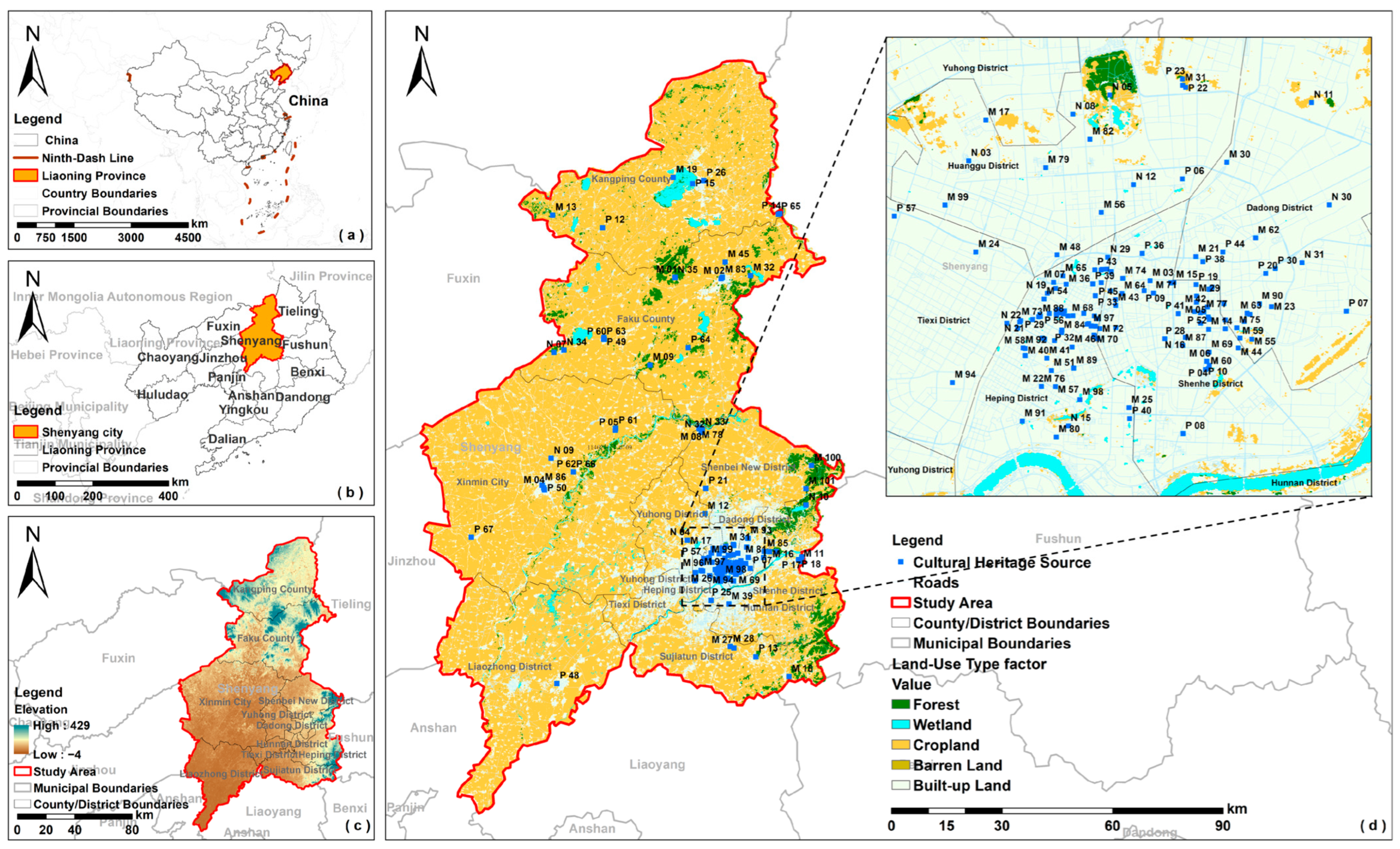
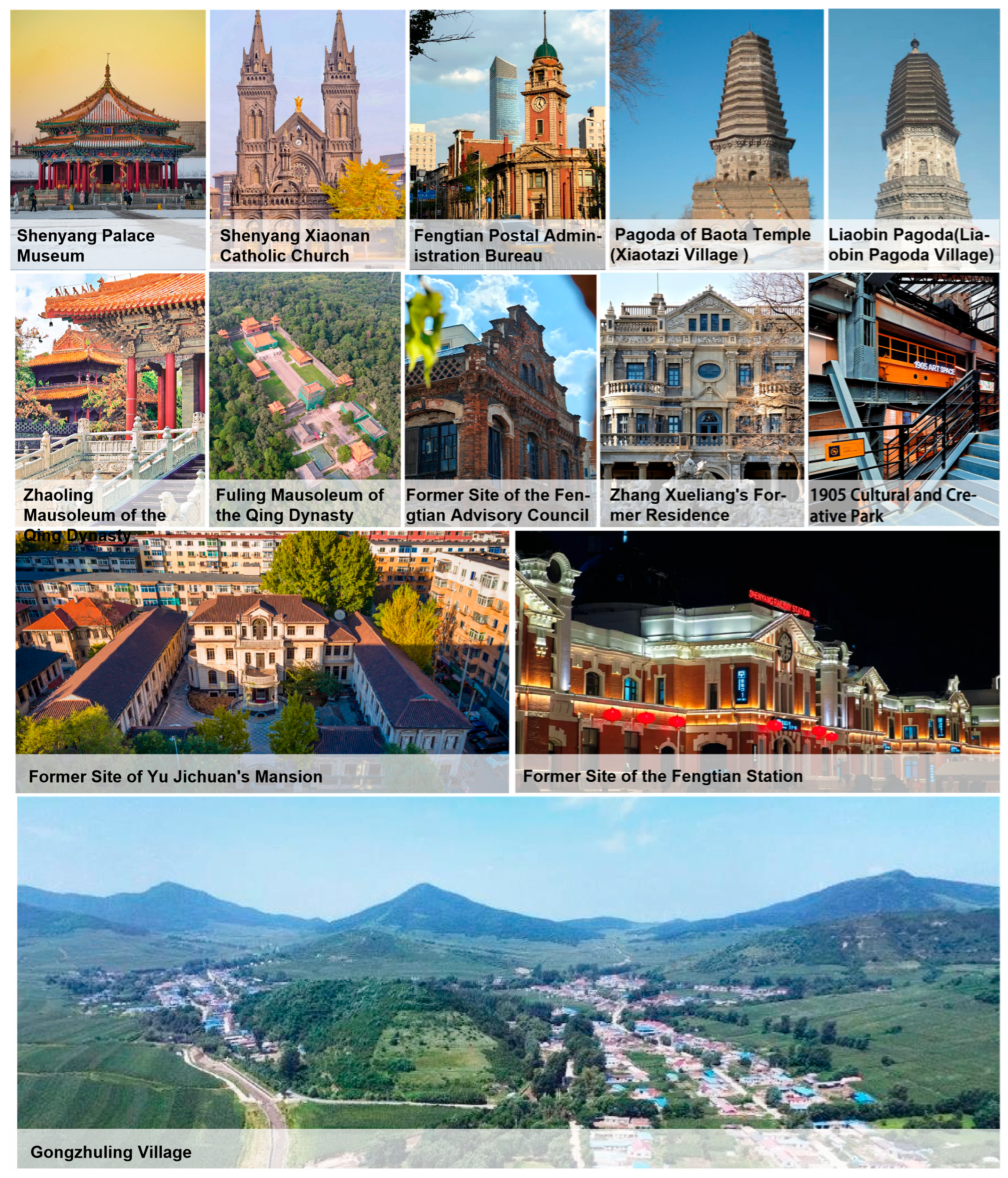
According to the immovable cultural heritage inventory published by the National Cultural Relics Bureau and the Shenyang Cultural and Tourism Bureau, the study area contains 314 cultural heritage protection sites at the municipal level and above, as well as 12 traditional villages at the provincial level and above. However, the reliability of corridor network structure generation is affected if discrete data is included due to inaccurate or missing spatial coordinate records for some heritage protection units, thus impacting the overall efficiency of corridor planning. Therefore, the study ultimately selected 191 cultural heritage protection sites and 12 traditional villages for analysis (Figure 1 and Figure 2), including 31 national cultural relic protection sites, 4 national-level famous historical and cultural towns and villages, 59 provincial cultural relic protection sites, 7 provincial traditional villages and 101 municipal cultural relic protection sites. Table 1 presents the composition of the 203 cultural heritage sites in the study area by protection level. The data reveal a pyramidal hierarchical structure: municipal-level sites account for the highest proportion (49.75%), followed by provincial-level (33.01%) and national-level sites (17.24%). This hierarchical distribution reflects Shenyang’s endowment as a historical city, where medium- and low-level heritage sites constitute the majority of the heritage system. However, their spatial distribution exhibits significant differentiation: national-level sites are concentrated in historical core districts (Huanggu, Shenhe), provincial-level sites are distributed in central urban areas and peri-urban industrial zones, while municipal-level sites are widely scattered across all districts and counties. This pattern of high-level concentration, low-level dispersion precisely illustrates the spatial polarization risk inherent in hierarchy-centered paradigms, as discussed above. The legal basis and grade description for each protection level are provided in the table notes; the complete list of heritage sites is available in Appendix A, Table A1.
Confronted with the pronounced typological and hierarchical diversity of heritage, our classification logic does not employ administrative grades as input weights for network construction; instead, they are utilized as label variables for post hoc validation. We advocate transcending the limitations of traditional typological or chronological thematic classification and redirecting focus toward the functional positioning and latent connectivity of heritage sites within contemporary urban spatial structures and public activity fields [46]. The core of this study lies in testing a novel logic of network construction: identifying and optimizing spatial connections without presupposing heritage-specific classifications, grounded solely in the spatial attributes of heritage clusters and the human activity data they host, to maximize the overall service efficiency and experiential resilience of the heritage assemblage. In other words, we aim to build a resilient network rooted in spatial–functional linkages to address planning prioritization under resource constraints. Shenyang, with its exceptionally diverse heritage typologies and status as a National Famous Historical and Cultural City, offers an ideal testing ground for validating this human-centered, contemporary-oriented network planning paradigm.

2.2. Determination of Resistance Factor

Based on the research of Zhou et al. [3,31] on the MCR model and combined with the actual conditions in Shenyang, a multidimensional comprehensive stress resistance evaluation system was established. Its theoretical framework is based on the costs affecting connectivity between heritage sites, which are jointly determined by the difficulty of traversing the multidimensional environmental space in which they are located.
First, the natural environment dimension characterizes the physical accessibility of the landscape. Shenyang’s natural geographic pattern—nestled between mountains and water, transitioning into plains—directly determines the composition of fundamental resistance factors. The extension of the Hadalings Range, a spur of the Changbai Mountains, into the urban area, coupled with the traversing of the Hun and Liao river systems, forms the original framework for heritage distribution. Digital Elevation Models (DEM) and slope factors quantify this topographic variation [47], explaining why pre-Qing sites and beacon towers predominantly cluster in eastern hills, while palaces, tombs, and major settlements concentrate on the Hun River alluvial plain. The distance-to-river factor directly reflects the macro-scale pattern of Shenyang’s cultural heritage distributed in belts along water systems, serving as a key to identifying potential historical water corridors [48]. The Normalized Difference Vegetation Index (NDVI) further delineates the transition from urban built-up areas to peripheral ecological zones, where resistance gradients influence the potential for integrating cultural heritage with ecological landscapes.
Second, Shenyang’s dramatic spatial transformation from the “Imperial Capital of Shengjing” to the “Industrial Eldest Son of the Republic” renders built environment factors indispensable. The overlay of the Qing dynasty’s “square city” layout with the modern Manchurian railway network and industrial zones has created a collage-like urban texture [45]. Resistance values for land use types must differentiate between high-intensity planning zones eroding heritage ambiance, buffering green spaces and water bodies, and historic urban fabric preserving historical memory [13]. Road hierarchy and density factors precisely depict the complex transportation system—both connecting and dividing—formed by historical networks like Taiyuan Street and modern expressways [9]. This is crucial for simulating contemporary population movement between heritage sectors such as the historic city center and the Tiexi industrial zone. Meanwhile, POI density serves as a spatial proxy variable representing human activity intensity and regional vitality, effectively reflecting the completeness of public facilities surrounding heritage sites and thereby influencing the convenience of public recreational behaviors [49]. In low-density POI areas, the lack of public services, inadequate transportation support, and insufficient vitality significantly undermine the connectivity efficiency of heritage sites within such zones. Conversely, high-density POI areas—supported by well-established facility networks and frequent socio-economic activities—provide a practical foundation for the formation of heritage corridor paths. This facilitates targeted corridor planning in connecting vitality nodes and mitigating the spatial mismatch inherent in the heritage system.
Third, the socio-economic dynamics dimension characterizes the spatiotemporal distribution and vitality intensity of human activities. It addresses the core contradiction in Shenyang’s heritage preservation: the spatial clustering of historical value versus the spatial mismatch of contemporary vitality. This manifests as overcrowding in the Forbidden City to Zhongjie area, coexisting with the desolation of numerous industrial heritage sites and remote ruins. Human activity heatmap data quantifies this vitality gap, ensuring corridor planning directs vitality rather than merely connecting spaces. Nighttime light indices form indicators measuring a heritage site’s regional economic soil [50]. They reveal why historic buildings around Zhongshan Square are easily revitalized, while isolated sites like Liaobin Tower face development challenges. Supply-demand accessibility directly situates all 203 heritage sites within existing urban-rural residential and road network structures, calculating the objective cost of serving actual populations [51]. This anchors corridor planning in authentic civic living spheres. Ultimately, this research employs a multi-source data framework, with data primarily categorized into three major categories: natural environment, built environment and socio-economic dynamics.

2.3. Data Source and Processing

Based on the determined resistance factors, all datasets were projected and unified into the WGS_1984_UTM_Zone_51N projected coordinate system and resampled to a 50 m × 50 m grid resolution to ensure consistency in the analysis. The specific data sources and processing are as follows (Table 2).
In terms of natural environment data, terrain and slope data are obtained from DEM elevation raster data provided by China Geospatial Data Cloud Platform, and the data accuracy is 30 m. The river buffer data is obtained by calculating the buffer of the urban water area vector data from OpenStreetMap and is divided into 5 levels based on the distance from the water area. The vegetation coverage data is obtained from the NDVI data of Luojia-1 Satellite Imagery, with a data accuracy of 250 m.
In terms of built environment data, the Chinese Academy of Sciences’ Resource and Environmental Science and Data Platform provides land use type data, which is categorized using the “Land Use Status Classification” (GB/T 21010-2017) [13]. Road hierarchy data is obtained from OpenStreetMap and divided into five levels according to Shenyang’s urban road planning. Road density data is obtained through the linear density analysis of road vector data [52]. Point of interest (POI) data for public service facilities is obtained from the POI data provided by the Baidu Map API interface. Following verification, deduplication and coordinate correction, the total effective data comprises 313,328 records. This includes categories and locations of various types of infrastructure in Shenyang, such as traffic stations and entertainment facilities.
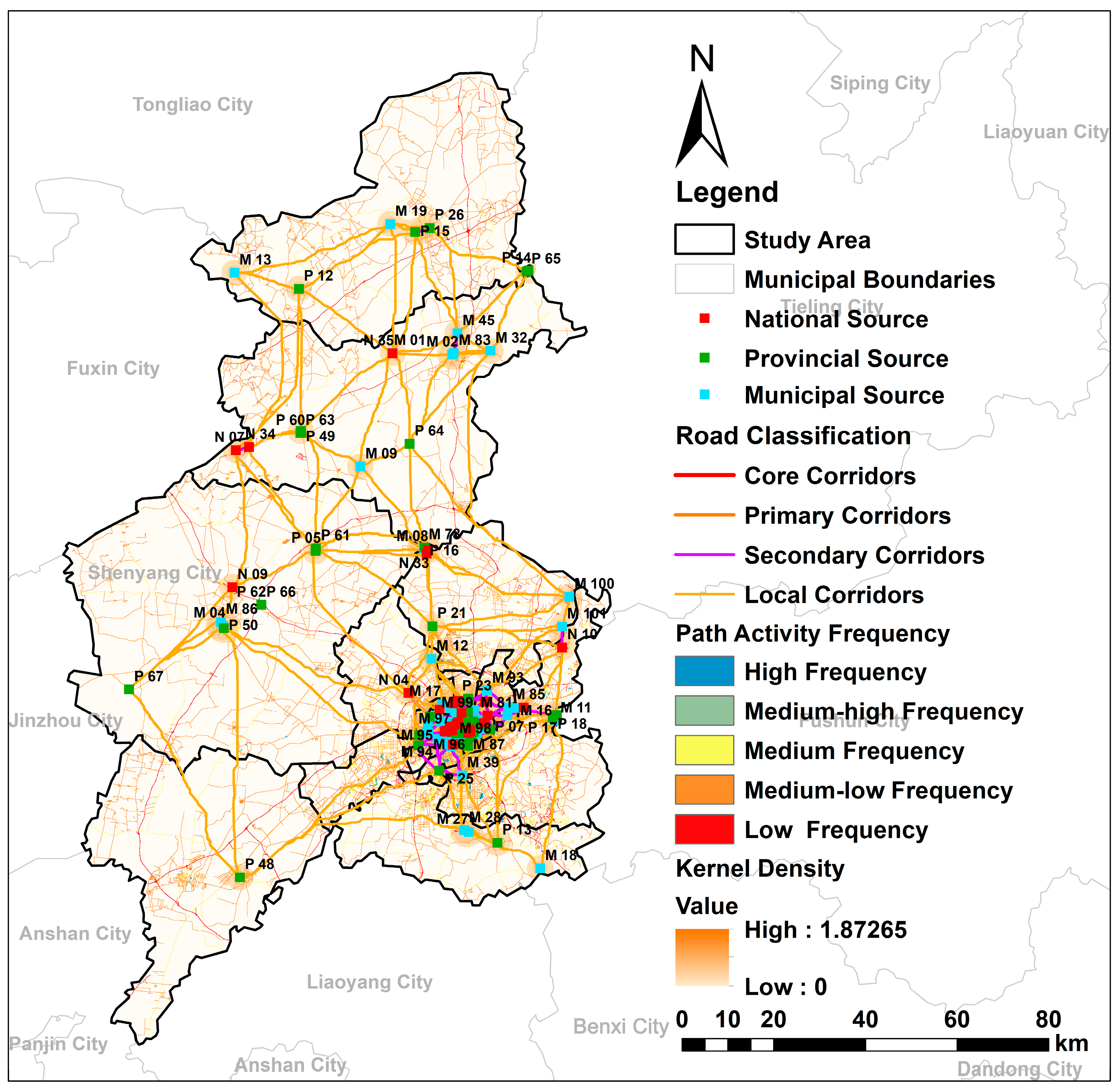
About socio-economic dynamic data, the evaluation of recreational potential is derived from the high-frequency activity paths of crowds, which are obtained by superimposing travel thermal data and road vector data [53]. Residents’ travel thermal data is derived from Baidu’s official website. The Baidu heat map of Shenyang City was crawled using Python 3.10.12 on 29 April 2025 (a working day) and 5 May 2025 (a holiday), from 00:00 to 24:00 over 24 h, with updates every 60 min. This data was then georeferenced and vectorised for basic research purposes. The heat values were classified using the natural grouping method. Nighttime light data were obtained from the Luojia 1-01 Spacecraft, while population density data were derived from the LandScan Global population distribution dataset [50]. GDP data was generated by superimposing these two datasets onto the same grid dimension. Since accessibility to residential areas and heritage resource points needs to be calculated using network analysis, the service scope within a specific time threshold was calculated using residential areas and heritage resource points as starting points, with the road network acting as a constraint [31]. POI data for residential areas was obtained from the Baidu Map API interface, and the resource point data was consistent with the research object [49].

2.4. Research Methodology

Based on the above background, this study adopts a post hoc validation research logic: during the corridor network construction phase, no heritage grade or typology information is input—only the spatial locations of heritage sites and resistance factors reflecting public usage intensity and surrounding environmental characteristics are considered to generate the network; after network generation, statistical tests are employed to examine whether the distribution of heritage grades across corridors of varying importance tiers exhibits equilibrium. If the test results support equilibrium, this demonstrates that the usage-intensity-based network construction paradigm possesses an inherent capacity for de-hierarchization.
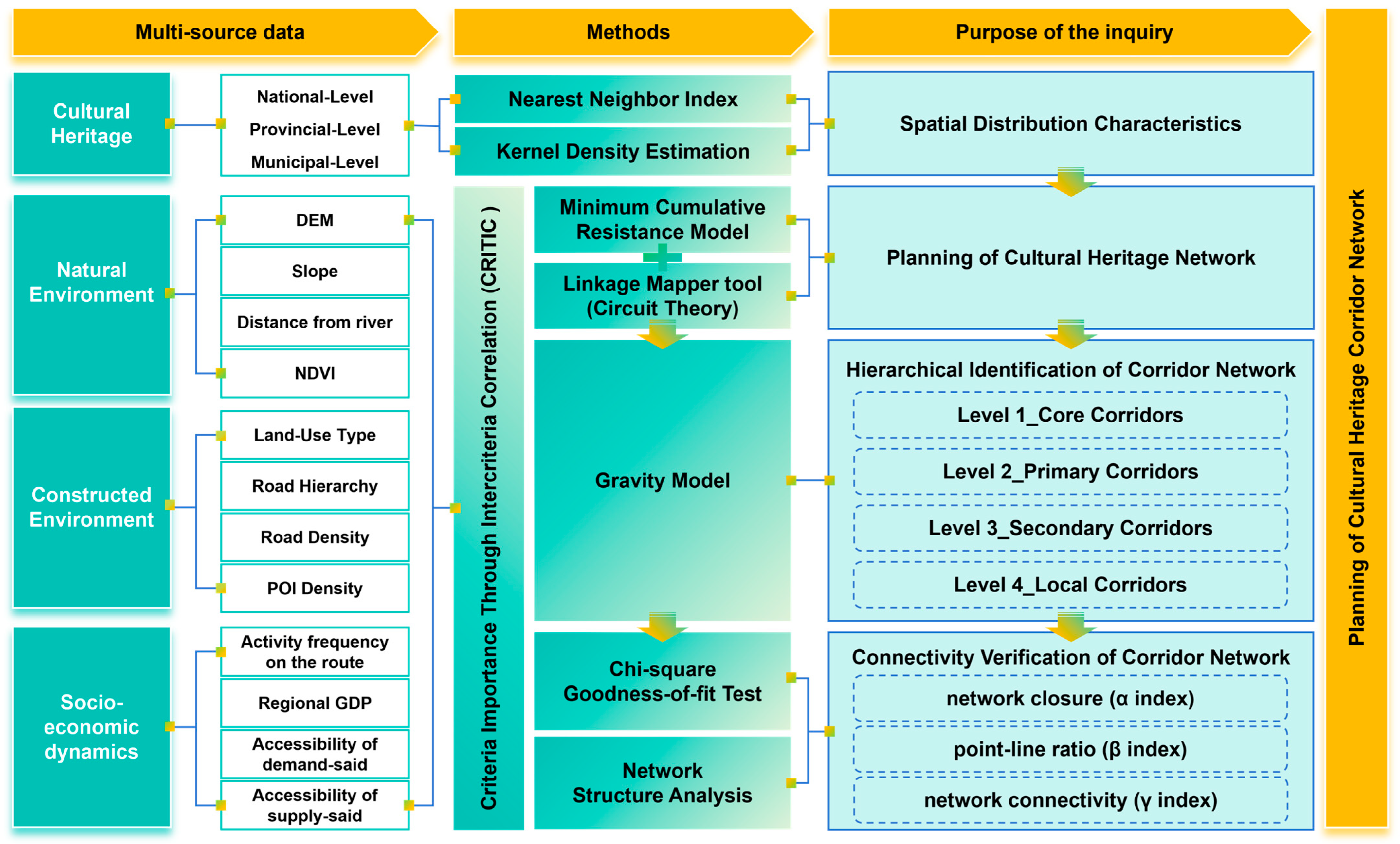
This study aims to establish a cultural heritage corridor system for Shenyang. The overall technical roadmap consists of four sequential modules (Figure 3): (1) analysis of spatial distribution characteristics of heritage sites; (2) planning of the cultural heritage network; (3) hierarchical identification of the corridor network; (4) connectivity verification of the corridor network. Specifically, the study first analyzes the spatial distribution characteristics of heritage sites at different protection levels. On this basis, the Minimum Cumulative Resistance (MCR) model is integrated with circuit theory to identify potential cultural heritage corridors, focusing on Shenyang’s cultural heritage resources. Subsequently, the gravity model is applied to grade the importance of the corridor network. Finally, the chi-square goodness-of-fit test and network structure analysis are employed to verify the equity of grade distribution and the connectivity of the corridors, respectively. In terms of methodological innovation, this study introduces the CRITIC (Criteria Importance Through Intercriteria Correlation) method to objectively assign weights to resistance factors, significantly reducing the interference of subjective factors and enhancing the scientific rigor and reproducibility of the findings. To improve the spatiotemporal adaptability and planning operability of the heritage network, this study comprehensively considers multi-dimensional resistance elements—including natural geography, built environment, and dynamic socio-economic factors—to establish an integrated resistance surface. This methodological framework provides theoretical support and practical pathways for the integrated conservation and revitalization of urban cultural heritage.

2.4.1. Analysis of Spatial Distribution Characteristics

(1)
Nearest Neighbor Index (NNI)
Nearest neighbour index analysis is a method of analysis that compares the distribution of points within a region based on the assumption that all points within that region are randomly distributed. Within the city, cultural heritage resources are represented as point elements. The distribution of these elements in space can be divided into three types: uniform, random, and cohesive. The principle of this method is to compare the calculated nearest neighbour index (NNI) with 1 [54].
When NNI = 1, the distribution pattern of the point elements tends to be average. NNI is the ratio of the ‘average observation distance’ to the ‘expected average distance’, and is calculated using the following formula:
N N I = r ¯ 1 r E ¯
r E ¯ = 1 2 D = 1 2 n A
In the formula, r1 is the average observation distance, representing the average distance between each point and its nearest neighbor. And r is the expected average distance, representing the theoretical nearest neighbor distance when the point elements are randomly distributed. A is the study area’s area, D is the point density, and n is the number of point elements.
(2)
Kernel Density Estimation (KDE)
Kernel density estimation (KDE) is a non-parametric method of estimating probability density, which is used to infer the distribution pattern of continuous random variables from finite samples [55]. It is a common method for analyzing the spatial distribution of points. It mainly reflects the degree of concentration and spatial aggregation of factor points, as well as the intensity of their influence on surrounding areas. The larger the kernel density estimate, the denser the points and the higher the probability of an event occurring in the region.
f x = 1 n d i = 1 n k x x i d
where k is the kernel function; d > 0 is the bandwidth; (x − xi) identifies the distance from the valuation point x to the xi’ heritage point.

2.4.2. Planning of Cultural Heritage Network

(1)
Criteria Importance Through Intercriteria Correlation (CRITIC)
To scientifically determine the weighting of each resistance factor within the suitability evaluation system, we employed the CRITIC method. This is an objective weighting method based on data volatility. The core idea is to use the standard deviation and the correlation coefficient to represent the variability and conflict between the indicators to determine their weight [56,57]. The greater the standard deviation, the greater the numerical difference of the factor and the greater the weight assigned to it. A greater correlation coefficient indicates less conflict between this factor and other factors, so the weight assigned to it should be reduced. The product of the standard deviation and the correlation coefficient represents the amount of information. The greater the amount of information, the greater the role of the influencing factor in the whole system and the greater the weight assigned to it should be. In practice, the CRITIC weighting method first performs dimensionless processing on the data to eliminate the influence of different index dimensions. Then, the standard deviation and correlation coefficient of each index are calculated to obtain the specific values of contrast strength and conflict. Finally, the contrast strength is multiplied by the conflict index and normalized to obtain the final weight [56].
R j = i = 1 n 1 r i j
C j = T j i = 1 n 1 r i j = T i × R J ˙
w j = C j j = 1 n C j
In the above formula, n represents the number of influencing factors. In Equation (4), Rj denotes the conflict level among the indicators and rij represents the correlation coefficient between the indicators. In Equation (5), Tj is the standard deviation of the indicator data, reflecting variability. Each indicator’s information content is indicated by Cj in Equation (6); higher information content indicates a more important position within the evaluation system and calls for a higher weight allocation. Thus, wj represents the weight assigned to each indicator.
(2)
Minimum Cumulative Resistance (MCR) Model
The minimum resistance model was originally used to design ecological corridors by simulating the minimum cost to species of crossing landscapes with different resistance values. Kongjian Yu and other scholars then introduced this model to the field of heritage corridors, employing it to simulate cultural heritage experiences in specific locations [58]. In this process, different environmental factors have different resistance values. The greater the resistance value, the less suitable the environment is for carrying out the activity, and vice versa. The path with the lowest cumulative resistance value is the best one to take when traveling from the “source” of the heritage corridor to the endpoint [59].
M C R = f m i n i ˙ = 1 n D i j × R i
In the formula, f represents the positive correlation between cumulative resistance and the motion process, Di represents the distance from heritage location i to environmental element j, and Ri represents the resistance of this location to heritage restoration activities within the heritage corridor. After determining the sum of the resistance coefficients of the different characteristic areas of the heritage ‘source’ and the environmental factors of the heritage recreation activities, the comprehensive resistance evaluation results of the heritage recreation activities are obtained using relevant GIS spatial analysis. In this study, Ri is not a single environmental resistance value but rather a multidimensional, dynamic, comprehensive resistance value synthesized by the weighted superposition of the natural environment layer, the built environment layer, and the socio-economic factor layer. Each factor index is assigned a weight objectively using the CRITIC method. Dynamic weight assignment avoids subjective deviation and enables the weight distribution to better reflect the amount of different information provided by the actual data of each factor.
(3)
Circuit Theory (Corridor Network Planning)
Circuit theory is applied in the study of spatial ecology, cultural heritage protection, and urban planning [40]. Similarly to the principle of current flow, the random walk characteristics of electrons in the circuit are used to simulate the migration and diffusion processes of individual species, or gene flow, in a given landscape. The calculation of cultural heritage corridors is based on two theoretical principles. Firstly, the randomness of human motion is reflected in the random motion of the charge in the circuit. Secondly, the various environmental or social resistance factors encountered during the process produce different resistance effects to simulate the optimal corridor path. The planning of cultural heritage corridors based on circuit theory requires the use of the Linkage Pathways Tool in the Linkage Mapper toolbox, as part of the Circuitscape program, to identify linkage pathways [41]. Additionally, the cost-weighted distance threshold for truncating corridors was set at 200,000 m. The determination of this threshold was based on a quantitative analysis of the spatial extent of the Shenyang municipality. According to official survey data, the study area covers approximately 12,948 km2, with a spatial frame extending approximately 115 km east–west and 205 km north–south. Within the methodology of landscape connectivity and corridor modeling, determining connectivity thresholds based on the spatial extent of the study area is a fundamental principle designed to ensure the analysis captures strategic linkage patterns at the regional scale [60]. Applying this principle to the specific context of Shenyang, the 200 km threshold was adopted as a robust planning-scale approximation of the 205 km maximum axis. This value resides within the same order of magnitude as the precise geodetic measurement, thereby faithfully representing the regional scale, while its rounded nature enhances clarity and utility for strategic planning communication and cross-study comparison. The threshold was thus selected to adequately cover this spatial framework, thereby connecting dispersed cultural heritage clusters across the municipality and identifying a regional-scale heritage corridor skeleton, as opposed to local, fine-grained connections. This logic for parameter setting—grounding a rounded, practical threshold in the measured spatial dimensions of the study area—aligns with practices adopted in comparable regional studies, such as those focusing on cultural heritage network construction in western Henan [61] and ecological security pattern identification in the Beijing–Tianjin–Hebei region [39]. The environment conducive to flow is characterized by lower resistance and higher current density, while the unsuitable environment shows higher resistance and lower density.

2.4.3. Hierarchical Identification of Corridor Network

(1)
Gravity Model (GM)
The Gravity Model is employed to quantitatively assess the intensity of interactions between heritage sites. Greater interaction between sites indicates lower resistance to the exchange of material and information between them, signifying a more significant role for that site and the importance of its directly connected corridors [33]. Consequently, the Gravity Model is utilized to identify key corridors within the cultural heritage network that play a crucial role in the connectivity of global heritage resource points. The calculation formula is as follows:
G i j = C i C j D i j 2 = 1 p × ln S i 1 p × ln S j L i j L m a x 2 = L m a x 2 ln S i ln S j L i j 2 P j P j
In the formula, Gij denotes the interaction force between heritage sites i and j, Ci and Cj represent the respective weight values of the two heritage sites, Dij denotes the standardized value of potential corridor resistance between sites i and j, Pj and Pj represent the resistance values of patches i and j, Si and Sj denote the areas of patches i and j, Lij is the cumulative resistance value of the corridor between patches i and j, and Lmax is the maximum value among all corridor resistances [34].

2.4.4. Connectivity Verification of Corridor Network

(1)
Chi-square Goodness-of-fit Test for Heritage Protection Level Distribution
To quantitatively assess the equilibrium with which corridors at different importance levels integrate heritage sites of varying protection levels, this study conducts a chi-square goodness-of-fit test for each of the four corridor importance levels (L1–L4), using the overall protection level structure of Shenyang’s heritage sites (national 17.24%, provincial 33.00%, municipal 49.75%) as the expected distribution.
First, for each corridor importance level k (k = 1, 2, 3, 4), the expected frequency Ejk of heritage sites at protection level j (national, provincial, municipal) is calculated as:
E j k = N k × P j
where Nk is the total number of heritage sites within level k, and Pj is the overall proportion of level j heritage.
Subsequently, a Pearson chi-square goodness-of-fit test was applied to each level. The test statistic is calculated as:
X k 2 = O j k E j k 2 E j k
where Ojk is the observed frequency (df = 2). If p > 0.05, the null hypothesis cannot be rejected, indicating that the distribution of heritage protection levels within that corridor level shows no significant difference from the overall regional distribution. Should this condition be met across the principal corridor levels, it demonstrates that the network as a whole exhibits no systematic preference for specific administrative protection levels, implying a decentralized hierarchical structure [62].
(2)
Network Structure Analysis for Corridor Connectivity Validation
Network connectivity indices are commonly employed to evaluate the complexity and ecological efficacy of the landscape corridor network. This study employs network closure (α index), point-line ratio (β index), and network connectivity (γ index) to conduct a quantitative analysis and evaluation of the overall condition of the cultural heritage network [51]. To assess the structural integrity and functional efficacy of the planned cultural heritage corridor network, the following three network indices are applied for validation, quantifying the network’s connectivity and complexity from a topological perspective:
a = L n + 1 2 n 5
β = L n
γ = L 3 n 2
In the formula, L refers to the number of connections, and n denotes the number of nodes. The α index varies between 0 and 1, with values closer to 1 indicating a higher degree of network closure. The β index ranges from 0 to 3, where larger values signify a more complex and stable network. The γ index fluctuates between 0 and 1, with values nearer to 1 reflecting a higher degree of node connectivity [63].

3. Results

3.1. Spatial Distribution Characteristics

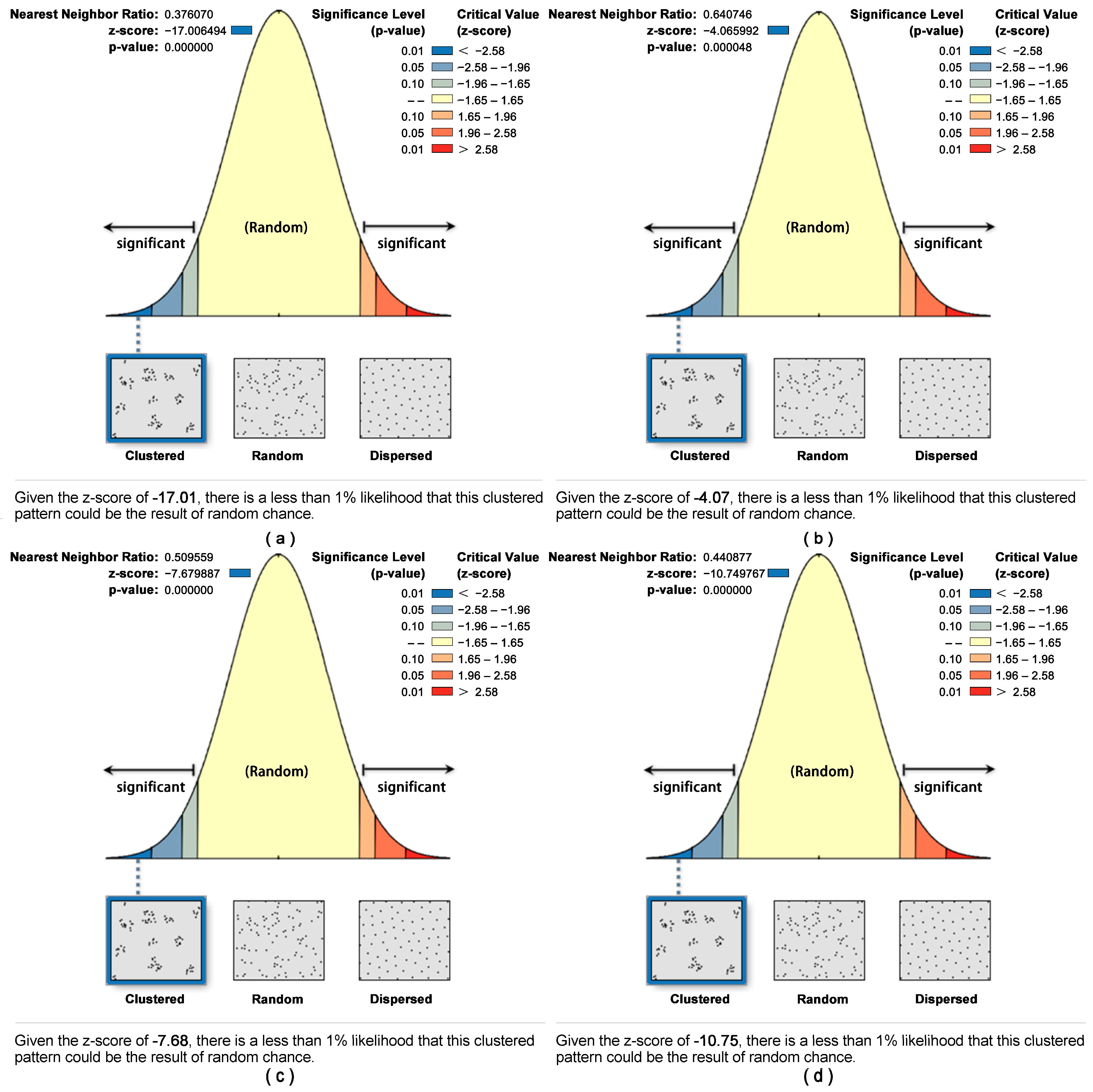
The Average Nearest Neighbor tool from the Spatial Statistics Tools in ArcGIS 10.8 was employed to quantitatively identify the spatial distribution patterns of cultural heritage resources in Shenyang. The analysis was conducted for all heritage sites as well as for subsets categorized by statutory protection level (national, provincial, and municipal). The results are presented in Figure 4.
Overall, cultural heritage sites in Shenyang exhibit a significant clustered pattern (Figure 4a). The observed mean distance ( r ¯ 1 = 1993.28 m) is substantially smaller than the expected mean distance ( r E ¯ = 5300.29 m), yielding a nearest neighbor index NNI = 0.376 (<1). The high statistical significance (z = −17.006, p < 0.001) indicates that the null hypothesis of complete spatial randomness is rejected at the 99% confidence level. Therefore, the overall distribution of cultural heritage sites in Shenyang is characterized as clustered.
Disaggregated analysis by protection level further reveals that all three grades exhibit significant clustering (Figure 4b–d). National-level sites (n = 35) have an NNI of 0.641 (z = −4.066, p < 0.001), provincial-level sites (n = 67) show an NNI of 0.510 (z = −7.680, p < 0.001), and municipal-level sites (n = 101) present an NNI of 0.441 (z = −10.750, p < 0.001). All p-values are below 0.001, confirming statistically significant clustering for each grade.
Notably, clustering intensity varies with protection level: the NNI decreases progressively from national (0.641) to provincial (0.510) to municipal (0.441), indicating that heritage sites with lower administrative grades exhibit statistically higher degrees of spatial clustering. This finding reveals distinct spatial patterns across heritage grades: higher-grade sites (e.g., national-level) are typically designated within specific historical core areas (e.g., the walled city of the Shengjing period) due to their unique historical value and conservation requirements, exhibiting a nucleated pattern characterized by a limited number of sites in strategically important locations. In contrast, the more numerous lower-grade sites—particularly municipal-level ones—are more integrated with the city’s everyday developmental processes, tending to form clustered distributions around historical districts, traditional communities, or specific functional zones across a broader urban-rural spectrum. Consequently, municipal-level heritage sites demonstrate stronger statistical clustering at the macro scale.
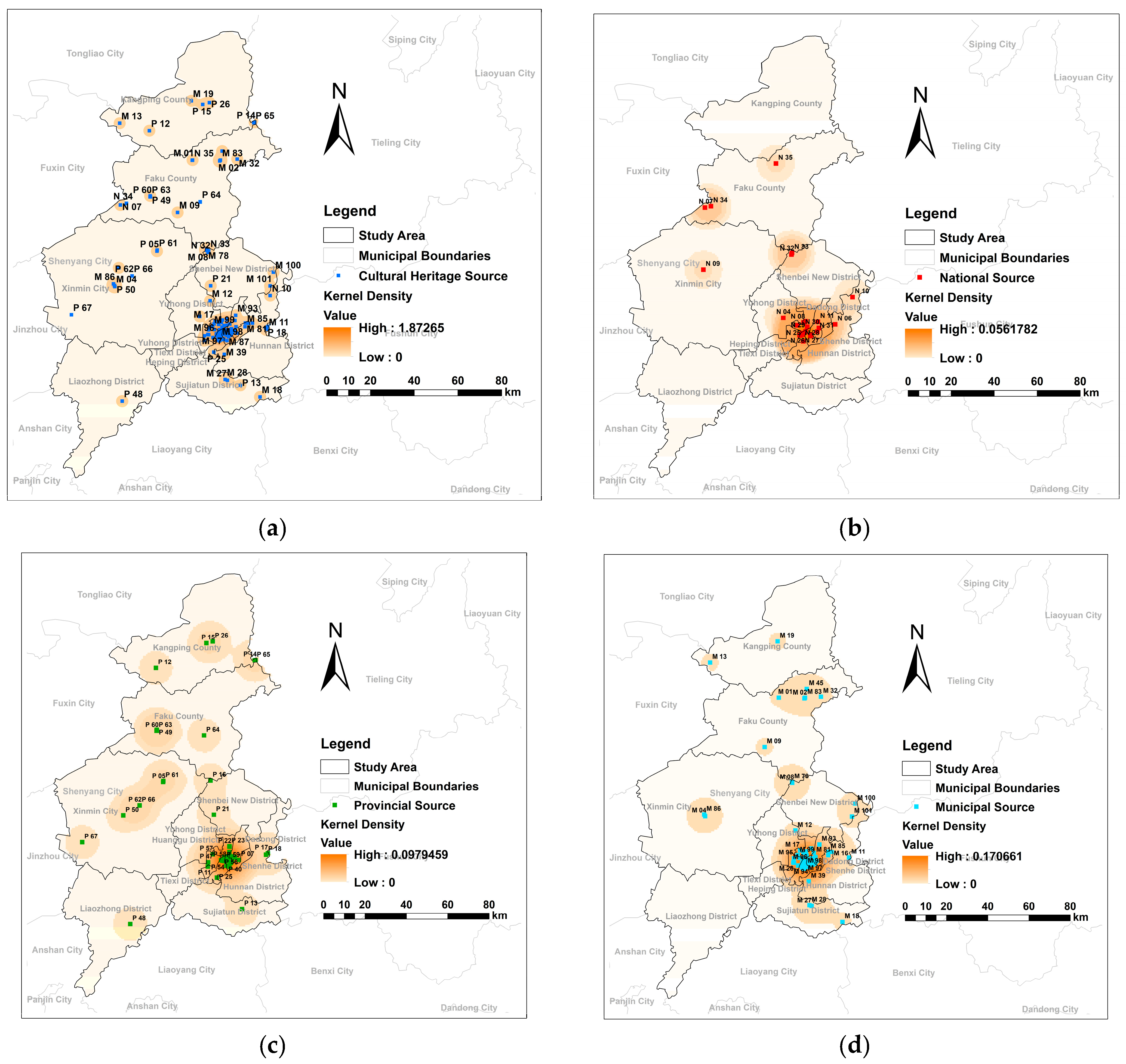
Kernel density estimation (KDE) was employed to quantify the spatial aggregation intensity and distribution patterns of cultural heritage sites across different administrative protection levels in Shenyang (Figure 5). The KDE value represents the intensity of spatial clustering, with higher values indicating stronger aggregation.
At the aggregate level, cultural heritage resources across the entire city (peak KDE = 1.873) exhibited a typical “one core with multiple satellites” clustering structure. The high-density core was highly concentrated in the central urban districts of Heping, Shenhe, Huanggu, and Dadong, reaching its peak value (KDE = 1.87265) at the junction of Shenhe and Heping Districts—forming the most densely distributed heritage region across the entire administrative area. Multiple secondary clusters developed in peripheral counties and districts, including Kangping, Faku, Shenbei New District, Xinmin, and Sujiatun. In contrast, areas such as Liaozhong District and western Xinmin represented cold spots, with KDE values approaching zero. This core–periphery structure reflected the macro-spatial characteristics of Shenyang’s cultural heritage: centered on the main urban core, radiating along the Hun River basin, and accompanied by multiple sub-centers.
Disaggregated analysis by protection level revealed significant spatial differentiation. National-level heritage (peak KDE = 0.056) exhibited the strongest spatial convergence, displaying a pattern of “monocentric core aggregation in the main urban area with discrete point distribution in peripheral areas.” High-density areas were almost entirely confined to the core urban districts of Shenhe, Heping, and Huanggu, forming the sole high-density cluster across the entire region. Peripheral areas contained only four isolated low-intensity clustering nodes in Faku, Xinmin, Shenbei New District, and eastern Hunnan District, demonstrating the most pronounced spatial imbalance among the three protection levels. Provincial-level heritage (peak KDE = 0.098) presented a pattern characterized by “core aggregation in the main urban area with balanced diffusion to multiple peripheral clusters.” Multiple secondary clusters of comparable scale and intensity formed in peripheral counties including Kangping, Faku, Xinmin, Shenbei New District, and Sujiatun, exhibiting notably superior spatial equilibrium compared to national-level sites. Municipal-level heritage (peak KDE = 0.171) displayed the highest clustering intensity and most extensive spatial coverage, closely aligning with the distribution pattern of all heritage sites combined. Multiple secondary clusters developed in peripheral areas including northern Kangping, eastern Faku, Shenbei New District, western Xinmin, and southern Sujiatun. The number of clustering nodes and spatial coverage both exceeded those of national- and provincial-level sites, establishing municipal-level heritage as the fundamental spatial foundation underpinning the “one core with multiple satellites” pattern across Shenyang’s entire administrative area.
The analysis revealed pronounced hierarchical spatial differentiation, collectively forming an overall spatial pattern characterized by “highly concentrated core, gradient diffusion to the periphery, and significant hierarchical differentiation.” As the administrative protection level decreased, spatial equilibrium progressively improved and coverage area expanded: national-level heritage was highly concentrated in the main urban core, provincial-level heritage formed multiple diffusion points in peripheral areas, and municipal-level heritage constituted the foundational network supporting comprehensive spatial connectivity. This hierarchical spatial structure—marked by the high convergence of high-value resources in the historical core and the deep integration of lower-grade heritage with everyday urban spaces—not only provides a spatial foundation for the construction of corridor networks but also results in the weakened perception of marginal heritage values and a lack of organic connections with the central area. This underscores the practical necessity of building a cross-regional heritage corridor network to enhance the overall effectiveness of heritage through systematic connectivity.

3.2. Planning of Cultural Heritage Network

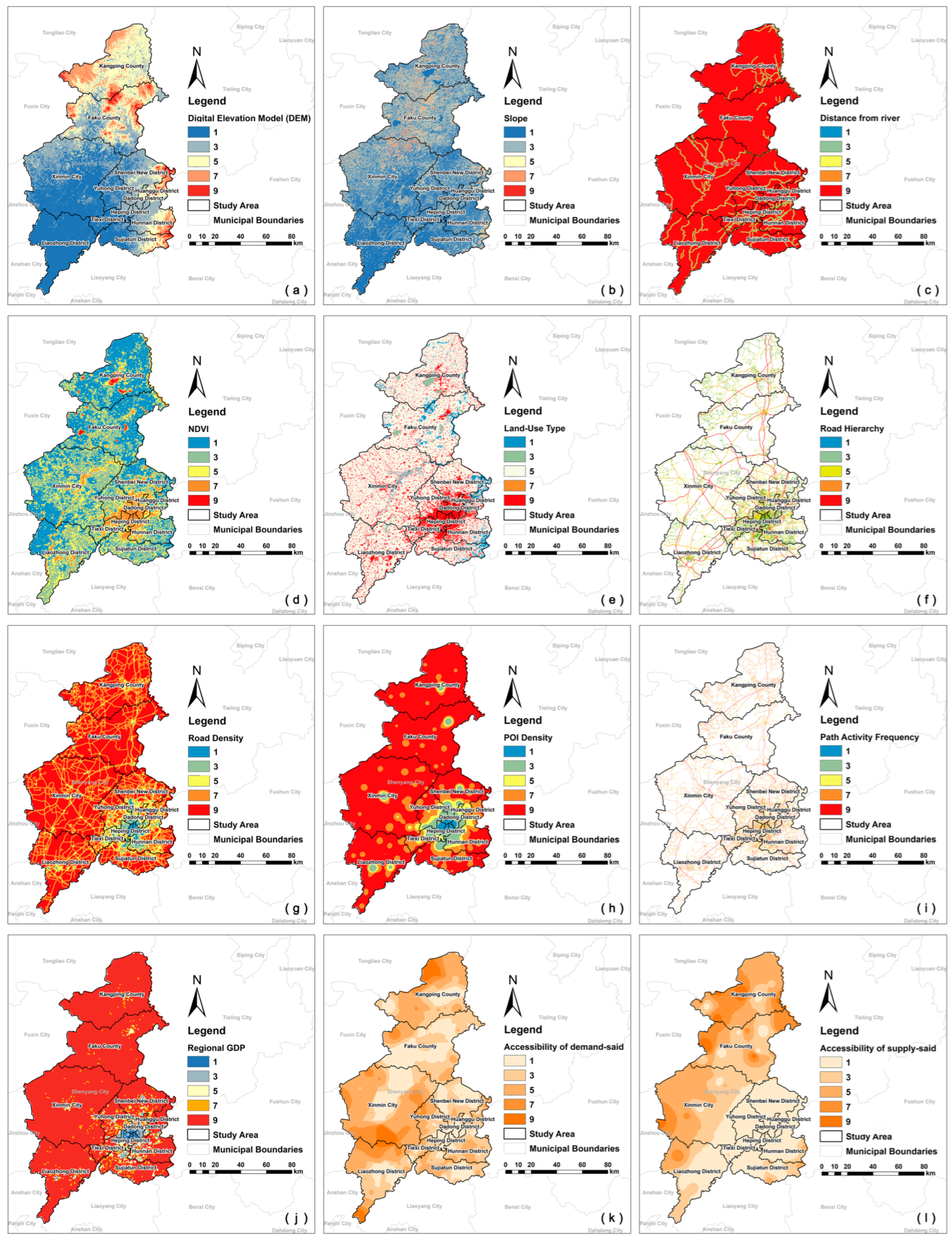
Based on the three dimensions identified in Section 2.2—natural environment, built environment, and socio-economic dynamics—this study selected 12 indicators to construct a multi-dimensional comprehensive resistance evaluation system. This system ensures that the MCR model not only incorporates ecological background and anthropogenic pressures but also integrates socio-economic functions, which are key drivers for the sustainable planning of cultural heritage corridors. Each resistance factor was reclassified and standardized using ArcGIS 10.8, employing a five-level classification system. The classification criteria were established by synthesizing relevant literature and expert judgment, with resistance values ranging from 1 to 9 for each level (higher values indicate greater difficulty of traversal). The specific classification standards and assignment logic are detailed in Table 3, while the spatial distribution of each single-factor resistance surface is shown in Figure 6. This standardization process laid the foundation for subsequent CRITIC weight calculation and the generation of a comprehensive resistance surface.
Based on this foundation, each factor illustrated in Figure 6 was statistically partitioned using the fishing grid method. Following positive and negative dimensionless processing of the original data, the CRITIC method was employed to calculate weights based on the conflict and variability among the factors; the results are presented in Table 4. The weight analysis indicates that socio-economic factors dominate the spatial pattern of the corridor, accounting for 43.52% of the total weight, followed by natural environment factors (35.08%) and built environment factors (21.40%). This suggests that the connectivity of the Shenyang cultural heritage corridor is not only constrained by natural geographical conditions but is also profoundly driven by human socio-economic activities and spatial demands.
Focusing on the dominant socio-economic dimension, the frequency of path activity (14.36%) and the accessibility of demand points (13.86%) carry the highest weights. This underscores that actual public leisure behavior patterns and the distribution of residential areas are key drivers of cultural heritage connectivity. Spatially, these high-weight factors exhibit a significant core–periphery gradient: the frequency of path activity peaks in the central urban districts (Heping, Shenhe, Huanggu) and rapidly decays towards the outer suburban counties (Kangping, Faku). Accessibility to demand points follows a similar pattern centered on major residential areas. This spatial structure directly contributes to the low center, high periphery pattern observed in the comprehensive resistance surface (Figure 7).
Within the built and natural environments, the contributions of factors exhibit distinct characteristics. In the built environment, the weight of land use type (10.21%) is significantly higher than that of linear features such as road slope (1.56%). This indicates that the connectivity constraints captured by our resistance surface stem primarily from human activities and socio-economic factors rather than the road network structure alone—particularly in peripheral areas, where socio-economic factors dominate the resistance pattern. Although natural environment factors collectively hold a relatively high weight (35.08%), their internal weight distribution is relatively balanced (DEM: 0.0846, Slope: 0.0906, Distance to River: 0.0922, NDVI: 0.0834). This suggests that they function more as fundamental baseline conditions imposing systematic constraints rather than as decisive limitations.
Regarding factor attributes, most high-weight socio-economic factors, such as path activity frequency and regional GDP, are negatively correlated with resistance. This demonstrates that higher levels of human activity and stronger economic development can reduce resistance to cultural heritage connectivity. It corroborates the hypothesis that high-vitality areas often coincide with cultural heritage concentration zones or serve as ideal connectivity corridors.
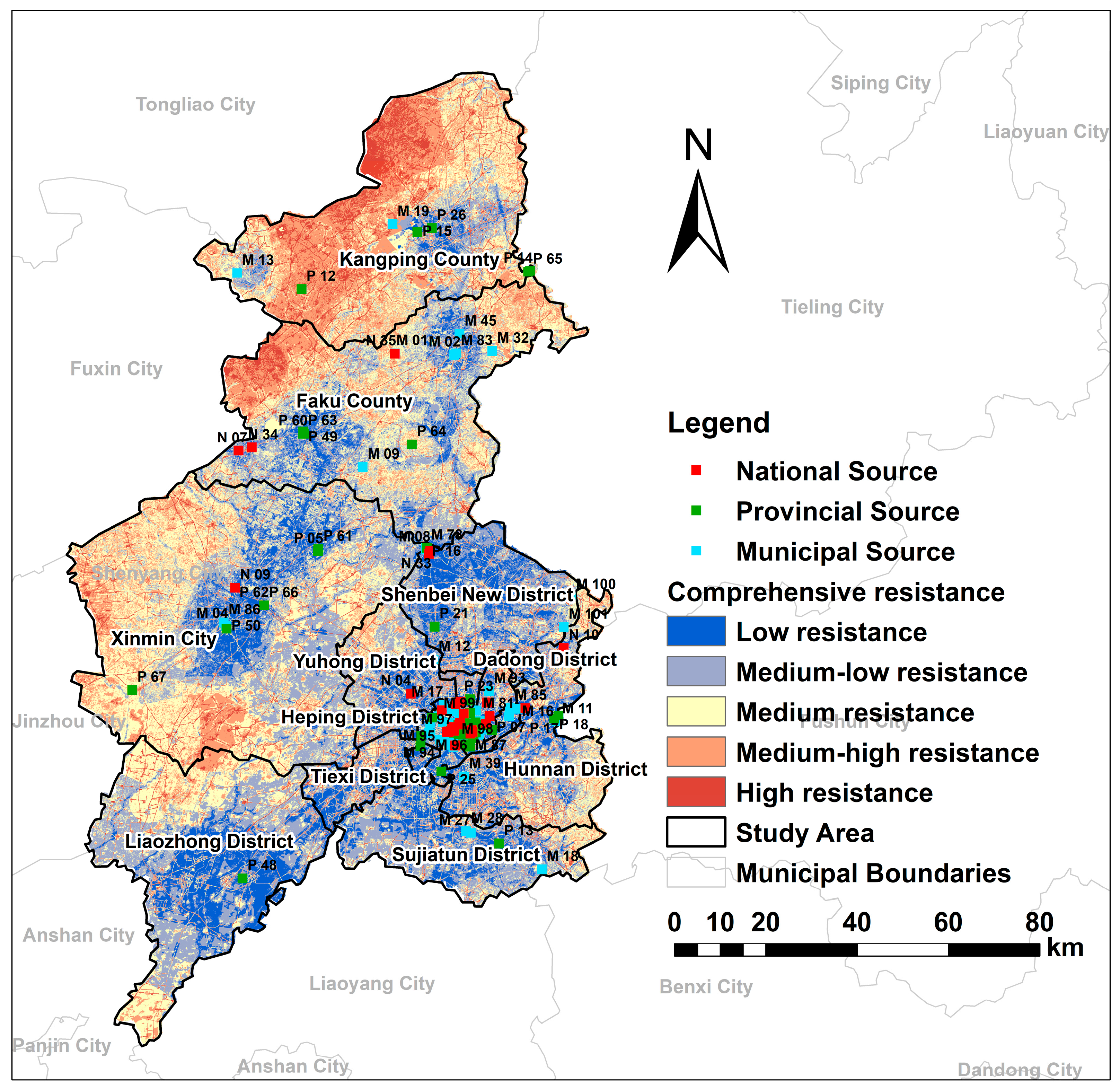
Subsequently, based on the weights determined by the CRITIC method, the 12 standardized resistance elements mentioned above were combined through weighted overlay analysis to generate a comprehensive resistance surface for the spatial connectivity of cultural heritage sites in Shenyang (Figure 7). This resistance surface quantitatively integrates. comprehensive cost required for traversing between any two points within Shenyang’s geographical space, simulating a cost surface that more accurately reflects the actual traversal experience. The results indicate that the comprehensive resistance surface of Shenyang exhibits a spatial pattern distinct from a “low center, high periphery” spatial pattern: resistance values are lowest in the central urban districts (Heping, Shenhe, Huanggu, Dadong), gradually increase in the inner suburbs, and peak in the outer counties (Kangping, Faku, Xinmin, Liaozhong). This pattern directly mirrors the spatial distribution of high-weight socio-economic factors and will serve as the foundational input for the MCR-based corridor identification and circuit theory analysis.
To be specific, the low-resistance and medium-low resistance zones correspond to the blue and blue-grey areas, which are concentrated in the central urban districts centred on Shenhe and Heping, as well as along major transport corridors. Scattered clusters are also present in the city centres of Kangping County, Fakou County, Xinmin City and Liaozhong District, with high overlap with built-up areas. These zones correlate with high-density cultural heritage distributions, forming the core matrix for cultural heritage protection. The moderate resistance zone corresponds to the light yellow area on the map and is primarily distributed in the urban-rural transition zones of the Hunnan and Yuhong districts, as well as around Xinmin City. This area is dominated by farmland and low-density residential areas and exhibits transitional characteristics in terms of average resistance values. The high-resistance zone and the medium-high-resistance zone correspond to the orange-to-red areas on the map. They are extensively distributed in the outlying counties of Kangping and Fakou, as well as in the city’s peripheral areas. They frequently appear on the northwestern edge. Heritage point density is relatively low. Due to average slopes exceeding 15° in some areas, the combined impact of the terrain and the scarcity of cultural heritage foundations creates significant barriers to the spatial connectivity of cultural heritage elements. This forms marginal fracture zones within the heritage landscape network.
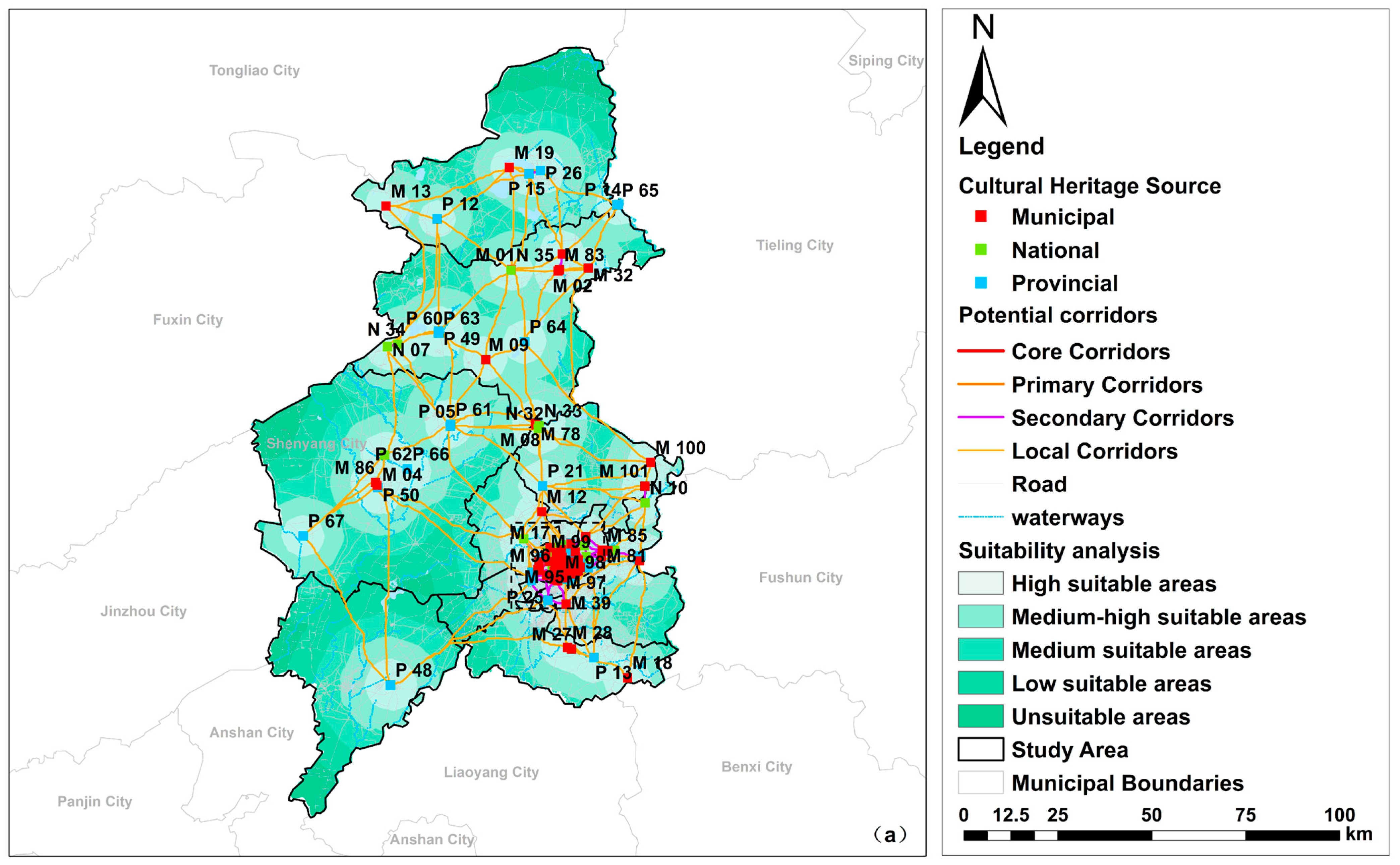
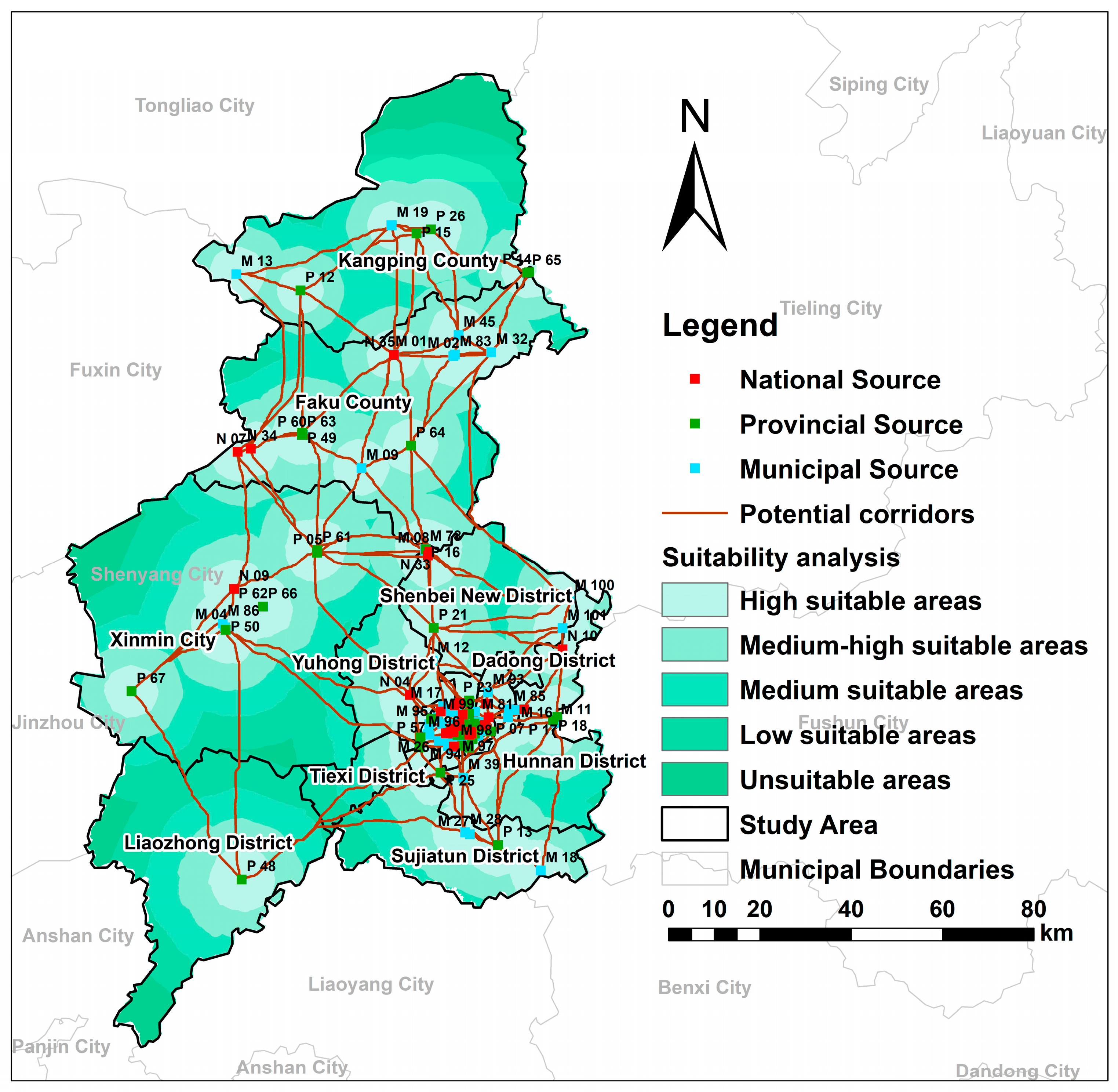
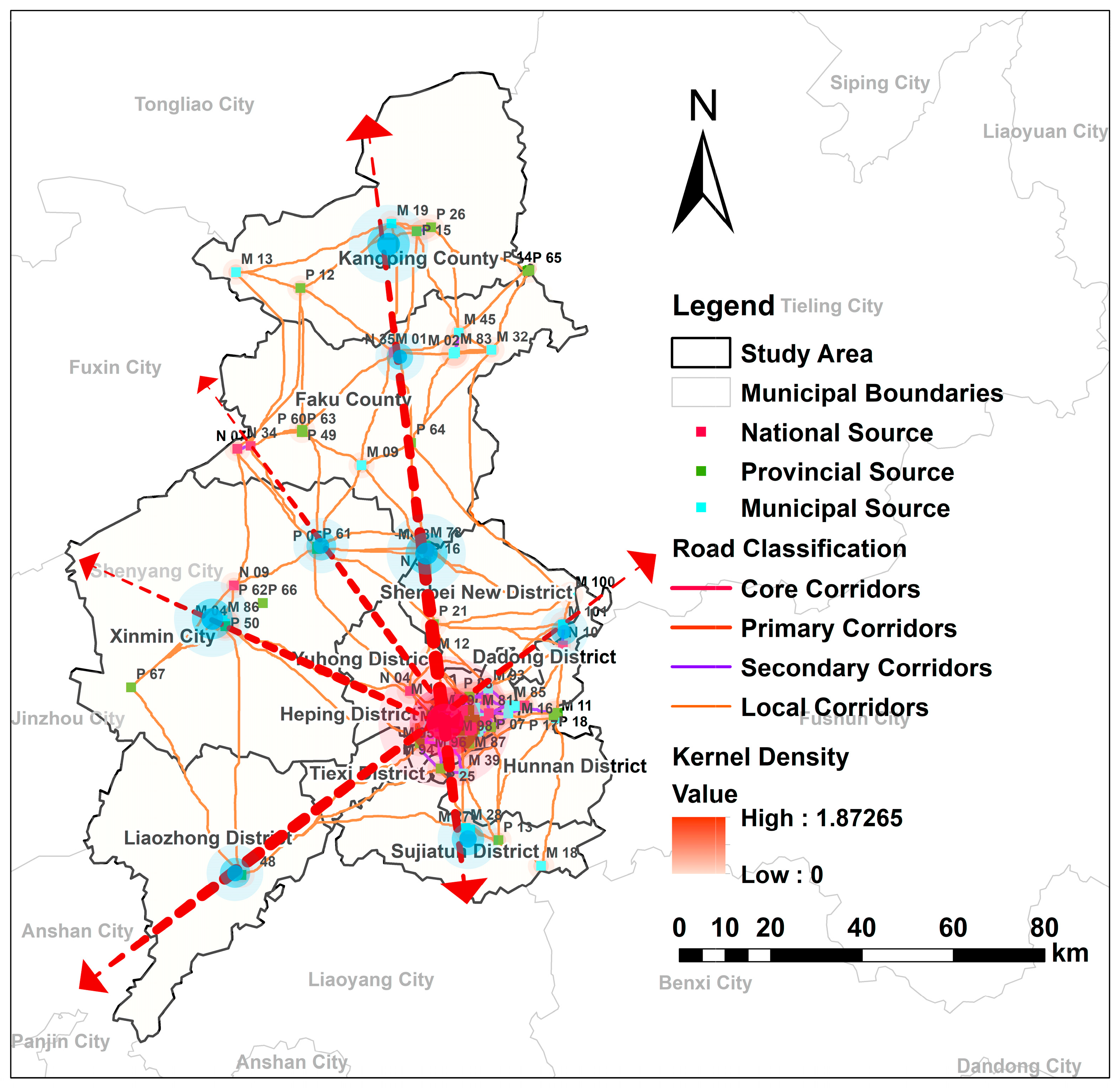
As illustrated in Figure 7, this study employed the MCR model and circuit theory to simulate the spatial potential for establishing connections between all possible node pairs. A total of 203 cultural heritage sites were designated as “source” nodes in the simulation. Specifically, the Linkage Pathways Tool module within the Linkage Mapper toolbox was employed to compute multi-path network connectivity between any two heritage nodes. In consideration of Shenyang’s urban spatial dimensions, the cost-weighted distance threshold for the truncation of corridors was determined to be 200,000 m. As demonstrated in Figure 8, this process yielded 611 potential corridors, defined as spatial overlays of the lowest-cost paths (LCPs) between node pairs. Each corridor is specifically designed to provide a direct connection between two distinct cultural heritage sites. The winding forms of these structures do not arise from random processes, but rather, they are a consequence of a spatial logic that seeks to minimise cumulative costs when traversing the composite resistance surface. The network under discussion here is one that covers an area of approximately 45,014 km and forms the macro-structural backbone for the comprehensive connectivity of Shenyang’s cultural heritage.

3.3. Hierarchical Identification of Corridor Network for Cultural Heritage

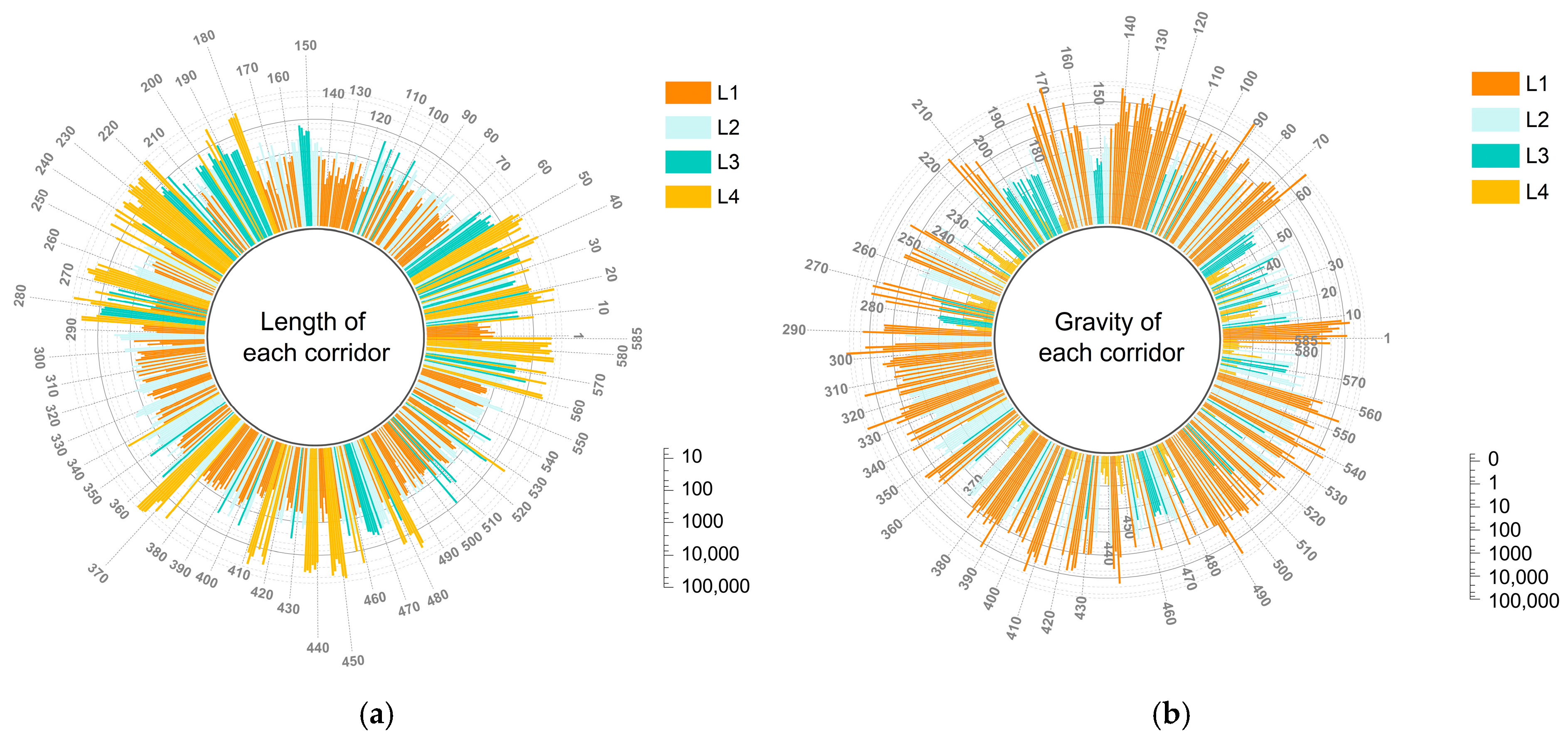
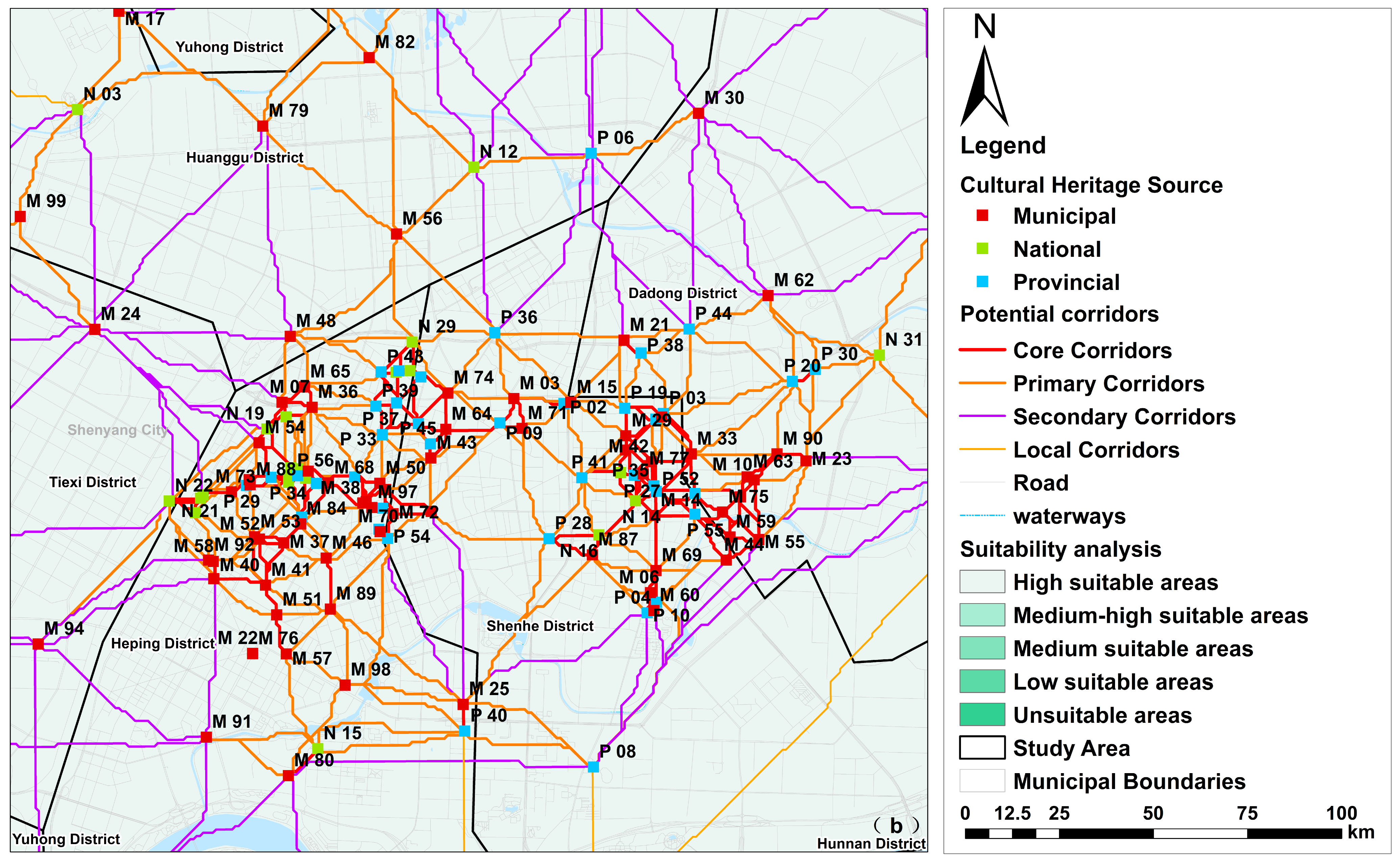
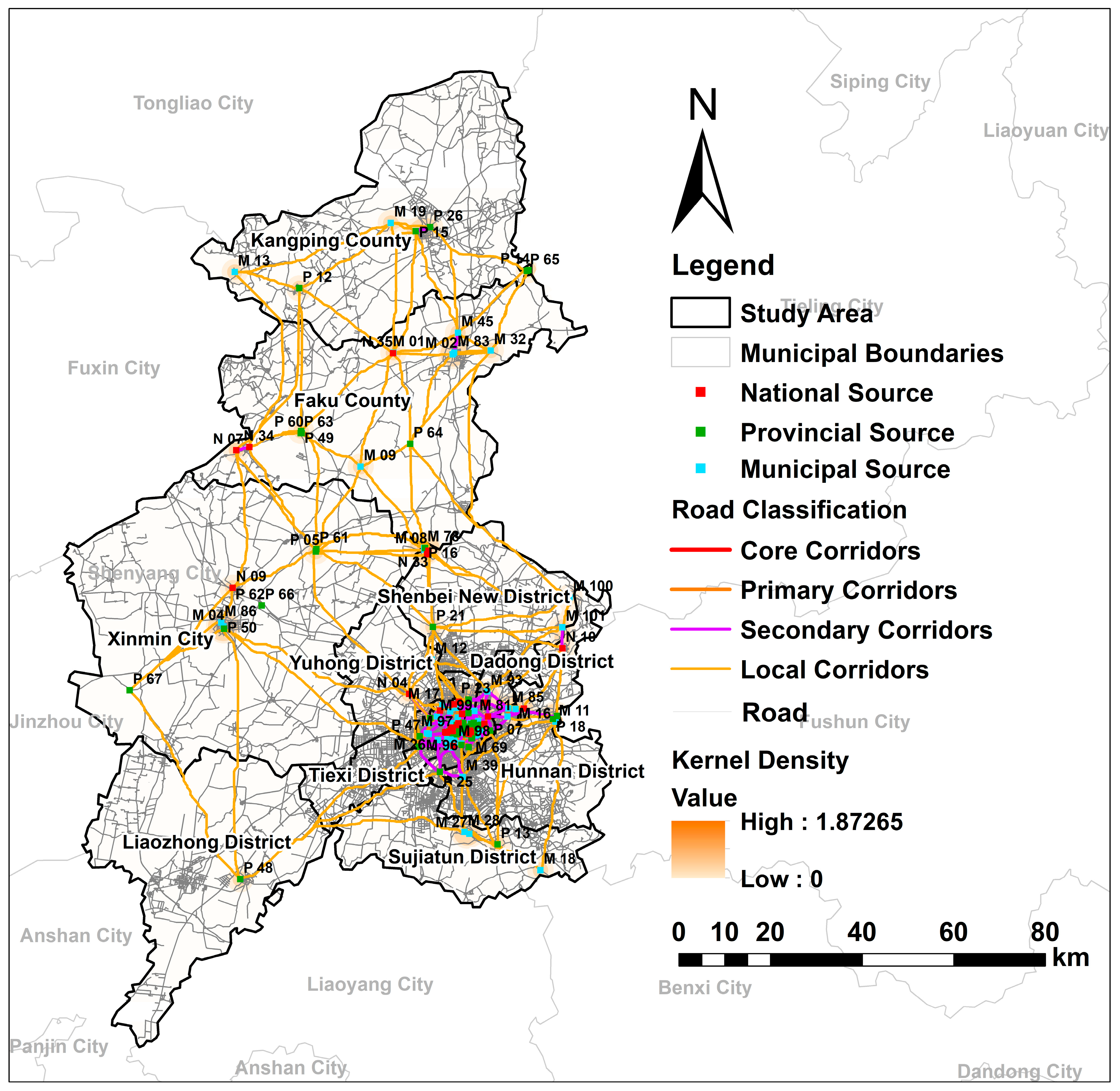
To further assess the importance of the corridors, 31 segments with excessively long cost paths or completely impassable barriers were excluded. Ultimately, 585 critical heritage corridors were identified, totaling approximately 4116 km. The Gravity Model was introduced to quantify and classify the strength of corridor connections. The results reveal a distinct hierarchical structure and spatial differentiation within the network. Based on gravity values (g), the corridors were categorized into four primary grades. Core and primary corridors establish robust direct connections between the most significant heritage clusters, while Secondary and local corridors form a resilient capillary system linking less prominent yet critically important heritage resources, thereby ensuring the network’s overall integrity and accessibility [15] (Table 5; Figure 9 and Figure 10). The complete dataset is available in the Figshare repository (see Data Availability Statement).
Specifically, a total of 394 core and primary corridors are highly concentrated in central urban districts such as Shenhe and Heping, accounting for over 65% of all corridors at all levels. This phenomenon is deeply rooted in the historical path dependence of urban development in Shenyang. The primary concentration of these corridors is observed to be surrounding the Shenyang Fangcheng Historic District and its extensions, including the commercial port area and the South Manchuria Railway Concession. This has formed a tertiary radiation structure centered on Zhongshan Square, the Shengjing Imperial City, and the Xibo Ancestral Temple. The area under consideration constitutes a dual-overlay zone of the Qing Dynasty Shengjing Imperial City and the modern South Manchuria Railway concession. It is notable for its high density of heritage clusters, which are characterised by their functionality and interconnectedness. For instance, the corridors linking the Former Site of the Fengtian Post Office to the Former Site of the Fengtian Municipal Committee of the Communist Party of China, as well as the corridors linking the Former Site of the Bank of Korea Fengtian Branch to the Former Site of the Red Cross Branch, both exhibit gravity values exceeding 100,000. These corridors rank first and second, respectively. This model is designed to replicate the remarkably high levels of interactive intensity observed in the historical urban administrative and communication core functional axes. Consequently, Level 1 corridors are not visible in the central district; rather, they are the inevitable manifestation of the spatial connectivity potential inherent in the historically formed core functional structure of the city. The relatively short average lengths of the routes (Level 1: 436 m; Level 2: 1506 m) serve to further corroborate the hypothesis that the routes are a “high-intensity short-distance connection” within a high-density heritage cluster. Conversely, in outlying counties such as Kangping, Fakou, and Xinmin, primary corridors are absent, and secondary corridors are extremely scarce. One reason lies in the inherent scarcity of heritage resources within these regions. The scarcity and uniformity of heritage sites, predominantly isolated ruins or villages, in conjunction with substantial spatial distances, impede the satisfaction of gravitational values calculated based on quality and distance between any two points, thereby hindering the attainment of higher-level thresholds. Secondly, as demonstrated by the composite resistance surface (Figure 7), the urbanization process exhibits a vitality gradient effect. These peripheral zones are characterised by high levels of resistance. The low road density, weak nighttime illumination, and sparse population heat maps of these areas reflect their marginal status in terms of economic and social activity intensity during urbanization. Consequently, even where heritage sites exist, the potential for socioeconomic connectivity between them is assessed as extremely low within the model. Thus, the absence of high-level corridors in peripheral regions objectively manifests their marginal position in both historical heritage distribution and contemporary urban vitality dimensions.
The average lengths of 79 Level 3 corridors and 112 Level 4 corridors have significantly increased (4828 m and 30,017 m, respectively), each serving distinct systemic functions. Level 3 corridors function as conduits for cultural diffusion, establishing connections between secondary industrial heritage clusters in the central urban area, such as the Tiexi District, and the core zone. This reflects Shenyang’s history of leapfrog urban expansion during its industrialization period. The exceptionally long Level 4 corridors, however, function as anchors for systemic resilience. Connecting peripheral areas like Kangping County, Fakou County, Xinmin City, and Liaozhong District to the central urban core, these corridors suffer from path interruptions or fragmentation due to complex topography and ecological constraints. Consequently, their gravitational values are generally low, forming a stark contrast to the high-gravity corridors in the core area. These corridors connect extremely isolated sites like the Liao Dynasty ancient city ruins and Ming Dynasty beacon towers at great spatial cost. Though economically inefficient, they maintain the physical integrity of the city’s cultural heritage landscape and the geographical continuity of its historical narrative at a macro scale. They mark key links requiring strategic cultivation and restoration through ecological and cultural heritage pathways in the future.
The hierarchical network structure of the gravity model (Figure 10) reflects the dual impact of urbanization processes and baseline cultural heritage resource distribution on the connectivity of spatial heritage networks. This differentiation is not random but rather a composite outcome of Shenyang’s historical urban structure, modern urban expansion pathways, and spatial mismatches in heritage resource endowments. The map delineates the historical evolution of Shenyang from a compact imperial city to a contemporary metropolis characterized by multiple centers. The historic imperial city generated the highest-intensity connectivity network (dense zones of Level 1 and 1 corridors); modern and contemporary leapfrog expansion formed secondary pathways connecting new functional areas (Level 3 corridors); while the vast rural and ecological base was integrated into the overall network through long-distance, weakly connected corridors (Level 4 corridors). This pattern not only elucidates the present circumstances but also signifies the necessity for diversified planning strategies. The central zone should prioritize the optimization of experiential continuity within high-vitality heritage clusters. In contrast, peripheral areas necessitate the strategic design of low-impact pathways to facilitate the activation of isolated heritage sites and their subsequent integration with regional ecological networks.

3.4. Connectivity Verification of Corridor Network

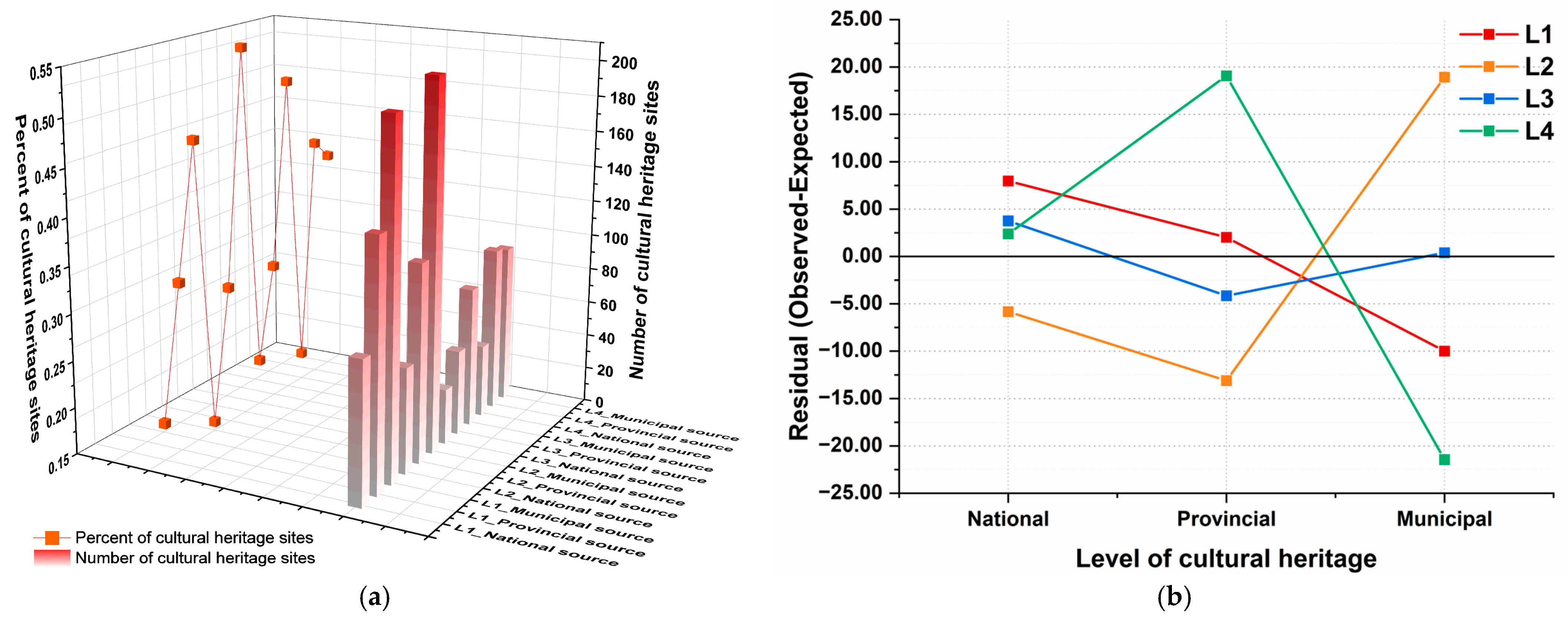
To rigorously validate the rationality and statistical robustness of the hierarchical corridor network, this study employs the chi-square goodness-of-fit test. Using the regional distribution proportions of cultural heritage sites across different administrative levels in Shenyang (national level: 17.24%, provincial level: 33.01%, municipal level: 49.75%) as the expected benchmark, the analysis examined whether the observed distribution of heritage source points matched by corridors of varying importance levels (L1–L4) showed significant deviation from the benchmark. This analysis quantitatively assessed the alignment between hierarchical corridor networks and regional heritage resource patterns, providing statistical support for the connectivity effectiveness of the corridor network (Figure 11, Table 6).
Test results indicate that the chi-square tests for L1, L2, and L3 corridors all failed to reach significance (p > 0.05). This suggests no statistically significant difference between the observed distribution of heritage sites matched by these corridor tiers and the regional expected distribution, validating the rationality and statistical validity of their identification. Among them, the L3-level corridor exhibited the lowest chi-square value (χ2 = 0.851) and highest p-value (p = 0.654), representing the optimal fit among the four levels. This indicates that the heritage source matching structure of this corridor level aligns most strongly with regional heritage distribution characteristics. The L1 core functional corridor demonstrated good goodness-of-fit (χ2 = 1.409, p = 0.494), with observed values for national-level heritage sites exceeding expected values (residual = +7.97). This indicates superior coverage and connectivity for high-level cultural heritage resources compared to expectations, fully aligning with its functional role as a core connectivity carrier for high-level heritage.
The validation results for the L4-level corridor reached statistical significance (χ2 = 9.194, p = 0.01 < 0.05). Residual analysis revealed that the observed values for provincial heritage sites along the L4 corridor were significantly higher than expected (residual = +19.07), while those for municipal heritage sites were significantly lower than expected (residual = –21.45). This outcome reflects that long-distance L4 corridors, serving as the regional network backbone, demonstrate outstanding connectivity coverage for provincial-level cultural heritage resources but exhibit clear deficiencies in linking municipal-level grassroots heritage sites. This provides direct quantitative evidence for subsequent spatial optimization of L4 corridors and connectivity supplementation for grassroots heritage sites.
Figure 11 visually presents the chi-square test results, complementing the tabular statistical findings. Figure 11a illustrates the number and proportion of national, provincial, and municipal cultural heritage sites matched by each of the four corridor tiers (L1–L4): L1 corridors matched the highest total number of heritage sites (412), forming the core carrier for regional heritage connectivity; Municipal-level heritage sites accounted for the highest proportion in L1–L3 corridors, aligning with the regional distribution pattern where municipal-level heritage dominates grassroots resources; The L4 corridor exhibited nearly equal proportions of provincial-level (41.52%) and municipal-level (40.18%) heritage sites, visually reflecting its prioritized coverage of provincial heritage resources—directly consistent with residual analysis findings. The observed-expected residual analysis in Figure 11b clearly shows that L4 corridors exhibit significant positive residuals at the provincial heritage level and significant negative residuals at the municipal heritage level, revealing structural disparities in heritage matching for this corridor tier; residuals for L2 and L3 corridors fluctuate slightly around the zero baseline, further validating the strong alignment of these corridor tiers with regional heritage distribution patterns.
Following the statistical validation of grade distribution, the topological connectivity of the corridor network was assessed using three classical indices: α (cyclomatic number), β (line-point ratio), and γ (connectivity index) [6,63]. The results (Table 7) demonstrate that the corridor network contains numerous looping paths, with an α index of 0.96, indicating high redundancy and resilience against node failure while effectively reducing reliance on single paths. The β index of 2.88 reflects relatively complex inter-node connections, confirming functional stability. The γ index of 0.97 signifies an overall high level of connectivity, characterized by extensive coverage and balanced node connections, ensuring good system-wide accessibility.
In conclusion, the combined evidence from the chi-square goodness-of-fit test and the topological analysis validates that the hierarchically classified cultural heritage corridor network for Shenyang is both statistically sound and structurally robust. The L1–L3 tiers align well with the regional heritage distribution, with L1 corridors excelling in connecting high-grade heritage as intended. The significant deviation observed in L4 corridors identifies a clear target for future optimization to enhance connectivity for municipal-level sites. Together, these findings provide a rigorous quantitative foundation for the graded protection, differentiated management, and spatial optimization of Shenyang’s cultural heritage corridor system.

4. Discussion

4.1. Spatial Patterns of Cultural Heritage Corridor Networks: Feature Analysis and Theoretical Implications

The corridor hierarchy reflects spatial patterns. The heritage corridor network of Shenyang exhibits a distinct core–periphery structure and a mono-centric, multi-nuclear, radial-linked spatial pattern (Figure 12). The ‘mono-centric’ refers to the high-density cultural heritage cluster centered on Shenyang’s urban core, which is particularly anchored by the areas surrounding the Shenyang Imperial Palace and Zhongshan Square. This region represents the convergence of the ancient capital city and modern railway zones and serves as the network’s radiating source and dynamic core. The term “multi-nuclear” is used to describe the secondary clusters that emerge around industrial heritage zones and traditional villages in the region, forming subsidiary nodes within the network. ‘Radial-linked’ describes the multiple corridors that radiate outwards from the central urban area and connect Shenyang’s satellite cities and peripheral cultural heritage sites.
The distinct “core–periphery” structure revealed by this study in Shenyang’s cultural heritage corridor network (Figure 12) results from the combined influence of local geographical-historical factors and universal spatial organization principles. This pattern not only validates the classic theory that heritage distribution is profoundly shaped by both geographical determinism and historical path dependence, but also aligns with the scale-free or central place structure commonly observed in urban network research, where a few core nodes dominate the majority of connections [28]. Within Shenyang’s context, the central urban area—as the dual origin of Qing dynasty culture and modern industry—leveraged its early-formed cultural capital and infrastructure advantages [7]. These strengths have been continuously reinforced through subsequent planning investments and market mechanisms, generating exceptionally high connectivity potential.
Importantly, this spatial consolidation stems not merely from physical agglomeration but more fundamentally from the coupling of social functional networks, wherein public preference plays a pivotal mediating role [46]. Areas with high heritage density tend to attract greater public engagement—through tourism, daily activities, and cultural consumption—which in turn reinforces their functional centrality within the corridor network. Conversely, peripheral heritage sites often suffer from low public visibility and weak cognitive association with the urban core, leading to their progressive marginalization. This feedback loop between spatial configuration and public preference helps explain why the fragility of heritage networks in rapidly transforming urban contexts often manifests first in peripheral and low-vitality zones: the spatial mismatch between historical value and contemporary functional value is exacerbated by the absence of sustained public preference signals. Therefore, future conservation planning must shift from preserving historical points to restoring functional networks, with particular attention to how new socio-economic connections—guided by public preference patterns—can be strategically injected into peripheral heritage areas to enhance overall network coherence and resilience.

4.2. Network Validity Verification: Coupling Potential Connectivity with Real-World Activity

The network generated by this study represents a potential optimal connectivity skeleton with defined width, derived from multi-source cost surfaces, rather than a direct ping of actual observed movement. To link the model to real-world conditions, we conducted a spatial overlay analysis between identified primary corridors and persistent high-activity hotspots extracted from Baidu heatmap data, where these hotspots are characterized by path activity frequency (Figure 13). The results reveal significant spatial consistency, with over 80% of core corridors—such as Shenyang Imperial Palace, Zhang’s Mansion, and Zhongjie Street—highly aligning with areas of sustained high pedestrian density. This correlation empirically supports the model’s ability to capture the underlying logic of spatial–social interactions, validating that high-potential connections often coincide with actual high-frequency usage paths [72].
Conversely, some model corridors—particularly in peripheral areas—exhibit non-coincidence with current vitality hotspots. This discrepancy is not a flaw but rather reveals the network’s strategic value [40]. These corridors identify potential cultural connections of high systemic importance yet currently underutilized, often due to poor accessibility or underdevelopment. For instance, corridors connecting isolated industrial heritage sites may lack vitality due to poor accessibility, yet their connections are indispensable for fully narrating Shenyang’s industrial cultural story. Thus, this network reflects existing vitality associations while proactively identifying strategic cultural links requiring urgent restoration and activation, providing planning decision-making grounds that shift from accommodating the status quo to guiding development.
Furthermore, to test whether the generated corridor network merely replicates existing transportation infrastructure, this study conducted a spatial overlay analysis between the identified hierarchical corridors and the road network (Figure 14). This analysis directly assessed the degree of overlap and deviation characteristics between the model-generated corridors and the actual road network, providing empirical evidence to determine whether the network is constrained by transportation infrastructure. The results reveal significant spatial differentiation. Within the urban core, high-importance corridors exhibit some overlap with major roads, reflecting the influence of the built environment on human activity patterns. However, in peripheral counties—including Kangping County, Fakou County, and Xinmin City—over 68% of corridor length lies outside the road network, traversing farmland, woodlands, or undeveloped terrain. These off-road corridor segments represent potential hidden corridors overlooked by traditional road-based analyses, yet may carry significant eco-cultural connectivity functions. This finding aligns strongly with CRITIC weight analysis results showing road grades accounting for only 1.56%, indicating that this methodology captures connectivity patterns driven by human activity rather than merely replicating transportation infrastructure.
In summary, through heatmap coupling validation and road network comparison analysis, the network validity of this study receives twofold empirical support: on one hand, the core corridors closely align with real-world vitality, confirming the model’s accurate representation of the status quo; on the other hand, the deviation of peripheral corridors from the road network and their strategic value demonstrate the model’s foresight in identifying potential connections.

4.3. Hierarchical Planning and Management: Embedding Networks into Shenyang’s Spatial Governance

To ensure that research outcomes transcend generalizations and serve practical applications, this study proposes a tiered strategy aligned with corridor classifications that can be incorporated into existing planning systems. Shenyang’s current Master Plan for Territorial Space and Protection Plan for Historic and Cultural Cities emphasize holistic conservation and regional coordination [73]. This network provides a precise spatial action map for implementing these principles at the macro level. This tiered framework reveals the intrinsic structure of heritage spaces and offers planning practitioners a clear hierarchy of priorities and a toolkit for interventions ranging from revitalization and renewal in core zones to maintaining ecological resilience in peripheral areas.
Level 1 (Core) Corridors are characterized by the highest concentration of heritage assets and urban vitality, requiring strategies focused on quality enhancement and functional integration. Optimization efforts should prioritize elevating quality and promoting functional synergy, including implementing pedestrianization upgrades, revitalizing historic district aesthetics, and fostering collaborative integration of cultural, commercial, and tourism uses. Specifically, implementing pedestrian-priority transportation strategies—such as along the axes connecting the Forbidden City, Zhang Family Mansion, and Central Street—can enhance the walking experience through measures like widening sidewalks, restricting motor vehicle access, and adding recreational facilities. This complements the urban greenway system planning, promoting green travel and leisure activities. Restoring building facades along the route, harmonizing architectural styles, and employing traditional materials and techniques will preserve the historical authenticity of neighborhoods to enhance their character [10,12]. Concurrently, enhanced landscape design incorporating historical and cultural elements will cultivate a distinctive sense of place. Encouraging the clustering of cultural and creative industries, specialty commerce, and tourism services will create a multifunctional complex integrating culture, commerce, and tourism. For instance, digital technologies can showcase heritage narratives, using augmented reality or virtual reality to deliver immersive visitor experiences. This revitalizes cultural heritage and offers innovative solutions for industrial heritage revitalization. Furthermore, within the smart city framework, information and communication technologies serve as a unifying agent, connecting diverse domains to manage and process vast data and information. This enables intelligent guidance of urban infrastructure and processes, fosters citizen engagement, and delivers new services. Integrate core corridors as central components of key urban design and renewal projects, such as the Shengjing Imperial City Comprehensive Conservation and Revitalization Project.
Level 2 (Primary) corridors form the secondary network backbone connecting major heritage clusters, requiring enhanced connectivity and thematic prominence. Public transportation accessibility can be enhanced by improving multimodal connections, such as adding bus routes, refining bicycle lane systems, and optimizing pedestrian paths to ensure convenient links between heritage sites [36]. Signage systems and public art can highlight specific historical themes, like installing art installations or QR code guide systems along the industrial heritage route centered on Tiexi District, Shenyang, to enrich visitors’ cultural experiences. Its development can also integrate with Shenyang’s greenway system planning and tourism development strategies, incorporating secondary corridors as components of these frameworks to create themed cultural leisure routes. This approach helps combine cultural heritage preservation with ecological health and economic revitalization.
Level 3 (Secondary) corridors serve as longer links connecting urban cores to peripheral heritage nodes, with optimization focusing on dual ecological and cultural restoration. Interventions should emphasize greenway development, low-impact trail planning, and restoration of landscape sightlines [74,75], shaping these corridors into experiential zones transitioning from urban culture to natural landscapes. Specifically, planning greenways and low-impact trails promotes ecological restoration while offering cultural experiences that connect people with nature [76]. For instance, integrating landscape resources builds a composite green infrastructure network to enhance the urban environment. Removing obstacles that block sightlines restores and rebuilds visual connections between heritage sites and their surrounding natural environments, thereby improving overall landscape quality. Coordinate its development with citywide ecological initiatives like the Hun River Waterfront Enhancement and Rural Revitalization Plan to form a functionally complementary integrated experience corridor. This aligns with the concept of planning composite ecological corridors and spatial planning guidelines under the park city philosophy, and its implementation can synergize with citywide ecological projects such as the Hun River Waterfront Enhancement and Rural Revitalization Plan.
Level 4 (Local) Corridors Characterized by long distances and weak connections between isolated heritage sites, these corridors require strategic conservation and minimal intervention. The primary objective is to ensure the physical continuity of these critical yet underutilized cultural heritage resources. Conservation employs ecological engineering methods, utilizing native plants for ecological restoration, supplemented by local heritage information displays to enhance public awareness. For instance, Digital Twin technology enables high-precision 3D modeling and data integration of cultural heritage sites. This facilitates heritage condition monitoring, supports maintenance decision-making, and employs visualization techniques for heritage interpretation [77]. By integrating heritage as a cultural component into urban ecological conservation and restoration planning, the multifunctionality of green infrastructure is enhanced.
In summary, the optimization of Shenyang’s heritage corridor network necessitates the integration of resources across multiple departments to achieve cross-departmental coordination. This transformation will shift heritage protection from passive inventory management to proactive, systematic, network-based spatial governance. Moreover, this approach is not only essential for the preservation of cultural heritage but also serves as a vital pathway for the promotion of sustainable urban development. In addition, future research and practice could integrate cultural heritage preservation with leisure tourism to explore route selection for cultural heritage tourism pathways. This would translate the current abstract corridor connectivity network into tangible transportation planning.

4.4. Innovations and Limitations

Current research into the suitability of resistance surfaces for existing cultural heritage corridors has extensively employed quantitative methods, such as the Analytic Hierarchy Process (AHP) [21]. This study employs the CRITIC weighting method to determine the weights of the resistance factors. Compared to traditional AHP, this approach objectively calculates raw data to eliminate subjective misguidance bias. Unlike entropy weighting, which considers only indicator differences, CRITIC incorporates conflict comparisons between data, making it better suited to balancing and selecting among multiple criteria [56]. It also visually displays hierarchical structures and weighting results, thereby enhancing the robustness of resistance quantification.
When it comes to selecting resistance factors, natural factors are frequently the focus of relevant studies [64]. Despite the fact that Feng et al. took into account social aspects such as population distribution, cultural value, and catering services from cultural, ecotourism, and recreational perspectives [23], relevant economic factors representing human behavioral preferences are still not extensively investigated owing to difficulties with quantification. Corridors identified solely through models based on static background features such as topography, vegetation and hydrology often produce idealized corridor paths that directly traverse urban built cores, resulting in a severe lack of practical feasibility. Therefore, this study expands upon traditional corridor simulation methods—which primarily focus on natural ecological factors—by incorporating dynamic socioeconomic data based on the MCR model and circuit theory. The results indicate that incorporating dynamic socio-economic data significantly expands upon traditional corridor simulation methods that rely solely on natural ecological factors. This breaks through the paradigm of one-dimensional modelling oriented towards physical structure integration. The model clearly shows that areas of high economic activity and dense built environments are the main spatial barriers to cultural heritage connectivity when socio-economic data such as GDP and night-time light values are included [49]. Furthermore, public spatial behavior preferences, as indicated by path activity frequencies, refine corridor routes to better align with actual recreational movement patterns. This shift moves the simulation from theoretical ecological potential towards reflecting real interaction patterns between humans and the land. The integration of these multi-source data significantly enhances the model’s explanatory power and its value in terms of its application to cultural heritage conservation planning within highly urbanized areas.
In addition, the planning of heritage corridor networks predominantly employs the MCR model, whereas circuit theory is more commonly used in ecological corridor network research [64] and has seen limited application in cultural heritage corridor networks. In recent years, however, some studies have attempted to transfer this theory to the cultural domain. For example, Li et al. analyzed the Corridor Construction of Railway Heritage [39], and Lyu et al. assessed connectivity among Heilongjiang’s Architectural heritage sites [40]. Both of which validated the applicability of circuit theory in cultural heritage spatial research. In response to the challenge posed by the dispersed distribution of heritage sites, this study goes beyond the application of single models in cultural heritage corridor research. It proposes a methodology for constructing cultural heritage corridor networks based on the consolidation of cultural heritage resources by integrating the MCR model with circuit theory. Unlike traditional Lowest Cost Path (LCP) models that typically generate single deterministic routes [30], a probabilistic multi-path framework offered by circuit theory more accurately captures the dynamics of cultural dispersion in the real world [43]. Its inherent redundancy enables the network structure to maintain connectivity even when certain nodes or pathways are disrupted. This redundancy in heritage corridor planning facilitates the dissemination and diffuse cultural assets from multiple sites and avoids systemic failure brought on by the loss of individual links [43].
The core contribution of this study lies in systematically integrating the resistance effects of multi-source dynamic social perception data—such as crowd heatmaps, nighttime lights, and activity trajectories—into a corridor modeling framework based on the MCR model and circuit theory. By planning a comprehensive “ecological-environmental-social” resistance surface, the model not only reflects the baseline connectivity of heritage spaces but also identifies and mitigates physical barriers caused by high-intensity socioeconomic activities. Results indicate that high-level corridors are distributed not only in heritage-dense areas but also highly overlap with current urban socioeconomic activity hotspots. This demonstrates that the vitality of heritage networks depends not only on heritage density but also on their coupling with contemporary urban functions. The absence of high-level corridors in peripheral areas can be understood as the dual overlap of heritage distribution margins and contemporary economic vitality boundaries. This insight propels heritage conservation from static form preservation toward dynamic functional integration, offering new perspectives for holistic heritage protection and living utilization in urbanized regions.
Furthermore, the hierarchical classification of corridors based on the gravity model combined with a topological analysis of the network’s structure, validates its overall architecture. The result is the planning of the Shenyang Cultural Heritage Corridor Network, which exhibits a core–periphery structure and a mono-centric, multi-nuclear, radial-linked spatial pattern. As a result, it facilitates cultural interaction and dissemination between these sites by improving transportation connections and accessibility to cultural heritage sites within the municipal region. From the standpoint of heritage utilization, modeling paths of minimal cumulative resistance for cultural exchange and dissemination between heritage sites makes it possible to quickly identify the best routes for cultural transmission and makes it easier to build networks of regional cultural heritage tourism corridors. This method improves the spatial integrity and inherent cultural significance linking heritage sites by establishing a monocentric-multinuclear radial spatial pattern from the standpoint of heritage conservation. This approach bridges the gap between static corridor mapping and dynamic network performance evaluation and vulnerability diagnosis, offering a more refined perspective on the holistic conservation and spatial planning of cultural heritage corridors.
It must be acknowledged that the present study is not without its limitations. Firstly, while the selection and weighting of resistance factors were based on the objective CRITIC method, it is important to note that these factors may not fully capture implicit social dimensions, such as land ownership and community willingness. Secondly, the analysis resolution of this study (50 m × 50 m grid) is suitable for identifying strategic connectivity patterns at the metropolitan scale but cannot capture the detailed local conditions required to guide specific corridor design. Therefore, the network presented herein should be interpreted as a strategic framework revealing potential connectivity priorities rather than a finalized corridor planning scheme. Furthermore, in terms of result interpretation, this study focuses on identifying macro-level heritage networks from the perspectives of spatial structure and connectivity, without yet constructing sub-networks or conducting comparative analyses of heritage sites of different types or cultural themes. Based on this, future research may explore the following directions: (1) Incorporating emerging data traces, such as social media check-ins and online photos, to integrate more public perspectives. This would provide a more realistic representation of how the public views cultural spaces by effectively bridging the gap between bottom-up public necessities and top-down expert planning. This approach would enhance the scientific rigor and social inclusivity of heritage corridor planning, ensuring that cultural heritage protection and revitalization are truly rooted in the community. (2) Employing machine learning algorithms, such as pixel-level random forests, to automatically learn and simulate more complex, nonlinear resistance surface generation mechanisms. (3) Evolving static models into dynamic ones to simulate the long-term impacts of urban change on the resilience of heritage corridor networks. (4) Building upon the comprehensive spatial network framework established by this institute, further research will be conducted on sub-networks targeting specific heritage types or cultural themes. Comparative analysis will examine the spatial diffusion patterns and key impediments across different cultural heritage categories, thereby providing a basis for developing more targeted, thematic conservation and revitalization strategies.

5. Conclusions

This study focuses on the practical demands for systematic conservation efficacy and resilience of regional heritage ensembles, as well as conservation and revitalization of cultural heritage in highly urbanized regions. Taking Shenyang as a case study, it integrates dynamic socioeconomic data—such as nighttime illumination and crowd activity heatmaps reflecting public preference and vitality—into a comprehensive resistance-surface suitability evaluation system. By combining the MCR model with circuit theory, it constructs an integrated framework for regional cultural heritage corridor network planning. The findings reveal that the spatial connectivity of cultural heritage is not only influenced by natural and built environments but is more profoundly shaped by the spatial distribution of contemporary socioeconomic activities. Among these factors, pathway activity frequency and demand point accessibility constitute the dominant driving forces. Shenyang’s cultural heritage network exhibits a distinct core–periphery structure and a monocentric, multi-nuclear, radial-linked spatial pattern. This multi-directional, hierarchically structured network, centered on the historic urban district, reveals the complex relationship between the heritage system and the urban functional system, which are both coupled and in conflict.
In theoretical terms, this study advances a paradigm shift in cultural heritage conservation from isolated sites to networked systems. It further proposes a posterior verification research logic—repositioning heritage administrative tiers from preset input weights in network construction to testable output variables. Through chi-square goodness-of-fit tests, the corridor network constructed based on public usage intensity achieves balanced integration of heritage assets across L1–L3 tiers. National-level heritage does not monopolize high-importance corridors due to administrative authority, validating that usage intensity inherently possesses decentralized integration capabilities. This finding challenges traditional hierarchical-centric conservation assumptions, offering a new theoretical perspective for heritage integration in highly urbanized areas: the holistic value of cultural heritage is rooted not only in its spatial connectivity and systemic resilience but also in its intrinsic alignment with the distribution of social vitality.
Methodologically, the study developed an objective corridor identification system integrating multi-source dynamic data. By introducing CRITIC objective weighting and combining social perception data to construct a comprehensive resistance surface, and generating probabilistic, multi-path connectivity networks supported by the MCR model and circuit theory, it significantly overcomes the limitations of traditional methods reliant on subjective weighting and fixed buffer zones. CRITIC weight analysis reveals that road grades account for only 1.56%, while path activity frequency (14.36%) and demand point accessibility (13.86%) dominate. This confirms that the resistance surface captures connectivity patterns driven by human activity rather than a simple replication of transportation infrastructure. Overlay validation with Baidu heatmaps and road networks further confirms the method’s dual efficacy in capturing real-world vitality and identifying strategic connections. This technical framework significantly enhances the adaptability and scientific rigor of corridor simulation under spatially heterogeneous conditions.
In practice, the study developed a spatial management plan structured around a four-tier corridor framework, comprising core, primary, secondary, and local corridors. This framework not only identifies high-potential corridors for prioritized conservation and revitalization but also provides differentiated planning guidelines and implementation strategies for corridors of varying tiers. The significant advantage of Level 4 corridors in covering provincial heritage sites and their notable weakness in connecting municipal heritage sites offer clear quantitative evidence for subsequent spatial optimization and connectivity enhancement of grassroots heritage. Network connectivity analysis further confirms the network’s high redundancy (α = 0.96), complex node connections (β = 2.88), and excellent overall accessibility (γ = 0.97). This provides an actionable toolkit for holistic conservation, cultural revitalization, and coordinated spatial development of composite heritage cities like Shenyang.
In summary, the establishment of cultural heritage corridors functions not only as a technical means to connect dispersed heritage sites but also as a vital spatial strategy for restoring urban cultural fabric, strengthening regional cultural identity, and promoting sustainable development. This study transitions from hierarchical preset approaches to empirical exploration of equitable usage, offering a transferable analytical pathway for similar regions to transcend traditional conservation paradigms and build more inclusive and responsive cultural heritage networks. Future research may further integrate real-time behavioral data and high-precision urban information to advance heritage conservation from static preservation toward dynamic adaptation and systemic governance.

Author Contributions

Conceptualization, O.H. and X.M.; methodology, X.M.; software, X.M.; validation, O.H., X.M. and Z.X.; formal analysis, X.M.; investigation, X.M. and Z.X.; resources, Z.X.; data curation, O.H. and X.M.; writing—original draft preparation, X.M.; writing—review and editing, O.H.; visualization, X.M.; funding acquisition, O.H. All authors have read and agreed to the published version of the manuscript.

Funding

This research was funded by the National Natural Science Foundation of China, grant number 51978420.

Data Availability Statement

The data supporting the findings of this study are openly available in Figshare at https://doi.org/10.6084/m9.figshare.31338919. The deposited dataset includes (1) attribute information of cultural heritage sites in Shenyang (including anonymized geographical coordinates, protection levels, and site types); (2) heritage corridors and nodes identified based on circuit theory and the gravity model; and (3) all result figures generated during the research process. The population activity data used were obtained from the Baidu Maps API and processed into aggregated, anonymized heat maps containing no personally identifiable information. To protect sensitive cultural heritage information, the coordinates provided have been anonymized; researchers seeking higher-precision data may contact the corresponding author under a data use agreement.

Acknowledgments

The authors would like to sincerely thank the reviewers for their valuable comments and the editors for improving the manuscript.

Conflicts of Interest

The authors declare no conflicts of interest.

Abbreviations

The following abbreviations are used in this manuscript:
GISGeographic Information System
NNINearest Neighbor Index
KDEKernel Density Estimation
MCRMinimum Cumulative Resistance
GMGravity Model
AHPAnalytic Hierarchy Process
CRITICCriteria Importance Through Intercriteria Correlation
DEMDigital Elevation Model
NDVINormalized Difference Vegetation Index
POIPoints of Interest
GDPGross Domestic Product
LCPLowest Cost Path

Appendix A

Table A1 provides the complete list of 203 cultural heritage sites used as source nodes in this study. The sites are categorized according to China’s statutory heritage protection system (national, provincial, and municipal levels). For each site, the unique code, official name, protection grade, and typological category are provided. The codes (N, P, M) correspond to national, provincial, and municipal levels, respectively, and are used throughout the main text to reference individual sites.
Table A1. Inventory of Cultural Heritage Source Sites.
N.CodeNameProtection Level
1N 01Shenyang Imperial PalaceNational
2N 02Xibe Ancestral TempleNational
3N 03Wugou Jingguang PagodaNational
4N 04Yong’an Stone BridgeNational
5N 05Zhaoling Tomb (North Mausoleum)National
6N 06Fuling Tomb (East Mausoleum)National
7N 07Yemaotai Liao Dynasty TombNational
8N 08Xinle SiteNational
9N 09Gaotaishan SiteNational
10N 10Shitaizi Mountain City SiteNational
11N 11North Barracks SiteNational
12N 12Site of the Special Military Tribunal for the Trial of Japanese War CriminalsNational
13N 13Site of the Manchurian Provincial Committee of the CPCNational
14N 14Zhang Xueliang’s Former ResidenceNational
15N 15Northeast University Old SiteNational
16N 16Shenyang Catholic ChurchNational
17N 17Fengtian Railway Office Old SiteNational
18N 18Joint Office & Loan Office, Fengtian Railway Police Section Old SiteNational
19N 19South Manchuria Railway Co., Ltd. Old Site (II)National
20N 20South Manchuria Railway Co., Ltd. Old Site (I)National
21N 21Yuelaizhan Inn Old SiteNational
22N 22Chinese Eastern Railway Building Complex—Fengtian Station Old SiteNational
23N 23Bank of Chosen Fengtian Branch Old SiteNational
24N 24Yamato Hotel Old SiteNational
25N 25Toyo Takushoku Co., Ltd. Fengtian Branch Old SiteNational
26N 26Fengtian Police Station Old SiteNational
27N 27Yokohama Specie Bank Fengtian Branch Old SiteNational
28N 28Mitsui Bank Building Old SiteNational
29N 29Liaoning General Station Old SiteNational
30N 30Fenghai Railway Bureau Old SiteNational
31N 31Shenyang WWII Allied Prisoners of War Camp SiteNational
32N 32Shifo Yicun Village, Shifosi Subdistrict, Shenbei New District, ShenyangNational
33N 33Shifo’ercun Village, Shifosi Subdistrict, Shenbei New District, ShenyangNational
34N 34Yemaotai Village, Yemaotai Town, Faku County, ShenyangNational
35N 35Gongzhuling Village, Sijiazi Mongol Ethnic Township, Faku County, ShenyangNational
36P 01Shisheng TempleProvincial
37P 02Taiqing Taoist TempleProvincial
38P 03Chang’an Buddhist TempleProvincial
39P 04Ci’en Buddhist TempleProvincial
40P 05Liaobin PagodaProvincial
41P 06Shenyang North Pagoda (incl. Falun Temple)Provincial
42P 07Shenyang East PagodaProvincial
43P 08Shenyang South PagodaProvincial
44P 09Shenyang South MosqueProvincial
45P 10Bore Buddhist TempleProvincial
46P 11Zhengjiawazi Tomb with Bronze DaggersProvincial
47P 12Mongolian Prince Narsu’s MausoleumProvincial
48P 13Tashan Mountain CityProvincial
49P 14Xiaotazi City Site (incl. Baota Temple Pagoda)Provincial
50P 15Shunshantun SiteProvincial
51P 16Shifosi City SiteProvincial
52P 17Qingzhuangzi City SiteProvincial
53P 18Shangboguan City SiteProvincial
54P 19Khan’s Palace SiteProvincial
55P 20Laolongkou Liquor CellarsProvincial
56P 21Yan-Han Dynasty Great Wall—Quanshengbao Beacon Tower (2 sites)Provincial
57P 22Soviet Army Martyrs’ MonumentProvincial
58P 23Memorial Cemetery for Martyrs of Resist US Aggression and Aid KoreaProvincial
59P 24Secret Residence Site of Comrade Liu ShaoqiProvincial
60P 25Hunhe Station Old SiteProvincial
61P 26Kangping Catholic ChurchProvincial
62P 27Three Northeast Provinces Governor’s Mansion Old SiteProvincial
63P 28Fengtian Advisory Council Old SiteProvincial
64P 29Fengtian Post Office Old SiteProvincial
65P 30Northeast Army Military Academy Old SiteProvincial
66P 31Japanese Consulate General in Fengtian Old SiteProvincial
67P 32South Manchuria Medical College Old SiteProvincial
68P 33Wan Fulin’s Mansion Old SiteProvincial
69P 34Shenyang Qiulin Company Old SiteProvincial
70P 35Mantetsu Fengtian Public Office Old SiteProvincial
71P 36Zhaoxin Pottery Co., Ltd. Old SiteProvincial
72P 37French Banque de l’Indochine Fengtian Branch Old SiteProvincial
73P 38Chang Yinhui’s Mansion Old SiteProvincial
74P 39Fengtian Postal Administration Old SiteProvincial
75P 40Fengtian Broadcasting Radio Station Old Site (Liaoning Radio & TV Station)Provincial
76P 41Tongze Girls’ Middle SchoolProvincial
77P 42Tang Yulin’s Mansion Old SiteProvincial
78P 43Daguan Tea House Old SiteProvincial
79P 44Sun Liechen’s Mansion Old SiteProvincial
80P 45Yu Jichuan’s Mansion Old Site & Ancillary Buildings (5 sites)Provincial
81P 46Song Renqiong’s Former ResidenceProvincial
82P 47Tiexi Workers’ Village Building ComplexProvincial
83P 48Xie Rongce Martyr’s TombProvincial
84P 49Xiushuihe Revolutionary Martyrs’ CemeteryProvincial
85P 50CPC Xinmin Special Branch Old SiteProvincial
86P 51Zhou Enlai’s Youth Study SiteProvincial
87P 52Fengtian YMCA Old SiteProvincial
88P 53Three Northeast Provinces Official BankProvincial
89P 54British HSBC Fengtian Branch Old SiteProvincial
90P 55Yang Yuting’s MansionProvincial
91P 56Zhongshan Square (Zhongshan Square Statues)Provincial
92P 57Former Shenyang Foundry Sand-Casting WorkshopProvincial
93P 58Chen Yun’s Former ResidenceProvincial
94P 59Wang Tiehan’s Office Old SiteProvincial
95P 60Xiushuihezi Town, Faku County, ShenyangProvincial
96P 61Liaobinta Village, Gongtun Town, Xinmin City, ShenyangProvincial
97P 62Juliuhe Village, Dongcheng Subdistrict, Xinmin City, ShenyangProvincial
98P 63Xiushuihezi Village, Xiushuihezi Town, Faku County, ShenyangProvincial
99P 64Banlashanzi Village, Dagu-jiazi Town, Faku County, ShenyangProvincial
100P 65Xiaotazi Village, Haoguantun Town, Kangping County, ShenyangProvincial
101P 66Mengjia Village, Mengjia Town, Faku CountyProvincial
102P 67Dahongqi Village, Dahongqi Town, Xinmin City, ShenyangProvincial
103M 01Senggelinqin SteleMunicipal
104M 02Jixiang TempleMunicipal
105M 03East MosqueMunicipal
106M 04Xinmin MosqueMunicipal
107M 05Zhongxin TempleMunicipal
108M 06Dafo TempleMunicipal
109M 07Yanshou TempleMunicipal
110M 08Shifosi PagodaMunicipal
111M 09Chaoyang Cave Three-layer HallMunicipal
112M 10Jiangzhe Guild HallMunicipal
113M 11Shangboguan Han-Wei Tomb ClusterMunicipal
114M 12Enggedeli TombMunicipal
115M 13Zhangjiayao Forest Farm Changbai Mountain Khitan Noble Tomb ClusterMunicipal
116M 14Shengjing City Desheng Gate Barbican Site (2 sites)Municipal
117M 15Shengjing City SiteMunicipal
118M 16Agricultural University Back Mountain SiteMunicipal
119M 17Qiansongyuan SiteMunicipal
120M 18Yingpandi SiteMunicipal
121M 19Chahainao City SiteMunicipal
122M 20Shengjing Bell & Drum Tower Site (2 sites)Municipal
123M 21Sanhuang Temple SiteMunicipal
124M 22Northeast China Liberation MonumentMunicipal
125M 23Daheng Iron Factory Office Building Old SiteMunicipal
126M 241905 Cultural & Creative Park (Manchuria Sumitomo Metal Co., Ltd. Workshop Old Site)Municipal
127M 25Liaoning Industrial Exhibition HallMunicipal
128M 26Shenyang Workers’ Cultural PalaceMunicipal
129M 27Russo-Japanese War Fengtian Battle Japanese 4th Army Merits SteleMunicipal
130M 28Russo-Japanese War Fengtian Battle Russian Fallen Soldiers SteleMunicipal
131M 29Shenyang ZhongjieMunicipal
132M 30“September 18th Incident” Bomb MonumentMunicipal
133M 31Soviet Army Martyrs’ CemeteryMunicipal
134M 32Yang Yuting’s Tomb Old SiteMunicipal
135M 33Shenyang Christian Church Dongguan ChurchMunicipal
136M 34Fengtian Medical University Old SiteMunicipal
137M 35Zhang Shouyi’s Mansion Old Site (I)Municipal
138M 36Shenyang Christian Church Xita ChurchMunicipal
139M 37Zhongshan Middle School Teaching Building Old SiteMunicipal
140M 38Zhang Zuoxiang’s Mansion Old Site (I)Municipal
141M 39Former Manchuria Education CollegeMunicipal
142M 40Che Xiangchen’s Former ResidenceMunicipal
143M 41Chiyoda Water TowerMunicipal
144M 42Fengtian Chamber of Commerce Old SiteMunicipal
145M 43German Consulate Old SiteMunicipal
146M 44Tongze Boys’ Middle School Old SiteMunicipal
147M 45Korean Official Han’s Compound Old SiteMunicipal
148M 46American Citibank Fengtian Branch Old SiteMunicipal
149M 47Zhang Tingshu’s MansionMunicipal
150M 48Huanggutun Incident SiteMunicipal
151M 49Fengtian Automatic Telephone Exchange Old SiteMunicipal
152M 50Tongze Club Old SiteMunicipal
153M 51Xingnong Cooperative Old SiteMunicipal
154M 52Manchuria Central Bank Chiyoda Branch Old SiteMunicipal
155M 53Zhicheng Bank Old SiteMunicipal
156M 54Japanese Special Commissioner Office Old SiteMunicipal
157M 55Wanquan Water TowerMunicipal
158M 56Japanese-style Tang Imitation ArchitectureMunicipal
159M 57Jin Changhao’s Residence Old SiteMunicipal
160M 58Heian-za Theater Old SiteMunicipal
161M 59Zhao Erxun’s Mansion Old SiteMunicipal
162M 60Wang Shuhan’s Residence Old SiteMunicipal
163M 61Zhang Shouyi’s Mansion Old Site (II)Municipal
164M 62Wang Mingyu’s Mansion Old SiteMunicipal
165M 63Fengtian Prefecture Right Wing Official School Old SiteMunicipal
166M 64Fengtian Customs Building Old SiteMunicipal
167M 65Russian Cemetery Chapel Old SiteMunicipal
168M 66Red Cross Society Branch Old SiteMunicipal
169M 67Zhang Zuoxiang’s Mansion Old Site (II)Municipal
170M 68Fengtian Naniwa Girls’ High School Old SiteMunicipal
171M 69Shen Bofu’s Mansion Old SiteMunicipal
172M 70Mu Jiduo’s Mansion Old SiteMunicipal
173M 71British-American Tobacco Company Office Old SiteMunicipal
174M 72Tang Yulin’s Mansion Old Site (II)Municipal
175M 73Seven Stars Department Store Old SiteMunicipal
176M 74Puppet Fengtian Municipal Government Office Old SiteMunicipal
177M 75Wu Junsheng’s Mansion Old SiteMunicipal
178M 76Heping Square Japanese-style Building ClusterMunicipal
179M 77Puppet Manchurian Police Station Old SiteMunicipal
180M 78Qixingshan Fort Cluster (27 sites)Municipal
181M 79Liaoning University Building ClusterMunicipal
182M 80Northeast Engineering Institute Building ClusterMunicipal
183M 81Liaoning Agricultural Exhibition Hall Building ClusterMunicipal
184M 82Liaoning HotelMunicipal
185M 83Faku County Christian Church—Mu’en ChurchMunicipal
186M 84Fengtian Middle School Public School Old SiteMunicipal
187M 85Northeast Military Academy Auditorium & BarracksMunicipal
188M 86Japanese Consulate in Xinmin Old SiteMunicipal
189M 87Song Yaoshan’s Former ResidenceMunicipal
190M 88CPC Fengtian Municipal Committee Old SiteMunicipal
191M 89Japanese Puppet 693 Troop Old SiteMunicipal
192M 90Manchuria Central Bank Mint Old SiteMunicipal
193M 91Japanese Aoi Elementary School Old SiteMunicipal
194M 92Japanese Foreign Trade Company Office Building Old SiteMunicipal
195M 93Japanese South Manchuria Army Arsenal Technician Training Institute Old SiteMunicipal
196M 94Fengtian Airport Hangar Old SiteMunicipal
197M 95Hongmei Cultural & Creative Park (Manchuria Agricultural Chemical Industry Co., Ltd. Fengtian Factory Filtration Workshop Old Site)Municipal
198M 96Shenyang No. 4 Middle School Teaching BuildingMunicipal
199M 97Sino-Soviet Friendship Palace Old SiteMunicipal
200M 98Northeast Design & Research Institute Office BuildingMunicipal
201M 99Shenyang Non-staple Food Group Tawan Cold StorageMunicipal
202M 100Lei Feng’s Former Residence SiteMunicipal
203M 101Ma Gang Martyrs’ CemeteryMunicipal

References

  1. Tang, C.; Qiu, T.; Li, Y. Heritage Perspectives on Cultural Memory and Spatial Identity in Yuan River Basin, Hunan, China. Herit. Sci. 2025, 13, 261. [Google Scholar] [CrossRef]
  2. Liu, B.; Li, Q.; Zheng, Z.; Huang, Y.; Deng, S.; Huang, Q.; Liu, W. A Review of Multi-Source Data Fusion and Analysis Algorithms in Smart City Construction: Facilitating Real Estate Management and Urban Optimization. Algorithms 2025, 18, 30. [Google Scholar] [CrossRef]
  3. Zhang, J.; Zhang, X.; Tan, X.; Yuan, X. Extraction of Urban Built-Up Area Based on Deep Learning and Multi-Sources Data Fusion—The Application of an Emerging Technology in Urban Planning. Land 2022, 11, 1212. [Google Scholar] [CrossRef]
  4. Been, V.; Ellen, I.G.; Gedal, M.; Glaeser, E.; McCabe, B.J. Preserving History or Restricting Development? The Heterogeneous Effects of Historic Districts on Local Housing Markets in New York City. J. Urban Econ. 2016, 92, 16–30. [Google Scholar] [CrossRef]
  5. Yu, K.; Xi, X.; Li, D.; Li, H.; Liu, K. On the Construction of the National Linear Culture Network in China. Hum. Geogr. 2009, 24, 11–16+116. [Google Scholar] [CrossRef]
  6. Arnaiz-Schmitz, C.; Díaz, P.; Ruiz-Labourdette, D.; Herrero-Jáuregui, C.; Molina, M.; Montes, C.; Pineda, F.D.; Schmitz, M.F. Modelling of Socio-Ecological Connectivity. The Rural-Urban Network in the Surroundings of Madrid (Central Spain). Urban Ecosyst. 2018, 21, 1199–1212. [Google Scholar] [CrossRef]
  7. Feng, X.; Xiu, C.; Bai, L.; Zhong, Y.; Wei, Y. Comprehensive Evaluation of Urban Resilience Based on the Perspective of Landscape Pattern: A Case Study of Shenyang City. Cities 2020, 104, 102722. [Google Scholar] [CrossRef]
  8. Cheshmehzangi, A.; Tang, T. Shenyang: One of China’s Major Industrial Hubs with Strategic Positioning and Regional Influence. In China Under Construction: Shaping Cities Through Recent Urban Transformation; Springer: Berlin/Heidelberg, Germany, 2024; pp. 177–196. [Google Scholar] [CrossRef]
  9. Wang, Y.; Jin, C.; Xu, D.; Wang, T.; Wang, B. Analysis of Multi-Dimensional Layers in Historic Districts Based on Theory of the Historic Urban Landscape: Taking Shenyang Fangcheng as an Example. Land 2024, 13, 1736. [Google Scholar] [CrossRef]
  10. Wu, Y.; Yang, Y.; Miao, M.; Wu, Y.; Zhu, H. Study on Spatial Distribution and Heritage Corridor Network of Traditional Settlements in Ancient Huizhou. Buildings 2025, 15, 1641. [Google Scholar] [CrossRef]
  11. Bai, Q.; Gao, M.; Lyu, H.; Zhang, L.; Zhang, J. Spatial Distribution Characteristics and Influencing Factors of Tangible Cultural Heritage in Henan Province, China: A Watershed Perspective. Sustainability 2024, 16, 8979. [Google Scholar] [CrossRef]
  12. Dong, B.; Zhang, M.; Wang, H.; Wu, J. Study on the Interaction Mechanism among Spatial Patterns of Traditional Villages and Tourism Attractiveness and Accessibility in Guizhou Province. Sci. Rep. 2025, 15, 10365. [Google Scholar] [CrossRef] [PubMed]
  13. Kersapati, M.I. Land Use-Based Stakeholders Mapping for Natural Heritage Preservation—Case Study: Hampstead Heath Ponds, London. Urban For. Urban Green. 2023, 80, 127821. [Google Scholar] [CrossRef]
  14. Ye, H.; Yang, Z.; Xu, X. Ecological Corridors Analysis Based on MSPA and MCR Model—A Case Study of the Tomur World Natural Heritage Region. Sustainability 2020, 12, 959. [Google Scholar] [CrossRef]
  15. Zhao, Y.; Zhang, G.; Zhao, H. Spatial Network Structures of Urban Agglomeration Based on the Improved Gravity Model: A Case Study in China’s Two Urban Agglomerations. Complexity 2021, 2021, 6651444. [Google Scholar] [CrossRef]
  16. Feng, Y.; Li, J.; Feng, D.; Feng, Y.; Li, J.; Feng, D. Research on Spatial Restructuring of Farmers’ Homestead Based on the “Point-Line-Surface” Characteristics of Mountain Villages. Land 2023, 12, 1598. [Google Scholar] [CrossRef]
  17. Ren, J.; Zhang, Y. Multi-Objective Optimization in the Renewal of Historic and Cultural Neighborhoods: Application to Shenyang’s Bagua Street Using an Improved NSGA-II Algorithm. KSCE J. Civ. Eng. 2025, 29, 100214. [Google Scholar] [CrossRef]
  18. Rivas Navarro, J.L.; Bravo Rodríguez, B.; Curiel Sanz, C. Vinculaciones Diacrónicas. Resignificando El Patrimonio Arquitectónico Para La Regeneración Urbana de La Granada Central. I2 Investig. Innovación Arquit. Territ. 2022, 10, 115–150. [Google Scholar] [CrossRef]
  19. Suárez, M.A.; Salas, E.L.; Franco, I.C.; Sousa, A.Á. Towards a Methodology of Good Practices for Heritage-Led Rural Regeneration: From the Main Paths to the Surrounding Areas. Cities 2025, 161, 105849. [Google Scholar] [CrossRef]
  20. Zhou, Y. Strategies to Promote Smart City Cultural Scene Construction through Multi-Sensor Fusion Data. Mob. Inf. Syst. 2022, 2022, 6890117. [Google Scholar] [CrossRef]
  21. Liu, Y.; Ma, X. Heritage Corridor Construction in the Sui–Tang Grand Canal’s Henan Section Based on the Minimum Cumulative Resistance (MCR) Model. Land 2025, 14, 2128. [Google Scholar] [CrossRef]
  22. Feng, B.; Ma, Y. Network Construction for Overall Protection and Utilization of Cultural Heritage Space in Dunhuang City, China. Sustainability 2023, 15, 4579. [Google Scholar] [CrossRef]
  23. Yue, F.; Li, X.; Huang, Q.; Li, D. A Framework for the Construction of a Heritage Corridor System: A Case Study of the Shu Road in China. Remote Sens. 2023, 15, 4650. [Google Scholar] [CrossRef]
  24. Lin, F.; Zhang, X.; Ma, Z.; Zhang, Y. Spatial Structure and Corridor Construction of Intangible Cultural Heritage: A Case Study of the Ming Great Wall. Land 2022, 11, 1478. [Google Scholar] [CrossRef]
  25. Dehghan Pour Farashah, M.; Ghaderi, Z.; Kaya, E. Identity Construction and Collective Memory: A Critical Heritage Study of Łódź’s Post-Industrial Legacy. Cities 2026, 170, 106743. [Google Scholar] [CrossRef]
  26. Poor, E.E.; Scheick, B.; Cox, J.J.; Guthrie, J.M.; Mullinax, J.M.; Poor, E.E.; Scheick, B.; Cox, J.J.; Guthrie, J.M.; Mullinax, J.M. Towards Robust Corridors: A Validation Framework to Improve Corridor Modeling. Landsc. Ecol. 2024, 39, 177. [Google Scholar] [CrossRef]
  27. Chengcheng, D.; Min, Z.; Xuechao, S.; Peng, P. Establishing Multi-Scale Urban Ecological Network: Hefei Case. Planners 2021, 37, 35–43. [Google Scholar]
  28. Chen, Y.; Zhou, Y. Reinterpreting Central Place Networks Using Ideas from Fractals and Self-Organized Criticality. Environ. Plann. B Plann. Des. 2006, 33, 345–364. [Google Scholar] [CrossRef]
  29. Hu, J.; Jiao, S.; Xia, H.; Qian, Q. Construction of Rural Multifunctional Landscape Corridor Based on MSPA and MCR Model—Taking Liukeng Cultural and Ecological Tourism Area as an Example. Sustainability 2023, 15, 12262. [Google Scholar] [CrossRef]
  30. Chen, Z.; Liu, S.; Liao, W.; Zhang, J. Construction of Security Pattern for Historical Districts in Cultural Landscape Based on MCR Model: A Case Study of Chaozong Street, Changsha City. Sustainability 2023, 15, 10619. [Google Scholar] [CrossRef]
  31. Zhou, X.; Tang, Y.; Su, J. Heritage Corridor Routing Method From Historic Urban Landscape and Digital Footprint Perspectives—The Case of Historical Urban Area in Nanjing, China. Landsc. Archit. Front. 2023, 11, 11–37. [Google Scholar] [CrossRef]
  32. Zhang, Z.; Li, Q.; Hu, S. Intangible Cultural Heritage in the Yellow River Basin: Its Spatial–Temporal Distribution Characteristics and Differentiation Causes. Sustainability 2022, 14, 11073. [Google Scholar] [CrossRef]
  33. Wang, Q.; Yang, C.; Wang, J.; Tan, L. Tourism in Historic Urban Areas: Construction of Cultural Heritage Corridor Based on Minimum Cumulative Resistance and Gravity Model—A Case Study of Tianjin, China. Buildings 2024, 14, 2144. [Google Scholar] [CrossRef]
  34. Wanghe, K.; Guo, X.; Wang, M.; Zhuang, H.; Ahmad, S.; Khan, T.U.; Xiao, Y.; Luan, X.; Li, K. Gravity Model Toolbox: An Automated and Open-Source ArcGIS Tool to Build and Prioritize Ecological Corridors in Urban Landscapes. Glob. Ecol. Conserv. 2020, 22, e01012. [Google Scholar] [CrossRef]
  35. McRae, B.H.; Dickson, B.G.; Keitt, T.H.; Shah, V.B. Using Circuit Theory to Model Connectivity in Ecology, Evolution, and Conservation. Ecology 2008, 89, 2712–2724. [Google Scholar] [CrossRef]
  36. Byrne, D. Heritage Corridors: Transnational Flows and the Built Environment of Migration. J. Ethn. Migr. Stud. 2016, 42, 2351–2369. [Google Scholar] [CrossRef]
  37. Zhang, X.; Kasimu, A.; Liang, H.; Wei, B.; Aizizi, Y.; Zhao, Y.; Reheman, R. Construction of Urban Thermal Environment Network Based on Land Surface Temperature Downscaling and Local Climate Zones. Remote Sens. 2023, 15, 1129. [Google Scholar] [CrossRef]
  38. Leonard, P.B.; Duffy, E.B.; Baldwin, R.F.; McRae, B.H.; Shah, V.B.; Mohapatra, T.K. Gflow: Software for Modelling Circuit Theory-Based Connectivity at Any Scale. Methods Ecol. Evol. 2017, 8, 519–526. [Google Scholar] [CrossRef]
  39. Li, X.; Xia, H. Spatial Structure and Corridor Construction of Railway Heritage: A Case Study of the Beijing-Tianjin-Hebei Region. Land 2025, 14, 2139. [Google Scholar] [CrossRef]
  40. Feng, L.; Sun, J.; Zhai, T.; Miao, M.; Yu, G. Planning for Cultural Connectivity: Modeling and Strategic Use of Architectural Heritage Corridors in Heilongjiang Province, China. Buildings 2025, 15, 1970. [Google Scholar] [CrossRef]
  41. Lin, Z.; Li, B. Circuit Theory-Based Cultural Heritage Corridor Network Development in Qin River Basin. Herit. Sci. 2025, 13, 385. [Google Scholar] [CrossRef]
  42. Fei, Y.; Huang, A.; Luo, Y.; Zhao, L. Ecological Restoration of Abandoned Mines within Giant Panda Habitat Based on Maxent Model and Circuit Theory. J. Environ. Eng. Technol. 2024, 14, 622–632. [Google Scholar] [CrossRef]
  43. Zhang, F.; Liu, X.; Jia, Y. Construction and Evolution of River Basin Ecological Network Based on Circuit Theory and MSPA: A Case Study of Dawen River Basin. Ecol. Modell. 2025, 510, 111364. [Google Scholar] [CrossRef]
  44. Prieto-Curiel, R. The Gravity Model for Social Systems. In Understanding Complex Systems; Springer: Cham, Switzerland, 2025; pp. 119–136. ISBN 978-3-031-82666-5. [Google Scholar]
  45. Wang, Q.; Song, G.; Ren, G.; Sui, H.; Su, R. Dynamic Simulation and Analysis of Land Use Competition Patterns to Support Sustainable Territorial Spatial Management: A Case Study of Shenyang City, Northeast China. Environ. Sci. Pollut. Res. 2023, 30, 106480–106501. [Google Scholar] [CrossRef]
  46. Gu, Z.; Tian, D. Public Participation in the Conservation and Management of Canal Cultural Heritage Worldwide: A Case Study of the Rideau Canal and Erie Canal. Humanit. Soc. Sci. Commun. 2024, 11, 1005. [Google Scholar] [CrossRef]
  47. Xie, W.; Wai Ming Lee, E.; Li, T.; Jiang, N.; Ma, Y. Pedestrian Dynamics on Slopes: Empirical Analysis of Level, Uphill, and Downhill Walking. Saf. Sci. 2024, 172, 106429. [Google Scholar] [CrossRef]
  48. Sun, Y.; Wang, Y.; Liu, L.; Wei, Z.; Li, J.; Cheng, X. Large-Scale Cultural Heritage Conservation and Utilization Based on Cultural Ecology Corridors: A Case Study of the Dongjiang-Hanjiang River Basin in Guangdong, China. Herit. Sci. 2024, 12, 44. [Google Scholar] [CrossRef]
  49. Sun, K.; Hu, Y.; Ma, Y.; Zhou, R.Z.; Zhu, Y. Conflating Point of Interest (POI) Data: A Systematic Review of Matching Methods. Comput. Environ. Urban Syst. 2023, 103, 101977. [Google Scholar] [CrossRef]
  50. Wang, L.; Fan, H.; Wang, Y. Improving Population Mapping Using Luojia 1-01 Nighttime Light Image and Location-Based Social Media Data. Sci. Total Environ. 2020, 730, 139148. [Google Scholar] [CrossRef] [PubMed]
  51. Zhang, Y.; Hu, W.; Min, M.; Zhao, K.; Zhang, S.; Liu, T. Optimization of Ecological Connectivity and Construction of Supply-Demand Network in Wuhan Metropolitan Area, China. Ecol. Indic. 2023, 146, 109799. [Google Scholar] [CrossRef]
  52. Ma, Y.; Xie, W.; Qin, X.; Liang, Z.; Guan, Z. The Joint Impact of Road Density and Width on Road Network Performances—A Simulation Approach Based on Macroscopic Fundamental Diagram. J. Urban Manag. 2025, 14, 543–561. [Google Scholar] [CrossRef]
  53. Shi, H.; Huang, H.; Ma, D.; Chen, L.; Zhao, M. Capturing Urban Recreational Hotspots from GPS Data: A New Framework in the Lens of Spatial Heterogeneity. Comput. Environ. Urban Syst. 2023, 103, 101972. [Google Scholar] [CrossRef]
  54. Clark, P.J.; Evans, F.C. Distance to Nearest Neighbor as a Measure of Spatial Relationships in Populations. Ecology 1954, 35, 445–453. [Google Scholar] [CrossRef]
  55. Parzen, E. On Estimation of a Probability Density Function and Mode. Ann. Math. Stat. 1962, 33, 1065–1076. [Google Scholar] [CrossRef]
  56. Krishnan, A.R.; Kasim, M.M.; Hamid, R.; Ghazali, M.F. A Modified Critic Method to Estimate the Objective Weights of Decision Criteria. Symmetry 2021, 13, 973. [Google Scholar] [CrossRef]
  57. Alinezhad, A.; Khalili, J. CRITIC Method. Int. Ser. Oper. Res. Manag. Sci. 2019, 277, 199–203. [Google Scholar] [CrossRef]
  58. Yu, K.; Li, W.; Li, D.; Li, C.; Huang, G.; Liu, H. Suitable Assessment on Heritage Corridors in Rapidly Urbanizing Region: A Case Study of Taizhou City. Geogr. Res. 2005, 01, 69–76+162. [Google Scholar] [CrossRef]
  59. Huang, X.; Wu, C.; You, H.; Xiao, W.; Zhong, S. Construction of Rural Landscape Ecological Corridor in Water Network Plain Area Based on MCR Model. Trans. CSAE 2019, 35, 243–251. [Google Scholar] [CrossRef]
  60. McLaughlin, D.L.; Diamond, J.S.; Quintero, C.; Heffernan, J.; Cohen, M.J. Wetland Connectivity Thresholds and Flow Dynamics From Stage Measurements. Water Resour. Res. 2019, 55, 6018–6032. [Google Scholar] [CrossRef]
  61. Ge, Y.; Liu, Y.; Ma, Y.; Wang, Y.; Guo, Y.; He, J.; Mao, Y. Spatial Identification and Corridor Network Analysis of Cultural Heritage Based on Multi-Model Fusion: A Case Study of Western Henan. Ecol. Indic. 2025, 178, 113859. [Google Scholar] [CrossRef]
  62. Tezel, O.; Tiryaki, B.K.; Ozkul, E.; Kesemen, O. A New Goodness-of-Fit Test: Free Chi-Square (Fcs). Gazi Univ. J. Sci. 2021, 34, 879–897. [Google Scholar] [CrossRef]
  63. Justeau-Allaire, D.; Ibanez, T.; Vieilledent, G.; Lorca, X.; Birnbaum, P. Refining Intra-Patch Connectivity Measures in Landscape Fragmentation and Connectivity Indices. Landsc. Ecol. 2024, 39, 24. [Google Scholar] [CrossRef]
  64. Chu, T.; Liu, C.; Li, Z. Composite Ecological–Heritage–Recreation Corridors for Social Sustainability: A Regional Framework in the Qinling–Daba Mountains. Buildings 2025, 15, 3700. [Google Scholar] [CrossRef]
  65. Xie, Z.; Fang, J.; Wang, L.; Wang, G.; Wang, S. Construction of Architectural Heritage Corridors in the Hubei Section of the Tea Road. npj Herit. Sci. 2025, 13, 324. [Google Scholar] [CrossRef]
  66. Du, C.; Pan, D.; Liu, Q. The Construction of a Protection Network for Traditional Settlements Across Regions: A Case Study of the Chengdu–Chongqing Ancient Post Road Heritage Corridor in China. Land 2025, 14, 327. [Google Scholar] [CrossRef]
  67. Zhang, H.; Wang, Y.; Qi, Y.; Wang, Q.; Zhang, B.; Zhang, H.; Wang, Y.; Qi, Y.; Chen, S.; Zhang, Z. Assessment of Yellow River Region Cultural Heritage Value and Corridor Construction across Urban Scales: A Case Study in Shaanxi, China. Sustainability 2024, 16, 1004. [Google Scholar] [CrossRef]
  68. Xu, H.; Zhao, G.; Fagerholm, N.; Primdahl, J.; Plieninger, T. Participatory Mapping of Cultural Ecosystem Services for Landscape Corridor Planning: A Case Study of the Silk Roads Corridor in Zhangye, China. J. Environ. Manag. 2020, 264, 110458. [Google Scholar] [CrossRef] [PubMed]
  69. Yu, Y.; Yu, B.; Zhang, X.; Ma, L.; Zhao, C.; Jia, Y.; Hou, S.; Han, X.; Li, K.; Chen, X.; et al. Construction of Symbiosis Corridors for Heritage Resources and Optimization of Conservation Strategies in the Basin: A Case Study of the Yellow River Basin in Shandong, China. Ecol. Indic. 2025, 178, 113962. [Google Scholar] [CrossRef]
  70. Frame, B.; Liggett, D.; Lindström, K.; Roura, R.M.; van der Watt, L.M. Tourism and Heritage in Antarctica: Exploring Cultural, Natural and Subliminal Experiences. Polar Geogr. 2022, 45, 37–57. [Google Scholar] [CrossRef]
  71. Sharmeen, F.; Arentze, T.; Timmermans, H. Dynamics of Face-to-Face Social Interaction Frequency: Role of Accessibility, Urbanization, Changes in Geographical Distance and Path Dependence. J. Transp. Geogr. 2014, 34, 211–220. [Google Scholar] [CrossRef]
  72. Wu, Y.; Wu, Y.; Miao, M.; Wang, M.; Li, X.; Candeias, A. Research on Construction of Suzhou’s Historical Architectural Heritage Corridors and Cultural Relics-Themed Trails Based on Current Effective Conductance (CEC) Model. Buildings 2025, 15, 2605. [Google Scholar] [CrossRef]
  73. Ahern, J. Greenways as a Planning Strategy. Landsc. Urban Plan. 1995, 33, 131–155. [Google Scholar] [CrossRef]
  74. Searns, R.M. The Evolution of Greenways as an Adaptive Urban Landscape Form. Landsc. Urban Plan. 1995, 33, 65–80. [Google Scholar] [CrossRef]
  75. Chen, S.; Weng, F.; Qiu, Y.; Li, H.; Ding, Z. Construction and Optimization of Cold and Heat Island Networks for Metropolitan Area: An Integration of Interpretable Machine Learning and Circuit Theory. J. Beijing For. Univ. 2025, 47, 152–166. [Google Scholar] [CrossRef]
  76. Bao, J.; Liu, X.; Liu, X.; Hui, C.; Liu, J.; Bai, Y.; Zhang, X. Construction of an Ecological Security Pattern in the Hexi Corridor Based on Circuit Theory. J. Gansu Agric. Univ. 2025, 250–260. [Google Scholar] [CrossRef]
  77. Tang, X.; Mei, J.; Tang, Y. Construction of Landscape Heritage Corridors in Ethnic Minority Villages Based on LCA-MSPA-MCR Framework: A Case Study of the Nanling Ethnic Corridor Region in China. Buildings 2025, 15, 3403. [Google Scholar] [CrossRef]
Figure 1. The location of the study area. (a) China; (b) Liaoning province; (c) Shenyang city; (d) Cultural heritage sites in Shenyang. (Note: The panel on the right is an enlarged view of the dashed box area in the main map on the left, clearly illustrating the details of land use types and the distribution of cultural heritage sites. The labeling for cultural heritage sources corresponds to the “code” column in Appendix A, Table A1).
Buildings 16 01311 g001
Figure 2. The Current State of Cultural Heritage in Shenyang.
Buildings 16 01311 g002
Figure 3. Research framework.
Buildings 16 01311 g003
Figure 4. Nearest neighbor index results in Shenyang. (a) All cultural heritage sites; (b) National-level cultural heritage sites; (c) Provincial-level cultural heritage sites; (d) Municipal-level cultural heritage sites. (Note: The vertical dashed line indicates the position of the z-score derived from the average nearest neighbor analysis along the standard normal distribution curve).
Buildings 16 01311 g004
Figure 5. Kernel Density Estimation results in Shenyang. (a) All cultural heritage sites; (b) National-level cultural heritage sites; (c) Provincial-level cultural heritage sites; (d) Municipal-level cultural heritage sites.
Buildings 16 01311 g005
Figure 6. The surface of each resistor. (a) DEM; (b) Slope; (c) Distance from river; (d) NDVI; (e) Land-Use Type; (f) Road Hierarchy; (g) Road Density; (h) POI Density; (i) Path Activity Frequency; (j) Regional GDP; (k) Accessibility of demand-said; (l) Accessibility of supply-said.
Buildings 16 01311 g006
Figure 7. Comprehensive resistance surface of Shenyang.
Buildings 16 01311 g007
Figure 8. Potential cultural heritage corridor network in Shenyang.
Buildings 16 01311 g008
Figure 9. Characteristic indicators of hierarchically identified cultural heritage corridors. (a) Length distribution of each corridor; (b) Gravity value distribution of each corridor. (Note: The concentric dashed circles represent the radial scale reference lines for the corridors, while the radial dashed lines represent the dividing reference lines for corridor numbering).
Buildings 16 01311 g009
Figure 10. Classification of the cultural heritage corridor network in Shenyang. (a) Corridor network hierarchy at the city scale; (b) Enlarged view of the high-density heritage area (Note: panel (b) provides a magnified view of the area within the dashed box in panel (a), intended to clearly illustrate the fine-scale spatial morphology of corridors within the high-density heritage zone).
Buildings 16 01311 g010aBuildings 16 01311 g010b
Figure 11. Chi-square goodness-of-fit test for hierarchical cultural heritage corridors. (a) Source sites distribution; (b) Residual analysis.
Buildings 16 01311 g011
Figure 12. The pattern of the Shenyang cultural heritage corridor network.
Buildings 16 01311 g012
Figure 13. Spatial Overlay Analysis of Path Activity Frequency.
Buildings 16 01311 g013
Figure 14. Spatial Overlay Analysis of Road Networks.
Buildings 16 01311 g014
Table 1. The composition of cultural heritage sites in Shenyang.
Protection LevelCountProportion (%)Designation BasisGrade DescriptionSpatial Distribution
National Level3517.24Law of the People’s Republic of China on the Protection of Cultural Relics, designated by the National Cultural Heritage AdministrationNationally protected sites of outstanding historical, artistic, and scientific valueConcentrated in historical core districts (Huanggu, Shenhe)
Provincial Level6733.01Liaoning Provincial Cultural Relics Protection Regulations, designated by the Liaoning Provincial Administration of Cultural HeritageSites of significant historical, artistic, or scientific value within the provincial administrative regionDistributed in central urban areas and peri-urban industrial zones
Municipal Level10149.75Shenyang Historical and Cultural City Protection Regulations, designated by the Shenyang Municipal Administration of Cultural HeritageSites with preservation value reflecting local history and cultural characteristics within the municipal administrative regionWidely distributed across all districts and counties
Total203100--Neolithic—ContemporaryEntire administrative area
Note: The complete list of cultural heritage sites, including code, name, and protection level, is provided in Appendix A, Table A1.
Table 2. Sources of data for the study.
CategorySpecific DataData Source
Natural
Environment
Digital Elevation Model (DEM)Geospatial Data Cloud, China
Slope DataGeospatial Data Cloud, China
River Buffer Zone DataOpen Street Map (OSM)
Normalized Difference Vegetation Index (NDVI)Luojia-1 Satellite Imagery
Constructed EnvironmentLand Use Cover TypesResource and Environmental Science Data Platform
Road Hierarchy DataOpen Street Map (OSM)
Road Density DataOpen Street Map (OSM)
Points of Interest (POI) for Public Service FacilitiesBaidu Maps API
Socio-economic
dynamics
Population Mobility Heatmap DataBaidu Maps API
Nighttime Light Remote Sensing ImageryLuojia 1-01 Spacecraft
Population Density DataLandScan Global
Residential Area POI DataBaidu Maps API
Table 3. Indicator system of the MCR minimum resistance model.
97531Criteria
DEM (m)factors were classified into 5 levels using the Natural Breaks[64,65]
Slope (°)>12.08.0 < x ≤ 12.05.0 < x ≤ 8.0≤5.0 [66]
Distance from river (km)>600300 < x ≤ 600100 < x ≤ 30050 < x ≤ 100≤50[67,68]
NDVIfactors were classified into 5 levels using the Natural Breaks[69,70]
Land-Use TypeBuilt-up LandBarren LandCroplandWetlandForest[10,41]
Road HierarchyVacant landExpresswayMain roadSecondary roadBranch road[23]
Road Density (n/km2)factors were classified into 5 levels using the Natural Breaks[39]
POI Density (n/km2)factors were classified into 5 levels using the Natural Breaks[61]
Path Activity FrequencyLowLow-MediumMediumMedium-HighHigh frequency[40]
Regional GDPfactors were classified into 5 levels using the Natural Breaks[29,31]
Accessibility of demand-said (min)>6060 < x ≤ 4545 < x ≤ 3030 < x ≤ 15≤15[12,29,71]
Accessibility of supply-said (min)>6060 < x ≤ 4545 < x ≤ 3030 < x ≤ 15≤15[12,29,71]
Table 4. Weight of the MCR minimum resistance model.
TypeCategory WeightResistance FactorFactor WeightProperty
Natural
Environment
0.3508DEM (m)0.0846+
Slope (°)0.0906+
Distance from river (km)0.0922+
NDVI0.0834
Constructed
Environment
0.2140Land-Use Type0.1021
Road Hierarchy0.0156+
Road Density (n/km2)0.0436
POI Density (n/km2)0.0528
Socio-economic
dynamics
0.4352Path Activity Frequency0.1436
Regional GDP0.0486
Accessibility of demand-said (min)0.1386+
Accessibility of supply-said (min)0.1045+
Note: The “+” and “−” signs indicate positive and negative effects of the factors on corridor resistance, respectively.
Table 5. Statistical table of cultural heritage corridors at all levels.
LevelRoad ClassificationNumber of CorridorsAverage Minimum Path Length/mGravity
L1Core Corridors206435.6626534g > 500
L2Primary Corridors1881505.588547500 < g < 50
L3Secondary Corridors794828.91980350 < g < 5
L4Local Corridors11230,017.20904g < 5
Table 6. Chi-square goodness-of-fit test results for the matching between hierarchical cultural heritage corridors and different levels of cultural heritage sites.
LevelNo. of Heritage SitesTypeObserved (%)Expected (n)Observed (n)Residual (O-E)χ2 (df = 2)p
L1412National19.17%71.03797.971.4090.494
Provincial33.50%135.981382.02
Municipal47.33%204.99195−9.99
L2376National15.69%64.8259−5.823.8210.148
Provincial29.52%123.98111−12.98
Municipal54.79%187.220618.8
L3158National19.62%27.24313.760.8510.654
Provincial30.38%52.1548−4.15
Municipal50.00%78.61790.39
L4224National18.30%38.62412.389.1940.01 *
Provincial41.52%73.939319.07
Municipal40.18%111.4590−21.45
* indicates significant difference at the p < 0.05 level; df = degrees of freedom.
Table 7. Corridor connectivity verification index.
Index TypeIndex Values
α indexEdgesNodesActual loopMaximum possible number of loopsα value
5852033834010.96
β indexEdgesNodesΒ value
5852032.88
γ indexEdgesNodesMaximum possible number of connectionsγ value
5852036030.97
Disclaimer/Publisher’s Note: The statements, opinions and data contained in all publications are solely those of the individual author(s) and contributor(s) and not of MDPI and/or the editor(s). MDPI and/or the editor(s) disclaim responsibility for any injury to people or property resulting from any ideas, methods, instructions or products referred to in the content.