Article

Research on Cable Force Optimization for the Construction of Reinforced Concrete Arch Bridges Based on Improved Whale Optimization Algorithm and Support Vector Machine

1
Guizhou Transportation Planning Survey & Design Academe Co., Ltd., Guiyang 550081, China
2
Guizhou Provincial Key Laboratory of Intelligent Construction and Operation & Maintenance for Bridge and Tunnel Engineering in Mountainous Areas, Guiyang 550005, China
3
College of Civil Engineering, Hunan University, Changsha 410082, China
4
Guizhou Road & Bridge Group Co., Ltd., Guiyang 550001, China
5
School of Civil and Environmental Engineering, Changsha University of Science & Technology, Changsha 410114, China
6
State Key Laboratory of Mountain Bridge and Tunnel Engineering, Chongqing Jiaotong University, Chongqing 400074, China
7
School of Civil Engineering, Chongqing Jiaotong University, Chongqing 400074, China
*
Author to whom correspondence should be addressed.
Buildings 2026, 16(6), 1254; https://doi.org/10.3390/buildings16061254
Submission received: 20 January 2026 / Revised: 2 March 2026 / Accepted: 20 March 2026 / Published: 22 March 2026

Abstract

To address the issue of cable force optimization during the cantilever casting stage of reinforced concrete arch bridge construction, this study proposes a cable force optimization method based on an Improved Whale Optimization Algorithm (IWOA) combined with a Support Vector Machine (SVM) model. First, the standard Whale Optimization Algorithm is enhanced through Tent chaotic mapping, a nonlinear iterative control parameter, adaptive weight factors, and adaptive threshold strategies. The improved algorithm is then used to optimize key parameters (C, g) in the SVM model, constructing a parameter-optimized cable force combination-structure response prediction model for the arch bridge. Next, with the average tensile stress of the arch ring’s top and bottom slabs during construction and the bending strain energy after bridge completion as target variables, a multi-objective optimization mathematical model for cable forces during the construction stage of reinforced concrete arch bridges based on IWOA-SVM was established. Finally, the feasibility of the method was validated using the Shatuo Bridge project as a case study. The results indicate that compared to the finite element optimization method, the IWOA-SVM cable force optimization method significantly improved computational efficiency while ensuring optimization effectiveness. After optimization, the peak tensile stress and vertical displacement of each arch segment were significantly reduced, leading to improved internal force distribution and alignment, thereby enhancing the overall structural safety and reliability of reinforced concrete arch bridges.

1. Introduction

With the rapid advancement of modern bridge engineering technology, large-span reinforced concrete arch bridges have become an ideal choice for crossing complex terrains due to their elegant form, excellent load-bearing capacity, and cost-effectiveness. However, constructing large-span arch bridges is highly complex, especially with the application of support-free construction techniques, such as cantilever casting and inclined cable-stay anchoring. In these methods, the optimization of cable forces is crucial to ensure the quality and safety of bridge construction. During the construction process, if the distribution of cable forces is improper, it can lead to deviations in the bridge alignment, an imbalance in internal structural forces, and even impact the long-term safety and durability of the structure. Therefore, rational optimization of cable forces has become a significant area of research in arch bridge construction control [1].
The cable force optimization problem in reinforced concrete arch bridges is similar to that in cable-stayed bridges, and the methods used for both are often alike. Currently, most cable force optimization methods are solved based on the influence matrix method or optimization algorithms. Yin [2] proposed a method combining the energy method with the influence matrix method to address limitations in single-analysis approaches. They developed software based on this combined approach, enabling cable force optimization calculations and verifying the method’s accuracy. Yu et al. [3], using the influence matrix method and the feasible region of construction cable forces, optimized cable forces for a reinforced concrete arch bridge construction by targeting the weakest section in each arch segment as the control section, thus obtaining optimal cable forces for the construction phase. Xie et al. [4], drawing on the influence matrix principle for cable force optimization and incorporating the unique stress characteristics of concrete-filled steel tube arch bridges, introduced a weighted matrix to simplify the cable force influence matrix. They proposed a reasonable calculation method for bridge cable forces, showing that this approach effectively controls hanger tensioning in large-span concrete-filled steel tube arch bridges. Liu et al. [5] developed a calculation method for cable forces based on the stress balance approach. They first derived the stress balance equation, considering only tensile stresses, and used the allowable tensile stresses of arch ribs to calculate the feasible region for the initial cable forces, thereby improving the original stress balance method. By leveraging the influence matrix and gradually reducing the allowable tensile stress of concrete, they optimized the initial cable forces, achieving the optimal initial cable force through an engineering case study that validated the method’s feasibility. Duan et al. [6] introduced an arch bridge cable force optimization method based on an improved grey wolf algorithm combined with a support vector machine model. By refining the standard grey wolf algorithm, they established a mathematical model for cable force optimization, achieving an optimal cable force combination with a satisfactory balance of calculation efficiency and accuracy. Cao et al. [7] formulated a multi-objective optimization model for reinforced concrete arch bridges, solving it by integrating an improved multi-objective particle swarm optimization algorithm with finite element software. The results demonstrated that this method is highly applicable and that the optimal cable force combination significantly enhances the internal force distribution of the completed arch bridge. In the field of structural damage identification and health monitoring, optimization algorithms and deep learning techniques also exhibit broad application prospects. Huang et al. [8] addressed the problems of low efficiency and insufficient sensitivity in structural damage identification. They proposed a framework combining the modal frequency strain energy assurance criterion and modal flexibility, solved by an enhanced Moth-Flame Optimization algorithm. Benchmark functions and structural examples verified that this method yields higher identification accuracy and efficiency. Huang et al. [9] proposed a damage identification method combining a time series and neural network to solve the problem that varying temperatures affect the accuracy of steel structure damage identification. By extracting time-series characteristics of structural vibration responses under temperature effects, they established a neural network model to locate and quantify damage in steel frames. Experimental results show that this method can effectively reduce temperature interference and provide reliable identification.
Currently, traditional cable force optimization methods and those incorporating machine learning often face significant computational demands and limited integration of machine learning techniques. These methods tend to rely heavily on iterative finite element calculations. Although the results are generally accurate, the approach lacks versatility. To address these issues, this paper proposes an optimization method for stay cable forces in reinforced concrete arch bridge construction that combines an improved whale optimization algorithm (IWOA) with support vector machine (SVM). The method enhances the standard whale optimization algorithm through various strategies, establishing an SVM-based multi-objective optimization model for parameter optimization. The IWOA algorithm is then used in a second iteration to determine the optimal cable force configuration for construction. This approach provides a reference framework for similar engineering projects focused on cable force optimization.

2. Construction of the Support Vector Machine Surrogate Model

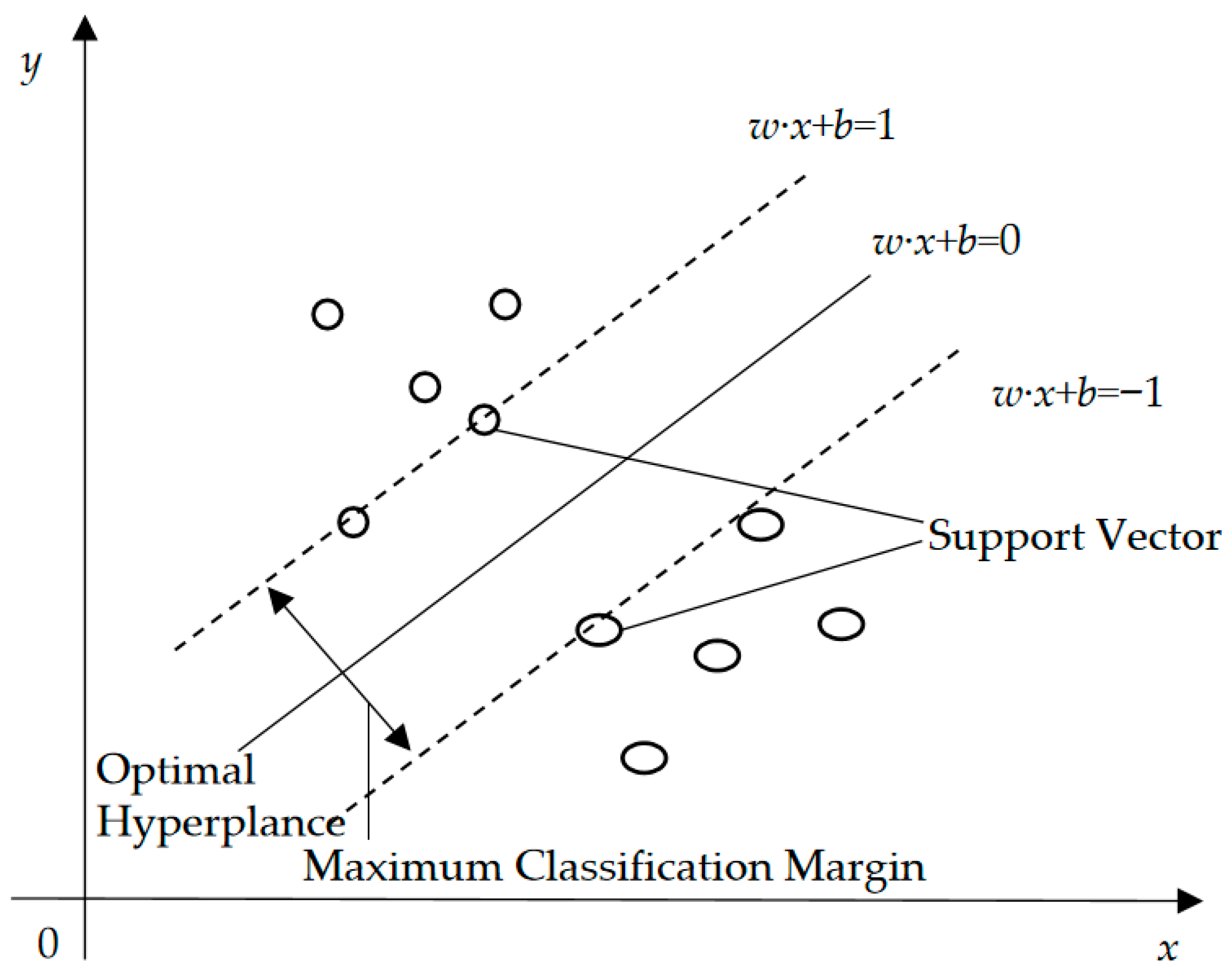
Support Vector Machine (SVM) is a classification and regression algorithm widely used in statistical learning, aimed at minimizing structural risk to establish data models [10]. Its core concept is to maximize the classification margin, transforming this into a convex quadratic optimization problem. SVM is well-suited for high-dimensional data processing, robust in nature, and has excellent generalization ability with small sample datasets. The fundamental principle is as follows: given a set of linearly separable data points, each belonging to one of two categories, the SVM seeks to find a hyperplane wx + b = 0 (a hyperplane in high-dimensional space, equivalent to a line in two-dimensional space) that separates the two classes and maximizes the margin between them, as illustrated in Figure 1. Thus, the task of determining the optimal margin for the SVM hyperplane can be formulated as solving an optimization problem under linear constraints, as shown in Equation (1):
min ω , b 1 2 ω 2 , s . t .       y i ( ω x i + b ) 1 , i = 1 , 2 , , n
where w represents the weight vector, b is the bias term, xi is the feature vector of the i-th training sample, and yi is the output variable category label of the i-th training sample.
By introducing Lagrange multipliers, the convex quadratic optimization problem can be transformed into a constrained optimization problem for solving the function, as shown in Equation (2):
max α ( i = 1 n α i 1 2 i = 1 n j = 1 n α i α j y i y j ( x i x j ) ) , s . t . i = 1 n y i α i = 0 α i 0
where α = ( α 1 , α 2 , , α n ) denotes the Lagrange multiplier.
The above constraint problem is a quadratic optimization problem with inequality constraints and has a unique solution. According to the Karush–Kuhn–Tucker (KKT) optimality conditions, only a small subset of solutions are non-zero, and the samples corresponding to these non-zero solutions are the support vectors.
Assuming α is the optimal solution to the convex quadratic optimization problem, the optimal solution to the original optimization problem can be expressed as shown in Equation (3).
ω = i = 1 n α i y i x i b = y i i = 1 n α i y i x i T x j
In practical engineering applications, problems are often high-dimensional and nonlinear. By introducing a kernel function and leveraging the concept of nonlinear transformations, samples in a low-dimensional space can be mapped to a high-dimensional feature space, allowing for the construction of an optimal separating hyperplane in this space to achieve linear separability. If a mapping function ϕ : x ϕ ( x ) represents the transformation from low-dimensional to high-dimensional space, then a separating hyperplane ω T ϕ ( x ) + b can be established in the high-dimensional space. The maximum-margin classification problem can also be converted into an optimization problem with linear constraints, as shown in Equation (4):
min ω , b 1 2 ω 2 + C i = 1 n ξ 1 , s . t . y i ( ω i ϕ ( x ) + b ) 1 ξ i , i = 1 , 2 , , n ξ i 0
where C represents the penalty factor, and ξi denotes the slack variable.
By introducing Lagrange multipliers, the above problem can be transformed into an extremum problem for a function, as shown in Equation (5):
max α i = 1 n y i ( α i α i ) ε i = 1 n ( α i + α i ) 1 2 i = 1 n j = 1 n ( α i α i ) ( α j α j ) ϕ ( x i ) T ϕ ( x j ) , s . t . i = 1 n ( α i α i ) = 0 α i 0 , α i C
where ε represents the loss function; when αi and αi* are support vectors, their values are non-zero, and otherwise, they are zero.
When solving this constrained optimization problem, it is challenging to directly compute the inner product ϕ ( x i ) T ϕ ( x j ) mapped to a high-dimensional space. To address this, a kernel function is introduced, as expressed in Equation (6):
κ ( x i , x j ) = ϕ ( x i ) , ϕ ( x j ) = ϕ ( x i ) T ϕ ( x j )
If the inner product between xi and xj in high-dimensional feature space is equivalent to the value of a function κ ( x i , x j ) obtained in the original space, complex computations can be avoided. In this study, we used the Gaussian Radial Basis Function (RBF) as the kernel function due to its wide mapping capability, low parameter requirements, and relatively simple computation [11]. Its expression is shown in Equation (7):
κ ( x i , x j ) = exp ( g x i x j ) 2
where g is the kernel parameter.
The Support Vector Machine (SVM) model has two critical parameters: the penalty parameter C and the kernel parameter g. The penalty parameter C controls the model’s tolerance to errors. A larger C means that the model has a lower tolerance for errors, imposing stricter penalties on misclassified samples, which can lead to overfitting. Conversely, a smaller C allows for greater error tolerance, reducing penalties on misclassifications, which may result in underfitting. If C is too large or too small, the model’s fit may be suboptimal, failing to achieve the desired learning effect. Striking a balance between model accuracy and complexity requires selecting an appropriate value for C. Similarly, the kernel parameter g is a key factor in the RBF function. A larger g value reduces the number of support vectors, while a smaller g value increases them, impacting the model’s training and prediction speed. The choice of C and g significantly affects the SVM performance. Therefore, selecting an optimal combination of these parameters for specific applications is essential for achieving the best classification results. In this study, the Improved Whale Optimization Algorithm (IWOA) was employed to optimize the SVM model parameters.

3. IWOA Based on Tent Chaos Mapping and Adaptive Threshold

3.1. Standard Whale Optimization Algorithm

In 2016, Seyedali Mirjalili and Andrew Lewis [12] proposed the Whale Optimization Algorithm (WOA), inspired by the social behavior and hunting strategy of whale groups. Since then, WOA has been developed to solve continuous optimization problems. Its core simulates the hunting behavior of humpback whales, which is divided into three core stages: surrounding prey, bubble net attack, and searching for prey, and achieves position updates and iterative optimization through specific mathematical models. The attacking behavior of surrounding prey is shown in Equation (8) [13]:
      D = C X ( t ) X ( t ) X ( t + 1 ) = X ( t ) A D A = 2 a r 1 a C = 2 r 2 a = 2 2 t t max
where t and tmax denote the current iteration and maximum number of iterations, respectively; X ( t ) represents the position vector of the fittest whale in the current iteration; X ( t ) is the position vector of a whale in the current iteration; A and C are coefficient vectors; r is a random vector with values between 0 and 1; a is an iteration control parameter.
After surrounding the prey, the whale algorithm enters the bubble net attack phase and updates its position through spiral motion, mathematically represented by Equation (9):
X ( t + 1 ) = X ( t ) + D e b l cos ( 2 π l )
where D is the distance between any individual in the population and the optimal position during the t-th iteration; b is the spiral motion coefficient of the whale; l is a random number within the range [−1, 1].
Finally, the algorithm enters the stage of searching for prey. Assuming that whales use circular and spiral motion with equal probability (50%) during hunting, the mathematical model of the hunting process can be represented by Equation (10):
            X ( t + 1 ) = X ( t ) A D ,                   p < 0.5 X ( t + 1 ) = X ( t ) + D e b l cos ( 2 π l ) , p 0.5
where p is a random number between [0, 1].
In addition to the hunting process, whales explore the search space randomly to locate prey. When A > 1 , individuals in the population will move away from the optimal whale’s position, performing a global search by updating positions relative to randomly selected whales. When A > 1 , the whales conduct a local search near the optimal position. This process is described by Equation (11):
X ( t + 1 ) = X r a n d ( t ) A D r a n d D r a n d = C X r a n d ( t ) X ( t )
where X r a n d represents the position of a randomly selected whale.

3.2. Improved Whale Optimization Algorithm

In the standard WOA, the initial population is generated randomly, which does not ensure diversity or uniform distribution across the search space. To enhance the algorithm’s initial population quality and improve convergence speed, this study applied an improved Tent chaotic mapping strategy to remap the randomly generated initial population. The Tent chaotic sequence is characterized by randomness, ergodicity, and regularity [14]. The mapping expression is shown in Equation (12):
x i + 1 = 2 x i + rand ( 0 , 1 ) × 1 N , 0 x 0.5 2 ( 1 x i ) + rand ( 0 , 1 ) × 1 N , 0.5 < x 1
where N represents the population size of the whales.
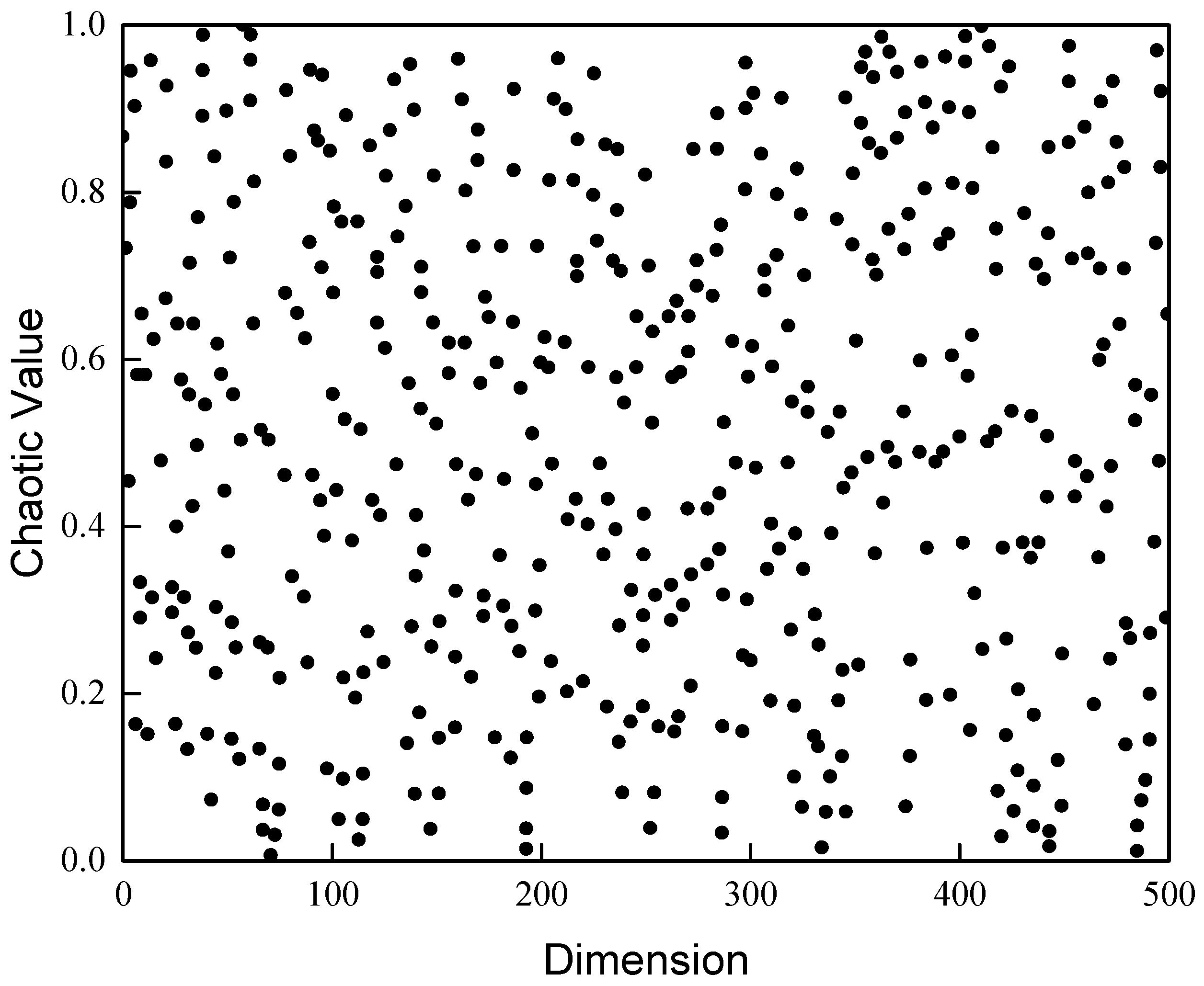
Figure 2 shows the distribution of chaotic sequences generated by the improved Tent chaotic mapping, with each point representing a specific dimension of chaotic values, which directly reflects the spatial distribution of the initial population. Unlike traditional Tent chaotic maps that may have uneven distributions, the improved version introduces random variables in the mapping function, effectively eliminating the inherent distribution bias of the original Tent map. As shown in Figure 2, the chaotic values are uniformly and randomly distributed throughout the entire [0, 1] interval in all dimensions, without obvious clustering or sparse regions, which verifies that the improved mapping successfully breaks the arrangement of the original Tent sequence. The uniform distribution of initial solutions is crucial for the global search capability of the WOA, as it ensures that the population covers the entire search space comprehensively, avoiding premature convergence to local optima due to initial value deviations, thereby directly improving the efficiency and accuracy of the algorithm in cable force optimization while reducing the impact of initial value sensitivity, laying the foundation for the robustness and reliability of subsequent optimization results. Therefore, Figure 2 directly and intuitively verifies the effectiveness of our improved Tent chaotic mapping, which is the key foundation for the superior performance of the proposed IWOA-SVM framework.
The optimization efficiency and accuracy of the WOA are closely linked to the position update strategy of the whale individuals. In Equation (8), the standard WOA employs a linear change in the iteration control parameter a, which limits its ability to balance global convergence with local search performance. To address this, we introduced a nonlinear iteration control parameter a, as shown in Equation (13) [15]:
a = 1 2 cos ( π t 2 t max )
The standard WOA is prone to local optima during iteration, which can prematurely end the optimization process without reaching a global optimum. To improve its global search capabilities, an adaptive weight factor strategy is introduced. This adaptive weight factor dynamically adjusts the search range and depth based on the algorithm’s state during iteration to better balance global and local search capabilities. At the start of the iterations, the adaptive weight factor w is relatively large, encouraging global exploration. As iterations proceed, w gradually decreases, leading the algorithm to focus on a specific area, thus reducing the likelihood of being trapped in local optima [16]. With the introduction of the adaptive weight factor, the WOA mathematical model is updated from Equations (10)–(14).
              X ( t + 1 ) = w X ( t ) A D ,             p < 0.5 X ( t + 1 ) = w X ( t ) + D e b l cos ( 2 π l ) , p 0.5
w ( t ) = e ( t t max ) k
where k represents the weight adjustment coefficient.
As shown in Equation (10), the WOA uses a 50% probability for each of the “encircling” and “spiral” movement strategies to update positions during the optimization iterations, typically setting the probability threshold at 0.5 to ensure a random selection between these movement strategies. However, this fixed probability threshold can slow down convergence as the number of iterations increases. To address this issue, an adaptive threshold p* was introduced in this study. The value of p* ranges between 0 and 1 and changes adaptively as the algorithm progresses. This dynamic threshold allows the WOA to have a greater likelihood of selecting an appropriate search strategy at each stage, balancing the local and global search capabilities. The adaptive threshold p* can be calculated using Equation (16):
p = 1 1 1 + λ ( λ t λ t max + μ t μ t max )
where λ and μ are the control parameters for the adaptive threshold, commonly set at λ = 0.5 and μ = 0.2.
With the introduction of the adaptive threshold p*, the mathematical model of the WOA is modified from Equations (14)–(17):
              X ( t + 1 ) = w X ( t ) A D ,             p < p X ( t + 1 ) = w X ( t ) + D e b l cos ( 2 π l ) , p p
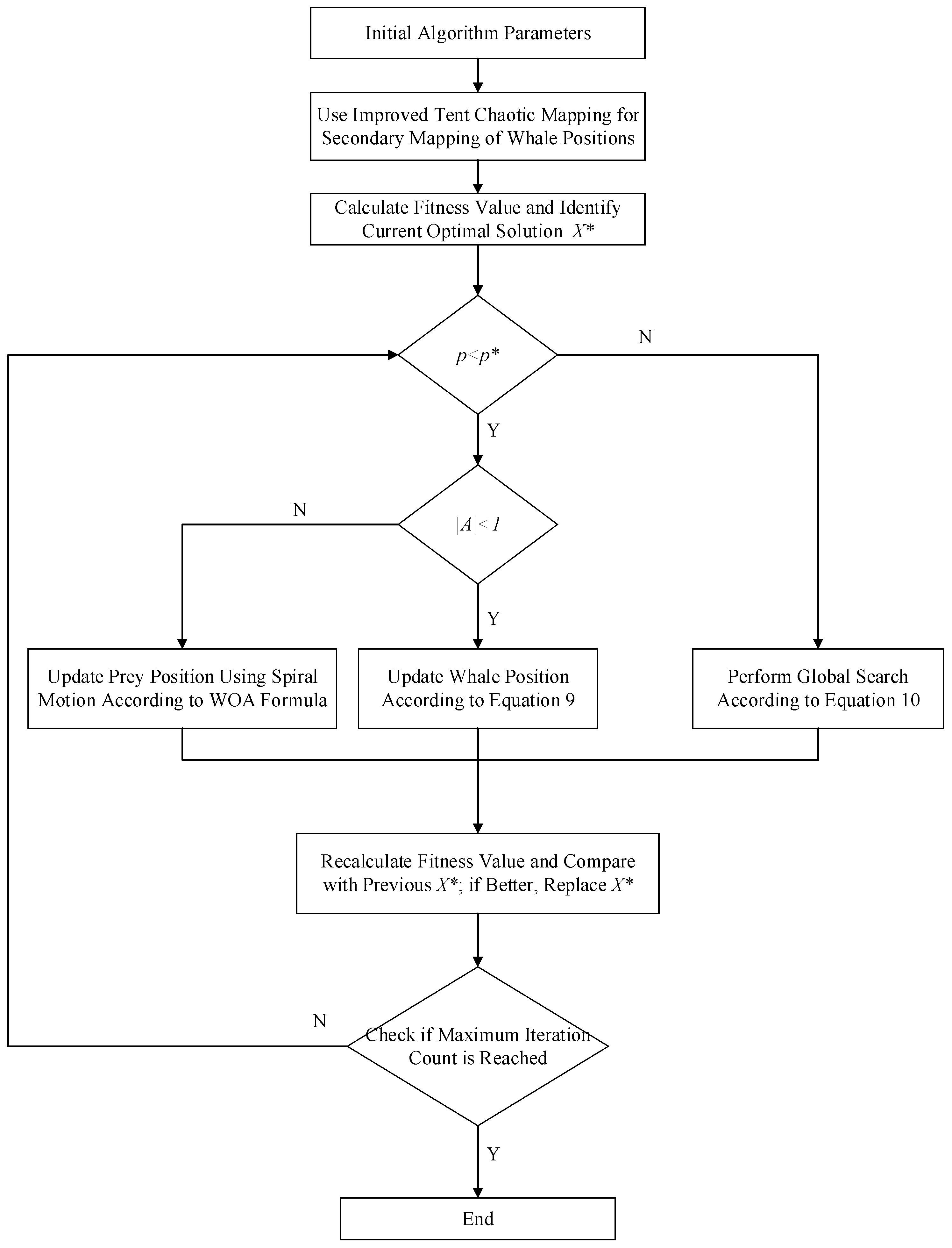
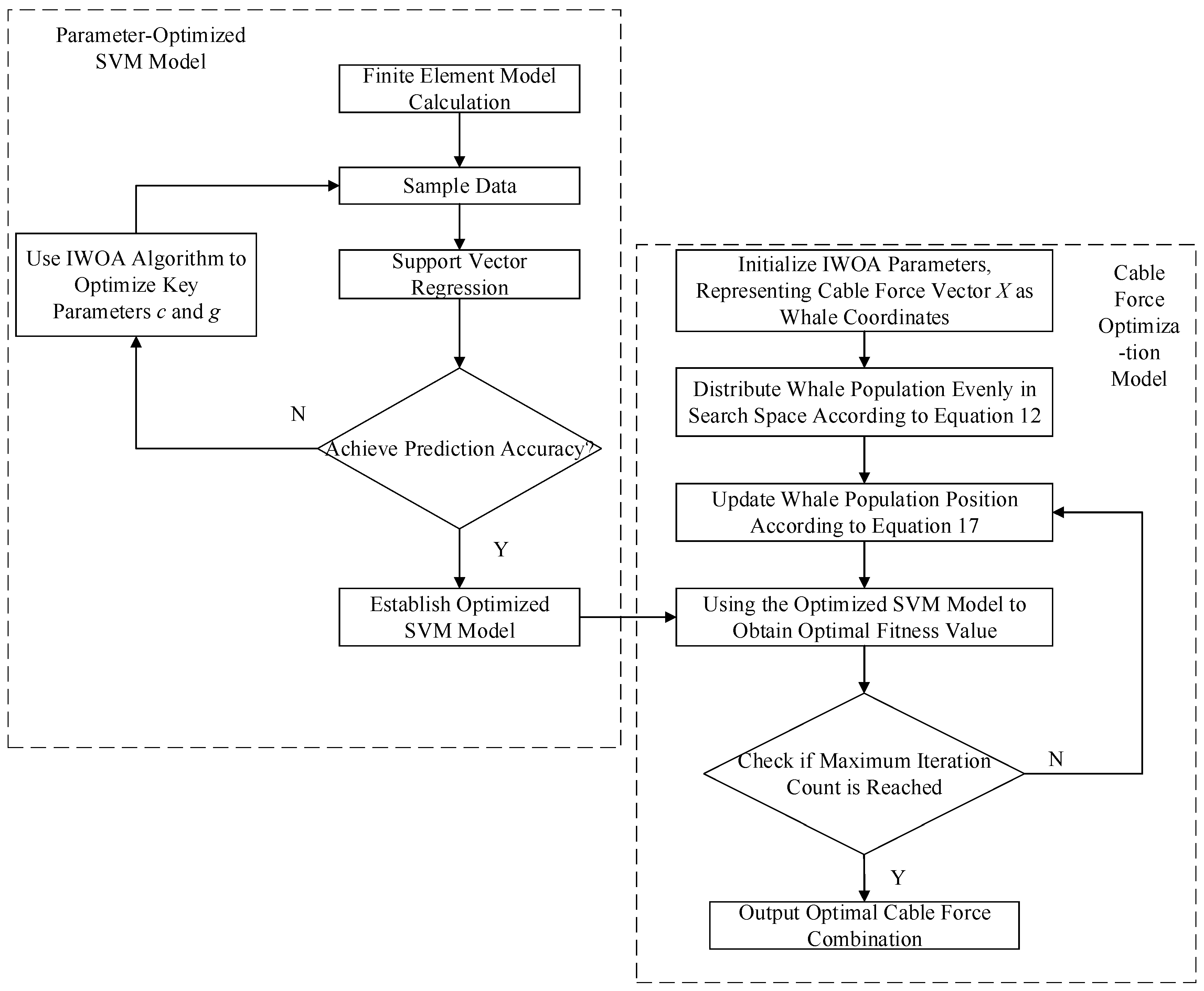
By incorporating improvements such as Tent chaotic mapping, nonlinear iteration control parameters, an adaptive weight factor, and the adaptive threshold, the WOA is optimized and enhanced. The workflow of the improved IWOA algorithm is shown in Figure 3.

3.3. Algorithm Performance Testing

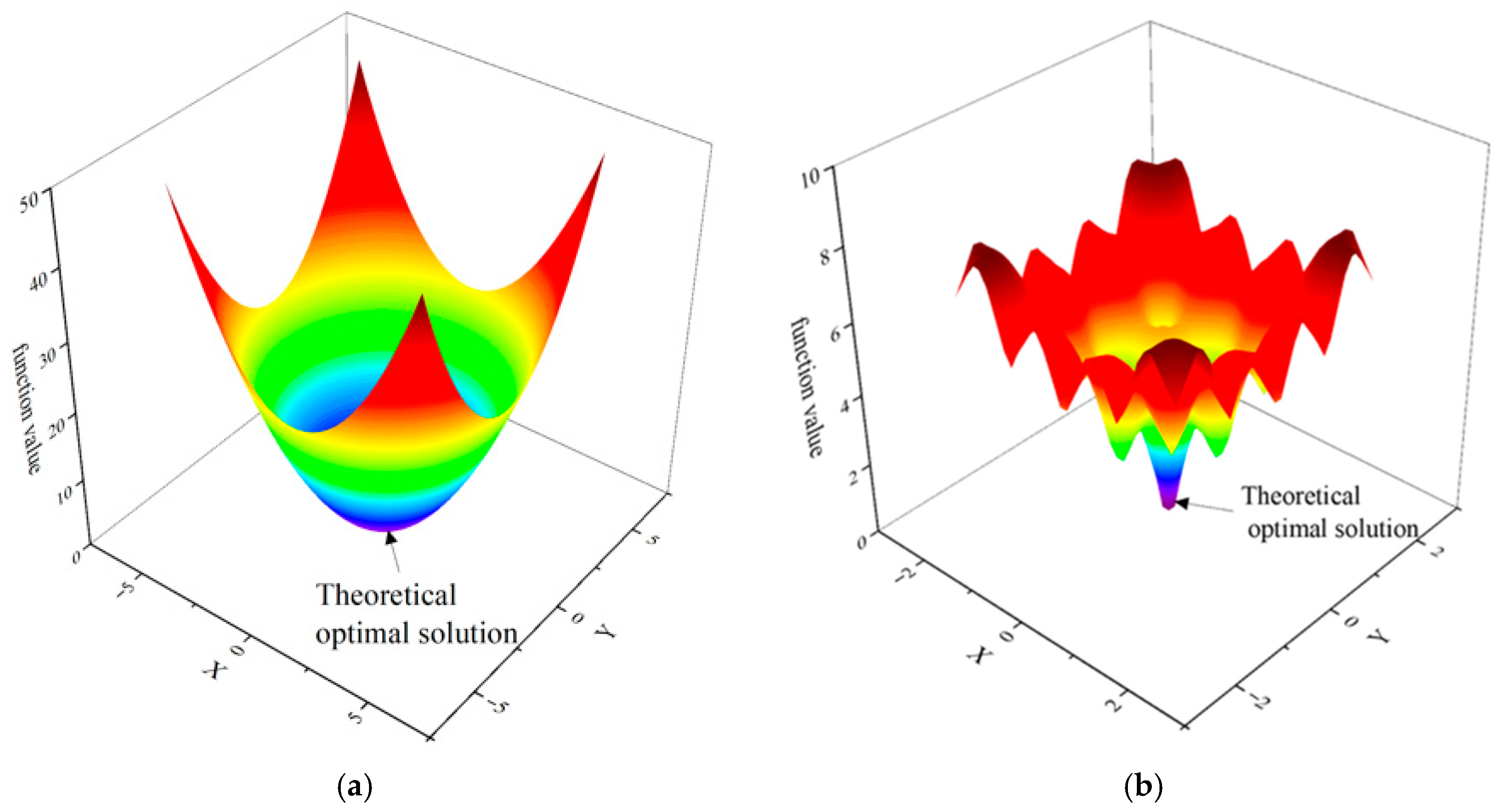
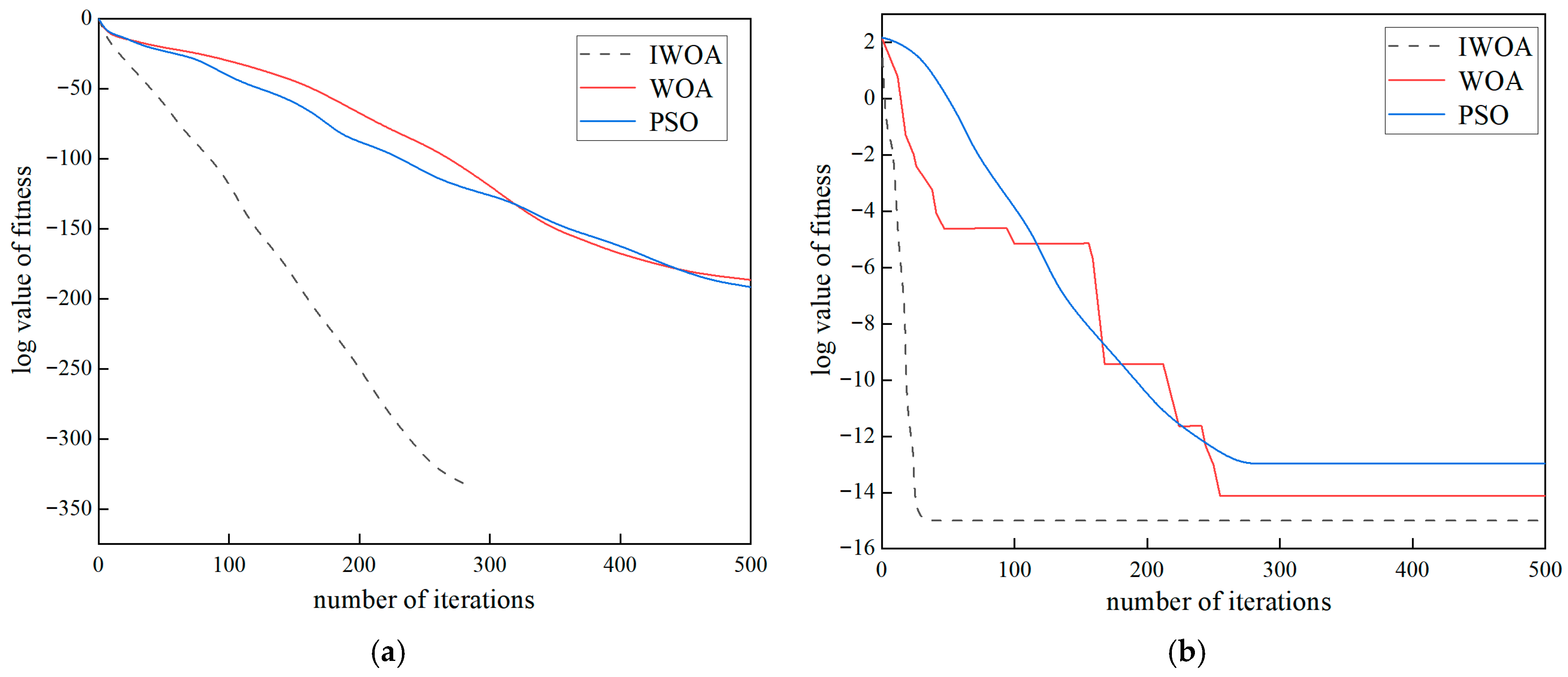
To verify the effectiveness of the improvement strategies applied to the standard WOA in this study, two test functions were employed: the unimodal Sphere function and the multimodal Ackley function. A function diagram is shown in Figure 4, and the specific parameters are detailed in Table 1 [17]. Optimization was performed using the IWOA, standard WOA, and particle swarm optimization (PSO) algorithms. For all three algorithms, the population size was set to N = 30, the maximum number of iterations Tmax = 500, and each test was run 30 times under identical parameter settings. Figure 5 presents the convergence curves of these algorithms for the two test functions.
As shown in Figure 5a, for the unimodal sphere function, the convergence speeds of the standard WOA and PSO algorithms were similar, whereas the IWOA algorithm (with the improved strategies) exhibited a faster convergence rate. All individuals could converge to the global optimal solution at an earlier stage, finishing the optimization within approximately 300 iterations.
In Figure 5b, for the multimodal Ackley function, due to the characteristic of multiple local optimal solutions in multimodal functions, none of the algorithms could guarantee that all individuals converge to the global optimal solution of 0. Nevertheless, the IWOA algorithm converged faster than the standard WOA and PSO algorithms, and the average fitness of all individuals obtained by the IWOA algorithm was higher, which proves its stronger optimization-seeking ability and higher accuracy.
The convergence curves of the unimodal and multimodal test functions validate the effectiveness of the improvements for the WOA, including Tent chaotic mapping, nonlinear iterative control parameters, adaptive weight factor, and adaptive threshold strategy. These enhancements greatly improve the optimization speed and accuracy of the WOA.

4. IWOA-SVM-Based Cable Force Optimization Model

4.1. Construction of the Cable Force Optimization Mathematical Model

To determine appropriate cable forces for a reinforced concrete arch bridge during construction and to ensure a rational stress distribution after bridge completion, this study developed an IWOA-SVM-based cable force optimization model for the construction phase. Initially, it is necessary to find the optimal combination of the SVM model’s penalty parameter C and kernel parameter g. This process involves calculating the finite element model of the reinforced concrete arch bridge, using the designed cable tensile forces as input variables and the bending strain energy responses of arch segments as output variables. An SVM model is then employed to establish the mapping between these variables, while the IWOA algorithm optimizes the parameters C and g to obtain their optimal values. Once an accurate SVM model is constructed, an optimization model for the cable forces is formulated by setting the average tensile stress in the top and bottom plates of the arch during construction and the bending strain energy U of the completed arch bridge as the objective variables. The IWOA algorithm is then applied to solve for the optimal cable force combination during the construction phase.
Since concrete exhibits a much higher compressive strength than tensile strength, and the forces acting on the arch segments are complex during construction, the average tensile stresses on the top and bottom plates of the arch segments are used as objective variables to ensure that the tensile stresses remain within the allowable concrete tensile design limits. The objective function is defined as shown in Equation (18):
σ a = min 1 n i = 1 n ( σ i t + σ i b )
where σ i t is the maximum tensile stress on the top plate of segment i, σ i b is the maximum tensile stress on the bottom plate of segment i, and n is the number of arch segments.
To improve the internal force distribution after bridge completion, the arch bridge structure is discretized, and the bending strain energy U of the completed bridge is expressed as shown in Equation (19) [18,19,20,21]:
U = i = 1 m L i 2 E i I i M i 2
where m is the number of discrete elements in the arch structure, and Li is the length of each element.
Considering the influence of stay cable forces during the cantilever construction stage on the alignment of the arch ring structure, the sum of squared differences between the designed and calculated vertical displacements at the control sections of each arch segment after releasing the temporary cables is selected as the deformation control index. The third objective function for cable force optimization of the arch bridge is established, as shown in Equation (20):
V = Min 1 n i = 1 n ( v i v i ) 2
where vi is the vertical displacement calculated by finite element analysis for the control section of the arch ring during the cantilever construction stage, and v i is the design vertical displacement of the arch ring control section during the cantilever construction stage.
Thus, the IWOA-SVM-based optimization mathematical model for cable forces during the construction phase of the reinforced concrete arch bridge is formulated as shown in Equation (21):
Find             x 1 , x 2 , , x 18 min             1 n i = 1 n ( σ i t + σ i b ) i = 1 m L i 2 E i I i M i 2 , 1 n i = 1 n ( v i v i ) 2 s . t .             σ i f i t max ( σ ) < σ max v _ v i v i v ¯ x i , min x i x i , max , i = 1 , 2 , , n
where x1~x18 represents the cable forces to be optimized, σ is the tensile stress in the concrete arch construction cables, and f i t is the design value of the concrete’s tensile strength.

4.2. IWOA-SVM-Based Cable Force Optimization Process

The basic process for optimizing cable forces in the construction phase of a reinforced concrete arch bridge using the IWOA-SVM method is shown in Figure 6. This method consists of two main optimization models: one for parameter optimization of the SVM model, and another for cable force optimization. The specific steps are as follows [22,23,24,25].
(1)
Initialize the IWOA Parameters: Set the population size of the IWOA algorithm to 50 and the maximum number of iterations tmax to 300. Define the key parameters of the SVM model, (c, g), as whale coordinates and distribute the whale population uniformly within the search space as per Equation (12).
(2)
Update Whale Population Position: Update the positions of the whale population according to Equation (17), calculate the fitness values, and identify the current optimal solution, assigning it to individual a.
(3)
Check Iteration Termination for SVM Parameter Optimization: If the maximum number of iterations is reached, output the optimal parameter combination to obtain the optimized SVM model. If not, return to Step 2.
(4)
Initialize Cable Force Optimization Model Parameters: Initialize IWOA parameters for the cable force optimization model. Here, the parameter to be optimized is the cable force X from Equation (19). Set the IWOA algorithm’s population size to 50 and tmax = 300, according to the design variable, the algorithm dimension is set to 18. Represent the designed cable tensile forces as coordinates in the improved whale algorithm. As the Shatuo Bridge is a symmetric structure, only the left half of the structure was analyzed, consisting of 18 cables with design tensile forces for each stage of construction, as shown in Table 2.
(5)
Calculate Fitness Using the SVM Model: Compute the fitness value of the arch bridge structure through the SVM model.
(6)
Update Whale Positions and Recalculate Fitness: Update the positions of the whale population and recalculate the fitness values.
(7)
Check Iteration Termination for Cable Force Optimization: If the termination conditions are met, output the results. If not, return to Step 3 and repeat the process [26,27,28,29].

5. Engineering Case Analysis

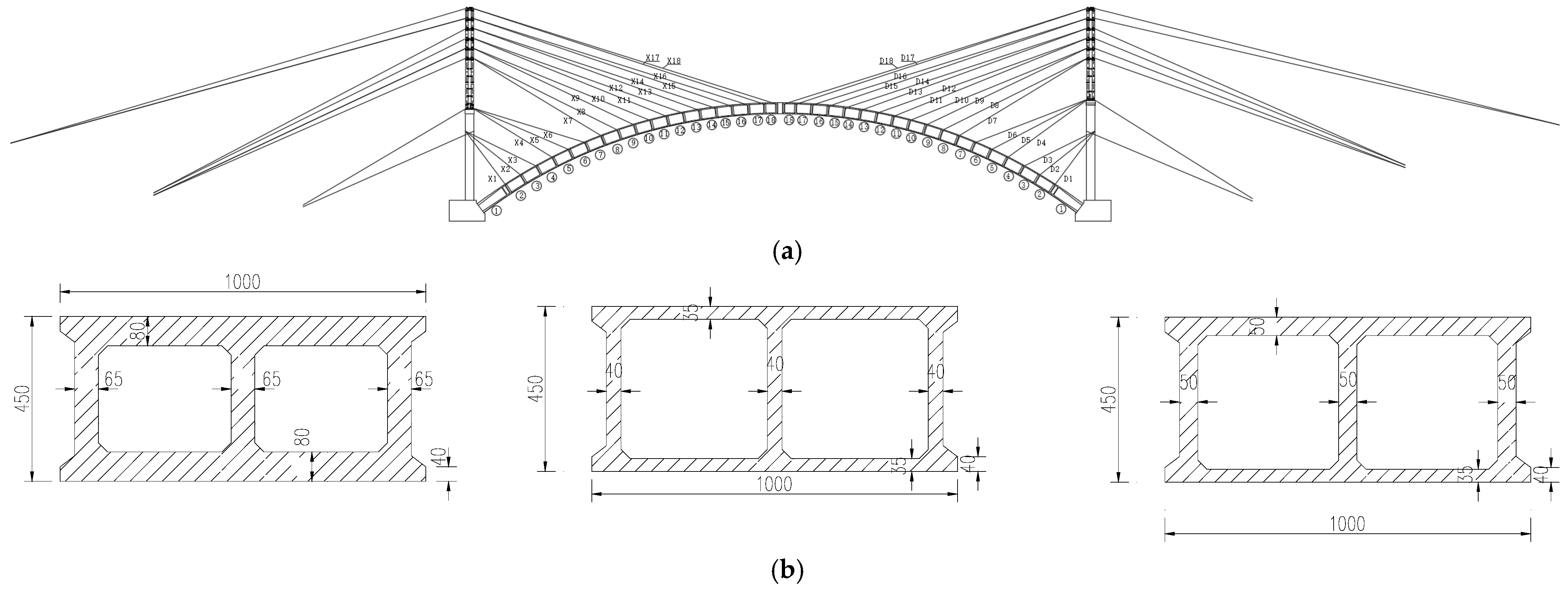
This study used Shatuo Bridge in Yanhe County, Guizhou Province, as an engineering case. The main bridge structure consists of a 240-m span reinforced concrete box arch with concrete arch seats and is constructed using an open foundation method. The arch shape follows a catenary curve with a net height of 40 m and an arch axis coefficient of 1.85. The main arch ring adopts a single-box double-chamber section with a width of 10 m and a height of 4.5 m, divided into 37 arch segments constructed through cantilever casting. The concrete strength grade is C60. The construction layout of the bridge is shown in Figure 7.
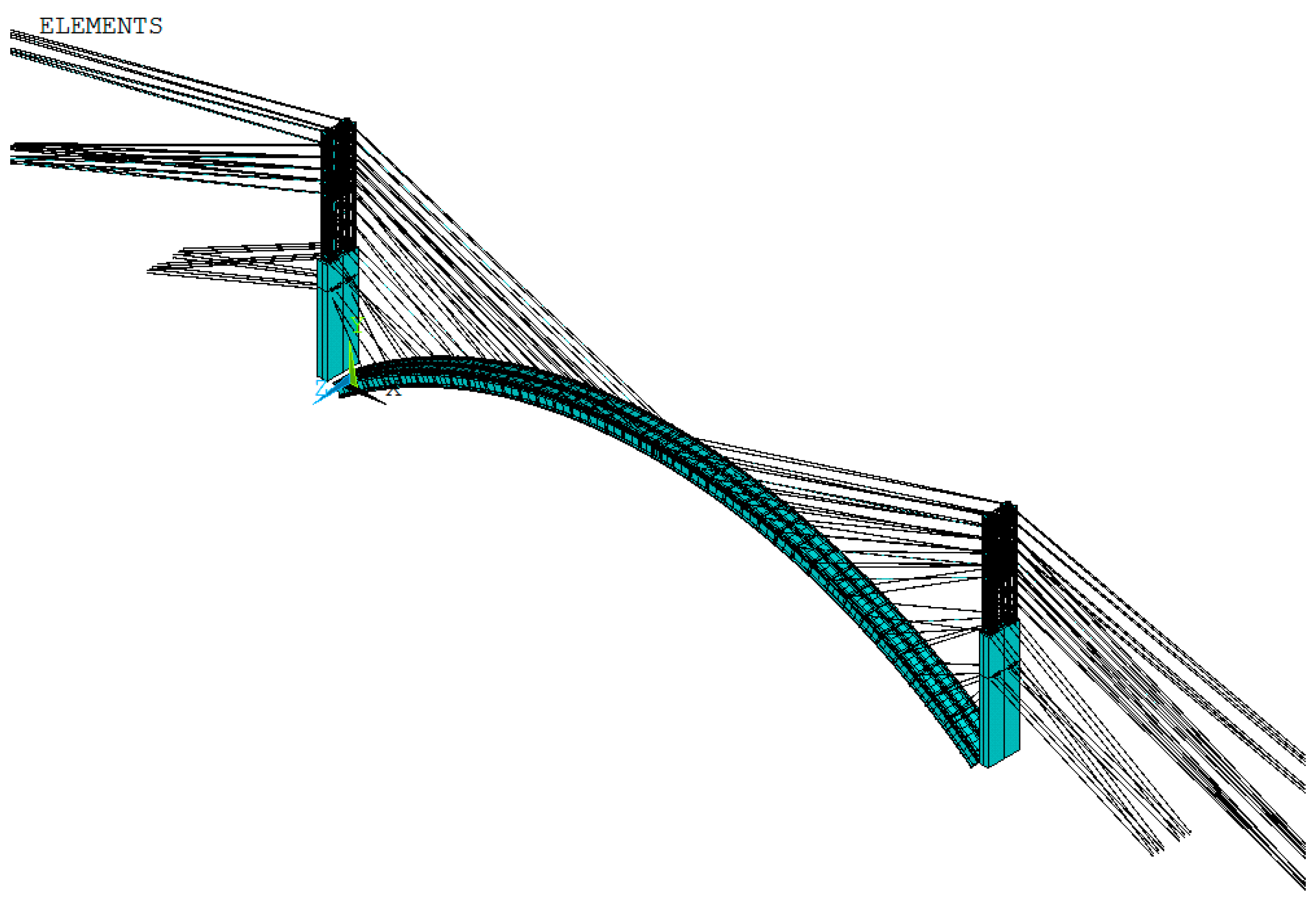
To achieve accurate response calculations for the long-span reinforced concrete arch bridge structure, a numerical model was established using finite element software. The model employs eight-node entity elements for the concrete main arch ring and transition piers, truss elements for cable and anchor cables, and beam elements for the piers and main girders. The entire bridge model uses a combination of mapped and swept meshing. The finite element model is shown in Figure 8.
Determine the statistical distribution law of random variables that affect the response characteristics of reinforced concrete arch bridge structures [30] as the random variables of the SVM surrogate model, as shown in Table 3.
Following the optimization workflow, an SVM model parameter optimization program for the reinforced concrete arch bridge was developed in MATLAB 2018b. Finite element software was used to generate the sample data, which was then employed to optimize key SVM parameters (c, g). Additionally, a cable force optimization program was implemented, utilizing the optimized SVM model as a solver to optimize the construction-stage cable forces for the reinforced concrete bridge.
To verify the fitting accuracy of the support vector machine model, R2, MAE, and RMSE were adopted as evaluation indices for prediction accuracy [31]. By comparing the fitting results with those of the BP neural network model and the random forest model, it was shown that the support vector machine model performed best, with the highest R2 value and the lowest MAE and RMSE values, indicating the smallest prediction error (Table 4).
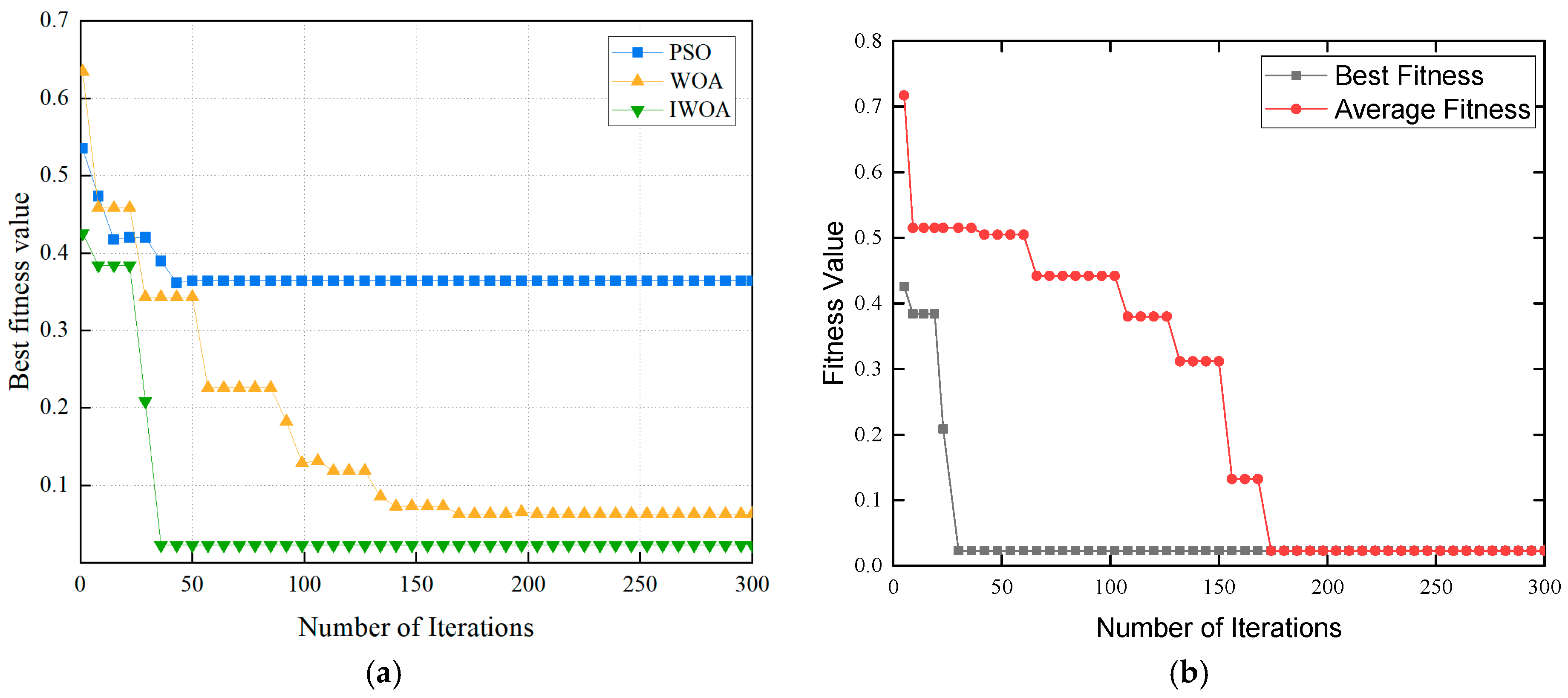
To verify the computational performance of the IWOA, it was compared with the two algorithms mentioned earlier for optimizing the stay cable forces in the construction of a reinforced concrete arch bridge. The population size and number of iterations were set to the same values for all three algorithms. Figure 9a shows the iteration curves of the three algorithms. As can be seen from the figure, all three algorithms converged by the final iteration, but there were significant differences in convergence speed and accuracy. The IWOA demonstrated notably faster convergence compared to the other two algorithms, along with the highest convergence accuracy. This indicates that the IWOA has good applicability in practical engineering. Figure 9b presents the fitness curve during the optimization of cable forces using the IWOA algorithm for the construction stage of the reinforced concrete arch bridge. As shown in Figure 9b, the IWOA algorithm converged to the optimal solution by the 175th iteration, indicating that the optimal cable force combination for the bridge’s construction stage had been obtained at this point.
Table 5 compares the computation time for the IWOA-SVM-based cable force optimization method with that of the finite element software’s built-in optimization approach. The results in Table 5 reveal that the finite element software’s optimization program had a significantly higher computation cost. By replacing the finite element model with a machine learning algorithm and surrogate optimization model, the proposed method achieved a substantial improvement in computational efficiency, reducing the time costs by approximately 80.8%.
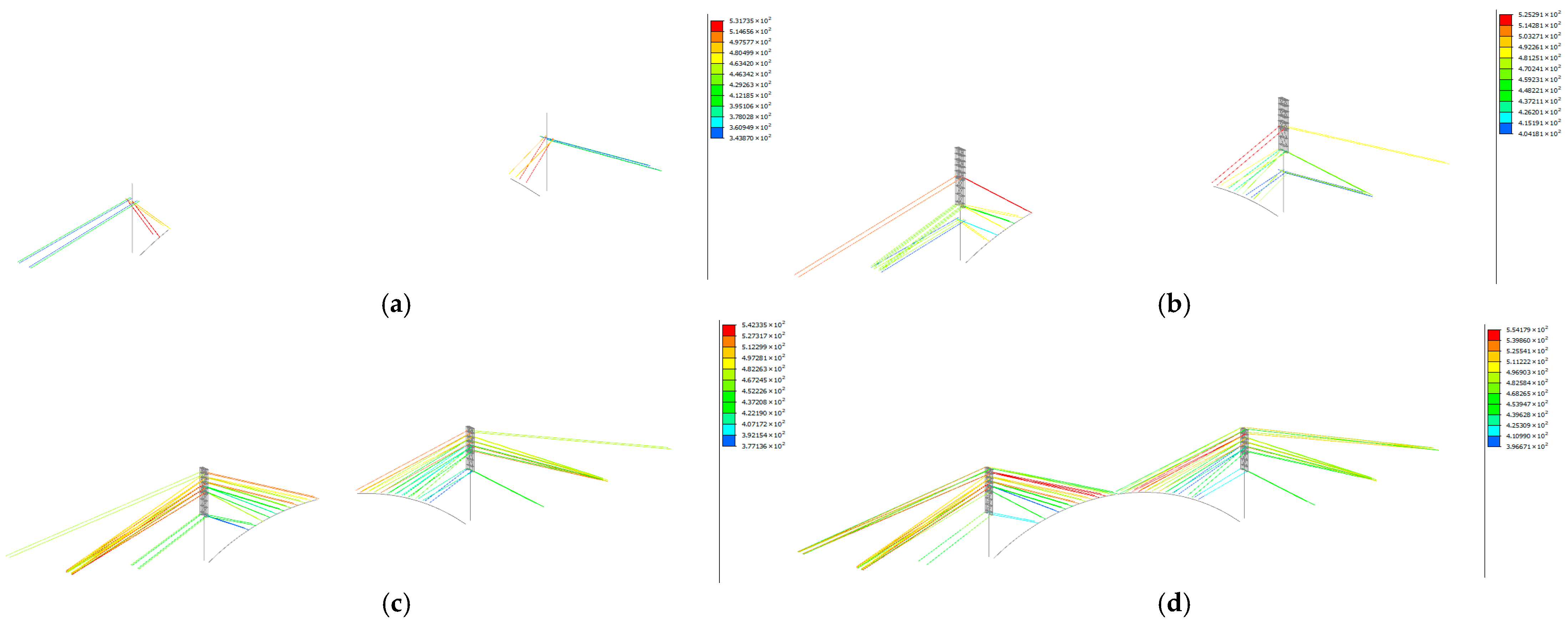
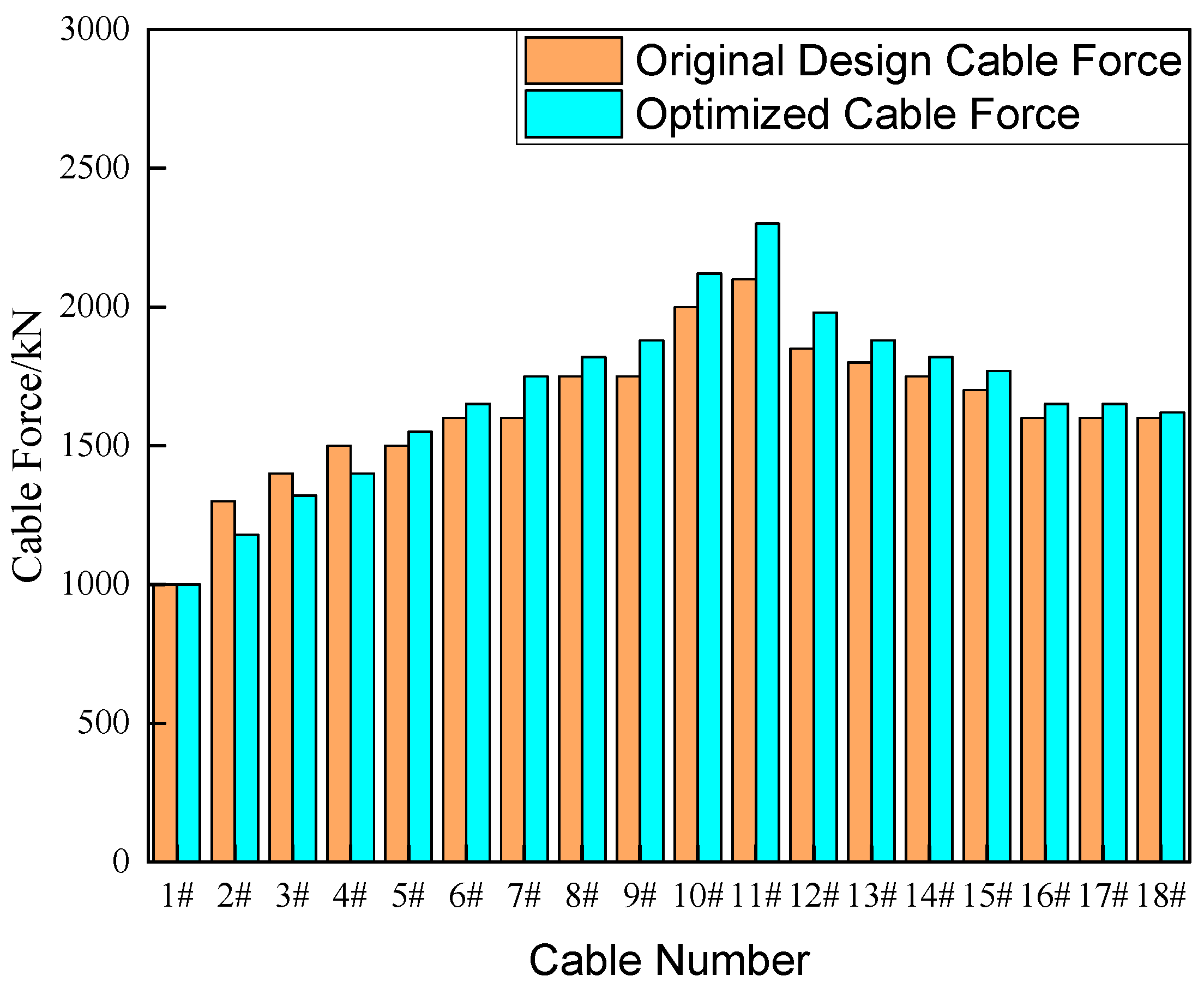
Figure 10 shows the stress nephogram of the stay cable of the arch bridge. It can be seen from Figure 10 that the cable force presented different stress distribution characteristics in different construction stages [32], but the cable force values in each construction stage were within the safety redundancy, meeting the requirements of the cable force safety constraints. As described in Section 4.2, this study focused on the left half of the structure. Figure 11 shows the comparison of cable forces before and after the optimization of the left half of the structure. As shown in Figure 11, the optimized cable force distribution mode was basically consistent with the original design. There was a slight reduction in cable forces near the arch foot, while the forces in the middle and arch crown regions increased to some extent, with the largest increase occurring at segment #11, reaching approximately 10%.
An analysis of the stress distribution during the bridge construction process reveals that, as construction progresses, the horizontal angle of the cables gradually decreases. Consequently, the horizontal component of the force provided by the cables to the arch segments increases, while the vertical component decreases. To ensure construction stability, the optimized cable forces increase beginning at the middle segments, providing the arch with greater vertical support.
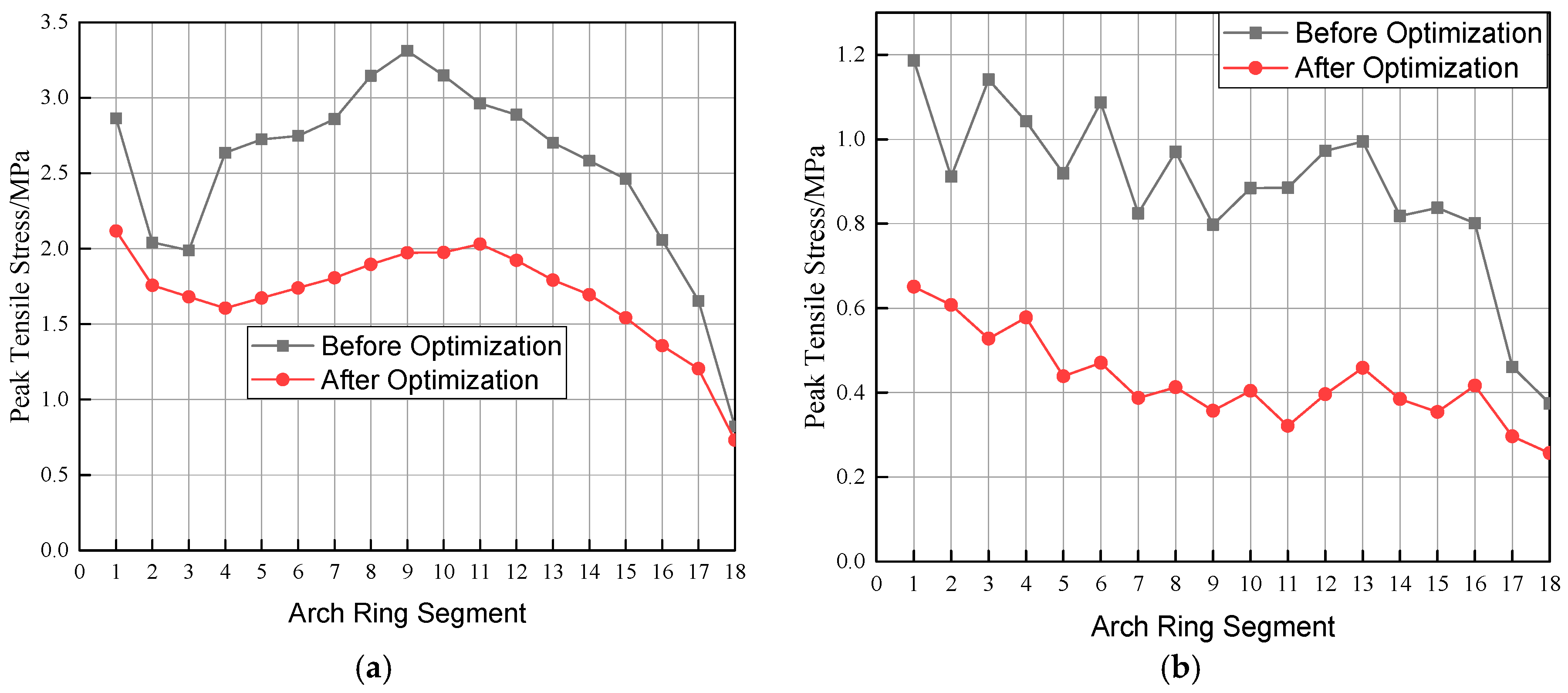
Figure 12 illustrates the comparison of peak tensile stresses in the top and bottom slabs of each arch segment before and after optimization. From Figure 12a, it can be observed that the peak tensile stress in the top slab of each segment decreased after optimization, with the most significant reduction occurring in the middle arch segments. Specifically, the peak tensile stress in segment #9 decreased from 3.31 MPa to 1.97 MPa, a reduction of approximately 40.5%. The peak tensile stress reduction at the arch crown and foot segments was relatively smaller. From Figure 12b, we can see that the bottom slab’s peak tensile stresses in each segment decreased substantially, with an average reduction of around 50.5%. After optimization of the cable forces during the construction of the reinforced concrete arch bridge, the peak tensile stresses in both the top and bottom slabs of all segments fell below the design tensile strength of C60 concrete, ensuring structural safety.
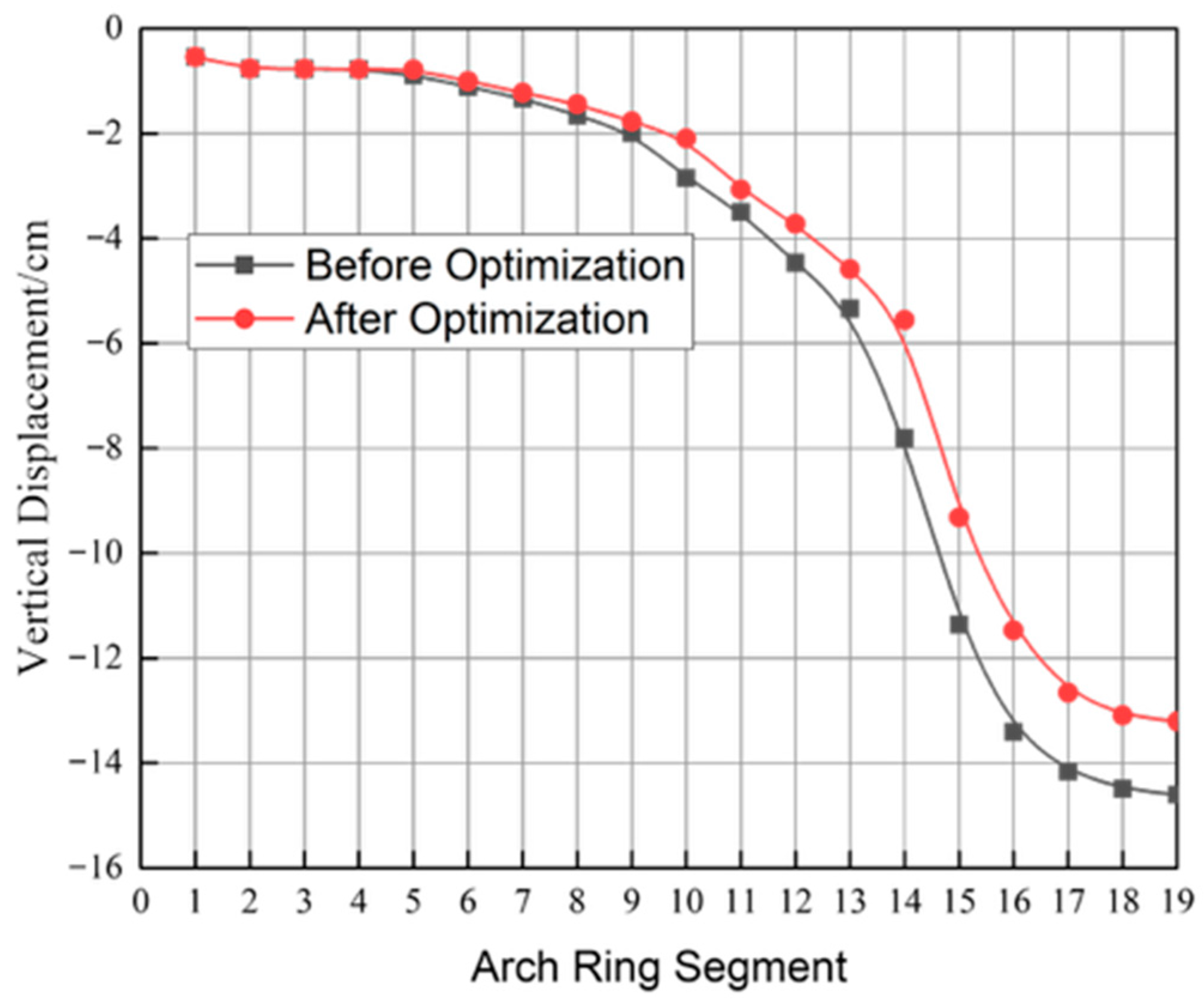
Figure 13 shows the comparison of vertical displacements for each arch segment before and after cable force optimization, following the release of cables upon bridge completion. The vertical displacement of each segment increased progressively from the arch foot toward the crown, resulting in a reasonably linear distribution after cable release. The overall vertical deformation of the arch decreased significantly after cable force optimization. Since deformation near the arch foot was already minor, the reduction there was less pronounced. As construction progresses, the cable lengths and forces increase, with the vertical force component reaching a minimum at the closure segment, where the arch’s vertical deformation is at its peak. Starting from segment #10, vertical displacement increased significantly, with the vertical deformation at the closure segment (#19) decreasing from 14.6 cm to 13.2 cm, representing a reduction of approximately 9.6%. After cable force optimization, the linear distribution of the arch segments was more reasonable than before, enhancing the overall safety and reliability of the reinforced concrete arch bridge structure.

6. Conclusions

This paper proposes an IWOA-SVM-based optimization method for cable forces in the construction of reinforced concrete arch bridges. By applying multiple strategies to improve the standard Whale Optimization Algorithm (WOA) and integrating finite element software with a support vector machine (SVM) regression model, a mapping relationship was established for the cable force–response sample data of reinforced concrete arch bridges. An SVM-based optimization mathematical model for cable force parameters was constructed, and the IWOA algorithm was used to solve the cable force optimization model, with the Shatuo Grand Bridge as a case study. The main conclusions are as follows.
(1)
Through the application of an improved Tent chaotic mapping strategy, a nonlinear iteration control parameter, an adaptive weight factor strategy, and an adaptive threshold strategy, the standard WOA was enhanced. Convergence curve results from single-peak and multi-peak test functions indicate that the IWOA algorithm achieved significantly faster convergence speeds and improved optimization performance compared to the other algorithms.
(2)
Compared with traditional finite element optimization methods, the IWOA-SVM-based optimization method for cable forces in reinforced concrete arch bridge construction greatly enhances computational efficiency while ensuring optimization effectiveness, resulting in significant time savings.
(3)
An IWOA-SVM-based optimization mathematical model for cable forces in reinforced concrete arch bridge structures was developed, yielding optimized cable force results. The optimized cable forces closely followed the distribution trend of the original design, with slight reductions in force at the arch foot and moderate increases in the middle and crown areas. The optimized peak tensile stresses and vertical displacements of each arch segment showed a noticeable reduction, resulting in a more rational distribution of internal forces and linear deformation in the arch. This enhances the overall structural safety and reliability of the reinforced concrete arch bridge. The SVM model trained in this study was specifically designed for the geometric, material, boundary conditions, and optimized construction sequence of the aforementioned particular arch bridge. Its predictive performance may degrade if the formulation is directly applied to other arch bridges with different spans, cross-sections, materials, or construction schemes.
(4)
The IWOA-SVM framework constructed in this article provides an efficient safety analysis tool for the cantilever pouring construction control of large-span reinforced concrete arch bridges. In the future, research can be extended to health monitoring during bridge operation, and integrating deep learning models to process real-time monitoring data will be a highly valuable direction.

Author Contributions

Methodology, J.L.; Software, J.L.; Validation, J.Y.; Formal analysis, J.Y. and J.Z. (Jinbo Zhu); Investigation, J.Z. (Jinbo Zhu) and Z.J.; Resources, H.Y.; Data curation, J.Z. (Jijin Zhang); Writing—original draft, H.Y.; Writing—review & editing, Z.Z.; Supervision, Z.J. and Z.Z.; Funding acquisition, J.Z. (Jijin Zhang). All authors have read and agreed to the published version of the manuscript.

Funding

This research was funded by the Science and Technology Project of Guizhou Provincial Department of Transportation, grant number 2017-123-007.

Data Availability Statement

The original contributions presented in the study are included in the article, further inquiries can be directed to the corresponding author.

Conflicts of Interest

Authors Hongping Ye, Jianjun Liu, Jian Yang and Jinbo Zhu were employed by the company Guizhou Transportation Planning Survey & Design Academe Co., Ltd. Author Jijin Zhang was employed by the company Guizhou Road & Bridge Group Co., Ltd. The remaining authors declare that the research was conducted in the absence of any commercial or financial relationships that could be construed as a potential conflict of interest.

References

  1. He, W.; Zhou, W.G.; Tran, J.C. Study of optimization fastening stay forces for arch bridge constructed by cantilever casting. Chin. Bridge Constr. 2015, 45, 32–36. [Google Scholar]
  2. Cunxin, Y.I.N. New method for adjustment and calculation of cable forces of cable-stayed bridges and software development compounding bending energy method and effect matrix method. Build. Struct. 2021, 51, 1532–1538. [Google Scholar]
  3. Yu, Q.H.; Li, W.; Zhe, J.G. Calculation and analysis of construction cable force of long-span cantilever reinforced concrete arch bridge. J. Transp. Sci. Eng. 2022, 38, 45–53. [Google Scholar]
  4. Xie, K.; Yu, M.; Yao, X.; Wang, L.; Hao, T.; Wang, H. Optimization of Suspender Cable Force of Long-Span Concrete Arch Bridges Based on Embedded Matrix Method. Adv. Civ. Eng. 2022, 2022, 2943806. [Google Scholar] [CrossRef]
  5. Liu, Z.; Zhou, S.; Zou, K.; Qu, Y. A numerical analysis of buckle cable force of concrete arch bridge based on stress balance method. Sci. Rep. 2022, 12, 12451. [Google Scholar] [CrossRef]
  6. Duan, J.; Wang, H.; Hao, T. Optimal model of arch bridge cable force based on improved grey wolf algorithm and support vector machine. Comput. Eng. Des. 2023, 44, 457–465. [Google Scholar]
  7. Cao, J.; Liu, G.; Sun, J. Research on Multi-Objective Cable Force Optimization of Reinforced Concrete Arch Bridge with Large Span Cantilever Casting in Reservoir Area. Highw. Eng. 2022, 47, 30–34+56. [Google Scholar]
  8. Huang, M.; Li, X.; Lei, Y.; Gu, J. Structural damage identification based on modal frequency strain energy assurance criterion and flexibility using enhanced Moth-Flame optimization. Structures 2020, 28, 1119–1136. [Google Scholar] [CrossRef]
  9. Huang, M.; Zhao, W.; Gu, J.; Lei, Y. Damage Identification of a Steel Frame Based on Integration of Time Series and Neural Network Under Varying Temperatures. Adv. Civ. Eng. 2020, 2020, 4284381. [Google Scholar] [CrossRef]
  10. Lin, X.L.; Yuan, R.; Sun, Y.Q.; Wang, C.; Chen, C.S. The basic theory and research progress of support vector machine. J. Yangtze Univ. (Nat. Sci. Ed.) 2018, 15, 48–53. [Google Scholar]
  11. Zhu, F.; Zhao, Q.; Wang, J. The Classification and Application of SVM Based on the RBF Kernel. J. Tangshan Univ. 2017, 30, 13–17+ 39. [Google Scholar]
  12. Mirjalili, S.; Lewis, A. The whale optimization algorithm. Adv. Eng. Softw. 2016, 95, 51–67. [Google Scholar] [CrossRef]
  13. Huang, M.; Cheng, X.; Zhu, Z.; Luo, J.; Gu, J. A Novel Two-Stage Structural Damage Identification Method Based on Superposition of Modal Flexibility Curvature and Whale Optimization Algorithm. Int. J. Struct. Stab. Dyn. 2021, 21, 2150169. [Google Scholar] [CrossRef]
  14. Zhang, N.; Zhao, Z.D.; Bao, X.A.; Qian, J.; Wu, B. Gravitational search algorithm based on improved Tent chaos. Control Decis. 2020, 35, 893–900. [Google Scholar]
  15. Lan, M.; Hu, H.; Wang, T.; Wang, H. Speed Control Algorithm of Brushless DC Motor Based on Improved Whale Optimization PID. J. Jilin Univ. (Sci. Ed.) 2024, 62, 704–712. [Google Scholar]
  16. Gao, T.; Yuan, D.C. Improved whale optimization algorithm to optimize support vector machine for breast cancer prediction. Mod. Electron. Tech. 2024, 47, 156–160. [Google Scholar]
  17. Mao, Q.; Wang, Y.; Niu, X. Improved mayfly optimization algorithm based on anti-attraction velocity update mechanism. J. Beijing Univ. Aeronaut. Astronaut. 2022, 50, 1770–1783. [Google Scholar]
  18. Fu, H.; Deng, C.; Sun, A.; Peng, W. Research on the Optimization of Cable Tension of Long-Span RC Arch Bridge During Construction Based on Kriging-ISOA. Highw. Eng. 2023, 48, 18–25. [Google Scholar]
  19. Lei, Y.; Liu, Q.; Wu, X.; Zhu, S.; Zhao, J.; Ren, X. A novel multi-task graph neural network model for cable force optimization in cable-stayed bridges. Eng. Struct. 2025, 345, 121468. [Google Scholar] [CrossRef]
  20. Liu, S.; Chen, F.; Li, Q.; Ma, X. Cable Force Optimization of Circular Ring Pylon Cable-Stayed Bridges Based on Response Surface Methodology and Multi-Objective Particle Swarm Optimization. Buildings 2025, 15, 2647. [Google Scholar] [CrossRef]
  21. Tu, B.; Zhang, P.; Cai, S.; Jiao, C. Cable Force Optimization in Cable-Stayed Bridges Using Gaussian Process Regression and an Enhanced Whale Optimization Algorithm. Buildings 2025, 15, 2503. [Google Scholar] [CrossRef]
  22. Guo, J.; Zhu, L.; Zhang, Y.; Guo, H. Application Research on Cable Force Optimization of Cable-Stayed Bridge Based on Improved Grey Wolf Algorithm. Buildings 2025, 15, 1309. [Google Scholar] [CrossRef]
  23. Tian, Z.; Zhang, Z.; Ning, C.; Peng, T.; Guo, Y.; Cao, Z. Multi-objective optimization of cable force of arch bridge constructed by cable-stayed cantilever cast-in-situ method based on improved NSGA-II. Structures 2024, 59, 105782. [Google Scholar] [CrossRef]
  24. Zhou, X.; Cao, L.; Xie, W.; Qin, D. DNN surrogate model based cable force optimization for cantilever erection construction of large span arch bridge with concrete filled steel tube. Adv. Eng. Softw. 2024, 189, 103588. [Google Scholar] [CrossRef]
  25. Yu, M.; Yao, X.; Deng, N.; Hao, T.; Wang, L.; Wang, H. Optimal cable force adjustment for long-span concrete-filled steel tube arch bridges: Real-Time Correction and Reliable Results. Buildings 2023, 13, 2214. [Google Scholar] [CrossRef]
  26. Song, C.; Xiao, R.; Sun, B.; Wang, Z.; Zhang, C. Cable force optimization of cable-stayed bridges: A surrogate model-assisted differential evolution method combined with B-Spline interpolation curves. Eng. Struct. 2023, 283, 115856. [Google Scholar] [CrossRef]
  27. Wang, L.; Xiao, Z.; Li, M.; Fu, N. Cable force optimization of cable-stayed bridge based on multiobjective particle swarm optimization algorithm with mutation operation and the influence matrix. Appl. Sci. 2023, 13, 2611. [Google Scholar] [CrossRef]
  28. Guo, J.; Guan, Z. Optimization of the cable forces of completed cable-stayed bridges with differential evolution method. Structures 2023, 47, 1416–1427. [Google Scholar] [CrossRef]
  29. Pouraminian, M.; Pourbakhshian, S. Multi-criteria shape optimization of open-spandrel concrete arch bridges: Pareto front development and decision-making. World J. Eng. 2019, 16, 670–680. [Google Scholar] [CrossRef]
  30. Wang, C.; Tang, Q.; Wu, B.; Jiang, Y.; Xin, J. Intelligent bridge monitoring system operational status assessment using analytic network-aided triangular intuitionistic fuzzy comprehensive model. Intell. Robot. 2025, 5, 378–403. [Google Scholar] [CrossRef]
  31. Asgarkhani, N.; Kazemi, F.; Jankowski, R. Machine-learning based tool for seismic response assessment of steel structures including masonry infill walls and soil-foundation-structure interaction. Comput. Struct. 2025, 317, 107918. [Google Scholar] [CrossRef]
  32. Pouraminian, M.; Ghaemian, M. Shape optimisation of concrete open spandrel arch bridges. Građevinar 2015, 67, 1177–1185. [Google Scholar]
Figure 1. Illustration of the optimal hyperplane.
Buildings 16 01254 g001
Figure 2. Improved the Tent chaotic map distribution map.
Buildings 16 01254 g002
Figure 3. IWOA algorithm flowchart.
Buildings 16 01254 g003
Figure 4. Schematic diagram of the test functions: (a) Sphere function; (b) Ackley function.
Buildings 16 01254 g004
Figure 5. Comparison of convergence curves for the test functions: (a) Sphere function convergence curve; (b) Ackley function convergence curve.
Buildings 16 01254 g005
Figure 6. Optimization process of cable forces for a reinforced concrete arch bridge based on the IWOA-SVM model.
Buildings 16 01254 g006
Figure 7. Construction layout of Shatuo Bridge: (a) Bridge layout plan; (b) Arch section diagram.
Buildings 16 01254 g007
Figure 8. Finite element model of Shatuo Bridge.
Buildings 16 01254 g008
Figure 9. Fitness curve. (a) Comparison results of fitness curves for three algorithms; (b) Fitness curve of the IWOA algorithm.
Buildings 16 01254 g009
Figure 10. Stress nephogram of the stay cables for the arch bridge: (a) Tension of No. 2 buckle cable; (b) Tension of No. 7 buckle cable; (c) Tension of No. 15 buckle cable; (d) Tension of No. 18 buckle cable.
Buildings 16 01254 g010
Figure 11. Results of cable force optimization.
Buildings 16 01254 g011
Figure 12. Optimization results of peak tensile stress of each segment of the arch ring: (a) peak tensile stress in top slab of arch segments; (b) peak tensile stress in bottom slab of arch segments.
Buildings 16 01254 g012
Figure 13. Optimization results of the vertical displacement of each segment of the arch ring.
Buildings 16 01254 g013
Table 1. Test function.
IDFunction NameDomainTheoretical Optimal Solution
f1Sphere[−100, 100]0
f2Ackley[−32, 32]0
Table 2. The buckling cable design tensile forces.
Cable IDDesign Value (kN)Cable IDDesign Value (kN)
x11000x102000
x21300x112100
x31400x121850
x41500x131800
x51500x141750
x61600x151700
x71600x161600
x81750x171600
x91750x181600
Table 3. Proxy model random variable statistical parameters.
Random VariableUnitMeanCoefficient of VariationDistribution Form
Elastic modulus of arch ringGPa360.1Normal distribution
Arch ring bulk densitykN/m327.50.1Normal distribution
Elastic modulus of buckleGPa1950.1Normal distribution
Buckle densitykN/m378.50.1Normal distribution
Elastic modulus of the towerGPa2060.1Normal Distribution
Tower density tkN/m378.50.1Normal Distribution
Table 4. Model accuracy evaluation.
ModelsR2MAERMSE (×10−2)
SVM0.9770.1650.256
BP neural network0.9630.1810.548
RF0.9650.1780.577
Table 5. Computation time comparison.
Optimization MethodOptimization Duration (min)
Finite element method1548
IWOA-SVM297
Disclaimer/Publisher’s Note: The statements, opinions and data contained in all publications are solely those of the individual author(s) and contributor(s) and not of MDPI and/or the editor(s). MDPI and/or the editor(s) disclaim responsibility for any injury to people or property resulting from any ideas, methods, instructions or products referred to in the content.