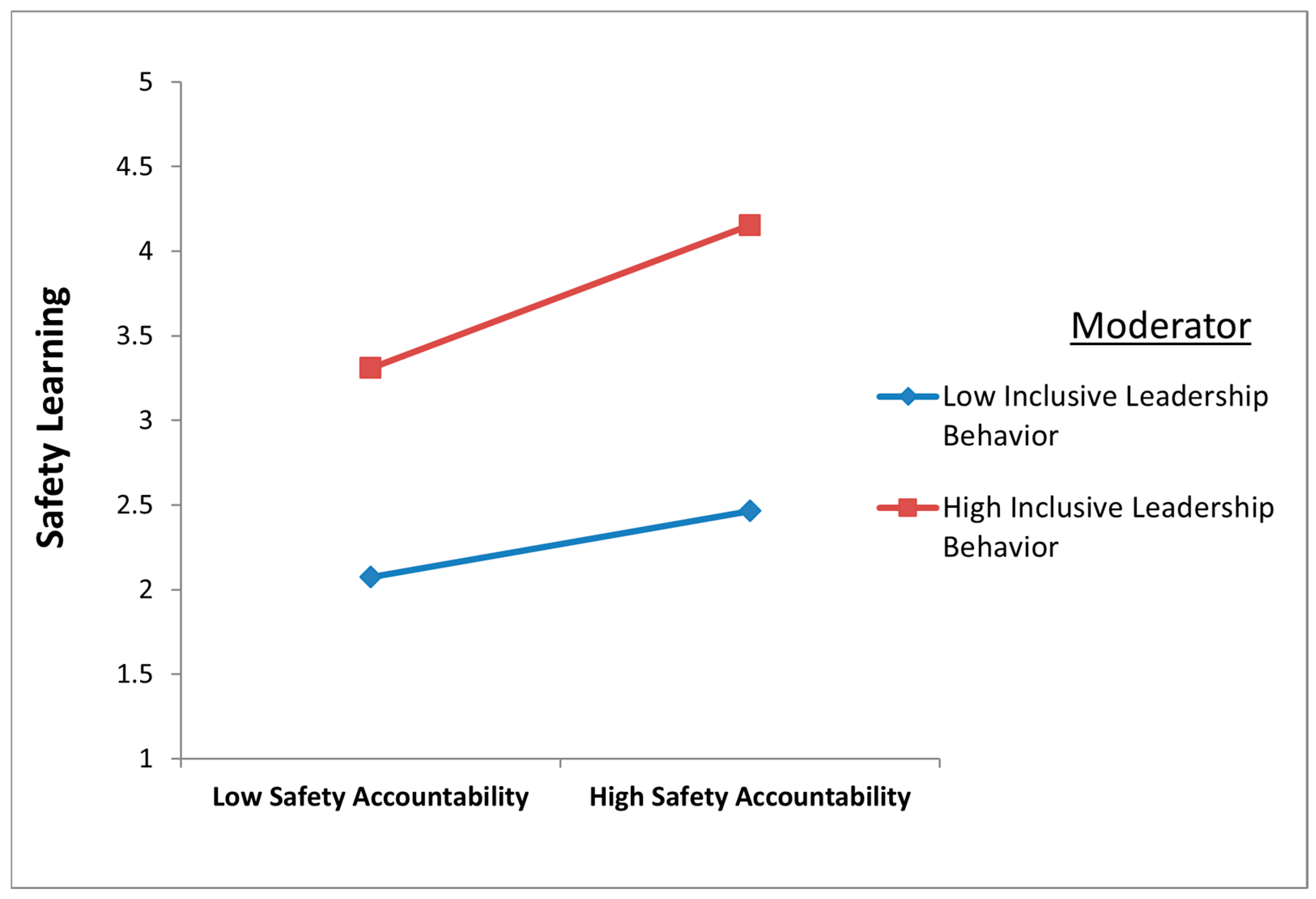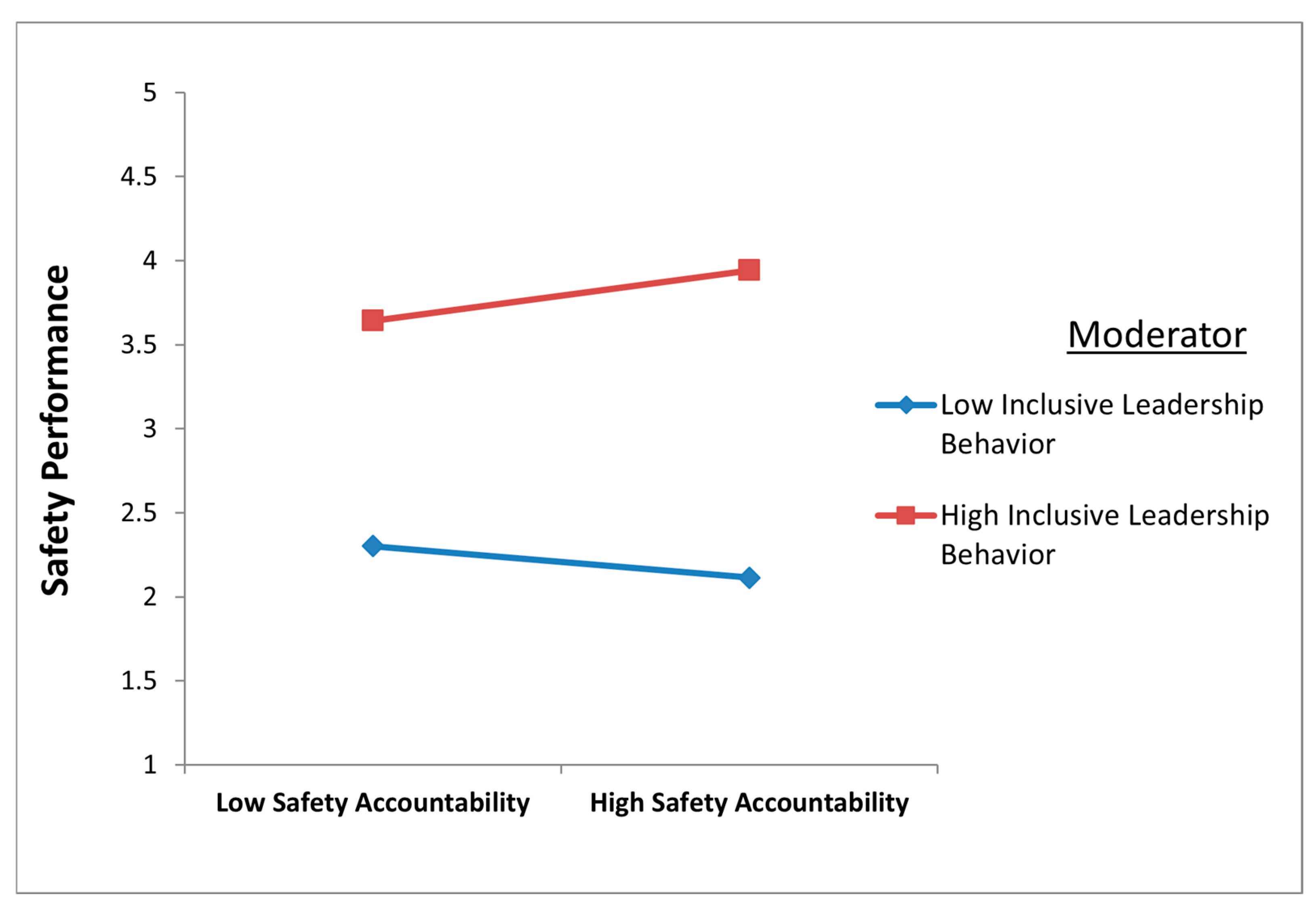



Using Safety Accountability to Enhance Construction Safety Performance: The Mediating Roles of Safety Monitoring and Safety Learning Under Inclusive Leadership

Abstract
1. Introduction
2. Theoretical Framework and Hypotheses Development
2.1. Accountability Theory and Social Learning Theory
2.2. Safety Accountability and Safety Performance
2.3. Safety Accountability and Safety Learning
2.4. Safety Learning and Safety Performance
2.5. Safety Accountability and Safety Monitoring
2.6. Safety Monitoring and Safety Performance
2.7. The Mediating Role of Safety Learning
2.8. The Mediating Role of Safety Monitoring
2.9. The Moderating Role of Inclusive Leadership
2.10. Control Variables: Firm and Employee Characteristics
2.11. Research Model
3. Methods
3.1. Sample and Data Collection
3.2. Measurement Instrument and Administration
3.3. Analytical Procedures
- The direct effect of safety accountability on safety performance (H1);
- The effect of safety accountability on safety learning (H2);
- The effect of safety accountability on safety monitoring (H4);
- The effect of safety learning on safety performance (H3);
- The effect of safety monitoring on safety performance (H5);
- The indirect (mediated) effects through safety learning (H6) and safety monitoring (H7).
- The interaction between safety accountability and inclusive leadership in predicting safety monitoring (H8);
- The interaction between safety accountability and inclusive leadership in predicting safety learning (H9);
- The interaction between safety accountability and inclusive leadership in predicting safety performance (H10).
3.4. Common Method Bias
4. Results
4.1. Reliability and Validity Assessment
4.2. Direct and Mediation Analysis
4.3. Moderation Analysis
5. Discussion and Implications
5.1. Discussion of Findings
5.2. Theoretical Implications
5.3. Practical Implications
5.4. Limitations and Future Research Directions
6. Conclusions
Author Contributions
Funding
Institutional Review Board Statement
Informed Consent Statement
Data Availability Statement
Conflicts of Interest
References
- Dodoo, J.E.; Al-Samarraie, H. A Systematic Review of Factors Leading to Occupational Injuries and Fatalities. J. Public Health 2023, 31, 99–113. [Google Scholar] [CrossRef]
- Awolusi, I.; Marks, E.; Hallowell, M. Wearable Technology for Personalized Construction Safety Monitoring and Trending: Review of Applicable Devices. Autom. Constr. 2018, 85, 96–106. [Google Scholar] [CrossRef]
- Dodoo, J.E.; Al-Samarraie, H.; Alzahrani, A.I.; Lonsdale, M.; Alalwan, N. Digital Innovations for Occupational Safety: Empowering Workers in Hazardous Environments. Workplace Health Saf. 2024, 72, 84–95. [Google Scholar] [CrossRef]
- Swieai, W.; Alzubi, A.B.; Aljuhmani, H.Y.; Topal, H. Unpacking the Role of Proactive Personality in Enhancing Safety Behavior: A Moderated Mediation Model in Turkish Healthcare Organizations. J. Health Organ. Manag. 2025, 1–29. [Google Scholar] [CrossRef] [PubMed]
- Sha, Y.; Zhang, Y.; Zhang, Y. How Safety Accountability Impacts the Safety Performance of Safety Managers: A Moderated Mediating Model. J. Saf. Res. 2024, 89, 160–171. [Google Scholar] [CrossRef] [PubMed]
- Nadeem, M.A.; Surienty, L.; Haque, M.M. Impact of Organization Decision Making Styles and Safety Accountability on Occupational Health and Safety Implementation: The Moderating Role of Mimetic Motives. Front. Public Health 2022, 10, 1004767. [Google Scholar] [CrossRef]
- Al-Arnous, A.B.; Abdelwahed, N.A.A. The Impact of the Implementation of Safety Measures on Frontline Workers’ Safety Accountability: A Saudi Arabian Case Study of a Well Intervention Business Model. Safety 2022, 8, 82. [Google Scholar] [CrossRef]
- Slil, E.; Iyiola, K.; Alzubi, A.; Aljuhmani, H.Y. Impact of Safety Leadership and Employee Morale on Safety Performance: The Moderating Role of Harmonious Safety Passion. Buildings 2025, 15, 186. [Google Scholar] [CrossRef]
- Senthamizh Sankar, S.; Anandh, K.S. Building Safer Workplaces: Unveiling the Impact of Safety Leadership Styles in the Construction Industry. Adm. Sci. 2024, 14, 212. [Google Scholar] [CrossRef]
- Giri, M.K. Teacher Retention in Private Schools: A Narrative Inquiry into Principals’ Leadership. Doctoral Dissertation, Kathmandu University, Kavrepalanchok, Nepal, 2025. [Google Scholar]
- Jiang, S.; Ma, G.; Wang, D.; Jia, J. How Inclusive Leadership Influences Voice Behavior in Construction Project Teams: A Social Identity Perspective. Proj. Manag. J. 2023, 54, 116–131. [Google Scholar] [CrossRef]
- Paul, J.; Pilbeam, C.; Smallwood, A. Safety Voice Concept Clean-up: Examining the Voice That Challenges Us to Be Safer. Saf. Sci. 2025, 191, 106931. [Google Scholar] [CrossRef]
- Lee, S.E.; Dahinten, V.S. Psychological Safety as a Mediator of the Relationship Between Inclusive Leadership and Nurse Voice Behaviors and Error Reporting. J. Nurs. Scholarsh. 2021, 53, 737–745. [Google Scholar] [CrossRef]
- Cheng, R.; Zhao, Z.; Sheng, S.; Sun, H. When Zodiac Year and Disaster Echoes Meet Accountability: Dual Moderators in Emergency Management Prioritization. Research Square (preprint). 2025. Available online: https://www.researchsquare.com/article/rs-6866868/v1 (accessed on 27 February 2026).
- Chatburn, E.; Macrae, C.; Carthey, J.; Vincent, C. Measurement and Monitoring of Safety: Impact and Challenges of Putting a Conceptual Framework into Practice. BMJ Qual. Saf. 2018, 27, 818–826. [Google Scholar] [CrossRef] [PubMed]
- Winge, S.; Albrechtsen, E.; Arnesen, J. A Comparative Analysis of Safety Management and Safety Performance in Twelve Construction Projects. J. Saf. Res. 2019, 71, 139–152. [Google Scholar] [CrossRef] [PubMed]
- Junwen, M.; Libing, C. The Influence of Inclusive Leadership Styles on the Safety Behaviors of New Generation High Altitude Railway Construction Workers. Sci. Rep. 2025, 15, 10706. [Google Scholar] [CrossRef] [PubMed]
- Qasim, S.; Usman, M.; Ghani, U.; Khan, K. Inclusive Leadership and Employees’ Helping Behaviors: Role of Psychological Factors. Front. Psychol. 2022, 13, 888094. [Google Scholar] [CrossRef]
- Kusumawardani, K.A.; Arquisola, M.J.; Amin, G.; Restiawati, M. Inclusive Leadership and Workers’ Safety Behaviour during Covid-19 Pandemic. Evid.-Based HRM A Glob. Forum Empir. Scholarsh. 2023, 11, 465–482. [Google Scholar] [CrossRef]
- Bandura, A. Human Agency in Social Cognitive Theory. Am. Psychol. 1989, 44, 1175–1184. [Google Scholar] [CrossRef]
- Frink, D.D.; Klimoski, R.J. Advancing Accountability Theory and Practice: Introduction to the Human Resource Management Review Special Edition. Hum. Resour. Manag. Rev. 2004, 14, 1–17. [Google Scholar] [CrossRef]
- Hall, A.T.; Frink, D.D.; Buckley, M.R. An Accountability Account: A Review and Synthesis of the Theoretical and Empirical Research on Felt Accountability. J. Organ. Behav. 2017, 38, 204–224. [Google Scholar] [CrossRef]
- Bandura, A. Social Learning Theory; Prentice-Hall: Englewood Cliffs, NJ, USA, 1977; ISBN 978-0-13-816744-8. [Google Scholar]
- Nwagbala, D.C.; Park, J.Y. A Study of the Foremen’s Influence on the Safety Behavior of Construction Workers Based on Cognitive Theory. Buildings 2023, 13, 1792. [Google Scholar] [CrossRef]
- Ayouz, H.; Alzubi, A.; Iyiola, K. Using Benevolent Leadership to Improve Safety Behaviour in the Construction Industry: A Moderated Mediation Model of Safety Knowledge and Safety Training and Education. Int. J. Occup. Saf. Ergon. 2025, 31, 167–180. [Google Scholar] [CrossRef]
- Bhuttah, T.M.; Xusheng, Q.; Abid, M.N.; Sharma, S. Enhancing Student Critical Thinking and Learning Outcomes through Innovative Pedagogical Approaches in Higher Education: The Mediating Role of Inclusive Leadership. Sci. Rep. 2024, 14, 24362. [Google Scholar] [CrossRef] [PubMed]
- Neal, A.; Griffin, M.A. A Study of the Lagged Relationships among Safety Climate, Safety Motivation, Safety Behavior, and Accidents at the Individual and Group Levels. J. Appl. Psychol. 2006, 91, 946–953. [Google Scholar] [CrossRef]
- Chan, A.P.C.; Guan, J.; Choi, T.N.Y.; Yang, Y.; Wu, G.; Lam, E. Improving Safety Performance of Construction Workers through Learning from Incidents. Int. J. Environ. Res. Public Health 2023, 20, 4570. [Google Scholar] [CrossRef] [PubMed]
- Al-Naser, N.K.; Al-Tabtabai, H. The Impact of Safety Violations on Construction Project Performance: A Case Study of the ADFA Project. J. Eng. Res. 2025, 13, 3037–3050. [Google Scholar] [CrossRef]
- McCall, J.R.; Pruchnicki, S. Just Culture: A Case Study of Accountability Relationship Boundaries Influence on Safety in HIGH-Consequence Industries. Saf. Sci. 2017, 94, 143–151. [Google Scholar] [CrossRef]
- Griffin, M.A.; Hu, X. How Leaders Differentially Motivate Safety Compliance and Safety Participation: The Role of Monitoring, Inspiring, and Learning. Saf. Sci. 2013, 60, 196–202. [Google Scholar] [CrossRef]
- Kadher, Y.; Alzubi, A.; Berberoğlu, A.; Öz, T. Perceived Leadership Support, Safety Citizenship, and Employee Safety Behavior in the Construction Industry: The Role of Safety Learning. Buildings 2024, 14, 3260. [Google Scholar] [CrossRef]
- Yazdi, M. The Impact of Leadership on Fostering a Safety-Oriented Organizational Culture. In Safety-Centric Operations Research: Innovations and Integrative Approaches: A Multidisciplinary Approach to Managing Risk in Complex Systems; Yazdi, M., Ed.; Springer Nature: Cham, Switzerland, 2025; pp. 31–50. ISBN 978-3-031-82934-5. [Google Scholar]
- Yeboah, M.A.; Kalvei, M.; Ansong, L.O.; Ansong, A. Responsible Leadership and Workplace Safety: Do Safety Culture and Safety Motivation Matter? Asia-Pac. J. Bus. Adm. 2024, 17, 285–302. [Google Scholar] [CrossRef]
- Carmeli, A.; Gittell, J.H. High-Quality Relationships, Psychological Safety, and Learning from Failures in Work Organizations. J. Organ. Behav. 2009, 30, 709–729. [Google Scholar] [CrossRef]
- Edmondson, A. Psychological Safety and Learning Behavior in Work Teams. Adm. Sci. Q. 1999, 44, 350–383. [Google Scholar] [CrossRef]
- Curcuruto, M.; Griffin, M.A. Upward Safety Communication in the Workplace: How Team Leaders Stimulate Employees’ Voice through Empowering and Monitoring Supervision. Saf. Sci. 2023, 157, 105947. [Google Scholar] [CrossRef]
- Wang, Y.; Liu, T.; Zhao, W.; Qian, Y.; He, M. How the Project Manager Influences Construction Workers’ Safety Behaviors: The Linking Roles of Safety Intervention and Safety Motivation. Eng. Constr. Archit. Manag. 2025, 1–22. [Google Scholar] [CrossRef]
- Shaikh, A.Y.; Osei-Kyei, R.; Hardie, M. A Critical Analysis of Safety Performance Indicators in Construction. Int. J. Build. Pathol. Adapt. 2020, 39, 547–580. [Google Scholar] [CrossRef]
- Tews, M.J.; Burke-Smalley, L.A. Enhancing Training Transfer by Promoting Accountability in Different Work Contexts: An Integrative Framework. In The Cambridge Handbook of Workplace Training and Employee Development; Brown, K.G., Ed.; Cambridge Handbooks in Psychology; Cambridge University Press: Cambridge, UK, 2017; pp. 201–227. ISBN 978-1-107-08598-5. [Google Scholar]
- Smith, M. How Safety and Accountability Build Work Culture; Work Wallet: Derby, UK, 2024. [Google Scholar]
- AlShemeili, H.; Davidson, R.; Khalid, K. Impact of Empowering Leadership on Safety Behavior and Safety Climate: Mediating and Moderating Role of Safety Monitoring. J. Eng. Des. Technol. 2022, 22, 1282–1305. [Google Scholar] [CrossRef]
- Kandola, R.; Curcuruto, M.; Griffin, M.; Morgan, J.I. The Influence of Organisational Safety Climate on Group Safety Outcomes: The Mediation Role of Supervisor Safety Communication and Monitoring. In Proceedings of the Advances in Safety Management and Human Factors; Arezes, P.M.F.M., Ed.; Springer International Publishing: Cham, Switzerland, 2019; pp. 35–46. [Google Scholar]
- Yang, J.; Wang, Y.; Huang, H.; Han, J.; Zhou, Y. How Can Inclusive Leadership Motivate Employee Voice? A Cross-Level Study from Psychological Capital and Internal Social Capital Perspective. BMC Psychol. 2025, 13, 1249. [Google Scholar] [CrossRef]
- Zeng, H.; Zhao, L.; Zhao, Y. Inclusive Leadership and Taking-Charge Behavior: Roles of Psychological Safety and Thriving at Work. Front. Psychol. 2020, 11, 62. [Google Scholar] [CrossRef]
- Guo, Y.; Zhu, Y.; Zhang, L. Inclusive Leadership, Leader Identification and Employee Voice Behavior: The Moderating Role of Power Distance. Curr. Psychol. 2022, 41, 1301–1310. [Google Scholar] [CrossRef]
- Chan, A.P.C.; Guan, J.; Choi, T.N.Y.; Yang, Y. Moderating Effects of Individual Learning Ability and Resilient Safety Culture on the Relationship between the Educational Level and Safety Performance of Construction Workers. Buildings 2023, 13, 3026. [Google Scholar] [CrossRef]
- Karimi, H.; Taghaddos, H. The Influence of Craft Workers’ Educational Attainment and Experience Level in Fatal Injuries Prevention in Construction Projects. Saf. Sci. 2019, 117, 417–427. [Google Scholar] [CrossRef]
- Cordellieri, P.; Baralla, F.; Ferlazzo, F.; Sgalla, R.; Piccardi, L.; Giannini, A.M. Gender Effects in Young Road Users on Road Safety Attitudes, Behaviors and Risk Perception. Front. Psychol. 2016, 7, 1412. [Google Scholar] [CrossRef]
- Sjöberg Forssberg, K.; Vänje, A.; Parding, K. Bringing in Gender Perspectives on Systematic Occupational Safety and Health Management. Saf. Sci. 2022, 152, 105776. [Google Scholar] [CrossRef]
- Ali, M.; Iyiola, K.; Alzubi, A.; Aljuhmani, H.Y. Using Safety-Specific Transformational Leadership to Improve Safety Behavior Among Construction Workers: Exploring the Role of Knowledge Sharing and Psychological Safety. Buildings 2025, 15, 3340. [Google Scholar] [CrossRef]
- Etikan, I.; Musa, S.A.; Alkassim, R.S. Comparison of Convenience Sampling and Purposive Sampling. Am. J. Theor. Appl. Stat. 2016, 5, 1–4. [Google Scholar] [CrossRef]
- Podsakoff, P.M.; MacKenzie, S.B.; Lee, J.-Y.; Podsakoff, N.P. Common Method Biases in Behavioral Research: A Critical Review of the Literature and Recommended Remedies. J. Appl. Psychol. 2003, 88, 879–903. [Google Scholar] [CrossRef]
- Elkhweildi, M.; Vetbuje, B.; Alzubi, A.B.; Aljuhmani, H.Y. Leading with Green Ethics: How Environmentally Specific Ethical Leadership Enhances Employee Job Performance Through Communication and Engagement. Sustainability 2025, 17, 7923. [Google Scholar] [CrossRef]
- Aljuhmani, H.Y.; Emeagwali, O.L.; Ababneh, B. The Relationships between CEOs’ Psychological Attributes, Top Management Team Behavioral Integration and Firm Performance. Int. J. Organ. Theory Behav. 2021, 24, 126–145. [Google Scholar] [CrossRef]
- Arslan, G.; Kivrak, S. The Lower Employment of Women in Turkish Construction Sector. Build. Environ. 2004, 39, 1379–1387. [Google Scholar] [CrossRef]
- Gumusburun Ayalp, G.; Yüksel Deniz, E. Identifying the Factors Hindering Stakeholder Management in Construction with Structural Equation Modeling. Buildings 2026, 16, 15. [Google Scholar] [CrossRef]
- Çabuk, A. Occupational Hazards in Veterinary Practice: A 15-Year Review of Türkiye’s Official Injury and Disease Data (2008–2023). Int. Arch. Occup. Environ. Health 2025, 98, 743–755. [Google Scholar] [CrossRef]
- Isik, V. From Worker Health to Occupational Health and Safety in Turkey: A History of Paradigm Change. Labor. Hist. 2026, 67, 108–122. [Google Scholar] [CrossRef]
- Han, Y.; Perry, J.L. Employee Accountability: Development of a Multidimensional Scale. Int. Public Manag. J. 2020, 23, 224–251. [Google Scholar] [CrossRef]
- Carmeli, A.; Reiter-Palmon, R.; Ziv, E. Inclusive Leadership and Employee Involvement in Creative Tasks in the Workplace: The Mediating Role of Psychological Safety. Creat. Res. J. 2010, 22, 250–260. [Google Scholar] [CrossRef]
- Brislin, R.W. The Wording and Translation of Research Instruments. In Field Methods in Cross-Cultural Research; Cross-cultural research and methodology series; Sage Publications, Inc.: Thousand Oaks, CA, USA, 1986; Volume 8, pp. 137–164. ISBN 978-0-8039-2549-6. [Google Scholar]
- Nasr, E.; Emeagwali, O.L.; Aljuhmani, H.Y.; Al-Geitany, S. Destination Social Responsibility and Residents’ Environmentally Responsible Behavior: Assessing the Mediating Role of Community Attachment and Involvement. Sustainability 2022, 14, 14153. [Google Scholar] [CrossRef]
- Anderson, J.C.; Gerbing, D.W. Structural Equation Modeling in Practice: A Review and Recommended Two-Step Approach. Psychol. Bull. 1988, 103, 411–423. [Google Scholar] [CrossRef]
- Byrne, B.M. Structural Equation Modeling with AMOS: Basic Concepts, Applications, and Programming, 3rd ed.; Routledge: London, UK, 2016. [Google Scholar]
- Hayes, A.F. Introduction to Mediation, Moderation, and Conditional Process Analysis: A Regression-Based Approach, 3rd ed.; Methodology in the social sciences; The Guilford Press: New York, NY, USA; London, UK, 2022. [Google Scholar]
- Hayes, A.F.; Rockwood, N.J. Regression-Based Statistical Mediation and Moderation Analysis in Clinical Research: Observations, Recommendations, and Implementation. Behav. Res. Ther. 2017, 98, 39–57. [Google Scholar] [CrossRef] [PubMed]
- Zhang, W.; Yuan, G.; Xue, R.; Han, Y.; Taylor, J.E. Mitigating Common Method Bias in Construction Engineering and Management Research. J. Constr. Eng. Manag. 2022, 148, 04022089. [Google Scholar] [CrossRef]
- Ashergawi, M.; Aljuhmani, H.Y.; Alzubi, A.B. Empowering Green Innovation Through Artificial Intelligence: The Strategic Role of Organizational Agility and Technological Readiness in the Turkish Construction Sector. Eng. Manag. J. 2026, 1–21. [Google Scholar] [CrossRef]
- Chang, S.-J.; van Witteloostuijn, A.; Eden, L. From the Editors: Common Method Variance in International Business Research. J. Int. Bus. Stud. 2010, 41, 178–184. [Google Scholar] [CrossRef]
- Rihal, J.; Alzubi, A.; Aljuhmani, H.Y.; Berberoğlu, A. From Ethics to Ecology: How Ethical Leadership Drives Environmental Performance through Green Organizational Identity and Culture. PLoS ONE 2025, 20, e0336608. [Google Scholar] [CrossRef]
- Harman, H.H. Modern Factor Analysis, 3rd ed., Revised; University of Chicago Press: Chicago, IL, USA, 1976. [Google Scholar]
- Rajhi, M.; Aljuhmani, H.Y. Fostering Sustainable Innovation Through Communication Quality: The Sequential Role of Trust in Leadership and Organizational Commitment in Team-Based Enterprises. Sustainability 2026, 18, 554. [Google Scholar] [CrossRef]
- Lindell, M.K.; Whitney, D.J. Accounting for Common Method Variance. J. Appl. Psychol. 2001, 86, 114–121. [Google Scholar] [CrossRef] [PubMed]
- Nunnally, J.C. Psychometric Theory, 2nd ed.; McGraw-Hill Companies: New York, NY, USA, 1978. [Google Scholar]
- Farnana, K.; Alzubi, A.B.; Aljuhmani, H.Y.; Khadem, A. Fostering a Green Workplace: How Responsible Leadership Inspires Voluntary Green Behavior through Perceived Insider Status and Green Work Climate. Kybernetes 2026, 1–31. [Google Scholar] [CrossRef]
- Fornell, C.; Larcker, D.F. Evaluating Structural Equation Models with Unobservable Variables and Measurement Error. J. Mark. Res. 1981, 18, 39–50. [Google Scholar] [CrossRef]
- Enbaia, E.; Alzubi, A.; Iyiola, K.; Aljuhmani, H.Y. The Interplay Between Environmental Ethics and Sustainable Performance: Does Organizational Green Culture and Green Innovation Really Matter? Sustainability 2024, 16, 10230. [Google Scholar] [CrossRef]
- Kock, N. Common Method Bias: A Full Collinearity Assessment. In Partial Least Squares Path Modeling; Springer: New York, NY, USA, 2017; pp. 245–257. [Google Scholar]
- Lei, M.; Lomax, R.G. The Effect of Varying Degrees of Nonnormality in Structural Equation Modeling. Struct. Equ. Model. A Multidiscip. J. 2005, 12, 1–27. [Google Scholar] [CrossRef]
- Al-Geitany, S.; Aljuhmani, H.Y.; Emeagwali, O.L.; Nasr, E. Consumer Behavior in the Post-COVID-19 Era: The Impact of Perceived Interactivity on Behavioral Intention in the Context of Virtual Conferences. Sustainability 2023, 15, 8600. [Google Scholar] [CrossRef]
- Brye, S. How Workplace Safety and Accountability Shape a Positive Culture; The Safety Geek: Ocala, FL, USA, 2023. [Google Scholar]
- Provan, D.J.; Woods, D.D.; Dekker, S.W.A.; Rae, A.J. Safety II Professionals: How Resilience Engineering Can Transform Safety Practice. Reliab. Eng. Syst. Saf. 2020, 195, 106740. [Google Scholar] [CrossRef]
- Ahmed, F.; Zhao, F.; Faraz, N.A.; Qin, Y.J. How Inclusive Leadership Paves Way for Psychological Well-being of Employees during Trauma and Crisis: A Three-wave Longitudinal Mediation Study. J. Adv. Nurs. 2021, 77, 819–831. [Google Scholar] [CrossRef]
- Al’Ararah, K.; Çağlar, D.; Aljuhmani, H.Y. Mitigating Job Burnout in Jordanian Public Healthcare: The Interplay between Ethical Leadership, Organizational Climate, and Role Overload. Behav. Sci. 2024, 14, 490. [Google Scholar] [CrossRef] [PubMed]
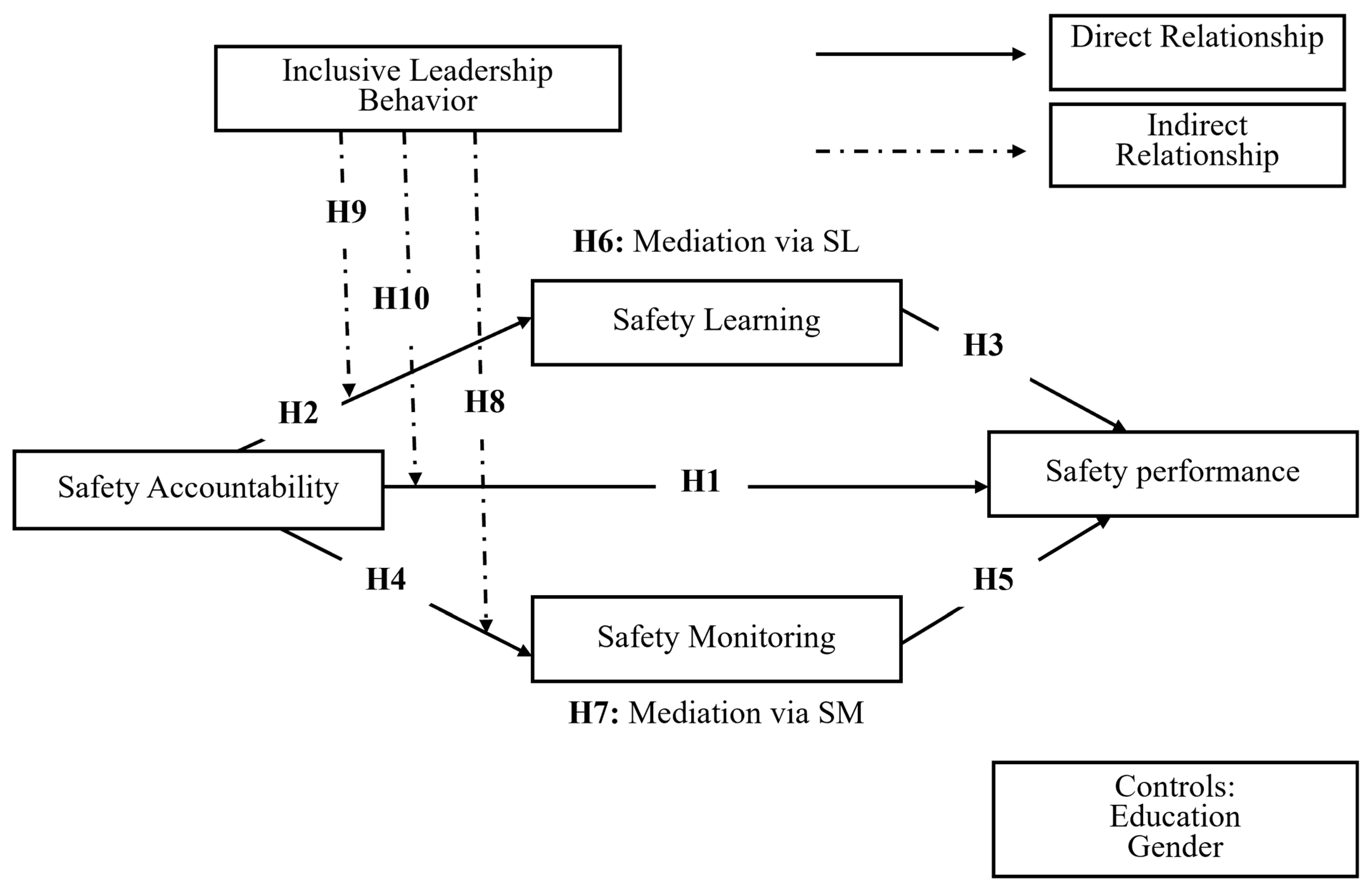



| Hypothesis | Proposed Relationship |
|---|---|
| H1 | Safety accountability → Safety performance |
| H2 | Safety accountability → Safety learning |
| H3 | Safety learning → Safety performance |
| H4 | Safety accountability → Safety monitoring |
| H5 | Safety monitoring → Safety performance |
| H6 | Safety learning mediates SA → SP |
| H7 | Safety monitoring mediates SA → SP |
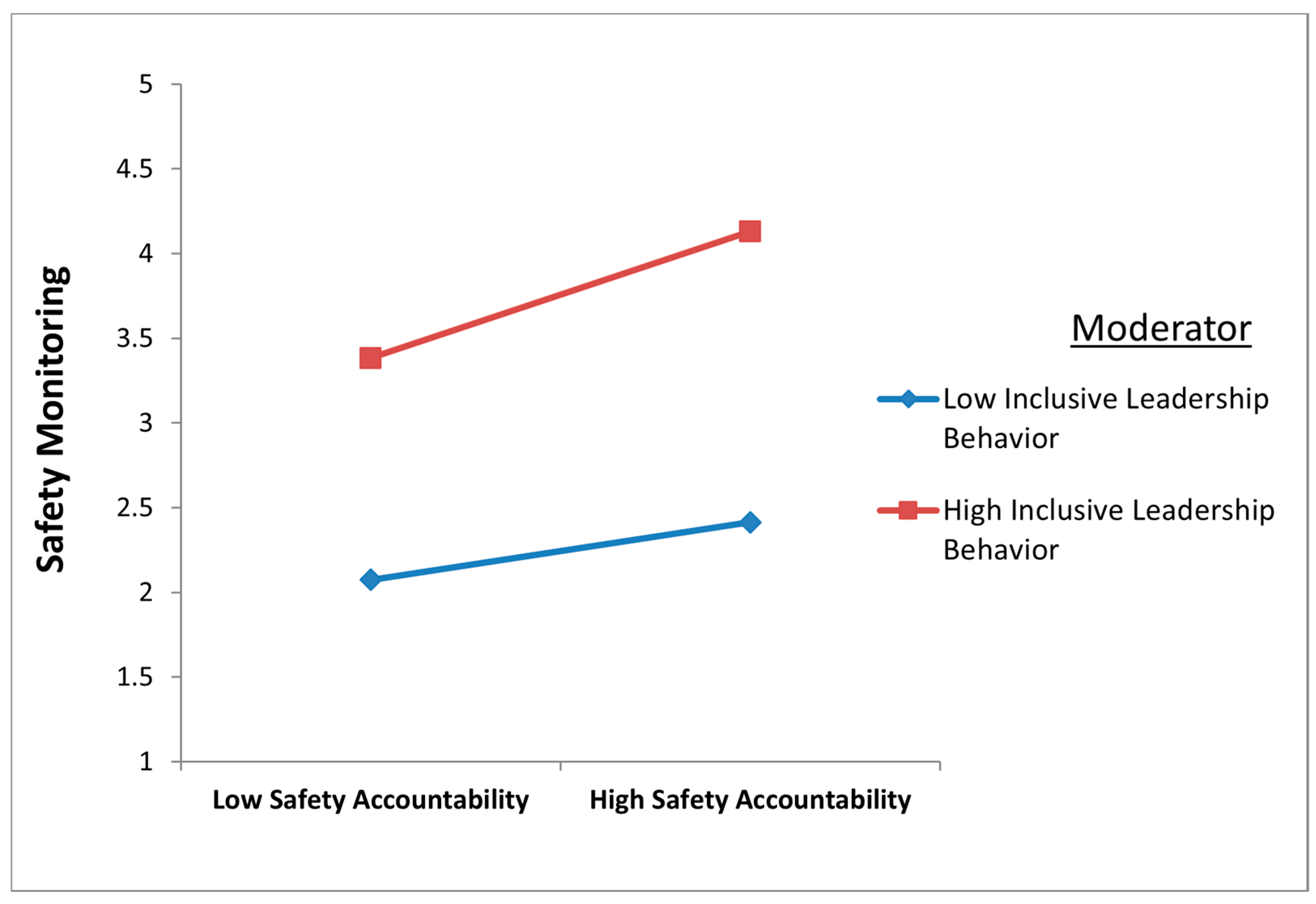
| H8 | Inclusive leadership moderates SA → SM |
| H9 | Inclusive leadership moderates SA → SL |
| H10 | Inclusive leadership moderates SA → SP |
| Characteristics | Classification | Frequency | Proportion (%) |
|---|---|---|---|
| Gender | Male | 611 | 97.14 |
| Female | 18 | 2.86 | |
| Education | Below high school | 141 | 22.42 |
| High school | 301 | 47.85 | |
| Bachelor degree | 101 | 16.06 | |
| Others | 86 | 13.67 | |
| Marital status | Married | 201 | 31.96 |
| Single | 379 | 60.25 | |
| Prefer not to disclose | 49 | 7.79 | |
| Job roles | Construction workers | 431 | 68.52 |
| Non-construction personnel | 168 | 26.71 | |
| Legal staff | 30 | 4.77 | |
| Experience | 3–7 | 186 | 29.57 |
| 8–12 | 101 | 16.06 | |
| 13–17 | 252 | 40.06 | |
| 18–22 | 43 | 6.84 | |
| Above 22 | 47 | 7.47 | |
| Total | 629 | 100% | |
| Construct | Variable | Number of Substances | Source |
|---|---|---|---|
| Independent | Safety Accountability | SA1: What I do is noticed by others in my organization. SA2: If I make a mistake, I will be caught. SA3: I am constantly watched to see if I follow my organization’s safety policies and procedures. SA4: Anyone outside my organization can tell whether I’m doing well in my safety job. SA5: My errors can be easily spotted outside my organization. SA6: People outside my organization are interested in my job performance. SA7: The outcomes of my work are rigorously evaluated. SA8: My work efforts are rigorously evaluated. SA9: I expect to receive frequent feedback from the management. SA10: I could not easily get away with making a false statement to justify my performance. SA11: I am always required to follow strict safety policies or procedures. SA12: I am not allowed to make excuses to avoid blame in my organization. SA13: If I perform well in safety work, I will be rewarded. SA14: Good effort on my part will ultimately be rewarded. SA15: If I do my safety management job well, my organization will benefit from it. | [60] |
| Dependent | Safety Performance | SP1: I use all the necessary safety equipment to do my job. SP2: I use the correct safety procedures for carrying out my job. SP3: I ensure the highest levels of safety when I carry out my job. SP4: I promote the safety program within the organization. SP5: I put in extra effort to improve the safety of the workplace. SP6: I voluntarily carry out tasks or activities that help to improve workplace safety. | [27] |
| Mediator | Safety Monitoring | SM1: Is alert to safety behavior in the team. SM2: Scans the environment for unsafe actions by the team. SM3: Let the subordinates know if they are working unsafely | [31] |
| Mediator | Safety Learning | SL1: Encourages new ways of thinking about safety. SL2: Sees unsafe behavior as an opportunity for learning. SL3: Actively seeks opportunities to learn about new safety protocols and practices | [31] |
| Moderator | Inclusive Leadership Behavior | ILB1: My supervisor is open to hearing new ideas ILB2: My supervisor is attentive to new opportunities to improve work processes ILB3: My supervisor is open to discussing the desired goals and new ways to achieve them ILB4: My supervisor is available for consultation on problems ILB5: My supervisor is an ongoing ‘presence’ in this team, someone who is readily available. ILB6: My supervisor is available for safety questions. ILB7: My supervisor is ready to listen to safety requests. ILB8: My supervisor always encourages subordinates on emerging issues. ILB9: My supervisor is accessible for discussing emerging problems. | [61] |
| Variables | Item Codes | λ | α | AVE | CR | Skewness | Kurtosis |
|---|---|---|---|---|---|---|---|
| Safety Accountability (SA) | 0.948 | 0.564 | 0.951 | ||||
| SA1 | 0.732 | −0.572 | 0.018 | ||||
| SA2 | 0.786 | −0.690 | 0.332 | ||||
| SA3 | 0.763 | −0.673 | 0.116 | ||||
| SA4 | 0.747 | −0.825 | 0.425 | ||||
| SA5 | 0.747 | −0.904 | 0.644 | ||||
| SA6 | 0.745 | −0.676 | 0.060 | ||||
| SA7 | 0.737 | −0.709 | 0.245 | ||||
| SA8 | 0.789 | −0.565 | −0.282 | ||||
| SA9 | 0.706 | −0.974 | 0.958 | ||||
| SA10 | 0.809 | −0.490 | −0.090 | ||||
| SA11 | 0.682 | −0.743 | 0.566 | ||||
| SA12 | 0.747 | −0.579 | −0.082 | ||||
| SA13 | 0.732 | −0.490 | −0.435 | ||||
| SA14 | 0.741 | −0.381 | −0.479 | ||||
| SA15 | 0.761 | −0.530 | 0.025 | ||||
| Safety Monitoring (SM) | 0.908 | 0.781 | 0.914 | ||||
| SM1 | 0.927 | −0.652 | 0.347 | ||||
| SM2 | 0.926 | −0.744 | 0.511 | ||||
| SM3 | 0.790 | −0.691 | 0.406 | ||||
| Safety Learning (SL) | 0.825 | 0.625 | 0.833 | ||||
| SL1 | 0.757 | −1.675 | −2.966 | ||||
| SL2 | 0.854 | −1.092 | −1.984 | ||||
| SL3 | 0.756 | −0.813 | 0.658 | ||||
| Inclusive Leadership Behavior (ILB) | 0.961 | 0.735 | 0.961 | ||||
| ILB1 | 0.828 | −0.308 | −0.526 | ||||
| ILB2 | 0.822 | −0.646 | 0.205 | ||||
| ILB3 | 0.833 | −0.545 | −0.376 | ||||
| ILB4 | 0.840 | −0.246 | −0.544 | ||||
| ILB5 | 0.885 | −0.444 | −0.566 | ||||
| ILB6 | 0.874 | −0.544 | −0191 | ||||
| ILB7 | 0.876 | −0.245 | −0.901 | ||||
| ILB8 | 0.874 | −0.373 | −0.432 | ||||
| ILB9 | 0.881 | −0.445 | −0.800 | ||||
| Safety Performance (SP) | 0.956 | 0.787 | 0.957 | ||||
| SP1 | 0.857 | −0.504 | 0.716 | ||||
| SP2 | 0.886 | −0.356 | −0.717 | ||||
| SP3 | 0.926 | −0.433 | 0.753 | ||||
| SP4 | 0.903 | −0.512 | −0.430 | ||||
| SP5 | 0.896 | −0.418 | −0.644 | ||||
| SP6 | 0.854 | −0.630 | 0.299 | ||||
| Variables | M | SD | SA | SM | SL | ILB | SP |
|---|---|---|---|---|---|---|---|
| SA | 5.424 | 0.930 | (0.751) | ||||
| SM | 5.675 | 0.968 | 0.472 ** | (0.884) | |||
| SL | 5.723 | 1.003 | 0.494 ** | 0.486 ** | (0.791) | ||
| ILB | 5.529 | 0.960 | 0.509 ** | 0.428 ** | 0.505 ** | (0.857) | |
| SP | 5.661 | 0.954 | 0.552 ** | 0.494 ** | 0.601 ** | 0.499 ** | (0.887) |
| Hypothesis | Path | B | SE | t-Value | p-Value | 95% CI (LL, UL) | R2 |
|---|---|---|---|---|---|---|---|
| H1 | SA → SP | 0.110 | 0.056 | 1.946 | 0.052 | [−0.001, 0.220] | 0.333 |
| H2 | SA → SL | 0.874 | 0.048 | 18.168 | <0.001 | [0.779, 0.921] | 0.372 |
| H3 | SL → SP | 0.132 | 0.055 | 2.404 | 0.016 | [0.024, 0.241] | 0.378 |
| H4 | SA → SM | 0.855 | 0.047 | 18.400 | <0.001 | [0.764, 0.946] | — |
| H5 | SM → SP | 0.322 | 0.057 | 5.644 | <0.001 | [0.209, 0.434] | — |
| H6 | SA → SL → SP | 0.115 | — | — | — | [0.026, 0.204] | — |
| H7 | SA → SM → SP | 0.275 | — | — | — | [0.184, 0.368] | — |
| Paths | B | S.E. | t-Value | p-Value | 95% CI | R2 | |
|---|---|---|---|---|---|---|---|
| LL | UL | ||||||
| Model 1: Safety Monitoring | |||||||
| SA → SM | 0.272 | 0.041 | 6.641 | 0.000 | 0.192 | 0.353 | 0.689 |
| ILB → SM | 0.756 | 0.033 | 23.276 | 0.000 | 0.692 | 0.820 | |
| H8: SA × ILB → SM | 0.102 | 0.031 | 3.337 | 0.001 | 0.042 | 0.161 | |
| Co: Education → SM | 0.047 | 0.052 | 0.904 | 0.775 | −0.095 | 0.067 | |
| Co: Gender → SM | 0.019 | 0.028 | 0.679 | 0.865 | −0.100 | 0.059 | |
| The conditional direct effect of SA on SM at levels of ILB | |||||||
| ILB (−1 SD) | 0.186 | 0.045 | 3.699 | 0.000 | 0.087 | 0.285 | |
| ILB (Mean) | 0.265 | 0.041 | 6.420 | 0.000 | 0.184 | 0.346 | |
| ILB (+1 SD) | 0.344 | 0.050 | 7.679 | 0.000 | 0.256 | 0.433 | |
| Model 2: Safety Learning | |||||||
| SA → SL | 0.309 | 0.045 | 6.859 | 0.000 | 0.220 | 0.397 | 0.649 |
| ILB → SL | 0.731 | 0.036 | 20.544 | 0.000 | 0.661 | 0.801 | |
| H9: SA × ILB → SL | 0.114 | 0.033 | 3.411 | 0.000 | 0.048 | 0.180 | |
| Co: Education → SL | 0.066 | 0.039 | 1.692 | 0.162 | −0.216 | 0.059 | |
| Co: Gender → SL | 0.024 | 0.042 | 0.571 | 0.804 | −0.099 | 0.048 | |
| The conditional direct effect of SA on SL at levels of ILB | |||||||
| ILB (−1 SD) | 0.212 | 0.055 | 3.699 | 0.000 | 0.103 | 0.320 | |
| ILB (Mean) | 0.300 | 0.045 | 6.420 | 0.000 | 0.211 | 0.389 | |
| ILB (+1 SD) | 0.389 | 0.049 | 7.679 | 0.000 | 0.292 | 0.486 | |
| Model 3: Safety Performance | |||||||
| SA → SP | 0.028 | 0.034 | 2.696 | 0.007 | 0.025 | 0.157 | |
| SM → SP | 0.207 | 0.040 | 5.226 | 0.000 | 0.129 | 0.285 | |
| SL → SP | 0.329 | 0.101 | 3.265 | 0.001 | 0.131 | 0.527 | |
| ILB → SP | 1.292 | 0.089 | 0.154 | 0.878 | −0.162 | 0.189 | |
| H10: SA × ILB → SP | 0.122 | 0.036 | 3.425 | 0.001 | 0.052 | 0.192 | |
| Co: Education → SP | 0.018 | 0.029 | 0.620 | 0.304 | −0.119 | 0.029 | |
| Co: Gender → SP | 0.031 | 0.033 | 0.939 | 0.206 | −0.102 | 0.051 | |
| The conditional direct effect of SA on SP at different levels of ILB | |||||||
| ILB (−1 SD) | 0.093 | 0.057 | 0.405 | 0.685 | −0.107 | 0.024 | |
| ILB (Mean) | 0.050 | 0.061 | 1.602 | 0.109 | −0.082 | 0.124 | |
| ILB (+1 SD) | 0.021 | 0.052 | 2.088 | 0.046 | 0.089 | 0.169 | |
Disclaimer/Publisher’s Note: The statements, opinions and data contained in all publications are solely those of the individual author(s) and contributor(s) and not of MDPI and/or the editor(s). MDPI and/or the editor(s) disclaim responsibility for any injury to people or property resulting from any ideas, methods, instructions or products referred to in the content. |
© 2026 by the authors. Licensee MDPI, Basel, Switzerland. This article is an open access article distributed under the terms and conditions of the Creative Commons Attribution (CC BY) license.
Share and Cite
Mohamed, M.; Vetbuje, B. Using Safety Accountability to Enhance Construction Safety Performance: The Mediating Roles of Safety Monitoring and Safety Learning Under Inclusive Leadership. Buildings 2026, 16, 1244. https://doi.org/10.3390/buildings16061244
Mohamed M, Vetbuje B. Using Safety Accountability to Enhance Construction Safety Performance: The Mediating Roles of Safety Monitoring and Safety Learning Under Inclusive Leadership. Buildings. 2026; 16(6):1244. https://doi.org/10.3390/buildings16061244
Chicago/Turabian StyleMohamed, Mohamed, and Benard Vetbuje. 2026. "Using Safety Accountability to Enhance Construction Safety Performance: The Mediating Roles of Safety Monitoring and Safety Learning Under Inclusive Leadership" Buildings 16, no. 6: 1244. https://doi.org/10.3390/buildings16061244
APA StyleMohamed, M., & Vetbuje, B. (2026). Using Safety Accountability to Enhance Construction Safety Performance: The Mediating Roles of Safety Monitoring and Safety Learning Under Inclusive Leadership. Buildings, 16(6), 1244. https://doi.org/10.3390/buildings16061244