Article

Thermal and Hydrodynamic Enhancement of a Ribbed Trombe Wall for Passive Solar Heating

by
Jamal-Eddine Salhi
1,2,
Tarik Zarrouk
3,
Merzouki Salhi
3,
Mohamed Barboucha
3 and
Seyed Soheil Mousavi Ajarostaghi
4,*
1
Department of Pure and Applied Mathematics, Saveetha School of Engineering, Saveetha Institute of Medical and Technical Sciences (SIMATS), Thandalam, Chennai 602105, Tamil Nadu, India
2
Laboratory of Energetics (LE), Faculty of Sciences, Abdelmalek Essaadi University, Tetouan 93000, Morocco
3
Centre de Recherche de l’Ecole des Hautes Etudes d’Ingénierie (CREHEIO), Oujda 60000, Morocco
4
Mechanical Engineering Department, Université de Sherbrooke, Sherbrooke, QC J1K 2R1, Canada
*
Author to whom correspondence should be addressed.
Buildings 2026, 16(6), 1107; https://doi.org/10.3390/buildings16061107

Submission received: 28 December 2025 / Revised: 14 February 2026 / Accepted: 4 March 2026 / Published: 11 March 2026

Abstract

Enhancing the thermal performance of the Trombe Wall is crucial for improving the energy efficiency of passive solar heating systems. This study presents a three-dimensional numerical analysis to investigate the combined effects of internal rib density and geometrical configuration on the thermo-hydrodynamic behavior of a Trombe wall. Using a finite-volume method with laminar flow assumptions based on the Reynolds number, the research is conducted in two sections. First, four rib densities (Nr = 3, 5, 7, and 9) are evaluated using a rectangular rib geometry to identify the best rib number. Subsequently, four innovative designs are compared: rectangular (Model A), semi-circular (Model B), crossed semi-circular (Model C), and spaced semi-circular (Model D) ribs. The findings indicate that while increasing rib count enhances heat transfer through secondary-flow intensification, improvements become marginal beyond Nr = 5 due to excessive flow resistance. At Re = 1600, the Nr = 5 configuration achieves a 68% increase in the average Nusselt number over a smooth channel while maintaining acceptable friction levels. The thermal enhancement factor of case Nr = 5 is the highest in all evaluated Re numbers. Regarding geometry, the model with crossed semi-circular ribs (Model C) provides the maximum thermal enhancement at Re = 1600, with nearly a twofold increase in heat transfer (compared to the smooth channel), albeit at the cost of higher pressure losses. Conversely, the spaced semi-circular ribs case (Model D) achieves the best thermal enhancement factor of 1.51, a 12.7% increase in heat flux, and a lower Poiseuille number. Overall, this study demonstrates that enhanced ribbed configurations can significantly improve Trombe Wall efficiency, with the spaced semi-circular design and five ribs.

1. Introduction

Buildings account for nearly one-third of global energy consumption, with heating, ventilation, and air conditioning (HVAC) systems representing the largest share [1,2]. This situation generates major environmental and economic concerns, particularly in the context of climate change and the growing demand for thermal comfort. In response to these challenges, passive solar systems have attracted significant attention, offering sustainable solutions to reduce reliance on mechanical HVAC systems [1,3].
Among these systems, the Trombe wall (TW)—first introduced by Félix Trombe and Jacques Michel in the 1960s—stands out for its ability to simultaneously provide passive heating and natural ventilation [4,5]. It consists of a massive wall placed behind glazing, separated by an air channel. Solar radiation passes through the glazing, is absorbed by the wall, and is stored as sensible heat. This heat is then released to the indoor space through conduction and convection. The air channel enables buoyancy-driven airflow, ensuring natural air renewal, improving indoor environmental quality, and reducing energy demand.
Several studies have investigated strategies to enhance the thermal and ventilation performance of TWs. The performance of different TW configurations is mainly assessed through numerical simulations or experimental investigations. Many parameters have been shown to significantly influence efficiency, such as glazing type [6], wall composition and thickness [7], air channel depth [8], choice of insulation materials [9], integration of shading devices [10], airflow velocity [11], and the addition of ventilation openings [12]. In a related study, Yada et al. [13] examined the thermo-hydraulic performance of a solar air heater equipped with ribs using computational fluid dynamics (CFD) simulations under ANSYS Fluent. Their results showed that the use of semi-circular ribs, with optimized pitch and height, could enhance heat transfer by up to 2.76 times compared to a smooth duct, with a maximum thermo-hydraulic performance factor of 1.98 at Re = 15,000.
Other studies have explored Earth–Air Heat Exchangers (EAHE). Sodha et al. [14] investigated the effect of tube length, mass flow rate, and radius on cooling performance under two different climates, for a given tube mass. Ascione et al. [15] demonstrated that the best performance was achieved in moist soil, with a 50 m tube buried at a depth of 3 m. Alikhani et al. [16] further showed that the optimal EAHE length increased by 37.9% after six days due to soil thermal saturation, and neglecting this phenomenon could lead to a 57.9% underestimation of the required length and, consequently, an overestimation of system performance.
Composite TWs have also been investigated in previous studies. Chen et al. [17] showed that adding an extra insulation panel or a closed air layer could increase thermal resistance and reduce indoor temperature fluctuations compared with traditional walls. Bajc et al. [18] performed a 3D CFD analysis of temperature and velocity fields in a TW and the adjacent room over several consecutive days, testing different glazing types to optimize system design, followed by an assessment of potential energy savings. Similarly, Chow et al. [19] numerically analyzed a PCM-based liquid flow heat exchanger, demonstrating that integrating PCM enabled an additional recovery of 31.4% and 11.4% of hot water during off-peak hours in summer and winter, respectively. Zhou et al. [20] compared the thermal performance of shape-stabilized PCM plates and PCM–gypsum composites using an enthalpy model, showing that both configurations effectively reduced indoor temperature fluctuations by 46% and 56%, respectively.
Photovoltaic (PV) integration is another promising pathway. Koyunbaba et al. [21] conducted experimental and numerical studies on the performance of semi-transparent amorphous silicon (a-Si) solar cells. Their results indicated that a 10% solar transmittance could achieve an average daily electrical efficiency of 4.52% and a thermal efficiency of 27.2%. Similarly, Vats et al. [22] investigated the integration of semi-transparent a-Si solar cells in buildings and concluded that such systems are particularly suitable for heating applications. Maleki et al. [23] studied a nearly zero-energy house integrating a TW with hydrogen storage, achieving 98.3% thermal comfort and reducing annual CO2 emissions by 8154.7 kg. Elghamry and Hassan [24] analyzed heating and ventilation performance in a building in Alexandria (Egypt) by combining a TW with renewable energy sources. Their study integrated geothermal probes, solar chimneys, and PV panels. Results indicated that installing PV modules on the façade and roof reduced annual energy consumption by 40% and 15%, respectively, with the best performance achieved by combining all renewable sources. An optimal PV tilt angle of 45° provided up to 58 air exchanges per day.
Significant advances have also been made in Phase Change Materials (PCM). Lu et al. [25] developed a PCM composite by mixing expanded graphite with paraffin, experimentally demonstrating that its thermal conductivity was over four times that of pure PCM. Gowreesunker and Tassou [26] designed a PCM wall incorporating PCM microcapsules and compacted clay in a polyethylene matrix, which reduced indoor peak summer temperatures by 3 °C compared to a traditional gypsum wall. Li et al. [27] proposed a novel double-layer PCM structure: the outer layer, with a higher phase transition temperature, blocked part of the incoming heat in summer, while the inner layer, with a lower transition temperature, reduced winter heat losses. Zhu et al. [28] further investigated this configuration and compared it with a single-layer TW under identical weather conditions, showing that the average indoor temperature decreased by 3.62 °C in summer and increased by 0.11 °C in winter. Bourdeau [29] assessed the effectiveness of two passive solar collector walls that store thermal energy using calcium chloride hexahydrate as the PCM. The study demonstrated the material’s long-term performance advantages over conventional storage solutions by integrating experimental test findings with a verified numerical model. Zalewski et al. [30] experimentally tested the performance of a hydrated salt PCM-TW system, showing that it could release stored solar heat after only 160 min—2.5 times faster than a 15 cm concrete wall.
More innovative concepts have also emerged. Li et al. [31] proposed a curved corrugated TW coupled with PCM, demonstrating a 26.8% increase in outlet air temperature and a 32–42% improvement in indoor comfort compared to conventional TWs. Friji et al. [32] experimentally and numerically investigated the integration of metallic fins into the air cavity, showing that six-fin configurations increased thermal efficiency from 18.2% (smooth wall) to 32.6%, nearly an 80% improvement. Zhu et al. [33] developed a dynamic heat transfer model coupled with an optimization algorithm, identifying optimal TW–PCM parameters that reduced annual building energy load by 13.52%. Li and Chen [34] designed a composite TW with porous granular PCM capsules, achieving 76.2% thermal efficiency and a 20.2% increase in nighttime room temperature compared to a porous wall without PCM. Rivera and Moraga [35] analyzed TW configurations with single- and double-PCM in two contrasting climates using CFD simulations, showing winter indoor temperature increases of 21–31% and summer reductions of 5–9%, depending on the PCM used. Lin et al. [36] developed a built-middle PV-TW, in which the PV module is placed within the cavity. Compared to the conventional external PV-TW, the system showed a thermal efficiency of 38.2% and an electrical efficiency of 12%, with an overall efficiency 10.8% higher. Onishi et al. [37] confirmed that PCM integration reduces building energy demand but emphasized that performance strongly depends on PCM type and operating conditions. Cui et al. [38] developed a solar thermal unit using porous foams and nanomaterials, showing that a nano-enhanced PCM combined with porous foam improved thermal performance by about 79.36%. Fiorito [39] simulated PCM-integrated TW systems in five typical climatic zones, showing that optimal PCM configuration depends strongly on local climate. Cunha et al. [40] experimentally tested PCM-enhanced mortars, showing that incorporating 20% PCM increased the minimum indoor temperature by 2 °C.
Although great advances have been made in the literature, in the vast majority of studies, TW optimization using PCM/PV integration, glazing changes, or minimal geometry changes has been examined without systematically accounting for the joint impact of rib density and rib geometry on thermo-hydrodynamic performance. This research gap is especially pertinent, as the internal air TW’s channel significantly affects convective heat transfer and flow resistance.
The current study addresses this gap by conducting a three-dimensional CFD analysis of TWs with various rib designs. What makes it original is the systematic study of two important design parameters: (i) the rib density (Nr = 3, 5, 7, 9) and (ii) four novel rib geometries (Models A–D), where Model A corresponds to the rectangular ribbed configuration, Model B adopts a semi-circular ribbed design, Model C corresponds to a crossed semi-circular rib configuration, and Model D corresponds to a spaced semi-circular rib configuration. To fully assess the system performance, several dimensionless and physical indicators are examined, such as the average Nusselt number (Nu) to measure heat transfer, the friction factor (f) and Poiseuille number (Po) to measure hydrodynamic losses, the Colburn factor (j) and thermal enhancement factor (TEF) to measure thermo-hydraulic efficiency, and the heat flux (Q) to directly measure energy transfer. These measurements will be used to determine the best configuration of the ribs to maximize heat exchange and minimize flow resistance, providing new design considerations for high-performance TW systems.

2. Problem Description

2.1. Physical Model

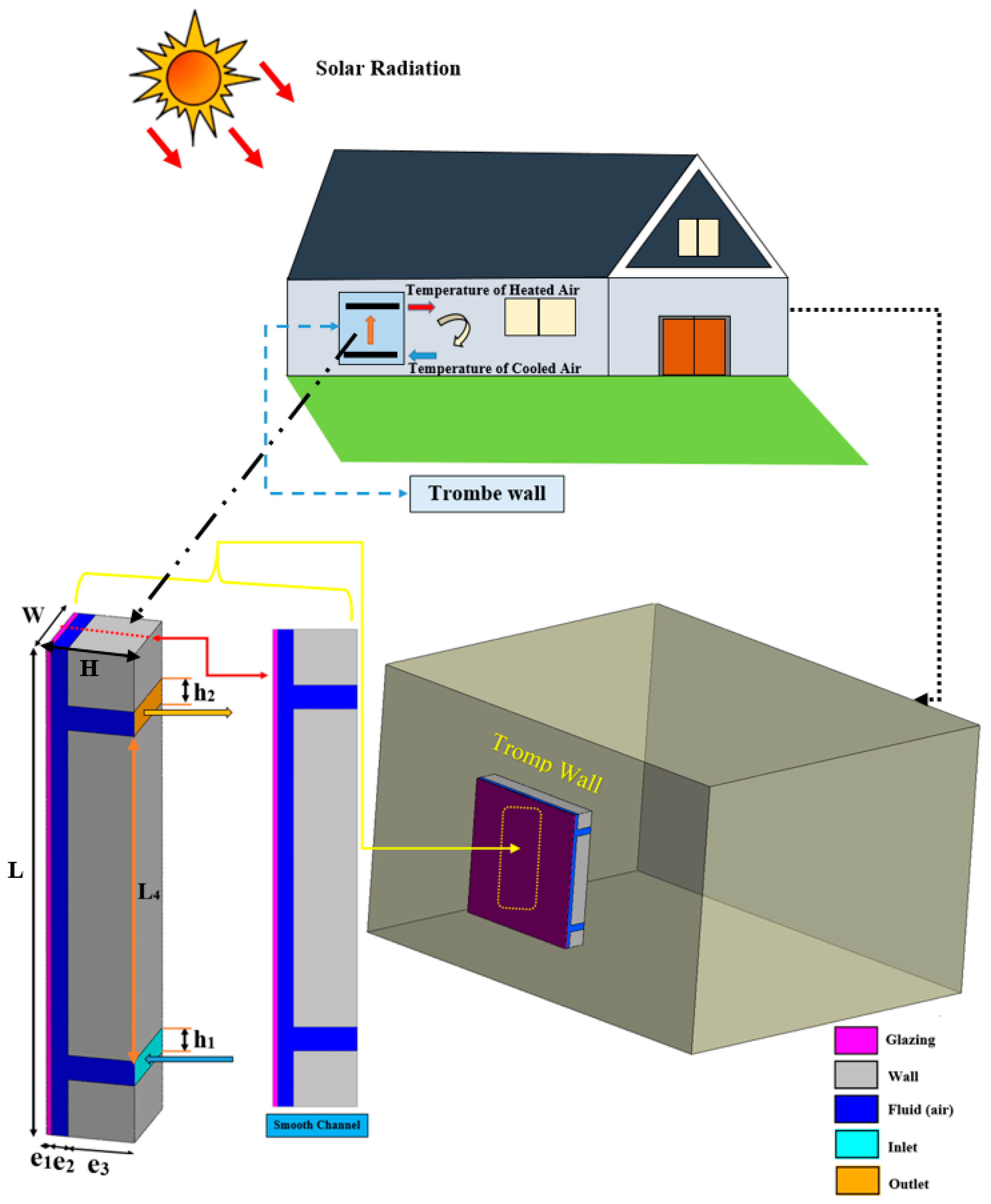
TWs are among the best-known passive solar systems for improving the thermal performance of buildings by harnessing direct solar radiation. Its functioning (as shown in Figure 1) is based on a simple yet effective physical principle: solar energy is separated by the external massive wall (usually coated with a dark coating to maximize radiative absorption) and stored in its thermal mass. During daytime operation, indoor air at a lower temperature enters the TW’s channel through the bottom hole (at height h1). It is heated as it moves upward along the warm absorber surface. Due to natural convection driven by buoyancy, the hot, lighter air ascends and escapes through the upper opening (at height h2), increasing the indoor air temperature without any external energy input. This process not only reduces the building’s total heating demand but also enhances thermal comfort and energy efficiency in the interior spaces.
Figure 1 also provides a detailed schematic of the computational domain for the current study, along with the underlying physical principle. This study modeled only the TW TW’s channel per se, as this system can be applied to both small and large buildings. The scale used is consistent with the literature and is assumed to represent real-world implementation. The schematic diagram shows the glazing layer that traps solar radiation as a greenhouse, and the multilayer wall, with thicknesses (e1, e2, e3) and TW’s channel size (defined by the height (H) and the width (W)). The arrows represent the natural circulation driven by buoyancy forces, as indicated by the airflow path. Figure 1, by combining the TW’s conceptual operation with the geometrical definition of the simulation domain, provides a clear representation of the physical model and the boundary conditions used in the numerical analysis.
Figure 1 also provides a closer view of how a TW can be integrated into a building and of the various shapes considered in this research. Figure 1 shows the TW at its actual location in an ordinary room, demonstrating its geometric accuracy and alignment. The most important dimensions of the TW are its height (H), width (W), and the thicknesses of its layers (e1, e2, and e3). Additionally, the air inlet and outlet openings are located on the bottom and top sides of the wall, respectively, thereby enhancing natural convection.
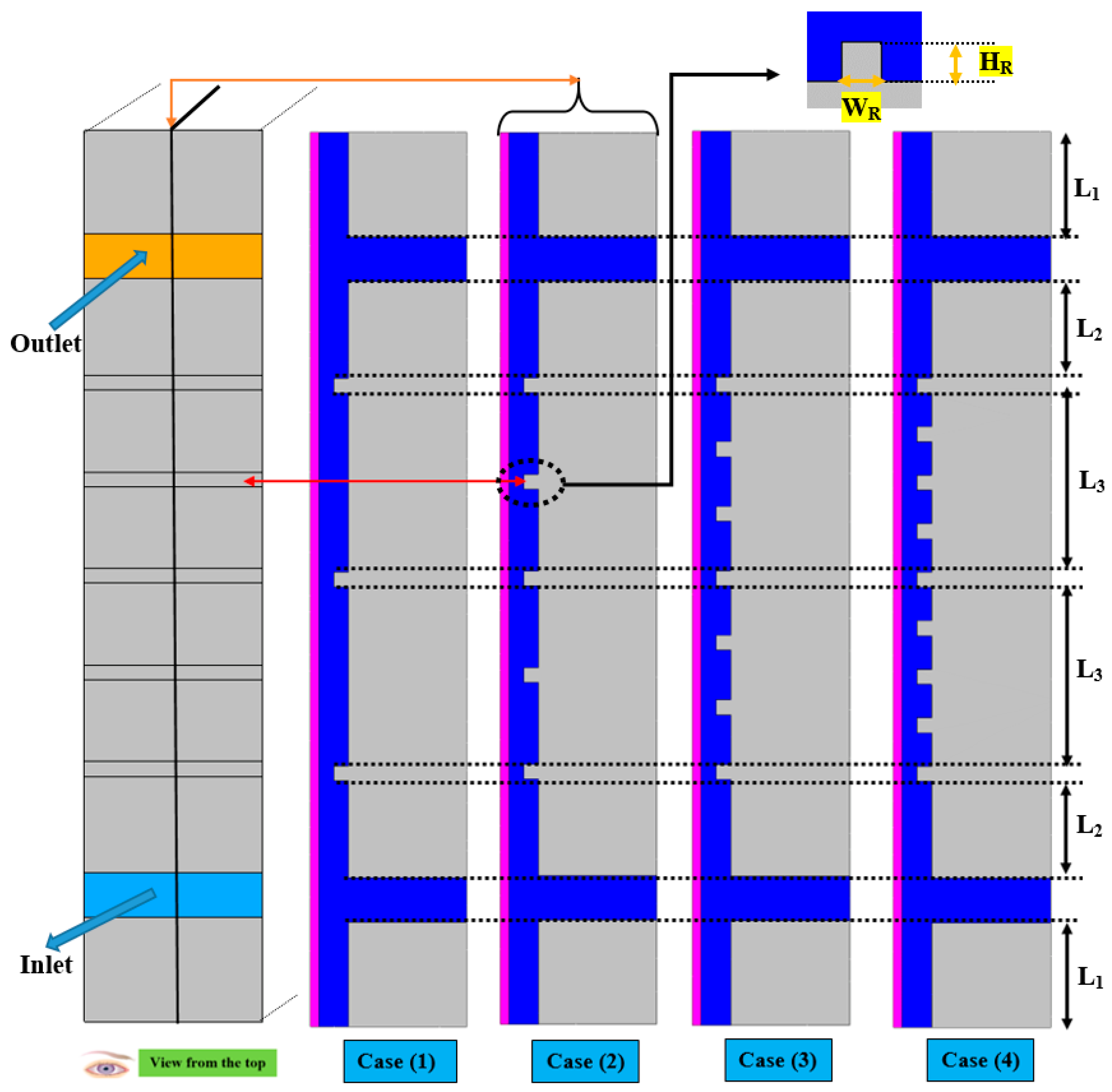
The four cases presented in Figure 2 demonstrate different internal ribs arrangements, with the number of ribs in the arrangements increasing gradually in a sequence starting with the first configuration (Configuration 1 with three ribs) and then the second, third, and last configuration (Configuration 4 with nine ribs). This directly affects airflow in the TW’s channel, increasing the intensity of secondary flows. Lastly, the top view embedded in the figure provides additional information on the dimensions and absolute positions of the design’s internal components, especially the most significant geometric parameters (WR and HR), which will be crucial for a systematic comparison of thermal and dynamic performance.
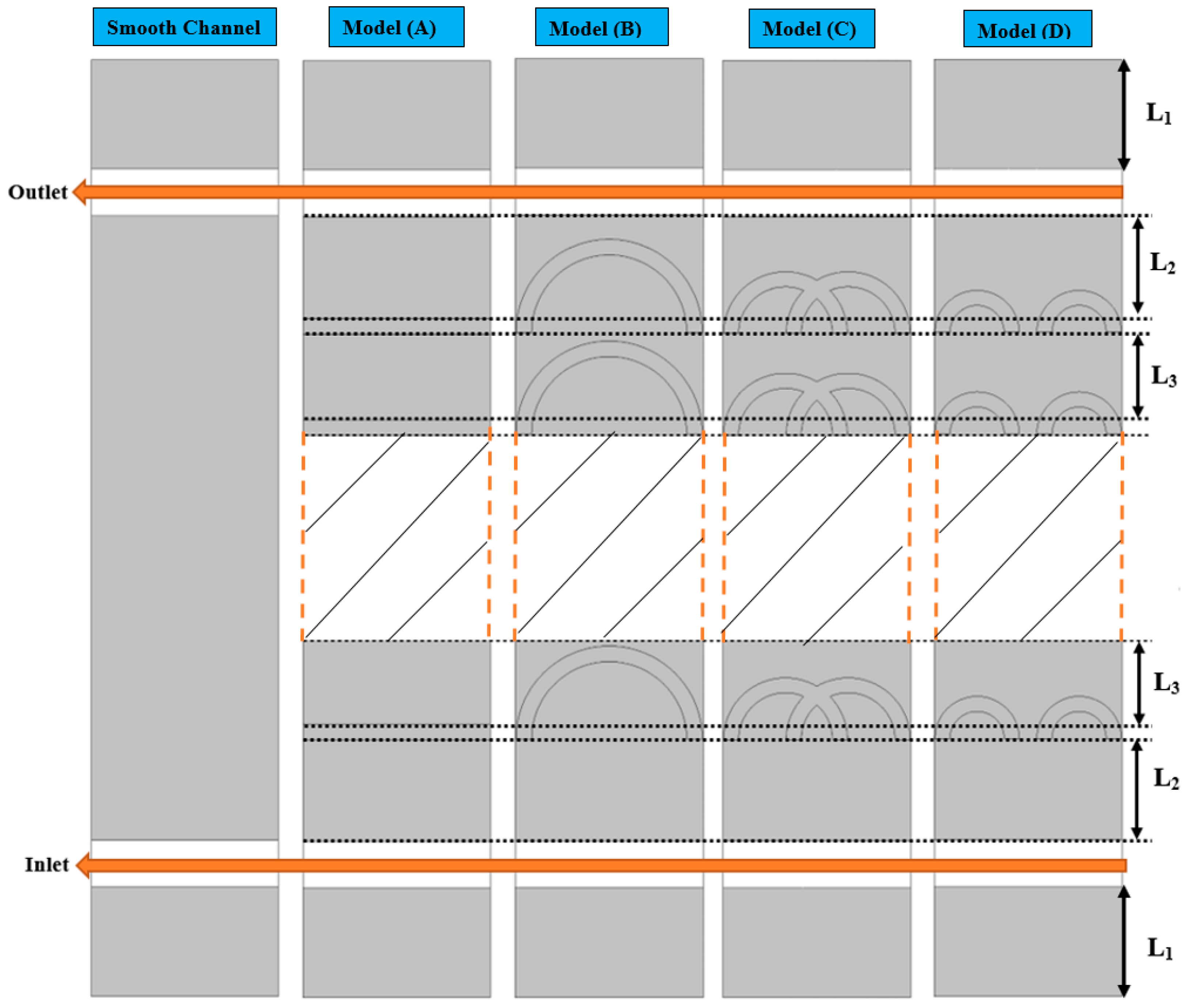
In the second section of the present work, as illustrated in Figure 3, a regular smooth-channel (without rib) is compared with the enhanced rib designs (Models A–D) integrated into the TW construction. It shows how flow behavior and heat transfer vary with the addition of ribs to the channel, considering various rib designs. The smooth channel serves as a reference with stable fluid flow and minimal thermal exchange. In contrast, the ribbed models are designed with various configurations to increase secondary flow levels and improve thermal performance.
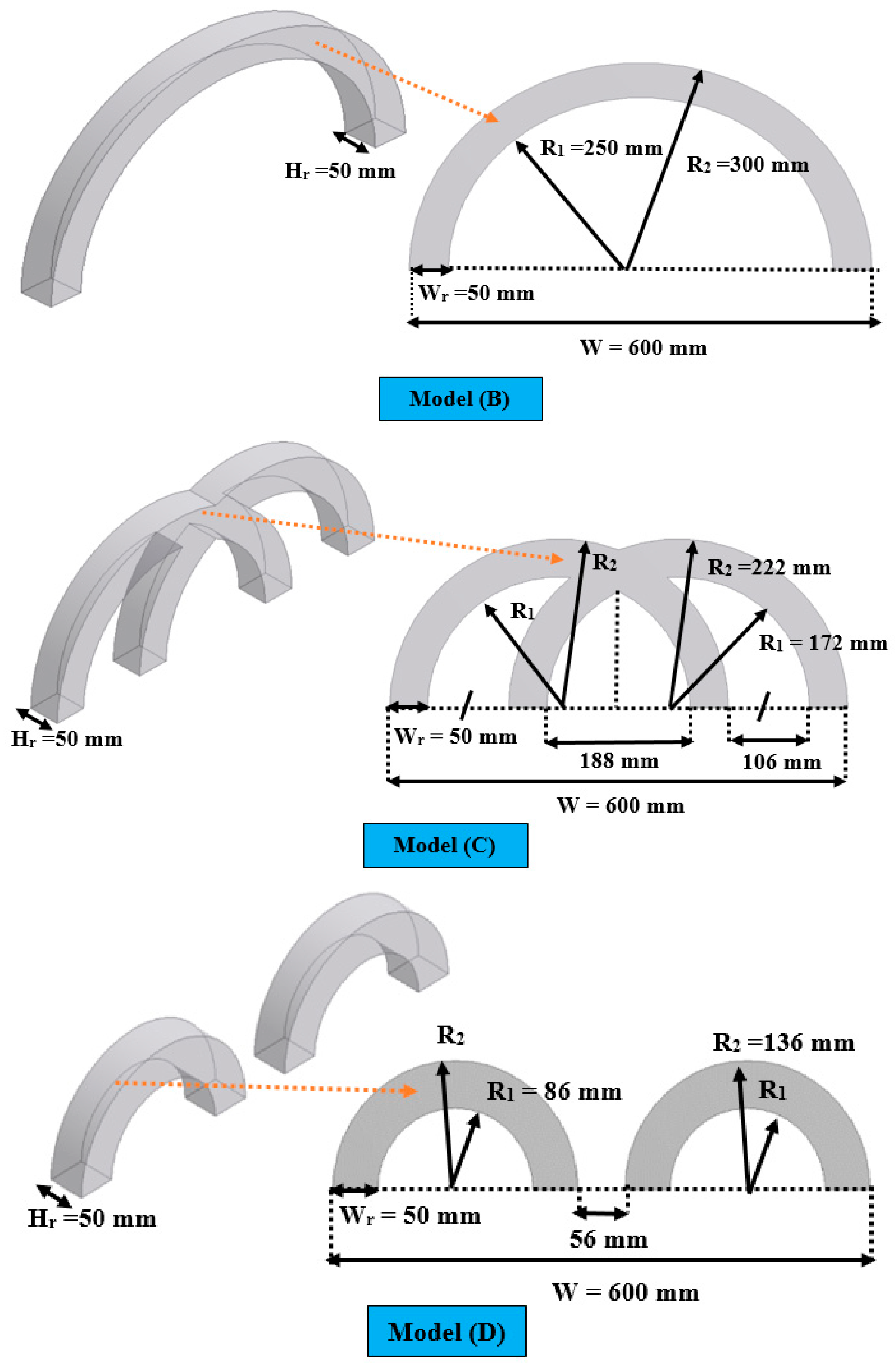
Each rib model is uniquely designed to control recirculation effects and enhance fluid mixing while also introducing pressure losses in the system. Model A incorporates basic rectangular ribs that induce moderate flow disturbances, making it a simple yet effective base case. Performance improves in Model B, where fully semi-circular ribs are employed. These ribs are known to disrupt the thermal boundary layer, thereby significantly enhancing heat-transfer efficiency. Model C features crossed semi-circular ribs, which further intensify secondary flows and enhance heat transfer relative to Model B. However, this improvement comes at the cost of a higher hydrodynamic pressure drop due to increased flow resistance. Finally, Model D employs spaced semi-circular ribs to balance thermal performance and pressure losses. This configuration offers the best balance of thermal efficiency and flow dynamics. Figure 3 demonstrates that increasing the complexity of rib designs improves performance, highlighting their role in improving TW efficiency. By combining thermal and hydrodynamic analyses, the study identifies the most effective rib configurations to improve energy performance in passive solar systems.
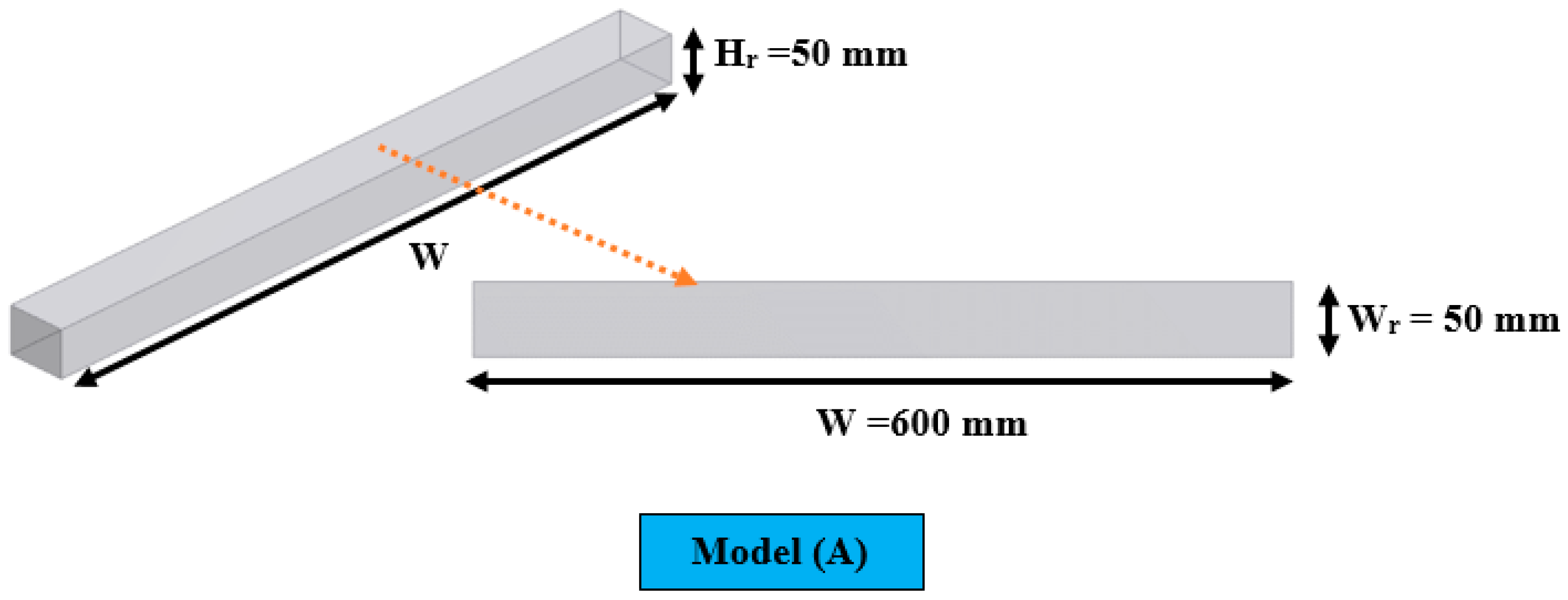
A comparison of the models presented in the second part of this study is shown in Figure 4, which is defined by their unique rib configurations within TWs. The models direct airflow through internal air-channel modifications to enhance thermal performance. Model A features rectangular barriers to create mild disturbances in airflow. The configuration of Model B includes complete semi-circular ribs that create fluid patterns by circulatory motion. Model C includes crossing semi-circular ribs that generate stronger secondary flows and enhance heat transfer. The final design of Model D uses spaced semi-circular ribs to achieve thermal intensification while minimizing pressure losses.
The selection of the investigated cases is carried out in two phases in this study. To showcase the influence of rib density on thermo-hydrodynamic performance, four configurations with variations in the number of ribs (Nr = 3, 5, 7, and 9) are designed in the first phase of this work, as shown in Figure 2, to investigate the various effects of rib density in a systematic manner. The purpose of these values is to demonstrate a gradual increase in the number of obstacles between low and high density and to determine the arrangement that promotes heat transfer without generating undue pressure losses.
After determining the best number of ribs, a second phase focused on the ribs’ geometry and design. They came up with four novel forms (Models A–D): Model A is rectangular ribbed (reference case), Model B is semi-circular ribbed, Model C is crossed semi-circular ribbed to maximize secondary flows, and Model D is semi-circular ribbed spaced to provide a compromise between vortex generation intensity and hydrodynamic efficiency.
The two-step selection methodology enables a comprehensive analysis of rib density and geometric arrangement and the determination of the best approach to designing TWs for use in passive solar heating systems. Table 1 presents the exact geometric dimensions of the TW configurations investigated. The main distinction between each case (Cases 1–4) is the number of internal ribs (Nr) and the distance between them (L3). The dimensions of the TW (length (L), height (H), width (W), the thickness of the layers (e1 and e2), and the sizes of the air input and outlet openings (h and w)) are held constant to comparatively rigorously investigate the effect of internal variation on the thermal and hydrodynamic performance of the system. An in-depth study of these dimensions can enable a successful evaluation of the impact of the investigated settings and the identification of the best designs to improve thermal efficiency.

2.2. Governing Equations

Before presenting the governing equations, the assumptions adopted in the numerical model must be clarified. In this study, the airflow inside the TW is assumed to be steady-state, incompressible, Newtonian, and laminar, depending on the Reynolds number (Re). The thermo-physical properties of air are assumed constant, and radiation effects on the airflow are neglected, as the focus is on convective heat transfer within the TW. ANSYS Fluent (2020 R1) is used to perform numerical simulations based on the conservation of mass, momentum, and energy. These equations provide the physical basis for explaining the thermo-hydrodynamic behavior of the TW. In this study, air is modeled as an incompressible fluid. The thermo-physical properties of air (density, viscosity, specific heat, and thermal conductivity) are preprocessed at the inlet using polynomial correlations evaluated at ambient temperature, and then treated as constant within the domain to ensure numerical stability.
The simulations are conducted under a forced laminar convection regime (Re = 600–1600). Natural convection effects are neglected, and the Boussinesq approximation is not applied, as the focus is placed on forced convection. This assumption simplifies the model by eliminating the complexity of buoyancy-driven flow, thereby enabling a controlled study of the effects of rib geometries on heat transfer. This approach isolates the impact of rib design on the thermo-hydrodynamic behavior of the TW while maintaining computational efficiency [3,42].
Conduction is explicitly solved in the solid domains (the absorber wall and the glazing), while convection is modeled in the air channel of TW. Radiation was represented by applying a constant solar flux of 748 W·m−2 to the absorbing surface [41], with the glazing treated as adiabatic with partial radiative trapping. This approach isolates the effect of ribs on the thermo-hydrodynamic behavior of the TW while maintaining computational efficiency.
These assumptions are necessary to simplify the modeling process and focus on the specific effects of rib geometries under controlled forced-convection conditions, thereby providing clarity and reducing the analysis’s complexity. The governing equations are as follows:
Continuity equation:
u i X i = 0
Momentum equation:
u j u i X j = 1 ρ P X i + ν 2 u i X i 2
Energy equation:
u j T X j = α 2 T X i 2
where α denotes the thermal diffusivity of air, defined as α = k/(ρ × Cp).

2.3. Thermo-Physical Properties of Materials

In this study, the thermo-physical properties of air are estimated using polynomial correlations as functions of ambient temperature (Tenv). These correlations are applied only at the inlet boundary to generate a working fluid with properties close to those of real conditions before it enters the TW. Once the inlet fluid is defined, the solver treats these properties as constant throughout the computational domain, thereby ensuring numerical stability and reducing computational cost. For the solid components of the TW (absorbing wall, glazing, and insulation), constant properties are assumed, as their variation within the considered temperature range is negligible relative to that of air.
Table 2 presents the correlations used to evaluate the thermo-physical properties of air as a function of ambient temperature, following the data reported in [35]. Each property is expressed through a polynomial relation with empirical coefficients describing its dependence on Tenv. These correlations are applied only at the inlet boundary to define the working fluid’s realistic properties before it enters the TW. This approach provides a more accurate initialization of the flow conditions, while, within the computational domain, the air properties are assumed constant. Such a treatment allows for a realistic representation of the inlet state without introducing unnecessary computational complexity.
Table 3 summarizes the thermo-physical characteristics of the solid materials used in the TW design, specifically the glazing, ribs, and insulation (outer wall). These parameters are fundamental in determining how well the wall absorbs incident solar radiation, stores thermal energy in its mass, and transfers it to the interior environment. Accurate descriptions of these properties are critical to the combined mechanisms of heat storage and conduction, ensuring the reliability of numerical results on the overall thermal performance of the TW.

Performance Parameters and Dimensionless Numbers

In this study, the main parameters characterizing thermal and hydrodynamic performance are defined by the following mathematical formulations:
Re Number [44,45]:
R e = U i n × ρ × D h μ
The hydraulic diameter Dh [44,45]:
D h = 2 A P
Friction factor (f) [44,45]:
f = 2 L D h × Δ P ρ U m 2
The mean velocity Um is defined as:
U m   = 1 ρ A   A ρ u · n d A
The Poiseuille number (Po), which quantifies the combined effects of friction and flow regime, is defined as [44,45]:
P o = f × R e
Average Nu Number [44,45]:
N u a v g = h × D h k
The local heat-transfer coefficient (h) [44,45]:
h = Q c A × ( T w T b )
where Tb = (Tin + Tout)/2.
Colburn j-Factor [44,45]:
j = N u R e × P r 1 / 3
The thermal enhancement factor (TEF) is introduced in this study as a dimensionless performance index to evaluate the overall thermo-hydrodynamic behavior of the TW channel. Unlike a thermodynamic efficiency, the TEF does not represent the ratio of useful to input energy, but rather quantifies the trade-off between heat transfer enhancement and the pressure drop penalty. It is defined as [44,45]:
T E F = N u N u 0 f f 0 1 3

2.4. Boundary Conditions and Numerical Model

This set of conditions is determined to recreate the physical work of the TW while remaining numerically stable. The operating conditions are set to a solar radiation intensity of I = 748 W·m−2, an ambient temperature of T = 293.75 K, and an ambient wind speed of U = 1 m·s−1 [41]. A velocity inlet is applied at the inlet (bottom opening, h1) with Re numbers within the range Re = 600–1600, corresponding to a laminar flow regime in the narrow TW air channel under moderate wind-driven ventilation conditions. Thermo-physical properties of inlet air are pre-computed using polynomial correlations as a function of ambient temperature, ensuring the incoming fluid is representative of atmospheric conditions. A pressure outlet with zero gauge pressure is introduced at the outlet (top opening, h2), allowing circulation by buoyancy and ensuring overall mass conservation.
Re numbers in the range Re = 600–1600 are specifically chosen to represent laminar flow conditions, characterized by low velocity and viscous forces that dominate inertial forces. This range corresponds to air velocities typically encountered in passive solar systems, where forced convection is moderate, and turbulence is avoided. By maintaining a laminar flow regime, we ensure that the study focuses on the effects of rib configurations in the absence of turbulence, enabling a more controlled analysis of heat transfer and flow dynamics. These low velocity conditions are essential for examining the subtle effects of rib geometries on thermal enhancement and hydrodynamic losses in TWs.
For the walls, the absorbing surface is held at a constant temperature of 300 K, representing the heating of a massive wall by the sun, but in a dark color, with the glazing layer adiabatic and partially trapping radiative energy, as per the greenhouse effect. All other walls are assumed to be adiabatic and no-slip so that the effect of the absorbing wall could be isolated. These simplifications are made to align with actual building conditions, including wind variations, different outdoor temperatures, and all-spectrum solar radiation, which are incorporated into this method; however, this methodology is consistent with other current CFD research on TWs. It enables the isolation and comparison of the effects of rib configurations under controlled conditions, with a strong foundation for evaluating the thermo-hydrodynamic performance.

2.5. Mesh-Independent Analysis

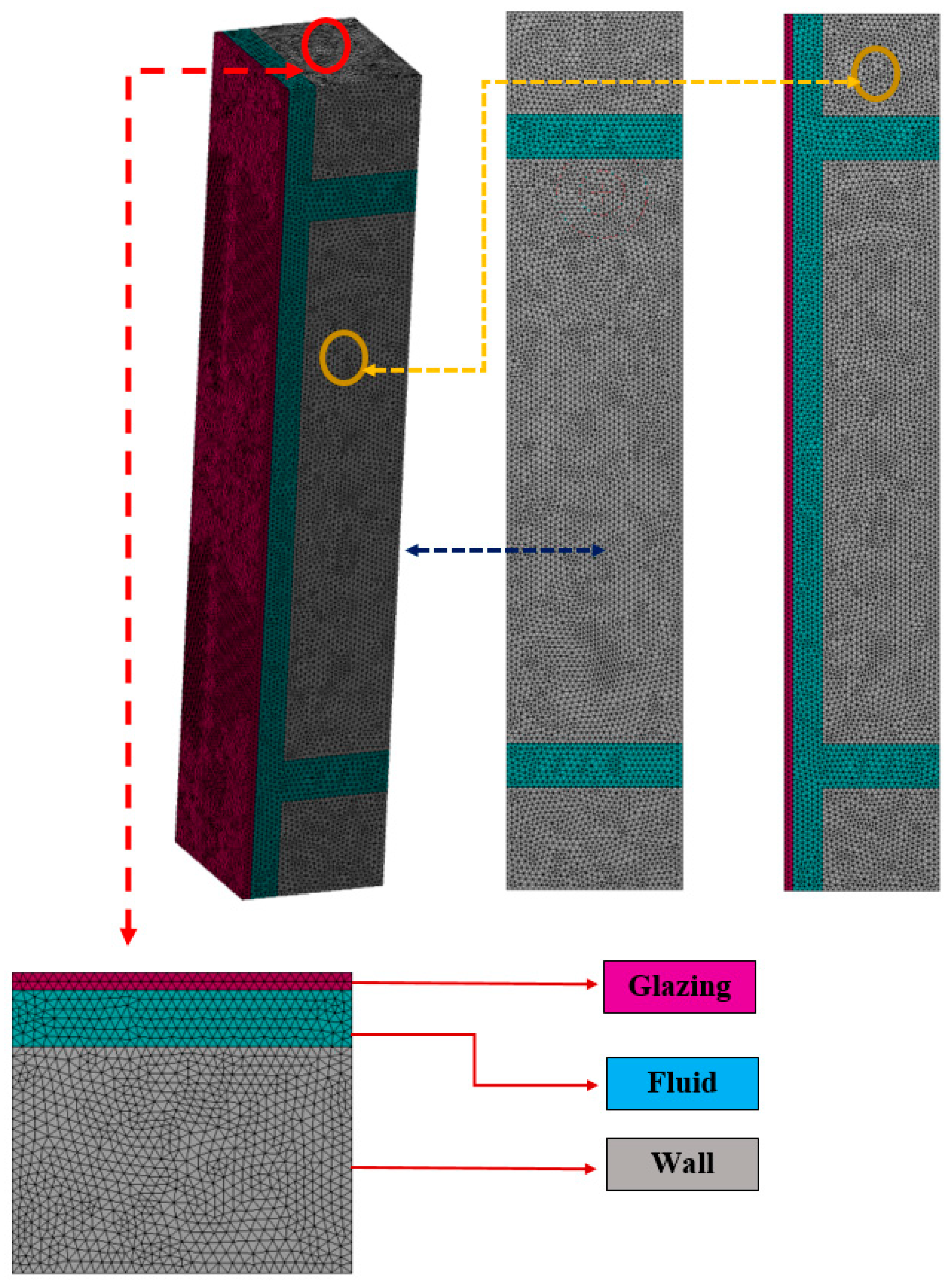
A mesh-independent study is also conducted to obtain optimal numerical results and to test several grid arrangements for a TW without fins at a reference Re number of Re = 600. As shown in Figure 5, the computational mesh is divided into three zones: (i) the glazing, (ii) the fluid domain, and (iii) the solid wall. To achieve high resolution with minimal computational expense, a grid is organized, and local refinement is applied in key areas to enhance the accuracy of heat transfer and fluid dynamics predictions.
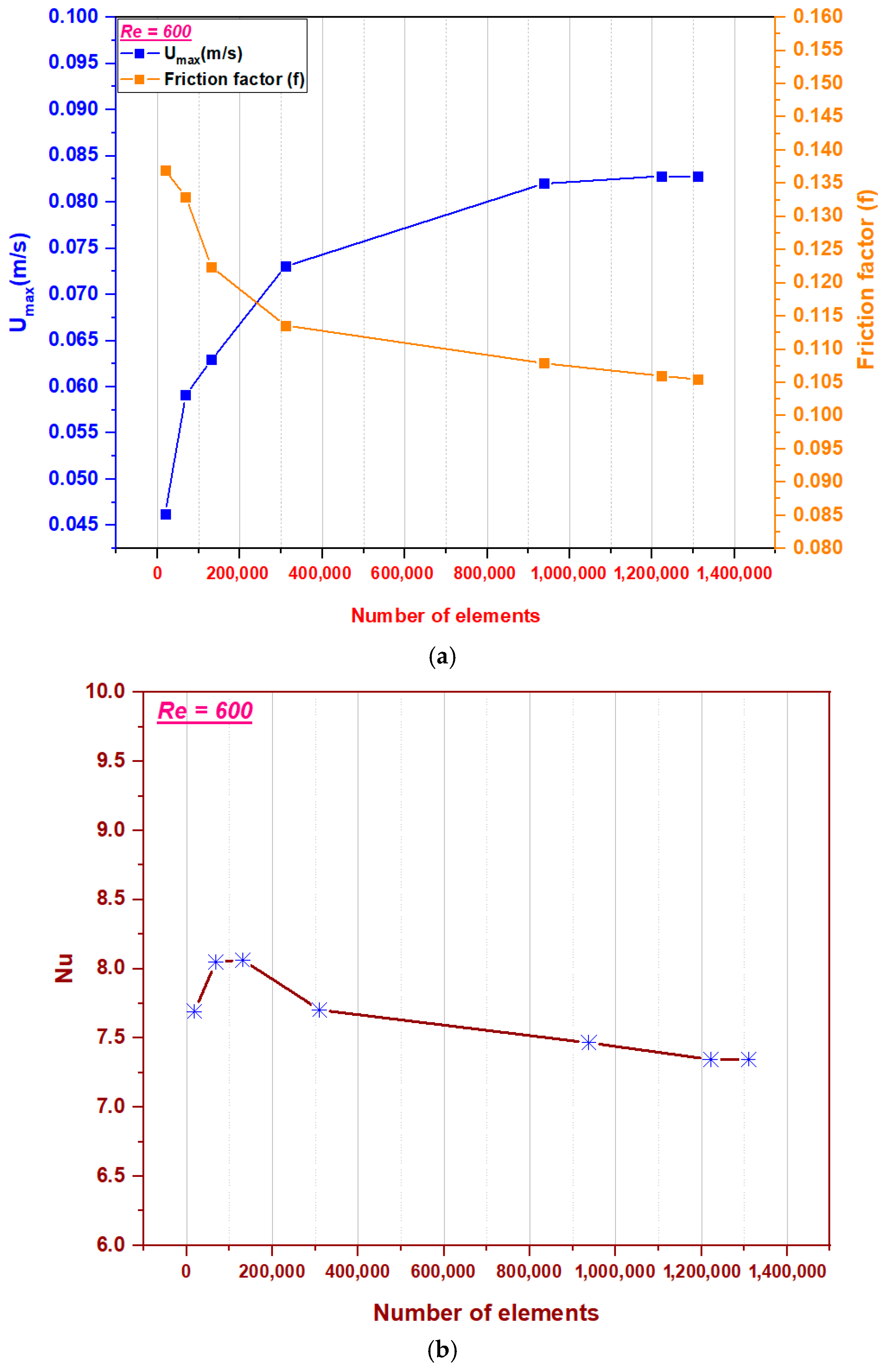
The results of the mesh independence study are presented in Figure 6, which shows the evolution of several parameters with the number of elements. Figure 6a shows that the variation in maximum velocity and friction factor becomes negligible beyond 937,624 elements, with deviations remaining below 2%, indicating convergence of the results. Figure 6b displays the average Nu number versus the number of elements, highlighting stabilization with variations less than 2.5% beyond the same threshold, thereby confirming the consistency of the results. According to these analyses, the appropriate grid is selected for the subsequent simulation, comprising 1,221,675 cells and providing the best balance between numerical accuracy and computational cost. This reduces the influence of mesh density on results and, in turn, the strength and consistency of the numerical simulations.

2.6. Validation of the Numerical Model

In the laminar flow regime, the average Nu number within TWs is consistent with the analytical correlation of Equation (13). It is commonly used as a benchmark for characterizing heat transfer in TWs [6]. Researchers [46,47,48,49,50] have conducted experiments to validate this equation, making it an interesting predictive technique for Nusselt numbers. The Re number range of Re = 600–1600 is an ideal application range for this reference, where the experimental results are well matched.
Nu = 0.13 × Re0.64 × Pr0.38
The behavior of hydrodynamics in the laminar flow in TWs is predicted based on the Hagen–Poiseuille law, formulated by Equation (14). The law describes the relationship between duct flow velocity and pressure drop in laminar flow. The coefficient of friction obtained using this law provides accurate data needed to examine the performance of TW in terms of aerodynamic and energy capacity issues. The law is most accurately applicable when the Re number remains below the turbulent transition point.
f = 64 R e
where f is the Darcy friction factor, and Re is the Re number. It is an analytical expression that is generally well accepted as the reference for the full development of the laminar duct flow correlation.
The two equations can also be combined, enabling the researcher to precisely capture both thermal transfer and fluid dynamics within the TWs. The theoretical framework, coupled with experimental validation, makes this method a useful design and optimization aid for passive heating systems, particularly for this technology.
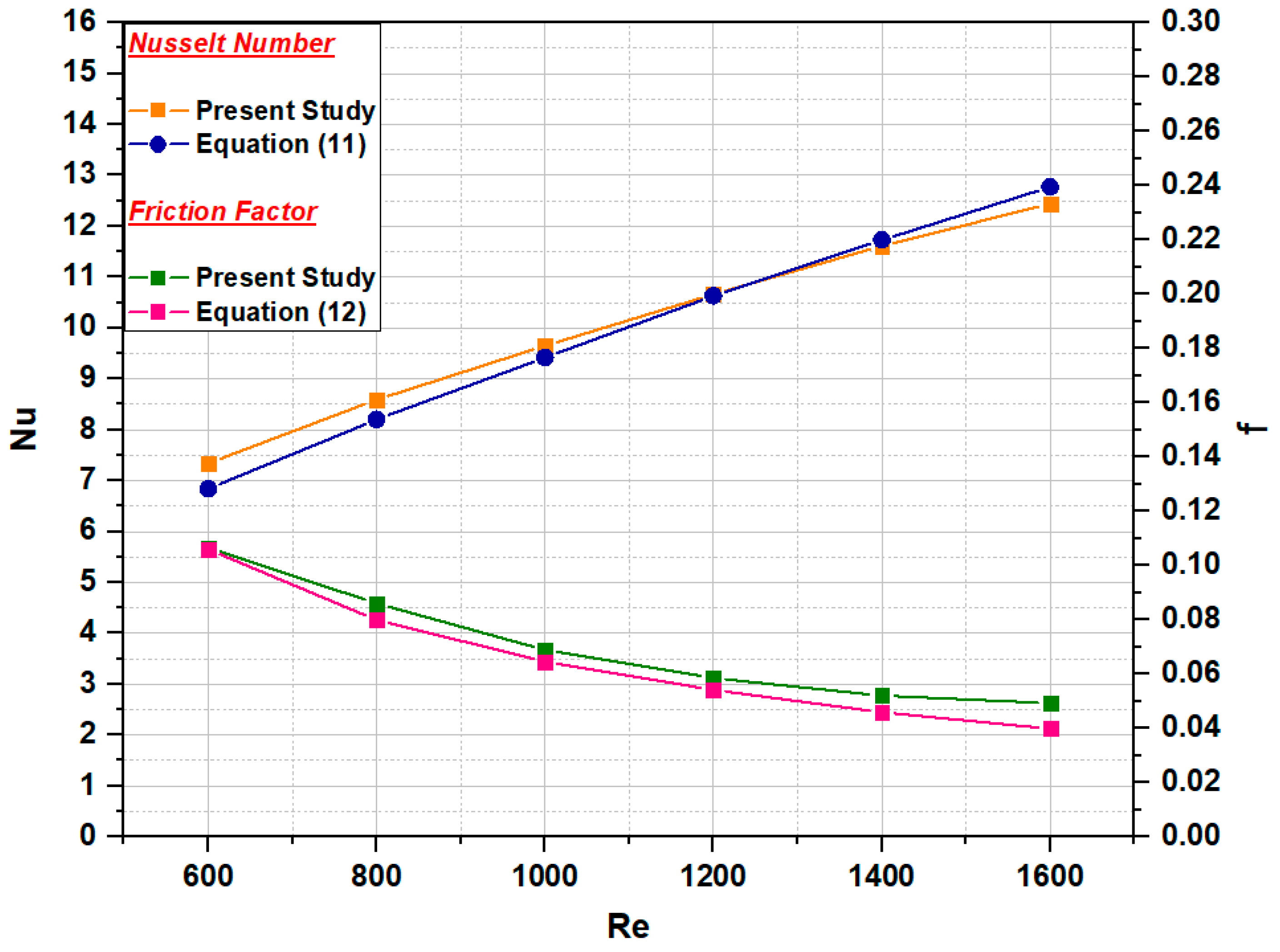
The CFD model validation is achieved by obtaining numerical results for the average Nu number and friction factor using the well-established experimental correlations (Equations (13) and (14)) for laminar flow in the TW. This validation is shown in Figure 7, which shows the variation in the average Nu number and the friction factor with the Re number (Re) over the range Re = 600–1600.
Regarding heat transfer, the numerical results shown in Figure 7 indicate that the average Nusselt numbers from the present CFD model are consistent with the results of experimental correlation (Equation (13)). The CFD model yields Nu = 7.34 at Re = 600. In contrast, Equation (13) predicted Nu = 6.84 (about 7.31% error). As the Re number increases, the deviation also decreases, to less than 3 percent at Re = 1000, indicating that the CFD and benchmark results are very consistent.
Regarding the friction factor, as illustrated in Figure 7, the present numerical model also shows strong agreement with the reference correlation (Equation (14)). At Re = 600, the present numerical model’s value of f = 0.1065, compared with the value of f = 0.1059 calculated by Equation (14), shows a very small deviation (around 0.56%). At Re = 1600, the difference is around 2.7%. The numerical model results also confirm the trend of decreasing friction factor with increasing Re number.
As a result, the numerical model is reliable, as the CFD results compare well with the experimentally validated analytical equations. The error has always remained within the 6% range across the entire range of Re numbers investigated, suggesting the simulation framework is accurate and robust. The validation analysis results indicate that the present numerical model accurately captures the thermo-hydrodynamic behavior of TW systems and can therefore be used as a useful tool for design enhancement.

3. Results and Discussion

To systematically evaluate the thermo-hydrodynamic performance of the proposed TW configurations, the results are presented in two stages. First, the influence of the number of ribs (Nr = 3, 5, 7, and 9) is investigated using the reference rectangular geometry (Model A) to identify the best rib density that maximizes heat transfer while minimizing pressure losses. This analysis provides insights into the balance between secondary flows intensification and hydraulic feasibility.
In the second stage, the focus shifts to the influence of rib geometry, with four designs (Models A–D) compared at the best rib density identified in the first stage. This comparison highlights the impact of rib shape and arrangement on both heat transfer and flow resistance, allowing the determination of the most efficient configuration in terms of comprehensive performance.

3.1. Effect of Rib Number

Evaluating the effect of rib number (Nr) is a crucial first step because rib density directly influences the intensity of secondary flows, the degree of boundary-layer disruption, and the resulting convective heat transfer in the TW’s channel. Before comparing rib geometries, it is therefore necessary to determine the best number of ribs capable of maximizing thermal enhancement without inducing excessive pressure losses. In this section, four rib-density configurations (Nr = 3, 5, 7, and 9) are analyzed over a Re range of 600–1600. The corresponding geometric arrangements are illustrated in Figure 2. This overview establishes the framework for the subsequent analysis, which identifies the Nr value offering the best compromise between heat transfer and hydrodynamic performance.
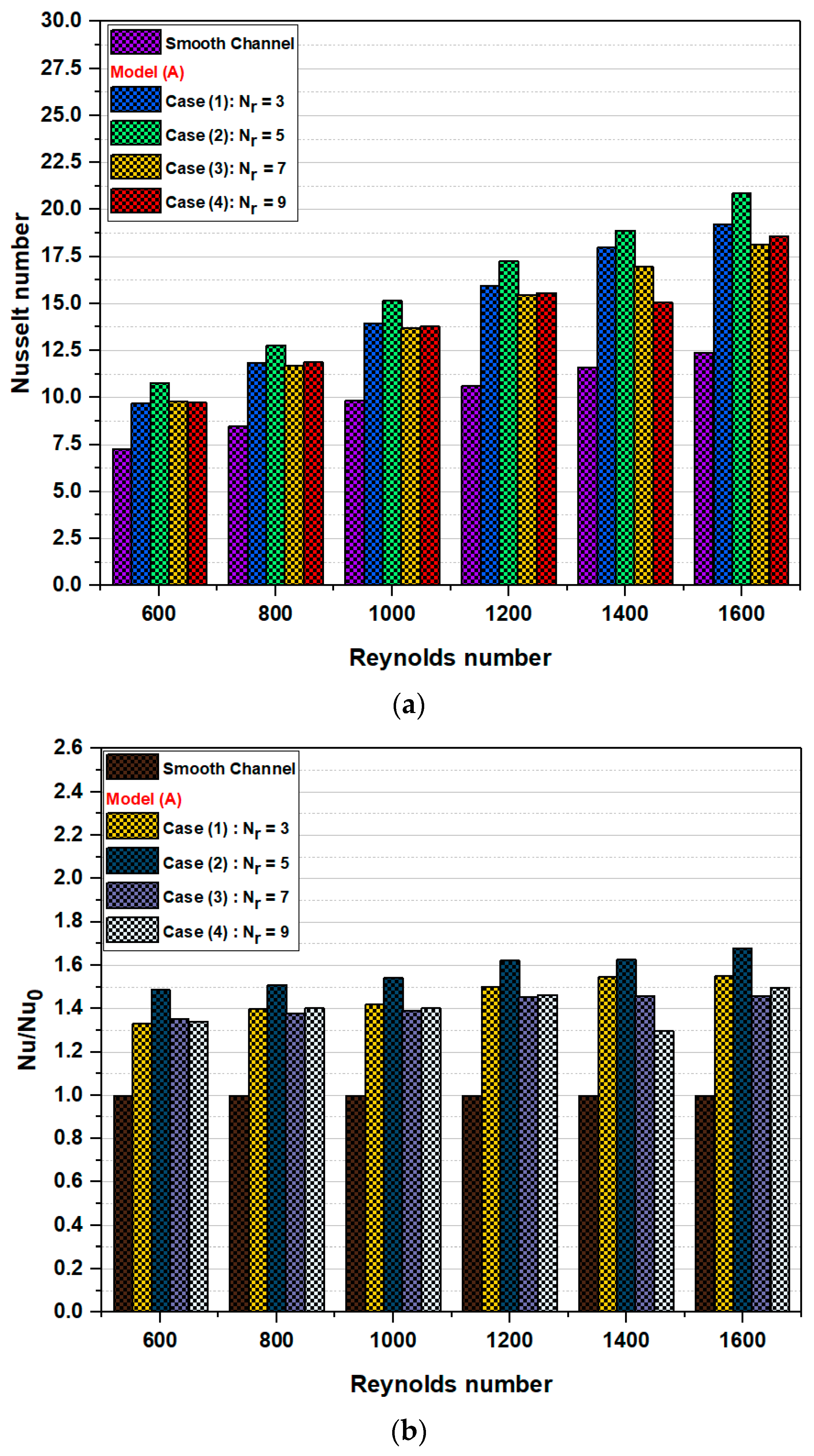
This is revealed in the analysis of Figure 8, which shows that the number of ribs influences heat transfer in the TW, as ribbed configurations are compared with the smooth reference channel. In Figure 8a, the change in average Nu number with Re number shows that there is a great enhancement in the convective heat transfer by the introduction of ribs, since the mixing of the flow and disruption of the boundary-layer becomes better. The geometry of Nr = 5 has the highest thermal gain: at Re = 600, the smooth channel gets Nu = 7.257, and the geometry of Nr = 5 gets Nu = 10.794 (+48.7%). Nu jumps at Re = 1600 to 20.880 (+68.2%), demonstrating the strong positive effect of the ribs by generating secondary flows.
But at Nr above 5, the thermal performance starts to level off. Nu still does not decrease, but it is somewhat lower than that of the smooth channel: Nu = 18.137 (+46.1%, Nr = 7) and Nu = 18.603 (+50%, Nr = 9), at Re = 1600. This reduction is attributable to excessive flow obstruction, which increases aerodynamic resistance and creates stagnant recirculation areas that hinder efficient wall–fluid contact. This tendency is also underlined by Figure 8b, which displays the ratio Nu/Nu0: at Re = 1600, Nr = 5 offers Nu/Nu0 = 1.682 (+68.2%), whereas Nr = 7 and Nr = 9 give Nu/Nu0 = 1.461 (+46.1%) and 1.498 (+50%), respectively.
These results indicate that although laminar vortex generation and convective exchange are initially improved with increasing rib density, extreme rib density is detrimental to the overall net thermal gain. The Nr = 5 case is found to provide the best heat transfer optimization while maintaining acceptable flow dynamics, which is important for the total energy performance of the TW.
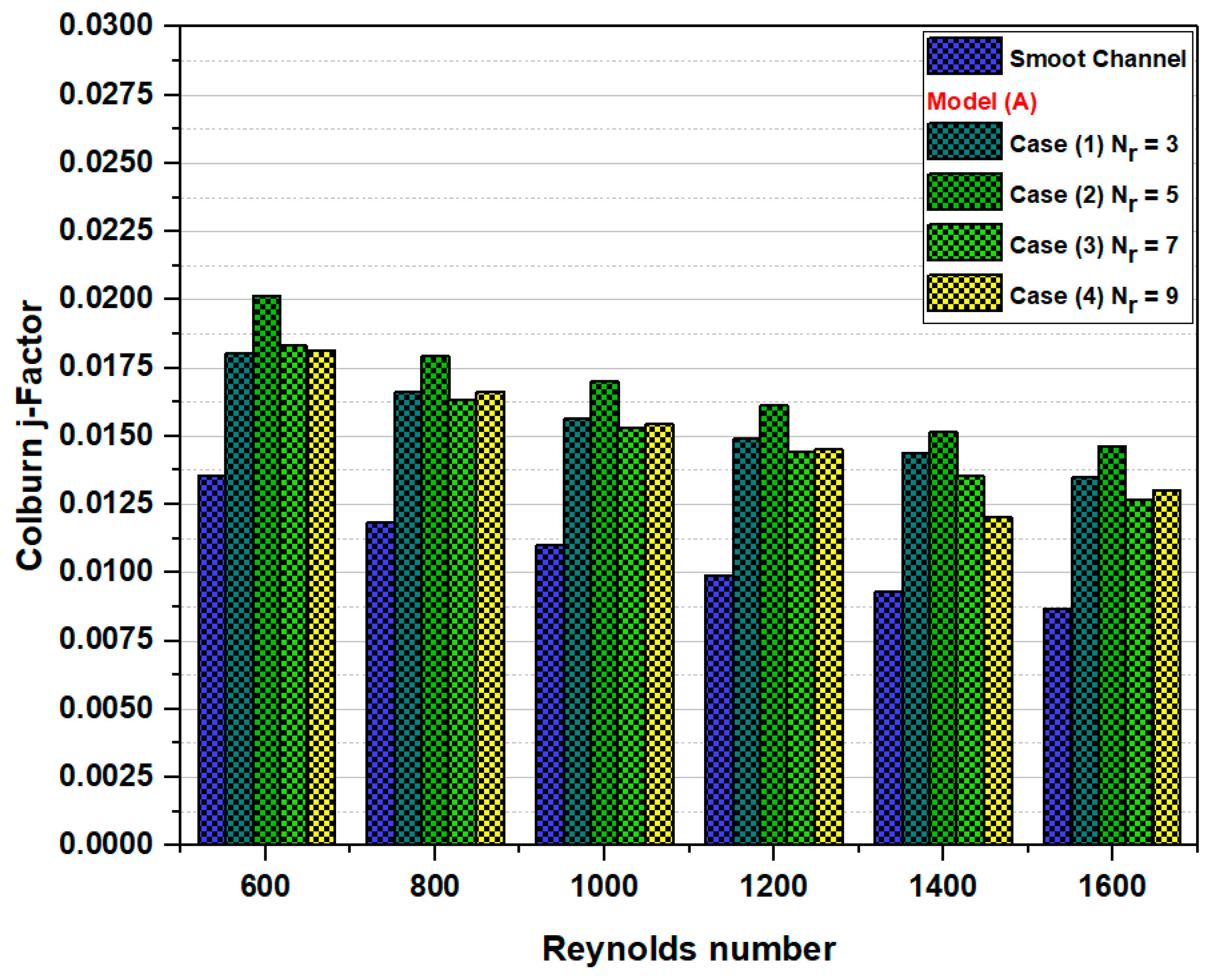
The results of Figure 9 are used to plot how the Colburn factor (j) varies with the Re number in the smooth reference channel and the ribbed profiles (Nr = 3, 5, 7, 9). The findings affirm that the introduction of ribs has a significant effect on enhancing convective performance by increasing the value of j relative to the smooth channel. This improvement is due to disturbances in the thermal boundary layer, which lead to the development of secondary flows that enhance air mixing and heat transfer. However, j gradually declines with increasing Re in all cases, as the relative effect of mixing due to secondary flows is diminished as flow rates increase, and inertial forces supersede.
The best performance is observed for the rib density with Nr = 5. At Re = 600, it attains j = 0.02017, which is a +48.7% improvement of the smooth channel. At Re = 1600, j reduces to 0.01469, which nonetheless represents a substantial +68.2 increase compared to the smooth channel. At this best, the thermal performance saturates: the Colburn factor decreases with further rib density enhancement (Nr = 7 and 9), which increases the flow resistance and adds recirculation isolating zones. Such effects reduce the effective secondary flows available for convective heat transfer, resulting in lower improvement.
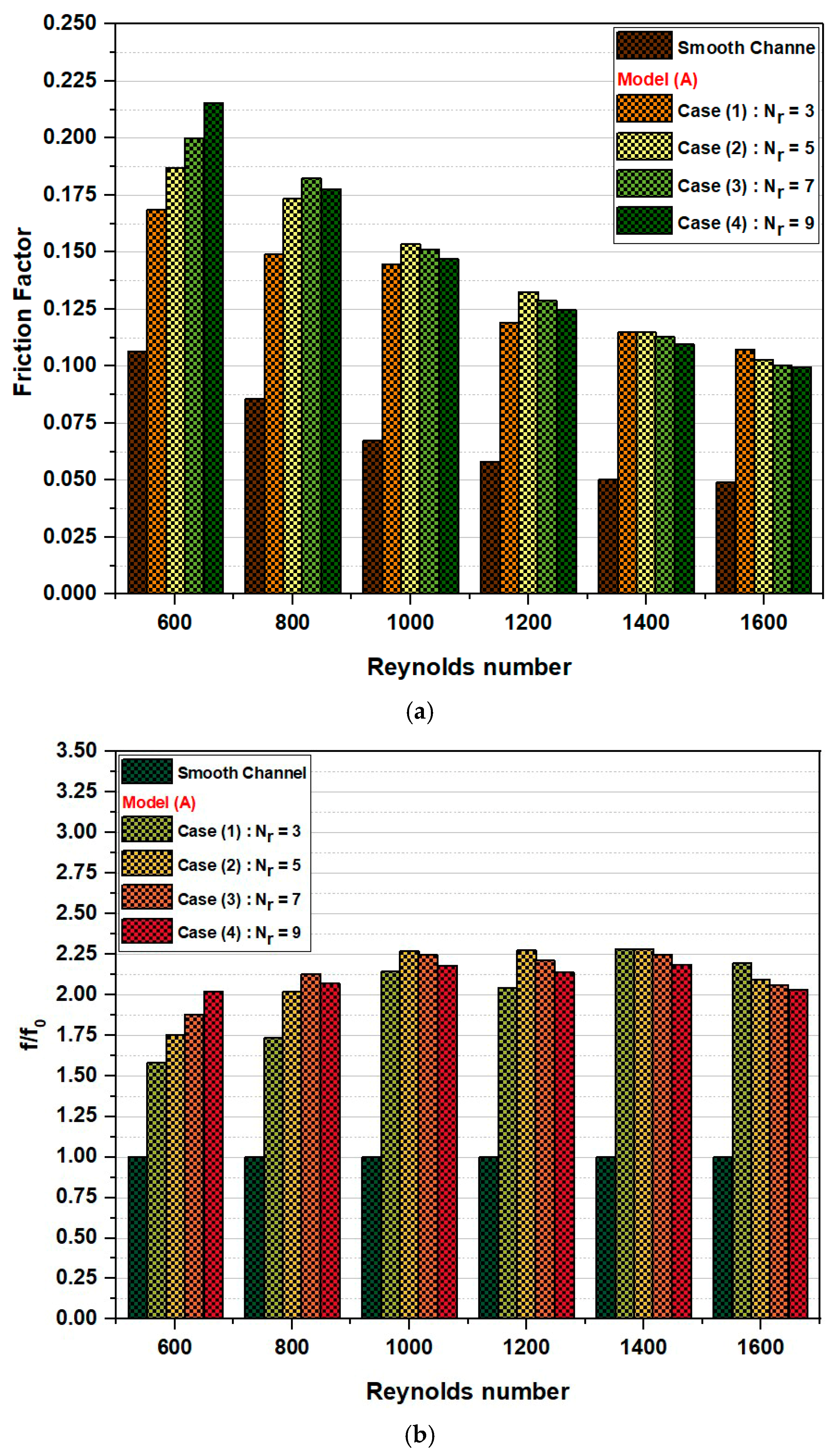
Figure 10 shows how the friction factor (f) and its normalized ratio (f/f0) vary with the Re number for the smooth and ribbed channels (Nr = 3, 5, 7, and 9). As shown, f also decreases with increasing Re, as inertial forces in higher flow regimes increasingly dominate viscous forces. Nevertheless, in the smooth channel, by contrast, the incorporation of ribs causes a significant increase in f, owing to a greater number of disturbances and recirculations, and to increased pressure losses.
Case 2 with Nr = 5 offers the best compromise between heat transfer and pressure drop. The smooth channel yields f = 0.1067 at Re = 600, whereas Nr = 5 yields f = 0.1871 (around 75.4% improvement). At Re = 1600, the f value of 0.0488 in the smooth channel changes to 0.1025, which is +110.0 percent greater than the f of Nr = 5, demonstrating the high hydrodynamic cost that ribs impose. At greater rib densities, the factor of friction increases even more: at Re = 600, Nr = 7 gives f = 0.2005 +87.9%, and Nr = 9 gives even larger penalties, which confirms the fact that too many ribs create significant hydraulic resistance.
Figure 10b is the normalized ratio of f/f0, or the relative increase relative to the smooth channel. This ratio appears highest at Re = 600 when Nr = 9, with a value of 2.022 (+102.2), indicating the extreme effects of rib density on pressure drop. As the Re number increases, f/f0 approaches 2.0 for the densest rib configurations, suggesting that absolute losses increase with Reynolds number. In contrast, for the more secondary-flow configurations, their proportion becomes less significant. In general, the analysis confirms that Nr = 5 offers the best balance between thermal benefits and hydrodynamic penalties, since Nr = 7 and Nr = 9 incur too much pressure loss, which negates the marginal heat transfer benefits and thus lowers the global energy performance of the TW.
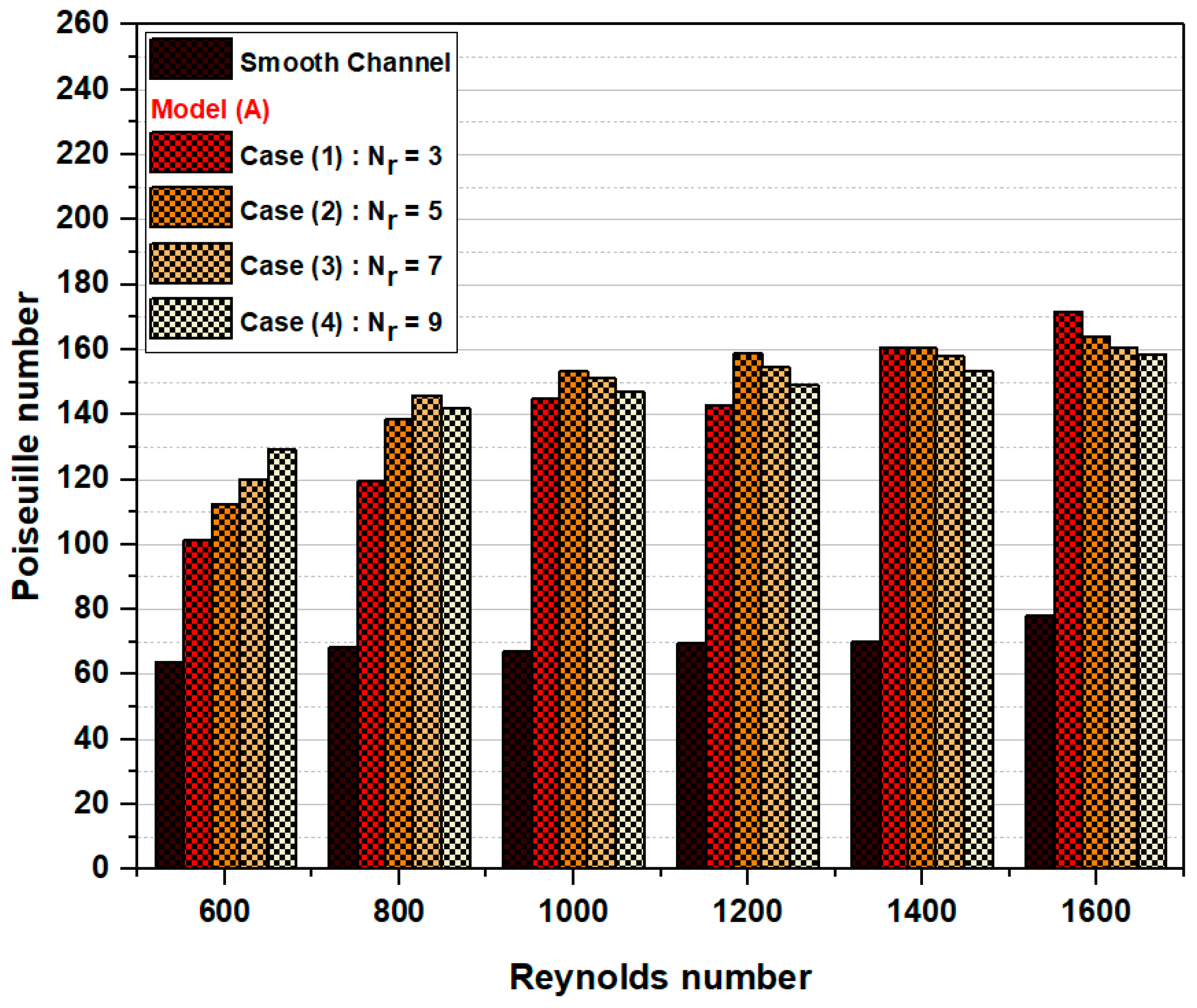
The curves of Figure 11 depict how the Poiseuille number (Po) varies with the Re number in both cases of the smooth channel and the ribbed ones (Nr = 3, 5, 7, 9). Po, being a non-dimensional parameter, is the product of the friction factor and the flow regime (Po = f × Re) and is therefore one of the most important factors indicating pressure losses in the system.
As the findings show, the Po is always higher in ribbed channels than in smooth channels, indicating that the resistance to flow due to ribs is substantial. When Re = 600 and Po = 64.01 in the smooth channel, but Nr = 9 gives Po = 129.46 (around 102.2% improvement), it is evident that the penalty cost of a too-dense rib is significant. With Re, the Poiseuille number approaches a constant value, as viscous forces become more important in the secondary flows. Po values at Re = 1600 are Po = 78.18 in the smooth channel and Po = 159.05 at Nr = 9 (an improvement of around 103.44%), confirming that the losses are higher even at higher flow rates.
Case 2 with Nr = 5 shows a good compromise: Po = 112.28 (around 75.4% enhancement) at Re = 600 and Po = 163.98 (around 110.0% enhancement) at Re = 1600, which is still much lower than those of Nr = 7 and Nr = 9. In the latter cases, the steady increase in the Po does not correspond to similar thermal gain, indicating performance saturation. This is a clear indication that, as the number of ribs is increased, secondary flows and heat transfer improve, but at the same time, hydraulic losses increase. At Nr above 5, the extra resistance of the wall exceeds the marginal thermal gains, resulting in a lower total energy efficiency for the TW.
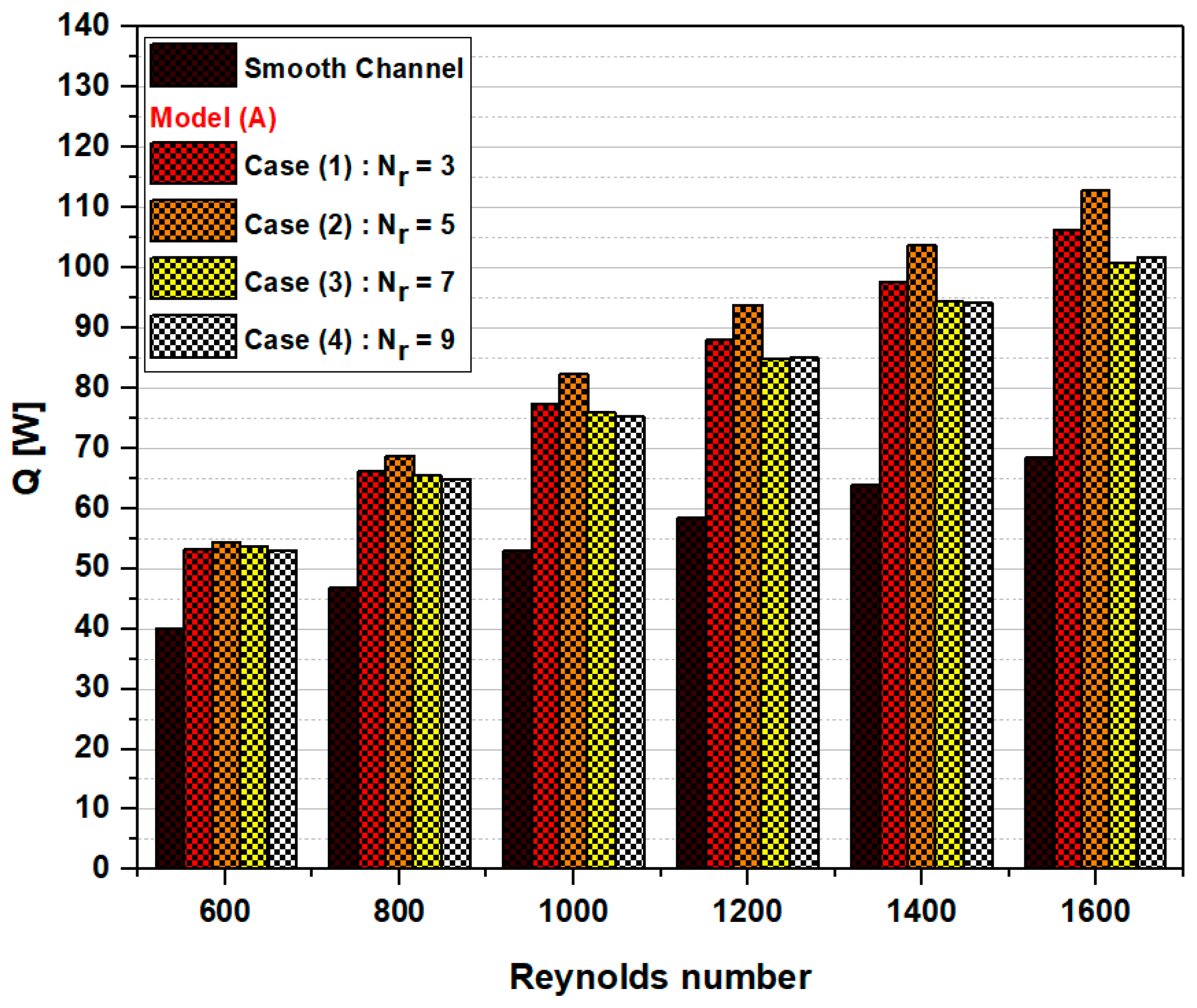
Figure 12 summarizes the change in heat flux (Q) with the Re number for smooth and ribbed channels (Nr = 3, 5, 7, 9). The findings indicate an apparent increase in heat flux with increasing Re, suggesting stronger convective transport at higher flow rates. The smooth channel gives Q = 40.20 W at Re = 600, and at Nr = 5, TW gives Q = 54.40 W (an enhancement of around 35.4%). The smooth channel is at Re = 1600 with Q = 68.54 W, and the ribbed channel is at Re = 1600 with Q = 112.88 W (an enhancement of around 64.7%), demonstrating the significant thermal advantage of rib inclusion. This is attributed to secondary flows generated by the downstream ribs, which disturb the thermal boundary layer, enhance fluid mixing, and elevate the convective heat transfer coefficient.
Still, at Nr > 5, the trend indicates saturation of thermal performance. Despite the heat flux still increasing at Nr = 7 and Nr = 9, the relative gain is insignificant compared to Nr = 5. This is a drawback, since as the number of ribs exceeds a certain point, the hydraulic resistance increases and local recirculation zones form, preventing effective heat exchange even with more intense secondary flows. In general, the discussion shows that Nr = 5 is the best compromise between vortex generation and flow resistance. This design yields the best thermal gain without adding excessive pressure loss, but above a certain rib density, the returns to thermal gain diminish, and thus the net energy output of the TW is lower.
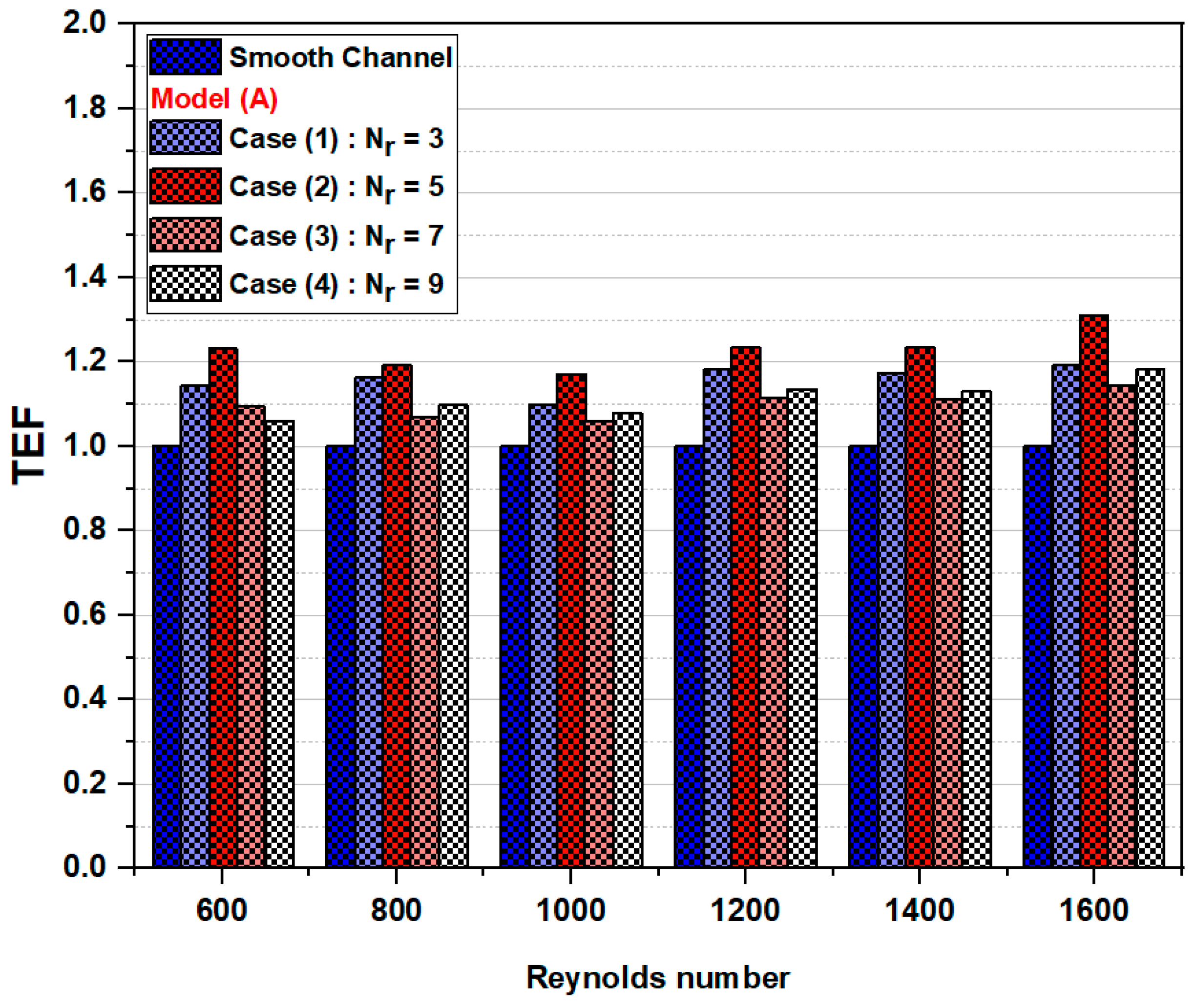
Figure 13 shows how the TEF varies with the Re number in the case of smooth channel and ribbed channel (Nr = 3, 5, 7, 9). The parameter quantifies thermo-hydrodynamic effectiveness by expressing the ratio of the heat-exchange enhancement to the associated increase in pressure losses (Equation (12)). The findings reveal that the TEF values are always greater than 1 for all ribbed geometries, indicating that adding ribs to the geometry improves overall performance compared to the smooth channel. At Re = 600, the smooth channel is at the baseline with TEF = 1.0, and Nr = 5 with TEF = 1.233 (about 23.3% improvement). The enhancement factor also increases gradually with Re, reaching a maximum of TEF = 1.314 (31.4% improvement) at Re = 1600, when Nr = 5. Such an observation shows that Nr = 5 is the most efficient within the range of the investigated studies because it produces vigorous secondary flows and effective interaction between the walls and the fluid without causing prohibitive hydraulic losses.
Those with increased rib densities, however, reduce thermal gains due to excessive pressure drops. TEF levels off to 1.148 (14.8% improvement) Nr = 7, and 1.182 (18.2% improvement) Nr = 9 at Re = 1600, indicating that the extra vortex generated by the additional ribs is not large enough to overcome the great increase in aerodynamic resistance. This means that thermal performance saturation has occurred. Overall, the Nr = 5 has the best balance between enhancing heat transfer and resisting flow. Settings Nr = 7 and Nr = 9 show slight thermal gains at the expense of increased pressure losses, resulting in low overall energy efficiency. The TEF thus demonstrates the importance of maximizing rib density to achieve the best thermo-hydrodynamic performance in TW systems.

3.2. Effect of Rib Design

Once the best rib density (Nr = 5) has been identified from the previous section (Section 3.1), it becomes essential to examine how the rib design and geometry itself affect the thermo-hydrodynamic performance of the TW. Rib shape governs vortical structure, vortex generation, flow redirection, and overall mixing efficiency, making it a key parameter in thermal enhancement. In this section, four rib configurations (Models A–D) are compared under identical operating conditions and within the Re number range of 600–1600. The detailed geometrical forms, including rectangular ribs (Model A), semi-circular ribs (Model B), crossed semi-circular ribs (Model C), and spaced semi-circular ribs (Model D), are shown in Figure 3 and Figure 4.
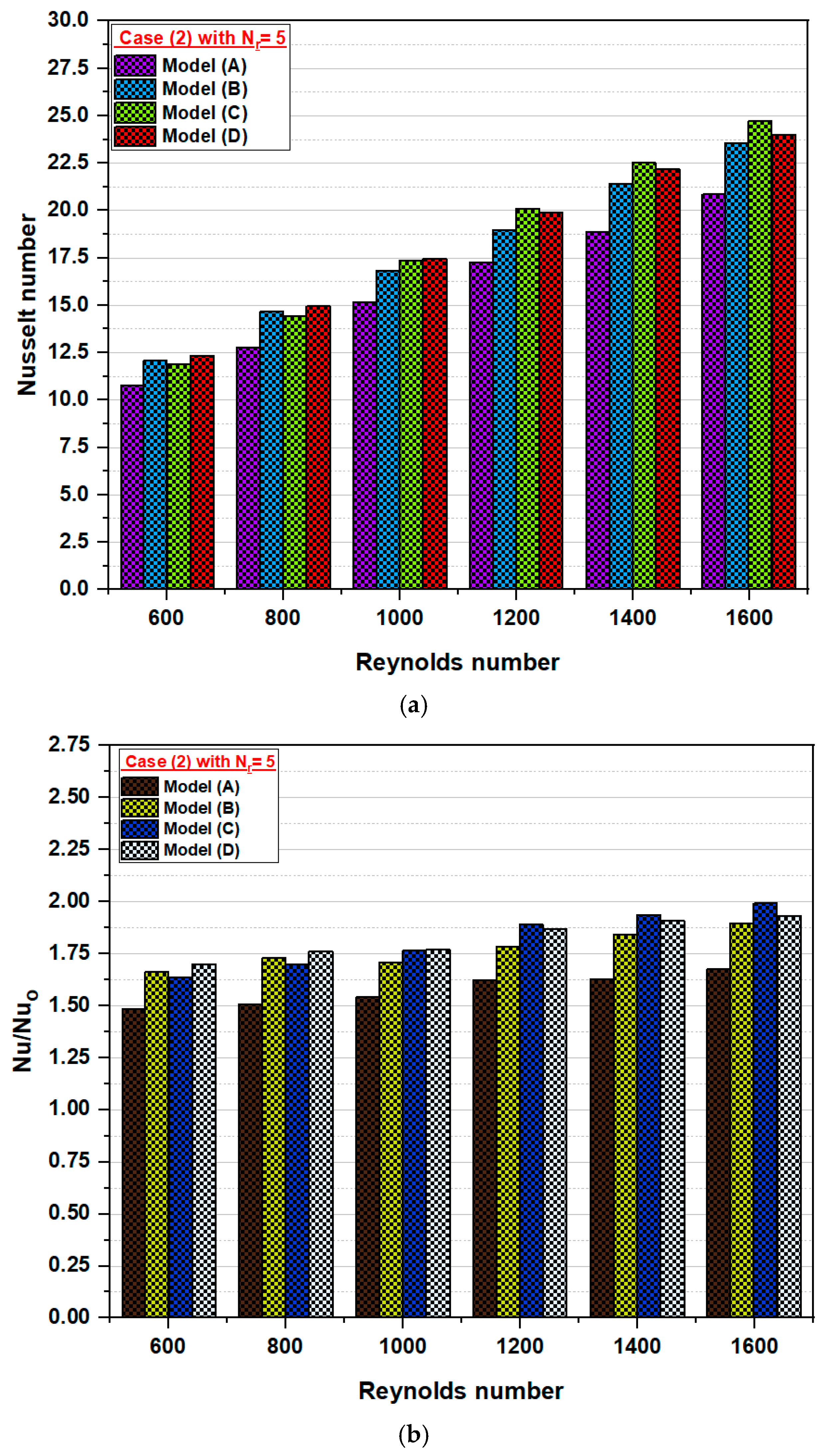
Figure 14 shows that the development of the average Nu number when using ribs of different geometry (Models A–D) is significantly affected by the rib geometry. As shown in Figure 14a, heat transfer is systematically improved with increasing Re number across all investigated configurations, due to stronger inertial forces and thinner boundary layers. At Re = 600, the smooth channel gives Nu0 = 7.26, and Models A–D give 10.79, 12.09, 11.90, and 12.35, respectively, representing improvements of 48.7%, 66.6%, 63.9%, and 70.2%, respectively. At Re = 1600, the smooth channel has Nu0 = 12.41, and four models have average Nusselt numbers of 20.88, 23.59, 24.75, and 24.04, representing improvements of 68.25%, 90.0%, 99.4%, and 93.9%, respectively.
According to Figure 14b, the ratio of Nu/Nu0 at Re = 600 is 1.49 for Model A (49% improvement), 1.67 for Model B (67% improvement), 1.64 for Model C (64% improvement), and 1.70 for Model D (70% improvement), which means that Models B and D create more productive secondary flows. The trend continues to increase at Re = 1600, with ratios of 1.68 (A, 68% improvement), 1.90 (B, 90% improvement), 1.99 (C, 99% improvement), and 1.94 (D, 94% improvement). Physically, these enhancements result from variations in flow disturbance and recirculation induced by the rib geometry. Model A, with simple rectangular ribs, offers minimal enhancement. Model B facilitates easier redirection of the flow, enhancing mixing and justifying its better performance over Model A. Model C, with crossed semi-circular ribs, produces the strongest secondary flows and secondary vortices, resulting in the highest heat transfer (about 99% improvement at Re = 1600). Model D is spaced with ribs and can be easily mixed with a relatively low secondary flow intensity, which is why it performs best, and suggests that the hydrodynamic penalties will also be reduced. To conclude, the analysis has determined that Model C is the most thermally efficient, with Model D just behind and offering a superior overall trade-off, taking into account hydrodynamic constraints.
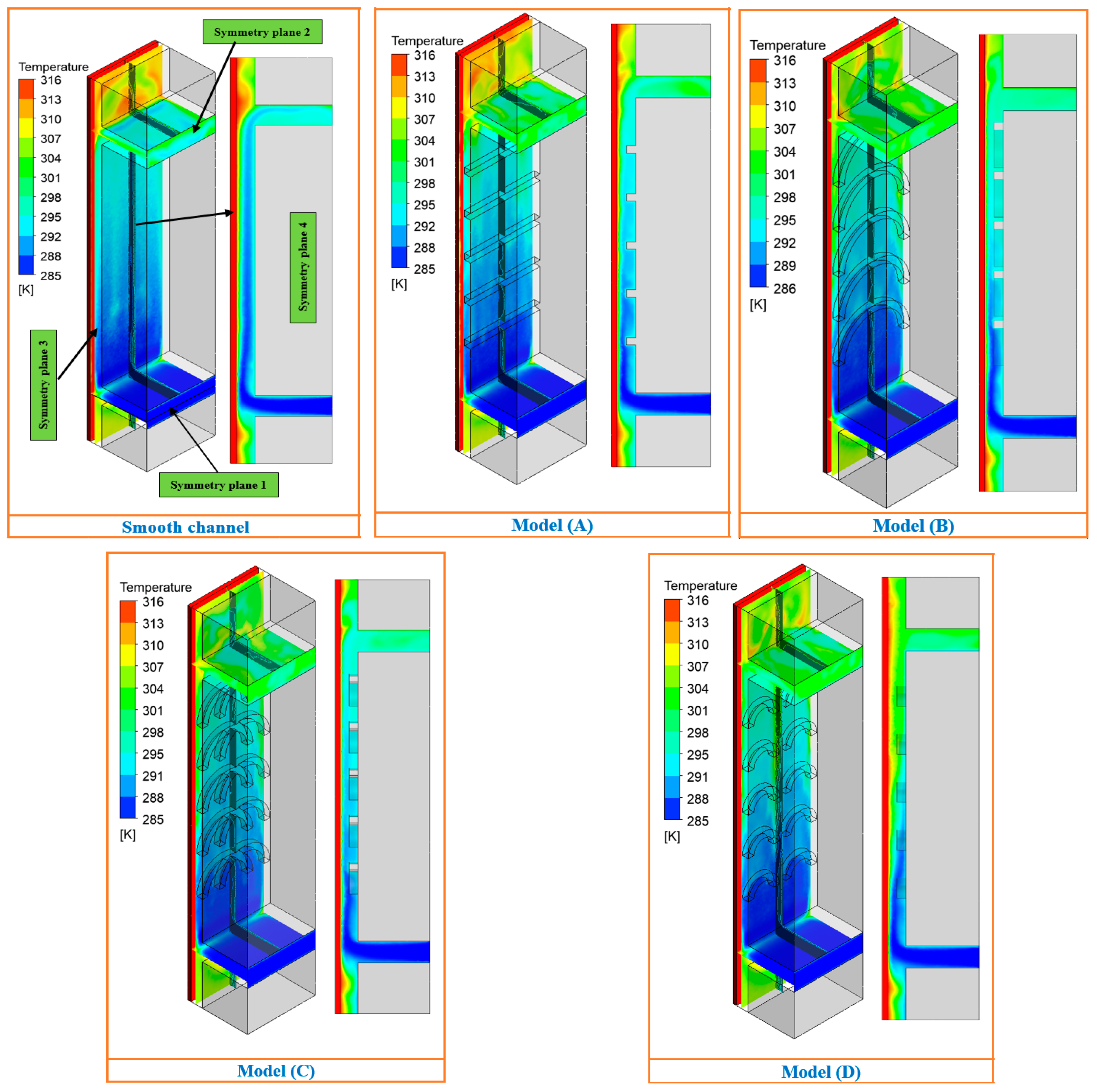
Figure 15 shows the temperature distributions in the TW, considering the smooth-channel (without ribs) and the four ribbed system (Models A–D). The smooth-channel thermal distribution exhibits vertical stratification, low wall–fluid interaction, and poor thermal mixing, thereby limiting overall heat transfer. The ribbed configurations, on the other hand, show a steady increase in thermal homogenization. The action of the ribs creates recirculating areas and secondary flows, thereby increasing fluid mixing and convective heat transfer between the circulating air and the absorber wall.
Simple rectangular ribs start with model A, which creates a more uniform temperature distribution (compared to the smooth-channel). Further on, the addition of semi-circular ribs to Model B increases mixing, thereby increasing the perturbation of the boundary layer and the transfer of heat to the wall. In models C and D, where the semi-circular geometry is crossed and spaced, the distributions are the most desirable: the temperature field is less stratified, and heat penetration through the TW’s channel is improved. This shows that the two geometries are especially appropriate at facilitating secondary flows and increasing the transfer of stored solar energy to the airflow. In general, the temperature-curve visual analysis shows that the addition of ribs can dramatically enhance the thermal efficiency of the TW by promoting improved secondary flows, enhanced mixing, and homogeneous temperature distributions in the channel.
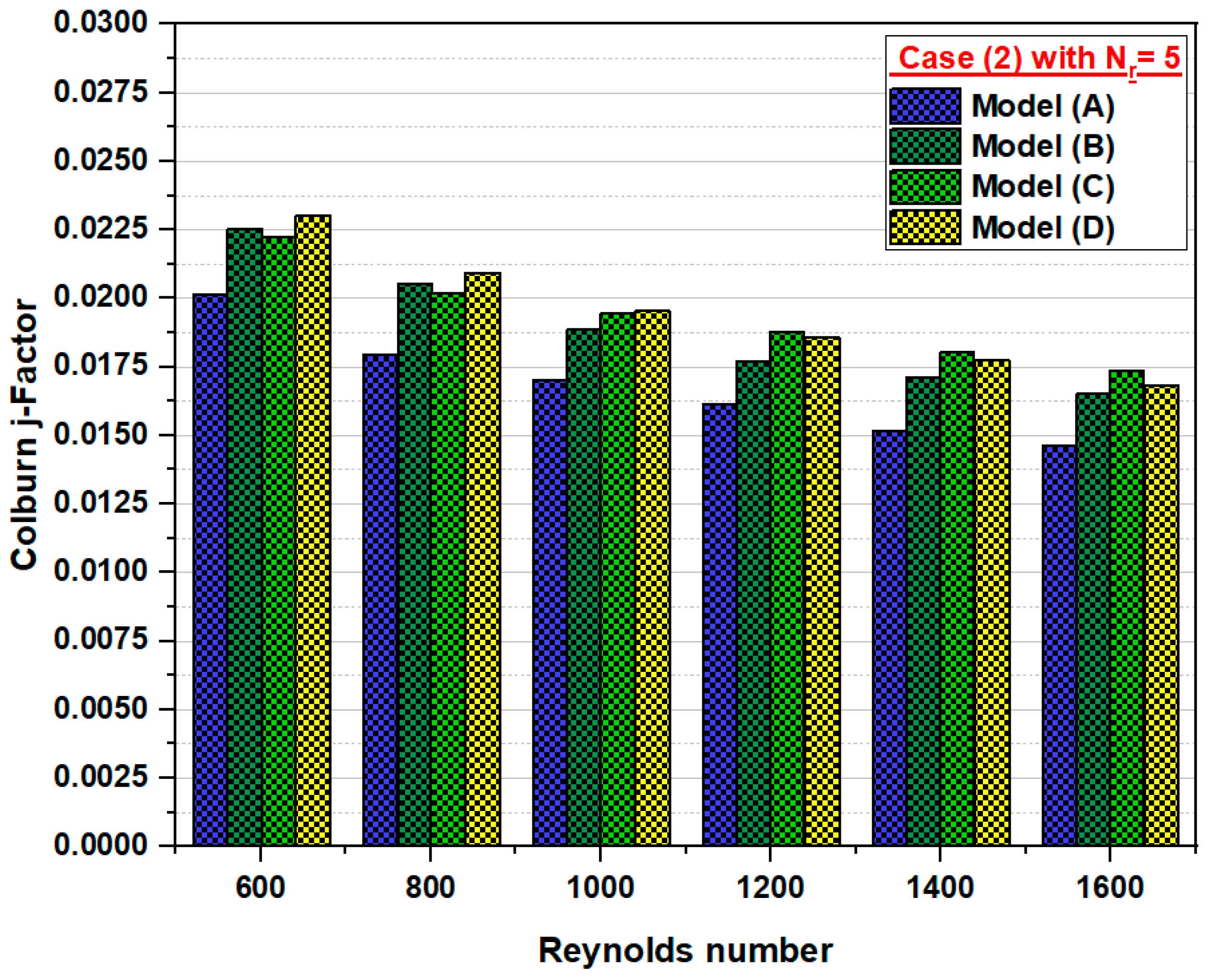
Figure 16 shows the Colburn factor (j) in the various rib geometries (Models A–D) in comparison with the smooth-channel. Being a non-dimensional number, j defines the efficiency of convective heat transfer and accounts for the effects of flow regimes. The increase in the Colburn factor implies that the vortex-producing forces are stronger, the wall–fluid interaction is greater, and hence the thermal performance is better.
The findings demonstrate that j decreases as the Re number increases and agree with the classical heat transfer theory: the higher the Reynolds number, the stronger the inertial effects are, and the smaller the proportion of mixing caused by secondary flows to thermal enrichment. Model A value at Re = 600 is j = 0.02017, whereas Model B–D have the values 0.02258, 0.02223, and 0.02308, representing an improvement of 11.94% (B), 10.2% (C), and 14.4% (D) over Model A. Re = 1600 the trend is similar, with j = 0.01463 Model A, j = 0.01653 (13.0% improvement for Model B over Model A), j = 0.01735 (18.6% improvement for Model C over Model A), and j = 0.01684 (15.1% improvement for Model D over Model A).
In comparison, Model A performs the least well because its rectangular ribs cause minimal disturbance to the boundary layer. Model B, which has semi-circular ribs, is more effective at mixing, although Model D is even better because the spacing of the semi-circular ribs is enhanced. Nevertheless, Model C performs best, producing intense secondary vortices and stronger recirculation, and optimizing convective heat transfer, with the highest gain of 18.6% at Re = 1600.
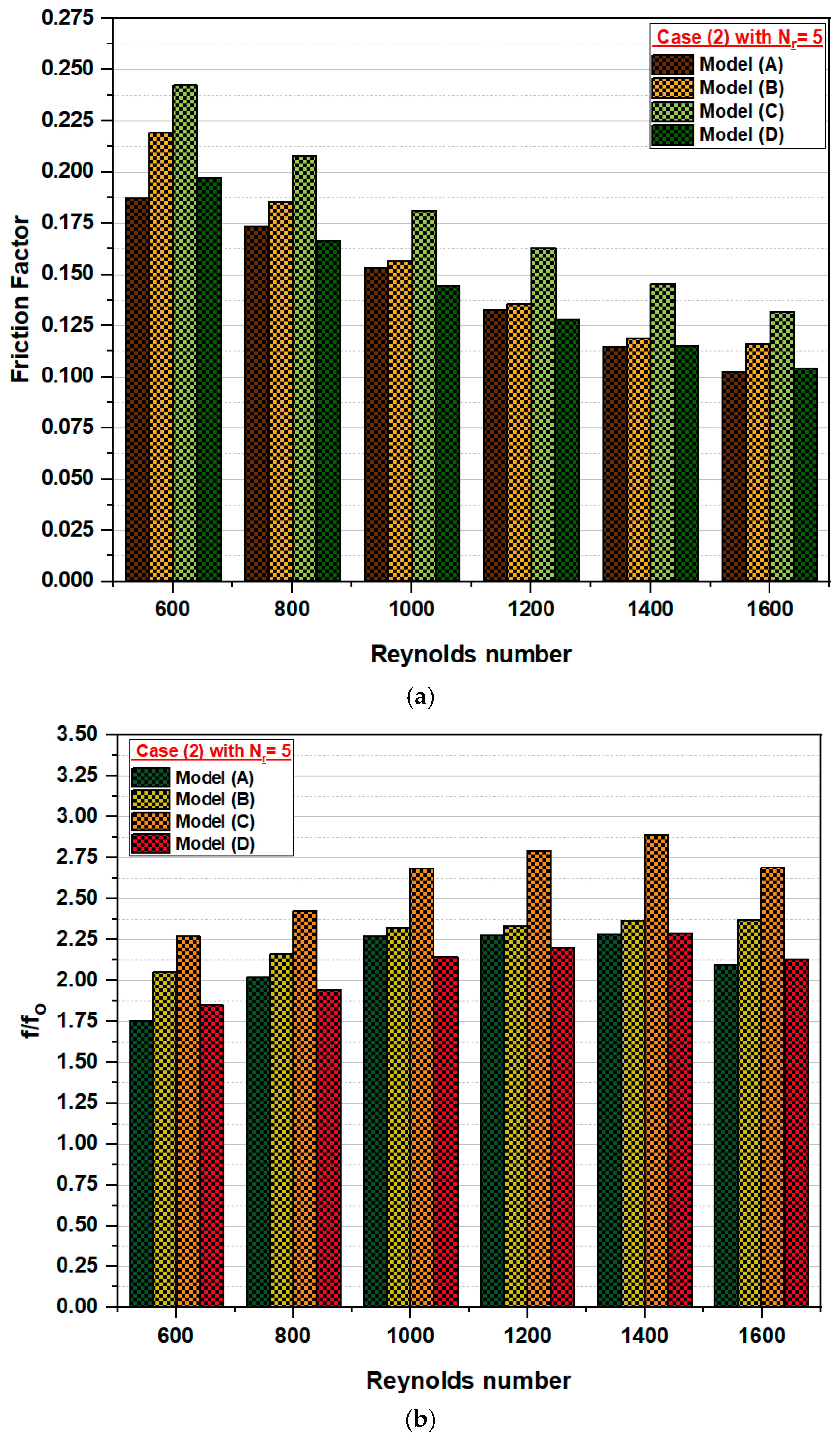
Figure 17a,b shows the change in the friction factor (f) and its normalized ratio (f/f0) for various rib geometries (Models A–D) and the smooth channel. These parameters are vital for determining the hydrodynamic penalties imposed by obstacles, which directly affect the TW system’s energy consumption efficiency. The numerical evidence demonstrates that f decreases as the Re number increases, a classical tendency in secondary flows in which viscous forces become less prominent relative to inertial forces. However, when ribs are introduced, the value of f increases significantly as compared to the smooth-channel case. At Re = 600, the smooth-channel gives f0 = 0.1067, whereas Models A, B, C, and D give 0.1871, 0.2195, 0.2427, and 0.1971, respectively, yielding improvements of 75.4% (A), 105.8% (B), 127.5% (C), and 84.8% (D), respectively. The same tendency can be observed at Re = 1600: f0 = 0.0489 in the smooth-channel and maximum improvement of about 137.7% for Model C.
These effects are better compared by using the normalized ratio f/f0. At Re = 600, Models A–D have ratios of 1.75, 2.05, 2.27, and 1.85, respectively, indicating that Model C produces the greatest pressure losses. Models A–D yield ratios of 2.10, 2.38, 2.69, and 2.13 at Re = 1600, respectively. These findings suggest that the absolute value of f decreases with Re, but the penalty imposed by the ribs remains high, with values of f/f0 leveling off at high Reynolds numbers.
The comparative analysis emphasizes the power of rib geometry. Model A produces the least pressure losses and the least effective thermal enhancement. Model B results in more resistance but offers moderate heat transfer gains. Model C maximizes thermal enhancement at the expense of the maximum hydrodynamic penalty, as evidenced by the highest f/f0 = 2.69 at Re = 1600. Model D provides a good compromise: it is not as thermally efficient as Model C, but it better restricts pressure losses, implying better flow redirection and fewer stagnation regions.
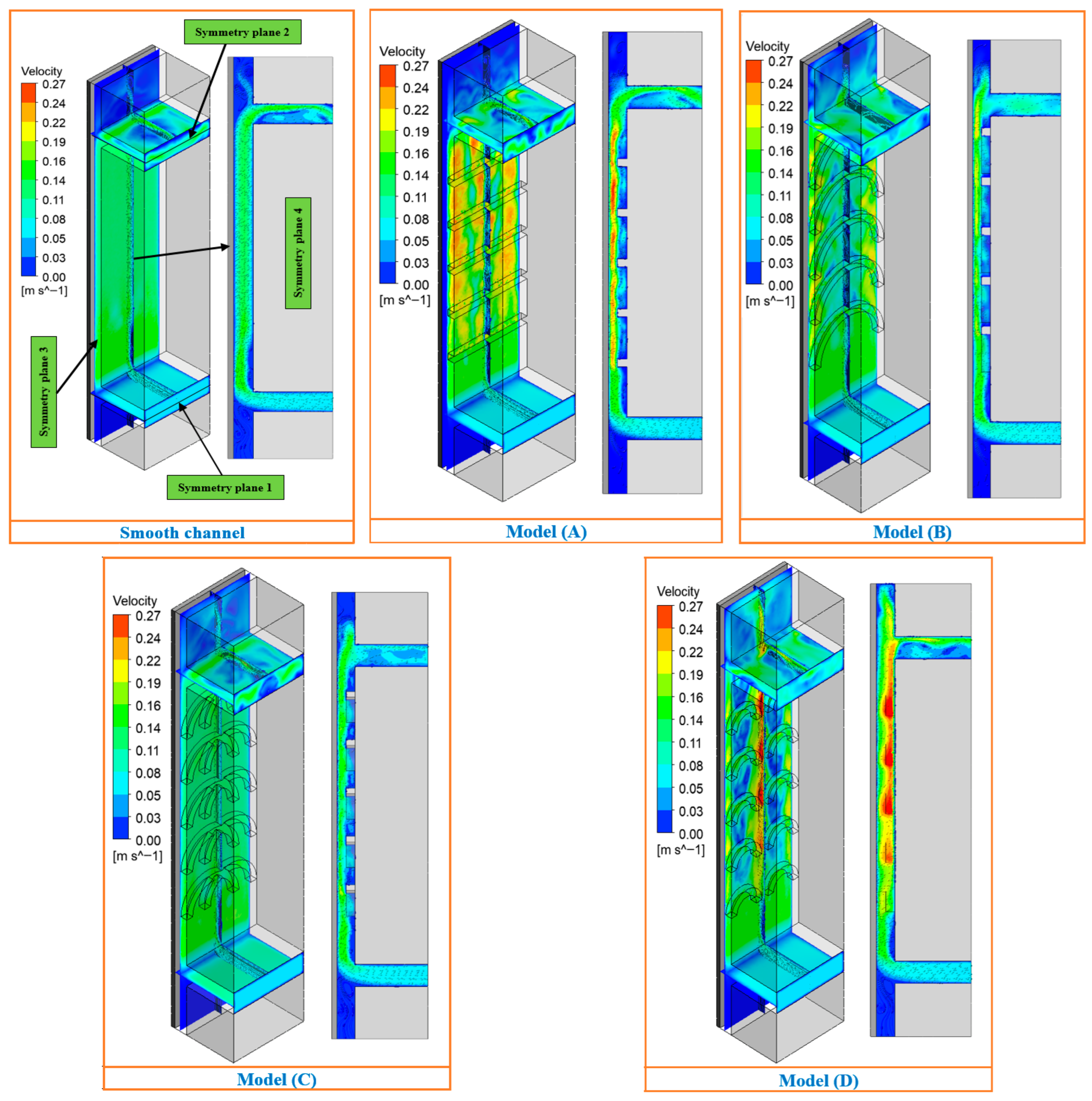
The velocity distribution in the TW of the smooth-channel and the ribbed design (Models A–D) is shown in Figure 18. The contours (low velocity in blue, high velocity in red) provide a qualitative evaluation of the flow dynamics and highlight the ribs’ contribution to altering the fluid flow. The flow in the smooth channel is relatively unperturbed, with limited acceleration near the walls and no significant recirculation. The result of this quasi-laminar profile is poor wall–fluid interaction and subsequent poor convective heat transfer. In comparison, the flow structure is considerably changed when ribs are added. The ribs’ hindrance creates shear layers and vortices, increasing secondary flows and promoting better mixing, thereby enhancing heat transfer.
The rectangular ribbed Model A produces localized velocity gradients and small recirculation regions, and offers a modest enhancement over the smooth-channel. Model B has a higher secondary flow intensity, with semi-circular ribs, and separate vortices were generated downstream of each rib. Models C and D, which use crossed and spaced semi-circular geometries, have the most desirable flow patterns. Model C generates a strong vortex and long recirculation zones, maximizing contact between the walls and the fluid. Though with slightly less secondary flows, Model D spreads the high-velocity regions more evenly throughout the TW’s channel, thereby reducing stagnation zones and increasing the overall flow homogeneity. This comparison analysis shows that rib geometry is highly decisive in determining flow dynamics. As Model C maximizes secondary flows intensity, Model D is more balanced in its velocity distribution, which implies it is better managed in hydrodynamics. Combined, these findings prove that Models C and D offer the most efficient improvements in fluid mixing and convective heat transfer.
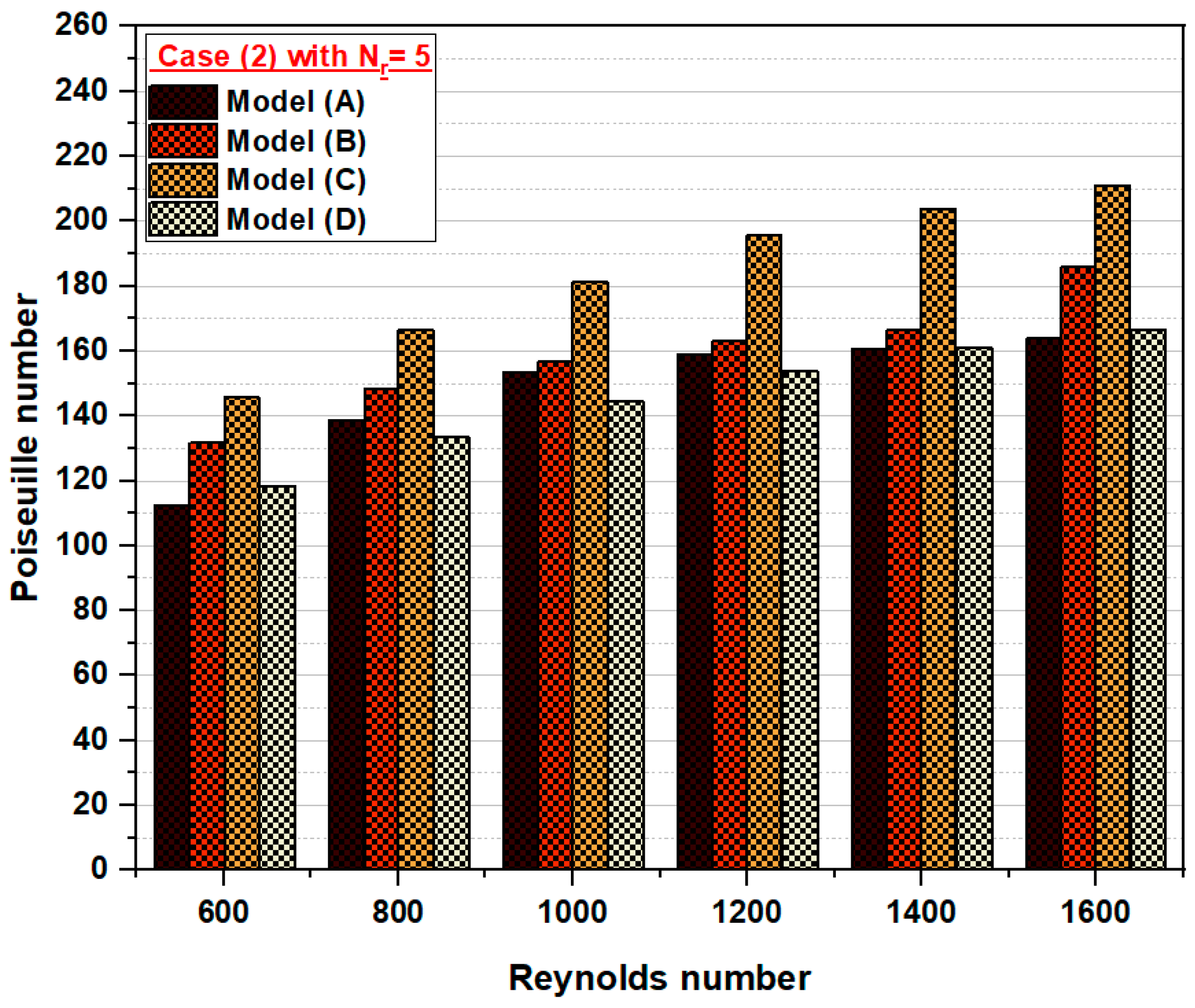
The variation in the Poiseuille number (Po) of various rib geometries (Models A–D) versus the Re number is shown in Figure 19. It is a product of the friction factor and the Re number (Po = f × Re), which is particularly important for evaluating the development of pressure losses and measuring the hydraulic resistance of a given configuration. These findings indicate that Po decreases with Re, which is common in secondary flows, where the viscous effects gradually decrease relative to the inertial effects. The values of Po at Re = 600 are then 112.29, 131.70, 145.62, and 118.26 in Models A–D, respectively, or increases of 17.3% (B), 29.7% (C), and 5.3% (D) to Model A. At Re = 1600, the same trend is also important: Model A is Po = 163.98, whereas Models B–D are 185.85 (13.3% over Model A), 210.71 (28.5% over Model A), and 166.31 (1.4 over Model A), respectively.
Comparatively, Model C shows the highest pressure losses across all Reynolds numbers, with the highest pressure loss, Po = 210.71, at Re = 1600. This is caused by highly secondary flows and vortex generation from its crossed semi-circular ribs, which, although effective for heat transfer, add significant hydraulic resistance. In Model D, however, the increase in Po is significantly less, and the values it attains are similar to those of the basement Model A. This implies better flow control, with a more uniform velocity distribution and fewer stagnation regions. Model B exhibits intermediate behavior, and Model A has the least pressure losses; however, it has poor thermal enhancement.
The main trade-off between thermal performance and hydraulic feasibility is evident in these results. Although it is most effective at maximizing heat transfer and secondary flows in Model C, its pressure penalties are a deterrent to global energy efficiency. Model D offers the best trade-off, providing large gains in heat transfer while accounting for pressure loss in the control, but it is slightly less thermally efficient; the trade-off is therefore the most feasible for the design of a TW.
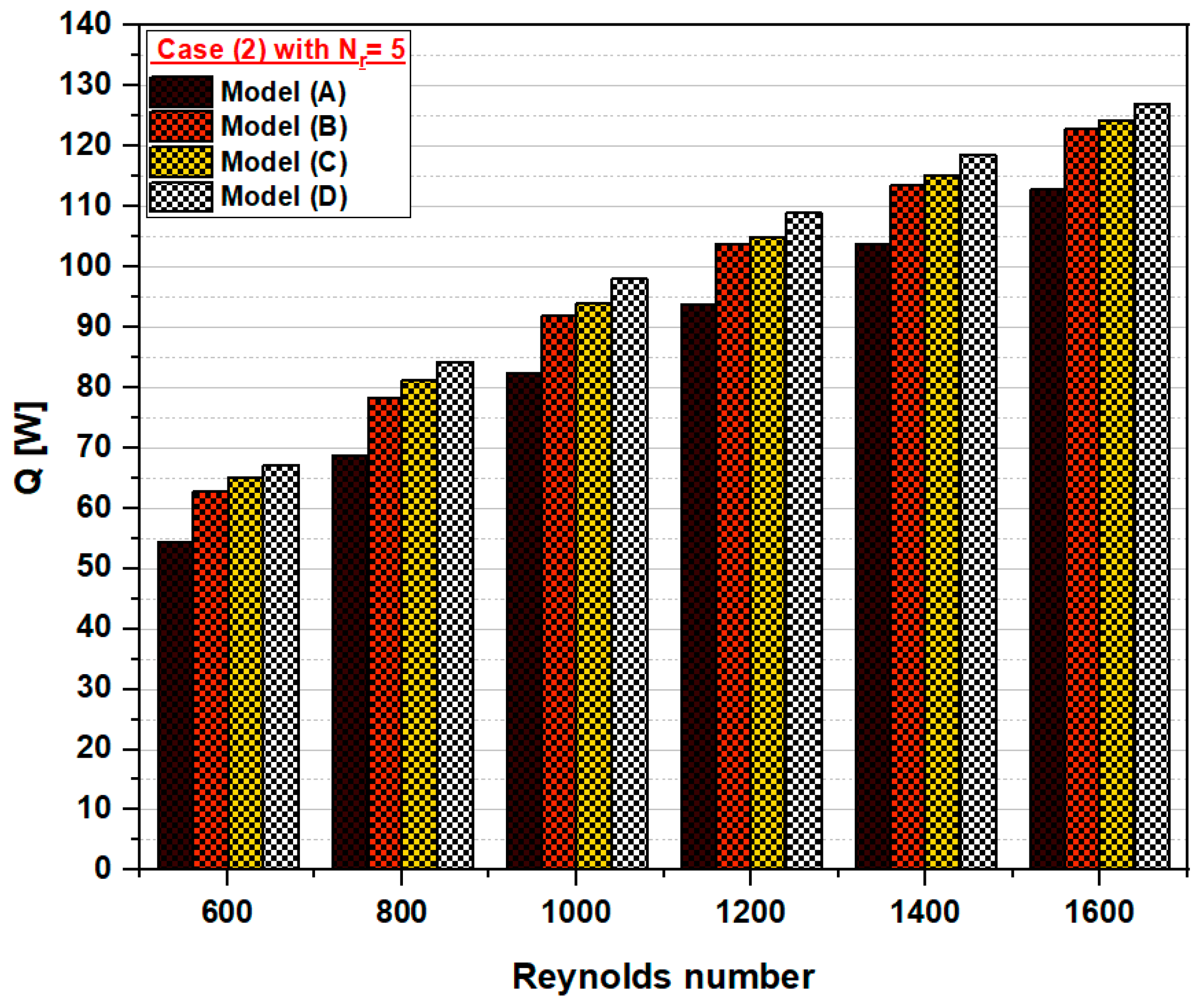
Figure 20 shows the change in heat flux (Q) versus Re number among the four ribbed structures (Models A–D). This parameter is a major indicator of the thermal efficiency of the TW, as it directly measures the rate at which absorbed solar energy is converted into flowing air. The findings support the idea that Q scales with Re, indicating increased secondary flows and stronger convective transport in high-Re conditions. Re = 600 shows a flux of 54.40 W in Model A, 62.69 W in Model B, 65.03 W in Model C, and 67.15 W in Model D, representing improvements of 15.2% (B), 19.5% (C), and 23.5% (D) over Model A. The corresponding values of A–D are 112.89 W, 122.81 W, 124.52 W, and 127.24 W, respectively, at Re = 1600, and reflect gains in thermal power of 8.8% (B), 10.3% (C), and 12.7% (D).
The development of the Q through the models indicates that Model D has the highest heat flux of 127.24 W at Re = 1600 (a 12.7% improvement over Model A). This is because its semi-circular geometry spacing improves mixing and does not affect the efficient redirection of the flow, thus maximizing the wall–fluid interaction. Next in line, and closely related (a 10.3% improvement over Model A), is Model C, which features crossed semi-circular ribs, benefiting from intense secondary flows but also carrying the risk of higher hydraulic penalties. Although Model C has very high heat transfer, Model D performs best in terms of Q, indicating that the geometry may be the most desirable for the interaction between vortex generation and flow homogeneity. However, Figure 19 shows that Poiseuille number analysis does not fully assess energy efficiency, as pressure losses should also be accounted for to prevent thermal advantages from being offset by high hydrodynamic costs.
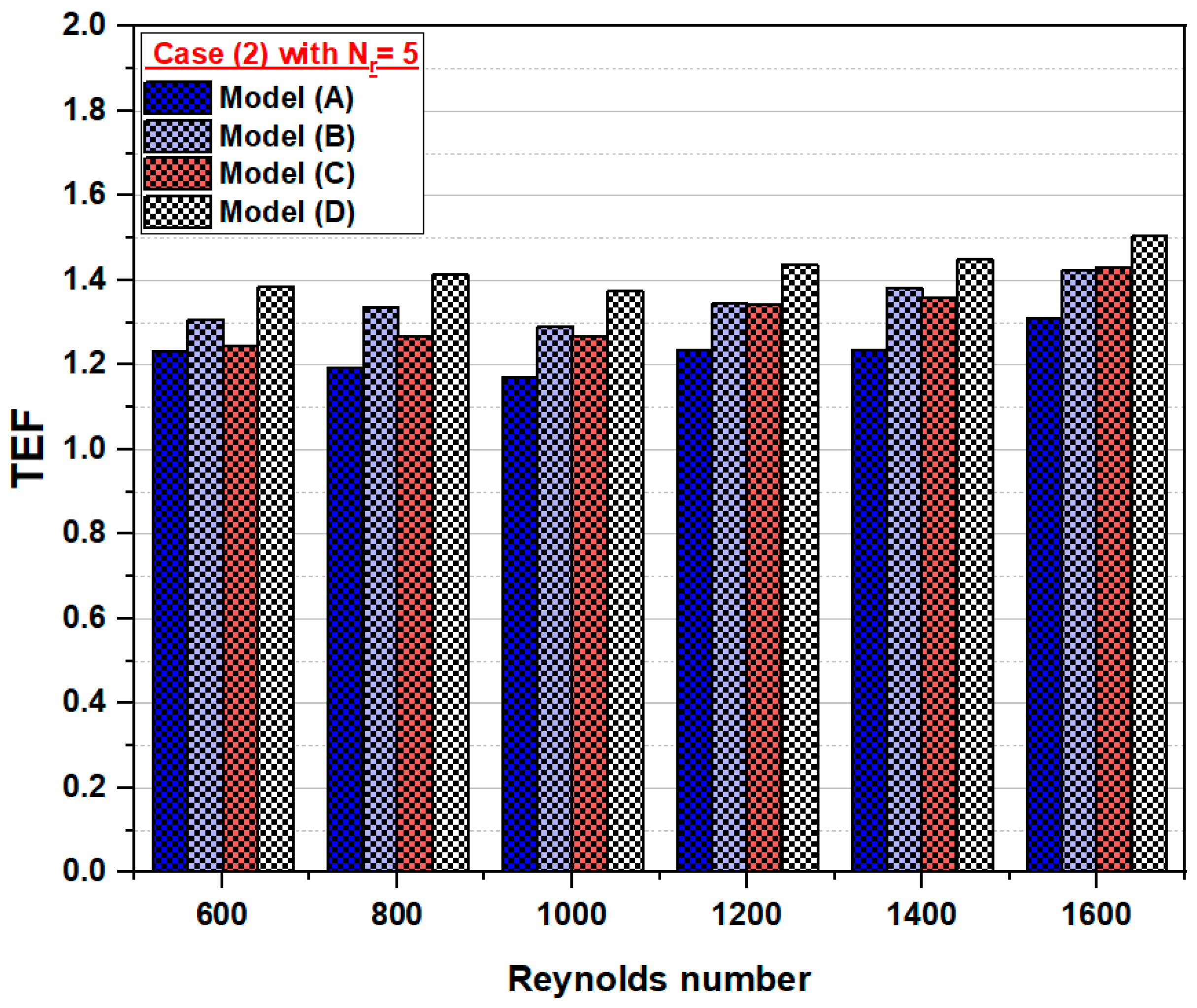
As shown in Figure 21, the TEF of different rib shapes (Models A–D) varies with Reynolds number, with the smooth-channel serving as the reference (TEF0 = 1). The parameter is particularly beneficial because it balances the advantages of intensified heat transfer with the drawbacks of pressure loss, making it a reliable indicator of which setup is the most energy-saving. The findings show that ribbed geometries produce TEF exceeding 1, indicating a global enhancement compared to the smooth channel. At Re = 600, the values of Models A–D are 1.23, 1.31, 1.25, and 1.39, respectively, and correspond to the improvements of 23.3%, 30.9%, 24.7%, and 38.7%, respectively. The trend is even more pronounced at Re = 1600: Model A demonstrates a 31.4% improvement, whereas models B–D show 42.4%, 43.3%, and 50.6% improvements, respectively.
Compared to the other cases, Model D performs well across all Reynolds numbers. It has spaced semi-circular ribs that ensure strong secondary flows and decent wall–fluid interaction, and it does not incur excessive hydraulic penalties; hence, the highest TEF = 1.51 at Re = 1600. Model C is next, with a TEF of 1.43 (43.3% improvement), which offers high secondary flows but at the cost of increased flow resistance. Model B is intermediate in performance, whereas the previous Model A, though better than the smooth-channel, is the least efficient.
In general, these results show that the thermo-hydrodynamic performance of TW systems depends heavily on the rib geometry. Because convective heat transfer in Model C is as large as possible, the hydraulic penalties reduce its relative benefit. Model D, on the other hand, offers the highest TEF, which is why it is the most desirable setup for power consumption efficiency.

4. Conclusions

This study numerically investigated the thermo-hydrodynamic behavior of a TW equipped with ribs using a three-dimensional CFD model, providing a detailed view of the interactions among fluid flow, vortex structures, and heat transfer. The influence of the number of ribs (Nr = 3, 5, 7, 9) and the effectiveness of different rib geometries (Models A–D) were systematically analyzed to optimize the system’s thermal performance. The main findings are as follows:
  • Increasing the number of ribs enhances heat transfer up to Nr = 5, beyond which the thermal gains become marginal. At Re = 600, the average Nu number increases from 7.26 for the smooth-channel to 8.98 (+23.7%) for Nr = 3, 10.79 (+48.7%) for Nr = 5, 10.96 (+50.9%) for Nr = 7, and 11.04 (+52.1%) for Nr = 9. At Re = 1600, Nu rises from 12.41 (smooth-channel) to 14.73 (+18.8%) for Nr = 3, 20.88 (+68.2%) for Nr = 5, 18.13 (+46.1%) for Nr = 7, and 18.60 (+50.0%) for Nr = 9.
  • The friction factor (f) increases with the number of ribs, confirming greater hydrodynamic losses. At Re = 600, f rises from 0.1067 (smooth-channel) to 0.1482 (+38.8%) for Nr = 3, 0.1871 (+75.4%) for Nr = 5, 0.2005 (+87.9%) for Nr = 7, and 0.2154 (+102.2%) for Nr = 9. At Re = 1600, f increases from 0.0489 (smooth-channel) to 0.0656 (+34.1%) for Nr = 3, 0.1025 (+110.0%) for Nr = 5, 0.1075 (+120.0%) for Nr = 7, and 0.1100 (+125.0%) for Nr = 9.
  • Nr = 5 is confirmed as the optimal rib density, providing the best compromise between thermal performance and pressure drop.
  • Regarding geometry, Model C achieves the maximum heat transfer, reaching Nu = 24.75 at Re = 1600 (+99.4%) but also induces the highest hydrodynamic penalties (f = 0.1317, +169.4%; Po = 210.71).
  • Model D offers the most balanced configuration, with TEF = 1.51 (+50.6%), Q = 127.24 W (+12.7%), and Po = 166.31, ensuring strong heat transfer while minimizing flow resistance.
  • Based on the results of the present work, the study recommends Model D with spaced semi-circular ribs and Nr = 5 as the improved rib design for TW systems, as it provides the best trade-off between thermal enhancement and hydrodynamic feasibility.
  • Limitations: The current study is restricted to steady-state 3D CFD simulations over a relatively small range of Reynolds numbers (Re = 600–1600). The factors taken as constant were material properties, and the model lacked consideration of the sun’s temporary radiation, seasonal effects, and experimental checks. Additionally, the wall and glazing surfaces were supposed to be perfectly smooth and non-degrading. As a matter of fact, dust deposition, surface roughness, material aging, and coating corrosion may decrease solar absorptivity, modify convective heat transfer, and impair long-term performance.
Numerous geometric dimensions exist in each model to examine their precise influence on the thermal and hydrodynamic performance of the TW system. Future investigations should focus on (i) developing innovative rib shapes using optimization techniques such as genetic algorithms and machine learning, (ii) integrating phase change materials (PCM) into TWs to combine heat transfer enhancement with thermal storage capacity, (iii) extending the analysis to higher Reynolds numbers and transient conditions, and (iv) conducting experimental validation to confirm the numerical predictions. Such approaches will further improve the energy efficiency of TW systems and enhance their applicability in sustainable building design. While the present work focused on steady-state thermo-hydrodynamic optimization, the results indicate that the improved configuration (Model D with spaced semi-circular ribs) can achieve a 12.7% increase in heat flux and a 50.6% growth in the thermal enhancement factor (TEF = 1.51). These improvements strongly suggest the potential for significant seasonal and annual energy savings when integrated into real buildings. Future work will therefore extend the analysis to transient simulations under realistic climatic conditions to quantify the actual energy savings achievable at the building scale.

Author Contributions

Conceptualization, J.-E.S., T.Z., M.S., M.B. and S.S.M.A.; methodology, J.-E.S., T.Z., M.S., M.B. and S.S.M.A.; software, J.-E.S. validation, J.-E.S.; formal analysis, J.-E.S.; investigation, J.-E.S.; data curation, J.-E.S.; writing—original draft preparation, J.-E.S.; writing—review and editing, J.-E.S., T.Z., M.S., M.B. and S.S.M.A.; visualization. J.-E.S.; supervision, T.Z., M.S., M.B. and S.S.M.A.; resources, S.S.M.A.; project administration, S.S.M.A. All authors have read and agreed to the published version of the manuscript.

Funding

This research received no external funding.

Data Availability Statement

The original contributions presented in this study are included in the article. Further inquiries can be directed to the corresponding authors.

Conflicts of Interest

The authors declare no conflicts of interest.

Nomenclature

Latin SymbolsDescriptionUnit
CpSpecific heat capacity J·kg−1·K−1
e1, e2, e3Thicknesses of different layersm
HHeight of the TWm
hConvective heat transfer coefficient W·m−2·K−1
h1, h2Heights of the inlet and outlet openingsm
LLength of the TWm
L1, L2, L3, L4Characteristic lengthsm
PPressure Pa
QHeat flux W
TTemperature K
uVelocity component along the x-axism·s−1
vVelocity component along the y-axism·s−1
wVelocity component along the z-axism·s−1
WWidth of the TWm
Greek SymbolsDescriptionUnit
αThermal diffusivitym2·s−1
νKinematic viscositym2·s−1
ρDensitykg·m−3
kThermal conductivity W·m−1·K−1
μDynamic viscosityPa·s
Dimensionless ParametersDescription
fFriction factor
jColburn factor
NrNumber of internal ribs
NuNusselt number
PoPoiseuille number
PrPrandtl number
ReReynolds number
TFEThermal enhancement factor
Subscription
avgAverage
bBulk
hHydroulic
inInlet
outOutlet
R or rRib
wWall
0Reference configuration (without ribs)
Abbriviation
CFDComputational fluid dynamics
EAHEEarth–air heat exchanger
HVACHeating, ventilation, and air conditioning
PCMPhase change material
PVPhotovoltaic
TWTrombe wall

References

  1. European Commission. Disaggregated Final Energy Consumption in Households–Quantities. Available online: https://ec.europa.eu/eurostat/databrowser/view/NRG_D_HHQ__custom_2920041/bookmark/table?lang=en&bookmarkId=36e7b119-c46a-47b3-9c3d-aac3d44470d4 (accessed on 6 November 2025).
  2. Wang, Z.; Wang, J.; Yu, M.; Zhang, X.; Ma, Q.; Xiao, Y.; Wei, X.; Yuan, X. A Review of PCM Trombe Walls: Advances in Structural Optimization, Material Selection, and Operational Strategies. Sustainability 2025, 17, 10123. [Google Scholar] [CrossRef]
  3. Fidaros, C.; Baxevanou, C.; Markousi, M.; Tsangrassoulis, A. Assessment of various Trombe wall geometries with CFD study. Int. J. Heat Technol. 2022, 43, 4877. [Google Scholar] [CrossRef]
  4. Agrawal, P.C. Review of passive systems and passive strategies for natural heating and cooling of buildings in Libya. Int. J. Energy Res. 1992, 16, 101–117. [Google Scholar] [CrossRef]
  5. Robbins, C.L. A review of the historical developments of the use of passive solar systems. In Solar Energy International Progress; Pergamon: Oxford, UK, 1980; pp. 939–959. [Google Scholar]
  6. Zalewski, L.; Lassue, S.; Duthoit, B.; Butez, M. Study of solar walls—Validating a simulation model. Build. Environ. 2002, 37, 109–121. [Google Scholar] [CrossRef]
  7. Ozbalta, T.G.; Kartal, S. Heat gain through Trombe wall using solar energy in a cold region of Turkey. Sci. Res. Essays 2010, 5, 2768–2778. [Google Scholar]
  8. Olenets, M.; Piotrowski, J.Z.; Stroy, A. Heat transfer and air movement in the ventilated air gap of passive solar heating systems. Energy Build. 2015, 103, 198–205. [Google Scholar] [CrossRef]
  9. Ji, J.; Luo, C.; Sun, W.; Yu, H.; He, W.; Pei, G. Application of Trombe wall system with selective thermo-insulation façades. Sci. Bull. 2009, 54, 1949–1956. [Google Scholar] [CrossRef]
  10. Soussi, M.; Balghouthi, M.; Guizani, A. Energy performance analysis of a solar-cooled building in Tunisia. Energy Build. 2013, 67, 374–386. [Google Scholar] [CrossRef]
  11. Du, L.; Ping, L.; Yongming, C. Study and analysis of air flow characteristics in Trombe wall. Renew. Energy 2020, 162, 234–241. [Google Scholar] [CrossRef]
  12. Liu, Y.; Wang, D.; Ma, C.; Liu, J. Numerical and experimental analysis of air vent management and heat storage in a Trombe wall. Sol. Energy 2013, 91, 1–10. [Google Scholar] [CrossRef]
  13. Yadav, A.S.; Alam, T.; Gupta, G.; Saxena, R.; Gupta, N.K.; Allamraju, K.V.; Kumar, R.; Sharma, N.; Sharma, A.; Pandey, U.; et al. A numerical investigation of an artificially roughened solar air heater. Energies 2022, 15, 8045. [Google Scholar] [CrossRef]
  14. Sodha, M.S.; Buddhi, D.; Sawhney, R.L. Optimization of pipe parameters of an underground air pipe cooling system. Energy Convers. Manag. 1993, 34, 465–470. [Google Scholar] [CrossRef]
  15. Ascione, F.; Bellia, L.; Minichiello, F. Earth-to-air heat exchangers for Italian climates. Renew. Energy 2011, 36, 2177–2188. [Google Scholar] [CrossRef]
  16. Alikhani, A.; Maerefat, M.; Sobhani, S.M.J. Analytical investigation on the optimal tube length of earth-to-air heat exchanger. Geothermics 2025, 127, 103250. [Google Scholar] [CrossRef]
  17. Chen, W.; Liu, W. Numerical analysis of heat transfer in a passive solar composite wall with porous absorber. Appl. Therm. Eng. 2008, 28, 1251–1258. [Google Scholar] [CrossRef]
  18. Bajc, T.; Todorović, M.N.; Svorcan, J. CFD analyses for passive house with Trombe wall. Energy Build. 2014, 98, 39–44. [Google Scholar] [CrossRef]
  19. Chow, T.T.; Lyu, Y. Numerical analysis of PCM heat exchanger in liquid-flow window. Appl. Therm. Eng. 2017, 125, 1218–1227. [Google Scholar] [CrossRef]
  20. Zhou, G.; Zhang, Y.; Wang, X.; Lin, K.; Xiao, W. An assessment of mixed type PCM-gypsum and shape-stabilized PCM plates in a building for passive solar heating. Sol. Energy 2007, 81, 1351–1360. [Google Scholar] [CrossRef]
  21. Koyunbaba, B.K.; Yilmaz, Z.; Ulgen, K. Energy modeling of BIPV Trombe wall system. Energy Build. 2013, 67, 680–688. [Google Scholar] [CrossRef]
  22. Vats, K.; Tiwari, G. Energy and exergy analysis of a semi-transparent PV/T system. Appl. Energy 2012, 96, 409–416. [Google Scholar] [CrossRef]
  23. Maleki Dastjerdi, S.; Ardehali, A.; Naseryar, F. Off-grid zero-energy building with hydrogen storage. Energy Technol. 2024, 12, 2300827. [Google Scholar] [CrossRef]
  24. Elghamry, R.; Hassan, H. Experimental investigation of heating and ventilation using Trombe wall. Sol. Energy 2020, 201, 63–74. [Google Scholar] [CrossRef]
  25. Lu, B.; Zhang, Y.; Sun, D.; Jing, X. Experimental investigation on thermal properties of paraffin/expanded graphite composite material for low temperature thermal energy storage. Renew. Energy 2021, 178, 669–678. [Google Scholar] [CrossRef]
  26. Gowreesunker, B.L.; Tassou, S.A. CFD performance prediction of PCM building boards. Build. Environ. 2013, 59, 612–625. [Google Scholar] [CrossRef][Green Version]
  27. Li, S.; Zhu, N.; Hu, P.; Lei, F.; Deng, R. Numerical study on thermal performance of PCM Trombe Wall. Energy Procedia 2019, 158, 2441–2447. [Google Scholar] [CrossRef]
  28. Zhu, N.; Lei, F.; Hu, P.; Xu, L.; Jiang, Z. Performance of PCM Trombe wall. Energy 2019, 187, 116001. [Google Scholar]
  29. Bourdeau, L.E. Study of two passive solar systems with PCM. In Proceedings of the 5th National Passive Solar Conference, Amherst, MA, USA, 19–26 October 1980. [Google Scholar]
  30. Zalewski, L.; Joulin, A.; Lassue, S.; Dutil, Y.; Rousse, D. Experimental study of small-scale solar wall with PCM. Sol. Energy 2012, 86, 208–219. [Google Scholar] [CrossRef]
  31. Li, S.; Ji, W.; Chen, H.; Chen, T.; Sun, J.; Liu, S. Curved corrugated Trombe wall with PCM. Energy Build. 2025, 327, 115095. [Google Scholar] [CrossRef]
  32. Friji, K.; Ghriss, O.; Bouabidi, A.; Cuce, E.; Rashid, F.L.; Ashour, A.M.; Kadhim, S.A. Thermal performance of Trombe wall with fins. Appl. Therm. Eng. 2025, 260, 127619. [Google Scholar] [CrossRef]
  33. Zhu, N.; Deng, R.; Hu, P.; Lei, F.; Xu, L.; Jiang, Z. Optimization of key factors in PCM Trombe wall. Energy 2021, 236, 121470. [Google Scholar] [CrossRef]
  34. Li, W.; Chen, W. PCM-encapsulated porous heat storage Trombe wall. Sol. Energy 2019, 188, 706–719. [Google Scholar] [CrossRef]
  35. Rivera, D.R.; Moraga, N.O. Single and dual PCM Trombe wall for indoor heating. J. Energy Storage 2024, 103, 114235. [Google Scholar] [CrossRef]
  36. Lin, Y.; Ji, J.; Zhou, F.; Ma, Y.; Luo, K.; Lu, X. Built-middle PV Trombe wall system. Energy Build. 2019, 200, 47–57. [Google Scholar] [CrossRef]
  37. Onishi, J.; Soeda, H.; Mizuno, M. Numerical study on a low energy architecture based upon distributed heat storage system. Renew. Energy 2001, 22, 61–66. [Google Scholar] [CrossRef]
  38. Cui, W.; Li, X.; Li, X.; Si, T.; Lu, L.; Ma, T.; Wang, Q. Thermal performance of modified melamine foam/graphene/paraffin wax composite phase change materials for solar-thermal energy conversion and storage. J. Clean. Prod. 2022, 367, 133031. [Google Scholar] [CrossRef]
  39. Fiorito, F. Trombe walls for lightweight buildings in temperate and hot climates. Exploring the use of phase-change materials for performances improvement. Energy Procedia 2012, 30, 1110–1119. [Google Scholar] [CrossRef]
  40. Cunha, S.; Leite, P.; Aguiar, J. Mortars with direct PCM incorporation. J. Energy Storage 2020, 30, 101439. [Google Scholar] [CrossRef]
  41. Alaoui, A.L.; Amrani, A.I.; Salhi, J.E.; Amrani, S.; Merrouni, A.; Chaabelasri, E.; Boulerhcha, O.; Daoudia, A.; Hassouani, Y.; Halimi, M. Enhancing energy efficiency for buildings in hot-desert climate: CFD investigation of Trombe walls using several thermal fins configuration. Int. J. Thermofluids 2024, 22, 100642. [Google Scholar] [CrossRef]
  42. Eiamsa-ard, S.; Promvonge, P. Heat transfer in a tube with multiple twisted tape inserts. Int. Commun. Heat Mass Transf. 2010, 37, 737–743. [Google Scholar]
  43. Salhi, J.E.; Zarrouk, T.; Merrouni, A.A.; Salhi, M.; Salhi, N. Novel turbulator configuration in heat exchangers. J. Energy Storage 2022, 46, 103813. [Google Scholar] [CrossRef]
  44. Salhi, J.E.; Zarrouk, T.; Hmidi, N.; Salhi, M.; Salhi, N.; Chennaif, M. Three-dimensional numerical analysis of the impact of the orientation of partially inclined baffles on the combined mass and heat transfer by a turbulent convective airflow. Int. J. Energy Environ. Eng. 2023, 14, 79–94. [Google Scholar] [CrossRef]
  45. Salhi, J.E.; Merrouni, A.A.; Amrani, A.I.; Chaabelasri, E.; Alaoui, A.L.; Talbi, S.; Salhi, M.; Salhi, N. Three-dimensional analysis of a novel solar air heater conception, for an improved heat transfer and energy conversion. Energy Convers. Manag. X 2023, 19, 100386. [Google Scholar] [CrossRef]
  46. Aparecido, J.B.; Cotta, R.M. Thermally developing laminar flow in rectangular ducts. Int. J. Heat Mass Transf. 1990, 33, 341–347. [Google Scholar] [CrossRef]
  47. Kakaç, S. Low Reynolds Number Flow Heat Exchangers; Hemisphere Pub. Corp.: Washington, DC, USA, 1983. [Google Scholar]
  48. Gryta, M.; Tomaszewska, M.; Morawski, A.W. Membrane distillation with laminar flow. Sep. Purif. Technol. 1997, 11, 93–101. [Google Scholar] [CrossRef]
  49. Phattaranawik, J.; Jiraratananon, R.; Fane, A.G. Heat transport in DCMD. J. Membr. Sci. 2003, 212, 177–193. [Google Scholar] [CrossRef]
  50. Wang, C.-C. Heat transfer correlation for membrane distillation. Energy Convers. Manag. 2011, 52, 1968–1973. [Google Scholar] [CrossRef]
Figure 1. Schematic of the TW, showing the operating principle and the computational domain with main dimensions.
Buildings 16 01107 g001
Figure 2. Perspective and top view of the TW with varying numbers of internal ribs (Cases 1–4).
Buildings 16 01107 g002
Figure 3. The 2D schematics of the four proposed rib models (A–D) and the smooth-channel (simple TW without ribs).
Buildings 16 01107 g003
Figure 4. Geometric details of rib configurations (A–D) with respective dimensions.
Buildings 16 01107 g004aBuildings 16 01107 g004b
Figure 5. Generated mesh zones of the 3D CFD model.
Buildings 16 01107 g005
Figure 6. Grid independence study: (a) variation in maximum velocity and friction factor; (b) average Nu number vs. number of elements.
Buildings 16 01107 g006
Figure 7. Validation of the CFD model against benchmark analytical correlations for the average Nu number and friction factor.
Buildings 16 01107 g007
Figure 8. Effect of the number of ribs (Nr) on: (a) average Nusselt number; (b) Nu/Nu0 ratio vs. Re.
Buildings 16 01107 g008
Figure 9. Variation in Colburn factor (j) as a function of Re for different rib numbers.
Buildings 16 01107 g009
Figure 10. Effect of rib number on: (a) friction factor (f); (b) normalized ratio of f/f0.
Buildings 16 01107 g010
Figure 11. Evolution of the Poiseuille number (Po) for different rib quantities.
Buildings 16 01107 g011
Figure 12. Heat flux (Q) as a function of Re for rib configurations Nr = 3, 5, 7, and 9.
Buildings 16 01107 g012
Figure 13. The variation in TEF vs. Re for different numbers of ribs.
Buildings 16 01107 g013
Figure 14. Comparison of (a) average Nu number enhancement and (b) (Nu/Nu0) among Models A–D, at Nr = 5.
Buildings 16 01107 g014
Figure 15. Temperature distribution inside the TW for all rib configurations, at Nr = 5.
Buildings 16 01107 g015
Figure 16. Variation in the Colburn factor (j) vs. Re for Models A–D, at Nr = 5.
Buildings 16 01107 g016
Figure 17. (a) Friction factor (f); (b) normalized friction ratio (f/f0) for Models A–D, at Nr = 5.
Buildings 16 01107 g017
Figure 18. Velocity distribution fields for different rib configurations, at Nr = 5.
Buildings 16 01107 g018
Figure 19. Poiseuille number (Po) vs. Re for Models A–D, at Nr = 5.
Buildings 16 01107 g019
Figure 20. Heat flux (Q) vs. Re for Models A–D, at Nr = 5.
Buildings 16 01107 g020
Figure 21. The variation in TEF vs. Re for Models A–D, at Nr = 5.
Buildings 16 01107 g021
Table 1. Geometric dimensions of the different TW configurations [41].
ModelsLHWL2L1L3L4h1,2e1e2e3HRWRNr
Smooth-Channel2000400600325350-300015030100400---
Case 1 (Nr = 3)200040060032535060030001503010040050503
Case 2 (Nr = 5)200040060032535027530001503010040050505
Case 3 (Nr = 7)2000400600325350166630001503010040050507
Case 4 (Nr = 9)2000400600325350112530001503010040050509
Table 2. Thermo-physical properties of air as a function of temperature [43].
CoefficientX1 + X2 × T + X3 × T2 + X4 × T3 + X5 × T4
Properties of AirDensity (ρ) [kg·m−3]Specific Heat Capacity (Cp) [J·kg−1·K−1]Viscosity (µ)
[kg·m−1·s−1]
Thermal Conducivity (k) [W·m−1·K−1]
X14.53991.0541 × 1039.468 × 10−51.8028 × 10−2
X2−2.3244 × 10⁻²−3.5068 × 10⁻¹−1.0222 × 10⁻⁶−1.6852 × 10−4
X35.6404 × 10−55.8417 × 10−44.7054 × 10−91.3838 × 10−6
X4−6.2803 × 10−83.0329 × 10−7−9.112 × 10⁻¹²−3.263 × 10−9
X52.3678 × 10−11−5.2479 × 10−106.546 × 10−152.7514 × 10⁻¹²
Table 3. Thermo-physical properties of the materials used in the design of the TW [41].
ZoneSpecific Heat Capacity (Cp) [J·kg−1·K−1]Density (ρ) [kg·m−3]Thermal Conducivity (k) [W·m−1·K−1]AbsorptivityTransmissivityEmissivity
Glazing8402500 0.10.90.9
Ribs100018000.9---
Insulation
(outer wall)
7501300.03
Disclaimer/Publisher’s Note: The statements, opinions and data contained in all publications are solely those of the individual author(s) and contributor(s) and not of MDPI and/or the editor(s). MDPI and/or the editor(s) disclaim responsibility for any injury to people or property resulting from any ideas, methods, instructions or products referred to in the content.