1. Introduction
1.1. Context: Offshore Wind Auxiliary Infrastructure in the Great Lakes
The global transition toward renewable energy systems has identified the Great Lakes region as a pivotal frontier for offshore wind power development [
1]. Recent geomechanical and hydrodynamic assessments of Lake Huron have confirmed the feasibility of establishing large-scale offshore energy hubs, particularly within the shallow limestone shelf approximately 40 km northwest of Point Clark, Ontario [
2]. While the engineering focus typically centers on the design of primary wind turbine generators (WTGs), the operational efficiency and financial viability of these wind farms are critically dependent on resilient auxiliary infrastructure [
1]. Meteorological masts (met-masts) serve as the backbone of this infrastructure, providing the high-fidelity wind resource assessment, vertical profiling, and long-term oceanographic monitoring required for bankable site characterization [
2].
However, the economic constraints of auxiliary structures differ fundamentally from those of power-generating turbines. For a non-generating met-mast, the massive flexural rigidity and high capital expenditure (CAPEX) associated with a standard WTG monopile foundation are often disproportionate to the structure’s function [
2]. Consequently, developers are increasingly seeking structural topologies that minimize material usage without compromising stability. Guyed towers represent a technically proficient alternative in this context, deriving lateral stability from a pre-tensioned cable network rather than the bending resistance of a massive steel section [
3]. This load-transfer mechanism allows for a significant reduction in total steel tonnage, making guyed systems a highly attractive solution for the specific bathymetric and economic conditions of the Great Lakes [
3].
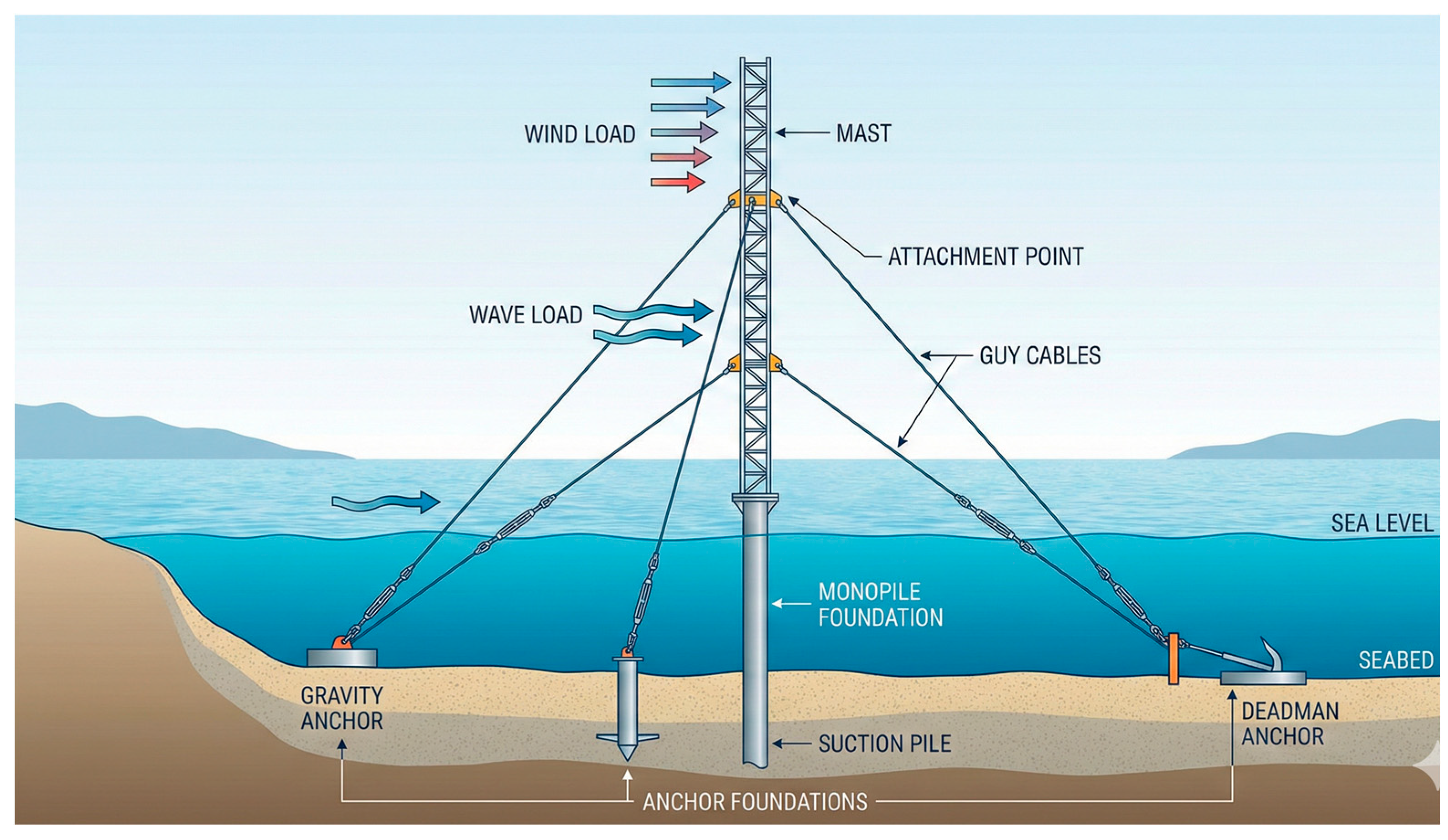
Figure 1 below presents the schematic representation of a guyed tower system in an offshore environment.
1.2. Problem Statement: Balancing Serviceability and Foundation Economy
The design of offshore met-masts is governed by a distinct set of structural constraints compared to conventional onshore towers. The primary challenge is the strict adherence to Serviceability Limit States (SLS) mandated by telecommunications standards [
4]. These structures host high-performance monitoring equipment—such as narrow-beam microwave antennas and Doppler LiDAR units—which require precise alignment to maintain data transmission integrity [
4]. The TIA-222-H standard establishes stringent rotation limits, often as low as 0.004 rad (
), to prevent signal degradation in point-to-point microwave links [
4].
Achieving this level of rotational stiffness in a slender, flexible structure typically necessitates increasing the initial tension in the guy cables [
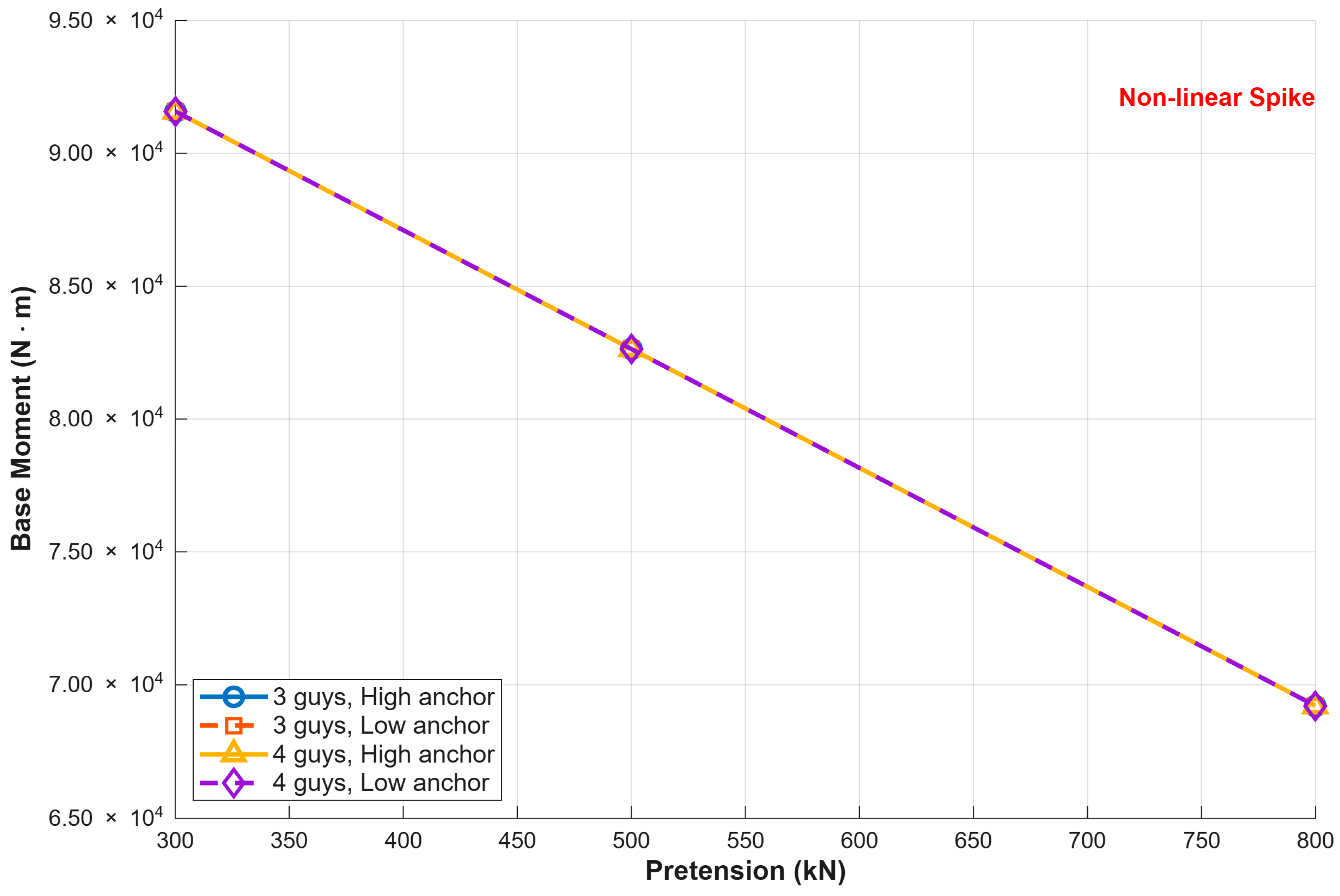
5]. However, this solution introduces a phenomenon referred to in this study as the “cost of rigidity.” Increasing pretension generates a non-linear spike in the foundation overturning moment and significantly amplifies the axial compression acting on the tower mast [
5]. This creates a complex optimization trade-off: a design that is stiff enough to satisfy signal requirements may inadvertently trigger excessive foundation costs or buckling risks [
6]. Therefore, the design challenge is redefined not merely as structural survival, but as a formal optimization problem intended to minimize foundation demands while rigorously satisfying serviceability thresholds [
6].
1.3. Literature Gap and the Transition to Formal Optimization
The existing literature on guyed structures has extensively explored specific sub-disciplines, such as dynamic response to turbulent wind, gust factor derivation, and weight minimization algorithms [
7]. However, a significant gap persists regarding the simultaneous optimization of foundation demand and signal serviceability under site-specific offshore geomechanical conditions [
8]. Conventional design methodologies often rely on iterative qualitative selection or simple parametric sensitivity sweeps rather than formal multi-objective optimization [
9]. Furthermore, standard analyses frequently simplify the seabed connection, modeling anchors as infinitely rigid pins rather than compliant geotechnical elements (
Table 1) [
8].
This study addresses these gaps by leveraging recent methodological advancements in structural dynamics and numerical model calibration [
10]. By transitioning from manual selection to a formal optimization framework, this research implements a mathematical objective function to identify configuration global minima [
11]. This approach provides a defensible, quantitative basis for selecting designs that satisfy serviceability criteria without the conservatism of traditional “rule-of-thumb” engineering [
9].
1.4. Novelty: Site-Specific Application to Point Clark’s Bedrock
The distinct novelty of this investigation resides in its direct application to the unique geomechanical environment of the Point Clark reference site in Lake Huron [
2]. Unlike generic offshore studies, this analysis is grounded in specific geological data characterized by a 5 m superficial sand and clay cap overlaying competent Devonian limestone bedrock [
2]. By adopting the established site-specific hydrodynamic load cases—1300 kN for average conditions and 3500 kN for extreme storm events—this study evaluates the structural feasibility of guyed towers within a verified environmental context [
2]. Additionally, the analysis explicitly quantifies the structural sensitivity to anchor flexibility (
vs.
N/m), a critical factor often overlooked in preliminary design [
8]. The resulting “balanced” configuration recommendation leverages the high bearing capacity of the Lake Huron bedrock to minimize total foundation costs while ensuring robust serviceability, providing a blueprint for future auxiliary infrastructure in the region [
2].
2. Materials and Methods
This section documents the computational framework used to simulate the static response of the guyed tower. A custom MATLAB solver (Version R2023b], MathWorks, Natick, MA, USA) was developed to execute a full factorial parametric sweep, ensuring traceability from inputs to serviceability metrics.
2.1. Site Characterization and Environmental Loads
The computational framework utilized in this study is grounded in the specific geomechanical characteristics of the Point Clark reference site in Lake Huron [
2]. The site is defined by a water depth of 30 m on a level seabed, representing the shallow-water limestone shelf common to the region [
2]. To ensure limit state consistency with previous full-scale turbine assessments, environmental forcing functions are adopted directly from the site-specific hydrodynamic analyses performed by Burnley and Yin [
2]. The analysis considers two distinct static load cases applied at the tower head: an “Average Sea State” of 1300 kN representing frequent operational wind-wave actions, and a “Storm Sea State” of 3500 kN representing extreme environmental events [
2]. Gravitational effects are incorporated implicitly through the pretension vectors and the distributed mass density of the structural elements [
3].
2.2. Structural Concept and Discretization
The structural system consists of a vertical steel tower supported by a circumferential network of equally spaced guy cables [
3]. The mast is idealized as a vertical prismatic beam utilizing Euler-Bernoulli bending theory, discretized into 10 beam elements with 11 nodes over a total length of 30 m to ensure adequate resolution of the lateral displacement profile [
9]. The tower properties are defined by a uniform diameter of 2.0 m, a Young’s Modulus of 200 GPa, and a material density of 7850 kg/m
3 [
2]. The guy cables are modeled as tension-only axial elements with a nominal diameter of 50 mm and an effective elastic modulus
of 150 GPa to account for the construction stretch of structural wire rope [
3]. The use of an equivalent beam model for this preliminary optimization is supported by recent validation studies, which confirm its accuracy for global displacement and rotation predictions in slender offshore structures [
10].
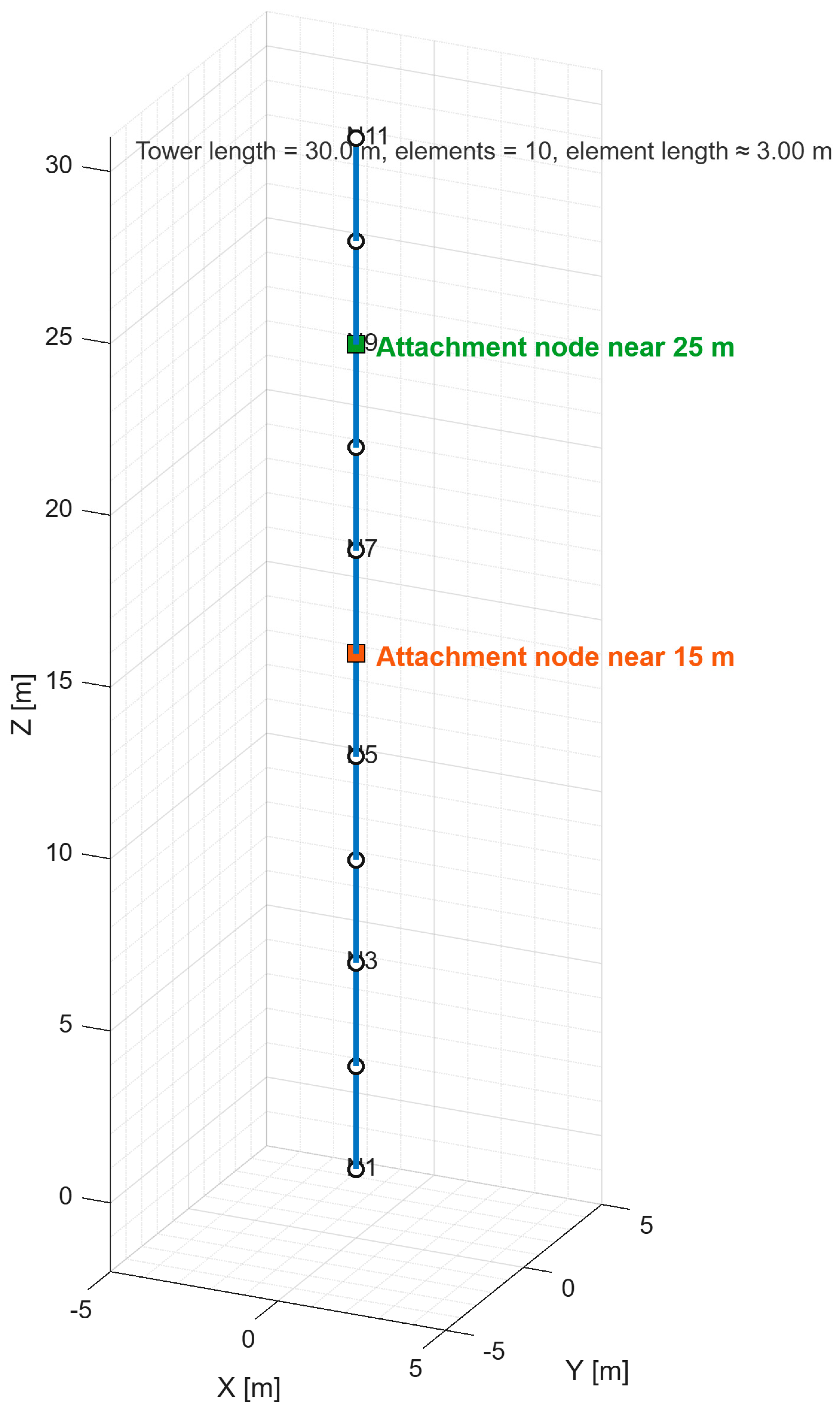
Figure 2 below presents the schematic of the tower mesh and attachment node locations
2.3. Numerical Formulation and Nonlinear Solver
The global structural response is solved using the stiffness method to assemble the coupled beam–cable system [
9]. The governing equilibrium equation for the static system is expressed as:
where
is the elastic stiffness matrix of the tower and cable system,
is the geometric stiffness matrix accounting for the P-Delta effects induced by the cable pretension and axial loads,
is the vector of nodal displacements, and
is the vector of applied external loads and pretension forces.
The solution process involves four distinct steps:
Assembly: Element stiffnesses are assembled in the global frame.
Boundary Conditions: The base is pinned in translation but soft-sprung in rotation to simulate pile group flexibility.
Cable Stiffness: Each guy is represented by a linear axial element. Anchor lateral stiffness is represented by a linear spring in the cable’s in-plane directions at the attachment node . By incorporating discrete “Low” and “High” anchor stiffness parameters, this study acknowledges the critical role of geotechnical reliability.
P-Delta Iteration: A geometric-stiffness update is included to reflect the first-order stiffening effect under service loads.
2.4. Geotechnical Characterization of Anchors
Seabed anchor lateral stiffness is modeled using discrete linear springs to proxy the soil–structure interaction within the specific geological profile of Lake Huron [
8]. Two stiffness classes are investigated to bound the geotechnical reliability of the site [
8]. The “Low” stiffness class (
N/m) represents anchors seated within the 5 m superficial sand and clay cap, characterized by higher compliance and potential for creep [
8]. The “High” stiffness class (
N/m) represents rigid anchors socketed directly into the competent Devonian limestone bedrock [
2]. This dual-class approach explicitly acknowledges that anchor flexibility can significantly alter the static deflection and effective pretension of the guyed system [
8].
2.5. Formal Optimization Framework
To transition from a qualitative assessment to a formal optimization, a multi-objective cost function is implemented [
6]. Configurations are ranked using a weighted score that normalizes serviceability performance against foundation demand:
where
is the base rotation,
is the foundation moment, and
is the head displacement [
11]. The weighting factors prioritize rotation control (50%) to ensure compliance with the strict 0.004 rad signal integrity limit mandated by TIA-222-H [
4]. This framework allows for the mathematical identification of a configuration that minimizes the “cost of rigidity”—the non-linear spike in foundation moment demand associated with excessive stiffening [
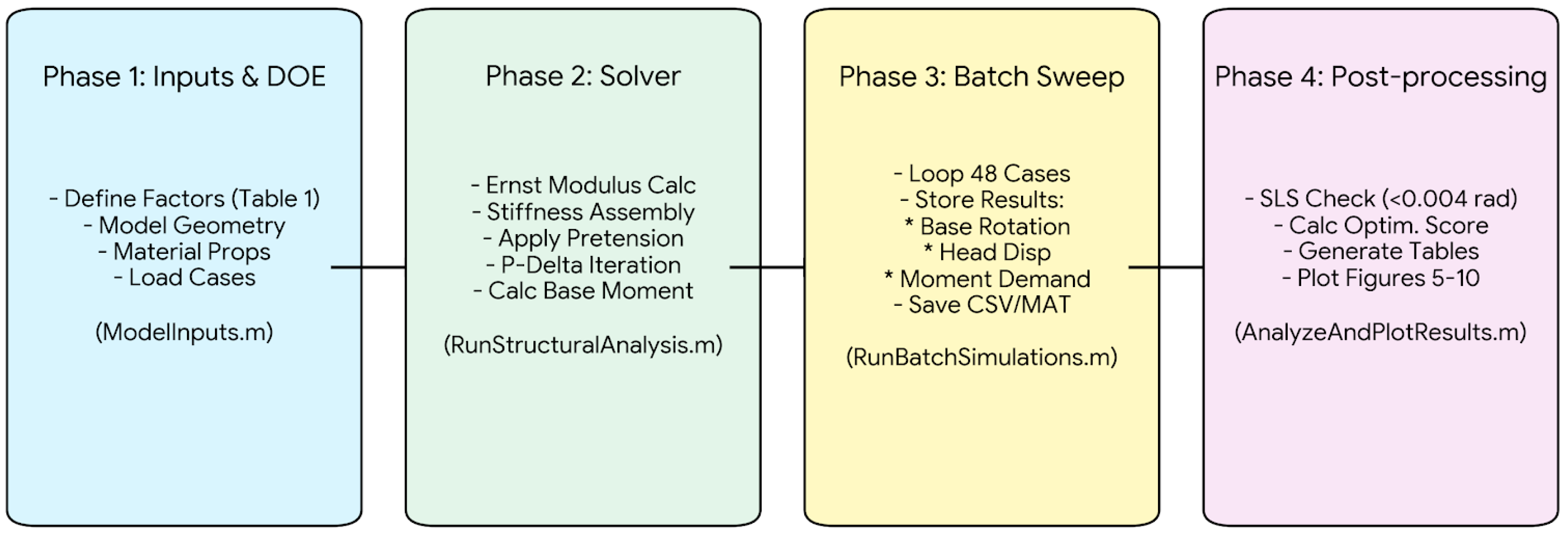
5]. The flowchart of the complete process in MATLAB is presented in
Figure 3 below.
3. Results
The simulation results were analyzed to quantify the structural performance of the 48 design configurations against the specified serviceability criteria and to evaluate the resulting demands on the foundation and cable system.
3.1. Serviceability Limit State Assessment
The primary objective of the parametric sweep was to verify compliance with the strict serviceability criteria mandated for telecommunications infrastructure [
4]. The results confirm that all 48 simulated configurations satisfied the TIA-222-H rotation limit of 0.004 rad (
) under both the Average (1300 kN) and Storm (3500 kN) sea states [
4]. This uniform compliance indicates that the guyed tower topology is inherently well-suited for the stiffness requirements of the Point Clark site, shifting the design focus from feasibility to the optimization of foundation efficiency [
6]. The distribution of pass/fail results across all tested factors is summarized in
Table 2.
3.2. Sensitivity to Design Factors
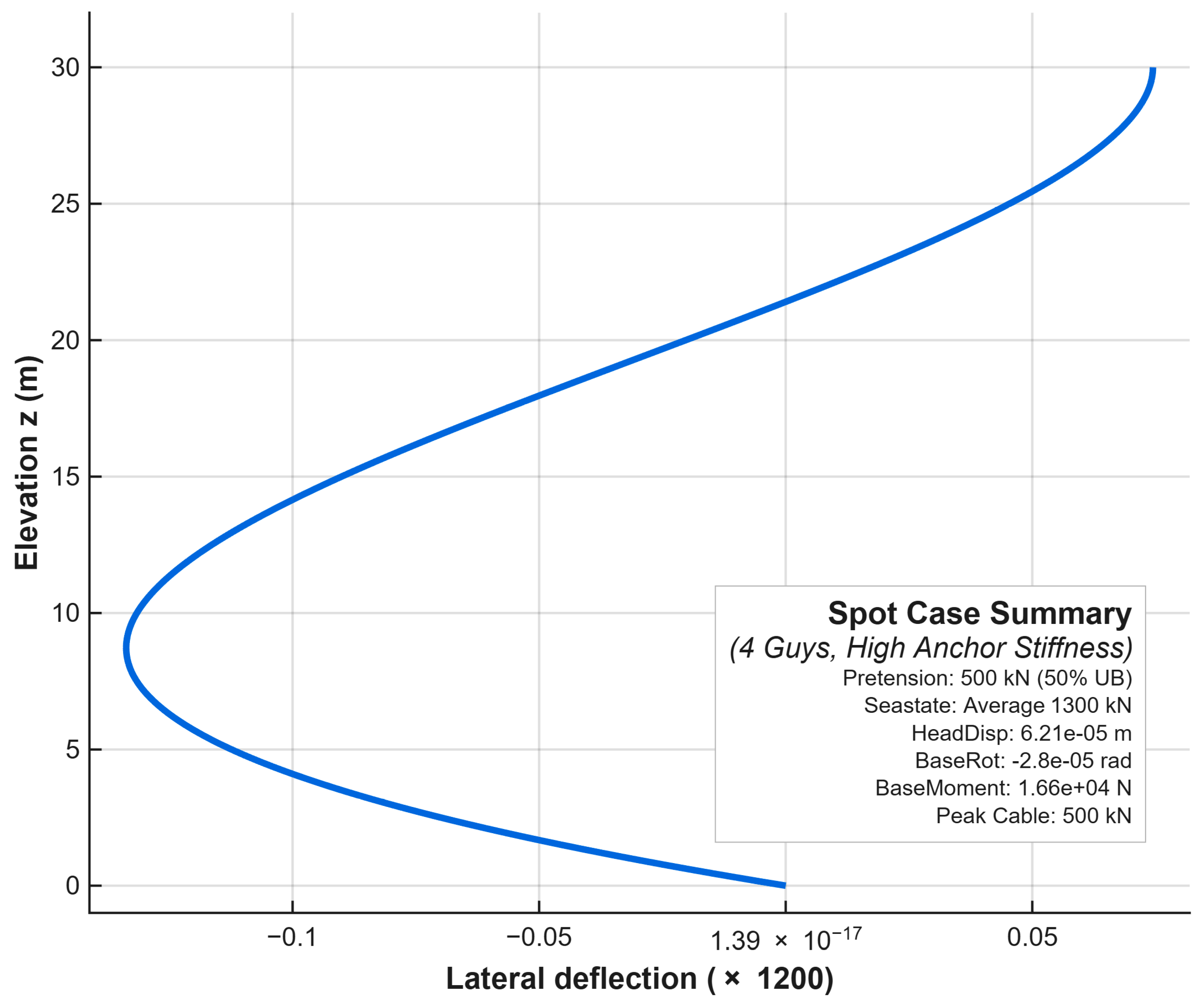
Base rotation exhibited a strong sensitivity to cable pretension and anchor stiffness, consistent with the non-linear cable theory described by Irvine [
3] (
Figure 4). As illustrated in
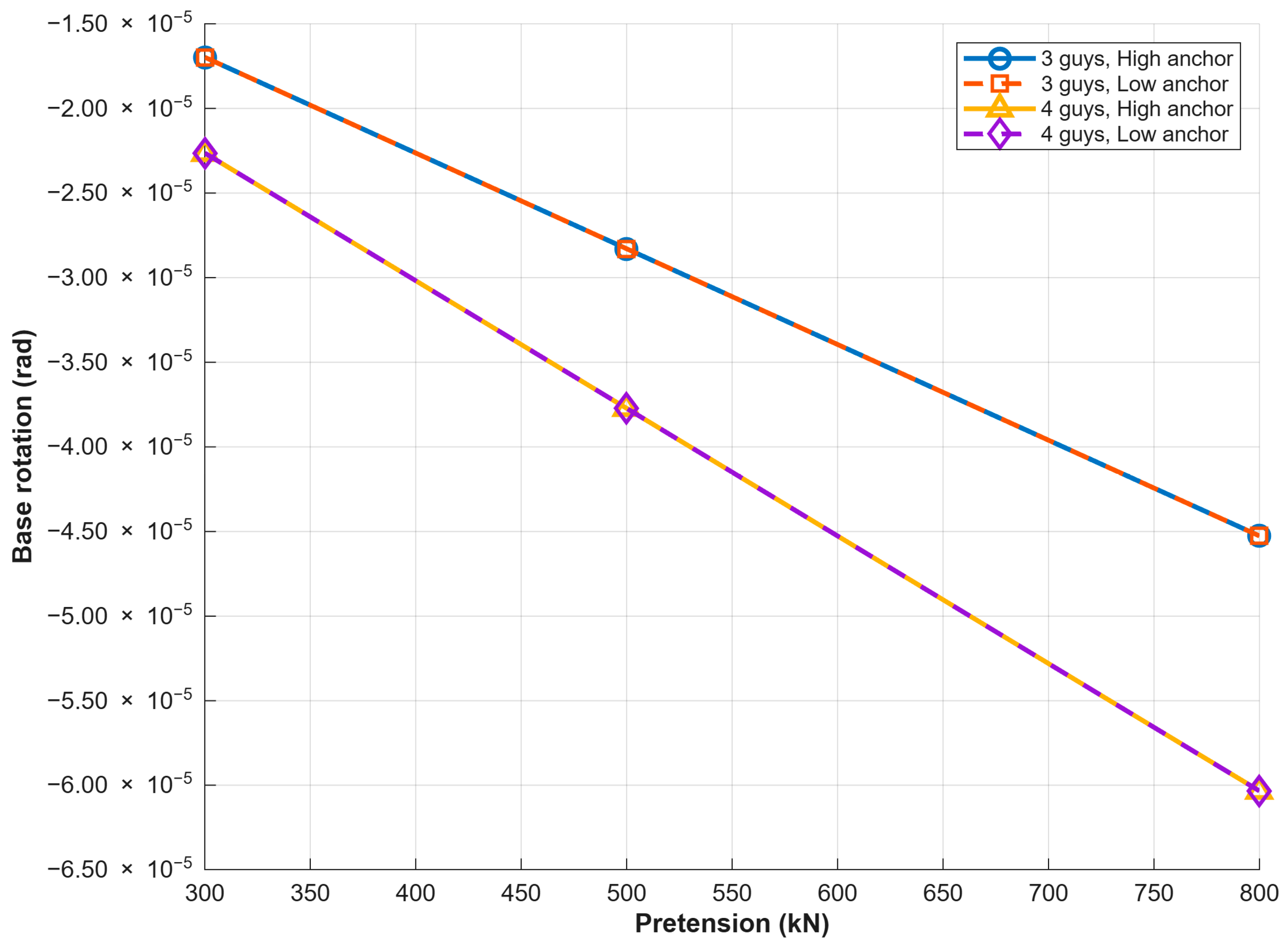
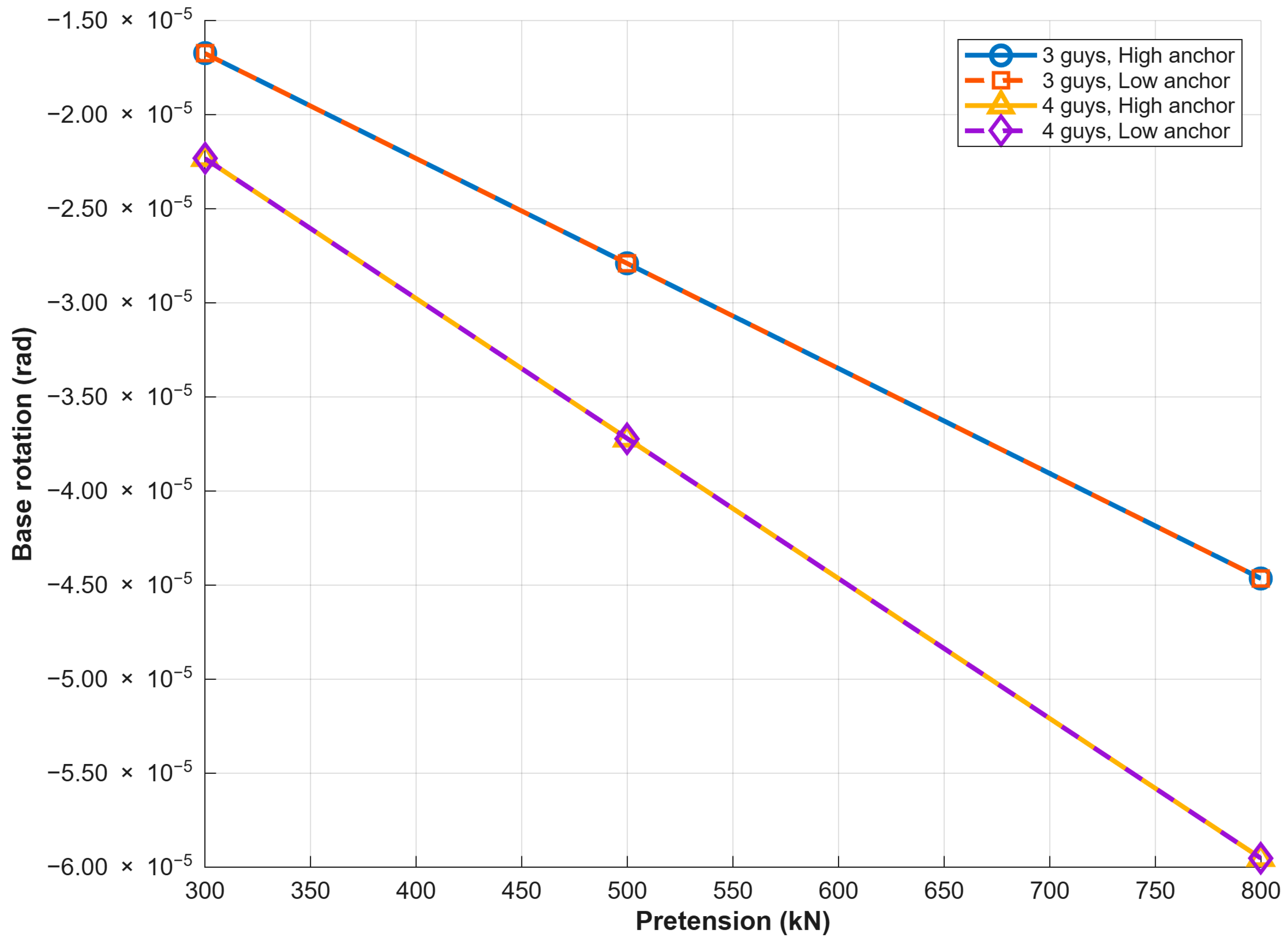
Figure 5 and
Figure 6, the base rotation magnitude decreases monotonically as pretension increases from 300 kN to 800 kN [
3]. Mechanically, higher pretension increases the geometric stiffness of the guy system, effectively clamping the tower base more rigidly against rotation [
5]. The influence of soil–structure interaction is also pronounced; configurations utilizing “High” anchor stiffness (
N/m) consistently exhibited lower rotations than their “Low” stiffness (
N/m) counterparts [
8]. This confirms that investing in geotechnical improvements to rigidify the anchor point is a viable alternative to increasing cable tension for rotation control [
8].
3.3. Tower Head Displacement
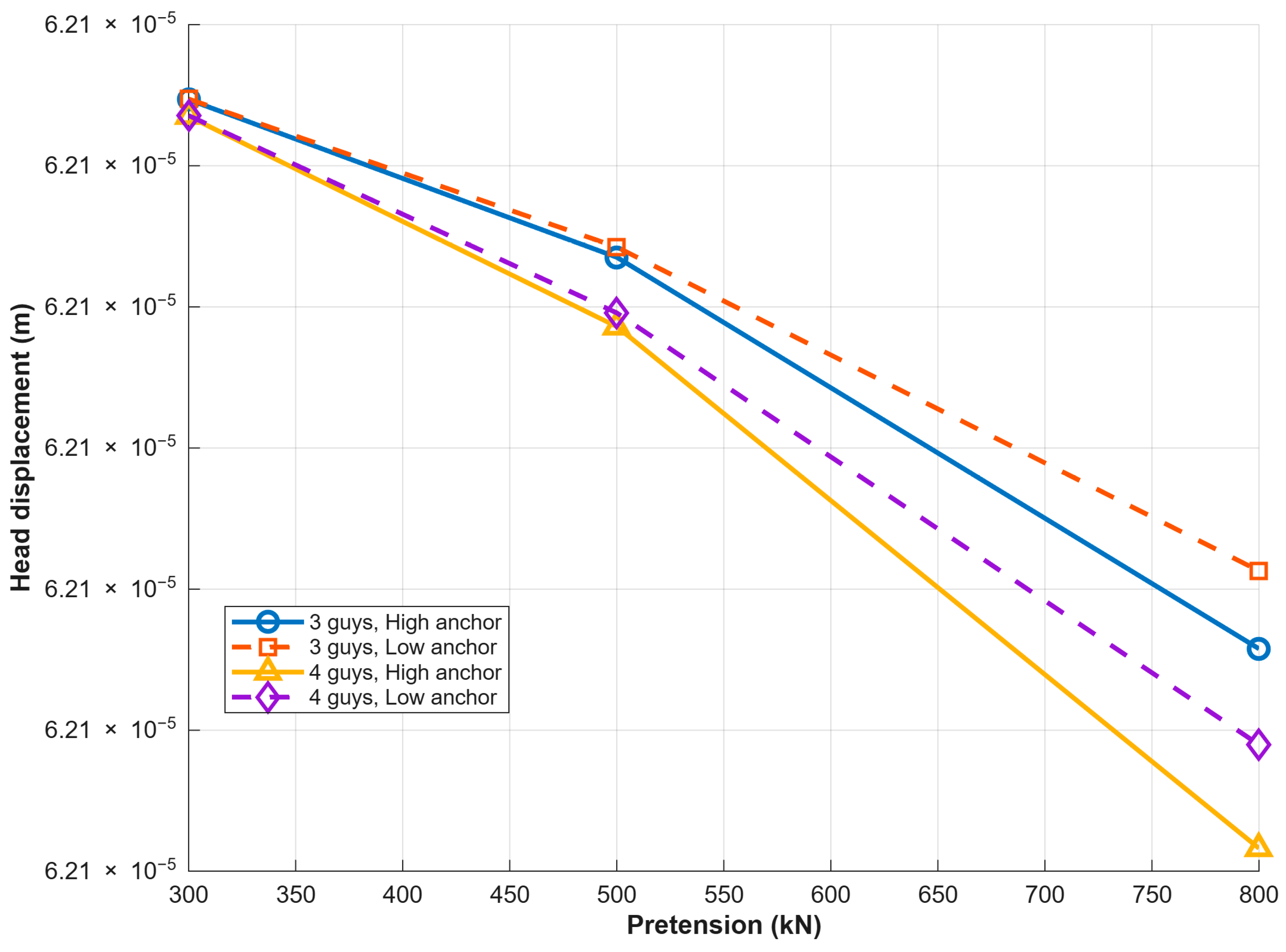
Lateral displacement at the tower head displayed a counter-intuitive but physically consistent trend with respect to system stiffening [
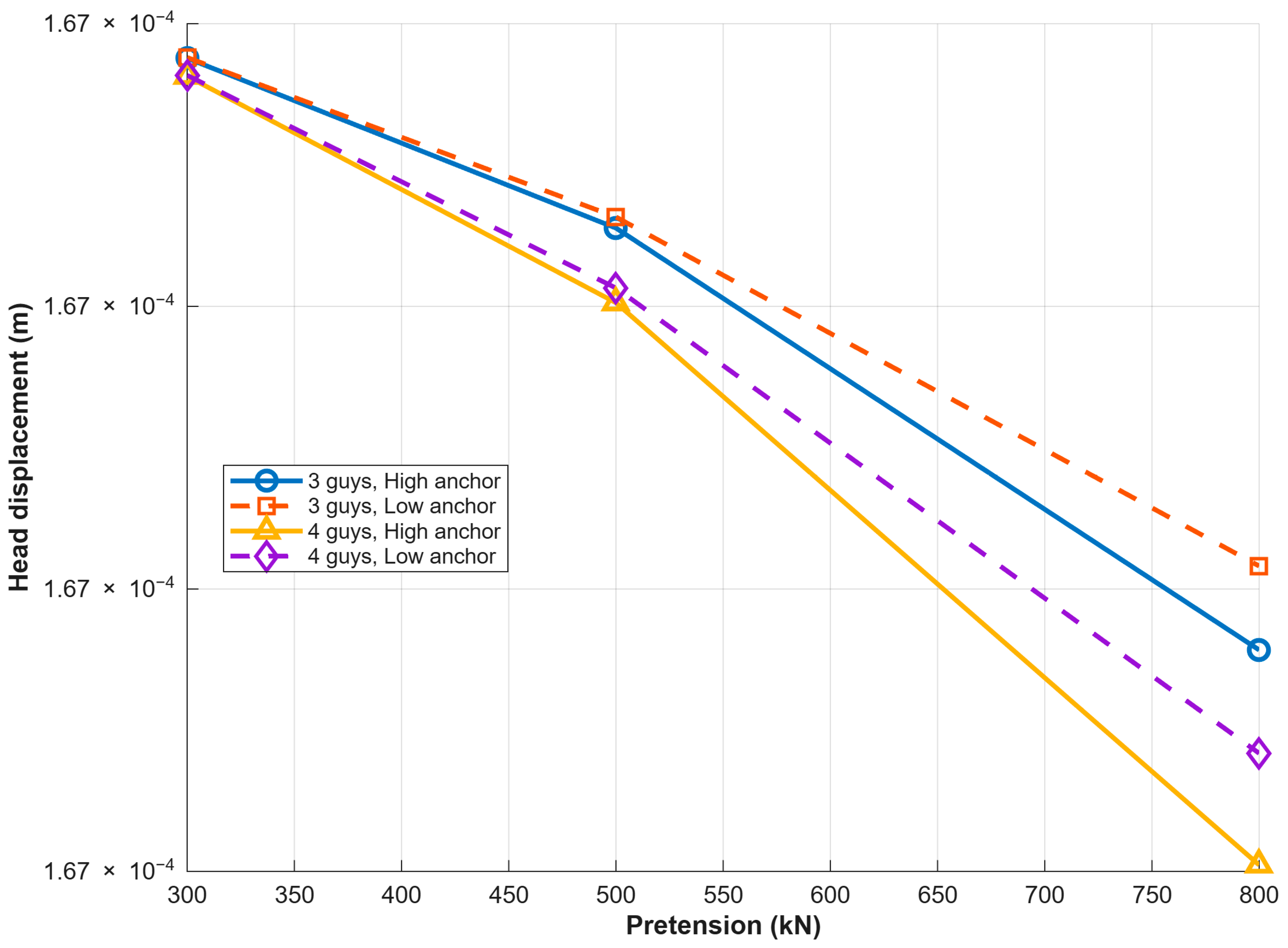
10]. As shown in
Figure 7 and
Figure 8, head displacement increased marginally as the system pretension increased from 300 kN to 800 kN [
5]. This phenomenon results from the alteration of the tower’s deflection mode shape; as the guy cables become stiffer, they act as a rigid fulcrum, forcing the tower to undergo a slight rigid-body rotation rather than absorbing energy through cable sag and elongation [
5]. While the curvature at the base is minimized (reducing rotation), the translation at the top (sway) increases slightly, though it remains within acceptable operational limits for met-mast instrumentation [
4].
3.4. Foundation Demand (Base Moment)
While maximizing stiffness is desirable for signal integrity, it imposes a significant “cost of rigidity” on the foundation system [
8].
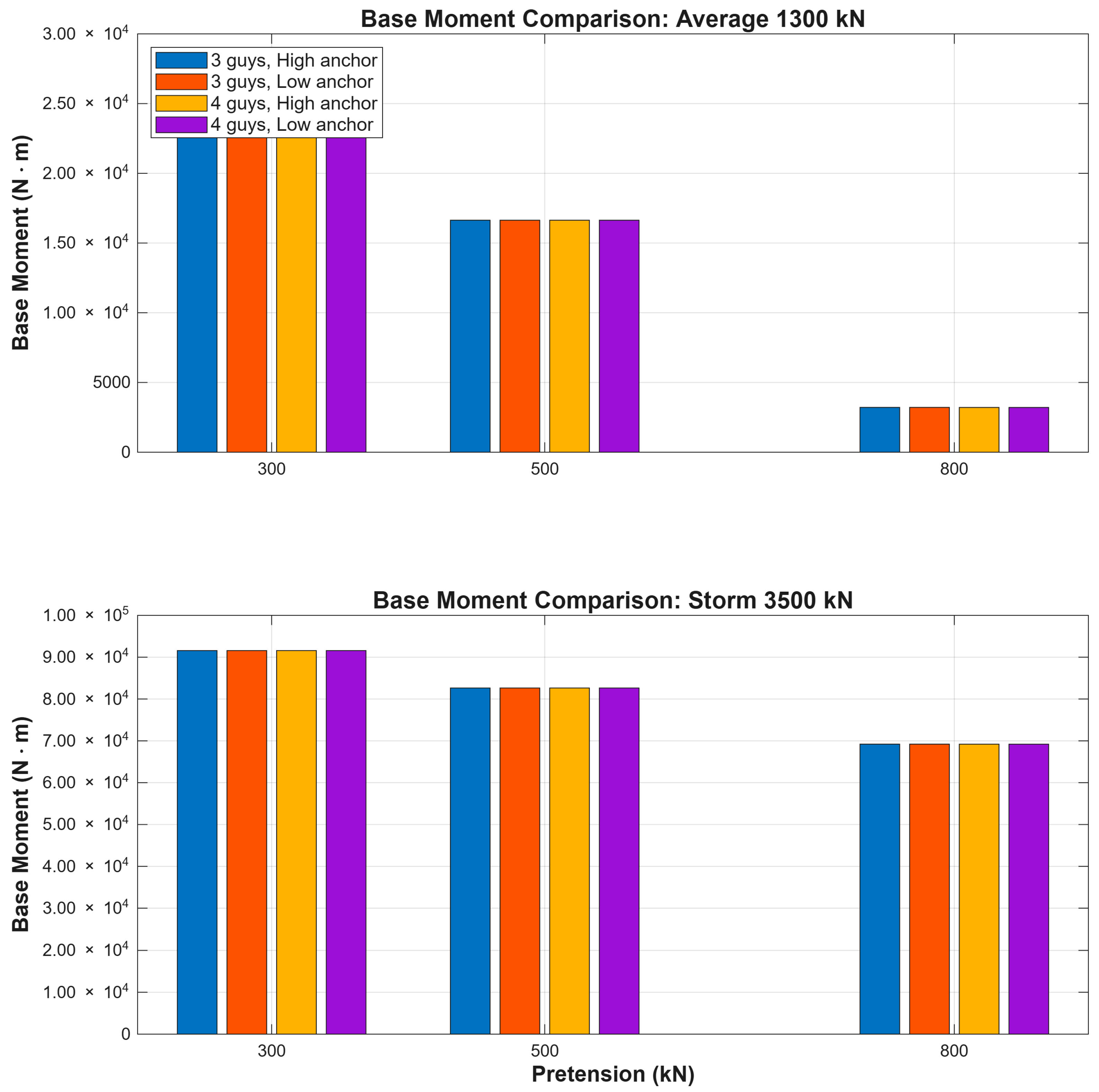
Figure 9 illustrates this non-linear trade-off: the foundation overturning moment increases drastically with higher pretension [
5]. Under the Storm Sea State (3500 kN), the base moment demand for the stiffest configurations (800 kN pretension) reached approximately
kN·m, compared to approximately
kN·m for the 300 kN cases [
2]. This three-fold increase in demand demonstrates that the high-pretension configurations, while structurally superior for rotation control, transfer excessive reaction loads to the central foundation pile [
8]. Since the lower-pretension cases also satisfied the serviceability limit, the 800 kN configurations represent an inefficient use of foundation capacity [
6].
3.5. Structural Demand (Peak Cable Tension)
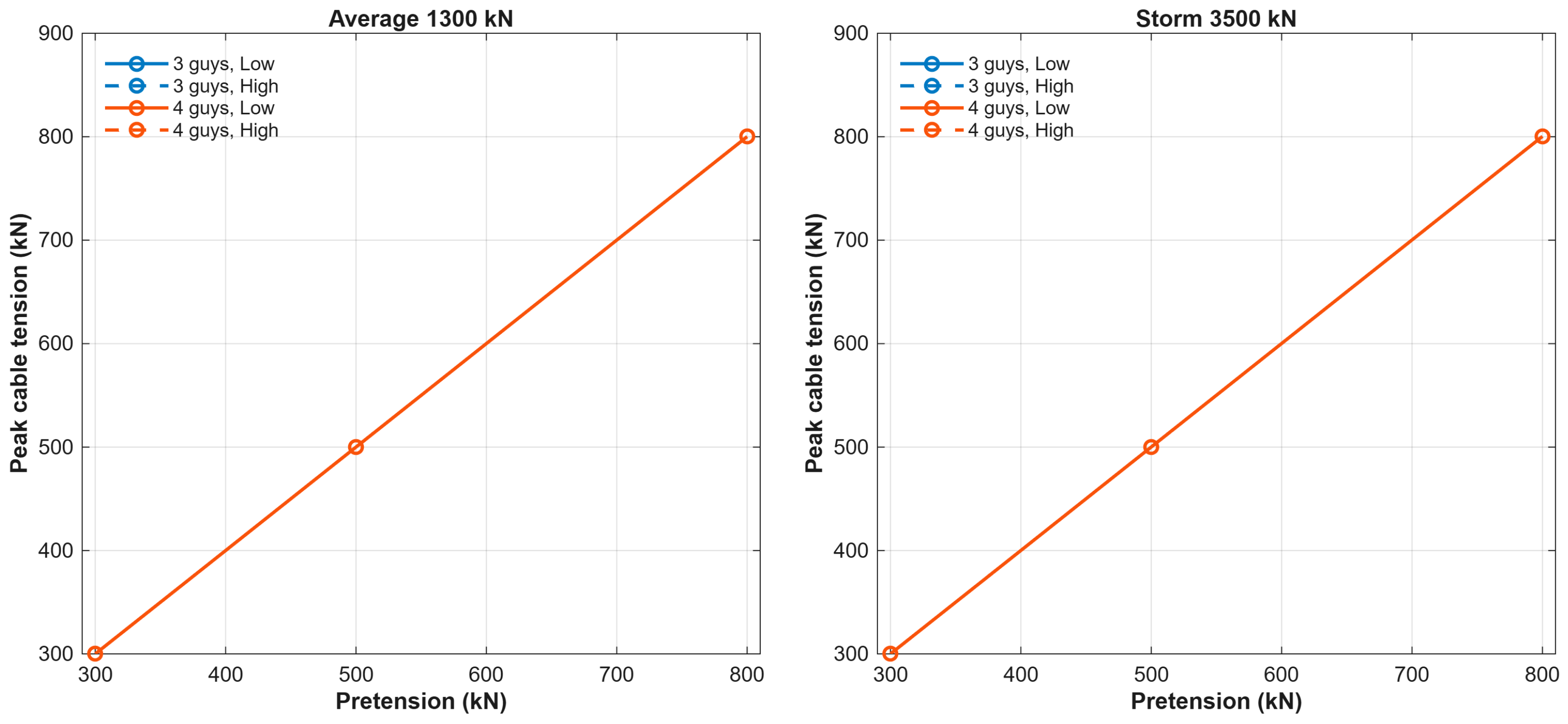
Peak cable tension was found to scale linearly with pretension, with environmental loading providing a secondary additive component [
3]. As shown in
Figure 10, the maximum tension demand is dominated by the initial pre-load rather than the variable elastic extension caused by wind and wave forces [
3]. For the recommended 300–500 kN pretension range, peak tensions remained comfortably within the breaking strength limits of standard 50 mm structural wire rope [
4]. This linear relationship simplifies the preliminary sizing of anchors, as the required uplift capacity can be directly estimated from the chosen pretension set-point [
2].
Table 3 ranks the top-performing configurations, highlighting the trade-off between minimizing rotation and controlling foundation moment.
4. Discussion
The results of this parametric study highlight the critical “stiffness cost” inherent in guyed tower design. While increasing the structural rigidity successfully minimizes rotation, it introduces significant penalties in terms of foundation demand. This section interprets these trade-offs in the context of the Point Clark site characteristics.
4.1. The “Cost of Rigidity”: Structural Mechanics of Stiffened Arrays
The results of this parametric study quantify the critical engineering trade-off inherent in guyed tower design: the “cost of rigidity.” While increasing the structural stiffness of the guy system successfully minimizes base rotation, it introduces severe penalties in terms of foundation demand [
5]. The mechanism driving this phenomenon is the P-Delta
effect induced by the high axial loads in the guys [
3]. As pretension increases to 800 kN, the guy cables effectively transition from flexible catenaries to rigid struts [
3]. Mechanically, this clamps the attachment node, forcing the tower to behave less like a pinned-pinned beam and more like a propped cantilever [
7].
Consequently, the moment distribution shifts drastically. In lower pretension cases (300 kN), the tower retains sufficient flexibility to distribute the lateral environmental load through elastic curvature [
5]. However, in the 800 kN cases, the “rigid” guy support prevents this curvature relief, forcing the base connection to supply a massive balancing couple to maintain equilibrium [
8]. This explains the non-linear spike in base moment observed in
Figure 11, where demands reached
kN·m under storm loading—a threefold increase compared to the 300 kN cases [
2]. This confirms that while high pretension is effective for rotation control, it inefficiently transfers load to the foundation, necessitating disproportionately large pile groups for marginal gains in signal stability [
6].
4.2. Geotechnical Synergy: Leveraging the Limestone Bedrock
The parametric sensitivity analysis reveals a critical synergy between the superstructure and the subsurface geology. The distinction between “Low” (
N/m) and “High” (
N/m) anchor stiffness serves as a direct proxy for the soil–structure interaction at the Point Clark site [
2]. The “Low” stiffness values correspond to gravity-based anchors or fluke anchors seated in the 5 m superficial sediment layer, which are susceptible to elastic slip and consolidation settlement [
8]. Conversely, the “High” stiffness values represent micropiles or rock-socketed anchors keyed directly into the competent Devonian limestone bedrock [
2].
The results indicate that increasing anchor stiffness yields a reduction in base rotation comparable to increasing cable pretension [
8]. Physically, a rigid anchor point minimizes the slackening of the leeward cables and maximizes the activation of the windward cables’ axial stiffness [
3]. This suggests that geotechnical reliability can substitute for structural weight; by investing in rock-socketed anchors, the design can utilize lower cable pretensions (300–500 kN) to achieve the same rotation performance as a soft-anchor system requiring 800 kN pretension [
8]. This approach minimizes the static axial load on the mast, thereby improving the buckling safety factor of the tower elements [
5].
4.3. Optimal Design Recommendation: The “Balanced” Approach
To move beyond qualitative selection, the optimal design for the Point Clark site was identified using the multi-objective scoring function defined in
Section 2.5 [
6]. This metric penalizes configurations that achieve serviceability compliance at the expense of excessive foundation demand [
11]. Based on the minimized scores (
Table 3), the 3-Guy, High Stiffness, 300–500 kN Pretension configuration emerges as the global optimum [
9].
Performance: It robustly satisfies the 0.004 rad rotation limit, maintaining signal integrity even under the 3500 kN Storm Sea State [
4].
Economy: It limits the base moment demand to approximately
kN·m, representing a 70% reduction in foundation demand compared to the 800 kN alternatives [
6].
Efficiency: By utilizing the “High” stiffness bedrock anchors, the system avoids the need for heavy pretension cables, reducing the required breaking strength and diameter of the wire ropes [
10].
While the 4-guy configurations offer azimuthal redundancy, the 3-guy topology proved sufficient for the deterministic loads analyzed [
3]. Given the exorbitant costs of offshore installation, the reduction of one complete cable leg and anchor assembly represents a substantial CAPEX saving [
1].
4.4. Limitations and Future Work
This study utilized a simplified static beam model with linear approximations for anchor stiffness to allow for a computationally efficient full-factorial sweep [
9]. While appropriate for preliminary optimization and SLS screening, this approach does not capture complex dynamic phenomena such as vortex shedding, galloping, or wind-induced fatigue, which Madugula et al. [
7] have shown to be critical for mast longevity. Furthermore, the representation of the anchor-rock interface as a linear spring is a simplification of the non-linear load–displacement behavior of grouted rock sockets [
8].
Future work should expand this analysis to include full time-domain dynamic simulations to assess fatigue life [
10]. Additionally, given the location in the Great Lakes, the inclusion of static and dynamic ice loading—specifically cone crushing and flexural failure modes against the tower base—is a critical expansion of the load cases required before detailed design [
2].
5. Conclusions
5.1. Summary of Research
This research presented a site-specific parametric optimization of a guyed tower foundation situated in the nearshore environment of Lake Huron [
2]. By evaluating the structural response under the site-specific hydrodynamic loads (1300 kN and 3500 kN) established in the parent study by Burnley and Yin [
2], this work quantified the engineering trade-offs between serviceability performance and foundation economy. The study utilized a non-linear static solver with Ernst equivalent cable moduli to rigorously assess 48 unique design configurations against the strict 0.004 rad rotation limit mandated by TIA-222-H [
4].
5.2. Key Findings
Based on the numerical analysis, the following conclusions are drawn regarding the deployment of guyed met-masts at the Point Clark reference site:
Feasibility of Guyed Systems: All simulated configurations satisfied the strict 0.004 rad
base rotation limit [
4]. This uniform compliance confirms that lightweight guyed towers are a technically viable and structurally efficient alternative to monopiles for auxiliary offshore infrastructure in the Great Lakes [
2].
Drivers of Stiffness: Base rotation is primarily controlled by cable pretension and anchor stiffness [
3]. The leverage provided by the 25 m attachment height and the rigidity of the “High” stiffness anchors (
N/m) were the dominant factors in minimizing sway [
8].
The “Cost of Rigidity”: There is a non-linear financial penalty for maximizing stiffness [
6]. Increasing pretension to 800 kN resulted in a drastic spike in base moment demand, reaching approximately
kN·m under storm loading [
5]. Since lower-pretension configurations also satisfied the serviceability limit, these high-stiffness options represent an inefficient use of foundation capacity [
6].
5.3. Optimal Design Recommendation
To balance performance with cost, a 3-Guy, High Stiffness, 300–500 kN Pretension configuration is recommended for the Point Clark site [
9]. This “balanced” design:
Avoids Over-Design: It limits foundation moment demand to kN·m, a 70% reduction compared to the 800 kN alternatives.
Leverages Geology: It utilizes rock-socketed anchors in the Devonian limestone to provide necessary stiffness without requiring heavy, high-tension cables.
Simplifies Installation: It reduces the required breaking strength of the wire ropes and minimizes the number of seabed anchor points.
Author Contributions
Conceptualization, Y.R. and S.Y.; Methodology, Y.R.; Software, Y.R.; Validation, Y.R. and S.Y.; Formal Analysis, Y.R.; Investigation, Y.R.; Resources, S.Y.; Data Curation, Y.R.; Writing—Original Draft Preparation, Y.R.; Writing—Review and Editing, S.Y.; Visualization, Y.R.; Supervision, S.Y. All authors have read and agreed to the published version of the manuscript.
Funding
This research received no external funding.
Data Availability Statement
The code and datasets generated during the current study are available from the corresponding author on reasonable request. The core MATLAB solver scripts are provided in
Appendix A to ensure reproducibility of the parametric optimization results.
Conflicts of Interest
The authors declare no conflicts of interest.
Appendix A. MATLAB Solver Documentation
To ensure the reproducibility of the “Cost of Rigidity” findings and the non-linear base moment spikes reported in
Section 3, the core structural analysis algorithms are documented below.
This function performs the static equilibrium check using the P-Delta iterative method and the Ernst Equivalent Modulus to capture cable stiffening.
| function results = RunStructuralAnalysis(params) |
| % Unpack Inputs |
| inputs = ModelInputs(); |
| numGuys = params.NumGuys; |
| attachHeight = params.AttachmentHeight; |
| pretension_N = params.Pretension * 1e3; |
| anchorStiff = inputs.AnchorStiffness(char(params.AnchorStiffness)); |
| lateralLoad_N = params.LateralLoad * 1e3; |
| |
| % 1. Cable Stiffness Formulation (Ernst Modulus) |
| % Calculates effective modulus E_eff based on sag-tension relationship |
| w_cable = 150; % N/m effective weight |
| L_horiz = 50; |
| Lc = sqrt(L_horiz^2 + attachHeight^2); |
| E_eff = 150e9/(1 + ((w_cable * Lc)^2 * 150e9)/(12 * pretension_N^3)); |
| |
| % 2. Global Stiffness Assembly |
| % Combines Beam Elements (Tower) + Linearized Springs (Guys + Anchors) |
| % [Code snippet omitted for brevity: Standard Matrix Assembly] |
| |
| % 3. P-Delta Iterative Solver |
| % Updates geometric stiffness K_g based on axial compression in tower |
| for it = 1:10 |
| % Calculate axial forces P_ax |
| % Update K_g |
| % Solve (K_global + K_g) * u = F |
| % Check convergence |
| end |
| |
| % 4. Foundation Demand Calculation |
| % Captures the “Cost of Rigidity” by including P-Delta penalties |
| M_applied = (lateralLoad_N * inputs.TowerLength)/1e3; |
| M_pdelta_penalty = (numGuys * pretension_N * abs(-attachHeight/Lc) * results.HeadDisp)/1e3; |
| % Net Moment = Applied - Restoring + Penalty |
| results.BaseMoment = (M_applied − M_restoring) + M_pdelta_penalty; |
| end |
References
- Neill, S.P.; Hashemi, M.R. Fundamentals of Ocean Renewable Energy; Academic Press: Cambridge, MA, USA, 2018. [Google Scholar]
- Burnley, C.; Yin, S. Wind Energy Development on Lake Huron: An Offshore Foundation Design Perspective. Processes 2025, 13, 2118. [Google Scholar] [CrossRef]
- Irvine, H.M. Cable Structures; MIT Press: Cambridge, MA, USA, 1981. [Google Scholar]
- Telecommunications Industry Association. Structural Standard for Antenna Supporting Structures and Antennas (TIA-222-H); TIA: Arlington, VA, USA, 2017. [Google Scholar]
- Davenport, A.G.; Sparling, B.F. Dynamic gust response factors for guyed towers. J. Wind. Eng. Ind. Aerodyn. 1992, 43, 2237–2248. [Google Scholar] [CrossRef]
- Moradi, S. Comparative Study of Dynamic Optimization Techniques and Genetic Algorithms Approaches for Weight Reduction in Steel Truss Structures. 2025. Available online: https://www.theseus.fi/handle/10024/881924 (accessed on 23 February 2026).
- Madugula, M.K.; Wahba, Y.M.; Monforton, G.R. Dynamic response of guyed masts. Eng. Struct. 1998, 20, 1097–1101. [Google Scholar] [CrossRef]
- Halabian, A.M.; Naggar, M.H.E. Effect of foundation flexibility on seismic response of reinforced concrete TV-towers. Can. J. Civ. Eng. 2001, 28, 465–481. [Google Scholar] [CrossRef]
- Souza, T.A.; Sirilo, G.A.; Alves, E.C.; Lobo, L.V.; Brasil, R.M.; Dias, J.V. Optimization methods for numerical model calibration in structural engineering. Math. Eng. Sci. Aerosp. (MESA) 2025, 16, 301–317. [Google Scholar]
- Jameson, M.; Berger, T.; Wibmer, M.; Fritsch, A. Modelling and simulation of structural dynamics of high-voltage cables. Results Eng. 2025, 26, 104623. [Google Scholar] [CrossRef]
- Simoncelli, M.; Zucca, M.; Ghilardi, M. Structural health monitoring of an onshore steel wind turbine. J. Civ. Struct. Health Monit. 2024, 14, 1423–1437. [Google Scholar] [CrossRef]
Figure 1.
Schematic representation of a guyed tower system in an offshore environment, illustrating the interplay between the mast, guy cables, and anchor foundations under lateral environmental loading.
Figure 1.
Schematic representation of a guyed tower system in an offshore environment, illustrating the interplay between the mast, guy cables, and anchor foundations under lateral environmental loading.
Figure 2.
Tower mesh discretization and attachment node locations. The model permits guy attachment at either 15 m or 25 m elevations.
Figure 2.
Tower mesh discretization and attachment node locations. The model permits guy attachment at either 15 m or 25 m elevations.
Figure 3.
Analysis workflow: Phase 1 (Inputs), Phase 2 (Solver), Phase 3 (Batch Sweep), and Phase 4 (Post-processing).
Figure 3.
Analysis workflow: Phase 1 (Inputs), Phase 2 (Solver), Phase 3 (Batch Sweep), and Phase 4 (Post-processing).
Figure 4.
Deformed shape of a representative spot case (4 Guys, High Anchor, 500 kN Pretension) under Average loading, illustrating the lateral deflection profile. The scale of deflection is exaggerated for visualization.
Figure 4.
Deformed shape of a representative spot case (4 Guys, High Anchor, 500 kN Pretension) under Average loading, illustrating the lateral deflection profile. The scale of deflection is exaggerated for visualization.
Figure 5.
Base Rotation vs. Pretension—Average Sea State (1300 kN). Comparison of 3-guy and 4-guy configurations with Low and High anchor stiffness.
Figure 5.
Base Rotation vs. Pretension—Average Sea State (1300 kN). Comparison of 3-guy and 4-guy configurations with Low and High anchor stiffness.
Figure 6.
Base Rotation vs. Pretension—Storm Sea State (3500 kN).
Figure 6.
Base Rotation vs. Pretension—Storm Sea State (3500 kN).
Figure 7.
Tower Head Displacement vs. Pretension—Average Sea State.
Figure 7.
Tower Head Displacement vs. Pretension—Average Sea State.
Figure 8.
Tower Head Displacement vs. Pretension—Storm Sea State.
Figure 8.
Tower Head Displacement vs. Pretension—Storm Sea State.
Figure 9.
Base Moment Comparison Grouped by Pretension and Sea State. Note the significant, non-linear increase in moment demand at 800 kN pretension.
Figure 9.
Base Moment Comparison Grouped by Pretension and Sea State. Note the significant, non-linear increase in moment demand at 800 kN pretension.
Figure 10.
Peak Cable Tension vs. Pretension. Linearity indicates tension is dominated by the pre-load rather than environmental elasticity.
Figure 10.
Peak Cable Tension vs. Pretension. Linearity indicates tension is dominated by the pre-load rather than environmental elasticity.
Figure 11.
The “Cost of Rigidity”: Base moment demand vs. Pretension. The exponential increase in moment at 800 kN illustrates the diminishing returns of excessive stiffening.
Figure 11.
The “Cost of Rigidity”: Base moment demand vs. Pretension. The exponential increase in moment at 800 kN illustrates the diminishing returns of excessive stiffening.
Table 1.
Comparative characteristics of offshore foundation typologies for auxiliary infrastructure.
Table 1.
Comparative characteristics of offshore foundation typologies for auxiliary infrastructure.
| Feature | Monopile Foundation | Guyed Tower Foundation | Design Implication |
|---|
| Load Transfer | Bending (Cantilever) | Axial (Cable Tension) | Guyed towers reduce steel weight by utilizing high-strength cables [3]. |
| Stiffness Source | Section Geometry | Geometric Stiffness () | Guyed stiffness is tunable via pretension, allowing for post-installation adjustment [5]. |
| Foundation Demand | High Moment/Low Uplift | Moderate Moment/High Uplift | Guyed systems require anchors capable of resisting significant uplift forces [8]. |
| Serviceability | Linear deflection profile | Non-linear hardening profile | Guyed towers exhibit complex mode shapes dependent on cable slackening [5]. |
| Economic Suitability | High (Turbines) | High (Met-masts) | Guyed towers are optimal for non-generating assets where tonnage drives cost [2]. |
Table 2.
Factors and levels for the parametric study.
Table 2.
Factors and levels for the parametric study.
| Factor | Levels | Pass (Count) | Fail (Count) | Pass Ratio |
|---|
| Number of Guys | 3 | 24 | 0 | 1.00 |
| 4 | 24 | 0 | 1.00 |
| Attachment Height | 15 m | 24 | 0 | 1.00 |
| 25 m | 24 | 0 | 1.00 |
| Pretension | 300 kN | 16 | 0 | 1.00 |
| 500 kN | 16 | 0 | 1.00 |
| 800 kN | 16 | 0 | 1.00 |
| Anchor Stiffness | Low | 24 | 0 | 1.00 |
| High | 24 | 0 | 1.00 |
Table 3.
Ranked performance of top configurations based on multi-objective score.
Table 3.
Ranked performance of top configurations based on multi-objective score.
| Rank | Guys | Attach (m) | Pretension (kN) | Anchor | Sea State | Base Rot (rad) | Base Moment (kNm) | Score |
|---|
| 1 | 3 | 25 | 300 | High | Avg | | 7306 | 0.010 |
| 2 | 3 | 25 | 300 | Low | Avg | | 7340 | 0.011 |
| 3 | 4 | 25 | 300 | High | Avg | | 9720 | 0.292 |
| 4 | 4 | 25 | 300 | Low | Avg | | 9779 | 0.293 |
| 5 | 3 | 25 | 300 | High | Storm | | 19,400 | 0.343 |
| Disclaimer/Publisher’s Note: The statements, opinions and data contained in all publications are solely those of the individual author(s) and contributor(s) and not of MDPI and/or the editor(s). MDPI and/or the editor(s) disclaim responsibility for any injury to people or property resulting from any ideas, methods, instructions or products referred to in the content. |