Review

Chloride-Induced Corrosion in Steel Fiber-Reinforced Cementitious Composites

by
Ana Carolina Moreno Nunes
1,
Cézar Augusto Casagrande
2,
Lidiane Fernanda Jochem
2,
Marcelo Henrique Farias de Medeiros
3 and
Ricardo Pieralisi
3,*
1
Graduate Program in Civil Engineering (PPGEC), Federal University of Paraná, Curitiba 81531-970, Paraná, Brazil
2
Academic Department of Civil Construction (DACOC), Technological Federal University of Parana (UTFPR), Curitiba 80230-901, Paraná, Brazil
3
Civil Engineering Studies Center (CESEC), Graduate Program in Civil Engineering (PPGEC), Federal University of Parana (UFPR), Curitiba 81531-990, Paraná, Brazil
*
Author to whom correspondence should be addressed.
Buildings 2026, 16(5), 963; https://doi.org/10.3390/buildings16050963
Submission received: 12 November 2025 / Revised: 29 December 2025 / Accepted: 31 December 2025 / Published: 1 March 2026
(This article belongs to the Section Building Materials, and Repair & Renovation)

Abstract

This paper presents an investigation of chloride-induced corrosion in steel fiber-reinforced cementitious composites (SFRCCs) under uncracked and pre-cracked conditions. The study focuses on a single SFRCC mixture and evaluates the impact of chloride exposure on the mechanical strength of the material using a 3-point bending test, with a particular focus on the chloride exposure period and the role of crack width in the corrosion process. The specimens were categorized into three groups: reference (unexposed), uncracked, and pre-cracked (with initial crack widths of 0.4 mm and 0.9 mm). They were exposed to salt spray cycles in a controlled chamber, simulating severe chloride environments, and tested after various exposure durations (28, 56, and 112 cycles). The results showed that in the uncracked samples, there was an increase in f R 1 with longer exposure time to the aggressive environment, reaching a 15.45% increase after 112 days compared to the reference. Overall, uncracked specimens maintained their residual tensile strength despite extended chloride exposure, supporting previous findings that corrosion in uncracked SFRCC does not significantly compromise durability. In the cracked samples, increases in f R 2 , f R 3 , and f R 4 were observed at early exposure stages (28 and 56 cycles) for specimens with a 0.9 mm crack width. After prolonged exposure (112 cycles), the residual tensile strengths converged toward reference values. For pre-cracked specimens, initial corrosion enhanced residual tensile strength in those with larger pre-cracks. However, after prolonged exposure, deterioration of the fiber–matrix bond became apparent.

1. Introduction

Cement-based materials are known for presenting brittle behavior with low tensile strength. This characteristic often leads to crack formation in structures during their service life, potentially causing durability issues and premature failure [1]. One of the most common durability problems in the construction industry is the corrosion of rebar reinforcement in cement-based structures.
Chloride ions, typically present in deicing salts and marine environments, can penetrate concrete and reach the steel reinforcement, causing corrosion and degradation [2]. Steel fiber-reinforced cementitious composites (SFRCCs) have been proposed as a solution to this issue due to their ability to control cracking and enhance the durability and toughness of concrete structures [3,4]. However, there is a fundamental difference between the use of rebar and fibers as reinforcement. Rebar can be precisely positioned within the formwork, allowing for control over its concrete cover based on the level of environmental aggression. In contrast, fibers are randomly dispersed throughout the entire volume of the concrete, meaning some fibers may end up positioned close to the surface [5].
The literature typically addresses the corrosion issue in steel fiber-reinforced cementitious composites (SFRCCs) from two perspectives [5]: (i) fibers near the surface, which are more susceptible to corrosion and can cause rust spots on exposed concrete surfaces [5,6,7,8,9], and (ii) fibers that corrode through cracks in the concrete [8,10,11,12,13,14]. The first issue is generally considered an aesthetic concern, while the second can compromise the structural stability and strength of the concrete.
According to [15], there is ongoing debate among standards and guidelines regarding the considerations of SFRCC in chloride exposure conditions. Ref. [15] identified four approaches: (i) limiting crack widths to between 0.10 and 0.20 mm [16,17]; (ii) adopting special measures, such as experimental validation [18]; (iii) utilizing coated carbon-steel or stain-less-steel fibers [16,17,18,19]; (iv) restricting the applicability of steel fibers for these exposure classes, or limiting their use to uncracked conditions, where their contribution to the serviceability limit state is not considered [20].
The studies summarized in Table 1 provide an overview of the trends in evaluating SFRCC under different specimen conditions and chloride exposure methods, while employing mechanical tests such as bending, direct tension, and pull-out to assess corrosion-related effects. Recently, some researchers have focused on evaluating the impact of fiber additions on the mechanical behavior of cementitious composites elements in environments where steel corrosion is a concern. The mechanical behavior was characterized using various tests, such as 3- and 4-point bending tests [6,8,9,14,21,22,23], direct tensile tests [12,24,25,26,27], and fiber–matrix interaction through pull-out tests [11,13,26,27,28,29]. The tested specimens were evaluated in both uncracked [6,8,9,14] and pre-cracked [27,28] conditions, with varying crack widths. The most common crack widths were less than 0.1 mm, reflecting typical service conditions. The exposure conditions found in the literature varied widely. Common approaches included wet and dry cycles, where the wet phase typically involved immersion in a NaCl solution [8,12,23,28]. Some studies maintained continuous immersion in NaCl solution throughout the exposure period [6,9,14,21]. In other cases, researchers used an electric current to accelerate the corrosion process [14,21,22]. Additionally, some experiments mixed NaCl directly into the fresh SFRCC [9], while others utilized pre-corroded fibers [24,26]. These diverse methods and specimen conditions were designed to evaluate the mechanical performance of SFRCC under varying environmental stressors and exposure durations.
The data from the literature indicate that for uncracked specimens, only the steel fibers near the exposed surface showed slight corrosion, even after prolonged chloride exposure. Additionally, no decrease nor improvement was observed in tensile behavior following chloride exposure, independent of the mechanical test [8,11]. For specimens with crack width less than 0.1 mm, the literature [12] suggests that the corrosion continues to be more an aesthetic problem than structural. In addition, some authors [28] reported an increase in residual tensile strength, which was attributed to the enhancement of the bond strength due to the corrosion products.
Although few studies have investigated the behavior of SFRCC subjected to corrosion with crack widths greater than 0.1 mm, it has been observed that as crack width increases, the average bond strength also increases. This is attributed to the accumulation of corrosion products at the fiber–crack interface, enhancing the frictional strength during fiber pull-out [11]. However, Refs. [27,28] reported that the pull-out energy and equivalent bond strength of fibers improved as crack width increased up to 0.2 mm. Beyond this threshold, significant deterioration occurred due to a shift in the failure mode from fiber pull-out to fiber fracture. This shift is significant because it highlights a change in the behavior of the SFRCC, where the fibers no longer contribute effectively to post-cracking tensile strength. It is important to note that while corrosion products might increase bond strength in some cases, the overall degradation due to progression of corrosion leads to a more brittle failure.
There is no consensus within the scientific community on the most suitable accelerated test for evaluating the behavior of SFRCC in chloride environments. It is important to note that each method has distinct characteristics. For instance, salt spray cycles can simulate atmospheric corrosion, while immersion in NaCl solution is better for simulating wet exposure conditions. The application of an electric current accelerates corrosion but may not fully replicate the natural corrosion process, as it increases the rate of chloride ingress and the formation of corrosion products. Understanding these differences is essential to evaluate how closely the results reflect real-world environmental conditions. In this sense, one of the primary challenges is the difficulty in correlating the results of accelerated tests with those observed in real structures exposed to various chloride conditions. Accelerated tests often use intensified conditions, such as higher chloride concentrations or electric current to accelerate corrosion, which may not accurately reflect the complex, long-term exposure in real-world environments. Moreover, actual structures are subjected to varying levels of chloride exposure, temperature, humidity, and internal stresses, making direct comparisons even more difficult [15]. Beyond chloride exposure, steel fiber-reinforced concretes have also been evaluated under other aggressive environments. Studies involving long-term acid attack (pH ≈ 3) and freeze–thaw cycles combined with chloride exposure have demonstrated reductions in compressive strength governed ultimately by tensile failure mechanisms, underscoring the relevance of tensile behavior in durability assessments of fiber-reinforced systems [30,31]. These findings reinforce the need to understand how corrosion affects the tensile capacity of SFRCC, particularly in cracked conditions.
Despite studies on the corrosion behavior of steel fibers embedded in cement-based composites, only a few studies [11,27,28] have evaluated the tensile behavior of SFRCC with crack widths greater than 0.1 mm. Although such crack widths are uncommon in serviceability limit states (SLSs), structural cracks can often reach these levels. Therefore, this research aims to investigate the mechanism of chloride-induced corrosion in steel fiber-reinforced cementitious composites under both uncracked conditions and cracked conditions with pre-crack widths of 0.4 and 0.9 mm. The study utilizes salt spray cycles to simulate a severe chloride environment, an accelerated test widely employed in the steel industry to assess the chloride resistance of steel elements used in harsh industrial conditions [32,33].

2. Materials and Methods

2.1. Materials, Mix Composition and Production Process

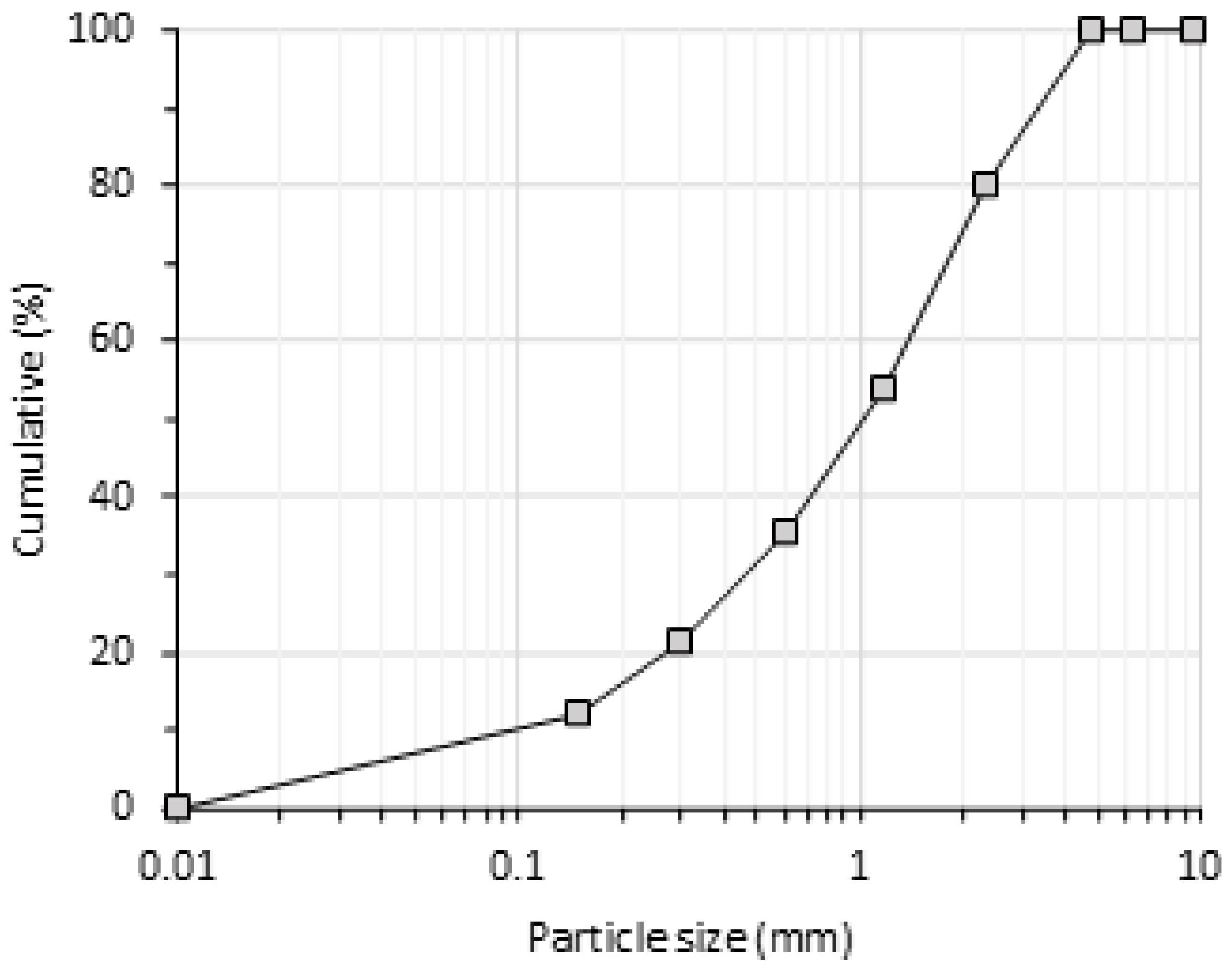
Brazilian cement Type II, modified with calcium carbonate in the range of 6% to 10% of Portland cement, was employed in the mixture. The aggregate used was quartz sand, featuring a density of 2.6 g/cm3, a unit weight of 1.57 g/cm3, water absorption of 0.3%, and a particle size distribution shown in Figure 1. For reinforcement, short-end-hooked steel fibers (Dramix® 3D 45/30 BL) were used, the properties and characteristics of these fibers are presented in Table 2.
The composition of the cement composite mix in this study was based on the research of [34], with adjustments made to accommodate the inclusion of fibers. The final composition of the steel fiber-reinforced cement composite (SFRCC) used in this study adhered to a ratio of 1:1.2 (cement to sand in volume) with specific components as follows: a cement content of 845 kg/m3, a water-to-cement (w/c) ratio of 0.4, and a fiber content of 120 kg/m3 (1.5% of composite volume). The mixture presents a relatively high cement content (845 kg/m3), which results from the need to ensure adequate paste volume for the dispersion and anchorage of the high fiber dosage used. With a water-to-cement ratio of 0.40, this proportioning ensured a stable workability without bleeding or segregation, which was essential for casting small prismatic specimens while maintaining homogeneity. The resulting dense matrix is advantageous for focusing chloride-induced corrosion mechanisms on surface-near fibers and cracked regions rather than on bulk matrix transport. The measured compressive strengths (71.97 ± 4.1 MPa at 28 days, 74.19 ± 5.4 MPa at 56 days, 78.13 ± 7.0 MPa at 84 days and 80.72 ± 7.1 MPa at 140 days) confirm the stability and performance of the matrix and support the use of this composition for the intended investigation.
The preparation of the SFRCC in this study followed the procedures outlined in the study conducted by [8]. Initially, cement and sand were introduced into a 20 L planetary mixer and homogenized for 60 s. Subsequently, water was added and mixed for another 60 s. Finally, steel fibers were manually incorporated and mixed for 240 s. The consistency of the fresh mixtures was assessed using a flow table, following UNE EN 12350-5 [35], with no strokes applied to the table. The resulting spread diameter measured 190 mm, with no signs of bleeding or segregation.
In total, 90 prismatic specimens, each measuring 40 mm × 40 mm × 160 mm (width × height × length), were cast following the guidelines outlined in UNE EN 12350–1 [36] and [8]. After casting, the molds were encased in plastic bags for 24 h. The samples were then de-molded 24 h after casting and subsequently placed in a curing chamber with controlled ambient temperature (25 ± 2 °C) and humidity (>95%) until they reached a complete age of 28 days. The specimen size was chosen because the internal space of the salt-spray chamber (described in Section 2.2.3) restricted the maximum size of the prismatic specimens that could be exposed simultaneously while ensuring uniform chloride deposition. Although the specimen geometry may influence fiber orientation near the boundaries, the adopted layout remained adequate for evaluating the relative effects of chloride exposure and crack width. The flexural test is sensitive to variation in fiber performance; therefore, potential reductions in fiber cross-section or bond quality caused by corrosion may be reflected in the residual tensile strengths. Additionally, fiber content uniformity was verified through the inductive method (described in Section 2.2.1), which helped maintain consistency across all tested specimens.

2.2. Test Procedures

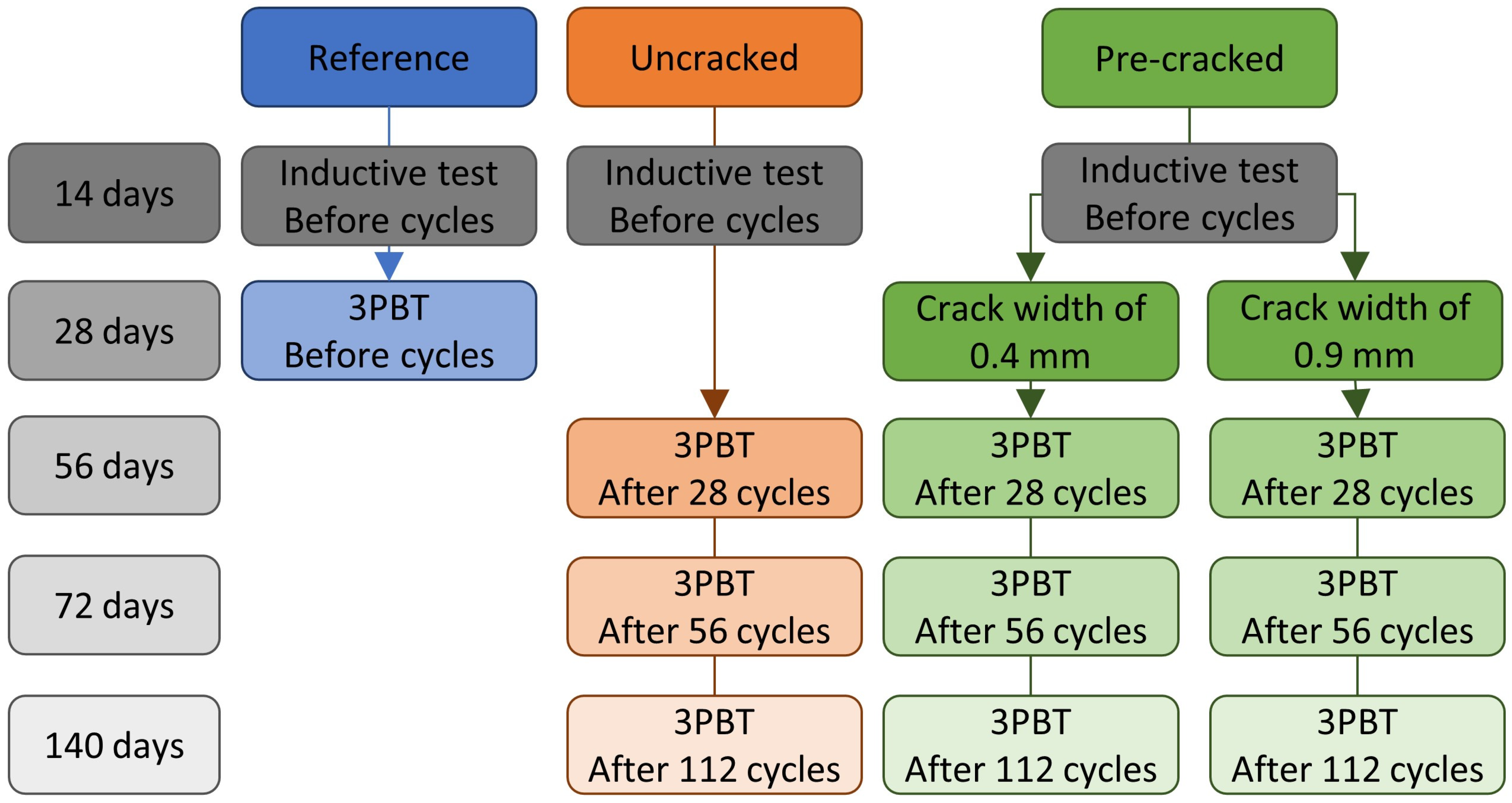
Figure 2 illustrates the experimental program conducted in this study. The study began by utilizing the inductive test [37,38] to quantify the steel fiber content within all prismatic specimens (see Section 2.2.1). Subsequently, these specimens were categorized into three distinct groups:
(i)
Reference (REF): This group comprised 9 specimens, primarily designated for characterizing the tensile behavior with a 3-point bending test (see Section 2.2.4) of the SFRCC at 28 days of cement hydration.
(ii)
Uncracked (UC): Consisting of 27 specimens, this group was subjected to NaCl spray cycles (see Section 2.2.3) and subsequently tested after intervals of 28 (UC/28), 56 (UC/56), and 112 (UC/112) cycles.
(iii)
Pre-cracked (C): Comprising 54 specimens, this group was further divided into two subgroups: one in which half of the specimens were pre-cracked (see Section 2.2.2) until reaching a crack width of 0.4 mm (C-0.4), and the other half until reaching a crack width of 0.9 mm (C-0.9). Following the precracking process, these specimens were subjected to NaCl spray cycles and subsequently tested after intervals of 28 (C-0.4/28 and C-0.9/28), 56 (C-0.4/56 and C-0.9/56), and 112 (C-0.4/112 and C-0.9/112) cycles.
The testing procedure was a comprehensive process encompassing four distinct steps, each of which is thoroughly described in Section 2.2.1, Section 2.2.2, Section 2.2.3 and Section 2.2.4. These subsections provide a detailed account of the individual phases involved in the testing process, ensuring a comprehensive understanding of the experimental methodology.

2.2.1. Inductive Test

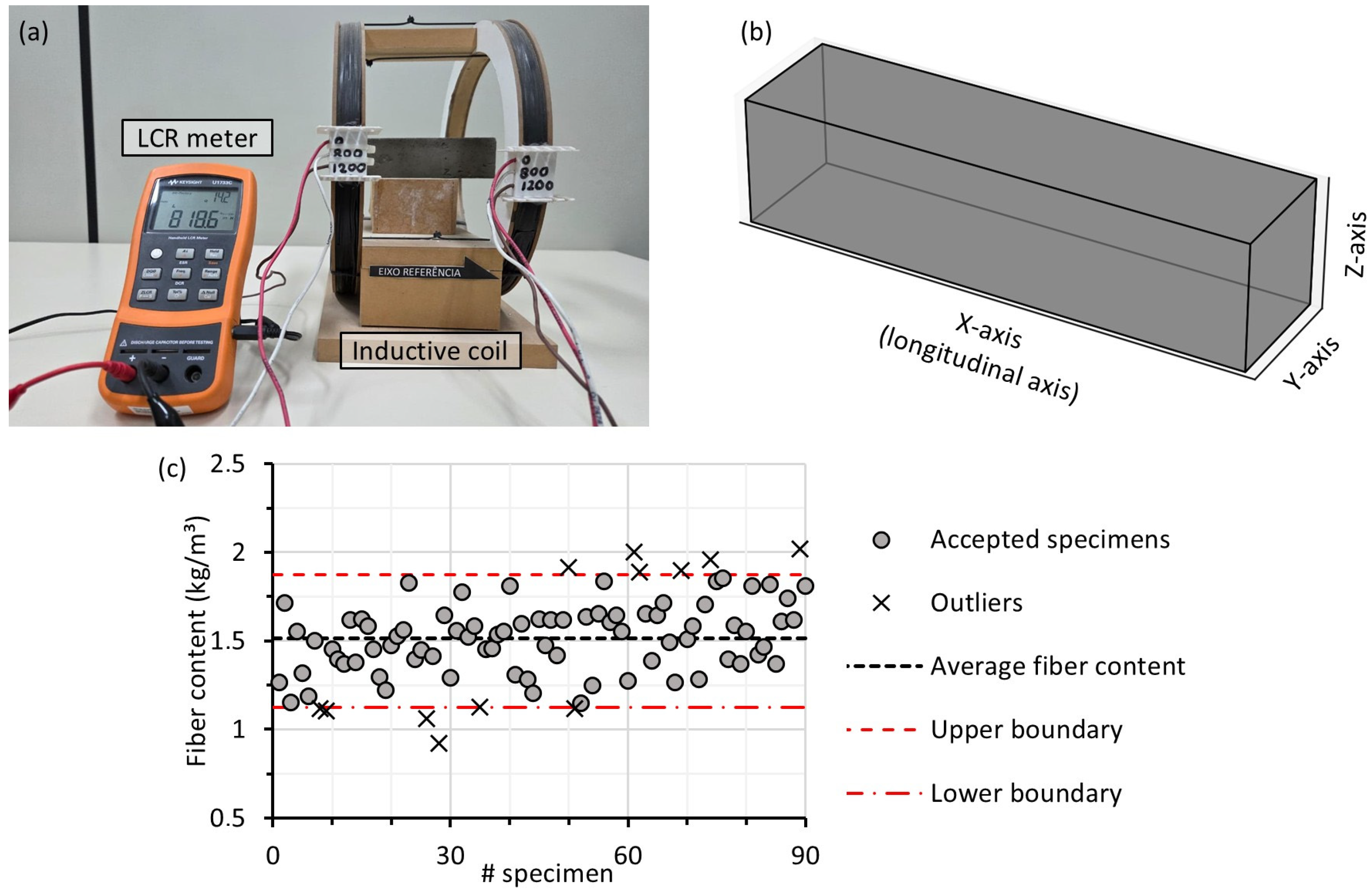
The inductive testing method, following the procedures outlined by [8], was utilized to assess the quantity of steel fibers in the SFRCC specimens. Figure 3a illustrates the testing apparatus, as described in Refs. [38,39], which consisted of two circular winding coils with an inner diameter of 25 cm, constructed using 0.3 mm diameter copper wire, totaling 1200 turns. The coils were positioned 13 cm apart and connected in parallel. Additionally, a Keysight model U1733C LCR meter was incorporated into the setup. To execute the test, SFRCC specimens were situated in three distinct orientations within the equipment, corresponding to three orthogonal axes (Figure 3b), and changes in inductance were measured for each orientation. The cumulative alterations in inductance across all directions provided a comprehensive estimation of the fibers content.
In line with quality control objectives, the procedure proposed by [8] was employed in this study. Any specimens that exhibited inductance values exceeding a predetermined range (±25% of the mean value) were categorized as outliers and subsequently excluded from the analysis. This action bolstered data integrity by removing data points that markedly diverged from the expected values. Figure 3c illustrates the distribution of fiber content across different specimens, highlighting the application of this quality control approach. The black dashed line represents the mean fiber content (~1.51 kg/m3) of the specimens that remained within the acceptable range, while the red dashed lines define the upper and lower boundaries set at ±25% of the objective fiber content (1.5 kg/m3). Specimens represented by gray circles fall within this range, whereas those marked with an “X” exceeded these limits and were categorized as outliers. The removal of these outliers ensured consistency in fiber content measurements, reducing the impact of extreme variations and improving dataset reliability.

2.2.2. Pre-Cracking Process

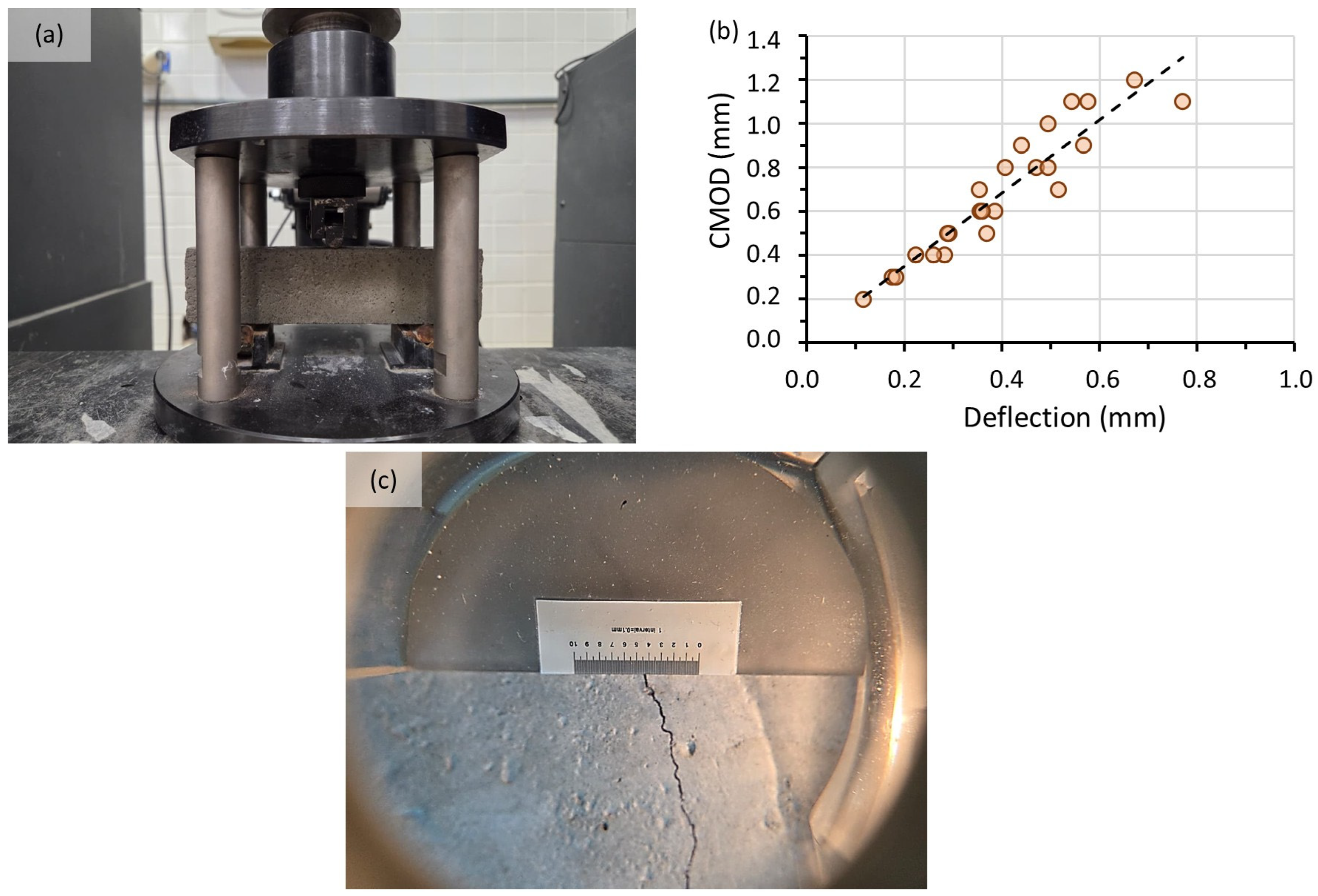
To assess the impact of crack width on chloride-induced corrosion in SFRCC, controlled localized cracking was initiated in the specimens through a mechanical pre-cracking procedure adapted from [40]. After 28 days of curing, the specimens within the precracking group (see Figure 2) underwent pre-cracking using a deflection-controlled three-point bending test (Figure 4a). This was conducted using an EMIC DL-10000 press equipped with a 100 kN load cell. The setup consisted of two supports holding the specimen while a central loading point induced controlled bending. The loading was applied at a deflection rate of 5 × 10⁻⁴ mm/s, maintaining a gradual increase in deformation until the target deflections were reached. To determine the appropriate deflections for achieving the desired crack widths, preliminary tests were carried out on sacrificial specimens. These initial trials helped establish the correlation between applied deflection and resulting crack width, enabling the identification of critical deflection values. As shown in Figure 4b, deflections of 0.25 mm and 0.55 mm were found to correspond to crack widths of 0.4 mm (C-0.4) and 0.9 mm (C-0.9), respectively. These values were selected as reference points for the pre-cracking procedure. Once the predetermined deflections were achieved, the specimens were unloaded at the same controlled rate to allow for crack stabilization. Following the pre-cracking procedure, crack width measurements were taken to verify the accuracy of the induced damage. A crack-measuring magnifier with 12× magnification and a resolution of 0.05 mm was used to measure and confirm the crack widths (Figure 4c).

2.2.3. Salt Spray Cycles

The salt spray cycles were conducted within an artificial weathering chamber to investigate the impact of chloride-induced corrosion on the flexural tensile strength of SFRCC specimens. Except for REF specimens, all others, including the uncracked (UC) and precracked (C-0.4 and C-0.9) groups, underwent wetting and drying cycles in a salt spray chamber, specifically utilizing the BASS USX-6000/2010-CYCLIC model, inducing corrosion in the steel fibers. A complete wetting and drying cycle, following the ASTM B117 [41] and ASTM D1654 [42] standards, comprised 8 h of wetting through the spraying of a 5% aqueous NaCl solution at a constant temperature of 40 °C ± 2 °C, followed by 16 h of drying at a constant temperature of 25 °C ± 2 °C. As a result, the exposure duration to chloride action varied as follows: 672 h (28 cycles), 1344 h (56 cycles), and 2688 h (112 cycles).
The salt spray test was selected because it reproduces the atmospheric marine environment where chloride deposition occurs through airborne droplets followed by wet–dry cycling, which is particularly relevant for corrosion processes initiated at cracks. This accelerated exposure method has already been used in several studies evaluating the durability of concrete under marine spray conditions, including investigations of fiber-reinforced and lightweight concretes [42,43,44,45]. Compared to immersion or impressed-current techniques, salt spray avoids electrochemical artifacts and better reflects the natural chloride accumulation experienced by structures exposed to marine atmospheres

2.2.4. 3-Point Bending Test

To evaluate the influence of steel fiber corrosion on the post-crack behavior of SFRCC, 3-point bending tests were performed. These tests were carried out following a modified version of the UNE EN 14651 [46], which involved reducing the size of the specimens [47] and eliminating the creation of notches in them [40]. Although the stress field in a 3-point bending test includes both bending and shear, this configuration is widely used for characterizing the post-cracking tensile behavior of FRC. Because our goal was to compare residual tensile strengths in corroded and uncorroded states, the test offers a standardized and highly reproducible framework for evaluating fiber–matrix interaction under flexural tension. Table 3 provides an overview of the number of specimens after the inductive test and their respective hydration times at the moment of testing. The REF group underwent testing before the initiation of salt spray cycles. In contrast, the UC group, as well as the pre-cracked specimens with crack widths of 0.4 mm (C-0.4) and 0.9 mm (C-0.9), were tested after exposure to 28, 56, and 112 salt spray cycles, corresponding to ages of 56, 84, and 140, respectively. To control the rate of load application, the deflection was incrementally increased at a rate of 1 × 10⁻³ mm/s. The tests concluded when the deflection reached 3.0 mm. Subsequently, data processing involved converting the deflection into Crack Mouth Opening Displacement (CMOD), and a load–CMOD curve was generated for each specimen. It is worth noting that, for all pre-cracked specimens, the initially measured pre-crack width served as the starting point for the CMOD data in these tests.

2.2.5. Statistical Analysis

A statistical evaluation was carried out to determine whether chloride exposure produced significant differences in the residual tensile strengths. A one-way ANOVA was applied separately to each residual strength parameter, adopting a significance level of α = 0.05. Only specimens that remained within the acceptable fiber-content range determined by the inductive test were included in the analysis, and the final sample sizes correspond to those presented in Table 3.
Before performing the ANOVA, the assumptions of normality and homogeneity of variance were verified using the Shapiro–Wilk and Levene tests, respectively. When the ANOVA indicated statistically significant differences, Tukey’s Honestly Significant Difference (HSD) post hoc test was applied to identify specific differences between groups.
All statistical computations were performed using the software PAST 5 (version 5.3). The same procedure was applied consistently to all exposure conditions and specimen types.

3. Results and Discussion

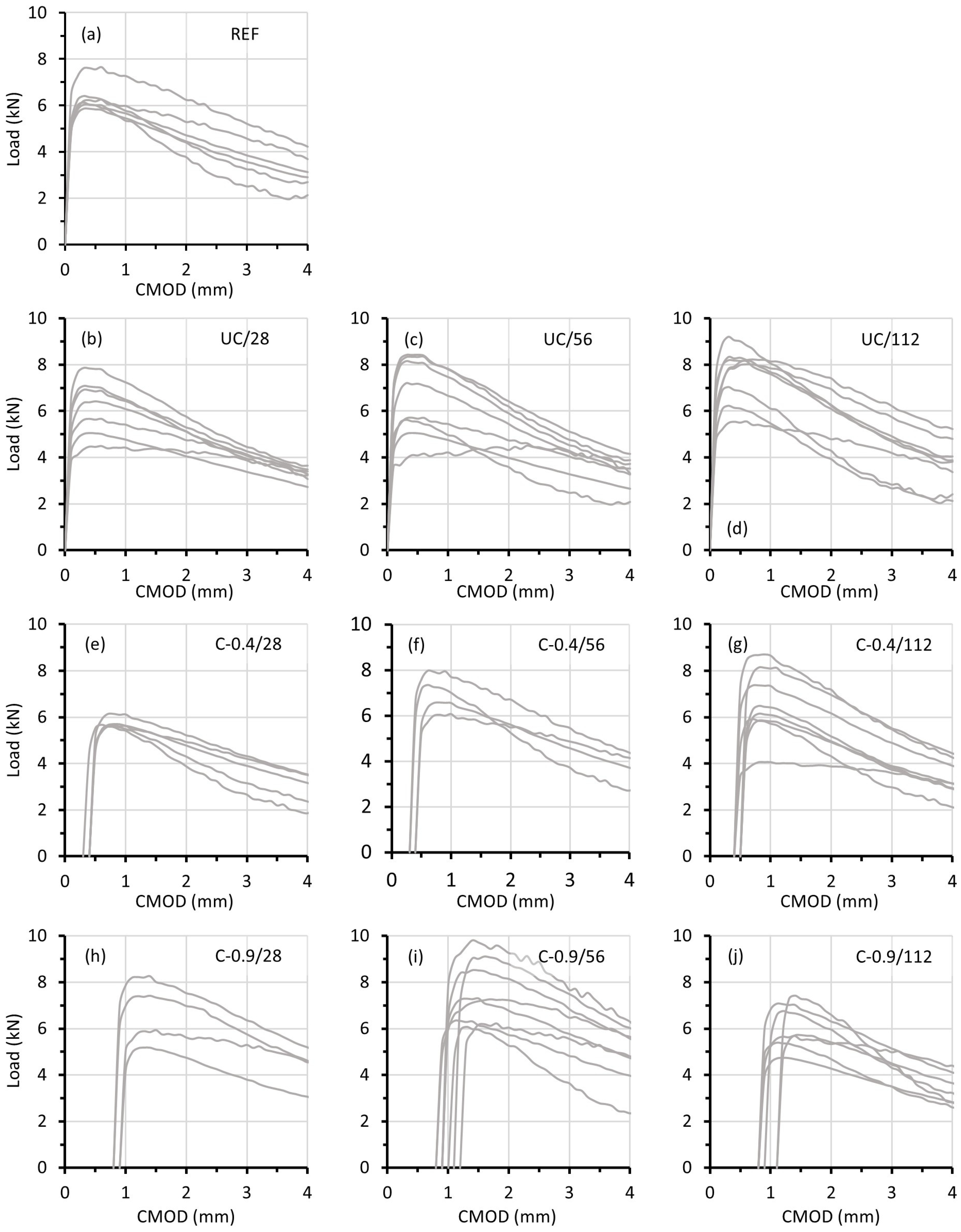
Figure 5 presents the load–CMOD curves for SFRCC specimens under different chloride exposure conditions, highlighting the influence of pre-cracking and exposure duration on mechanical performance. Figure 6a represents the reference condition (REF), depicting the flexural response of unexposed specimens at 28 days of curing. Figure 5b–d show the load–CMOD behavior of uncracked specimens (UC series) after 28, 56, and 112 salt spray cycles, respectively. For pre-cracked specimens, Figure 5e–g and Figure 5h–j illustrate the results for initial crack widths of 0.4 mm (C-0.4 series) and 0.9 mm (C-0.9 series), respectively, tested after different exposure periods. The load–CMOD curves for these specimens are influenced by their respective initial crack widths, affecting the onset of each curve’s behavior.
The Load–CMOD response of the UC series remained relatively consistent across exposure durations, with minimal variations in peak load and post-peak behavior, indicating that chloride exposure had a negligible effect on the initial mechanical response of uncracked specimens. Conversely, pre-cracked specimens (C-0.4 and C-0.9) exhibited notable differences, particularly in terms of initial stiffness and peak load capacity. The C-0.4 and C-0.9 series presented reduced initial stiffness, as expected due to the presence of an initial crack, with the C-0.9 specimens showing the most pronounced reduction in peak load. The Load–CMOD curves of pre-cracked specimens were strongly influenced by their initial crack width, with C-0.9 specimens exhibiting an earlier onset of softening and lower load resistance compared to C-0.4 specimens. Despite differences in peak load, all specimens demonstrated deflection-softening behavior, suggesting that even after extended chloride exposure, SFRCC retained its post-cracking ductility. These results indicate that pre-existing cracks, rather than chloride exposure alone, are dominant in altering mechanical performance, with wider initial cracks leading to more pronounced reductions in peak strength.
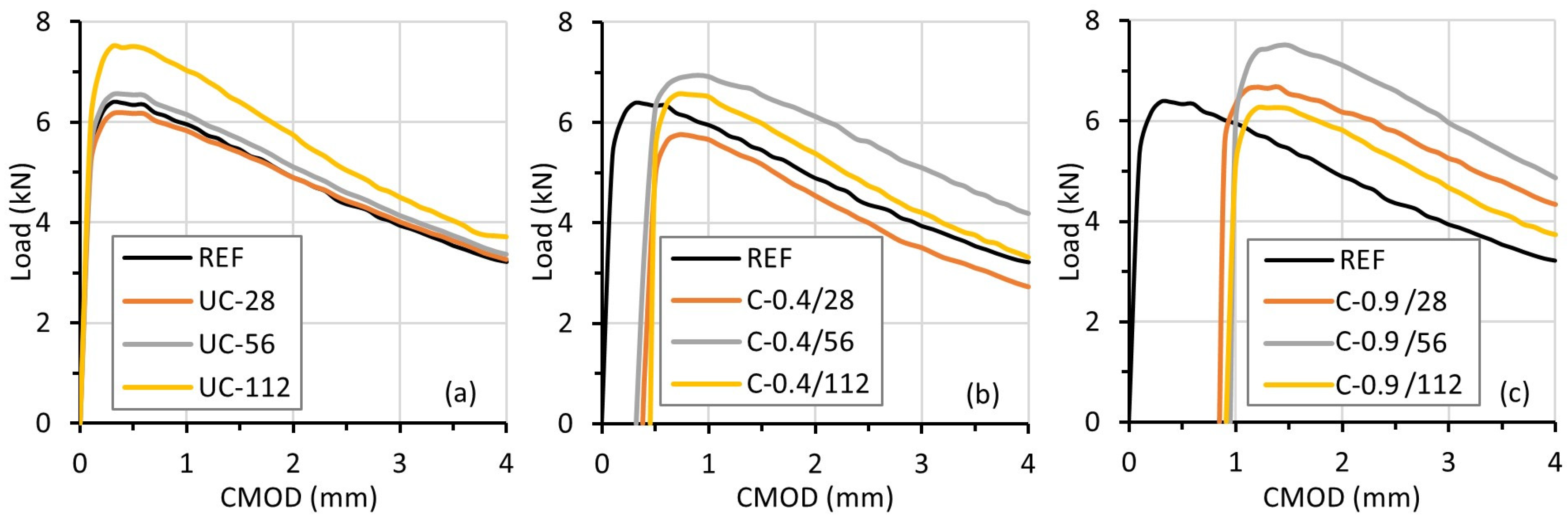
To enhance the comparison among the different exposure conditions and initial crack widths, an additional figure presenting only the average load–CMOD curves for each series has been included (Figure 6). This figure complements the individual curves shown previously by providing a clearer visualization of the overall trends in flexural behavior, including the evolution of post-cracking response with increasing exposure duration. Because the area under the load–CMOD curve is directly related to the energy absorption capacity of the material, the average curves also enable a qualitative and quantitative assessment of how chloride exposure influences toughness.
The reference specimens exhibited an average toughness of 19.22 kN·mm, while the uncracked specimens showed comparable or slightly higher values with increasing exposure time (19.13 kN·mm at 28 cycles, 19.99 kN·mm at 56 cycles, and 22.34 kN·mm at 112 cycles). For pre-cracked specimens with an initial crack width of 0.4 mm, the toughness values ranged between 15.36 and 20.78 kN·mm, whereas specimens with a 0.9 mm crack width presented values between 15.67 and 19.41 kN·mm. In both cracked series, higher toughness values were generally observed at intermediate exposure durations, followed by a reduction after prolonged exposure. The average curves were computed from all specimens that remained within the acceptable fiber-content range determined by the inductive test.
To improve readability and comparison of the results, the residual tensile strengths ( F R j ) of SFRCC specimens were calculated according to [47], to consider the size effect, and Equation (1) for specific CMODs (0.5, 1.5, 2.5 and 3.5 mm). Load values corresponding to a CMOD of 0.5 mm could not be obtained for the pre-cracked specimens, denoted as C-0.4 and C-0.9. For the C-0.4 specimens, the proximity of the initial crack width to the 0.5 mm CMOD threshold raises concerns about the precision of load estimation, potentially introducing inaccuracies into the data of this point. On the other hand, in the case of the C-0.9 specimens, the initial crack width exceeded the 0.5 mm CMOD, resulting in load values that could not be practically determined. Therefore, Table 4 presents the average and standard deviation results of residual tensile strengths ( f R 1 , f R 2 , f R 3 and f R 4 ) associated with CMOD values of 0.5, 1.5, 2.5 and 3.5 mm. These results are organized according to the duration of the salt-spray cycles and the initial condition (whether uncracked or pre-cracked).
f R j = F j l b h s p 2
f R j refers to the residual tensile strength associated with the CMOD value j defined in EN 14651 (i.e., f R 1 for CMOD = 0.5 mm, f R 2 for 1.5 mm, f R 3 for 2.5 mm, and f R 4 for 3.5 mm).
ANOVA and Tukey test were performed to evaluate the differences between the REF and the other groups (UC/28, UC/56, UC112, C-0.4/28, C-0.4/56, C-0.4/112, C-0.9/28, C-0.9/56 and C-0.9/112) for each residual tensile strength ( f R 1 , f R 2 , f R 3 and f R 4 ) within a 0.05 significance level. Table 5 summarizes the results of the statistical analysis, highlighting the absence of significant differences for uncracked specimens and the enhancement of post-cracking residual strengths in pre-cracked specimens with larger (>0.4 mm) crack widths. No statistically significant differences were observed between the REF and UC specimens, regardless of the exposure duration. This suggests that chloride exposure alone did not significantly impact residual tensile strength in intact (uncracked) specimens. These findings align with existing literature, which states that in steel fiber-reinforced composites without pre-existing cracks, the lack of fiber connectivity inhibits the progression of corrosion-related deterioration. Additionally, no significant rust spots were observed on the UC series specimens, even after prolonged exposure of 112 cycles, further supporting their durability under chloride attack. For specimens with an initial crack width of 0.4 mm (C-0.4 series), no statistically significant differences in residual tensile strengths were detected when compared to REF. However, an increasing trend in f R 2 and f R 3 values was noted with longer exposure durations (56 and 112 cycles), despite the higher coefficient of variation in this group.
For the C-0.4 series, a greater presence of stains and corrosion products was observed. The fibers near the cracked zone exhibited a more pronounced onset of corrosion; however, no propagation of the corrosion process to fibers farther from the surface was detected, even within the cracked zone. This suggests that the corrosion of the more superficial fibers partially sealed the crack, hindering the ingress of aggressive agents. Another hypothesis is that late-stage cement hydration may have occurred. The mixture used contained a high quantity of cement, which could have led to continued hydration once the crack formed, allowing water to penetrate and hydrate the cement, resulting in pore closure [48]. Since this was not pozzolanic hydration, no hydration products were detected in microscopic analyses that could be identified as self-healing products.
The mechanisms proposed to explain the evolution of residual strengths are interpretations based on observable trends. These include the increase in fiber surface roughness caused by corrosion [11], the partial filling of cracks by corrosion products [10,28], and the possibility of continued hydration in mixtures with high cement content [48]. These explanations should be viewed as plausible rather than definitive, since direct measurements (e.g., micro-CT or quantitative ITZ characterization) were not carried out.
For crack widths of 0.9 mm (C-0.9 series), statistically significant differences were observed compared to the REF series, except in the case of C-0.9/112, where the results converged with REF values. The specimens from the C-0.9/28 and C-0.9/56 series showed increased residual strengths ( f R 2 , f R 3 , and f R 4 ) relative to REF, indicating an initial improvement in fiber–matrix bond strength due to corrosion-induced surface roughness. The enhanced interlock between corroded fibers and the cement matrix likely contributed to greater resistance during fiber pullout, leading to higher load-bearing capacity. However, when the exposure time was increased from 56 cycles (C-0.9/56 samples) to 112 cycles (C-0.9/112 samples), a reduction in residual strengths was observed. This suggests the existence of a threshold between 56 and 112 exposure cycles, where significant deterioration occurred, and the fiber roughness due to corrosion was no longer beneficial. For shorter hydration periods, up to 56 days, fiber corrosion appears to generate an increased specific surface area around the fibers due to the precipitation of hydroxides and metal oxides. This leads to greater resistance during fiber pullout, reflected in higher residual tensile strength compared to the REF samples. However, after 56 days, a degradation of the interfacial transition zone (ITZ) between the fiber and the cement matrix occurs. The ITZ, rich in calcium hydroxide and calcium ions, dissolves in the presence of NaCl and precipitates as calcium chloride. This process reduces the calcium concentration in the ITZ solution, dissolving part of the calcium hydroxide in the region, and alters the mechanical properties due to pore formation [49,50]. Consequently, lower residual tensile strength was observed in specimens exposed to 112 cycles.
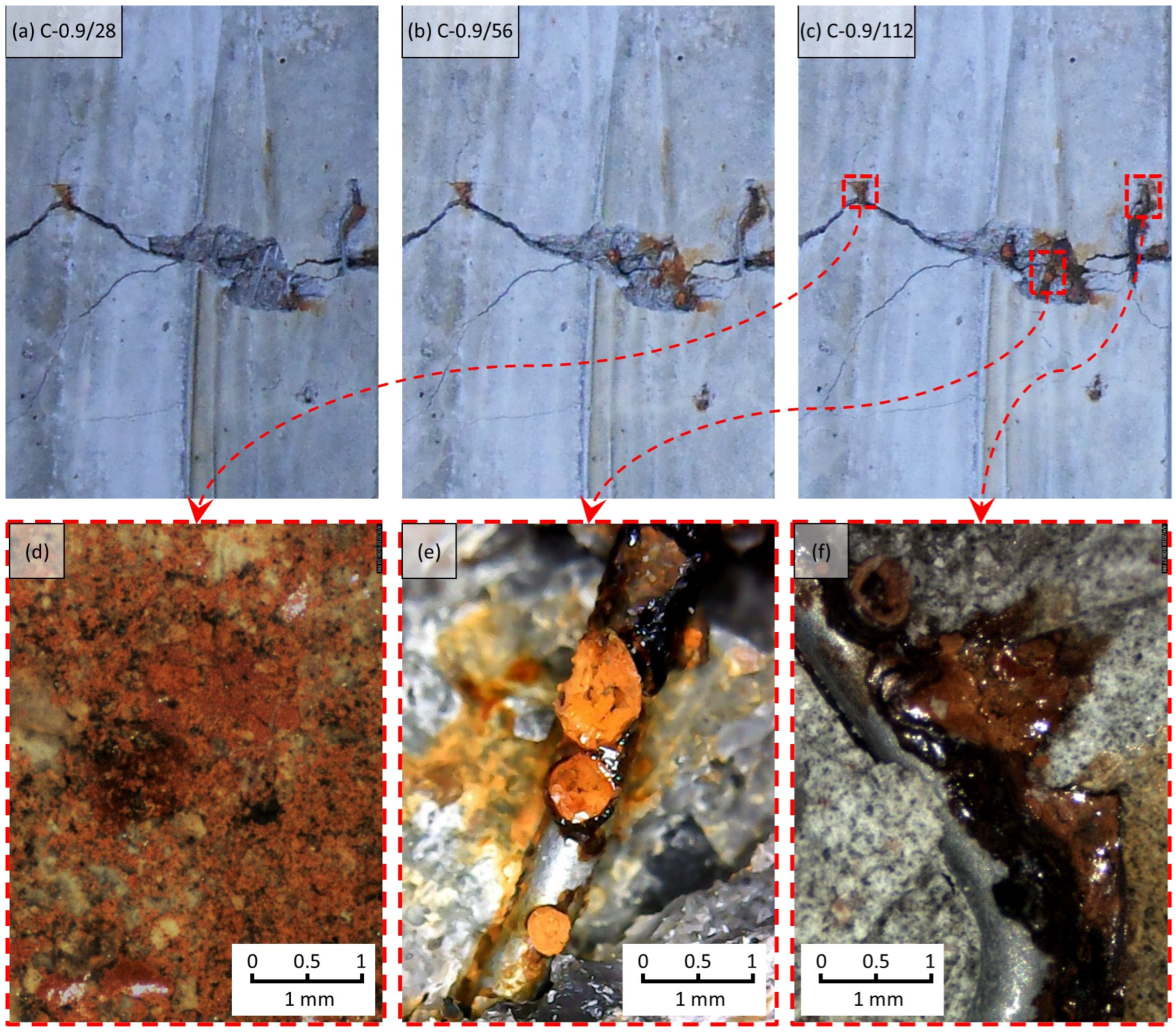
Figure 7 presents the progression of corrosion in a specimen with an initial crack width of 0.9 mm, subjected to different durations of chloride exposure cycles. The macro images (Figure 7a–c) illustrate the increasing severity of corrosion over 28, 56, and 112 cycles, respectively, with rust stains and corrosion deposits becoming progressively more pronounced along the cracked surface. After 112 cycles (Figure 7c), the specimen exhibits the most significant accumulation of corrosion products, suggesting that prolonged chloride exposure facilitated fiber oxidation and deterioration.
The microscopic images (Figure 7d–f) provide further insight into the corrosion mechanisms affecting the fibers. Figure 7d displays an area covered with dense oxide deposits, indicating the presence of corrosion products accumulating along the crack interface. Figure 7e captures the central section of corroded fiber, where localized oxidation has significantly increased surface roughness, potentially influencing fiber–matrix bonding. Figure 7f reveals the bent region of an exposed fiber, where pitting corrosion and material loss are evident, suggesting that fiber integrity is increasingly compromised with prolonged exposure. These findings confirm that corrosion effects intensify over time, with early-stage oxidation potentially enhancing fiber–matrix interaction through increased roughness, but long-term exposure leading to material degradation, bond weakening, and mechanical performance reductions. Additionally, the accumulation of corrosion products in the crack region suggests partial crack sealing, which may temporarily slow chloride ingress but does not prevent progressive fiber deterioration. This highlights the complex relationship between corrosion, fiber–matrix interaction, and long-term durability in chloride-exposed SFRCC specimens.

4. Conclusions

The following conclusions may be derived based on the analysis of the experimental studies conducted here.
  • Corrosion of steel fibers in SFRCC specimens does not significantly affect the residual tensile strength when the specimen remains uncracked (UC). This aligns with literature suggesting that in intact steel fiber-reinforced elements, corrosion does not pose a significant durability issue due to the lack of connectivity between the fibers.
  • Width of cracks plays a significant role in the corrosion process. For specimens an initial crack width of 0.4 mm, no significant deterioration was observed in residual tensile strength, even after prolonged exposure to salt spray cycles. In these specimens, corrosion of surface fibers may have partially sealed the cracks, hindering further ingress of aggressive agents.
  • For specimens with a larger initial crack width (0.9 mm), corrosion led to a noticeable increase in residual tensile strength at early exposure times (28 and 56 cycles). This can be attributed to the increase in surface roughness of the fibers, which enhanced the bond strength with the cementitious matrix. After 112 cycles of exposure, no statistically significant differences were observed relative to the reference specimens, indicating that the beneficial effect of early corrosion was no longer present.
The findings suggest that the durability of SFRCC can be influenced by both the presence of cracks and the duration of chloride exposure. While uncracked specimens maintain satisfactory strength, pre-cracked specimens, especially those with larger cracks, show more significant deterioration in performance after prolonged exposure, making the monitoring of crack widths important to ensure the long-term durability of SFRCC in chloride-exposed environments.
Future research could explore microstructural techniques such as SEM–EDS to provide additional insight into corrosion products and fiber–matrix interaction. It would also be valuable to investigate longer exposure periods and other aggressive environments to better understand how different deterioration mechanisms influence the tensile performance of SFRCC.

Author Contributions

Conceptualization, A.C.M.N. and R.P.; methodology, A.C.M.N. and R.P.; software, R.P.; formal analysis, C.A.C., L.F.J., M.H.F.d.M. and R.P.; investigation, A.C.M.N.; resources, C.A.C., L.F.J., M.H.F.d.M. and R.P.; data curation, R.P.; writing—original draft preparation, A.C.M.N.; writing—review and editing, C.A.C., L.F.J., M.H.F.d.M. and R.P.; visualization, R.P.; supervision, R.P. All authors have read and agreed to the published version of the manuscript.

Funding

This research received no external funding.

Data Availability Statement

No new data were created or analyzed in this study.

Acknowledgments

The authors would like to thank the Graduate Program in Civil Engineering at the Federal University of Paraná (PPGEC/UFPR) and the Civil Engineering Studies Center (CESEC) for the institutional support.

Conflicts of Interest

The authors declare no conflicts of interest.

References

  1. Beglarigale, A.; Yazıcı, H. Electrochemical corrosion monitoring of steel fiber embedded in cement based composites. Cem. Concr. Compos. 2017, 83, 427–446. [Google Scholar] [CrossRef]
  2. Korec, E.; Jirásek, M.; Wong, H.S.; Martínez-Pañeda, E. Unravelling the interplay between steel rebar corrosion rate and corrosion-induced cracking of reinforced concrete. Cem. Concr. Res. 2024, 186, 107647. [Google Scholar] [CrossRef]
  3. Zheng, Y.; Lv, X.; Hu, S.; Zhuo, J.; Wan, C.; Liu, J. Mechanical properties and durability of steel fiber reinforced concrete: A review. J. Build. Eng. 2024, 82, 108025. [Google Scholar] [CrossRef]
  4. Debella, L.C.; de Sousa, A.M.D.; de Resende, T.L.; Pieralisi, R. Behavior and shear strength of SFRC beams without stirrups: Proposed model and parametric analyses. Structures 2024, 67, 106954. [Google Scholar] [CrossRef]
  5. Balouch, S.U.; Forth, J.P.; Granju, J.-L. Surface corrosion of steel fibre reinforced concrete. Cem. Concr. Res. 2010, 40, 410–414. [Google Scholar] [CrossRef]
  6. Pyo, S.; Koh, T.; Tafesse, M.; Kim, H.-K. Chloride-induced corrosion of steel fiber near the surface of ultra-high performance concrete and its effect on flexural behavior with various thickness. Constr. Build. Mater. 2019, 224, 206–213. [Google Scholar] [CrossRef]
  7. Lv, L.-S.; Wang, J.-Y.; Xiao, R.-C.; Fang, M.-S.; Tan, Y. Influence of steel fiber corrosion on tensile properties and cracking mechanism of ultra-high performance concrete in an electrochemical corrosion environment. Constr. Build. Mater. 2021, 278, 122338. [Google Scholar] [CrossRef]
  8. Vieira, M.M.; Cavalaro, S.H.P.; Aguado, A.; Rambo, D.A.S.; Salvador, R.P. Fibre corrosion in uncracked high-performance fibre reinforced cementitious composites. Constr. Build. Mater. 2021, 312, 125440. [Google Scholar] [CrossRef]
  9. Gao, D.; Cao, Z.; Yang, L.; Yang, X.; Sun, G.; Li, Y.; Zhang, Y.; Zhang, Y. Performance of steel fiber reinforced concrete mixed with chloride solution and exposed to high humidity environment. Constr. Build. Mater. 2023, 393, 132122. [Google Scholar] [CrossRef]
  10. Granju, J.-L.; Balouch, S.U. Corrosion of steel fibre reinforced concrete from the cracks. Cem. Concr. Res. 2005, 35, 572–577. [Google Scholar] [CrossRef]
  11. Frazão, C.; Barros, J.; Camões, A.; Alves, A.C.; Rocha, L. Corrosion effects on pullout behavior of hooked steel fibers in self-compacting concrete. Cem. Concr. Res. 2016, 79, 112–122. [Google Scholar] [CrossRef]
  12. Yoo, D.-Y.; Shin, W.; Chun, B.; Banthia, N. Assessment of steel fiber corrosion in self-healed ultra-high-performance fiber-reinforced concrete and its effect on tensile performance. Cem. Concr. Res. 2020, 133, 106091. [Google Scholar] [CrossRef]
  13. Ngo, T.T.; Tran, N.T.; Kim, D.J.; Pham, T.C. Effects of corrosion level and inhibitor on pullout behavior of deformed steel fiber embedded in high performance concrete. Constr. Build. Mater. 2021, 280, 122449. [Google Scholar] [CrossRef]
  14. Song, Z.; Li, S.; Yu, Q. Chloride induced mechanical degradation of ultra-high performance fiber-reinforced concrete: Insights from corrosion evolution paths. Constr. Build. Mater. 2023, 395, 132329. [Google Scholar] [CrossRef]
  15. Marcos-Meson, V.; Michel, A.; Solgaard, A.; Fischer, G.; Edvardsen, C.; Skovhus, T.L. Corrosion resistance of steel fibre reinforced concrete-A literature review. Cem. Concr. Res. 2018, 103, 1–20. [Google Scholar] [CrossRef]
  16. American Concrete Institute (ACI) State-of-the-Art Report on Fiber Reinforced Concrete; ACI Committee 544.1R; American Concrete Institute: Farmington Hills, MI, USA, 2002; ISBN 9780870315282.
  17. American Concrete Institute (ACI) Report on the Physical Properties and Durability of Fiber-Reinforced Concrete; ACI Committee 544.5R; American Concrete Institute: Farmington Hills, MI, USA, 2010; ISBN 978-0-87031-365-3.
  18. Boletín Oficial del Estado (BOE). Real Decreto 470/2021, Agencia Estatal, Código Estructural; Boletín Oficial del Estado (BOE): Madrid, Spain, 2021. [Google Scholar]
  19. CRN. Guide for the Design and Construction of Fiber-Reinforced Concrete Structures; National Research CouncilCRN: Rome, Italy, 2006. [Google Scholar]
  20. DafStb. DAfStb Stahlfaserbeton; Deutscher Ausschuss für Stahlbeton e. V.-DafStb: Berlin, Germany, 2012. [Google Scholar]
  21. Pyo, S.; Tafesse, M.; Kim, H.; Kim, H.-K. Effect of chloride content on mechanical properties of ultra high performance concrete. Cem. Concr. Compos. 2017, 84, 175–187. [Google Scholar] [CrossRef]
  22. Song, Z.; Li, S.; Cheng, L.; Yu, Q. Corrosion-induced deterioration and fracture mechanisms in ultra-high-performance fiber-reinforced concretet. Constr. Build. Mater. 2024, 423, 135886. [Google Scholar] [CrossRef]
  23. Tai, Y.; Yang, L.; Gao, D.; Kang, K.; Cao, Z.; Zhao, P. Properties evolution and deterioration mechanism of steel fiber reinforced concrete (SFRC) under the coupling effect of carbonation and chloride attack. J. Build. Eng. 2024, 95, 110275. [Google Scholar] [CrossRef]
  24. Yoo, D.-Y.; Shin, W.; Chun, B. Corrosion effect on tensile behavior of ultra-high-performance concrete reinforced with straight steel fibers. Cem. Concr. Compos. 2020, 109, 103566. [Google Scholar] [CrossRef]
  25. Bashar, I.I.; Visintin, P.; Sheikh, A.H. An experimental investigation on tensile behaviour of corroded ultra-high-performance concrete. Case Stud. Constr. Mater. 2022, 17, e01400. [Google Scholar] [CrossRef]
  26. Jang, Y.S.; Oh, T.; Banthia, N.; Yoo, D.-Y. Effects of nano-SiO2 coating and induced corrosion of steel fiber on the interfacial bond and tensile properties of ultra-high-performance concrete (UHPC). J. Build. Eng. 2022, 54, 104637. [Google Scholar] [CrossRef]
  27. Yoo, D.-Y.; Oh, T.; Shin, W.; Kim, S.; Banthia, N. Tensile behavior of crack-repaired ultra-high-performance fiber-reinforced concrete under corrosive environment. J. Mater. Res. Technol. 2021, 15, 6813–6827. [Google Scholar] [CrossRef]
  28. Wang, X.; Liu, Y.; Liu, S. Effect of chloride-induced corrosion on bond performance of various steel fibers in cracked SFRC. Cem. Concr. Compos. 2023, 140, 105113. [Google Scholar] [CrossRef]
  29. Yoo, D.-Y.; Gim, J.Y.; Chun, B. Effects of rust layer and corrosion degree on the pullout behavior of steel fibers from ultra-high-performance concrete. J. Mater. Res. Technol. 2020, 9, 3632–3648. [Google Scholar] [CrossRef]
  30. Kroviakov, S.; Kryzhanovskyi, V.; Hedulian, D. Comparison of the Corrosion Resistance of Fiber-Reinforced Concrete with Steel and Polypropylene Fibers in an Acidic Environment. Constr. Mater. 2025, 5, 6. [Google Scholar] [CrossRef]
  31. Kos, Ž.; Kroviakov, S.; Kryzhanovskyi, V.; Hedulian, D. Strength, Frost Resistance, and Resistance to Acid Attacks on Fiber-Reinforced Concrete for Industrial Floors and Road Pavements with Steel and Polypropylene Fibers. Materials 2022, 15, 8339. [Google Scholar] [CrossRef]
  32. Li, M.; Su, T.; Chen, Y.; He, H.; Yang, X. Salt spray aging effects on dynamic responses and failure characteristics of hybrid bonded-riveted CFRP/Al joints under high speed loading. J. Manuf. Process. 2021, 72, 582–593. [Google Scholar] [CrossRef]
  33. Peng, J.; Xiao, J.; Yang, Y.; Dong, Y.; Zhang, J. Long-term experimental study and prediction of the mechanical performance on corroded prestressing steel strands subjected to marine salt spray environment. Constr. Build. Mater. 2024, 425, 136069. [Google Scholar] [CrossRef]
  34. de Oliveira Pereira, V.C.; Monteiro, E.C.B.; da Silva Almeida, K. Influence of cement type in reinforcement corrosion of mortars under action of chlorides. Constr. Build. Mater. 2013, 40, 710–718. [Google Scholar] [CrossRef]
  35. EN 12350-5; Testing Fresh Concrete-Part 5: Flow Table Test. AENOR: Madrid, Spain, 2020.
  36. EN 12350–1; Testing Fresh Concrete-Part 1: Sampling and Common Apparatus. AENOR: Madrid, Spain, 2020.
  37. Cavalaro, S.H.P.; López, R.; Torrents, J.M.; Aguado, A. Improved assessment of fibre content and orientation with inductive method in SFRC. Mater. Struct. 2014, 48, 1859–1873. [Google Scholar] [CrossRef]
  38. Cavalaro, S.H.P.; López-Carreño, R.; Torrents, J.M.; Aguado, A.; Juan-García, P. Assessment of fibre content and 3D profile in cylindrical SFRC specimens. Mater. Struct. 2015, 49, 577–595. [Google Scholar] [CrossRef]
  39. Voigt, C.V.; Pieralisi, R.; Bonfim, M.J.C.; Cavalaro, S.H.P.; Medeiros-Junior, R.A. Numerical and Experimental Surface Inductive Method for Steel Fibers. ACI Mater. J. 2022, 119, 269–279. [Google Scholar] [CrossRef]
  40. Niu, L.; Zhang, S. Performance of Cracked Ultra-High-Performance Fiber-Reinforced Concrete Exposed to Dry-Wet Cycles of Chlorides. Adv. Mater. Sci. Eng. 2021, 2021, 4625972. [Google Scholar] [CrossRef]
  41. ASTM, B117-19; Standard Practice for Operating Salt Spray (Fog) Apparatus. ASTM International: West Conshohocken, PA, USA, 2019.
  42. ASTM, D1654-24; Standard Test Method for Evaluation of Painted or Coated Specimens Subjected to Corrosive Environments. ASTM International: West Conshohocken, PA, USA, 2024.
  43. Yu, J.; Abdalla, J.A.; Hawileh, R.A.; Zhang, X.; Zhang, Z. Corrosion inhibition in concrete: Synergistic performance of hybrid Steel-Polypropylene fiber reinforcement against marine salt spray. Polymers 2025, 17, 2645. [Google Scholar] [CrossRef]
  44. Su, L.; Niu, D.; Huang, D.; Luo, Y.; Qiao, H.; Zhang, Y. Chloride diffusion behavior and microstructure of basalt-polypropylene hybrid fiber reinforced concrete in salt spray environment. Constr. Build. Mater. 2022, 324, 126716. [Google Scholar] [CrossRef]
  45. Huang, D.; Niu, D.; Su, L.; Liu, Y.; Guo, B.; Xia, Q.; Peng, G. Diffusion behavior of chloride in coral aggregate concrete in marine salt-spray environment. Constr. Build. Mater. 2021, 316, 125878. [Google Scholar] [CrossRef]
  46. EN 14651:2007+A1:2008; Test Method for Metallic Fibre Concrete-Measuring the Flexural Tensile Strength (Limit of PROPORTIONALITY (LOP), Residual). AENOR: Madrid, Spain, 2008.
  47. Galeote, E.; Blanco, A.; De La Fuente, A. Design-oriented approach to determine FRC constitutive law parameters considering the size effect. Compos. Struct. 2020, 239, 112036. [Google Scholar] [CrossRef]
  48. Casagrande, C.A.; Cavalaro, S.H.P.; Repette, W.L. Ultra-high performance fibre-reinforced cementitious composite with steel microfibres functionalized with silane. Constr. Build. Mater. 2018, 178, 495–506. [Google Scholar] [CrossRef]
  49. Casagrande, C.A.; Jochem, L.F.; Repette, W.L.; Hotza, D. Evaluation of nano-TiO2 on properties of cementitious mortars. Matéria 2020, 25, e-12883. [Google Scholar] [CrossRef]
  50. Casagrande, C.A.; Roque, J.S.; Jochem, L.F.; Correa, J.N.; Medeiros, A. Copper slag in cementitious composites: A systematic review. J. Build. Eng. 2023, 78, 107725. [Google Scholar] [CrossRef]
Figure 1. Particle size distribution of the sand.
Buildings 16 00963 g001
Figure 2. Outline of the experimental program carried out in this study.
Buildings 16 00963 g002
Figure 3. Inductive Testing Method for Fiber Content Assessment and Quality Control—(a) experimental setup with inductive testing apparatus, (b) specimen positioning in three orthogonal orientations for inductance measurement, and (c) distribution of fiber content highlighting quality control measures and outlier identification.
Buildings 16 00963 g003
Figure 4. Pre-Cracking procedure: (a) three-point bending test, (b) deflection–crack width correlation, and (c) crack measurement.
Buildings 16 00963 g004
Figure 5. Experimental flexural strength in terms of Load–CMOD: (a) REF, (b) UC/28, (c) UC/112, (d) C-0.4/28, (e) C-0.4/56, (f) C-0.4/56, (g) C-0.4/112, (h) C-0.9/28, (i) C-0.9/56, and (j) C-0.9/112.
Buildings 16 00963 g005
Figure 6. Average load–CMOD curves for all experimental series: (a) REF and UC series, (b) REF and C-0.4 series, and (c) REF and C-0.9 series.
Buildings 16 00963 g006
Figure 7. Corrosion progression on a specimen with a 0.9 mm crack width exposed to different corrosion cycles – (a) 28, (b) 56, and (c) 112 cycles – and microscopic analysis of (d) rust stains and (e) middle and (f) end of fiber surface changes.
Buildings 16 00963 g007
Table 1. Summary of studies that evaluated SFRCC exposed to chlorides.
Ref.TestCondition of the SpecimenExposure Condition
BendingDirect TensilePull-OutUncrackedCrack Width < 0.1 mmCrack Width > 0.1 mmWet/Dry CyclesImmersionOther *
[6]X X X
[8,23]X X X
[21]X X X
[9,14,21,22]X X X
[12] X XX X
[25] X XX X
[24] X X X
[28] X XXX
[11,27] XXXX X
[13,26,29] XX X
* Electric current, or mixing NaCl directly into the fresh SFRCC, or using pre-corroded fibers.
Table 2. Properties of the steel fibers used in the SFRCC mixture.
PropertyAverage Results
Length (mm)30
Diameter (mm)0.62
Aspect ratio48.4
Tensile strength (MPa)1270
Modulus of elasticity (GPa)210
Table 3. Distribution of specimens and their tested ages.
NomenclatureNumber of Tested Specimens and Tested Age
28 Days
(Before Cycles)
56 Days
(28 Cycles)
84 Days
(56 Cycles)
140 Days
(112 Cycles)
REF8---
UC/28-7--
UC/56--9-
UC/112---8
C-0.4/28-5--
C-0.4/56--5-
C-0.4/112---8
C-0.9/28-4--
C-0.9/56--8-
C-0.9/112---8
Table 4. Average results of residual tensile strength with standard deviation.
f R 1 (MPa) f R 2 (MPa) f R 3 (MPa) f R 4 (MPa)
REF14.85 ± 1.3612.78 ± 1.8310.22 ± 2.218.29 ± 2.16
UC/2814.47 ± 2.7912.64 ± 1.8710.39 ± 0.998.52 ± 0.69
UC/5615.63 ± 4.1313.37 ± 3.1510.71 ± 3.018.64 ± 2.02
UC/11217.09 ± 2.6614.73 ± 3.0111.69 ± 3.289.40 ± 3.02
C-0.4/28-12.15 ± 0.809.66 ± 1.517.62 ± 1.72
C-0.4/56-14.04 ± 1.4711.34 ± 1.759.17 ± 1.81
C-0.4/112-14.13 ± 3.1111.27 ± 2.398.87 ± 1.96
C-0.9/28-15.46 ± 3.0913.61 ± 2.8711.31 ± 2.38
C-0.9/56-17.58 ± 3.3515.63 ± 3.5112.81 ± 3.23
C-0.9/112-14.00 ± 2.2411.57 ± 1.698.93 ± 1.58
Table 5. Summary of statistical analysis for residual tensile strengths.
ParameterGroups Included in ANOVAANOVA p-ValueSignificant Differences Identified
f R 1 REF, UC/28, UC/56, UC/1120.148None
f R 2 REF, UC series, C-0.4 series, C-0.9 series0.0079C-0.9/28 > REF; C-0.9/56 > REF, UC/28, UC/56
f R 3 REF, UC series, C-0.4 series, C-0.9 series≈0.001C-0.9/56 > REF, UC/28, UC/56, UC/112
f R 4 REF, UC series, C-0.4 series, C-0.9 series0.0014C-0.9/28 > REF; C-0.9/56 > REF, UC/28, UC/56
Disclaimer/Publisher’s Note: The statements, opinions and data contained in all publications are solely those of the individual author(s) and contributor(s) and not of MDPI and/or the editor(s). MDPI and/or the editor(s) disclaim responsibility for any injury to people or property resulting from any ideas, methods, instructions or products referred to in the content.