Article

Audiovisual Modulation of Traffic Noise Effects on Psychological Restoration in Expressway-Adjacent Residential Environments: A Virtual Reality Study


The College of Architecture and Urban Planning, Tongji University, Shanghai 200092, China
*
Author to whom correspondence should be addressed.
Buildings 2026, 16(4), 873; https://doi.org/10.3390/buildings16040873
Submission received: 16 January 2026 / Revised: 14 February 2026 / Accepted: 17 February 2026 / Published: 21 February 2026
(This article belongs to the Section Architectural Design, Urban Science, and Real Estate)

Abstract

Expressway traffic noise poses a critical threat to public health in developed high-density cities, causing chronic environmental stress in adjacent residential areas. While physical noise barriers are commonly used, the potential of audiovisual interactions in mitigating the adverse effects of traffic noise remains under-explored. Using immersive virtual reality (VR), this study examined the efficacy of visual greenery and auditory masking (birdsong) in promoting stress recovery, and tested whether audiovisual perception mediates the environment–restoration link. Following an acute stressor, 100 participants were randomly assigned to a 2 × 2 between-subjects experiment manipulating Green View Index (high vs. low) and soundscape composition (traffic noise vs. traffic noise plus birdsong), with 25 participants in each group. Restorative outcomes were assessed using self-reported measures and continuous physiological monitoring (heart rate variability [HRV] and electrodermal activity [EDA]). Results demonstrated that high-intensity visual greenery and natural sounds effectively enhance psychological restoration in noise-affected environments. Structural equation modeling revealed that audiovisual perception fully mediated the relationship between environmental features and restorative outcomes. The physiological outcome showed a distinct tiered restoration pattern, indicating that immediate psychological buffering can be achieved through natural sounds, while consistent visual reinforcement remained essential for deep physiological recovery. Consequently, soundscape planning in expressway-adjacent zones should integrate visual greening strategies to optimize the perceptual masking of traffic noise and enhance the environmental quality.

1. Introduction

Environmental noise has emerged as a critical global public health threat, and both the World Health Organization and the European Union identify transportation noise as the second leading environmental risk factor for ill health, surpassed only by air pollution [1,2,3]. This challenge is particularly acute in rapidly urbanizing nations like China, where noise complaints—especially in mega-cities like Beijing and Shanghai—now top environmental grievance lists [4]. A defining feature of this urbanization is the proliferation of expressways, and residents face persistent challenges to their psychological well-being. Consequently, there is an urgent need to move beyond traditional physical noise barriers and explore nature-based solutions (NbS) that mitigate stressors not just physically, but psychologically, by reintroducing restorative elements into the hardened urban fabric [5].
While noise is traditionally defined as unwanted sound causing potential harm [6], its impact is heavily modulated by subjective, contextual, and cultural factors [7]. This highlights the critical role of environmental perception—the sensory mediation between physical exposure and health outcomes [8]. Within urban forestry and landscape architecture, vegetation is increasingly recognized for its capacity to regulate these perceptions, providing cultural ecosystem services [9]. The potential for such environments to facilitate recovery from depleted cognitive and emotional resources is supported by two complementary frameworks: attention restoration theory, which emphasizes the restorative value of “soft fascination” [10], and stress reduction theory, which posits an evolutionary, physiological relaxation response to unthreatening natural scenes [11], which provides a theoretical basis for the restorative mechanisms that operate in residential areas directly besieged by severe traffic noise.
The detrimental effects of environmental noise on health are well documented, though perceptual mechanisms remain underexplored. Macro-level epidemiological studies link long-term transportation noise exposure with increased risks of hypertension, ischemic heart disease, sleep disturbance, depression and anxiety [12,13,14]. However, this often relies on coarse exposure metrics and limits its ability to inform design at the scale of residential courtyards or micro-open spaces [15,16]. In contrast, micro-scale empirical studies provide richer evidence on how specific environmental features shape perceptual and affective responses. For example, the introduction of water sounds in Sheffield’s train station plaza was found to enhance pleasure and reduce traffic noise annoyance [17,18]. Other experiments show that acoustic parameters such as sharpness and LAeq correlate with subjective acoustic satisfaction [19]. However, these studies rarely investigate the deeper pathways connecting environmental characteristics, perception and short-term psychological restoration, particularly in expressway-adjacent residential areas.
Additionally, the impact of acoustic environment on human health is a complex process; the ISO 12913 series defines soundscape as “the acoustic environment as perceived or experienced and/or understood by a person or people, in context”, explicitly distinguishing it from purely physical sound levels [17,20]. A growing body of work shows statistically significant relationships between positive soundscape appraisals (e.g., pleasantness, calmness, appropriateness) and beneficial self-reported health and well-being [21,22]. Previous studies indicate that familiarity with the composition and dynamics of the landscape can buffer individuals from adverse sound effects, enabling them to adjust expectations and thereby mitigate negative impacts on mental health-related outcomes [23]. Visual and auditory inputs interact strongly: natural sounds can perceptually mask traffic noise, improving acoustic quality [24], while soundscape–function compatibility enhances satisfaction [23,25]. Residents also tend to tolerate higher noise levels where vegetation is abundant [26], and the relative proportions of greenery, buildings and hard surfaces influence acoustic satisfaction. This masking and re-framing are often interpreted in terms of attentional diversion and cross-modal congruence: attractive visual scenes draw attention away from aversive sounds and shape what is considered to be an acceptable soundscape in a given place [27,28]. Despite these insights, the potential of residential greenery to act as a resilient “audiovisual buffer” in expressway-adjacent zones remains underexplored through the lens of sensory ecology.
As research on restorative environments has advanced, field studies have increasingly been complemented by digital simulations that allow for a controlled exploration of environment–perception interactions. Real-world observations link environmental features with perceptions but cannot fully isolate mechanisms or tightly control exposure conditions. Virtual reality (VR) offers precise manipulation of audiovisual stimuli while maintaining a high degree of perceptual realism, minimizing external variability and enhancing ecological validity [29]. VR-based experiments have documented restorative effects in diverse settings, from biophilic interiors to hospital environments and urban green spaces [30,31,32]. To capture psychological responses more comprehensively, physiological indicators such as electrodermal activity (EDA), heart rate variability (HRV), respiration and electroencephalography are widely applied as complementary measures of autonomic arousal and regulation [33,34,35]. Systematic reviews suggest that VR-based nature exposure is a promising tool for stress reduction, but also highlight the need for studies that integrate subjective, physiological and contextual variables in everyday environments, rather than exceptional natural settings.
Against this backdrop, residential areas along urban expressways represent a critical yet under-studied context. These communities are typically characterized by high building density, limited open space and persistent traffic noise. Emerging work suggests that micro-scale greenness and built form can attenuate perceived noise and enhance soundscape quality, sometimes even when measured sound levels remain high [16,19], yet we lack an integrated understanding of how specific NbS parameters—such as the Green View Index (GVI) and the presence of natural sounds—affect residents’ audiovisual perceptions, perceived restorativeness and acute psychological states in expressway-adjacent residential landscapes.
To address these gaps, the present study develops and empirically tests an environment–perception–psychological restoration framework for residential landscapes along expressways. Building on mediation theory, we assume that environmental characteristics influence restorative outcomes both directly and indirectly, via their effects on audiovisual perception, and that cross-modal interactions are likely: visual greenery may shape not only visual appraisal but also soundscape evaluations, whereas natural sounds may alter how visual scenes are experienced. Therefore, five hypotheses to be tested are formulated. First, we hypothesize that micro-scale environmental characteristics—specifically, higher GVI and the presence of natural sounds—exert significantly positive within-modality effects on visual perception and auditory perception, respectively (H1). Second, we expect cross-modal effects of environmental characteristics, such that high GVI improves auditory perception and natural sounds enhance visual perception (H2). Third, we posit that more positive visual and auditory perceptions are associated with greater psychological restoration, manifested as larger reductions in state anxiety and stronger gains in perceived restorativeness between pre- and post-exposure (H3). Fourth, we hypothesize that high GVI and natural sounds have direct positive effects on psychological restoration, over and above their effects mediated by audiovisual perception (H4). Fifth, we expect that high GVI and natural sounds also have indirect positive effects on psychological restoration through audiovisual perception, such that perception partially mediates the environment–restoration relationship (H5).
Specifically, environmental characteristics refer to objectively manipulable features of the visual and auditory environment: the visual environment is operationalized through GVI, while the auditory environment contrasts traffic noise alone with traffic noise plus natural sound (birdsong). Restorative outcomes denote short-term changes in psychological and physiological indicators of stress and recovery following exposure, captured here through pre–post changes in Perceived Restorativeness Scale (PRS) and State Anxiety Inventory (SAI) scores, together with time-series indicators of HRV and EDA recorded during audiovisual VR exposure. By integrating VR-based experiments and structural equation modeling, using combined questionnaire and psycho-physiological measures, this study seeks to clarify how nature-based solutions can be optimized to support mental health in the face of rapid urbanization and noise pollution.

2. Materials and Methods

2.1. Study Design

According to the 2023 China Noise Pollution Prevention and Control Report, first-tier cities such as Beijing and Shanghai report the highest number of traffic noise complaints, largely due to expressways. These corridors create extensive negative acoustic zones that severely disrupt nearby residents’ daily lives. Therefore, the study selected representative residential areas along Shanghai’s Middle Ring Expressway for investigation. The research team had previously identified several neighborhoods with the most severe noise issues and strongest resident complaints through online surveys, ultimately selecting Tongji Village as the case site. Located south of the Middle Ring Expressway, this site suffers from intense traffic noise pollution, whose greenery conditions in the outdoor spaces are complicated, with large vegetation groups as natural sound sources. As an open residential area, this site has a balanced age composition of residents, which meets the research requirements for field research and participant recruitment. After preliminary field investigations, the researcher developed a parametric model of the site using a VR platform (MARS 2020) to apply precision regulation of environmental elements for experimental simulation.
Three categories of variables were examined: environmental characteristics, audiovisual perception, and psychological restoration outcomes. Environmental elements were manipulated on a VR platform, while perceptual and psychological responses were collected through participant questionnaires and physiological monitoring. Environmental characteristics are divided into visual and auditory components. To ensure objectivity, only features that can be digitally recognized and quantified are selected. Vegetation, a common element in residential landscapes, is used as the visual factor, measured by the GVI, with which we measured the proportion of vegetation elements in the visual image of the landscape [36]. In this study, GVI was calculated from a sight point of 1.6 m height, with a horizontal visual field of 360 degrees and a vertical field of 120 degrees. The equidistant cylindrical projection was processed in Python 3.11, using OpenCV-4.7.0. Green vegetation was segmented using the HSV color space hue 35–85°, saturation > 20% and value > 20%. For the auditory factor, natural sounds is chosen, as the sound source type reflects the perceived quality and natural sounds are standard in soundscape studies [37].
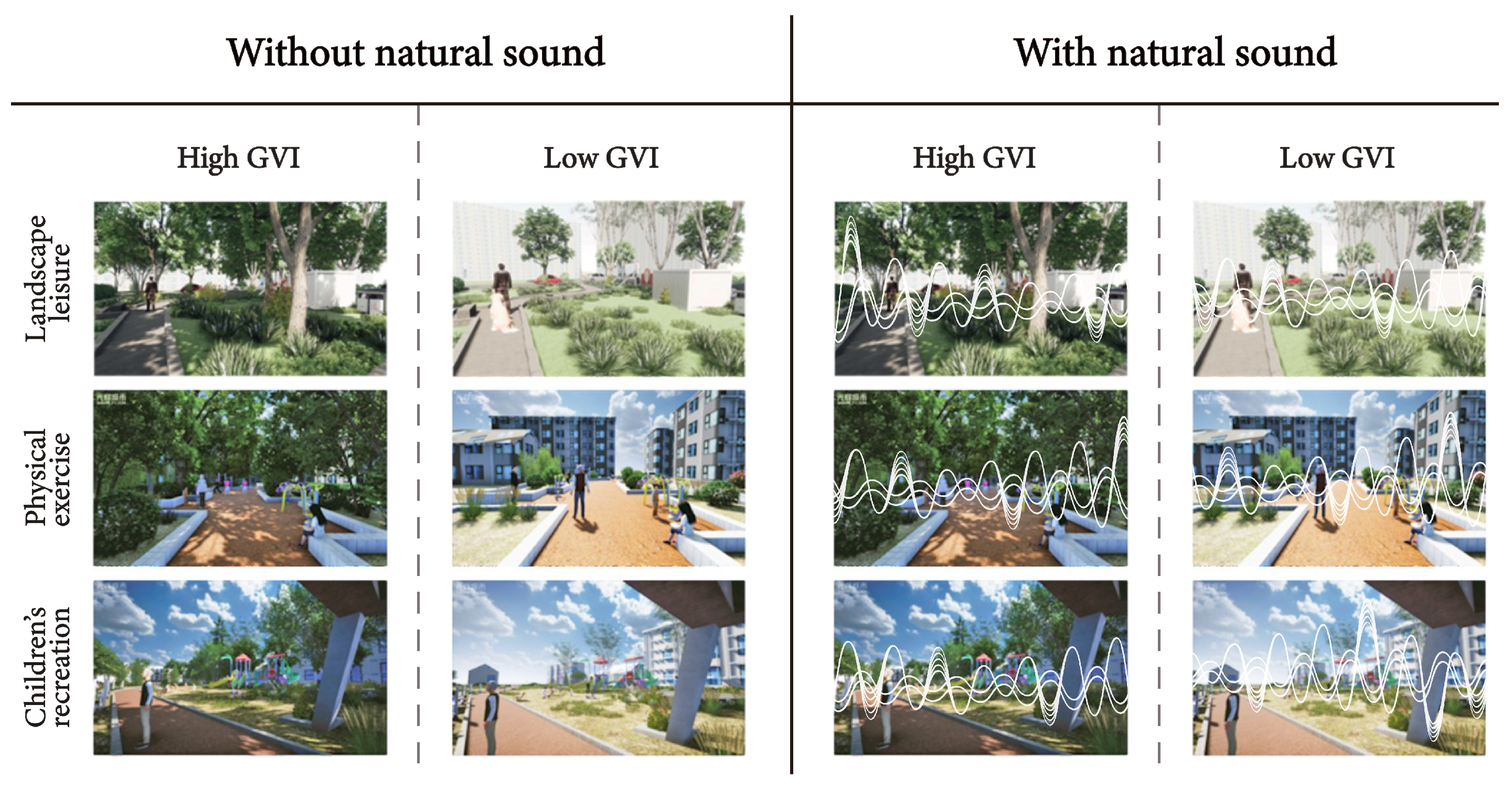
Through preliminary field investigation and comprehensive consideration of the landscape conditions of the outdoor space in the residential area, three functional sites—landscape leisure, physical exercise, and children’s recreation, representing the most common and accessible gathering spaces respectively—were selected as experimental locations. Within the same experimental group, these three scenarios shared identical GVI and natural sound conditions, with no differences in other variables relevant to this study. After capturing panoramic videos at a 1.6 m viewing height on-site with a vertical field of 120 degrees, the footage was imported into the MARS to create the foundational virtual scenes, which could effectively reflect the characteristics of the residential environments. To meet experimental requirements, the environmental elements were regulated in the VR platform, and the three functional sites shared the same spatial layout, with only GVI and sound conditions being varied. The variation in GVI was controlled by adjusting the proportion of vegetation in the scene. As for audio production, traffic noise samples were recorded every two hours (8:00–18:00) at the site, using a Multichannel Signal Analyzer (AWA6290L+) (Hangzhou Aihua Electronic Instruments Co., Ltd., Hangzhou, China), each lasting for 10 min and yielding an average of 75 dB. Recordings were adjusted by −8 dB to 67 dB for ecological validity in VR scenes [38], then synthesized as experimental background noise. Three 20 min intermittent birdsongs were recorded on-site, using the same equipment. After removing the blank sections in the AWA6290L+ Acoustic Analysis Platform, a continuous birdsong with LAeq of 58dB was generated as the natural sound audio.
The experiment categorized GVI into two groups: high (approximately 60%) and low (approximately 15%). Additionally, the presence of natural sound was divided into two conditions: with natural sound (67 dB traffic noise as the background sound plus intermittent 58 dB birdsong) and without natural sound (pure 67 dB traffic noise). This resulted in four experimental groups: high GVI with natural sound, high GVI without natural sound, low GVI with natural sound, and low GVI without natural sound (see Figure 1). Participants were evenly assigned to the four groups above with comparable demographic profiles and engaged in 20 min immersive sessions using VR devices and wearable physiological sensors, after which they reported perceptual and psychological responses.

2.2. Experiment Process

By contacting the local neighborhood committee to recruit experiment participants through online questionnaires, only residents who had lived in this area for over 1 year and were aged between 18 and 45 were selected to ensure familiarity with the residential environment. Ultimately, 100 participants were recruited: mainly local residents and small proportion of college students from a built environment background (mean age 32.4, balanced gender ratio). All had normal vision and hearing, and provided informed consent. A randomized controlled design assigned participants evenly to four groups, with roughly equal numbers in each age group and a balanced gender ratio. Each participant experienced all scenarios within their group, completing pre- and post-test questionnaires as well as audiovisual perception questionnaires.
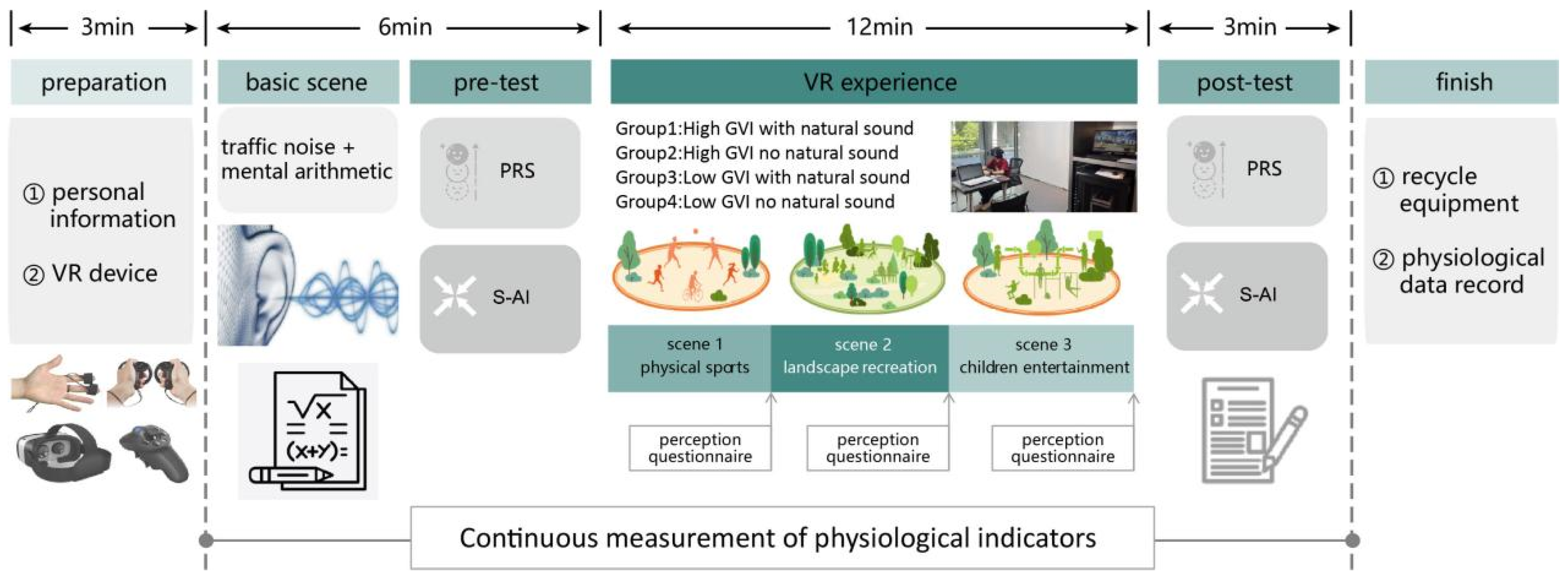
To capture psychological responses, the mental health questionnaires, made of the Chinese version of SAI and PRS, were administered before and after the VR sessions. Within each group, participants also completed a short perception evaluation after each scenario. Physiological data, including HRV and EDA, were continuously recorded with wearable sensors. The study was conducted in May 2024.
The procedure followed a standardized sequence. First, baseline demographic data were collected, and the protocol was explained, including the operation of the VR device. Participants were then fitted with headphones and sensors, allowing them to freely operate for a short period to acclimate to the VR device. The following stress induction, mainly consisting of mental arithmetic, was applied for three minutes, along with 67 dB background traffic noise, after which SAI and PRS were administered. Participants then entered the VR environment, experiencing three landscape scenarios, each lasting three minutes with corresponding background audio. To avoid the order effect, the functional models were projected randomly. After each scenario, participants answered the same 10-item audiovisual perception questionnaire. Upon completing all scenarios, they again filled out the SAI and PRS to capture overall changes (see Figure 2).

2.3. Measures

To capture short-term psychological restoration, we used two self-report scales that have been widely applied in environmental and restorative research.
First, the SAI, developed based on Spielberger’s conceptual framework that differentiates temporary emotional arousal from enduring anxiety proneness, was used to capture momentary anxiety [39] (seeing Appendix A: State Anxiety Inventory Scale). Participants rate 20 items, including worry, tension and autonomic arousal, on a four-point scale (1 = not at all, 4 = very much so), yielding a total score of state anxiety [40]. As with PRS, SAI was administered before and after the VR exposure [41], and the pre–post difference was used as an index of anxiety reduction.
Second, the 22-item PRS was used to assess the restorative benefits of the VR environments [42] (seeing Appendix B: Perceived Restorativeness Scale). PRS, based on attention restoration theory and an important tool for assessing restorative qualities in environmental psychology, evaluates four components—coherence, fascination, being away, and compatibility—on a seven-point Likert scale (1 = not at all, 7 = very strongly). Widely applied in landscape studies [43,44], PRS is specifically designed for environmental settings, making it suitable for comparing restorative qualities across different configurations. In this study, participants completed the PRS immediately after the stressor and again after the three VR scenes. The difference scores thus reflect the extent to which exposure to a given environment supported actual restoration from the stressed state, building on the environment’s perceived restorativeness.
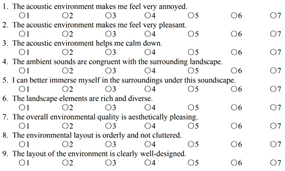
In addition, the study developed a nine-item audiovisual perception questionnaire informed by Russell’s circumplex model of affect, stress-reduction theory, and ISO 12913 soundscape standards [45](seeing Appendix C: Audiovisual Perception Scale). Each item in the questionnaire represents a dimension of environmental assessment and is independent of the others, which has also been used in other environmental restoration fields and the reliability has been proven. Visual items assessed richness, esthetics, orderliness, and design quality, operationalizing key visual quality attributes identified in environmental esthetics research [46]; auditory items assessed preference, annoyance, pleasantness, calmness, coherence, and immersion, capturing core perceptual domains in soundscape studies [20,47]. All items were rated on a seven-point scale (1 = strongly disagree, 7 = strongly agree). Higher scores indicate more positive audiovisual perceptions, with annoyance reverse-coded. Each participant completed three identical perception questionnaires in a randomized order across three scenarios, with the final average of these responses serving as their individual perceptual outcome.
To index autonomic nervous system (ANS) dynamics, both HRV and EDA were monitored. HRV was quantified using the root mean square of successive differences (RMSSD), a time-domain metric that primarily reflects parasympathetic (vagal) activity, with higher values indicating greater cardiac vagal tone and a more relaxed state [48]. EDA was recorded as skin conductance and decomposed into phasic skin conductance responses, which capture rapid sympathetic arousal in response to cognitive or emotional stimuli [49]. Detailed reliability and validity statistics for the psychological scales, as well as descriptive information on HRV and EDA, are reported in the Section 3.

2.4. Data Analysis Strategy

2.4.1. Statistical Analysis Performed to Test Hypothesis

A total of 495 valid questionnaires were finally collected in the experiment, of which 198 were psychological restoration questionnaires (including SAI and PRS) and 297 were landscape audiovisual perception questionnaires. For the psychological restoration component, 99 questionnaires were administered as pre-tests and 99 as post-tests; for each landscape scene, 99 audiovisual perception questionnaires were collected. First, Cronbach’s α, combination reliability (CR), and average variance extracted (AVE) [50,51] were calculated to evaluate the internal consistency and reliability of the questionnaires. Second, a one-way analysis of variance (ANOVA) was conducted using SPSS 26 to assess the differences in restoration and emotional states among the four groups. The changes in psychological states after the intervention were measured by the differences between pre-test and post-test scores. Additionally, a two-way ANOVA was performed to examine the effects of the intervention on restoration and mood states, considering the interaction between the GVI and the presence of natural sound. Third, partial least squares structural equation modeling (PLS-SEM) was employed to analyze the causal relationships and impact pathways among the landscape environment, visual and auditory perception, and psychological restoration. This approach provides an expanded framework for studying landscapes as restorative environments in residential areas adjacent to expressways and affected by traffic noise.
For the processing of physiological data, the study utilized repeated-measures data from 100 participants, with the HRV indicator RMSSD employed as a quantitative metric for recovery effects. Ultimately, a linear mixed-effects model (LMM) was selected for data analysis—this model incorporated individual random effects to control for the inter-individual heterogeneity of HRV. The goodness-of-fit of the model was validated through residual tests and the assessment of explained variance by random effects, ensuring the reliability of the results.
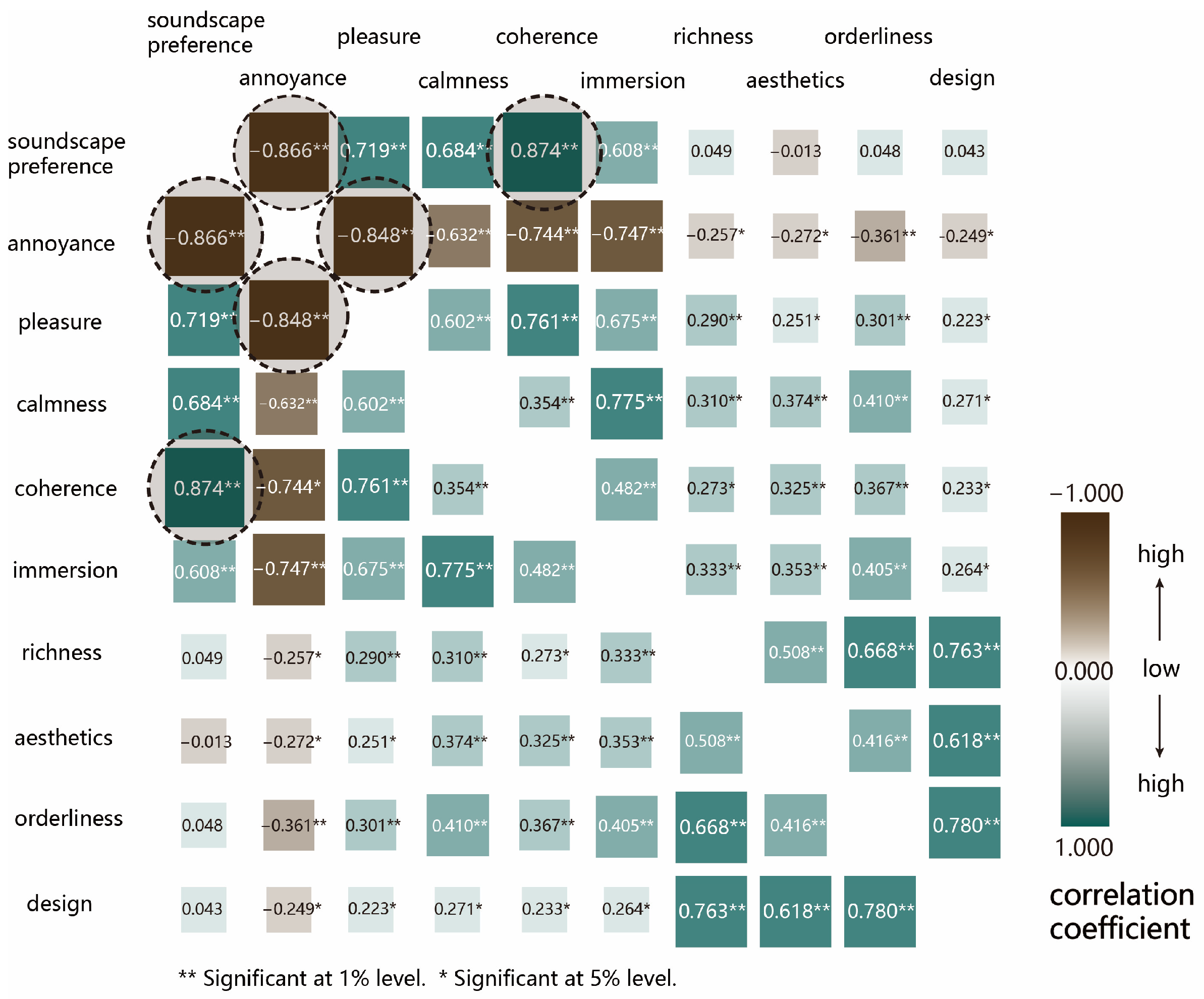
To avoid potential multicollinearity in the mathematical model, Pearson correlation analysis was conducted on the audiovisual perception indicators (Figure 3), with larger squares representing higher correlation. Indicators with a correlation coefficient higher than 0.8 (in dashed circles), which might induce multicollinearity, were excluded. Therefore, two variables—soundscape preference and pleasure degree—were eliminated.

2.4.2. SEM Construction

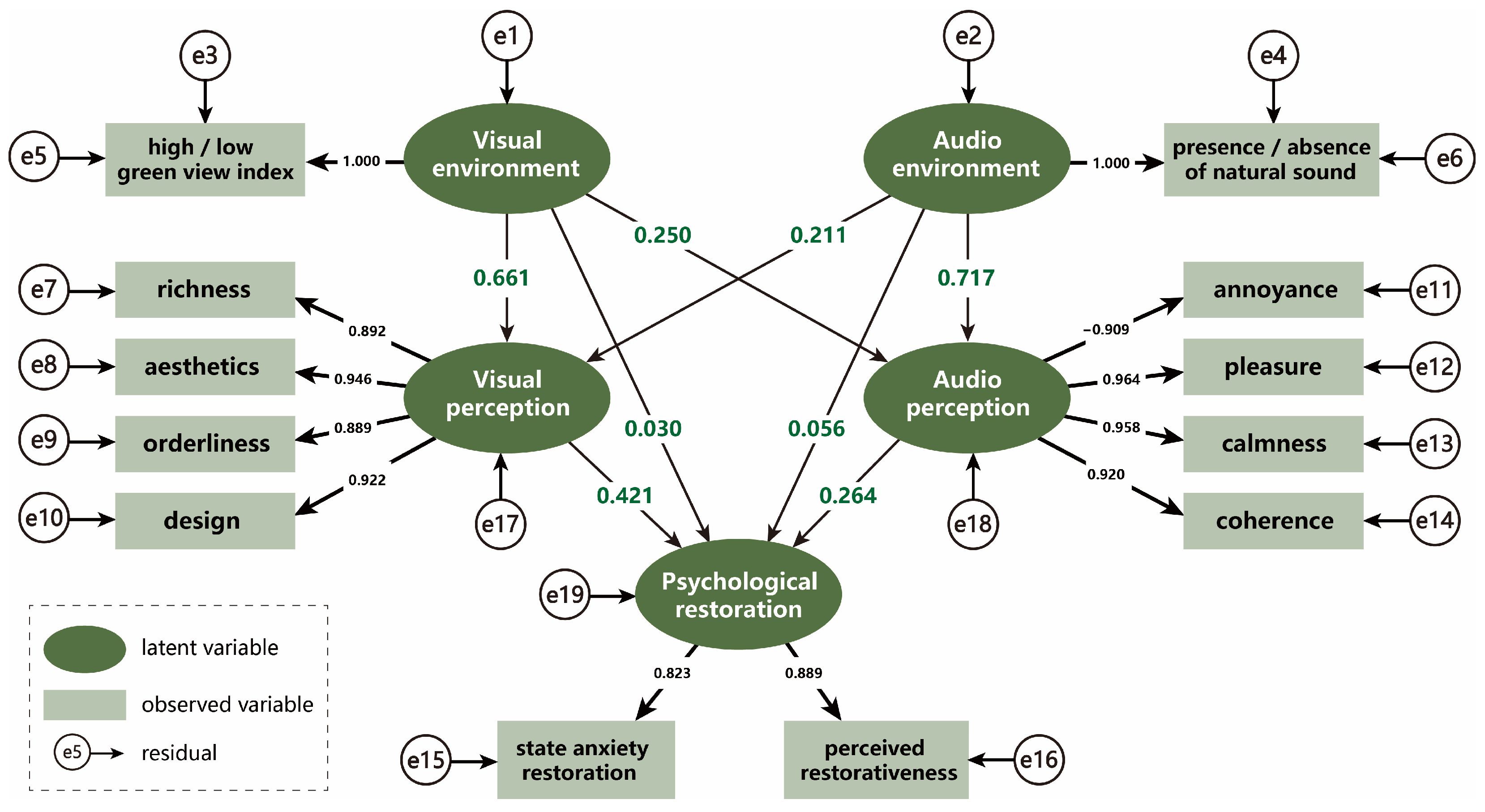
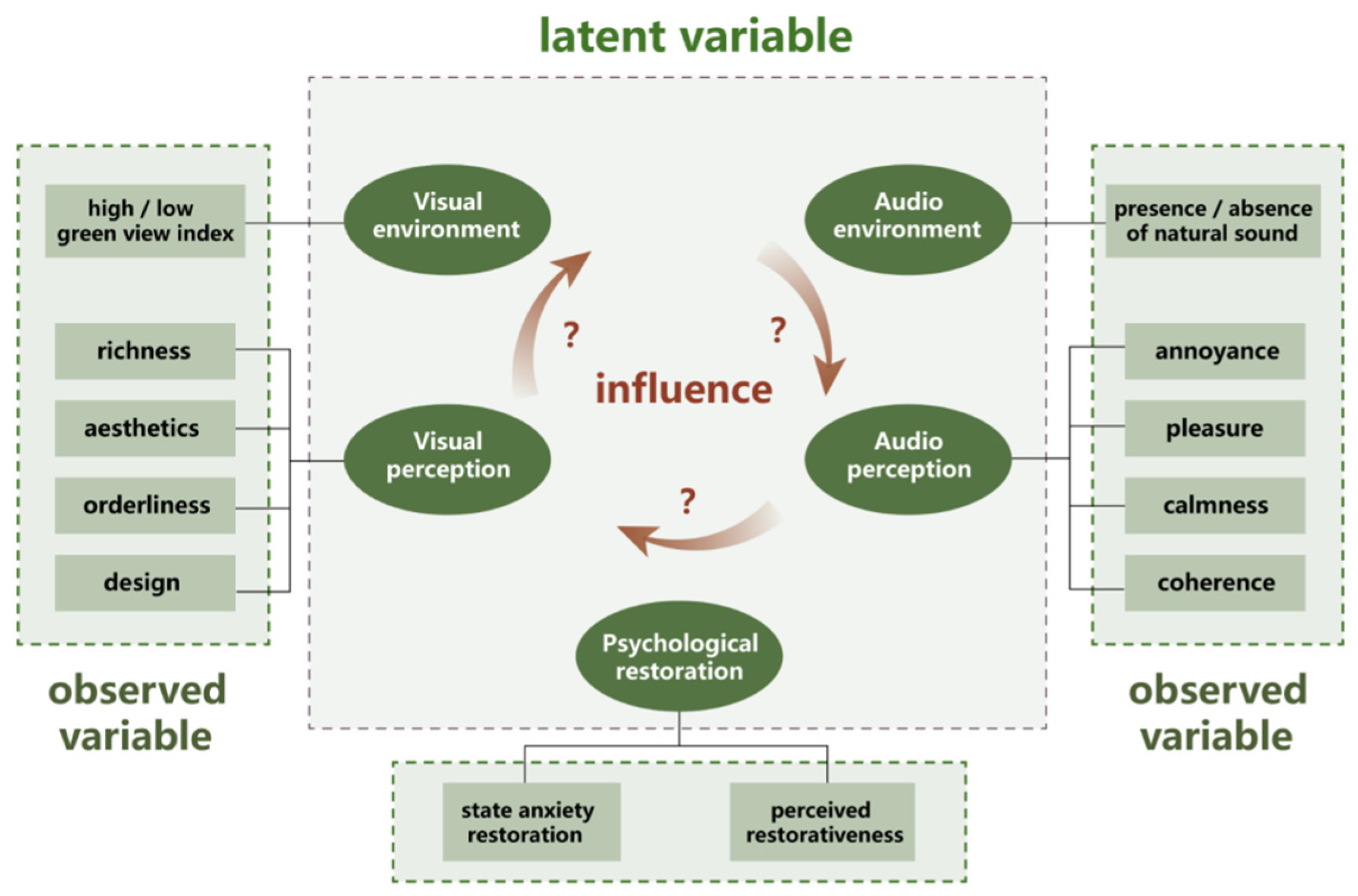
Based on the established analytical framework of “environmental characteristics—audiovisual perception—psychological restoration”, the study hypothesizes that in addition to exerting direct effects on audiovisual perception and psychological restoration, different environmental elements can also exert indirect effects on psychological restoration through audiovisual perception as a mediating factor [52]. Thus, a structural equation model (SEM) was constructed (Figure 4).
Among the aforementioned hypotheses at the end of the Introduction, Hypothesis 4 and Hypothesis 5 represent the direct effect and indirect effect of landscape environmental characteristics on mental health benefits, respectively, and the linear superposition of their quantitative results represents the total effect of landscape environmental characteristics on psychological restoration benefits.
High/low GVI and presence/absence of natural sounds were respectively set as categorical data and analyzed in combination with data from audiovisual perception and psychological restoration questionnaires. Among these, questionnaires related to psychological restoration reflect participants’ psychological states from both positive and negative emotional perspectives. Since traditional SEM analysis methods are suitable for confirmatory studies on existing conclusions, and the hypotheses proposed in this study are derived from a literature review, partial least squares structural equation modeling was selected. This method is applicable to confirmatory studies and has relatively low sample size requirements. The integrated data were collectively input into SmartPLS 3.2.9 software to construct the aforementioned SEM and calculate the intensity of influences between various elements.

2.4.3. Reliability and Validity Analysis

In this study, aside from environmental factors, the main variables were measured using scales. Therefore, assessing the quality of the measurement data is a crucial prerequisite for ensuring the significance of subsequent analyses. Firstly, Cronbach’s α was used to analyze the internal consistency of each variable. The reliability coefficient ranges from zero to one, with higher values indicating greater reliability. Generally, a reliability coefficient above 0.6 is considered acceptable, and above 0.7 is deemed reliable [53]. The reliability analysis results for the experimental data are shown in Table 1. The Cronbach’s α coefficients for the psychological restoration and landscape perception variables met the reliability standards, indicating good internal consistency of the experimental data. Secondly, CR and AVE were also used to assess the reliability of the questionnaires. When CR exceeds 0.80 and AVE surpasses the threshold of 0.40, the questionnaire design is confirmed to be reasonable. Additionally, the Heterotrait–Monotrait ratio (HTMT) values were all below 0.90 [54], as shown in Table 2, further confirming the discriminant validity among the variables. The explanatory power of the model is evaluated using explained variance (R2). The R2 values of subjective audiovisual perception and psychological restoration benefits are both around 0.5, indicating that the constructed model has a moderate explanatory level. All the aforementioned tests confirm the reliability and validity of the model, supporting the subsequent model path analysis.

3. Results

3.1. The Effects of Visual and Auditory Exposure on Mental Responses: One-Way ANOVA (Between Group Comparisons) and Two-Way ANOVA (Within Subjects Effects)

To examine the total effect of environmental exposure (GVI and the presence of natural sound) on mental responses among the four groups, we compiled the means of the pre-test and post-test of each group and performed one-way ANOVAs on the pre–post difference scores of the psychological questionnaires (ΔSAI and ΔPRS), so that positive values indicated greater recovery. It is noteworthy that the recovery benefits analyzed here referred to the sum of the direct and indirect effect in Hypothesis 4 and 5. Before experiencing the VR scenes, all groups showed little variation in the means of pre-test results, indicating comparable mental health status levels among participants following stress induction.
The one-way ANOVA results showed that different groups had significant effects on anxiety state (F = 4.696, p = 0.005) and perceived restorativeness (F = 6.984, p < 0.001) recovery after experience. In the case of anxiety, post hoc analysis showed that the restorative benefits of the low GVI no natural sound group was significantly less than other three groups. The restorative benefits in the high GVI no sound group were less than those in the high GVI with sound group, and this difference approached significance with a p-value of around 0.1 (p = 0.105). With respect to perceived restorativeness, post hoc analysis showed that the effects of the low GVI no natural sound group was significantly less than other three groups. The restorative effects of the low GVI with sound group was significantly less than the high GVI with sound group, while the high GVI no sound group had lower restorative effects compared to the high GVI with sound group, with the difference approaching significance (p = 0.09) (Table 2). The relatively large standard deviations observed in some cells (Table 2) reflect inter-individual variability in baseline anxiety and restorativeness, which is common in experimental stress-recovery studies.
The two-way ANOVA analysis allowed us to understand the main effects and interaction between different factors. The results showed that the main effect of GVI on both anxiety and restorativeness was significant. The natural sound condition had a higher psychological restorative effect than an environment without sound. Respectively, for anxiety recovery, F (1/76) = 5.939, p = 0.017, η2 = 0.072; for perceived restorativeness recovery, F (1/76) = 12.702, p < 0.001, η2 = 0.143. Then, the main effect of natural sound on both anxiety and restorativeness was significant as well. In terms of anxiety, F (1/76) = 7.908, p = 0.006, η2 = 0.094, and as for perceived restorativeness, F (1/76) = 8.08, p = 0.006, η2 = 0.096. No interaction effect was detected between the level of Green View Index and the presence of natural sound on anxiety or perceived restorativeness (Table 3).

3.2. Effects of GVI and Natural Sound on Physiological Restoration: HRV and EDA

3.2.1. Electrodermal Activity (EDA)

To assess the impact of the different environmental conditions on autonomic arousal, changes in EDA were analyzed over the course of the experiment. The results from a repeated measures analysis indicate that the restorative effects varied significantly across the four groups (Figure 5; Table 4).
The high GVI with sound group exhibited a statistically significant decrease in EDA from the beginning (T1) to the end (T18) of the exposure period, indicating a strong physiological calming effect (p = 0.002). In the high GVI without sound group, a similar trend of decreased EDA was observed, although this effect was marginally significant (p = 0.052). In contrast, both the low GVI with sound (p = 0.589) and the low GVI without sound (p = 0.312) groups showed no significant changes in EDA throughout the experiment.
These findings suggest that a high Green View Index is the primary driver of physiological relaxation as measured by EDA. Furthermore, the presence of natural sound appears to enhance or solidify this restorative effect, as the combination of high GVI and natural sound yielded the most statistically robust reduction in sympathetic nervous system arousal.

3.2.2. Heart Rate Variability (HRV)

A linear mixed-effects model (LMM) was employed to examine the influence of GVI and natural sound on heart rate variability, using the root mean square of successive differences (RMSSD) as the primary indicator of parasympathetic activity. The model included group and time as fixed effects, and a random intercept for each participant to account for individual baseline differences.
The analysis revealed a significant main effect for the experimental group. As shown in Table 5, with the low GVI without sound group serving as the reference, both the high GVI without sound group (β = 302, 95% CI [69, 535], p = 0.006) and the high GVI with sound group (β = 602, 95% CI [401, 803], p < 0.001) demonstrated significantly higher RMSSD levels. However, the RMSSD level in the low GVI with sound group did not significantly differ from the reference group (β = −4.8, 95% CI [−131, 117], p = 0.794). This indicates that a high GVI was the critical factor in promoting HRV-measured recovery, while natural sound did not exert a significant independent effect.
In addition, a significant interaction between time and group was found, indicating that the RMSSD trajectory over time differed between groups. Specifically, the RMSSD levels for both the high GVI without sound groups (β = −26, 95% CI [−34.5, −17.4], p < 0.001) showed a significant gradual decline over the experimental period, while a resembled trend in high GVI with sound groups (β = −8.6, 95% CI [−19.7, 2.5], p = 0.131) could also be witnessed. This suggests that while high-GVI environments provide a strong initial restorative boost, this effect may attenuate over time.
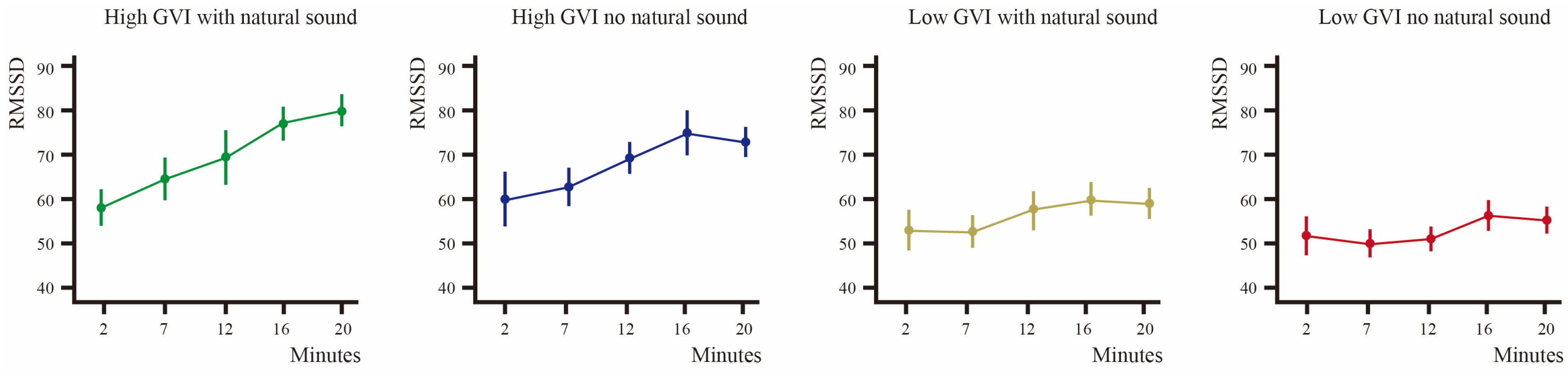
To further dissect the significant group effect, detailed post hoc pairwise comparisons were conducted at each time point. The results consistently showed that at all measured times, RMSSD in both groups, either with high GVI or with natural sound, was higher than the according comparison group. Notably, while RMSSD values did vary across different sound groups, these differences were less significant than those observed among different GVI groups. This suggests that the environments with high GVI exert a more pronounced effect on HRV, whereas natural sound conditions alone fail to produce pronounced HRV effects, likely due to vision being the most important way for humans to receive information from the outside environment [55].
Then, an analysis of the estimated marginal means (least-squares means) derived from the model provides a clear picture of these dynamics (Table 6). In the initial phase (Time = 2), the RMSSD values across the four groups showed no significant differences, almost falling within the 50–60 range. However, when the formal trial commenced and participants underwent varying environmental exposures (Time = 7), the RMSSD values began to exhibit marked differences. Except for the low GVI no sound group, which displayed irregular fluctuations, the RMSSD values of the other groups generally followed an upward trend, though a slight decline may have occurred at the final stage (Time = 20) by the end of the exposure. Notably, the high GVI with sound group recorded the general highest RMSSD values and reached its peak of 80.36 (95% CI, 77.21–83.51) at Time 20, which was consistent with the anticipated outcomes. In addition, the HRV recovery in this group was higher than that in the groups with high GVI or with sound alone, demonstrating the synergistic effect between audio and visual stimuli.
In summary, the LMM and subsequent post hoc analyses consistently demonstrate that the Green View Index was the dominant factor influencing HRV recovery, producing a strong and lasting restorative effect. The addition of natural sound provided certain enhancement to this core physiological indicator of recovery, while the low GVI without sound group showed minimal recovery, indicating that both visual and auditory enrichment are important for robust HRV restoration in highway-adjacent settings. These dynamics are visualized in Figure 6.

3.3. The Effect of Visual and Auditory Perception on the Path from Visual and Auditory Exposure to Psychological Restoration

3.3.1. Path Coefficient and Factor Loadings

The analysis of the structural model’s path coefficients (green numbers between latent variables in Figure 7) provided clear empirical support for most of the proposed hypotheses, systematically revealing the mechanism linking the environment to psychological restoration.
The model first confirmed that the environmental features strongly and predictably shaped sensory perception. In support of Hypothesis 1, strong positive paths were found between environmental features and their corresponding perceptions. The visual environment (high GVI) significantly predicted visual perception (β = 0.661, p < 0.05, t > 1.96), while the auditory environment (natural sounds) exerted an even more substantial impact on auditory perception (β = 0.717, p < 0.05, t > 1.96). Furthermore, the analysis supported Hypothesis 2 by revealing significant cross-modal effects. The visual environment also positively influenced auditory perception (β = 0.250, p < 0.05), and the auditory environment similarly enhanced visual perception (β = 0.211, p < 0.05), indicating that the sensory experience is an interconnected process.
Moving down the causal chain, the results affirmed the critical role of perception in influencing psychological well-being. In line with Hypothesis 3, both visual perception (β = 0.421, p < 0.05) and auditory perception (β = 0.264, p < 0.05) were found to be significant and direct positive predictors of psychological restoration benefits.
The factor loadings (balck numbers between latent variable and observed variable) analysis confirmed the robustness of the measurement model. Most observed variables demonstrated loadings greater than 0.7, with several exceeding 0.9, indicating strong representativeness. Among auditory indicators, pleasantness (0.964) and calmness (0.958) exhibited the highest loadings, whereas annoyance (–0.909) showed a strong negative loading, reflecting its role as an inverse auditory indicator. In the visual domain, esthetics (0.946) and sense of design (0.922) were the strongest indicators, followed by orderliness (0.889) and richness (0.892).

3.3.2. Mediation Effects and Interaction Effects

The next stage of the analysis clarified the nature of the environment’s influence, yielding a pivotal finding regarding its direct versus indirect effects (Table 7). The results led to the rejection of Hypothesis 4, as the direct paths from both the visual environment (β = 0.030) and the auditory environment (β = 0.056) to psychological restoration benefits were negligible and statistically non-significant.
Instead, the model provided robust support for Hypothesis 5, demonstrating that the environment’s influence operates entirely through an indirect pathway. This pattern of non-significant direct effects alongside strong, significant indirect effects indicates that audiovisual perception acts as a full mediator. For the visual environment, the total indirect effect on psychological restoration was substantial at 0.374. This was primarily channeled through the visual perception pathway (β = 0.278), which accounted for 74.3% of the indirect influence, while the cross-modal path through auditory perception contributed the remaining 25.7% (β = 0.066). Similarly, for the auditory environment, the total indirect effect was strong at 0.334. The main mediating pathway was through auditory perception (β = 0.189), explaining 56.6% of the effect, with the cross-modal path through visual perception also playing a significant role (β = 0.089), accounting for 26.6% of the influence.
To determine if visual and auditory perceptions interact to influence psychological restoration, their combined effect on psychological outcomes was analyzed. The analysis revealed a nuanced pattern: the interaction term (visual perception × auditory perception) was not a significant predictor of changes in the state of anxiety (p > 0.60). However, a statistically significant interaction effect was found for attention restoration (p = 0.009). This indicates that while the two perceptual modalities may influence anxiety in parallel, their combined influence has a unique, synergistic effect specifically on the cognitive process of restoring directed attention.
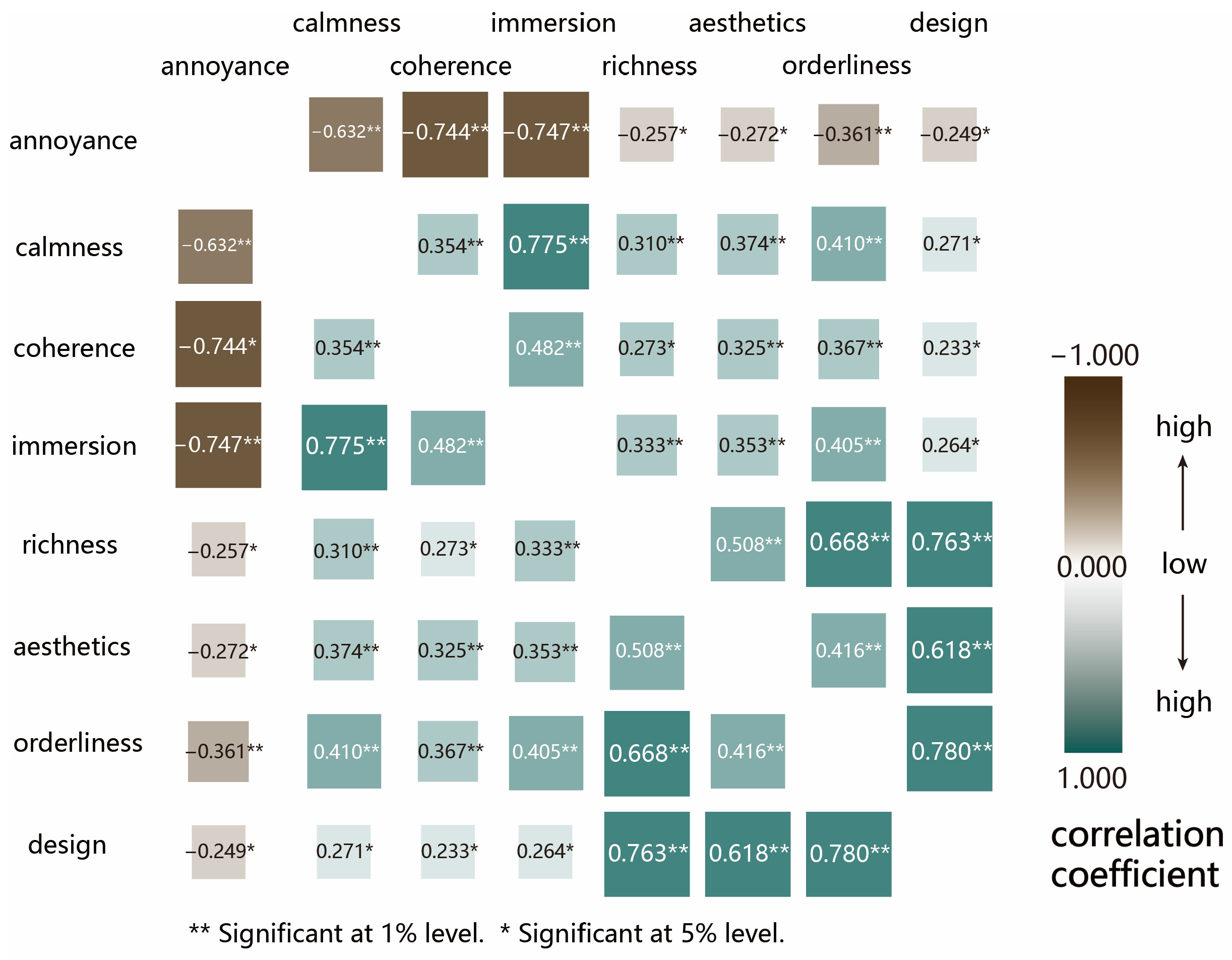
To further explore the nature of this multisensory relationship, a Pearson correlation analysis was performed between specific visual and auditory perceptual attributes (Figure 8). The results revealed a network of significant cross-modal associations. The negative auditory experience of annoyance emerged as a key factor, showing significant negative correlations with visual richness (r = −0.257, p < 0.05), orderliness (r = −0.361, p < 0.05), and design (r = −0.249, p < 0.05).
Conversely, positive perceptions demonstrated a synergistic relationship. Auditory calmness was positively correlated with visual esthetics (r = 0.374, p < 0.01), and auditory coherence was positively linked to visual orderliness (r = 0.367, p < 0.01). This influence also operated in the reverse direction. Visual richness was significantly and positively correlated with both auditory calmness (r = 0.310, p < 0.01) and immersion (r = 0.333, p < 0.01). Finally, visual orderliness exhibited a particularly strong positive correlation with auditory immersion (r = 0.405, p < 0.01), suggesting a robust link between visual structure and the depth of the auditory experience.
In general, high GVI significantly reduced anxiety and enhanced perceived restorativeness, with natural sound providing additional but weaker benefits. Physiologically, high GVI significantly decreased EDA and increased RMSSD, whereas sound showed no independent effect on HRV. Structural equation modeling revealed that environmental effects on psychological restoration were fully mediated by audiovisual perception, with significant cross-modal interactions.

4. Discussion

This VR experiment provides empirical evidence that NbS applied to residential areas adjacent to highways—specifically through green infrastructure (high GVI) and auditory bio-components (natural sounds)—can shape psychological restoration through visual and auditory perception. The findings confirm the significant positive influence of biophilic elements on mental and physical well-being. At the same time, multidimensional psychological and physiological data reveal the layered pathways through which these ecological interventions affect restoration in the presence of traffic noise. Together, these results offer additional insight into the ‘environment–landscape perception–psychological restoration’ chain and contribute to a more nuanced understanding of how urban nature delivers cultural ecosystem services to support human recovery.

4.1. The Dual Effect of Natural Sounds: Psychological Comfort vs. Physiological Limits

One of the main findings of this study is the distinct role of natural sounds as a cultural ecosystem service. On the one hand, the ANOVA results show that the addition of natural sounds (birdsong) significantly reduced participants’ self-reported anxiety and enhanced their perceived restorativeness, regardless of the level of green view. This aligns with soundscape theory and previous studies, which emphasize that the value of sound lies primarily in its perceived meaning, rather than its physical properties [27,28]. As a positive auditory stimulus, natural sounds reshaped participants’ cognitive appraisal of an environment dominated by traffic noise, providing psychological comfort and emotional relief.
On the other hand, analysis of HRV, an indicator of autonomic nervous system balance, revealed no significant independent effect of natural sounds. Under the continuous stress of 67 dB traffic noise, the introduction of natural sounds alone did not significantly increase RMSSD, a marker of relaxation. This suggests potential divergence between psychological perception and core physiological stress responses [35]. While natural sounds may “convince” the brain at a cognitive level, their intensity or nature appears insufficient to counteract the dominance of strong traffic noise in regulating overall heart rate patterns. It suggests that the pathways linking environment, perception, and psychological restoration are not uniform but layered, with psychological appraisal and physiological regulation responding differently to the same environmental inputs.

4.2. A Multi-Dimensional Physiological Narrative

EDA provides a more nuanced perspective on the apparent gap between psychological and physiological findings. As a direct measure of sweat gland activity governed by the sympathetic nervous system, EDA is a sensitive indicator of emotional arousal and stress. In this study, EDA results mirrored HRV findings in showing that high levels of green view were the primary driver of physiological relaxation, reflected in a significant decline in EDA [34]. However, unlike HRV, EDA revealed that natural sounds enhanced the physiological calming effect of high GVI, rather than acting independently [56]. Specifically, the “high green view with natural sounds” condition produced a robust and statistically significant relaxation effect (p = 0.002), whereas the “high green view without natural sounds” condition showed only a marginal effect (p = 0.052), and critically, the “low green view with natural sounds” condition showed no significant EDA change (p = 0.589).
This divergence is theoretically instructive. HRV, particularly RMSSD, reflects parasympathetic (rest and digest) regulation. By contrast, EDA tracks sympathetic arousal. The results suggest that auditory NbS may potentiate sympathetic dampening when combined with visual greenery—captured by EDA—but this enhancement does not occur in low-green environments and is not yet strong enough to shift the deeper autonomic balance dominated by traffic noise, as reflected in HRV. In this sense, EDA serves as a physiological bridge, validating that biophilic sounds do induce a measurable reduction in arousal, even if the deeper vagal recovery requires more substantial visual greening.

4.3. The Dominant Role of Visual Greenery: Consistent Restoration of Mind and Body

In our data, high GVI emerged as a consistently strong restorative factor across all measures, including self-reported questionnaires, HRV, and EDA, in contrast to the more complex effects of natural sounds [57]. Both subjective experiences and objective physiological indicators confirmed that participants in the high-GVI condition achieved significantly greater recovery than those in the low-GVI condition.
This finding provides robust support for stress reduction theory and attention restoration theory. A high proportion of vegetation not only offers visual “soft fascination” that helps restore attention but also exerts a direct and deeper influence on the autonomic nervous system. Specifically, it reduces sympathetic activity (as indicated by lower EDA) and may enhance parasympathetic tone (as suggested by improved HRV), leading to a synchronized state of psychological and physiological relaxation [58].
These results reinforce previous research and highlight a clear design implication: in high-density urban settings, increasing greenery is a core strategy for simultaneously easing emotional distress, promoting psychological restoration, and mitigating the impacts of environmental stressors [59]. More broadly, the evidence positions urban forestry and vegetation as a pivotal element within the “environment–perception–restoration” chain, demonstrating how visual exposure to nature can generate aligned benefits across both cognitive appraisal and physiological regulation [60].

4.4. The Mediating Role of Perception and Cross-Sensory Interaction

The study’s central empirical finding, as indicated by SEM, is that audiovisual perception appeared to fully mediate the relationship between environmental features and psychological restoration. The results provide converging evidence that, in this sample, the direct paths from physical environmental features (GVI and natural sounds) to psychological outcomes were negligible within the tested model. Instead, their observed restorative influence seemed to be largely channeled through how they shaped an individual’s subjective sensory experience—the degree to which a scene was perceived as beautiful, orderly, and calm. This pattern offers quantitative support for the view that short-term psychological states are strongly shaped by cognitive processing of environmental input; in this context, it is the perceived quality of the environment, rather than its mere physical presence, that appears most proximal to psychological restoration [21].
Delving deeper, the model suggested a complex interplay between the senses. While the ANOVA did not detect a significant interaction between GVI and natural sounds at the environmental level, the SEM results point to the possibility that such synergy may emerge at the perceptual level [61]. More positive perceptions were mutually reinforcing: visually rich scenes were associated with a greater sense of auditory immersion, while calmer soundscapes were associated with higher ratings of visual esthetics [62]. However, this interaction was not exclusively synergistic. The analysis also suggested an antagonistic component driven by auditory annoyance. The relatively strong negative association between annoyance and positive visual attributes is consistent with a process of cognitive and emotional spillover. A persistent negative auditory signal, such as traffic noise, may capture limited cognitive resources and thereby reduce the observer’s capacity to process and appreciate positive details in the visual landscape [63]. In other words, the psychological effort required to cope with an adverse soundscape can diminish the resources available to enjoy an otherwise attractive view.
Taken together, these findings outline a useful conceptual framework for urban design and planning in high-density, noise-affected areas. The mediation effect of perception in this model supports a shift in emphasis from purely physical metrics toward the prioritization of perceptual quality; the goal is not only to add environmental elements, but to craft scenes that are experienced as being coherent, engaging, and beautiful. Furthermore, the analysis highlights the potential of strong visual stimuli to function as a psychological buffer against auditory annoyance, suggesting that high-quality, high-GVI landscapes may serve as a promising, evidence-informed complement to conventional noise mitigation strategies. Finally, the indications of cross-modal synergy and antagonism reinforce arguments for a holistic, multisensory design approach. The most restorative environments are likely to be those in which positive visual and auditory elements are intentionally combined to create a cohesive and mutually reinforcing sensory experience, thereby potentially enhancing their restorative impact beyond what each element could achieve on its own.

4.5. Limitations and Future Directions

Several limitations of this study should be acknowledged. First, although VR allowed for precise control over audiovisual stimuli and minimized environmental confounds, the simulated environments inevitably lacked other sensory dimensions that contribute to real-world experiences, such as smell, air movement, and complex spatial acoustics, which may influence both perceived restorativeness and physiological responses. Furthermore, the presence of virtual reality devices inevitably affects the environmental experience of participants, leading to deviations in experimental data. Future studies could combine VR with field experiments or mobile physiological monitoring in real residential courtyards to validate and extend the present findings.
Second, the sample consisted mainly of younger and middle-aged adults with relatively high educational levels, and individual differences in noise sensitivity, nature connectedness, or prior experience of expressway-adjacent living were not explicitly measured. These characteristics may moderate both perception and restoration. Incorporating such individual-difference variables and recruiting more diverse samples including older adults and children would help to clarify for whom and under which conditions greenery and natural sounds are most beneficial.
Third, the exposure duration in this experiment was relatively short, and we focused on immediate changes in psychological and physiological indicators. Longer-term adaptations to repeated exposure, including potential habituation or sensitization to traffic noise and natural sounds, were beyond the scope of this study. Longitudinal or repeated-session designs could examine whether the benefits of high GVI and natural sounds accumulate or attenuate over time.
Finally, we examined only one type of natural sound—birdsong—at a fixed noise level. The extent to which other natural sounds (e.g., water, wind, insects) and different spectral relationships with traffic noise may produce stronger or weaker restorative effects remains an open question. Future work could systematically vary the type, loudness, and temporal characteristics of natural sounds to identify optimal soundscape configurations for expressway-adjacent residential areas.

5. Conclusions

By integrating psychological, physiological, and structural equation modeling data, this study provides converging evidence that, in residential areas along highways, visual greenery appears to function as a relatively stable and powerful driver of both psychological and physiological restoration. In contrast, our data are consistent with natural sounds exhibiting a tiered restoration effect: while they can effectively provide emotional comfort and reduce peripheral nervous system arousal, we hypothesize that their capacity to restore core autonomic balance may be limited under high-intensity noise. In line with the SEM results, the restorative benefits of both landscape elements appeared to be conferred not directly but through positive environmental perception as a full mediator.
This study’s main theoretical implication is that NbS in noise-affected areas operate hierarchically. Drawing on three layers of data—subjective experience, peripheral physiological responses (EDA), and indicators of cardiac autonomic regulation (HRV)—our findings suggest that different environmental interventions may operate at different physiological depths. In our sample, soft interventions such as natural sounds seemed to act primarily on psychological states and peripheral arousal, whereas harder interventions such as high visual exposure to greenery were associated with more wide-ranging restorative effects across measures. This pattern points to a tiered strategic approach for urban planning: relatively low-cost perceptual enhancements may help to support short-term emotional well-being, while more substantial investment in green infrastructure is likely to be important for alleviating chronic environmental stress and supporting population health over the longer term. More broadly, creating healthy urban environments is not only a matter of reducing physical stressors; it also involves the intentional design of multimodal, synergistic landscapes that foster positive human perception.

Author Contributions

Conceptualization, Y.S. and T.J.; methodology, Y.S. and T.J.; software, T.J. and Z.Z.; validation, Y.S. and T.J.; formal analysis, T.J. and Z.Z.; investigation, T.J. and Z.Z.; resources, Y.S., T.J. and Z.Z.; data curation, Y.S., T.J. and Z.Z.; writing—original draft preparation, T.J. and Z.Z.; writing—review and editing, Y.S., T.J. and Z.Z.; visualization, T.J. and Z.Z.; supervision, Y.S.; project administration, Y.S. and T.J.; funding acquisition, Y.S. and T.J. All authors have read and agreed to the published version of the manuscript.

Funding

This research was funded by Natural Science Foundation of Shanghai grant number 24ZR1469800 and Peking University Lincoln Institute grant number FS0420241001JTF. The APC was funded by Peking University Lincoln Institute.

Institutional Review Board Statement

The study was conducted in accordance with the Declaration of Helsinki and approved by the Ethics Committee of Tongji University (protocol code tjdxdr068) on 4 March 2024.

Informed Consent Statement

Informed consent was obtained from all subjects involved in the study.

Data Availability Statement

The original contributions presented in this study are included in the article. Further inquiries can be directed to the corresponding author.

Acknowledgments

We thank all the participants for their involvement in the VR experiments and the laboratory staff for their technical support. This study was approved by the Ethics Committee of the authors’ institution, and all participants provided informed consent.

Conflicts of Interest

The authors declare no conflicts of interest.

Abbreviation

ANOVAAnalysis of Variance
AVEAverage Variance Extracted
CRComposite Reliability
EDAElectrodermal Activity
GVIGreen View Index
HRVHeart Rate Variability
HTMTHeterotrait–Monotrait Ratio
LMMLinear Mixed-Effects Model
NbsNature-Based Solutions
PRSPerceived Restorativeness Scale
R2Explained Variance
RMSSDRoot Mean Square of Successive Differences
SAIState Anxiety Inventory
SEMStructural Equation Model
VRVirtual Reality

Appendix A. State Anxiety Inventory Scale

Buildings 16 00873 i001

Appendix B. Perceived Restorativeness Scale

Buildings 16 00873 i002

Appendix C. Audiovisual Perception Scale
Buildings 16 00873 i003

References

  1. World Health Organization. Environmental Noise Guidelines for the European Region; World Health Organization, Regional Office for Europe: Geneva, Switzerland, 2018. [Google Scholar]
  2. Van Renterghem, T.; Botteldooren, D. View on outdoor vegetation reduces noise annoyance for dwellers near busy roads. Landsc. Urban Plan. 2016, 148, 203–215. [Google Scholar] [CrossRef]
  3. Chen, S.; He, P.; Yu, B.; Wei, D.; Chen, Y. The challenge of noise pollution in high-density urban areas: Relationship between 2D/3D urban morphology and noise perception. Build. Environ. 2024, 253, 111313. [Google Scholar] [CrossRef]
  4. Ministry of Ecology and Environment of the People’s Republic of China. China noise pollution prevention report. Environ. Impact Assess. 2023, 51, 58–66. [Google Scholar]
  5. Van den Bosch, M.; Ode Sang, Å. Urban natural environments as nature-based solutions for improved public health—A systematic review of reviews. Environ. Res. 2017, 158, 373–384. [Google Scholar] [CrossRef] [PubMed]
  6. Fink, D. A new definition of noise: Noise is unwanted and/or harmful sound. Noise is the new ‘secondhand smoke’. In Proceedings of Meetings on Acoustics; AIP Publishing: Melville, NY, USA, 2019; Volume 39, No. 1. [Google Scholar] [CrossRef]
  7. Liu, F.; Jiang, S.; Kang, J.; Wu, Y.; Yang, D.; Meng, Q.; Wang, C. On the definition of noise. Humanit. Soc. Sci. Commun. 2022, 9, 1–17. [Google Scholar] [CrossRef]
  8. Liu, J.; Tang, X. Reflections on restorative landscape design based on landsenses ecological concept. Landsc. Archit. 2021, 28, 107–112. [Google Scholar] [CrossRef]
  9. Dickinson, D.C.; Hobbs, R.J. Cultural ecosystem services: Characteristics, challenges and lists. Ecosyst. Serv. 2017, 25, 179–194. [Google Scholar] [CrossRef]
  10. Kaplan, S. The restorative benefits of nature: Toward an integrative framework. J. Environ. Psychol. 1995, 15, 169–182. [Google Scholar] [CrossRef]
  11. Ulrich, R.S. View through a window may influence recovery from surgery. Science 1984, 224, 420–421. [Google Scholar] [CrossRef]
  12. Andersson, E.M.; Ögren, M.; Molnár, P.; Segersson, D.; Rosengren, A.; Stockfelt, L. Road traffic noise, air pollution and cardiovascular events in a Swedish cohort. Environ. Res. 2020, 185, 109446. [Google Scholar] [CrossRef]
  13. Mohamed, A.M.O.; Paleologos, E.K.; Howari, F.M. Noise pollution and its impact on human health and the environment. In Pollution Assessment for Sustainable Practices in Applied Sciences and Engineering; Butterworth-Heinemann: Amsterdam, The Netherlands, 2021; pp. 975–1026. [Google Scholar] [CrossRef]
  14. Tortorella, A.; Menculini, G.; Moretti, P.; Attademo, L.; Balducci, P.M.; Bernardini, F.; Cirimbilli, F.; Chieppa, A.G.; Ghiandai, N.; Erfurth, A. New determinants of mental health: The role of noise pollution. A narrative review. Int. Rev. Psychiatry 2022, 34, 783–796. [Google Scholar] [CrossRef] [PubMed]
  15. Gao, W.; Kang, J.; Ma, H.; Wang, C. The effects of environmental sensitivity and noise sensitivity on soundscape evaluation. Build. Environ. 2023, 245, 110945. [Google Scholar] [CrossRef]
  16. Dzhambov, A.M.; Lercher, P.; Botteldooren, D. Childhood sound disturbance and sleep problems in Alpine valleys with high levels of traffic exposures and greenspace. Environ. Res. 2024, 242, 117642. [Google Scholar] [CrossRef] [PubMed]
  17. Kang, J. On the Diversity of Urban Waterscape. Acoustics 2012, Apr 2012, Nantes, France. Available online: https://hal.archives-ouvertes.fr/hal-00811058/ (accessed on 13 February 2026).
  18. Chen, B.; Liao, H.; Jiang, B.; Kang, J. Space and landscape reshaping in the old town under urban revival: Insights from the Sheffield train station renovation project in the UK. New Archit. 2018, 6, 64–68. [Google Scholar] [CrossRef]
  19. Hong, X.D.; Zhang, W.C.; Zhu, W.Y.; Chu, Y.P. Research on evaluation indicators of urban open space sound environment based on perception. Acoust. Technol. 2023, 42, 88–94. [Google Scholar] [CrossRef]
  20. ISO/TS 12913-2:2018; Soundscape—Part 2: Data Collection and Reporting Requirements—What’s It All About? Acoustics Bulletin: Geneva, Switzerland, 2018.
  21. Aletta, F.; Oberman, T.; Kang, J. Associations between positive health-related effects and soundscapes perceptual constructs: A systematic review. Int. J. Environ. Res. Public Health 2018, 15, 2392. [Google Scholar] [CrossRef]
  22. Kang, J.; Ma, H.; Xie, H.; Zhang, Y.; Li, Z. Research progress on the acoustic environments of healthy buildings. Chin. Sci. Bull. 2020, 65, 288–299. [Google Scholar] [CrossRef]
  23. Shao, Y.; Hao, Y.; Yin, Y.; Meng, Y.; Xue, Z. Improving soundscape comfort in urban green spaces based on aural-visual interaction attributes of landscape experience. Forests 2022, 13, 1262. [Google Scholar] [CrossRef]
  24. Coensel, B.D.; Vanwetswinkel, S.; Botteldooren, D. Effects of natural sounds on the perception of road traffic noise. J. Acoust. Soc. Am. 2011, 129, EL148–EL153. [Google Scholar] [CrossRef]
  25. Shao, Y.; Yin, Y.; Xue, Z. Evaluation and Comparison of Streetscape Comfort in Beijing and Shanghai Based on A Big Data Approach with Street Images. Landsc. Archit. 2021, 28, 53–59. [Google Scholar] [CrossRef]
  26. Xu, W.; Wang, H.; Su, H.; Sullivan, W.C.; Lin, G.; Pryor, M.; Jiang, B. Impacts of sights and sounds on anxiety relief in the high-density city. Landsc. Urban Plan. 2024, 241, 104927. [Google Scholar] [CrossRef]
  27. Hao, Y.; Kang, J.; Wöertche, H. Assessment of the masking effects of birdsong on the road traffic noise environment. J. Acoust. Soc. Am. 2016, 140, 978–987. [Google Scholar] [CrossRef] [PubMed]
  28. Buxton, R.T.; Pearson, A.L.; Allou, C.; Fristrup, K.; Witt, M.Y. A synthesis of health benefits of natural sounds and their distribution in national parks. Proc. Natl. Acad. Sci. USA 2021, 118, e2013097118. [Google Scholar] [CrossRef] [PubMed]
  29. Dong, W.; Liu, Y.; Dong, Y. Measurement methods of urban residents’ perception of built environment from a health perspective: A review. Sci. Technol. Rev. 2020, 38, 61–68. [Google Scholar] [CrossRef]
  30. Yin, J.; Yuan, J.; Arfaei, N.; Catalano, P.J.; Allen, J.G.; Spengler, J.D. Effects of biophilic indoor environment on stress and anxiety recovery: A between-subjects experiment in virtual reality. Environ. Int. 2020, 136, 105427. [Google Scholar] [CrossRef]
  31. Yin, J.; Bratman, G.N.; Browning, M.H.; Spengler, J.D.; Olvera-Alvarez, H.A. Stress recovery from virtual exposure to a brown (desert) environment versus a green environment. J. Environ. Psychol. 2022, 81, 101775. [Google Scholar] [CrossRef]
  32. Jung, D.; Kim, D.I.; Kim, N. Bringing nature into hospital architecture: Machine learning-based EEG analysis of the biophilia effect in virtual reality. J. Environ. Psychol. 2023, 89, 102033. [Google Scholar] [CrossRef]
  33. Arakaki, X.; Arechavala, R.J.; Choy, E.H.; Bautista, J.; Bliss, B.; Molloy, C.; Wu, D.-A.; Shimojo, S.; Jiang, Y.; Kleinman, M.T.; et al. The connection between heart rate variability (HRV), neurological health, and cognition: A literature review. Front. Neurosci. 2023, 17, 1055445. [Google Scholar] [CrossRef]
  34. Kumpulainen, S.; Esmaeilzadeh, S.; Pesonen, M.; Brazão, C.; Pesola, A.J. Enhancing psychophysiological well-being through nature-based soundscapes: An examination of heart rate variability in a cross-over study. Psychophysiology 2025, 62, e14760. [Google Scholar] [CrossRef]
  35. Lebamovski, P.; Gospodinova, E. Investigating Stress During a Virtual Reality Game Through Fractal and Multifractal Analysis of Heart Rate Variability. Appl. Syst. Innov. 2025, 8, 16. [Google Scholar] [CrossRef]
  36. Perez, J.G. Ascertaining landscape perceptions and preferences with pair-wise photographs: Planning rural tourism in Extremadura, Spain. Landsc. Res. 2002, 27, 297–308. [Google Scholar] [CrossRef]
  37. Chau, C.K.; Leung, T.M.; Chung, W.K.; Tang, S.K. Effect of perceived dominance and pleasantness on the total noise annoyance responses evoked by augmenting road traffic noise with birdsong/stream sound. Appl. Acoust. 2023, 213, 109650. [Google Scholar] [CrossRef]
  38. Lu, Y.; Lau, S.K. Examining the ecological validity of VR experiments in soundscape and landscape research. Comput. Hum. Behav. 2025, 162, 108462. [Google Scholar] [CrossRef]
  39. Skapinakis, P. Spielberger State-Trait Anxiety Inventory. In Encyclopedia of Quality of Life and Well-Being Research; Michalos, A.C., Ed.; Springer: Dordrecht, The Netherlands, 2014. [Google Scholar] [CrossRef]
  40. Julian, L.J. Measures of anxiety: State-Trait Anxiety Inventory (STAI), Beck Anxiety Inventory (BAI), and Hospital Anxiety and Depression Scale-Anxiety (HADS-A). Arthritis Care Res. 2011, 63, S467–S472. [Google Scholar] [CrossRef]
  41. Barnhofer, T.; Crane, C.; Hargus, E.; Amarasinghe, M.; Winder, R.; Williams, J.M. Mindfulness-based cognitive therapy as a treatment for chronic depression: A preliminary study. Behav. Res. Ther. 2009, 47, 366–373. [Google Scholar] [CrossRef]
  42. Hartig, T.; Korpela, K.; Evans, G.W.; Gärling, T. A measure of restorative quality in environments. Scand. Hous. Plan. Res. 1997, 14, 175–194. [Google Scholar] [CrossRef]
  43. Hernández, B.; Hidalgo, M.C. Effect of urban vegetation on psychological restorativeness. Psychol. Rep. 2005, 96, 1025–1028. [Google Scholar] [CrossRef]
  44. Peschardt, K.K.; Stigsdotter, U.K. Associations between park characteristics and perceived restorativeness of small public urban green spaces. Landsc. Urban Plan. 2013, 112, 26–39. [Google Scholar] [CrossRef]
  45. Russell, J.A. A circumplex model of affect. J. Personal. Soc. Psychol. 1980, 39, 1161. [Google Scholar] [CrossRef]
  46. Grahn, P.; Stigsdotter, U.K. The relation between perceived sensory dimensions of urban green space and stress restoration. Landsc. Urban Plan. 2010, 94, 264–275. [Google Scholar] [CrossRef]
  47. Yong Jeon, J.; Jik Lee, P.; Young Hong, J.; Cabrera, D. Non-auditory factors affecting urban soundscape evaluation. J. Acoust. Soc. Am. 2011, 130, 3761–3770. [Google Scholar] [CrossRef]
  48. Task Force of the European Society of Cardiology and the North American Society of Pacing and Electrophysiology. Heart rate variability: Standards of measurement, physiological interpretation, and clinical use. Circulation 1996, 93, 1043–1065. [Google Scholar] [CrossRef]
  49. Benedek, M.; Kaernbach, C. Decomposition of skin conductance data by means of nonnegative deconvolution. Psychophysiology 2010, 47, 647–658. [Google Scholar] [CrossRef] [PubMed]
  50. Chin, W.W. The Partial Least Squares Approach for Structural Equation Modeling. In Modern Methods for Business Research; Marcoulides, A.G., Ed.; Lawrence Erlbaum Associates: Mahwah, NJ, USA, 1998; pp. 295–336. [Google Scholar]
  51. Fornell, C.; Larcker, D.F. Evaluating Structural Equation Models with Unobservable Variables and Measurement Error. J. Mark. Res. 1981, 18, 39–50. [Google Scholar] [CrossRef]
  52. Nitzl, C.; Roldan, J.L.; Cepeda, G. Mediation Analysis in Partial Least Squares Path Modeling. Ind. Manag. Data Syst. 2016, 116, 1849–1864. [Google Scholar] [CrossRef]
  53. Schrepp, M. On the Usage of Cronbach’s Alpha to Measure Reliability of UX Scales. J. Usability Stud. 2020, 15, 247–258. [Google Scholar]
  54. Leguina, A. A Primer on Partial Least Squares Structural Equation Modeling (PLS-SEM). Int. J. Res. Method Educ. 2015, 38, 220–221. [Google Scholar] [CrossRef]
  55. Miller, L.M.; D’Esposito, M. Perceptual Fusion and Stimulus Coincidence in the Cross-Modal Integration of Speech. J. Neurosci. 2005, 25, 5884–5893. [Google Scholar] [CrossRef]
  56. Abed, D.; Bchara, J.; Abed, D.; Alfeel, J.; Bshara, N. Reducing children’s anxiety and pain in dental environment using an eye massage device combined with natural sounds—A randomized controlled trial. Sci. Rep. 2025, 15, 1678. [Google Scholar] [CrossRef]
  57. Browning, M.; Lee, K. Within what distance does “greenness” best predict physical health? A systematic review of articles with GIS buffer analyses across the lifespan. Int. J. Environ. Res. Public Health 2017, 14, 675. [Google Scholar] [CrossRef]
  58. Berto, R. The role of nature in coping with psycho-physiological stress: A literature review on restorativeness. Behav. Sci. 2014, 4, 394–409. [Google Scholar] [CrossRef]
  59. Yuan, Y.; Wang, L.; Wu, W.; Zhong, S.; Wang, M. Locally contextualized psycho-physiological wellbeing effects of environmental exposures: An experimental-based evidence. Urban For. Urban Green. 2023, 88, 128070. [Google Scholar] [CrossRef]
  60. Twohig-Bennett, C.; Jones, A. The health benefits of the great outdoors: A systematic review and meta-analysis of greenspace exposure and health outcomes. Environ. Res. 2018, 166, 628–637. [Google Scholar] [CrossRef] [PubMed]
  61. Marselle, M.R.; Irvine, K.N.; Lorenzo-Arribas, A.; Warber, S.L. Does perceived restorativeness mediate the effects of perceived biodiversity and perceived naturalness on emotional well-being following group walks in nature? J. Environ. Psychol. 2016, 46, 217–232. [Google Scholar] [CrossRef]
  62. Zheng, Y.; Zhang, J.; Yang, Y.; Xu, M. Neural representation of sensorimotor features in language-motor areas during auditory and visual perception. Commun. Biol. 2025, 8, 41. [Google Scholar] [CrossRef]
  63. Benfield, J.A.; Taff, B.D.; Newman, P.; Smyth, J. Natural sound facilitates mood recovery. Ecopsychology 2014, 6, 183–188. [Google Scholar] [CrossRef]
Figure 1. Experimental treatment.
Buildings 16 00873 g001
Figure 2. Experiment process.
Buildings 16 00873 g002
Figure 3. Heat map of correlation of audiovisual perception indicators.
Buildings 16 00873 g003
Figure 4. The SEM constructed to analyze “environment–perception–psychological restoration” mechanism.
Buildings 16 00873 g004
Figure 5. EDA level changes from the individual mean levels.
Buildings 16 00873 g005
Figure 6. Estimated marginal means of RMSSD over time for the four experimental groups.
Buildings 16 00873 g006
Figure 7. The operation results of the SEM.
Buildings 16 00873 g007
Figure 8. Heat map of audiovisual perception correlation.
Buildings 16 00873 g008
Table 1. Reliability and validity test results.
Cronbach’s CoefficientCombination ReliabilityAVER2(HTMT)
Visual
Environment
Audio
Environment
Visual
Perception
Audio
Perception
Psychological
Restoration
Visual Environment-1.0001.000-0.7070.7150.6840.5110.500
Audio Environment-1.0001.000-0.7150.7070.5750.6290.500
Visual Perception0.9330.9520.8320.4380.6840.5750.7630.5370.723
Audio Perception0.7590.8860.8800.5760.5110.6290.5370.7820.702
Psychological Restoration0.6410.8460.7340.4780.5000.5000.7230.7020.685
Table 2. Results of one-way ANOVA for groups.
VariablesGroupSample
Size
Pre-
Test
Post-
Test
MeanStd. DeviationF-
Statistic
p-Valueη2Post Hoc Analysis
AnxietyLow GVI (no sound) (A)2559.544.3−15.211.2894.6960.0050.156A < B *, A < C *, A < D **, C < D
Low GVI (sound) (B)2561.436.95−24.4511.067
High GVI (no sound) (C)2557.233.8−23.415.463
High GVI (sound) (D)2560.530.6−29.911.765
RestorativenessLow GVI (no sound) (A)2573.15103.930.7522.8916.984<0.0010.216A < B *, A < C *, A < D **, B < D*, C < D
Low GVI (sound) (B)2576.3127.851.527.245
High GVI (no sound) (C)2577.6133.756.134.133
High GVI (sound) (D)2571.4143.071.628.658
** Significant at 1% level. * Significant at 5% level. Marginally significant at 10% level.
Table 3. Results of two-way ANOVA for GVI, sound and the combination effects.
VariablesInteractiondfMean SquareF-Statisticp-Valueη2
AnxietyGVI1931.6135.9390.017 *0.072
Sound11240.3137.9080.006 *0.094
GVI × Sound137.8130.2410.6250.003
RestorativenessGVI110,328.51312.702<0.001 **0.143
Sound16570.3138.080.006 *0.096
GVI × Sound1137.8130.1690.6820.002
** Significant at 1% level. * Significant at 5% level.
Table 4. Changes in EDA over time across experimental groups.
GroupTimeMean ± Standard DeviationStandard Errorp-Value
High GVI with soundT10.079 ± 0.3090.0690.002
T18−0.274 ± 0.2840.063
High GVI without soundT10.236 ± 0.4790.1070.052
T18−0.141 ± 0.6530.014
Low GVI with soundT10.211 ± 0.4320.1010.589
T180.079 ± 0.0790.150
Low GVI without soundT10.085 ± 0.2220.0490.312
T180.067 ± 0.3010.069
Note: For brevity, only the start (T1) and end (T18) points are shown. The p-value represents the significance of the change in EDA from T1 to T18 within each group.
Table 5. Results of the linear mixed-effects model for RMSSD.
CharacteristicBeta (β)95% CIp-Value
Time−0.39−5.8, 4.60.725
Group
Low GVI without sound
Low GVI with sound−4.8−116, 1250.794
High GVI without sound30269, 5350.006
High GVI with sound602401, 803<0.001
Time × Group
Time × Low GVI with sound1.13−4.7, 7.00.564
Time × High GVI without sound−26−34.5, −17.4<0.001
Time × High GVI with sound−8.6−19.7, 2.50.131
Abbreviation: CI = Confidence interval.
Table 6. Least squares mean of different groups at different time points.
Grouptime = 2time = 7time = 12time = 16time = 20
High GVI
with sound
58.29 (54.26
~62.32)
64.10 (59.67
~68.53)
70.62 (66.05
~75.19)
76.06 (72.50
~79.62)
80.36 (77.21
~83.51)
High GVI
no sound
60.26 (54.11
~66.41)
63.09 (58.62
~67.56)
69.35 (65.74
~72.96)
73.94 (69.21
~78.67)
71.44 (68.37
~74.51)
Low GVI
with sound
53.71 (50.24
~57.18)
53.08 (49.47
~56.69)
57.55 (52.38
~62.72)
58.58 (54.03
~63.13)
58.42 (52.89
~63.95)
Low GVI
no sound
52.27 (48.54
~56.01)
50.76 (49.03
~52.49)
51.33 (49.88
~52.78)
56.27 (53.51
~59.03)
55.26 (53.14
~57.38)
Table 7. Test of latent variable influence relationship in SEM.
ImpactPath Coefficient of Visual ElementsPath Coefficient of Audio Elements
DirectImpactvisual environment → visual perception0.661audio environment → visual perception0.211
visual environment → audio perception0.250audio environment → audio perception0.717
visual environment →
psychological restoration
0.030audio environment →
psychological restoration
0.056
visual perception →
psychological restoration
0.421audio environment →
psychological restoration
0.264
IndirectImpactvisual environment (→ visual
perception) → psychological restoration
0.278audio environment (→ visual
perception) → psychological restoration
0.089
visual environment (→ audio perception)
→ psychological restoration
0.066audio environment (→ audio perception) → psychological restoration0.189
Total
Impact
visual environment →
psychological restoration
0.374audio environment →
psychological restoration
0.334
Disclaimer/Publisher’s Note: The statements, opinions and data contained in all publications are solely those of the individual author(s) and contributor(s) and not of MDPI and/or the editor(s). MDPI and/or the editor(s) disclaim responsibility for any injury to people or property resulting from any ideas, methods, instructions or products referred to in the content.